Front matter (continued 2)
Reading edition
On the 13th of October 1269, the choir and east end being all complete, the coffin of King Edward, which had been kept during the rebuilding, first in the "quire where the monks do sing," and then in the Palace of Westminster, was solemnly carried back to the Abbey by the king and his brother, his two sons and many nobles, followed by a vast procession of clergy and citizens, and placed with great pomp and ceremony in the newly-made shrine.
The next time you go into Edward the Confessor's Chapel, you must wander back in imagination for more than six hundred years, and picture to yourself that solemn service of the "Translation of St. Edward."
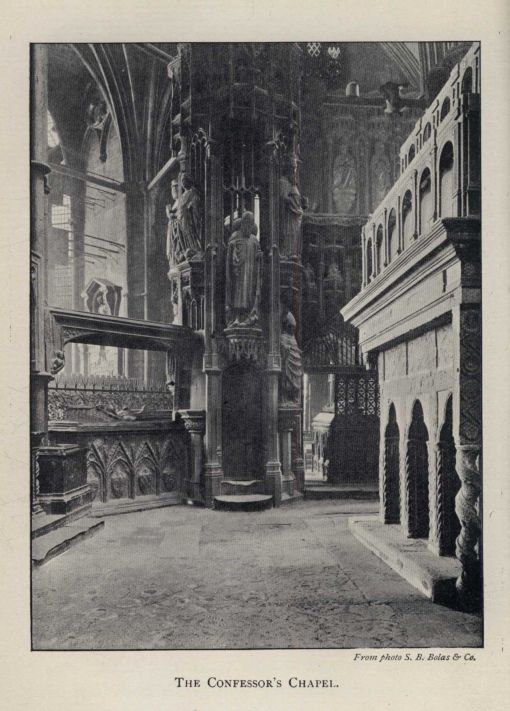
THE CONFESSOR'S CHAPEL.
The workmen had done their work right well, and we know at least the names of some of them; for Peter, the Roman citizen who wrought the mosaic, has left an inscription telling us that he finished the work in 1269; and among the Fabric Rolls of Westminster we can find accounts sent in by Robert de Beverley, mason; Brother Ralph, the convert; Alexander, the carpenter; and Adam Stretton, clerk of the works, "for the wages of masons serving before the shrine, carpenters, painters, plumbers, glaziers, inferior workmen, and workmen sent to divers places."
The tomb of the Confessor was in the middle of the shrine, set on high "as a light to the church," and was divided into three parts: the base, in the niches of which sick people were to be laid, that the Saint might heal them; the tomb itself, of soft Purbeck marble, rich with mosaic work of coloured gems and stones, and above this a shrine of pure gold set with all manner of costly jewels, sapphires, emeralds, and rubies, whilst images in gold and silver of the Virgin and the Holy Child, John the Evangelist and Peter, stood around as guardian spirits.
Much of the old magnificence has vanished; time has wrought its work, but more deadly than time have been the ravages of covetous men who longed to possess its treasure, or violent men who believed it to be little better than an idol set up in their midst.
Yet it has a mellow beauty of its own, a dignity enhanced rather than lessened by the traces everywhere apparent of its former glory, and we see in it not only an exquisite piece of work, but also that shrine which, like a magnet, drew so many of England's kings and queens to rest beneath its shadow.
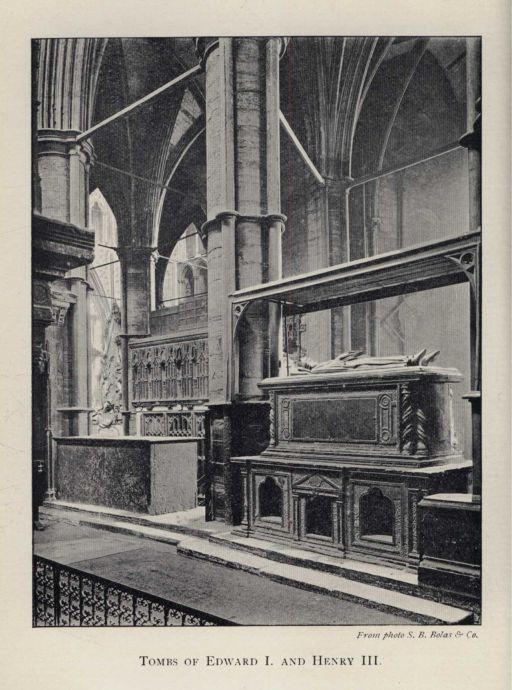
TOMBS OF EDWARD I. AND HENRY III.
CHAPTER V
WITH KINGS AND QUEENS IN EDWARD'S SHRINE
As you stand in the Confessor's shrine, you will see all around you the tombs of kings and queens, and in the next chapters I am going to tell you something of those who were thought worthy to lie in a place of such high honour.
Henry III. was not at first buried in this chapel, on which he had lavished so much thought and wealth. He died in the November of 1272, and was carried to Westminster, the Knights Templars, who had given some precious gifts to the Abbey, undertaking to provide the coffin and to pay all the expenses of the funeral, that it might be on a scale befitting one who had been so princely in his dealings with the Church and all matters concerning religion. There is something pathetic in the ending of Henry's life, for though he had reigned nearly sixty years, he had not won the love or trust of his people, and it has been truly said that "in his time England did nothing great except against him." The old king was alone when the end came, for his son Edward was away on a Crusade, and his brother, Richard, had died the year before, broken-hearted at the murder of his son Henry by a son of Simon de Montfort. But the Templars spared nothing that could make the funeral costly, so that, as the solemn procession passed along, men declared that "the king shone more magnificent dead than he had appeared when living."
He was laid before the altar, in the very place from which the coffin of Edward the Confessor had been removed, for it was considered that special virtues still hovered round that spot.
Very different must the new choir have looked, with its immense height, its delicate work, and its mysterious flying buttresses, to the low, simple choir of the Confessor's day. Round the High Altar itself was a blaze of colour, for all the mosaic work on the floor, which you still can see, was freshly brought from Rome by the Abbot Ware, who had gone there to do homage to the Pope, the monks of Westminster having refused to hold themselves subject to the Bishop of London, and it was dazzling in its richness. Quarrels between the monks of Westminster and other dignitaries seem to have occurred very often in those days, as the monks, somewhat elated at the royal favours showered upon their church, were inclined to be overbearing and to resent any authority; while once at least during Henry's reign there had been a serious fracas between the "citizens of London" and the "men of Westminster" on the occasion of some sports. For when the "men of London" seemed to be getting the mastery, the Baylif of Westminster, with some men, harnessed themselves and fell to fighting, so wounding the citizens that they resolved to be revenged. Spurred on by one Constantine Fitz-Henulfe, they issued forth without any order, fought a civil battle round Westminster, and pulled down as many houses as they could belonging to the Abbot and Baylif. Nor when Constantine was captured would he express any sorrow for his misdeeds. On the contrary, he affirmed gladly that "he had done it all, and had done much less than he ought to have done." The fact that King Henry, among other punishments, forced the citizens to pay many thousand marks for this raid, did not tend to soften down the ill-feeling which existed.
Even at Henry's funeral the dignity of the Abbot had to be asserted, for he refused to allow the Archbishop to read the service until he had signed a paper explaining that his so officiating was not to be made a precedent, or to rob the Abbot of any privileges.
So, with quarrels going on around him to the end, King Henry was buried, and the Earl of Gloucester, laying his hand on the coffin, solemnly swore fealty to "Lord Edward," the lawful heir, then far away in Palestine.
Edward I. was in a special sense a child of Westminster, for he had been born in the Palace there, and had been christened Edward after the Confessor. With all his faults, Henry was devoted to his wife and to his children, and the young Edward spent much more of his boyhood with his parents than was usual in those days. He was delicate too, and often his mother had greatly upset the old monks in the monastery at Beaulieu by going to nurse him there when he had fallen ill while on a visit. He was kept during his boyhood under her watchful eye at Westminster. Probably he was taught by one of the Westminster monks, and though we hear that he was "fonder of actions than of books," he learned to speak eloquently in French and English and to understand Latin. As he grew stronger he showed a great liking for all outdoor sports, riding, hawking, hunting, and sword exercises, and with his cousin Henry, the son of Richard of Cornwall, his young French uncles, who had taken up their abode at the Court, and the sons of Simon de Montfort, he played many a game and had many a boyish adventure round Westminster. His affection for the place never failed. Had not he watched it growing in grace and beauty, and was there a single corner of it with which he was not familiar? The deeply religious influence of King Henry, too, could not fail to leave its mark on his son, who, in spite of being his opposite in every other way, had always an intense reverence for sacred things. Henry was the dreamer, Edward the doer, but among the many fine qualities the young Prince possessed, one of the most charming was his loyalty and patience towards his father, which had never wavered, however sorely he had been tried by Henry's utter incapacity to hold the reins of government.
It was nearly two years after the death of Henry before Edward was able to reach England, and yet all had gone on quietly during the interval. The new king had been proclaimed; the assembly of prelates, knights of the shire and citizens had met, had solemnly bound themselves by the same oath as that taken by the Earl of Gloucester at Henry's funeral, and three men, the Archbishop of York, Robert Mortimer, Lord of the Welsh Marches, and Robert Burnell, all trusty friends of Edward, were appointed to carry on the government for the time being.
On August 1, 1272, Edward landed at Dover, and on August 19 he was crowned with his dearly loved wife Eleanor, who had been at his side through all the perilous years which were past. "Nothing ought to part those whom God has joined, and the way to heaven was as near from Palestine as from England," she had declared.
Great were the rejoicings in London that day, for the beautiful Eleanor had a warm place in all hearts, and of Edward all had high hopes. "In face and form he is comely. By a head and shoulders he outstrips most every man," the citizens said as they marked his white determined face, his eyes, which, though soft, could flash like fire, his hair the colour of burnished gold, and his well-knit figure straight as a dart.
And throughout his reign the nation understood Edward. His was a great simple character which appealed to them. His faults were the faults of a strong man who will not be turned aside from his purpose; his ambitions were bound up in England only. To make her a strong united kingdom was the dream of his life, and though in this cause, he fought relentlessly, alike against Llewellyn of Wales and Wallace of Scotland, he strove with equal vigour to give his people good laws, fair taxation, and just representation. "That which touches all should be approved by all," was his creed, and it was he who developed the Parliaments of Simon de Montfort, until, under his guidance, what was called the Model Parliament was assembled at Westminster in 1295. So large was this new assembly, that it was no longer an easy matter for all to sit together in the hall of Westminster Palace, and a division was made, the Barons remaining in the Palace, and the Commons, or representatives of the people, using the wonderful new Chapter-House, which formed part of Henry III.'s work in the cloisters of the Abbey. This Chapter-House was the place in which the monks, with the Abbot and all the other dignitaries of the Abbey, met once a week for conference. Here complaints were listened to, here misdeeds were inquired into, here, tied to the central pillar, those older monks who had offended were publicly flogged. It was designed for a meeting-place, with its rows of stone benches and its stall at the east end for the high officials; and what more natural than that the Abbot should offer it to the king as the place where the Parliament should assemble?
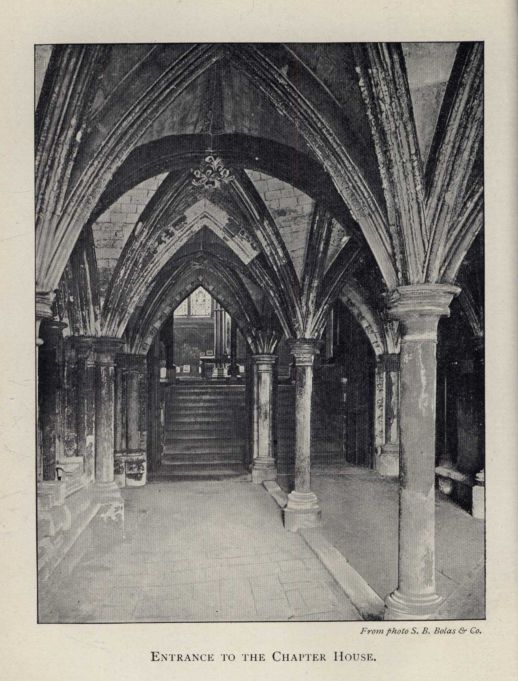
ENTRANCE TO THE CHAPTER HOUSE.
The story goes that the prudent Abbot made one condition with the offer, and stipulated that the Chapter-House, being lent to the king for the use of the Commons, the Crown should keep it in repair. No doubt the story is true, nor can we blame Abbot Wace for making the best terms he could. Can you not see the knights and the burgesses making their way up the cloisters, where the monks were working or walking, through the door, with its wealth of gold and of carving, past the graves of Chamberlain Hugelin, with his wife and daughter, Abbot Eadwyn, and the chronicler Seculdus, into that "incomparable building" which Henry had determined should be unequalled in beauty? Handsome indeed had been their old meeting-place, but this exceeded anything they had ever seen. "In the centre rose a slender pillar of grey marble, or rather a group of shafts held together by moulded bauds, from which seemed to spring the vaulted roof; the building was eight-sided, in itself a new idea; the walls were richly painted with frescoes setting forth the glories revealed to St. John in his vision of that New Jerusalem, the city not built with hands; the large windows had glass of wondrous colours; saints stood in their niches, and from within and without the Virgin Mother watched over the place."
Edward I., throughout his life, held the Abbey in great reverence, and besides carrying on his father's work and completing the choir stalls, he caused several magnificent tombs to be set up there. Always a devoted son, he resolved that the tomb of Henry III. should lack nothing in beauty; so he sent to Purbeck for the marble, to Rome for the gold and glass mosaics, and to these he added the precious stones of jasper to be brought from France, while to a certain William Torrel he entrusted the work of carving in gilt bronze the fine effigy of the dead king, which, save that it has been robbed of its jewels, is still in perfect preservation, stately in its simplicity. To this tomb the body of Henry was removed; only his heart, as he had himself desired, was carried to the Abbey of Fontrevault in France, there to be placed near to where his mother, his uncle, Richard Coeur de Lion, and others of his race lay buried.
In the same year the greatest blow of his life fell on Edward, for after thirty-five years of the happiest married life, Queen Eleanor, "the good merciful lady beloved of all the English," died of slow fever near Lincoln.
"I loved her with a great love while she lived; I cannot cease to love her while she is no more," said Edward. And his people loved him all the more for his deep grief. He came straight away from his journey to Scotland, to follow that sad funeral procession which slowly made its way to Westminster, and at each place where they paused to rest, he caused a cross to be erected to the memory of the "Chère Reine," one of which, as you know, stood close to Charing Cross station. She was buried in King Edward's Chapel at the feet of Henry III., and once more the skilful hands of William Torrel, "goldsmith and citizen of London," fashioned in gilt copper a wonderfully wrought figure, "the finest in any country" a great authority has declared, which shows us a sweet strong face at peace with God, a sleeping form, queenly and beautiful. Another English workman, Master Thomas of Leghton, made the screen of wrought-iron which protects this monument, round which run the words—
"Ici Gost Alinor, jadis Reine de Engleterre
Femme Al Rey Edward, Fiz le Rey Henri
E Fille Al Rey de Espagne, Contesse de Puntiff
Del Alme de li Dieu pur sa pitié eyt merci.
Amen."
"The king, who loved her well, as she deserved, gave to the monastery seven or eight manors, to the yearly value of two hundred pounds, for religious services, and for an anniversary to be performed for her, and for wax tapers to be kept burning on her tomb both day and night."
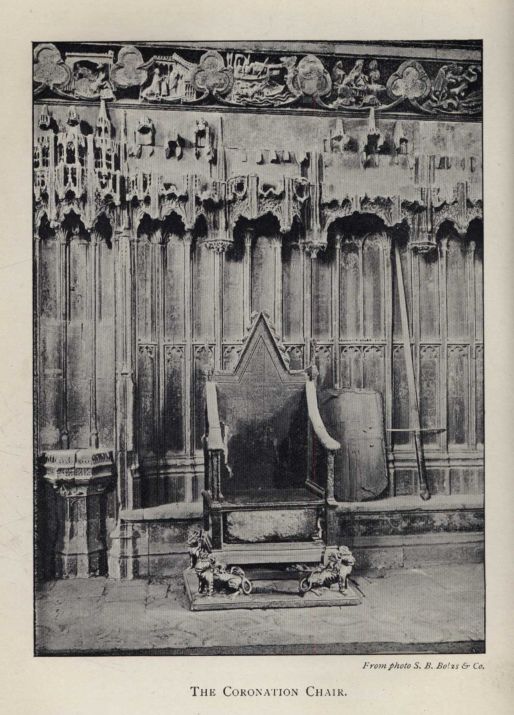
THE CORONATION CHAIR.
It being in the chapel of the Confessor that she who was dearer than all else was laid, he brought here, as if to lay it at her feet, his greatest trophy wrested from the Scots, the famous stone of Scone, on which so many kings of Scotland had been crowned. This was put at his command into a chair by a certain Walter of Durham, who was paid one hundred shillings for his work, with an extra sum of about £2, 12s. for carving, painting, and gilding two small leopards, for the wages of carpenters and painters, and for colours and gold employed.
When you look at this chair, remember that on it every sovereign of England has been crowned from the reign of Edward II.
Another trophy had been offered to the shrine of the Confessor a few years before, and that was the golden crown of the conquered Welsh Prince Llewellyn. The offering had been solemnly made by Edward's own little son, Alphonso, a boy of twelve, who, dressed from head to foot in chain-armour, and wearing a long cloak, followed by nobles and knights, had laid it down at the feet of the blessed King Edward, the jewels thereof being applied to adorn the tomb. In the same year the little prince died, and was buried in this chapel of the kings.
More than one great disturbance agitated the Abbey during the later years of Edward's reign. First a fire, which began in the Palace, spread rapidly and caused much damage to parts of the building; then there were several quarrels with some of the Begging Friars, a new Order which was highly disapproved of by the regular monks, for those begging orders got a great reputation among the people, and likewise were in high favour with the Court of Rome. But worst of all, a terrible scandal arose, which ended in forty of the Westminster monks being thrown into prison.
King Edward, when he went to Scotland, left all his jewels and treasures, with a sum of money, amounting all told to the value of £100,000, in the care of the Abbot, who carefully put away most of this charge in the strongly made Chapel of the Pyx, and the rest in the Refectory. In the April of 1303 a great quantity of treasure was stolen, and the king, very wroth, ordered a strict investigation to be made, which ended in the discovery that a certain small merchant or pedlar, named Roger Podlicote, had got into the Abbey during the night on several occasions, and had carried away his booty in bags. That he could have got in unaided was impossible; he must have had accomplices within the Abbey. Besides, the Sacrist was found with a gold cup, which he said he had picked up outside St. Margaret's Church. William the Palmer, keeper of the Palace, declared he had noticed the Sacrist, the sub-Prior, and many of the monks, coming and going unusually often, carrying bags and hampers; while John Abbas, a workman, told how Alexander the monk had caused him to make tools of a special design, threatening to kill him if he spoke aught of this.
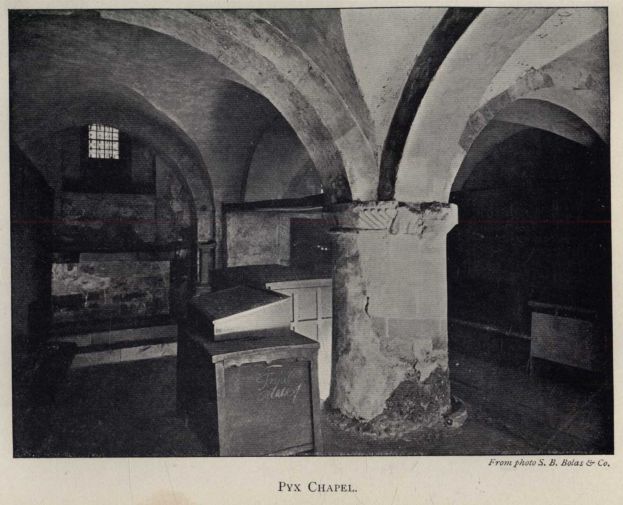
PYX CHAPEL.
Podlicote, a most adventurous spirit, made a full confession, in which he generously took all the blame upon himself, saying he knew the ways of the Abbey and where the treasury was; and being poor, he had thought how easily he could obtain the goods which were in the Refectory, which he had seen. But considering that this wholesale robbery went on for many months, it is impossible to believe that Master Podlicote's nightly visits to the Abbey through a window in the Chapter-House were quite unknown to the monks, and no one had much pity for them when they were committed to the Tower for two years. Still it was a great disgrace to fall on a monastery which held its head so high; besides, to quote Widmore, "it was a peculiar baseness to wrong a prince who had been so kind to their house, had readily renewed their charters, had improved some of them, and had been very bountiful in giving them lands of great value."
One action taken by the Abbot at this time, however, greatly pleased both the king and the people. For a certain brave knight, John de St. John, governor for Edward in Aquitaine, having been decoyed and taken prisoner by the French, and being too poor to pay the large ransom they demanded, was presented with a generous offering by Abbot Wenlock, "a commendable and charitable thing of public service," comments an old writer, "seeing that monasteries did not always lay out their money so well as for the liberty of a person in high command, a gallant man whom, while fighting valiantly for his prince, the chances of war had made prisoner." Edward's eventful reign was drawing to a close; already he was the oldest king who had ruled England, and his life had been a hard one. He had never spared himself in mind or body; he had never wavered in his great aims; and his favourite motto, Pactum serva, "Keep troth," words he had desired should be carved upon his tomb, was the motto to which he had consistently been faithful. And yet over these closing years a dark cloud hung, for his son, young Edward, showed no signs of rising to his great responsibilities. Tall and handsome to behold, he was weak, changeable, and careless, given to gambling and low society, a tool in the hands of first one and then another of his worthless friends. The old king knew all too well how useless it was to dream that his son would carry on the work to which he had devoted himself, but the knowledge was a veritable cup of bitterness. He had always sought to inspire him with high thoughts, great enthusiasms, and now, as the end loomed on the horizon, he made one more effort, and appealed to the deepest feelings of the young prince. At the festival of Whitsuntide in Westminster Abbey, he admitted his son, with many other young nobles, to the order of knighthood, and throughout one long night the Prince of Wales kept his vigil before the altar at the shrine of the Confessor. Then at the royal banquet which followed, Edward, though so weak he could barely stand, swore solemnly to march at once to Scotland to crush the rebellion which had broken out afresh when all seemed peaceful, and to avenge the death of Comyn, who had been murdered in the church at Dumfries by Robert Bruce. The Scotsmen had not kept troth, and the king was fierce with indignation. But to this vow Edward added another, which was made also by the prince and all the newly dubbed knights in the ball at Westminster; they pledged themselves that so soon as Robert Bruce was conquered, they would no more bear arms against Christendom, but would go to the Holy Land and conquer the infidel, or die in the attempt to do so.
Without delay, king and army set off for Scotland, but the great triumph for which he had longed was not to be his. His spirit was as strong as ever, only his body failed him. He struggled bravely on, then came a day when he could only ride two miles, and at last he had to own that he was face to face with an enemy before whom even his strong will lay powerless. Near Carlisle he died, knight and warrior to the end. He entreated his son to tear himself away from his favourites, and to set before himself the conquest of Scotland and the recovery of the Holy Land, and he asked that his bones might be carried about with the army till Scotland was subdued, that his heart might go with the knights to the Holy Land. Then with a prayer for mercy on his lips he passed away.
Edward II. had not even the grace to carry out one of these dying requests. Four months later Edward was buried in the Confessor's Chapel near to his father, his brother, and his wife, while to his memory was raised only the plainest tomb, in striking contrast to the beautiful monuments around it. The new king scattered his money among his favourites with too free a hand to have anything to spare for the building of a costly tomb.
Yet, after all, as you stand by the grave of this "greatest of the Plantagenets," and look at the simple unornamented monument, I think you will feel with me that in its very simplicity and strength it is unconsciously a truthful memorial of Edward, a striking description of those qualities which in life he loved and strove after. He was a man of action, not of words; a soldier, not a saint; a statesman, not a dreamer. For Edward the Confessor there was a beautiful shrine, the delicate work, the gold, the jewels, the angels, and the martyrs. For Edward the First there was the uncarved block of grey marble, and the blunt inscription—
"Here lies Edward the First, the Scourge of Scotland. Keep troth."
CHAPTER VI
EDWARD III. AND QUEEN PHILIPPA
"The character of the reigning Prince, King Edward II., will not give leave to expect anything of great service to this place," wrote grimly a chronicler of the Abbey. Indeed, beyond the fact that he was crowned here, that a riot nearly took place at the coronation, so angered were the people at Piers Gaveston being given the place of honour and allowed to carry the crown, in defiance of the old king's last request, and that he made an offering of two images to the shrine of the Confessor, there is nothing to tell of Edward's reign in connection with Westminster Abbey.
The country bore with the king for nearly twenty years. Then the Parliament assembled at Westminster asserted itself. The king, all were agreed, had shown himself unfit to rule; he had violated his coronation oath, he had oppressed his people, and had lost Scotland. It was only right, therefore, that he should be deposed, and his son, a boy of great promise, be chosen in his stead. Out of that great assembly only four voices were raised for the king, and a deputation was sent to him telling him what his Parliament had resolved to do. To his honour, the young Prince Edward refused to accept the crown unless with his father's consent, but Edward II., "clad in a plain black gown," submitted without a word to the decree of the assembly, and listened unmoved as they told him how they "rendered and gave back to him, once king of England, their homage and fealty, counting him henceforth as a private person, without any manner of royal dignity."
So Edward III. was crowned on the 29th of January 1327, and the shield with the sword of state, Scottish trophies of his grandfather's which were carried before him, are the identical shield and sword which exist to-day.
Only fourteen years old when he was crowned king, young Edward had already impressed all those who came in contact with him. Men saw in him a worthy successor of Edward I., whose great qualities stood out in shining contrast after the second Edward's disastrous reign. He was strong, he was brave; he, like his grandfather, passionately loved justice and passionately loved England. Nothing could have been more unfortunate than his boyhood or his early education. For neither his father nor his mother could he feel the smallest respect, and the influences about the Court were of the worst. A weaker character would have been swamped by circumstances, and would have sunk to the level of its surroundings; Edward fought his way through, and came out triumphantly on the other side. When he was sixteen he married Philippa of Hainault, and a year later a son was born to them. The delight of the nation was intense; Edward was deeply touched at the signs of affection everywhere shown to him by his subjects, and he resolved all the more earnestly, with the growing strength of his young manhood, to be a king indeed, to rule his people justly, to lead them wisely, to live up to the great things expected of him. England in those days was a young nation, just beginning to feel its power, rejoicing in its strength and its freedom, ready for action, for adventure, for enterprise, and Edward represented in the highest degree all these enthusiasms and aspirations. He was able to lead; he grasped the spirit of his people; king and nation were at one in their aims, so that into the years which followed were crowded great deeds and great victories, victories made all the more honourable by the chivalrous conduct of the conquerors.
I should like to linger over the stories of Edward and his men-at-arms, the knights, the hobblers, and the archers, who won such fame for England on foreign battle-fields, but that would be to wander far away from Westminster, so we must leave Crecy, Calais, and Poitiers, and come back to the Abbey and the Monastery, this little world of itself, where life went on in its own way, regardless of wars in Scotland and France.
As usual, there were several disputes in progress, and one between the Abbot and the king's treasurer ended in a lawsuit which lasted both beyond the Abbot's and treasurer's time. The quarrel was as to who had the right to visit the Hospital of St. James, a hospital founded and endowed by some citizens of London for fourteen leprous maids, on the ground where now St. James's Palace stands. No fewer than six chaplains were attached to this hospital, to perform divine service for the afflicted fourteen lepers, and as the building stood within the parish, the Abbot declared that these chaplains were under his authority. To this the king's treasurer would not agree, and hence the dispute. Apparently at last the verdict was given in favour of the Abbot, but the original Abbot and treasurer being dead, and the new Abbot being indolent, while the new treasurer was grasping, it ended in an actual victory for the latter.
Another quarrel centred round the little chapel of St. Stephen's, which had been founded by Edward I. within the Palace at Westminster, and so liberally endowed by Edward III. that it possessed its own dean and canons.
In this chapel masses were said daily for past and present kings, while altogether nearly forty priests were attached to the foundation, all of whom lived in the Palace. Quite naturally the Abbot of Westminster was not well pleased at this rich foundation within a stone's throw of his Abbey, and insisted that it should be placed under his jurisdiction, a claim which was warmly supported by the Pope. But in this "the people of St. Stephen's," who had the Court on their side, did not acquiesce; and at last the king, who was not greatly interested in these matters, proposed a compromise, which was accepted. The Abbot was to have the right of appointing the dean, and was to be paid a yearly sum of money as a tribute to his authority; while, on the other hand, the dean and canons were to order their own services and control their own affairs.
This chapel of St. Stephen's was very beautiful, more beautiful, we are told, than St. George's Chapel at Windsor. But no traces remain of it or of its cloisters and its chantry except the crypt. In the reign of Henry VIII. Westminster Palace was seriously destroyed by fire, and the chapel was then altered, turned from its original use, and given over to the House of Commons as their Parliament House, another link, you see, between the Palace, the Church, and the People.
In the year 1349 the Black Death, that most terrible plague, swept over England, killing nearly one half of the people; fifty thousand of its victims were buried in London, and the Abbey was not spared, for the Abbot and twenty-six of the monks caught it and died. They were buried in one grave in the south cloister, covered by a large stone, which you will easily find, although it has a wrong name, that of Gervase de Blois, carved upon it; and that vast stone, says Dean Stanley, "is the footmark left in the Abbey by the greatest plague which ever swept over Europe."
Abbot Bircheston, who thus died, had not been very satisfactory. "It is well of this place that he continued no longer," says the chronicler severely; "for he ran the house into a great deal of debt, being himself extravagant and his relations being wasteful people." His successor was that remarkable man Simon Langham, the only Abbot of Westminster who ever became Archbishop of Canterbury, and he did such great things for the monastery that he won for himself the name of the second founder. Not only did he pay off the debts of his predecessors, but he managed with great prudence all the estates and revenues under his care, saved large sums of money by his frugality, and, perhaps most difficult task of all, brought the house once more into excellent discipline. This is what Plete, himself a monk at Westminster, has to say of Abbot Langham: "He rectified many abuses which had crept in, truly a service as it is most useful to any place, so commonly is it the most difficult also; and accordingly it cost him a great deal of study, pains, and resolution to effect it, as having many ill tempers to deal with, some being indolent, others odd and particular, some extravagant, and others perverse."
While he was Archbishop, and afterwards when made a cardinal and living abroad, he never forgot the Abbey where he had been educated and where he had laid the foundation of his great career, but left to it a sum equal to £200,000 to be spent on building, and desired that he should be buried there. So you will find his tomb of marble and alabaster in the little chapel of St. Benedict at the entrance to the south ambulatory, the first monument of any importance set up to the memory of a bishop or abbot.
He was followed by the Prior, Nicholas Litlington, "a stirring person, very useful to the monastery," whose mind was set on improving the buildings. This was an easy task enough, thanks to the legacy of Langham and the good favour in which he stood with king and queen. So at once he set to work, the monastery being the object of his care. He built the south and west cloisters, setting his initials on the roof; the Abbot's Palace, the College Hall, the Jerusalem Chamber, houses for the bailiff, the cellarer, the infirmaries, and the sacrist, a malt-house and a water-mill; and besides this he presented the Abbey with much valuable plate and many rich vestments.
"But," remarks an old writer severely, "as he was enabled to do all this with the money left by his predecessor Langham, he should have put some memorial of the Cardinal upon the buildings. Instead, he has his own arms and the initial letters of his name on the keystone of the cloister arches."
The Abbot's house built by Litlington is the present Deanery; but the College Hall, once the Abbot's refectory, now the dining-hall of the Westminster scholars, and the Jerusalem Chamber, the room into which the Abbot's guests used to pass when they had dined, are open to the public at certain hours, and you must not forget them when you are walking through the cloisters. The Jerusalem Chamber has been restored since the days of Litlington, though the fine roof and the actual building stand now as then. The glass in one of the windows, however, is very old, as is the wonderful stone reredos, which once must have been part of the high altar. In the dining-hall you must notice the gallery at the one end in which the minstrels used to perform, and the fine pointed windows; for as the Norman architecture had given way to the Early English, and the Early English had developed into the beautiful Decorated style, so now another change was taking place, of which Litlington's building is an early example, and the Perpendicular style, which was entirely English, was creeping in.
While Litlington was abbot, another royal funeral took place in the Confessor's Chapel, for in 1369, "that moost gentyll, moost lyberall, and moost courtesse fayre lady, Phillipp of Heynault, died."
This is how a writer living at the time quaintly describes the sad event: "There fell in England a heavy case and a comon, righte pyteouse for the King, his children and all his realme. For the good Queen of England fell sicke, the which sickenesse contynewed on her so longe, that there was no remedye but deathe. And the good lady whenne she this knewe and perceyved, desyred to speke with the Kynge, her husbande. And she sayde, 'Sir, we have in peace, ioye, and great prosperyte, used all our time toguyer. Sir, nowe I pray you at our departyng, that ye will grant me my desyres.... I requyre you, that it may please you to take none other sepulture whensoever it shall please God to call you out of this transytorie lyfe, but besyde me in Westmynster.'
"The Kynge all weepynge sayde, 'Madam, I graunt all your desyre.' Then the good ladye made on her the sign of the Cross, and anone after she yielded up her spiryte, the which I beleeve surely the Holy Angels receyved with great ioy up to Heven, for, in all her lyfe, she dyd neyther in thought nor dede, thynge whereby to lose her soule, so farr as any creature coulde knowe."
Her tomb was ordered to be made of "neat black marble, with her image thereon in polished alabaster, and round the pedestal, sweetly carved niches, with images therein." But what makes this monument specially interesting is that the figure of Queen Philippa is really a likeness and not a beautiful fancy picture, so that as you look at that kind, motherly face you can quite easily picture to yourself the queen who pleaded for the lives of the citizens of Calais, and of whom it was said at her death, "She had done many good deeds in her lyfe; having succoured so many knyghts and comforted ladyes and damosels."
Eight years later, King Edward was laid beside her, all the glory of his life having passed from him with her.
"In his time, England had seemed to shine in her meridian; learning was encouraged; gallantry, and that the most honourable, was practised; the subjects were beloved; the king was honoured at home and feared abroad." But after Philippa's death strength of mind and body alike failed him; his favourite son, the Black Prince, had died; his other sons neglected him, his courtiers robbed him, and when the end came, there was only a poor priest by his bedside, who pressed the crucifix to his lips and caught his last dying word—Jesus.
His funeral, however, was magnificent; he was carried through London with his face uncovered, followed by his children and by the nobles and prelates of England, and afterwards a fine tomb was set up to him with figures of his twelve children kneeling around.
But it was only round the tomb and in the sculptor's fancy that those strong, high-spirited sons of Edward and Philippa knelt in one accord, for from them arose the quarrels and strife which later on brought to England the greatest calamity which can come to any nation—a civil war in its midst.
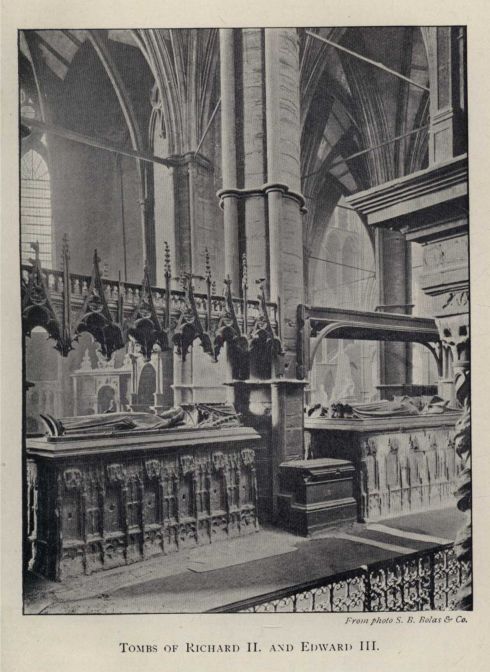
TOMBS OF RICHARD II. AND EDWARD III.
CHAPTER VII
RICHARD II. AND QUEEN ANNE
Edward the Black Prince, that flower of English chivalry, had left his little son Richard as his legacy to the people who loved him so well.
"I commend to you my son," he said, as he lay dying in Westminster Palace, "for he is but young and small. And I pray that as you have served me, so from your heart you will serve him."
One year afterwards, this boy of eleven was crowned in Westminster, and so "young and small" was he that the long day with all its wearying ceremony was too much for him; he fainted away, and had to be carried from the Abbey to the Palace on a litter.
Never before had there been a coronation on so magnificent a scale: the citizens of London, with their good wives and daughters, were learning to enjoy pageants and holidays, and it was now better than half a century since a king had been crowned. First Richard had spent some days in the Tower, that great fort of the capital, and then had come the wonderful procession through Cheapside, Fleet Street, and the Strand, the boy riding bareheaded, surrounded by a band of young knights in new attire, forerunners of the knightly Order of the Bath, winning all hearts by his beautiful face and his lavish generosity. For the young king was from the first recklessly extravagant, and while he with his nobles feasted in the Palace at the coronation banquet, he caused the fountains outside to pour forth wine in abundance, that all who would might drink to their heart's desire.
John of Gaunt, his uncle, one of those many sons of Edward III., was made Regent, and Richard, with the approbation of all, was placed under the tutorship of that accomplished knight, Guiscard d'Angle, Earl of Huntingdon, to be instructed in the paths of virtue and honour.
But those were not peaceful days in England, and John of Gaunt made the fatal mistake of defying the knights of the shire and burgesses who composed the House of Commons, and who really represented the thoughts and feelings of the people.
"What do these base and ignoble knights attempt?" he asked contemptuously. "Do they think they be kings or princes in the land?"
Nevertheless, in the end he was forced to flee from England, so bitter was the feeling against him. The cause of the universal discontent was the heavy taxation, the result of the long French wars, and the Bishop of Rochester, in his sermon at the coronation, had boldly touched on this with words of solemn warning. For the first time the great peasant population of England, who had hitherto suffered in resentful silence, was in a position to lift up a voice of protest, as the Black Death had so ravaged the country that those labourers who were left were able to make terms for themselves, and to refuse to work without payment. The tax which brought the discontent to a crowning point was the poll-tax, which was a tax of twelve pence (about eighteen shillings) to be paid by every person over fifteen; and when a certain Wat the Tiler killed a tax-collector, who, not content with trying to force him into paying this poll-tax, insulted his little daughter, the men of Kent rallied in their thousands round Wat and marched on London. Richard was now only fifteen, but he was at his best, full of courage, full of strength, worthy grandson of Edward III., true son of Edward the Black Prince. He determined to ride out with a small escort and meet these thousands of rebels face to face. It was a bold stroke, and he knew the risk. But he would not be stayed. There is a story, most probably true, that he consulted the aged Anchorite of the Abbey, for every monastery of importance had its Anchorite, a monk who voluntarily set himself apart for the rest of his life to live in one cell, praying for the house; and more than one of the Anchorites of Westminster had given counsel to the kings who sought them out, the words of these holy men being held as sacred. Certain it is that, on the morning of this eventful day, he, with his escort, heard mass in the Abbey, paid his devotions, and made his offerings at King Edward's shrine, "in which," says an old writer, "the kings of England have great faith." Then he rode out to Smithfield.
"Here is the king," said Wat Tiler to his men. "I will go speak with him. When I give you a sign, step forward and kill every one except the king. Hurt him not, for he is young and we can do what we will with him. We will lead him with us about all England, so shall we be lords of the kingdom without a doubt."
But in a few minutes, as you know, the scene had changed. Wat Tiler lay dead, and the boy king, ordering that not one of his attendants should follow him, rode forward into the midst of the excited crowd, and said calmly, "Sirs, what aileth you? I will be your leader and captain. I am your king."
The men were Englishmen, and this cool courage won their hearts on the spot. They crowded round the king begging for pardon, which he granted to them at once, forbidding his followers to strike a blow. And so the great rebellion ended.
As he rode back to London, Richard stopped to reassure his mother.
"Rejoice and thank God, madam," he said, kissing her, "for I have this day regained my inheritance and the kingdom which I had lost."
If only the king had been true to the promise of his boyhood, he might have ranked among the greatest of our rulers. As it was, he went on his way unchecked, uncontrolled, till one after another his good points sank into the background; cowardice took the place of courage, cruelty of chivalry, and he who had said confidently to his people, "I will be your leader and your captain," proved himself to be utterly incapable and helpless.
A year later Richard married Princess Anne of Bohemia, the sister of that "good King Wencelaus," about whom was written the Christmas Carol you know so well, and on their wedding day there were great feastings at Westminster. All the city guilds and companies, splendidly arrayed, came out to do honour to the rosy-cheeked and smiling girl queen, herself only sixteen; and when at his coronation she entreated the king as a favour to set free all prisoners in the country, the delighted citizens gave her the name of "Our Good Queen Anne."
The young king spent much of his time in his Palace of Westminster, and as you look to-day at Westminster Hall, the only part of the fine building which stands, I want you to try and imagine all the busy life which centred there round the court and the church. Everything connected with Richard was done on a magnificent scale. He had a body-guard of four thousand archers; he had a band of nearly four hundred workmen—carpenters, jewellers, armourers, masons, tilers, furriers—whose duty it was to work everything needed for the king's service, and these, with their wives and children, lived under the shadow of Westminster. Then there were all the servants connected with the royal kitchen, the pantry, spicery, buttery, bakehouse, and brewery, and there must have been a goodly number of these, for a writer who belonged to the court tells us that every day ten thousand folk that "followed the Hous" drew their rations of food from the Palace.
Besides all these we must count the higher court officials, the members of the royal household, the judges who sat in Westminster Hall, the priests of St. Stephen's Chapel, the bishops and abbots and nobles with all their retinues, and then we may have some idea of the bustle and life round Westminster Palace at a time when there was "greate pride, and riche arraye, and all things much more costious and more precious than was before or sith."
Look at Old Palace Yard and New Palace Yard, with the dull old streets leading out of them, and then imagine Richard's Palace, with its towers, its posterns, its great halls and painted chambers, its cloisters, its courts, and its galleries; "gabled houses with carved timber and plastered fronts, cloisters which glowed in the sunshine with their lace like tracery, with the gold and crimson of their painted roofs and walls; everywhere tourelles with rich carvings, windows of tracery most beautiful, archways, gates, battlements; chantry chapels, oratories, courts of justice, and interiors bright with splendid tapestry, the colours of which had not yet faded, with canopies of scarlet and gold, and the sunlight reflected from many a shining helm and breastplate, from many a jewelled hilt and golden scabbard." Would that the Great Fire which destroyed all this had left us one little glimpse of its old splendour.
Inside the monastery, too, there was plenty of life of a different sort, though the monks were by no means cut off from the great world which lay at their door. For the Abbey of St. Peter was the richest of all the great houses, and was now at the height of its glory; and Litlington's new buildings greatly added to its importance, as the Abbot freely entertained in his new palace the highest in the land.
Yet a daily routine was carried out. Eight hours were given to sleep and eight were spent in church; the remainder were devoted to work—that is to say, some monks taught the young, others studied and transcribed, others had duties in the refectory and dormitory, and so on. Most of the monks had come here as young boys; many of them spent here fifty and sixty years of their lives, praying, working, teaching, learning. But I think sometimes the young men must have longed for some share in the life outside of which they heard the echoes daily, and saw all the outward splendours and delights.
Certain it is that Abbot Litlington was something more than a monk. For when, during the reign of Richard, there was a great scare that the French were about to invade England, he, though at that time seventy, armed himself and set off with some of his monks to the coast to defend his country. And we find that "one of these monks, Brother John, supposing his courage equal to his stature, was a very proper person for a soldier, being one of the largest men in the kingdom. His armour, the invasion not taking place, was carried into London to be sold, being so big that no person could be found of a size that it would fit."
One other part of vanished Westminster comes into prominence in this reign, and that is its Sanctuary, which stood where now is Westminster Hospital. It was a massive square keep built of stone, each side nearly eighty feet long, with a heavy oak and iron door, stone stairs, strong dark rooms and thick walls, and besides a belfry tower, in which hung those bells which rang for coronations and tolled for royal funerals; it contained two chapels. This place was the haven of refuge alike to innocent and to guilty; so long as they remained within its walls the Church protected them and kept them. Of course, originally these sanctuaries attached to the religious houses had been intended to protect the weak, the helpless, and the oppressed, but gradually all manner of men, thieves, debtors, and law-breakers, gathered round it, and at Westminster, where all the Abbey buildings were counted as sacred ground, strange and lawless crowds assembled; but the right of sanctuary was jealously guarded.
Outside the world of Westminster the country was full of discontent, which showed itself in parties and in plots. John of Gaunt had fled, and his place had been filled by his brother, Thomas Woodstock, Duke of Gloucester, who, with Gaunt's son, Henry of Bolingbroke, and other nobles, had forced Richard, still a minor, into accepting several of their demands. But directly he was of age Richard had his revenge; and in the Council Chamber he made it clear that he intended to keep all the authority in his own hands or in the hands of those he himself should choose. Francis, a scribe, and the lame Clerk to the Council, has left us a vivid picture of the scene.
"Then Richard stood in the doorway; upon his head he wore a crown; in his hand he carried his sceptre; on his shoulders hung a mantle of ermine, and through the door I saw a throng of armed men, and heard the clank of steel.
"Since the time of David there had not been a more comely prince in the world to look upon than King Richard.... Yet let no one say that his eyes were soft. This morning they were like the eyes of a falcon.
"'Good, my lord,' began the Duke of Gloucester.
"The King strode across the room and took his seat upon the throne.
"'Fair uncle,' he said, 'tell me how old I am.'
"'Your Highness,' said the Duke, 'is now in his twenty-fourth year.'
"'Say you so? Then, fair uncle, I am old enough to manage mine own affairs.'
"So saying, he took the Great Seal from the Archbishop, and the keys of the Exchequer from the Bishop of Hereford. From the Duke of Gloucester he took his office, he appointed new judges, he created a new council. 'Twas a gallant prince. Alas! that he was not always strong; twice in his life Richard was strong—that day and another. That night there was high revelry in the Palace: the mummers and the minstrels and the music made the Court merry. And the king's fool made the courtiers laugh when he jested about the Duke's amazement and the Archbishop's discomfiture."
Richard now fell entirely under the influence of his own favourites, and the friction between himself and his Parliament increased each year. The one good influence in his life was that of Queen Anne; over and over again her sound sense saved the situation. Once Richard, in a fit of sulkiness, had gone to live at Bristol, very privately, and to him there came the Archbishop of Canterbury, who warned him that unless he returned to London the citizens of London and the greater part of his subjects would be very discontented. Richard at first refused to pay any attention to the Archbishop, but at last the good advice of the queen prevailed; he controlled his anger and said he would cheerfully go to London. On his arrival there, a special Parliament was summoned, which made London and Westminster very crowded; the king heard Mass with the crown on his head in the chapel of the Palace; the Archbishop of Canterbury performed the divine service, and was very attentively heard, for he was an excellent preacher; and then came the barons, prelates, and nobles to Richard, with joined hands, as showing themselves to be vassals, swearing faith and loyalty, and kissing him on the mouth.
"But it was visible," adds Froissart, "that the king kissed some heartily and others not."
Possibly, if Anne had lived, her sensible influence might have saved Richard, in spite of the growing irritation of his people at his reckless extravagance. But after only a few hours' illness the queen died at the Feast of Whitsuntide 1394, in Sheen Palace, "to the infinite distress of King Richard, who was deeply afflicted at her death."
Richard was with her when she died, and so uncontrolled was his grief, that, cursing the place of her death, he ordered the Palace of Sheen to be levelled to the ground. He determined that hers should be the greatest burial ever seen in London, and sent to Flanders for large quantities of wax wherewith to have made the torches and flambeaux, though this delayed the funeral by some months. He summoned all the nobles of the land to be present in these words:—
"Inasmuch as our beloved companion the Queen, whom God has hence commanded, will be buried at Westminster on Monday, the 3rd of August next, we earnestly entreat that you, setting aside all excuses, will repair to our city of London the Wednesday previous to the same day, bringing with you our very dear kinswoman your consort at the same time. We desire that you will, the preceding day, accompany the corpse of our dear consort from our manor of Sheen to Westminster, and for this we trust we may rely on you, as you desire our honour and that of our kingdom."
So a great procession followed the queen from Sheen to Westminster, and all were clothed in black, men and women, with black hoods also. Richard behaved as one mad with grief, and when the Earl of Arundel arrived late, he seized a cane, and struck him on the head with such force that the unfortunate nobleman fell to the ground.
A year later the king ordered the beautiful monument which you see in the Confessor's Chapel, and so great was his devotion that he had his own monument made at the same time, with his hand clasped in that of his dearly loved queen. And the touching inscription, of which this is a translation, was of his own choosing:—
"Under this stone lies Anne, here entombed,
Wedded in this world's life to the second Richard.
To Christ were her meek virtues devoted,
His poor she freely fed from her treasures.
Strife she healed and feuds she appeased.
Beauteous her form, her face surpassing fair.
Only July's seventh day, thirteen hundred, ninety four,
All comfort was bereft, for through irremediable sickness
She passed away into eternal joys."
In spite of his grief, which was very real, Richard married again; but the new queen had no influence with him, and the breach between him and his people widened daily. "Nothing but complaints were heard; the courts of justice were closed; the enmities increased, and the common people said, 'Times are sadly changed; we have a good-for-nothing king, who only attends to his idle pleasures, and so that his inclinations are gratified cares not how public affairs are managed. We must look for a remedy, or our enemies and well-wishers will rejoice.'"
So writes Froissart, who lived in England at the time; and he goes on to say how the people declared to one another, "Our ancestors in former days provided a remedy; our remedy is in Henry of Lancaster. Him we must send for and appoint him regent of the kingdom. For these people are most obstinate, and of all England, the Londoners are the leaders."
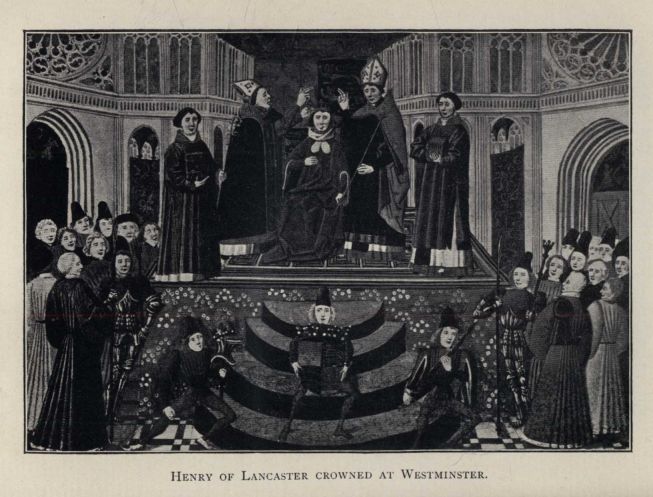
HENRY OF LANCASTER CROWNED AT WESTMINSTER.
This being the feeling in the country, the time was ripe for John of Gaunt's banished son, Henry Bolingbroke, who had long been waiting for his hour. He landed with but thirty men, while Richard was away on one of his highly unpopular expeditions in Ireland; soon he had an army of fifty thousand with which he marched to London, and Richard when he returned agreed meekly, without a word, to all that was demanded. He signed a deed prepared by Parliament in which he said that "he was incapable of reigning, worthy to be deposed, and willing to renounce the throne."
"If it pleases you, it pleases me also," was his feeble remark.
Then he was put into prison, first in the Tower, afterwards in Pontefract Castle, and from this last place he never came out alive. His death was very sudden; some said he fell sick, some said he was starved, almost certainly he was murdered. He was buried at Langley, though many a long year afterwards his body was moved to Westminster by command of Henry V., and laid in the tomb he had chosen close to his wife, after it had been carried through London followed by 20,000 persons, of whom "some on him had pity and some none."
So husband and wife lie united at last under this fine tomb, which cost £10,000 in our money. But in one detail Richard's wish is ungratified to-day, for his hand and hers, which on the monument were clasped together, have been ruthlessly broken off.
Another memorial of Richard in the Abbey is his portrait, which you will find in the choir near the altar, and which is "an ancient painting of the unhappy, beautiful prince, sitting in a chair of gold dressed in a vest of green, flowered with flowers of gold and the initial letters of his name, having on shoes of gold powdered with pearls, the whole robed in crimson lined with ermine, and the shoes spread with the same fastened under a collar of gold." It is valuable because it is the first portrait we have of an English king.
Richard rebuilt Westminster Hall, and built a fine porch called Solomon's Porch, where now stands the great north entrance; but of this porch not a trace remains.
CHAPTER VIII
HENRY V. AND HIS CHANTRY
On the last day of September 1399, Westminster was well astir, for Parliament had met to decide an all-important question.
Richard had renounced the crown, and his cousin, Henry of Lancaster, claimed it.
"Risyng from his place, mekeley makyne the signe of the Crosse, he saide unto the people, 'In the name of the Father, Son, and Holy Ghost, I, Henry of Lancaster, claim the realme of Englande and the crowne, as that I am dyscended by righte lyne of bloode from that good Lord King Henry III." Moreover, he proceeded to make clear, Richard had resigned the crown into his hands, and he had also won it by right of conquest.
Then the Archbishop asked the assembly if they would have Henry for king, to which with one voice they answered "Ye, ye, ye," and after that the Archbishop led Henry to the king's throne and set him thereon with great reverence, making to him a long "oryson" from the words, "When I was a child, I spake as a child; but at the time when I came unto the state of a man, I put away childish things."
"A chylde," he said, "will lyghtly promise and as lyghtly brake his promise, doing all thinges that his fancye giveth him unto, and forgettinge lyghtly what he hath done. By which reason it followyth that great inconvenyence must fall to that people a chylde is ruler and governour of. But now we ought all to rejoyse that a man and not a chylde shall have lordeshype over us, a man that shall govern the people by skylful doyngs, settyne apart wylfulnesse and all pleasure of himself."
And the people answered "Amen" with great gladness; they clapped their hands for joy and did homage to the new king, while the coronation was fixed for the 13th of October, the Feast of St. Edward.
Froissart has left us a vivid account of that great day, which you shall have in his words.
"On the Saturday before the coronation, the new king went from Westminster to the Tower attended by great numbers, and those squires who were to be knighted watched their arms that night. They amounted to forty-six, and each squire had his chamber and his bath in which he bathed. The ensuing day, the Duke of Lancaster, after mass, created them knights, and presented them with long green coats with straight sleeves. After dinner on this Sunday, the Duke left the Tower on his return to Westminster; he was bareheaded, and there were of nobility from eight to nine hundred horse in the procession. The Duke was dressed in a jacket of cloth of gold, mounted on a white courser, with a blue garter on his left leg. The same night the king bathed himself, and on the morrow confessed himself and heard three masses. The prelates and clergy who had assembled, then came in a large procession from Westminster Abbey to conduct the king thither, and returned in the same manner, the king and nobles following. The dukes, earls, and barons wore long scarlet robes, with mantles trimmed with ermine and large hoods of the same. The dukes and earls had three bars of ermine on the left arm, the barons but two. On each side of the king were carried the sword of mercy and the sword of justice, and the Marshal of England carried the sceptre.
"The procession entered the church about nine o'clock, in the middle of which was erected a scaffold covered with crimson cloth, and in the centre a royal throne of cloth of gold. When the Duke entered the church, he seated himself upon the throne, and was thus in royal state, except having the crown on his head.
"The Archbishop of Canterbury proclaimed how God had given them a man for their lord and sovereign, and then asked the people if they were consenting to his being consecrated and crowned king. They unanimously shouted out Ay.
"After this the Duke descended from the throne, and advanced to the altar to be consecrated. He was anointed in six places, and while this was doing the clergy chanted a litany that is performed at the hallowing of a font.
"The king was now dressed in churchman's clothes, and they put on him crimson shoes. Then they added spurs; the sword of justice was drawn, blest, and delivered to the king, who put it into the scabbard. The crown of St. Edward, which is arched over like a cross, was then brought and blessed, and put on the king's head by the Archbishop.
"When mass was over, the king left the Abbey and returned to the Palace, and went first to his apartment, then returned to the Hall to dinner.
"At the first table sat the king; at the second, five great peers of England; at the third, the principal citizens of London; at the fourth, the new created knights; at the fifth, all knights and squires of honour. And the king was served by the Prince of Wales, who carried the sword of mercy.
"When dinner was half over, a knight of the name of Dymock entered the Hall completely armed, mounted on a handsome steed. The knight was armed for wager of battle, and was preceded by another knight bearing his lance; he himself had his drawn sword in one hand and a naked dagger at his side. The knight presented the king with a written paper, the contents of which were, that if any knight or gentleman would dare maintain that King Henry was not the lawful sovereign, he was ready to offer him combat in the presence of the king, when and where he would.
"After King Henry had dined and partaken of wines and spices, he retired to his private apartments, and all the company went. Thus passed the Coronation Day of King Henry, who remained that and the ensuing day at the Palace of Westminster."
But though Henry was thus firmly set on the throne by the will of Parliament, he knew full well that he was not the lawful heir while the Earl of March, the descendant of John of Gaunt's elder brother, was alive, and this fact put him very much at the mercy of his Parliament throughout his reign. He was there by the will of Parliament, and therefore, according to their will he must act. His was a troubled, anxious rule; for rebellions broke out in many different parts of the country, and Henry never felt really secure.
With Westminster he had little to do, save at the beginning and end of his reign, and he has left no memorial of himself in the building. Yet he is the one king who died within the Abbey walls.
To ease his conscience, he had resolved to make a pilgrimage to the sepulchre of the Lord at Jerusalem, and this in spite of the fact that he was suffering from a grave disease.
"Galleys of warre" were made ready for the expedition, and the king came to Westminster, both to meet his Parliament and to pray in the shrine of Edward for the blessing and protection of that saint, though he firmly believed an old prophecy that he should die in Jerusalem would be now fulfilled.
While kneeling in the shrine, he became so ill that those about him thought he would die in that place. But with difficulty they moved him to the fine chamber in the Abbot's house, carrying him on a litter through the cloisters, and "there they laid him before the fire on a pallet, he being in great agony for a certain time."
At last, when he came to himself, he asked where he was, and when this had been told him, he inquired if the chamber had any special name.
He was told its name was Jerusalem.
"Then sayd the Kynge: Laud be to the Father of Heaven, for nowe I knowe I shall dye in this chamber, accordynge to ye propheseye of me aforesayde, that I should dye in Jerusalem."
So, in that dark tapestried room, the king, lying there in his royal robes, just as he had come from doing honour to St. Edward, made himself ready to die. His son, Prince Harry, was with him, though between the two there had been many a misunderstanding and quarrel during the last few years; and Shakespeare, taking his facts from the French chronicler, tells how Henry lay there unconscious, his crown on a pillow at his side, and at last seemed to breathe no more. Whereupon the attendants, believing him to be dead, covered over his face, and Prince Harry first held the crown in his hands, then set it on his own head.
This very act seemed to call the dying king back to life, for he groaned, came to himself, and missed the crown.
"What right have you to it, my son?" he asked reproachfully.
The Prince made answer: "My lord, as you have held it by the right of your sword, it is my intent to hold and defend the same during my life."
To which replied the king: "I leave all things to God, and pray that He will have mercy upon me."
And thus saying he died.
But the English chroniclers give another picture of the Prince, and describe him sobered and awestruck in the presence of Death, kneeling at his father's side as the priest administered the Holy Sacrament, tenderly recalling his wandering mind and saying—
"My lord, he has just consecrated the Body of the Lord Christ: I entreat you to worship Him, by whom kings reign and princes rule."
Then the king raised himself up to receive the cup, blessed his son, kissed him, and died.
Prince Harry wept distractedly, full of remorse as he thought of all the follies and mistakes of his past life, which had so added to the sorrows of the dead king. But all that was good and great in him came to the front now. Alone, in a little chapel inside the Abbey, he passed the rest of that day, kneeling in utter humility before the King of kings, praying for pardon, for peace, and for strength. "Then, when the shades of night had fallen upon the face of the earth, the tearful Prince in the darkness went to the Anchorite of Westminster (whose stone cell lay on the south side of the infirmary cloister), and unfolding to this perfect man the secrets of his life, being washed in penitence, he received absolution, and putting off the cloak of iniquity, he returned garbed in the mantle of virtue." Nor was this sudden change the impulse of a moment, for "Henry, after he was admitted to the rule of the land, showed himself a new man, and tourned all his wyldness into sobernesse, wyse sadnesse and constant virtue."
The king, at his own wish, was buried at Canterbury by the side of the Black Prince; some chroniclers say, because he trembled at the thought of lying near Richard's tomb in the Confessor's Chapel; and nothing disturbed the peace of the Abbey till the following spring, when on Passion Sunday, "a daye of exceedinge rayne and snow," Henry V. was crowned.
His first act as king was to give King Richard an honourable burial in the tomb he had chosen, to order that tapers should burn around his grave "as long as the world endureth," and that dirges and masses should be said for his soul. Then he concerned himself with the building which had stood still throughout his father's reign, and he made as his chief architect the wealthy and generous Whittington, now Lord Mayor of London—possibly the hero of the old story—with a monk of Westminster named Haweden. To those two was entrusted the work of completing the nave and all the western part of the Abbey.
Henry was brave and adventurous, the nobles were longing for war, and France, at that moment divided against itself, almost invited attack. The old pretext did well enough; Henry laid claim to the throne of France and invaded the land, scorning all idea of compromise. Disease attacked his army, so that when he came face to face with his foe he had but 15,000 men to their 50,000. But his courage rose to the crisis, and when one of his knights sighed for the thousands of brave warriors in England, he said warmly—
"I would not have a single man more. If God give us the victory, it will be plain we owe it to His grace."
And the battle there fought and won was the great battle of Agincourt, the victory once again of the English archers. Henry had always been loved by the nation, now he became their hero and their darling.
"Oh, when shall Englishmen
With such acts fill a pen,
Or England breed again
Such a King Harry?"
The news of the triumph was quickly sent to London by a special messenger, and the Mayor, with the commonalty and an immense number of citizens, set out on foot to make their pilgrimage to St. Edward's shrine, there to offer devout thanksgiving for the joyful news.
And to this procession there joined themselves very many lords and peers of the realm, with the substantial men, both spiritual and temporal, for all knew that thanksgiving was due unto God, and to Edward, the glorious Confessor. Therefore went they like pilgrims on foot to Westminster, as aforesaid, passing through the newly built nave.
Later on, when Henry made his triumphant entry into London as the victor of Agincourt, "the gates and streets of the cities were garnished and apparelled with precious cloths of arras, containing the victories and triumphs of the king of England, which was done to the intent that the king might understand what remembrance his people would leave to their posterity of these, his great victories and triumphs."
But the king would not have any ditties to be sung of his victory, for he said the glory belonged to God, and the hymn of praise he commanded was a joyful Te Deum, which rang through the vaulted arches of the Abbey, led by the monks, swelled by countless voices of brave Englishmen. Nor would Henry allow his battered helmet of gold and his other armour, "that in cruel battaille was so sore broken with the great strokes he hadde received," to be carried before him or shown to his people. With a fine modesty, he sought in no way to glorify himself. The memory of his early manhood, with its dark side, was ever before his eyes; the conflict with the enemy within was ever waging, and the knowledge of his own weakness swept over him even in the hour of his greatest triumph, so that he could not but be humble as a little child.
Peace was at last made with France, the terms being that Henry should marry the French king's daughter, Katherine, who possessed "a white oval face, dark flashing eyes, and most engaging manners," and that he should succeed to the throne of France on the death of his father-in-law. In the February of 1421 he brought his pretty bride to England, where the people received her "as if she had been an angel of God," and on the 24th of that month she was crowned by the Archbishop.
In the words of Robert Fabyan, an alderman of London, but devoted to the pleasures of learning, "I will proceed to show you some part of the great honour that was exercised and used upon that day."
After the service in the church was ended, Queen Katherine was led into the great hall of Westminster, and there sat at dinner at Henry's side, while close to her sat the captive Prince James of Scotland, the Archbishop of Canterbury, and many great nobles. The Countess of Kent sat under the table at the right side of the queen, and the Countess Marshal on the left side, holding her napkin, while the Earl of Worcester rode about the hall on a great courser to keep room and order. Being Lent, no meat was allowed, excepting brawn served with mustard, but of fish there was a great choice; "pyke in herbage lamprey powderyd, codlyng, crabbys, solys, fresshe samon, dryed smelt, halybut, rochet, porpies rostyd, prawys, clys roast, and a white fisshe florysshed with hawthorne leaves and redde lawrys." Wonderful ornaments called "subtelties" were on the table, being images intended to symbolise the happy event, and fastened on to these were labels with such verses as—
"To this sign the king
Great joy will bring,
And all his people
The queen will content."
Or—
"It is written
And can be seen,
In marriage pure
No strifes endure."
Katherine's pity was roused by the clever and charming young Scottish prince who had been so long a prisoner, and who was now deeply in love with Lady Joanna Beaufort, a lady he had seen in the gardens of Windsor Castle, and at this banquet she pleaded for him with her husband, with the result that he was eventually set free, and allowed to marry the lady of his love.
In spite of the peace which had been made, the French people were not inclined to submit to their conquerors, and within a few months of Katherine's coronation war broke out again, which sent Henry off in haste to France. He was still victorious, and when besieging Meaux the news was brought that Katherine had given him a son. At the same time came a loving letter from the queen herself, begging that she might join him in France so soon as her health would permit. The permission was readily granted, and she came, but not too soon; for Henry, who had bravely fought illness as he fought all other enemies, was conquered at last, and died at Vincennes, he, "mighty victor, mighty lord, being carried there helpless on a litter."
In the third year of his reign Henry had made his will, in which he had set down careful instructions as to his own burying, which was to be at Westminster, among the kings; and as by now there was but little room left in the Confessor's Chapel, he directed that at its eastern end, where the relics were kept, a high place should be made, ascended on each side by steps, and that there should be raised an altar, while underneath it his body should be laid. To this altar he bequeathed plate, vestments, and a sum of money for the Abbey, in token of which three monks of the Abbey were daily to say three masses there for his soul.
He had been a great benefactor to the Abbey, for besides having completed the nave, he had paid to it a thousand marks yearly, restored to it a ring valued at a thousand marks, and given such valuable presents as a Psalter and other fine books; so the monks were anxious to do him all honour, while the people of London were determined to worthily show their sorrow and their love.
The great funeral procession set out from France, and by slow stages reached London. The coffin had been set on an open chariot, and behind it was carved an image of the king made of leather and painted to look lifelike, clothed in purple with ermine, holding a sceptre, crowned and sandalled. The queen and King James of Scotland followed as chief mourners; a thousand men in white bore torches; throughout the day chants, hymns, and sacred offices were sung by the priests, and wherever his body rested for awhile in a church, masses were said.
From Paris to Calais, Calais to Dover, Dover to Canterbury, and Canterbury to London, this solemn journey of many weeks was made, while once on English soil the procession was greatly lengthened. The streets of London were draped in black; each householder stood at his door with a lighted torch; before the royal coffin rode the king's favourite knight and standard-bearer, Sir Louis Robsart, and many lords bore the banners of saints. Men at arms, in deep black and on black horses, formed the guard of honour; behind came his three chargers, then followed the royal mourners, and once more came a touch of relief from the rich vestments of the bishops and abbots, and the white robes of the priests and singers.
"So with great solemnity and honour was that excellent prince brought unto the monastery of Westminster, and there at the feet of St. Edward reverently interred, on whose soul, sweet Jesus, be merciful."
The little king of England was not yet a year old, but directly after the funeral Parliament met, and Queen Katherine rode through the city of London in a chariot drawn by white horses, surrounded by the nobles of the land. She held her baby in her arms, and in the words of one who watched, "Those pretty hands which could not yet feed himself, were made capable of wielding a sceptre, and he who beholden to his nurses for food, did distribute law and justice to the nation." By his Chancellor the infant king saluted, and to his people spoke his mind, by means of another tongue. Alice Boteler and Joan Ashley were appointed by this year-old child to be his governess and nurse, "from time to time reasonably to chastise us as the case may require, to teach us courtesy and good manners, and many things convenient for our royal persons to learn."
The building of the chantry over the grave of Henry V. was not long delayed, and all his instructions were carefully carried out. You will see it is a little chapel of itself at the east end of the Confessor's Chapel, standing so high, that at first the people from the farther end of the Abbey could see the priests celebrating mass at its altar.
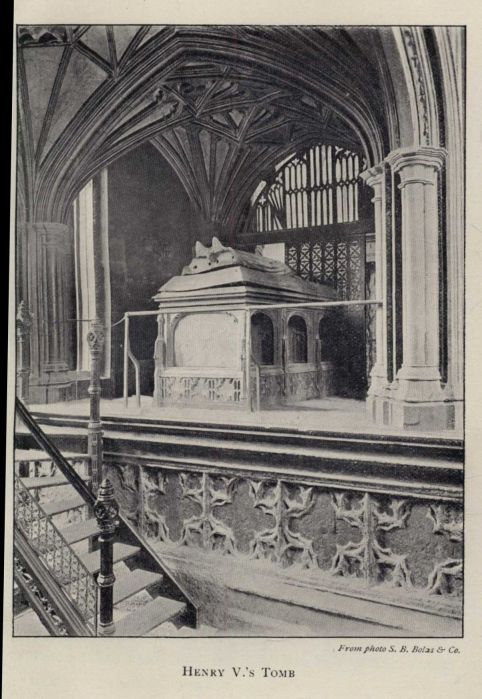
HENRY V.'s TOMB
But before long the stone screen put up about this time, to the further honour of St. Edward, cut it off from view. How exquisite must that screen have been, with its lacework tracery, its niches full of saints, its brilliancy of gold, of crimson, and of blue! You must look carefully at the carvings, which tell the story of Edward's life, fact and legend blended together. Here I will tell you shortly what each scene is meant to represent, beginning from your left as you face the screen.
The first two describe the birth of Edward; the third, his coronation; the fourth, his dream of the devil dancing for joy over the piles of money collected by the much-hated tax called Danegeld, a dream which so alarmed the king that he did away with the tax. The fifth shows how Edward had mercy on a thief who tried to steal his gold, for the king said, "Let him keep it; he hath more need of it than us." The sixth tells how Christ appeared to the king at the Holy Sacrament; the seventh and eighth describe the crowning of the king of Denmark and a quarrel between Harold and Tostig. The ninth and tenth go back to legend, the vision of the Seven Sleepers and the appearance of St. John as a pilgrim; while the twelfth and thirteenth describe St. John giving back the ring to the pilgrim, and the pilgrim's bearing it to King Edward. The eleventh shows the king washing his hands on the right, and on the left are three blind men, waiting for their sight to be restored to them when they wash their eyes in the water Edward had used; and the two last tell of the king's death and the dedication of the Abbey.
The chantry of King Henry was less ornate than this screen, but it was nevertheless very beautiful. You must look at the pattern of the open work on the iron grating which is round the tomb gates, and pick out the fleur-de-lis, the emblem of France, claimed by Henry as his inheritance. The figure of the king was the special gift of his widow, and was carved of the best English oak, with a head of silver, and its value made it too great a temptation to some "covetous pilferers about the latter end of Henry VIII., who broke it off and conveyed it clean awaie."
Over the chantry you will see a helmet, shield, and saddle; and though the helmet is certainly not the one which Henry kept hidden from all people at the Agincourt festival, it is certainly as old as the funeral day, and was probably made for that occasion.
In the year 1878, Katherine of Valois, who had first been buried in Henry III.'s chapel, then left for more than two hundred years in a rudely made coffin, open to the public gaze, by her husband's tomb, and afterwards laid in a side chapel, was at last buried under the altar slab in the Chantry Chapel of Henry V., and here within the calm shelter of Edward's shrine were carried the remains of two other queens, Eadgytha, the wife of Harold, and good Queen Maude, the wife of Henry I. Here, too, rest two tiny royal children, Margaret of York, the baby daughter of Edward IV., and her niece, Elizabeth Tudor, the three-year-old child of Henry VII. and Elizabeth. Their little marble tombs are plain and bear now no name. One other royal prince is buried here, Thomas of Woodstock, the uncle and for some time the adviser of Richard II., who certainly suffered heavily for any advice he gave, good or otherwise, for he was smothered to death at Calais with Richard's consent. And one man not of royal birth lies here—John of Waltham, Bishop of Salisbury, for whom this same Richard II. had so great a liking, that, defying every one, he ordered him to be laid among kings, close to the tomb of the Confessor.
I wonder if by now you know thoroughly that chapel which holds our earliest and some of our greatest kings and queens? Does that stately tomb in the centre call to your mind Edward, the dreamer and the builder, the dramatic ending of his life, the splendid ceremony of his burial within these walls, when he was honoured not alone as king of England or founder of the Abbey, but as a saint of the Church? Does the tomb of Henry III., with its remains of soft coloured marble and gilt mosaics, tell you of Westminster's second great builder, a lover of beauty and religious observances, but withal weak and extravagant, and incapable of rising to his great responsibilities? Does the rugged, undecorated monument of Edward I. show you the man, strong, stern, and steadfast, or the tomb of his beloved Eleanor speak to you of his wonderful love for her and of her sweet goodness? And when you look at the resting-place of Edward III. and Philippa, does it not call up to your mind the days of chivalry and the feats of English soldiers, the victories of Poitiers and Crecy, the siege of Calais and the compassionate pleading of the kindly queen? You stand by the tomb of Richard and Anne, united at last, and do not you think, "Oh, the pity of it," when you remember how Richard might have been strong and brave, had only he kept true to his best self? And then, do you not turn with a thrill of pride to the lofty chantry which encircles the grave of Henry V., the best loved king England ever had, the king who set a glow of patriotism alight in his realm, who rose above his failings and his faults, and gave to his people the fine example of a man who was victor over himself as well as victor over his foreign foes? Worthily I think does Henry's chantry crown the Confessor's shrine.
If some of these thoughts have come to you, this chapel will have taught you more history than any number of books or any number of dates. Because history only grows real to all of us, when the men and women about whom we read and learn cease to be mere figures and become our familiar acquaintances, till we fit them in as it were to their proper places in the story of England—places which are not always bounded by the years of a reign, which often cannot be bounded even by centuries.
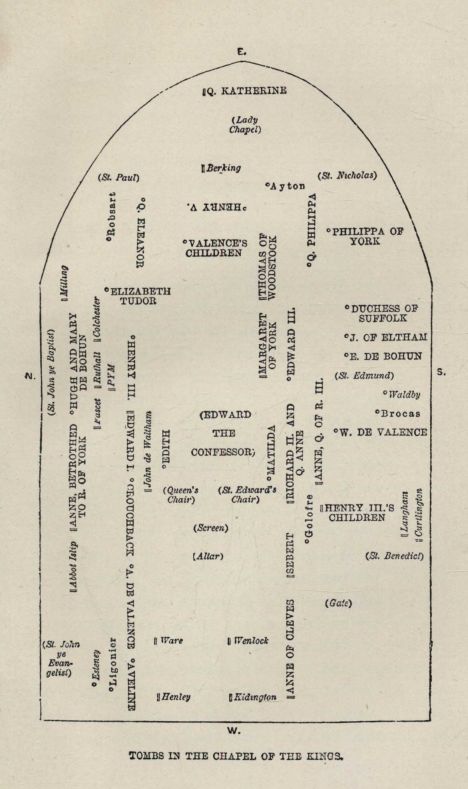
TOMBS IN THE CHAPEL OF THE KINGS.
CHAPTER IX
THE WARS OF THE ROSES AND THE THIRD ROYAL BUILDER
Little Henry VI. was not crowned till he was nine years old, and one old writer says that "so small was he, he could not wear the crown, and a bracelet of his mother's was placed on his head." He was a dreamy, gentle boy, and, far from being excited or happy on his coronation day, we hear how "very sadly and gravely he beheld all the people round about him, at the sight of which he showed great humility." His mother, Katherine, had married a Welshman named Owen Tudor, much to the anger of those about the court and the nobles, who considered that by so doing she had demeaned herself, and after this she was allowed to see very little of her son, who was therefore left entirely to his uncles, the Duke of Bedford and the Duke of Gloucester. Like Edward the Confessor, Henry was fit for a cloister but not for a crown, and he was called to reign in troublous times, when strength of will and purpose were more needed in a king than saintliness or simplicity of life. His uncles, who realised his weakness, arranged that he should marry Margaret of Anjou, a woman who was brave, ambitious, and masterful; but the fact that she soon got Henry completely under her control only brought about in the end his destruction and hers. In France the English lose all that they had won, for a deliverer of France had arisen in the girl Joan of Arc, who gave fresh courage and hope to her fellow-countrymen and led them on to victory as though she had been a saint sent by God. Then back to England came those many thousands of soldiers who had been fighting abroad all these years, and they were not inclined to settle down to a peaceful life; they wanted adventure, excitement, and plunder, and they were ready to flock round any leader who could promise them the chance of a fight. You will remember how, when you looked at Edward III.'s tomb, with the figures of his sons kneeling round, I told you that the descendants of those sons brought civil war upon England; and it was in the reign of Henry VI. that this terrible war broke out. Henry, as you know, was descended from John of Gaunt, Duke of Lancaster, and his grandfather, Henry IV., had gained the throne by will of Parliament and by right of conquest, but not by right of inheritance. Now there was living Richard, Duke of York, who was descended from the Duke of Clarence, the elder brother of John of Gaunt, and when, owing to Henry's weakness and the jealousies of the great nobles, two parties gradually began to form themselves, these parties naturally became divided into those who supported the king, that is to say, the House of Lancaster, and those who supported the House of York. At first there was no thought of civil war; these two parties merely opposed each other and schemed one against the other; but before long feeling ran so high that open warfare became inevitable, and each side took as its badge a rose.
So began the Wars of the Roses, and there followed those terrible battles of Northampton, Wakefield, St. Albans, Towton, Barnet, and Tewkesbury, in which thousands of Englishmen were slain (20,000 at Towton alone), the victory resting first on one side and then on the other, though finally with the Yorkists. The Duke of York had been killed early in the campaign, but his place had been filled by his young son, Edward, and at last, after the battle of Tewkesbury, King Henry and Queen Margaret were taken prisoners, their son Edward having been killed in battle or murdered afterwards. Both were taken to the Tower, and one night, between eleven and twelve, King Henry was put to death, the Duke of Gloucester and divers of his men being in the Tower that night. So Edward of York ascended the throne, the fourth king of that name, and the first stage of the War of the Roses was ended.
Henry was not buried at Westminster; in the darkness of the night his body was carried from the Tower, put on to a lighted barge, and, "without singing or saying," conveyed up the dark waters of the Thames to his silent interment at Chertsey Abbey. And yet this gentle, humble king had loved the Abbey well, and had greatly longed to lie near to St. Edward, by his father and his ancestors, having chosen the spot where the relics had been kept, as a "good place."
Edward IV. reigned for twelve years, but he did not reign in peace; and once his wife Elizabeth was in such distress and danger that, with her three little girls, Elizabeth, Mary, and Cicely, and one faithful attendant, Lady Scrope, she fled to Westminster for sanctuary, and threw herself on the mercy of Abbot Mylling. In this gloomy place of refuge her son was born, she being tended by a certain Mother Cobb, who also lived in sanctuary, while the Abbot sent her some few things for her comfort, and a kind butcher named Gould provided "half a beef and two muttons every week."
It was a strange birthplace for an English prince; but his christening, which took place in the Abbey, was not without honour, though the ceremony was carried out as though he were a poor man's son. He was given the honoured name of Edward, the Abbot was his godfather, and the Duchess of Bedford with Lady Scrope stood as his godmothers. When peace was restored, Edward IV. at once came to Westminster to comfort his queen, and he did not forget to reward those who had helped Elizabeth in the hour of her distress. To Nurse Cobb he gave £12 a year; from the butcher he ordered a royal shipful of hides and tallow; while the Abbot, for "his great civility," was made a Privy Councillor, and afterwards Bishop of Hereford.