Front matter
Reading edition
Transcriber’s Note
Clicking on most images will open a larger version.
Harper & Brothers New York.
THE STORY
OF
THE EARTH AND MAN,
BY
J. W. DAWSON, LL.D., F.K.S., F.G.S.,
PRINCIPAL AND VICE-CHANCELLOR OF McGILL UNIVERSITY, MONTREAL, AUTHOR OF “ARCHAIA,” “ACADIAN GEOLOGY,” ETC.
NEW YORK:
HARPER & BROTHERS, PUBLISHERS,
FRANKLIN SQUARE
PREFACE
The science of the earth as illustrated by geological research, is one of the noblest outgrowths of our modern intellectual life. Constituting the sum of all the natural sciences in their application to the history of our world, it affords a very wide and varied scope for mental activity, and deals with some of the grandest problems of space and time and of organic existence. It invites us to be present at the origin of things, and to enter into the very workshop of the Creator. It has, besides, most important and intimate connection with the industrial arts and with the material resources at the disposal of man. Its educational value, as a means of cultivating the powers of observing and reasoning, and of accustoming the mind to deal with large and intricate questions, can scarcely be overrated.
But fully to serve these high ends, the study of geology must be based on a thorough knowledge of the subjects which constitute its elementary data. It must be divested as far as possible of merely local colouring, and of the prejudices of specialists. It must be emancipated from the control of the bald metaphysical speculations so rife in our time, and above all it must be delivered from that materialistic infidelity, which, by robbing nature of the spiritual element, and of its presiding Divinity, makes science dry, barren, and repulsive, diminishes its educational value, and even renders it less efficient for purposes of practical research.
That the want of these preliminary conditions mars much of the popular science of our day is too evident; and I confess that the wish to attempt something better, and thereby to revive the interest in geological study, to attract attention to its educational value, and to remove the misapprehensions which exist in some quarters respecting it, were principal reasons which induced me to undertake the series of papers for the Leisure Hour, which are reproduced, with some amendments and extension, in the present work. How far I have succeeded, I must leave to the intelligent and, I trust, indulgent reader to decide. In any case I have presented this many-sided subject in the aspect in which it appears to a geologist whose studies have led him to compare with each other the two great continental areas which are the classic ground of the science, and who retains his faith in those unseen realities of which the history of the earth itself is but one of the shadows projected on the field of time.
To geologists who may glance at the following pages, I would say that, amidst much that is familiar, they will find here and there some facts which may be new to them, as well as some original suggestions and conclusions as to the relations of things, which though stated in familiar terms, I have not advanced without due consideration of a wide range of facts, To the general reader I have endeavoured to present the more important results of geological investigation divested of technical difficulties, yet with a careful regard to accuracy of statement, and in such a manner as to invite to the farther and more precise study of the subject in nature, and in works which enter into technical details. I have endeavoured as far as possible to mention the authors of important discoveries; but it is impossible in a work of this kind to quote authority for every statement, while the omission of much important matter relating to the topics discussed is also unavoidable. Shortcomings in these respects must be remedied by the reader himself, with the aid of systematic text-books. Those who may desire any farther explanation of the occasional allusions to the record of creation in Genesis, will find this in my previously published volume entitled “Archaia.”
J. W. D,
McGill College, Montreal, January, 1873.
CONTENTS.
PAGE
Chapter I.—The Genesis Of The Earth.
Uniformity and Progress.—Internal Heat.—Nebular Theory.—Probable Condition of the Primitive World. 1
Chapter II.—The Eozoic Ages.
The Laurentian Rocks.—Their Character and Distribution.—The Conditions of their Deposition.—Their Metamorphism.—Eozoon Canadense.—Laurentian Vegetation. 17
Chapter III.—The Primordial or Cambrian Age.
Connection of the Laurentian and Primordial.—Animals of the Primordial Seas.—Lingula, Trilobites, Oldhamia, etc.—The terms Cambrian and Silurian.—Statistics of Primordial Life. 36
Chapter IV.—The Silurian Ages.
Geography of the Continental Plateaus.—Life of the Silurian.—Reign of Invertebrates.—Corals, Crinoids, Mollusks, Crustaceans.—The First Vertebrates. Silurian Fishes.—Land Plants. 56
Chapter V.—The Devonian or Erian Age.
Physical Character of the Age.—Difference of Deposits in Marginal and Continental Areas.—Specialisation of Physical Geography.—Corals, Crustaceans, Fishes, Insects, Plants. 81
Chapter VI.—The Carboniferous Age.
Perfection of Palæozoic Life.—Carboniferous Geography.—Colours of Sediments.—Vegetation.—Origin of Coal.—Land Life.—Reptiles, Land Snails, Millipedes, etc.—Oceanic Life. 109
Chapter VII.—The Permian Age.
Movements of the Land.—Plication of the Crust.—Chemical Conditions of Dolomite, etc.—Geographical Results of Permian Movements.—Life of the Period. Summary of Palæozoic History. 160
Chapter VIII.—The Mesozoic Ages.
Characters of the Trias.—Summary of Changes in the Triassic and Cretaceous Periods.—Changes of the Continental Plateaus.—Relative Duration of the Palæozoic and Mesozoic.—Mesozoic Forests.—Land Animals.—The reign of Reptiles.—Early Mammals and Birds. 188
Chapter IX.—The Mesozoic Ages (continued).
Animals of the Sea.—Great Sea Lizards, Fishes, Cephalopods, etc.—Chalk and its History.—Tabular View of the Mesozoic Ages. 211
Chapter X.—The Neozoic Ages.
Physical Changes at the end of Mesozoic.—Subdivisions of the Neozoic.—Great Eocene Seas.—Land Animals and Plants. Life of the Miocene.—Reign of Mammals. 235
Chapter XI.—The Neozoic Ages (continued).
Later Vegetation.—The Animals of the Pliocene Period. Approach of the Glacial Period.—Character of the Post-pliocene or Glacial. 258
Chapter XII.—Close of the Post-pliocene, and Advent or Man.
Connection of Geological and Human History.—The Post-glacial Period.—Its Relations to the Pre-Historic Human Period.—Elevation of Post-Pliocene Land.—Introduction of Man.—Subsidence and Re-elevation.—Calculations as to Time.—Tabular View of the Neozoic Ages. 282
Chapter XIII.—Advent Of Man (continued).
Relations of Post-pliocene and Modern Animals.—Cavern Deposits.—Kent’s Cave.—General Remarks. 299
Chapter XIV.—Primitive Man.
Theory of Evolution as applied to Man.—Its Demands.—Its Deficiencies.—Fallacious Character of Arguments of Derivationists. Hypothesis of Creation.—Its Demands and Advantages. 316
Chapter XV.—Primitive Man (continued).
Geological Conditions of Man’s Introduction.—His Modern Date.—His Isolated Position.—His Higher Powers.—Pictures of Primitive Man according to Evolution and Creation.—General Conclusion. 350
LIST OF ILLUSTRATIONS.
PAGE
Ideal Sections Illustrating the Genesis or the Earth 8
America In The Laurentian Period 18
Eozoon Canadense 24
Life in the Primordial Age 40
Organic Limestone of the Silurian 63
Life in the Silurian 66
Life in the Devonian 88
Vegetation of the Devonian 103
Carboniferous Plants 126
Oldest Land Snails 139
Carboniferous Reptiles 146
Foldings of the Crust in the Permian Period 162
Curves of Elevation and Depression 179
Culmination of Types of Palæozoic Animals 183
Land Animals of the Mesozoic 194
Aquatic Animals of the Mesozoic 219
Foraminiferal Rock-builders 243
Miocene Mammals 253
Britain in the Post-pliocene 301

CHAPTER I.
THE GENESIS OF THE EARTH.
The title of this work is intended to indicate precisely its nature. It consists of rough, broad sketches of the aspects of successive stages in the earth’s history, as disclosed by geology, and as they present themselves to observers at the present time. The last qualification is absolutely necessary, when dealing with a science whose goal to-day will be its starting point to-morrow, and in whose view every geological picture must have its light and shaded portions, its clear foreground and its dim distance, varying according to the lights cast on them by the progress of investigation, and according to the standpoint of the observer. In such pictures results only can be given, not the processes by which they have been obtained; and with all possible gradations of light and distance, it may be that the artist will bring into too distinct outline facts still only dimly perceived, or will give too little prominence to others which, should appear in bold relief. He must in this judge for himself; and if the writer’s impressions do not precisely correspond with those of others, he trusts that they will allow something for difference of vision and point of view.
The difficulty above referred to perhaps rises to its maximum in the present chapter. For how can any one paint chaos, or give form and filling to the formless void? Perhaps no word-picture of this period of the first phase of mundane history can ever equal the two negative touches of the inspired penman—“without form and void”—a world destitute of all its present order, and destitute of all that gives it life and animation. This it was, and not a complete and finished earth, that sprang at first from its Creator’s hand; and we must inquire in this first chapter what information science gives as to any such condition of the earth.
In the first place, the geological history of the earth plainly intimates a beginning, by utterly negativing the idea that “all things continue as they were from the creation of the world.” It traces back to their origin not only the animals and plants which at present live, but also their predecessors, through successive dynasties emerging in long procession from the depths of a primitive antiquity. Not only so; it assigns to their relative ages all the rocks of the earth’s crust, and all the plains and mountains built up of them. Thus, as we go back in geological time, we leave behind us, one by one, all the things with which we are familiar, and the inevitable conclusion gains on us that we must be approaching a beginning, though this may be veiled from us in clouds and thick darkness. How is it, then, that there are “Uniformitarians” in geology, and that it has been said that our science shows no traces of a beginning, no indications of an end? The question deserves consideration; but the answer is not difficult. In all the lapse of geological time there has been an absolute uniformity of natural law. The same grand machinery of force and matter has been in use throughout all the ages, working out the great plan. Yet the plan has been progressive and advancing, nevertheless. The uniformity has been in the methods, the results have presented a wondrous diversity and development. Again, geology, in its oldest periods, fails to reach the beginning of things. It shows us how course after course of the building has been laid, and how it has grown to completeness, but it contains as yet no record of the laying of the foundation-stones, still less of the quarry whence they were dug. Still the constant progress which we have seen points to a beginning which we have not seen; and the very uniformity of the process by which the edifice has been erected, implies a time when it had not been begun, and when its stones were still reposing in their native quarry.
What, then, is the oldest condition of the earth actually shown to us by geology,—that which prevailed in the Eozoic or Laurentian period, when the oldest rocks known, those constituting the foundation-stones of our present continents, were formed and laid in their places? With regard to physical conditions, it was a time when our existing continents were yet in the bosom of the waters, when the ocean was almost universal, yet when sediments were being deposited in it as at present, while there were also volcanic foci, vomiting forth molten matter from the earth’s hidden interior. Then, as now, the great physical agencies of water and fire were contending with one another for the mastery, doing and undoing, building up and breaking down. But is this all? Has the earth no earlier history? That it must have had, we may infer from many indications; but as to the nature of these earlier states, we can learn from conjecture and inference merely, and must have recourse to other witnesses than those rocky monuments which are the sure guides of the geologist.
One fact bearing on these questions which has long excited attention, is the observed increase in temperature in descending into deep mines, and in the water of deep artesian wells—an increase which may be stated in round numbers at one degree of heat of the centigrade thermometer for every 100 feet of depth from the surface. These observations apply of course to a very inconsiderable depth, and we have no certainty that this rate continues for any great distance towards the centre of the earth. If, however, We regard it as indicating the actual law of increase of temperature, it would result that the whole crust of the earth is a mere shell covering a molten mass of rocky matter. Thus a very slight step of imagination would carry us back to a time when this slender crust had not yet formed, and the earth rolled through space an incandescent globe, with all its water and other vaporisable matters in a gaseous state. Astronomical calculation has, however, shown that the earth, in its relation to the other heavenly bodies, obeys the laws of a rigid ball, and not of a fluid globe. Hence it has been inferred that its actual crust must be very thick, perhaps not less than 2,500 miles, and that its fluid portion must therefore be of smaller dimensions than has been inferred from the observed increase of temperature. Further, it seems to have been rendered probable, from the density of rocky matter in the solid and liquid states, that a molten globe would solidify at the centre as well as at the surface, and consequently that the earth must not only have a solid crust of great thickness, but also a solid nucleus, and that any liquid portions must be of the nature of a sheet or of detached masses intervening between these. On the other hand, it has recently been maintained that the calculations which are supposed to have established the great thickness of the crust, on the ground that the earth does not change its form in obedience to the attraction of the sun and moon, are based on a misconception, and that a molten globe with a thin crust would attain to such a state of equilibrium in this respect as not to be distinguishable from a solid planet. This view has been maintained by the French physicist, Delaunay, and for some time it made geologists suppose that, after all, the earth’s crust may be very thin. Sir William Thomson, however, and Archdeacon Pratt, have ably maintained the previous opinion, based on Hopkins' calculations; and it is now believed that we may rest upon this as representing the most probable condition of the interior of the earth at present. Another fact bearing on this point is the form of the earth, which is now actually a spheroid of rotation; that is, of such a shape as would result from the action of gravity and centrifugal force in the motion of a huge liquid drop rotating in the manner in which the earth rotates. Of course it may be said that the earth may have been made in that shape to fit it for its rotation; but science prefers to suppose that the form is the result of the forces acting on it. This consideration would of course corroborate the deductions from that just mentioned. Again, if we examine a map showing the distribution of volcanoes upon the earth, and trace these along the volcanic belt of Western America and Eastern Asia, and in the Pacific Islands, and in the isolated volcanic regions in other parts of the world; and if we add to these the multitude of volcanoes now extinct, we shall be convinced that the sources of internal heat, of which these are the vents, must be present almost everywhere under the earth’s crust. Lastly, if we consider the elevations and depressions which large portions of the crust of the earth have undergone in geological time, and the actual crumpling and folding of the crust visible in great mountain chains, we arrive at a similar conclusion, and also become convinced that the crust has been not too thick to admit of extensive fractures, flexures, and foldings. There are, however, it must be admitted, theories of volcanic action, strongly supported by the chemical nature of the materials ejected by modern volcanoes, which would refer all their phenomena to the softening, under the continued influence of heat and water, of materials within the crust of the earth rather than under it.[A] Still, the phenomena of volcanic action, and of elevation and subsidence, would, under any explanation, suppose intense heat, and therefore probably an original incandescent condition.
La Place long ago based a theory of the originally gaseous condition of the solar system on the relation of the planets to each other, and to the sun, on their planes of revolution, the direction of their revolution, and that of their satellites. On these grounds he inferred that the solar system had been formed out of a nebulous mass by the mutual attraction of its parts. This view was further strengthened by the discovery of nebulae, which it might be supposed were undergoing the same processes by which the solar system was produced. This nebular theory, as it was called, was long very popular. It was subsequently supposed to be damaged by the fact that some of the nebulæ which had been regarded as systems in progress of formation were found by improved telescopes to be really clusters of stars, and it was inferred that the others might be of like character. The spectroscope has, however, more recently shown that some nebulæ are actually gaseous; and it has even been attempted to demonstrate that they are probably undergoing change fitting them to become systems. This has served to revive the nebular hypothesis, which has been further strengthened by the known fact that the sun is still an incandescent globe surrounded by an immense luminous envelope of vapours rising from its nucleus and condensing at its surface. On the other hand, while the sun may be supposed, from its great magnitude, to remain intensely heated, and while it will not be appreciably less powerful for myriads of years, the moon seems to be a body which has had time to complete the whole history of geological change, and to become a dry, dead, and withered world, a type of what our earth would in process of time actually become.
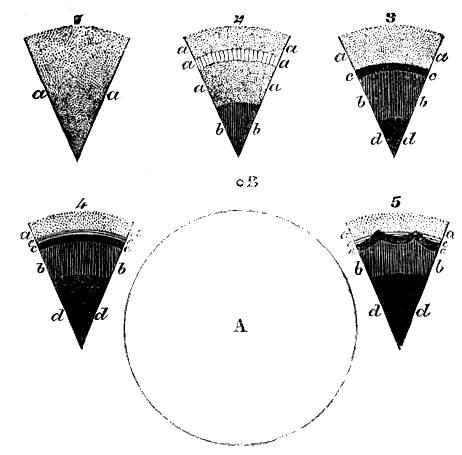
Figs. 1 to 5.—Ideal sections illustrating the Genesis of the Earth.
Fig. 1. A vaporous world.
Fig. 2. A world with a central fluid nucleus (b) and a photosphere (a).
Fig. 3. The photosphere darkened, and a solid crust (c) and solid nucleus (d) formed.
Fig. 4. Water (e) deposited on the crust, forming a universal ocean.
Fig. 5. The crust crumpled by shrinkage, land elevated, and the water occupying the intervening depressions.
The figures are all of uniform size; but the circle (A) shows th diameter of the globe when in the state of fig. 1, and that marked (B) its diameter when in the state of fig. 5. In all the figures (a) represents vapour or air; (b) liquid rock; (c) solid rock as a crust; (d) solid nucleus; (e) water.
Such considerations lead to the conclusion that the former watery condition of our planet was not its first state, and that we must trace it back to a previous reign of fire. The reasons which can be adduced in support of this are no doubt somewhat vague, and may in their details be variously interpreted; but at present we have no other interpretation to give of that chaos, formless and void, that state in which “nor aught nor nought existed,” which the sacred writings and the traditions and poetry of ancient nations concur with modern science in indicating as the primitive state of the earth.
Let our first picture, then, be that of a vaporous mass, representing our now solid planet spread out over a space nearly two thousand times greater in diameter than that which it now occupies, and whirling in its annual round about the still vaporous centre of our system, in which at an earlier period the earth had been but an exterior layer, or ring of vapour. The atoms that now constitute the most solid rocks are in this state as tenuous as air, kept apart by the expansive force of heat, which prevents not only their mechanical union, but also their chemical combination. But within the mass, slowly and silently, the force of gravitation is compressing the particles in its giant hand, and gathering the denser toward the centre, while heat is given forth on all sides from the condensing mass into the voids of space without. Little by little the denser and less volatile matters collect in the centre as a fluid molten globe, the nucleus of the future planet; and in this nucleus the elements, obeying their chemical affinities hitherto latent, are arranging themselves in compounds which are to constitute the future rocks. At the same time, in the exterior of the vaporous envelope, matters cooled by radiation into the space without, are combining with each other, and are being precipitated in earthy rain or snow into the seething mass within, where they are either again vaporised and sent to the surface or absorbed in the increasing nucleus. As this process advances, a new brilliancy is given to the faint shining of the nebulous matter by the incandescence of these solid particles in the upper layers of its atmosphere, a condition which at this moment, on a greater scale, is that of the sun; in the case of the earth, so much smaller in volume, and farther from the centre of the system, it came on earlier, and has long since passed away. This was the glorious starlike condition of our globe: in a physical point of view, its most perfect and beautiful state, when, if there were astronomers with telescopes in the stars, they might have seen our now dull earth flash forth—a brilliant white star secondary to the sun.
But in process of time this passes away. All the more solid and less volatile substances are condensed and precipitated; and now the atmosphere, still vast in bulk, and dark and misty in texture, contains only the water, chlorine, carbonic acid, sulphuric acid, and other more volatile substances; and as these gather in dense clouds at the outer surface, and pour in fierce corrosive rains upon the heated nucleus, combining with its materials, or flashing again into vapour, darkness dense and gross settles upon the vaporous deep, and continues for long ages, until the atmosphere is finally cleared of its acid vapours and its superfluous waters.[B] In the meantime, radiation, and the heat abstracted from the liquid nucleus by the showers of condensing material from the atmosphere, have so far cooled its surface that a crust of slag or cinder forms upon it. Broken again and again by the heavings of the ocean of fire, it at length sets permanently, and receives upon its bare and blistered surface the ever-increasing aqueous and acid rain thrown down from the atmosphere, at first sending it all hissing and steaming back, but at length allowing it to remain a universal boiling ocean. Then began the reign of the waters, and the dominion of fire was confined to the abysses within the solid crust. Under the primeval ocean were formed the first stratified rocks, from the substances precipitated from its waters, which must have been loaded with solid matter. We must not imagine this primeval ocean like our own blue sea, clear and transparent, but filled with earthy and saline matters, thick and turbid, until these were permitted to settle to the bottom and form the first sediments. The several changes above referred to are represented in diagrammatic form in figs. 1 to 4.
In the meantime all is not at rest in the interior of the new-formed earth. Under the crust vast oceans of molten rock may still remain, but a solid interior nucleus is being crystallised in the centre, and the whole interior globe is gradually shrinking. At length this process advances so far that the exterior crust, like a sheet of ice from below which the water has subsided, is left unsupported; and with terrible earthquake-throes it sinks downward, wrinkling up into huge folds, between which are vast sunken areas into which the waters subside, while from the intervening ridges the earth’s pent-up fires belch forth ashes and molten rocks. (Fig. 5.) So arose the first dry land:—
"The mountains huge appear Emergent, and their broad bare backs upheave Into the clouds, their tops ascend the sky, So high as heaved the tumid hills, so low Down sunk a hollow bottom, broad and deep, Capacious bed of waters."
The cloud was its garment, it was swathed in thick darkness, and presented but a rugged pile of rocky precipices; yet well might the “morning stars sing together, and all the sons of God shout with joy,” when its foundations were settled and its corner-stone laid, for then were inaugurated the changes which were to lead to the introduction of life on the earth, and to all the future development of the continents.
Physical geographers have taught us that the great continents, whether we regard their coasts or their mountain chains, are built up on lines which run north-east and south-west, and north-west and south-east; and it is also observed that these lines are great circles of the earth tangent to the polar circle. Further, we find, as a result of geological investigation, that these lines determined the deposition and the elevation of the oldest rocks known to us. Hence it is fair to infer that these were the original directions of the first lines of fracture and upheaval. Whether these lines were originally drawn by the influence of of the seasons on the cooling globe, or by the currents of its molten interior, or of the superficial ocean, they bespeak a most uniform and equable texture for the crust, and a definite law of fracture and upheaval; and they have modified all the subsequent action of the ocean as a depositor of sediment, and of the internal heat as a cause of alteration and movement of rocks. Against these earliest belts of land the ocean first chafed and foamed. Along their margins marine denudation first commenced, and the oceanic currents first deposited banks of sediment; and along these first lines have the volcanic orifices of all periods been most plentiful, and elevatory movements most powerfully felt.
We must not suppose that the changes thus shortly sketched were rapid and convulsive. They must have required periods of enormous duration, all of which had elapsed before the beginning of geological time, properly so called. From Sir William Thomson’s calculations, it would appear that the time which has elapsed from the first formation of a solid crust on the earth to the modern period may have been from seventy to one hundred millions of years, and the whole time from the vaporous condition of the solar system to the present, must of course have been still greater than even this enormous series of ages. Such a lapse of time is truly almost inconceivable, but it is only a few days to Him with whom one day is as a thousand years, and a thousand years as one day. How many and strange pictures does this series of processes call up! First, the uniform vaporous nebula. Then the formation of a liquid nucleus, and a brilliant photosphere without. Then the congealing of a solid crust under dark atmospheric vapours, and the raining down of acid and watery showers. Then the universal ocean, its waves rolling unobstructed around the globe, and its currents following without hindrance the leading of heat and of the earth’s rotation. Then the rupture of the crust and the emergence of the nuclei of continents.
Some persons seem to think that by these long processes of creative work we exclude the Creator, and would reduce the universe into a mere fortuitous concourse of atoms. To put it in more modern phrase, “given a quantity of detached fragments cast into space, then mutual gravitation and the collision of the fragments would give us the spangled heavens.” But we have still to ask the old question, “Whence the atoms?” and we have to ask it with all the added weight of our modern chemistry, so marvellous in its revelations of the original differences of matter and their varied powers of combination. We have to ask, What is gravitation itself, unless a mode of action of Almighty power? We have to ask for the origin of of thousands of correlations, binding together the past and the future in that orderly chain of causes and effects which constitutes the plan of the creation. If it pleased God to create in the beginning an earth “formless and void” and to elaborate from this all that has since existed, who are we, to say that the plan was not the best? Nor would it detract from our view of the creative wisdom and power if we were to hold that in ages to come the sun may experience the same change that has befallen the earth, and may become “black as sackcloth of hair,” preparatory perhaps, to changes which may make him also the abode of life; or if the earth, cooling still further, should, like our satellite the moon, absorb all its waters and gases into its bosom, and become bare, dry, and parched, until there shall be “no more sea” how do we know but that then there shall be no more need of the sun, because a better light may be provided? Or that there may not be a new baptism of fire in store for the earth, whereby, being melted with fervent heat, it may renew its youth in the fresh and heavenly loveliness of a new heaven and a new earth, free from all the evils and imperfections of the present? God is not slack in these things, as some men count slackness; but His ways are not like our ways. He has eternity wherein to do His work, and takes His own time for each of His operations. The Divine wisdom, personified by a sacred writer, may well in this exalt his own office:—
“Jehovah possessed me in the beginning of His way, Before His work of old. I was set up from everlasting, From the beginning, or ever the earth was. When there were no deeps, T was brought forth; When there were no fountains abounding in water. Before the mountains were settled, Before the hills, was I brought forth: While as yet He had not made the earth, Nor the plains, nor the higher part of the habitable world, When He gave the sea His decree, That her waters should not pass His limits; When He determined the foundations of the earth.”
CHAPTER II.
THE EOZOIC AGES.
The dominion of heat has passed away; the excess of water has been precipitated from the atmosphere, and now covers the earth as a universal ocean. The crust has folded itself into long ridges, the bed of the waters has subsided into its place, and the sea for the first time begins to rave against the shores of the newly elevated land, while the rain, washing the bare surfaces of rocky ridges, carries its contribution of the slowly wasting rocks back into the waters whence they were raised, forming, with the material worn from the crust by the surf, the first oceanic sediments. Do we know any of these earliest aqueous beds, or are they all hidden from view beneath newer deposits, or have they been themselves worn away and destroyed by denuding agencies? Whether we know the earliest formed sediments is, and may always remain, uncertain; but we do know certain very ancient rocks which may be at least their immediate successors.
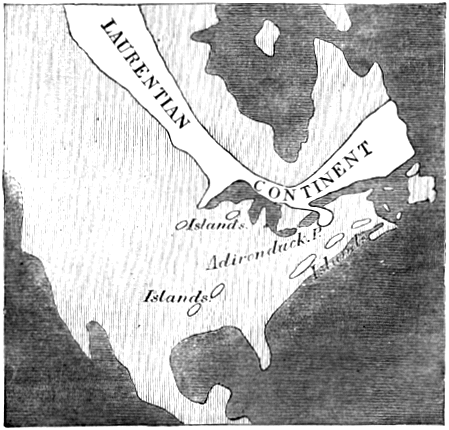
Fig. 6.—The Laurentian nucleus of the American continent.
Deepest and oldest of all the rocks we are acquainted with in the crust of the earth, are certain beds much altered and metamorphosed, baked by the joint action of heat and heated moisture—rocks once called Azoic, as containing no traces of life, but for which I have elsewhere proposed the name “Eozoic,” or those that afford the traces of the earliest known living beings. These rocks are the Laurentian Series of Sir William Logan, so named from the Laurentide hills, north of the River St. Lawrence, which are composed of these ancient beds, and where they are more largely exposed than in any other region. It may seem at first sight strange that any of these ancient rocks should be found at the surface of the earth; but this is a necessary result of the mode of formation of the continents. The oldest rocks, thrown up in places into high ridges, have either not been again brought under the waters, or have lost by denudation the sediments once resting on them; and being of a hard and resisting nature, still remain; and often rise into hills of considerable elevation, showing as it were portions of the skeleton of the earth protruding through its superficial covering. Such rocks stretch along the north side of the St. Lawrence river from Labrador to Lake Superior, and thence northwardly to an unknown distance, constituting a wild and rugged district often rising into hills 4000 feet high, and in the deep gorge of the Saguenay forming cliffs 1,500 feet in sheer height from the water’s edge. South of this great ridge, the isolated mass of the Adirondack Mountains rises to the height of 6,000 feet, rivalling the newer, though still very ancient, chain of the White Mountains. Along the eastern coast of North America, a lower ridge of Laurentian rock, only appearing here and there from under the overlying sediments, is seen in Newfoundland, in New Brunswick, possibly in Nova Scotia, and perhaps farther south in Massachusetts, and as far as Maryland. In the old world, rocks of this age do not, so far as known, appear so extensively. They have been recognised in Norway and Sweden, in the Hebrides, and in Bavaria, and may, no doubt, be yet discerned in other localities. Still, the grandest and most instructive development of these rocks is in North America; and it is there that we may best investigate their nature, and endeavour to restore the conditions in which they were deposited. It has been already stated that the oldest wrinkles of the crust of the globe take the direction of great circles of the earth tangent to the polar circle, forming north-east and south-west, and north-west and south-east lines. To such lines are the great exposures of Laurentian rock conformed, as may be well seen from the map of North America (fig. 6), taken from Dana, with some additions. The great angular Laurentian belt is evidently the nucleus of the continent, and consists of two broad bands or ridges meeting in the region of the great lakes. The remaining exposures are parallel to these, and appear to indicate a subordinate coast-line of comparatively little elevation. It is known that these Laurentian exposures constitute the oldest part of the continent, a part which was land before any of the rocks of the shaded portion of the map were deposited in the bed of the ocean—all this shaded portion being composed of rocks of various geological ages resting on the older Laurentian. It is further to be observed that the beds occurring in the Laurentian bands are crumpled and folded in a most remarkable manner, and that these folds were impressed upon them before the deposition of the rocks next in geological age.
What then are these oldest rocks deposited by the sea—the first-born of the reign of the waters? They are very different in their external aspect from the silt and mud, the sand and gravel, and the shell and coral rocks of the modern sea, or of the more recent geological formations. Yet the difference is one in condition rather than composition. The members of this ancient aristocracy of the rocks are made of the same clay with their fellows, but have been subjected to a refining and crystallizing process which has greatly changed their condition. They have been, as geologists say, metamorphosed; and are to ordinary rocks what a china vase is to the lump of clay from which it has been made. Deeply buried in the earth under newer sediments, they have been baked, until sandstones, gravels, and clays came out bright and crystalline, as gneiss, mica-schist, hornblende-schist, and quartzite—all hard crystalline rocks showing at first sight no resemblance to their original material, except in the regularly stratified or bedded arrangement which serves to distinguish them from igneous or volcanic rocks. In like manner certain finer, calcareous sediments have been changed into Labrador feldspar, sometimes gay with a beautiful play of colour, and what were once common limestones appear as crystalline marble. If the evidence of such metamorphoses is asked for, this is twofold. In the first place, these rocks are similar in structure to more modern beds which have been partially metamorphosed, and in which the transition from the unaltered to the altered state can be observed. Secondly, there are limited areas in the Laurentian itself, in which the metamorphism has been so imperfect as to permit traces of the original character of the rocks to remain. It seems also quite certain, and this is a most important point for our sketch, that the Laurentian ocean was not universal, but that there were already elevated portions of the crust capable of yielding sediment to the sea.
In North America these Laurentian rocks attain to an enormous thickness. This has been estimated by Sir W. E. Logan at 30,000 feet, so that the beds would, if piled on each other horizontally, be as high as the highest mountains on earth. They appear to consist of two great series, the Lower and Upper Laurentian. Even if we suppose that in the earlier stages of the world’s history erosion and deposition were somewhat more rapid than at present, the formation of such deposits, probably more widely spread than any that succeeded them, must have required an enormous length of time.
Geologists long looked in vain for evidences of life in the Laurentian period; but just as astronomers' have suspected the existence of unknown planets from the perturbations due to their attraction, geologists have guessed that there must have been some living things on earth even at this early time. Dana and Sterry Hunt especially have committed themselves to such speculations. The reasons for this belief may be stated thus: (1.) In later formations limestone is usually an organic rock, produced by the accumulation of shells, corals, and similar calcareous organisms in the sea, and there are enormous limestones in the Laurentian, constituting regular beds. (2.) In later formations coaly matter is an organic substance, derived from vegetables, and there are large quantities of Laurentian carbon in the form of graphite. (3.) In later formations deposits of iron ores are almost always connected with the deoxidising influence of organic matters as an efficient cause of their accumulation, and the Laurentian contains immense deposits of iron ore, occurring in layers in the manner of later deposits of these minerals. (4.) The limestone, carbon, and iron of the Laurentian exist in association with the other beds in the same manner as in the later formations in which they are known to be organic.
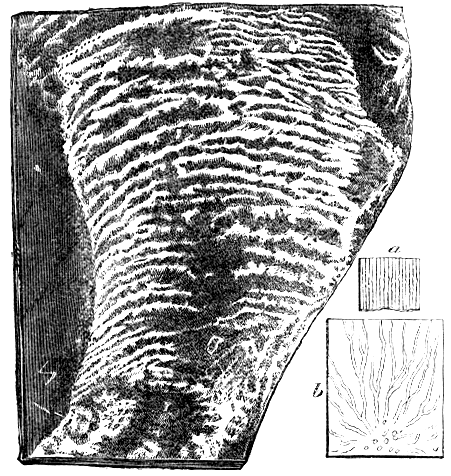
Fig. 7.—Eozoon Canadense. Dawson.
The oldest known animal. Portion of skeleton, two-thirds natural size, (a) Tabulated cell-wall, magnified, (b) Portion of canal system, magnified.
In addition to this inferential evidence, however, one well-marked animal fossil has at length been found in the Laurentian of Canada, Eozoon Canadense, (fig. 7), a gigantic representative of one of the lowest forms of animal life, which the writer had the honour of naming and describing in 1865—its name of “Dawn-animal” having reference to its great antiquity and possible connection with the dawn of life on our planet. In the modern seas, among the multitude of low forms of life with which they swarm, occur some in which the animal matter is a mere jelly, almost without distinct parts or organs, yet unquestionably endowed with life of an animal character. Some of these creatures, the Foraminifera, have the power of secreting at the surface of their bodies a calcareous shell, often divided into numerous chambers, communicating with each other, and with the water without, by pores or orifices through which, the animal can extend soft and delicate prolongations of its gelatinous body, which, when stretched out into the water, serve for arms and legs. In modern times these creatures, though extremely abundant in the ocean, are usually small, often microscopic; but in a fossil state there are others of somewhat larger size, though few equalling the Eozoon, which seems to been a sessile creature, resting on the bottom of the sea, and covering its gelatinous body with a thin crust of carbonate of lime or limestone, adding to this, as it grew in size, crust after crust, attached to each other by numerous partitions, and perforated with pores for the emission of gelatinous filaments. This continued growth of gelatinous animal matter and carbonate of lime went on from age to age, accumulating great beds of limestone, in some of which the entire form and most minute structures of the creature are preserved, while in other cases the organisms have been broken up, and the limestones are a mere congeries of their fragments. It is a remarkable instance of the permanence of fossils, that in these ancient organisms the minutest pores through which the semi-fluid matter of these humble animals passed, have been preserved in the most delicate perfection. The existence of such creatures supposes that of other organisms, probably microscopic plants, on which they could feed. No traces of these have been observed, though the great quantity of carbon in the beds probably implies the existence of larger sea-weeds. No other form of animal has yet been distinctly recognized in the Laurentian limestones, but there are fragments of calcareous matter which may have belonged to organisms distinct from Eozoon. Of life on the Laurentian land we know nothing, unless the great beds of iron ore already referred to may be taken as a proof of land vegetation.[C]
To an observer in the Laurentian period, the earth would have presented an almost boundless ocean, its waters, perhaps, still warmed with the internal heat, and sending up copious exhalations to be condensed in thick clouds and precipitated in rain. Here and there might be seen chains of rocky islands, many of them volcanic, or ranges of bleak hills, perhaps clothed with vegetation the forms of which are unknown to us. In the bottom of the sea, while sand and mud and gravel were being deposited in successive layers in some portions of the ocean floor, in others great reefs of Eozoon were growing up in the manner of reefs of coral. If we can imagine the modern Pacific, with its volcanic islands and reefs of coral, to be deprived of all other forms of life, we should have a somewhat accurate picture of the Eozoic time as it appears to us now. I say as it appears to us now; for we do not know what new discoveries remain to be made. More especially the immense deposits of carbon and iron in the Laurentian would seem to bespeak a profusion of plant life in the sea or on the land, or both, second to that of no other period that succeeded, except that of the great coal formation. Perhaps no remnant of this primitive vegetation exists retaining its form or structure; but we may hope for better things, and cherish the expectation that some fortunate discovery may still reveal to us the forms of the vegetation of the Laurentian time.
It is remarkable that the humbly organized living things which built up the Laurentian limestones have continued to exist unchanged, save in dimensions, up to modern times; and here and there throughout the geological series we find beds of Foraminiferous limestone, similar, except in the species of Foraminifera composing them, to that of the Laurentian. It is true that other kinds of creatures, the coral animals more particularly, have been introduced, and have proved equally efficient builders of limestones; but in the deeper parts of the sea the Foraminifera continue to assert their pre-eminence in this respect, and the dredge reveals in the depths of our modern oceans beds of calcareous matter which may be regarded as identical in origin with the limestones formed in the period which is to us the dawn of organic life.
Many inquiries suggest themselves to the zoologist in connection with the life of the Laurentian period. Was Eozoon the first creature in which the wondrous forces of animal life were manifested, when, in obedience to the Divine fiat, the waters first “swarmed with swarmers,” as the terse and expressive language of the Mosaic record phrases it? If so, in contemplating this organism we are in the presence of one of the greatest of natural wonders—brought nearer than in any other case to the actual workshop of the Almighty Maker. Still we cannot affirm that other creatures even more humble may not have preceded Eozoon, since such humble organisms are known in the present world. Attempts have often been made, and very recently have been renewed with much affirmation of success, to prove that such low forms of life may originate spontaneously from their materials in the waters; but so far these attempts merely prove that the invisible germs of the lower animals and plants exist everywhere, and that they have marvellous powers of resisting extreme heat and other injurious influences. We need not, therefore, be surprised if even lower forms than Eozoon may have preceded that creature, or if some of these may be found, like the organisms said to live in modern boiling springs, to have had the power of existing even at a time when the ocean may have been almost in a state of ebullition. Another problem is that of means of subsistence for the Eozoic Foraminifera. A similar problem exists in the case of the modern ocean, in whose depths live multitudes of creatures, where, so far as we know, vegetable matter, ordinarily the basis of life, cannot exist in a living condition. It is probable, however, from the researches of Dr. Wyville Thompson, that this is to be accounted for by the abundance of life at the surface and in the shallower parts of the sea, and by the consequent diffusion through the water of organic matter in an extremely tenuous state, but yet sufficient to nourish these creatures. The same may have been the case in the Eozoic sea, where, judging from the vast amount of residual carbon, there must have been abundance of organic matter, either growing at the bottom, or falling upon it from the surface; and as the Eozoon limestones are usually free from such material, we may assume that the animal life in them was sufficient to consume the vegetable pabulum. On the other hand, as detached specimens of Eozoon occur in graphitic limestones, we suppose that in some cases the vegetable matter was in excess of the animal, and this may have been either because of its too great exuberance, or because the water was locally too shallow to permit Eozoon and similar creatures to nourish. These details we must for the present fill up conjecturally; bu the progress of discovery may give us further light as to the precise conditions of the beginning of life in the “great and wide sea wherein are moving things innumerable” and which is as much a wonder now as in the days of the author of the “Hymn of Creation”[D] in regard to the life that swarms in all its breadth and depth, the vast variety of that life, and its low and simple types, of which we can affirm little else than that they move.
The enormous accumulations of sediment on the still thin crust of the earth in the Laurentian period—accumulations probably arranged in lines parallel to the directions of disturbance already indicated—weighed down the surface, and caused great masses of the sediment to come within the influence of the heated interior nucleus. Thus, extensive metamorphism took place, and at length the tension becoming too great to be any longer maintained, a second great collapse occurred, crumpling and disturbing the crust, and throwing up vast masses of the Laurentian itself, probably into lofty mountains—many of which still remain of considerable height, though they have been subjected to erosion throughout all the extent of subsequent geological time.
The Eozoic age, whose history we have thus shortly sketched, is fertile in material of thought for the geologist and the naturalist. Until the labours of Murchison, Sedgwick, Hall, and Barrande had developed the vast thickness and organic richness of the Silurian and Cambrian rocks, no geologist had any idea of the extent to which life had reached backward in time. But when this new and primitive world of Siluria was unveiled, men felt assured that they had now at last reached to the beginnings of life. The argument on this side of the Question was thus put by one of the most thoughtful of English geologists, Professor Phillips: "It is ascertained that in passing downwards through the lower Palæozoic strata, the forms of life grow fewer and fewer, until in the lowest Cambrian rocks they vanish entirely. In the thick series of these strata in the Longmynd, hardly any traces of life occur, yet these strata are of such a kind as might be expected to yield them.... The materials are fine-grained or arenaceous, with or without mica, in laminae or beds quite distinct, and of various thicknesses, by no means unlikely to retain impressions of a delicate nature, such as those left by graptolites, or mollusks, or annulose crawlers. Indeed, one or two such traces are supposed to have been recognised, so that the almost total absence of the traces of life in this enormous series is best understood by the supposition that in these parts of the sea little or no life existed. But the same remark of the excessive rarity of life in the lower deposits is made in North America, in Norway, and in Bohemia, countries well searched for this very purpose, so that all our observations lead to the conviction that the lowest of all the strata are quite deficient of organic remains. The absence is general—it appears due to a general cause. Is it not probable that during these very early periods the ocean and its sediments were nearly devoid of plants and animals, and in the earliest time of all, which is represented by sediments, quite deprived of such?" These words were written ten years ago, and about the same time were published in America those anticipations of the probability of life in the Laurentian already referred to, and Lyell was protesting against the name Primordial, on the ground that it implied that we had reached the beginning of life, when this was not proved. Yet there were elements of truth in both views. It is true now, as then, that the Primordial seems to be a morning hour of life, having, as we shall see in our next paper, unmistakable signs about it of that approach to the beginning to which Phillips refers. It is also true that it is not so early a morning hour as one who has not risen with the dawn might suppose, since with its apparently small beginnings of life it is almost as far removed from the Eozoon reefs of the early Laurentian on the one hand, as it is from the modern period on the other. The dawn of life seems to have been a very slow and protracted process, and it may have required as long a time between the first appearance of Eozoon and the first of those primordial Trilobites which the next period will introduce to our notice, as between these and the advent of Adam. Perhaps no lesson is more instructive than this as to the length of the working days of the Almighty.
Another lesson lies ready for us in these same facts. Theoretically, plants should have preceded animals; and this also is the assertion of the first chapter of Genesis; but the oldest fossil certainly known to us is an animal. What if there were still earlier plants, whose remains are still to be discovered? For my own part, I can see no reason to despair of the discovery of an Eophytic period preceding the Eozoic; perhaps preceding it through ages of duration to us almost immeasurable, though still within the possible time of the existence of the crust of the earth. It is even possible that in a warm and humid condition of the atmosphere, before it had been caused “to rain upon the earth” and when dense “mists ascended from the earth and watered the whole surface of the ground,”[E] vegetation may have attained to a profusion and grandeur unequalled in the periods whose flora is known to us.
But while Eozoon thus preaches of progress and of development, it has a tale to tell of unity and sameness Just as Eozoon lived in the Laurentian sea, and was preserved for us by the infiltration of its canals with siliceous mineral matters, so its successors and representatives have gone on through all the ages accumulating limestone in the sea bottom. To-day they are as active as they were then, and are being fossilised in the same way. The English chalk and the chalky modern mud of the Atlantic sea-bed, are precisely similar in origin to the Eozoic limestones. There is also a strange parallelism in the fact that in the modern seas Foraminifera can live under conditions of deprivation of light and vital air, and of enormous pressure, under which few organisms of greater complexity could exist, and that in like manner Eozoon could live in seas which were perhaps as yet unfit for most other forms of life.
It has been attempted to press the Eozoic Foraminifers into the service of those theories of evolution which would deduce the animals of one geological period by descent with modification from those of another; but it must be confessed that Eozoon proves somewhat intractable in this connection. In the first place, the creature is the grandest of his class, both in form and structure; and if, on the hypothesis of derivation, it has required the whole lapse of geological time to disintegrate Eozoon into Orbulina, Globigerina, and other comparatively simple Foraminifers of the modern seas, it may have taken as long, probably much longer, to develop Eozoon from such simple forms in antecedent periods. Time fails for such a process. Again, the deep sea has been the abode of Foraminifers from the first. In this deep sea they have continued to live without improvement, and with little material change. How little likely is it that in less congenial abodes they could have improved into higher grades of being; especially since we know that the result in actual fact of any such struggle for existence is merely the production of depauperated Foraminifers? Further, there is no link of connection known to us between Eozoon and any of the animals of the succeeding Primordial, which are nearly all essentially new types, vastly more different from Eozoon than it is from many modern creatures. Any such connection is altogether imaginary and unsupported by proof. The laws of creation actually illustrated by this primeval animal are only these: First, that there has been a progress in creation from few, low, and generalised types of life to more numerous, higher, and more specialised types; and secondly, that every type, low or high, was introduced at first in its best and highest form, and was, as a type, subject to degeneracy, and to partial or total replacement by higher types subsequently introduced. I do not mean that we could learn all this from Eozoon alone; but that, rightly considered, it illustrates these laws, which we gather from the subsequent progress of the creative work. As to the mystery of the origin of living beings from dead matter, or any changes which they may have undergone after their creation, it is absolutely silent.
CHAPTER III.
THE PRIMORDIAL, OR CAMBRIAN AGE.
Between the time when Eozoon Canadense flourished in the seas of the Laurentian period, and the age which we have been in the habit of calling Primordial, or Cambrian, a great gap evidently exists in our knowledge of the succession of life on both of the continents, representing a vast lapse of time, in which the beds of the Upper Laurentian were deposited, and in which the Laurentian sediments were altered, contorted, and upheaved, before another immense series of beds, the Huronian, or Lower Cambrian, was formed in the bottom of the sea. Eozoon and its companions occur in the Lower Laurentian. The Upper Laurentian has afforded no evidence of life; and even those conditions from which we could infer life are absent. The Lowest Cambrian, as we shall see, presents only a few traces of living beings. Still, the physical history of this interval must have been most important. The wide level bottom of the Laurentian sea was broken up and thrown into those bold ridges which were to constitute the nuclei of the existing continents. Along the borders of these new-made lands intense volcanic eruptions broke forth, producing great quantities of lava and scoriæ and huge beds of conglomerate and volcanic ash, which are characteristic features of the older Cambrian in both hemispheres. Such conditions, undoubtedly not favourable to life, seem to have prevailed, and extended their influence very widely, so that the sediments of this period are among the most barren in fossils of any in the crust of the earth. If any quiet undisturbed spots existed in which the Lower Laurentian life could be continued and extended in preparation for the next period, we have yet discovered few of them. The experience of other geological periods would, however, entitle us to look for such oases in the Lower Cambrian desert, and to expect to find there some connecting links between the life of the Eozoic and the very dissimilar fauna of the Primordial.
The western hemisphere, where the Laurentian is so well represented, is especially unproductive in fossils of the immediately succeeding period. The only known exception is the occurrence of Eozoon and of apparent casts of worm-burrows in rocks at Madoc in Canada, overlying the Laurentian, and believed to be of Huronian age, and certain obscure fossils of uncertain affinities, recently detected by Mr. Billings, in rocks supposed to be of this age, in Newfoundland. Here, however, the European series comes in to give us some small help. Gümbel has described in Bavaria a great series of gneissic rocks corresponding to the Laurentian, or at least to the lower part of it; above these are what he calls the Hercynian mica-slate and primitive clay-slate, in the latter of which he finds a peculiar species of Eozoon, which he names Eozoon Bavaricum. In England also the Longmynd groups of rocks in Shropshire and in Wales appears to be the immediate successor to the Upper Laurentian; and it has afforded some obscure “worm-burrows” or, perhaps, casts of sponges or fucoids, with a small shell of the genus Lingulella, and also fragments of crustaceans (Palæeopyge). The “Fucoid Sandstones” of Sweden, believed to be of similar age, afford traces of marine plants and burrows of worms, while the Harlech beds of Wales have afforded to Mr. Hicks a considerable number of fossil animals, not very dissimilar from those of the Upper Cambrian. If these rocks are really the next in order to the Eozoic, they show a marked advance in life immediately on the commencement of the Primordial period. In Ireland, the curious Oldhamia, noticed below, appears to occur in rocks equally old. As we ascend, however, into the Middle and Upper parts of the Cambrian, the Menevian and Lingula flag-beds of Britain, and their equivalents in Bohemia and Scandinavia, and the Acadian and Potsdam groups of America, we find a rich and increasing abundance of animal remains, constituting the first Primordial fauna of Barrande.
The rocks of the Primordial are principally sandy and argillaceous, forming flags and slates, without thick limestones, and often through great thicknesses, very destitute of organic remains, but presenting some layers, especially in their upward extension, crowded with fossils. These are no longer mere Protozoa, but include representatives of all the great groups of animals which yet exist, except the vertebrates. We shall not attempt any systematic classification of these; but, casting our dredge and tow-net into the Primordial sea, examine what we collect, rather in the order of relative abundance than of classification.
Over great breadths of the sea bottom we find vast numbers of little bivalve shells of the form and size of a finger-nail, fastened by fleshy peduncles imbedded in the sand or mud; and thus anchored, collecting their food by a pair of fringed arms from the minute animals and plants which swarm in the surrounding waters. These are the Lingulæ, from the abundance of which some of the Primordial beds have received in England and Wales the name of Lingula flags. In America, in like manner, in some beds near St. John, New Brunswick, the valves of these shells are so abundant as to constitute at least half of the material of the bed; and alike in Europe and America, Lingula and allied forms are among the most abundant Primordial fossils. The Lingulæ are usually reckoned to belong to the great sub-kingdom of mollusks, which includes all the bivalve and univalve shell-fish, and several other groups of creatures; but an able American naturalist, Mr. Morse, has recently shown that they have many points of resemblance to the worms; and thus, perhaps, constitute one of those curious old-fashioned “comprehensive” types, as they have been called, which present resemblances to groups of creatures, in more modern times quite distinct from each other. He has also found that the modern Lingulæ are very tenacious of life, and capable of suiting themselves to different circumstances, a fact which, perhaps, has some connection with their long persistence in geological time. They are in any case members of the group of lamp-shells, creatures specially numerous and important in the earlier geological ages.
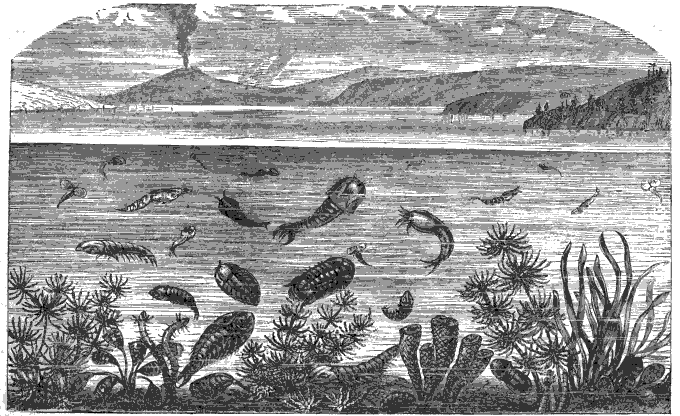
Fig. 8.—LIFE IN THE PRIMORDIAL SEA.
On the bottom are seen, proceeding from left to right, Oldhamia antiqua, Lingulæ, Arenicolæ, Oldhamia radiata, Paradoxides, Histioderma, Agnostus, Oldhamia radiata, Algæ, and Lingulæ. In the water are Hymenocaris, different species of Trilobites, and Pteropods.
The Lingulæ are especially interesting as examples of a type of beings continued almost from the dawn of life until now; for their shells, as they exist in the Primordial, are scarcely distinguishable from those of members of the genus which still live. While other tribes of animals have run through a great number of different forms, these little creatures remain the same. Another interesting point is a most curious chemical relation of the Lingula, with reference to the material of its shell. The shells of mollusks generally, and even of the ordinary lamp-shells, are hardened by common limestone or carbonate of lime: the rarer substance, phosphate of lime, is in general restricted to the formation of the bones of the higher animals. In the case of the latter, this relation depends apparently on the fact that the albuminous substances on which animals are chiefly nourished require for their formation the presence of phosphates in the plant. Hence the animal naturally obtains phosphate of lime or bone-earth with its food, and its system is related to this chemical fact in such wise that phosphate of lime is a most appropriate and suitable material for its teeth and bones. Now, in the case of the lower animals of the sea, their food, not being of the nature of the richer land plants, but consisting mainly of minute algæ and of animals which prey on these, furnishes, not phosphate of lime, but carbonate. An exception to this occurs in the case of certain animals of low grade, sponges, etc., which, feeding on minute plants with siliceous cell-walls, assimilate the flinty matter and form a siliceous skeleton. But this is an exception of downward tendency, in which these animals approach to plants of low grade. The exception in the case of Lingulaa is in the other direction. It gives to these humble creatures the same material for their hard parts which is usually restricted to animals of much higher rank. The purpose of this arrangement, whether in relation to the cause of the deviation from the ordinary rule or its utility to the animal itself, remains unknown. It has, however, been ascertained by Dr. Hunt, who first observed the fact in the case of the Primordial Lingulæ, that their modern successors coincide with them, and differ from their contemporaries among the mollusks in the same particular. This may seem a trifling matter, but it shows in this early period the origination of the difference still existing in the materials of which animals construct their skeletons, and also the wonderful persistence of the Lingulæ, through all the geological ages, in the material of their shells. This is the more remarkable, in connection with our own very slender acquaintance with the phenomenon, in relation either to its efficient or final causes.
Before leaving the Lingulæ, I may mention that Mr. Morse informs me that living specimens, when detached from their moorings, can creep like worms, leaving long furrows on the sand, and that they can also construct sand-tubes wherein to shelter themselves. This shows that some of the abundant “worm burrows” of the Primordial may have been the work of these curious little shell-fishes, as well as, perhaps, some of the markings which have been described under the name of Eophyton, and have been supposed, I think incorrectly, to be remains of land plants.
In addition to Lingula we may obtain, though rarely, lamp-shells of another type, that of the Orthids, These have the valves hinged along a straight line, in the middle of which is a notch for the peduncle, and the valves are often marked with ribs or striae. The Orthids were content with limestone for their shells, and apparently lived in the same circumstances with the Lingulæ; and in the period succeeding the Primordial they became far more abundant. Yet they perished at an early stage of the world’s progress, and have no representatives in the modern seas.
In many parts of the Primordial ocean the muddy bottom swarmed with crustaceans, relatives of our shrimps and lobsters, but of a form which differs so much from these modern shell-fishes that the question of their affinities has long been an unsettled onfi with zoologists. Hundreds of species are known, some almost microscopic in size, others a foot in length. All are provided with a broad flat horseshoe-shaped head-plate, which, judging from its form and a comparison with the modern king-crabs or horseshoe-crabs, must have been intended as a sort of mud-plough to enable them to excavate burrows or hide themselves in the slimy ooze of the ocean bed. On the sides of this buckler are placed the prominent eyes, furnished with many separate lenses, on precisely the same plan with those of modern crustaceans and insects, and testifying, as Buckland long ago pointed out, to the identity of the action of light in the ancient and the modern seas. The body was composed of numerous segments, each divided transversely into three lobes, whence they have received the name of Trilobites, and the whole articulated, so that the creature could roll itself into a ball, like the modern slaters or wood-lice, which are not very distant relatives of these old crustaceans.[F] The limbs of Trilobites were long unknown, and it was even doubted whether they had any; but recent discoveries have shown that they had a series of flat limbs useful both for swimming and creeping. The Trilobites, under many specific and generic forms, range from the Primordial to the Carboniferous rocks, but are altogether wanting in the more recent formations and in the modern seas. The Trilobites lived on muddy bottoms, and their remains are extremely abundant in shaly and slaty beds, though found also in limestone and sandstone. In the latter they have left most curious traces of their presence in the trails which they have produced. Some of the most ancient sandstones have their surfaces covered with rows of punctured impressions (Protichnites, first footprints), others have strange series of transverse grooves with longitudinal ones at the side (Climactichnites, ladder footprints); others are oval burrows, marked with transverse lines and a ridge along the middle (Rusichnites, wrinkle footprints). All of these so nearly resemble the trails and tracks of modern king-crabs that there can be little doubt as to their origin. Many curious striated grooves and bifid marks, found on the surfaces of Primordial beds, and which have been described as plants, are probably only the marks of the oral organs or feet of these and similar creatures, which passed their lives in grubbing for food in the soft, slimy ooze, though they could, no doubt, like the modern king-crabs, swim when necessary. Some still more shrimp-like creatures, Hymenocaris, which are found with them, certainly had this power.
A lower type of annulose or ringed animal than that of the Trilobites, is that of the worms. These creatures cannot be preserved in a fossil state, except in the case of those which inhabit calcareous tubes: but the marks which their jointed bodies and numerous side-bristles leave on the sand and mud may, when buried under succeeding sediments, remain; and extensive surfaces of very old rocks are marked in this way, either with cylindrical burrows or curious trails with side scratches looking like pinnate leaves. These constitute the genus Crusiana, while others of more ordinary form belong to the genus Arenicolites, so named from the common Arenicola, or lobworm, whose burrows they are supposed to resemble. Markings referable to seaweed also occur in the Primordial rocks, and also some grotesque and almost inexplicable organisms known as Oldhamia, which have been chiefly found in the Primordial of Ireland. One of the most common forms consists of a series of apparently jointed threads disposed in fan-like clusters on a central stem (Oldhamia antiqua). Another has a wider and simpler fan-like arrangement of filaments. These have been claimed by botanists as algæ, and have been regarded by zoologists as minute Zoophytes, while some more sceptical have supposed that they may be mere inorganic wrinklings of the beds. This last view does not, however, seem tenable. They are, perhaps, the predecessors of the curious Graptolites, which we shall have to represent in the Silurian.
Singularly enough, Foraminifera, the characteristic fossils of the Laurentian, have been little recognised in the Primordial, nor are there any limestones known so massive as those of the former series. There are, however, a number of remarkable organisms, which have usually been described as sponges, but are more probably partly of the nature of sponges and partly of that of Foraminifera. Of this kind are some of the singular conical fossils described by Billings as Archæocyathus, and found in the Primordial limestone of Labrador. They are hollow within, with radiating porss and plates, calcareous in some, and in others with siliceous spicules like those of modern sponges. Some of them are several inches in diameter, and they must have grown rooted in muddy bottoms, in the manner of some of the deep-sea sponges of modern times. One species at least of these creatures was a true Foraminifer, allied, though somewhat distantly, to Eozoon. In some parts of the Primordial sandstones, curious funnel-shaped casts in sand occur, sometimes marked with spiral lines. The name Histioderma has been given to some of these, and they have been regarded as mouths of worm-burrows. Others of larger size have been compared to inverted stumps of trees. If they were produced by worms, some of these must have been of gigantic size, but Billings has recently suggested that they may be casts of sponges that lived like some modern species imbedded in the sand. In accordance with this view I have represented these curious objects in the engraving, On the whole, the life of these oldest Palæozoic rocks is not very abundant; but there are probably representatives of three of the great subdivisions of animals or, as some would reckon them, of four the Protozoa, the Radiata (Cœlenterata), the Mollusca, and the Annulosa. And it is most interesting thus to find in these very old rocks the modern subdivisions of animals already represented, and these by types some of them nearly allied to existing inhabitants of the seas I have endeavoured in the engraving to represent some of the leading forms of marine life in this ancient period.
Perhaps one of the most interesting discoveries in these rocks is that of rain-marks and shrinkage-cracks, in some of the very oldest beds—those of the Longmynd in Shropshire. On the modern muddy beach any ordinary observer is familiar with the cracks produced by the action of the sun and air on the dried surfaces left by the tides. Such cracks, covered by the waters of a succeeding tide, may be buried in newer silt, and once preserved in this way are imperishable. In like manner, the pits left by passing showers of rain on the mud recently left bare by the tide may, when the mud has dried, become sufficiently firm to be preserved. In this way we have rain-marks of various geological ages; but the oldest known are those of the Longmynd, where they are associated both with ripple-marks and shrinkage-cracks. We thus have evidence of the action of tides, of sun, and of rain, in these ancient periods just as in the present day. Were there no land animals to prowl along the low tidal flats in search of food? Were there no herbs or trees to drink in the rains and flourish in the sunshine? If there were, no bone or footprint on the shore, or drifted leaf or branch, has yet revealed their existence to the eyes of geologists The beds of the Primordial age exist in England, in Bohemia, in Sweden and Norway, and also in North America. They appear to have been deposited along the shores of the old Laurentian continent, and probably some of them indicate very deep water. The Primordial rocks are in many parts of the world altered and hardened. They have often assumed a slaty structure, and their bedding, and the fossils which they contain, are both affected by this. The usual view entertained as to what is called slaty structure is, that it depends on pressure, acting on more or less compressible material in some direction usually different from that of the bedding. Such pressure has the effect of arranging all the flat particles as scales of mica, etc. in planes parallel to the compressing surface. Hence, if much material of this kind is present in the sediment, the whole rock assumes a fissile character causing it to split readily into thin plates. That such yielding to pressure has actually taken place is seen very distinctly in microscopic sections of some slaty rocks, which often show not only a laminated structure, but an actual crumpling on a small scale, causing them to assume almost the aspect of woody fibre. Such rocks often remind a casual observer of decaying trunks of trees, and sections of them under the microscope show the most minute and delicate crumpling. It is also proved by the condition of the fossils the beds contain. These are often distorted, so that some of them are lengthened and others shortened, and if specimens were selected with, that view, it would be quite easy to suppose that those lengthened by distortion are of different species from those distorted so as to be shortened. Slaty cleavage and distortion are not, however, confined to Primordial rocks, but occur in altered sediments of various ages.
The Primordial sediments must have at one time been very widely distributed, and must have filled up many of the inequalities produced by the rending and contortion of the Laurentian beds. Their thicker and more massive portions are, however, necessarily along the borders of the Laurentian continents, and as they in their turn were raised up into land, they became exposed to the denuding action first of the sea, and afterwards of the rain and rivers, and were so extensively wasted away that only in a few regions do large areas of them remain visible. That of Bohemia has afforded to Barrande a great number of most interesting fossils. The rocks of St. David’s in Wales, those of Shropshire in England, and those of Wicklow in Ireland are also of great interest; and next to these in importance are, perhaps, the Huronian and Acadian groups of North America, in which continent—as for example in Nova Scotia and in some parts of New England—there are extensive areas of old metamorphic rocks whose age has not been determined by fossils, but which may belong to this period.
The question of division lines of formations is one much agitated in the case of the Cambrian rocks. Whether certain beds are to be called Cambrian or Silurian has been a point greatly controverted; and the terms Primordial and Primordial Silurian have been used as means to avoid the raising of this difficulty. Many of our division lines in geology are arbitrary and conventional, and this may be the case with that between the Primordial and Silurian, the one age graduating into the other. There appears to be, however, the best reason to recognise a distinct Cambrian period, preceding the two great periods, those of the second and third faunas of Barrande, to which the term Silurian is usually applied. On the other hand, in so far as our knowledge extends at present, a strongly marked line of separation exists between the Laurentian and Primordial, the latter resting on the edges of the former, which seems then to have been as much altered as now. Still a break of this kind may be, perhaps must be, merely local; and may vary in amount. Thus, in some places we find rocks of Silurian and later ages resting directly on the Laurentian, without the intervention of the Primordial. In any case, where a line of coast is steadily sinking, each succeeding deposit will overlap that which went before; and this seems to have been the case with the Laurentian shore when the Primordial and Silurian were being deposited. Hence over large spaces the Primordial is absent, being probably buried up, except where exposed by denudation at the margin of the two formations.
This occurs in several parts of Canada, while the Laurentian rocks have evidently been subjected to metamorphism and long-continued weathering before the Lower Silurian were deposited; and in some cases the latter rest on weather-worn and pitted surfaces, and are filled with angular bits of the underlying rock, as well as with drift-shells which have been cast on these old Laurentian shores; while in other cases the Silurian rests on smooth water-worn Laurentian rocks, and is filled at the junction with well-rounded pebbles and grains of sand which have evidently been subjected to a more thorough attrition than those of the present beach. With respect to the line of division between the Primordial and the next succeeding rocks, it will be seen that important movements of the continents occurred at the close of the Cambrian, and in some places the Cambrian rocks have been much disturbed before the deposition of the Lower Silurian.
Seated on some ancient promontory of the Laurentian, and looking over the plain which, in the Primordial and Lower Silurian periods was the sea, I have often wished for some shred of vegetable matter to tell what lived on that land when the Primordial surf beat upon its shore, and washed up the Trilobites and Brachiopods of those old seas; but no rock has yet taken up its parable to reveal the secret, and the Primordial is vocal only with the old story: “And God said, Let the waters swarm with swarming living things, and it was so.” So our picture of the period may represent a sea-bottom swarming with animals of low grade, some sessile, some locomotive; and we may merely suppose a distant shore with vegetation dimly seen, and active volcanoes; but a shore on which no foot of naturalist has yet trod to scan its productions. Very different estimates have been formed of the amount of life in this period, according to the position given to its latest limit. Taking some of the more modern views of this subject, we might have included among the Primordial animals many additional creatures, which we prefer noticing in the Silurian, since it may at least be affirmed that their head-quarters were in that age, even if they had a beginning in the Primordial. It may be interesting here, however, to note the actual amount of life known to us in this period, taken in its largest scope. In doing this, I shall take advantage of an interesting table given by Dr. Bigsby,[G] and representing the state of knowledge in 1868, and shall group the species in such a manner as to indicate the relative abundance of distinct types of structure. We find then—
Plants (all, or nearly all, supposed to be sea-weeds, and some, probably, mere tracks or trails of animals) 22 species.
Sponges, and similar creatures 27 ”
Corals and their allies 6 ”
Starfishes and their allies 4 ”
Worms 29 ”
Trilobites and other crustaceans 442 ”
Lamp-shells and other molluscoids 193 ”
Common bivalve mollusks 12 ”
Common univalve mollusks and their allies 172 ”
Higher mollusks, nautili, cuttle-fishes, etc. 65 ”
In all 972 ”
Now in this enumeration we observe, in the first place, a representation of all the lower or invertebrate groups of the waters. We have next the remarkable fact that the Radiata of Cuvier, the lowest and most plant-like of the marine animals, are comparatively slenderly represented, yet that there are examples of their higher as well as of their lower forms. We have the further fact that the crustaceans, the highest marine animals of the annulose type, are predominant in the waters; and that in the mollusks the highest and lowest groups are most plentiful, the middle less so. The whole number of species is small, and this may arise either from our having here reached an early period in the history of life, or from our information being defective. Both are probably true. Still, of the animals known, we cannot say that the proportions of the different kinds depend on defective knowledge. There is no reason, for example, why corals should not have been preserved as well as Trilobites, or why Brachiopods should have been presurved rather than ordinary bivalves. The proportions, therefore, it may be more safe to reason from than the aggregate. In looking at these proportions, and comparing them with those of modern seas, we are struck with the great number of species representing some types either now extinct or comparatively rare: the Trilobites and Brachiopods more particularly. We are astonished at the enormous preponderance of these two groups, and especially of the Trilobites. Further, we observe that while some forms, like Lingula and Nautilus, have persisted down to modern times, others, like the Trilobites and Orthids, perished very early. In all this we can dimly perceive a fitness of living things to physical conditions, a tendency to utilise each type to the limit of its capacities for modification, and then to abandon it for something higher; a tendency of low types to appear first, but to appear in their highest perfection and variety; a sudden apparition of totally diverse plans of structure subserving similar ends simultaneously with each other, as for instance those of the Mollusk and the Crustacean; the appearance of optical and mechanical contrivances, as for example the compound eyes of the Trilobite and the swimming float of the Orthoceras, in all their perfection at first, just as they continue to this day in creatures of similar grade. That these and other similar things point to a uniform and far-reaching plan, no rational mind can doubt; and if the world had stopped short in the Primordial period, and attained to no further development, this would have been abundantly apparent; though it shines forth more and more conspicuously in each succeeding page of the stony record. How far such unity and diversity can be explained by the modern philosophy of a necessary and material evolution out of mere death and physical forces, and how far it requires the intervention of a Creative mind, are questions which we may well leave with the thoughtful reader, till we have traced this history somewhat further.
CHAPTER IV.
THE LOWER AND UPPER SILURIAN AGES.
By English geologists, the great series of formations which succeeds to the Cambrian is usually included under the name Silurian System, first proposed by Sir Roderick Murchison. It certainly, however, consists of two distinct groups, holding the second and third faunas of Barrande. The older of the two, usually called the Lower Silurian, is the Upper Cambrian of Sedgwick, and may properly be called the Siluro-Cambrian. The newer is the true Silurian, or Silurian proper—the Upper Silurian of Murchison. We shall in this chapter, for convenience, consider both in connection, using occasionally the term Lower Silurian as equivalent to Siluro-Cambrian. The Silurian presents us with a definite physical geography, for the northern hemisphere at least; and this physical geography is a key to the life conditions of the time. The North American continent, from its great unbroken area, affords, as usual, the best means of appreciating this. In this period the northern currents, acting perhaps in harmony with old Laurentian outcrops, had deposited in the sea two long submarine ridges, running to the southward from the extreme ends of the Laurentian nucleus, and constituting the foundations of the present ridges of the Roeky Mountains and the Alleghanies. Between these the extensive triangular area now constituting the greater part of North America, was a shallow oceanic plateau, sheltered from the cold polar currents by the Laurentian land on the north, and separated by the ridges already mentioned from the Atlantic and Pacific. It was on this great plateau of warm and sheltered ocean that what we call the Silurian fauna lived; while of the creatures that inhabited the depths of the great bounding oceans, whose abysses must have been far deeper and at a much lower temperature, we know little. During the long Silurian periods, it is true, the great American plateau underwent many revolutions, sometimes being more deeply submerged, and having clear water tenanted by vast numbers of corals and shell-fishes, at others rising so as to become shallow and to receive deposits of sand and mud; but it was always distinct from the oceanic area without. In Europe, in like manner, there seems to have been a great internal plateau bounded by the embryo hills of Western Europe on the west, and harbouring a very similar assemblage of creatures to those existing in America.
Further, during these long periods there were great changes, from a fauna of somewhat primordial type up to a new order of things in the Upper Silurian, tending toward the novelties which were introduced in the succeeding Devonian and Carboniferous. We may, in the first place, sketch these changes as they occurred on the two great continental plateaus, noting as we proceed sucli hints as can be obtained with reference to the more extensive oceanic spaces.
Before the beginning of the age, both plateaus seem to have been invaded by sandy and muddy sediments charged at some periods and places with magnesian limestone; and these circumstances were not favourable to the existence or preservation of organic remains. Such are the Potsdam and Calciferous beds of America and the Tremadoc and Llandeilo beds of England. The Potsdam and Tremadoc are by their fossils included in the Cambrian, and may at least be regarded as transition groups. It is further to be observed, in the case of these beds, that if we begin at the west side of Europe and proceed easterly, or at the east side of America and proceed westerly, they become progressively thinner, the greater amount of material being deposited at the edges of the future continents; just as on the sides of a muddy tideway the flats are higher, and the more coarse sediment deposited near the margin of the channel, and fine mud is deposited at a greater distance and in thinner beds. The cause, however, on the great scale of the Atlantic, was somewhat different, ancient ridges determining the border of the channel. This statement holds good not only of these older beds, but of the whole of the Silurian, and of the succeeding Devonian and Carboniferous, all deposited on these same plateaus. Thus, in the case of the Silurian in England and Wales, the whole series is more than 20,000 feet thick, but in Russia, it is less than 1,000 feet. In the eastern part of America the thickness is estimated at quite as great an amount as in Europe, while in the region of the Mississippi the Silurian rocks are scarcely thicker than in Russia, and consist in great part of limestones and fine sediments, the sandstones and conglomerates thinning out rapidly eastward of the Appalachian Mountains.
In both plateaus the earlier period of coarse accumulations was succeeded by one in which was clear water depositing little earthy sediment, and this usually fine; and in which the sea swarmed with animal life, from the débris of which enormous beds of limestone were formed the Trenton limestone of America and the Bala limestone of Europe. The fossils of this part of the series open up to us the head-quarters of Lower Silurian life, the second great fauna of Barrande, that of the Upper Cambrian of Sedgwick; and in America more especially, the Trenton and its associated limestones can be traced over forty degrees of longitude; and throughout the whole of this space its principal beds are composed entirely of comminuted corals, shells, and crinoids, and studded with organisms of the same kinds still retaining their forms. Out of these seas, in the European area, arose in places volcanic islets, like those of the modern Pacific.
In the next succeeding era the clear waters became again invaded with muddy and sandy sediments, in various alternations, and with occasional bands of limestone, constituting the Caradoc beds of Britain and the Utica and Hudson River groups of America. During the deposition of these, the abounding life of the Siluro-Cambrian plateaus died away, and a middle group of sandstones and shales, the Oneida and Medina of America and the Mayhill of England, form the base of the Upper Silurian.
But what was taking place meanwhile in the oceanic areas separating our plateaus? These were identical with the basins of the Atlantic and Pacific, which already existed in this period as depressions of the earth’s crust, perhaps not so deep as at present. As to the deposits in their deeper portions we know nothing; but on the margin of the Atlantic area are some rocks which give us at least a little information.
In the later part of the Cambrian period the enormous thickness of the Quebec group of North America appears to represent a broad stripe of deep water parallel to the eastern edge of the American plateau, and in which an immense thickness of beds of sand and mud was deposited with very few fossils, except in particular beds, and these of a more primordial aspect than those of the plateau itself. These rocks no doubt represent the margin of a deep Atlantic area, over which cold currents destructive of life were constantly passing, and in which great quantities of sand and mud, swept from the icy regions of the North, were continually being laid. The researches of Dr. Carpenter and Dr. Wyville Thomson show us that there are at present cold areas in the deeper parts of the Atlantic, on the European side, as we have long known that they exist at less depths on the American side; and these same researches, with the soundings on the American banks, show that sand and gravel may be deposited not merely on shallows, but in the depths of the ocean, provided that these depths are pervaded by cold and heavy currents capable of eroding the bottom, and of moving coarse material. The Quebec group in Canada and the United States, and the metalliferous Lower Silurian rocks of Nova Scotia and Newfoundland, destitute of great marine limestones and coral reefs, evidently represent deep and cold-water areas on the border of the Atlantic plateau.
At a later period, the beginning of the Upper Silurian, the richly fossiliferous and exceptional deposits of the Island of Anticosti, formed in the deep hollow of the Gulf of St. Laurence, show that when the plateau had become shallowed up by deposition and elevation, and converted into desolate sand-banks, the area of abundant life was transferred to the still deep Atlantic basin and its bordering bays, in which the forms of Lower Silurian life continued to exist until they were mixed up with those of the Upper Silurian.
If we turn now to these latter rocks, and inquire as to their conditions on our two great plateaus, we shall find a repetition of changes similar to those which occurred in the times preceding. The sandy shallows of the earlier part of this period give place to wide oceanic areas similar to those of the Lower Silurian; In these we find vast and thick coral and shell limestones, the Wenlock of England and Niagara of America, as rich in life as the limestones of the Lower Silurian, and with the generic and family forms similar, but the species for the most part different. In America these limestones were followed by a singularly shallow condition of the plateau, in which the surface was so raised as at times to be converted into separate salt lakes in which beds of salt were deposited. On both plateaus there were alternations of oceanic and shallow conditions, under which the Lower Helderberg and Ludlow beds, the closing members of the Silurian, were laid down. Of the Atlantic beds of this period we know little, except that the great limestones appear to be wanting, and to be replaced by sandy and muddy deposits, in some parts at least of the margins of the area. In some portions also of the plateaus and their margins, extensive volcanic outbursts seem to have occurred; so that the American plateau presented, at least in parts, the aspect of a coral sea with archipelagos of volcanic islands, the ejections from which became mixed with the aqueous deposits forming around them.
Having thus traced the interesting series of geographical conditions indicated by the Silurian series, we may next take our station on one of the submerged plateaus, and inquire as to the new forms of life now introduced to our notice; and in doing so shall include the life of both the Lower and Upper Silurian.