Front matter (continued 4)
Reading edition
If the forests of the Mesozoic present a great advance over those of the Palæozoic, so do the animals of the land, which now embrace all the great types of vertebrate life. Some of these creatures have left strange evidence of their existence in their footprints on the sand and clay, now cemented into beds of hard rock excavated by the quarryman. If we had landed on some wide muddy Mesozoic shore, we might have found it marked in all directions with animal footprints. Some of these are shaped much like a human hand. The creature that made this mark was a gigantic successor of the crocodilian newts or labyrinthodonts of the Carboniferous, and this type seems to have attained its maximum in this period, where one species, Labyrinthodon giganteus, had great teeth three or four inches in length, and presenting in their cross section the most complicated foldings of enamel imaginable. But we may see on the shores still more remarkable footprints. They indicate biped and three-toed animals of gigantic size, with a stride perhaps six feet in length. Were they enormous birds? If so, the birds of this age must have been giants which would dwarf even our ostriches. But as we walk along the shore we see many other impressions, some of them much smaller and different in form. Some, again, very similar in other respects, have four toes; and, more wonderful still, in tracing up some of the tracks, we find that here and there the creature has put down on the ground a sort of four-fingered hand, while some of these animals seem to have trailed long tails behind them. What were these portentous creatures—bird, beast, or reptile? The answer has been given to us by their bones, as studied by Yon Meyer and Owen, and more recently by Huxley and Cope. We thus have brought before us the Dinosaurs—the terrible Saurians—of the Mesozoic age, the noblest of the Tanninim of old. These creatures constitute numerous genera and species, some of gigantic size, others comparatively small;—some harmless browsers on plants, others terrible renders of living flesh; but all remarkable for presenting a higher type of reptile organization than any now existing, and approaching in some respects to the birds and in others to the mammalia. Let us take one example of each of the principal groups. And first marches before us the Iguanodon or his relation Hadrosaurus—a gigantic biped, twenty feet or more in height, with enormous legs shaped like those of an ostrich, but of elephantine thickness. It strides along, not by leaps like a kangaroo, but with slow and stately tread, occasionally resting, and supporting itself on the tripod formed by its hind limbs and a huge tail, like the inverted trunk of a tree. The upper part of its body becomes small and slender, and its head, of diminutive size and mild aspect, is furnished with teeth for munching the leaves and fruits of trees, which it can easily reach with its small fore-limbs, or hands, as it walks through the woods. The outward appearance of these creatures we do not certainly know. It is not likely that they had bony plates like crocodiles, but they may have shone resplendent in horny scale armour of varied hues. But another and more dreadful form rises before us. It is Megalosaurus or perhaps Lælaps. Here we have a creature of equally gigantic size and biped habits; but it is much more agile, and runs with great swiftness or advances by huge leaps, and its feet and hands are armed with strong curved claws; while its mouth has a formidable armature of sharp-edged and pointed teeth. It is a type of a group of biped bird-like lizards, the most terrible and formidable of rapacious animals that the earth has ever seen. Some of these creatures, in their short deep jaws and heads, resembled the great carnivorous mammals of modern times, while all in the structure of their limbs had a strange and grotesque resemblance to the birds. Nearly all naturalists regard them as reptiles; but in their circulation and respiration they must have approached to the mammalia, and their general habit of body recalls that of the kangaroos. They were no doubt oviparous; and this, with their biped habit, seems to explain the strong resemblance of their hind quarters to those of birds. Had we seen the eagle-clawed Lælaps rushing on his prey; throwing his huge bulk perhaps thirty feet through the air, and crushing to the earth under his gigantic talons some feebler Hadrosaur, we should have shudderingly preferred the companionship of modern wolves and tigers to that of those savage and gigantic monsters of the Mesozoic.
We must not leave the great land-lizards of the reptilian age, without some notice of that Goliath of the race which, by a singular misnomer, has received the appellation of Ceteosaurus or “Whale-Saurian.” It was first introduced to naturalists by the discovery of a few enormous vertebrae in the English Oolite; and as these in size and form seemed best to fit an aquatic creature, it was named in accordance with this view. But subsequent discoveries have shown that, incredible though this at first appeared, the animal had limbs fitted for walking on the land. Professor Phillips has been most successful in collecting and restoring the remains of Ceteosaurus, and devotes to its history a long and interesting section of his “Geology of Oxford.” The size of the animal may be estimated, from the fact that its thigh-bone is sixty-four inches long, and thick in proportion. From this and other fragments of the skeleton, we learn that this huge monster must have stood ten feet high when on all fours, and that its length, could not have been less than fifty feet; perhaps much more. From a single tooth, which has been found, it seems to have been herbivorous; and it was probably a sort of reptilian Hippopotamus, living on the rich herbage by the sides of streams and marshes, and perhaps sometimes taking to the water, where the strokes of its powerful tail would enable it to move more rapidly than on the land. In structure, it seems to have been a composite creature, resembling in many points the contemporary Dinosaurs; but in others, approaching to the crocodiles and the lizards.
But the wonders of Mesozoic reptiles are not yet exhausted. While noticing numerous crocodiles and lizard: like creatures, and several kinds of tortoises, we are startled by what seems a flight of great bats, wheeling and screaming overhead, pouncing on smaller creatures of their own kind, as hawks seize sparrows and partridges, and perhaps diving into the sea for fish. These were the Pterodactyles, the reptile bats of the Mesozoic. They fly by means of a membrane stretched on a monstrously enlarged little finger, while the other fingers of the fore limb are left free to be used as hands or feet. To move these wings, they had large breast-muscles like those of birds. In their general structure, they were lizards, but no doubt of far higher organization than any animals of this order now living; and in accordance with this, the interior of their skull shows that they must have had a brain comparable with that of birds, which, they rivalled in energy and intelligence. Some of them were larger than the largest modern birds of prey, others were like pigeons and snipes in size. Specimens in the Cambridge Museum indicate one species twenty feet in the expanse of its wings. Cope has recently described an equally gigantic species from the Mesozoic of Western America, and fragments of much larger species are said to exist.[AE] Imagine such a creature, a flying dragon, with vast skinny wings, its body, perhaps, covered with scales, both wings and feet armed with strong claws, and with long jaws furnished with sharp teeth. Nothing can be conceived more strange and frightful. Some of them had the hind limbs long, like wading birds. Some had short, legs, adapted perhaps for perching. They could probably fold up their wings, and walk on all fours. Their skeleton, like that of birds, was very light, yet strong; and the hollow bones have pores, which show that, as in birds, air could be introduced into them from the lungs. This proves a circulation resembling that of birds, and warm blood. Indeed, in many respects, these creatures bridge over the space between the birds and the reptiles. “That they lived,” says Seeley, "exclusively upon land or in the air is improbable, considering the circumstances under which their remains are found. It is likely that they haunted the sea-shores; and while sometimes rowing themselves over the water with their powerful wings, used the wing membrane, as does the bat, to encloses the prey and bring it to the mouth. The large Pterodactyles probably pursued a more substantial prey than dragon-flies. Their teeth were well suited for fish; but probably fowl and small mammal, and even fruits, made a variety in their food. As the lord of the cliff, it may be supposed to have taken toll of all animals that could be conquered with tooth and nail. From its brain, it might be regarded as an intelligent animal. The jaws present indications of having been sheathed with a horny covering, and some species show a rugose anterior termination of the snout, suggestive of fleshy lips like those of the bat, and which may have been similarly used to stretch and clean the wing-membrane."
Here, however, perched on the trees, we see true birds. At least they have beaks, and are clothed with feathers. But they have very strange wings, the feathers all secondaries, without any large quills, and several fingers with claws at the angle of the wing, so that though less useful as wings, they served the double purpose of wing and hand. More strange still, the tail was long and flexible, like that of a lizard, with the feathers arranged in rows along its sides. If the lizards of this strange and uncertain time had wings like bats, the birds had tails and hands like lizards. This was in short the special age of reptiles, when animals of that class usurped the powers which rightfully belonged to creatures yet in their nonage, the true birds and mammals of our modern days, while the birds were compelled to assume some reptilian traits.
Yet, strange to say, representatives of the higher creatures destined to inherit the earth at a later date actually existed. Toward the close of the Mesozoic we find birds approaching to those of our own day, and almost at the beginning of the time there were small mammals, remains of which are found both in the earlier and later formations of the Mesozoic, but which never seem to have thriven; at least so far as the introduction of large and important species is concerned. Traversing the Mesozoic woods, we might see here and there little hairy creatures, which would strike a naturalist as allies of the modern bandicoots, kangaroo rats, and myrmecobius of Australia; and closer study would confirm this impression, though showing differences of detail. In their teeth, their size, and general form, and probably in their pouched or marsupial reproduction, these animals were early representatives of the smaller quadrupeds of the Austral continent, creatures which are not only small but of low organisation in their class.
One of these mammals, known to us only by its teeth, and well named Microlestes, the “little thief” sneaks into existence, so to speak, in the Trias of Europe, while another very similar, Dromatherium, appears in rocks of similar age in America; and this is the small beginning of the great class Mammalia, destined in its quadrupedal forms to culminate in the elephants and their contemporaries in the Tertiary period. Who that saw them trodden under foot lay the reptile aristocracy of the Mesozoic could have divined their destiny? But, notwithstanding the struggle for existence, the weakest does not always “go to the wall.” The weak things of this world are often chosen to confound those that are mighty; and the little quadrupeds of the Mesozoic are an allegory. They may typify the true, the good, and the hopeful, mildly and humbly asserting themselves in the world that now is, in the presence of the dragon monsters of pride and violence, which in the days to come they will overthrow. Physically the Mesozoic has passed away, but still exists morally in an age of evil reptiles, whose end is as certain as that of the great Dinosaurs of the old world.
The Mesozoic mammals are among the most interesting fossils known to us. In a recent memoir by Professor Owen, thirty-three species are indicated—all, or nearly all, Marsupial—all small—all closely allied to modern Australian animals; some herbivorous, some probably carnivorous. Owen informs us that these animals are not merely marsupials, but marsupials of low grade, a point in which, however, Huxley differs somewhat in opinion. They are at least not lower than some that still exist, and not so low as those lowest of mammals in Modern Australia, the duck-billed platypus and the echidna. Owen further supposes that they were possibly the first mammals, and not only the predecessors but the progenitors of the modern marsupials. If so, we have the singular fact that they not only did not improve throughout the vast Mesozoic time, but that they have been in the progress of subsequent geological ages expelled out of the great eastern continent, and, with the exception of the American opossums, banished, like convicts, to Australia. Yet, notwithstanding their multiplied travels and long experiences, they have made little advance. It thus seems that the Mesozoic mammals were, from the evolutionist point of view, a decided failure, and the work of introducing mammals had to be done over again in the Tertiary; and then, as we shall find, in a very different way. If nothing more, however, the Mesozoic mammals were a mute prophecy of a better time, a protest that the age of reptiles was an imperfect age, and that better things were in store for the world. Moses seems to have been more hopeful of them than Owen or even Huxley would have been. He says that God “created” the great Tanninim, the Dinosaurs and their allies, but only “made” the mammals of the following creative day; so that when Microlestes and his companions quietly and unnoticed presented themselves in the Mesozoic, they would appear in some way to have obviated, in the case of the tertiary mammals, the necessity of a repetition of the greater intervention implied in the word “create.” How that was effected none of us know; but, perhaps, we may know hereafter.
CHAPTER IX.
THE MESOZOIC AGES (continued).
The waters of the Mesozoic period present features quite as remarkable as the land. In our survey of their teeming multitudes, we indeed scarcely know where to begin or whither to turn. Let us look first at the higher or more noble inhabitants of the waters. And here, just as in the case of the greater animals of the land, the Mesozoic was emphatically an age of reptiles. In the modern world the highest animals the sea are mammals, and these belong to three great and somewhat diverse groups. The first is that of the seals and their allies, the walruses, sea-lions, etc. The second is that of the whales and dolphins and porpoises. The third is that of the manatees, or dugongs. All these creatures breathe air, and bring forth their young alive, and nourish them with milk. Yet they all live habitually or constantly in the water. Between these aquatic mammals and the fishes, we have some aquatic reptiles as the turtles, and a few sea-snakes and sea-lizards, and crocodiles; but the number of these is comparatively small, and in the more temperate latitudes there are scarcely any of them.
All this was different in the Mesozoic. In so far as we know, there were no representatives of the seals and whales and their allies, but there were vast numbers of marine reptiles, and many of these of gigantic size. Britain at present does not possess one large reptile, and no marine reptile whatever. In the Mesozoic, in addition to the great Dinosaurs and Pterodactyls of the land, it had at least fifty or sixty species of aquatic reptiles, besides many turtles. Some of these were comparable in size with our modern whales, and armed with tremendous powers of destruction. America is not relatively rich in remains of Mesozoic Saurians, yet while the existing fauna of the temperate parts of North America is nearly destitute of aquatic reptiles, with the exception of the turtles, it can boast, according to Cope’s lists, about fifty Mesozoic species, many of them of gigantic size, and the number of known species is increasing every year When it is taken in connection with these statistics, that while we know all the modern species, we know but a small percentage of the fossils, the discrepancy becomes still more startling. Further, from the number of specimens and fragments found, it is obvious that these great aquatic saurians were by no means rare; and that some of the species at least must have been very abundant. Could we have taken our post on the Mesozoic shore, or sailed over its waters, we should have found ourselves in the midst of swarms of these strange, often hideous, and always grotesque creatures.
Let us consider for a little some of the more conspicuous forms, referring to our illustration for their portraits. Every text-book figures the well-known types of the genera Ichthyosaurus and Plesiosaurus; we need scarcely, therefore, dwell on them, except to state that the catalogues of British fossils include eleven species of the former genus and eighteen of the latter, We may, however, notice some of the less familiar points of comparison of the two genera. Both were aquatic, and probably marine. Both swam by means of paddles; both were carnivorous, and probably fed principally upon fishes; both were proper reptiles, and breathed air, and had large and capacious lungs. Yet with these points in common, no two animals could have been more different in detail. The Ichthyosaurus had an enormous head, with powerful jaws, furnished with numerous and strong teeth. Its great eyes, strengthened by a circle of bony plates, exceeded in dimensions, and probably in power of vision under water, those of any other animal, recent or fossil. Its neck was short, its trunk massive, with paddles or swimming limbs of comparatively small size, and a long tail, probably furnished with a caudal fin or paddle for propulsion through the water. The Plesiosaur, on the other hand, had a small and delicate head, with slender teeth and small eyes. Its neck, of great length and with numerous joints, resembled the body of a serpent. Its trunk, short, compact, and inflexible, was furnished with large and strong paddles, and its tail was too short to be of any service except for steering. Compared with the Ichthyosaur, it was what the giraffe is to the rhinoceros, or the swan to the porpoise. Two fishermen so variously and differently fitted for their work it would be difficult to imagine. But these differences were obviously related to corresponding differences in food and habit. The Ichthyosaur was fitted to struggle with the waves of the stormy sea, to roll therein like modern whales and grampuses, to seize and devour great fishes, and to dive for them into the depths; and its great armour-plated eyes must have been well adapted for vision in the deeper waters. The Plesiosaur, on the contrary, was fitted for comparatively still and shallow waters; swimming near the surface with its graceful neck curving aloft, it could dart at the smaller fishes on the surface, or stretch its long neck downward in search of those near the bottom. The Ichthyosaurs rolled like porpoises in the surf of the Liassic coral reefs and the waves beyond; the Plesiosaurs careered gracefully in the quiet waters within. Both had their beginning at the same time in the earlier Mesozoic, and both found a common and final grave in its later sediments. Some of the species were of very moderate size, but there were Ichthyosaurs twenty five feet long, and Plesiosaurs at least eighteen feet in length.
Another strange and monstrous group of creatures, the Elasmosaurs and their allies, combined the long neck of Plesiosaurs with the swimming tail of Ichthyosaurs, the latter enormously elongated, so that these Creatures were sometimes fifty feet in length, and whale-like in the dimensions of their bodies. It is curious that these composite creatures belong to a later period of the Mesozoic than the typical Ichthyosaurs and Plesiosaurs, as if the characters at one time separated in these genera had united in their successors.
One of the relatives of the Plesiosaurs, the Pliosaur, of which genus several species of great size are known perhaps realized in the highest degree possible the idea of a huge marine predaceous reptile. The head in some of the species was eight feet in length, armed with conical teeth a foot long. The neck was not only long, but massive and powerful, the paddles, four in number, were six or seven feet in length and must have urged the vast bulk of the animal, perhaps forty feet in extent, through the water with prodigious speed. The capacious chest and great ribs show a powerful heart and lungs. Imagine such a creature raising its huge head twelve feet or more out of water, and rushing after its prey, impelled with perhaps the most powerful oars ever possessed by any animal. We may be thankful that such monsters, more terrible than even the fabled sea-serpent, are unknown in our days. Buckland, I think, at one time indulged in the jeu d’esprit of supposing an Ichthyosaur lecturing on the human skull. “You will at once perceive,” said the lecturer, “that the skull before us belonged to one of the lower orders of animals. The teeth are very insignificant, the power of the jaws trifling, and altogether it seems wonderful how the creature could have procured food.” We cannot retort on the Ichthyosaur and his contemporaries, for we can see that they were admirably fitted for the work they had in hand; but we can see that had man been so unfortunate as to have lived in their days, he might have been anything but the lord of creation.
But there were sea-serpents as well as other monsters in the Mesozoic seas. Many years ago the Lower Cretaceous beds of St. Peter’s Mount, near Maestricht, afforded a skull three feet in length, of massive proportions, and furnished with strong conical teeth, to which the name Mosasaurus Camperi was given. The skull and other parts of the skeleton found with it, were held to indicate a large aquatic reptile, but its precise position in its class was long a subject of dispute. Faujas held it to be a crocodile; Camper, Cuvier, and Owen regarded it as a gigantic lizard. More recently, additional specimens, especially those found in the Cretaceous formations of North America, have thrown new light upon its structure, and have shown it to present a singular combination of the character of serpents, lizards, and of the great sea saurians already referred to. Some parts of the head and the articulation of the jaws, in important points resemble those of serpents, while in other respects the head is that of a gigantic lizard. The body and tail are greatly lengthened out, having more than a hundred vertebral joints, and in one of the larger species attaining the length of eighty feet. The trunk itself is much elongated, and with ribs like those of a snake. There are no walking feet, but a pair of fins or paddles like those of Ichthyosaurus. Cope, who has described these great creatures as they occur in the Cretaceous of the United States, thus sketches the Mosasaur: “It was a long and slender reptile, with a pair of powerful paddles in front, a moderately long neck, and flat pointed head. The very long tail was flat and deep, like that of a great eel, forming a powerful propeller. The arches of the vertebral column were more extensively interlocked than in any other reptiles except the snakes. In the related genus Clidastes this structure is as fully developed as in the serpents, so that we can picture to ourselves its well-known consequences; their rapid progress through the water by lateral undulations, their lithe motions on the land, the rapid stroke, the ready coil, or the elevation of the head and vertebral column, literally a living pillar, towering above the waves or the thickets of the shore swamps.” As in serpents, the mouth was wide in its gape, and the lower jaw capable of a certain separation from the skull to admit of swallowing large prey. Besides this the lower jaw had an additional peculiarity, seen in some snakes, namely, a joint in the middle of the jaw enabling its sides to expand, so that the food might be swallowed “between the branches of the jaw.” Perhaps no creatures more fully realize in their enormous length and terrible powers the great Tanninim (the stretched-out or extended reptiles) of the fifth day of the Mosaic record, than the Mosasaurus and Elasmosaurus. When Mr. Cope showed me, a few years ago, a nearly complete skeleton of Elasmosaurus, which for want of space he had stretched on a gallery along two sides of a large room, I could not help suggesting to him that the name of the creature should be Teinosaurus[AF] instead of that which he had given. Marsh has recently ascertained that the Mosasaurs were covered in part at least with bony scales.
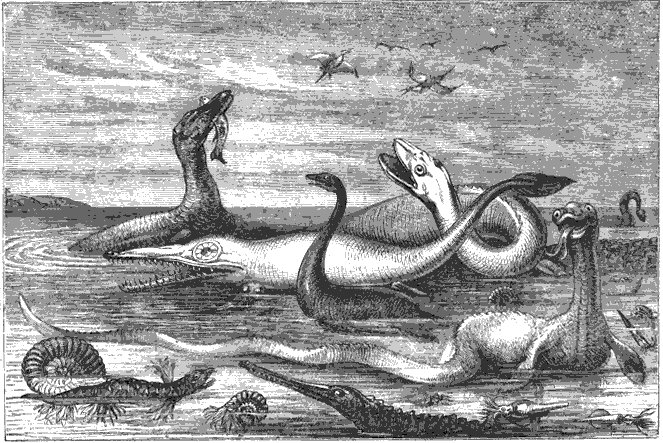
LIFE IN THE MESOZOIC PERIOD.
Aquatic Reptiles and Cephalopods. Reptiles.—Plesiosaur and Osteopygis, Ichthyosaur, Teliosaur, Plesiosaur, Elasmosaur, Mosasaur (in order of the heads from left to right).—Cephalopods.—Ammonite, Crioceras, Belemnites, Baculites, and Ammonites (in order from left to right). The Reptiles after Hawkins and Cope’s Restorations.
These animals may serve as specimens of the reptilian giants of the Mesozoic seas; but before leaving them we must at least invite attention to the remarkable fact that they were contemporary with species which represent the more common aquatic reptiles of the modern world. In other words, the monsters which we have described existed over and above a far more abundant population of crocodiles and turtles than the modern waters can boast. The crocodiles were represented both in Europe and America by numerous and large species, most of them with long snouts like the modern Gavials, a few with broad heads like those of the alligators. The turtles again presented not only many species, but most of the aquatic subdivisions of the group known in modern times, as for instance the Emydes or ordinary fresh-water forms, the snapping turtles, and the soft-shelled turtles. Cope says that the Cretaceous of New Jersey alone affords twenty species, one of them a snapping turtle six feet in length. Owen records above a dozen large species from the Upper Mesozoic of England, and dates the first appearance of the turtles in England about the time of the Portland stone, or in the upper half of the Mesozoic; but footprints supposed to be those of turtles are found as far back as the Trias. Perhaps no type of modern reptiles is more curiously specialized than these animals, yet we thus find them contemporaneous with many generalized types, and entering into existence perhaps as soon as they. The turtles did not culminate in the Mesozoic, but go on to be represented by more numerous and larger species in the Tertiary and Modern. In the case of the crocodiles, while they attained perhaps a maximum toward the end of the Mesozoic, it was in a peculiar form. The crocodiles of this old time had vertebrae with a hollow at each end like the fishes, or with a projection in the front. At the end of the Mesozoic this was changed, and they assumed a better-knit back, with joints having a ball behind and a socket in front. In the Cretaceous age, species having these two kinds of backbone were contemporaneous. Perhaps this improvement in the crocodilian back had something to do with the persistence of this type after so many others of the sea-lizards of the Mesozoic had passed away.
Of the fishes of the Mesozoic we need only say that they were very abundant, and consisted of sharks and ganoids of various types, until near the close of the period, when the ordinary horny-scaled fishes, such as abound in our present seas, appear to have been introduced. One curious point of difference is that the unequally lobed tail of the Palæozoic fishes is dropped in the case of the greater part of the ganoids, and replaced by the squarely-cut tail prevalent in modern times.
In the sub-kingdom of the Mollusca many important revolutions occurred. Among the lamp-shells a little Leptaena, no bigger than a pea, is the last and depauperated representative of a great Palæozoic family. Another, that of the Spirifers, still shows a few species in the Lower Mesozoic. Others, like Rhynchonella, and Terebratula, continue through the period, and extend into the Modern. Passing over the ordinary bivalves and sea-snails, which in the main conform to those of our own time, we find perhaps the most wonderful changes among the relatives of the cuttle-fishes and Nautili. As far back as the Silurian we find the giant Orthoceratites contemporary with Nautili, very like those of the present ocean. With the close of the Palæozoic, however, the Orthoceratites and their allies disappear, while the Nautili continue, and are reinforced by multitudes of new forms of spiral chambered shells, some of them more wonderful and beautiful than any of those which either preceded or followed them. Supreme among these is the great group of the Ammonites,—beautifully spiral shells, thin and pearly like the Nautilus, and chambered like it, so as to serve as a float, but far more elaborately constructed, inasmuch as the chambers were not simply curved, but crimped and convoluted, so as to give the outer wall much more effectual support. This outer wall, too, was worked into ornamental ribs and bands, which not only gave it exquisite beauty, but contributed to combine strength to resist pressure with the lightness necessary to a float. In some of these points it is true the Gyroceras and Goniatites of the Palæozoic partially anticipated them, but much less perfectly. The animals which inhabited these shells must have been similar to that of Nautilus, but somewhat different in the proportion of parts. They must have had the same power of rising and sinking in the water, but the mechanical construction of their shells was so much more perfect relatively to this end, that they were probably more active and locomotive than the Nautili. They must have swarmed in the Mesozoic seas, some beds of limestone and shale being filled with them; and as many as eight hundred species of this family are believed to be known, including, however, such forms as the Baculites or straight Ammonites, bearing to them perhaps a relation similar to that of Orthoceras to Nautilus. Further, some of the Ammonites are of gigantic size, one species being three feet in diameter, while others are very minute. The whole family of Ammonitids, which begins to be in force in the Trias, disappears at the end of the Mesozoic, so that this may be called the special age of Ammonites as well as of reptiles.
Further, this time was likewise distinguished by the introduction of true cuttle-fishes, the most remarkable of which were those furnished with the internal supports or “bones,” known as Belemnites, from a fancied resemblance to javelins or thunder-bolts, a comparison at least as baseless as that often made in England of the Ammonites to fossil snakes. The shell of the Belemnite is a most curious structure. Its usual general shape is a pointed cylinder or elongated cone. At top it has a deep cavity for the reception of certain of the viscera of the animal. Below this is a conical series of chambers, the Phragmacone; and the lower half of the shell is composed of a solid shelly mass or guard, which, in its structure of radiating fibres and concentric layers, resembles a stalactite, or a petrified piece of exogenous wood. This structure was an internal shell or support like those of the modern cuttle-fishes; but it is difficult to account for its peculiarities, so much more complex than in any existing species. The most rational supposition seems to be that it was intended to serve the triple purpose of a support, a float, and a sinker. Unlike the shell of a Nautilus, if thrown into the water it would no doubt have, sunk, and with the pointed end first. Consequently, it was not a float simply, but a float and sinker combined, and its effect must have been to keep the animal at the bottom, with its head upward. The Belemnite was therefore an exceptional cuttle-fish, intended to stand erect on the sea-bottom and probably to dart upward in search of its prey; for the suckers and hooks with which its arms were furnished show that, like other cuttle-fishes, it was carnivorous and predaceous. The guard may have been less ponderous when recent than in the fossil specimens, and in some species it was of small size or slender, and in others it was hollow. Possibly, also, the soft tissues of the animal were not dense, and it may have had swimming fins at the sides. In any case they must have been active creatures, and no doubt could dart backward by expelling water from their gill chamber, while we know that they had ink-bags, provided with that wonderfully divided pigment, inimitable by art, with which the modern Sepia darkens the water to shelter itself from its enemies. The Belemnites must have swarmed in the Mesozoic seas; and as squids and cuttles now afford choice morsels to the larger fishes, so did the Belemnites in their day. There is evidence that even the great sea-lizards did not disdain to feed on them. We can imagine a great shoal of these creatures darting up and down, seizing with their ten hooked arms their finny or crustacean prey. In an instant a great fish or saurian darts down among them; they blacken the water with a thick cloud of inky secretion and disperse on all sides, while their enemy, blindly seizing a few mouthfuls, returns sullenly to the surface. A great number of species of Belemnites and allied animals have been described; but it is probable that in naming them too little regard has been paid to distinctions of age and sex. The Belemnites were for the most part small creatures; but there is evidence that there existed with them some larger and more formidable cuttles; and it is worthy of note that, in several of these, the arms, as in the Belemnites, were furnished with hooks as well as suckers, an exceptional arrangement in their modern allies. It is probable that while the four-gilled or shell-bearing cuttles culminated in size and perfection in the Ammonitids of the Mesozoic, the modern cuttles of the two-gilled and shell-less type are grander in dimensions than their Mesozoic predecessors. It is, however, not a little singular that a group so peculiar and apparently so well provided with means, both of offence and defence, as the Belemnites, should come in and go out with the Mesozoic, and that the Nautiloid group, after attaining to the magnitude and complexity of the great Ammonites, should retreat to a few species of diminutive and simply-constructed Nautili; and in doing so should return to one of the old types dating as far back as the older Palæozoic, and continuing unchanged through all the intervening time.
The Crustaceans of the Mesozoic had lost all the antique peculiarities of the older time, and had so much of the aspect of those of the present day, that an ordinary observer, if he could be shown a quantity of Jurassic or Cretaceous crabs, lobsters, and shrimps, would not readily recognise the difference, which did not exceed what occurs in distant geographical regions in the present day. The same remark may be made as to the corals of the Mesozoic; and with some limitations, as to the star-fishes and sea-urchins, which latter are especially numerous and varied in the Cretaceous age. In short, all the invertebrate forms of life, and the fishes and reptiles among the vertebrates, had already attained their maximum elevation in the Mesozoic; and some of them have subsequently sunk considerably in absolute as well as relative importance.
In the course of the Mesozoic, as indicated in the last chapter, there had been several great depressions and re-elevations of the Continental Areas. But these had been of the same quiet and partial character with those of the Palæozoic, and it was not until the close of the Mesozoic time, in the Cretaceous age, that a great and exceptional subsidence involved for a long period the areas of our present continents in a submergence wider and deeper than any that had previously occurred since the dry land first rose out of the waters.
Every one knows the great chalk beds which appear in the south of England, and which have given its name to the latest age of the Mesozoic. This great deposit of light-coloured and usually soft calcareous matter attains in some places to the enormous thickness of 1,000 feet. Nor is it limited in extent. According to Lyell, its European distribution is from Ireland to the Crimea, a distance of 1,140 geographical miles; and from the south of France to Sweden, a distance of 840 geographical miles. Similar rocks, though not in all cases of the precise nature of chalk, occur extensively in Asia and in Africa, and also in North and South America.
But what is chalk? It was, though one of the most familiar, one of the most inscrutable of rocks, until the microscope revealed its structure. The softer varieties, gently grated or kneaded down in water, or the harder varieties cut in thin slices, show a congeries of microscopic chambered shells belonging to the humble and simple group of Protozoa. These shells and their fragments constitute the material of the ordinary chalk. With these are numerous spicules of sponges and silicious cell-walls of the minute one-celled plants called Diatoms. Further, the flinty matter of these organisms has by the law of molecular attraction been collected into concretions, which are the flints of the chalk. Such a rock is necessarily oceanic; but more than this, it is abyssal. Laborious dredging has shown that similar matter is now being formed only in the deep bed of the ocean, whither no sand or mud is drifted from the land, and where the countless hosts of microscopic shell-bearing protozoa continually drop their little skeletons on the bottom, slowly accumulating a chalky mud or slime. That such a rock should occur over vast areas of the continental plateaus, that both in Europe and America it should be found to cover the tops of hills several thousand feet high, and that its thickness should amount to several hundreds of feet, are facts which evidence a revolution more stupendous perhaps than that at the close of the Palæozoic. For the first time since the Laurentian, the great continental plateaus changed places with the abysses of the ocean, and the successors of the Laurentian Eozoon again reigned on surfaces which through the whole lapse of Palæozoic and Mesozoic time had been separated more or less from that deep ocean out of which they rose at first. This great Cretaceous subsidence was different from the disturbances of the Permian age. There was at first no crumpling of the crust, but merely a slow and long-continued sinking of the land areas, followed, however, by crumpling of the most stupendous character, which led at the close of the Cretaceous and in the earlier Tertiary to the formation of what are now the greatest mountain chains in the world. As examples may be mentioned the Himalaya, the Andes, and the Alps, on all which the deep-sea beds of the Cretaceous are seen at great elevations. In Europe this depression was almost universal, only very limited areas remaining out of water. In America a large tract remained above water in the region of the Appalachians. This gives us some clue to the phenomena. The great Permian collapse led to the crumpling-up of the Appalachians and the Urals, and the older hills of Western Europe. The Cretaceous collapse led to the crumpling of the great N.W. and S.E. chain of the Rocky Mountains and Andes, and to that of the east and west chains of the south of Asia and Europe. The cause was probably in both cases the same; but the crust gave way in a different part, and owing to this there was a greater amount of submergence of our familiar continental plateaus in the Cretaceous than in the Permian.
Another remarkable indication of the nature of the Cretaceous subsidence, is the occurrence of beds filled with grains of the mineral Glauconite or “green-sand.” These grains are not properly sand, but little concretions, which form in the bottom of the deep sea, often filling and taking casts of the interior and fine tubes of Foraminiferal shells. Now this Glauconite, a hydrous silicate of iron and potash, is akin to similar materials found filling the pores of fossils in Silurian beds. It is also akin to the Serpentine filling the pores of Eozoon in the Laurentian. Such materials are formed only in the deeper parts of the ocean, and apparently most abundantly where currents of warm water are flowing at the surface, as in the area of the Gulf Stream. Thus, not only in the prevalence of Foraminifera, but in the formation of hydrous silicates, does the Cretaceous recall the Laurentian. Such materials had no doubt been forming, and such animals living in the ocean depths, all through the intervening ages, but with the exception of a few and merely local instances, we know nothing of them, till the great subsidence and re-elevation of the Cretaceous again allows them to ascend to the continental plateaus, and again introduces us to this branch of the world-making process.
The attention recently drawn to these facts by the researches of Dr. Carpenter and others, and especially the similarity in mineral character and organic remains of some of the deposits now forming in the Atlantic and those of the chalk, have caused it to be affirmed that in the bed of the Atlantic these conditions of life and deposit have continued from the Cretaceous up to the present time, or as it has been expressed, that “we are still living in the Cretaceous epoch.” Now, this is true or false just as we apply the statement. We have seen that the distinction between abyssal areas, continental oceanic plateaus, and land surfaces has extended through the whole lapse of geological time. In this broad sense we may be said to be still living in the Laurentian epoch. In other words, the whole plan of the earth’s development is one and the same, and each class of general condition once introduced is permanent somewhere. But in another important sense we are not living in the Cretaceous epoch; otherwise the present site of London would be a thousand fathoms deep in the ocean; the Ichthyosaurs and Ammonites would be disporting themselves in the water, and the huge Dinosaurs and strange Pterodactyls living on the land. The Italian peasant is still in many important points living in the period of the old Roman Empire. The Arab of the desert remains in the Patriarchal period, and there are some tribes not yet beyond the primitive age of stone. But the world moves, nevertheless, and the era of Victoria is not that of the Plantagenets or of Julius Cæsar. So while we may admit that certain of the conditions of the Cretaceous seas still prevail in the bed of the present ocean, we must maintain that nearly all else is changed, and that the very existence of the partial similarity is of itself the most conclusive proof of the general want of resemblance, and of the thorough character of the changes which have occurred.
The duration of the Cretaceous subsidence must have been very great. We do not know the rate at which the Foraminifera accumulate calcareous mud. In some places, where currents heap up their shells, they may be gathered rapidly; but on the average of the ocean bed, afoot of such material must indicate the lapse of ages very long when compared with those of modern history. We need not wonder, therefore, that while some forms of deep-sea Cretaceous life, especially of the lower grades, seem to have continued to our time, the inhabitants of the shallow waters and the land have perished; and that the Neozoic or Tertiary period introduces us to a new world of living beings. I say we need not wonder; yet there is no reason why we should expect this as a necessary consequence. As the Cretaceous deluge rose over the continents of the Mesozoic, the great sea saurians might have followed. Those of the land might have retreated to the tracts still remaining out of water, and when the dry land again appeared in the earlier Tertiary, they might again have replenished the earth, and we might thus have truly been living in the Reptilian age up to this day. But it was not so. The old world again perished, and the dawn of the Tertiary shows to us at once the dynasties of the Mammalian age, which was to culminate in the introduction of man. With the great Cretaceous subsidence the curtain falls upon the age of reptiles, and when it rises again, after the vast interval occupied in the deposition of the green-sand and chalk, the scene has entirely changed. There are new mountains and new plains, forests of different type, and animals such as no previous age had seen.
How strange and inexplicable is this perishing of types in the geological ages! Some we could well spare. We would not wish to have our coasts infested by terrible sea saurians, or our forests by carnivorous Dinosaurs. Yet why should these tyrants of creation so utterly disappear without waiting for us to make war on them? Other types we mourn. How glorious would the hundreds of species of Ammonites have shone in the cases of our museums, had they still lived! What images of beauty would they have afforded to the poets who have made so much of the comparatively humble Nautilus! How perfectly, too, were they furnished with all those mechanical appliances for their ocean life, which are bestowed only with a niggardly hand on their successors! Nature gives us no explanation of the mystery.
“From scarped cliff and quarried stone, She cries—‘A thousand types are gone.’”
But why or how one was taken and another left she is silent, and I believe must continue to be so, because the causes, whether efficient or final, are beyond her sphere. If we wish for a full explanation, we must leave Nature, and ascend to the higher domain of the Spiritual.
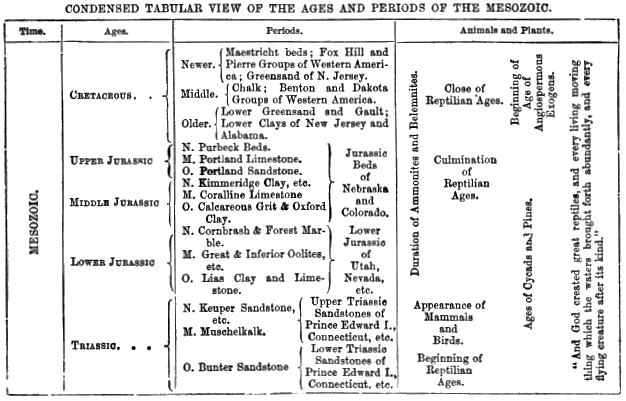
Click on table to view larger version.
CHAPTER X.
THE NEOZOIC AGES.
Between the Mesozoic and the next succeeding time which may be known as the Neozoic or Tertiary,[AG] there is in the arrangements of most geologists a great break in the succession of life; and undoubtedly the widespread and deep subsidence of the Cretaceous, followed by the elevation of land on a great scale at the beginning of the next period, is a physical cause sufficient to account for vast life changes. Yet we must not forget to consider that even in the Cretaceous itself there were new features beginning to appear. Let us note in this way, in the first place, the introduction of the familiar generic forms of exogenous trees. Next we may mention the decided prevalence of the modern types of coral animals and of a great number of modern generic forms of mollusks. Then we have the establishment of the modern tribes of lobsters and crabs, and the appearance of nearly all the orders of insects. Among vertebrates, the ordinary fishes are now introduced. Modern orders of reptiles, as the crocodiles and chelonians, had already appeared, and the first mammals. Henceforth the progress of organic nature lies chiefly in the dropping of many Mesozoic forms and in the introduction of the higher tribes of mammals and of man.
It is further to be observed that the new things introduced in the later Mesozoic came in little by little in the progress of the period, and anticipated the great physical changes occurring at its close. On the other hand, while many family and even generic types pass over from the Mesozoic to the earlier Tertiary, very few species do so. It would seem, therefore, as if changes of species were more strictly subordinate to physical revolutions than were changes of genera and orders—these last overriding under different specific forms many minor vicissitudes, and only in part being overwhelmed in the grander revolutions of the earth.
Both in Europe and America there is evidence of great changes of level at the beginning of the Tertiary. In the west of Europe beds often of shallow-water or even fresh-water origin fill the hollows in the bent Cretaceous strata. This is manifestly the case with the formations of the London and Paris basins, contemporaneous but detached deposits of the Tertiary age, lying in depressions of the chalk. Still this does not imply much want of conformity, and according to the best explorers of those Alpine regions in which both the Mesozoic and Tertiary beds have been thrown up to great elevations, they are in the main conformable to one another. Something of the same kind occurs in America. On the Atlantic coast the marine beds of the Older Tertiary cover the Cretaceous, and little elevation seems to have occurred Farther west the elevation increases, and in the upper part of the valley of the Mississippi it amounts to 1700 feet. Still farther west, in the region of the Rocky Mountains, there is evidence of elevation to the extent of as much as 7000 feet. Throughout all these regions scarcely any disturbance of the old Cretaceous sea-bottom seems to have occurred until after the deposition of the older Tertiary, so that there was first a slow and general elevation of the Cretaceous ocean bottom, succeeded by gigantic folds and fractures, and extensive extravasations of the bowels of the earth in molten rocks, in the course of the succeeding Tertiary age. These great physical changes inaugurated the new and higher life of the Tertiary, just as the similar changes in the Permian did that of the Mesozoic.
The beginning of these movements consisted of a great and gradual elevation of the northern parts of both the Old and New Continents out of the sea, whereby a much greater land surface was produced, and such changes of depth and direction of currents in the ocean as must have very much modified the conditions of marine life. The effect of all these changes in the aggregate was to cause a more varied and variable climate, and to convert vast areas previously tenanted by marine animals into the abodes of animals and plants of the land, and of estuaries, lakes, and shallow waters. Still, however, very large areas now continental were under the sea. As the Tertiary period advanced, these latter areas were elevated, and in many cases were folded up into high mountains. This produced further changes of climate and habitat of animals, and finally brought our continents into all the variety of surface which they now present, and which fits them so well for the habitation of the higher animals and of man.
The thoughtful reader will observe that it follows from the above statements that the partial distribution and diversity in different localities which apply to the deposits of such ages as the Permian and the Trias apply also to the earlier Tertiary; and as the continents, notwithstanding some dips under water, have retained their present forms since the beginning of the Tertiary, it follows that these beds are more definitely related to existing geographical conditions than are those of the older periods, and that the more extensive marine deposits of the Tertiary are, to a great extent, unknown to us. This has naturally led to some difficulty in the classification of Neozoic deposits—those of some of the Tertiary ages being very patchy and irregular, while others spread very widely. In consequence of this, Sir Charles Lyell, to whom we owe very much of our definite knowledge of this period, has proposed a subdivision based on the percentage of recent and fossil animals. In other words, he takes it for granted that a deposit which contains more numerous species of animals still living than another, may be judged on that account to be more recent. Such a mode of estimation is, no doubt, to some extent arbitrary; but in the main, when it can be tested by the superposition of deposits, it has proved itself reliable. Further, it brings before us this remarkable fact, that while in the older periods all the animals whose remains we find are extinct as species, so soon as we enter on the Neozoic we find some which still continue to our time—at first only a very few, but in later and later beds in gradually increasing percentage, till the fossil and extinct wholly disappear in the recent and living.
The Lyellian classification of the Tertiary will therefore stand as in the following table, bearing in mind that the percentage of fossils is taken from marine forms, and mainly from mollusks, and that the system has in some cases been modified by stratigraphical evidence:—
Tertiary, or Neozoic Time. Post-pliocene, including that which immediately precedes the Modern. In this the shells, etc., are recent, the Mammalia in part extinct. Pliocene, or more recent age. In this the majority of shells found are recent in the upper beds. In the lower beds the extinct become predominant. Miocene, or less recent. In this the large majority of shells found are extinct. Eocene, the dawn of the recent. In this only a few recent shells occur.
If we attempt to divide the Tertiary time into ages corresponding to those of the older times, we are met by the difficulty that as the continents have retained their present forms and characters to a great extent throughout this time, we fail to find those evidences of long-continued submergences of the whole continental plateaus, or very large portions of them, which we have found so very valuable in the Palæozoic and Mesozoic. In the Eocene, however, we shall discover one very instructive case in the great Nummulitic Limestone. In the Miocene and Pliocene the oscillations seem to have been slight and partial. In the Post-pliocene we have the great subsidence of the glacial drift; but that seems to have been a comparatively rapid dip, though of long duration when measured by human history; not allowing time for the formation of great limestones, but only of fossiliferous sands and clays, which require comparatively short time for their deposition If then we ask as to the duration of the Neozoic, I answer that we have not a definite measure of its ages, if it had any; and that it is possible that the Neozoic may have as yet had but one age, which closed with the great drift period, and that we are now only in the beginning of its second age. Some geologists, impressed with this comparative shortness of the Tertiary, connect it with Mesozoic, grouping both together. This, however, is obviously unnatural. The Mesozoic time certainly terminated with the Cretaceous, and what follows belongs to a distinct aeon.
But we must now try to paint the character of this new and peculiar time; and this may perhaps be best done in the following sketches: 1. The seas of the Eocene. 2. Mammals from the Eocene to the Modern. 3. Tertiary floras. 4. The Glacial period. 5. The Advent of Man.
The great elevation of the continents which closed the Cretaceous was followed by a partial and unequal subsidence, affecting principally the more southern parts of the land of the northern hemisphere. Thus, a wide sea area stretched across all the south of Europe and Asia, and separated the northern part of North America from what of land existed in the southern hemisphere. This is the age of the great Nummulitic Limestones of Europe, Africa, and Asia, and the Orbitoidal Limestones of North America. The names are derived from the prevalence of certain forms of those humble shell-bearing protozoa which we first met with in the Laurentian, and which we have found to be instrumental in building up the chalk, the Foraminifera of zoologists. (Fig. p. 243.) But in the Eocene the species of the chalk were replaced by certain broad flat forms, the appearance of which is expressed by the term nummulite, or money-stone; the rock appearing to be made up of fossils, somewhat resembling shillings, sixpences, or three-penny pieces, according to the size of the shells, each of which includes a vast number of small concentric chambers, which during life were filled with the soft jelly of the animal. The nummulite limestone was undoubtedly oceanic, and the other shells contained in it are marine species. After what we have already seen we do not need this limestone to convince us of the continent-building powers of the oceanic protozoa; but the distribution of these limestones, and the elevation which they attain, furnish the most striking proofs that we can imagine of the changes which the earth’s crust has undergone in times geologically modern, and also of the extreme newness of man and his works. Large portions of those countries which constitute the earliest seats of man in Southern Europe, Northern Africa, and Western and Southern Asia, are built upon the old nummulitic sea-bottom. The Egyptians and many other ancient nations quarried it for their oldest buildings. In some of these regions it attains a thickness of several thousand feet, evidencing a lapse of time in its accumulation equal to that implied in the chalk itself. In the Swiss Alps it reaches a height above the sea of 10,000 feet, and it enters largely into the structure of the Carpathians and Pyrenees. In Thibet it has been observed at an elevation of 16,500 feet above the sea. Thus we learn that at a time no more geologically remote than the Eocene Tertiary, lands now of this great elevation were in the bottom of the deep sea; and this not merely for a little time, but during a time sufficient for the slow accumulation of hundreds of feet of rock, made up of the shells of successive generations of animals. If geology presented to us no other revelation than this one fact, it would alone constitute one of the most stupendous pictures in physical geography which could be presented to the imagination. I beg leave here to present to the reader a little illustration of the limestone-making Foraminifera of the Cretaceous and Eocene seas. In the middle above is a nummulite of the natural size. Below is another, sliced to show its internal chambers. At one side is a magnified section of the common building stone of Paris, the milioline limestone of the Eocene, so called from its immense abundance of microscopic shells of the genus Miliolina. At the other side is a magnified section of one of the harder varieties of chalk, ground so thin as to become transparent,[AH] and mounted in Canada balsam. It shows many microscopic chambered shells of Foraminifera. These may serve as illustrations of the functions of these humble inhabitants of the sea as accumulators of calcareous matter. It is further interesting to remark that some of the beds of nummulitic limestone are so completely filled with these shells, that we might from detached specimens suppose that they belonged to sea-bottoms whereon no other form of life was present. Yet some beds of this age are remarkably rich in other fossils. Lyell states that as many as six hundred species of shells have been found in the principal limestone of the Paris basin alone; and the lower Eocene beds afford remains of fishes, of reptiles, of birds, and of mammals. Among the latter are the bones of gigantic whales, of which one of the most remarkable is the Zeuglodon of Alabama, a creature sometimes seventy feet in length, and which replaces in the Tertiary the great Elasmosaurs and Ichthyosaurs of the Mesozoic, marking the advent, even in the sea, of the age of Mammals as distinguished from the age of Reptiles.
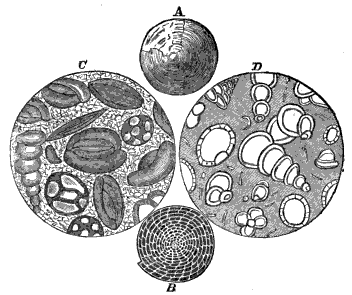
FORAMINIFERAL ROCK-BUILDERS.
A. Nummulites lævigata—Eocene. B. The same, showing chambered interior. C. Milioline limestone, magnified—Eocene, Paris. D. Hard Chalk, section magnified—Cretaceous.
This fact leads us naturally to consider in the second place the mammalia, and other land animals of the Tertiary. At the beginning of the period we meet with that higher group of mammals, not pouched, which now prevails. Among the oldest of these Tertiary beasts are Coryphodon, an animal related to the Modern Tapirs, and Arctocyon, a creature related to the bears and racoons. These animals represent respectively the Pachyderms, or thick-skinned mammals, and the ordinary Carnivora. Contemporary with or shortly succeeding these, were species representing the Rodents, or gnawing animals, and many other creatures of the group Pachydermata, allied to the Modern Tapirs and Hogs, as well as several additional carnivorous quadrupeds. Thus at the very beginning of the Tertiary period we enter on the age of mammals, It may be well, however, to take these animals somewhat in chronological order.
If the old Egyptian, by quarrying the nummulite limestone, bore unconscious testimony to the recent origin of man (whose remains are wholly absent from the Tertiary deposits), so did the ancient Britons and Gauls, when they laid the first rude foundations of future capitals on the banks of the Thames and of the Seine. Both cities lie in basins of Eocene Tertiary, occupying hollows in the chalk. Under London there is principally a thick bed of clay, the “London clay” attaining a thickness of five hundred feet. This bed is obviously marine, containing numerous species of sea shells; but it must have been deposited near land, as it also holds many fossil fruits and other remains of plants to which we shall refer in the sequel, and the bones of several species of large animals. Among these the old reptiles of the Mesozoic are represented by the vertebrae of a supposed “sea snake” (Palæophis) thirteen feet long, and species of crocodile allied both to the alligators and the gavials. But besides these there are bones of several animals allied to the hog and tapir, and also a species of opossum, These remains must be drift carcases from neighbouring shores, and they show first the elevation of the old deep-sea bottom represented by the chalk, so that part of it became dry land; next, the peopling of that land by tribes of animals and plants unknown to the Mesozoic; and lastly, that a warm climate must have existed, enabling England at this time to support many types of animals and plants now proper to intertropical regions. As Lyell well remarks, it is most interesting to observe that these beds belong to the beginning of the Tertiary, that they are older than those great nummulite limestones to which we have referred, and that they are older than the principal mountain chains of Europe and Asia. They show that no sooner was the Cretaceous sea dried from off the new land, than there were abundance of animals and plants ready to occupy it, and these not the survivors of the flora and fauna of the Wealden, but a new creation. The mention of the deposit last named places this in a striking light. We have seen that the Wealden beds, under the chalk, represent a Mesozoic estuary, and in it we have the remains of the animals and plants of the land that then was. The great Cretaceous subsidence intervened, and in the London clay we have an estuary of the Eocene. But if we pass through the galleries of a museum where these formations are represented, though we know that both existed in the same locality under a warm climate, we see that they belong to two different worlds, the one to that of the Dinosaurs, the Ammonites, the Cycads, and the minute Marsupials of the Mesozoic, the other to that of the Pachyderms, the Palms, and the Nautili of the Tertiary.
The London clay is lower Eocene; but in the beds of the Isle of Wight and neighbouring parts of the South of England, we have the middle and upper members of the series. They are not, however, so largely developed as in the Paris basin, where, resting on the equivalent of the London clay, we have a thick marine limestone, the Calcaire Grossier, abounding in marine remains, and in some beds composed of shells of foraminifera. The sea in which this limestone was deposited, a portion no doubt of the great Atlantic area of the period, became shallow, so that beds of sand succeeded those of limestone, and finally it was dried up into lake basins, in which gypsum, magnesian sediments, and siliceous limestone were deposited. These lakes or ponds must at some period have resembled the American “salt-licks,” and were no doubt resorted to by animals from all the surrounding country in search of the saline mud and water which they afforded. Hence in some marly beds intervening between the layers of gypsum, numerous footprints occur, exactly like those already noticed in the Trias. Had there been a Nimrod in those days to watch with bow or boomerang by the muddy shore, he would have seen herds of heavy short-legged and three-hoofed monsters (Palæotherium), with large heads and long snouts, probably scantily covered with sleek hair, and closely resembling the Modern Tapirs of South America and India, laboriously wading through the mud, and grunting with indolent delight as they rolled themselves in the cool saline slime. Others more light and graceful, combining some features of the antelope with those of the Tapir (Anoplotherium) ran in herds over the drier ridges, or sometimes timidly approached the treacherous clay, tempted by the saline waters. Other creatures representing the Modern Damans or Conies—“feeble folk” which, with the aspect of hares, have the structure of Pachyderms—were also present. Creatures of these types constituted the great majority of the animals of the Parisian Eocene lakes; but there were also Carnivorous animals allied to the hyæna, the wolf, and the opossum, which prowled along the shores by night to seize unwary wanderers, or to prey on the carcases of animals mired in the sloughs. Wading birds equal in size to the ostrich also stalked through the shallows, and tortoises crawled over the mud.
Lyell mentions the discovery of some bones of one of these gigantic birds (Gastornis) in a bed of the rolled chalk flints which form the base of the Paris series, resting immediately on the chalk; one of the first inhabitants perhaps to people some island of chalk just emerged from the waters, and under which lay the bones of the mighty Dinosaurs, and in which were embedded those of sea birds that had ranged, like the albatross and petrel, over the wide expanse of the Cretaceous ocean. These waders, however, like the tortoises and crocodiles and small marsupial mammals, form a link of connection in type at least between the Eocene and the Cretaceous, for bones of wading birds have been found in the Greensands indicating their existence before the close of the Mesozoic.
The researches of Baron Cuvier in the bones collected in the quarries of Montmartre were regarded as an astonishing triumph of comparative anatomy; and familiar as we now are with similar and yet more difficult achievements, we can yet afford to regard with admiration the work of the great French naturalist as it is recorded in its collected form in his “Recherches sur les Ossemens Fossiles,” published in 1812. His clear and philosophical views as to the plan perceptible in nature, his admirable powers of classification, his acute perception of the correlation of parts in animals, his nice discrimination of the resemblances and differences of fossil and recent structures, and of the uses of these,—all mark him as one of the greatest minds ever devoted to the study of natural science. It is obvious, that had his intellect been occupied by the evolutionist metaphysics which pass for natural science with too many in our day, he would have effected comparatively little; and instead of the magnificent museum in the “Règne Animal” and the “Ossemens Fossiles,” we might have had wearisome speculations on the derivation of species. It is reason for profound thankfulness that it was not so; and also that so many great observers and thinkers of our day, like Sedgwick, Murchison, Lyell, Owen, Dana, and Agassiz, have been allowed to work out their researches almost to completion before the advent of those poisoned streams and mephitic vapours which threaten the intellectual obscuration of those who should be their successors.
If we pass from the Eocene to the Miocene, still confining ourselves mainly to mammalian life, we find three remarkable points of difference—(1) Whereas the Eocene mammals are remarkable for adherence to one general type, viz., that group of pachyderms most regular and complete in its dentition, we now find a great number of more specialised and peculiar forms; (2) We find in the latter period a far greater proportion of large carnivorous animals; (3) We find much greater variety of mammals than either in the Eocene or the Modern, and a remarkable abundance of species of gigantic size. The Miocene is thus apparently the culminating age of the mammalia, in so far as physical development is concerned; and this, as we shall find, accords with its remarkably genial climate and exuberant vegetation.
In Europe, the beds of this age present, for the first time, examples of the monkeys, represented by two generic types, both of them apparently related to the modern long-armed species, or Gibbons. Among carnivorous animals we have cat-like creatures, one of which is the terrible Machairodus, distinguished from all modern animals of its group by the long sabre-shaped canines of its upper jaw, fitting it to pull down and destroy those large pachyderms which could have easily shaken off a lion or a tiger. Here also we have the elephants, represented by several species now extinct; the mastodon, a great, coarsely-built, hog-like elephant, some species of which had tusks both in the upper and lower jaw; the rhinoceros, the hippopotamus, and the horse, all of extinct species. We have also giraffes, stags, and antelopes, the first ruminants known to us, and a great variety of smaller and less noteworthy creatures. Here also, for the first time, we find the curious and exceptional group of Edentates, represented by a large ant-eater. Of all the animals of the European Miocene, the most wonderful and unlike any modern beast, is the Dinotherium, found in the Miocene of Epplesheim in Germany; and described by Kaup. Some doubt rests on the form and affinities of the animal; but we may reasonably take it, as restored by its describer, and currently reproduced in popular books, to have been a quadruped of somewhat elephantine form. Some years ago, however, a huge haunch bone, supposed to belong to this creature, was discovered in the South of France; and from this it was inferred that the Dinothere may have been a marsupial or pouched animal, perhaps allied in form and habits to the kangaroos. The skull is three feet four inches in length; and when provided with its soft parts, including a snout or trunk in front, it must have been at least five or six feet long. Such a head, if it belonged to a quadruped of ordinary proportions, must represent an animal as large in proportion to our elephant as an elephant to an ox. But its size is not its most remarkable feature. It has two large tusks firmly implanted in strong bony sockets; but they are attached to the end of the lower jaw and point downward at right angles to it, so that the lower jaw forms a sort of double-pointed pickaxe of great size and strength. This might have been used as a weapon; or, if the creature was aquatic, as a grappling iron to hold by the bank, or by floating timber; but more probably it was a grubbing-hoe for digging up roots or loosening the bases of trees which the animal might afterward pull down to devour them. However this may be, the creature laboured under the mechanical disadvantage of having to lift an immense weight in the process of mastication, and of being unable to bring its mouth to the ground, or to bite or grasp anything with the front of its jaws. To make up for this, it had muscles of enormous power on the sides of the head attached to great projecting processes; and it had a thick but flexible proboscis, to place in its mouth the food grubbed up by its tusks. Taken altogether, the Dinothere is perhaps the most remarkable of mammals, fossil or recent; and if the rest of its frame were as extraordinary as its skull, we have probably as yet but a faint conception of its peculiarities. We may apply to it, with added force, the admiring ejaculation of Job, when he describes the strength of the hippopotamus, “He is the chief of the ways of God. He who made him, gave him his sword.”
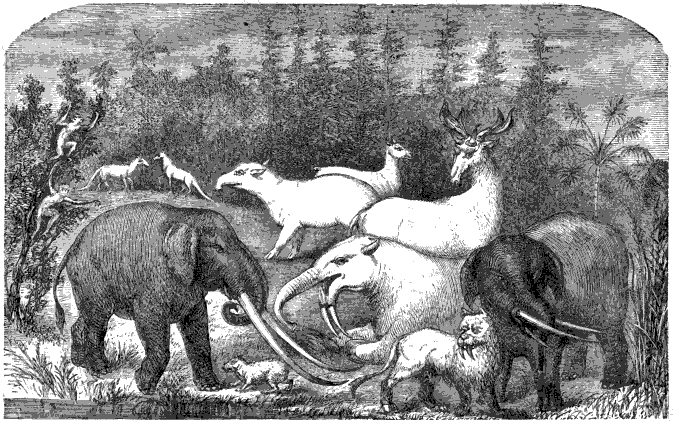
MIOCENE MAMMALS OF THE EASTERN CONTINENT.
In the foreground Elephas, Ganesa, Hydracotherium, Dinotherium, Machairodus, Mastodon longirostris. In the middle distance, Apes, two Anoplotheres, Palæotherium, Xiphodon, and Sivatherium. Sequoias and Fan Palm in the background.
In Asia, the Siwalik hills afforded to Falconer and Cautley one of the most remarkable exhibitions of Miocene animals in the world. These hills form a ridge subordinate to the Himalayan chain; and rise to a height of 2,000 to 3,000 feet. In the Miocene period, they were sandy and pebbly shores and banks lying at the foot of the then infant Himalayas, which, with the table-lands to the north, probably formed a somewhat narrow east and west continental mass or large island. As a mere example of the marvellous fauna which inhabited this Miocene land, it has afforded remains of seven species of elephants, mastodons, and allied animals; one of them, the E. Ganesa, with tusks ten feet and a half long, and twenty-six inches in circumference at the base. Besides these there are five species of rhinoceros, three of horse and allied animals, four or more of hippopotamus, and species of camel, giraffe, antelope, sheep, ox, and many other genera, as well as numerous large and formidable beasts of prey. There is also an ostrich; and, among other reptiles, a tortoise having a shell twelve feet in length, and this huge roof must have covered an animal eighteen feet long and seven feet high. Among the more remarkable of the Siwalik animals is the Sivatherium, a gigantic four-horned antelope or deer, supposed to have been of elephantine size, and of great power and swiftness; and to have presented features connecting the ruminants and pachyderms. Our restoration of this creature is to some extent conjectural; and a remarkably artistic, and probably more accurate, restoration of the animal has recently been published by Dr. Murie, in the Geological Magazine. We justly regard the Mammalian fauna of modern India as one of the noblest in the world; but it is paltry in comparison with that of the much more limited Miocene India; even if we suppose, contrary to all probability, that we know most of the animals of the latter. But if we consider the likelihood that we do not yet know a tenth of the Miocene animals, the contrast becomes vastly greater.
Miocene America is scarcely behind the Old World in the development of its land animals. From one locality in Nebraska, Leidy described in 1852 fifteen species of large quadrupeds; and the number has since been considerably increased. Among these are species of Rhinoceros, Palæotherium, and Machairodus; and one animal, the Titanotherium, allied to the European Anoplothere, is said to have attained a length of eighteen feet and a height of nine, its jaws alone being five feet long.
In the illustration, I have grouped some of the characteristic Mammalian forms of the Miocene, as we can restore them from their scattered bones, more or less conjecturally; but could we have seen them march before us in all their majesty, like the Edenic animals before Adam, I feel persuaded that our impressions of this wonderful age would have far exceeded anything that we can derive either from words or illustrations. I insist on this the more that the Miocene happens to be very slenderly represented in Britain; and scarcely at all in north-eastern America; and hence has not impressed the imagination of the English race so strongly as its importance justifies.
The next succeeding period, that of the Pliocene, continues the conditions of the last, but with signs of decadence. Many of the old gigantic pachyderms have disappeared; and in their stead some familiar modern genera were introduced. The Pliocene was terminated by the cold or glacial period, in which a remarkable lowering of temperature occurred over all the northern hemisphere, accompanied, at least in a portion of the time, by a very general and great subsidence, which laid all the lower parts of our continents under water. This terminated much of the life of the Pliocene, and replaced it with boreal and Arctic forms, some of them, like the great hairy Siberian mammoth and the woolly rhinoceros, fit successors of the gigantic Miocene fauna. How it happened that such creatures were continued during the Post-pliocene cold, we cannot understand till we have the Tertiary vegetation before us. It must suffice now to say, that as the temperature was modified, and the land rose, and the Modern period was inaugurated, these animals passed away, and those of the present time remained.
Perhaps the most remarkable fact connected with this change, is that stated by Pictet, that all the modern European mammals are direct descendants of Post-pliocene species; but that in the Post-pliocene they were associated with many other species; and these, often of great dimensions, now extinct. In other words, the time from the Pliocene to the Modern, has been a time of diminution of species, while that from the Eocene to the Miocene was a time of rapid introduction of new species. Thus the Tertiary fauna culminated in the Miocene. Yet, strange though this may appear, Man himself, the latest and noblest of all, would seem to have been a product of the later stages of the time of decadence. I propose, however, to return to the animals immediately preceding man and his contemporaries, after we have noticed the Tertiary flora and the Glacial period.
CHAPTER XI.
THE NEOZOIC AGES (continued).
Plant-life in the Tertiary approaches very nearly to that of the Modern World, in so far as its leading types are concerned; but in its distribution geographically it was wonderfully different from that with which we are at present familiar. For example, in the Isle of Sheppey, at the mouth of the Thames, are beds of “London clay,” fall of fossil nuts; and these, instead of being hazel nuts and acorns, belong to palms allied to species now found in the Philippine Islands and Bengal, while with them are numerous cone-like fruits belonging to the Proteaceæ (banksias, silver-trees, wagenbooms, etc.), a group of trees now confined to Australia and South Africa, but which in the Northern Hemisphere had already, as stated in a previous paper, made their appearance in the Cretaceous, and were abundant in the Eocene. The state of preservation of these fruits shows that they were not drifted far; and in some beds in Hampshire, also of Eocene age, the leaves of similar plants occur along with species of fig, cinnamon, and other forms equally Australian or Indian. In America, especially in the west, there are thick and widely-distributed beds of lignite or imperfect coal of the Eocene period; but the plants found in the American Eocene are more like those of the European Miocene or the Modern American flora, a fact to which we must revert immediately.
In Europe, while the Eocene plants resemble those of Australia, when we ascend into the Miocene they resemble those of America, though still retaining some of the Australian forms. In the leaf-beds of the Isle of Mull,—where beds of vegetable mould and leaves were covered up with the erupted matter of a volcano belonging to a great series of such eruptions which produced the basaltic cliffs of Antrim and of Staffa,—and at Bovey, in Devonshire, where Miocene plants have accumulated in many thick beds of lignite, the prevailing plants are sequoias or red-woods, vines, figs, cinnamons, etc. In the sandstones at the base of the Alps similar plants and also palms of American types occur. In the Upper Miocene beds of [OE]ningen in the Rhine valley, nearly five hundred species of plants have been found, and include such familiar forms as the maples, plane-trees, cypress, elm, and sweet-gum, more American, however, than European in their aspect. It thus appears that the Miocene flora of Europe resembles that of America at pre sent, while the Eocene flora of Europe resembles that of Australia, and the Eocene flora of America, as well as the modern, resembles the Miocene of Europe. In other words, the changes of the flora have been more rapid in Europe than in America and probably slowest of all in Australia. The Eastern Continent has thus taken the lead in rapidity of change in the Tertiary period, and it has done so in animals as well as in plants.
The following description of the flora of Bovey is given, with slight alteration, in the words of Dr. Heer, in his memoir on that district. The woods that covered the slopes consisted mainly of a huge pine-tree (sequoia), whose figure resembled in all probability its highly-admired cousin, the giant Wellingtonia of California. The leafy trees of most frequent occurrence were the cinnamon and an evergreen oak like those now seen in Mexico. The evergreen figs, the custard apples, and allies of the Cape jasmine, were rarer. The trees were festooned with vines, beside which the prickly rotang palm twined its snake-like form. In the shade of the forest throve numerous ferns, one species of which formed trees of imposing grandeur, and there were masses of under-wood belonging to various species of Nyssa, like the tupelos and sour-gums of North America. This is a true picture, based on actual facts, of the vegetation of England in the Miocene age.
But all the other wonders of the Miocene flora are thrown into the shade by the discoveries of plants of this age which have recently been made in Greenland, a region now bound up in what we poetically call eternal ice, but which in the Miocene was a fair and verdant land, rejoicing in a mild climate and rich vegetation. The beds containing these specimens occur in various places in North Greenland; and the principal locality, Atane-Kerdluk, is in lat. 70 N. and at an elevation of more than a thousand feet above the sea. The plants occur abundantly in sandstone and clay beds, and the manner in which delicate leaves and fruits are preserved shows that they have not been far water-borne, a conclusion which is confirmed by the occurrence of beds of lignite of considerable thickness, and which are evidently peaty accumulations containing trunks of trees. The collections made have enabled Heer to catalogue 137 species, all of them of forms proper to temperate, or even warm regions, and mostly American in character. As many as forty-six of the species already referred to as occurring at Bovey Tracey and [OE]ningen occur also in the Greenland beds. Among the plants are many species of pines, some of them of large size; and the beeches, oaks, planes, poplars, maples, walnuts, limes, magnolias, and vines are apparently as well represented as in the warm temperate zone of America at the present day. This wonderful flora was not a merely local phenomenon, for similar plants are found in Spitzbergen in lat. 78° 56'. It is to be further observed, that while the general characters of these ancient Arctic plants imply a large amount of summer heat and light, the evergreens equally imply a mild winter. Further, though animal remains are not found with these plants, it is probable that so rich a supply of vegetable food was not unutilised, and that we shall some time find that there was an Arctic fauna corresponding to the Arctic flora. How such a climate could exist in Greenland and Spitzbergen is still a mystery. It has, however, been suggested that this effect might result from the concurrence of such astronomical conditions in connection with the eccentricity of the earth’s orbit as would give the greatest amount of warmth in the Northern Hemisphere with such distribution of land and water as would give the least amount of cold northern land and the most favourable arrangement of the warm surface currents of the ocean.[AI]
Before leaving these Miocene plants, I must refer to a paragraph which Dr. Heer has thought it necessary to insert in his memoir on the Greenland flora, and which curiously illustrates the feebleness of what with some men passes for science. He says: “In conclusion, I beg to offer a few remarks on the amount of certainty in identification which the determination of fossil plants is able to afford us. We know that the flowers, fruits, and seeds are more important as characteristics than the leaves. There are many genera of which the leaves are variable, and consequently would be likely to lead us astray if we trusted in them alone. However, many characters of the form and venation of leaves are well-known to be characteristic of certain genera, and can therefore afford us characters of great value for their recognition.” In a similar apologetic style he proceeds through several sentences to plead the cause of his Greenland leaves. That he should have to do so is strange, unless indeed the botany known to those for whom he writes is no more than that which a school-girl learns in her few lessons in dissecting a buttercup or daisy. It is easy for scientific triflers to exhibit collections of plants in which species of different genera and families are so similar in their leaves that a careless observer would mistake one for the other, or to get up composite leaves in part of one species and in part of another, and yet seeming the same, and in this way to underrate the labours of painstaking observers like Heer. But it is nevertheless true that in any of these leaves, not only are there good characters by which they can be recognised, but that a single breathing pore, or a single hair, or a few cells, or a bit of epidermis not larger than a pin’s head, should enable any one who understands his business to see as great differences as a merely superficial botanist would see between the flower of a ranunculus and that of a strawberry. Heer himself, and the same applies to all other competent students of fossil plants, has almost invariably found his determinations from mere fragments of leaves confirmed when more characteristic parts were afterwards discovered. It is high time, in the interests of geology, that botanists should learn that constancy and correlation of parts are laws in the plant as well as in the animal; and this they can learn only by working more diligently with the microscope. I would, however, go further than this, and maintain that, in regard to some of the most important geological conclusions to be derived from fossils, even the leaves of plants are vastly more e valuable than the hard parts of animals. For instance, the bones of elephants and rhinoceroses found in Greenland would not prove a warm climate; because the creatures might have been protected from cold with hair like that of the musk-sheep, and they might have had facilities for annual migrations like the bisons. The occurrence of bones of reindeer in France does not prove that its climate was like that of Lapland; but only that it was wooded, and that the animals could rove at will to the hills and to the coast. But, on the other hand, the remains of an evergreen oak in Greenland constitute absolute proof of a warm and equable climate; and the occurrence of leaves of the dwarf birch in France constitutes a proof of a cool climate, worth more than that which can be derived from the bones of millions of reindeer and musk-sheep. Still further, in all those greater and more difficult questions of geology which relate to the emergence and submergence of land areas, and to the geographical conditions of past geological periods, the evidence of plants, especially when rooted in place, is of far more value than that of animals, though it has yet been very little used.
This digression prepares the way for the question: Was the Miocene period on the whole a better age of the world than that in which we live? In some respects it was. Obviously there was in the Northern Hemisphere a vast surface of land under a mild and equable climate, and clothed with a rich and varied vegetation. Had we lived in the Miocene, we might have sat under our vine and fig-tree equally in Greenland and Spitzbergen and in those more southern climes to which this privilege is now restricted. We might have enjoyed a great variety of rich and nutritive fruits, and, if sufficiently muscular, and able to cope with the gigantic mammals of the period, we might have engaged in either the life of the hunter or that of the agriculturist under advantages which we do not now possess. On the whole, the Miocene presents to us in these respects the perfection of the Neozoic time, and its culmination in so far as the nobler forms of brute animals and of plants are concerned. Had men existed in those days, however, they should have been, in order to suit the conditions surrounding them, a race of giants; and they would probably have felt the want of many of those more modern species belonging to the flora and fauna of Europe and Western Asia on which man has so much depended for his civilization. Some reasons have been adduced for the belief that in the Miocene and Eocene there were intervals of cold climate; but the evidence of this may be merely local and exceptional, and does not interfere with the broad characteristics of the age as sketched above.
The warm climate and rich vegetation of the Miocene extended far into the Pliocene, with characters very similar to those already stated; but as the Pliocene age went on, cold and frost settled down upon the Northern Hemisphere, and a remarkable change took place in its vegetable productions. For example, in the somewhat celebrated “forest bed” of Cromer, in Norfolk, which is regarded as Newer Pliocene, we have lost all the foreign and warm-climate plants of the Miocene, and find the familiar Scotch firs and other plants of the Modern British flora. The animals, however, retain their former types; for two species of elephant, a hippopotamus, and a rhinoceros are found in connection with these plants. This is another evidence, in addition to those above referred to, that plants are better thermometers to indicate geological and climatal change than animals. This Pliocene refrigeration appears to have gone on increasing into the next or Post-pliocene age, and attained its maximum in the Glacial period, when, as many geologists think, our continents were, even in the temperate latitudes, covered with a sheet of ice like that which now clothes Greenland. Then occurred a very general subsidence, in which they were submerged under the waters of a cold icy sea, tenanted by marine animals now belonging to boreal and arctic regions. After this last great plunge-bath they rose to constitute the dry land of man and his contemporaries. Let us close this part of the subject with one striking illustration from Heer’s memoir on Bovey Tracey. At this place, above the great series of clays and lignites containing the Miocene plants already described, is a thick covering of clay, gravel, and stones, evidently of much later date. This also contains some plants; but instead of the figs, and cinnamons, and evergreen oaks, they are the petty dwarf birch of Scandinavia and the Highland hills, and three willows, one of them the little Arctic and Alpine creeping willow. Thus we have in the south of England a transition in the course of the Pliocene period, from a climate much milder than that of Modern England to one almost Arctic in its character.
Our next topic for consideration is one of the most vexed questions among geologists, the Glacial period which immediately preceded the Advent of Man. In treating of this it will be safest first to sketch the actual appearances which present themselves, and then to draw such pictures as we can of the conditions which they represent. The most recent and superficial covering of the earth’s crust is usually composed of rock material more or less ground up and weathered. This may, with reference to its geological character and origin, be considered as of three kinds. It may be merely the rock weathered and decomposed to a certain extent in situ; or it may be alluvial matter carried or deposited by existing streams or tides, or by the rains; or, lastly, it may be material evidencing the operation of causes not now in action. This last constitutes what has been called drift or diluvial detritus, and is that with which we have now to do. Such drift, then, is very widely distributed on our continents in the higher latitudes. In the Northern Hemisphere it extends from the Arctic regions to about 50° of north latitude in Europe, and as low as 40° in North America; and it occurs south of similar parallels in the Southern Hemisphere. Farther towards the equator than the latitudes indicated, we do not find the proper drift deposits, but merely weathered rocks or alluvia, or old sea bottoms raised up. This limitation of the drift, at the very outset gives it the character of a deposit in some way connected with the Polar cold. Besides this, the general transport of stones and other material in the northern regions has been to the south; hence in the Northern Hemisphere this deposit may be called the Northern Drift.
If now we take a typical locality of this formation, such, for instance, as we may find in Scotland, or Scandinavia, or Canada, we shall find it to consist of three members, as follows:—