Front matter (continued 2)
Reading edition
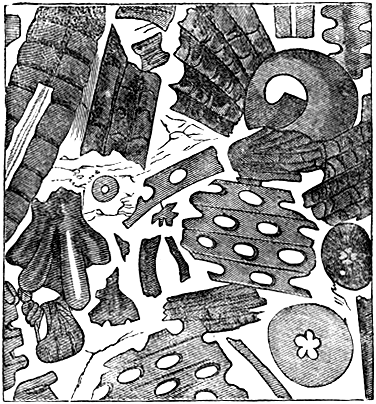
Fig. 9.—Fragment of Lower Silurian Limestone, sliced and magnified ten diameters, showing the manner in which it is made up of fragments of corals, crinoids, and shells. (From a paper oil the Microscopic Structure of Canadian limestone, “Canadian Naturalist.”)
First, we may remark the vast abundance and variety of corals. The polyps, close relatives of the common sea-anemone of our coasts, which build up our modern coral reefs, were represented in the Silurian seas by a great number of allied yet different forms, equally effectual in the great work of secreting carbonate of lime in stony masses, and therefore in the building-up of continents. Let us note some of the differences. In the first place, whereas our modern coral-workers can show us but the topmost pinnacles of their creations, peeping above the surface of the sea in coral reefs and islands, the work of the coral animals of the Silurian has been finished, by these limestones being covered with masses of new sediment consolidated into hard rock, and raised out of the sea to constitute a parfc of the dry land. In the Silurian limestones we thus have, not merely the coral reefs, but the wide beds of comminuted coral, mixed with the remains of other animals, which are necessarily accumulated in the ocean bed around the reefs and islands. Further, these beds, which we might find loose and unconsolidated in the modern sea, have their fragments closely cemented together in the old limestones. The nature of this difference can be well seen by comparing a fragment of modern coral or shell limestone from Bermuda, with a similar fragment of the Trenton limestone, both being sliced for examination under the microscope. The old limestone is black or greyish, the modern one is nearly white, because in the former the organic matter in the animal fragments has been carbonised or converted into coaly and bituminous matter. The old limestone is much more dense and compact, partly because its materials have been more closely compressed by superincumbent weight, but chiefly because calcareous matter in solution in water has penetrated all the interstices, and filled them up with a deposit of crystalline limestone. In examining a slice, however, under the microscope, it will be seen that the fragments of corals and other organisms are as distinct and well preserved as in the crumbling modern rock, except that they are perfectly imbedded in a paste of clear transparent limestone, or rather calcareous spar, infiltrated between them. I have examined great numbers of slices of these limestones, ever with new wonder at the packing of the organic fragments which they present. The hard marble-like limestones used for building in the Silurian districts of Europe and America, are thus in most cases consolidated masses of organic fragments.
In the next place, the animals themselves must have differed somewhat from their modern successors. This we gather from the structure of their stony cells, which present points of difference indicating corresponding difference of detail in the soft parts. Zoologists thus separate the rugose or wrinkled corals and the tabulate or floored corals of the Silurian from those of the modern seas. The former must have been more like the ordinary coral animals; the latter were very peculiar, more especially in the close union of the cells, and in the transverse floors which they were in the habit of building across these cells as they grew in height. They presented, however, all the forms of our modern corals. Some were rounded and massive in form, others delicate and branching. Some were solitary or detached, others aggregative in communities. Some had the individual animals large and probably showy, others had them of microscopic size. Perhaps the most remarkable of all is the American Beatricea,[H] which grew like a great trunk of a tree twenty feet or more in height, its solitary animal at the top like a pillar-saint, though no doubt more appropriate and comfortable; and multitudes of delicate and encrusting corals clinging like mosses or lichens to its sides. This creature belongs to the very middle of the Silurian, and must have lived in great depths, undisturbed by swell or breakers, and sheltering vast multitudes of other creatures in its stony colonnades.
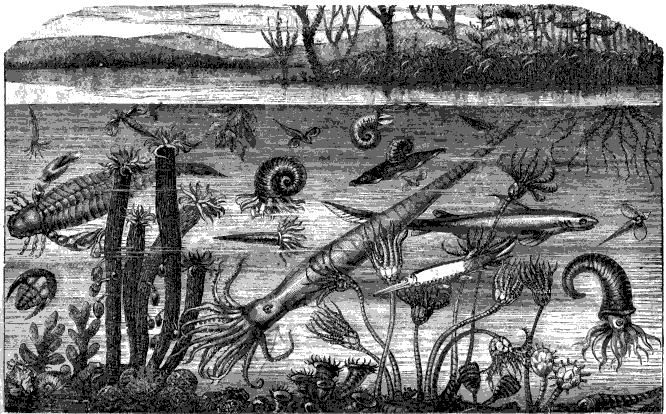
Fig. 10.—LIFE IN THE SILURIAN AGE.
On the bottom are seen, proceeding from left to right, Corals (Stenopora and Beatricea) and a Gasteropod; Orthoceras; Coral (Patria); Crinoids, Lingulæ, and Cystideans; a Trilobite and Cyrtolites. In the water is a large Pterygotus, and under it a Trinucleus. Furthere on, are Cephalopods, a Heteropod, and Fishes. At the surface, Phyllograptus, Graptolithus, and Bellerophon. On the Land, Lepidodendron, Psilophyton, and Prototaxites.
Lastly, the Silurian corals nourished in latitudes more boreal than their modern representatives. In both hemispheres as far north as Silurian limestones have been traced, well-developed corals have been found. On the great plateaus sheltered by Laurentian ridges to the north, and exposed to the sun and to the warmer currents of the equatorial regions, they nourished most grandly and luxuriantly: but they lived also north of the Laurentian bands in the Arctic Sea basins, though probably in the shallower and more sheltered parts. Undoubtedly the geographical arrangements of the Silurian period contributed to this. We have already seen how peculiarly adapted to an exuberant marine life were the submerged continents of the period; and there was probably little Arctic land producing icebergs to chill the seas. The great Arctic currents, which then as now flowed powerfully toward the equator, must have clung to the deeper parts of the ocean basins, while the return waters from the equator would spread themselves widely over the surface; so that wherever the Arctic Seas presented areas a little elevated out of the cold water bottom, there might be suitable abodes for coral animals. It has been supposed that in the Silurian period the sea might have derived some appreciable heat from the crust of the earth below, and astronomical conditions have been suggested as tending to produce changes of climate; but it is evident that whatever weight may be due to these causes, the observed geographical conditions are sufficient to account for the facts of the case. It is also to be observed, that we cannot safely infer the requirements as to temperature of Silurian coral animals from those of the tenants of the modern ocean. In the modern seas many forms of life thrive best and grow to the greatest size in the colder seas; and in the later tertiary period there were elephants and rhinoceroses sufficiently hardy to endure the rigours of an Arctic climate. So there may have been in the Silurian seas corals of much less delicate constitution than those now living.
Next to the corals we may place the crinoids, or stone-lilies—creatures abounding throughout the Silurian seas, and realizing a new creative idea, to be expanded in subsequent geological time into all the multifarious types of star-fishes and sea-urchins. A typical crinoid, such as the Glyptocrinus of the Lower Silurian, consists of a flexible jointed stem, sometimes several feet in length, composed of short cylindrical discs, curiously articulated together, a box-like body on top made up of polygonal pieces attached to each other at the edges, and five radiating jointed arms furnished with branches and branchlets, or fringes, all articulated and capable of being flexed in any direction. Such a creature has more the aspect of a flower than of an animal; yet it is really an animal, and subsists by collecting with its arms and drifting into its mouth minute creatures floating in the water. Another group, less typical, but abundantly represented in the Silurian seas, is that of the Cystideans, in which the body is sack-like, and the arms few and sometimes attached to the body. They resemble the young or larvaa of crinoids. In the modern seas the crinoids are extremely few, though dredging in very deep water has recently added to the number of known species; but in the Silurian period they had their birth, and attained to a number and perfection not afterwards surpassed. Perhaps the stone-lilies of the Upper Silurian rocks of Dudley, in England, are the most beautiful of Palæozoic animals. Judging from the immense quantities of their remains in some limestones, wide areas of the sea bottom must have been crowded with their long stalks and flower-like bodies, presenting vast submarine fields of these stony water-lilies.
Passing over many tribes of mollusks, continued or extended from the Primordial—and merely remarking that the lamp-shells and the ordinary bivalve and univalve shell-fishes are all represented largely, more especially the former group, in the Silurian—we come to the highest of the Mollusca, represented in our seas by the cuttle-fishes and nautili, creatures which, like the crinoids, may be said to have had their birth in the Silurian, and to have there attained to some of their grandest forms. The modern pearly nautilus shell, well known in every museum, is beautifully coiled in a disc-like form, and when sliced longitudinally shows a series of partitions dividing it into chambers, air-tight, and serving as a float to render the body of the creature independent of the force of gravity. As the animal grows it retracts its body toward the front of the shell, and forms new partitions, so that the buoyancy of the float always corresponds with the weight of the animal; while by the expansion and contraction of the body and removal of water from a tube or syphon which traverses the chambers, or the injection of additional water, slight differences can be effected, rendering the creature a very little lighter or heavier than the medium in which it swims. Thus practically delivered from the encumbrance of weight, and furnished with long flexible arms provided with suckers, with great eyes and a horny beak, the nautilus becomes one of the tyrants of the deep, creeping on the bottom or swimming on the surface at will, and everywhere preying on whatever animals it can master. Fortunately for us, as well as for the more feeble inhabitants of the sea, the nautili are not of great size, though some of their allies, the cuttle-fishes, which, however, want the floating apparatus, are sufficiently powerful to be formidable to man. In the Silurian period, however, there were not only nautili like ours, but a peculiar kind of straight nautilus—the Orthoceratites—which sometimes attained to gigantic size. The shells of these creatures may be compared to those of nautili straightened out, the chambers being placed in a direct line in front of each other. A great number of species have been discovered, many quite insignificant in size, but others as much as twelve feet in length and a foot in diameter at the larger end. Indeed, accounts have been given of individuals of much larger growth. These large Orthoceratites were the most powerful marine animals known to us in the Silurian, and must have been in those days the tyrants of the seas.[I]
Among the crustaceans, or soft shell-fishes of the Silurian, we meet with the Trilobites, continued from the Primordial in great and increasing force, and represented by many and beautiful species; while an allied group of shell-fishes of low organization but gigantic size, the Eurypterids, characteristic of the Upper Silurian, were provided with powerful limbs, long flexible bodies, and great eyes in the front of the head, and were sometimes several feet in length. Instead of being mud grovellers, like the Trilobites and modern king-crabs, these Eurypterids must have been swimmers, careering rapidly through the water, and probably active and predaceous. There were also great multitudes of those little crustaceans which are inclosed in two horny or shelly valves like a bivalve shell-fish, and the remains of which sometimes fill certain beds of Silurian shale and limestone.
No remains found in the Silurian rocks have been more fertile sources of discussion than the so-called Graptolites, or written stones—a name given long ago by Linnæus, in allusion to the resemblance of some species having rows of cells on one side, to minute lines of writing. These little bodies usually appear as black coaly stains on the surface of the rock, showing a slender stem or stalk, with a row of little projecting cells at one side, or two rows, one on each side. The more perfect specimens show that, in many of the species at least, these fragments were branches of a complex organism spreading from a centre; and at this centre there is sometimes perceived a sort of membrane connecting the bases of the branches, and for which various uses have been conjectured. The branches themselves vary much in different species. They may be simple or divided, narrow, or broad and leaf-like, with one row of cells, or two rows of cells. Hence arise generic distinctions into single and double graptolites, leaf and tree graptolites, net graptolites, and so on. But while it is easy to recognise these organisms, and to classify them in species and genera, it is not so easy to say what their affinities are with modern things. They are exclusively Silurian, disappearing altogether at the close of this period, and, so far as we know, not succeeded by any similar creatures serving to connect them with modern forms. Hence the most various conjectures as to their nature. They have been supposed to be plants, and have been successively referred to most of the great divisions of the lower animals. Most recently they have been regarded by Hall, Nicholson,[J] and others, who have studied them most attentively, as zoophytes or hydroids allied to the Sertularise, or tooth-corallines and sea-fir-corallines of our coasts, to the cell-bearing branches of which their fragments bear a very close resemblance. In this case, each of the little cells or teeth at the sides of the fibres must have been the abode of a little polyp, stretching out its tentacles into the water, and enjoying a common support and nutrition with the other polyps ranged with it. Still the mode of life of the community of branching stems is uncertain. In some species there is a little radicle or spike at the base of the main stem, which may have been a means of attachment. In others the hollow central disk has been conjectured to have served as a float. Occurring as the specimens do usually in shales and slates, which must have been muddy beds, they could not have been attached to stones or rocks, and they must have lived in clear water, either seated on the surface of the mud, attached to sea-weeds, or floating freely by means of hollow disks filled with air. After much thought on their structure and mode of occurrence, I am inclined to believe that in their younger stages they were attached, but by a very slender thread; that at a more advanced stage they became free, and acquiring a central membranous disk filled with air, floated by means of this at the surface, their long branches trailing in the waters below. They would thus be, with reference to their mode of life, though not to the details of their structure, prototypes of the modern Portuguese man-of-war, which now drifts so gaily over the surface of the warmer seas. I have represented them in this attitude; but in case I should be mistaken, the reader may imagine it possible that they may be adhering to the lower surface of floating tangle. The head-quarters of the Graptolites seem to be in the upper part of the Cambrian, and in the Siluro-Cambrian, and they are widely distributed in Europe, in America, and in Australia. This very wide distribution of the species is probably connected with their floating and oceanic habits.
Lastly, just as the Silurian period was passing away, we find a new thing in the earth—vertebrate animals, represented by several species of shark-like fishes, which came in here as forerunners of the dynasty of the vertebrates, which from that day to this have been the masters of the world. These earliest vertebrates are especially interesting as the first known examples of a plan of structure which culminates only in man himself. They appear to have had cartilaginous skeletons; and in this and their shagreen-like skin, strong bony spines, and trenchant teeth, to have much resembled our modern sharks, or rather the dog-fishes, for they were of small size. One genus (Pteraspis), apparently the oldest of the whole, belongs, however, to a tribe of mailed fishes allied to some of those of the old red sandstone. In both cases the groups of fishes representing the first known appearance of the vertebrates were allied to tribes of somewhat high organization in that class; and they asserted their claims to dominancy by being predaceous and carnivorous creatures, which must have rendered themselves formidable to their invertebrate contemporaries. Coprolites, or fossil masses of excrement, which are found with them, indicate that they chased and devoured orthoceratites and sea-snails of various kinds, and snapped Lingulæ and crinoids from their stalks; and we can well imagine that these creatures, when once introduced, found themselves in rich pasture and increased accordingly. Space prevents us from following further our pictures of the animal life of the great Silurian era, the monuments of which were first discovered by two of England’s greatest geologists, Murchison and Sedgwick. How imperfect such a notice must be, may be learned from the fact that Dr. Bigsby, in his “Thesaurus Siluricus” in 1868, catalogues 8,897 Silurian species, of which only 972 are known in the Primordial.
Our illustration, carefully studied, may do more to present to the reader the teeming swarms of the Silurian seas than our word-picture, and it includes many animal forms not mentioned above, more especially the curved and nautilus-like cuttle-fishes, those singular molluscous swimmers by fin or float known to zoologists as violet-snails, winged-snails or pteropods, and carinarias; and which, under various forms, have existed from the Silurian to the present time. The old Lingulæ are also there as well as in the Primordial, while the fishes and the land vegetation belong, as far as we yet know, exclusively to the Upper Silurian, and point forward to the succeeding Devonian. We know as yet no Silurian animal that lived on the land or breathed air. But our knowledge of land plants, though very meagre, is important. Without regarding such obscure and uncertain forms as the Eophyton of Sweden, Hooker, Page, and Barrande have noticed, in the Upper Silurian, plants allied to the Lycopods or club-mosses. I have found in the same deposits another group of plants allied to Lycopods and pill-worts (Psilophyton), and fragments of wood representing the curious and primitive type of pine-like trees known as Prototaxites. These are probably only a small instalment of Silurian land plants, such as a voyager might find floating in the sea on his approach to some unknown shore, which had not yet risen above his horizon. Time and careful search will, no doubt, add largely to our knowledge.
In the Silurian, as in the Cambrian, the head-quarters of animal life were in the sea. Perhaps there was no animal life on the land; but here our knowledge may be at fault. It is, however, interesting to observe the continued operation of the creative fiat, “Let the waters swarm with swarmers” which, beginning to be obeyed in the Eozoic age, passes down through all the periods of geological time to the “moving things innumerable” of the modern ocean. Can we infer anything further as to the laws of creation from these Silurian multitudes of living things? One thing we can see plainly, that the life of the Silurian is closely related to that of the Cambrian. The same generic and ordinal forms are continued. Even some species may be identical. Does this indicate direct genetic connection, or only like conditions in the external world correlated with likeness in the organic world? It indicates both. First, it is in the highest degree probable that many of the animals of the Lower Silurian are descendants of those of the Cambrian. Sometimes these descendants may be absolutely unchanged. Sometimes they may appear as distinct varieties. Sometimes they may have been regarded as distinct though allied species. The continuance in this manner of allied forms of life is necessarily related to the continuance of somewhat similar conditions of existence, while changes in type imply changed external conditions. But is this all? I think not; for there are forms of life in the Silurian which cannot be traced to the Cambrian, and which relate to new and even prospective conditions, which the unaided powers of the animals of the earlier period could not have provided for. These new forms require the intervention of a higher power, capable of correlating the physical and organic conditions of one period with those of succeeding periods. Whatever powers may be attributed to natural selection or to any other conceivable cause of merely genetic evolution, surely prophetic gifts cannot be claimed for it; and the life of all these geological periods is full of mute prophecies to be read only in the light of subsequent fulfilments.
The fishes of the Upper Silurian are such a prophecy. They can claim no parentage in the older rocks, and they appear at once as kings of their class. With reference to the Silurian itself, they are of little consequence; and in the midst of its gigantic forms of invertebrate life they seem almost misplaced. But they predict the coming Devonian, and that long and varied reign of vertebrate life which culminates in man himself. No such prophetic ideas are represented by the giant crustaceans and cuttle-fishes and swarming graptolites. They had already attained their maximum, and were destined to a speedy and final grave in the Silurian, or to be perpetuated only in decaying families whose poverty is rendered more conspicuous by the contrast with the better days gone by. The law of creation provided for new types, and at once for the elevation and degradation of them when introduced; and all this with reference to the physical conditions not of the present only but of the future. Such facts, which cannot be ignored save by the wilfully blind, are beyond the reach of any merely material philosophy.
The little that we know of Silurian plants is as eloquent of plan and creation as that which we can learn of animals. I saw not long ago a series of genealogies in geological time reduced to tabular form by that ingenious but imaginative physiologist, Haeckel. In one of these appeared the imaginary derivation of the higher plants from Algæ or sea-weeds. Nothing could more curiously contradict actual facts. Algæ were apparently in the Silurian neither more nor less elevated than in the modern seas, and those forms of vegetable life which may seem to bridge over the space between them and the land plants in the modern period, are wanting in the older geological periods, while land plants seem to start at once into being in the guise of club-mosses, a group by no means of low standing. Our oldest land plants thus represent one of the highest types of that cryptogamous series to which they belong, and moreover are better developed examples of that type than those now existing. We may say, if we please, that all the connecting links have been lost; but this is begging the whole question, since no thing but the existence of such links could render the hypothesis of derivation possible. Further, the occurrence of any number of successive yet distinct species would not be the kind of chain required, or rather would not be a chain at all.
Yet in some respects development is obvious in creation. Old forms of life are often embryonic, or resemble the young of modern animals, but enlarged and exaggerated, as if they had overgrown themselves and had prematurely become adult. Old forms are often generalized, or less specific in their adaptations than those of modern times. There is less division of labour among them. Old forms sometimes not only rise to the higher places in their groups, but usurp attributes which in later times are restricted to their betters. Old forms are often gigantic in size in comparison with their modern successors, which, if they could look back on their predecessors, might say, “There were giants in those days.” Some old forms have gone onward in successive stages of elevation by a regular and constant gradation. Others have remained as they were through all the ages, Some have no equals in their groups in modern days. All these things speak of order, but of order along with development, and this development not evolution; unless by this term we understand the emergence into material facts of the plans of the creative mind. These plans we may hope in some degree to understand, though we may not be able to comprehend the mode of action of creative power any more than the mode in which our own thought and will act upon the machinery of our own nerves. Still, the power is not the less real, that we are ignorant of its mode of operation. The wind bloweth whither it listeth, and we feel its strength, though we may not be able to calculate the wind of to-morrow or the winds of last year. So is the Spirit of God when it breathes into animals the breath of life, or the Almighty word when it says, “Let the waters bring forth.”
CHAPTER V.
THE DEVONIAN AGE.
Paradoxical as it may appear, this period of geological history has been held as of little account, and has even been by some geologists regarded as scarcely a distinct age, just because it was one of the most striking and important of the whole. The Devonian was an age of change and transition, in both physical and organic existence; and an age which introduced, in the Northern hemisphere at least, more varied conditions of land and water and climate than had previously existed. Hence, over large areas of our continents, its deposits are irregular and locally diverse; and the duration and importance of the period are to be measured rather by the changes and alterations of previous formations, and the ejection of masses of molten rock from beneath, than by a series of fossiliferous deposits. Nevertheless, in some regions in North America and Eastern Europe, the formations of this era are of vast extent and volume, those of North America being estimated at the enormous thickness of 15,000 feet, while they are spread over areas of almost continental breadth.
At the close of the Upper Silurian, the vast continental plateaus of the northern hemisphere were almost wholly submerged. No previous marine limestone spreads more widely than that of the Uppei Silurian, and in no previous period have we much less evidence of the existence of dry land; yet before the end of the period we observe, in a few fragments of land plants scattered here and there in the marine limestones—evidence that islands rose amid the waste of waters. As it is said that the sailors of Columbus saw the first indications of the still unseen Western Continent in drift canes, and fragments of trees floating in mid ocean, so the voyager through the Silurian seas finds his approach to the verdant shores of the Devonian presaged by a few drift plants borne from shores yet below the horizon. The small remains of land in the Upper Silurian were apparently limited to certain clusters of islands in the north-eastern part of America and north-western part of Europe, with perhaps some in the intervening Atlantic On these limited surfaces grew the first land plants certainly known to us—herbs and trees allied to the modern club-mosses, and perhaps forests of trees allied to the pines, though of humbler type; and this wide Upper Silurian sea, with archipelagos of wooded islands, may have continued for a long time. But with the beginning of the Devonian, indications of an unstable condition of the earth’s crust began to develop themselves. New lands were upheaved; great shallow, muddy, and sandy flats were deposited around them the domains of corals and sea-weeds were contracted and on banks, and in shallows and estuaries, there swarmed shoals of fishes of many species, and some of them of most remarkable organization. On the margins of these waters stretched vast swamps, covered with a rank vegetation.
But the period was one of powerful igneous activity. Volcanoes poured out their molten rocks over sea and land, and injected huge dykes of trap into the newly-formed beds. The land was shaken with earthquake throes, and was subject to many upheavals and subsidences. Violent waves desolated the coasts, throwing sand and gravel over the flatk, and tearing up newly-deposited beds; and poisonous exhalations, or sudden changes of level, often proved fatal to immense shoals of fishes. This was the time of the Lower Devonian, and it is marked, both in the old world and the new, by extensive deposits of sandstones and conglomerates.
But the changes going on at the surface were only symptomatic of those occurring beneath. The immense accumulations of Silurian sediment had by this time so overweighted certain portions of the crust, that great quantities of aqueous sediment had been pressed downward into the heated bowels of the earth, and were undergoing, under an enormous weight of superincumbent material, a process of baking and semi-fusion. This process was of course extremely active along the margins of the old Silurian plateaus, and led to great elevation of land, while in the more central parts of the plateaus the oceanic conditions still continued; and in the Middle Devonian, in America at least, one of the most remarkable and interesting coral limestones in the world—the corniferous limestone—was deposited. In process of time, however, these clear waters became shallow, and were invaded by muddy sediments; and in the Upper Devonian the swampy flats and muddy shallows return in full force, and in some degree anticipate the still greater areas of this kind which existed in the succeeding Coal formation.
Such is a brief sketch of the Devonian, or, as it may be better called in America, from the vast development of its beds on the south side of Lake Erie, the Erian formation. In America the marine beds of the Devonian were deposited on the same great continental plateau which supported the seas of the Upper and Lower Silurian, and the beds were thicker towards the east and thinned towards the west, as in the case of the older serios. But in the Devonian there was much, land in the north-east of America; and on the eastern margin of this land, as in Gaspé and New Brunswick, the deposits throughout the whole period were sandstones and shales, without the great coral limestones of the central plateau. Something of the same kind occurred in Europe, where, however, the area of Devonian sea was smaller. There the fossiliferous limestones of the Middle Devonian in Devon, in the Eifel district, in France and in Russia, represent the great corniferous limestone of America; while the sandstones of South Wales, of Ireland, and of Scotland, resemble the local conditions of Gaspé and New Brunswick, and belonged to a similar area in the north-west of Europe, in which shallow water and land conditions prevailed during the whole of the Devonian, and which was perhaps connected with the corresponding region in Eastern America by a North Atlantic archipelago, now submerged. This whole subject is so important to the knowledge of the Devonian, and of geology in general, that I may be pardoned for introducing it here in a tabular form, taking the European series from Etheridge’s excellent and exhaustive paper in the “Journal of the Geological Society.”
DEVONIAN OF ERIAN.
DIVISIONS. CENTRAL AREAS.
Devon. Rhen. Prussia. New York.
Upper Pilton group:— Brown calcareous shales, brown and yellow sandstone. Land plants and marine shells. Clymenia, Cypridina, etc. Shales, limestones, and sandstones. Plants and marine shells. Chemung and Portage. Sandstones and shales. Plants and marine shells.

Middle Ilfracombe group:— Grey and red sandstones and flags, calcareous slates and limestones, with corals, etc. Eifel limestone, Calceola shales, etc. Corals, shells, etc. Hamilton shales, and Corniferous or cherty limestone. Many corals and shells, also plants.
Lower Lynton group:— Bed and purple sandstones. Marine shells, etc. Coblentz and Wisseubach shales, Rhenish greywacke, Spinier sandstone. Marine shells. Schoharie and Caudagalli grits. Oriskany sandstones. Marine shells.
DIVISIONS. MARGINAL AREAS.
Scotland. Ireland. Gaspé and New Brunswick.
Upper Yellow and red sandstones. Fishes and plants. Yellow and red sandstones, etc. Plants, fishes, etc. Red and grey sandstones, grits and shales, and conglomerates of Gaspé and Miapeck. Plants.
Middle Red shales and sandstones, and conglomerates. Caithness flags. Fishes and plants. Grits and sandstones of Dingle. Grey and Red sandstones, and grey and dark shales. Gaspé and St. John. Many plants and fishes.
Lower Flagstones, shales and conglomerates. Fishes and plants. Glengariff grits, etc. Sandstone and conglomerate. Gaspé and St. John. Plants and fishes.
A glance at this table suffices to show that when we read Hugh Miller’s graphic descriptions of the Old Red Sandstone of Scotland, with its numerous and wonderful fishes, we have before us a formation altogether distinct from that of Devonshire or the Eifel. But the one represents the shallow, and the other the deeper seas of the same period. We learn this by careful tracing of the beds to their junction with, corresponding series, and by the occasional occurrence of the characteristic fishes of the Scottish strata in the English and German beds. In like manner a geologist who explores the Gaspé sandstones or the New Brunswick shales has under his consideration a group of beds very dissimilar from that which he would have to study on the shores of Lake Erie. But here again identity of relations to the Silurian below and the carboniferous above, shows the contemporaneousness of the beds, and this is confirmed by the occurrence in both series of some of the same plants and shells and fishes.
It will further be observed that it is in the middle that the greatest difference occurs. Sand and mud and pebble-banks were almost universal over our two great continental plateaus in the Older and Newer Devonian. But in the Middle there were in some places deeper waters with coral reefs, in others shallow flats and swamps rich in vegetation. Herein we see the greater variety and richness of the Devonian. Had we lived in that age, we should not have seen great continents like those that now exist, but we could have roamed over lovely islands with breezy hills and dense lowland jungles, and we could have sailed over blue coral seas, glowing below with all the fanciful forms and brilliant colours of polyp life, and filled with active and beautiful fishes. Especially did all these conditions culminate in the Middle Devonian, when what are now the continental areas of the northern hemisphere must have much resembled the present insular and oceanic regions of the South Pacific.
Out of the rich and varied life of the Devonian I may select for illustration its corals, its crustaceans, its fishes, its plants, and its insects.
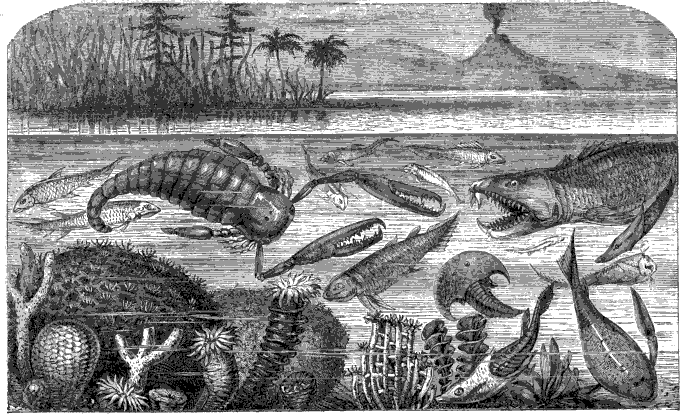
Fig. 11.—CORALS, FISHES, AND CRUSTACEANS OF THE DEVONIAN
In the foreground are Corals of the genera Favosites, Michelina, Phillipsatrea, Zaphrentis, Blothrophyllum, and Syringopora, and the seaweed Spirephyton; also Fishes of the genera Cephalaspis and Pterichthys. Above are Pterygotus and Dinichtys, with Fishes of the genera Diplacanthus, Osteolepis, Holoptychius, Pteraspis, Coccosteus, etc. The distant land had Lepidodendra, Pines and Tree-ferns.
The central limestones of the Devonian may be regarded as the head-quarters of the peculiar types of coral characteristic of the Palæozoic age. Here they were not only vastly numerous, but present some of their grandest and also their most peculiar forms. Edwards and Haime, in their “Monograph of British Fossil Corals” in 1854, enumerate one hundred and fifty well-ascertained species, and the number has since been largely increased; I have no doubt that my friend Dr. Bigsby, in his forth-coming “Thesaurus Devonicus,” will more than double it. In the Devonian limestones of England, as for instance at Torquay, the specimens, though abundant and well preserved as to their internal structure, are too firmly imbedded in the rock to show their external forms. In the Devonian of the continent of Europe much finer specimens occur; but, perhaps, in no part of the world is there so clear an exhibition of them as in the Devonian limestones of the United States and Canada. Sir Charles Lyell thus expresses his admiration of the exposure of these corals, which he saw at the falls of the Ohio, near Louisville. He says, "Although the water was not at its lowest, I saw a grand display of what may be termed an ancient coral-reef, formed by zoophytes which flourished in a sea of earlier date than the Carboniferous period. The ledges of horizontal limestone, over which the water flows, belong to the Devonian group, and the softer parts of the stone have decomposed and wasted away, so that the harder calcareous corals stand out in relief. Many branches of these zoophytes project from their erect stems precisely as if they were living. Among other species I observed large masses, not less than five feet in diameter, of Favosites Gothlandica, with its beautiful honeycomb structure well displayed. There was also the cup-shaped Cyathophyllum, and the delicate network of Fenestella, and that elegant and well-known European species of fossil, the chain coral, Catenipora escharoides, with a profusion of others which it would be tedious to all but the geologist to enumerate. Although hundreds of fine specimens have been detached from these rocks to enrich the museums of Europe and America, another crop is constantly working its way out under the action of the stream, and of the sun and rain in the warm season when the channel is laid dry."[K] These limestones have been estimated to extend, as an almost continuous coral reef, over the enormous area of five hundred thousand square miles of the now dry and inland surface of the great American continental plateau. The limestones described by Sir Charles are known in the Western States as the “Cliff limestone.” In the State of New York and in Western Canada the “Corniferous limestone,” so called from the masses of hornstone, like the flint of the English chalk, contained in it, presents still more remarkable features. The corals which it contains have been replaced by the siliceous or flinty matter in such a manner that, when the surrounding limestone weathers away, they remain projecting in relief in all the beauty of their original forms. Not only so, but on the surface of the country they remain as hard siliceous stones, and may be found in ploughing the soil and in stone fences and roadside heaps, so that tons of them could often be collected over a very limited space. When only partly disengaged from the matrix, the process may be completed by immersing them in a dilute acid. The beauty of these specimens when thus prepared is very great not at all inferior to that of modern corals, which they often much resemble in general form, though differing in details of structure. One of the most common forms is that of the Favosites, or honeycomb coral, presenting regular hexagonal cells with transverse floors or tabulæ. Of these there are several species, usually flat or massive in form; but one species, F. polymorpha, branches out like the modern stag-horn corals. Another curious form, Michelina, looks exactly like a mass of the papery cells of the great American hornet in a petrified state, and the convex floors simulate the covers of the cells, so that it is quite common to find them called fossil wasps' nests. Some of the largest belong to the genus Phillipsastrea or Smithia, which Hugh Miller has immortalized by comparing its crowded stars, with confluent rays, to the once-popular calico pattern known as “Lane’s net”—a singular instance of the accidental concurrence of a natural and artificial design. Another very common type is that of the conical Zaphrentis, with a deep cut at top to lodge the body of the animal, whose radiating chambers are faithfully represented by it’s delicate lamellæ. Perhaps the most delicate of the whole is the Syringopora, with its cylindrical worm-like pipes bound together by transverse processes, and which sometimes can be dissolved out in all its fragile perfection by the action of an acid on a mass of Corniferous limestone filled with these corals in a silicified state.
These Devonian corals, like those of the Silurian, belong to the great extinct groups of Tabulate and Rugose corals; groups which present, on the one hand, points of resemblance to the ordinary coral animals of the modern seas, and, on the other, to those somewhat exceptional corals, the Millepores, which are produced by another kind of polyp, the Hydroids. Some of them obviously combine properties belonging to both, as, for example, the radiating partitions with the arrangement of the parts in multiples of four, the horizontal floors, and the external solid wall; and this fact countenances the conclusion that in these old corals we have a group of high and complex organization, combining properties now divided between two great groups of animals, neither of them probably, either in their stony skeletons or the soft parts of the animal, of as high organization as their Paleozoic predecessors. This sort of disintegration of composite types, or dissolution of old partnerships, seems to liave been no unusual occurrence in the history of life.[L]
If the Devonian witnessed the culmination of the Palæozoic corals, its later stages saw the final decadence of the great dynasty of the Trilobites. Of these creatures there are in the Devonian some large and ornate species, remarkable for their spines and tubercles; as if in this, the latter day of their dominion, they had fallen into habits of luxurious decoration unknown to their sterner predecessors, and at the same time had found it necessary to surround their now disputed privileges with new safeguards of defensive armour. Not improbably the decadence of the Trilobites may have been connected with the introduction of the numerous and formidable fishes of the period.
But while the venerable race of the Trilobites was preparing to fight its last and unsuccessful battle, another and scarcely less ancient tribe of crustaceans, the Eurypterids, already strong in the Silurian, was armed with new and formidable powers. The Pterygotus anglicus, which should have been named scoticus, since its head-quarters are in Scotland, was in point of size the greatest of known crustaceans, recent or fossil. According to Mr. Henry Woodward, who has published an admirable description and figures of the creature in the Palæontographical Society’s Memoirs, it must have been six feet in length, and nearly two feet in breadth. Its antennæ were, unlike the harmless feelers of modern Crustacea, armed with powerful claws. Two great eyes stood in the front of the head, and two smaller ones on the top. It had four pairs of great serrated jaws, the largest as wide as a man’s hand. At the sides were a pair of powerful paddles, capable of urging it swiftly through the water as it pursued its prey; and when attacked by any predaceous fish, it could strike the water with its broad tail, terminated by a great flat “telson,” and retreat backward with the rapidity of an arrow. Woodward says it must have been the “shark of the Devonian seas;” rather, it was the great champion of the more ancient family of the lobsters, set to arrest, if possible, the encroachments of the coming sharks.
The Trilobites and Eurypterids constitute a hard case for the derivationists. Unlike those Melchisedeks, the fishes of the Silurian, which are without father or mother, the Devonian crustaceans may boast of their descent, but they have no descendants. No distinct link connects them with any modern crustaceans except the Limuli, or horse-shoe crabs; and here the connection is most puzzling, for while there seems some intelligible resemblance between the adult Eurypterids and the horse-shoe, or king-crabs, the latter, in their younger state, rather resemble Trilobites, as Dr. Packard has recently shown. Thus the two great tribes of Eurypterids and Trilobites have united in the small modern group of king-crabs, while on the other hand, there are points of resemblance, as already stated, between Trilobites and Isopods, and the king-crabs had already begun to exist, since one species is now known in the Upper Silurian. So puzzling are these various relationships, that one naturalist of the derivationist school has recently attempted to solve the difficulty by suggesting that the Trilobites are allied to the spiders! Thus nature sports with our theories, showing us in some cases, as in the corals and fishes, partnerships split up into individuals, and in others distinct lines of being converging and becoming lost in one slender thread. Barrande, the great palæontologist of Bohemia, has recently, in an elaborate memoir on the Trilobites, traced these and other points through all their structures and their whole succession in geological time thereby elaborating a most powerful inductive argument against the theory of evolution, and concluding that, so far from the history of these creatures favouring such a theory, it seems as if expressly contrived to exclude its possibility.
But, while the gigantic Eurypterids and ornate Trilobites of the Devonian were rapidly approaching their end, a few despised little crustaceans,—represented by the Amphipeltis of New Brunswick and Kampecaris of Scotland,—were obscurely laying the foundation of a new line of beings, that of the Stomapods, destined to culminate in the Squillas and their allies, which, however different in structure, are practically the Eurypterids of the modern ocean. So change the dynasties of men and animals.
"Thou takest away their breath, they die, They return to their dust; Thou sendest forth Thy Spirit, They are created; Thou renewest the form of the earth."
The reign of fishes began in the Upper Silurian, for in the rocks of this age, more especially in England, several species have been found. They occur, however, only in the newer beds of this formation, and are not of large size, nor very abundant. It is to be observed that, in so far as the fragments discovered can be interpreted, they indicate the existence already of two distinct types of fishes, the Ganoids, or gar-fishes, protected with bony plates and scales, and the Placoids, or shark-like fishes; and that in the existing world these fishes are regarded as occupying a high place in their class. Further, these two groups of fishes are those which throughout a large portion of geological time continue to prevail to the exclusion of other types, the ordinary bony fishes having been introduced only in comparatively recent periods. With the Devonian, however, there comes a vast increase to the finny armies; and so characteristic are these that the Devonian has been called the age of fishes par excellence, and we must try, with the help of our illustration, to paint these old inhabitants of the waters as distinctly as we can. Among the most ancient and curious of these fishes are those singular forms covered with broad plates, of which the Pteraspis of the Upper Silurian is the herald, and which are represented in the Lower Devonian by several distinct genera. Of these, one of the most curious is the Cephalaspis, or buckler-head, distinguished by its broad flat head, rounded in front and prolonged at the sides into two great spines, which project far beyond the sides of the comparatively slender body. This fish, it may be mentioned, is the type of a family highly characteristic of the Lower Devonian, as well as of the Upper Silurian, and all of which are provided with large plate-like cephalic coverings, sometimes with a long snout in front, and, in so far as is known, a comparatively weak body and tail. They were all probably ground-living creatures, feeding on worms and shell-fishes, and “rooting” for these in the mud, or burrowing therein for their safety. In these respects they have a most curious analogy to the Trilobites, which in habits they must have greatly resembled, though belonging by their structure to an entirely different and much higher class. So close is this resemblance, that their head-shields used to be mistaken for those of Trilobites. The case is one of those curious analogies which often occur in nature, and which must always be distinguished from the true affinities which rest on structural resemblances. Another group of small fishes, likewise cuirassed in bony armour of plates, may be represented by the Pterichthys, with its two strong bony fins at the sides, which may have served for swimming, but probably also for defence, and for creeping on or shovelling up the mud at the bottom of the sea. But, besides the Ganoids which were armed in plated cuirasses, there were others, active and voracious, clad in shining enamelled scales, like the bony pikes of the American rivers and the Polypterus of the Nile. Some of these, like the Diplacanthus, or “double-spine” were of small size, and chiefly remarkable for their sharp defensive bony spines. Others, like Holoptychius (wrinkled-scale) and Osteolepis (bone-scale), were strongly built, and sometimes of great size. One Russian species of Asterolepis (star-scale) is supposed to have been twenty feet in length, and furnished with strong and trenchant teeth in two rows. These great fishes afford a good reason for the spines and armour-plates of the contemporary trilobites and smaller fishes. Just as man has been endeavouring to invent armour impenetrable to shot, for soldiers and for ships, and, on the other hand, shot and shells that can penetrate any armoury so nature has always presented the spectacle of the most perfect defensive apparatus matched with the most perfect weapons for destruction. In the class of fishes, no age of the world is more eminent in these respects than the Devonian.[M] In addition to these fishes, there were others, represented principally by their strong bony spines, which must have been allied to some of the families of modern sharks, most of them, however, probably to that comparatively harmless tribe which, furnished with flat teeth, prey upon shell-fishes. There are other fishes difficult to place in our systems of classification; and among these an eminent example is the huge Dinichthys of Newberry, from the Hamilton group of Ohio. The head of this creature is more than three feet long and eighteen inches broad, with the bones extraordinarily strong and massive. In the upper jaw, in addition to strong teeth, there were in front two huge sabre-shaped tusks or incisors, each nearly a foot long; and corresponding to these in the massive lower jaw were two closely joined conical tusks, fitting between those of the upper jaw. No other fish presents so frightful an apparatus for destruction; and if, as is probable, this was attached to a powerful body, perhaps thirty feet in length, and capable of rapid motion through the water, we cannot imagine any creature so strong or so well armed as to cope with the mighty Dinichthys.
The difference between the fishes of the Devonian and those of the modern seas is well marked by the fact that, while the ordinary bony fishes now amount to probably 9,000 species, and the ganoid fishes to less than thirty, the finny tribes of the Devonian are predominantly ganoids, and none of the ordinary type are known. To what is this related, with reference to conditions of existence? Two explanations, different yet mutually connected, may be suggested. One is that armour was especially useful in the Devonian as a means of defence from the larger predaceous species, and the gigantic crustaceans of the period. That this was the case may be inferred from the conditions of existence of some modern ganoids. The common bony pike of Canada (Lepidosteus), frequenting shallow and stagnant waters, seems to be especially exposed to injury from its enemies. Consequently, while it is rare to find an ordinary fish showing any traces of wounds, a large proportion of the specimens of the bony pike which I have examined have scars on their scales, indicating injuries which they have experienced, and which possibly, to fishes not so well armed, might have proved fatal. Again, in the modern Amia, or mud-fish, in the bony pike and Polypterus, there is an extremely large air-bladder, amply supplied with blood-vessels, and even divided into cells or chambers, and communicating with the mouth by an “air-duct.” This organ is unquestionably in function a lung, and enables the animal to dispense in some degree with the use of its gills, which of course depend for their supply of vital air on the small quantity of oxygen dissolved in the water. Hence, by the power of partially breathing air, these fishes can live in stagnant and badly aerated waters, where other fishes would perish. In the case of the Amia, the grunting noises which it utters, its habit of frequenting the muddy creeks of swamps, and its possession of gill-cleaners, correspond with this view. It is possible that the Devonian fishes possessed this semi-reptilian respiration; and if so, they would be better adapted than other fishes to live in water contaminated with organic matter in a state of decay, or in waters rich in carbonic acid or deficient in oxygen. Possibly the palæozoic waters, as well as the palæozoic atmosphere, were less rich in pure oxygen than those of the present world; and it is certain that, in many of the beds in which the smaller Devonian fishes abound, there was so much decaying vegetable matter as to make it probable that the water was unfit for the ordinary fishes. Thus, though at first sight the possession of external armour and means to respire air, in the case of these peculiar fishes, may seem to have no direct connection with each other, their obvious correlation in some modern ganoids may have had its parallel on a more extensive scale among their ancient relatives. Just as the modern gar-fish, by virtue of its lungs, can live in stagnant shallows and hunt frogs, but on that account needs strong armour to defend it against the foes that assail it in such places; so in the Devonian the capacity to inhabit unaërated water and defensive plates and scales may have been alike necessary, especially to the feebler tribes of fishes. We shall find that in the succeeding carboniferous period there is equally good evidence of this.
We have reserved little space for the Devonian plants and insects; but we may notice both in a walk through a Devonian forest, in which we may include the vegetation of the several subordinate periods into which this great era was divisible. The Devonian woods were probably, like those of the succeeding carboniferous period, dense and dark, composed of but few species of plants, and these somewhat monotonous in appearance, and spreading out into broad swampy jungles, encroaching on the shallow bays and estuaries. Landing on one of these flats, we may first cast our eyes over a wide expanse, covered with what at a distance we might regard as reeds or rushes. But on a near approach they appear very different; rising in slender, graceful stems, they fork again and again, and their thin branches are sparsely covered with minute needle-like leaves, while the young shoots curl over in graceful tresses, and the older are covered with little oval fruits, or spore-cases; for these plants are cryptogamous, or flowerless. This singular vegetation stretches for miles along the muddy flats, and rises to a height of two or three feet from a knotted mass of cylindrical roots or root-stocks, twining like snakes through and over the soil. This plant may, according as we are influenced by its fruit or structure, be regarded as allied to the modern club-mosses or the modern pill-worts. It is Psilophyton, in every country one of the most characteristic plants of the period, though, when imperfectly preserved, often relegated by careless and unskilled observers to the all-engulfing group of fucoids. A little further inland we see a grove of graceful trees, forking like Psilophyton, but of grander dimensions, and with the branches covered with linear leaves, and sometimes terminated by cones. These are Lepidodendra, gigantic club-mosses, which were developed to still greater dimensions in the coal period. Near these we may see a still more curious tree, more erect in its growth, with rounded and somewhat rigid leaves and cones of different form, and with huge cable-like roots, penetrating the mud, and pitted with the marks of long rootlets. This is Cyclostigma, a plant near to the Lepidodendron, but distinct, and peculiar to the Devonian. Some of its species attain to the dimensions of considerable trees; others are small and shrubby. Another small tree, somewhat like the others, but with very long shaggy leaves, and its bark curiously marked with regular diamond-shaped scars, is the Leptophleum. All these plants are probably allied to our modern club-mosses, which are, however, also represented by some low and creeping species cleaving to the ground. A little further, and we reach a dense clump of Sigillariæ, with tall sparsely forking stems, and ribbed with ridges holding rows of leaf-scars a group of plants which we shall have further occasion to notice in the coal formation; and here is an extensive jungle of Calamites, gigantic and overgrown mares'-tails, allies of the modern equisetums.
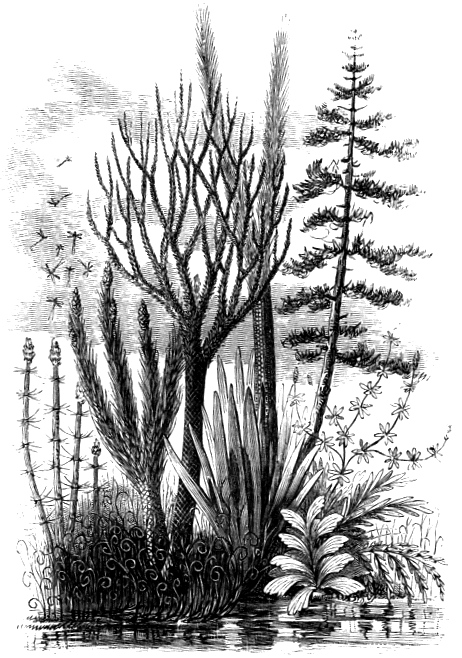
Fig. 12.—VEGETATION OF THE DEVONIAN.
To the left are Calamites; next to these, Leptophleum; in the centre are Lepidodendron, Sigillaria, and a Pine. Below are Psilophyton, Cordaites, Ferns, and Asterophyllites.
Amidst these trees, every open glade is filled with delicate ferns of marvellous grace and beauty; and here and there a tree-fern rears its head, crowned with its spreading and graceful leaves, and its trunk clad with a shaggy mass of aërial roots—an old botanical device, used in these ancient times, as well as now, to strengthen and protect the stems of trees not fitted for lateral expansion. Beyond this mass of vegetation, and rising on the slopes of the distant hills, we see great trees that look like pines. We cannot approach them more nearly; but here on the margin of a creek we see some drift-trunks, that have doubtless been carried down by a land flood. One of them is certainly a pine, in form and structure of its wood very like those now living in the southern hemisphere; it is a Dadoxylon. Another is different, its sides rough and gnarled, and marked with huge irregular ridges; its wood loose, porous, and stringy, more like the bark of modern pines, yet having rings of growth and a true bark of its own, and sending forth large branches and roots. It is the strange and mysterious Prototaxites, one of the wonders of the Devonian land, and whose leaves and fruits would be worth their weight in gold in our museums, could we only procure them. A solitary fragment further indicates that in the yet unpenetrated solitudes of the Devonian forests there may be other trees more like our ordinary familiar friends of the modern woods; but of these we know as yet but little. What inhabitants have these forests? All that we yet know are a few large insects, relatives of our modern May-flies, flitting with broad veined wings over the stagnant waters in which their worm-like larvæ dwell, and one species at least assuming one of the properties of the grasshopper tribe, and enlivening the otherwise silent groves with a cricket-like chirp, the oldest music of living things that geology as yet reveals to us; and this, not by the hearing of the sound itself, but by the poor remains of the instrument attached to a remnant of a wing from the Devonian shales of New Brunswick.
A remarkable illustration of the abundance of certain plants in the Devonian, and also of the slow and gradual accumulation of some of its beds, is furnished by layers of fossil spore-cases, or the minute sacs which contain the microscopic germs of club-mosses and similar plants. In the American forests, in spring, the yellow pollen-grains of spruces and pines sometimes drift away in such quantities in the breeze that they fall in dense showers, popularly called showers of sulphur; and this vegetable sulphur, falling in lakes and ponds, is drifted to the shore in great sheets and swathes. The same thing appears to have occurred in the Devonian, not with the pollen of flowering plants, but with the similar light spores and spore-cases of species of Lepidodendron and allied trees. In a bed of shale, at Kettle Point, Lake Huron, from 12 to 14 feet thick, not only are the surfaces of the beds dotted over with minute round spore-cases, but, on making a section for the microscope, the substance of each layer is seen to be filled with them; and still more minute bodies, probably the escaped spores, are seen to fill up their interstices. The quantity of these minute bodies is so great that the shale is combustible, and burns with much flame. A bed of this nature must have been formed in shallow and still water, on the margin of an extensive jungle or forest; and as the spore-cases are similar to those of the Lepidodendra of the coal-measures, the trees were probably of this kind. Year after year, as the spores became ripe, they were wafted away, and fell in vast quantities into the water, to be mixed with the fine mud there accumulating. When we come to the coal period, we shall see that such beds of spore-cases occur there also, and that they have even been supposed to be mainly instrumental in the accumulation of certain beds of coal. Their importance in this respect may have been exaggerated, but the fact of their occurrence in immense quantities in certain coals and shales is indisputable.
This is but a slender sketch of the Devonian forests: but we shall find many of the same forms of plants in the carboniferous period which succeeds. With one thought we may close. We are prone to ask for reasons and uses for things, but sometimes we cannot be satisfied. Of what use were the Devonian forests? They did not, like those of the coal formation, accumulate rich beds of coal for the use of man. Except possibly a few insects, we know no animals that subsisted on their produce, nor was there any rational being to admire their beauty. Their use, except as helping us in these last days to complete the order of the vegetable kingdom as it has existed in geological time, is a mystery. We can but fall back on that ascription of praise to Him “who liveth for ever and ever,” on the part of the heavenly elders who cast down their crowns before the throne and say, “Thou art worthy, Lord, to receive the glory, and the honour, and the might; because Thou didst create all things, and by reason of Thy will they are and were created.”
CHAPTER VI.
THE CARBONIFEROUS AGE.
That age of the world’s history which, from its richness in accumulations of vegetable matter destined to be converted into coal, has been named the Carboniferous, is in relation to living beings the most complete and noble of the Palæozoic periods. In it those varied arrangements of land and water which had been increasing in perfection in the previous periods, attained to their highest development. In it the forms of animal and plant life that had been becoming more numerous and varied from the Eozoic onward, culminated. The Permian which succeeded was but the decadence of the Carboniferous, preparatory to the introduction of a new order of things. Thus the Carboniferous was to the previous periods what the Modern is to the preceding Tertiary and Mesozoic ages the summation and completion of them all, and the embodiment of their highest excellence. If the world’s history had closed with the Carboniferous, a naturalist, knowing nothing further, would have been obliged to admit that it had already fulfilled all the promise of its earlier years. It is important to remember this, since we shall find ourselves entering on an entirely new scene in the Mesozoic period, and since this character of the Carboniferous, as well as its varied conditions and products, may excuse us for dwelling on it a little longer than on the others, On the other hand, the immense economic importance of the coal formation, and the interesting points connected with it, have made the Carboniferous more familiar to general readers than most other geological periods, so that we may select points less common and well-known for illustration. Popular expositions of geology are, however, generally so one-sided and so distorted by the prevalent straining after effect, that the true aspect of this age is perhaps not much better known than that of others less frequently described.
Let us first consider the Carboniferous geography of the northern hemisphere; and in doing so we may begin with a fact concerning the preceding age. One of the most remarkable features of the Newer Devonian is the immense quantity of red rocks, particularly red sandstones, contained in it. Ked sandstones, it is true, occur in older formations, but comparatively rarely; their great head-quarters, both in Europe and America, in so far as the Palæozoic is concerned, are in the Upper Devonian. Now red sandstone is an infallible mark of rapid deposition, and therefore of active physical change. If we examine the grains of sand in a red sandstone, we shall find that they are stained or coated, externally, with the peroxide of iron, or iron rust; and that this coating, with perhaps a portion of the same substance in the intervening cement, is the cause of the colour. In finer sandstones and red clays the same condition exists, though less distinctly perceptible. Conrrequently, if red sands and clays are long abraded or scoured in water, or are subjected to any chemical agent capable of dissolving the iron, they cease to be red, and resume their natural grey or white colour. Now in nature, in addition to mechanical abrasion, there is a chemical cause most potent in bleaching red rocks, namely, the presence of vegetable or animal matter in a state of decay. Without entering into chemical details, we may content ourselves with the fact that organic matter decaying in contact with peroxide of iron tends to take oxygen from it, and then to dissolve it in the state of protoxide, while the oxygen set free aids the decay. Carrying this fact with us, we may next affirm that iron is so plentiful in the crust of the earth that nearly all sands and clays when first produced from the weathering of rocks are stained with it, and that when this weathering takes place in the air, the iron is always in the state of peroxide. More especially does this apply to the greater number of igneous or volcanic rocks, which nearly always weather brown or red. Now premising that the original condition of sediment is that of being reddened with iron, and that it may lose this by abrasion, or by the action of organic matter, it follows that when sand has been produced by decay of rocks in the air, and when it is rapidly washed into the sea and deposited there, red beds will result. For instance, in the Bay of Fundy, whose rapid tides cut away the red rocks of its shores and deposit their materials quickly, red mud and sand constitute the modern deposit. On the other hand, when the red Band and mud are long washed about, their red matter may disappear; and when the deposition is slow and accompanied with the presence of organic matter, the red colour is not only removed, but is replaced by the dark tints due to carbon. Thus, in the Gulf of St. Lawrence, where red rocks similar to those of the Bay of Fundy are being more slowly wasted, and deposited in the presence of sea-weeds and other vegetable substances, the resulting sands and clays are white and grey or blackened in colour. An intermediate condition is sometimes observed, in which red beds are stained with grey spots and lines, where sea-weeds or land-plants have rested on them. I have specimens of Devonian red shale with the forms of fern leaves, the substance of which has entirely perished, traced most delicately upon them in greenish marks.
It follows from these facts that extensive and thick deposits of red beds evidence sub-aërial decay of rocks, followed by comparatively rapid deposition in water, and that such red rocks will usually contain few fossils, not only because of their rapid deposition, but because the few organic fragments deposited with them will probably have been destroyed by the chemical action of the superabundant oxide of iron, which, so to speak, “iron-moulds” them, just as stains of iron eat holes out of linen. Now when Sir Roderick Murchison tells us of 10,000 feet in thickness of red iron-stained rocks in the old red sandstone of England, we can see in this the evidence of rapid aqueous deposition, going on for a very long time, and baring vast areas of former land surface. Consequently we have proof of changes of level and immense and rapid denudation—a conclusion further confirmed by the apparent unconformity of different members of the series to each other in some parts of the British Islands, the lower beds having been tilted up before the newer were deposited. Such was the state of affairs very generally at the close of the Devonian, and it appears to have been accompanied with some degree of subsidence of the land, succeeded by re-elevation at the beginning of the Carboniferous, when many and perhaps large islands and chains of islands were raised out of the sea, along whose margins there were extensive volcanic eruptions, evidenced by the dykes of trap traversing the Devonian, and the beds of old lava interstratified in the lower part of the Carboniferous, where also the occurrence of thick beds of conglomerate or pebble-rock indicates the tempestuous action of the sea.
But a careful study of the Lower Carboniferous beds, where their margins rest upon the islands of older rocks, shows great varieties in these old shores. In some places there were shingly beaches; in others, extensive sand-banks; in others, swampy flats clothed with vegetation, and sometimes bearing peaty beds, still preserved as small seams of coal. The bays and creeks swarmed with, fishes. A few sluggish reptiles crept along the muddy or sandy shores, and out sea-ward were great banks and reefs of coral and shells in the clear blue sea. The whole aspect of nature, taken in a general view, in the Older Carboniferous period, must have much resembled that at present seen among the islands of the southern hemisphere. And the plants and animals, though different, were more like those of the modern South Pacific than any others now living.
As the age wore on, the continents were slowly lifted out of the water, and the great continental plateaus were changed from coral seas into swampy flats or low uplands, studded in many places with shallow lakes, and penetrated with numerous creeks and sluggish streams. In the eastern continent these land surfaces prevailed extensively, more especially in the west; and in America they spread both eastward and westward from the Appalachian ridge, until only a long north and south Mediterranean, running parallel to the Rocky Mountains, remained of the former wide internal ocean. On this new and low land, comparable with the “Sylvas” of the South American continent, flourished the wondrous vegetation of the Coal period, and were introduced the new land animals, whose presence distinguishes the close of the Palæozoic.
After a vast lapse of time, in which only slow and gradual subsidence occurred, a more rapid settlement of the continental areas brought the greater part of the once fertile plains of the coal formation again under the waters; and shifting sand-banks and muddy tides engulfed and buried the remains of the old forests, and heaped on them a mass of sediment, which, like the weights of a botanical press, flattened and compressed the vegetable débris preserved in the leaves of the coal formation strata. Then came on that strange and terrible Permian period, which, like the more modern boulder-formation, marked the death of one age and the birth of another.
The succession just sketched is the normal one; but the terms in which it has been described show that it cannot be universal. There are many places in which the whole thickness of the Carboniferous is filled with fossils of the land, and of estuaries and creeks. There are places, on the other hand, where the deep sea appears to have continued during the whole period. In America this is seen on the grandest scale in the absence of the marine members along the western slopes of the Appalachians, and the almost exclusive prevalence of marine beds in the far west, where the great Carboniferous Mediterranean of America spread itself, and continued uninterruptedly into the succeeding Permian period.
In our survey of the Carboniferous age, though there are peculiarities in the life of its older, middle, and newer divisions, we may take the great coal measures of the middle portion as the type of the land life of the period, and the great limestones of the lower portion as that of the marine life; and as the former is in this period by far the most important, we may begin with it. Before doing so, however, to prevent misapprehension, it is necessary to remind the reader that the Flora of the Middle Coal Period is but one of a succession of related floras that reach from the Upper Silurian to the Permian. The meagre flora of club-mosses and their allies in the Upper Silurian and Lower Devonian was succeeded by a comparatively rich and varied assemblage of plants in the Middle Devonian. The Upper Devonian was a period of decadence, and in the Lower Carboniferous we have another feeble beginning, presenting features somewhat different from those of the Upper Devonian. This was the time of the Culm of Germany, the Tweedian formation of the North of England and South of Scotland, and the Lower Coal formation of Nova Scotia. It was a period eminently rich in Lepidodendra. It was followed by the magnificent flora of the Middle Coal formation, and then there was a time of decadence in the Upper Coal formation and only a slight revival in the Permian.
In the present condition of our civilization, coal is the most important product which the bowels of the earth afford to man. And though there are productive beds of coal in most of the later geological formations, down to the peats of the modern period, which are only unconsolidated coals, yet the coal of the Carboniferous age is the earliest valuable coal in point of time, and by far the most important in point of quantity. Mineral coal may be defined t o be vegetable matter which has been buried in the strata of the earth’s crust, and there subjected to certain chemical and mechanical changes. The proof of its vegetable origin will grow upon us as we proceed. The chemical changes which it has undergone are not very material. Wood or bark, taken as an example of ordinary vegetable matter, consists of carbon or charcoal, with the gases hydrogen and oxygen. Coal has merely parted with a portion of these ingredients in the course of a slow and imperfect putrefaction, so that it comes to have much less oxygen and considerably less hydrogen than wood, and it has been blackened by the disengagement of a quantity of free carbon. The more bituminous flaming coals have a larger amount of residual hydrogen. In the anthracite coals the process of carbonisation has proceeded further, and little remains but charcoal in a dense and compact form. In cannel coals, and in certain bituminous shales, on the contrary, the process seems to have taken place entirely under water, by which putrefaction has been modified, so that a larger proportion than usual of hydrogen has been retained. The mechanical change which the coal has experienced consists in the flattening and hardening effect of the immense pressure of thousands of feet of superincumbent rock, which has crashed together the cell-walls of the vegetable matter, and reduced what was originally a pulpy mass of cellular tissue to the condition of a hard laminated rock. To understand this, perhaps tha simplest way is to compare under the microscope a transverse section of recent pine-wood with a similar section of a pine trunk compressed into brown coal or jet. In the one the tissue appears as a series of meshes with thin woody walls and comparatively wide cavities for the transmission of the sap. In the other the walls of the cells have been forced into direct contact, and in some cases have altogether lost their separate forms, and have been consolidated into a perfectly compact structureless mass.
With regard to its mode of occurrence, coal is found in beds ranging in vertical thickness from less than an inch to more than thirty feet, and of wide horizontal extent. Many such beds usually occur in the thickness of the coal formation, or “coal measures,” as the miners call it, separated from each other by beds of sandstone and compressed clay or shale. Very often the coal occurs in groups of several beds, somewhat close to each other and separated from other groups by “barren measures” of considerable thickness. In examining a bed of coal, where it is exposed in a cutting or shore cliff, we nearly always find that the bed below it, or the “underclay,” as it is termed by miners, is a sort of fossil soil, filled with roots and rootlets. On this rests the coal, which, when we examine it closely, is found to consist of successive thin layers of hard coal of different qualities as to lustre and purity, and with intervening laminae of a dusty fibrous substance, like charcoal, called “mother coal” by miners, and sometimes mineral charcoal. Thin partings of dark shale also occur, and these usually present marks and impressions of the stems and leaves of plants. Above the coal is its “roof” of hardened clay or sandstone, and this generally holds great quantities of remains of plants, and sometimes large stumps of trees with their bark converted into coal, and the hollow once occupied with wood filled with sandstone, while their roots spread over the surface of the coal. Such fossil forests of erect stumps are also found at various levels in the coal measures, resting directly on under-clays without any coals. A bed of coal would thus appear to be a fossil bog or swamp.
This much being premised about the general nature of the sooty blocks which fill our coal-scuttles, we may now transport ourselves into the forests and bogs of the coal formation, and make acquaintance with this old vegetation, while it still waved its foliage in the breeze and drank in the sunshine and showers. We are in the midst of one of those great low plains formed by the elevation of the former sea bed. The sun pours down its fervent rays upon us, and the atmosphere, being loaded with vapour, and probably more rich in carbonic acid than that of the present world, the heat is as it were accumulated and kept near the surface, producing a close and stifling atmosphere like that of a tropical swamp. This damp and oppressive air is, however, most favourable to the growth of the strange and grotesque trees which tower over our heads, and to the millions of delicate ferns and club-mosses, not unlike those of our modern woods, which carpet the ground. Around us for hundreds of miles spreads a dense and monotonous forest, with here and there open spaces occupied by ponds and sluggish streams, whose edges are bordered with immense savannahs of reed-like plants, springing from the wet and boggy soil. Everything bespeaks a rank exuberance of vegetable growth; and if we were to dig downward into the soil, we should find a thick bed of vegetable mould evidencing the prevalence of such conditions for ages. But the time will come when this immense flat will meet with the fate which in modern times befell a large district at the mouth of the Indus. Quietly, or with earthquake shocks, it will sink under the waters; fishes and mollusks will swarm where trees grew, beds of sand and mud will be deposited by the water, inclosing and preserving the remains of the vegetation, and in some places surrounding and imbedding the still erect trunks of trees. Many feet of such deposits may be formed, and our forest surface, with its rich bed of vegetable mould, has been covered up and is in process of transformation into coal; while in course of time the shallow waters being filled up with deposit, or a slight re-elevation occurring, a new forest exactly like the last will flourish on the same spot. Such changes would be far beyond the compass of the life even of a Methuselah; but had we lived in the Coal period, we might have seen all stages of thesa processes contemporaneously in different parts of either of the great continents.
But let us consider the actual forms of vegetation presented to us in the Coal period, as we can restore them from the fragments preserved to us in the beds of sandstone and shale, and as we would have seen them in our imaginary excursion through the Carboniferous forests. To do this we must first glance slightly at the great subdivisions of modern plants, which we may arrange in such a way as to give an easy means for comparison of the aspects of the vegetable kingdom in ancient and modern times. In doing this I shall avail myself of an extract from a previous publication of my own on this subject.
"The modern flora of the earth admits of a grand twofold division into the Phænogamous, or flowering and seed-bearing plants, and the Cryptogamous, or flowerless and spore-bearing plants. In the former series, we have, first, those higher plants which start in life with two seed-leaves, and have stems with distinct bark, wood, and pith—the Exogens; secondly, those similar plants which begin life with one seed-leaf only, and have no distinction of bark, wood, and pith, in the stem—the Endogens; and, thirdly, a peculiar group starting with two or several seed-leaves, and having a stem with bark, wood, and pith, but with very imperfect flowers, and wood of much simpler structure than either of the others—the Gymnosperms. To the first of these groups or classes belong most of the ordinary trees of temperate climates. To the second belong the palms and allied trees found in tropical climates. To the third belong the pines and cycads. In the second or Cryptogamous series we have also three classes,—(1.) The Acrogens, or ferns and club-mosses, with stems having true vessels marked on the sides with cross-bars—the Scalariform vessels. (2.) The Anophytes, or mosses and their allies, with stems and leaves, but no vessels. (3.) The Thallophytes, or lichens, fungi, sea-weeds, etc., without true stems and leaves.
"In the existing climates of the earth we find these classes of plants variously distributed as to relative numbers. In some, pines predominate. In others, palms and tree-ferns form a considerable part of the forest vegetation. In others, the ordinary exogenous trees predominate, almost to the exclusion of others. In some Arctic and Alpine regions, mosses and lichens prevail. In the Coal period we have found none of the higher Exogens, though one species is known in the Devonian, and only a few obscure indications of the presence of Endogens; but Gymnosperms abound, and are highly characteristic. On the other hand, we have no mosses or lichens, and very few algæ, but a great number of ferns and Lycopodiaceæ or club-mosses. Thus the coal formation period is botanically a meeting-place of the lower Phænogams and the higher Cryptogams, and presents many forms which, when imperfectly known, have puzzled botanists in regard to their position in one or other series. In the present world, the flora most akin to that of the Coal period is that of moist and warm islands in the southern hemisphere. It is not properly a tropical flora, nor is it the flora of a cold region, but rather indicative of a moist and equable climate. In accordance with this is the fact that the equable but not warm climate of the southern hemisphere at present (which is owing principally to its small extent of land) enables sub-tropical plants to extend into high latitudes. In the Coal period this uniformity was evidently still more marked, since we find similar plants extending from regions within the Arctic circle to others near to the tropics. Still we must bear in mind that we may often be mistaken in reasoning as to the temperature required by extinct species of plants differing from those now in existence. Further, we must not assume that the climatal conditions of the northern hemisphere were in the Coal period at all similar to those which now prevail. As Sir Charles Lyell has argued, a less amount of land in the higher latitudes would greatly modify climates, and there is every reason to believe that in the Coal period there was less land than now. It has been shown by Tyndall that a very small additional amount of carbonic acid in the atmosphere would, by obstructing the radiation of heat from the earth, produce almost the effect of a glass roof or conservatory, extending over the whole world. There is much in the structure of the leaves of the coal plants, as well as in the vast amount of carbon which they accumulated in the form of coal, and the characteristics of the animal life of the period, to indicate, on independent grounds, that the Carboniferous atmosphere differed from that of the present world in this way, or in the presence of more carbonic acid a substance now existing in the very minute proportion of one-thousandth of the whole by weight, a quantity adapted to the present requirements of vegetable and animal life, but probably not to those of the Coal period."
Returning from this digression to the forests of the Coal period, we may first notice that which is the most conspicuous and abundant tree in the swampy levels—the Sigillaria or seal-tree, so called from the stamp-like marks left by the fall of its leaves—a plant which has caused much discussion as to its affinities. Some regard it as a gymnosperm, others as a cryptogam. Most probably we have under this name trees allied in part to both groups, and which, when better known, may bridge over the interval between them. These trees present tall pillar-like trunks, often ribbed vertically with raised bands, and marked with rows of scars left by the fallen leaves. They are sometimes branchless, or divide at top into a few thick limbs, covered with long rigid grass-like foliage. On their branches they bear long slender spikes of fruit, and we may conjecture that quantities of nut-like seeds scattered over the ground around their trunks are their produce. If we approach one of these trees closely, more especially a young specimen not yet furrowed by age, we are amazed to observe the accurate regularity and curious forms of the leaf-scars, and the regular ribbing, so very different from that of our ordinary forest trees. If we cut into its stem, we are still further astonished at its singular structure. Externally it has a firm and hard rind. Within this is a great thickness of soft cellular inner bark, traversed by large bundles of tough fibres. In the centre is a core or axis of woody matter very slender in proportion to the thickness of the trunk, and still further reduced in strength by a large cellular pith. Thus a great stem four or five feet in diameter is little else than a mass of cellular tissue, altogether unfit to form a mast or beam, but excellently adapted, when flattened and carbonised, to blaze upon our winter hearth as a flake of coal. The roots of these trees were perhaps more singular than their stems; spreading widely in the soft soil by regular bifurcation, they ran out in long snake-like cords, studded all over with thick cylindrical rootlets, which spread from them in every direction. They resembled in form, and probably in function, those cable-like root-stocks of the pond-lilies which run through the slime of lakes, but the structure of the rootlets was precisely that of those of some modern Cycads. It was long before these singular roots were known to belong to a tree. They were supposed to be the branches of some creeping aquatic plant, and botanists objected to the idea of their being roots; but at length their connection with Sigillaria was observed simultaneously by Mr. Binney, in Lancashire, and by Mr. Kichard Brown, in Cape Breton, and it has been confirmed by many subsequently observed facts. This connection, when once established, further explained the reason of the almost universal occurrence of Stigmaria, as these roots were called, under the coal beds; while trunks of the same plants were the most abundant fossils of their partings and roofs. The growth of successive generations of Sigillariæ was, in fact, found to be the principal cause of the accumulation of a bed of coal. Two species form the central figures in our illustration.
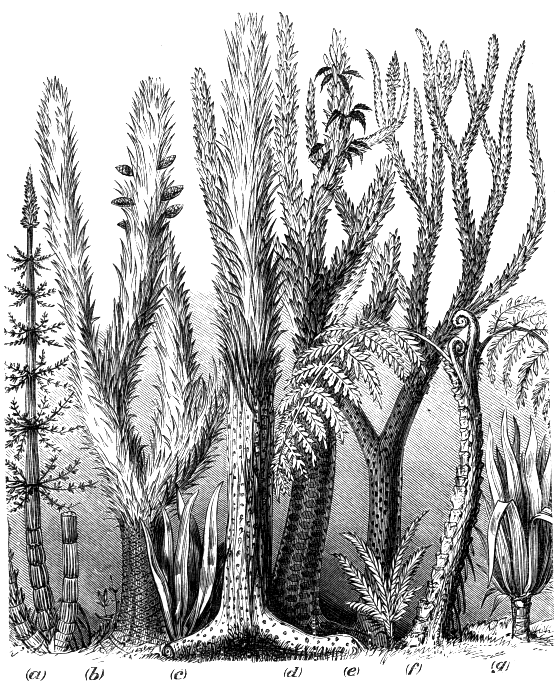
Fig. 13.—GROUP OF CARBONIFEROUS PLANTS, RESTORED FROM ACTUAL SPECIMENS.
(a) Calamites (type of C. Suckovii). (b) Lepidofloios, or Ulodendron. (c) Sigillaria (type of S. reniformis). (d) (type of S. elegans). (e) Lepidodendron (type of L. corrugatum). (f) Megaphyton (type of M. magnificum). (g) Cordaites, or Pychnophyllum (type of C. borassifolia).
Along with the trees last mentioned, we observe others of a more graceful and branching form, the successors of those Lepidodendra already noticed in the Devonian, and which still abound in the Carboniferous, and attain to larger dimensions than their older relations, though they are certainly more abundant and characteristic in the lower portions of the carboniferous. Relatives, as already stated, of our modern club-mosses, now represented only by comparatively insignificant species, they constitute the culmination of that type, which thus had attained its acme very long ago, though it still continues to exist under depauperated forms. They all branched by bifurcation, sometimes into the most graceful and delicate sprays. They had narrow slender leaves, placed in close spirals on the branches. They bore their spores in scaly cones. Their roots were similar to Stigmaria in general appearance, though differing in details. In the coal period there were several generic forms of these plants, all attaining to the dimensions of trees. Like the Sigillariæ, they contributed to the materials of the coal; and one mode of this has recently attracted some attention. It is the accumulation of their spores and spore-cases already referred to in speaking of the Devonian, and which was in the Carboniferous so considerable as to constitute an important feature locally in some beds of coal. A similar modern accumulation of spore-cases of tree-ferns occurs in Tasmania; but both in the Modern and the Carboniferous, such beds are exceptional; though wherever spore-cases exist as a considerable constituent of coal, from their composition they give to it a highly bituminous character, an effect, however, which is equally produced by the hard scales supporting the spores, and by the outer epidermal tissues of plants when these predominate in the coal, more especially by the thick corky outer bark of Sigillaria. In short, the corky substance of bark and similar vegetable tissues, from its highly carbonaceous character, its indestructibility, and its difficult permeability by water carrying mineral matter in solution, is the best of all materials for the production of coal; and the microscope shows that of this the principal part of the coal is actually composed.
In the wide, open forest glades, tree-ferns almost precisely similar to those of the modern tropics reared their leafy crowns. But among them was one peculiar type, in which the fronds were borne in pairs on opposite sides of the stem, leaving when they fell two rows of large horseshoe-shaped scars marking the sides of the trunk. Botanists, who have been puzzled with these plants almost as much as with the Stigmaria, have supposed these scars to be marks of branches, of cones, and even of aërial roots; but specimens in my collection prove conclusively that the stem of this genus was a great caudex made up of the bases of two rows of huge leaves cemented together probably by intervening cellular tissue. As in the Devonian and in modern times, the stems of the tree-ferns of the Carboniferous strengthened themselves by immense bundles of cord-like aërial roots, which look like enormous fossil brooms, and are known under the name Psaronius.
We have only time to glance at the vast brakes of tall Calamites which fringe the Sigillaria woods, and stretch far sea-ward over tidal flats. They were allied to modern Mares' Tails or Equisetums, but were of gigantic size, and much more woody structure of stem. The Calamites grew on wet mud and sand-flats, and also in swamps; and they appear to have been especially adapted to take root in and clothe and mat together soft sludgy material recently deposited or in process of deposition. When the seed or spore of a Calamite had taken root, it probably produced a little low whorl of leaves surrounding one small joint, from which another and another, widening in size, arose, producing a cylindrical stem, tapering to a point below. To strengthen the unstable base, the lower joints, especially if the mud had been accumulating around the plant, shot out long roots instead of leaves, while secondary stems grew out of the sides at the surface of the soil, and in time there was a stool of Calamites, with tufts of long roots stretching downwards, like an immense brush, into the mud. When Calamites thus grew on inundated flats, they would, by causing the water to stagnate, promote the elevation of the surface by new deposits, so that their stems gradually became buried; but this only favoured their growth, for they continually pushed out new stems, while the old buried ones shot out bundles of roots instead of regular whorls of leaves.
The Calamites, growing in vast fields along the margins of the Sigillaria forests, must have greatly protected these from the effects of inundations, and by collecting the mud brought down by streams in times of flood, must have done much to prevent the intrusion of earthy deposits among the vegetable matter. Their chief office, therefore, as coal-producers, seems to have been to form for the Sigillaria forests those reedy fringes which, when inundations took place, would exclude mud, and prevent that mixture of earthy matter in the coal which would have rendered it too impure for use. Quantities of fragments of their stems can, however, be detected by the microscope in most coals.
The modern Mares' Tails have thin-walled hollow stems, and some of the gigantic calamites of the coal resembled them in this. But others, to which the name Calamodendron, or Reed-tree, has been given, had stems with thick woody walls of a remarkable structure, which, while similar in plan to that of the Mares' Tails, was much more perfect in its development. Professor Williamson has shown that there were forms intervening between these extremes; and thus in the calamites and calamodendrons we have another example of the exaltation in ancient times of a type now of humble structure; or, in other words, of a comprehensive type, low in the modern world, but in older periods taking to itself by anticipation the properties afterward confined to higher forms. The gigantic club-mosses of the Coal period constitute a similar example, and it is very curious that both of these types have been degraded in the modern world, though retaining precisely their general aspect, while the tree-ferns contemporary with them in the Palæozoic still survive in all their original grandeur.