Front matter (continued 5)
Reading edition
3. Superficial Sands or Gravels.
2. Stratified Clays.
1. Till or Boulder Clay.
This arrangement may locally be more complicated, or it may be deficient in one of its members. The boulder clay may, for example, be underlaid by stratified sand or gravel, or even by peaty deposits; it may be intermixed with layers of clay or sand; the stratified clay or the boulder clay may be absent, or may be uncovered by any upper member. Still we may take the typical series as above stated, and inquire as to its characters and teaching.
The lower member, or boulder clay, is a very remarkable kind of deposit, consisting of a paste which may graduate from tough clay to loose sand, and which holds large angular and rounded stones or boulders confusedly intermixed; these stones may be either from the rocks found in the immediate vicinity of their present position, or at great distances. This mass is usually destitute of any lamination or subordinate stratification, whence it is often called Unstratified Drift, and is of very variable thickness, often occurring in very thick beds in valleys, and being comparatively thin or absent on intervening hills. Further, if we examine the stones contained in the boulder clay, we shall find that they are often scratched or striated and grooved; and when we remove the clay from the rock surfaces on which it rests, we find these in like manner striated, grooved and polished. These phenomena, viz., of polished and striated rocks and stones, are similar to those produced by those great sliding masses of ice, the glaciers of Alpine regions, which in a small way and in narrow and elevated valleys, act on the rocks and stones in this manner, though they cannot form deposits precisely analogous to the boulder clay, owing to the wasting away of much of the finer material by the torrents, and the heaping of the coarser detritus in ridges and piles. Further, we have in Greenland a continental mass, with all its valleys thus filled with slowly-moving ice, and from this there drift off immense ice-islands, which continue at least the mud-and-stone-depositing process, and possibly also the grinding process, over the sea bottom. So far all geologists are agreed; but here they diverge into two schools. One of these, than of the Glacier theorists, holds that the boulder clay is the product of land-ice; and this requires the supposition that at the time when it was deposited the whole of our continents north of 40° or 50° was in the condition of Greenland at present. This is, however, a hypothesis so inconvenient, not to say improbable, that many hesitate to accept it, and prefer to believe that in the so-called Glacial period the land was submerged, and that icebergs then as now drifted from the north in obedience to the Arctic currents, and produced the effects observed. It would be tedious to go into all the arguments of the advocates of glaciers and icebergs, and I shall not attempt this, more especially as the only way to decide the question is to observe carefully the facts in every particular locality, and inquire as to the conclusions fairly deducible. With the view of aiding such a solution, however, I may state a few general principles applicable to the appearances observed. We may then suppose that boulder clay may be formed in three ways. (1) It may be deposited on land, as what is called the bottom moraine of a land glacier. (2) It may be deposited in the sea when such a glacier ends on the coast. (3) It may be deposited by the melting or grounding on muddy bottoms of the iceberg masses floated off from the end of such a glacier. It is altogether likely, from the observations recently made in Greenland, that in that country such a deposit is being formed in all these ways. In like manner, the ancient boulder clay may have been formed in one or more of these ways in any given locality where it occurs, though it may be difficult in many instances to indicate the precise mode. There are, however, certain criteria which may be applied to the determination of its origin, and I may state a few of these, which are the results of my own experience. (1) Where the boulder clay contains marine shells, or rounded stones which if exposed to the air would have been cracked to pieces, decomposed, or oxidized, it must have been formed under water. Where the conditions are the reverse of these, it may have been formed on land. (2) When the striations and transport of materials do not conform to the levels of the country, and take that direction, usually N.E. and S.W., which the Arctic current would take if the country were submerged, the probability is that it was deposited in the sea. Where, however, the striation and transport take the course of existing valleys, more especially in hilly regions, the contrary may be inferred. (3) Where most of the material, more especially the large stones, has been carried to great distances from its original site, especially over plains or up slopes, it has probably been sea-borne. Where it is mostly local, local ice-action may be inferred. Other criteria may be stated, but these are sufficient for our present purpose. Their application in every special case I do not presume to make; but I am convinced that when applied to those regions in Eastern America with which I am familiar, they necessitate the conclusion that in the period of extreme refrigeration, the greater part of the land was under water, and such hills and mountains as remained were little Greenlands, covered with ice and sending down glaciers to the sea. In hilly and broken regions, therefore, and especially at considerable elevations, we find indications of glacier action; on the great plains, on the contrary, the indications are those of marine glaciation and transport. This last statement, I believe, applies to the mountains and plains of Europe and Asia as well as of America.
This view requires not only the supposition of great refrigeration, but of a great subsidence of the land in the temperate latitudes, with large residual islands and hills in the Arctic regions. That such subsidence actually took place is proved, not only by the frequent occurrence of marine shells in the boulder clay itself, but also by the occurrence of stratified marine clays filled with shells, often of deep-water species, immediately over that deposit. Further, the shells, and also occasional land plants found in these beds, indicate a cold climate and much cold fresh water pouring into the sea from melting ice and snow. In Canada these marine clays have been traced up to elevations of 600 feet, and in Great Britain deposits of this kind occur on one of the mountains of Wales at the height of 1300 feet above the level of the sea. Nor is it to be supposed that this level marks the extreme height of the Post-pliocene waters, for drift material not explicable by glaciers, and evidences of marine erosion, occur at still higher levels, and it is natural that on high and exposed points fewer remains of fossiliferous beds should be left than in plains and valleys.
At the present day the coasts of Britain and other parts of Western Europe enjoy an exceptionally warm temperature, owing to the warm currents of the Atlantic being thrown on them, and the warm and moist Atlantic air flowing over them, under the influence of the prevailing westerly winds. These advantages are not possessed by the eastern coast of North America, nor by some deep channels in the sea, along which the cold northern currents flow under the warmer water. Hence these last-mentioned localities are inhabited by boreal shells much farther south than such species extend on the coasts and banks of Great Britain. In the Glacial period this exceptional advantage was lost, and while the American seas, as judged by their marine animals, were somewhat colder than at present, the British seas were proportionally much more cooled down. No doubt, however, there were warmer and colder areas, determined by depth and prevailing currents, and as these changed their position in elevation and subsidence of the land, alternations and even mixtures of the inhabitants of cold and warm water resulted, which have often been very puzzling to geologists.
I have taken the series of drift deposits seen in Britain and in Canada as typical, and the previous discussion has had reference to them. But it would be unfair not to inform the reader that this succession of deposits after all belongs to the margins of our continents rather than to their great central areas. This is the case at least in North America, where in the region of the great lakes the oldest glaciated surfaces are overlaid by thick beds of stratified clay, without marine fossils, and often without either stones or boulders, though these sometimes occur, especially toward the north. The clay, however, contains drifted fragments of coniferous trees. Above this clay are sand and gravel, and the principal deposit of travelled stones and boulders rests on these. I cannot affirm that a similar succession occurs on the great inland plains of Europe and Asia: but I think it probable that to some extent it does. The explanation of this inland drift by the advocates of a great continental glacier is as follows: (1) In the Pliocene period the continents were higher than at present, and many deep valleys, since filled up, were cut in them. (2) In the Post-pliocene these elevated continents became covered with ice, by the movement of which the valleys were deepened and the surfaces striated. (3) This ice-period was followed by a depression and submergence, in which the clays were deposited, filling up old channels, and much changing the levels of the land. Lastly, as the land rose again from this submergence, sand and gravel were deposited, and boulders scattered over the surface by floating ice.
The advocates of floating ice as distinguished from a continental glacier, merely dispense with the latter, and affirm that the striation under the clay, as well as that connected with the later boulders, is the effect of floating bergs. The occurrence of so much drift wood in the clay favours their view, as it is more likely that there would be islands clothed with trees in the sea, than that these should exist immediately after the country had been mantled in ice. The want of marine shells is a difficulty in either view, but may be accounted for by the rapid deposition of the clay and the slow spreading of marine animals over a submerged continent under unfavourable conditions of climate.
In any case the reader will please observe that theorists must account for both the interior and marginal forms of these deposits. Let us tabulate the facts and the modes of accounting for them.
FACTS OBSERVED. THEORETICAL VIEWS.
Inland Plains. Marginal Areas. Glacial Theories. Floating Ice Theories.
Terraces. Terraces and Raised Beaches. Emergence of Modern Land.[AJ]
Travelled Boulders and Glaciated Stones and Rocks. Stratified Sand and Gravel. Sand and Gravel, with Sea Shells and Boulders. Shallow Sea and Floating Ice.
Stratified Clay with Drift Wood, and a few Stones and Boulders. Striated Rocks. Stratified Clay with Sea Shells. Boulder Clay with or without Sea Shells. Striated Rocks. Deep Sea and Floating Ice.
Submergence of the land. Great continental mantle of Ice. Much floating Ice and local Glaciers. Submergence of Pliocene Land.
Old channels, indicating a higher level of the land. Old channels, etc., indicating previous dry land. Erosion by continental Glacier. Erosion by atmospheric agencies and accumulation of decomposed rock.
This table will suffice at least to reduce the great glacier controversy to its narrowest limits, when we have added the one further consideration that glaciers are the parents of icebergs, and that the question is not of one or the other exclusively, but of the relative predominance of the one or the other in certain given times and places. Both theories admit a great Post-pliocene subsidence. The abettors of glaciers can urge the elevation of the surface, the supposed powers of glaciers as eroding agents, and the transport of boulders. Those whose theoretical views lean to floating ice, believe that they can equally account for these phenomena, and can urge in support of their theory the occurrence of drift wood in the inland clay and boulder clay, and of sea-shells in the marginal clay and boulder clay, and the atmospheric decomposition of rock in the Pliocene period, as a source of the material of the clays, while to similar causes they can attribute the erosion of the deep valleys piled with the Post-pliocene deposits. They can also maintain that the general direction of striation and drift implies the action of sea currents, while they appeal to local glaciers to account for special cases of glaciated rocks at the higher levels.
How long our continental plateaus remained under the icy seas of the Glacial period we do not know. Relatively to human chronology, it was no doubt a long time; but short in comparison with those older subsidences in which the great Palæozoic limestones were produced. At length, however, the change came. Slowly and gradually, or by intermittent lifts, the land rose: and as it did so, shallow-water sands and gravels were deposited on the surface of the deep-sea clays, and the sides of the hills were cut into inland cliffs and terraces, marking the stages of recession of the waters. At length, when the process was complete, our present continents stood forth in their existing proportions ready for the occupancy of man.
The picture which these changes present to the imagination is one of the most extraordinary in all geological history. We have been familiar with the idea of worlds drowned in water, and the primeval incandescent earth shows us the possibility of our globe being melted with fervent heat; but here we have a world apparently frozen out destroyed by cold, or doubly destroyed by ice and water. Let us endeavour to realise this revolution, as it may have occurred in any of the temperate regions of the Northern Hemisphere, thickly peopled with the magnificent animals that had come down from the grand old Miocene time. Gradually the warm and equable temperature gives place to cold winters and chilly wet summers. The more tender animals die out, and the less hardy plants begin to be winter-killed, or to fail to perfect their fruits. As the forests are thus decimated, other and hardier species replace those which disappear. The animals which have had to confine themselves to sheltered spots, or which have perished through cold or want of food, are replaced by others migrating from the mountains, or from colder regions. Some, perhaps, in the course of generations, become dwarfed in stature, and covered with more shaggy fur. Permanent snow at length appears upon the hill-tops, and glaciers plough their way downward, devastating the forests, encroaching on the fertile plains, and at length reaching the heads of the bays and fiords. While snow and ice are thus encroaching from above, the land is subsiding, and the sea is advancing upon it, while great icebergs drifting on the coasts still further reduce the temperature. Torrents and avalanches from the hills carry mud and gravel over the plains. Peat bogs accumulate in the hollows. Glaciers heap up confused masses of moraine, and the advancing sea piles up stones and shingle to be imbedded in mud on its further advance, while boreal marine animals invade the now submerged plains. At length the ice and water meet everywhere, or leave only a few green strips where hardy Arctic plants still survive, and a few well-clad animals manage to protract their existence. Perhaps even these are overwhelmed, and the curtain of the Glacial winter falls over the fair scenery of the Pliocene. In every locality thus invaded by an apparently perpetual winter, some species of laud animals must have perished. Others may have migrated to more genial climes, others under depauperated and hardy varietal forms may have continued successfully to struggle for existence. The general result must have been greatly to diminish the nobler forms of life, and to encourage only those fitted for the most rigorous climates and least productive soils.
Could we have visited the world in this dreary period, and have witnessed the decadence and death of that brilliant and magnificent flora and fauna which we have traced upward from the Eocene, we might well have despaired of the earth’s destinies, and have fancied it the sport of some malignant demon; or have supposed that in the contest between the powers of destruction and those of renovation the former had finally gained the victory. We must observe, however, that the suffering in such a process is less than we might suppose. So long as animals could exist, they would continue to enjoy life. The conditions unfavourable to them would be equally or more so to their natural enemies. Only the last survivors would meet with what might be regarded as a tragical end. As one description of animal became extinct, another was prepared to occupy its room. If elephants and rhinoceroses perished from the land, countless herds of walruses and seals took their places. If gay insects died and disappeared, shell-fishes and sea-stars were their successors.
Thus in nature there is life even in death, and constant enjoyment even when old systems are passing away. But could we have survived the Glacial period, we should have seen a reason for its apparently wholesale destruction. Out of that chaos came at length an Eden; and just as the Permian prepared the way for the Mesozoic, so the glaciers and icebergs of the Post-pliocene were the ploughshare of God preparing the earth for the time when, with a flora and fauna more beautiful and useful, if less magnificent than that of the Tertiary, it became as the garden of the Lord, fitted for the reception of His image and likeness, immortal and intelligent Man. We need not, however, with one modern school of philosophy, regard man himself as but a descendant of Miocene apes, scourged into reason and humanity by the struggle for existence in the Glacial period. We may be content to consider him as a son of God, and to study in the succeeding chapters that renewal of the Post-pliocene world which preceded and heralded his advent.
In the meantime, our illustration,[AK] borrowed in part from the magnificent representation of the Post-pliocene fauna of England, by the great restorer of extinct animals, Mr. Waterhouse Hawkins, may serve to give some idea of the grand and massive forms of animal life which, even in the higher latitudes, survived the Post-pliocene cold, and only decayed and disappeared under that amelioration of physical conditions which marks the introduction of the human period.
CHAPTER XII.
CLOSE OF THE POST-PLIOCENE, AND ADVENT OF MAN.
In closing these sketches it may seem unsatisfactory not to link the geological ages with the modern period in which we live; yet, perhaps, nothing is more complicated or encompassed with greater difficulties or uncertainties. The geologist, emerging from the study of the older monuments of the earth’s history, and working with the methods of physical science, here meets face to face the archæologist and historian, who have been tracing back in the opposite direction, and with very different appliances, the stream of human history and tradition. In such circumstances conflicts may occur, or at least the two paths of inquiry may refuse to connect themselves without concessions unpleasant to the pursuers of one or both. Further, it is just at this meeting-place that the dim candle of traditional lore is almost burnt out in the hand of the antiquary, and that the geologist finds his monumental evidence becoming more scanty and less distinct. We cannot hope as yet to dispel all the shadows that haunt this obscure domain, but can at least point out some of the paths which traverse it. In attempting this, we may first classify the time involved as follows: (1) The earlier Post-pliocene period of geology may be called the Glacial era. It is that of a cold climate, accompanied by glaciation and boulder deposits. (2) The later Post-pliocene may be called the Post-glacial era. It is that of re-elevation of the continents and restoration of a mild temperature. It connects itself with the pre-historic period of the archæologist, inasmuch as remains of man and his works are apparently included in the same deposits which hold the bones of Post-glacial animals. (3) The Modern era is that of secular human history.
It may be stated with certainty that the Pliocene period of geology affords no trace of human remains or implements; and the same may I think be affirmed of the period of glaciation and subsidence which constitutes the earlier Post-pliocene. With the rise of the land out of the Glacial sea indications of man are believed to appear, along with remains of several mammalian species now his contemporaries. Archæology and geology thus meet somewhere in the pre-historic period of the former, and in the Post-glacial of the latter. Wherever, therefore, human history extends farthest back, and geological formations of the most modern periods exist and have been explored, we may expect best to define their junctions. Unfortunately it happens that our information on these points is still very incomplete and locally limited. In many extensive regions, like America and Australia, while the geological record is somewhat complete, the historic record extends back at most a few centuries, and the pre-historic monuments are of uncertain date. In other countries, as in Western Asia and Egypt, where the historic record extends very far back, the geology is less perfectly known. At the present moment, therefore, the main battle-field of these controversies is in Western Europe, where, though history scarce extends farther back than the time of the Roman Republic, the geologic record is very complete, and has been explored with some thoroughness. It is obvious, however, that we thus have to face the question at a point where the pre-historic gap is necessarily very wide.
Taking England as an example, all before the Roman invasion is pre-historic, and with regard to this pre-historic period the evidence that we can obtain is chiefly of a geological character. The pre-historic men are essentially fossils. We know of them merely what can be learned from their bones and implements embedded in the soil or in the earth of the caverns in which some of them sheltered themselves. For the origin and date of these deposits the antiquary must go to the geologist, and he imitates the geologist in arranging his human fossils under such names as the “Paleolithic,” or period of rude stone implements; the “Neolithic” or period of polished stone implements; the Bronze Period, and the Iron Period; though inasmuch as higher and lower states of the arts seem always to have coexisted, and the time involved is comparatively short, these periods are of far less value than those of geology. In Britain the age of iron is in the main historic. That of bronze goes back to the times of early Phoenician trade with the south of England. That of stone, while locally extending far into the succeeding ages, reaches back into an unknown antiquity, and is, as we shall see in the sequel, probably divided into two by a great physical change, though not in the abrupt and arbitrary way sometimes assumed by those who base their classification solely on the rude or polished character of stone implements. We must not forget, however, that in Western Asia the ages of bronze and iron may have begun two thousand years at least earlier than in Britain, and that in some parts of America the Palaeolithic age of chipped stone implements still continues. We must also bear in mind that when the archæologist appeals to the geologist for aid, he thereby leaves that kind of investigation in which dates are settled by years, for that in which they are marked merely by successive physical and organic changes.
Turning, then, to our familiar geological methods, and confining ourselves mainly to the Northern Hemisphere and to Western Europe, two pictures present themselves to us: (!) The physical changes preceding the advent of man; (2) The decadence of the land animals of the Post-pliocene age, and the appearance of those of the modern.
In the last chapter I had to introduce the reader to a great and terrible revolution, whereby the old Pliocene continents, with all their wealth of animals and plants, became sealed up in a mantle of Greenland ice, or, slowly sinking beneath the level of the sea, were transformed into an ocean-bottom over which icebergs bore their freight of clay and boulders. We also saw that as the Post-pliocene age advanced, the latter condition prevailed, until the waters stood more than a thousand feet deep over the plains of Europe. In this great glacial submergence, which closed the earlier Post-pliocene period, and over vast areas of the Northern Hemisphere, terminated the existence of many of the noblest forms of life, it is believed that man had no share. We have, at least as yet, no record of his presence.
Out of these waters the land again rose slowly and intermittently, so that the receding waves worked even out of hard rocks ranges of coast cliff which the further elevation converted into inland terraces, and that the clay and stones deposited by the Glacial waters were in many places worked over and rearranged by the tides and waves of the shallowing sea before they were permanently raised up to undergo the action of the rains and streams, while long banks of sand and gravel were stretched across plains and the mouths of valleys, constituting “kames,” or “eskers,” only to be distinguished from moraines of glaciers by the stratified arrangement of their materials.
Further, as the land rose, its surface was greatly and rapidly modified by rains and streams. There is the amplest evidence, both in Europe and America, that at this time the erosion by these means was enormous in comparison with anything we now experience. The rainfall must have been excessive, the volume of water in the streams very great; and the facilities for cutting channels in the old Pliocene valleys, filled to the brim with mud and boulder-clay, were unprecedented. While the area of the land was still limited, much of it would be high and broken, and it would have all the dampness of an insular climate. As it rose in height, plains which had, while under the sea, been loaded with the débris swept from the land, would be raised up to experience river erosion. It was the spring-time of the Glacial era, a spring eminent for its melting snows, its rains, and its river floods.[AL] To an observer living at this time it would have seemed as if the slow process of moulding the continents was being pushed forward with unexampled rapidity. The valleys were ploughed out and cleansed, the plains levelled and overspread with beds of alluvium, giving new features of beauty and utility to the land, and preparing the way for the life of the Modern period, as if to make up for the time which had been lost in the dreary Glacial age. It will readily be understood how puzzling these deposits have been to geologists, especially to those who fail to present to their minds the true conditions of the period; and how difficult it is to separate the river alluvia of this age from the deposits in the seas and estuaries, and these again from the older Glacial beds. Further, in not a few instances the animals of a cold climate must have lived in close proximity to those which belonged to ameliorated conditions, and the fossils of the older Post-pliocene must often, in the process of sorting by water, have been mixed with those of the newer.
Many years ago the brilliant and penetrating intellect of Edward Forbes was directed to the question of the maximum extent of the later Post-pliocene or Post-glacial land; and his investigations into the distribution of the European flora, in connection with the phenomena of submerged terrestrial surfaces, led to the belief that the land had risen until it was both higher and more extensive than at present. At the time of greatest elevation, England was joined to the continent of Europe by a level plain, and a similar plain connected Ireland with its sister islands. Over these plains the plants constituting the “Germanic” flora spread themselves into the area of the British Islands, and herds of mammoth, rhinoceros, and Irish elk wandered and extended their range from east to west. The deductions of Forbes have been confirmed and extended by others; and it can scarcely be doubted that in the Post-glacial era, the land regained fully the extent which it had possessed in the time of the Pliocene. In these circumstances the loftier hills might still reach the limits of perpetual snow, but their glaciers would no longer descend to the sea. What are now the beds of shallow seas would be vast wooded plains, drained by magnificent rivers, whose main courses are now submerged, and only their branches remain as separate and distinct streams, The cold but equable climate of the Post-pliocene would now be exchanged for warm summers, alternating with sharp winters, whose severity would be mitigated by the dense forest covering, which would also contribute to the due supply of moisture, preventing the surface from being burnt into arid plains.
It seems not improbable that it was when the continents had attained to their greatest extension and when animal and vegetable life had again over-spread the new land to its utmost limits, that man was introduced on the eastern continent, and with him several mammalian species, not known in the Pliocene period, and some of which, as the sheep, the goat, the ox, and the dog, have ever since been his companions and humble allies. These, at least in the west of Europe, were the “Palaeolithic” men, the makers of the oldest flint implements; and armed with these, they had to assert the mastery of man over broader lands than we now possess, and over many species of great animals now extinct. In thus writing, I assume the accuracy of the inferences from the occurrence of worked stones with the bones of post-glacial animals, which must have lived during the condition of our continents above referred to. If these inferences are well founded, not only did man exist at this time, but man not even varietally distinct from modern European races. But if man really appeared in Europe in the Post-glacial era, he was destined to be exposed to one great natural vicissitude before his permanent establishment in the world. The land had reached its maximum elevation, but its foundations, “standing in the water and out of the water,” were not yet securely settled, and it had to take one more plunge-bath before attaining its modern fixity. This seems to have been a comparatively rapid subsidence and re-elevation, leaving but slender traces of its occurrence, but changing to some extent the levels of the continents, and failing to restore them fully to their former elevation, so that large areas of the lower grounds still remained under the sea. If, as the greater number of geologists now believe, man was then on the earth, it is not impossible that this constituted the deluge recorded in that remarkable “log book” of Noah preserved to us in Genesis, and of which the memory remains in the traditions of most ancient nations. This is at least the geological deluge which separates the Post-glacial period from the Modern, and the earlier from the later pre-historic period of the archæologists.[AM]
Very important questions of time are involved in this idea of Post-glacial man, and much will depend, in the solution of these, on the views which we adopt as to the rate of subsidence and elevation of the land. If, with the majority of British geologists, we hold that it is to be measured by those slow movements now in progress, the time required will be long. If, with most Continental and some American geologists, we believe in paroxysmal movements of elevation and depression, it may be much reduced. We have seen in the progress of our inquiries that the movements of the continents seem to have occurred with accelerated rapidity in the more modern periods. We have also seen that these movements might depend on the slow contraction of the earth’s crust due to cooling, but that the effects of this contraction might manifest themselves only at intervals. We have further seen that the gradual retardation of the rotation of the earth furnishes a cause capable of producing elevation and subsidence of the land, and that this also might be manifested at longer or shorter intervals, according to the strength and resisting power of the crust. Under the influence of this retardation, so long as the crust of the earth did not give way, the waters would be driven toward the poles, and the northern land would be submerged; but so soon as the tension became so great as to rupture the solid shell, the equatorial regions would collapse, and the northern land would again be raised. The subsidence would be gradual, the elevation paroxysmal, and perhaps intermittent. Let us suppose that this was what occurred in the Glacial period, and that the land had attained to its maximum elevation. This might not prove to be permanent; the new balance of the crust might be liable to local or general disturbance in a minor degree, leading to subsidence and partial re-elevation, following the great Post-glacial elevation. There is, therefore, nothing unreasonable in that view which makes the subsidence and re-elevation at the close of the Post-glacial period somewhat abrupt, at least when compared with some more ancient movements.
But what is the evidence of the deposits formed at this period? Here we meet with results most diverse and contradictory, but I think there can be little doubt that on this kind of evidence the time required for the Post-glacial period has been greatly exaggerated, especially by those geologists who refuse to receive such views as to subsidence and elevation as those above stated. The calculations of long time based on the gravels of the Somme, on the cone of the Tinière, on the peat bogs of France and Denmark, on certain cavern deposits, have all been shown to be more or less at fault; and possibly none of these reach further back than the six or seven thousand years which, according to Dr. Andrews, have elapsed since the close of the boulder-clay deposits in America.[AN] I am aware that such a statement will be regarded with surprise by many in England, where even the popular literature has been penetrated with the idea of a duration of the human period immensely long in comparison with what used to be the popular belief; but I feel convinced that the scientific pendulum must swing backward in this direction nearer to its old position. Let us look at a few of the facts. Much use has been made of the “cone” or delta of the Tinière on the eastern side of the Lake of Geneva, as an illustration of the duration of the Modern period. This little stream has deposited at its mouth a mass of débris carried down from the hills. This being cut through by a railway, is found to contain Roman remains to a depth of four feet, bronze implements to a depth of ten feet, stone implements at a depth of nineteen feet. The deposit ceased about three hundred years ago, and calculating 1300 to 1500 years for the Roman period, we should have 7000 to 10,000 years as the age of the cone. But before the formation of the present cone, another had been formed twelve times as large. Thus for the two cones together, a duration of more than 90,000 years is claimed. It appears, however, that this calculation has been made irrespective of two essential elements in the question. No allowance has been made for the fact that the inner layers of a cone are e necessarily smaller than the outer; nor for the further fact that the older cone belongs to a distinct time (the pluvial age already referred to), when the rainfall was much larger, and the transporting power of the torrent great in proportion. Making allowance for these conditions, the age of the newer cone, that holding human remains, falls between 4000 and 5000 years. The peat bed of Abbeville, in the north of France, has grown at the rate of one and a half to two inches in a century. Being twenty-six feet in thickness, the time occupied in its growth must have amounted to 20,000 years; and yet it is probably newer than some of the gravels on the same river containing flint implements. But the composition of the Abbeville peat shows that it’s a forest peat, and the erect stems preserved in it prove that in the first instance it must have grown at the rate of about three feet in a century, and after the destruction of the forest its rate of increase down to the present time diminished rapidly almost to nothing. Its age is thus reduced to perhaps less than 4000 years. In 1865 I had an opportunity to examine the now celebrated gravels of St. Acheul, on the Somme, by some supposed to go back to a very ancient period. With the papers of Prestwich and other able observers in my hand, I could conclude merely that the undisturbed gravels were older than the Roman period, but how much older only detailed topographical surveys could prove; and that taking into account the probabilities of a different level of the land, a wooded condition of the country, a greater rainfall, and a glacial filling of the Somme valley with clay and stones subsequently cut out by running water the gravels could scarcely be older than the Abbeville peat. To have published such views in England would have been simply to have delivered myself into the hands of the Philistines. I therefore contented myself with recording my opinion in Canada. Tylor[AO] and Andrews[AP] have, however, I think, subsequently shown that my impressions were correct. In like manner, I fail to perceive, and I think all American geologists acquainted with the pre-historic monuments of the western continent must agree with me, any evidence of great antiquity in the caves of Belgium and England, the kitchen-middens of Denmark, the rock-shelters of France, the lake habitations of Switzerland. At the same time, I would disclaim all attempt to resolve their dates into precise terms of years. I may merely add, that the elaborate and careful observations of Dr. Andrews on the raised beaches of Lake Michigan, observations of a much more precise character than any which, in so far as I know, have been made of such deposits in Europe, enable him to calculate the time which has elapsed since North America rose out of the waters of the Glacial period as between 5500 and 7500 years. This fixes at least the possible duration of the human period in North America, though I believe there are other lines of evidence which, would reduce the residence of man in America to a much shorter time. Longer periods have, it is true, been deduced from the delta of the Mississippi and the gorge of Niagara; but the deposits of the former have been found by Hilgard to be in great part marine, and the excavation of the latter began at a period probably long Anterior to the advent of man.
But another question remains. From the similarities existing in the animals and plants of regions in the southern hemisphere now widely separated by the ocean, it has been inferred that Post-pliocene land of great extent existed there; and that on this land men may have lived before the continents of the northern hemisphere were ready for them. It has even been supposed that, inasmuch as the flora and fauna of Australia have an aspect like that of the Eocene Tertiary, and very low forms of man exist in that part of the world, these low races are the oldest of all, and may date from Tertiary times. Positive evidence of this, however, there is none. These races have no monuments; nor, so far as known, have they left their remains in Post-pliocene deposits. It depends on the assumptions that the ruder races of men are the oldest; and that man has no greater migratory powers than other animals. The first is probably false, as being contrary to history; and also to the testimony of palaeontology with reference to the laws of creation. The second is certainly false; for we know that man has managed to associate himself with every existing fauna and flora, even in modern times; and that the most modern races have pitched their tents amid tree-ferns and Proteaceæ, and have hunted kangaroos and emus. Further, when we consider that the productions of the southern hemisphere are not only more antique than those of the northern, but, on the whole, less suited for the comfortable subsistence of man and the animals most useful to him; and that the Post-pliocene animals of the southern hemisphere were of similar types with their modern successors, we are the less inclined to believe that these regions would be selected as the cradle of the human race.
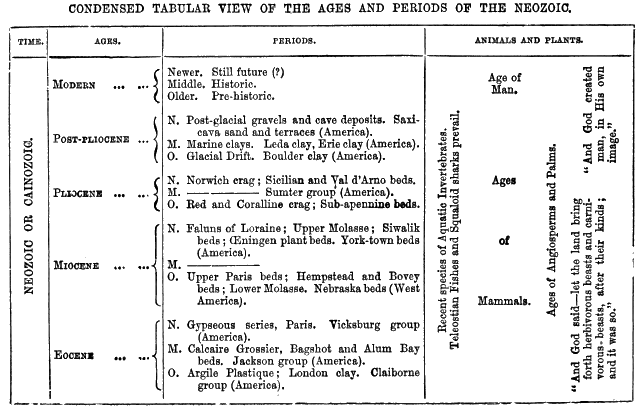
Click on table to view larger version.
CHAPTER XIII.
CLOSE OF THE POST-PLIOCENE, AND ADVENT OF MAN. (Continued.)
Turning from these difficult questions of time, we may now look at the assemblage of land-animals presented by the Post-glacial period. Here, for the first time in the great series of continental elevations and depressions, we find the newly-emerging land peopled with familiar forms. Nearly all the modern European animals have left their bones in the clays, gravels, and cavern deposits which belong to this period; but with them are others either not now found within the limits of temperate Europe, or altogether extinct. Thus the remarkable fact comes out, that the uprising land was peopled at first with a more abundant fauna than that which it now sustains, and that many species, and among these some of the largest and most powerful, have been weeded out, either before the advent of man or in the changes which immediately succeeded that event. That in the Post-glacial period so many noble animal species should have been overthrown in the struggle for existence, without leaving any successors, at least in Europe, is one of the most remarkable phenomena in the history of life on our planet.
According to. Pictet,[AQ] the Post-glacial beds of Europe afford ninety-eight species of mammals, of which fifty-seven still live there, the remainder being either locally or wholly extinct. According to Mr. Boyd Dawkins,[AR] in Great Britain about twelve Pliocene species survived the Glacial period, and reappeared in the British Islands in the Post-glacial. To these were added forty-one species making in all fifty-three, whose remains are found in the gravels and caves of the latter period. Of these, in the Modern period twenty-eight, or rather more than one-half, survive, fourteen are wholly extinct, and eleven are locally extinct.
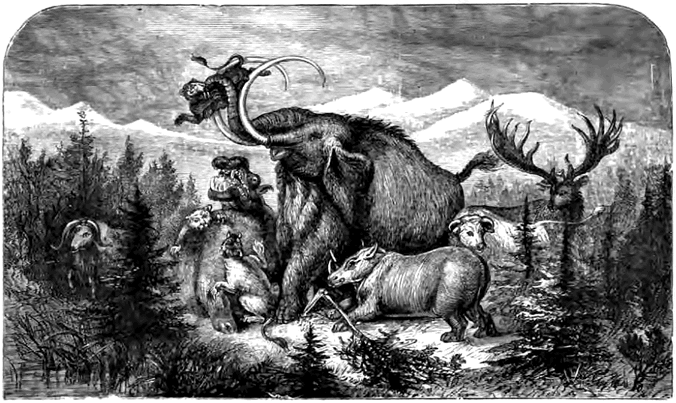
BRITAIN IN THE POST-PLIOCENE AGE. Musk-sheep, Hippopotamus, Machairodus, Mammoth, Wooly Rhinoceros, Long-fronted Ox, and Irish stag. The animals are taken from Mr. Waterhouse Hawkins’s picture, “Struggles of Life among British Animals of the Antediluvian Times.” London: 1853. The landscape is that of the later part of the cold Post-pliocene period.
Among the extinct beasts, were some of very remarkable character. There were two or more species of elephant, which seem in this age to have overspread, in vast herds, all the plains of Northern Europe and Asia; and one of which we know, from the perfect specimen found embedded in the frozen soil of Siberia, lived till a very modern period; and was clothed with long hair and fur, fitting it for a cold climate. There were also three or four species of rhinoceros, one of which at least (the R. Tichorhinus) was clad with wool like the great Siberian mammoth. With these was a huge hippopotamus (H. major), whose head-quarters would, however, seem to have been farther south than England, or which perhaps inhabited chiefly the swamps along the large rivers running through areas now under the sea. The occurrence of such an animal shows an abundant vegetation, and a climate so mild, that the rivers were not covered with heavy ice in winter; for the supposition that this old hippopotamus was a migratory animal seems very unlikely. Another animal of this time, was the magnificent deer, known as the Irish elk; and which perhaps had its principal abode on the great plain which is now the Irish Sea. The terrible machairodus, or cymetar-toothed tiger, was continued from the Pliocene; and in addition to species of bear still living, there was a species of gigantic size, probably now extinct, the cave bear. Evidences are accumulating, to show that all or nearly all these survived until the human period.
If we turn now to those animals which are only locally extinct, we meet with some strange, and at first sight puzzling anomalies. Some of these are creatures now limited to climates much colder than that of Britain. Others now belong to warmer climates. Conspicuous among the former are the musk-sheep, the elk, the reindeer, the glutton, and the lemming. Among the latter, we see the panther, the lion, and the Cape hyena. That animals now so widely separated as the musk-sheep of Arctic America and the hyena of South Africa, could ever have inhabited the same forests, seems a dream of the wildest fancy. Yet it is not difficult to find a probable solution of the mystery. In North America, at the present day, the puma, or American lion, comes up to the same latitudes with the caribou, or reindeer, and moose; and in Asia, the tiger extends its migrations into the abodes of boreal animals in the plains of Siberia. Even in Europe, within the historic period, the reindeer inhabited the forests of Germany; and the lion extended its range nearly as far northward. The explanation lies in the co-existence of a densely wooded country with a temperate climate; the forests affording to southern animals shelter from the cold or winter; and equally to the northern animals protection from the heat of summer. Hence our wonder at this association of animals of diverse habitudes as to climate, is merely a prejudice arising from the present exceptional condition of Europe. Still it is possible that changes unfavourable to some of these animals, were in progress before the arrival of man, with his clearings and forest fires and other disturbing agencies. Even in America, the megalonyx, or gigantic sloth, the mammoth, the mastodon, the fossil horse, and many other creatures, disappeared before the Modern period; and on both continents the great Post-glacial subsidence or deluge may have swept away some of the species. Such a supposition seems necessary to account for the phenomena of the gravel and cave deposits of England, and Cope has recently suggested it in explanation of similar storehouses of fossil animals in America.[AS]
Among the many pictures which this fertile subject calls up, perhaps none is more curious than that presented by the Post-glacial cavern deposits. We may close our survey of this period with the exploration of one of these strange repositories; and may select Kent’s Hole at Torquay, so carefully excavated and illumined with the magnesium light of scientific inquiry by Mr. Pengelly and a committee of the British Association.
The somewhat extensive and ramifying cavern of Kent’s Hole is an irregular excavation, evidently due partly to fissures in limestone rock, and partly to the erosive action of water enlarging such fissures into chambers and galleries. At what time it was originally cut we do not know, but it must have existed as a cavern at the close of the Pliocene or beginning of the Post-pliocene period, since which time it has been receiving a series of deposits which have quite filled up some of its smaller branches.
First and lowest, according to Mr. Pengelly, is a “breccia” or mass of broken and rounded stones, with hardened red clay filling the interstices. Most of the stones are of the rock which forms the roof and walls of the cave, but many, especially the rounded ones, are from more distant parts of the surrounding country. In this mass, the depth of which is unknown, are numerous bones, all of one kind of animal, the cave bear, a creature which seems to have lived in Western Europe from the close of the Pliocene down to the modern period. It must have been one of the earliest and most permanent tenants of Kent’s Hole at a time when its lower chambers were still filled with water. Next above the breccia is a floor of “stalagmite” or stony carbonate of lime, deposited from the drippings of the roof, and in some places three feet thick. This also contains bones of the cave bear, deposited when there was less access of water to the cavern. Mr. Pengelly infers the existence of man at this time from a single flint flake and a single flint chip found in these beds; but mere flakes and chips of flint are too often natural to warrant such a conclusion. After the old stalagmite floor above mentioned was formed, the cave again received deposits of muddy water and stones; but now a change occurs in the remains embedded. This stony clay, or “cave earth” has yielded an immense quantity of teeth and bones, including those of the elephant, rhinoceros, horse, hyena, cave bear, reindeer, and Irish elk. With these were found weapons of chipped flint, and harpoons, needles, and bodkins of bone, precisely similar to those of the North American Indians and other rude races. The “cave earth” is four feet or more in thickness, It is not stratified, and contains many fallen fragments of rock, rounded stones, and broken pieces of stalagmite. It also has patches of the excrement of hyenas, which the explorers suppose to indicate the temporary residence of these animals; and in one spot, near the top, is a limited layer of burnt wood, with remains which indicate the cooking and eating of repasts of animal food by man. It is clear that when this bed was formed the cavern was liable to be inundated with muddy water, carrying stones and other heavy objects, and breaking up in places the old stalagmite floor. One of the most puzzling features, especially to those who take an exclusively uniformitarian view, is, that the entrance of water-borne mud and stones implies a level of the bottom of the water in the neighbouring valleys of about 100 feet above its present height. The cave earth is covered by a second crust of stalagmite, less dense and thick than that below, and containing only a few bones, which are of the same general character with those below, but include a fragment of a human jaw with teeth. Evidently, when this stalagmite was formed, the influx of water-borne materials had ceased, or nearly so; but whether the animals previously occupying the country still continued in it, or only accidental bones, etc., were introduced into the cave or lifted from the bed below, does not appear.
The next bed marks a new change. It is a layer of black mould from three to ten inches thick. Its microscopic structure does not seem to have been examined; but it is probably a forest soil, introduced by growth, by water, by wind, and by ingress of animals, at a time when the cave was nearly in its present state, and the surrounding country densely wooded. This bed contains bones of animals, all of them modern, and works of art ranging from the old British times before the Roman invasion up to the porter-bottles and dropped halfpence of modern visitors. Lastly, in and upon the black mould are many fallen blocks from the roof of the cave.
There can be no doubt that this cave and the neighbouring one of Brixham have done very much to impress the minds of British geologists with ideas of the great antiquity of man, and they have, more than any other Post-glacial monuments, shown the persistence of some animals now extinct up to the human age. Of precise data for determining time, they have, however, given nothing. The only measures which seed to have been applied, namely, the rate of growth of stalagmite and the rate of erosion of the neighbouring valleys, are, from the very sequence of the deposits, obviously worthless; and the only apparently available constant measure, namely, the fall of blocks from the roof, seems not yet to have been applied. We are therefore quite uncertain as to the number of centuries involved in the filling of this cave, and must remain so until a surer system of calculation is adopted. We may, however, attempt to sketch the series of events which it indicates.
The animals found in Kent’s Hole are all “Post-glacial.” They therefore inhabited the country after it rose from the great Glacial submergence. Perhaps the first colonists of the coasts of Devonshire in this period were the cave bears, migrating on floating ice, and subsisting, like the Arctic bear, and the black bears of Anticosti, on fish, and on the garbage cast up by the sea. They found Kent’s Hole a sea-side cavern, with perhaps some of its galleries still full of water, and filling with, breccia, with which the bones of dead bears became mixed. As the land rose, these creatures for the most part betook themselves to lower levels, and in process of time the cavern stood upon a hill-side, perhaps several hundreds of feet above the sea; and the mountain torrents, their beds not yet emptied of glacial detritus, washed into it stones and mud and carcases of animals of many species which had now swarmed across the plains elevated out of the sea, and multiplied in the land. This was the time of the cave earth; and before its deposit was completed, though how long before, a confused and often-disturbed bed of this kind cannot tell, man himself seems to have been added to the inhabitants of the British land. In pursuit of game he sometimes ascended the valleys beyond the cavern, or even penetrated into its outer chambers; or perhaps there were even in those days rude and savage hill-men, inhabiting the forests and warring with the more cultivated denizens of plains below, which are now deep under the waters. Their weapons, lost in hunting, or buried in the flesh of wounded animals which crept to the streams to assuage their thirst, are those found in the cave earth. The absence of human bones may merely show that the mighty hunters of those days were too hardy, athletic, and intelligent, often to perish from accidental causes, and that they did not use this cavern for a place of burial. But the land again subsided. The valley of that now nameless river, of which the Rhine the Thames, and the Severn may have alike been tributaries, disappeared under the sea; and some tribe, driven from the lower lands, took refuge in this cave, now again near the encroaching waves, and left there the remains of their last repasts ere they were driven farther inland or engulfed in the waters. For a time the cavern may have been wholly submerged, and the charcoal of the extinguished fires became covered with its thin coating of clay. But ere long it re-emerged to form part of an island, long barren and desolate; and the valleys having been cut deeper by the receding waters, it no longer received muddy deposits, and the crust formed by drippings from its roof contained only bones and pebbles washed by rains or occasional land floods from its own clay deposits. Finally, the modern forests overspread the land, and were tenanted by the modern animals. Man returned to use the cavern again as a place of refuge or habitation, and to leave there the relics contained in the black earth. This seems at present the only intelligible history of this curious cave and others resembling it; though, when we consider the imperfection of the results obtained even by a large amount of labour, and the difficult and confused character of the deposits in this and similar caves, too much value should not be attached to such histories, which may at any time be contradicted or modified by new facts or different explanations of those already known. The time involved depends very much, as already stated, on the question whether we regard the Post-glacial subsidence and re-elevation as somewhat sudden, or as occupying long ages at the slow rate at which some parts of our continents are now rising or sinking.[AT]
Such are the glimpses, obscure though stimulating to the imagination, which geology can give of the circumstances attending the appearance of man in Western Europe. How far we are from being able to account for his origin, or to give its circumstances and relative dates for the whole world, the reader will readily understand. Still it is something to know that there is an intelligible meeting-place of the later geological ages and the age of man, and that it is one inviting to many and hopeful researches. It is curious also to find that the few monuments disinterred by geology, the antediluvian record of Holy Scripture, and the golden age of heathen tradition, seem alike to point to similar physical conditions, and to that simple state of the arts of life in which “gold and wampum and flint stones”[AU] constituted the chief material treasures of the earliest tribes of men. They also point to the immeasurable elevation, then as now, of man over his brute rivals for the dominion of the earth. To the naturalist this subject opens up most inviting yet most difficult paths of research, to be entered on with caution and reverence, rather than in the bold and dashing spirit of many modern attempts. The Christian, on his part, may feel satisfied that the scattered monumental relics of the caves and gravels will tell no story very different from that which he has long believed on other evidence, nor anything inconsistent with those views of man’s heavenly origin and destiny which have been the most precious inheritance of the greatest and best minds of every age, from that early pre-historic period when men, “palaeolithic” men, no doubt, began to “invoke the name of Jehovah,” the coming Saviour, down to those times when life and immortality are brought to light, for all who will see, by the Saviour already come.
In completing this series of pictures, I wish emphatically to insist on the imperfection of the sketches which I have been able to present, and which are less, in comparison with the grand march of the creative work, even as now imperfectly known to science, than the roughest pencilling of a child when compared with a finished picture. If they have any popular value, it will be in presenting such a broad general view of a great subject as may induce further study to fill up the details. If they have any scientific value, it will be in removing the minds of British students for a little from the too exclusive study of their own limited marginal area, which has been to them too much the “celestial empire” around which all other countries must be arranged, and in divesting the subject of the special colouring given to it by certain prominent cliques and parties.
Geology as a science is at present in a peculiar and somewhat exceptional state. Under the influence of a few men of commanding genius belonging to the generation now passing away, it has made so gigantic conquests that its armies have broken up into bands of specialists, little better than scientific banditti, liable to be beaten in detail, and prone to commit outrages on common sense and good taste, which bring their otherwise good cause into disrepute. The leaders of these bands are, many of them, good soldiers, but few of them fitted to be general officers, and none of them able to reunite our scattered detachments. We need larger minds, of broader culture and wider sympathies, to organise and rule the lands which we have subdued, and to lead on to further conquests.
In the present state of natural science in Britain, this evil is perhaps to be remedied only by providing a wider and deeper culture for our young men. Few of our present workers have enjoyed that thorough training in mental as well as physical science, which is necessary to enable men even of great powers to take large and lofty views of the scheme of nature. Hence we often find men who are fair workers in limited departments, reasoning most illogically, taking narrow and local views, elevating the exception into the rule, led away by baseless metaphysical subtleties, quarrelling with men who look at their specialties from a different point of view, and even striving and plotting for the advancement of their own hobbies. Such defects certainly mar much of the scientific work now being done. In the more advanced walks of scientific research, they are to some extent neutralised by that free discussion which true science always fosters; though even here they sometimes vexatiously arrest the progress of truth, or open floodgates of error which it may require much labour to close. But in public lectures and popular publications they run riot, and are stimulated by the mistaken opposition of narrow-minded good men, by the love of the new and sensational, and by the rivalry of men struggling for place and position. To launch a clever and startling fallacy which will float for a week and stir up a hard fight, seems almost as great a triumph as the discovery of an important fact or law; and the honest student is distracted with the multitude of doctrines, and hustled aside by the crowd of ambitious groundlings.
The only remedy in the case is a higher and more general scientific education; and yet I do not wonder that many good men object to this, simply because of the difficulty of finding honest and competent teachers, themselves well grounded in their subjects, and free from that too common insanity of specialists and half-educated men, which impels them to run amuck at everything that does not depend on their own methods of research. This is a difficulty which can be met in our time only by the general good sense and right feeling of the community taking a firm hold of the matter, and insisting on the organization and extension of the higher scientific education, as well as that of a more elementary character, under the management of able and sane men. Yet even if not so counteracted, present follies will pass away, and a new and better state of natural science will arise in the future, by its own internal development. Science cannot long successfully isolate itself from God. Its life lies in the fact that it is the exponent of the plans and works of the great Creative Will. It must, in spite of itself, serve His purposes, by dispelling blighting ignorance and superstition, by lighting the way to successive triumphs of human skill over the powers of nature, and by guarding men from the evils that flow from infringement of natural laws. And it cannot fail, as it approaches nearer to the boundaries of that which may be known by finite minds, to be humbled by the contemplation of the infinite, and to recognise therein that intelligence of which the human mind is but the image and shadow.
It may be that theologians also are needed who shall be fit to take the place of Moses to our generation, in teaching it again the very elements of natural theology; but let them not look upon science as a cold and godless demon, holding forth to the world a poisoned cup cunningly compounded of truth and falsehood; but rather as the natural ally and associate of the gospel of salvation. The matter is so put in one of those visions which close the canon of revelation, when the prophet sees a mighty angel having the “everlasting gospel to preach;” but he begins his proclamation by calling on men to “worship Him that made heaven and earth and the sea and the fountains of waters.” Men must know God as the Creator even before they seek Him as a benefactor and redeemer. Thus religion must go hand in hand with all true and honest science. In this way only may we look forward to a time when a more exact and large-minded science shall be in perfect accord with a more pure and spiritual Christianity, when the natural and the spiritual shall be seen to be the necessary complements of each other, and when we shall hear no more of reconciliations between science and theology, because there will be no quarrels to reconcile. Already, even in the present chaos of scientific and religious opinion, indications can be seen by the observant, that the Divine Spirit of order is breathing on the mass, and will evolve from it new and beautiful worlds of mental and spiritual existence.
CHAPTER XIV.
PRIMITIVE MAN. CONSIDERED WITH REFERENCE TO MODERN THEORIES AS TO HIS ORIGIN.
The geological record, as we have been reading it, introduces us to primitive man, but gives us no distinct information as to his origin. Tradition and revelation have, it is true, their solutions of the mystery, but there are, and always have been, many who will not take these on trust, but must grope for themselves with the taper of science or philosophy into the dark caverns whence issue the springs of humanity. In former times it was philosophic speculation alone which lent its dim and uncertain light to these bold inquirers; but in our day the new and startling discoveries in physics, chemistry, and biology have flashed up with an unexpected brilliancy, and have at least served to dazzle the eyes and encourage the hopes of the curious, and to lead to explorations more bold and systematic than any previously undertaken. Thus has been born amongst us, or rather renewed, for it is a very old thing, that evolutionist philosophy, which has been well characterised as the “baldest of all the philosophies which have sprung up in our world,” and which solves the question of human origin by the assumption that human nature exists potentially in mere inorganic matter, and that a chain of spontaneous derivation connects incandescent molecules or star-dust with the world, and with man himself.
This evolutionist doctrine is itself one of the strangest phenomena of humanity. It existed, and most naturally, in the oldest philosophy and poetry, in connection with the crudest and most uncritical, attempts of the human mind to grasp the system of nature; but that in our day a system destitute of any shadow of proof, and supported merely by vague analogies and figures of speech, and by the arbitrary and artificial coherence of its own parts, should be accepted as a philosophy, and should find able adherents to string upon its thread of hypotheses our vast and weighty stores of knowledge, is surpassingly strange. It seems to indicate that the accumulated facts of our age have gone altogether beyond its capacity for generalisation; and but for the vigour which one sees everywhere, it might be taken as an indication that the human mind has fallen into a state of senility, and in its dotage mistakes for science the imaginations which were the dreams of its youth.
In many respects these speculations are important and worthy of the attention of thinking men. They seek to revolutionise the religious beliefs of the world, and if accepted would destroy most of the existing theology and philosophy. They indicate tendencies among scientific thinkers, which, though probably temporary, must, before they disappear, descend to lower strata, and reproduce themselves in grosser forms, and with most serious effects on the whole structure of society. With one class of minds they constitute a sort of religion, which so far satisfies the craving for truths higher than those which relate to immediate wants and pleasures. With another and perhaps larger class, they are accepted as affording a welcome deliverance from all scruples of conscience and fears of a hereafter. In the domain of science evolutionism has like tendencies. It reduces the position of man, who becomes a descendant of inferior animals, and a mere term in a series whose end is unknown. It removes from the study of nature the ideas of final cause and purpose; and the evolutionist, instead of regarding the world as a work of consummate plan, skill, and adjustment, approaches nature as he would a chaos of fallen rocks, which may present forms of castles and grotesque profiles of men and animals, but they are all fortuitous and without significance. It obliterates the fine perception of differences from the mind of the naturalist, and resolves all the complicated relations of living things into some simple idea of descent with modification. It thus destroys the possibility of a philosophical classification, reducing all things to a mere series, and leads to a rapid decay in systematic zoology and botany, which is already very manifest among the disciples of Spencer and Darwin in England. The effect of this will be, if it proceeds further, in a great degree to destroy the educational value and popular interest attaching to these sciences, and to throw them down at the feet of a system of debased metaphysics. As redeeming features in all this, are the careful study of varietal forms, and the inquiries as to the limits of species, which have sprung from these discussions, and the harvest of which will be reaped by the true naturalists of the future.
Thus these theories as to the origin of men and animals and plants are full of present significance, and may be studied with profit by all; and in no part of their applications more usefully than in that which relates to man. Let us then inquire,—1. What is implied in the idea of evolution as applied to man? 2. What is implied in the idea of creation? 3. How these several views accord with what we actually know as the result of scientific investigation? The first and second of these questions may well occupy the whole of this chapter, and we shall be able merely to glance at their leading aspects. In doing so, it may be well first to place before us in general terms the several alternatives which evolutionists offer, as to the mode in which the honour of an origin from apes or ape-like animals can be granted to us, along with the opposite view as to the independent origin of man which have been maintained either on scientific or scriptural grounds.
All the evolutionist theories of the origin of man depend primarily on the possibility of his having been produced from some of the animals more closely allied to him, by the causes now in operation which lead to varietal forms, or by similar causes which have been in operation; and some attach more and others less weight to certain of these causes, or gratuitously suppose others not actually known. Of such causes of change some are internal and others external to the organism. With respect to the former, one school assumes an innate tendency in every species to change in the course of time.[AV] Another believes in exceptional births, either in the course of ordinary generation or by the mode of parthenogenesis.[AW] Another refers to the known facts of reproductive accelleration or retardation observed in some humble creatures.[AX] New forms arising in any of these ways or fortuitously, may, it is supposed, be perpetuated and increased and further improved by favouring external circumstances and the effort of the organism to avail itself of these,[AY] or by the struggle for existence and the survival of the fittest.[AZ]
On the other hand, those who believe in the independent origin of man admit the above causes as adequate only to produce mere varieties, liable to return into the original stock. They may either hold that man has appeared as a product of special and miraculous creation, or that he has been created mediately by the operation of forces also concerned in the production of other animals, but the precise nature of which is still unknown to us; or lastly, they may hold what seems to be the view favoured by the book of Genesis, that his bodily form is a product of mediate creation and his spiritual nature a direct emanation from his Creator.
The discussion of all these rival theories would occupy volumes, and to follow them into details would require investigations which have already bewildered many minds of some scientific culture. Further, it is the belief of the writer that this plunging into multitudes of details has been fruitful of error, and that it will be a better course to endeavour to reach the root of the matter by looking at the foundations of the general doctrine of evolution itself, and then contrasting it with its rival.
Taking, then, this broad view of the subject, two great leading alternatives are presented to us. Either man is an independent product of the will of a Higher Intelligence, acting directly or through the laws and materials of his own institution and production, or he has been produced by an unconscious evolution from lower things. It is true that many evolutionists, either unwilling to offend, or not perceiving the logical consequences of their own hypothesis, endeavour to steer a middle course, and to maintain that the Creator has proceeded by way of evolution. But the bare, hard logic of Spencer, the greatest English authority on evolution, leaves no place for this compromise, and shows that the theory, carried out to its legitimate consequences, excludes the knowledge of a Creator and the possibility of His work. We have, therefore, to choose between evolution and creation; bearing in mind, however, that there may be a place in nature for evolution, properly limited, as well as for other things, and that the idea of creation by no means excludes law and second causes.
Limiting ourselves in the first place to theories of evolution, and to these as explaining the origin of species of living beings, and especially of man, we naturally first inquire as to the basis on which they are founded. Now no one pretends that they rest on facts actually observed, for no one has ever observed the production of even one species. Nor do they even rest, like the deductions of theoretical geology, on the extension into past time of causes of change now seen to be in action. Their probability depends entirely on their capacity to account hypothetically for certain relations of living creatures to each other, and to the world without; and the strongest point of the arguments of their advocates is the accumulation of cases of such relations supposed to be accounted for. Such being the kind of argument with which we have to deal, we may first inquire what we are required to believe as conditions of the action of evolution, and secondly, to what extent it actually does explain the phenomena.
In the first place, as evolutionists, we are required to assume certain forces, or materials, or both, with which evolution shall begin. Darwin, in his Origin of Species, went so far as to assume the existence of a few of the simpler types of animals; but this view, of course, was only a temporary resting-place for his theory. Others assume a primitive protoplasm, or physical basis of life, and arbitrarily assigning to this substance properties now divided between organised and unorganised, and between dead and living matter, find no difficulty in deducing all plants and animals from it. Still, even this cannot have been the ultimate material. It must have been evolved from something. We are thus brought back to certain molecules of star-dust, or certain conflicting forces, which must have had self-existence, and must have potentially included all subsequent creatures. Otherwise, if with Spencer we hold that God is “unknowable” and creation “unthinkable,” we are left suspended on nothing over a bottomless void, and must adopt as the initial proposition of our philosophy, that all things were made out of nothing, and by nothing; unless we prefer to doubt whether anything exists, and to push the doctrine of relativity to the unscientific extreme of believing that we can study the relations of things non-existent or unknown. So we must allow the evolutionist some small capital to start with; observing, however, that self-existent matter in a state of endless evolution is something of which we cannot possibly have any definite conception.
Being granted thus much, the evolutionist next proceeds to demand that we shall also believe in the indefinite variability of material things, and shall set aside all idea that there is any difference in kind between the different substances which we know. They must all be mutually convertible, or at least derivable from some primitive material. It is true that this is contrary to experience. The chemist holds that matter is of different kinds, that one element cannot be converted into another; and he would probably smile if told that, even in the lapse of enormous periods of time, limestone could be evolved out of silica. He may think that this is very different from the idea that a snail can be evolved from an oyster, or a bird from a reptile. But the zoologist will inform him that species of animals are only variable within certain limits, and are not transmutable, in so far as experience and experiment are concerned. They have their allotropic forms, but cannot be changed into one another.
But if we grant this second demand, the evolutionist has a third in store for us. We must also admit that by some inevitable necessity the changes of things must in the main take place in one direction, from the more simple to the more complex, from the lower to the higher. At first sight this seems not only to follow from the previous assumptions, but to accord with observation. Do not all living things rise from a simpler to a more complex state? has not the history of the earth displayed a gradually increasing elevation and complexity? But, on the other hand, the complex organism becoming mature, resolves itself again into the simple germ, and finally is dissolved into its constituent elements. The complex returns into the simple, and what we see is not an evolution, but a revolution. In like manner, in geological time, the tendency seems to be ever to disintegration and decay. This we see everywhere, and find that elevation occurs only by the introduction of new species in a way which is not obvious, and which may rather imply the intervention of a cause from without; so that here also we are required to admit as a general principle what is contrary to experience.
If, however, we grant the evolutionist these postulates, we must next allow him to take the facts of botany and zoology out of their ordinary connection, and thread them like a string of beads, as Herbert Spencer has done in his “Biology,” on the threefold cord thus fashioned. This done, we next find, as might have been expected, certain gaps or breaks which require to be cunningly filled with artificial material, in order to give an appearance of continuity to the whole.
The first of these gaps which we notice is that between dead and living matter. It is easy to fill this with such a term as protoplasm, which includes matter both dead and living, and so to ignore this distinction; but practically we do not yet know as a possible thing the elevation of matter, without the agency of a previous living organism, from that plane in which it is subject merely to physical force, and is unorganised, to that where it becomes organised, and lives. Under that strange hypothesis of the origin of life from meteors, with which Sir William Thomson closed his address at a late meeting of the British Association, there was concealed a cutting sarcasm which the evolutionists felt. It reminded them that the men who evolve all things from physical forces do not yet know how these forces can produce the phenomena of life even in its humblest forms. It is true that the scientific world has been again and again startled by the announcement of the production of some of the lowest forms of life, either from dead organic matter, or from merely mineral substances; but in every case heretofore the effort has proved as vain as the analogies attempted to be set up between the formation of crystals and that of organized tissues are fallacious.
A second gap is that which separates vegetable and animal life. These are necessarily the converse of each other, the one deoxidizes and accumulates, the other oxidizes and expends. Only in reproduction or decay does the plant simulate the action of the animal, and the animal never in its simplest forms assumes the functions of the plant. Those obscure cases in the humbler spheres of animal and vegetable life which have been supposed to show a union of the two kingdoms, disappear on investigation. This gap can, I believe, be filled up only by an appeal to our ignorance. There may be, or may have been, some simple creature unknown to us, on the extreme verge of the plant kingdom, that was capable of passing the limit and becoming an animal. But no proof of this exists. It is true that the primitive germs of many kinds of humble plants and animal s are so much alike, that much confusion has arisen in tracing their development. It is also true that some of these creatures can subsist under very dissimilar conditions, and in very diverse states, and that under the specious name of Biology,[BA] we sometimes find a mass of these confusions, inaccurate observations and varietal differences made to do duty for scientific facts. But all this does not invalidate the grand primary distinction between the animal and the plant, which should be thoroughly taught and illustrated to all young naturalists, as one of the best antidotes to the fallacies of the evolutionist school.
A third is that between any species of animal or plant and any other species. It was this gap, and this only, which Darwin undertook to fill up by his great work on the origin of species, but, notwithstanding the immense amount of material thus expended, it yawns as wide as ever, since it must be admitted that no case has been ascertained in which an individual of one species has transgressed the limits between it and other species. However extensive the varieties produced by artificial breeding, the essential characters of the species remain, and even its minor characters may be reproduced, while the barriers established in nature between species by the laws of their reproduction, seem to be absolute.
With regard to species, however, it must be observed that naturalists are not agreed as to what constitutes a species. Many so-called species are probably races, or varieties, and one benefit of these inquiries has been to direct attention to the proper discrimination of species from varieties among animals and plants. The loose discrimination of species, and the tendency to multiply names, have done much to promote evolutionist views; but the researches of the evolutionists themselves have shown that we must abandon transmutation of true species as a thing of the present; and if we imagine it to have occurred, must refer it to the past.
Another gap is that between the nature of the animal and the self-conscious, reasoning, moral nature of man. We not only have no proof that any animal can, by any force in itself, or by any merely physical influences from without, rise to such a condition; but the thing is in the highest degree improbable. It is easy to affirm, with the grosser materialists, that thought is a secretion of brain, as bile is of the liver; but a moment’s thought shows that no real analogy obtains between the cases. We may vaguely suppose, with Darwin, that the continual exercise of such powers as animals possess, may have developed those of man. But our experience of animals shows that their intelligence differs essentially from that of man, being a closed circle ever returning into itself, while that of man is progressive, inventive, and accumulative, and can no more be correlated with that of the animal than the vital phenomena of the animal with those of the plant. Nor can the gap between the higher religious and moral sentiments of man, and the instinctive affections of the brutes, be filled up with that miserable ape imagined by Lubbock, which, crossed in love, or pining with cold and hunger, conceived, for the first time in its poor addled pate, “the dread of evil to come,” and so became the father of theology. This conception, which Darwin gravely adopts, would be most ludicrous, but for the frightful picture which it gives of the aspect in which religion appears to the mind of the evolutionist.
The reader will now readily perceive that the simplicity and completeness of the evolutionist theory entirely disappear when we consider the unproved assumptions on which it is based, and its failure to connect with each other some of the most important facts in nature: that, in short, it is not in any true sense a philosophy, but merely an arbitrary arrangement of facts in accordance with a number of unproved hypotheses. Such philosophies, “falsely so called,” have existed ever since man began to reason on nature, and this last of them is one of the weakest and most pernicious of the whole. Let the reader take up either of Darwin’s great books, or Spencer’s “Biology,” and merely ask himself as he reads each paragraph, “What is assumed here and what is proved?” and he will find the whole fabric melt away like a vision. He will find, however, one difference between these writers. Darwin always states facts carefully and accurately, and when he comes to a difficulty tries to meet it fairly. Spencer often exaggerates or extenuates with reference to his facts, and uses the arts of the dialectician where argument fails.
Many naturalists who should know better are puzzled with the great array of facts presented by evolutionists; and while their better judgment causes them to doubt as to the possibility of the structures which they study being produced by such blind and material processes, are forced to admit that there must surely be something in a theory so confidently asserted, supported by so great names, and by such an imposing array of relations which it can explain. They would be relieved from their weak concessions were they to study carefully a few of the instances adduced, and to consider how easy it is by a little ingenuity to group undoubted facts around a false theory. I could wish to present here illustrations of this, which abound in every part of the works I have referred to, but space will not permit. One or two must suffice. The first may be taken from one of the strong points often dwelt on by Spencer in his “Biology.”[BB]
"But the experiences which most clearly illustrate to us the process of general evolution are our experiences of special evolution, repeated in every plant and animal. Each organism exhibits, within a short space of time, a series of changes which, when supposed to occupy a period indefinitely great and to go on in various ways instead of one, may give us a tolerably clear conception of organic evolution in general. In an individual development we have compressed into a comparatively infinitesimal space a series of metamorphoses equally vast with those which the hypothesis of evolution assumes to have taken place during those unmeasurable epochs that the earth’s crust tells us of. A tree differs from a seed immeasurably in every respect—in bulk, in structure, in colour, in form, in specific gravity, in chemical composition: differs so greatly that no visible resemblance of any kind can be pointed out between them. Yet is the one changed in the course of a few years into the other; changed so gradually that at no moment can it be said, ‘Now the seed ceases to be and the tree exists.’ What can be more widely contrasted than a newly-born child and the small gelatinous spherule constituting the human ovum? The infant is so complex in structure that a cyclopædia is needed to describe its constituent parts. The germinal vesicle is so simple that it may be defined in a line.... If a single cell under appropriate conditions becomes a man in the space of a few years, there can surely be no difficulty in understanding how, under appropriate conditions, a cell may in the course of untold millions of years give origin to the human race."
“It is true that many minds are so unfurnished with those experiences of nature, out of which this conception is built, that they find difficulty in forming it.... To such the hypothesis that by any series of changes a protozoan should ever give origin to a mammal seems grotesque—as grotesque as did Galileo’s assertion of the earth’s movement seem to the Aristoteleans; or as grotesque as the assertion of the earth’s sphericity seems now to the New Zealanders.”
I quote the above as a specimen of evolutionist reasoning from the hand of a master, and as referring to one of the corner-stones of this strange philosophy. I may remark with respect to it, in the first place, that it assumes those “conditions” of evolution to which I have already referred. In the second place, it is full of inaccurate statements of fact, all in a direction tending to favour the hypothesis. For example, a tree does not differ “immeasurably” from a seed, especially if the seed is of the same species of tree, for the principal parts of the tree and its principal chemical constituents already exist and can be detected in the seed, and unless it were so, the development of the tree from the seed could not take place. Besides, the seed itself is not a thing self-existent or fortuitous. The production of a seed without a previous tree of the same kind is quite as difficult to suppose as the production of a tree without a previous seed containing its living embryo. In the third place, the whole argument is one of analogy. The germ becomes a mature animal, passing through many intermediate stages, therefore the animal may have descended from some creature which when mature was as simple as the germ. The value of such an analogy depends altogether on the similarity of the “conditions” which, in such a case, are really the efficient causes at work. The germ of a mammal becomes developed by the nourishment supplied from the system of a parent, which itself produced the germ, and into whose likeness the young animal is destined to grow. These are the “appropriate conditions” of its development. But when our author assumes from this other “appropriate conditions,” by which an organism, which on the hypothesis is not a germ but a mature animal, shall be developed into the likeness, of something different from its parent, he oversteps the bounds of legitimate analogy. Further, the reproduction of the animal, as observed, is a closed series, beginning at the embryo and returning thither again; the evolution attempted to be established is a progressive series going on from one stage to another. A reproductive circle once established obeys certain definite laws, but its origin, or how it can leave its orbit and revolve in some other, we cannot explain without the introduction of some new efficient cause. The one term of the analogy is a revolution, and the other is an evolution. The revolution within the circle of the reproduction of the species gives no evidence that at some point the body will fly off at a tangent, and does not even inform us whether it is making progress in space. Even if it is so making progress, its orbit of revolution may remain the same. But it may be said the reproduction of the species is not in a circle but in a spiral. Within the limit of experience it is not so, since, however it may undulate, it always returns into itself. But supposing it to be a spiral, it may ascend or descend, or expand and contract; but this does not connect it with other similar spirals, the separate origin of which is to be separately accounted for.
I have quoted the latter part of the passage because it is characteristic of evolutionists to decry the intelligence of those who differ from them. Now it is fair to admit that it requires some intelligence and some knowledge of nature to produce or even to understand such analogies as those of Mr. Spencer and his followers, but it is no less true that a deeper insight into the study of nature may not only enable us to understand these analogies, but to detect their fallacies. I am sorry to say, however, that at present the hypothesis of evolution is giving so strong a colouring to much of popular and even academic teaching, more especially in the easy and flippant conversion of the facts of embryology into instances of evolution on the plan of the above extract, that the Spencerians may not long have to complain of want of faith and appreciation on the part of the improved apes whom they are kind enough to instruct as to their lowly origin.
The mention of “appropriate conditions” in the above extract reminds me of another fatal objection to evolution which its advocates continually overlook. An animal or plant advancing from maturity to the adult state is in every stage of its progress a complete and symmetrical organism, correlated in all its parts and adapted to surrounding conditions. Suppose it to become modified in any way, to ever so small an extent, the whole of these relations are disturbed. If the modification is internal and spontaneous, there is no guarantee that it will suit the vastly numerous external agencies to which the creature is subjected. If it is produced by agencies from without, there is no guarantee that it will accord with the internal relations of the parts modified. The probabilities are incalculably great against the occurrence of many such disturbances without the breaking up altogether of the nice adjustment of parts and conditions. This is no doubt one reason of the extinction of so many species in geological time, and also of the strong tendency of every species to spring back to its normal condition when in any way artificially caused to vary. It is also connected with the otherwise mysterious law of the constant transmission of all the characters of the parent.