Front matter (continued 3)
Reading edition
Barely in the swampy flats, perhaps more frequently in the uplands, grew great pines of several kinds; trees capable of doing as good service for planks and beams as many of their modern successors, but which lived before their time, and do not appear even to have aided much in the formation of coal. These pines of the Coal-period seem to have closely resembled some species still living in the southern hemisphere; and, like the ferns, they present to us a vegetable type which has endured through vast periods of time almost unchanged. Indeed, in the Middle Devonian we have pines almost as closely resembling those of the Modern world as do those of the Coal period. It is in accordance with this long duration of the ferns and pines, that they are plants now of world-wide distribution—suited to all climates and stations. Capacity to exist under varied conditions is near akin to capacity to survive cosmical changes. A botanist in the strange and monstrous woods which we have tried to describe, would probably have found many curious things among the smaller herbaceous plants, and might have gathered several precursors of the modern Exogens and Endogens which have not been preserved to us as fossils, or are known only as obscure fragments. But incomplete though our picture necessarily is, and obscured by the dust of time, it may serve in some degree to render green to our eyes those truly primeval forests which treasured up for our long winter nights the Palæozoic sunshine, and established for us those storehouses of heat-giving material which work our engines and propel our ships and carriages. Truly they lived not in vain, both as realizing for us a type of vegetation which otherwise we could not have imagined, and as preparing the most important of all the substrata of our modern arts and manufactures. In this last regard even the vegetable waste of the old coal swamps was most precious to us, as the means of producing the clay iron ores of the coal measures. I may close this notice of the Carboniferous forests with a suggestive extract from a paper by Professor Huxley in the Contemporary Review:—
"Nature is never in a hurry, and seems to have had always before her eyes the adage, ‘Keep a thing long enough, and you will find a use for it.’ She has kept her beds of coal for millions of years without being able to find much use for them; she has sent them down beneath the sea, and the sea-beasts could make nothing of them: she has raised them up into dry land and laid the black veins bare, and still for ages and ages there was no living thing on the face of the earth that could see any sort of value in them; and it was only the other day, so to speak, that she turned a new creature oat of her workshop, who by degrees acquired sufficient wits to make a fire, and then to discover that the black rock would burn.
"I suppose that nineteen hundred years ago, when Julius Cæsar was good enough to deal with Britain as we have dealt with New Zealand, the primeval Briton, blue with cold and woad, may have known that the strange black stone, of which he found lumps here and there in his wanderings, would burn, and so help to warm his body and cook his food. Saxon, Dane, and Norman swarmed into the land. The English people grew into a powerful nation, and Nature still waited for a return for the capital she had invested in the ancient club-mosses. The eighteenth century arrived, and with it James Watt. The brain of that man was the spore out of which was developed the steam-engine, and all the prodigious trees and branches of modern industry which have grown out of this. But coal is as much an essential condition of this growth and development as carbonic acid is for that of a club-moss. Wanting the coal, we could not have smelted the iron needed to make our engines, nor have worked our engines when we had got them. But take away the engines, and the great towns of Yorkshire and Lancashire vanish like a dream. Manufactures give place to agriculture and pasture, and not ten men could live where now ten thousand are amply supported.
“Thus all this abundant wealth of money and of vivid life is Nature’s investment in club-mosses and the like so long ago. But what becomes of the coal which is burnt in yielding the interest? Heat comes out of it, light comes out of it, and if we could gather together all that goes up the chimney and all that remains in the grate of a thoroughly-burnt coal fire, we should find ourselves in possession of a quantity of carbonic acid, water, ammonia, and mineral matters, exactly equal in weight to the coal. But these are the very matters with which Nature supplied the club-moss which made the coal. She is paid back principal and interest at the same time; and she straightway invests the carbonic acid, the water, and the ammonia in new forms of life, feeding with them the plants that now live. Thrifty Nature! surely no prodigal, but most notable of housekeepers!”
All this is true and admirably put. Its one weak point is the poetical personification of Nature as an efficient planner of the whole. Such an imaginary goddess is a mere superstition, unknown alike to science and theology. Surely it is more rational to hold that the mind which can utilize the coal and understand the manner of its formation, is itself made in the image and likeness of the Supreme Creative Spirit, in whom we live and move and have our being, who knows the end from the beginning, whose power is the origin of natural forces, whose wisdom is the source of laws and correlations of laws, and whose great plan is apparent alike in the order of nature of the Palæozoic world and of the modern world, as well as in the relation of these to each other.
In the Carboniferous, as in the Devonian age, insects existed, and in greater numbers. The winged insects of the period, so far as known, belong to three of the nine or ten orders into which modern insects are usually divided. Conspicuous among them are representatives of our well-known domestic pests the cockroaches, which thus belong geologically to a very old family. The Carboniferous roaches had not the advantage of haunting our larders, but they had abundance of vegetable food in the rank forests of their time, and no doubt lived much as the numerous wild out-of-door species of this family now do. It is, however, a curious fact that a group of insects created so long ago, should prove themselves capable of the kind of domestication to which these creatures attain in our modern days; and that, had we lived even so far back as the coal period, we might have been liable to the attacks of this particular kind of pest. Another group, represented by many species in the coal forests, was that of the May-flies and shad-flies, or ephemeras, which spend their earlier days under water, feeding on vegetable matter, and affording food to many fresh-water fishes—a use which they no doubt served in the coal period also. Some of them were giants in their way, being probably seven inches in expanse of wing, and their larvæ must have been choice morsels to the ganoid fishes, and would have afforded abundant bait had there been anglers in those days. Another group of insects was that of the weevils, a family of beetles, whose grubs must have found plenty of nuts and fruits to devour, without attracting the wrathful attentions of any gardener or orchardist.
A curious and exceptional little group of creatures in the present world is that of the galley-worms or millipedes; wingless, many-jointed, and many-footed crawlers, resembling worms, but more allied to insects. These animals seem to have swarmed in the coal forests, and perhaps attained their maximum numbers and importance in this period, though they still remain, a relic of an ancient comprehensive type. I have myself found specimens referred by Mr. Scudder, a most competent entomologist, to two genera and five species, in a few decayed fossil stumps in Nova Scotia, and several others have been discovered in other parts of the world. It is not wonderful that animals like these, feeding on decayed vegetable matter, should have flourished in the luxuriant Sigillaria swamps. A few species of scorpions and spiders, very like those of the modern world, have been found in the coal measures, both in Europe and America; so that while we know of no enemy of the Devonian insects except the fishes, we know in addition to these in the Carboniferous the spiders and their allies, and the smaller reptiles or batrachians to be noticed in the sequel. With reference to the latter, it is a curious fact that one of the first fragments of a winged insect found in the coal-fields of America was a part of a head and some other remains contained in the coprolites or excrementitious matter of one of the smaller fossil reptiles. It is perhaps equally interesting that this head shows one of the compound facetted eyes as perfectly developed as those of any modern Neuropter, a group of insects remarkable even in the present world for their large and complex organs of vision. We may pause here to note that, just as in the Primordial we already have the Trilobites presenting all the modifications of which the type is susceptible, so in the Carboniferous we have in the case of the terrestrial articulates a similar fact—highly specialised forms like the beetles, the spiders, and the scorpions, already existing along with comprehensive forms like the millipedes. Let us formulate the law of creation which the Primordial trilobites, the Devonian fishes, and the Carboniferous club-mosses and insects have taught us: it is, that every new type rapidly attains its maximum of development in magnitude and variety of forms, and then remains stationary, or even retrogrades, in subsequent ages. We may connect this with other laws in the sequel.
In the coal measures we also meet, for the first time in our ascending progress, the land snails so familiar now in every part of the world, and which are represented by two little species found in the coal formation of Nova Scotia. The figures of these must speak for themselves; but the fact of their occurrence here and the mode of their preservation require some detailed mention. The great province of the Mollusks we have carried with us since we met with the Lingulæ in the Primordial, but all its members have been aquatic, and probably marine. For the first time, in the Carboniferous period, snails emerge from the waters, and walk upon the ground and breathe air; for, like the modern land snails, these creatures no doubt had air-sacks instead of gills. They come suddenly upon us—two species at once, and these representing two distinct forms of the snail tribe, the elongated and the rounded. They were very numerous. In the beds where they occur, probably thousands of specimens, more or less perfect, could be collected. Were they the first-born of land snails? It would be rash to affirm this, more especially since in all the coal-fields of the world no specimens have been found except at one locality in Nova Scotia;[N] and in all the succeeding beds we meet with no more till we have reached a comparatively modern time. Yet it is very unlikely that these creatures were in the coal period limited to one country, and that, after that period, they dropped out of existence for long ages, and then reappeared. Still it may have been so.
THE TWO OLDEST LAND SNAILS.
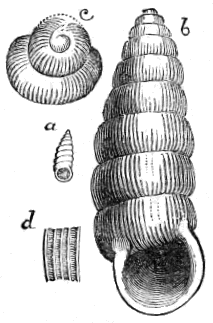
Fig. 14.—Pupa Vetusta, Dawson.
(a) Natural size, (b) Enlarged, (c) Apex, enlarged, (d) Sculpture, magnified.
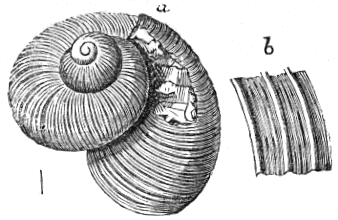
Fig. 15.—Conulus Priscus, Carpenter.
(a) Specimen enlarged, (b) Sculpture, magnified.
There are cases of geographical limitation quite as curious now. Here again another peculiarity meets us. If these are really the oldest land snails, it is curious that they are so small,—so much inferior to many of their modern successors even in the same latitudes. The climate of the coal period must have suited them, and there was plenty of vegetable food, though perhaps not the richest or most tender. There is no excuse for them in their outward circumstances. Why, then, unlike so many other creatures, do they enter on existence in this poor and sneaking way. We must here for their benefit modify in two ways the statement broadly made in a previous chapter, that new types come in under forms of great magnitude. First, we often have, in advance of the main inroad of a new horde of animals, a few insignificant stragglers as a sort of prelude to the rest—precursors intimating beforehand what is to follow. We shall find this to be the case with the little reptiles of the coal, and the little mammals of the Trias, preceding the greater forms which subsequently set in. Secondly, this seems to be more applicable in the case of land animals than in the case of those of the waters. To the waters was the fiat to bring forth living things issued. They have always kept to themselves the most gigantic forms of life; and it seems as if new forms of life entering on the land had to begin in a small way and took more time to culminate.
The circumstances in which the first specimens of Carboniferous snails and gally-worms were found are so peculiar and so characteristic of the coal formation, that I must pause here to notice them, and to make of them an introduction to the next group of creatures we have to consider. In the coal formation in all parts of the world it is not unusual, as stated already in a previous page, to find erect trees or stumps of trees, usually Sigillariæ, standing where they grew; and where the beds are exposed in coast cliffs, or road cuttings, or mines, these fossil trees can be extracted from the matrix and examined. They usually consist of an outer cylinder of coal representing the outer bark, while the space within, once occupied by the inner bark and wood, is filled with sandstone, sometimes roughly arranged in layers, the lowest of which is usually mixed with coaly matter or mineral charcoal derived from the fallen remains of the decayed wood, a kind of deposit which affords to the fossil botanist one of the best modes of investigating the tissues of these trees. These fossil stumps are not uncommon in the roofs of the coal-seams. In some places they are known to the miners as “coal pipes,” and are dreaded by them in consequence of the accidents which occur from their suddenly falling after the coal which supported them has been removed. An old friend and helper of mine in Carboniferous explorations had a lively remembrance of the fact that one of these old trees, falling into the mine in which he was working, had crushed his leg and given him a limp for life; and if he had been a few inches nearer to it would have broken his back.
The manner in which such trees become fossilized may be explained as follows:—Imagine a forest of Sigillariæ growing on a low flat. This becomes submerged by subsidence or inundation, the soil is buried under several feet of sand or mud, and the trees killed by this agency stand up as bare and lifeless trunks. The waters subside, and the trees rapidly decay, the larvæ of wood-boring insects perhaps aiding in the process, as they now do in the American woods. The dense coaly outer bark alone resists decomposition, and stands as a hollow cylinder until prostrated by the wind or by the waters of another inundation, while perhaps a second forest or jungle has sprung up on the new surface. When it falls, the part buried in the soil becomes an open hole, with a heap of shreds of wood and bark in the bottom. Such a place becomes a fit retreat for gally-worms and land-snails; and reptiles pursuing such animals, or pursued by their own enemies, or heedlessly scrambling among the fallen trunks, may easily fall into such holes and remain as prisoners. I remember to have observed, when a boy, a row of post-holes dug across a pasture-field and left open for a few days, and that in almost every hole one or two toads were prisoners. This was the fate which must have often befallen the smaller reptiles of the coal forests in the natural post-holes left by the decay of the Sigillariæ. Yet it may be readily understood that the combination of circumstances which would effect this result must have been rare, and consequently this curious fact has been as yet observed only in the coal formation of Nova Scotia; and in it only in one locality, and in this in one only out of more than sixty beds in which erect trees have been found. But these hollow trees must be filled up in order to preserve their contents; and as inundation and subsequent decay have been the grave-diggers for the reptiles, so inundations filled up their graves with sand, to be subsequently hardened into sandstone, burying up at the same time the newer vegetation which had grown upon the former surface. The idea that something interesting might be found in these erect stumps, first occurred to Sir C. Lyell and the writer while exploring the beautiful coast cliffs of Western Nova Scotia in 1851; and it was in examining the fragments scattered on the beach that we found the bones of the first Carboniferous reptile discovered in America, and the shell of the oldest known land snail.
These were not, however, the earliest known instances of Carboniferous reptiles. In 1841, Sir William Logan found footprints of a reptile at Horton Bluff, in Nova Scotia, in rocks of Lower Carboniferous age. In 1844, Von Dechen found reptilian bones in the coal-field of Saarbruck; and in the same year Dr. King found reptilian footprints in the Carboniferous of Pennsylvania. Like Robinson Crusoe on his desert island, we saw the footprints before we knew the animals that produced them; and the fact that there were marks on a slab of shale or sandstone that must have been made by an animal walking on feet, was as clear and startling a revelation of the advent of a new and higher form of life, as were the footprints of Man Friday. Within the thirty years since the discovery of the first slab of footprints, the knowledge of coal formation reptiles has grown apace. I can scarcely at present sum up exactly the number of species, but may estimate it at thirty-five at least. I must, however, here crave pardon of some of my friends for the use of the word reptile. In my younger days frogs and toads and newts used to be reptiles; now we are told that they are more like fishes, and ought to be called Batrachians or Amphibians, whereas reptiles are a higher type, more akin to birds than to these lower and more grovelling creatures. The truth is, that the old class Reptilia bridges over the space between the fishes and the birds, and it is in some degree a matter of taste whether we make a strong line at the two ends of it alone, or add another line in the middle. I object to the latter course, however, in the period of the world’s history of which I am now writing, since I am sure that there were animals in those days which were batrachians in some points and true reptiles in others; while there are some of them in regard to which it is quite uncertain whether they are nearer to the one group or the other. Although, therefore, naturalists, with the added light and penetration which they obtain by striding on to the Mesozoic and Modern periods, may despise my old-fashioned grovellers among the mire of the coal-swamps, I shall, for convenience, persist in calling them reptiles in a general way, and shall bring out whatever claims I can to justify this title for some of them at least.
Perhaps the most fish-like of the whole are the curious creatures from the coal measures of Saarbruck, first found by Yon Dechen, and which constitute the genus Archegosaurus. Their large heads, short necks, supports for permanent gills, feeble limbs, and long tails for swimming, show that they were aquatic creatures presenting many points of resemblance to the ganoid fishes with which they must have associated; still they were higher than these in possessing lungs and true feet, though perhaps better adapted for swimming than even for creeping.
From these creatures the other coal reptiles diverge, and ascend along two lines of progress, the one leading to gigantic crocodile-like animals provided with powerful jaws and teeth, and probably haunting the margins of the waters and preying on fishes; the other leading to small and delicate lizard-like species, with well-developed limbs, large ribs, and ornate horny scales and spines, living on land and feeding on insects and similar creatures.
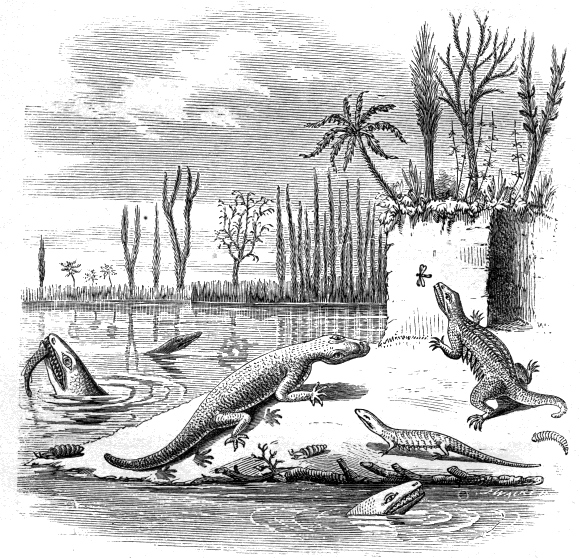
Fig. 16.—RESTORATIONS OF BAPHETES, DENDRERPETON. HYLONOMUS, AND HYLERPETON, WITH CARBONIFEROUS PLANTS IN THE DISTANCE.
In the first direction we have a considerable number of species found in the Jarrow coal-field in Ireland, and described by Professor Huxley. Some of them were like snakes in their general form, others more like lizards. Still higher stand such animals as Baphetes and Eosaurus from the Nova Scotia coal-field and Anthracosaurus from that of Scotland. The style and habits of these creatures it is easy to understand, however much haggling the comparative anatomists may make over their bones. They were animals of various size, ranging from a foot to at least ten feet in length, the body generally lizard-like in form, with stout limbs and a flattened tail useful in swimming. Their heads were flat, stout, and massive, with large teeth, strengthened by the insertion and convolution of plates of enamel. The fore limbs were probably larger than the hind limbs, the better to enable them to raise themselves out of the water. The belly was strengthened by bony plates and closely imbricated scales, to resist, perhaps, the attacks of fishes from beneath, and to enable them without injury to drag their heavy bodies over trunks of trees and brushwood, whether in the water or on the land. Their general aspect and mode of life were therefore by no means unlike those of modern alligators; and in the vast swamps of the coal measures, full of ponds and sluggish streams swarming with fish, such creatures must have found a most suitable habitat, and probably existed in great numbers, basking on the muddy banks, surging through the waters, and filling the air with their bellowings. The most curious point about these creatures is, that while rigid anatomy regards them as allied in structure more to frogs and toads and newts than to true lizards, it is obvious to common sense that they were practically crocodiles; and even anatomy must admit that their great ribs and breastplates, and powerful teeth and limbs, indicate a respiration, circulation, and general vitality, quite as high as those of the proper reptiles. Hence, it happens that very different views are stated as to their affinities; questions into which we need not now enter, satisfied with the knowledge of the general appearance and mode of life of these harbingers of the reptilian life of the succeeding geological periods.
In the other direction, we find several animals of small size but better developed limbs, leading to a group of graceful little creatures, quite as perplexing with regard to affinities as those first mentioned, but tending towards the smaller lizards of the modern world. At the top of these I may place the genus Hylonomus from hollow fossil trees of Nova Scotia, of which two species are represented as restored in our illustration. In these restorations I have adhered as faithfully as possible to the proportions of parts as seen in my specimens. Imagine a little animal six or seven inches long, with small short head, not so flat as those of most lizards, but with a raised fore-head, giving it an aspect of some intelligence. Its general form is that of a lizard, but with the hind feet somewhat large, to aid it in leaping and standing erect, and long and flexible toes. Its belly is covered with bony scales, its sides with bright and probably coloured scale armour of horny consistency, and its neck and back adorned with horny crests, tubercles, and pendants. It runs, leaps, and glides through the herbage of the coal forests, intent on the pursuit of snails and insects, its eye glancing and its bright scales shining in the sun. This is a picture of the best known species of Hylonomus drawn from the life. Yet the anatomist, when he examines the imperfectly-ossified joints of its backbone, and the double joint at the back of its skull, will tell you that it is after all little better than a mere newt, an ass in a lion’s skin, a jackdaw with borrowed feathers, and that it has no right to have fine scales, or to be able to run on the land. It may be so; but I may plead in its behalf, that in the old coal times, when reptiles with properly-made skeletons had not been created, the next best animals may have been entitled to wear their clothes and to assume their functions as well. In short, functionally or officially, our ancient batrachians were reptiles; in point of rank, as measured by type of skeleton, they belonged to a lower grade. To this view of the case I think most naturalists will agree, and they will also admit that the progress of our views has been in this direction, since the first discovery of Carboniferous air-breathing vertebrates. In evidence of this I may quote from Professor Huxley’s description of his recently found species,[O] After noticing the prevalent views that the coal reptiles were of low organization, he says: “Discoveries in the Nova Scotia coal-fields first shook this view, which ceased to be tenable when the great Anthracosaurus of the Scotch coal-field was found to have well-ossified biconcave vertebrae.”
The present writer may, however, be suspected of a tendency to extend forms of life backward in time, since it has fallen to his lot to be concerned in this process of stretching backward in several cases. He has named and described the oldest known animal. He has described the oldest true exogen, and the oldest known pine-tree. He was concerned in the discovery of the oldest known land snails, and found the oldest millipedes. He has just described the oldest bituminous bed composed of spore-cases, and he claims that his genus Hylonomus includes the oldest animals which have a fair claim to be considered reptiles. Still this discovery of old things comes rather of fortune and careful search than of a desire to innovate; and a distinction should be drawn between that kind of novelty which consists in the development of new truths, and that which consists in the invention of new fancies, or the revival of old ones. There is too much of this last at present; and it would be a more promising line of work for our younger naturalists, if they would patiently and honestly question nature, instead of trying to extort astounding revelations by throwing her on the rack of their own imaginations.
We may pause here a moment to contemplate the greatness of the fact we have been studying the introduction into our world of the earliest known vertebrate animals which could open their nostrils and literally “breathe the breath of life.” All previous animals that we know, except a few Devonian insects, had respired in the water by means of gills or similar apparatus, Now we not only have the little land snails, with their imperfect substitutes for lungs, but animals which must have been able to draw in the vital air into capacious chambered lungs, and with this power must have enjoyed a far higher and more active style of vitality; and must have possessed the faculty of uttering truly vocal sounds. What wondrous possibilities unknown to these creatures, perhaps only dimly perceived by such rational intelligences as may have watched the growth of our young world, were implied in these gifts. It is one of the remarkable points in the history of creation in Genesis, that this step of the creative work is emphatically marked. Of all the creatures we have noticed up to this point, it is stated that God said, “Let the waters bring them forth”—but it is said that “God created” great reptiles (tanninim).[P] No doubt these “great tanninim” culminate in the succeeding Mesozoic age, but their first introduction dates as far back as the Carboniferous; and this introduction was emphatically a creation, as being the commencement of a new feature among living beings. What further differences may be implied in the formulæ, “Let the waters produce” and “God created,” we do not know; very probably he who wrote the words did not fully know. But if we could give a scientific expression to this difference, and specify the cases to which its terms apply, we might be able to solve one of the most vexed questions of biology.
Let us observe, however, that even here, where, if anywhere, we have actual creation, especial pains are taken to bridge over the gap, and to prevent any appearance of discontinuity in the work. The ganoid fishes of the coal period very probably had, like their modern congeners, well-developed air-bladders, serving to some extent, though very imperfectly, as lungs. The humbler and more aquatic reptiles of the period retained the gills, and also some of the other features of the fishes; so that, like some modern creatures of their class, they stood, as to respiration, on two stools, and seemed unwilling altogether to commit themselves to the new mode of life in the uncongenial element of air. Even the larger and more lizard-like of the coal reptiles may—though this we do not certainly know, and in some cases there are reasons for doubting it—have passed the earliest stage of their lives in the water as gilled tadpoles, in the manner of our modern frogs. Thus at the very point where one of the greatest advances of animal life has its origin, we have no sudden stop, but an inclined plane; and yet, as I have elsewhere endeavoured to show by arguments which cannot be repeated here,[Q] we have not a shadow of reason to conclude that, in the coal period, fishes were transmuted into reptiles.
But the reader may be wearied with our long sojourn in the pestilential atmosphere of the coal swamps, and in the company of their low-browed and squalid inhabitants. Let us turn for a little to the sea, and notice the animal life of the great coral reefs and shell beds preserved for us in the Carboniferous limestone. Before doing so, one point merits attention. The coal formation for the first time distinctly presents to us the now familiar differences in the inhabitants of the open sea and those of creeks, estuaries and lakes. Such distinctions are unknown to us in the Silurian. There all is sea. They begin to appear in the Devonian, in the shallow fish-banks and the Anodon-like bivalves found with fossil plants. In the coal period they become very manifest. The animals found in the shales with the coal are all, even the aquatic ones, distinct from those of the open seas of the period. Some of them may have lived in salt or brackish water, but not in the open sea. They are creatures of still and shallow waters. It is true that in some coal-fields marine beds occur in the coal measures with their characteristic fossils, but these are quite distinct from the usual animal remains of the coal-fields, and mark occasional overflows of the sea, owing to subsidence of the land. It is important to notice this geographical difference, marking the greater specialisation and division of labour, if we may so speak, that was in the process of introduction.
The sea of the Carboniferous period presented in the main similar great groups of animals to those of the Devonian, represented however by different species. We may notice merely some of the salient points of resemblance or difference. The old types of corals continue in great force; but it is their last time, for they rapidly decay in the succeeding Permian and disappear. The Crinoids are as numerous and beautiful as in any other period, and here for the first time we meet with the new and higher type of the sea-urchin, in large and beautiful species. One curious group, that of the Pentremites, a sort of larval form, is known here alone. Among the lamp-shells we may note, as peculiarly and abundantly Carboniferous, those with one valve very convex and the other very concave and anchored in the mud by long spines instead of a peduncle attached to stones and rocks.[R] There are many beautiful shells allied to modern scallops, and not a few sea-snails of various sorts. The grand Orthoceratites of the Silurian diminish in size preparatory to their disappearance in the Permian, and the more modern type of Nautilus and its allies becomes prevalent. Among the Crustaceans we may notice the appearance of the Limulus, or king-crab, of which the single little species described by Woodward from the Upper Silurian may be regarded as merely a prophecy. It is curious that the Carboniferous king-crabs are very small, apparently another case of a new form appearing in humble guise; but as the young of modern king-crabs haunt creeks and swampy flats, while the adults live in the sea, it may be that only the young of the Carboniferous species are yet known to us, the specimens found being mostly in beds likely to be frequented by the young rather than by the full-grown individuals.
The old order of the Trilobites, which has accompanied us from Primordial times, here fails us, and a few depauperated species alone remain, the sole survivors of their ancient race—small, unornamented, and feeble representatives of a once numerous and influential tribe. How strange that a group of creatures so numerous and apparently so well adapted to conditions of existence which still continue in the sea, should thus die out, while the little bivalved crustaceans, which began life almost as far back and lived on the same sea-floors with the Trilobites, should still abound in all our seas; and while the king-crabs, of precisely similar habits with the Trilobites, should apparently begin to prosper. Equally strange is the fate of the great swimming Eurypterids which we saw in the Devonian. They also continue, but in diminished force, in the Carboniferous, and there lay down for ever their well-jointed cuirasses and formidable weapons, while a few little shrimp-like creatures, their contemporaries, form the small point of the wedge of our great tribes of squillas and crabs and lobsters. Some years ago the late lamented palæontologist, Salter, a man who scarcely leaves his equal in his department, in conjunction with Mr. Henry Woodward, prepared a sort of genealogical chart of the Crustacea on which these facts are exhibited. Some new species have since been discovered, and a little additional light about affinities has been obtained; but taken as it stands, the history of the Crustacea as there shown in one glance, has in it more teaching on the philosophy of creation than I have been able to find in many ponderous quartos of tenfold its pretensions. Had Salter been enabled, with the aid of other specialists like Woodward, to complete similar charts of other classes of invertebrate animals, scientific palaeontology in England would have been further advanced than it is likely to be in the next ten years.
To return to our Trilobites: one of the most remarkable points in their history is their appearance in full force in the Primordial. In these rocks we have some of the largest in size—some species of Paradoxides being nearly two feet long, and some of the very smallest. We have some with the most numerous joints, others with the fewest; some with very large tails, others with very small; some with no ornamentation, others very ornate; some with large eyes, others with none that have been made out, though it is scarcely probable that they were wholly blind. They increased in numbers and variety through the Silurian and Devonian, and then suddenly drop off at the end of the Lower Carboniferous. Throughout their whole term of existence they kept rigidly to that type of the mud-plough which the king-crab still retains, and which renders the anterior extremity so different from that of the ordinary Crustacea. They constitute one of the few cases in which we seem to see before us the whole history of an animal type; and the more we look into that history, the more do we wonder at their inscrutable introduction, the unity and variety mingled in their progress, and their strange and apparently untimely end. I have already referred (page 95) to the use which Barrande makes of this as an argument against theories of evolution; but must refer to his work for the details.
One word more I must say before leaving their graves. I have reason to believe that they were not only the diggers of the burrows, and of the ladder-tracks and pitted tracks[S] of the Silurian and Primordial, but that with the strokes of their rounded or spinous tails, the digging of their snouts, and the hoe-work of their hard upper lips, or Hypostomes, they made nearly all those strange marks in the Primordial mud which have been referred to fucoids, and even to higher plants. The Trilobites worked over all the mud bottoms of the Primordial, even in places where no remains of them occur, and the peculiarities of the markings which they left are to be explained only by a consideration of the structures of individual species.
I had almost lost sight of the fishes of the Carboniferous period, but after saying so much of those of the Devonian, it would be unfair to leave their successors altogether unnoticed. In the Carboniferous we lose those broad-snouted plate-covered species that form so conspicuous a feature in the Devonian; and whatever its meaning, it is surely no accident that these mud-burrowing fishes should decay along with those crustacean mud-burrowers, the Trilobites. But swarms of fishes remain, confined, as in the Devonian, wholly to the two orders of the Gar-fishes (Ganoids) and the sharks (Placoids). In the former we have a multitude of small and beautiful species haunting the creeks and ponds of the coal swamps, and leaving vast quantities of their remains in the shaly and even coaly beds formed in such places. Such were the pretty, graceful fishes of the genera Palæoniscus and Amblypterus. Pursuing and feeding on these were larger ganoids, armed with strong bony scales, and formidable conical or sharp-edged teeth. Of these were Rhizodus and Acrolepis. There were besides multitudes of sharks whose remains consist almost wholly of their teeth and spines, their cartilaginous skeletons having perished. One group was allied to the few species of modern sharks whose mouths are paved with flat teeth for crushing shells. These were the most abundant sharks of the Carboniferous—slow and greedy monsters, haunting shell banks and coral reefs, and grinding remorselessly all the shell-fishes that came in their way. There were also sharks furnished with sharp and trenchant teeth, which must have been the foes of the smaller mailed fishes, pursuing them into creeks and muddy shallows; and if we may judge from the quantity of their remains in some of these places, sometimes perishing in their eager efforts. On the whole, the fishes of the Carboniferous were, in regard to their general type, a continuation of those of the Devonian, but the sharks and the scaly ganoids were relatively more numerous. They differed from our modern fishes in the absence of the ordinary horny-scaled type to which all our more common fishes belong, and in the prevalence of that style of tail which has been termed “heterocercal,” in which the continuation of the backbone forms the upper lobe of the tail, a style which, if we may judge from modern examples, gives more power of upward and downward movement, and is especially suitable to fishes which search for food only at the bottom, or only above the surface of the waters.
Most reluctantly I must here leave one of the most remarkable periods of the world’s history, and reserve to our next chapter the summation of the history of the older world of life in its concluding stage, the Permian.
CHAPTER VII.
THE PERMIAN AGE AND CLOSE OF THE PALÆOZOIC.
The immense swamps and low forest-clad plains which occupied the continental areas of the Northern Hemisphere, and which we now know extended also into the regions south of the equator, appear at the close of the Carboniferous age to have again sunk beneath the waves, or to have relapsed into the condition of sand and gravel banks; for a great thickness of such deposits rests on the coal measures and constitutes the upper coal formation, the upper “barren measures” of the coal-miners. There is something grand in the idea of this subsidence of a world of animal and vegetable life beneath the waters. The process was very slow, so slow that at first vegetable growth and deposition of silt kept pace with it; and this is the reason of the immense series of deposits, in some places nearly 15,000 feet thick, which inclose or rest upon the coal beds; but at length it became more rapid, so that forests and their inhabitants perished, and the wild surf drifted sand and pebbles over their former abodes. So the Carboniferous world, like that of Noah, being overflowed with water, perished. But it was not a wicked world drowned for its sins, but merely an old and necessarily preliminary system, which had fully served its purpose; and, like the stubble of last year, must be turned under by the plough that it may make way for a new verdure. The plough passed over it, and the winter of the Permian came, and then the spring of a new age.
The Permian and the succeeding Triassic are somewhat chilly and desolate periods of the earth’s history. The one is the twilight of the Palæozoic day, the other is the dawn of the Mesozoic. Yet to the philosophical geologist no ages excel them in interest. They are times of transition, when old dynasties and races pass away and are replaced by new and vigorous successors, founding new empires and introducing new modes of life and action.
Three great leading points merit our attention in entering on the Permian age. The first is the earth-movements of the period. The second is the resulting mineral characteristics of the deposits formed. The third is the aspect of the animal and vegetable life of this age in their relation more especially to those which preceded.
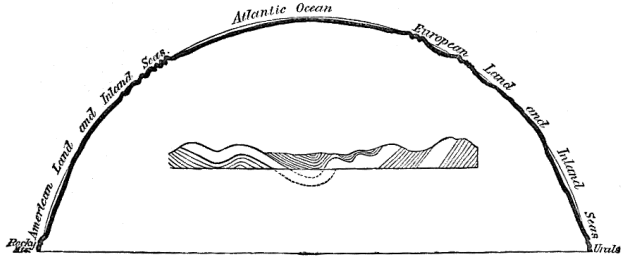
DIAGRAM OF FOLDINGS OF THE CRUST IN THE PERMIAN PERIOD. (The vertical scale of heights and depressions exaggerated more than six times.) The lower figure shows a portion of folded strata in the Appalachians—after Rogers.
With respect to the first point above named, the earth’s crust was subjected in the Permian period to some of the grandest movements which have occurred in the whole course of geologic time, and we can fix the limits of these, in Europe and America at least, with some distinctness. If we examine the Permian rocks in England and Germany, we shall find that everywhere they lie on the upturned edges of the preceding Carboniferous beds. In other words, the latter have been thrown into a series of folds, and the tops of these folds have been more or less worn away before the Permian beds were placed on them. But if we pass on to the eastward, in the great plain between the Volga and the Ural mountains, where, in the “ancient kingdom of Perm,” the greatest known area of these rocks is found, an area equal in extent to twice that of France, and which Sir R. I. Murchison, who first proposed the name, took as the typical district, we find, on the contrary, that the Permian and Carboniferous are conformable to one another. If now we cross the Atlantic and inquire how the case stands in America, we shall find it precisely the same. Here the great succession of earth-waves constituting the Appalachian Mountains rises abruptly at the eastern edge of the continent, and becomes flatter and flatter, until, in the broad plains west of the Mississippi, the Permian beds appear, as in Russia, resting upon the Carboniferous so quietly that it is not always easy to draw a line of separation between them. As Dana has remarked, we find at the western side of Europe and the eastern side of America, great disturbances inaugurating the Permian period; and in the interior of both, in the plains between the Volga and the Ural in one, and between the Mississippi and Rocky Mountains in the other, an entire absence of these disturbances. The main difference is, that in eastern America the whole Carboniferous areas have apparently been so raised up that no Permian was deposited on them, while in Europe considerable patches of the disturbed areas became or remained submerged. Another American geologist has largely illustrated the fact that the movements which threw up the Appalachian folds were strongest to the eastward, and that the ridges of rock are steepest on their west sides, the force which caused them acting from the direction of the sea. It seems as if the Atlantic area had wanted elbow-room, and had crushed up the edges of the continents next to it. In other words, in the lapse of the Palæozoic ages the nucleus of the earth had shrunk away from its coating of rocky layers, which again collapsed into great wrinkles.
Such a process may seem difficult of comprehension. To understand it we must bear in mind some of its conditions. First, the amount of this wrinkling was extremely small relatively to the mass of the earth. In the diagram on page 162 it is greatly exaggerated, yet is seen to be quite insignificant, however gigantic in comparison with microscopic weaklings like ourselves. Secondly, it was probably extremely slow. Beds of solid rock cannot be suddenly bent into great folds without breaking, and the abruptness of some of the folds may be seen from our figure, copied from Rogers (page 162), of some of the foldings of the Appalachian Mountains. Thirdly, the older rocks below the Carboniferous and the Devonian must have been in a softened and plastic state, and so capable of filling up the vacancies left by the bending of the hard crust above. In evidence of this, we have in the Lower Permian immense volcanic ejections—lavas and other molten rocks spewed out to the surface from the softened and molten masses below. Fourthly, the basin of the Atlantic must have been sufficiently strong to resist the immense lateral pressure, so that the yielding was all concentrated on the weaker parts of the crust near the old fractures at the margins of the great continents. In these places also, as we have seen in previous papers, the greatest thickness of deposits had been formed; so that there was great downward pressure, and probably, also, greater softening of the lower part of the crust. Fifthly, as suggested in a previous chapter, the folding of the earth’s crust may have resulted from the continued shrinkage of its interior in consequence of cooling, leading after long intervals to collapse of the surface. Astronomers have, however, suggested another cause. The earth bulges at the equator, and is flattened at the poles in consequence of, or in connection with, the swiftness of its rotation; but it has been shown that the rotation of the earth is being very gradually lessened by the attraction of the moon.[T] Pierce has recently brought forward the idea[U] that this diminution of rotation, by causing the crust to subside in the equatorial regions and expand in the polar, might produce the movements observed; and which, according to Lesley, have amounted in the whole course of geological time to about two per cent, of the diameter of our globe. We thus have two causes, either of which seems sufficient to produce the effect.
Viewed in this way, the great disturbances at the close of the Palæozoic period constitute one of the most instructive examples in the whole history of the earth of that process of collapse to which the crust was subject after long intervals, and of which no equally great instance occurs except at the close of the Laurentian and the close of the Mesozoic. The mineral peculiarities of the Permian are also accounted for by the above considerations. Let us now notice some of these. In nearly all parts of the world the Permian presents thick beds of red sandstone and conglomerate as marked ingredients. These, as we have already seen, are indications of rapid deposition accompanying changes of level. In the Permian, as elsewhere, these beds are accompanied by volcanic rocks, indicating the subterranean causes of the disturbances. Again, these rocks are chiefly abundant in those regions, like Western Europe, where the physical changes were at a maximum. Another remarkable feature of the Permian rocks is the occurrence of great beds of magnesian limestone, or dolomite. In England, the thick yellow magnesian limestone, the outcrop of which crosses in nearly a straight line through Durham, Yorkshire, and Nottingham, marks the edge of a great Permian sea extending far to the eastward. In the marls and sandstones of the Permian period there is also much gypsum. Now, chemistry shows us that magnesian limestones and gypsums are likely to be deposited where sea water, which always contains salts of magnesia, is evaporating in limited or circumscribed areas into which carbonate of lime and carbonate of soda are being carried by streams from the land or springs from below;[V] and it is also to be observed that solutions of sulphuric acid, and probably also of sulphate of magnesia, are characteristic products of igneous activity. Hence we find in various geological periods magnesian limestones occurring as a deposit in limited shallow sea basins, and also in connection with volcanic breccias. Now these were obviously the new Permian conditions of what had once been the wide flat areas of the Carboniferous period. Still further, we find in Europe, as characteristic of this period, beds impregnated with metallic salts, especially of copper. Of this kind are very markedly the copper slates of Thuringia. Such beds are not, any more than magnesian limestones, limited to this age; but they are eminently characteristic of it. To produce them it is required that water should bring forth from the earth’s crust large quantities of metallic salts, and that these should come into contact with vegetable matters in limited submerged areas, so that sulphates of the metals should be deoxidized into sulphides. A somewhat different chemical process, as already explained, was very active in the coal period, and was connected with the production of its iron ores; but, in the Permian, profound and extensive fractures opened up the way to the deep seats of copper and other metals, to enrich the copper slate and its associated beds. It is also to be observed that the alkaline springs and waters which contain carbonate of soda, very frequently hold various metallic salts; so that where, owing to the action of such waters, magnesian limestone is being deposited, we may expect also to find various metallic ores.
Let us sum up shortly this history. We have foldings of the earth’s crust, causing volcanic action and producing limited and shallow sea-basins, and at the same time causing the evolution of alkaline and metalliferous springs. The union of these mechanical and chemical causes explains at once the conglomerates, the red sandstones, the trap rocks, the magnesian limestones, the gypsum, and the metalliferous beds of the Permian. The same considerations explain the occurrence of similar deposits in various other ages of the earth’s history; though, perhaps, in none of these were they so general over the Northern Hemisphere as in the Permian.
From the size of the stones in some of the Permian conglomerates, and their scratched surfaces, it has been supposed that there were in this period, on the margins of the continents, mountains sufficiently high to have snow-clad summits, and to send down glaciers, bearing rocks and stones to the sea, on which may have floated, as now in the North Atlantic, huge icebergs.[W] This would be quite in accordance with the great elevation of land which we know actually occurred; and the existence of snow-clad mountains along with volcanoes would be a union of fire and frost of which we still have examples in some parts of the earth’s surface, and this in proximity to forms of vegetable life very similar to those which we know existed in the Permian.
With the exception of a few small and worthless beds in Russia, the Permian is not known to contain any coal. The great swamps of the coal period had disappeared. In part they were raised up into rugged mountains. In part they were sunken into shallow sea areas. Thus, while there was much dry land, there was little opportunity for coal production, or for the existence of those rank forests which had accumulated so much vegetable matter in the Carboniferous age. In like manner the fauna of the Permian waters is poor. According to Murchison, the Permian limestones of Europe have afforded little more than one-third as many species of fossils as the older Carboniferous. The fossils themselves also have a stunted and depauperated aspect, indicating conditions of existence unfavourable to them. This is curiously seen in contrasting Davidson’s beautiful illustrations of the British Lamp-shells of the Permian and Carboniferous periods. Another illustrative fact is the exceptionally small size of the fossils even in limestones of the Carboniferous period when these are associated with gypsum, red sandstones, and magnesian minerals; as, for instance, those of some parts of Nova Scotia. In truth, the peculiar chemical conditions conducive to the production of magnesian limestones and gypsum are not favourable to animal life, though no doubt compatible with its existence. Hence the rich fauna of the Carboniferous seas died out in the Permian, and was not renewed; and the Atlantic areas of the period are unknown to us. They were, however, probably very deep and abrupt in slope, and not rich in life. This would be especially the case if they were desolated by cold ice-laden currents.
During the Permian period there was in each of our continental areas a somewhat extensive inland sea. That of Western America was a northward extension of the Gulf of Mexico. That of Eastern Europe was a northward extension of the Euxine and Caspian. In both, the deposits formed were very similar—magnesian limestones, sandstones, conglomerates, marls, and gypsums. In both, these alternate in such a way as to show that there were frequent oscillations of level, producing alternately shallow and deep waters. In both, the animal remains are of similar species, in many instances even identical. But in the areas intervening between these sea basins and the Atlantic the conditions were somewhat different. In Europe the land was interrupted by considerable water areas, not lakes, but inland sea basins; sometimes probably connected with the open sea, sometimes isolated. In these were, deposited the magnesian limestone and its associated beds in England, and the Zechstein and Rotheliegende with their associates in Germany. In America the case was different. In all that immense area which extends from the Atlantic to the plains east of the Mississippi, we know no Permian rocks, unless a portion of those reckoned as Upper Carboniferous, or Permo-carboniferous in Northern Nova Scotia, and Prince Edward Island, should be included in this group. If such existed, they may possibly be covered up in some places by more modern deposits, or may have been swept away by denudation in the intervening ages; but even in these cases we should expect to find some visible remains of them. Their entire absence would seem to indicate that a vast, and in many parts rugged and elevated, continent represented North America in the Permian period. Yet if so, that great continent is an absolute blank to us. We know nothing of the animals or plants which may have lived on it, nor do we even know with certainty that it had active volcanoes, or snow-clad mountains sending down glaciers.
Our picture of the Permian World has not been inviting, yet in many respects it was a world more like that in which we live than was any previous one. It certainly presented more of variety and grand physical features than any of the previous ages; and we might have expected that on its wide and varied continents some new and higher forms of life would have been introduced. But it seems rather to have been intended to blot out the old Palæozoic life, as an arrangement which had been fully tried and served its end, preparatory to a new beginning in the succeeding age.
Still the Permian has some life features of its own, and we must now turn to these. The first is the occurrence here, not only of the representatives of the great Batrachians of the coal period, but of true reptiles, acknowledged to be such by all naturalists. The animals of the genus Protorosaurus, found in rocks of this age both in England and Germany, were highly-organised lizards, having socketed teeth like those of crocodiles, and well-developed limbs, with long tails, perhaps adapted for swimming. They have, however, biconcave vertebras like the lizard-like animals of the coal already mentioned, which, indeed, in their general form and appearance, they must have very closely resembled. The Protorosaurs were not of great size; but they must have been creatures of more stately gait than their Carboniferous predecessors, and they serve to connect them with the new and greater reptiles of the next period.
Another interesting feature of the Permian is its flora, which, in so far as known, is closely related to that of the coal period, though the species are regarded as different; some of the forms, however, being so similar as to be possibly identical. In a picture of the Permian flora we should perhaps place in the foreground the tree-ferns, which seem to have been very abundant, and furnished with dense clusters of aërial roots to enable them to withstand the storms of this boisterous age. The tree-ferns, now so plentiful in the southern hemisphere, should be regarded as one of the permanent vegetable institutions of our world—those of the far-back Lower Devonian, and of all intervening ages up to the present day, having been very much alike. The great reed-like Calamites have had a different fate. In their grander forms they make their last appearance in the Permian, where they culminate in great ribbed stems, sometimes nearly a foot in diameter, and probably of immense height. The brakes of these huge mares'-tails which overspread the lower levels of the Permian in Europe, would have been to us what the hayfields of Brobdingnag were to Gulliver. The Lepidodendra also swarmed, though in diminished force; but the great Sigillarise of the coal are absent, or only doubtfully present. Another feature of the Permian woods was the presence of many pine-trees different in aspect from those of the coal period. Some of these are remarkable for their slender and delicate branches and foliage.[X] Others have more dense and scaly leaves, and thick short cones.[Y] Both of these styles of pines are regarded as distinct, on the one hand, from those of the coal formation, and on the other from those of the succeeding Trias. I have shown, however, many years ago, that in the upper coal formation of America there are branches of pine-trees very similar to Walchia, and, on the other hand, the Permian pines are not very remote in form and structure from some of their modern relations. The pines of the first of the above-mentioned types (Walchia) may indeed be regarded as allies of the modern Araucarian pines of the southern hemisphere, and of the old conifers of the Carboniferous. Those of the second type (Ulmannia) may be referred to the same group with the magnificent Sequoias or Redwoods of California.
It is a curious indication of the doubts which sometimes rest on fossil botany, that some of the branches of these Permian pines, when imperfectly preserved, have been described as sea-weeds, while others have been regarded as club-mosses. It is true, however, that the resemblance of some of them to the latter class of plants is very great; and were there no older pines, we might be pardoned for imagining in the Permian a transition from club-mosses to pines. Unfortunately, however, we have pines nearly as far back in geological time as we have club-mosses; and, in so far as we know, no more like the latter than are the pines of the Permian, so that this connection fails us. In all probability the Permian forests are much less perfectly known to us than those of the coal period, so that we can scarcely make comparisons. It appears certain, however, that the Permian plants are much more closely related to the coal plants than to those of the next succeeding epoch, and that they are not so much a transition from the one to the other as the finishing of the older period to make way for the newer.
But we must reserve some space for a few remarks on the progress and termination of the Palæozoic as a whole, and on the place which it occupies in the world’s history. These remarks we may group around the central question, What is the meaning or value of an age or period in the history of the earth, as these terms are understood by geologists? In most geological books terms referring to time are employed very loosely. Period, epoch, age, system, series, formation, and similar terms, are used or abused in a manner which only the indefiniteness of our conceptions can excuse.
A great American geologist[Z] has made an attempt to remedy this by attaching definite values to such words as those above mentioned. In his system the greater divisions of the history were “Times:” thus the Eozoic was a time and the Palæozoic was a time. The larger divisions of the times are “Ages:” thus the Lower and Upper Silurian, the Devonian, and the Carboniferous are ages, which are equivalent in the main to what English geologists call Systems of Formations. Ages, again, may be divided into “Periods:” thus, in the Upper Silurian, the Ludlow of England, or Lower Helderberg of America, would constitute a period. These periods may again be divided into “Epochs,” which are equivalent to what English geologists call Formations, a term referring not directly to the time elapsed, but to the work done in it. Now this mode of regarding geological time introduces many thoughts as to the nature of our chronology and matters relating to it. A “time” in geology is an extremely long time, and the Palæozoic was perhaps the longest of the whole. By the close of the Palæozoic nine-tenths of all the rocks we know in the earth’s crust were formed. At least this is the case if we reckon mere thickness. For aught that we know, the Eozoic time may have accumulated as much rock as the Palæozoic; but leaving this out of the question, the rocks of the Palæozoic are vastly thicker than those of the Mesozoic and Cainozoic united. Thus the earth’s history seems to have dragged slowly in its earlier stages, or to have become accelerated in its latter times. To place it in another point of view, life changes were greater relatively to merely physical changes in the later than in the earlier times.
The same law seems to have obtained within the Palæozoic time itself. Its older periods, as the Cambrian and Lower Silurian, present immense thicknesses of rock with little changes in life. Its later periods, the Carboniferous and Permian, have greater life-revolution relatively to less thickness of deposits. This again was evidently related to the growing complexity and variety of geographical conditions, which went on increasing all the way up to the Permian, when they attained their maximum for the Palæozoic time.
Again, each age was signalized, over the two great continental plateaus, by a like series of elevations and depressions. We may regard the Siluro-Cambrian, the Silurian, the Devonian, the Carboniferous, and Permian, as each of them a distinct age. Each of these began with physical disturbances and coarse shallow-water deposits. In each this was succeeded by subsidence and by a sea area tenanted by corals and shell-fishes. In each case this was followed by a re-elevation, leading to a second but slow and partial subsidence, to be followed by the great re-elevation preparatory to the next period. Thus we have throughout the Palæozoic a series of cycles of physical change which we may liken to gigantic pulsations of the thick hide of mother earth. The final catastrophe of the Permian collapse was quite different in kind from these pulsations as well as much greater in degree. The Cambrian or Primordial does not apparently present a perfect cycle of this kind, perhaps because in that early period the continental plateaus were not yet definitely formed, and thus its beds are rather portions of the general oceanic deposit. In this respect it is analogous in geological relations to the chalk formation of a later age, though very different in material. The Cambrian may, however, yet vindicate its claim to be regarded as a definite cycle: and the recent discoveries of Hicks in North Wales, have proved the existence of a rich marine fauna far down in the lower part of this system. It is also to be observed that the peculiar character of the Cambrian, as an oceanic bottom rather than a continental plateau, has formed an important element in the difficulties in establishing it as a distinct group; just as a similar difficulty in the case of the chalk has led to a recent controversy about the continuance of the conditions of that period into modern times.
But in each of the great successive heaves or pulsations of the Palæozoic earth, there was a growing balance in favour of the land as compared with the water. In each successive movement more and more elevated land was thrown up, until the Permian flexures finally fixed the forms of our continents. This may be made evident to the eye in a series of curves, as in the following diagram, in which I have endeavoured to show the recurrence of similar conditions in each of the great periods of the Palæozoic, and thus their equivalency to each other as cycles of the earth’s history.
There is thus in these great continental changes a law of recurrence and a law of progress; but as to the efficient causes of the phenomena we have as yet little information. It seems that original fractures and shrinkages of the crust were concerned in forming the continental areas at first. Once formed, unequal burdening of the earth’s still plastic mass by deposits of sediment in the waters, and unequal expansion by the heating and crystallization of immense thicknesses of the sediment, may have done the rest; but the results are surprisingly regular to be produced by such causes. We shall also find that similar cycles can be observed in the geological ages which succeeded the Palæozoic. Geologists have hitherto for the most part been content to assign these movements to causes purely terrestrial; but it is difficult to avoid the suspicion that the succession of geological cycles must have depended on some recurring astronomical force tending to cause the weaker parts of the earth’s crust alternately to rise and subside at regular intervals of time. Herschel, Adhémar, and more recently Croll, have directed attention to astronomical cycles supposed to have important influences on the temperature of the earth. Whether these or other changes may have acted on the equilibrium of its crust is a question well worthy of attention, as its solution might give us an astronomical measure of geological time. This question, however, the geologist must refer to the astronomer.
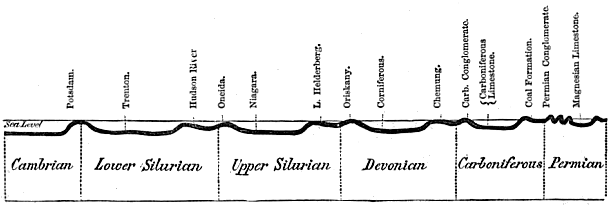
CURVES SHOWING THE SUCCESSIVE ELEVATIONS AND DEPRESSIONS OF THE AMERICAN CONTINENT, IN SEVERAL CYCLES OF THE PALÆOZOIC TIME.
There are two notes of caution which must here be given to the reader. First, it is not intended to apply the doctrine of continental oscillations to the great oceanic areas. Whether they became shallower or deeper, their conditions would be different from those which occurred in the great shallow plateaus, and these conditions are little known to us. Further, throughout the Palæozoic period, the oscillations do not seem to have been sufficient to reverse the positions of the oceans and continents. Secondly, it is not meant to affirm that the great Permian plications were so widespread in their effects as to produce a universal destruction of life. On the contrary, after they had occurred, remnants of the Carboniferous fauna still flourished even on the surfaces of the continents, and possibly the inhabitants of the deep ocean were little affected by these great movements. True it is that the life of the Palæozoic terminates with the Permian, but not by a great and cataclysmic overthrow.
We know something at least of the general laws of continental oscillations during the Palæozoic. Do we know anything of law in the case of life? The question raises so many and diverse considerations that it seems vain to treat it in the end of a chapter; still we must try to outline it with at least a few touches.
First, then, the life of the Palæozoic was remarkable, as compared with that of the present world, in presenting a great prevalence of animals and plants of synthetic types, as they are called by Agassiz that is, of creatures comprehending in one the properties of several groups which were to exist as distinct in the future. Such types are also sometimes called embryonic, because the young of animals and plants often show these comprehensive features. Such types were the old corals, presenting points of alliance with two distinct groups now widely separated; the old Trilobites, half king-crabs and half Isopods; the Amphibians of the coal, part fish, part newt, and part crocodile; the Sigillariæ, part club-mosses and part pines; the Orthoceratites, half nautili and half cuttle-fishes. I proposed, in the illustration in a former article, to give a restoration of one of the curious creatures last mentioned, the Orthoceratites; but on attempting this, with the idea that, as usually supposed, they were straight Nautili, it appeared that the narrow aperture, the small outer chamber, the thin outer wall, often apparently only membranous, and the large siphuncle, would scarcely admit of this; and I finished by representing it as something like a modern squid; perhaps wrongly, but it was evidently somewhere between them and the Nautili.
Secondly, these synthetic types often belonged to the upper part of a lower group, or to the lower part of an upper group. Hence in one point of view they may be regarded as of high grade, in another as of low grade, and they are often large in size or in vegetative development.[AA] From this law have arisen many controversies about the grade and classification of the Palæozoic animals and plants.
Thirdly, extinctions of species occur in every great oscillation of the continental areas, but some species reappear after such oscillations, and the same genus often recurs under new specific forms. Families and orders, such as those of the Trilobites and Orthoceratites, appear to have a grand and gradual culmination and decadence extending over several successive periods, or even over the whole stretch of the Palæozoic time. Toward the close of the Palæozoic, while all the species disappear, some whole families and orders are altogether dropped, and, being chiefly synthetic groups, are replaced by more specialised types, some of which, however, make small beginnings alongside of the more general types which are passing away. Our diagram (page 183) illustrates these points.
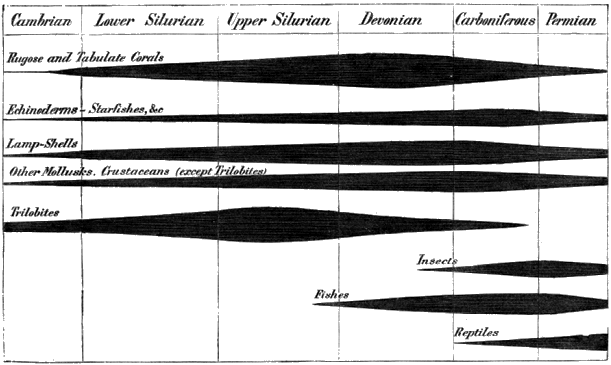
DIAGRAM SHOWING THE ADVANCE, CULMINATION, AND DECADENCE OF SOME OF THE LEADING TYPES OF PALÆOZOIC LIFE.
Fourthly, the progress in animal life in the Palæozoic related chiefly to the lower or invertebrate tribes, and to the two lower classes of the vertebrates. The oldest animal known to us is not only a creature of the simplest structure, but also a representative of the great and on the whole low type of animal life, in which the parts are arranged around a central axis, and not on that plan of bilateral symmetry which constitutes one great leading distinction of the higher animals. With the Cambrian, bilateral animals abound and belong to two very distinct lines of progress—the one, the Mollusks, showing the nutritive organs more fully developed—the other, the Articulates, having the organs of sense and of locomotion more fully organized. These three great types shared the world among them throughout the earlier Palæozoic time, and only in its later ages began to be dominated by the higher types of fishes and reptiles. In so far as we know, it remained for the Mesozoic to introduce the birds and mammals. In plant life the changes were less marked, though here also there is progress—land plants appear to begin, not with the lowest forms, but with the highest types of the lower of the two great series into which the vegetable kingdom is divided. From this they rapidly rise to a full development of the lowest type of the flowering plants, the pines and their allies, and there the progress ceases; for the known representatives of the higher plants are extremely few and apparently of little importance.
Fifthly, in general the history tells of a continued series of alternate victories and defeats of the species that had their birth on the land and in the shallow waters, and those which were born in the ocean depths, The former spread themselves widely after every upheaval, and then by every subsidence were driven back to their mountain fastnesses. The latter perished from the continental plateaus at every upheaval, but climbed again in new hordes and reoccupied the ground after every subsidence. But just as in human history every victory or defeat urges on the progress of events, and develops the great plan of God’s providence in the elevation of man; so here every succeeding change brings in new and higher actors on the stage, and the scheme of creation moves on in a grand and steady progress towards the more varied and elevated life of the Modern World.
But, after all, how little do we know of these laws, which are only beginning to dawn on the minds of naturalists; and which the imperfections of our classification and nomenclature, and the defects in our knowledge of fossil species, render very dim and uncertain. All that appears settled is the existence of a definite plan, working over long ages, and connected with the most remarkable correlation of physical and organic change: going on with regular march throughout the Palæozoic, and then brought to a close to make room for another great succession. This following Mesozoic time must next engage our attention.
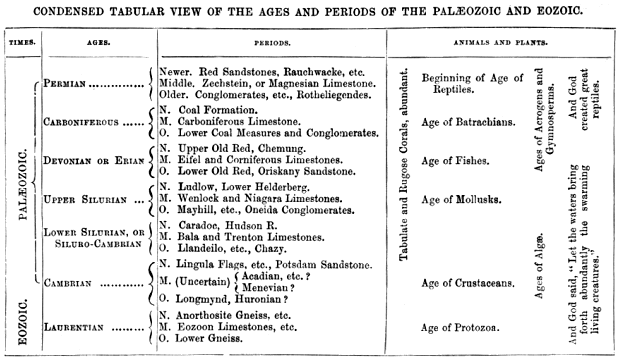
We may close for the present with presenting to the eye in tabular form the periods over which we have passed. The table on page 187, and the diagram (page 179), mutually illustrate each other; and it will be seen that each age constitutes cycle, similar in its leading features to the other cycles, while each is distinguished by some important fact in relation to the introduction of living beings. In this table I have, with Mr. Hull,[AB] for simplicity, arranged the formations of each age under three periods—an older, middle, and newer. Of these, however, the last or newest is in each case so important and varied as to merit division into two, in the manner which I have suggested in previous publications for the Palæozoic rocks of North America.[AC] Under each period I have endeavoured to give some characteristic example from Europe and America, except where, as in the case of the coal formation, the same names are used on both continents. Such a table as this, it must be observed, is only tentative, and may admit of important modifications. The Laurentian more especially may admit of division into several ages; and a separate age may be found to intervene between it and the Cambrian. The reader will please observe that this table refers to the changes on the continental plateaus; and that on both of these each age was introduced with shallow water and usually coarse deposits, succeeded by deeper water and finer beds, usually limestones, and these by a mixed formation returning to the shallow water and coarse deposits of the older period of the age. This last kind of deposition culminates in the great swamps of the coal formation.
Click on table to view larger version.
CHAPTER VIII.
THE MESOZOIC AGES.
Physically, the transition from the Permian to the Trias is easy. In the domain of life a great gulf lies between; and the geologist whose mind is filled with the forms of the Palæozoic period, on rising into the next succeeding beds, feels himself a sort of Rip Van Winkle, who has slept a hundred years and awakes in a new world. The geography of our continents seems indeed to have changed little from the time of the Permian to that next succeeding group which all geologists recognise as the beginning of the Mesozoic or Middle Age of the world’s history, the Triassic period. Where best developed, as in Germany, it gives us the usual threefold series, conglomerates and sandstones below, a shelly limestone in the middle, and sandstones and marls above. Curiously enough, the Germans, recognising this tripartite character here more distinctly than in their other formations, named this the Trias or triple group, a name which it still retains, though as we have seen it is by no means the earliest of the triple groups of strata. In England, where the middle limestone is absent, it is a “New Red Sandstone,” and the same name may be appropriately extended to Eastern America, where bright red sandstones are a characteristic feature. In the Trias, as in the Permian, the continents of the northern hemisphere presented large land areas, and there were lagoons and landlocked seas in which gypsum, magnesian limestones, and rock salt were thrown down, a very eminent example of which is afforded by the great salt deposits of Cheshire. There were also tremendous outbursts of igneous activity along the margins of the continents, more especially in Eastern America. But with all this there was a rich land flora and a wonderful exuberance of new animal life on the land; and in places there were even swamps in which pure and valuable beds of coal, comparable with those of the old coal formation, were deposited.
The triple division of the Trias as a cycle of the earth’s history, and its local imperfection, are well seen in the European development of the group, thus:—
German Series. French Series. English Series.
Keuper, Sandstone and Shale Marnes Irisées Saliferous and gypseous Shales and Sandstones.
Muschelkalk, Limestone and Dolomite Calcaire Coquillier Wanting.
Bunter, Sandstone and Conglomerate Grès bigarré Sandstone and Conglomerate.
The Trias is succeeded by a great and complex system of formations, usually known as the Jurassic, from its admirable development and exposure in the range of the Jura; but which the English geologists often name the “Oolitic,” from the occurrence in it of beds of Oolite or roe-stone. This rock, of which the beautiful cream-coloured limestone of Bath is an illustration, consists of an infinity of little spheres, like seeds or the roe of a fish. Under the microscope these are seen to present concentric layers, each with a radiating fibrous: structure, and often to have a minute grain of sand or fragment of shell in the centre. They are, in short, miniature concretions, produced by the aggregation of the calcareous matter around centres, by a process of molecular attraction to which fine sediments, and especially those containing much lime, are very prone. This style of limestone is very abundant in the Jurassic system, but it is not confined to it. I have seen very perfect Oolites in the Silurian and the Carboniferous. The Jurassic series, as developed in England, may be divided into three triplets or cycles of beds, in the following way:
Upper Jurassic Purbeck Beds. Portland Limestone. Portland Sand.

Middle Jurassic Kimmeridge Clay, etc. Coral Rag, Limestone. Lower Calcareous Grit, Oxford Clay, etc.
Lower Jurassic[AD] Cornbrash and Forest Marble. Great and inferior Oolite, Limestone. Lias Clays and Limestones.
These rocks occupy a large space in England, as the names above given will serve to show; and they are also largely distributed over the continent of Europe and Asia which had evidently three great and long-continued dips under water, indicated by the three great limestones. In America the case was different. The Jurassic has not been distinctly recognised in any part of the eastern coast of that continent, which then perhaps extended farther into the Atlantic than it does at present; so that no marine beds were formed on its eastern border. But in the west, along the base of the Rocky Mountains and also in the Arctic area, there were Jurassic seas of large extent, swarming with characteristic animals. At the close of the Jurassic period our continents seem to have been even more extensive than at present. In England and the neighbouring parts of the continent of Europe, according to Lyell, the fresh-water and estuarine beds known as the Wealden have been traced 320 miles from west to east, and 200 miles from north-west to south-east, and their thickness in one part of this area is estimated at no less than 2,000 feet. Such a deposit is comparable in extent with the deltas of such great rivers as the Niger or even the Mississippi, and implies the existence of a continent much more extensive and more uniform in drainage than Europe as it at present exists. Lyell even speculates on the possible existence of an Atlantic continent west of Europe. America also at this time had, as already stated, attained to even more than its present extension eastwards. Thus this later Jurassic period was the culmination of the Mesozoic, the period of its most perfect continental development, corresponding in this to the Carboniferous in the Palæozoic.
The next or closing period of this great Mesozoic time brought a wondrous change. In the Cretaceous period, so called from the vast deposits of chalk by which it is characterized, the continents sunk as they had never sunk before, so that vast spaces of the great continental plateaus were brought down, for the first time since the Laurentian, to the condition of abyssal depths, tenanted by such creatures as live in the deepest recesses of our modern oceans. This great depression affected Europe more severely than America; the depression of the latter being not only less, but somewhat later in date. In Europe, at the period of greatest submergence, the hills of Scandinavia and of Britain, and the Urals, perhaps alone stood out of the sea. The Alps and their related mountains, and even the Himalayas, were not yet born, for they have on their high summits deep-sea beds of the Cretaceous and even of later date. In America, the Appalachians and the old Laurentian ranges remained above water; but the Rocky Mountains and the Andes were in great part submerged, and a great Cretaceous sea extended from the Appalachians westward to the Pacific, and southward to the Gulf of Mexico, opening probably to the North into the Arctic Ocean.
This great depression must have been of very long continuance, since in Western Europe it sufficed for the production of nearly 1,000 feet in thickness of chalk, a rock which, being composed almost entirely of microscopic shells, is, as we shall see in the sequel, necessarily of extremely slow growth. If we regard the Cretaceous group as one of our great ages or cycles, it seems to be incomplete. The sandstones and clays known as the Greensand and Gault constitute its lower or shallow-water member. The chalk is its middle or deep-sea member, but the upper shallow-water member is missing, or only very locally and imperfectly developed. And the oldest of the succeeding Tertiary deposits, which indicate much less continuous marine conditions, rest on the chalk, as if the great and deep sea of the Cretaceous age had been suddenly upheaved into land. This abrupt termination of the last cycle of the Mesozoic is obviously the reason of the otherwise inexplicable fact that the prevalent life of the period ceases at the top of the chalk, and is exchanged immediately and without any transition for the very different fauna of the Tertiary. This further accords with the fact that the Cretaceous subsidence ended in another great crumpling of the crust, like that which distinguished the Permian. By this the Mesozoic time was terminated and the Cainozoic inaugurated; while the Rocky Mountains, the Andes, the Alps, and the Himalayas, rose to importance as great mountain ranges, and the continents were again braced up to retain a condition of comparative equilibrium during that later period of the earth’s chronology to which we ourselves belong.
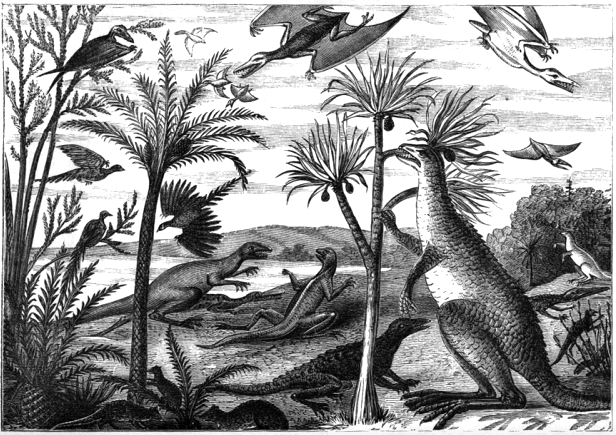
LIFE ON LAND IN THE MESOZOIC PERIOD.
In the foreground are a Pine, Cycads, and a Pandanus; also small Mammals, an herbivorous Dinosaur, and a Labyrinthodont. In the distance are other Dinosaurs and Crocodiles. In the air are birds (Archæopterux) and Pterodactyls.
Was the length of the Mesozoic time equal to that of the Palæozoic? Measured by recurring cycles it was. In the latter period we find five great cycles, from the Lower Silurian to the Permian inclusive. So in the Mesozoic we have five also, from the Trias to the Cretaceous inclusive. We have a right to reckon these cycles as ages or great years of the earth; and so reckoning them, the Mesozoic time may have been as long as the Palæozoic. But if we take another criterion the result will be different. The thickness of the deposits in the Palæozoic as compared with the Mesozoic, where these are severally best developed, may be estimated as at least four or five to one; so that if we suppose the beds to have been formed with equal rapidity in the two great periods, then the older of the two was between four and five times as long as the latter, which would indeed be only a little greater than one of the separate ages of the Palæozoic. Either, therefore, the deposits took place with greater rapidity in the Palæozoic, or that period was by much the longer of the two. This it will be observed, is only another aspect of the great laws of geological sequence referred to in our last paper.
Let us look into this question a little more minutely. If the several pulsations of our continents depended upon any regularly recurring astronomical or terrestrial change, then they must represent, at least approximately, equal portions of time, and this, if proved, would settle the question in favour of an equal duration of these two great eras of the earth’s history. But as we cannot yet prove this, we may consider what light we can derive from the nature of the rocks produced. These may be roughly classified as of two kinds: First, the beds of sediment, sand, clay, etc., accumulated by the slow chemical decay of rocks and the mechanical agency of water. Secondly, the beds formed by accumulation of the harder and less perishable parts of living beings, of which the limestones are the chief. With reference to the first of these kinds of deposit, the action of the atmosphere and rains on rocks in the earlier times might have been somewhat more powerful if there was more carbonic acid in the atmosphere, that substance being the most efficient agent in the chemical decay of rocks. It might have been somewhat more powerful if there was a greater rainfall. It must, on the other hand, have been lessened by the apparently more equable temperature which then prevailed. These differences might perhaps nearly balance one another. Then the rocks of the older time were quite as intractable as those of the newer, and they were probably neither so high nor so extensive. Further, the dips and emergences of the great continental plateaus were equally numerous in the two great periods, though they were probably, with the exception of the latest one of each, more complete in the older period. In so far, then, as deposition of sediment is concerned, these considerations would scarcely lead us to infer that it was more rapid in the Palæozoic. But the Palæozoic sediments may be estimated in the aggregate at about 50,000 feet in thickness, while those of the Mesozoic scarcely reach 8,000. We might, therefore, infer that the Palæozoic period was perhaps five or six times as long as the Mesozoic.
If we take the second class of rocks, the limestones, and suppose these to have been accumulated by the slow growth of corals, shells, etc., in the sea, we might, at first sight, suppose that Palæozoic animals would not grow or accumulate limestone faster than their Mesozoic successors. We must, however, consider here the probability that the older oceans contained more lime in solution than those which now exist, and that the equable temperature and extensive submerged plateaus gave very favourable conditions for the lower animals of the sea, so that it would perhaps be fair to allow a somewhat more rapid rate of growth of limestone for the Palæozoic. Now the actual proportions of limestone may be roughly stated at 13,000 feet in the Palæozoic, and 3,000 feet in the Mesozoic, which would give a proportion of about four and a quarter to one; and as a foot of limestone may be supposed on the average to require five times as long for its formation as a foot of sediment, this would give an even greater absolute excess in favour of the Palæozoic on the evidence of the limestones an excess probably far too great to be accounted for by any more favourable conditions for the secretion of carbonate of lime by marine animals.
The data for such calculations are very uncertain, and three elements of additional uncertainty closely related to each other must also be noticed. The first is the unknown length of the intervals in which no deposition whatever may have been taking place over the areas open to our investigation. The second is the varying amounts in which material once deposited may have been swept away by water. The third is the amount of difference that may have resulted from the progressive change of the geographical features of our continents. These uncertainties would all tend to diminish our estimate of the relative length of the Mesozoic. Lastly, the changes that have taken place in living beings, though a good measure of the lapse of time, cannot be taken as a criterion here, since there is much reason to believe that more rapid changes of physical conditions act as an inducing cause of rapid changes of life.
On the whole, then, taking such facts as we have, and making large deductions for the several causes tending to exaggerate our conception of Palæozoic time, we can scarcely doubt that the Palæozoic may have been three times as long as the Mesozoic. If so, the continental pulsations, and the changes in animal and vegetable life, must have gone on with accelerated rapidity in the later period,—a conclusion to which we shall again have occasion to refer when we arrive at the consideration of the Tertiary or Neozoic time, and the age of man, and the probable duration of the order of things under which we live.
I have given this preliminary sketch of the whole Mesozoic time, because we cannot here, as in the Palæozoic, take up each age separately; and now we must try to picture to ourselves the life and action of these ages. In doing so we may look at, first, the plant life of this period; second, animal life on the land; and third, animal life in the waters and in the ocean depths.
The Mesozoic shores were clothed with an abundant flora, which changed considerably in its form during the lapse of this long time; but yet it has a character of its own distinct from that of the previous Palæozoic and the succeeding Tertiary. Perhaps no feature of this period is more characteristic than the great abundance of those singular plants, the cycads, which in the modern flora are placed near to the pines, but in their appearance and habit more resemble palms, and which in the modern world are chiefly found in the tropical and warm temperate zones of Asia and America. No plants certainly of this order occur in the Carboniferous, where their nearest allies are perhaps some of the Sigillarise; and in the modern time the cycads are not so abundant, nor do they occur at all in climates where their predecessors appear to have abounded. In the quarries of the island of Portland, we have a remarkable evidence of this in beds with numerous stems of cycads still in situ in the soil in which they grew, and associated with stumps of pines which seem to have flourished along with them. In further illustration of this point, I may refer to the fact that Carruthers, in a recent paper, catalogues twenty-five British species belonging to eight genera—a fact which markedly characterizes the British flora of the Mesozoic period. These plants will therefore occupy a prominent place in our restoration of the Mesozoic landscape, and we should give especial prominence to the beautiful species Williamsonia gigas, discovered by the eminent botanist whose name it bears, and restored in his paper on the plant in the “Linnæan Transactions.” These plants, with pines and gigantic equisetums, prevailed greatly in the earlier Mesozoic flora, but as the time wore on, various kinds of endogens, resembling the palms and the screw-pines of the tropical islands, were introduced, and toward its close some representatives of the exogens very like our ordinary trees. Among these we find for the first time in our upward progress in the history of the earth, species of our familiar oaks, figs, and walnut, along with some trees now confined to Australia and the Cape of Good Hope, as the banksias and “silver-trees,” and their allies. In America a large number of the genera of the modern trees are present, and even some of those now peculiar to America, as the tulip-trees and sweet-gums. These forests of the later Mesozoic must therefore have been as gay with flowers and as beautiful in foliage as those of the modern world, and there is evidence that they swarmed with insect life. Further, the Mesozoic plants produced in some places beds of coal comparable in value and thickness to those of the old coal formation. Of this kind are the coal beds of Brora in Sutherlandshire, those of Richmond in Virginia, and Deep River in N. Carolina, those of Vancouver’s Island, and a large part of those of China. To the same age have been referred some at least of the coal beds of Australia and India. So important are these beds in China, that had geology originated in that country, the Mesozoic might have been our age of coal.