Front matter (continued 7)
Reading edition
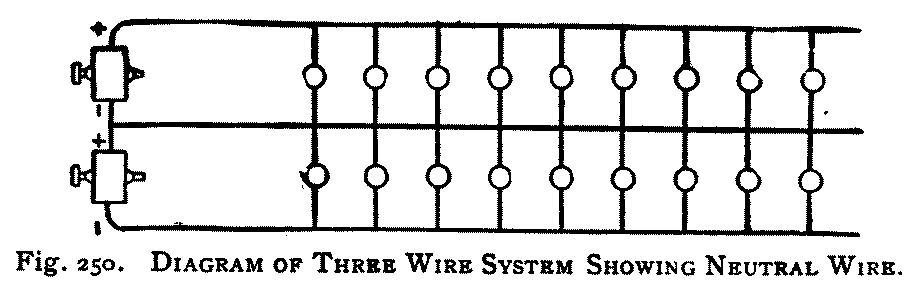
389 STANDARD ELECTRICAL DICTIONARY. N. (a) Symbol for north pole or north-seeking pole of a magnet. (b) Symbol for the number of lines of force in a magnetic circuit. Nairne's Electrical Machine. The cylinder electrical machine, q.v. Napierian Logarithms. A series of logarithms the base of whose system is 2.72818. They are also called hyperbolic logarithms. Nascent State. An element just separating from a combination possesses at that time higher affinities than after separation, and can effect more powerful chemical changes. It is sometimes attributed to a differential time of existence in the atomic modification, before the freed atoms have united to form molecules. Natural Currents. A term for earth currents. (See Current, Earth.) Needle. (a) A term applied to a bar magnet poised horizontally upon a vertical point, or suspended in a horizontal position by a filament. Thus the magnet in a mariner's compass, which may be a substantial bar magnet, is called a magnetic needle. (b) An indicator in general shape like the hand of a clock. (Sec Annunciator, Needle- Telegraph, Needle.) Needle of Oscillation. The magnetic needle poised horizontally, and used for measuring the intensity of the earth's magnetic field, or of an artificial magnetic field, by the method of oscillations. The intensities of the field is inversely as the square of the number of oscillations performed in a given time. Needle, Telegraphic. The index in needle telegraphy (see Telegraph, Needle), whose motions indicate the characters it is desired to transmit. Negative Charge. One of the two kinds of electric charges. The other is the positive. By the double fluid hypothesis this is assumed to be a charge of a particular kind of electricity--negative electricity. By the single fluid hypothesis it is supposed to be caused by the absence of part of the normal electricity of a surface. The reverse is held by some theorists. The subject is so purely theoretical that neither of the two hypotheses is accepted as final. [Transcriber's note: Current is a wire is the motion of negative electrons. Current in a electrolyte is the motion of positive ions and negative ions. Current in a plasma is the motion of electrons and positive ions.] 390 STANDARD ELECTRICAL DICTIONARY. Negative Electricity. The kind of electricity with which a piece of amber is charged by friction with flannel; resinous electricity. (See Electrostatic Series.) In a galvanic battery the surface of the zinc plate is charged with negative electricity. According to the single fluid theory negative electrification consists in a deficiency of electricity. [Transcriber's note: Negative electrification is an excess of electrons.] Negative Element. In a voltaic cell the plate not dissolved by the solution; the one which is positively charged; the copper, platinum, or carbon plate in the usual type of battery. The current is assumed to flow from negative element to positive element (the zinc plate) through the wire or other external conductor. Nerve Currents. Currents of electricity obtained from nerves. They are much more feeble than those obtained from muscle, but are produced in the same general ways. Network. Conductors in parallel and crossing each other, with connections at the junctions. The term is sometimes so loosely applied as to include parallel conductors. Neutral Line of Commutator. The diameter of a commutator which connects its Neutral Points, q. v.; sometimes termed the diameter of commutation; the diameter approximately at right angles with the lines of force. The commutator brushes are applied at the extremities of this diameter. Neutral Point of a Commutator. The points of a commutator at which no lines of force are cut; the points at the extremities of a diameter which, except for the lag, would be at right angles to the lines of force; the points at which the brushes touch the commutator. Neutral Point, Thermo-electric. A temperature marking a point of no thermo-electric difference of potential. If the junctions of a thermo-electric couple are at temperatures, one a little over and the other an equal amount under the neutral point, no current will be developed. At the neutral point the thermo-electric polarities are reversed. Differences of temperature above it give currents of reverse direction to those given by corresponding differences below it. For an iron-copper couple the neutral point is 274.5° C. (526° F.) Synonym--Neutral Temperature. Neutral Relay Armature. An unpolarizable armature for use with a relay; an armature of soft iron or iron wire; as distinguished from a polarized armature. 391 STANDARD ELECTRICAL DICTIONARY. Neutral Wire. The central wire in the three wire system, q. v., of electric distribution; the wire connected to a point between the two dynamos, or otherwise to the central point of the current generator. Fig. 250. DIAGRAM OF THREE WIRE SYSTEM SHOWING NEUTRAL WIRE. Neutral Wire Ampere Meter. An ampere meter connected in the circuit of the neutral wire to determine the current passing through it. Such determination is for the purpose of ascertaining how much more work is being done by one of the lateral leads than by the other. Synonym--Balance Ampere Meter. N. H. P. Symbol or contraction for "nominal horse power." This is a basis for rating the size of an engine. Nickel. A metal; one of the elements; atomic weight, 58.8 ; equivalent, 29.4; valency, 2; specific gravity, 8.8. It is a conductor of electricity. Relative resistance, annealed (Silver = 1), 8.285 Specific Resistance, 12.47 microhms. Resistance of a wire (a) 1 foot long, weighing 1 grain, 15.206 ohms. (b) 1 foot long, 1/1000 inch thick, 74.963 " (c) 1 meter long, weighing 1 gram, 1.060 " (d) 1 meter long, 1 millimeter thick, .1587 " Resistance of a 1-inch cube, 4.907 microhms. Electro-chemical equivalent, (Hydrogen = .0105) .3087 mgs. It is strongly paramagnetic, but loses this quality at 350º C. (662º F.) It is important as a constituent of German silver, an alloy much used for resistance coils. Nickel, Bath. A bath for the electro-deposition of nickel. A great many formulae have been given. Metallic nickel is dissolved in 1 vol. sulphuric acid mixed with 2 vols. water. Neutralize with ammonia, and add of ammonium sulphate one-half the weight of metallic nickel originally used; 135 parts of nickel will be enough for a bath of 10,000 parts. 392 STANDARD ELECTRICAL DICTIONARY. Other formulae are as follows: Double nickel-ammonium sulphate, 4 parts. Ammonium carbonate, 3 " Water 100 " Nickel sulphate, nitrate or chloride, 1 " Sodium bisulphate, 1 " Water, 20 " Nickel anodes are used in the bath to maintain the strength. Too much care cannot be exercised in the absolute cleanliness of the articles to be plated. A too alkaline bath gives a disagreeable yellow color to the deposit; too acid a bath gives badly adhering deposits. Night Bell. An alarm bell in a telegraph office, which bell is connected at night to give a loud signal to attract the operator's attention. It is used in telephone exchanges and is connected so as to ring as long as a subscriber remains unanswered after calling. Nobili's Rings. When a dilute solution of copper acetate is placed on a bright silver plate and a strip of zinc is touched to the silver beneath the copper, a series of rings of copper are formed by electrolysis around the zinc. These are Nobili's rings. If for the copper acetate a solution of lead oxide in potassium hydrate solution is substituted, and if the polished plate which may be German silver is connected to the positive electrode of a battery, and a platinum wire connected to the negative pole is immersed in the liquid, it determines the formation of beautiful iridescent rings of lead binoxide. The platinum wire is sometimes sealed in glass so that only its point projects. The colors are due to interference of light, the layers of lead oxide being extremely thin. The lead binoxide is formed by secondary reaction. Metallic lead is first deposited on the negative pole. The oxygen which goes to the positive pole formed by the polished plate produces lead binoxide which is deposited there in rings. The reaction is comparable to that of a storage battery. Synonyms--Metallochromes--Electric Rings. Nodular Deposit. A deposit obtained in electroplating, characterized by irregular thickness; due to too low density of current. Non-conductor. A material that does not conduct electricity except with great difficulty; a substance of very high resistance. Synonym--Insulator--Dielectric. North Pole. (a) The north-seeking pole of a magnet; the pole of a magnet which tends to point to the north, and whence lines of force are assumed to issue on their course to the other pole of the magnet. (b) The North Pole of the earth. Treating the earth as a magnet, and accepting the above nomenclature the north pole should be termed the south pole. (See Austral Pole--Boreal Pole.) 393 STANDARD ELECTRICAL DICTIONARY. North-seeking Pole. The pole of a magnet which tends to point to the north; the north pole of a magnet. Null Method. Any method of obtaining measurements or comparisons, in which the measurement is correct when the deflection of the galvanometer or other indicator is zero, nought or null. The Wheatstone Bridge (see Bridge, Wheatstone) is an example of a null method. Two obvious advantages attach to null methods in electric galvanometer work. One is that an uncalibrated galvanometer can be employed. The other is that a galvanometer of any high degree of sensitiveness can be employed, there being no restriction as to its fineness of winding or highness of resistance.
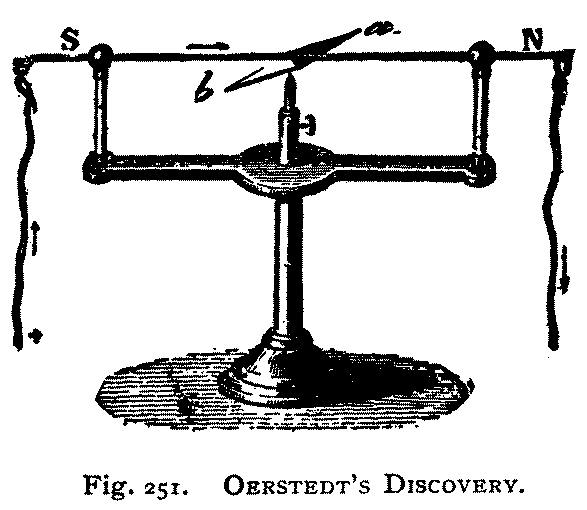
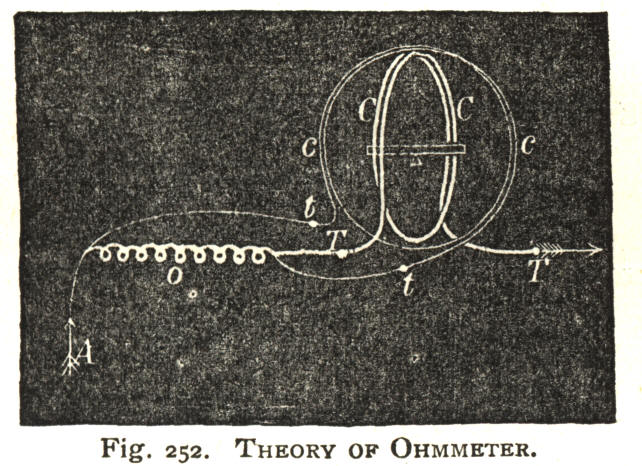
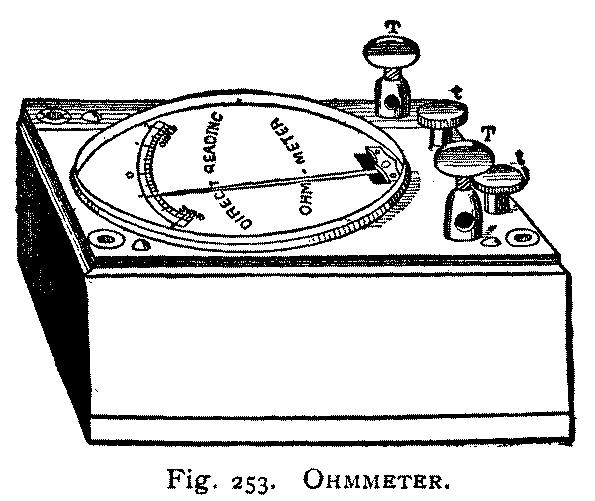
393 STANDARD ELECTRICAL DICTIONARY. "Upper case Omega Graphic". (Greek capital" Omega") symbol for megohm. [Transcriber's note: Now used for ohms.] "Lower case Omega Graphic". (Greek omega) symbol for ohm. [Transcriber's note: Now used for angular velocity, 2*PI*frequency.] Occlusion. An absorption of gases by metals. Palladium will, if used as the hydrogen evolving electrode in decomposing water, absorb 980 times its volume of hydrogen, which is said to be occluded. The metal may also be heated in hydrogen and allowed to cool therein, when occlusion occurs. Platinum will occlude 4 times its volume of hydrogen; iron, 4.15 times its volume of carbon-monoxide; silver, 7 times its volume of oxygen. Metals with occluded gases may serve as elements in a galvanic couple. (See Gas Battery.) A metal expands in occluding a gas. In the storage battery it is believed that occlusion plays a part, hydrogen and oxygen being respectively absorbed by the two sets of plates, and acting as they do in Groves' gas battery. Oerstedt. Name proposed for the unit of current strength, but not adopted. The ampere is the accepted name. 394 STANDARD ELECTRICAL DICTIONARY. Oerstedt's Discovery. Oerstedt discovered in 1820 that a magnetic needle tended to place itself at right angles to a current of electricity. This fundamental experiment is the basis of the galvanometer. Fig. 251. OERSTEDT'S DISCOVERY. Ohm. The practical unit of resistance; 1E9 C. G. S. electro-magnetic units. The legal ohm is the resistance of a mercury column 1 square millimeter in cross-sectional area and 106 centimeters in length. There has been considerable confusion, owing to inaccuracy in early determinations, in the valuation of the ohm. In this work the legal ohm is used. The different ohms will be found defined in their place. Resistance units of various names may also be consulted. The following table gives the relative values of the different ohms. Length of Mercury Board of Column in True B. A. Trade Legal Centimetre. Ohm. Ohm. Ohm. Ohm. True Ohm, 106.24 1. 1.0128 .9994 1.0022 B. A. Ohm, 104.9 .9874 1. .9868 .9889 Board of Trade Ohm 106.3 1.00050 1.0133 1. 1.0028 Legal Ohm, 106.0 .9977 1.0112 .9971 1. Ohmage. The Resistance of a circuit expressed in ohms. Ohm, B. A. The British Association unit of resistance; the resistance of a column of mercury 1 square millimeter in cross sectional area and 104.9 centimeters long; the B. A. Unit of Resistance. Ohm, Board of Trade. The approximate ohm as recommended by the British Board of Trade on the advice of a committee (Sir W. Thomson, Dr. J. Hopkinson, Lord Rayleigh and others). It is the resistance of a mercury column one square millimeter in section, and 106.3 centimeters long at 0º C. (32º F.) Synonym--New Ohm. 395 STANDARD ELECTRICAL DICTIONARY. Ohmic Resistance. True resistance as distinguished from spurious resistance, or counter-electro-motive force. Ohm, Legal. The practical unit of resistance. The resistance of a column of mercury one square millimeter in cross-sectional area and 106 centimetres long at 0º C. (32º F.) The ohm used previously to 1884 is the B. A. Unit of Resistance, q. v. One legal ohm = 1.0112 B. A. Units, and I B. A. Unit = 0.9889 legal ohm. The resistance of a copper wire 1 foot long and 1/1000 inch in diameter is about 10 ohms. The resistance of 1 mile of iron wire 1/3 inch in diameter is about 10 ohms. Synonym--Congress Ohm. 396 STANDARD ELECTRICAL DICTIONARY. Fig. 252. THEORY OF OHMMETER. Fig. 253. OHMMETER. Ohmmeter. An instrument for measuring directly the resistance of a conductor or of any part of a circuit through which a strong current is passing. It is the invention of Prof. W. E. Ayrton. It contains two fixed coils at right angles to each other acting on the same needle of soft iron. One coil is of thick wire and is placed in series with the resistance to be measured. The other is of very thin wire and is placed in parallel with the same resistance. One wire acts by the total current, the other by the potential difference between the ends of the resistance. The action on the soft iron needle is due to the ratio of potential difference to total currents, or to the resistance itself. By properly designing and proportioning the coils the angular deflections of the needle are made proportional to the resistance. In use the thick wire may be kept permanently in circuit. On connecting the binding posts of the thin wire coil to any two parts of the circuit its resistance is at once given by the deflection of the needle. When no current is passing the needle rests in any position. A current in the thick coil brings it to zero. A current simultaneously passing through the thin high resistance coil brings about the deflection. The instrument is a commercial rather than a scientific one. Ohm's Law. The fundamental law expressing the relations between current, electro-motive force and resistance in an active electric circuit. It may be expressed thus: (a) The current strength is equal to the electro-motive force divided by the resistance. (b) The electro-motive force is equal to the current strength multiplied by the resistance. (c) The resistance is equal to the electro-motive force divided by the current strength. All these are different forms of the same statement. Algebraically the law is usually expressed thus, (a) C = E/R. It may also be expressed thus: (b) E = C*R and (c) R= E/C, in which R denotes resistance, C denotes current strength, and E denotes electro-motive force. Ohm, True. The true ohm is the resistance of a column of mercury 1 square millimeter in cross-sectional area, and 106.24 centimeters long. (See Ohm.) Synonym-Rayleigh Ohm. Oil Insulation. Oil insulation has received several applications in electrical work. It has been proposed for use in underground conduits. These it was proposed to fill with oil after the insertion of the conductors, the latter properly wrapped with cotton or other covering. For induction coils it has been very successfully used. Its principal utility depends on the fact that it is liquid, so that if pierced by a spark it at once closes again. A solid insulator if pierced is permanently injured. It is also used in telegraph insulators (see Insulator, Liquid) to prevent surface leakage. 397 STANDARD ELECTRICAL DICTIONARY. Olefiant Gas. A compound gas; C2H4; composed of carbon, 24; hydrogen, 4; molecular weight, 28; specific gravity, .981. It is a dielectric of about the resistance of air. Its specific inductive capacity at atmospheric pressure is 1.000722 (Boltzman.) Synonym--Ethene; heavy carburetted hydrogen. [Transcriber's note: Also called ethylene. A primary use is polyethylene plastic.] Open. adj. An electric circuit is said to be open when it is cut or broken so that no current can pass through it. The term may be recollected by thinking of a switch; when open no current can pass through it. The same adjective is applied to magnetic circuits, an air gap implying an open circuit. Open Circuit Oscillation. An oscillation of current in open circuit so that a spark discharge accompanies it. It is produced by electric resonance in a simple circle or loop of wire with ends placed near together but not touching, if the circuit is of such size that its period of oscillation corresponds with that of the inducing discharge. (See Resonance, Electric.) Its period depends entirely on the self-induction of the circuit. Ordinate. In a system of plane co-ordinates (see Co-ordinates), the distance of any point from the axis of abscissas measured parallel to the axis of ordinates. Ordinates, Axis of. The vertical axis in a system of co-ordinates, q. v. Synonym--Axis of Y. Organ, Electric. An organ in which the air blast is admitted or excluded from the different pipes by electric mechanism. The outlines of the system are a series of contacts worked by the keys and stops, which cause, when operated by the organist, a current to pass through electro-magnets, opening the valves of the different pipes. Thus the manual may be at any distance from the organ, and a number of organs may be worked upon the same manual. As many as five in a single cathedral are thus connected to a manual in the chancel. Orientation of a Magnetic Needle. The acquirement by a magnetic needle of its position of rest, with its magnetic axis in the magnetic meridian. Origin of Co-ordinates. In a system of linear co-ordinates the point of intersection of the axes; the point whose co-ordinates are both zero. 398 STANDARD ELECTRICAL DICTIONARY. Oscillating Needle. A small light bar magnet suspended by a filament and employed in determining the intensity of a magnetic field by the oscillations it completes in a given time after a given disturbance. Oscillations, Electric. In static electricity the sudden and very rapid alternations in the discharge of a static condenser. This discharge of the disruptive order seems a single one, but is really composed of a number of discharges alternating in direction and producing electro-magnetic ether waves, probably identical with light waves except that they are longer and far less rapid. Oscillatory Electro-motive Force. Electro-motive force rapidly changing in sense or in direction, so that it presents an oscillatory character. The alternating current and the telephone current as used in practice are actuated by this type of electro-motive force. Osmose, Electric. When two liquids are separated by a porous diaphragm, and a strong current of electricity is passed through from the liquid on one side, through the diaphragm, to the liquid on the other side, the liquid on the side towards which the current is passing rises in level. The process is termed electric osmose. When a liquid is forced through a diaphragm a current is produced; in other words electric osmose is reversible. The current thus produced is termed a diaphragm current. Oscillation, Electric. The phase of discharge of a static condenser in one direction. It is usually followed by a discharge in the opposite direction constituting a second oscillation, and so on, so that a great number of exceedingly short oscillations are comprised. Thus, in the discharge of the Leyden jar a large number of oscillations of current back and forth are produced, the current alternating like the swings of a pendulum. These oscillations are supposed to affect the ether, producing waves in it identical with light waves, except that we have not been able yet to produce them short enough to affect the visual organs. The waves thus produced can be reflected or refracted; some substances are transparent for them and others opaque. There is a possibility that man may yet succeed in producing electric oscillations of sufficient frequency to bring about the direct production of light. Oscillatory Displacement. Hypothetical displacement currents of rapidly alternating direction produced in the oscillatory discharge of a Leyden jar or static condenser. Oscillatory Induction. Induction produced by sympathetic action of an oscillatory discharge or by electric resonance. (See Oscillations, Electric--Resonance, Electric--Resonator, Electric.) 399 STANDARD ELECTRICAL DICTIONARY. Outlet. The part of an electrolier or electric light fixture out of which the wires are led for attachment of an incandescent light socket. Output. The rate of energy delivered or of work done by a machine. In the case of a current generator it is the volt-coulombs per given second, or better the volt-amperes delivered at its outer circuit terminals. Output, Magnetic. The analogue in a magnetic circuit of the output of an electric circuit. It is the product of the magnetizing force by the induced magnetism. Output, Unit of. As a unit of output of a dynamo Prof. Sylvanus P. Thompson has proposed 1,000 watts, or one kilowatt. This unit is now frequently used. To completely define the dynamo, however, the amperage or the voltage must also be given, as a 10 kilowatt--110 volt machine, or a 10 kilowatt--99 ampere machine. [Transcriber's note: 10 kilowatt at 110 volts is 91 amperes.] Over-Compounding. A proportioning of the series and shunt windings of a compound dynamo, so that the voltage of the terminals rises with the load or output enough to allow for the drop in mains, thus maintaining the potential for full load at distant points in a district. It is carried out by an increase of ampere-turns in the series winding. Overload. In an electric motor a mechanical load put upon it so great as to prevent economical working. One effect of such a load is to make the armature run so slowly as to unduly reduce the counter-electro-motive force and hence to permit so much current to pass through the coils as to heat them, perhaps injuriously. In this case the production of heat implies the waste of energy. Overtype Dynamo or Motor. A dynamo or motor whose armature is placed above or in the upper part of the field magnets, the yoke piece of the magnets being in or resting upon the base of the machine. Ozone. An allotropic form of oxygen. It possesses much more energetic chemical properties than oxygen. It is supposed to contain three atoms of oxygen in its molecule, represented thus: O / \ O---O It is produced by electric discharges and it is its peculiar odor which is noticed about an electric machine, and sometimes in a thunderstorm near the path of a lightning flash. In the electrolysis of water some ozone may be produced, thus diminishing the volume of the oxygen or of the mixed gases given off. This is a source of inaccuracy in a gas voltameter.

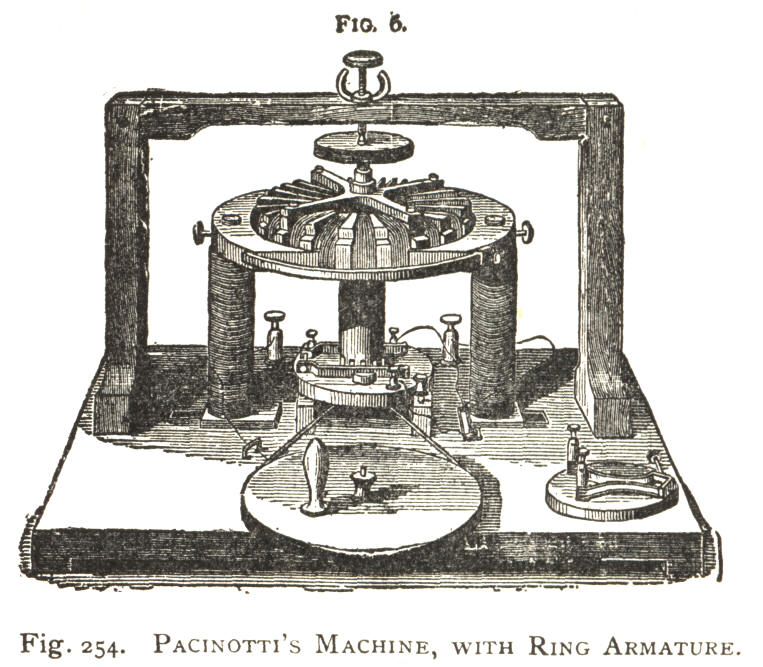
400 STANDARD ELECTRICAL DICTIONARY. Pacinotti's Inductor. The Pacinotti or Gramme Ring. (See Pacinotti's Ring.) Pacinotti's Ring. A ring of iron wire wound with coils of insulated wire at right angles to its circular axis, and used as the armature of a dynamo or motor. A number of connections are taken from the coils to a central commutator. Fig. 254. PACINOTTI'S MACHINE, WITH RING ARMATURE. If such a ring with its coils is rotated in a field, current can be taken from points of the commutator on a line at right angles to the lines of force entering the ring. The ring was discovered in 1862 by Pacinotti, and later was independently discovered by Gramme. It is often known as the Gramme ring. Pacinotti Teeth. Projections on a cylindrical or drum armature, between which in the grooves formed thereby, the wire is wound. The teeth being of iron tend to diminish the reluctance or magnetic resistance of the interpolar space, or interval between the poles of the field magnet. Synonym--Pacinotti Projections. Paillard Alloys. Non-magnetic palladium alloys, invented by Paillard, of Switzerland, used in anti-magnetic watches. The following are given as the compositions of several such alloys: I. II. Palladium, 60 to 75 parts 50 to 75 parts Copper, I5 to 25 " 20 to 30 " Iron. 1 to 5 " 5 to 20 " 401 STANDARD ELECTRICAL DICTIONARY. The following are more complex: I. II. Palladium, 65 to 75 parts 45 to 50 parts Copper, 15 to 25 " 15 to 25 " Nickel, 1 to 5 " 2 to 5 " Silver, 3 to 10 " 20 to 25 " Gold, 1 to 2-1/2 " 2 to 5 " Platinum, 1/2 to 2 " 2 to 5 " Steel, 1 to 5 " 2 to 5 " These alloys are used for balance springs, as well as for the balance wheels and escapement parts of watches. The elasticity of recently produced springs has been found to be very satisfactory. Page Effect. The sounds produced by magnetizing and demagnetizing a bar of iron or steel; the magnetic tick. The sounds are strong enough to produce a telephonic effect. (See Magnetic Tick.) Palladium. A metal of the platinum series. It has the highest power of occlusion, q.v., of all metals. It is the characteristic ingredient of non-magnetic watch alloys. Palladium used as an electrode in the electrolysis of water will occlude 936 volumes of hydrogen, and the hydrogen-palladium alloy will exceed in size the original electrode. Fig. 255. LUMINOUS PANE. Pane, Luminous. A pane of glass, one side of which has pasted to it a long zigzag strip of tinfoil. A design is made by cutting through the strip. On discharging a Leyden jar or an electric machine through the strip sparks appear where the tinfoil is severed, thus producing the design in a luminous effect. Many variations can be employed in their construction. 402 STANDARD ELECTRICAL DICTIONARY. Pantelegraphy. A system of telegraphy for transmitting designs, maps, drawing, and the like by telegraphy. (See Telegraphy, Facsimile.) Paper Filaments. Filaments of carbon for incandescent lamps made from paper. This is one of the earliest materials practically used. The paper is cut out of proper shape, and is carbonized in a close vessel, while embedded in powdered charcoal or some other form of carbon to absolutely cut off access of air. It is then placed in the lamp chamber and flashed or subjected to the regular treatment. Parabola. A curve; one of the conic sections. It is approximately represented by a small arc of a circle, but if extended becomes rapidly deeper than a half circle. If, from a point within called the focus, lines are drawn to the curve and then other lines are drawn from these points parallel to the axis, the angles of incidence will he equal to the angles of reflection as referred to tangents at the points where the lines touch the curve. [Transcriber's note; The general equation of a parabola is A*x^2 + B*x*y + C*y^2 + D*x + E*y + F = 0 such that B^2 = 4*A*C, all of the coefficients are real, and A and C are not zero. A parabola positioned at the origin and symmetrical on the y axis is simplified to y = a*x^2 ] Parabolic Reflector. A reflector for a light, a paraboloid or surface of revolution whose section is a parabola. A light placed at its focus has its rays reflected parallel to each other. Examples of parabolic reflectors are seen in electric search lights and in locomotive head-lights. They are employed in electric search lights. The arc light must be of such construction as to maintain its ignited points always at the same point, the focus of the paraboloid. Paraffine. v. To coat or saturate with paraffine wax. Paper may be paraffined by dipping in the wax, or by being sprinkled with fragments of wax, subsequently melted in with a hot iron or otherwise. The tops of battery carbons are often paraffined to prevent the acid from rising in the pores by capillary attraction and rusting the connections.
403 STANDARD ELECTRICAL DICTIONARY.
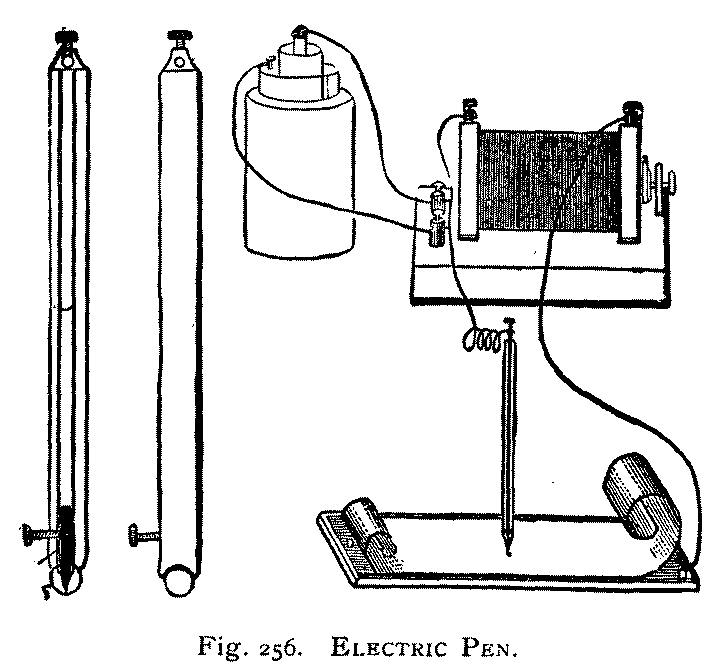
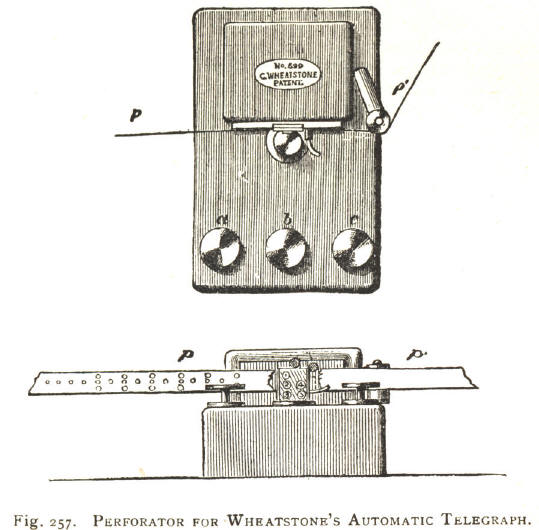
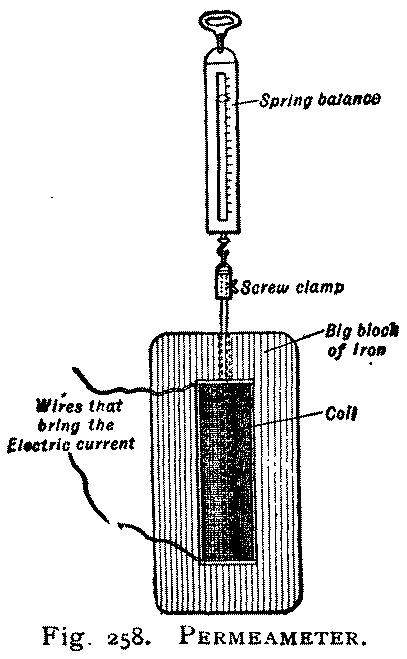
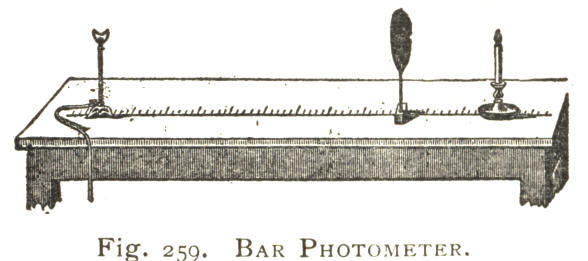
Paraffine Wax. A hydro-carbon composed principally of mixtures of the higher members of the paraffine series C n H2 n + 2. It is made from cannel coal, coal tar, or petroleum by distillation. It is an insulator. Its resistance at 46° C. (114.8° F.) per centimeter cube is 3.4E16 ohms, or about the highest resistance known. Its specific inductive capacity (for milky wax) is 2.47 (Schiller). For clear wax it is given as follows by different authorities: 1.92 Ayrton. 1.96 Wüllner. 1.977 Gibson & Barclay. 2.32 Baltzmann. It is extensively used in condensers and other electric apparatus as a dielectric and insulator. Paragrêles. Protectors against hail; lightning rods used to guard fields against hail; of little or no real utility. Parallax. The apparent change in position of an object when looked at from two points of view. By looking at an object a few feet distant first with one eye and then with the other, the shifting in apparent position is seen. In reading the position of an indicator or needle over a scale parallax introduces an error unless the eye is held vertically over the needle. By making the dial of looking- glass and holding the eye so that the reflection of its pupil is bisected by the needle this verticality is ensured. Parallel. (a) In the nomenclature of electric circuits two or more conductors leading from one point to another, are said to be in parallel. (b) When two or more conductors connect two main leads of comparatively large size and low resistance they are said to be in parallel or in multiple arc. This order is easiest pictured as the rungs of a ladder in parallel connecting its two sides representing the main leads. It may be used as a noun as "arranged in parallel," or as an adjective as "a parallel circuit," the opposite of series, q. v. Paramagnetic. adj. Possessing paramagnetic properties; tending to occupy a position with the longer axis parallel to the lines of force of a magnetic field; having magnetism; attracted by a magnet. "If a homogeneous isotropic substance is placed in a magnetic field it becomes magnetized at every point in the direction of the magnetic intensity at that point, and with an intensity of magnetization proportional to the magnetic intensity. When the positive direction of the induced magnetization is the same as that of the magnetic intensity the substance is called Magnetic or Paramagnetic; when it is opposite, the substance is called Diamagnetic." (Emtage.) A paramagnetic substance has high permeability or multiplying power for lines of force, hence in a magnetic field a bar of iron, etc., is in unstable equilibrium unless its longer axis is parallel with the lines of force in order to reduce as much as possible the reluctance of the circuit. 404 STANDARD ELECTRICAL DICTIONARY. Iron is the most paramagnetic of all substances. Other paramagnetic metals are: Nickel, cobalt, manganese, platinum, cerium, osmium, palladium. Diamagnetic metals are bismuth, antimony, zinc, tin, mercury, lead, silver, copper, gold, arsenic. Bismuth is the most diamagnetic of all metals. Of gases oxygen is most paramagnetic. Becquerel calculated that a cubic yard of oxygen condensed would act on a magnetic needle as powerfully as 5.5 grains of metallic iron. Liquefied oxygen will adhere to the poles of a magnet. Changes of temperature and of other conditions may affect a body's magnetism. Thus hot oxygen is diamagnetic, and a substance paramagnetic in a vacuum may be diamagnetic in air. Of liquids, solutions of iron or cobalt are paramagnetic; water, blood, milk, alcohol, ether, oil of turpentine and most saline solutions are diamagnetic. Paramagnetism. (a) The science or study of paramagnetic substances and phenomena. (b) The magnetic property of a paramagnetic substance; that of being attracted by a magnet, and of arranging itself with its longer axis parallel with the lines of force of a magnetic field. Parchmentizing. If cellulose is treated with a mixture of two parts of sulphuric acid and one part of water perfectly cold, it becomes like parchment. It should at once be washed with water, and then with ammonia and water. The Swan incandescent light fibres are made of parchmentized cotton thread, which is afterward carbonized. Partial Earth. A fault in a conductor caused by imperfect connection with the earth, where insulation from the earth is desired. Passive State. A state of a substance in virtue of which it is unattacked by a solvent which ordinarily would dissolve or attack it. Iron in strong nitric acid is unattacked or assumes the passive state. This particular case is supposed to be due to a coating of magnetic oxide, so that there would be properly speaking no question of a passive state, but only one of superficial protection. The existence of a true passive state of any substance is very doubtful. P. D. Abbreviation for potential difference or difference of potential, or for electro-motive force. 405 STANDARD ELECTRICAL DICTIONARY. Peltier Effect. The thermal effect produced by the passage of a current through the junction of two unlike conductors. Such junction is generally the seat of thermo-electric effects, and a current is generally produced by heating such a junction. If an independent current is passed in the same direction as that of the thermoelectric current, it cools the junction, and warms it if passed in the other direction. In general terms, referring to thermo-electric couples, if passed through them it tends to cool the hot and heat the cool junction. The phenomenon does not occur in zinc-copper junctions. Peltier's Cross. A bar of bismuth and a bar of antimony soldered centre to centre at right angles, being notched or halved there to receive or to set into each other. It is used to demonstrate the Peltier effect, q. v. To one pair of ends are connected the terminals of a battery circuit; to the other pair are connected the terminals of a galvanometer. The galvanometer by its deflections in one and then in the other direction indicates that the junction is heated when the current passes from antimony to bismuth and vice versa. It thus illustrates the heating and cooling of a thermo-electric junction by a current of electricity. The current from the battery by the Peltier effect either heats or cools the junction, as the case may be. This heating or cooling them produces a thermo-electric current in the galvanometer circuit. The battery has no direct influence on the galvanometer. Pendant Cord. A double conductor or pair of conductors, insulated from each other and covered with a worsted, silk, or cotton covering and used to suspend incandescent lamps and at the same time to conduct the current to them. It is also used for other similar service, such as acting as conductors for small motors. Often each conductor is composed of a number of thin wires laid together. This gives flexibility to the cord. Synonym--Flexible Cord. Pendulum, Electric. (a) A pendulum operated by the intermittent action of an electro-magnet, whose circuit is opened and closed by the pendulum itself. A point at the lower end of the pendulum swinging through a globule of mercury may close and open the circuit. Various other methods of accomplishing the same end are employed .. (b) A pith ball suspended by a thread from an insulating stand. It is used to show the attraction exercised by a piece of sealing wax or other substance excited by rubbing. 406 STANDARD ELECTRICAL DICTIONARY. Pen, Electric. A stylus for producing a series of perforations in paper, so that the paper may act as a stencil for the reproduction of a great number of copies of the original matter. Various kinds of electric pens have been invented. One kind, invented by Edison, consists of a handle carrying an electric motor actuating a needle, which is driven in and out of the other end of the handle with high rapidity. It is used by being held vertically on the paper with the needle end downward, and is moved so as to describe perforated letters or designs. The paper is then used as a stencil with an ink roller to reproduce the writing or design ad libitum. A simpler kind dispenses with the motor and depends on the perforations produced by the electric spark. As shown in the cut the stylus is one terminal of an induction coil circuit. The support on which the paper rests is the other terminal and must be a conductor. In use the induction coil is started, and the stylus is moved over the paper; a series of sparks pass through the paper from stylus to the supporting tablet, perforating the paper and producing a stencil to be used for reproduction. Fig. 256. ELECTRIC PEN. Pentane Standard, Harcourt's. A standard of illuminating power; in it the combustible substance is a gas made by mixing one cubic foot of air with three cubic inches of liquid pentane, measured at 60° F. or, if measured as gases, 20 volumes of air to 7 of pentane. It is burned at the rate of 0.5 cubic foot per hour from a cylindrical tube one inch in diameter, closed at the top by a disc 0.5 inch thick with a hole 0.25 inch in diameter, through which the gas issues. It gives a flame 2.5 inches high. The pentane used is the distillate of petroleum which boils at 50° C. (122° F.) ; it has a specific gravity at 15° C. (60° F.) of from 0.628 to 0.631. It is almost pure pentane (C5H12). As long as the rate of consumption is between 0.48 and 0.52 cubic foot per hour the flame gives practically the same light. 407 STANDARD ELECTRICAL DICTIONARY. Perforator. An apparatus used in automatic high speed telegraphy for perforating strips of paper. These are then used by drawing between a roller and contact spring for making and breaking the telegraphic circuit for the production of a record, such as the Morse record, at the distant receiving station. The perforated strip has different classes of holes punched in it to represent dots or dashes. It is fed by machinery very rapidly, so that the message is transmitted with the highest speed. Several operators may simultaneously prepare the paper strips, and thus in conjunction with its rapid feeding in the transmitter, far surpass the time of ordinary direct transmission. Fig. 257. PERFORATOR FOR WHEATSTONE'S AUTOMATIC TELEGRAPH. Perforators may be entirely mechanical but are sometimes pneumatic, compressed air being used to operate them. The holes they make are on different levels of the paper strip, as shown in the cut. Period. The time required for the completion of one complete element of periodic motion. This may be a complete alternation (See Alternation, Complete) of an alternating current, or of an oscillatory discharge. Periodicity. The rate of succession of alternations or of other fixed phases; the rate of recurrence of phenomena. 408 STANDARD ELECTRICAL DICTIONARY. Permanency. In electric current conductors the property of possessing conductivity unaffected by lapse of time. Generally the permanency of conductors is very high. In some cases a slow annealing takes place which causes a gradual change with the lapse of time. Annealed German silver wire has been found to increase in conductivity at about .02 per cent. in a year. (Matthiessen.) Wire, whether annealed or not, is left in a strained condition after the drawing operations, and such a change is consonant with this fact. The figure only applies to the samples tested by Matthiessen. Permanent State. In a telegraph line or other current conductor, the condition when a uniform current strength obtains over the whole line. When a current is started it advances through the line with a sort of wave front gradually increasing in strength. At the further end some time may elapse before it attains its full intensity. When its does the permanent state prevails. Until then the variable state, q. v., exists in the line. Permeameter. An apparatus for determining the permeability of samples of iron. It consists of a large slotted block of iron. A coil is placed within the slot. A hole is drilled through one end, and a rod of the iron to be tested is passed through this hole and through the coil to the bottom of the slot. The lower end of the rod must be accurately faced off. The current is turned on, upon which the rod adheres to the bottom of the slot. The force required to detach it is determined with a spring balance. The permeation through its face is proportional to the square of the force required. Fig. 258. PERMEAMETER. Permeance. The multiplying or the conducting power for magnetic lines of force possessed by a given mass of material. It varies with the shape and size of the substance as well as with the inducing force. It is distinguished from permeability, as the latter is a specific quality proper to the material, and expressed as such; the permeance is the permeability as affected by size and shape of the object as well as by its material. 409 STANDARD ELECTRICAL DICTIONARY. Pflüger's Law. A law of electro-therapeutics. It states that stimulation of a nerve is only produced by successive appearance of the kathelectrotonic state, and disappearance of the anelectrotonic state. Phantom Wires. The extra transmission circuits obtained in multiplex telegraph systems. A single line arranged for four separate simultaneous transmissions by quadruplex apparatus is said to establish three phantom wires. Phase. In wave motion, oscillating motion, simple harmonic motion, or similar periodic phenomena, the interval of time passed from the time the moving particle moved through the middle point of its course to the instant when the phase is to be stated. Pherope. An apparatus for the electric transmission of pictures. (See Telephote.) [Transcriber's note: Precursor of the contemporary Fax and scanner.] Philosopher's Egg. An ellipsoidal vessel mounted with its long axis vertical and with two vertical electrodes, the upper one sliding, and arranged to be attached to an air pump. A discharge through it when the air is exhausted takes the general shape of an egg. Phonautograph. An apparatus for registering the vibrations of a stylus, which is mounted on a diaphragm and is acted on by sound waves. It is virtually a resonating chamber, over one of whose ends a parchment diaphragm is stretched. To the centre of the parchment a needle or stylus is attached. A cylinder covered with soot is rotated in contact with the point of the stylus. As the chamber is spoken into the diaphragm and stylus vibrate and the vibrations are marked on the cylinder. It is of some electric interest in connection with telephony. Phone. Colloquial abbreviation for telephone. Phonic Wheel. A form of small motor of very simple construction. It consists of a toothed wheel of soft iron. A bar electro-magnet is fixed with one pole facing the teeth of the wheel. By a tuning fork make and break a succession of impulses of rapid frequency and short duration are sent through the magnet. The teeth act as armatures and are successively attracted by the magnet. The regulated speed is one tooth for each impulse, but it may rotate at one-half the speed, giving two teeth for each impulse, or at certain other sub-multiples of its regular speed. It is the invention of Paul Lecour. 410 STANDARD ELECTRICAL DICTIONARY. Phonograph. An apparatus for reproducing articulate speech. It is not electric, except as it may be driven by electricity. It consists of a cylinder of wax-like material which is rotated and moved slowly, longitudinally, screw fashion, at an even speed. A glass diaphragm carrying a needle point is supported with the point barely touching the wax. If the diaphragm is agitated, as by being spoken against, the needle is driven back and forwards cutting a broken line or groove following the direction of the thread of a screw in the wax, the depth of which line or groove continually varies. This imprints the message. If the needle is set back and the cylinder is rotated so as to carry the needle point over the line thus impressed, the varying depth throws the needle and diaphragm into motion and the sound is reproduced. The cylinder is rotated often by an electric motor, with a centrifugal governor. [Transcriber's note; Due to T. A. Edison, 1877, fifteen years before this book.] Phonozenograph. An apparatus for indicating the direction of the point where a sound is produced. It operates by a microphone and telephone in conjunction with a Wheatstone bridge to determine the locality. Phosphorescence. The emission of light rays by a substance not heated, but whose luminosity is due to the persistence of luminous vibration after light has fallen upon it. A phosphorescent body, after exposure to light, is luminous itself. Phosphorescence may be induced by rubbing or friction, by heat, by molecular bombardment, as in Crookes' tubes, and by static discharge of electricity, as well as by simple exposure to light. Another form of phosphorescence may be due to slow chemical combustion. This is the cause of the luminosity of phosphorous. Phosphorous, Electrical Reduction of. Phosphorous is reduced from bone phosphate by the heat of the electric arc. The phosphate mixed with charcoal is exposed to the heat of the voltaic are, and reduction of the phosphorous with its volatilization at once ensues. The phosphorous as it volatilizes is condensed and collected. Photo-electricity. The development of electrical properties by exposure to light. Crystals of fluor spar are electrified not only by heat (see Pyro-electricity) but also by exposure to sunlight or to the light of the voltaic arc. [Transcribers note: Although first observed in 1839 by Becquerel, it was not explained until 1905 by Albert Einstein with the introduction of photons.] Photo-electric Microscope. A projection, solar or magic-lantern microscope worked by the electric light. Photo-electro-motive Force. Electro-motive force produced in a substance by the action of light. 411 STANDARD ELECTRICAL DICTIONARY. Photometer. An apparatus for measuring the intensity of light emitted by a given lamp or other source of illuminating power. They may be classified into several types. Calorimetric or Heat Photometers act by measuring relatively the heat produced by the ether waves (so-called radiant heat) emitted by the source. The accuracy of the instrument is increased by passing the rays through an alum solution. A thermopile, or an air thermometer, may be used to receive the rays. Chemical Photometers. In these the light falls upon sensitized photographic paper. The depth of coloration is used as the index of illuminating power. Direct Visual Photometers. These include Rumford's Shadow Photometer, Bunsen's Bar Photometer, and Wheatstone's Bead Photometer, in which the light is estimated by direct visual comparison of its effects. Optical Photometers. These include Polarization Photometers, in which the light is polarized; Dispersion Photometers, in which a diverging lens is placed in the path of the rays of light so as to reduce the illuminating power in more rapid ratio than that of the square of the distance. Selenium Photometers, in which the variations in resistance of selenium as light of varying intensity falls upon it is used as the indicator of the intensity of the light. Jet Photometers, for gas only, in which the height of a flame under given conditions, or the conditions requisite to maintain a flame of given height, is used to indicate the illuminating power. The subject of photometers has acquired more importance than ever in view of the extensive introduction of the electric light. (See Candle, Standard--Carcel--Violé's Standard--and Photometers of various kinds.) Photometer, Actinic. A photometer whose registrations are produced by the action of the light being tested upon sensitized paper or plates, such as used in photography. Some efforts at self-registering photometers have been based on actinic registration of the height of a flame of the gas to be tested. Photometer, Bar. A photometer in which the two lights to be compared are fixed at or opposite to the ends of a bar or scale of known length, generally 60 or 100 inches. The bar is divided by the rule of the inverse square of the distances, so that if a screen is placed on any part of the bar where it receives an equal amount of light from both sources, the figure on the bar will indicate the relative illuminating power of the larger lamp or light in terms of the smaller. The divisions of the bar are laid out on the principle that the illuminating power of the two sources of light will vary inversely with the square of their distance from the screen. 412 STANDARD ELECTRICAL DICTIONARY. The screen used is sometimes the Bunsen disc. This is a disc of paper with a spot of paraffine wax in the centre melted thoroughly into the paper or with a ring of paraffine wax surrounding the untouched centre. When this disc is equally illuminated on both sides the spot is nearly invisible. Inequality of illumination brings it out more visibly. Sometimes a Leeson disc is used. This consists of three pieces of paper, two thin ones between which a thicker piece, out of which a star is cut, is laid. When equally illuminated on both sides the star appears equally bright on both sides. The bar photometer is the standard form. A candle or pair of candles may be burned at one end and an incandescent lamp at the other, or a gas flame may first be rated by candles and used as a standard. Synonyms--Bunsen's Photometer--Translucent Disc Photometer. Fig. 259. BAR PHOTOMETER. Photometer. Calorimetric. A photometer in which the radiant energy, so called radiant heat, is used as the measurer of the light. In one type a differential air thermometer is used, one of whose bulbs is blackened. On exposing this bulb to a source of light it will become heated, and if lights of the same character are used the heating will be in proportion to their illuminating power quite closely. The heating is shown by the movements of the index. By careful calibration the instrument may be made quite reliable. Photometer, Dispersion. A photometer in which the rays from one of the lights under comparison are made more divergent by a concave lens. In this way a strong light, such as all arc lamp can be photometered more readily than where only the natural divergence of the beam exists. The law of the variation of the intensity of light with the square of the distance is abrogated for a law of more rapid variation by the use of a concave lens. The diagram, Fig. 260, illustrates the principle. E represents a powerful light, an arc light, to be tested. Its distance from the screen is e. Its light goes through the concave lens L and is dispersed as shown over an area A1, instead of the much smaller area A, which the same rays would otherwise cover. Calling l the distance of the lens from the screen, f its focus, and c the distance of the standard candle from the screen when the shadows are of equal intensity, we have the proportion.
Illuminating power of lamps: ditto of standard candle:: (l (e-l) + fe)2 : (c f)2
413 STANDARD ELECTRICAL DICTIONARY. Fig. 260. DIAGRAM OF PRINCIPLE OF THE DISPERSION PHOTOMETER. The cut, Fig. 261, gives a perspective view of Ayrton's Dispersion Photometer. C is the standard candle, L the concave lens, R the rod for producing the two shadows on the screen S. Fig. 261. AYRTON'S DISPERSION PHOTOMETER. The mirror M is fixed at an angle of 45° with the stem on which it rotates. The light of the arc lamp is received by the mirror and is reflected through the lens. The candle holder slides along a graduated bar C, and at D is an index plate to show the angle at which the spindle carrying the mirror is set. 414 STANDARD ELECTRICAL DICTIONARY. Dr. J. Hopkinson in his dispersion photometer uses a double convex lens. This gives a focal image of the arc-lamp between the lens and screen, whence the rays diverge very rapidly, thus giving the desired dispersion effect. It is principally for arc lamps that dispersion photometers are used. Photometer, Shadow. A photometer in which the relative intensity of the two lights is estimated by the intensity or strength of shadows of the same object which they respectively cast. Fig. 262. RUMFORD'S SHADOW PHOTOMETER. Fig. 263. RUMFORD'S SHADOW PHOTOMETER ARRANGED FOR TESTING INCANDESCENT LAMPS. 415 STANDARD ELECTRICAL DICTIONARY. A rod is supported in a vertical position. Back of it is a screen of white paper. The two lights to be compared are arranged in front of the rod and at a little distance from each other. They are shifted about until the two shadows appear of equal darkness. The relative intensity of the lights varies inversely with the square of their distances from the shadows cast respectively by them on the screen. The cut, Fig. 262, shows the simplest type of the shadow photometer. In the cut, Fig. 263, a shadow photometer for testing incandescent lamps is shown. In it E is the lamp under trial supported by a clamp H. A is an ampere meter in circuit with the lamp, and V is a voltmeter. A candle C can be moved along a graduated scale G G. R is the vertical rod, and S is the screen on which the shadows fall. Photophore. An instrument for medical examination of the cavities of the body. It includes an incandescent lamp mounted in a tube with a concave mirror and convex lens. Photo-voltaic Effect. The change in resistance of some substances effected by light. Selenium, of all substances, is most susceptible to this effect. (See Selenium.) Piano, Electric. A piano whose manual or key-board operates to close electric circuits, whereby electro-magnets are caused to operate to drive the hammers against the strings. Pickle. An acid solution for cleaning metal surfaces before electro-plating, galvanizing or other deposition of metal upon them. Picture, Electric. A picture produced by passing a strong discharge through a piece of gold leaf clamped or firmly pressed upon a sheet of paper. The gold leaf is cut out of the desired shape, or else a stencil of paper overlays it. The discharge dissipates the gold, and produces a purple colored reproduction of the design upon the paper. The design is due to the deposition of an exceedingly thin film of metallic gold. Synonym--Electric Portrait. Pile. A galvanic or voltaic battery. It is sometimes restricted to a number of voltaic couples connected. It should be only applied to batteries with superimposed plates and no containing vessel such as the Dry Pile, q. v., or Volta's Pile, q. v. Pilot Transformer. In alternating current distribution a small transformer placed at any part of the system and connected to a voltmeter in the central station, to indicate the potential difference of the leads. Pilot Wires. Wires brought from distant parts of electric light or power mains, and leading to voltmeters at the central station, so that the potential of distant parts of the system can be watched. The wires can be very small, as they have but little current to transmit. 416 STANDARD ELECTRICAL DICTIONARY. Pistol, Electric. An experimental apparatus for exhibiting the power of electric incandescence or of the electric spark. A tube is mounted with a handle like a pistol. A plug is provided to screw in and out of its side. The plug carries two wires connected on its inner side by a fine platinum wire, or else disconnected but with their ends brought near together to act as terminals for the production of a spark. To use it the tube is filled with a mixture of air and gas, the latter either hydrogen, hydro-carbon or other combustible gas. The tube when full is corked. The wire is heated to incandescence by a current, or a spark is passed from a Leyden jar or other source of electrostatic excitation. The mixture, if properly proportioned, explodes and expels the cork violently. Fig. 264. ELECTRIC PISTOL. Pith. A light and soft cellular tissue forming the central core of exogenous trees and plants. In the older parts of the tree the woody tissue often encroaches in and partly obliterates it. For electrical pith-balls, the pith of the elder, of corn, or, best of all, of sun-flower stems is used. Pith-balls. Ball made of pith. They are used in the construction of electroscopes and for other experiments in static electricity. They are cut out with a sharp knife and their shape may be improved by gentle rolling in the hand or between the fingers. Pivot Suspension. Suspension poising or supporting of an object on a sharp pivot. This is used for the needle in the ordinary compass. A cavity or inverted cup, which may be made of agate, is attached to the middle of the needle which has a hole for its reception. The centre of gravity of the needle comes below the bottom of the cup. Pivot suspension is not perfect, as it has considerable friction. There is no restitution force, as with torsion filaments. 417 STANDARD ELECTRICAL DICTIONARY. Plant. The apparatus for commercial manufacturing or technical works. An electric lighting plant includes the boilers, engines and dynamos for producing the current, and the electric mains and subsidiary apparatus. Plant Electricity. Electricity manifested by plant life. By means of a galvanometer potential differences are found to exist in different parts of trees or fruits. The roots and interior portions are negative, and the flowers, smaller branches and fruit are positive. In some cases a contraction of the tissue of plants can be produced by an electric current. The sensitive plant and others exhibit this phenomenon, exactly analogous to the action of muscular tissue. Plate, Arrester. In a lightning arrester the plate connected to the circuit. Sometimes both plates are designated arrester plates. Plate Condenser. A static condenser having a flat plate of glass for dielectric. (See Epinus' Condenser.) Plate Electrical Machine. A frictional electric machine, in which a circular plate of glass is excited by friction with the cushions. It is the most recent type of frictional machine and has superseded the old cylinder machines. In its turn it is superseded by influence machines, really plate machines, but not so termed in practice. Plate, Ground. In a lightning arrester, the plate connected to the earth. Plate, Negative. In a voltaic battery, either primary or secondary, the plate which is unattacked by the oxygen or negative radical or element of the fluid. It corresponds to the carbon plate in the ordinary voltaic battery, and is the one charged with positive electricity. Plate, Positive. In a voltaic battery, either primary or secondary, the plate which is dissolved or attacked by the oxygen or negative radical or element of the fluid. It is the plate corresponding to the zinc plate in the ordinary voltaic battery, and is the one charged with negative electricity. Plating Balance. A balance or scales to which articles in an electroplater's bath are suspended. A weight exceeding by a known amount that of the article as immersed overbalances the article. When the plating is being deposited as soon as it exceeds the excess of weight of the counterpoise the balance tips, the article descends a little, the electric circuit is broken and the plating ceases. Thus the plating is automatically stopped when a predetermined amount of metal is deposited. 418 STANDARD ELECTRICAL DICTIONARY. Plating Bath. A vessel of solution for the deposition of metal by electrolysis as used in electro-plating. Plating, Electro-. The deposition of metal by electrolysis so as to coat the conducting surface of objects therewith. The full details of the many processes are very lengthy and cannot be given here. The general principle includes a battery or source of electric current. The object to be plated is connected to the negative terminal and is immersed in the solution. Thus with a battery the object is in electrical connection with the zinc plate. To the other terminal a metallic plate is connected. The object and the plate termed the anode being introduced into a suitable bath, the metal whose solution is in the bath is deposited upon the surface of the object. The bath is a solution of the metal in some form that will lend itself to the electrolytic action. The anode is often a plate of the metal of the bath, so that it dissolves as fast as metal is deposited on the object, thus keeping up the strength of the solution. The objects to be plated must be scrupulously clean, and great care must be taken to keep the bath uncontaminated. When the object has a non-conducting surface, it is made conducting by being brushed over with plumbago q.v. In addition iron dust is sometimes dusted over it. This acts by precipitating the metal of the bath directly and thus giving a conducting basis for the metal to deposit on. To avoid getting iron in a bath the object may be dipped in copper sulphate solution. This precipitates copper in place of the iron and leaves the article in good shape for silver or other plating. Electro-plating, if made thick enough, gives a reverse of the article when separated therefrom. A direct copy can be got by a second plating, on the first plating after separation, or a wax impression can be employed. Under the different metals, formulae for the baths will be found. (See also Quicking-- Steeling--Plating Balance.) Platinoid. An alloy of copper, nickel, zinc in the proportions of German silver with 1 or 2 per cent of tungsten. It is used for resistances. It has a specific resistance (or resistance per centimeter cube) of about 34 microhms. Its percentage variation in resistance per degree C. (1.8° F.) is only about .021 per cent., or less than half that of German silver. This is its most valuable feature. 419 STANDARD ELECTRICAL DICTIONARY. Platinum. A metal; one of the elements; symbol, Pt; atomic weight, 197.4; equivalent, 49.35; valency, 4; specific gravity, 21.5. It is a conductor of electricity. The following data refer to the annealed metal at 0° C. (32° F.) Relative Resistance (Silver annealed = 1), 6.022 Specific Resistance, 9.057 microhms. Resistance of a wire, (a) 1 foot long, weighing 1 grain, 2.779 ohms. (b) 1 foot long, 1/1000 inch thick, 54.49 " (c) 1 meter long, weighing 1 gram, 1.938 " (d) 1 meter long, 1 millimeter thick, .1153 " Resistance of a 1 inch cube, 3.565 Electro-chemical equivalent (Hydrogen = .0105), 0.5181. The coefficient of expansion by heat is almost the same as that of glass. It can be passed through holes in glass and the latter can be melted about it so as to hermetically seal its place of passage through the glass. It is used in incandescent lamps for leading-in wires and other similar uses. Platinum Black. Finely divided platinum. It is made by boiling a solution of platinic chloride with excess of sodium carbonate and a quantity of sugar, until the precipitate is perfectly black and the supernatant liquid is colorless. It seems to possess a great power of occluding oxygen gas. When heated to redness it becomes spongy platinum. The negative plates of a Smee battery are coated with platinum black. Platinum-silver Alloy. An alloy of 1 part platinum and 2 parts silver, used for resistance coils. Relative Resistance (silver annealed = 1 ), 16.21 microhms. Specific Resistance at 0°C. (32° F.), 24.39 Resistance of a wire, (a) 1 foot long, weighing 1 grain, 4.197 ohms. (b) 1 foot long, 1/1000 inch diameter, 146.70 " (c) 1 meter long weighing 1 gram, 2.924 " (d) 1 meter long, 1 millimeter diameter, 0.3106 " Resistance of a 1 inch cube, 9.603 microhms. Percentage Variation per degree C. (1.8° F.) at about 20° C. (68° F.), 0.031 per cent. Synonym--Platinum Alloy. Platinum Sponge. Finely divided platinum obtained by igniting platinum black, q.v., and also by igniting salts of platinum. It has considerable power of condensing or occluding oxygen. It will, if in good condition, set fire to a jet of hydrogen impinging upon it. Plow. Contact arms projecting downwards from the motors, trucks, or bodies of electric street cars, which enter the underground conduit through the slot and carry contact pieces or brushes, to take the current for driving the motors from the leads within the conduit. 420 STANDARD ELECTRICAL DICTIONARY. Plücker Tubes. A special form of Geissler tube designed for the production of stratification and for observing the effects produced in the space surrounding the negative electrode. Plug. (a) A piece of metal with a handle and a somewhat tapered end, used to make connections by insertions between two plates or blocks of metal slightly separated and with grooves to receive it. (b) A plug or wedge with two metallic faces, insulated from each other with a separate wire connected to each one. It is used in spring-jacks q. v., to introduce a loop in a circuit. Synonym--Wedge. Plug. v. To connect by inserting a plug, as in a resistance box. Fig. 265. PLUGS FOR RESISTANCE COIL BOX. Fig. 266. PLUG SWITCH. Plug, Double. A spring-jack plug or wedge with two pairs of insulated faces, one behind the other, so as to simultaneously introduce two loops into a circuit. Plug, Grid. A piece or mass of lead oxide, inserted into the holes in the lead plates of storage batteries. The holes are often dovetailed or of uneven section to better retain the plugs. Plug Infinity. In a box-bridge or resistance box, a plug whose removal from between two disconnected discs opens the circuit. All the other discs are connected by resistance coils of various resistance. Plug Switch. A switch composed of two contact blocks, not touching each other and brought into electrical connection by the insertion of a metallic plug. The latter is usually provided with an insulating handle, and a seat is reamed out for it in the two faces of the contact blocks. 421 STANDARD ELECTRICAL DICTIONARY. Plumbago. Soft lustrous graphite, a native form of carbon; sometimes chemically purified. It is used in electro-plating to give a conducting surface to non-conducting objects, such as wax moulds. The surface, after coating with plumbago, is sometimes dusted over with iron dust, which precipitates the metal of the bath and starts the plating. It is sometimes plated with copper, silver or gold, and is then termed coppered, silvered, or gilt plumbago. It is gilded by moistening with etherial solution of gold chloride and exposing to the air, and drying and igniting. Plunger. A movable core which is used in connection with a so-called solenoid coil, to be drawn in when the coil is excited. (See Coil and Plunger.) Fig. 267 COIL AND PLUNGER WITH SCALES TO SHOW ATTRACTION. P. O. Abbreviation for Post Office, q.v. Poggendorf's Solution. An acid depolarizing and exciting fluid for zinc-carbon batteries. The following is its formula: Water, 100 parts; potassium bichromate, 12 parts; concentrated sulphuric acid, 25 parts. All parts by weight. Use cold. Point, Neutral. (a) On a commutator of a dynamo the points at the ends of the diameter of commutation, or where the brushes rest upon the surface of the commutator, are termed neutral points. At these points there is no generation of potential, they marking the union of currents of opposite direction flowing from the two sides of the armature into the brushes. (b) In electro-therapeutics, a place in the intra-polar region of a nerve so situated with reference to the kathode and electrode as applied in treatment, that its condition is unaffected. Synonym--Indifferent Point. (c) In a magnet the point of no attraction, situated between the two poles, at about an equal distance from each, so as to mark the centre of a magnet of even distribution of polarity. (d) In thermo-electricity the point of temperature where the thermo-electric powers of two metals are zero; in a diagram the point where the lines representing their thermo-electric relations cross each other; if the metals are arranged in a thermo-electric couple, one end at a temperature a given amount above, the other at a temperature the same amount below the neutral point, no current or potential difference will be produced. 422 STANDARD ELECTRICAL DICTIONARY. Point, Null. A nodal point in electrical resonators; a point where in a system of waves or oscillations, there is rest, the zero of motion being the resultant of oppositely directed and equal forces. In electrical resonators it is to be sought for in a point symmetrically situated, with reference to the spark gap, or in a pair of points, which pair is symmetrically placed. The null point in resonators is found by connecting a lead from one of the secondary terminals of an induction coil to different parts of the resonator. The null point is one where the connection does not give rise to any sparks between the micrometer knobs or spark gap, or where the sparks are of diminished size. The whole is exactly comparable to loops and nodes in a vibrating string or in a Chladni plate as described in treatises on sound and acoustics. (See Resonance, Electrical--Resonator, Electrical.) Synonym--Nodal Point. Point Poles. Magnet poles that are virtually points, or of no magnitude. A long thin magnet with little leakage except close to the ends may be supposed to have point poles within itself a short distance back from the ends. Points, Consequent. In a magnet with consequent poles, the points where such poles are situated. Points, Corresponding. In bound electrostatic charges the points of equal charges of opposite potentials; the points at opposite extremities of electrostatic lines of force. This definition implies that the bound charges shall be on equal facing areas of conductors, as otherwise the spread or concentration of the lines of force would necessitate the use of areas of size proportionate to the spreading or concentrating of the lines of force. At the same time it may figuratively be applied to these cases, the penetration of the surface by a single line of force including the area fixed by its relation to the surrounding lines. Points, Isoelectric. In electro-therapeutics, points of equal potential in a circuit. 423 STANDARD ELECTRICAL DICTIONARY. Points of Derivation. The point where a single conductor branches into two or more conductors, operating or acting in parallel with each other. Polar Angle. The angle subtended by one of the faces of the pole pieces of the field- magnet of a dynamo or motor. The centre of the circle of the angle lies in the axis of the armature. Synonym--Angle of Polar Span. Polar Extension. An addition made of iron to the poles of magnets. Various forms have been experimented with. The pole pieces of dynamo field magnets are polar extensions. Synonyms--Pole Piece--Polar Tips. Polarity, Diamagnetic. The induced polarity of diamagnetic substances; it is the reverse of paramagnetic polarity, or of the polarity of iron. A bar of diamagnetic material held parallel with the lines of force in a magnetic field has a like pole induced in the end nearest a given pole of the field magnet, and vice versa. This theory accounts for the repulsion by a magnet of a diamagnetic substance. The existence of this polarity is rather an assumption. It originated with Faraday. Polarity, Paramagnetic. The induced polarity of paramagnetic substances, such as iron, nickel, or cobalt. When such a substance is brought into a magnetic field the part nearest a specific pole of a magnet acquires polarity opposite to that of such pole and is thereby attracted. Another way of expressing it, in which the existence of a pole in or near to the field is not implied, is founded on the conventional direction of lines of force. Where these enter the substance a south pole is formed and where they emerge a north pole is formed. Such polarity tends always to be established in the direction of greatest length, if the body is free to rotate. 424 STANDARD ELECTRICAL DICTIONARY. Polarization. (a) The depriving of a voltaic cell of its proper electro-motive force. Polarization may be due to various causes. The solution may become exhausted, as in a Smee battery, when the acid is saturated with zinc and thus a species of polarization follows. But the best definition of polarization restricts it to the development of counter-electro-motive force in the battery by the accumulation of hydrogen on the negative (carbon or copper) plate. To overcome this difficulty many methods are employed. Oxidizing solutions or solids are used, such as solution of chromic acid or powdered manganese dioxide, as in the Bunsen and Leclanché batteries respectively; a roughened surface of platinum black is used, as in the Smee battery; air is blown through the solution to carry off the hydrogen, or the plates themselves are moved about in the solution. (b) Imparting magnetization to a bar of iron or steel, thus making a permanent magnet, is the polarization of the steel of which it is made. Polarization may be permanent, as in steel, or only temporary, as in soft iron. (c) The strain upon a dielectric when it separates two oppositely charged surfaces. The secondary discharge of a Leyden jar, and its alteration in volume testify to the strain put upon it by charging. (d) The alteration of arrangement of the molecules of an electrolyte by a decomposing current. All the molecules are supposed to be arranged with like ends pointing in the same direction, positive ends facing the positively-charged plate and negative ends the negatively-charged one. (e) The production of counter-electro-motive force in a secondary battery, or in any combination capable of acting as the seat of such counter-electro-motive force. (See Battery, Secondary--Battery, Gas.) The same can be found often in organized cellular tissue such as that of muscles, nerves, or of plants. If a current is passed through this in one direction, it often establishes a polarization or potential difference that is susceptible of giving a return current in the opposite direction when the charging battery is replaced by a conductor. Polarization Capacity. A voltaic cell in use becomes polarized by its negative plate accumulating hydrogen, or other cause. This gradually gives the plate a positive value, or goes to set up a counter-electro-motive force. The quantity of electricity required to produce the polarization of a battery is termed its Polarization Capacity or Capacity of Polarization. Polarization of the Medium. The dielectric polarization, q. v., of a dielectric, implying the arrangement of its molecules in chains or filaments; a term due to Faraday. He illustrated it by placing filaments of silk in spirits of turpentine, and introduced into the liquid two conductors. On electrifying one and grounding (or connecting to earth) the other one, the silk filaments arranged themselves in a chain or string connecting the points of the conductors. Polar Region. That part of the surface of a magnet whence the internal magnetic lines emerge into the air. (S. P. Thompson.) As such lines may emerge from virtually all parts of its surface, the polar regions are indefinite areas, and are properly restricted to the parts whence the lines emerge in greatest quantity. Polar Span. A proportion of the circle which represents the transverse section of the armature space between the pole pieces of the field magnet in a dynamo or motor; it is the proportion which is filled by the faces of the pole pieces. 425 STANDARD ELECTRICAL DICTIONARY. Pole, Analogous. The end of a crystal of a pyroelectric substance, such as tourmaline, which end when heated become positively electrified. On reduction of temperature the reverse effect obtains. Pole, Antilogous. The end of a crystal of a pyroelectric substance, such as tourmaline, which end, while increasing in temperature, becomes negatively electrified. During reduction of its temperature the reverse effect obtains. Pole Changer. (a) An automatic oscillating or vibrating switch or contact-breaker which in each movement reverses the direction of a current from a battery or other source of current of fixed direction, as such current goes through a conductor. (b) A switch moved by hand which for each movement effects the above result. Pole, Negative. (a) In a magnet the south pole; the pole into which the lines of force are assumed to enter from the air or outer circuit. (b) In a current generator the pole or terminal into which the current is assumed to flow from the external circuit. It is the negatively charged terminal and in the ordinary voltaic battery is the terminal connected to the zinc or positive plate. Pole Pieces. The terminations of the cores of field or other electro-magnets, or of permanent magnets. These terminations are variously shaped, sometimes being quite large compared to the core proper of the magnet. They are calculated so as to produce a proper distribution of and direction of the lines of force from pole to pole. As a general rule the active field should be of uniform strength and the pole pieces may be of contour calculated to attain this end. Pole, Positive. (a) In a magnet the north pole; the pole from which lines of force are assumed to emerge into the air. (b) In a current generator the pole or terminal whence the current is assumed to issue into the outer circuit. It is the positively charged terminal, and in the ordinary voltaic battery is the terminal connected to the copper or carbon plate, termed the negative plate. Poles. (a) The terminals of an open electric circuit, at which there necessarily exists a potential difference, produced by the generator or source of electro-motive force in the circuit. (b) The terminals of an open magnetic circuit; the ends of a magnetized mass of steel, iron or other paramagnetic substance. (c) The ends in general of any body or mass which show electric or magnetic properties more developed than those of the central sections of the body. 426 STANDARD ELECTRICAL DICTIONARY. Pole, Salient. In dynamo and motor field magnets, salient poles are those projecting from the base or main body of the field magnet, as distinguished from consequent poles formed by coils wound on the main body itself. Fig. 268. SALIENT POLES OF FIELD MAGNET. Poles, Compensating. A device for avoiding the cross-magnetizing effect on the commutator core due to the lead of the brushes. It consists in maintaining a small bar electro-magnet perpendicularly between the pole pieces. This compensates the cross-magnetizing effect. Poles of Intensity. The locus of highest magnetic force on the earth's surface. One such pole is in Siberia, another is about lat. 52° N., long. 92° W. [Transcriber's note: 52° N., long. 92° W is about 250 miles Northeast of Winnipeg.] Poles of Verticity. The magnetic poles of the earth. (See Magnetic Poles.) Pole Tips. The extreme ends of the expanded poles of a field magnet. In some machines some of the pole tips are made of cast iron, to alter the distribution of the lines of force and resulting magnetic pull upon the armatures. This is done to take off the weight of the armature from its bearings. Pole, Traveling. A term applied to the poles produced in the action of a rotatory field, whose poles constantly rotate around the circle of the field. (See Field, Rotatory.) 417 STANDARD ELECTRICAL DICTIONARY. Porous Cup. A cup of pipe clay, unglazed earthenware or other equivalent material used in voltaic cells to keep two liquids separate and yet to permit electrolysis and electrolytic conduction. They are necessarily only an expedient, as their porous nature permits considerable diffusion, and were they not porous electrolytic action would be impossible. Synonym--Porous Cell. Porret's Phenomenon. In electro-physiology, an increase in the diameter of a nerve produced by the positive pole of a voltaic circuit, when placed in contact with the tissue and near to the nerve in question, the other pole being connected to a more or less remote part of the body. Portelectric Railroad. A railroad worked by solenoidal attraction, the car forming the core of the solenoids. It includes a series of solenoids or hollow coils of copper wire distributed all along the road and inclosing within themselves the track. On this a cylindrical car with pointed ends moves on wheels. Current is supplied to the solenoid in advance of the car, and attracts it. As it advances it breaks the contacts of the attracting solenoid and turns the current into the one next in advance. This operation is repeated as the car advances. The solenoids are placed close together, each including in the trial track 630 turns of No. 14 copper wire. The car was of wrought iron, 12 feet long, 10 inches in diameter and weighing 500 lbs. It was proposed to employ the system for transportation of mail matter and similar uses. Position Finder. An instrument for determining the position of objects which are to be fired at from forts. It is designed for use from forts situated on the water. Fiske's position finder may be thus generally described. On a chart the channel is divided into squares, and the position finder determines the square in which a vessel lies. For each square the direction and elevation of the guns is calculated beforehand. The enemy can therefore be continuously located and fired at, although from smoke or other cause the object may be quite invisible to the gunner. It comprises two telescopes situated at distant extremities of as long a base line as is obtainable. These telescopes are kept directed upon the object by two observers simultaneously. The observers are in constant telephonic communication. As each telescope moves, it carries a contact over an arc of conducting material. Below each telescope is an arm also moving over an arc of conducting material. These arcs enter into a Wheatstone bridge and are so connected that when the arm and the distant telescope are at the same angle or parallel a balance is obtained. Thus each observer has the power of establishing a balance. A chart is provided for each of them, and over it the arm connected with the distant telescope and an arm or indicator attached to the telescope at that station move so that as long as both telescopes point at the object and each observer maintains the electric balance, the intersection of the arms shows the position on the chart. The Position Finder is a simplification and amplification of the Range Finder, q. v. In practice the observers may be placed far from the forts, and may telephone their observations thereto. It has been found accurate within one-third of one per cent. 428 STANDARD ELECTRICAL DICTIONARY. Positive Direction. The direction which lines of force are assumed to take in the air or outer circuit from a positive to a negative region. It applies to electrostatic, to magnetic and to electro-magnetic lines of force. Positive Electricity. The kind of electricity with which a piece of glass is charged when rubbed with silk; vitreous electricity. In a galvanic cell the surface of the copper or carbon plate is charged with positive electricity. (See Electrostatic Series.) According to the single fluid theory positive electrification consists in a surplus of electricity. [Transcriber's note: "Positive electricity" is a deficiency of electrons.] Post Office. adj. Many pieces of electric apparatus of English manufacture are thus qualified, indicating that they are of the pattern of the apparatus used by the British Post Office in its telegraph department. Potential. Potential in general may be treated as an attribute of a point in space, and may express the potential energy which a unit mass would have if placed at that point. This conception of potential is that of a property attributable to a point in space, such that if a unit mass were placed there the forces acting upon it would supply the force factor of energy, while the body would supply the mass factor. This property is expressible in units, which produce, if the supposed mass is a unit mass, units of work or energy, but potential itself is neither. Thus taking gravitation, a pound mass on the surface of the earth (assuming it to be a sphere of 4,000 miles radius) would require the expenditure of 21,120,000 foot pounds to remove it to an infinite distance against gravity. The potential of a point in space upon the surface of the earth is therefore negative and is represented by -21,120,000*32.2 foot poundals (32.2 = acceleration of gravity). (See Poundal.) In practice and conventionally all points on the earth's surface are taken as of zero potential. [Transcriber's note; 21,120,000 foot pounds is about 8 KWh.] 429 STANDARD ELECTRICAL DICTIONARY. Potential, Absolute. The absolute electrical potential at a point possesses a numerical value and measures the tendency which the existing electric forces would have to drive an electrified particle away from or prevent its approach to the point, if such a particle, one unit in quantity, were brought up to or were situated at that point. It is numerically equal to the number of ergs of work which must be done to bring a positive unit of electricity from a region where there is absolutely no electric force up to the point in question. (Daniell.) Two suppositions are included in this. The region where there is an electric force has to be and only can be at an infinite distance from all electrified bodies. The moving of the particle must take place without any effect upon the distribution of electricity on other particles. Potential, Constant. Unchanging potential or potential difference. The ordinary system of incandescent lighting is a constant potential system, an unvarying potential difference being maintained between the two leads, and the current varying according to requirements. Potential Difference, Electric. If of any two points the absolute potentials are determined, the difference between such two expresses the potential difference. Numerically it expresses the quantity of work which must be done to remove a unit of electricity from one to the other against electric repulsion, or the energy which would be accumulated in moving it the other way. A positively charged particle is driven towards the point of lower potential. A negatively charged body is driven in the reverse direction. Potential Difference, Electro-motive. A difference of potential in a circuit, or in part of a circuit, which difference produces or is capable of producing a current, or is due to the flow of such current. It may be expressed as the fall in potential or the electro-motive force included between any two points on a circuit. The current in an active circuit is due to the total electro-motive force in the circuit. This is distributed through the circuit in proportion to the resistance of its parts. Owing to the distribution of electro-motive force throughout a circuit including the generator, the terminals of a generator on closed circuit may show a difference of potential far lower than the electro-motive force of the generator on closed circuit. Hence potential difference in such a case has been termed available electro-motive force. Potential, Electric Absolute. The mathematical expression of a property of a point in space, measuring the tendency which existing electric forces would have to drive an electrified unit particle away from or prevent its approach to the point in question, according to whether the point was situated at or was at a distance from the point in question. Potential is not the power of doing work, although, as it is expressed always with reference to a unit body, it is numerically equal to the number of ergs of work which must be done in order to bring a positive unit of electricity from a region where there is no electric force--which is a region at an infinite distance from all electrified bodies--up to the point in question. This includes the assumption that there is no alteration in the general distribution of electricity on neighboring bodies. (Daniell.) In practice the earth is arbitrarily taken as of zero electric potential. 430 STANDARD ELECTRICAL DICTIONARY. Potential, Fall of. The change in potential between any two points on an active circuit. The change in potential due to the maintenance of a current through a conductor. The fall in potential multiplied by the current gives work or energy units. The fall of potential in a circuit and its subsequent raising by the action of the generator is illustrated by the diagram of a helix. In it the potential fall in the outer circuit is shown by the descent of the helix. This represents at once the outer circuit and the fall of potential in it. The vertical axis represents the portion of the circuit within the battery or generator in which the potential by the action of the generator is again raised to its original height. In a circuit of even resistance the potential falls evenly throughout it. A mechanical illustration of the relation of fall of potential to current is shown in the cut Fig. 269. A vertical wire is supposed to be fixed at its upper end and a lever arm and cord at its lower end, with weight and pulley imparts a torsional strain to it. The dials and indexes show a uniform twisting corresponding to fall of potential. For each unit of length there is a definite loss of twisting, corresponding to fall of potential in a unit of length of a conductor of uniform resistance. The total twisting represents the total potential difference. The weight sustained by the twisting represents the current maintained by the potential difference. For a shorter wire less twisting would be needed to sustain the weight, as in a shorter piece of the conductor less potential difference would be needed to maintain the same current. Fig. 269. MECHANICAL ILLUSTRATION OF FALL OF POTENTIAL AND CURRENT STRENGTH. 431 STANDARD ELECTRICAL DICTIONARY. Fig. 270. ILLUSTRATION OF THE FALL AND REDEVELOPMENT OF POTENTIAL IN AN ELECTRIC CIRCUIT. The fall of potential in a circuit in portions of it is proportional to the resistance of the portions in question. This is shown in the diagram. The narrow lines indicate high and the broad lines low resistance. The fall in different portions is shown as proportional to the resistance of each portion. Fig. 271. DIAGRAM OF FALL OF POTENTIAL IN A CONDUCTOR OF UNEVEN RESISTANCE. Potential, Magnetic. The magnetic potential at any point of a magnetic field expresses the work which would be done by the magnetic forces of the field on a positive unit of magnetism as it moves from that point to an infinite distance therefrom. The converse applies to a negative unit. It is the exact analogue of absolute electric potential. The potential at any point due to a positive pole m at a distance r is m/r;. that due to a negative pole - m at a distance r' is equal to -m/r';. that due to both is equal to m/r - m/r' or m(1/r - 1/r'). Like electric potential and potential in general, magnetic potential while numerically expressing work or energy is neither, although often defined as such. 432 STANDARD ELECTRICAL DICTIONARY. Potential, Negative. The reverse of positive potential. (See Potential, Positive.) Potential, Positive. In general the higher potential. Taking the assumed direction of lines of force, they are assumed to be directed or to move from regions of positive to regions of negative potential. The copper or carbon plate of a voltaic battery is at positive potential compared to the zinc plate. Potential, Unit of Electric. The arbitrary or conventional potential--or briefly, the potential of a point in an electric field of force--is, numerically, the number of ergs of work necessary to bring a unit of electricity up to the point in question from a region of nominal zero potential--i. e., from the surface of the earth. (Daniell.) This would give the erg as the unit of potential. Potential, Zero. The potential of the earth is arbitrarily taken as the zero of electric potential. The theoretical zero is the potential of a point infinitely distant from all electrified bodies. Fig. 272. DIAGRAM OF POTENTIOMETER CONNECTIONS. Potentiometer. An arrangement somewhat similar to the Wheatstone Bridge for determining potential difference, or the electro-motive force of a battery. In general principle connection is made so that the cell under trial would send a current in one direction through the galvanometer. Another battery is connected, and in shunt with its circuit the battery under trial and its galvanometer are connected, but so that its current is in opposition. By a graduated wire, like that of a meter bridge, the potential of the main battery shunt can be varied until no current passes. This gives the outline of the method only. 433 STANDARD ELECTRICAL DICTIONARY. In the cut A B is the graduated potentiometer wire through which a current is passed in the direction of the arrow. E is the battery under trial, placed in opposition to the other current, with a galvanometer next it. Under the conditions shown, if the galvanometer showed no deflection, the E. M. F. of the battery would be to the E. M. F. between the ends of the potentiometer wire, 1 . . . . .10, as 1.5 the distance between the points of connection, A and D of the battery circuit, is to 10, the full length of the potentiometer wire. Poundal. The British unit of force; the force which acting on a mass of one pound for one second produces an acceleration of one foot. [Transcriber's note: The force which acting on a mass of one pound produces an acceleration of ONE FOOT PER SECOND PER SECOND.] Power. Activity; the rate of activity, of doing work, or of expending energy. The practical unit of electric power is the volt-ampere or watt, equal to 1E7 ergs per second. The kilowatt, one thousand watts or volt-amperes, is a frequently adopted unit. Power, Electric. As energy is the capacity for doing work, electric energy is represented by electricity in motion against a resistance. This possesses a species of inertia, which gives it a species of kinetic energy. To produce such motion, electro- motive force is required. The product of E. M. F. by quantity is therefore electric energy. (See Energy, Electric.) Generally the rate of energy or power is used. Its dimensions are ( ( (M^.5)*(L^.5) ) / T ) * ( ( (M^.5) *(L^1.5) )/( T^2) ) (intensity or current rate) * (electro-motive force or potential) = (M * (L^2) ) / (T^3), which are the dimensions of rate of work or activity. The practical unit of electric rate of energy or activity is the volt-ampere or watt. By Ohm's law, q. v., we have C = E/R (C = current; E = potential difference or electro-motive force; R = resistance.) The watt by definition = C*E. By substitution from Ohm's formula we deduce for it the following values: ((C^2) * R) and ((E^2) /R). From these three expressions the relations of electric energy to E.M.F., Resistance, and Current can be deduced. Power of Periodic Current. The rate of energy in a circuit carrying a periodic current. In such a circuit the electro-motive force travels in advance of the current it produces on the circuit. Consequently at phases or intervals where, owing to the alternations of the current, the current is at zero, the electro-motive force may be quite high. At any time the energy rate is the product of the electro-motive force by the amperage. To obtain the power or average rate of energy, the product of the maximum electro-motive force and maximum current must be divided by two and multiplied by the cosine of the angle of lag, which is the angle expressing the difference of phase. [Transcriber's note; The voltage phase will lead if the load is inductive. The current phase will lead if the load is capacitive. Capacitors or inductors may be introduced into power lines to correct the phase offset introduced by customer loads.] 434 STANDARD ELECTRICAL DICTIONARY. Pressel. A press-button often contained in a pear-shaped handle, arranged for attachment to the end of a flexible conductor, so as to hang thereby. By pressing the button a bell may be rung, or a distant lamp may be lighted. Pressure. Force or stress exerted directly against any surface. Its dimensions are force/area or ((M*L)/(T^2)) / (L^2) = M/(L* (T^2)). Pressure, Electric. Electro-motive force or potential difference; voltage. An expression of metaphorical nature, as the term is not accurate. Pressure, Electrification by. A crystal of Iceland spar (calcium carbonate) pressed between the fingers becomes positively electrified and remains so for some time. Other minerals act in a similar way. Dissimilar substances pressed together and suddenly separated carry off opposite charges. This is really contact action, not pressure action. Primary. A term used to designate the inducing coil in an induction coil or transformer; it is probably an abbreviation for primary coil. Primary Battery. A voltaic cell or battery generating electric energy by direct consumption of material, and not regenerated by an electrolytic process. The ordinary voltaic cell or galvanic battery is a primary battery. Prime. vb. To impart the first charge to one of the armatures of a Holtz or other influence machine. Fig. 273. PRIME CONDUCTOR AND PROOF PLANE. 435 STANDARD ELECTRICAL DICTIONARY. Prime Conductor. A metal or metal coated sphere or cylinder or other solid with rounded ends mounted on insulating supports and used to collect electricity as generated by a frictional electric machine. According to whether the prime conductor or the cushions are grounded positive or negative electricity is taken from the ungrounded part. Generally the cushions are grounded, and the prime conductor yields positive electricity. Probe, Electric. A surgeon's probe, designed to indicate by the closing of an electric circuit the presence of a bullet or metallic body in the body of a patient. Two insulated wires are carried to the end where their ends are exposed, still insulated from each other. In probing a wound for a bullet if the two ends touch it the circuit is closed and a bell rings. If a bone is touched no such effect is produced. The wires are in circuit with an electric bell and battery. Projecting Power of a Magnet. The power of projecting its lines of force straight out from the poles. This is really a matter of magnetic power, rather than of shape of the magnet. In electromagnets the custom was followed by making them long to get this effect. Such length was really useful in the regard of getting room for a sufficient number of ampere turns. 436 STANDARD ELECTRICAL DICTIONARY. Fig. 274. PRONY BRAKE. Prony Brake. A device for measuring the power applied to a rotating shaft. It consists of a clamping device to be applied more or less rigidly to the shaft or to a pulley upon it. To the clamp is attached a lever carrying a weight. The cut shows a simple arrangement, the shaft A carries a pulley B to which the clamp B1 B2 is applied. The nuts C1 C2 are used for adjustment. A weight is placed in the pan E attached to the end of the lever D. The weight and clamp are so adjusted that the lever shall stand horizontally as shown by the index E. If we call r the radius of the pulley and F the friction between its surface and the clamp, it is evident that r F, the moment of resistance to the motion of the pulley, is equal to the weight multiplied by its lever arm or to W*R, where W indicates the weight and R the distance of its point of application from the centre of the pulley or r*F = R*W. The work represented by this friction is equal to the distance traveled by the surface of the wheel multiplied by the frictional resistance, or is 2*PI*r*n*F, in which n is the number of turns per minute. But this is equal to 2*PI*R*W. These data being known, the power is directly calculated therefrom in terms of weight and feet per minute. Proof-plane. A small conductor, usually disc shaped, carried at the end of an insulating handle. It is used to collect electricity by contact, from objects electrostatically charged. The charge it has received is then measured (see Torsion Balance) or otherwise tested. (See Prime Conductor.) Proof-sphere. A small sphere, coated with gold-leaf or other conductor, and mounted on an insulated handle. It is used instead of a proof-plane, for testing bodies whose curvature is small. Fig. 275. BOX BRIDGE. 437 STANDARD ELECTRICAL DICTIONARY. Proportionate Arms. In general terms the arms of a Wheatstone bridge whose proportion has to be known to complete the measurement. There is a different system of naming them. Some designate by this title the two arms in parallel with each other branching at and running from one end of the bridge to the two galvanometer connections. In the cut of the Box Bridge, A C and A B are the proportionate arms. The third arm is then termed the Rheostat arm. (Stewart & Gee.) Others treat as proportionate arms the two side members of the bridge in parallel with the unknown resistance and third or rheostat arm. Synonym--Ratio Arms. Prostration, Electric. Too great exposure to the voltaic arc in its more powerful forms causes symptoms resembling those of sunstroke. The skin is sometimes affected to such a degree as to come off after a few days. The throat, forehead and face suffer pains and the eyes are irritated. These effects only follow exposure to very intense sources of light, or for very long times. [Transcriber's note: Arcs emit ultraviolet rays.] Protector, Comb. A lightning arrester, q. v., comprising two toothed plates nearly touching each other. Protector, Electric. A protective device for guarding the human body against destructive or injurious electric shocks. In one system, Delany's, the wrists and ankles are encircled by conducting bands which by wires running along the arms, back and legs are connected. A discharge it is assumed received by the hands will thus be short circuited around the body and its vital organs. India rubber gloves and shoe soles have also been suggested; the gloves are still used to some extent. Pull. A switch for closing a circuit when pulled. It is used instead of a push button, q.v., in exposed situations, as its contacts are better protected than those of the ordinary push button. Pump, Geissler. A form of mercurial air pump. It is used for exhausting Geissler tubes, incandescent lamp bulbs and similar purposes. Referring to the cut, A is a reservoir of mercury with flexible tube C connected to a tube at its bottom, and raised and lowered by a windlass b, the cord from which passes over a pulley a. When raised the mercury tends to enter the chamber B, through the tube T. An arrangement of stopcocks surmounts this chamber, which arrangement is shown on a larger scale in the three figures X, Y and Z. To fill the bulb B, the cocks are set in the position Z; n is a two way cock and while it permits the escape of air below, it cuts off the tube, rising vertically from it. This tube, d in the full figure connects with a vessel o, pressure gauge p, and tube c, the latter connecting with the object to be exhausted. The bulb B being filled, the cock m is closed, giving the position Y and the vessel A is lowered until it is over 30 inches below B. 438 STANDARD ELECTRICAL DICTIONARY. This establishes a Torricellian vacuum in B. The cock n is now turned, giving the position X, when air is at once exhausted from the vessel connected to C. This process is repeated until full exhaustion is obtained. In practice the first exhaustion is often effected by a mechanical pump. By closing the cock on the outlet tube c but little air need ever find its way to the chambers o and B. Fig. 276. GEISSLER AIR PUMP. 439 STANDARD ELECTRICAL DICTIONARY. Pumping. In incandescent lamps a periodical recurring change in intensity due to bad running of the dynamos, or in arc lamps to bad feeding of the carbons. Fig. 277. SPRENGEL AIR PUMP. Pump, Sprengel. A form of mercurial air pump. A simple form is shown in the cut. Mercury is caused to flow from the funnel A, through c d to a vessel B. A side connection x leads to the vessel R to be exhausted. As the mercury passes x it breaks into short columns, and carries air down between them, in this way exhausting the vessel R. In practice it is more complicated. It is said to give a better vacuum than the Sprengel pump, but to be slower in action. 440 STANDARD ELECTRICAL DICTIONARY. Pump, Swinburne. A form of mechanical air pump for exhausting incandescent lamp bulbs. Referring to the cut, A is a bulb on the upper part of a tube G; above A are two other bulbs C and D. From the upper end a tube runs to the bulb E. Through the cock L, and tube F connection is made with a mechanical air pump. The tube H leads to a drying chamber I, and by the tube J connects with the lamp bulbs or other objects to be exhausted. The tube G enters the bottle B through an airtight stopper, through which a second tube with stopcock K passes. In use a vacuum is produced by the mechanical pumps, exhausting the lamp bulbs to a half inch and drawing up the mercury in G. The bent neck in the bulb E, acts with the bulb as a trap to exclude mercury from F. When the mechanical pumps have produced a vacuum equal to one half inch of mercury, the cock L is closed and K is opened, and air at high pressure enters. This forces the mercury up to the vessel D, half filling it. The high pressure is now removed and the mercury descends. The valve in D closes it as the mercury falls to the level G. Further air from the lamps enters A, and by repetition of the ascent of the mercury, is expelled, through D. The mercury is again lowered, producing a further exhaustion, and the process is repeated as often as necessary. Fig. 278. SWINBURNE'S AIR PUMP. Push-Button. A switch for closing a circuit by means of pressure applied to a button. The button is provided with a spring, so that when pushed in and released it springs back. Thus the circuit is closed only as long as the button is pressed. The electric connection may be made by pressing together two flat springs, each connected to one of the wires, or by the stem of the button going between two springs, not in contact, forcing them a little apart to secure good contact, and thereby bridging over the space between them. 441 STANDARD ELECTRICAL DICTIONARY. Pyro-electricity. A phenomenon by which certain minerals when warmed acquire electrical properties. (Ganot.) The mineral tourmaline exhibits it strongly. It was originally observed in this mineral which was found to first attract and then to repel hot ashes. The phenomenon lasts while any change of temperature within certain limits is taking place. In the case of tourmaline the range is from about 10º C. (50º F.) to 150º C. (302º F.) Above or below this range it shows no electrification. The effect of a changing of temperature is to develop poles, one positive and the other negative. As the temperature rises one end is positive and the other negative; as the temperature becomes constant the polarity disappears; as the temperature falls the poles are reversed. If a piece of tourmaline excited by pyro-electricity is broken, its broken ends develop new poles exactly like a magnet when broken. The following minerals are pyro-electric: Boracite, topaz, prehnite, zinc silicate, scolezite, axenite. The following compound substances are also so: Cane sugar, sodium- ammonium racemate and potassium tartrate. The list might be greatly extended. The phenomenon can be illustrated by sifting through a cotton sieve upon the excited crystal, a mixture of red lead and flowers of sulphur. By the friction of the sifting these become oppositely electrified; the sulphur adheres to the positively electrified end, and the red lead to the negatively electrified end. (See Analogous Pole-Antilogous Pole.) Pyromagnetic Motor. A motor driven by the alternation of attraction and release of an armature or other moving part, as such part or a section of it is rendered more or less paramagnetic by heat. Thus imagine a cylinder of nickel at the end of a suspension rod, so mounted that it can swing like a pendulum. A magnet pole is placed to one side to which it is attracted. A flame is placed so as to heat it when in contact with the magnet pole. This destroys its paramagnetism and it swings away from the magnet and out of the flame. It cools, becomes paramagnetic, and as it swings back is reattracted, to be again released as it gets hot enough. This constitutes a simple motor. A rotary motor may be made on the same lines. Nickel is particularly available as losing its paramagnetic property easily. 442 STANDARD ELECTRICAL DICTIONARY. Various motors have been constructed on this principle, but none have attained any practical importance. Owing to the low temperature at which it loses its paramagnetic properties nickel is the best metal for paramagnetic motors. In Edison's motor, between the pole pieces of an electro-magnet a cylinder made up of a bundle of nickel tubes is mounted, so as to be free to rotate. A screen is placed so as to close or obstruct the tubes farthest from the poles. On passing hot air or products of combustion of a fire or gas flame through the tubes, the unscreened ones are heated most and lose their paramagnetism. The screened tubes are then attracted and the armature rotates, bringing other tubes under the screen, which is stationary. Then the attracted tubes are heated while the others cool, and a continuous rotation is the result. Fig. 279. EDISON'S PYROMAGNETIC MOTOR. Pyromagnetic Generator. A current generator producing electric energy directly from thermal energy by pyromagnetism. Edison's pyromagnetic generator has eight electro-magnets, lying on eight radii of a circle, their poles facing inward and their yokes vertical. Only two are shown in the cut. On a horizontal iron disc are mounted eight vertical rolls of corrugated nickel representing armatures. On each armature a coil of wire, insulated from the nickel by asbestus is wound. The coils are all in series, and have eight connections with a commutator as in a drum armature. There are two main divisions to the commutator. Each connects with an insulated collecting ring, and the commutator and collecting rings are mounted on a spindle rotated by power. Below the circle of vertical coils is a horizontal screen, mounted on the spindle and rotating with it. A source of heat, or a coal stove is directly below the machine and its hot products of combustion pass up through the coils, some of which are screened by the rotating screen. The effect is that the coils are subjecting to induction owing to the change in permeability of the nickel cores, according as they are heated, or as they cool when the screen is interposed. The two commutator segments are in constant relation to the screen, and current is collected therefrom and by the collecting rings is taken to the outside circuit. 443 STANDARD ELECTRICAL DICTIONARY. Pyromagnetism. The development of new magnetic properties or alteration of magnetic sensibility in a body by heat. Nickel and iron are much affected as regards their paramagnetic power by rise of temperature. Fig. 280. PYROMAGNETIC GENERATOR. Pyrometer, Siemens' Electric. An instrument for measuring high temperatures by the variations in electric resistance in a platinum wire exposed to the heat which is to be measured.