Front matter (continued 2)
Reading edition


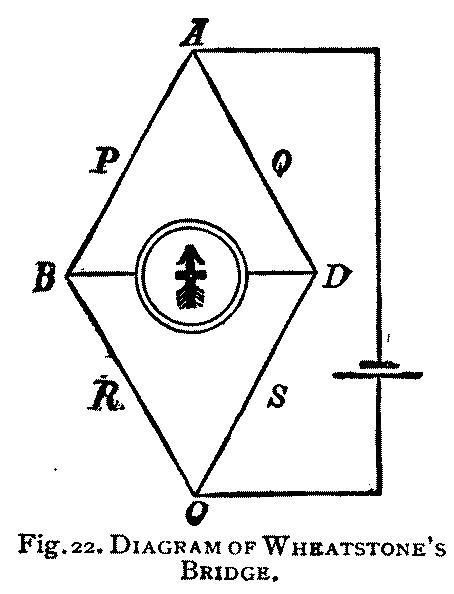
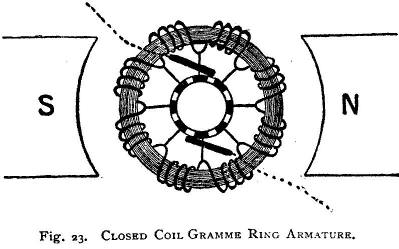
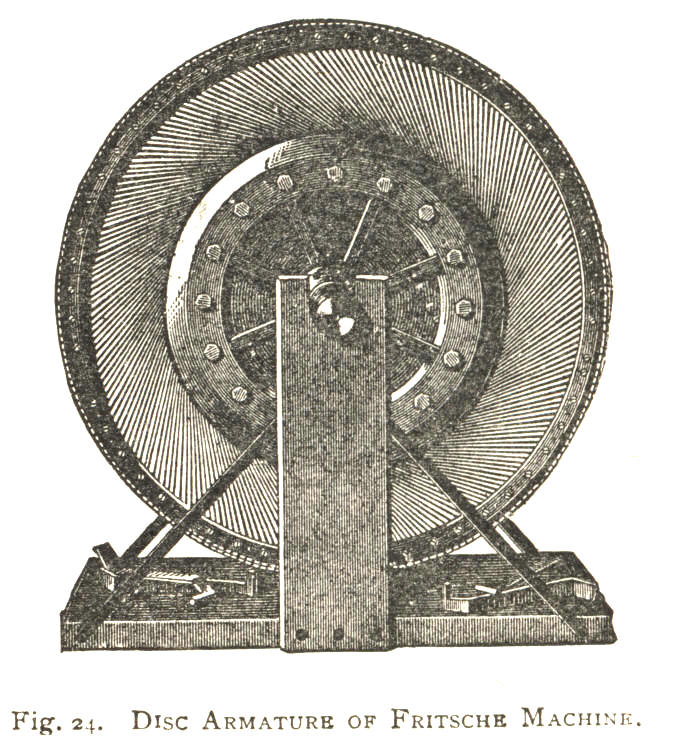
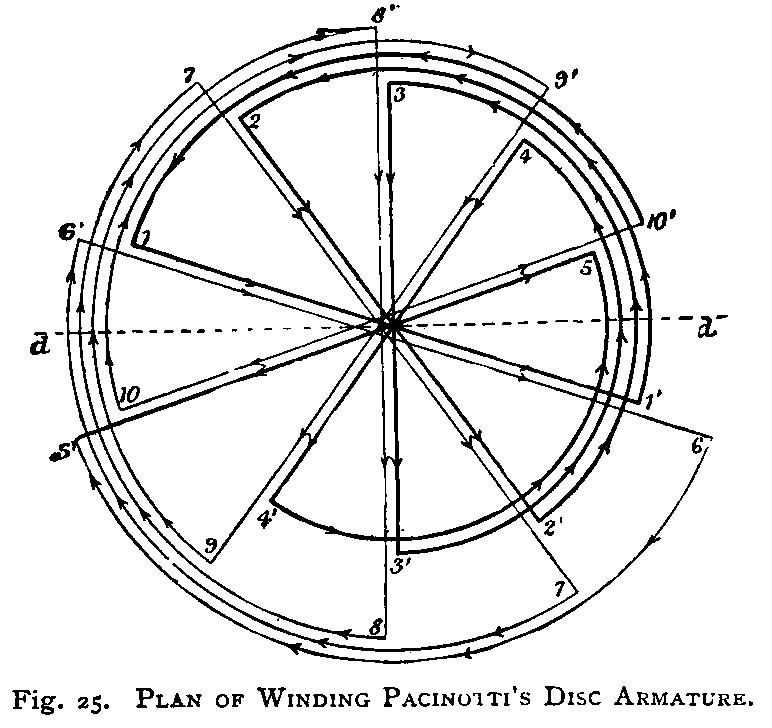
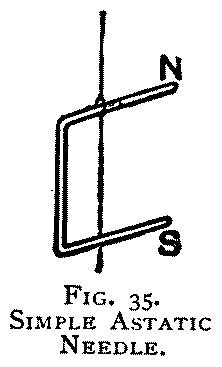
55 STANDARD ELECTRICAL DICTIONARY. B. (a) Abbreviation for Baumé, a hydrometer scale. (See Baumé.) Thus 10º B. means "ten degrees Baumé." (b) Symbol for the coefficient of induced magnetization, or the number of lines per square centimeter induced in a magnetic circuit or in any specified part of it. B. A. Abbreviation for British Association. It is prefixed to standards fixed by the committee of the British Association for the Advancement of Science. Thus the B. A. ohm means the British Association ohm, a measure of resistance which is equal to the resistance of a column of mercury 104.9 centimeters long and one square millimeter area of cross-section. (See Ohm.) Back Induction. A demagnetizing force produced in a dynamo armature when a lead is given the brushes. The windings by such setting of the brushes are virtually divided into two sets, one a direct magnetizing set, the other a cross magnetizing set. The latter have a component due to the obliqueness of the neutral line, which component is demagnetizing in its action. Back Shock or Stroke of Lightning. A lightning stroke received after the main discharge of the lightning, and caused by a charge induced in neighboring surfaces by the main discharge. The discharge affects the evenness of distribution of surrounding surfaces so that a species of secondary discharge is required to make even the distribution, or to supply charge where needed to bind an opposite one. The effects are much lese severe as a rule than those of the main charge, although the back stroke has caused death. The back stroke is sometimes felt a considerable distance from the place of the original lightning stroke. Synonym--Return Stroke. Back Stroke. (a) In telegraphy the return stroke of the lever in a telegraph sounder, striking the end of the regulating screw with a sound distinct from that which it produces on the forward stroke as it approaches the magnet poles. It is an important factor in receiving by ear or sound reading. (b) See Back Shock or Stroke of Lightning. Balance. (a) Wheatstone's Bridge, q. v., is sometimes termed the Electric Balance. (b) A suspension or torsion balance is one which includes a filament or pair of filaments to whose lower end or ends are attached a horizontal indicator often called a needle, or a magnetic needle. (See Torsion Balance.) (c) See Induction Balance, Hughes'. (d) For Thermic Balance, see Bolometer. (e) See Balance, Ampere. 56 STANDARD ELECTRICAL DICTIONARY. Balance, Ampere. A class of electrical measuring instruments due to Sir William Thomson may be grouped under this head. The instrument is a true balance or scales such as used for weighing. It is supported by a torsional wire support in place of knife edges. At each end it carries a circle of wire through which the current to be tested is passed. The torsional wire support enables the current to be carried to these wire rings. Above and below each of these rings are two similar rings, also connected so as to receive the current. They are so connected that the current shall go through them in opposite senses. When a current passes, therefore, one of these rings repels and one attracts the balanced ring. The extent of this action measures the intensity of the current. A sliding weight moving along a graduated scale on the balance is used to bring the balance beam into equilibrium when the current is passing. The degree of displacement of this weight gives the strength of the current in amperes. These balances are made for different currents. Thus there is a centi-ampere balance, deka-ampere balance and others, as well as an ampere balance. Balata. A gum used as an insulating material. It is the inspissated juice of a sapotaceous tree, the bullet tree, Mimusops globosa, of tropical America, from the Antilles to Guiana. It is intermediate in character between caoutchouc and gutta percha. It is superior to gutta percha in some respects, being very slightly acted on by light. Synonym--Chicle. B. & S.. W. G. Abbreviation for Brown & Sharpe Wire Gauge; the regular American Wire Gauge. (See Wire Gauge, American.) Barad. An absolute or fundamental unit of pressure, equal to one dyne per square centimeter. Barometer. An apparatus for measuring the pressure exerted by the atmosphere. It consists, in the mercurial form, of a glass tube, over 31 inches long, closed at one end, filled with mercury and inverted, with its open end immersed in a cistern of mercury. The column falls to a height proportional to the pressure of the atmosphere from 30 to 31 inches at the sea level. The "standard barometer" is a height of the mercury or of the "barometric column" of 30 inches or 760 centimeters, measured from the surface of the mercury in the cistern. The column of mercury is termed the barometric column. Above it in the tube is the Torricellian vacuum. [Transcriber's note: More accurately, 29.92 inches of mercury or 14.696 PSI.] Bars of Commutators. The metal segments of a commutator of a dynamo or motor. They are made of bars of copper, brass or bronze insulated from one another. (See Commutator.) Synonyms--Segments, Commutator Segments, Commutator Bars. 57 STANDARD ELECTRICAL DICTIONARY. Bath. (a) In electro-plating the solution used for depositing metal as contained in a vat or tank; as a silver, copper, or nickel bath used for plating articles with silver, copper, or nickel respectively. (b) In electro-therapeutics a bath with suitable arrangements, electrodes and connections for treating patients with electricity. It is termed an electric bath or electro-therapeutic bath. Bath, Bipolar Electric. In electro-therapeutics a bath in which the electrodes are both immersed in the water. The patient placed between them receives part of the discharge. The electrodes are large copper plates, termed shovel electrodes. Bath, Electric Shower. An electro-medical shower bath. The patient is placed on a metallic stove or support connected to one of the electric terminals. Water slightly alkaline is showered upon him. The other electrode is in connection with the water. The rain of drops and streamlets is the conductor of the current or discharge. Bath, Multipolar Electric. An electro-medical bath with a number of electrodes instead of two. Bath, Stripping. In electro-plating a solution used for dissolving and thus removing the plating from any object. The stripping bath is of the same general type as the plating bath for the same metal as the one to be dissolved. The object to be "stripped" is made the anode of a plating circuit, and as the current acts the old plating is attacked and dissolves, leaving the body of the article bare. It is simply the operation of plating reversed. The same term is applied to baths acting by simple solution. Stripping baths are described under the different metals as Silver Bath, Stripping--Gold Bath, Stripping. Bath, Unipolar Electric. An electro-medical bath, in which only one electrode connects with the water of the bath. The second electrode is supported above the bath. The patient touches this while in the water whenever electric action is desired. FIG. 36. THREE WIRE MOULDING OR BATTEN. FIG. 37. TWO WIRE MOULDING OR BATTEN. 58 STANDARD ELECTRICAL DICTIONARY. Batten. A strip of wood grooved longitudinally for holding wires in wiring apartments for electric light or power. In use they are fastened to the wall, grooves inward, or else grooves outward, with the wires lying in the grooves and covered with the covering strip. For two wire work each batten contains two grooves; for the three wire system it contains three grooves. Synonym--Moulding. Battery. A combination of parts or elements for the production of electrical action. The term is principally applied to voltaic batteries, but there are also magnetic batteries, batteries of Leyden jars, and other combinations, described in their places, which come under this category. [Transcriber's note: A group of similar items such as questions, machines, parts, guns, or electric cells.] Battery, Acetic Acid. A battery whose active solution or excitant is acetic acid or vinegar. This acid has been used by Pulvermacher in his medical battery, as being a substance found in every household in the form of vinegar. It is now but little used. Battery, Alum. A battery using as excitant a solution of alum. This battery has had some application for electric clocks, but only to a limited extent. Fig. 38. BALLOON OR FLASK BATTERY. Battery, Aluminum. A battery in which aluminum is the negative plate and aluminum sulphate the excitant. It is mounted like the gravity battery. Its electro-motive force is 0.2 volt. 59 STANDARD ELECTRICAL DICTIONARY. Battery, Bagration. A battery with zinc and carbon electrodes immersed in earth sprinkled with sal ammoniac (ammonium chloride). The copper is preferably first immersed in sal ammoniac solution and dried, until a green layer is formed on its surface. The battery is highly praised for its constancy by De la Rive, but may be regarded as obsolete. Battery, Balloon. A form of gravity battery into whose centre a globular flask, B, is inverted, which is filled before inversion with copper sulphate, of which 2 lbs. are used, and water, so as to remain full. This acts as a reservoir of copper sulphate, which it constantly supplies. The glass jar is closed with a perforated wooden cover. Battery, Banked. (a) A battery arranged to feed a number of separate circuits. (b) A battery connected in parallel or in multiple arc. Battery, Bichromate. A battery with amalgamated zinc and carbon plates, with an exciting fluid composed of sulphuric acid, water, and potassium bichromate. For formula of such solutions see Electropoion Fluid--Kookogey's Solution--Poggendorff's Solution--Trouvé's Solution--Delaurier's Solution, and others. (See Index.) Battery, Bunsen. A two fluid porous cell battery. The negative plate is carbon, the positive plate, amalgamated zinc. The depolarizer is nitric acid or electropoion fluid, q.v., in which the carbon is immersed. The last named depolarizer or some equivalent chromic acid depolarizing mixture is now universally used. The excitant is a dilute solution of sulphuric acid. Originally the carbon was made cylindrical in shape and surrounded the porous cups, in which the zinc was placed. This disposition is now generally reversed. The electro-motive force is 1.9 volts. The depolarizing solution is placed in the compartment with the carbon. The excitant surrounds the zinc. Fig. 39. BUNSEN'S BATTERY. 60 STANDARD ELECTRICAL DICTIONARY. Battery, Cadmium. A battery in which cadmium is the negative plate, sulphate of cadmium solution the excitant and depolarizer, and zinc the positive plate. Electro-motive force, .31 volt or about one third of a Daniell cell. It is mounted like a gravity battery. Battery, Callan. A modification of Grove's battery. Platinized lead is used for the negative plate, and as a depolarizer a mixture of 4 parts concentrated sulphuric acid, 2 parts of nitric acid, and 2 parts of a saturated solution of potassium nitrate. (See Battery, Grove's.) Battery, Camacho's. A battery with carbon negative and amalgamated zinc positive electrodes. The carbon is contained in a porous cup, packed with loose carbon. Electropoion or other fluid of that type serves as excitant and depolarizer, and is delivered as shown from cell to cell by syphons. Fig. 40. CAMACHO'S BATTERY. Battery, Carré's. A Daniell battery for whose porous cup a vessel or species of sack made of parchment paper is substituted. The battery has been used for electric light, and has been run for 200 successive hours, by replacing every 24 hours part of the zinc sulphate solution by water. 61 STANDARD ELECTRICAL DICTIONARY. Battery, Cautery. A battery used for heating a platinum wire or other conductor used for cauterization in electro-therapeutics. The term is descriptive, not generic. Battery, Chloric Acid. A battery of the Bunsen type in which an acidulated solution of potassium chlorate is used as depolarizer. Battery, Chloride of Lime. A battery in which bleaching powder is the excitant. The zinc electrode is immersed in a strong solution of salt, the carbon in a porous vessel is surrounded with fragments of carbon and is packed with chloride of lime (bleaching powder). There is no action on open circuit. It has to be hermetically sealed on account of the odor. Its electro-motive force is--initial, 1.65 volts; regular, 1.5 volts. Synonym--Niaudet's Battery. Battery, Chromic Acid. Properly a battery in which chromic acid is used as a depolarizer. It includes the bichromate battery. (See Battery, Bichromate.) Battery, Closed Circuit. A battery adapted by its construction to maintain a current on a closed circuit for a long time without sensible polarization. The term is merely one of degree, for any battery becomes exhausted sooner or later. As examples the Grove, Bunsen or Daniell batteries may be cited. 62 STANDARD ELECTRICAL DICTIONARY. Fig. 41. COLUMN BATTERY. Battery, Column. The original Volta's pile. It consists of a series of compound circular plates, the upper or lower half, A, copper; the other, Z, of zinc. Between each pair of plates some flannel or cloth, u, u, is laid, which is saturated with dilute acid. As shown in the cut, the parts are laid up in two piles, connected at the top with a bar, c, c, and with vessels of acidulated water, b, b, as electrodes. The great point in setting it up is to be sure that no acid runs from one disc of flannel to the next over the outside of the plates, as this would create a short circuit. The plates are best compound, being made up of a zinc and a copper plate soldered together. They may, however, be separate, and merely laid one on the other. In such case great care must be taken to admit no acid between them. Volta's pile is no longer used, except occasionally. Trouvé's blotting paper battery (see Battery, Trouvé's) is a relic of it, and the same is to be said for Zamboni's dry pile. It rapidly polarizes, the flannel retains but little acid, so that it is soon spent, and it is very troublesome to set up. Great care must be taken to have the cloth discs thoroughly saturated, and wrung out to avoid short circuiting by squeezing out of the acid. Battery, D'Arsonval's. A battery of the Bunsen type, differing therefrom in the solutions. As excitant in which the zinc electrode is immersed, the following solution is used: Water, 20 volumes; Sulphuric Acid (purified by shaking with a little olive or similar oil), 1 volume; hydrochloric acid, 1 volume. As polarizer in which the carbon is immersed the following is used: Nitric acid, 1 volume; hydrochloric acid, 1 volume; water acidulated with 1/20th sulphuric acid, 2 volumes. Battery, de la Rue. A battery with zinc positive and silver negative electrode; the depolarizer is silver chloride; the excitant common salt or ammonium chloride. The cut shows one of its forms of construction. The right hand portion of the cut, Fig. 42, shows the zinc perforated at C for the connection from the next silver plate. The next to it is the negative electrode of silver around which a mass of silver chloride is cast in cylindrical form. A is a parchment paper cylinder with two holes near its top, through which the silver wire of the negative electrode is threaded, as shown in B. A solution of 23 parts ammonium chloride in 1,000 parts of water is the approved excitant. Its electro-motive force is 1.03 volts. The jars are closed with paraffin. Fig. 42. DE LA RUE'S BATTERY. 63 STANDARD ELECTRICAL DICTIONARY. Battery, Dry. (a) A form of open circuit battery in which the solutions by a mass of zinc oxychloride, gypsum, or by a gelatinous mass such as gelatinous silica, or glue jelly, are made practically solid. Numbers of such have been patented, and have met with considerable success. (b) Zamboni's dry pile, q. v., is sometimes termed a dry battery. Battery, Element of. A term applied sometimes to a single plate, sometimes to the pair of plates, positive and negative, of the single couple. Battery, Faradic. A term applied, not very correctly however, to apparatus for producing medical faradic currents. It may be an induction coil with battery, or a magneto-generator worked by hand. Battery, Ferric Chloride. A battery of the Bunsen type, in which a solution of perchloride of iron (ferric chloride) is used for the depolarizing agent. A little bromine is added with advantage. The depolarizing agent recuperates on standing, by oxidation from the oxygen of the air. Battery, Fuller's. A battery of the Bunsen type. The zinc plate is short and conical, and rests in the porous jar into which some mercury is poured. An insulated copper wire connects with the zinc. A plate of carbon is in the outer jar. The solutions are used as in the Bunsen battery. Synonym--Mercury Bichromate Battery. Battery, Gas. (a) A battery whose action depends on the oxidation of hydrogen as its generating factor. It was invented by Grove. Plates of platinum are immersed in cups of dilute acid, arranged as if they were plates of zinc and carbon, in an ordinary battery. Each plate is surrounded by a glass tube sealed at the top. The plates are filled with acid to the tops. Through the top the connection is made. A current from another battery is then passed through it, decomposing the water and surrounding the upper part of one set of plates with an atmosphere of oxygen and of the other with hydrogen. Considerable quantities of these gasses are also occluded by the plates. On now connecting the terminals of the battery, it gives a current in the reverse direction of that of the charging current. This battery, which is experimental only, is interesting as being the first of the storage batteries. (b) Upward's Chlorine Battery and any battery of that type (see Battery, Upward's,) is sometimes termed a gas battery. 64 STANDARD ELECTRICAL DICTIONARY. Battery Gauge. A pocket or portable galvanometer for use in testing batteries and connections. Battery, Gravity. A battery of the Daniell type, in which the porous cup is suppressed and the separation of the fluids is secured by their difference in specific gravity. A great many forms have been devised, varying only in details. The copper plate, which is sometimes disc shaped, but in any case of inconsiderable height, rests at the bottom of the jar. Near the top the zinc plate, also flat or of slight depth, is supported. As exciting liquid a strong solution of copper sulphate lies at the bottom of the jar. This is overlaid by a solution of zinc sulphate, or sodium sulphate, which must be of considerably less specific gravity than that of the copper sulphate solution. In charging the jar one-tenth of a saturated solution of zinc sulphate mixed with water is sometimes used as the upper fluid. This may be first added so as to half fill the jar. The strong solution of copper sulphate may then be added with a syphon or syringe underneath the other so as to raise it up. From time to time copper sulphate in crystals are dropped into the jar. They sink to the bottom and maintain the copper sulphate solution in a state of saturation. Fig. 43. GRAVITY BATTERY OF THE TROUVÉ-CALLAUD TYPE. If the battery is left on open circuit the liquids diffuse, and metallic copper precipitates upon the zincs. This impairs its efficiency and creates local action. As long as the battery is kept at work on closed circuit work but little deposition, comparatively speaking, occurs. From time to time, in any case, the zinc plates are removed and scraped, so as to remove the copper which inevitably forms on their surface. Care must be taken that the zinc sulphate solution, which is constantly increasing in strength, does not get so strong as to become of as high specific gravity as the copper sulphate solution. From time to time some of the upper solution is therefore removed with a syphon or syringe and replaced with water. An areometer is useful in running this battery. 65 STANDARD ELECTRICAL DICTIONARY. Battery, Grenet. A plunge battery with zinc positive and carbon negative electrodes. Electropoion or other chromic acid or bichromate solution is used as depolarizer and excitant. The zinc plate alone is plunged into and withdrawn from the solution. Fig. 44. GRENET'S BATTERY. Fig. 45. GROVE'S BATTERY. Battery, Grove's. A two fluid galvanic battery. A porous cup has within it a riband of platinum, which is the negative plate; amalgamated zinc in the outer jar is the positive plate. Dilute sulphuric acid (10 per cent. solution) is placed in the outer jar, and strong nitric acid (40° B.) as a depolarizer in the porous cups. Its E. M. F. is 1.96 volts. It is objectionable, as it gives off corrosive nitrous fumes. These are produced by the oxidation of the nascent hydrogen by the nitric acid, by the following reaction: 3 H + H N O3 = 2 H2 O + N O. There are other reactions, one of which results in the formation of ammonia by the reduction of the nitric acid radical by the hydrogen. Ammonium can be detected in the spent liquids. 66 STANDARD ELECTRICAL DICTIONARY. Battery, Hydrochloric Acid. A battery in which hydrochloric acid is used as the excitant. Many attempts have been made to use this acid in batteries, but the volatile nature of the acid causes the production of so much odor with corrosive fumes that it has never come into use. Battery, Lead Chloride. A battery of the lead sulphate type in which lead chloride is the depolarizer. It has had no extended use. Battery, Lead Sulphate. A battery similar to Marié Davy's battery or the gravity battery, but using lead sulphate as depolarizer and excitant. Lead, copper or tin is the material of the negative plate. Becquerel used the lead sulphate as a solid cylindrical mass surrounding a lead rod 1/5 to 1/4 inch in diameter. One part of common salt may be mixed with 5 parts of the lead sulphate. The electro-motive force is about 0.5 volt. The resistance is very high. Battery, Leclanché. An open circuit battery with porous cup. In the outer jar is a zinc rod; a carbon plate is placed in the porous cup. The latter is packed with a mixture of clean powdered manganese binoxide as depolarizer, and graphite in equal volumes. A strong solution of ammonium chloride (sal ammoniac) is placed in the outer jar. It is only used on open circuit work. Its electromotive force is 1.48 volts, when not polarized. The reaction is supposed to be about the following: 2 N H4 Cl + 2 Mn O2 + Zn = Zn Cl2 + 2 N H3 + H2 0 + M2 O3 The battery rapidly weakens on open circuit, but quickly recuperates. There is another form of this battery, termed the agglomerate battery. (See Battery, Leclanché Agglomerate.) Fig. 46. LECLANCHÉ BATTERY. Battery, Leclanché Agglomerate. A form of the Leclanché in which the porous jar is suppressed. Cakes made of a mixture of carbon, 52 parts; manganese binoxide, 40 parts; gum lac, 5 parts; potassium bisulphate, 3 parts, compressed at 300 atmospheres, at a temperature of 100° C. (212° F.), are fastened by India rubber bands or otherwise against the carbon plate. These constitute the depolarizer. Various shapes are given the carbon and depolarizing agglomerates. Battery, Local. A battery supplying a local circuit (see Circuit. Local). The current is governed by the relay situated on the main line and operated by its current. Battery, Main. The battery used in operating the main line. It is usually applied to telegraphy. Its function is then to supply current for working relays, which in turn actuate the local circuits. Main and local circuits and batteries are also used in the automatic block system of railroad signalling. 67 STANDARD ELECTRICAL DICTIONARY. Battery, Marié Davy's. A two fluid porous cup battery with carbon negative plate, zinc positive plate, and mercury sulphate, a nearly insoluble salt, as depolarizer and excitant. Mercurous or mercuric sulphates have been used in it. Its electromotive force is 1.5 volts. The local action and waste, owing to the slight solubility of the mercury compounds, is very slight. If used on close circuit it becomes polarized. It is also subject under extreme circumstances to reversal of polarity, zinc becoming deposited upon the carbon, and there forming a positive electrode. In using the cells in series the level of liquid in all must be the same, otherwise the cell in which it is lowest will become polarized and exhausted. Modifications of this battery on the lines of the gravity battery have been constructed. Synonym--Sulphate of Mercury Battery. Battery, Maynooth's. A battery of the Bunsen type, with cast iron negative plate. The iron takes the passive form and is not attacked. Battery, Medical. A term applied very indiscriminately to medical current generators, and to medical induction coils, or to any source of electricity, static or current, for medical application. 68 STANDARD ELECTRICAL DICTIONARY. Battery, Meidinger's. A variety of Daniell cell of the gravity type. The plates are cylindrical. The zinc plate lies against the upper walls of the vessel. The copper plate of smaller diameter rests on the bottom. A large tube, with an aperture in its bottom, is supported in the centre and is charged with copper sulphate crystals. The cup is filled with a dilute solution of Epsom salts (magnesium sulphate) or with dilute sulphuric acid. Battery Mud. A deposit of mud-like character which forms in gravity batteries and which consists of metallic copper precipitated by the zinc. It indicates wasteful action. Battery, Multiple-connected. A battery connected in parallel, all the positive plates being connected to one electrode, and all the negative to another. Battery, Nitric Acid. A battery in which nitric acid is used as the excitant. Owing to its cost and volatility this acid has been but little used in batteries, other than as a depolarizer. In Grove's battery (see Battery, Grove's) it has been thus used. Battery of Dynamos. A number of dynamos may be arranged to supply the same circuit. They are then sometimes termed as above, a Dynamo Battery. They may be arranged in series or in parallel or otherwise combined. Battery of Leyden Jars. To produce the quantity effect of a single large Leyden jar with a number of small ones they are often connected in parallel and termed a battery. In such case the inner coatings are all connected by regular bar conductors, and the outside coatings are also all in connection. They are conveniently placed in a box or deep tray whose inner surface is lined with tinfoil, with an outside connection for grounding, etc. The cascade, q. v., arrangement is not so generally termed a battery. Battery, Open Circuit. A battery adapted for use in open circuit work. Its main requirement is that it shall not run down, or exhaust itself when left on open circuit. The Leclanché battery is very extensively used for this work. Its action is typical of that of most open circuit batteries. It is without any action on open circuit. It is very quickly exhausted on closed circuit, but recuperates or depolarizes quite soon when on open circuit. It is always in condition for a momentary connection, but useless for steady work. Battery, Oxide of Copper. A battery with zinc positive and iron negative electrodes. The excitant is a 30 or 40 per cent. solution of sodium or potassium hydrate (caustic soda or caustic potash). The depolarizer is copper oxide. In action the copper is gradually reduced to the metallic state. The iron element is often the containing vessel. The battery is practically inactive on open circuit. Its electro-motive force varies from .75 to .90 volt. To prevent the formation of sodium or potassium carbonate the cell should be closed, or else the liquid should be covered with mineral oil. Synonyms--Lalande & Chaperon Battery--Lalande-Edison Battery. 69 STANDARD ELECTRICAL DICTIONARY. Battery, Peroxide of Lead. A battery in which peroxide of lead (lead binoxide) is the depolarizer. It is a sort of predecessor of the present secondary battery. Battery, Platinized Carbon. A modification of Smee's battery, in which platinized carbon is used for the negative plates. Before polarization the E. M. F. is equal to that of Smee's battery. Polarization reduces its electro-motive force one-half. Battery, Plunge. A battery whose plates are mounted so as to be immersed in the battery cups or cells, when the battery is to be used, and withdrawn and supported out of the cups when not in use. The object is to prevent wasting of the plates by standing in the solution. It is a construction generally used with sulphuric acid--chromic acid solution and amalgamated zinc and carbon plates. Battery, Pneumatic. A battery arranged to have air blown through the solution to assist diffusion and depolarization. It is a construction applied to chromic acid or bichromate batteries. Battery, Primary. A battery in which the current is supplied by the solution of one of the plates by the solution. The term distinguishes it from a secondary or storage battery. Battery, Pulvermacher's Electro-Medical. In this battery, the electrodes were zinc and copper wires wound upon small pieces of wood. Dilute vinegar was used as the excitant, because it could be found in every household. Formerly the battery had great success. It is now little used. Battery, Sal Ammoniac. Batteries in which a solution of ammonium chloride is the excitant; they are very extensively used on open circuit work. (See Battery, Leclanché.) The crystals formed in these batteries have been analyzed and found to consist of ammonium zinc chloride, 3 Zn Cl2, 8 N H3, 4 H20. Battery, Salt, or Sea Salt. Batteries in which a solution of sodium chloride or common salt is the excitant, have been largely used, especially for telegraphic purposes. The Swiss telegraphs use a carbon-zinc combination with salt and water as the excitant. The batteries are sometimes mounted as plunge batteries. They are exhausted by short circuiting after some hours, but recuperate on standing. The zinc is not amalgamated. 70 STANDARD ELECTRICAL DICTIONARY. Battery, Sand. A battery whose cells are charged with sand saturated with dilute acid. It prevents spilling of acid. It is now practically obsolete. Fig. 47. SECONDARY BATTERY. Battery, Secondary. A voltaic battery whose positive and negative electrodes are formed or deposited by a current from a separate source of electricity by electrolysis. On disconnection the battery is ready to yield a current, in the reverse direction of that of the charging current. The usual type has lead plates on one of which lead binoxide and on the other of which spongy lead is formed. The lead binoxide seems to be the negative element, and it also acts as the depolarizer. The spongy lead is the positive electrode. The solution is dilute sulphuric acid of specific gravity 1.17. The action consists first in the oxidation of the spongy lead. The hydrogen set free by the reaction, and which by electrolytic transfer goes to the other plate, reduces the lead binoxide to protoxide. The sulphuric acid then attacks the oxides and converts the oxides into sulphates. The charging process consists in sending a current in the reverse direction through the battery. If there are several cells they are arranged in series, so that each one receives the same intensity of current. An electrolytic decomposition takes place, the lead sulphate on one plate is reduced to metallic lead, and that on the other plate is oxidized to lead binoxide. It is then ready for use. 71 STANDARD ELECTRICAL DICTIONARY. The plates in a lead plate battery are of very large area per cell, and are placed close together. Sometimes, as in Planté's battery, large flat plates are laid together with a separating insulator between them, and are then rolled into a spiral. Sometimes, the most usual arrangement, the plates are in sets, the positive and negative ones alternating, and each cell containing a number of plates. To secure a good quantity of active material, the plates are sometimes perforated, and the perforations are filled with oxide of lead. This gives a good depth of material for the charging current to act on, and avoids the necessity for a tedious "forming," q. v. The electro-motive force of such a battery per cell is 2 volts. Its resistance may only be one or two-hundredths of an ohm. An intense current of many amperes can be supplied by it, but to avoid injuring the cell a current far less than the maximum is taken from it. To charge it, a slightly greater electro-motive force, the excess being termed spurious voltage, is required. Fig. 48. SIEMENS' AND HALSKE'S PAPER PULP BATTERY. 72 STANDARD ELECTRICAL DICTIONARY. Battery, Secondary, Plante's. Plante's secondary battery is one of the earlier forms of storage battery, but has had much success. Two lead plates, large in area and close together but not touching, are "formed," by exposure to an electrolyzing current of electricity in one direction, while they are immersed in dilute sulphuric acid. This converts the surface of one plate into binoxide. The cell is then allowed to discharge itself almost completely, when the charging current is again turned on. This process is repeated over and over again, until the surfaces of the plates are considerably attacked, one plate, however, being maintained in a state of oxidation. After a few days of this operation a period of rest is allowed between the reversals, which sets up a local action on the oxidized plate, between the metallic lead of the plate, and its coating of binoxide. This causes the lead to be attacked, under the influence of the local couple, and sulphate of lead is formed, which, ultimately, by the charging current is converted into peroxide. These operations produce an exceedingly good battery. The process described is termed forming. The plates separated by strips of insulating material are generally wound into a double spiral. Battery, Siemens' and Halske's. A Daniell battery of peculiar shape. The copper, C, is at the bottom of the glass jar, A. The inner jar, K, has the form of a bell, and supports a mass of paper pulp, which is dampened with sulphuric acid. The zinc, Z, rests on top of the mass of pulp. The battery is very durable, but of high resistance. Battery, Sir William Thomson's. A form of Daniell battery, of the gravity type. The receptacles are shallow wooden trays lined with lead. A thin plate of copper rests on the bottom. The zinc plate is of gridiron shape, and rests on wooden blocks which support it in a horizontal position above the copper. One tray is placed on top of the other, the upper tray resting on the corners of the zinc plate which rise above the level of the top of the flat vessel. Thus connection is assured without wires or binding posts. It is charged like a gravity battery. The density of the zinc sulphate solution should be between 1.10 and 1.30. The circuit must be kept closed to prevent deposition of metallic copper on the zinc. The entire disposition of the battery is designed to reduce resistance. Battery, Skrivanow. A pocket battery of the De la Rue type, with a solution of 75 parts caustic potash in 100 parts of water as the excitant. The silver chloride is contained in a parchment paper receptacle. Its electro-motive force is 1.45 to 1.5 volts. Battery, Smee's. A single fluid combination, with zinc positive plate, and a plate of silver, coated with platinum black, for the negative plate. The finely divided platinum affords a surface from which the hydrogen bubbles instantly detach themselves, thus preventing polarization. The liquid is a mixture of one part sulphuric acid to seven parts of water. For the negative plate silver-plated copper, coated with platinum black, is used. Electromotive force, .47 volt. Fig. 49. SMEE'S BATTERY. 73 STANDARD ELECTRICAL DICTIONARY. Fig. 50. SPIRAL BATTERY, OR HARE'S DEFLAGRATOR. Battery, Spiral. A battery whose plates of thin zinc and copper are wound into a spiral so as to be very close, but not touching. Dilute sulphuric acid is the excitant. It is now practically obsolete. Synonyms--Calorimeter--Hare's Deflagrator. Battery, Split. A battery of a number of voltaic cells, connected in series, with their central portion grounded or connected to earth. This gives the ends of opposite potentials from the earth, and of difference therefrom equal to the product of one-half of the number of cells employed, multiplied by their individual voltage. Battery Solutions, Chromic Acid. A number of formulae have been proposed for these solutions. (See Electropoion Fluid--Kookogey's Solution--Poggendorff's Solution-- Trouvé's Solution--Delaurier's Solution--Chutaux's Solution--Dronier's Salt--Tissandier's Solution.) Battery, Trough. A battery whose elements are contained in a trough, which is divided by cross-partitions so as to represent cups. A favorite wood for the trough is teak, which is divided by glass or slate partitions. Marine glue or other form of cement is used to make the joints tight. For porous cup divisions plates of porous porcelain or pottery are placed across, alternating with the impervious slate partitions. Battery, Trouvé's Blotting Paper. A battery of the Daniell type in which the solutions are retained by blotting paper. A considerable thickness of blotting paper lies between the two plates. The upper half of the thickness of the blotting paper is saturated with a solution of zinc sulphate, on which the zinc plate rests. The lower half of the paper is saturated with copper sulphate solution, and this rests upon the copper plate. Fig. 51. TROUVÉ'S BLOTTING PAPER BATTERY. 74 STANDARD ELECTRICAL DICTIONARY. Battery, Tyer's. A modification, as regards the positive element, of Smee's battery, q. v. The bottom of the battery jar contains a quantity of mercury in which pieces of zinc are thrown, and this constitutes the positive element. A ball of zinc at the end of an insulated copper wire affords the connection with the zinc and mercury. Its great advantage is that the smallest scraps of zinc can be used in it, by being dropped into the mercury. The negative plate is platinized silver; the exciting liquid, dilute sulphuric acid. Fig. 52. TYER'S BATTERY. 75 STANDARD ELECTRICAL DICTIONARY. Fig. 53. SECTION OF UPWARD'S BATTERY. Fig. 54. ELEVATION OF UPWARD'S BATTERY. Battery, Upward's. A primary voltaic cell, the invention of A. Renée Upward. Referring to the cuts, the positive plate. Z, is of cast zinc; it is immersed in water, in a porous cup, B. Outside of the porous cup and contained in the battery jar are two carbon plates, C, C, connected together. The rest of the space between the porous cup and battery jar is packed with crushed carbon, and the top is cemented. Chlorine gas is led by a pipe, D, into the outer cell. It diffuses through the fine carbon, dissolves in the water, and so finds its way to the zinc, which it attacks, directly combining therewith, and forming zinc chloride (Zn + 2 Cl = Zn Cl 2). Such of the chlorine as is not absorbed finds its way by an outlet tube, E, to the next cell. Arrangements are provided for generating chlorine gas as required. The high specific gravity of the gas is utilized in regulating its distribution through the cells. The electro-motive force of the cell is 2.1 volts. A cell 11.5 by 5.5 inches and 12.5 inches deep has a resistance of 0.2 ohm. An overflow pipe, F, with faucet, T, is supplied to withdraw the solution of zinc chloride as it accumulates. 76 STANDARD ELECTRICAL DICTIONARY. Battery, Varley's. A Daniell battery of the Siemens' and Halske's type (see Battery, Siemens' and Halske's), in which zinc oxide is substituted for the paper pulp of the other battery. It has been very little used. Battery, Volta's. The original acid battery. It has a negative electrode of copper, a positive electrode of zinc; the excitant is sulphuric acid diluted with sixteen times its volume of water. It rapidly polarizes, and is very little used. Battery, Voltaic or Galvanic. An apparatus for converting chemical energy directly into electric energy. This is as broad a definition as can well be given. The general conception of a battery includes the action of electrolysis, a solution in the battery acting upon one of two conducting electrodes immersed in such fluid, which dissolves one of them only, or one more than the other. The best way to obtain a fundamental idea of a battery is to start with the simplest. Dilute sulphuric acid dissolves neither pure zinc nor copper. But it has a far stronger affinity for the first named metal. If now we immerse in dilute acid two plates, one of pure zinc, and one of copper, no action will be discernible. But if the plates are brought in contact with each other a stream of bubbles of hydrogen gas will escape from the surface of the copper and the zinc will dissolve. By applying proper tests and deductions it will be found that the copper and zinc are being constantly charged with opposite electricities, and that these are constantly recombining. This recombination produces what is known as an electric current. To constitute a battery the zinc and copper plates must be connected outside of the solution. This connection need not be immediate. Any conductor which touches both plates will bring about the action, and the current will pass through it. The easiest way to picture the action of a battery is to accept the doctrine of contact action. In the battery the molecules of water are pulled apart. The hydrogen molecules go to the copper, the oxygen molecules go to the zinc, each one, leaving its contact with the other, comes off charged with opposite electricity. This charges the plates, and the continuous supply of charge and its continuous discharge establishes the current. The accumulation of hydrogen acts to stop the action by polarization. Its own affinity for oxygen acts against or in opposition to the affinity of the zinc for the same element, and so cuts down the action. A depolarizer of some kind is used in acid batteries for this reason. As such depolarizer has only to act upon one plate, in most batteries it is usual to surround such plate only, as far as it is possible, with the depolarizer. The solution which dissolves the zinc is termed the excitant or exciting solution. To this concrete notion of a voltaic battery the different modifications described here may be referred. Zinc, it will be seen, forms the almost universally used dissolved plate; carbon or copper forms the most usual undissolved plate; sulphuric acid in one form or another is the most usual excitant. The solution in a voltaic battery is electrolyzed (see Electrolysis). Hence the solutions must be electrolytes. The sulphuric acid and other ingredients play a secondary role as imparting to the battery fluids this characteristic. It is not necessary to have electrodes of different substances, the same metal maybe used for both if they are immersed in different solutions which act differentially upon them, or which act with more energy on one than on the other. Such are only of theoretical interest. 77 STANDARD ELECTRICAL DICTIONARY. Battery, Water. A voltaic battery, whose exciting fluid is water. They are used for charging quadrant electrometer needles and similar purposes. They polarize very quickly and are of high resistance. Hence very small plates in large number can be used without impairing their advantage. Rowland's water battery dispenses with cups and uses capillarity instead. The zinc and platinum or copper plates of a couple are placed very close together, while the couples are more distant. On dipping into water each couple picks up and retains by capillarity a little water between its plates, which forms the exciting fluid. Many hundred couples can be mounted on a board, and the whole is charged by dipping into water and at once removing therefrom. It then develops its full potential difference. Fig. 55. SECTION OF WOLLASTON BATTERY. Fig. 56. PLATES OF WOLLASTON'S BATTERY. 78 STANDARD ELECTRICAL DICTIONARY. Battery, Wollaston. The original plunge battery is attributed to Wollaston. He also invented the battery known by his name, having the disposition shown in the cut, of zinc Z, surrounded by a thin sheet of copper C; o, o', o", are the terminals and B, B, the battery jars. Dilute sulphuric acid is used for exciting fluid. B. A. U. Abbreviation for British Association unit, referring generally to the B. A. unit of resistance. B. A. Unit of Resistance. The original ohm used under that name previous to 1884. The Paris committee of that year recommended as a practical unit what is known as the legal ohm. (See Ohm, Legal.) 1 Legal Ohm = 1.0112 B. A. Units of Resistance. 1 B. A. Unit of Resistance = .9889 Legal Ohms. 1 B. A. Unit of Resistance = .98651E9 C. G. S. units. B. E. adj. British Engineering, a qualification of a set of units, the B. E. units, having for base the foot and pound. The term is but little used. Beaumé Hydrometer. A hydrometer graduated on the following principle: The zero point corresponds to the specific gravity of water for liquids heavier than water. A solution of 15 parts of salt in 85 parts of water corresponds in specific gravity to 15° B., and between that and zero fifteen equal degrees are laid out. The degrees are carried down below this point. The zero points for liquids lighter than water correspond to the specific gravity of a solution of 10 parts of salt in 90 parts of water. The specific gravity of water is taken as 10° B. This gives ten degrees which are continued up the scale. Becquerel's Laws of Thermoelectricity. These are stated under the heads, Law of Intermediate Metals and Law of Successive Temperatures, q. v. Bed Piece. In a dynamo or motor the frame carrying it, including often the standards in which the armature shaft is journaled, and often the yoke or even entire field magnet core. Bell, Automatic Electric. A bell which rings as long as the circuit is closed, having a circuit breaker operated by its own motion. (See Bell, Electric.) Synonyms--Trembling Bell--Vibrating Bell. Bell, Call. A bell operated by electricity, designed to call attention, as to a telephone or telegraphic receiver. (See Bell, Electric.) 79 STANDARD ELECTRICAL DICTIONARY. Bell Call. A calling device for attracting the attention of any one, consisting of some type of electric bell. Bell, Circular. A gong-shaped bell, whose clapper and general mechanism is within its cavity or behind it. Bell, Differentially Wound. An electric bell, whose magnet is wound differentially so as to prevent sparking. Fig. 57. AUTOMATIC ELECTRIC BELL. Bell, Electric. A bell rung by electricity. Generally it is worked by a current exciting an electro-magnet, attracting or releasing an armature which is attached to the vibrating or pivoted tongue of the bell. It may be worked by a distant switch or press-button, q. v., ringing once for each movement of the distant switch, etc., or it may be of the vibrating bell type as shown in the cut. When the current is turned on in this case it attracts the armature. As this moves towards the poles of the magnet it breaks the circuit by drawing the contact spring, q. v., away from the contact point, q. v. This opens the circuit, to whose continuity the contact of these two parts is essential. The hammer, however, by its momentum strikes the bell and at once springs back. This again makes the contact and the hammer is reattracted. This action continues as long as the circuit is closed at any distant point to which it may be carried. The ordinary vibrating bell is a typical automatic circuit breaker, q. v., this type keeping up the ringing as long as the circuit is closed. Other bells have no electric contact and simply ring once every time the circuit is closed. Others worked by an alternating current ring once for each change of direction of current. 80 STANDARD ELECTRICAL DICTIONARY. Bell, Electro-mechanical. A bell which has its striking train operated by a spring or descending weight, and which train is thrown into action by the release of a detent or equivalent action by the closing of an electric circuit. It rings for any given time after being started. Bell, Indicating. A bell which by drop-shutter or other indicator connected in circuit with it, indicates its number or other designation of its call. Bell, Magneto. An electric bell operated by the alternating current from a magneto generator. It has a polarized armature and no circuit breaker. The armature is attracted first in one direction and then in the other, as the current alternates and reverses the polarity of the electro-magnet. Bell, Relay. A bell operated by a relay circuit. Bias. In polarized relay the adjustment of the tongue to lie normally against one or the other contact. (See Relay, Polarized.) 81 STANDARD ELECTRICAL DICTIONARY. Fig. 58. RESISTANCE COILS SHOWING BIFILAR WINDING. Bifilar Winding. The method followed in winding resistance coils to prevent them from creating fields of force. The wire is doubled, and the doubled wire starting with the bend or bight is wound into a coil. The current going in opposite senses in the two lays of the winding produces no field of force. Binary Compound. A chemical compound whose molecule contains only two elements, such as water (H2 0), lead oxide (Pb 0), and many others. Binding. In a dynamo or motor armature the wire wound around the coils to secure them in place and prevent their disturbance by centrifugal action. Fig. 59. DOUBLE BINDING POST. Fig. 60. BINDING POST, ENGLISH PATTERN. FIG. 61. WOOD SCREW BINDING POST. Binding Posts or Screws. Arrangements for receiving the loose end of a wire of an electric circuit, and securing such end by a screw. Several constructions are used, as shown here. Sometimes the wire is passed through a hole, and a screw tapped in at right angles to the hole is screwed down upon the wire. Sometimes the wire is clamped between two shoulders, one on the screw, the other on the post. The screw is often a flat-headed thumb screw or has a milled edge. Sometimes the screw has a slot and is turned by a screw-driver. Several openings are often provided in the same post for different wires. Binnacle. The case containing a mariner's compass on shipboard. It is enclosed completely; it has a glass side or window through which the compass can be seen, and is provided with one or two lamps arranged to light the card, while showing as little light as possible outside. 82 STANDARD ELECTRICAL DICTIONARY. Bioscopy, Electric. The diagnosis of life and death by the action of the animal system when subjected to an electric current or electrification. Bismuth. A metal, one of the elements, atomic weight, 210 ; equivalent, 70; valency, 3; specific gravity, 9.9. It is a conductor of electricity. Relative Resistance, compressed, (silver = 1) 87.23 Specific Resistance, 131.2 microhms Resistance of a wire (a) 1 foot long, weighing 1 grain, 18.44 ohms (b) 1 foot long, 1/1000 inch thick, 789.3 " (c) 1 meter long, weighing 1 gram, 12.88 " (d) 1 meter long, 1 millimeter thick, 1.670 " Resistance of a 1-inch cube 51.65 microhms Electro chemical equivalent, .7350 (Hydrogen = .0105) (See Thermo-electric Series.) Figs. 62, 63. INCANDESCENT WIRE FUSE. ABEL'S PATENT. Fig. 64. VON EBNER'S FRICTIONAL ELECTRIC MACHINE FOR EXPLODING ELECTRIC FUSES OR DETONATORS. Bi-telephone. A pair of telephones arranged with a curved connecting arm or spring, so that they can be simultaneously applied to both ears. They are self-retaining, staying in position without the use of the hands. 83 STANDARD ELECTRICAL DICTIONARY. Blasting, Electric. The ignition of blasting charges of powder or high explosives by the electric spark, or by the ignition to incandescence (red or white heat) of a thin wire immersed in or surrounded by powder. Special influence or frictional electric machines or induction coils are used to produce sparks, if that method of ignition is employed. For the incandescent wire a hand magneto is very generally employed. (See Fuse, Electric.) The cuts, Figs. 62 and 63, show one form of incandescent wire fuse. The large wires are secured to the capsule, so that no strand can come upon the small wire within the cavity. The cut, Fig. 64, shows a frictional electric machine for igniting spark fuses. Bleaching, Electric. Bleaching by agents produced or made available by the direct action of electricity. Thus if a current under proper conditions is sent through a solution of common salt (sodium chloride), the electrodes being close together, the salt is decomposed, chlorine going to one pole and sodium hydrate to the other. The two substances react upon each other and combine, forming sodium hypochlorite, which bleaches the tissue immersed in its solution. Block System. A system of signalling on railroads. The essence of the system consists in having signal posts or stations all along the road at distances depending on the traffic. The space between each two signal posts is termed a block. From the signal posts the trains in day time are signalled by wooden arms termed semaphores, and at night by lanterns. The arms may be moved by hand or by automatic mechanism depending in part on electricity for carrying out its functions. Thus in the Westinghouse system the semaphores are moved by pneumatic cylinders and pistons, whose air valves are opened and shut by the action of solenoid magnets, q. v. The current of these magnets is short circuited by passing trains, so as to let the valves close as the train passes the signal post. The block system causes the semaphore to be set at "danger" or "caution," as the train enters the next block. Then the following train is not allowed to enter the block until the safety signal is shown. The Westinghouse system provides for two semaphores on a post, one indicating "danger" as long as the train is on the next block; the other indicating "caution" as long as the train is on the next two blocks. The rails form part of the circuit, their joints being bridged by copper wire throughout the block, and being insulated where the blocks meet. Block Wire. In the block system a wire connecting adjacent block-signal towers or semaphore poles. Blow-pipe. A name sometimes given to an electric experiment illustrating the repulsion of electrified air particles from a point held at high relative potential. A metallic point, placed on the prime conductor of an electric friction or influence machine, becomes highly electrified, and the air becoming excited is repelled and acts upon the candle flame. If the candle is placed on the conductor and a point held towards it the repulsion is still away from the point. 84 STANDARD ELECTRICAL DICTIONARY. Blow-pipe, Electric Arc. A name sometimes given to devices for using the voltaic arc to produce local heating effects. The directive action of the magnet may be used to force out the arc like a blow-pipe flame, or a blast of air may be directly applied for the same purpose. Blue-stone. A trade name for crystallized copper sulphate, used in Daniell's and gravity batteries. Boat, Electric. A boat propelled by electricity. The electricity drives a motor which actuates a screw propeller. The current is generally supplied by a storage battery. When used on rivers charging stations are established at proper places. When the boat is used as a tender or launch for a steam ship, such as a war-vessel, the battery is charged by a plant on board the ship. From their noiselessness electric boats are peculiarly available for nocturnal torpedo operations, and the universal equipment of modern war-ships with electric lightning and power plants makes their use possible at all points. This type is often termed an electric launch, and most or all electric boats fall under this category. Bobbins. A spool of wood or other material wound with insulated wire. In a tangent galvanometer the bobbin becomes a ring, with a channel to receive the winding. As the ring is not infinitely large compared to the needle the tangent law is not absolutely fulfilled. It is most accurately fulfilled (S. P. Thomson) when the depth of the groove or channel in the radial direction bears to the breadth in the axial direction the ratio of square root of 3 to the square root of 2 or approximately 11 : 9 Body Protector. A metallic short circuit connected with the wrists and lower legs of the human body, so that if by accident an active circuit is grounded by the hands and body of the workman wearing it, most of the current will pass through the wire conductors, thus avoiding the vital organs of the body. Boiler Feed, Electric. An apparatus by which an electric current acting on an electro-magnet, or other equivalent device, opens the water supply when the water level in a boiler sinks too low, and cuts off the water supply as the water level rises. Boiling. In secondary batteries the escape of hydrogen and oxygen gas when the battery is charged. The bubbling of the escaping gases produces the effect of boiling. 85 STANDARD ELECTRICAL DICTIONARY. Boll. An absolute, or c. g. s., unit of momentum; a gram moving at the rate of one centimeter per second; a gram-kine (see Kine); a unit proposed by the British Association. Bolometer. An apparatus for detecting small amounts of radiant energy (radiant heat, so called). A coil suspended by a fine wire or filament so as to be free to rotate under the effect of force is made up of two parallel and equal wires, insulated from each other, but connected so that parallel currents sent through them go in opposite direction through each. This coil is hung in a strong electro-magnetic field produced by a large coil surrounding it. When a current passes through the suspended coil no effect will follow, because the oppositely wound portions counteract each other exactly. In the circuit with one half of the suspended coil is an exceedingly thin strip of platinum wire. The other half of the coil has no strips. Both halves unite after leaving the coil. If now the strip of platinum is heated its conductivity is affected and its half of the coil receives less current than the other half. This disturbs the balance and the coil swings through a small arc. This apparatus may be made very sensitive, so that an increase of temperature of 1/1400º F., 9/70000°C. (1/14000º F.) will be perceptible. Another construction takes the form of a Wheatstone Bridge, q. v., in whose arms are introduced resistances consisting of bands of iron, .5 Millimeter wide (.02 inches), .004 millimeter (.00016 inch) thick, and folded on themselves 14 times so as to make a rectangular grating, 17 x 12 millimeters (.68 x .48 inch). The least difference of heat applied to the grating affects the galvanometer. Synonym-Thermic Balance. Boreal Pole. The south pointing pole of the magnet. (See Austral Pole.) Bot. A colloquial expression for the English Board of Trade unit of Electrical Supply. It is formed of the initials of the words "Board of Trade." (See Unit, Board of Trade.) Box Bridge. A constriction of Wheatstone's Bridge in which the necessary resistance coils are contained in a single box with plugs for throwing the coils in and out of circuit, and connections to bring the coils into the different arms of the system. The cut shows a box bridge. Connections for the galvanometer, battery wires, and terminals of the unknown resistance are provided, by which its resistances and the connections are brought into the exact relations indicated in the conventional diagram of Wheatstone's bridge. (See Wheatstone's Bridge.) Referring to the cut, the battery wire, say from the zinc plate, connects at A1, thereby reaching A, its true connecting point. To B1 one end of the galvanometer circuit or lead is attached, thereby reaching B, its true connecting point. To C are connected the other end from the galvanometer and one end of the unknown resistance. The other end of the unknown resistance, and the other end of the battery wire, in this case from the carbon plate, connect to D. At G is an infinity plug, as it is called. When out it breaks the circuit. In use after the connections are made the key is depressed and the galvanometer observed. The resistance is changed until no action of the galvanometer is produced by closing the circuit when the ratio of the resistances of the arms gives the proportion for calculating the unknown resistances. Synonym--Commercial Wheatstone Bridge, or commercial form of same. Fig. 65. TOP OF BOX BRIDGE. 86 STANDARD ELECTRICAL DICTIONARY. Boxing the Compass. Naming the thirty-two points of the compass in order, and in sequence to any point called out at random. There are many exercises in the relative sailing points and bearings that come under the same head. Thus the direction of two given points being given by names of the compass points, it may be required to state the number of points intervening. Brake, Electro-magnetic. A brake to stop a wheel from rotating. It comprises a shoe, or sometimes a ring, which by electro-magnetic attraction is drawn against the rotating wheel, thus preventing it from turning, or tending to bring it to rest. (See Electro-magnet, Annular.) Fig. 66. ELECTRIC BRAKE. 87 STANDARD ELECTRICAL DICTIONARY. Branch. A conductor branching from a main line. Sometimes the term is restricted to a principal conductor, from which current is distributed. Branch Block. In electric wiring of buildings, a block of porcelain or other material with grooves, holes and screws for the connection of branch wires to a main wire. Its functions are not only to afford a basis for connecting the wires, but also to contain safety fuses. As when a branch wire is taken off, fuses have to be put in its line, the branch block carries these also. One end of each fuse connects with a main wire, the other end connects with one of the wires of the branch leader or wire. Porcelain is a favorite material for them, as the fusing or "blowing out" of the safety fuses cannot set it on fire. Branch Conductor. A parallel or shunt conductor. Brazing, Electric. Brazing in which the spelter is melted by means of electricity; either current incandescence or the voltaic arc may be used. It is identical in general with electric welding. (See Welding, Electric.) Branding, Electric. A system of branding in which the heat of electrically ignited or incandescent conductors is used to produce or burn in the marks upon the surface. For the alternating current a small transformer is connected to or forms part of the tool. 88 STANDARD ELECTRICAL DICTIONARY. Brassing. The deposition of a coating of brass by electrolysis. The plating bath contains both copper and zinc. As anode a plate of brass is used. The operation must be constantly watched. The deposition of both metals goes on simultaneously, so that a virtual alloy is deposited. By changing the depth of immersion of the anode the color of the deposit is varied. As a formula for a brassing bath the following are typical. They are expressed in parts by weight. (a) For iron and steel. I. Sodium Bisulphate, 200 Potassium Cyanide, 70 per cent., 500 Sodium Carbonate, 1,000 Water, 8,000 II. Copper Acetate, 125 Zinc Chloride, 100 Water, 2,000 Add the second solution to the first. (b) For zinc. I. Sodium Bisulphate, 700 Potassium Cyanide, 70 per cent., 1,000 Water, 20,000 II. Copper Acetate, 350 Zinc Chloride, 350 Aqua Ammoniae, 400 Water, 5,000 Add the second solution to the first. Use a brass anode; add more zinc to produce a greenish color; more copper for a red color. A weak current gives a red color; a strong current lightens the color. The battery power can be altered, a larger or smaller anode can be used, or a copper or zinc anode can be used to change the color of the deposit. The bath may vary from 1.036 to 1.100 sp. gr., without harm. Break. A point where an electric conductor is cut, broken, or opened by a switch or other device, or simply by discontinuity of the wires. Break-down Switch. A switch used in the three-wire system to provide for the discontinuance of the running of one of the dynamos. By connecting the positive and negative bus wires to one terminal of the active dynamo, and the neutral bus wire to the other terminal, one dynamo will supply the current and the system operates like a two-wire system, but can only be used for half its normal capacity. Breaking Weight. The weight which, applied in tension, will break a prism or cylinder, as an electric current conductor. 89 STANDARD ELECTRICAL DICTIONARY. Breath Figures, Electric. If a conductor is electrified and placed upon a piece of glass, it will electrify the glass in contact with it by conduction or discharge. On removing the conductor the glass remains electrified. The localized electrification is shown by breathing gently on the glass, when a species of image of the conductor is produced by the condensed moisture. A coin is often used for conductor. Breeze, Electric. A term in medical electricity, used to designate the silent or brush discharge of high tension electricity. As an instance of its employment, the electric head bath (see Bath, Electric Head,) may be cited. The patient forming one electrode, being insulated and connected to one of the conductors, the other conductor, on being brought near his person, discharges into his body. Bridge. (a) A special bar of copper connecting the dynamos to the bus wire, q. v., in electric lighting or power stations. (b) Wheatstone's bridge, q. v., and its many modifications, all of which may be consulted throughout these pages. British Association Bridge. The type of Wheatstone bridge used by the committee of the association in determining the B. A. ohm; the meter bridge, q. v. Broadside Method. A method of determining the magnetic moment of a magnet. The magnet, n, s, under examination is fixed so that it is at right angles to the magnetic meridian, M, R, which passes through its own center and that of a compass needle. From the deflection of the latter the moment is calculated. Fig. 67. BROADSIDE METHOD. Bronzing. In electro-plating the deposition of a mixture or virtual alloy of copper and tin. In general manipulation it resembles the operation of depositing gold and silver alloy, or of brassing. For bronzing the following bath is recommended: Prepare each by itself (a) a solution of copper phosphate and (b) a solution of stannous chloride in a solution of sodium pyrophosphate. For a, dissolve recently precipitated copper phosphate in concentrated solution of sodium pyrophosphate. For b, add to a saturated solution of sodium pyrophosphate solution of stannous chloride as long as the precipitate which is formed dissolves. Of these two solutions add to a solution of sodium pyrophosphate which contains about 1.75 oz. of the salt to the quart, until the precipitate appears quickly and of the desired color. For anodes use cast bronze plates. Sodium phosphate must be added from time to time; if the deposit is too light add copper solution, if too dark add tin solution. (W. T. Brannt.) 90 STANDARD ELECTRICAL DICTIONARY. Brush. In electric current generators and motors, the pieces of copper or other material that bear against the cylindrical surface of the commutator are thus termed. Many different constructions have been employed. Some have employed little wheels or discs bearing against and rotating on the surface of the commutator. A bundle of copper strips is often employed, placed flatwise. Sometimes the same are used, but are placed edgewise. Wire in bundles, soldered together at their distant ends have been employed. Carbon brushes, which are simply rods or slabs of carbon, are used with much success. Synonym--Collecting Brush. Brush, Carbon. A brush for a dynamo or motor, which consists of a plate or rod of carbon, held in a brush holder and pressed against the commutator surface. Brushes, Adjustment of. In electric current generators and motors, the brushes which bear upon the commutator when the machine is in action need occasional adjustment. This is effected by shifting them until sparking between them and the commutator is nearly or quite suppressed. Fig. 68. BRUSH HOLDER. Brushes, Lead of. In a dynamo electric generator, the lead or displacement in advance of or beyond the position at right angles to the line connecting the poles of the field magnet, which is given the brushes. In a motor the brushes are set back of the right angle position, or are given a negative lead. (See Lag.) 91 STANDARD ELECTRICAL DICTIONARY. Brush Holders. The adjustable (generally) clutch or clamps for holding the commutator brushes of a dynamo, which keep them in contact with the commutator, and admit of adjustment by shifting backward and forward of the brushes to compensate for wear. They are connected to and form part of the rocker, q. v. By rotating the latter the brush-holders and brushes are carried in one direction or other around the commutator, so as to vary the lead as required. Brush, Pilot. A third brush, used for application to different parts of a revolving armature commutator to determine the distribution of potential difference between its different members. (See Curve of Distribution of Potential in Armature.) One terminal of a volt-meter is connected to one of the regular brushes, A, of a dynamo; the other to a third brush, p, which is pressed against different portions of the commutator of the dynamo. The readings of the volt-meter are plotted in a curve of distribution of potential. Fig. 69. PILOT BRUSH. Brush, Rotating. Brushes for taking off the current from dynamo commutators, or giving current connection to motors, whose ends are in the form of rollers which rotate like little wheels, and press against the commutator surface. Brush, Third. A third brush is sometimes provided in a dynamo for regulating purposes. Applied to a series machine it adjoins one of the regular brushes and delivers its current to a resistance, to whose further end the regular circuit is connected. By a sliding connection the resistance is divided between the third brush circuit and the regular circuit, and by varying the position of this contact regulation is obtained. It is to be distinguished from the pilot brush used for determining the characteristic of the commutator, although based on the same general principles. Fig. 70. THIRD BRUSH REGULATION. 92 STANDARD ELECTRICAL DICTIONARY. Brush, Wire Gauze. A collecting or commutator brush for a dynamo or motor, which brush is made of wire gauze rolled up and compressed into shape. Buckling. The bending up and distortion of secondary battery plates. It is largely due to over-exhausting the batteries. Where the E. M. F. is never allowed to fall below 1.90 volt it is far less liable to occur. Bug. Any fault or trouble in the connections or working of electric apparatus. Bug Trap. A connection or arrangement for overcoming a "bug." It is said that the terms "bug" and "bug trap" originated in quadruplex telegraphy. Bunsen Disc. In photometry, the Bunsen Disc is a piece of paper upon whose centre a spot is saturated with melted paraffin, or a ring of paraffined surface surrounds an untouched central spot. If placed in such a position that it receives an equal illumination on each side, the spot almost disappears. It is used on the bar photometer. (See Photometer, Bar.) Synonym--Grease Spot. 93 STANDARD ELECTRICAL DICTIONARY. Buoy, Electric. A buoy for use to indicate channels or dangers in harbors and elsewhere, which carries an electric light, whose current is supplied by cable from shore. It has been proposed to use glass tubes exhausted of air and containing mercury, which, as moved by the waves, would produce a luminous effect. A fifty-candle power incandescent lamp is an approved source of light. Burner, Electric Gas. A gas burner arranged for the flame to be lighted by electricity. It takes a great variety of forms. In some cases a pair of terminals are arranged near the flame or a single terminal is placed near the metal tip, the latter forming one of the terminals. The spark is generally produced by an induction coil, or a spark coil. The gas may first be turned on and the spark then passed. Sometimes the turning of the gas cock of an individual burner makes and breaks a contact as it turns, and thereby produces simultaneously with the turning on of the gas a spark which lights it. Another form is wholly automatic. A pair of electro-magnets are attached below the base of the burner, one of which, when excited, turns on the gas, and the other one when it is excited turns it off. At the same time a spark is produced with the turning on of the gas so that it is lighted. Thus, by use of a automatic burner, a distant gas burner can be lighted by turning an electric switch. An out-door lamp may be lighted from within a house. The increasing use of electric incandescent lamps, lighted by the turning of a switch, tends to displace electric gas burners. The latter have been classified into a number of types depending on their construction. Burners are sometimes connected in series with leads from an induction coil. Then the gas is turned on all at once, and a succession of sparks passed until the gas is all lighted. The ignition is practically instantaneous. Button, Push. A species of switch which is actuated by the pressure of a button. In its normal position the button is pressed outwards by a spring, and the circuit is open. When pressed inwards, it closes the circuit. When released it springs backward and opens the circuit again. They are principally used for ringing bells. If the latter are of the automatic type, they ring as long as the button is pressed. For door-bells and room-bells, the button often occupies the center of a rosette of wood or bronze or other ornamental piece. Sometimes, as shown in the cut, they are constructed for use on floors to be pressed by the foot. The general principle of their construction is shown, although the method of making the contact varies. Synonym--Press Button. Fig. 71. FLOOR PUSH BUTTON. 94 STANDARD ELECTRICAL DICTIONARY. Burning. (a) In a dynamo, the production of shifting and temporary arcs between the commutator and brushes, which arcs produce heat enough to injure the parts in question. (b) In electro-plating, a defect due to too strong a current in proportion to the strength of solution and area of electrodes. This gives a black or badly-colored deposit. Bus Rod. A copper conductor used in electric lighting or power stations, to receive the current from all the dynamos. The distributing leads are connected to the bus wires. In the three-wire system there are three; in the two-wire system there are two bus wires. The name is undoubtedly derived from "omnibus." The bus wires may be divided into positive, negative, and, in the three-wire system, neutral bus wires. Synonyms--Omnibus Rod, Wire, or Bar--Bus Bar, or Wire. Buzzer. An electric alarm or call produced by a rapid vibration of electric make and break mechanism, which is often magnified by enclosure in a resonating chamber, resembling a bell, but which is not struck or touched by the vibrating parts. Sometimes a square wooden box is used as resonator. Fig. 72. BUZZER. 95 STANDARD ELECTRICAL DICTIONARY. B. W. G. Abbreviation for Birmingham Wire Gauge. (See Wire Gauge, Birmingham.)
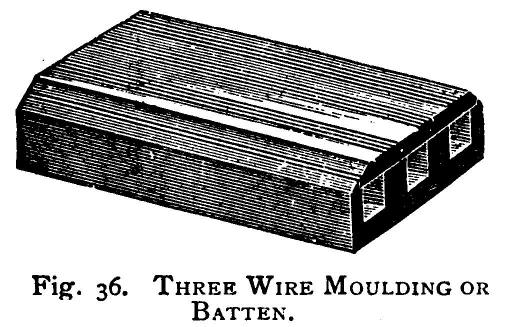
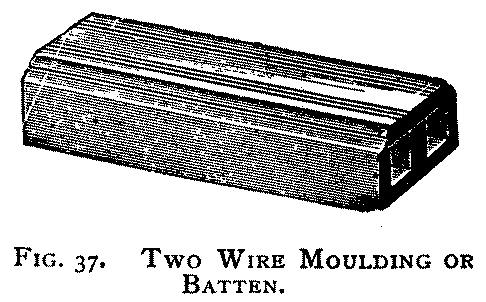
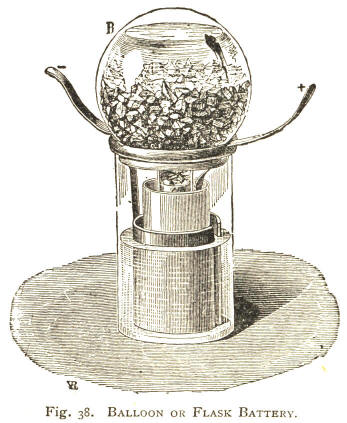
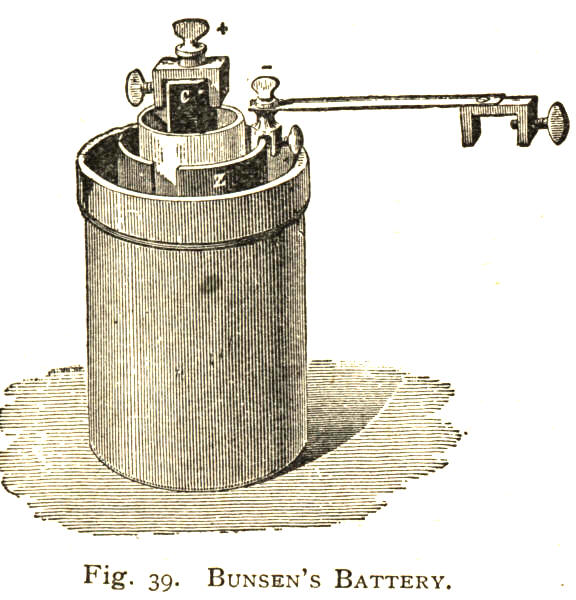
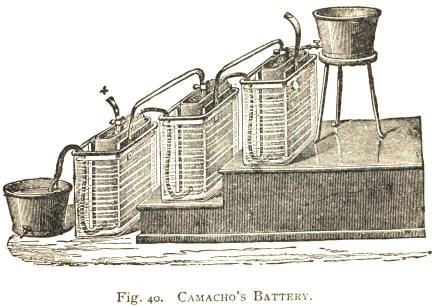
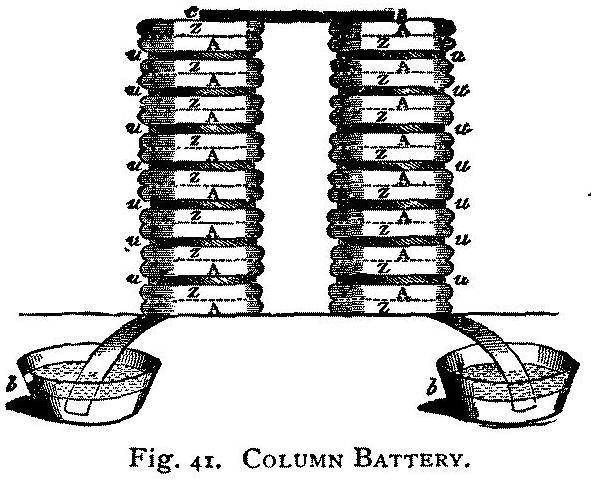
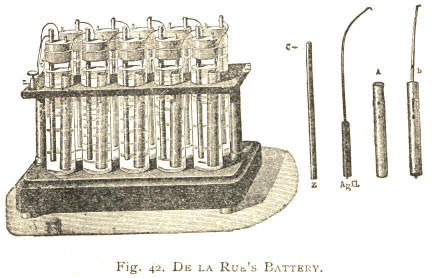
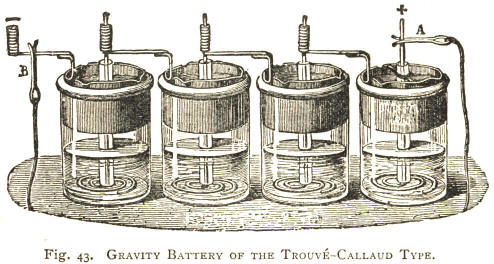
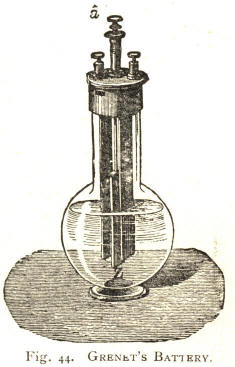
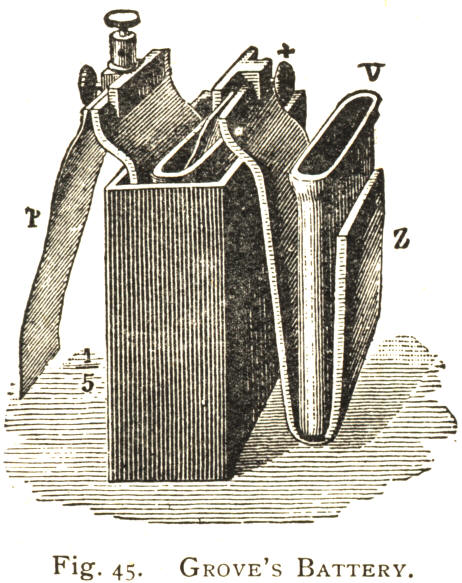
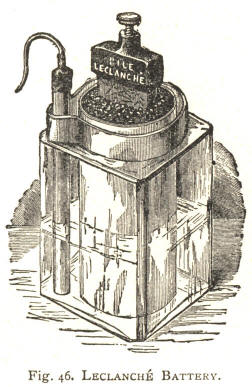
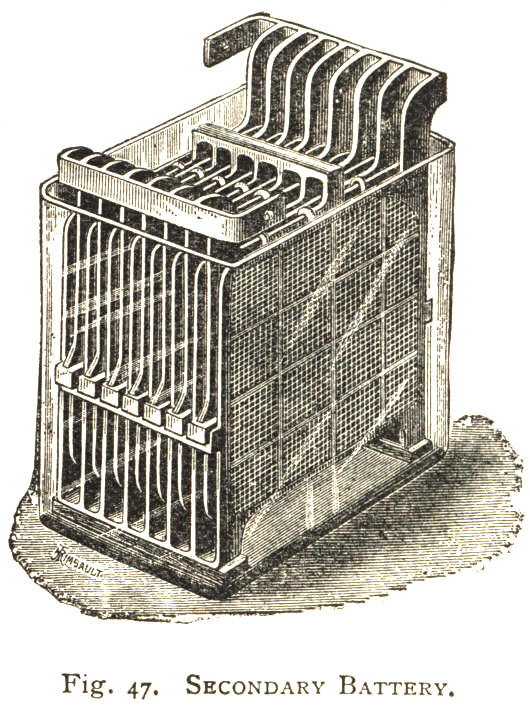
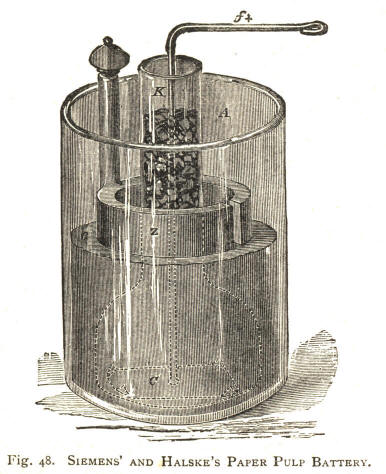
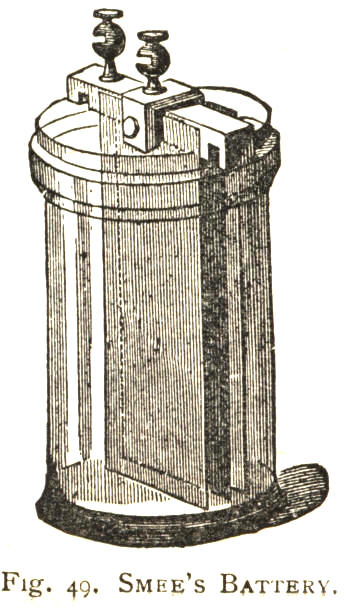
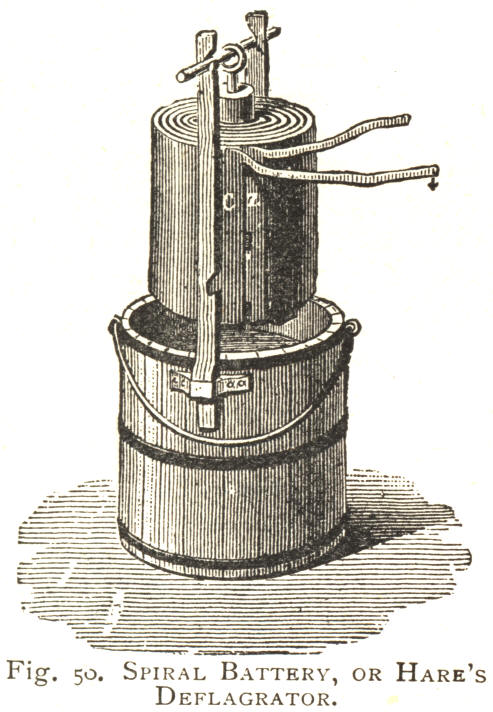
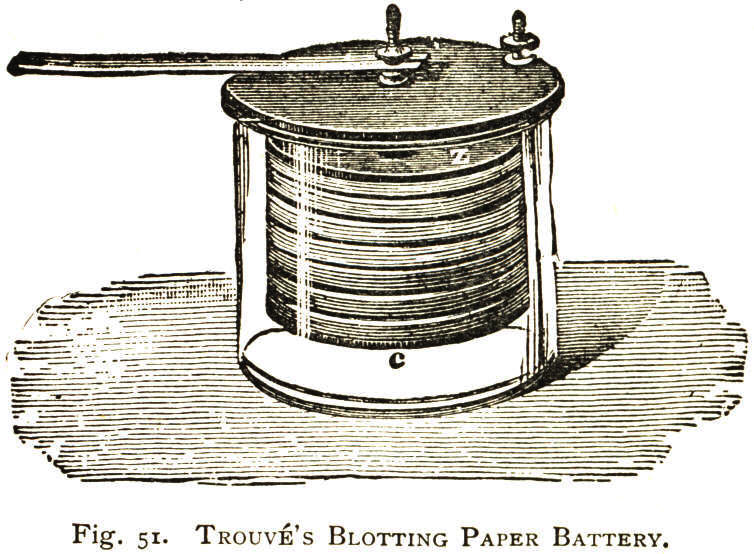
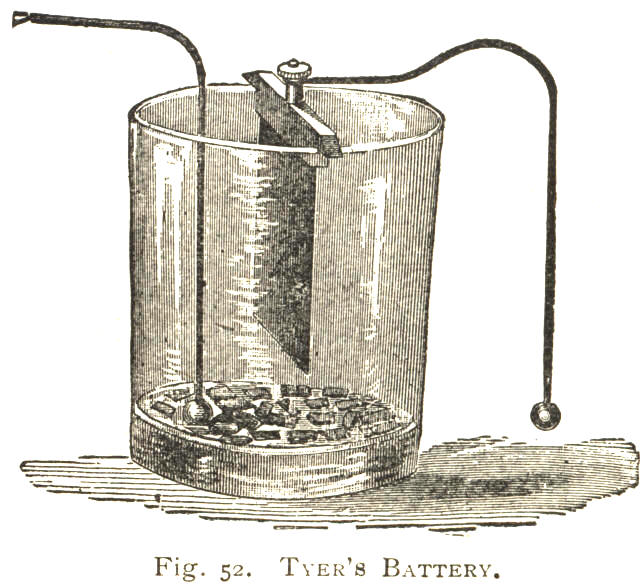
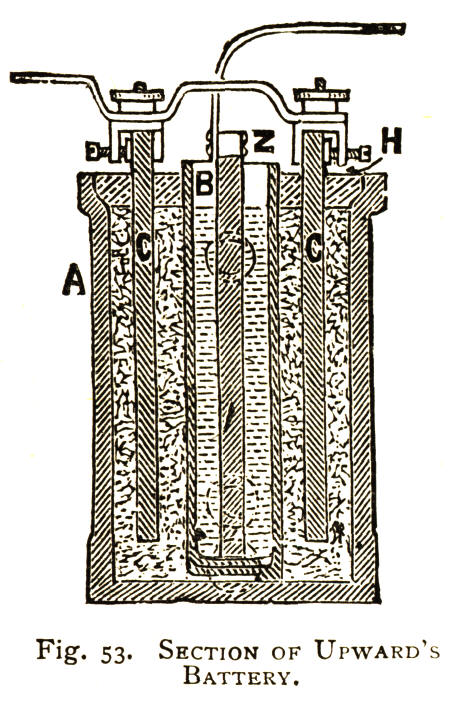
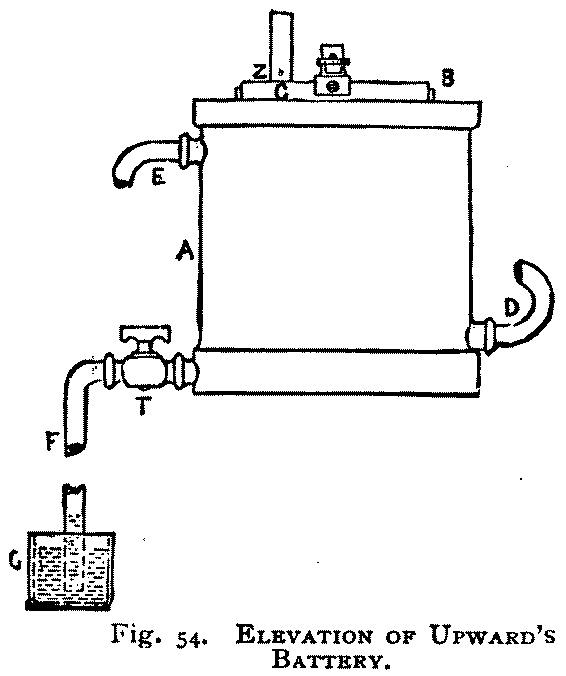
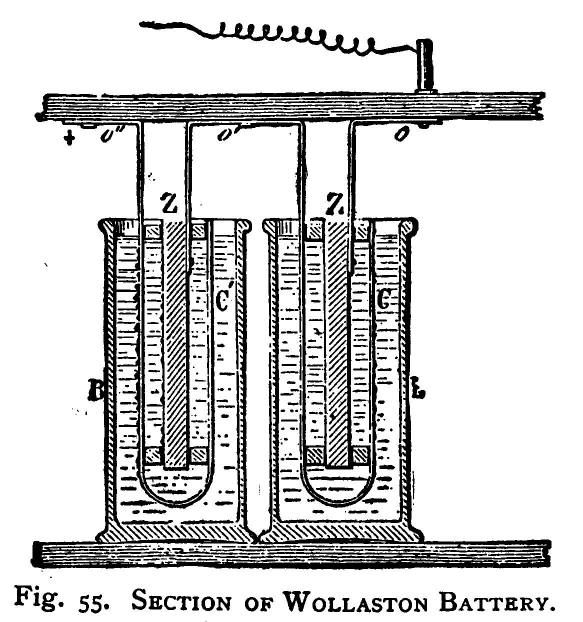
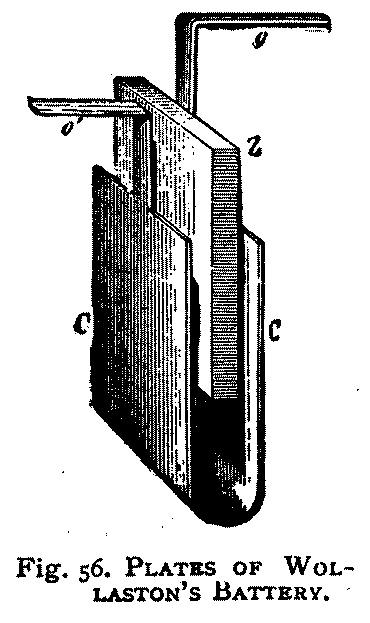
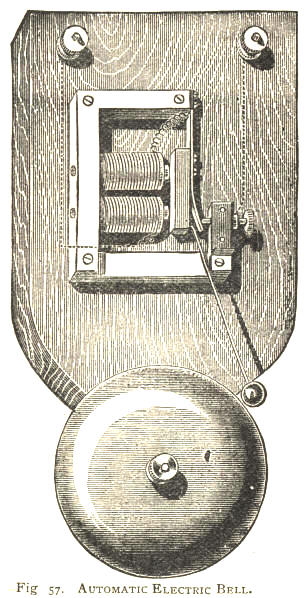
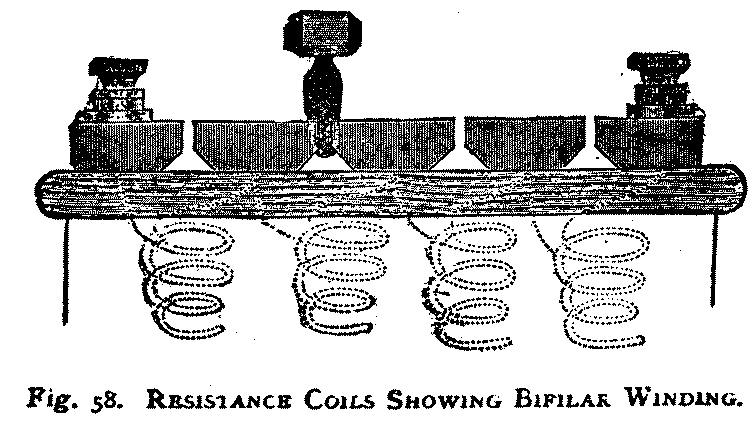
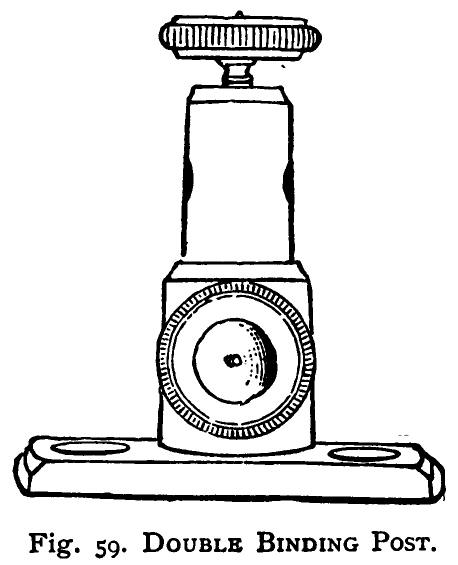
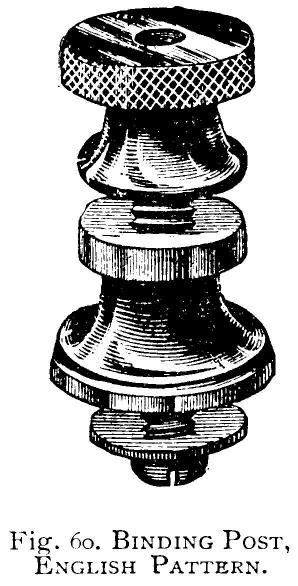
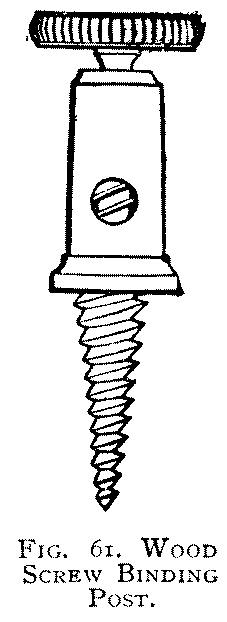
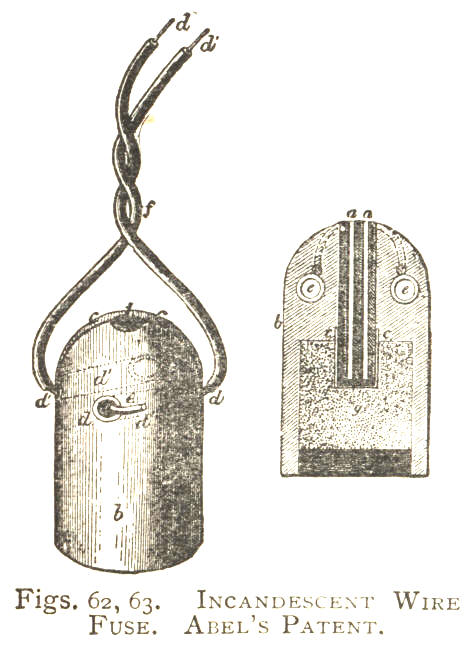
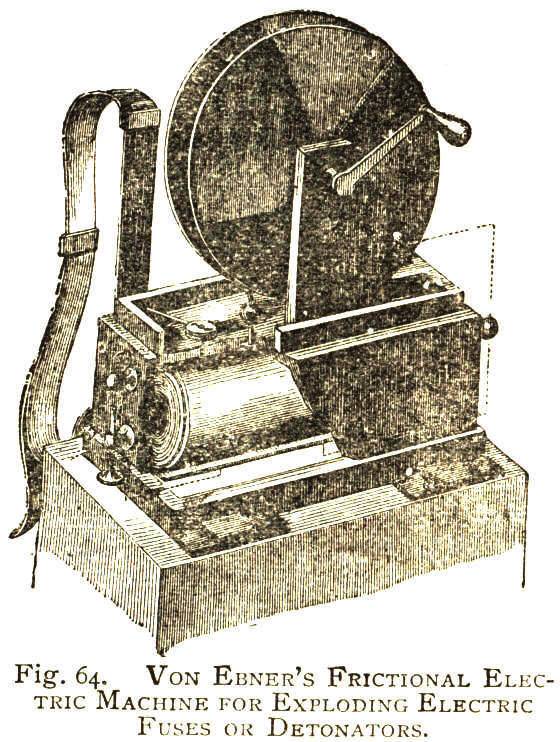
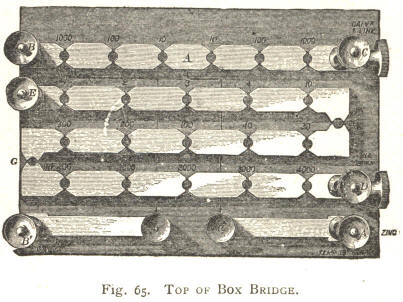
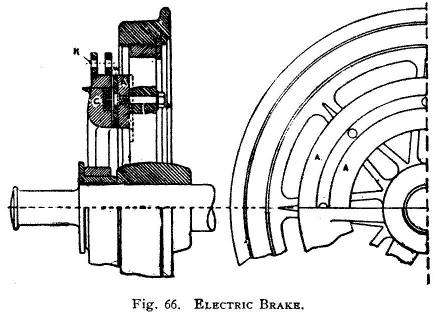
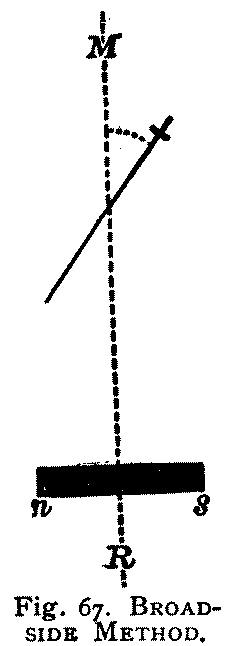
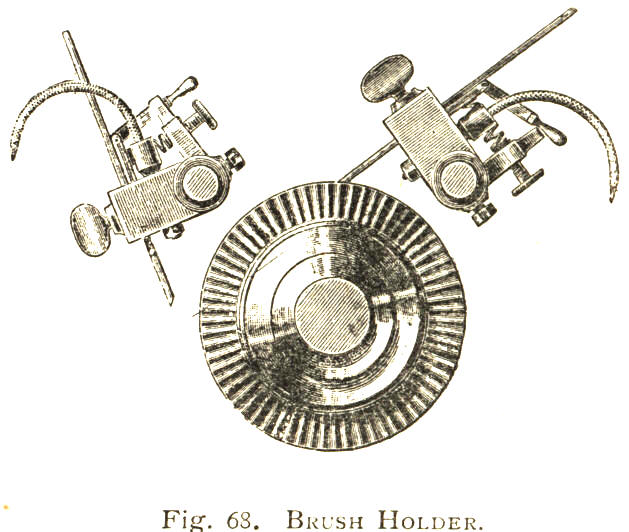
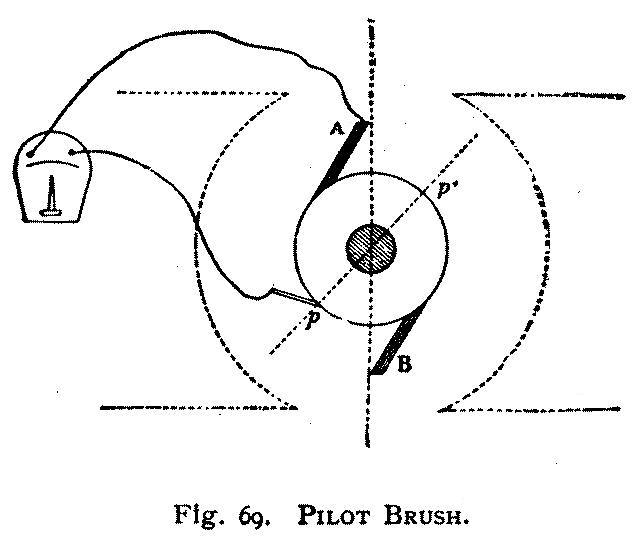
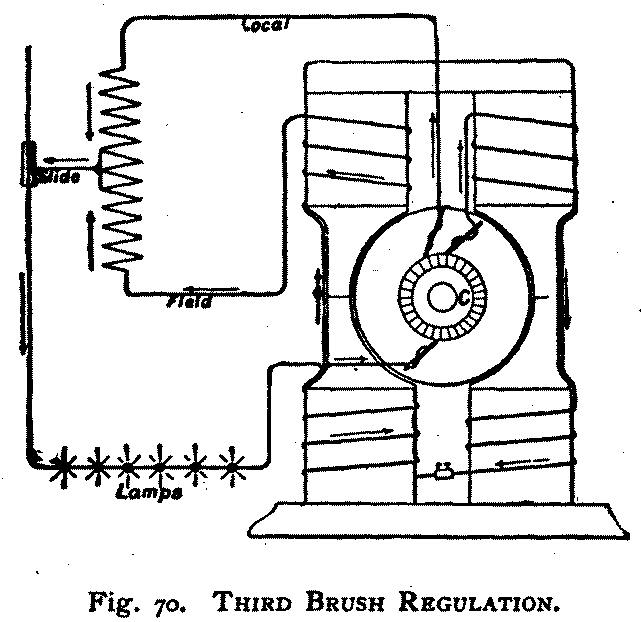
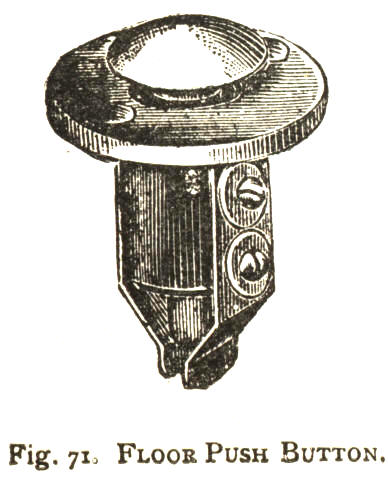
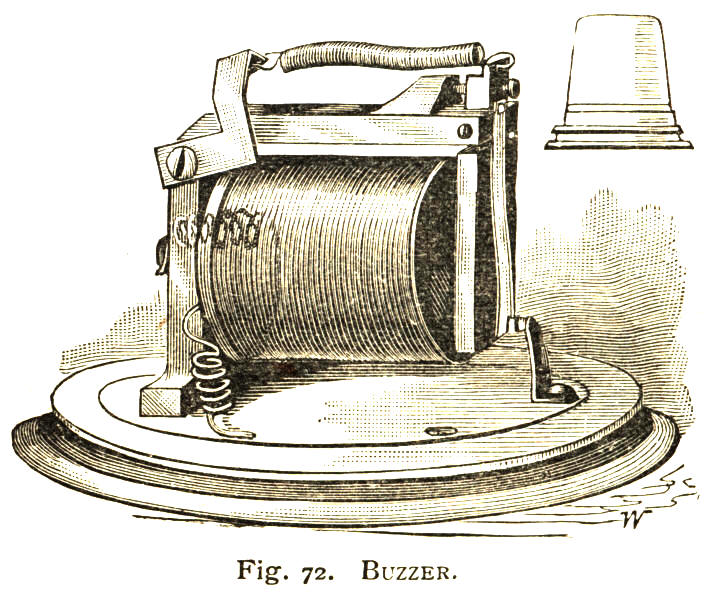
C. (a) Abbreviation for Centigrade, as 100 C., meaning 100 Centigrade. (See Centigrade Scale.) (b) A symbol of current or of current strength. Thus in the expression of Ohm's law C = E/R. C indicates current strength or intensity, not in any fixed unit, but only in a unit of the same order in which E and R are expressed; E Indicating electro-motive force and R resistance. Cable. (a) Abbreviation for Cablegram, q. v. (b) v. It is also used as a verb, meaning to transmit a message by submarine cable. (c). An insulated electric conductor, of large diameter. It often is protected by armor or metallic sheathing and may be designed for use as an aerial, submarine, subterranean or conduit cable. A cable often contains a large number of separately insulated conductors, so as to supply a large number of circuits. Cable, Aerial. A cable usually containing a large number of separately insulated wires, and itself insulated. It is suspended in the air. As its weight is sometimes so great that it could not well sustain it, a suspending wire is in such cases carried along with it, to which it is suspended by cable hangers, q. v. Cable Box. A box for receiving underground cable ends and connecting the separate wires of the cable to air-line wires. It is often mounted on a pole, which forms the starting point of the air-line portion of the system. Cable, Bunched. A cable containing a number of separate and individual conductors. In some forms it consists virtually of two or more small cables laid tangent to each other and there secured. Thus each in section represents two or more tangent circles with the interstice solidly filled with the metal sheathing. Cable, Capacity of. The electrostatic capacity of a cable. A cable represents a Leyden jar or static condenser. The outer sheathing or armor, or even the more or less moist coating, if it is unarmored, represents one coating. The wire conductors represent the other coating, and the insulator is the dielectric. The capacity of a cable interferes with its efficiency as a conductor of broken or interrupted currents, such as are used in telegraphy or telephoning. As each impulse or momentary current is sent into the line, it has to charge the cable to at least a certain extent before the effects of the current are perceptible at the other end. Then the cable has to discharge itself. All this creates a drag or retardation. The capacity of a cable is used to determine the locality of breaks in the continuity of the conductors. The capacity per unit of length being accurately known, it is obvious that, if the conductor breaks without disturbance of the insulator, the distance of the break from the end can be ascertained by determining the capacity of the cable from one end. This capacity will be in proportion to the capacity of a mile, a knot or any fixed unit, as the distance to the break is to the length used as standard. 96 STANDARD ELECTRICAL DICTIONARY. Cable Core. The conductors of a cable. They are generally copper wire. In a telephone cable they may be very numerous and insulated from each other. In ocean cables they may be a group of bare wires twisted or laid together. Sometimes the conductors are arranged for metallic circuits, each pair being distinguished by special colored windings. Cable, Duplex. A cable containing two wires, each with separate insulation, so as to be virtually two cables, laid and secured parallel and side by side. Cable, Flat. A cable, flat in shape, so as to lie closely against a wall or ceiling. Cablegram. A message which has been transmitted or is to be transmitted by a submarine cable. It is sometimes called a cable. Cable Grip. A grip for holding the end of a cable, when the cable is to be drawn into a conduit in a subway. It is an attachment to provide the cable with an eye or loop. Its end is a split socket and embraces the end of the cable, and is secured thereto by bolts driven through the cable end. In drawing a cable into a conduit a capstan and rope are often used, and the rope is secured to the cable end by the grip. Fig. 73. CABLE HANGER, CABLE, AND SUSPENDING WIRE. Fig. 74. CABLE HANGER, OPEN. Cable Hanger. When a heavy electric cable is suspended from poles it often would be unsafe to trust to its longitudinal strength to support or sustain its own weight unless the poles were very near together. In such case an auxiliary or sustaining wire is run along with it, and by clips or hangers the cable is connected thereto at as frequent intervals as seem desirable. The contrivance may take the form of a strip of metal surrounding the cable and carrying a hook or eye through which the supporting wire passes. Synonym--Cable Clip. 97 STANDARD ELECTRICAL DICTIONARY Cable Hanger Tongs. Tongs for attaching cable hangers, q.v. They have long handles so as to be worked from the ground at the middle of a span. Cable, Suspending Wire of. A wire by which an aerial cable is in part or entirely suspended. The cable, being incapable of sustaining its own weight, is secured by clips or hangers to a wire, strong from pole to pole immediately above it. (See Cable Hanger.) Cable Tank. A tank in which a submarine cable is coiled away on board a cable-laying ship, or in the factory on shore for the purpose of testing or watching its insulation. Sometimes, in order to test it under pressures approximating to those it will be subjected to in practice, the tank is closed and the portion of cable within it is subjected to hydraulic pressure. This represents the pressure it will be exposed to in deep water. Calamine. A mineral; zinc silicate; formula Zn2 Si 03, crystalline system, Orthorhombic; specific gravity, 3.16-3.9. The crystals often show strong pyroelectric properties. Calibration. The determination by experiment or calculation of the value of the readings of an instrument, such as a galvanometer or eudiometer. Thus if a tangent galvanometer has its circle graduated in degrees, a table of the value of tangents corresponding to every reading occurring in practice would represent a calibration by calculation. A determination of the current required to produce each deflection would be a calibration in the more usual sense. Calibration is generally absolute, as referring to some fixed unit, but it may be relative, as between two things both of unknown absolute value. Calibration, Absolute. The determination of the absolute value of currents producing given deflections in a galvanometer, or in other instruments the determination of corresponding values, as the instrument may be a magnetometer, quadrant electrometer, or other apparatus. Calibration, Invariable. Calibration applicable to specially constructed galvanometers, which is unaffected by the proximity of masses of iron or field magnets. Such galvanometers must have a constant controlling field. Such is given by a powerful permanent magnet, whose field is practically unaffected by the causes named. Or else, in place of a controlling field, a spring maybe used to which the needle is attached, and which tends to hold it in one position. 98 STANDARD ELECTRICAL DICTIONARY. Calibration, Relative. The determination of the law connecting the various indications of an instrument, such as the deflections of the needle of a galvanometer, with the relative causes; in the case of a galvanometer, the strength of the currents or the electro-motive forces producing them directly or indirectly. Call Bell. A bell rung by pressing a button or otherwise to call the attention of a person in a distant place. They can be classified into a great variety of types according to their uses or construction. Call Button. A push button used for ringing a call bell, sounding a buzzer, working an annunciator and for similar purposes. (See Push Button.) Synonym--Push Button. Calling Drop. In a telephone exchange or telegraph office a drop shutter annunciator, which falls to call the attention of the operator, notifying him that the line connected to such drop is to be connected to some other circuit. Calorie or Calory. A practical unit of heat. There are two calories, respectively called the great and the small calorie, or the kilogram and the gram calorie. The first is the quantity of heat required to raise the temperature of one kilogram of water one degree centigrade. The second is the quantity of heat required to raise the temperature of one gram of water one degree centigrade. Calorimeter. An apparatus for measuring the quantity of heat evolved or produced by or under different conditions. Dulong's water calorimeter consists of a water jacket, and by the increase of temperature of the water and enclosing vessels the amount of heat produced by anything in the inner vessels is determined. The amount of ice a heated body will melt is sometimes made the basis of a calorimeter. The expansion of a fluid, as water, may be used. In the calorimeter shown in the cut the heat produced in a conductor by the passage of an electric current is caused to heat water whose temperature is shown by a thermometer immersed therein. The increase of temperature and the weight of the water give the basis for a determination of the heat produced by the current. Knowing the resistance of the conductor immersed, the watts can be calculated. This gives the bases for the determination of the heat-equivalent of electric energy. This is but an imperfect calorimeter, as it constantly would lose heat by the surrounding atmosphere, and would cease to operate as a calorimeter when the water was as hot as the wire normally would be, for then it would not absorb all the heat. Fig. 75. CALORIMETER. 99 STANDARD ELECTRICAL DICTIONARY. Candle. The generally accepted unit of illuminating power; there are three kinds in use as standards. (See Candle, Decimal--Candle, German Standard--Candle, Standard.) Candle, Concentric. An electric candle of the Jablochkoff type, having a small solid carbon inside of an outside tubular carbon, the space between being filled with refractory material corresponding to the colombin, q. v., of the ordinary type. The arc springs across from one carbon to the other. Candle, Debrun. An arc lamp with approximately parallel carbons. A transverse priming connects their bases, and the arc starting there at once flies out to the end. Candle, Decimal. A standard of illuminating power, proposed to the Congress of Electricians of 1889 by Picou. It is one-twentieth of a Viole, or almost exactly one standard candle. (See Viole's Standard of Illuminating Power.) Candle, Electric. An arc lamp regulated by simple gravity, or without any feed of the carbons or special feeding apparatus, generally for the production of an arc light of low intensity. This definition may be considered too elastic, and the word may be restricted to parallel carbon lamps in which the arc springs across from carbon to carbon. For the latter class an alternating current is used to keep the carbons of equal length. They are but little used now. Various kinds have been invented, some of which are given here. Candle, German Standard. A standard of illuminating power used in Germany. It is a paraffin candle, 6 to the pound, 20 millimeters diameter; flame, 56 millimeters high; rate of consumption, 7.7 grams per hour. Its value is about two per cent. lower than the English standard candle. 100 STANDARD ELECTRICAL DICTIONARY. Candle Holder. A clamp for holding electric candles of the Jablochkoff type. The ones shown in the cut designed for Jablochkoff candles comprise a pair of metallic clamps, each member insulated from the other, and connected as terminals of the circuit. When the candle is placed in position the metal pieces press against the carbons of the candle and thus convey the current. Below each member of the clamps is a binding screw for the line wire terminals. Fig. 76. JABLOCHKOFF CANDLE HOLDERS. Fig. 77. JABLOCHKOFF CANDLE. Candle, Jablochkoff. An arc lamp without regulating mechanism, producing an arc between the ends of parallel carbons. It consists of two parallel rods of carbon, between which is an insulating layer of non-combustible material called the colombin. Kaolin was originally employed for this part; later, as the fusion of this material was found to short- circuit the arc, a mixture of two parts of calcium sulphate and one of barium sulphate was used. The carbons are 4 millimeters (.16 inch) thick, and the colombin is 3 millimeters (.12 inch) wide and two-thirds as thick. A little slip of carbon is placed across the top, touching both carbons to start the arc. Once started the candle burns to the end, and cannot be restarted after ignition, except by placing a short conductor across the ends, as at first. The Jablochkoff candle may now be considered as virtually extinct in this country. In France at one time a great number were in use. To keep the carbons of equal length an alternating current must always be used with them. Special alternating combinations were employed in some cases where a direct current had to be drawn upon. Candle, Jamin. An arc lamp with approximately parallel carbons, one of which oscillates and is controlled by an electro-magnet and armature. A coil of wire is carried around the carbons to keep the arc steady and in place. The frame and wire coils have been found unsatisfactory, as causing a shadow. Candle Power. The amount of light given by the standard candle. The legal English and standard American candle is a sperm candle burning two grains a minute. It should have burned some ten minutes before use, and the wick should be bent over and have a red tip. Otherwise its readings or indications are useless. A sixteen candle power lamp means a lamp giving the light of sixteen candles. The candle power is a universal unit of illuminating power. 101 STANDARD ELECTRICAL DICTIONARY. Candle Power, Rated. The candle power of arc lamps is always stated in excess of the truth, and this may be termed as above. A 2000 candle power lamp really gives about 800 candles illumination. Synonym--Nominal Candle Power. Candle Power, Spherical. The average candle power of a source of light in all directions. An arc lamp and an incandescent lamp vary greatly in the intensity of light emitted by them in different directions. The average of a number of determinations at various angles, the lamp being moved about into different positions, is taken for the spherical candle power. Candle, Standard. A standard of illuminating power. Unless otherwise expressed the English standard sperm candle is indicated by this term. (See Candle Power.) Candle, Wilde. An arc lamp with approximately parallel carbons. One of the carbons can rotate through a small arc being pivoted at its base. This oscillation is regulated by an electro-magnet at its base, and the carbons touch when no current is passing. They separate a little when the current passes, establishing an arc. The regulation is comparable to that of a regular arc lamp. Fig. 78. WILDE CANDLE. Caoutchouc. India rubber; a substance existing in an emulsion or solution in the juice of certain trees and vines of the tropics, whence it is obtained by coagulation and drying. The name "rubber" is due to the fact that one of its earliest uses was for erasing pencil marks by rubbing. It has a very high value as an insulator. The unworked crude rubber is called virgin gum; after working over by kneading, it is termed masticated or pure gum rubber; after mixture with sulphur and heating, it is termed vulcanized rubber. If enough sulphur is added it becomes hard, and if black, is termed ebonite; if vermilion or other pigment is also added to produce a reddish color, it is termed vulcanite. The masticated gum dissolves more or less completely in naphtha (sp. gr., .850) benzole, turpentine, chloroform, ether and other similar liquids.. The resistance per centimeter cube of "Hooper's" vulcanized India rubber, such as is used in submarine cables is 1.5E16 ohms. The specific inductive capacity of pure India rubber is 2.34--of vulcanized 2.94 (Schiller). Synonyms--India Rubber--Rubber. 102 STANDARD ELECTRICAL DICTIONARY. Capacity, Dielectric. The capacity of a dielectric in retaining an electrostatic charge; the same as Specific Inductive Capacity. 'The number expressing it is sometimes called the dielectric constant. (See Capacity, Specific Inductive.) Capacity, Electric, or Electrostatic. The relative capacity of a conductor or system to retain a charge of electricity with the production of a given difference of potential. The greater the charge for a given change of potential, or the less the change of potential for a given charge the greater the capacity. The measure of its capacity is the amount of electricity required to raise the potential to a stated amount. The unit of capacity is the farad, q. v. Electric capacity is comparable to the capacity of a bottle for air. A given amount of air will raise the pressure more or less, and the amount required to raise its pressure a stated amount might be taken as the measure of capacity, and would be strictly comparable to electrostatic charge and potential change. The capacity, K, is obviously proportional to the quantity, Q, of the charge at a given potential, E, and inversely proportional to the potential, E, for a given quantity, Q, or, (1) K == Q/E and (2) Q = K * E, or, the quantity required to raise a conductor by a given potential is equal to the capacity of the conductor or system multiplied by the rise of potential. The capacity of a conductor depends upon its environments, such as the nature of the dielectric surrounding it, the proximity of oppositely charged bodies and other similar factors. (See Dielectric-Condenser-Leyden jar.) The dimensions of capacity are found by dividing a quantity of electricity by the potential produced in the conductor by such quantity. Quantity ( ((M^.5)*(L^1.5)) / T ) / potential ( ((M^.5)*(L^.5)) / T ) = L. Capacity, Instantaneous. The capacity of a condenser when connected only for an instant to a source of electricity. This is in contrast to electric absorption (see Absorption, Electric), and is capacity without such absorption taking part in the action. 103 STANDARD ELECTRICAL DICTIONARY. Capacity of a Telegraph Conductor. The electric capacity of a telegraphic conductor is identical in quality with that of any other conductor. It varies in quantity, not only for different wires, but for the same wire under different environments, as the wire reacting through the surrounding air or other dielectric upon the earth, represents one element of a condenser, the earth, in general, representing the other. Hence, a wire placed near the earth has greater capacity than one strung upon high poles, although the wires may be identical in length, material and diameter. The effect of high capacity is to retard the transmission of intermitting signals. Thus, when--as in the Morse system--a key is depressed, closing a long telegraph current and sending a signal into a line, it is at least very probable that a portion of the electricity travels to the end of the wire with the velocity of light. But as the wire has to be charged, enough current to move the relay may not reach the end for some seconds. Capacity of Polarization of a Voltaic Cell. The relative resistance to polarization of a voltaic cell, measured by the quantity of electricity it can supply before polarization. A counter-electromotive force may be developed, or the acid or other solution may become exhausted. The quantity of electricity delivered before this happens depends on the size and type of cell and other factors. Capacity, Residual. When two insulated conductors are separated by a dielectric, and are discharged disruptively by being connected or nearly connected electrically, on removing the discharger it is found that a slight charge is present after a short interval. This is the residual charge. (See Charge, Residual.) Shaking or jarring the dielectric facilitates the complete discharge. This retaining of a charge is a phenomenon of the dielectric, and as such, is termed residual capacity. It varies greatly in different substances. In quartz it is one-ninth what it is in air. Iceland spar (crystalline calcite) seems to have no residual capacity. The action of shaking and jarring in facilitating a discharge indicates a mechanical stress into which the electrostatic polarization of the conductor has thrown the intervening dielectric. Capacity, Specific Inductive. The ratio of the capacity of a condenser when its plates are separated by any substance to the capacity of the same condenser when its plates are separated by air. A static accumulator consists of two conducting surfaces separated by an insulator. It is found that the capacity of an accumulator for an electric charge, which varies with or may be rated by the potential difference to which its conductors will be brought by the given charge, varies with the nature of the interposed dielectric, and is proportional to a constant special to each substance. This constant is the specific inductive capacity of the dielectric. The same condenser will have a higher capacity as the dielectric is thinner, other things being equal. But different dielectrics having different specific inductive capacities, the constant may be determined by ascertaining the relative thicknesses of layers having the same total inductive capacity. The thicker the layer, the higher is its specific inductive capacity. Thus it is found that 3.2 units thickness of sulphur have the same total inductive capacity as 1 unit thickness of air. In other words, if sulphur is interposed between two conducting plates, they may be separated to over three times the distance that would be requisite to retain the same capacity in air. Hence, sulphur is the better dielectric, and air being taken as unity, the specific inductive capacity of sulphur is 3.2. 104 STANDARD ELECTRICAL DICTIONARY. The specific inductive capacity of a dielectric varies with the time and temperature. That of glass rises 2.5 per cent. between 12° C. (53.6° F.) and 83° C. (181.4° F.). If a condenser is discharged disruptively, it retains a small residual charge which it can part with later. If a metallic connection is made between the plates, the discharge is not instantaneous. Vibration shaking and jarring facilitate the complete discharge. All this shows that the charge is a phase of the dielectric itself, and indicates a strained state into which it is brought. The following table gives the specific inductive capacity of various substances: Specific Inductive Capacity. Substance Specific Inductive Authority Capacity. Vacuum, air at about 0.001 millimeters pressure 0.94 about Ayrton Vacuum, air at about 5 millimeters 0.9985 Ayrton 0.99941 Boltzmann Hydrogen at about 760 millimeters pressure 0.9997 Boltzmann 0.9998 Ayrton Air at about 760 millimeters pressure 1.0 Taken as the standard Carbon Dioxide at about 760 millimeters pressure 1.000356 Boltzmann 1.0008 Ayrton Olefiant Gas at about 760 millimeters pressure 1.000722 Boltzmann Sulphur Dioxide at about 760 millimeters pressure 1.0037 Ayrton Paraffin Wax, Clear 1.92 Schiller 1.96 Wüllner 1.977 Gibson and Barclay 2.32 Boltzmann Paraffin Wax, Milky 2.47 Schiller India Rubber, Pure 2.34 Schiller India Rubber, Vulcanized 2.94 Schiller Resin 2.55 Boltzmann Ebonite 2.56 Wüllner 2.76 Schiller 3.15 Boltzmann Sulphur 2.88 to 3.21 Wüllner 3.84 Boltzmann Shellac 2.95 to 3.73 Wüllner Gutta percha 4.2 Mica 5 Flint Glass, Very light 6.57 J. Hopkinson Flint Glass, Light 6.85 J. Hopkinson Flint Glass, Dense 7.4 J. Hopkinson Flint Glass, Double extra dense 10.1 J. Hopkinson 105 STANDARD ELECTRICAL DICTIONARY. Capacity, Unit of. The unit of capacity is the capacity of a surface which a unit quantity will raise to a unit potential. The practical unit is the surface which a coulomb will raise to one volt, and is called the farad, q. v. Capacity, Storage. In secondary batteries the quantity of electrical current which they can supply when charged, without undue exhaustion. It is expressed in ampere-hours. The potential varies so little during the discharge that it is assumed to be constant. Capillarity. The reaction between liquid surfaces of different kinds or between liquid and solid surfaces due to surface tension. Its phenomena are greatly modified by electric charging, which alters the surface tension. Capillarity is the cause of solutions "creeping," as it is termed. Thus in gravity batteries a crust of zinc sulphate often formed over the edge of the jar due to the solution creeping and evaporating. As a liquid withdraws from a surface which it does not wet, creeping as above is prevented by coating the edge with paraffin wax, something which water does not moisten. It also causes the liquids of a battery cell to reach the connections and injure them by oxidation. The solutions creep up in the pores of the carbons of a battery and oxidize the clamps. To give good connections a disc of platinum or of lead is used for the contact as not being attacked. Another way is to dip the upper ends of the dry and warm carbons into melted paraffin wax, or to apply the wax to the hot carbons at the top, and melt it in with a hot iron. 106 STANDARD ELECTRICAL DICTIONARY. Carbon. (a) One of the elements; atomic weight, 12. It exists in three allotropic modifications, charcoal, graphite and diamond. In the graphitic form it is used as an electric current conductor, as in batteries and for arc lamp, electrodes and incandescent lamp filaments. It is the only substance which conducts electricity and which cannot be melted with comparative ease by increase of current. (See Resistance.) (b) The carbon plate of a battery or rod of an arc lamp. To secure greater conductivity in lamp carbons, they are sometimes plated with nickel or with copper. (c) v. To place carbons in arc lamps. This has generally to be done once in twenty-four hours, unless the period of burning is very short. Carbon, Artificial. For lamps, carbons and battery plates carbons are made by igniting, while protected from the action of the air, a mixture of carbon dust and a cementing and carbonizable substance. Lamp black may be added also. Powdered coke or gas carbon is mixed with molasses, coal tar, syrup, or some similar carbonaceous liquid. It is moulded into shape. For lamp carbons the mixture is forced from a vessel through a round aperture or die, by heavy pressure, and is cut into suitable lengths. For battery plates it may be simply pressed into moulds. The carbons are ignited in covered vessels and also covered with charcoal dust, lamp black or its equivalent. They are heated to full redness for some hours. After removal and cooling they are sometimes dipped again into the liquid used for cementing and reignited. Great care in securing pure carbon is sometimes necessary, especially for lamps. Fine bituminous coal is sometimes used, originally by Robert Bunsen, in 1838 or 1840; purification by different processes has since been applied; carbon from destructive distillation of coal tar has been used. The famous Carré carbons are made, it is said, from 15 parts very pure coke dust, five parts calcined lamp-black, and seven or eight parts sugar--syrup mixed with a little gum. Five hours heating, with subsequent treatment with boiling caramel and reignition are applied. The latter treatment is termed "nourishing." Napoli used three parts of coke to one of tar. Sometimes a core of different carbon than the surrounding tube is employed. 107 STANDARD ELECTRICAL DICTIONARY. The following are the resistances of Carré's carbons per meter (39.37 inches): Diameter in Diameter in Resistance in Ohms. Millimeters. Inches. @ 20° C. (98° F.) 1 .039 50.000 2 .078 12.5 3 .117 5.55 4 .156 3.125 5 .195 2.000 6 .234 1.390 8 .312 .781 10 .390 .5 12 .468 .348 15 .585 .222 18 .702 .154 20 .780 .125 At high temperatures the resistance is about one-third these amounts. A layer of copper may increase the conductivity one hundred times and prolong the duration 14 per cent. Thus a layer of copper 1/695 millimeter (1/17300 inch) thick increases the conductivity 4.5 times; a coating 1/60 millimeter (1/1500 inch) thick increases the conductivity one hundred and eleven times. Carbon, Cored. A carbon for arc lamps with a central core of softer carbon than the exterior zone. It fixes the position of the arc, and is supposed to give a steadier light. Synonym--Concentric Carbon. Carbon Holders. In arc lamps, the fixed clamps for holding the ends of the carbons. Carbonization. The igniting in a closed vessel, protected from air, of an organic substance so as to expel from it all the constituents except part of the carbon; destructive distillation. (See Carbonized Cloth.) Carbonized Cloth. Cloth cut in discs and heated in vessels protected from the air, until reduced to carbon. The heating is sometimes conducted in vacuo. They are placed in a pile in a glass or other insulating tube, and offer a resistance which can be varied by pressure. The greater the pressure the less will be the resistance, and vice versa. Carbon Dioxide. A compound gas, CO2. It is composed of Carbon, 12 parts by weight. Oxygen. 32 " Specific gravity, 1.524 (Dulong and Berzelins). Molecular weight, 44. It is a dielectric of about the resistance of air. Its specific inductive capacity at atmospheric pressures is 1.000356 (Boltzmann). 1.0008 (Ayrton). Synonyms--Carbonic Acid--Carbonic Acid Gas. 108 STANDARD ELECTRICAL DICTIONARY Carbon, Volatilization of. In arc lamps the heat is so intense that it is believed that part of the carbon is volatilized as vapor before being burned or oxidized by the oxygen of the air. The same volatilization may take place in incandescent lamps which are overheated. Carcel. The standard of artificial illumination used in France. It is the light yielded by a standard lamp burning 42 grams (648 grains) of colza oil per hour, with a flame 40 millimeters (1.57 inch) in height. One carcel is equal to 9.5 to 9.6 candles. Carcel Lamp. The lamp giving the standard of illuminating power. The wick is cylindrical, giving an Argand or central draft flame. It is woven with 75 strands, and weighs 3.6 grams (55.5 grains) per decimeter (3.9 inches) of length. The chimney is 29 centimeters (11.3 inches) high, 47 millimeters (1.88 inch) in diameter at the bottom, contracting just above the wick to 34 millimeters (1.36 inch). Carcel Gas Jet. A standard Argand gas burner, made with proper rating to give the light of a definite number of carcels illuminating power. Cognizance must be taken of the quality of the gas as well as of the burner used. Carrying Capacity. In a current conductor, its capacity for carrying a current without becoming unduly heated. It is expressed in amperes. (See Wire Gauge, American.) Cascade. The arrangement of Leyden jars in series on insulating supports, as described below. Cascade, Charging and Discharging Leyden Jars In. An arrangement of Leyden jars in series for the purpose of charging and discharging. They are placed on insulating supports, the inner coating of one connected with the outer coating of the next one all through the series. The actual charge received by such a series, the outer coating of one end jar being grounded, and the inner coating of the other being connected to a source of high potential, or else the same being connected to electrodes of opposite potentials is no greater than that of a single jar, but a much higher potential difference can be developed without risk of perforating the glass of a jar. The difference of potential in each jar of the series is equal to the total potential difference divided by the number of jars. The energy of discharge is equal to the same fraction of the energy of a single jar charged with the same quantity. [Transcriber's note: The equal distribution of potential assumes all the jars have the same capacity. The charge on all jars is the same since they are in series.] 109 STANDARD ELECTRICAL DICTIONARY. Case-hardening, Electric. The conversion of the surface of iron into steel by applying a proper carbonaceous material to it while it is heated by an electric current. It is a superficial cementation process. Cataphoresis. Electric osmore; the transfer of substances in solution through porous membranes under the influence probably of electrolysis, but without themselves being decomposed. Cautery, Electric. An electro-surgical appliance for removing diseased parts, or arresting hemorrhages, taking the place of the knife or other cutting instrument. The cautery is a platinum wire heated to whiteness by an electric current, and when in that condition used to cut off tumors, stop the flow of blood and parallel operations. The application is painful, but by the use of anaesthetics pain is avoided, and the healing after the operation is greatly accelerated. The heated wire of the cautery can be used for cutting operations in many cases where excision by a knife would be almost impracticable. Synonyms--Galvano-cautery--Galvano-caustry--Galvano-electric, do.--Galvano-thermal, do. C. C. A contraction of cubic centimeter. It is often written in small letters, as 100 c.c., meaning 100 cubic centimeters. Cell, Constant. A cell which yields a constant and uniform current under unvarying conditions. This implies that neither the electro-motive force or the resistance of the cell shall vary, or else that as the electro-motive forces run down the resistance shall diminish in proper proportion to maintain a constant current. There is really no constant cell. The constancy is greatest when the external resistance is high in proportion to the internal resistance. Cell, Electrolytic. A vessel containing the electrolyte, a liquid decomposable by the current, and electrodes, arranged for the passage of a decomposing current. The voltameter, q. v., is an example. Cell, Standard Voltaic. A cell designed to be a standard of electro-motive force; one in which the same elements shall always be present under the same conditions, so as to develop the same electro-motive force. In use the circuit is closed only for a very short time, so that it shall not become altered by polarization or exhaustion. Cell, Standard Voltaic, Daniell's. A zinc-copper-copper sulphate couple. Many forms are used. Sometimes a number of pieces of blotting paper are interposed between two plates, one of copper--the other of zinc. The paper next the copper is soaked in copper sulphate solution, and those next the zinc in zinc sulphate solution, of course before being put together. Sometimes the ordinary porous cup combination is employed. The cut shows a modification due to Dr. Fleming (Phil. Mag. S. 5, vol. xx, p. 126), which explains itself. The U tube is 3/4-inch diameter, and 8 inches long. Starting with it empty the tap A is opened, and the whole U tube filled with zinc sulphate solution, and the tap A is closed. The zinc rod usually kept in the tube L is put in place, tightly corking up its end of the U tube. The cock C is opened, which lowers the level of the solution in the right-hand limb of the U tube only. The tap B is opened and the copper sulphate solution is run in, preserving the line of separation of the two solutions. The copper rod is taken out of its tube M, and is put in place. India rubber corks are used for both rods. As the liquids begin to mix the mixture can be drawn off at C and the sharp line of demarcation re-established. In Dr. Sloane's standard cell two test tubes are employed for the solutions and a syphon is used to connect them. Oxidation of the zinc lowers the E. M. F.; oxidation of the copper raises it. With solutions of equal sp. gr. the E. M. F. is 1.104 volts. If the copper sulphate solution is 1.100 sp. gr. and the zinc sulphate solution 1.400 sp. gr., both at 15° C. (59°F.), the E. M. F. will be 1.074 volt. Clean pure zinc and freshly electrolyzed copper should be used. Fig. 79 STANDARD DANIELL CELL--FLEMING'S FORM. 110 STANDARD ELECTRICAL DICTIONARY. Cell, Standard Voltaic, Latimer Clark's. A mercury and zinc electrode couple with mercurous sulphate as excitant and depolarizer. The positive element is an amalgam of zinc, the negative is pure mercury. Each element, in a representative form, the H form, is contained in a separate vessel which communicate by a tube. Over the pure mercury some mercurous sulphate is placed. Both vessels are filled to above the level of the connecting tube with zinc sulphate solution, and kept saturated. It is tightly closed or corked. The E. M. F. at 15° C (59° F.) is 1.438. Temperature correction (1 - (.00077 *(t - 15° C) ) ) t being expressed in degrees centigrade (Rayleigh). A diminution in specific gravity of the zinc solution increases the E. M. F. The cell polarizes rapidly and the temperature coefficient is considered too high. Fig. 80. LATIMER CLARK'S STANDARD CELL. 111 STANDARD ELECTRICAL DICTIONARY. Cements, Electrical. A few cements find their use in electrical work. Marine glue, Chatterton's compound, and sealing wax may be cited. Centi-. Employed as a prefix to indicate one-hundredth, as centimeter, the one-hundredth of a meter; centi-ampere, the one-hundredth of an ampere. Centigrade-scale. A thermometer scale in use by scientists of all countries and in general use in many. The temperature of melting ice is 0º; the temperature of condensing steam is 100° ; the degrees are all of equal length. To reduce to Fahrenheit degrees multiply by 9 and divide by 5, and add 32 algebraically, treating all readings below 0º as minus quantities. For its relations to the Reamur scale, see Reamur Scale. Its abbreviation is C., as 10º C., meaning ten degrees centigrade. Centimeter. A metric system unit of length; one-hundredth of a meter; 0.3937 inch. The absolute or c. g. s. unit of length. Centimeter-gram-second System. The accepted fundamental or absolute system of units, called the C. G. S. system. It embraces units of size, weight, time, in mechanics, physics, electricity and other branches. It is also called the absolute system of units. It admits of the formation of new units as required by increased scope or classification. The following are basic units of the system : Of length, centimeter; of mass, gram; of time, second: of force, dyne: of work or energy, erg. See Dyne, Erg., and other units in general. 112 STANDARD ELECTRICAL DICTIONARY. Central Station Distribution or Supply. The system of supplying electric energy in current form from a main generating plant to a district of a number of houses, factories, etc. It is in contrast with the isolated plant system in which each house or factory has its own separate generating installment, batteries or dynamos. Centre of Gravity. A point so situated with respect to any particular body, that the resultant of the parallel attracting forces between the earth and the several molecules of the body always passes through it. These are resultants of the relative moments of the molecules. If a body is suspended, as by a string, the centre of gravity always lies vertically under its point of suspension. By two trials the point of intersection of plumb lines from the point of suspension being determined the centre of gravity is known. The vertical from the point of support coincides with the line of direction. Centre of Gyration. The centre of gyration with respect to the axis of a rotating body is a point at which if the entire mass of the body were concentrated its moment of inertia would remain unchanged. The distance of this point from the axis is the radius of gyration. Centre of Oscillation. The point referred to in a body, suspended or mounted to swing like a pendulum, at which if all the mass were concentrated, 1t would complete its oscillations in the same time. The distance from the axis of support to this point gives the virtual length of the pendulum which the body represents. Centre of Percussion. The point in a suspended body, one free to swing like a pendulum, at which an impulse may be applied, perpendicular to the plane through the axis of the body and through the axis of support without shock to the axis. It is identical with the centre of oscillation, q. v., when such lies within the body. Centrifugal Force. The force which draws a body constrained to move in a curved path away from the centre of rotation. It is really due to a tangential impulse and by some physicists is called the centrifugal component of tangential velocity. It has to be provided against in generator and motor armatures, by winding them with wire or bands to prevent the coils of wire from spreading or leaving their bed upon the core. 113 STANDARD ELECTRICAL DICTIONARY. Centrifugal Governor. The usual type of steam-engine governor. The motion of the engine rotates a system of weights, which are forced outward by centrifugal force, and are drawn inwards by gravity or by springs. Moving outwards they shut off steam, and moving inwards they admit it, thus keeping the engine at approximately a constant speed. The connections between them and the steam supply and the general construction vary widely in different governors. C. G. S. Abbreviation or symbol for Centimeter-gram-second, as the C. G. S. system. (See Centimeter-gram-second System.) It is sometimes expressed in capitals, as above, and sometimes in small letters, as the c. g. s. unit of resistance. Chamber of Incandescent Lamp. The interior of the bulb of an incandescent lamp. (See Lamp, Incandescent.) Fig. 81. CHARACTERISTIC CURVE OF A DYNAMO. FIG. 82. DROOPING CHARACTERISTIC. Characteristic Curve. A curve indicating the variations in electro-motive force developed during the rotations of the armature of a dynamo or other generator of E. M. F. The term as used in the electrical sense is thus applied, although the indicator diagram of a steam engine may be termed its characteristic curve, and so in many other cases. As the amperes taken from a series generator are increased in number, the E. M. F. rises, it may be very rapidly up to a certain point, and thereafter more slowly. To construct the curve coordinates, q. v., are employed. The resistance of the dynamo and of the outer circuit being known, the current intensity is measured. To obtain variations in electro-motive force the external resistance is changed. Thus a number of ampere readings with varying known resistance are obtained, and for each one an electro-motive force is calculated by Ohm's law. From these data a curve is plotted, usually with volts laid off on the ordinate and amperes on the abscissa. By other methods other characteristic curves may be obtained, for which the titles under Curve may be consulted. 114 STANDARD ELECTRICAL DICTIONARY. Characteristic, Drooping. A characteristic curve of a dynamo which indicates a fall in voltage when an excessive current is taken from the dynamo in question. It is shown strongly in some Brush machines, and is partly due to the arrangements for cutting out two of the coils as they approach the neutral line. It is an advantage, as it protects from overheating on short circuit. Characteristic, External. In a dynamo the characteristic curve in which the relations of volts between terminals to amperes in the outer circuit are plotted. (See Curve, External Characteristic.) Characteristic, Internal. A characteristic curve of a shunt dynamo, in which the relations of volts to amperes in the shunt circuit is plotted. Characteristics of Sound. Of interest, electrically, as affecting the telephone, they comprise: (1) Pitch, due to frequency of vibrations. (2) Intensity or loudness, due to amplitude of waves of sound. (3) Quality or timbre, the distinguishing characteristics of any specific sound due to overtones, discords, etc., by which the sound is recognizable from others. The telephone is held by the U. S. courts to be capable of reproducing the voice by means of the undulatory current. (See Current, Undulatory.) Charge. The quantity of electricity that is present on the surface of a body or conductor. If no electricity is supplied, and the conductor is connected to the earth, it is quickly discharged. A charge is measured by the units of quantity, such as the coulomb. The charge that a conductor can retain at a given rise of potential gives its capacity, expressible in units of capacity, such as the farad. A charge implies the stretching or straining between the surface of the charged body, and some complimentary charged surface or surfaces, near or far, of large or small area, of even or uneven distribution. Charge. v. (a) To introduce an electrostatic charge, as to charge a condenser. (b) To decompose the elements of a secondary battery, q. v., so as to render it capable of producing a current. Thus, a spent battery is charged or recharged to enable it to do more work. Synonyms--Renovate--Revivify--Recharge. 115 STANDARD ELECTRICAL DICTIONARY. Charge, Bound. A charge of electricity borne by the surface of a body so situated with reference to another oppositely charged body, that the charge is imperceptible to ordinary test, will not affect an electroscope nor leave the surface if the latter is connected to the earth. To discharge such a body it must be connected to its complimentarily charged body. The bound charge was formerly called dissimulated or latent electricity. (See Charge, Free.) The charge or portion of a charge of a surface which is neutralized inductively by a neighboring charge of opposite kind. The degree of neutralization or of binding will depend on the distance of the two charged surfaces from one another and on the electro-static nature of the medium intervening, which must of necessity be a dielectric. A charge not so held or neutralized is termed a free charge. Thus a surface may be charged and by the approach of a surface less highly charged may have part of its charge bound. Then if connected to earth. it will part with its unbound or free charge, but will retain the other until the binding surface is removed, or until the electricity of such surface is itself bound, or discharged, or until connection is made between the two surfaces. Thus a body may have both a bound and a free charge at the same time. Charge, Density of. The relative quantity of electricity upon a given surface. Thus a charged surface may have an evenly distributed charge or one of even density, or an unevenly distributed charge or one of uneven density. In a thunderstorm the earth has a denser charge under the clouds than elsewhere. Synonym--Electrical Density. Charge, Dissipation of. As every body known conducts electricity, it is impossible so to insulate a surface that it will not lose its charge by leakage. An absolute vacuum might answer, and Crookes in a high vacuum has retained a charge against dissipation for years. The gradual loss is termed as above. Charge, Distribution of. The relation of densities of charge on different parts of a charged body. On a spherical conductor the charge is normally of even distribution; on other conductors it is unevenly distributed, being of greatest density at points, edges, and parts of smallest radius of curvature. Even distribution can also be disturbed by local induction, due to the presence of oppositely charged bodies. 116 STANDARD ELECTRICAL DICTIONARY. Charge, Free. The charge borne by an insulated body, independent of surrounding objects. Theoretically it is an impossibility. A charge always has its compliment somewhere in surrounding objects. As a matter of convenience and convention, where the complimentary charge is so distributed that its influence is not perceptible the charge is called a free charge. If connected to earth the free charge will leave the body. If the body is connected with an electroscope the free charge will affect the same. (See Charge, Bound.) Charge, Residual. When a Leyden jar or other condenser is discharged by the ordinary method, after a few minutes standing a second discharge of less amount can be obtained from it. This is due to what is known as the residual charge. It seems to be connected in some way with the mechanical or molecular distortion of the dielectric. The jarring of the dielectric after discharge favors the rapidity of the action, diminishing the time required for the appearance of the residual charge. The phenomenon, it will be seen, is analogous to residual magnetism. This charge is the reciprocal of electric absorption and depends for its amount upon the nature of the dielectric. (See Absorption, Electric, and Capacity, Residual.) Synonym--Electric Residue. Chatterton's Compound. A cement used for cementing together layers or sheets of gutta percha, and for similar purposes in splicing telegraph cables. Its formula is: Stockholm Tar, 1 part. Resin, 1 part. Gutta Percha, 3 parts. All parts by weight. Chemical Change. When bodies unite in the ratio of their chemical equivalents, so as to represent the satisfying of affinity or the setting free of thermal or other energy, which uniting is generally accompanied by sensible heat and often by light, as in the ignition of a match, burning of a candle, and, when the new compound exhibits new properties distinct from those of its components, a chemical combination is indicated. More definitely it is a change of relation of the atoms. Another form of chemical change is decomposition, the reverse of combination, and requiring or absorbing energy and producing several bodies of properties distinct from those of the original compound. Thus in a voltaic battery chemical combination and decomposition take place, with evolution of electric instead of thermal energy. Chemical Equivalent. The quotient obtained by dividing the atomic weight, q. v., of an element by its valency, q. v. Thus the atomic weight of oxygen is 16, its valency is 2. its chemical equivalent is 8. It is the weight of the element corresponding to a unit weight of hydrogen, either as replacing it, or combining with it. In electro-chemical calculations the chemical equivalent is often conveniently used to avoid the necessity of dividing by the valency when atomic weights are used. The latter is really the better practice. The atomic weights in the old system of chemical nomenclature were chemical equivalents. 117 STANDARD ELECTRICAL DICTIONARY. Chemical Recorder. A form of telegraphic recorder in which the characters, often of the Morse alphabet or some similar one, are inscribed on chemically prepared paper by decomposition affecting the compound with which the paper is charged. In the original chemical recorder of Bain, the instrument was somewhat similar to the Morse recorder, except that the motionless stylus, S, always pressing against the paper was incapable of making any mark, but being of iron, and the paper strip being impregnated with potassium ferrocyanide, on the passage of a current a stain of Prussian blue was produced where the stylus touched the paper. The current passes from the line by way of the iron stylus, through the paper, and by way of a brass surface, M, against which the paper is held and is pressed by the stylus, to the earth. This recorder is extremely simple and has no part to be moved by the current. The solution in which the paper is dipped contains a mixture of potassium ferrocyanide and ammonium nitrate. The object of the latter is to keep the paper moist. In recent recorders a solution of potassium iodide has been used, which gives a brown stain of free iodine, when the current passes. This stain disappears in a few days. Fig. 83. BAIN'S TELEGRAPH EMPLOYING CHEMICAL RECORDER. In the cut, R is the roll of paper, B is a tank of solution with roll, W1, for moistening the paper; M is the brass surface against which the stylus, S, presses the paper, P P; W, W are feed rollers; T is the transmitting key, and zk the battery; Pl, Pl are earth plates. The apparatus is shown duplicated for each end. 118 STANDARD ELECTRICAL DICTIONARY. Chemistry. The science treating of atomic and molecular relations of the elements and of chemical compounds of the same. Chimes, Electric. An apparatus employed to illustrate the principles of the electrostatic charge, involving the ringing of bells by electrostatic attraction and repulsion. It is used in connection with a frictional, or influence electric machine. Two bells are employed with a button or clapper suspended between them. One bell is connected to one of the prime conductors, q. v., of the machine. The other insulated therefrom is connected to earth, or if an influence machine is used, to the other prime conductor. The clappers are hung by a silk thread, so as to be entirely insulated. On working the machine the bells become oppositely excited. A clapper is attracted to one, then when charged is repelled and attracted to the other, it gives up its charge and becoming charged with similar electricity to that of the bell it touches, is repelled and attracted to the other, and this action is kept up as long as the excitement continues, the bells ringing continuously. Fig. 84. ELECTRIC CHIMES. Chronograph, Electric. An apparatus for indicating electrically, and thereby measuring, the lapse of time. The periods measured may be exceedingly short, such as the time a photographic shutter takes to close, the time required by a projectile to go a certain distance, and similar periods. A drum rotated with even and known velocity may be marked by a stylus pressed upon it by the action of an electro-magnet when a key is touched, or other disturbance. Then the space between two marks would give the period elapsing between the two disturbances of the circuit. As it is practically impossible to secure even rotation of a drum, it is necessary to constantly measure its rate of rotation. This is effected by causing a tuning-fork of known rate of vibration to be maintained in vibration electrically. A fine point or bristle attached to one of its arms, marks a sinuous line upon the smoked surface of the cylinder. This gives the basis for most accurately determining the smallest intervals. Each wave drawn by the fork corresponds to a known fraction of a second. For projectiles, the cutting of a wire opens a circuit, and the opening is recorded instead of the closing. By firing so as to cut two wires at a known distance apart the rate is obtained by the chronograph. Synonym--Chronoscope. 119 STANDARD ELECTRICAL DICTIONARY. Chutaux's Solution. A solution for bichromate batteries. It is composed as follows: Water, 1,500 parts Potassium bichromate, 100 parts mercury bisulphate, 100 parts 66° sulphuric acid, 50 parts. Circle, Galvanic or Voltaic. A term for the voltaic circuit; obsolete. Fig. 85. MAGIC CIRCLE. Circle, Magic. A form of electro-magnet. It is a thick circle of round iron and is used in connection with a magnetizing coil, as shown, to illustrate electro-magnetic attraction. 120 STANDARD ELECTRICAL DICTIONARY. Circuit. A conducting path for electric currents properly forming a complete path with ends joined and including generally a generating device of some kind. Part of the conduction may be true and part electrolytic. (See Electrolytic Conduction.) The term has become extended, so that the term is often applied to any portion of a circuit conveniently considered by itself. The simplest example of a complete circuit would be a circular conductor. If rotated in the earth's field so as to cut its lines of force a current would go through it, and it would be an electric circuit. Another example is a galvanic battery with its ends connected by a wire. Here the battery generates the current which, by electrolytic conduction, goes through the battery and by true conduction through the wire. For an example of a portion of a circuit spoken of as "a circuit" see Circuit, Astatic. Circuit, Astatic. A circuit so wound with reference to the direction of the currents passing through it that the terrestrial or other lines of force have no directive effect upon it, one member counteracting the other. It may be produced by making the wire lie in two closed curves, A and B, each enclosing an equal area, one of identical shape and disposition with the other, and with the current circulating in opposite directions in each one. Thus each circuit represents a magnetizing turn of opposite polarity and counteracting each other's directive tendency exhibited in a field of force with reference to an axis a c. Another form of astatic circuit is shown in Fig. 86. The portions C, D, lying on opposite sides of the axis of rotation a c, are oppositely acted on by the earth's directive force as regards the direction of their rotation. Figs. 86 and 87. ASTATIC CIRCUITS. Circuit, Branch. A circuit dividing into two or more parts in parallel with each other. 121 STANDARD ELECTRICAL DICTIONARY. Circuit Breaker. Any apparatus for opening and closing a circuit is thus termed, but it is generally applied to automatic apparatus. A typical circuit breaker is the hammer and anvil of the induction coil. (See Induction Coil; Anvil.) Again a pendulum connected to one terminal of a circuit may swing so as to carry a point on its lower end through a globule of mercury as it swings, which globule is connected to the other terminal. A great many arrangements of this character have been devised. Synonym.--Contact Breaker. Circuit Breaker, Automatic. A circuit breaker worked by the apparatus to which it is attached, or otherwise automatically. (See Induction Coil; Anvil; Bell, Electric.) Circuit Breaker, File. A coarsely cut file, forms one terminal of an electric circuit, with a straight piece of copper or steel for the other terminal. The latter terminal drawn along the teeth makes and breaks the contact once for every tooth. The movable piece should have an insulated handle. Circuit Breaker, Mercury. A circuit breaker which may be identical in principle, with the automatic circuit breaker of an induction coil, but in which in place of the anvil, q. v., a mercury cup is used, into which the end of a wire dips and emerges as it is actuated by the impulses of the current. Each dip makes the contact, which is broken as the wire springs back. The mercury should be covered with alcohol to protect it from oxidation. Circuit Breaker, Pendulum. A circuit breaker in which a pendulum in its swing makes and breaks a contact. It may be kept in motion by clockwork, or by an electro-magnet, attracting intermittently an armature attached to its rod, the magnet circuit being opened and closed by the pendulum or circuit breaker itself. A mercury contact may be used with it. Fig. 88. PENDULUM CIRCUIT BREAKER. 122 STANDARD ELECTRICAL DICTIONARY. Circuit Breaker, Tuning Fork. A circuit breaker in which a tuning fork makes and breaks the circuit. Each vibration of one of the prongs in one direction makes a contact, and the reverse vibration breaks a contact. The adjustment is necessarily delicate, owing to the limited amplitude of the motion of the fork. The fork is kept in vibration sometimes by an electro-magnet, which is excited as the circuit is closed by the fork. One leg of the fork acts as the armature of the magnet, and is attracted according to its own natural period. Circuit Breaker, Wheel. A toothed wheel with a spring bearing against its teeth. One terminal of a circuit connects with the wheel through its axle, the other connects with the spring. When the wheel is turned the circuit is opened and closed once for each tooth. The interstices between teeth on such a wheel may be filled with insulating material, giving a cylindrical surface for the contact spring to rub on. Fig. 89--TOOTHED WHEEL CIRCUIT BREAKER. Circuit, Closed. A circuit whose electric continuity is complete; to make an open circuit complete by closing a switch or otherwise is to close, complete, or make a circuit. Synonyms--Completed Circuit--Made Circuit. Circuit, Compound. A circuit characterized by compounding of generating or receiving devices, as including several separate batteries, or several motors, or other receiving devices. It is sometimes used to indicate a circuit having its battery arranged in series. It should be restricted to the first definition. 123 STANDARD ELECTRICAL DICTIONARY. Circuit, Derived. A partial circuit connected to two points of another circuit, so as to be in parallel with the portion thereof between such two points; a shunt circuit. Synonyms--Shunt Circuit--Derivative Circuit--Parallel Circuit. Circuit, Electric, Active. A circuit through which a current passes. The circuit itself need only be a conducting ring, or endless wire. Generally it includes, as part of the circuit, a generator of electro-motive force, and through which generator by conduction, ordinary or electrolytic, the same current goes that passes through the rest of the circuit. One and the same current passes through all parts of a series circuit when such current is constant. A current being produced by electro-motive force, and electromotive force disappearing in its production in an active circuit, there must be some source of energy which will maintain electromotive force against the drain made upon it by the current. The simplest conception of an active electric circuit is a ring or endless conductor swept through a field of force so as to cut lines of force. A simple ring dropped over a magnet pole represents the simplification of this process. In such a ring a current, exceedingly slight, of course, will be produced. In this case there is no generator in the circuit. An earth coil (see Coil, Earth,) represents such a circuit, with the addition, when experimented with, of a galvanometer in the circuit. In practice, a circuit includes a generator such as a battery or dynamo, and by conductors is led through a continuous path. Electric lamps, electrolytic cells, motors and the like may be included in it. The term "circuit" is also applied to portions of a true circuit, as the internal circuit, or external circuit. A certain amount of elasticity is allowed in its use. It by no means necessarily indicates a complete through circuit. Circuit, Electrostatic. (a) A circuit through which an electrostatic or high tension discharge takes place. It is virtually an electric circuit. (b) The term is applied also to the closed paths of electrostatic lines of force. Circuit, External. The portion of a circuit not included within the generator. Circuit, Grounded. A circuit, one of whose members, the return circuit, is represented by the earth, so that the earth completes the circuit. In telegraphy each end of the line is grounded or connected to an earth-plate, q. v., or to the water or gas-pipes, and the current is assumed to go through the earth on its return. It really amounts to a discharging at one end, and charging at the other end of the line. The resistance of the earth is zero, but the resistance of the grounding or connection with the earth may be considerable. Synonyms--Ground Circuit--Earth Circuit--Single Wire Circuit. [Transcriber's note: The resistance of the earth is high enough that large power system return currents may produce dangerous voltage gradients when a power line is shorted to the ground. Don't walk near downed lines!] 124 STANDARD ELECTRICAL DICTIONARY. Circuit Indicator. A pocket compass, decomposition apparatus, galvanometer or other device for indicating the condition of a wire, whether carrying a current or not, and, if carrying one, its direction, and sometimes roughly indicating its strength. Circuit, Internal. The portion of an electric circuit included within the generator. Circuit, Line. The portion of a circuit embracing the main line or conductor, as in a telegraph circuit the line carried on the poles; distinguished from the local circuit (see Circuit, Local,) in telegraphy. Circuit, Local. In telegraphy, a short circuit with local generator or battery included, contained within the limits of the office or station and operated by a relay, q. v. This was the original local circuit; the term is applicable to any similar arrangement in other systems. Referring to the cut, the main line circuit includes the main battery, E, Key, P, Relay, R, ground plates, G, G1. The relay magnet opens and closes the local circuit with its local battery, L, and sounder magnet, H, with its armature, B. The minor parts, such as switches, are omitted. Fig. 90. LOCAL CIRCUIT OF TELEGRAPH SYSTEM. Circuit, Local Battery. A local circuit worked by and including a local battery in its course. 125 STANDARD ELECTRICAL DICTIONARY. Circuit, Loop. A minor circuit introduced in series into another circuit by a cut-out, or other device, so as to become a portion of the main circuit. Circuit Loop Break. A supporter or bracket with two arms for carrying insulators. Its use is to enable a loop connection to be introduced into a line which is cut, so as to enable the connection of the ends of the loop to be made, one to each end of the through wire, which ends are attached, one to each of the two insulators. Circuit, Main. The circuit including the main line and apparatus supplied by the main battery, as distinguished from the local circuit. (See Circuit, Local.) Circuit, Main Battery. The main circuit, including the main or principal battery in its course. Circuit, Metallic. A circuit in which the current outside the generator, or similar parts, is carried on a metallic conductor; a circuit without any ground circuit. The including of a galvanic battery or electro plating bath would not prevent the application of the term; its essential meaning is the omission of the earth as the return circuit. Circuit, Negative Side of. The side of a circuit opposite to the positive side. (See Circuit, Positive Side of) It is defined as the half of a circuit leading to the positive terminal of the generator. Circuit, Open. A circuit with its continuity broken, as by disconnecting a wire from the battery, or opening a switch; a broken circuit is its synonym. To open a switch or disconnect or cut the wire is termed opening or breaking the circuit. Synonyms--Incomplete Circuit--Broken Circuit. Circuit, Positive Side of. This side is such that an observer standing girdled by the current with his head in the positive side or region, would see the current pass around him from his right toward his left hand. It is also defined as the half of the circuit leading to the negative terminal of the generator. Circuit, Recoil. The portion of a parallel circuit presenting an alternative path, q. v., for a disruptive discharge. Circuit, Return. (a) The part of a circuit extending from the generator to the extreme point in general, upon which no apparatus is placed. In telegraph systems the ground generally forms the return circuit. The distinction of return and working circuit cannot always be made. (b) It may also be defined as the portion of a circuit leading to the negative terminal of the generator. 126 STANDARD ELECTRICAL DICTIONARY Circuits, Forked. Circuits starting in different paths or directions from one and the same point. Circuit, Simple. A circuit containing a single generator, and single receiver of any kind, such as a motor or sounder, with a single connecting conductor. It is also used to indicate arrangement in multiple arc, but not generally, or with approval. Circuits, Parallel. Two or more conductors starting from a common point and ending at another common point are termed, parallel circuits, although really but parts of circuits. If of equal resistance their joint resistance is obtained by dividing the resistance of one by the number of parallel circuits. If of unequal resistance r, r', r" , etc., the formula for joint resistance, R, of two is R = ( r * r' ) / ( r + r' ) This resistance may then be combined with a third one by the same formula, and thus any number may be calculated. Synonym--Shunt Circuit. Circuit, Voltaic. Properly a circuit including a conductor and voltaic couple. It is also applied to the electric circuit, q. v., or to any circuit considered as a bearer of current electricity. Circular Units. Units of area, usually applied to cross sectional area of conductors, by whose use area is expressed in terms of circle of unit diameter, usually a circular mil, which is the area of a circle of one-thousandth of an inch diameter, or a circular millimeter, which is the area of a circle of one millimeter diameter. Thus a wire one-quarter of an inch in diameter has an area of 250 circular mils; a bar one centimeter in diameter has an area of ten circular millimeters. [Transcriber's Note: Area is the diameter squared. A 1/4 inch wire has 62500 circular mils of area. A one centimeter (10 millimeter) wire has 100 circular millimeters of area. Actual area = circular mils * (PI/4).] Circumflux. The product of the total number of conductor turns on the armature of a dynamo or motor, into the current carried thereby. For two pole machines it is equal to twice the armature ampere-turns; for four pole machines to four times such quantity, and so on. Clamp. The appliance for grasping and retaining the end of the rod that holds a carbon in the arc lamp. Clark's Compound. A cement used for the outside of the sheath of telegraph cables. Its formula is: Mineral Pitch, 65 parts. Silica, 30 parts. Tar, 5 parts. All parts by weight. 127 STANDARD ELECTRICAL DICTIONARY. Cleats. A support; a short block of wood, grooved transversely, for holding electric wires against a wall. For the three wire system three grooves are used. The entire wiring of apartments is sometimes done by the "cleat system," using cleats instead of battens, q. v., or mouldings. The cleats are secured against the wall with the grooves facing it, and the wires are introduced therein. Fig. 91. TWO WIRE CLEAT. Fig. 92. THREE WIRE CLEAT. Cleat, Crossing. A cleat with grooves or apertures to support wires which cross each other. Two or three grooves are transverse, and on the under side, as above; one groove is longitudinal and on the upper side. Cleavage, Electrification by. If a mass of mica is rapidly split in the dark a slight flash is perceived. Becquerel found that in such separation the two pieces came away oppositely charged with electricity. The splitting of mica is its cleavage. Clock, Controlled. In a system of electric clocks, the clocks whose movements are controlled by the current, regulated by the master or controlling clock. Synonym--Secondary Clock. Clock, Controlling. In a system of electric clocks the master clock which controls the movements of the others, by regulating the current. Synonym--Master Clock. Clock, Electric Annunciator. A clock operating any form of electric annunciator, as dropping shutters, ringing bells, and the like. It operates by the machinery closing circuits as required at any desired hour or intervals. 128 STANDARD ELECTRICAL DICTIONARY. Clock, Electrolytic. A clock worked by the electrolytic deposition and resolution of a deposit of metal upon a disc. It is the invention of Nikola Tesla. A metallic disc is mounted on a transverse axis, so as to readily rotate. It is immersed in a vessel of copper sulphate. A current is passed through the bath, the terminals or electrodes being near to and facing the opposite edges of the disc, so that the line connecting the electrodes lies in the plane of the disc. If a current is passed through the solution by the electrodes, copper is deposited on one side of the disc, and as it rotates under the influence of the weight thus accumulated on one side, the same metal as it is brought to the other side of the disc is redissolved. Thus a continuous rotation is maintained. The cause of the deposition and solution is the position of the disc; one-half becomes negative and the other positive in their mutual relations. Clock, Self-winding Electric. A clock which is wound periodically by an electric motor and battery. Clockwork, Feed. In arc-lamps the system of feeding the carbon or carbons by clockwork whose movements are controlled by the resistance of the arc. This system is employed in the Serrin, and in the Gramme regulators, among others. The carbons, if they approach, move clockwork. The movement of this is stopped or freed by an electro-magnet placed in shunt around the arc and carbons. Cloisons. Partitions or divisions; applied to the winding of electro-magnets and coils where the winding is put on to the full depth, over single sections of the core, one section at a time, until the whole core is filled up. Closure. The closing or completion of a circuit by depressing a key or moving a switch. Clutch. In arc lamps a device for the feed of the upper carbons. In its simplest form it is simply a plate or bar pierced with a hole through which the carbon passes loosely. The action of the mechanism raises or lowers one end of the plate or bar. As it rises it binds and clutches the carbon, and if the action continues it lifts it a little. When the same end is lowered the carbon and clutch descend together until the opposite end of the clutch being prevented from further descent, the clutch approaches the horizontal position and the rod drops bodily through the aperture. The cut shows the clutches of the Brush double carbon lamp. In practice the lifting and releasing as regulated by an electro-magnet are so very slight that practically an almost absolutely steady feed is secured. A similar clutch is used in the Weston lamp. 129 STANDARD ELECTRICAL DICTIONARY. Clutch, Electro-magnetic. A clutch or appliance for connecting a shaft to a source of rotary motion while the latter is in action. In one form a disc, in whose face a groove has been formed, which groove is filled with a coil of wire, is attached to the loose wheel, while the shaft carries a flat plate to act as armature. On turning on the current the flat plate is attached, adheres, and causes its wheel to partake of the motion of the shaft. Contact is made by brushes and collecting rings. In the cut, A A is the attracted disc; the brushes, B B, take current to the collecting rings, C. The magnetizing coil is embedded in the body of the pulley, as shown. Fig. 93. CLUTCH OF BRUSH LAMP. Fig. 94. ELECTRO-MAGNETIC CLUTCH. 130 STANDARD ELECTRICAL DICTIONARY. Coatings of a Condenser or Prime Conductor. The thin conducting coatings of tinfoil, gold leaf or other conducting substance, enabling the surface to receive and part with the electric charge readily. Without such a coating the charge and discharge would be very slow, and would operate by degrees only, as one part of a non-conducting surface might be densely charged and another part be quite devoid of sensible charge. Code, Cipher. A code of arbitrary words to designate prearranged or predetermined words, figures or sentences. The systems used in commerce have single words to represent whole sentences or a number of words of a sentence. This not only imparts a degree of secrecy, but makes the messages much shorter. Codes are used a great deal in cable transmission. Code, Telegraphic. A telegraphic alphabet. (See Alphabets, Telegraphic.) Coefficient. In algebra, the numerical multiplier of a symbol, as in the expression "5x," 5 is the coefficient. In physics, generally a number expressing the ratio or relation between quantities, one of which is often unity, as a standard or base of the set of coefficients. Thus the coefficient of expansion by heat of any substance is obtained by dividing its volume for a given degree of temperature by its volume at the standard temperature as 0º C., or 32º F. This gives a fraction by which if any volume of a substance, taken at 0º C., or at whatever may be taken as the basic temperature, is multiplied, the expanded volume for the given change of temperature will be obtained as the product. A coefficient always in some form implies the idea of a multiplier. Thus the coefficient of an inch referred to a foot would be 1/12 or .833+, because any number of inches multiplied by that fraction would give the corresponding number of feet. [Transcriber's note: 1/12 is 0.0833+] Coefficient, Economic. In machinery, electric generators, prime motors and similar structures, the number expressing the ratio between energy absorbed by the device, and useful, not necessarily available, work obtained from it. It is equal to work obtained divided by energy absorbed, and is necessarily a fraction. If it exceeded unity the doctrine of the conservation of energy would not be true. The economic coefficient expresses the efficiency, q. v., of any machine, and of efficiencies there are several kinds, to express any one of which the economic coefficient may be used. Thus, let W--energy absorbed, and w = work produced ; then w/W is the economic coefficient, and for each case would be expressed numerically. (See Efficiency, Commercial--Efficiency, Electrical--Efficiency of Conversion.) The distinction between useful and available work in a dynamo is as follows: The useful work would include the work expended by the field, and the work taken from the armature by the belt or other mechanical connection. Only the latter would be the available work. 131 STANDARD ELECTRICAL DICTIONARY. Coercive or Coercitive Force. The property of steel or hard iron, in virtue of which it slowly takes up or parts with magnetic force, is thus termed ("traditionally"; Daniell). It seems to have to do with the positions of the molecules, as jarring a bar of steel facilitates its magnetization or accelerates its parting, when not in a magnetic field, with its permanent or residual magnetism. For this reason a permanent magnet should never be jarred, and permitting the armature to be suddenly attracted and to strike against it with a jar injures its attracting power. Coercive force is defined also as the amount of negative magnetizing force required to reduce remnant magnetism to zero. By some authorities the term is entirely rejected, as the phenomenon does not seem directly a manifestation of force. Coil and Coil Plunger. A device resembling the coil and plunge, q. v., except that for the plunger of iron there is substituted a coil of wire of such diameter as to enter the axial aperture of the other, and wound or excited in the same or in the opposite sense, according to whether attraction or repulsion is desired. Coil and Plunger. A coil provided with a core which is free to enter or leave the central aperture. When the coil is excited, the core is drawn into it. Various forms of this device have been used in arc lamp regulators. Synonym--Sucking coil. Fig. 95. COIL AND COIL PLUNGER OF MENGIES ARC LAMP. Fig. 96. COIL AND PLUNGER EXPERIMENT. 132 STANDARD ELECTRICAL DICTIONARY. Coil and Plunger, Differential. An arrangement of coil and plunger in which two plungers or one plunger are acted on by two coils, wound so as to act oppositely or differentially on the plunger or plungers. Thus one coil may be in parallel with the other, and the action on the plunger will then depend on the relative currents passing through the coils. Coil, Choking. A coil of high self-induction, used to resist the intensity of or "choke" alternating currents. Any coil of insulated wire wound around upon a laminated or divided iron core forms a choking coil. The iron coil is usually so shaped as to afford a closed magnetic circuit. A converter or transformer acts as a choking coil as long as its secondary is left open. In alternating current work special choking coils are used. Thus for theatrical work, a choking coil with a movable iron core is used to change the intensity of the lights. It is in circuit with the lamp leads. By thrusting in the core the self-induction is increased and the current diminishes, lowering the lamps; by withdrawing it the self-induction diminishes, and the current increases. Thus the lamps can be made to gradually vary in illuminating power like gas lights, when turned up or down. Synonyms--Kicking Coil--Reaction Coil. Fig. 97. DIFFERENTIAL COILS AND PLUNGERS. Fig. 98. BISECTED COILS. 133 STANDARD ELECTRICAL DICTIONARY. Coils, Bisected. Resistance coils with connections at their centers, as shown in the diagram. They are used for comparing the resistances of two conductors. The connections are arranged as shown in the coil, each coil being bisected. For the wires, movable knife-edge contacts are employed. The principle of the Wheatstone bridge is used in the method and calculations. Coil, Earth. A coil of wire mounted with commutator to be rotated so as to cut the lines of force of the earth's magnetic field, thereby generating potential difference. The axis of rotation may be horizontal, when the potential will be due to the vertical component of the earth's field, or the axis may be horizontal, when the potential will be due to the vertical component, or it may be set at an intermediate angle. Synonym--Delezenne's Circle. Fig. 99. DELEZENNE'S CIRCLE OR EARTH COIL. Coil, Electric. A coil of wire used to establish a magnetic field by passing a current through it. The wire is either insulated, or so spaced that its convolutions do not touch. Coil, Flat. A coil whose windings all lie in one plane, making a sort of disc, or an incomplete or perforated disc. Coil, Induction. A coil in which by mutual induction the electromotive force of a portion of a circuit is made to produce higher or lower electro-motive force, in an adjoining circuit, or in a circuit, part of which adjoins the original circuit, or adjoins part of it. An induction coil comprises three principal parts, the core, the primary coil and the secondary coil. If it is to be operated by a steady current, means must be provided for varying it or opening and closing the primary circuit. A typical coil will be described. 134 STANDARD ELECTRICAL DICTIONARY. The core is a mass of soft iron preferably divided to prevent extensive Foucault currents. A cylindrical bundle of soft iron wires is generally used. Upon this the primary coil of reasonably heavy wire, and of one or two layers in depth, is wrapped, all being carefully insulated with shellac and paper where necessary. The secondary coil is wrapped upon or over the primary. It consists of very fine wire; No. 30 to 36 is about the ordinary range. A great many turns of this are made. In general terms the electro-motive force developed by the secondary stands to that of the primary terminals in the ratio of the windings. This is only approximate. The greatest care is required in the insulating. The secondary is sometimes wound in sections so as to keep those parts differing greatly in potential far from each other. This prevents sparking, which would destroy the insulation. A make and break, often of the hammer and anvil type, is operated by the coil. (See Circuit Breaker, Automatic.) As the current passes through the primary it magnetizes the core. This attracts a little hammer which normally resting on an anvil completes the circuit. The hammer as attracted is lifted from the anvil and breaks the circuit. The soft iron core at once parts with its magnetism and the hammer falls upon the anvil again completing the circuit. This operation goes on rapidly, the circuit being opened and closed in quick succession. Every closing of the primary circuit tends to produce a reverse current in the secondary, and every opening of the primary circuit tends to produce a direct current in the secondary. Both are of extremely short duration, and the potential difference of the two terminals of the secondary may be very high if there are many times more turns in the secondary than in the primary. The extra currents interfere with the action of an induction coil. To avoid their interference a condenser is used. This consists of two series of sheets of tin foil. Leaves of paper alternate with the sheets of tin-foil, the whole being built up into a little book. Each sheet of tin-foil connects electrically with the sheet next but one to it. Thus each leaf of a set is in connection with all others of the same set, but is insulated from the others. One set of leaves of tin-foil connects with the hammer, the other with the anvil. In large coils there may be 75 square feet of tin-foil in the condenser. The action of the condenser is to dispose of the direct extra current. When the primary circuit is opened this current passes into the condenser, which at once discharges itself in the other direction through the coil. This demagnetizes the core, and the action intensifies and shortens the induced current. The condenser prevents sparking, and in general improves the action of the coil. Many details enter into the construction of coils, and many variations in their construction obtain. Thus a mercury cup into which a plunger dips often replaces the anvil and hammer. 135 STANDARD ELECTRICAL DICTIONARY. The induction coil produces a rapid succession of sparks, which may spring across an interval of forty inches. The secondary generally ends in special terminals or electrodes between which the sparking takes place. A plate of glass, two inches in thickness, can be pierced by them. In the great Spottiswoode coil there are 280 miles of wire in the secondary, and the wire is about No. 36 A.W.G. Fig. 100. VERTICAL SECTION OF INDUCTION COIL. Fig. l01. PLAN OF INDUCTION COIL CONNECTIONS. Induction coils have quite extended use in electrical work. They are used in telephone transmitters, their primary being in circuit with the microphone, and their secondary with the line and receiving telephone. In electric welding, and in the alternating current system they have extended application. In all these cases they have no automatic circuit breaker, the actuating current being of intermittent or alternating type. 136 STANDARD ELECTRICAL DICTIONARY. In the cuts the general construction of an induction coil is shown. In the sectional elevation, Fig. 100, A, is the iron core; B is the primary of coarse wire; C is a separating tube, which may be of pasteboard; D is the secondary of fine wire; E, E are the binding posts connected to the secondary; H, H are the heads or standards; K, K are the terminals of the primary; F is the vibrating contact spring; G, a standard carrying the contact screw; J is the condenser with wires, L, M, leading to it. Referring to the plan, Fig. 101, H represents the primary coil; B and A are two of the separate sheets of the condenser, each sheet with projecting ears; G, G are the heads of the coil; the dark lines are connections to the condenser. One set of sheets connects with the primary coil at C, and also with the vibrating spring shown in plan and in the elevation at F. The other set of sheets connects with the post, carrying the contact screw. The other terminal of the primary runs to a binding post E. F, in the plan is a binding post in connection with the standard and contact screw. Coil, Induction, Inverted. An induction coil arranged to have a lower electro-motive force in the secondary than in the primary. This is effected by having more convolutions in the primary wire than in the secondary. Such coils in practice are used with the alternating current and then do not include a circuit breaker or condenser. They are employed in alternating current system and in electric welding. (See Welding, Electric--Converter.) In the cut an inverted coil, as constructed for electric welding is shown. In it the primary coil is marked P; the secondary, merely a bar of metal, is marked E, with terminals S, S; the heavy coils, I, of iron wire are the core; K is a screw for regulating the clamps; J, Z is a second one for the same purpose, while between D and D' the heat is produced for welding the bars, B, B', held in the clamps, C, C'. It will be seen how great may be the difference in turns between the single circle of heavy copper rod or bar which is the secondary of the coil, and the long coil of wire forming the primary. Fig. 102. INVERTED INDUCTION COIL FOR ELECTRIC WELDING. 137 STANDARD ELECTRICAL DICTIONARY. Coil, Induction, Telephone. An induction coil used in telephone circuits. It is placed in the box or case near the transmitter. The primary is in circuit with the microphone. The secondary is in circuit with the line and receiving telephone. In the Bell telephone apparatus the primary of the induction coil is wound with No. 18 to 24 A. W. G. wire to a resistance of 1/2 ohm; the secondary, with No. 36 wire to a resistance of 80 ohms. The Edison telephone induction coil was wound with similar wires to a resistance of 3 to 4 ohms and of 250 ohms respectively. Coil, Magnetizing. A coil of insulated wire for making magnets; and for experimental uses; it has a short axis and central aperture of as small size as consistent with the diameter of the bar to be magnetized, which has to pass through it readily. The wire may be quite heavy, 2 or 3 millimeters (.08--.12 inch) thick, and is cemented together with carpenter's glue, or with shellac or ethereal solution of gum copal. In use it is passed over the bar a few times while a heavy current is going through it. It is used for magic circles also. (See Circle, Magic.) Fig. 103. MAGNETIZING COIL. Coil, Resistance. A coil constructed for the purpose of offering a certain resistance to a steady current. This resistance may be for the purpose of carrying out quantitative tests, as in Wheatstone bridge work (see Wheatstone's Bridge), or simply to reduce the intensity of a current. For the first class of work the coils are wound so as to prevent the creation of a magnetic field. This is effected by first doubling the wire without breaking it, and then starting at the bend the doubled wire, which is insulated, is wound on a bobbin or otherwise until a proper resistance is shown by actual measurement. The coils are generally contained or set in closed boxes with ebonite tops. Blocks of brass are placed on the top, and one end from one coil and one end from the next connect with the same block. By inserting a plug, P, so as to connect any two blocks, which have grooves reamed out for the purpose, the coil beneath will be short circuited. German silver, platinoid or other alloy, q. v., is generally the material of the wire. A great object is to have a wire whose resistance will be unaffected by heat. 138 STANDARD ELECTRICAL DICTIONARY. Fig. 104. RESISTANCE COILS AND CONNECTIONS, SHOWING PLUG. Coil, Rhumkorff. The ordinary induction coil with circuit breaker, for use with original direct and constant current, is thus termed. (See Coil, Induction.) Synonym--Inductorium. Coil, Ribbon. A coil made of copper ribbon wound flatwise, often into a disc-like shape, and insulated by tape or strips of other material intervening between the successive turns. Coils, Compensating. Extra coils on the field magnets of dynamos or motors, which coils are in series with the armature windings for the purpose of keeping the voltage constant. In compound wound machines the regular series-wound coil is thus termed. In a separately excited dynamo a coil of the same kind in circuit with the armature may be used as a compensator. Coils, Henry's. An apparatus used in repeating a classic experiment in electro-magnetic induction, due to Prof. Henry. It consists in a number of coils, the first and last ones single, the intermediate ones connected in pairs, and one of one pair placed on the top of one of the next pair. On opening or closing the circuit of an end coil the induced effect goes through the series and is felt in the circuit of the other end coil. Prof. Henry extended the series so as to include seven successive inductions, sometimes called inductions of the first, second, third and other orders. Frequently ribbon coils (see Coil, Ribbon,) are used in these experiments. Coils, Sectioned. A device for prolonging the range of magnetic attraction. It consists of a series of magnetizing coils traversed by an iron plunger. As it passes through them, the current is turned off the one in the rear or passing to the rear and turned into the next one in advance. The principle was utilized in one of Page's electric motors about 1850, and later by others. The port-electric railroad, q. v., utilizes the same principle. 139 STANDARD ELECTRICAL DICTIONARY. Collecting Ring. In some kinds of generators instead of the commutator a pair of collecting rings of metal, insulated from the machine and from each other, are carried on the armature shaft. A brush, q. v., presses on each, and the circuit terminals connect to these two brushes. Such rings are employed often on alternating current generators, where the current does not have to be changed or commuted. Collecting rings with their brushes are used also where a current has to be communicated to a revolving coil or circuit as in the magnetic car wheel, the cut of which is repeated here. The coil of wire surrounding the wheel and rotating with it has to receive current. This it receives through the two stationary brushes which press upon two insulated metallic rings, surrounding the shaft. The terminals of the coil connect one to each ring. Thus while the coil rotates it constantly receives current, the brushes being connected to the actuating circuit. Fig. 105. MAGNETIC CAR WHEEL SHOWING COLLECTING RINGS AND BRUSHES. Collector. (a) A name for the brush, q. v., in mechanical electric generators, such as dynamos, a pair of which collectors or brushes press on the commutator or collecting rings, and take off the current. (b) The pointed connections leading to the prime conductor on a static machine for collecting the electricity; often called combs. The points of the combs or collectors face the statically charged rotating glass plate or cylinder of the machine. Colombin. The insulating material between the carbons in a Jablochkoff candle or other candle of that type. Kaolin was originally used. Later a mixture of two parts calcium sulphate (plaster of Paris) and one part barium sulphate (barytes) was substituted. The colombin was three millimeters (.12 inch) wide, and two millimeters (.08 inch) thick. (See Candle, Jablochkoff.) Column, Electric. An old name for the voltaic pile, made up of a pile of discs of copper and zinc, with flannel discs, wet with salt solution or dilute acid, between each pair of plates. 140 STANDARD ELECTRICAL DICTIONARY. Comb. A bar from which a number of teeth project, like the teeth of a comb. It is used as a collector of electricity from the plate of a frictional or influence electric machine; it is also used in a lightning arrester to define a path of very high resistance but of low self-induction, for the lightning to follow to earth. Communicator. The instrument by which telegraph signals are transmitted is sometimes thus termed. Commutator. In general an apparatus for changing. It is used on electric current generators, and motors, and on induction coils, and elsewhere, for changing the direction of currents, and is of a great variety of types. Synonym--Commuter (but little used). Fig. 106. DYNAMO OR MOTOR COMMUTATOR. Commutator Bars. The metallic segments of a dynamo or motor commutator. Commutator, Flats in. A wearing away or lowering in level of one or more metallic segments of a commutator. They are probably due in many cases to sparking, set up by periodic springing in the armature mounting, or by defective commutator connections. Commutator of Current Generators and Motors. In general a cylinder, formed of alternate sections of conducting and non-conducting material, running longitudinally or parallel with the axis. Its place is on the shaft of the machine, so that it rotates therewith. Two brushes, q. v., or pieces of conducting material, press upon its surface. 141 STANDARD ELECTRICAL DICTIONARY. As a part of electric motors and generators, its function is to collect the currents produced by the cutting of lines of force so as to cause them all to concur to a desired result. The cut shows the simplest form of commutator, one with but two divisions. Its object may be to enable a current of constant direction to be taken from a rotating armature, in which the currents alternate or change direction once in each rotation. It is carried by the shaft A of the armature and rotates with it. It consists of two leaves, S S, to which the terminals of the armature are connected. Two springs, W W, the terminals of the outer circuit, press against the leaves. The springs which do this take off the current. It is so placed, with reference to the springs and armature, that just as the current changes in direction, each leaf changes from one spring to the other. Thus the springs receive constant direction currents. The changing action of this commutator appears in its changing the character of the current from alternating to constant. Were two insulated collecting rings used instead of a commutator, the current in the outer circuit would be an alternating one. On some dynamos the commutator has a very large number of leaves. Taking the Gramme ring armature, there must be as many divisions of the commutator as there are connections to the coils. In this case the function of the commutator is simply to lessen friction, for the brushes could be made to take current from the coils directly outside of the periphery of the ring. Commutator, Split Ring. A two-division commutator for a motor; it consists of two segments of brass or copper plate, bent to arcs of a circle, and attached to an insulating cylinder. They are mounted on the revolving spindle, which carries the armature, and acts as a two part commutator. For an example of its application, see Armature, Revolving, Page's. (See also Fig. 107.) Fig. 107. SECTION OF SPLIT RING COMMUTATOR, WITH BRUSHES. Compass. An apparatus for utilizing the directive force of the earth upon the magnetic needle. It consists of a circular case, within which is poised a magnetized bar of steel. This points approximately to the north, and is used on ships and elsewhere to constantly show the direction of the magnetic meridian. Two general types are used. In one the needle is mounted above a fixed "card" or dial, on which degrees or points of the compass, q. v., are inscribed. In the other the card is attached to the needle and rotates with it. The latter represents especially the type known as the mariner's compass. (See Compass, Mariner's--Compass, Spirit, and other titles under compass, also Magnetic Axis--Magnetic Elements.) The needle in good compasses carries for a bearing at its centre, a little agate cup, and a sharp brass pin is the point of support. Compass, Azimuth. A compass with sights on one of its diameters; used in determining the magnetic bearing of objects. 142 STANDARD ELECTRICAL DICTIONARY. Compass Card. The card in a compass; it is circular in shape, and its centre coincides with the axis of rotation of the magnetic needle; on it are marked the points of the compass, at the ends generally of star points. (See Compass, Points of the.) It may be fixed, and the needle may be poised above it, or it may be attached to the needle and rotate with it. Compass, Declination. An instrument by which the magnetic declination of any place may be determined. It is virtually a transit instrument and compass combined, the telescope surmounting the latter. In the instrument shown in the cut, L is a telescope mounted by its axis, X, in raised journals with vernier, K, and arc x, for reading its vertical angle, with level n. The azimuth circle, Q, R, is fixed. A vernier, V is carried by the box, A, E, and both turn with the telescope. A very light lozenge-shaped magnetic needle, a, b, is pivoted in the exact centre of the graduated circles, Q R, and M. The true meridian is determined by any convenient astronomical method, and the telescope is used for the purpose. The variation of the needle from the meridian thus determined gives the magnetic declination. FIG. 108. DECLINATION COMPASS. Compass, Inclination. A magnetic needle mounted on a horizontal axis at its centre of gravity, so as to be free to assume the dip, or magnetic inclination, when placed in the magnetic meridian. It moves over the face of a vertical graduated circle, and the frame also carries a spirit level and graduated horizontal circle. In use the frame is turned until the needle is vertical. Then the axis of suspension of the needle is in the magnetic meridian. The vertical circle is then turned through 90° of the horizon, which brings the plane of rotation of the needle into the magnetic meridian, when it assumes the inclination of the place. 143 STANDARD ELECTRICAL DICTIONARY. Compass, Mariner's. A compass distinguished by the card being attached to and rotating with the needle. A mark, the "lubber's mark" of the sailors is made upon the case. This is placed so that the line connecting it, and the axis of rotation of the card is exactly in a plane, passing through the keel of the ship. Thus however the ship may be going, the point of the card under or in line with the "lubber's mark," shows how the ship is pointing. The case of the mariner's compass is often bowl-shaped and mounted in gimbals, a species of universal joint, so as to bc always horizontal. (See Compass, Spirit-Gimbals.) FIG. 109. MARINER'S COMPASS. Compass, Points of the. The circle of the horizon may bc and is best referred to angular degrees. It has also been divided into thirty-two equiangular and named points. A point is 11.25°. The names of the points are as follows: North, North by East, North North-east, North-east by North, North-east, North-east by East, East North-east, East by North, East, East by South, East South-east, South-east by East, South-east, South-east by South, South South-east, South by East, South, South by West, South South-west, South-west by South, South-west, South-west by West, West South-west, West by South, West, West by North, West North-west, North-west by West, North-west, North West by North, North North-west, North by West. They are indicated by their initials as N. N. W., North North-west, N. by W., North by West. Compass, Spirit. A form of mariner's compass. The bowl or case is hermetically sealed and filled with alcohol or other nonfreezing liquid. The compass card is made with hollow compartments so as nearly to float. In this way the friction of the pivot or point of support is greatly diminished, and the compass is far more sensitive. Compass, Surveyor's. A species of theodolite; a telescope with collimation lines, mounted above a compass, so as to be applicable for magnetic surveys. Its use is to be discouraged on account of the inaccuracy and changes in declination of the magnetic needle. 144 STANDARD ELECTRICAL DICTIONARY. Compensating Resistances. In using a galvanometer shunt the total resistance of the circuit is diminished so that in some cases too much current flows through it; in such case additional resistance, termed as above, is sometimes introduced in series. The shunt in parallel with the galvanometer is thus compensated for, and the experimental or trial circuit does not take too much current. Complementary Distribution. Every distribution of electricity has somewhere a corresponding distribution, exactly equal to it of opposite electricity; the latter is the complimentary distribution to the first, and the first distribution is also complimentary to it. Component. A force may always be represented diagrammatically by a straight line, terminating in an arrow-head to indicate the direction, and of length to represent the intensity of the force. The line may always be assumed to represent the diagonal of a parallelogram, two of whose sides are represented by lines starting from the base of the arrow, and of length fixed by the condition that the original force shall be the diagonal of the parallelogram of which they are two contiguous sides; such lines are called components, and actually represent forces into which the original force may always be resolved. The components can have any direction. Thus the vertical component of a horizontal force is zero; its horizontal component is equal to itself. Its 450 component is equal to the square root of one-half of its square. Condenser. An appliance for storing up electrostatic charges: it is also called a static accumulator. The telegraphic condenser consists of a box packed full of sheets of tinfoil. Between every two sheets is a sheet of paraffined paper, or of mica. The alternate sheets of tinfoil are connected together, and each set has its own binding post. (See Accumulator, Electrostatic.) Condenser, Sliding. An apparatus representing a Leyden jar whose coatings can be slid past each other. This diminishes or increases the facing area, and consequently in almost exactly similar ratio diminishes or increases the capacity of the condenser. Conductance. The conducting power of a given mass of specified material of specified shape and connections. Conductance varies in cylindrical or prismatic conductors, inversely as the length, directly as the cross-section, and with the conductivity of the material. Conductance is an attribute of any specified conductor, and refers to its shape, length and other factors. Conductivity is an attribute of any specified material without direct reference to its shape, or other factors. Conduction. The process or act of conducting a current. 145 STANDARD ELECTRICAL DICTIONARY. Conductivity. The relative power of conducting the electric current possessed by different substances. A path for the current through the ether is opened by the presence of a body of proper quality, and this quality, probably correlated to opacity, is termed conductivity. There is no perfect conductor, all offer some resistance, q. v., and there is hardly any perfect non-conductor. It is the reverse and reciprocal of resistance. Conductivity, Specific. The reciprocal of specific resistance. (See Resistance--Specific.) Conductivity, Unit of. The reciprocal of the ohm; it is a more logical unit, but has never been generally adopted; as a name the title mho (or ohm written backwards) has been suggested by Sir William Thomson, and provisionally adopted. Conductivity, Variable. The conductivity for electric currents of conductors varies with their temperature, with varying magnetization, tension, torsion and compression. Conductor. In electricity, anything that permits the passage of an electric current. Any disturbance in the ether takes the form of waves because the ether has restitutive force or elasticity. In a conductor, on the other hand, this force is wanting; it opens a path through the ether and a disturbance advances through it from end to end with a wave front, but with no succession of waves. This advance is the beginning of what is termed a current. It is, by some theorists, attributed to impulses given at all points along the conductor through the surrounding ether, so that a current is not merely due to an end thrust. If ether waves preclude a current on account of their restitutive force, ether waves cannot be maintained in a conductor, hence conductors should be opaque to light, for the latter is due to ether waves. This is one of the more practical every day facts brought out in Clerk Maxwell's electromagnetic theory of light. The term conductor is a relative one, as except a vacuum there is probably no substance that has not some conducting power. For relative conducting power, tables of conductivity, q. v., should be consulted. The metals beginning with silver are the best conductors, glass is one of the worst. [Transcriber's note: See "ether" for contemporary comments on this now discarded concept.] Conductor, Anti-Induction. A current conductor arranged to avoid induction from other lines. Many kinds have been invented and made the subject of patents. A fair approximation may be attained by using a through metallic circuit and twisting the wires composing it around each other. Sometimes concentric conductors, one a wire and the other a tube, are used, insulated, one acting as return circuit for the other. Conductor, Conical. A prime conductor of approximately conical shape, but rounded on all points and angles. Its potential is highest at the point. 146 STANDARD ELECTRICAL DICTIONARY. Conductor, Imbricated. A conductor used in dynamo armatures for avoiding eddy currents, made by twisting together two or more strips of copper. Conductor, Prime. A body often cylindrical or spherical in shape, in any case with no points or angles, but rounded everywhere, whose surface, if the conductor itself is not metallic, is made conducting by tinfoil or gold leaf pasted over it. It is supported on an insulating stand and is used to collect or receive and retain static charges of electricity. Conductors, Equivalent. Conductors of identical resistance. The quotient of the length divided by the product of the conductivity and cross-section must be the same in each, if each is of uniform diameter. Conjugate. adj. Conjugate coils or conductors are coils placed in such relation that the lines of force established by one do not pass through the coils of the other. Hence variations of current in one produce no induced currents in the other. Connect. v. To bring two ends of a conductor together, or to bring one end of a conductor in connection with another, or in any way to bring about an electrical connection. Connector. A sleeve with screws or other equivalent device for securing the ends of wires in electrical contact. A binding-post, q. v., is an example. Sometimes wire spring-catches are used, the general idea being a device that enables wires to be connected or released at will without breaking off or marring their ends. The latter troubles result from twisting wires together. Consequent Poles. A bar magnet is often purposely or accidentally magnetized so as to have both ends of the same polarity, and the center of opposite polarity. The center is said to comprise two consequent poles. (See Magnet, Anomalous.) Conservation of Electricity. As every charge of electricity has its equal and opposite charge somewhere, near or far, more or less distributed, the sum of negative is equal always to the sum of positive electrical charges. For this doctrine the above title was proposed by Lippman. Contact Breaker. Any contrivance for closing a circuit, and generally for opening and closing in quick succession. An old and primitive form consisted of a very coarsely cut file. This was connected to one terminal, and the other terminal was drawn over its face, making and breaking contact as it jumped from tooth to tooth. (See Circuit Breaker--do. Automatic, etc.--do. Wheel-do. Pendulum.) 147 STANDARD ELECTRICAL DICTIONARY. Contact, Electric. A contact between two conductors, such that a current can flow through it. It may be brought about by simple touch or impact between the ends or terminals of a circuit, sometimes called a dotting contact, or by a sliding or rubbing of one terminal on another, or by a wheel rolling on a surface, the wheel and surface representing the two terminals. There are various descriptions of contact, whose names are self-explanatory. The term is applied to telegraph line faults also, and under this, includes different descriptions of contact with neighboring lines, or with the earth. Contact Electricity. When two dissimilar substances are touched they assume different electric potentials. If conductors, their entire surfaces are affected; if dielectrics, only the surfaces which touch each other. (See Contact Theory.) Contact Faults. A class of faults often called contacts, due to contact of the conductor of a circuit with another conductor. A full or metallic contact is where practically perfect contact is established; a partial contact and intermittent contact are self-explanatory. Contact Point. A point, pin or stud, often of platinum, arranged to come in contact with a contact spring, q. v., or another contact point or surface, under any determined conditions. Contact Potential Difference. The potential difference established by the contact of two dissimilar substances according to the contact theory, q. v. Contact Series. An arrangement or tabulation of substances in pairs, each intermediate substance appearing in two pairs, as the last member of the first, and first member of the succeeding pair, with the statement of the potential difference due to their contact, the positively electrified substance coming first. The following table of some contact potentials is due to Ayrton and Perry: CONTACT SERIES. Difference of Potential in Volts. Zinc--Lead .210 Lead--Tin .069 Tin--Iron .313 Iron--Copper .146 Copper--Platinum .238 Platinum-Carbon .113 The sum of these differences is 1.089, which is the contact potential between zinc and carbon. Volta's Law refers to this and states that-- The difference of potential produced by the contact of any two substances is equal to the sum of the differences of potentials between the intervening substances in the contact series. It is to be remarked that the law should no longer be restricted to or stated only for metals. 148 STANDARD ELECTRICAL DICTIONARY. Contact-spring. A spring connected to one lead of an electric circuit, arranged to press against another spring, or contact point, q. v., under any conditions determined by the construction of the apparatus. (See Bell, Electric--Coil, Induction.) Contact Theory. A theory devised to explain electrification, the charging of bodies by friction, or rubbing, and the production of current by the voltaic battery. It holds that two bodies, by mere contact become oppositely electrified. If such contact is increased in extent by rubbing together, the intensity of their electrification is increased. This electrification is accounted for by the assumption of different kinetic energy, or energy of molecular motion, possessed by the two bodies; there being a loss and gain of energy, on the two sides respectively, the opposite electrifications are the result. Then when separated, the two bodies come apart oppositely electrified. The above accounts for the frictional production of electricity. In the voltaic battery, a separation of the atoms of hydrogen and oxygen, and their consolidation into molecules occurs, and to such separation and the opposite electrification of the electrodes by the oxygen and hydrogen, the current is attributed, because the hydrogen goes to one electrode, and the oxygen to the other, each giving up or sharing its own charge with the electrodes to which it goes. If zinc is touched to copper, the zinc is positively and the copper negatively electrified. In the separation of hydrogen and oxygen, the hydrogen is positively and the oxygen negatively electrified. In the battery, the current is due to the higher contact difference of oxygen and hydrogen compared to that between zinc and copper. It will be seen that the two contact actions in a battery work against each other, and that the current is due to a differential contact action. The zinc in a battery is electrified negatively because the negative electrification of the oxygen is greater in amount than its own positive electrification due to contact with the copper. Contractures. A muscular spasm or tetanus due to the passage of a current of electricity; a term in electro-therapeutics. Controlling Field. The magnetic or electro-magnetic field, which is used in galvanometers to control the magnetic needle, tending to restore it to a definite position whenever it is turned therefrom. It may be the earth's field or one artificially produced. Controlling Force. In galvanometers and similar instruments, the force used to bring the needle or indicator back to zero. (See Controlling Field--Electro-Magnetic Control--Gravity Control--Magnetic Control--Spring Control.) 149 STANDARD ELECTRICAL DICTIONARY. Convection, Electric. The production of blasts or currents of air (convection streams) from points connected to statically charged conductors. The term is sometimes applied to electric convection of heat. (See Convection of Heat, Electric.) Convection, Electrolytic. The resistance of acidulated water as a true conductor is known to be very, almost immeasurably, high. As an electrolytic, its resistance is very much lower. Hence the current produced between immersed electrodes is theoretically almost null, unless the difference of potential between them is high enough to decompose the liquid. Yet a feeble current too great for a true conduction current is sometimes observed when two electrodes with potential difference too low to cause decomposition are immersed in it. Such a current is termed an electrolytic convection current. It is supposed to be due to various causes. Some attribute it to the presence of free oxygen from the air, dissolved in the water with which the hydrogen combines. Others attribute it to the diffusion of the gases of decomposition in the solution; others assume a partial polarization of the molecules without decomposition. Other theories are given, all of which are unsatisfactory. The term is due to Helmholtz. Convection of Heat, Electric. The effect of a current upon the distribution of heat in an unevenly heated conductor. In some, such as copper, the current tends to equalize the varying temperatures; the convection is then said to be positive, as comparable to that of water flowing through an unequally heated tube. In others, such as platinum or iron, it is negative, making the heated parts hotter, and the cooler parts relatively cooler. The effect of the electric current in affecting the distribution of heat in unequally heated metal (Thomson's effect. q. v.), is sometimes so termed. If a current passes through unequally heated iron it tends to increase the difference of temperature, and the convection is negative; in copper it tends to equalize the temperature, and the convection is positive. Converter. An induction coil used with the alternating current for changing potential difference and inversely therewith the available current. They generally lower the potential, and increase the current, and are placed between the primary high potential system that connects the houses with the central station, and the secondary low potential system within the houses. A converter consists of a core of thin iron sheets, wound with a fine primary coil of many convolutions, and a coarse secondary coil of few convolutions. The ratio of convolutions gives the ratio of maximum potential differences of their terminals between the primary and secondary coils. The coil may be jacketed with iron to increase the permeance. (See Alternating Current System.) Fig. 110. FERRANTI'S CONVERTER OR TRANSFORMER. Fig. 111. SWINBURNE'S HEDGEHOG TRANSFORMER. 150 STANDARD ELECTRICAL DICTIONARY. Co-ordinates, System of. A system for indicating the position of points in space by reference to fixed lines, intersecting at a determined and arbitrary point 0, termed the origin of co-ordinates. In plane rectangular co-ordinates two lines are drawn through the origin, one horizontal, termed the axis of abscissas, or axis of X. All distances measured parallel to it, if unknown, are indicated by x, and are termed abscissas. The other axis is vertical, and is termed the axis of ordinates, or axis of Y. All distances measured parallel to it, if unknown, are indicated by y and are termed ordinates. Thus by naming its abscissa and ordinate a point has its position with reference to the axes determined, and by indicating the relation between a point, line or curve, and a system of abscissas and ordinates, the properties of a line or curve can be expressed algebraically. Co-ordinates may also be inclined to each other at any other angles, forming oblique co-ordinates; relations may be expressed partly in angles referred to the origin as a centre, giving polar co-ordinates. For solid geometry or calculations in three dimensions, a third axis, or axis of Z, is used, distances parallel to which if unknown are indicated by z. Fig. 112. AXES OF CO-ORDINATES. 151 STANDARD ELECTRICAL DICTIONARY. Cooling Box. In a hydroelectric machine, q. v., a conduit or chest through which the steam passes on its way to the nozzles. Its object is to partially condense the steam so as to charge it with water vesicles whose friction against the sides of the nozzles produces the electrification . 152 STANDARD ELECTRICAL DICTIONARY. Copper. A metal; one of the elements. Symbol, Cu; atomic weight, 63.5; equivalent, 63.5 and 31.75; valency, 1 and 2; specific gravity, 8.96. It is a conductor of electricity, whose conductivity is liable to vary greatly on account of impurities. Annealed. Hard drawn. Relative resistance (Silver = 1), 1.063 1.086 Specific resistance, 1.598 1.634 microhms. Resistance of a wire at 0° C. (32° F.), Annealed. Hard Drawn. (a) 1 foot long, weighing 1 grain, .2041 ohms .2083 ohms. (b) 1 foot long, 1/1000 inch thick, 9.612 " 9.831 " (c) 1 meter long, weighing 1 gram, .1424 " .1453 " (d) 1 meter long, 1 millimeter thick, .02034 " .02081 " microhm. microhm. Resistance of 1 inch cube at 0°C. (32° F.) .6292 .6433 Percentage of resistance change, per 1° C. (1.8° F.) at about 20° C. (68° F.) = 0.388 per cent. Electro-chemical Equivalent (Hydrogen = .0105) Cuprous .6667 Cupric .3334 In electricity it has been very extensively used as the negative plate of voltaic batteries. It has its most extensive application as conductors for all classes of electrical leads. Copper Bath. A solution of copper used for depositing the metal in the electroplating process. For some metals, such as zinc or iron, which decompose copper sulphate solution, special baths have to be used. The regular bath for copper plating is the following: To water acidulated with 8 to 10 percent. of sulphuric acid as much copper sulphate is added as it will take up at the ordinary temperature. The saturated bath should have a density of 1.21. It is used cold and is kept in condition by the use of copper anodes, or fresh crystals may be added from time to time. For deposition on zinc, iron, tin and other metals more electropositive than copper, the following baths may be used, expressed in parts by weight: Tin Iron and Steel. Cast Iron Cold Hot. and Zinc. Zinc. Sodium Bisulphate, 500 200 300 100 Potassium Cyanide, 500 700 500 700 Sodium Carbonate, 1000 500 --- --- Copper Acetate, 475 500 350 450 Aqua Ammoniae, 350 300 200 150 Water, 2500 2500 2500 2500 These are due to Roseleur. 153 STANDARD ELECTRICAL DICTIONARY. Copper Stripping Bath. There is generally no object in stripping copper from objects. It can be done with any of the regular copper baths using the objects to be stripped as anode. The danger of dissolving the base itself and thereby injuring the article and spoiling the bath is obvious. Cord Adjuster. A device for shortening or lengthening the flexible cord, or flexible wire supplying the current, and by which an incandescent lamp is suspended. It often is merely a little block of wood perforated with two holes through which the wires pass, and in which they are retained in any desired position by friction and their own stiffness. Fig. 113. FLEXIBLE CORD ADJUSTER. Cord, Flexible. A pair of flexible wire conductors, insulated lightly, twisted together and forming apparently a cord. They are used for minor services, such as single lamps and the like, and are designated according to the service they perform, such as battery cords, dental cords (for supplying dental apparatus) and other titles. Core. (a) The conductor or conductors of an electric cable. (See Cable Core.) (b) The iron mass, generally central in an electro-magnet or armature, around which the wire is coiled. It acts by its high permeance to concentrate or multiply the lines of force, thus maintaining a more intense field. (See Armature--Magnet, Electro--Magnet, Field--Core, Laminated). In converters or transformers (See Converter) it often surrounds the wire coils. Core-discs. Discs of thin wire, for building up armature cores. (See Laminated Core.) The usual form of core is a cylinder. A number of thin discs of iron are strung upon the central shaft and pressed firmly together by end nuts or keys. This arrangement, it will be seen, gives a cylinder as basis for winding the wire on. Core-discs, Pierced. Core-discs for an armature of dynamo or motor, which are pierced around the periphery. Tubes of insulating material pass through the peripheral holes, and through these the conductors or windings are carried. The conductors are thus embedded in a mass of iron and are protected from eddy currents, and they act to reduce the reluctance of the air gaps. From a mechanical point of view they are very good. For voltages over 100 they are not advised. Synonym--Perforated Core-discs. 154 STANDARD ELECTRICAL DICTIONARY. Core-discs, Segmental. Core-discs made in segments, which are bolted together to form a complete disc or section of the core. The plan is adopted principally on large cores. The discs thus made up are placed together to form the core exactly as in the case of ordinary one piece discs. Fig. 114. PIERCED OR PERFORATED CORE-DISC. Core-discs, Toothed. Core-discs of an armature of a dynamo or motor, which discs are cut into notches on the periphery. These are put together to form the armature core, with the notches corresponding so as to form a series of grooves in which the wire winding is laid. This construction reduces the actual air-gaps, and keeps the wires evenly spaced. Distance-pieces of box-wood, m, m, are sometimes used to lead the wires at the ends of the armature. Fig. 115. TOOTHED CORE-DISC. Core, Laminated. A core of an armature, induction coil or converter or other similar construction, which is made up of plates insulated more or less perfectly from each other. The object of lamination is to prevent the formation of Foucault currents. (See Currents, Foucault.) As insulation, thin shellacked paper may be used, or sometimes the superficial oxidation of the plates alone is relied on. The plates, in general, are laid perpendicular to the principal convolutions of the wire, or parallel to the lines of force. The object is to break up currents, and such currents are induced by the variation in intensity of the field of force, and their direction is perpendicular to the lines of force, or parallel to the inducing conductors. A core built up of core discs is sometimes termed a tangentially laminated core. Made up of ribbon or wire wound coil fashion, it is termed a radially laminated core. 155 STANDARD ELECTRICAL DICTIONARY. Core Ratio. In a telegraph cable the ratio existing between the diameter of the conducting core and the insulator. To get a ratio approximately accurate in practical calculations, the diameter of the core is taken at 5 per cent. less than its actual diameter. The calculations are those referring to the electric constants of the cable, such as its static capacity and insulation resistance. Core, Ribbon. For discoidal ring-shaped cores of armatures, iron ribbon is often used to secure lamination and prevent Foucault currents. Synonym--Tangentially Laminated Core. Core, Ring. A core for a dynamo or motor armature, which core forms a complete ring. Core, Stranded. In an electric light cable, a conducting core made up of a group of wires laid or twisted together. Core, Tubular. Tubes used as cores for electro-magnets. For very small magnetizing power, tubular cores are nearly as efficient as solid ones in straight magnets, because the principal reluctance is due to the air-path. On increasing the magnetization the tubular core becomes less efficient than the solid core, as the reluctance of the air-path becomes proportionately of less importance in the circuit. Corpusants. The sailors' name for St. Elmo's Fire, q. v. Coulomb. The practical unit of quantity of electricity. It is the quantity passed by a current of one ampere intensity in one second. It is equal to 1/10 the C. G. S. electro-magnetic unit of quantity, and to 3,000,000,000 C. G. S. electrostatic units of quantity. It corresponds to the decomposition of .0935 milligrams of water, or to the deposition of 1.11815 milligrams of silver. [Transcriber's note: A coulomb is approximately 6.241E18 electrons. Two point charges of one coulomb each, one meter apart, exerts a force of 900,000 metric tons.] Coulomb's Laws of Electrostatic Attraction and Repulsion. 1. The repulsions or attractions between two electrified bodies are in the inverse ratio of the squares of their distance. 2. The distance remaining the same, the force of attraction or repulsion between two electrified bodies is directly as the product of the quantities of electricity with which they are charged. 156 STANDARD ELECTRICAL DICTIONARY. Counter, Electric. A device for registering electrically, or by electro-magnetic machinery, the revolutions of shafts, or any other data or factors. Counter-electro-motive Force. A potential difference in a circuit opposed to the main potential difference, and hence, resisting the operation of the latter, and diminishing the current which would be produced without it. It appears in electric motors, which, to a certain extent, operate as dynamos and reduce the effective electro-motive force that operates them. It appears in the primary coils of induction coils, and when the secondary circuit is open, is almost equal to the main electro-motive force, so that hardly any current can go through them under such conditions. It appears in galvanic batteries, when hydrogen accumulates on the copper plate, and in other chemical reactions. A secondary battery is charged by a current in the reverse direction to that which it would normally produce. Its own potential difference then appears as a counter-electro-motive force. Synonym--Back Electro-motive Force. Counter-electro-motive Force of Polarization. To decompose a solution by electrolysis, enough electro-motive force is required to overcome the energy of composition of the molecule decomposed. A part of this takes the form of a counter-electromotive force, one which, for a greater or less time would maintain a current in the opposite direction if the original source of current were removed. Thus in the decomposition of water, the electrodes become covered, one with bubbles of oxygen, the others with bubbles of hydrogen; this creates a counter E. M. F. of polarization. In a secondary battery, the working current may be defined as due to this cause. Synonym--Back Electro-motive Force of Polarization. Couple. Two forces applied to different points of a straight line, when opposed in direction or unequal in amount, tend to cause rotation about a point intermediate between their points of application and lying on the straight line. Such a pair constitute a couple. Couple, Voltaic or Galvanic. The combination of two electrodes, and a liquid or liquids, the electrodes being immersed therein, and being acted on differentially by the liquid or liquids. The combination constitutes a source of electro-motive force and consequently of current. It is the galvanic or voltaic cell or battery. (See Battery, Voltaic--Contact Theory--Electro-motive Force--Electro-motive Series.) Coupling. The joining of cells of a galvanic battery, of dynamos or of other devices, so as to produce different effects as desired. 157 STANDARD ELECTRICAL DICTIONARY Couple, Astatic. An astatic couple is a term sometimes applied to astatic needles, q.v. C. P. (a) An abbreviation of or symbol for candle power, q. v. (b) An abbreviation of chemically pure. It is used to indicate a high degree of purity of chemicals. Thus, in a standard Daniell battery, the use of C. P. chemicals may be prescribed or advised. Crater. The depression that forms in the positive carbon of a voltaic arc. (See Arc, Voltaic.) Creeping. A phenomenon of capillarity, often annoying in battery jars. The solution, by capillarity, rises a little distance up the sides, evaporates, and as it dries more creeps up through it, and to a point a little above it. This action is repeated until a layer of the salts may form over the top of the vessel. To avoid it, paraffine is often applied to the edges of the cup, or a layer of oil, often linseed oil, is poured on the battery solution, Crith. The weight of a litre of hydrogen at 0º C. (32º F.), and 760 mm. (30 inches) barometric pressure. It is .0896 grams. The molecular weight of any gas divided by 2 and multiplied by the value of the crith, gives the weight of a litre of the gas in question. Thus a litre of electrolytic gas, a mixture of two molecules of hydrogen for one of oxygen, with a mean molecular weight of 12, weighs (12/2) * .0896 or .5376 gram. Critical Speed. (a) The speed of rotation at which a series dynamo begins to excite its own field. (b) In a compound wound dynamo, the speed at which the same potential is generated with the full load being taken from the machine, as would be generated on open circuit, in which case the shunt coil is the only exciter. The speed at which the dynamo is self-regulating. (c) In a dynamo the rate of speed when a small change in the speed of rotation produces a comparatively great change in the electro-motive force. It corresponds to the same current (the critical current) in any given series dynamo. Cross. (a) A contact between two electric conductors; qualified to express conditions as a weather cross, due to rain, a swinging cross when a wire swings against another, etc. (b) vb. To make such contact. Cross-Connecting Board. A special switch board used in telephone exchanges and central telegraph offices. Its function is, by plugs and wires, to connect the line wires with any desired section of the main switchboard. The terminals of the lines as they enter the building are connected directly to the cross-connecting board. 158 STANDARD ELECTRICAL DICTIONARY. Cross Connection. A method of disposing of the effects of induction from neighboring circuits by alternately crossing the two wires of a metallic telephone circuit, so that for equal intervals they lie to right and left, or one above, and one below. [Transcriber's note: Also used to cancel the effect of variations in the ambient magnetic field, such as solar activity.] Crossing Wires. The cutting out of a defective section in a telegraph line, by carrying two wires from each side of the defective section across to a neighboring conductor, pressing it for the time into service and cutting the other wire if necessary. Cross-magnetizing Effect. A phase of armature interference. The current in an armature of a dynamo or motor is such as to develop lines of force approximately at right angles to those of the field. The net cross-magnetizing effect is such component of these lines, as is at right angles to the lines produced by the field alone. Cross-over Block. A piece of porcelain or other material shaped to receive two wires which are to cross each other, and hold them so that they cannot come in contact. It is used in wiring buildings, and similar purposes. (See Cleat, Crossing.) Cross Talk. On telephone circuits by induction or by contact with other wires sound effects of talking are sometimes received from other circuits; such effects are termed cross talk. Crucible, Electric. A crucible for melting difficultly fusible substances, or for reducing ores, etc., by the electric arc produced within it. Sometimes the heating is due more to current incandescence than to the action of an arc. Fig. 116. ELECTRIC FURNACE OR CRUCIBLE. Crystallization, Electric. Many substances under proper conditions take a crystalline form. The great condition is the passage from the fluid into the solid state. When such is brought about by electricity in any way, the term electric crystallization may be applied to the phenomenon. A solution of silver nitrate for instance, decomposed by a current, may give crystals of metallic silver. 159 STANDARD ELECTRICAL DICTIONARY. Cup, Porous. A cup used in two-fluid voltaic batteries to keep the solutions separate to some extent. It forms a diaphragm through which diffusion inevitably takes place, but which is considerably retarded, while electrolysis and electrolytic convection take place freely through its walls. As material, unglazed pottery is very generally used. In some batteries the cup is merely a receptacle for the solid depolarizer. Thus, in the Leclanché battery, the cup contains the manganese dioxide and graphite in which the carbon electrode is embedded, but does not separate two solutions, as the battery only uses one. Nevertheless, the composition of the solution outside and inside may vary, but such variation is incidental only, and not an essential of the operation. Current. The adjustment, or effects of a continuous attempt at readjustment of potential difference by a conductor, q. v., connecting two points of different potential. A charged particle or body placed in a field of force tends to move toward the oppositely charged end or portion of the field. If a series of conducting particles or a conducting body are held so as to be unable to move, then the charge of the field tends, as it were, to move through it, and a current results. It is really a redistribution of the field and as long as such redistribution continues a current exists. A current is assumed to flow from a positive to a negative terminal; as in the case of a battery, the current in the outer circuit is assumed to flow from the carbon to the zinc plate, and in the solution to continue from zinc to carbon. As a memoria technica the zinc may be thought of as generating the current delivering it through the solution to the carbon, whence it flows through the wire connecting them. (See Ohm's Law--Maxwell's Theory of Light--Conductor-Intensity.) [Transcriber's note: Supposing electric current to be the motion of positive charge causes no practical difficulty, but the current is actually the (slight) motion of negative electrons.] Current, After. A current produced by the animal tissue after it has been subjected to a current in the opposite direction for some time. The tissue acts like a secondary battery. The term is used in electro-therapeutics. Current, Alternating. Usually defined and spoken of as a current flowing alternately in opposite directions. It may be considered as a succession of currents, each of short duration and of direction opposite to that of its predecessor. It is graphically represented by such a curve as shown in the cut. The horizontal line may denote a zero current, that is no current at all, or may be taken to indicate zero electro-motive force. The curve represents the current, or the corresponding electro-motive forces. The further from the horizontal line the greater is either, and if above the line the direction is opposite to that corresponding to the positions below the line. Thus the current is alternately in opposite directions, has periods of maximum intensity, first in one and then in the opposite sense, and between these, passing from one direction to the other, is of zero intensity. It is obvious that the current may rise quickly in intensity and fall slowly, or the reverse, or may rise and fall irregularly. All such phases may be shown by the curve, and a curve drawn to correctly represent these variations is called the characteristic curve of such current. It is immaterial whether the ordinates of the curve be taken as representing current strength or electromotive force. If interpreted as representing electro-motive force, the usual interpretation and best, the ordinates above the line are taken as positive and those below as negative. Synonyms--Reversed Current--Periodic Currents. Fig. 117. CHARACTERISTIC CURVE OF ALTERNATING CURRENT. 160 STANDARD ELECTRICAL DICTIONARY. Current, Atomic. A unit of current strength used in Germany; the strength of a current which will liberate in 24 hours (86,400 seconds) one gram of hydrogen gas, in a water voltameter. The atomic current is equal to 1.111 amperes. In telegraphic work the milliatom is used as a unit, comparable to the milliampere. The latter is now displacing it. Current, Charge. If the external coatings of a charged and uncharged jar are placed in connection, and if the inner coatings are now connected, after separating them they are both found to be charged in the same manner. In this process a current has been produced between the outside coatings and one between the inner ones, to which Dove has given the name Charge Current, and which has all the properties of the ordinary discharge current. (Ganot.) Current, Circular. A current passing through a circular conductor; a current whose path is in the shape of a circle. Current, Commuted. A current changed, as regards direction or directions, by a commutator, q. v., or its equivalent. Current, Constant. An unvarying current. A constant current system is one maintaining such a current. In electric series, incandescent lighting, a constant current is employed, and the system is termed as above. In arc lighting systems, the constant current series arrangement is almost universal. 161 STANDARD ELECTRICAL DICTIONARY. Current, Continuous. A current of one direction only; the reverse of an alternating current. (See Current, Alternating.) Current, Critical. The current produced by a dynamo at its critical speed; at that speed when a slight difference in speed produces a great difference in electro-motive force. On the characteristic curve it corresponds to the point where the curve bends sharply, and where the electro-motive force is about two-thirds its maximum. Current, Daniell/U.S. , Daniell/Siemens' Unit. A unit of current strength used in Germany. It is the strength of a current produced by one Daniell cell in a circuit of the resistance of one Siemens' unit. The current deposits 1.38 grams of copper per hour. It is equal to 1.16 amperes. Current, Demarcation. In electro-therapeutics, a current which can be taken from an injured muscle, the injured portion acting electro-negatively toward the uninjured portion. Current Density. The current intensity per unit of cross-sectional area of the conductor. The expression is more generally used for electrolytic conduction, where the current-density is referred to the mean facing areas of the electrodes, or else to the facing area of the cathode only. The quality of the deposited metal is intimately related to the current density. (See Burning.) Proper Current Density for Electroplating Amperes Per Square Foot of Cathode.--(Urquhart.) Copper, Acid Bath. 5.0 to 10.0 " Cyanide Bath, 3.0 " 5.0 Silver, Double Cyanide, 2.0 " 5.0 Gold, Chloride dissolved in Potassium Cyanide, 1.0 " 2.0 Nickel, Double Sulphate, 6.6 " 8.0 Brass, Cyanide, 2.0 " 3.0 Current, Diacritical. A current, which, passing through a helix surrounding an iron core, brings it to one-half its magnetic saturation, q. v. Current, Diaphragm. If a liquid is forced through a diaphragm, a potential difference between the liquid on opposite sides of the diaphragm is maintained. Electrodes or terminals of platinum may be immersed in the liquid, and a continuous current, termed a diaphragm current, may be taken as long as the liquid is forced through the diaphragm. The potential difference is proportional to the pressure, and also depends on the nature of the diaphragm and on the liquid. 162 STANDARD ELECTRICAL DICTIONARY. Current, Direct. A current of unvarying direction, as distinguished from an alternating current. It may be pulsatory or intermittent in character, but must be of constant direction. Current, Direct Induced. On breaking a circuit, if it is susceptible of exercising self-induction, q. v., an extra current, in the direction of the original is induced, which is called "direct" because in the same direction as the original. The same is produced by a current in one circuit upon a parallel one altogether separated from it. (See Induction, Electro-Magnetic-Current, Extra.) Synonym--Break Induced Current. Current, Direction of. The assumed direction of a current is from positively charged electrode to negatively charged one; in a galvanic battery from the carbon or copper plate through the outer circuit to the zinc plate and back through the electrolyte to the carbon or copper plate. (See Current.) [Transcriber's note: Current is caused by the motion of negative electrons, from the negative pole to the positive. The electron was discovered five years after this publication.] Current, Displacement. The movement or current of electricity taking place in a dielectric during displacement. It is theoretical only and can only be assumed to be of infinitely short duration. (See Displacement, Electric.) Currents, Eddy Displacement. The analogues of Foucault currents, hypothetically produced in the mass of a dielectric by the separation of the electricity or by its electrification. (See Displacement.) Current, Extra. When a circuit is suddenly opened or closed a current of very brief duration, in the first case in the same direction, in the other case in the opposite direction, is produced, which exceeds the ordinary current in intensity. A high potential difference is produced for an instant only. These are called extra currents. As they are produced by electro-magnetic induction, anything which strengthens the field of force increases the potential difference to which they are due. Thus the wire may be wound in a coil around an iron core, in which case the extra currents may be very strong. (See Induction, Self-Coil, Spark.) Current, Faradic. A term in medical electricity for the induced or secondary alternating current, produced by comparatively high electro-motive force, such as given by an induction coil or magneto-generator, as distinguished from the regular battery current. 163 STANDARD ELECTRICAL DICTIONARY. Current, Foucault. A current produced in solid conductors, and which is converted into heat (Ganot). These currents are produced by moving the conductors through a field, or by altering the strength of a field in which they are contained. They are the source of much loss of energy and other derangement in dynamos and motors, and to avoid them the armature cores are laminated, the plane of the laminations being parallel to the lines of force. (See Core, Laminated.) The presence of Foucault currents, if of long duration, is shown by the heating of the metal in which they are produced. In dynamo armatures they are produced sometimes in the metal of the windings, especially if the latter are of large diameter. Synonyms--Eddy Currents--Local Currents--Parasitical Currents. Current, Franklinic. In electro-therapeutics the current produced by a frictional electric machine. Current, Induced. The current produced in a conductor by varying the conditions of a field of force in which it is placed; a current produced by induction. Current Induction. Induction by one current on another or by a portion of a current on another portion of itself. (See Induction.) Current Intensity. Current strength, dependent on or defined by the quantity of electricity passed by such current in a given time. The practical unit of current intensity is the ampere, equal to one coulomb of quantity per second of time. Current, Inverse Induced. The current induced in a conductor, when in a parallel conductor or in one having a parallel component a current is started, or is increased in strength. It is opposite in direction to the inducing current and hence is termed inverse. (See Induction, Electro-magnetic.) The parallel conductors may be in one circuit or in two separate circuits. Synonyms--Make-induced Current--Reverse-induced Current. Current, Jacobi's Unit of. A current which will liberate one cubic centimeter of mixed gases (hydrogen and oxygen) in a water voltameter per minute, the gases being measured at 0º C. (32º F.) and 760 mm. (29.92 inches) barometric pressure. It is equal to .0961 ampere. Current, Joint. The current given by several sources acting together. Properly, it should be restricted to sources connected in series, thus if two battery cells are connected in series the current they maintain is their joint current. Current, Linear. A current passing through a straight conductor; a current whose path follows a straight line. 164 STANDARD ELECTRICAL DICTIONARY. Current, Make and Break. A succession of currents of short duration, separated by absolute cessation of current. Such current is produced by a telegraph key, or by a microphone badly adjusted, so that the circuit is broken at intervals. The U. S. Courts have virtually decided that the telephone operates by the undulatory currents, and not by a make and break current. Many attempts have been made to produce a telephone operating by a demonstrable make and break current, on account of the above distinction, in hopes of producing a telephone outside of the scope of the Bell telephone patent. [Transcriber's note: Contemporary long distance telephone service is digital, as this item describes.] Current-meter. An apparatus for indicating the strength of current. (See Ammeter.) Current, Negative. In the single needle telegraph system the current which deflects the needle to the left. Current, Nerve and Muscle. A current of electricity yielded by nerves or muscles. Under proper conditions feeble currents can be taken from nerves, as the same can be taken from muscles. Current, Opposed. The current given by two or more sources connected in opposition to each other. Thus a two volt and a one volt battery may be connected in opposition, giving a net voltage of only one volt, and a current due to such net voltage. Current, Partial. A divided or branch current. A current which goes through a single conductor to a point where one or more other conductors join it in parallel, and then divides itself between the several conductors, which must join further on, produces partial currents. It produces as many partial currents as the conductors among which it divides. The point of division is termed the point of derivation. Synonym--Derived Current. Current, Polarizing. In electro-therapeutics, a constant current. Current, Positive. In the single needle telegraph system the current which deflects the needle to the right. Current, Pulsatory. A current of constant direction, but whose strength is constantly varying, so that it is a series of pulsations of current instead of a steady flow. Current, Rectified. A typical alternating current is represented by a sine curve, whose undulations extend above and below the zero line. If by a simple two member commutator the currents are caused to go in one direction, in place of the sine curve a series of short convex curves following one another and all the same side of the zero line results. The currents all in the same direction, become what is known as a pulsating current. Synonym--Redressed Current. 165 STANDARD ELECTRICAL DICTIONARY. Current, Rectilinear. A current flowing through a rectilinear conductor. The action of currents depending on their distance from the points where they act, their contour is a controlling factor. This contour is determined by the conductors through which they flow. Current Reverser. A switch or other contrivance for reversing the direction of a current in a conductor. Currents, Ampérian. The currents of electricity assumed by Ampere's theory to circulate around a magnet. As they represent the maintenance of a current or of currents without the expenditure of energy they are often assumed to be of molecular dimensions. As they all go in the same sense of rotation and are parallel to each other the result is the same as if a single set of currents circulated around the body of the magnet. More will be found on this subject under Magnetism. The Ampérian currents are purely hypothetical and are predicated on the existence of a field of force about a permanent magnet. (See Magnetism, Ampére's Theory of.) If the observer faces the north pole of a magnet the Ampérian currents are assumed to go in the direction opposite to that of a watch, and the reverse for the south pole. Figs. 118-119 DIRECTION OF AMPÉRIAN CURRENTS. Currents, Angular. Currents passing through conductors which form an angle with each other. Currents, Angular, Laws of. 1. Two rectilinear currents, the directions of which form an angle with each other, attract one another when both approach to or recede from the apex of the angle. 2. They repel one another, if one approaches and the other recedes from the apex of the angle. 166 STANDARD ELECTRICAL DICTIONARY Currents, Earth. In long telegraph lines having terminal grounds or connected to earth only at their ends, potential differences are sometimes observed that are sufficient to interfere with their working and which, of course, can produce currents. These are termed earth-currents. It will be noted that they exist in the wire, not in the earth. They may be of 40 milliamperes strength, quite enough to work a telegraph line without any battery. Lines running N. E. and S. W. are most affected; those running N.W. and S. E. very much less so. These currents only exist in lines grounded at both ends, and appear in underground wires. Hence they are not attributable to atmospheric electricity. According to Wilde they are the primary cause of magnetic storms, q. v., but not of the periodical changes in the magnetic elements. (See Magnetic Elements.) Synonym--Natural Currents. Current, Secondary. (a) A current induced in one conductor by a variation in the current in a neighboring one; the current produced in the secondary circuit of an induction coil or alternating current converter. (b) The current given by a secondary battery. This terminology is not to be recommended. Current, Secretion. In electro-therapeutics, a current due to stimulation of the secretory nerves. Current Sheet. (a) If two terminals of an active circuit are connected to two points of a thin metallic plate the current spreads over or occupies practically a considerable area of such plate, and this portion of the current is a current sheet. The general contour of the current sheet can be laid out in lines of flux. Such lines resemble lines of force. Like the latter, they are purely an assumption, as the current is not in any sense composed of lines. (b) A condition of current theoretically brought about by the Ampérian currents in a magnet. Each molecule having its own current, the contiguous portions of the molecules counteract each other and give a resultant zero current. All that remains is the outer sheet of electric current that surrounds the whole. Current, Sinuous. A current passing through a sinuous conductor. Currents, Multiphase. A term applied to groups of currents of alternating type which constantly differ from each other by a constant proportion of periods of alternation. They are produced on a single dynamo, the winding being so contrived that two, three or more currents differing a constant amount in phase are collected from corresponding contact rings. There are virtually as many windings on the armature as there are currents to be produced. Separate conductors for the currents must be used throughout. Synonyms--Polyphase Currents--Rotatory Currents. 167 STANDARD ELECTRICAL DICTIONARY. Currents of Motion. In electro-therapeutics, the currents produced in living muscle or nerves after sudden contraction or relaxation. Currents of Rest. In electro-therapeutics, the currents traversing muscular or nervous tissue when at rest. Their existence is disputed. Currents, Orders of. An intermittent current passing through a conductor will induce secondary alternating currents in a closed circuit near it. This secondary current will induce a tertiary current in a third closed circuit near it, and so on. The induced currents are termed as of the first, second, third and other orders. The experiment is carried out by Henry's coils. (See Coils, Henry's.) Currents, Thermo-electric. These currents, as produced from existing thermo-electric batteries, are generated by low potential, and are of great constancy. The opposite junctions of the plates can be kept at constant temperatures, as by melting ice and condensing steam, so that an identical current can be reproduced at will from a thermopile. Thermo-electric currents were used by Ohm in establishing his law. (See Ohm's Law.) Current, Swelling. In electro-therapeutics, a current gradually increasing in strength. Current, Undulatory. A current varying in strength without any abrupt transition from action to inaction, as in the make and break current. The current may be continually changing in direction (see Current, Alternating), and hence, of necessity, may pass through stages of zero intensity, but such transition must be by a graduation, not by an abrupt transition. Such current may be represented by a curve, such as the curve of sines. It is evident that the current may pass through the zero point as it crosses the line or changes direction without being a make and break current. When such a current does alternate in direction it is sometimes called a "shuttle current." The ordinary commercial telephone current and the alternating current is of this type. (See Current, Make and Break.) Current, Unit. Unit current is one which in a wire of unit length, bent so as to form an arc of a circle of unit length of radius, would act upon a unit pole (see Magnetic Pole, Unit,) at the center of the circle with unit force. Unit length is the centimeter; unit force is the dyne. [Transcriber's note: The SI definition of an ampere: A current in two straight parallel conductors of infinite length and negligible cross-section, 1 metre apart in vacuum, would produce a force equal to 2E-7 newton per metre of length.] 168 STANDARD ELECTRICAL DICTIONARY. Current, Wattless. Whenever there is a great difference in phase in an alternating current dynamo between volts and current, the true watts are much less than the product of the virtual volts and amperes, because the the watts are obtained by multiplying the product of the virtual volts and amperes by the cosine of the angle of lag (or lead). Any alternating current may be resolved into two components in quadrature with each other, one in phase with the volts, the other in quadrature therewith, the former is termed by S. P. Thompson the Working Current, the latter the Wattless Current. The greater the angle of lag the greater will be the wattless current. Curve, Arrival. A curve representing the rate of rise of intensity of current at the end of a long conductor when the circuit has been closed at the other end. In the Atlantic cable, for instance, it would require about 108 seconds for the current at the distant end to attain 9/10 of its full value. The curve is drawn with its abscissa representing time and its ordinates current strength. Curve, Characteristic. A curve indicating, graphically, the relations between any two factors, which are interdependent, or which vary simultaneously. Thus in a dynamo, the voltage increases with the speed of rotation, and a characteristic curve may be based on the relations between the speed of rotation and voltage developed. The current produced by a dynamo varies with the electro-motive force, and a curve can express the relations between the electro-motive force and the current produced. A characteristic curve is usually laid out by rectangular co-ordinates (see Co-ordinates). Two lines are drawn at right angles to each other, one vertical, and the other horizontal. One set of data are marked off on the horizontal line, say one ampere, two amperes, and so on, in the case of a dynamo's characteristic curve. For each amperage of current there is a corresponding voltage in the circuit. Therefore on each ampere mark a vertical is erected, and on that the voltage corresponding to such amperage is laid off. This gives a series of points, and these points may be connected by a curve. Such curve will be a characteristic curve. The more usual way of laying out a curve is to work directly upon the two axes. On one is laid off the series of values of one set of data; on the other the corresponding series of values of the other dependent data. Vertical lines or ordinates, q. v., are erected on the horizontal line or axis of abscissas at the points laid off; horizontal lines or abscissas, q. v., are drawn from the points laid off on the vertical line or axis of ordinates. The characteristic curve is determined by the intersections of each corresponding pair of abscissa and ordinate. 169 STANDARD ELECTRICAL DICTIONARY. Variations exist in characteristic curve methods. Thus to get the characteristic of a commutator, radial lines may be drawn from a circle representing its perimeter. Such lines may be of length proportional to the voltage developed on the commutator at the points whence the lines start. A cut giving an example of such a curve is given in Fig. 125. (See Curve of Distribution of Potential in Armature.) There is nothing absolute in the use of ordinates or abscissas. They may be interchanged. Ordinarily voltages are laid off as ordinates, but the practise may be reversed. The same liberty holds good for all characteristic curves. Custom, however, should be followed. Synonym--Characteristic. Fig. 120. CHARACTERISTIC CURVE OF A DYNAMO WITH HORSE POWER CURVES. Curve, Characteristic, of Converter. The characteristic curve of the secondary circuit of an alternating current converter. It gives by the usual methods (see Curve, Characteristic,) the relations between the electro-motive force and the current in the secondary circuit at a fixed resistance. If connected in parallel a constant electro-motive force is maintained, and the curve is virtually a straight line. If connected in series an elliptical curve is produced. 170 STANDARD ELECTRICAL DICTIONARY. Curve, Charging. In secondary battery manipulation, a curve indicating the increase of voltage as the charging is prolonged. The rise in voltage with the duration of the charging current is not uniform. In one case, shown in the cut, there was a brief rapid rise of about 0.1 volt; then a long slow rise for 0.15 volt; then a more rapid rise for nearly 0.40 volt, and then the curve became a horizontal line indicating a cessation of increase of voltage. The charging rate should be constant. The horizontal line is laid off in hours, the vertical in volts, so that the time is represented by abscissas and the voltage by ordinates of the curve. Fig. 121. CHARGING CURVE OF A SECONDARY BATTERY. Curve, Discharging. A characteristic curve of a storage battery, indicating the fall in voltage with hours of discharge. The volts may be laid off on the axis of ordinates, and the hours of discharging on the axis of abscissas. To give it meaning the rate of discharge must be constant. Curve, Electro-motive Force. A characteristic curve of a dynamo. It expresses the relation between its entire electromotive force, as calculated by Ohm's Law, and the current intensities corresponding thereto. To obtain the data the dynamo is driven with different resistances in the external circuit and the current is measured for each resistance. This gives the amperes. The total resistance of the circuit, including that of the dynamo, is known. By Ohm's Law the electro-motive force in volts is obtained for each case by multiplying the total resistance of the circuit in ohms by the amperes of current forced through such resistance. Taking the voltages thus calculated for ordinates and the corresponding amperages for abscissas the curve is plotted. An example is shown in the cut. 171 STANDARD ELECTRICAL DICTIONARY. Curve, External Characteristic. A characteristic curve of a dynamo, corresponding to the electro-motive force curve, except that the ordinates represent the voltages of the external circuit, the voltages as taken directly from the terminals of the machine, instead of the total electro-motive force of the circuit. The dynamo is run at constant speed. The resistance of the external circuit is varied. The voltages at the terminals of the machine and the amperages of current corresponding thereto are determined. Using the voltages thus determined as ordinates and the corresponding amperages as abscissas the external characteristic curve is plotted. This curve can be mechanically produced. A pencil may be moved against a constant force by two electro-magnets pulling at right angles to each other. One must be excited by the main current of the machine, the other by a shunt current from the terminals of the machine. The point of the pencil will describe the curve. Fig. 122. CHARACTERISTIC CURVE OF A DYNAMO. Curve, Horse Power. Curves indicating electric horse power. They are laid out with co-ordinates, volts being laid off on the axis of ordinates, and amperes on the axis of abscissas generally. The curves are drawn through points where the product of amperes by volts equals 746. On the same diagram 1, 2, 3 .... and any other horse powers can be plotted if within the limits. See Fig. 120. Curve, Isochasmen. A line drawn on the map of the earth's surface indicating the locus of equal frequency of auroras. 172 STANDARD ELECTRICAL DICTIONARY. Curve, Life. A characteristic curve showing the relations between the durability and conditions affecting the same in any appliance. It is used most for incandescent lamps. The hours of burning before failure give ordinates, and the rates of burning, expressed indirectly in volts or in candle-power, give abscissas. For each voltage or for each candle-power an average duration is deducible from experience, so that two dependent sets of data are obtained for the construction of the curve. Curve, Load. A characteristic curve of a dynamo, expressing the relation between its voltage and the amount of excitation under a definite condition of ampere load, at a constant speed. The ordinates represent voltage, the abscissas ampere turns in the field, and the curves may be constructed for a flow of 0, 50, 100, or .. , or any other number of amperes. Fig. 123. LOAD CURVES. Curve, Magnetization. A characteristic curve of an electromagnet, indicating the relation of magnetization to exciting current. Laying off on the axis of ordinates the quantities of magnetism evoked, and the corresponding strengths of the exciting current on the axis of abscissas, the curve can be plotted. It first rises rapidly, indicating a rapid increase of magnetization, but grows nearly horizontal as the iron becomes more saturated. The effect due to the coils alone, or the effect produced in the absence of iron is a straight line, because air does not change in permeability. Curve of Distribution of Potential in Armature. A characteristic curve indicating the distribution of potential difference between adjoining sections of the commutator of an armature in different positions all around it. The potential differences are taken by a volt-meter or potential galvanometer, connection with the armature being made by two small metal brushes, held at a distance apart equal to the distance from centre to centre of two adjoining commutator bars. The curve is laid out as if by polar co-ordinates extending around the cross-section of the commutator, with the distances from the commutator surface to the curve proportional to the potential differences as determined by shifting the pair of brushes all around the commutator. The above is S. P. Thompson's method. Another method of W. M. Mordey involves the use of a pilot brush. (See Brush, Pilot.) Otherwise the method is in general terms identical with the above. 173 STANDARD ELECTRICAL DICTIONARY. Fig. 124. MAGNETIZATION CURVE. Fig. 125. ARMATURE: CURVE. Fig. 126. DEVELOPMENT OF ARMATURE CURVE. Curve of Dynamo. The characteristic curve of a dynamo. (See Curve, Characteristic.) Curve of Sines. An undulating curve representing wave motion. It is produced by compounding a simple harmonic motion, or a two and fro motion like that of an infinitely long pendulum with a rectilinear motion. Along a horizontal line points may be laid off to represent equal periods of time. Then on each point a perpendicular must be erected. The length of each must be equal to the length of path traversed by the point up to the expiration of each one of the given intervals of time. The abscissas are proportional to the times and the ordinates to the sines of angles proportional to the times. Thus if a circle be drawn upon the line and divided into thirty-two parts of equal angular value, the sines of these angles may be taken as the ordinates and the absolute distance or length of arc of the angle will give the abscissas. Synonyms--Sine Curve--Sinusoidal Curve--Harmonic Curve. Fig. 127. CURVE OF SINES. 174 STANDARD ELECTRICAL DICTIONARY. Curve of Saturation of the Magnetic Circuit. A characteristic curve whose ordinates may represent the number of magnetic lines of force induced in a magnetic circuit, and whose abscissas may represent the ampere turns of excitation or other representative of the inducing force. Curve of Torque. A characteristic curve showing the relations between torque, q. v., and current in a dynamo or motor. Curve, Permeability Temperature. A characteristic curve expressing the changes in permeability of a paramagnetic substance as the temperature changes. The degrees of temperature may be abscissas, and the permeabilities corresponding thereto ordinates of the curve. Cut In. v. To connect any electric appliance, mechanism or conductor, into a circuit. Cut Out. v. The reverse of to cut in; to remove from a circuit any conducting device, and sometimes so arranged as to leave the circuit completed in some other way. Cut Out. An appliance for removing any apparatus from an electric circuit, so that no more current shall pass through such apparatus, and sometimes providing means for closing the circuit so as to leave it complete after the removal of the apparatus. 175 STANDARD ELECTRICAL DICTIONARY. Cut Out, Automatic. (a) A mechanism for automatically shunting an arc or other lamp when it ceases to work properly. It is generally worked by an electro-magnet of high resistance placed in parallel with the arc. If the arc grows too long the magnet attracts its armature, thereby completing a shunt of approximately the resistance of the arc, and which replaces it until the carbons approach again to within a proper distance. Sometimes a strip or wire of fusible metal is arranged in shunt with the arc. When the arc lengthens the current through the wire increases, melts it and a spring is released which acts to complete or close a shunt circuit of approximately arc-resistance. (b) See Safety Device--Safety Fuse. (c) See below. Cut-out, Magnetic. A magnetic cut-out is essentially a coil of wire with attracted core or armature. When the coil is not excited the core, by pressing down a strip of metal or by some analogous arrangement, completes the circuit. When the current exceeds a certain strength the core rises as it is attracted and the circuit is opened. Cut-out, Safety. A block of porcelain or other base carrying a safety fuse, which melts and breaks the circuit before the wire connected to it is dangerously heated. Synonyms--Fuse Block--Safety Catch--Safety Fuse. Cut Out, Wedge. A cut out operated by a wedge. The line terminals consist of a spring bearing against a plate, the circuit being completed through their point of contact. A plug or wedge composed of two metallic faces insulated from each other is adapted to wedge the contact open. Terminals of a loop circuit are connected to the faces of the wedge. Thus on sliding it into place, the loop circuit is brought into series in the main circuit. Synonym--Plug Cut Out--Spring Jack. Cutting of Lines of Force. A field of force is pictured as made up of lines of force; a conductor swept through the field is pictured as cutting these lines. By so doing it produces potential difference or electro-motive force in itself with a current, if the conductor is part of a closed circuit. Cycle of Alternation. A full period of alternation of an alternating current. It begins properly at the zero line, goes to a maximum value in one sense and returns to zero, goes to maximum in the other sense and returns to zero. Cystoscopy. Examination of the human bladder by the introduction of a special incandescent electric lamp. The method is due to Hitze.