Front matter (continued 6)
Reading edition
343
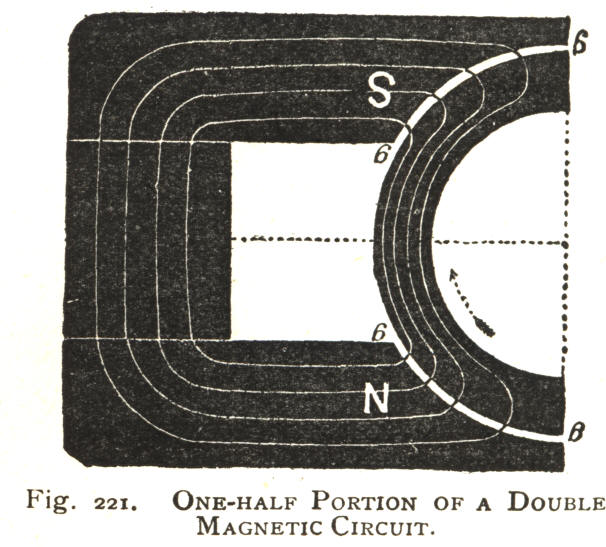
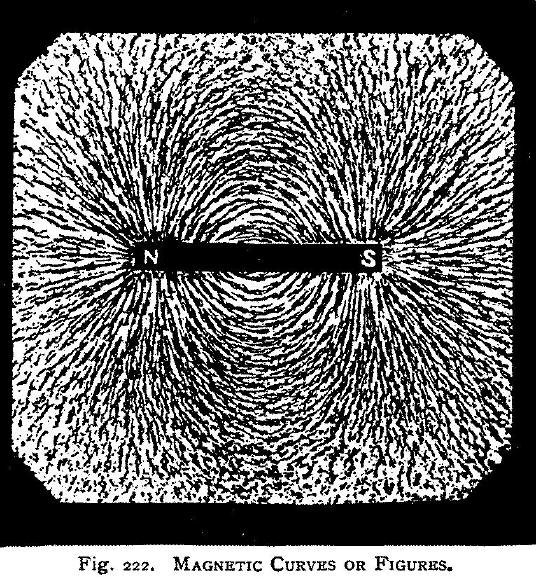
STANDARD ELECTRICAL DICTIONARY. Table of Declination or Variation at Paris. Year. Declination. 1580 11º 30' E. 1663 0° 1700 8° 10' W. 1780 19º 55' W. 1785 22º 00' W. 1805 22º 5' W. 1814 22º 34' W. 1825 22° 22' W. 1830 22º 12' W. 1835 22º 4' W. 1850 20º 30' W. 1855 19º 57' W. 1860 19º 32' W. 1865 18º 44' W. 1875 17º 21' W. 1878 17º 00' W. [Transcriber's note The value for 2008 is about 0° 48' W, changing by 0° 7' E/year.] On scrutinizing these figures it will be seen that there is part of a cycle represented and that the declination is slowly returning to the zero point after having reached its maximum western variation in 1814. Upwards of 300 years would be required for its completion on the basis of what is known. In other places, notably the coast of Newfoundland, the Gulf of the St. Lawrence and the rest of the North American seaboard and in the British Channel, the secular variations are much more rapid in progress. (b) Annual variations--These were first discovered in 1780 by Cassini. They represent a cycle of annual change of small extent, from 15' to 18' only. In Paris and London the annual variation is greatest about the vernal equinox, or March 21st, and diminishes for the next three months, and slowly increases again during the nine following months. It varies during different epochs. (c) Diurnal variations were discovered in 1722 by Graham. A long needle has to be employed, or the reflection of a ray of light, as in the reflecting galvanometer, has to be used to observe them. In England the north pole of the magnetic needle moves every day from east to west from sunrise until 1 or 2 P. M.; it then tends towards the east and recovers its original position by 10 P. M. During the night the needle is almost stationary. As regards range the mean amplitude of diurnal variations at Paris is from April to September 13' to 15'; for the other months from 8' to 10'. On some days it amounts to 25' and sometimes is no more than 5'. The amplitude of diurnal variations decreases from the poles to the equator. Irregular variations accompany earthquakes, the aurora borealis and volcanic eruptions. In Polar regions the auroral variations may be very great; even at 40° latitude they may be 1° or 2°. Simultaneous irregularities sometimes extend over large areas. Such are attributed to magnetic storms. II. The Inclination is the angle which the magnetic needle makes with the horizon, when the vertical plane in which the needle is assumed to be free to move coincides with the magnetic meridian. It is sometimes called the dip of the needle. It varies as does the declination, as shown in the following table of inclinations of London. 344 STANDARD ELECTRICAL DICTIONARY. Table of Inclination or Dip at London Year. Inclination. 1576 71° 50' 1600 72° 1676 73° 30' 1723 74° 42' 1773 72° 19' 1780 72° 8' 1790 71° 33' 1800 70° 35' 1821 70° 31' 1828 69° 47' 1838 69° 17' 1854 68° 31' 1859 68° 21' 1874 67° 43' 1876 67° 39' 1878 67° 36' 1880 67° 35' 1881 67° 35' III. Force or Intensity is the directive force of the earth. It varies with the squares of the number of oscillations the magnetic needle will make if caused to oscillate from a determined initial range. The intensity is supposed to be subject to secular change. According to Gauss the total magnetic intensity of the earth is equal to that which would be exerted if in each cubic yard there were eight bar magnets, each weighing one pound. This is, of course, a rough way of expressing the degree of intensity. Intensity is least near the magnetic equator and greatest near the magnetic poles; the places of maximum intensity are termed the magnetic foci. It varies with the time of day and possibly with changes in altitude. Magnetic Elongation. The elongation a bar of iron or steel undergoes when magnetized. By magnetization it becomes a little longer and thinner, there being no perceptible change in volume. The change is accompanied by a slight sound--the magnetic tick. An exceedingly delicate adjustment of apparatus is required for its observation. Magnetic Equator. A locus of the earth's surface where the magnet has no tendency to dip. It is, approximately speaking, a line equally distant from the magnetic poles, and is called also the aclinic line. It is not a great circle of the earth. 345 STANDARD ELECTRICAL DICTIONARY. Magnetic Field of Force. The field of force established by a magnet pole. The attractions and repulsions exercised by such a field follow the course of the electro- magnetic lines of force. (See also Field of Force.) Thus the tendency of a polarized needle attracted or repelled is to follow, always keeping tangential to curved lines, the direction of the lines of force, however sweeping they may be. The direction of magnetic lines of force is assumed to be the direction in which a positive pole is repelled or a negative one attracted; in other words, from the north pole of a magnet to its south pole in the outer circuit. The direction of lines of force at any point, and the intensity or strength of the field at that point, express the conditions there. The intensity may bc expressed in terms of that which a unit pole at unit distance would produce. This intensity as unitary it has been proposed to term a Gauss. (See Weber.) The direction of the lines of force in a magnetic field are shown by the time-honored experiment of sprinkling filings of iron upon a sheet of paper held over a magnet pole or poles. They arrange themselves, if the paper is tapped, in more or less curved lines tending to reach from one pole of the magnet to the other. Many figures may be produced by different conditions. Two near poles of like name produce lines of force which repel each other. (See Magnetic Curves.) A magnetic and an electro-magnetic field are identical in all essential respects; the magnetic field may be regarded as a special form of the electro-magnetic field, but only special as regards its production and its defined north and south polar regions. Synonyms--Magnetic Spin (not much used). Magnetic Field, Uniform. A field of identical strength in all parts, such as the earth's magnetic field. If artificially produced, which can only be approximately done, it implies large cross-section of magnet pole in proportion to the length of the magnetic needle affected by it, which is used in determining its uniformity. Magnetic Figures. The figures produced by iron filings upon paper or glass held near magnetic poles. By these figures the direction of lines of force is approximately given, and a species of map of the field is shown. (See Magnetic Field of Force--Magnetic Curves.) Magnetic Filament. The successive rows of polarized molecules assumed to exist in magnetized iron. Each molecule represents an infinitely small magnet, and its north pole points to the south pole of the next molecule. Such a string or row is a theoretical conception based on the idea that the molecules in a magnet are all swung in to parallelism in the magnetizing process. A magnetic filament may be termed the longitudinal element of a magnet. (See Magnetism, Hughes' Theory of.) [Transcriber's note: This description parallels the modern notion of electron spin as the basis of magnetism in materials.] Magnetic Fluids. A two-fluid theory of magnetism has been evolved, analogous to the two-fluid theory of electricity. It assumes north fluid or "red magnetism" and a south fluid or "blue magnetism." Each magnetism is supposed to predominate at its own pole and to attract its opposite. Before magnetization the fluids are supposed to neutralize each other about each molecule; magnetization is assumed to separate them, accumulating quantities of them at the poles. Magnetic Flux. Magnetic induction; the number of lines of force that pass through a magnetic circuit. Synonym--Magnetic Flow. 346 STANDARD ELECTRICAL DICTIONARY. Magnetic Force. The forces of attraction and repulsion exercised by a magnet. By Ampere's theory it is identical with the forces of attraction and repulsion of electric currents. Magnetic Friction. The damping effect produced on the movements of a mass of metal by proximity to a magnet; the phenomenon illustrated in Arago's wheel, q. v. When a mass of metal moves in the vicinity of a magnet it cuts the lines of force emanating from its poles, thereby producing currents in its mass; as the production of these currents absorbs energy a damping effect is produced upon the movements of the mass. Magnetic Gear. Friction gear in which electro-magnetic adherence is employed to draw the wheels together. (See Adherence, Electro-magnetic--Electro-magnetic Friction Gear.) Magnetic Inclination. The inclination from the horizontal of a magnetic needle placed in the magnetic meridian. (See Magnetic Element--Inclination Map.) Synonym--Magnetic Dip. Magnetic Induction. The force of magnetization within an induced magnet. It is in part due to the action of the surrounding particles of polarized material; in part to the magnetic field. (See Magnetic Induction, Coefficient of.) In a more general way it is the action of a magnet upon bodies in its field of force. In some cases the magnetism induced causes the north pole of the induced magnet to place itself as far as possible from the north pole of the inducing magnet and the same for the south poles. Such substances are called paramagnetic or ferromagnetic. They lie parallel or tangential to the lines of force. In other cases the bodies lie at right angles or normal to the lines of force. Such bodies are called diamagnetic. Some bodies are crystalline or not homogeneous in structure, and in them the lines of magnetic induction may take irregular or eccentric paths. (See AEolotropic.) Synonym--Magnetic Influence. Magnetic Induction, Apparent Coefficient of. The apparent permeability of a paramagnetic body as affected by the presence of Foucault currents in the material itself. These currents act exactly as do the currents in the coils surrounding the cores of electro-magnets. They produce lines of force which may exhaust the permeability of the iron, or may, if in an opposite direction, add to its apparent permeability. Magnetic Induction, Coefficient of. The number, obtained by dividing the magnetization of a body, expressed in lines of force produced in it, by the magnetizing force which has produced such magnetization, expressed in lines of force producible by the force in question in air. It always exceeds unity for iron, nickel and cobalt. It is also obtained by multiplying the coefficient of induced magnetization by 4 PI (4 * 3.14159) and adding 1. (See Magnetic Susceptibility--Magnetization, Coefficient of Induced.) 347 STANDARD ELECTRICAL DICTIONARY. The coefficient of magnetic induction varies with the material of the induced mass, and varies with the intensity of the magnetizing force. This variation is due to the fact that as the induced magnetism in a body increases, the magnetizing force required to maintain such induction, increases in a more rapid ratio. The coefficient of magnetic induction is the same as magnetic permeability, and in a certain sense is the analogue of conductivity. It is also termed the multiplying power of the body or core magnetized. It is the coefficient of induced magnetization (see Magnetization, Coefficient of Induced) referred to a mass of matter. For diamagnetic bodies the coefficient has a negative sign; for paramagnetic bodies it has a positive sign. Synonyms--Permeability--Multiplying Power--Magnetic Inductive Capacity. Magnetic Induction, Dynamic. The induction produced by a magnetic field which moves with respect to a body, or where the body if moving moves at a different rate, or where the body moves and the field is stationary. In the case where both move, part of the induction may be dynamic and part static. (See Magnetic Induction, Static.) Magnetic Induction, Static. Magnetic induction produced by a stationary field acting upon a stationary body. Magnetic Induction, Tube of. An approximate cylinder or frustrum of a cone whose sides are formed of lines of magnetic induction. (See Magnetic Induction, Lines of.) The term tube is very curiously applied in this case, because the element or portion of a magnetic field thus designated is in no sense hollow or tubular. Magnetic Inertia. A sensible time is required to magnetize iron, or for it to part with its magnetism, however soft it may be. This is due to its magnetic inertia and is termed the lag. Permanent or residual magnetism is a phase of it. It is analogous to self-induction of an electric circuit, or to the residual capacity of a dielectric. Magnetic Insulation. Only approximate insulation of magnetism is possible. There is no perfect insulator. The best ones are only 10,000 times less permeable than iron. Hence lines of force find their way through air and all other substance, being simply crowded together more in paths of iron or other paramagnetic substance. 348 STANDARD ELECTRICAL DICTIONARY. Magnetic Intensity. The intensity of the magnetization of a body. It is measured by the magnetic lines of force passing through a unit area of the body, such area being at right angles to the direction of the lines of force. Magnetic Lag. In magnetism the tendency of hard iron or steel especially to take up magnetism slowly, and to part with it slowly. (See Magnetic Inertia.) The lag affects the action of a dynamo, and is a minor cause of those necessitating the lead of the brushes. Synonym--Magnetic Retardation. Magnetic Latitude. Latitude referred to the magnetic equator and isoclinic lines. Magnetic Leakage. The lines of force in a field magnet which pass through the air and not through the armature are useless and represent a waste of field. Such lines constitute magnetic leakage. Magnetic Limit. The temperature beyond which a paramagnetic metal cannot be magnetized. The magnetic limit of iron is from a red to a white heat; of cobalt, far beyond a white heat; of chromium, below a red heat; of nickel at about 350° C. (662°F.) of manganese, from 15° C. to 20° C. (59° to 68° F.) Magnetic Lines of Force. Lines of force indicating the distribution of magnetic force, which is due presumably to whirls of the ether. A wire or conductor through which a current is passing is surrounded by an electro-magnetic field of force, q. v., whose lines of force form circles surrounding the conductor in question. A magnet marks the existence of a similar electro-magnetic field of force whose lines form circuits comprising part of and in some places all of the body of the magnet, and which are completed through the air or any surrounding paramagnetic or diamagnetic body. They may be thought of as formed by the Ampérian sheet of current, and analogous to those just mentioned as surrounding a conductor. Fig. 223. MAGNETIC LINES OF FORCE, DIRECTION OF. A magnetic line of force may be thought of as a set of vortices or whirls, parallel to each other, and strung along the line of force which is the locus of their centres. If as many lines are drawn per square centimeter as there are dynes (per unit pole) of force at the point in question, each such line will be a unitary c. g. s. line of force. 349 STANDARD ELECTRICAL DICTIONARY. Magnetic Mass. A term for a quantity of magnetism. Unit mass is the quantity which at unit distance exercises unit force. Magnetic Matter. Imaginary matter assumed as a cause of magnetism. Two kinds, one positive and one negative, may be assumed as in the two fluid theory of electricity, or only one kind, as in the single fluid theory of electricity. Various theories of magnetic matter have been presented whose value is only in their convenience. [Transcriber's note: See "magnet" and Edward Purcell's explanation of magnetism using general relativity.] Magnetic Memory. The property of retaining magnetism; coercive force; magnetic inertia; residual magnetism. [Transcriber's note: Small ferrite magnetic donuts were used as computer main memory from 1950 to 1970.] Magnetic Meridian. A line formed on the earth's surface by the intersection therewith of a plane passing through the magnetic axis. It is a line determined by the direction of the compass needle. The meridians constantly change in direction and correspond in a general way to the geographical meridians. Magnetic Moment. The statical couple with which a magnet would be acted on by a uniform magnetic field of unit intensity if placed with its magnetic axis at right angles to the lines of force of the field. (Emtage.) A uniformly and longitudinally magnetized bar has a magnetic moment equal to the product of its length by the strength of its positive pole. Magnetic Needle. A magnet with a cup or small depression at its centre and poised upon a sharp pin so as to be free to rotate or oscillate in a horizontal plane. The cup is often made of agate. Left free to take any position, it places its magnetic axis in the magnetic meridian. Magnetic Parallels. Lines roughly parallel to the magnetic equator on all parts of each of which the dip of the magnetic needle is the same; also called Isoclinic Lines. These lines mark the places of the intersection of equipotential surfaces with the earth's surface. They are not true circles, and near the poles are irregular ellipses; the magnet there points toward their centres of curvature. They correspond in a general way with the Geographical Parallels of Latitude. Magnetic Permeability. The specific susceptibility of any substance, existing in a mass, for magnetic induction. (See Magnetic Induction, Coefficient of, synonym for Magnetic Permeability and Magnetization, Coefficient of Induced.) Synonyms--Magnetic Inductive Capacity--Multiplying Power--Coefficient of Magnetic Induction. 350 STANDARD ELECTRICAL DICTIONARY. Magnetic Perturbations. Irregular disturbances of the terrestrial magnetism, as by the aurora and in electric storms. Magnetic Poles. The points where the equipotential surfaces of the terrestrial field of force graze the earth's surface; the points toward which the north or south poles of the magnetic needle is attracted. Over a magnetic pole the magnetic needle tends to stand in a vertical position. There are two poles, Arctic or negative, and Antarctic or positive. Magnetic needles surrounding them do not necessarily point toward them, as they point to the centres of curvature of their respective magnetic parallels. The poles constantly change in position. The line joining them does not coincide with anything which may be termed the magnetic axis of the earth. Magnetic Poles, False. Poles on the earth's surface other than the two regular magnetic poles. There seem by observation to be several such poles, while analogy would limit true magnetic poles to two in number. Magnetic Potential. The potential at any point of a magnetic field is the work which would be done by the magnetic forces of the field upon a positive unit of magnetism as it moves from that point to an infinite distance. (Emtage.) Magnetic Proof Piece. A piece of iron used for testing magnets and the distribution of magnetism in bars, by suspending or supporting above or near the magnet, by detaching after adherence, and in other ways. Magnetic Proof Plane. An exploring coil used for testing the distribution of magnetism. It is connected in circuit with a galvanometer, and exposed to alternation of current, or to other disturbing action produced by the magnet or field under examination. This affects the galvanometer, and from its movements the current produced in the coil, and thence the magnetic induction to which it was exposed, are calculated. Synonym--Exploring Coil. Magnetic Quantity. The magnetism possessed by a body; it is proportional to the action of similar poles upon each other, or to the field produced by the pole in question. It is also called the strength of a pole. The force exercised by two similar poles upon each other varies with their product and inversely with the square of the distance separating them; or it may be expressed thus (m * m) / (L^2). This is a force, and the dimensions of a force are ML/(T^2). Therefore, (m^2)/(L^2) = ML/(T^2) or m = (M^.5)*(L^1.5)/T. 351 STANDARD ELECTRICAL DICTIONARY. Magnetic Reluctance. The reciprocal of permeance; magnetic resistance; the relative resistance to the passage of lines of force offered by different substances. The idea is derived from treating the magnetic circuit like an electric one, and basing its action on magneto-motive force acting through a circuit possessing magnetic reluctance. Magnetic Reluctivity. The reciprocal of magnetic permeability, q. v. Synonym--Magnetic Resistance. Magnetic Retentivity. The property of steel or hard iron by which it slowly takes up and slowly parts with a magnetic condition--traditionally (Daniell) called coercitive force. Magnetic Rotary Polarization. If a plane polarized beam of light is sent through a transparent medium in a magnetic field its plane of polarization is rotated, and this phenomenon is denoted as above. (Compare Refraction, Electric, and see Electro-magnetic Stress.) This has been made the basis of a method for measuring current. A field of force varies with the current; the polarization produced by such field is therefore proportional to the current. (Becquerel & Rayleigh.) A plane polarized beam of light passing through the transparent medium in the magnetic field by the retardation or acceleration of one of its circular components has its plane of polarization rotated as described. The direction of the lines of force and the nature of the medium determine the sense of the rotation; the amount depends upon the intensity of the field resolved in the direction of the ray, and on the thickness and nature of the medium. Magnetic Saturation. The maximum magnetic force which can be permanently imparted to a steel bar. A bar may be magnetized beyond this point, but soon sinks to it. The magnetism produced in a bar is prevented from depolarization by the retentivity or coercive force of the bar. The higher the degree of magnetization the greater the tendency to depolarization. It is also defined as the maximum intensity of magnetism produced in a paramagnetic substance by a magnetic field as far as affected by the permeability of the substance in question. The more lines of force passed through such a substance the lower is its residual permeability. It is assumed that this becomes zero after a certain point, and then the point of saturation is reached. After this point is reached the addition of any lines of force is referred entirely to the field and not at all to the permeability of the substance. But such a zero is only definable approximately. Magnetic Screen. A box or case of soft iron, as thick as practicable, for protecting bodies within it from the action of a magnetic field. The lines of force to a great extent keep within the metal of the box on account of its permeability, and but a comparatively few of them cross the space within it. Such screens are used to prevent watches from being magnetized, and are a part of Sir William Thomson's Marine galvanometer. A magnetic screen may be a sphere, an infinite or very large plane, or of the shape of any equipotential surface. Synonym--Magnetic Shield. 352 STANDARD ELECTRICAL DICTIONARY. Magnetic Self-induction. The cause of a magnet weakening is on account of this quality, which is due to the direction of the lines of force within a magnet from the positive towards the negative pole. "A magnet thus tends to repel its own magnetism and to weaken itself by self-induction." (Daniell.) Magnetic Separator. An apparatus for separating magnetic substances from mixtures. Such separators depend on the action of electro-magnets. In one form the material falls upon an iron drum, magnetized by coils. Any magnetic substance adheres to the drum and is thereby separated. They are used by porcelain makers for withdrawing iron particles from clay, by machinists to separate iron filings and chips from brass, and for similar purposes. Fig. 224. MAGNETIC SEPARATOR. Magnetic Shell. A theoretical conception of a cause of a magnetic field or of a distribution of magnetism. If we imagine a quantity of very short magnets arranged in contact with their like poles all pointing in the same direction so as to make a metal sheet, we have a magnetic shell. Its magnetic moment is equal to the sum of the magnetic moment of all its parts. If the shell is of uniform strength the magnetic moment of a unit area gives the strength of the shell; it is equal to the magnetic quantity per unit of area, multiplied by the thickness of the shell. If its strength is uniform throughout a magnetic shell is called simple; if its strength varies it is termed complex. Emtage thus defines it: A magnetic shell is an indefinitely thin sheet magnetized everywhere in the direction normal to itself. Magnetic Shell, Strength of. The magnetic quantity per unit of area of the shell multiplied by the thickness of the shell. 353 STANDARD ELECTRICAL DICTIONARY. Magnetic Shield. In general a magnetic screen, q. v. Sometimes a strong local field is made to act as a shield, by its predominance overcoming any local or terrestrial field to which the needle to be protected may be exposed. Magnetic Shunt. The conception of a magnetic circuit being formed, the shunt is a corollary of the theory. It is any piece of iron which connects points of a magnet differing in polarity, so as to divert part of the lines of force from the armature or yoke. The shunt is especially applicable in the case of horseshoe magnets. Thus a bar of iron placed across from limb to limb a short distance back from the poles would act as a shunt to the armature and would divert to itself part of the lines of force which would otherwise go through the armature and would weaken the attraction of the magnet for the latter. In dynamos a bar of iron used as a magnetic shunt has been used to diminish the lines of force going through the armature and hence to weaken the field and diminish the electro-motive force. By moving the shunt nearer or further from the poles the dynamo is regulated. In the cut the projections between the yoke and poles of the magnet shown act as a shunt to the yoke, taking some lines of force therefrom. Fig. 225. MAGNETIC SHUNT. Magnetic Storms. Terrestrial magnetic disturbances sometimes covering very wide areas, and affecting the magnetic declination and inclination. One such disturbance was felt simultaneously at Toronto, Canada, the Cape of Good Hope, Prague and Van Diemen's Land. (Sabine.) 354 STANDARD ELECTRICAL DICTIONARY. Magnetic Strain. The strain produced by magnetic lines of force in substances exposed to their action. It is observed in substances placed between the poles of a strong electro-magnet, and evinces itself in the alteration of the optical properties of transparent substances. Magnetic Stress. The stress produced by magnetic lines of force on substances through which they pass, evidenced in alteration of the optical properties of transparent bodies thus treated. Magnetic Susceptibility. The specific intrinsic susceptibility of any material for magnetic induction. It refers to the particle of matter, and not to the mass, as in the latter its own particles react on each other and bring about what is termed permeability, q. v. (See also Magnetization, Coefficient of Induced, and Magnetic Induction, Coefficient of.) Synonym--Coefficient of Induced Magnetization. Magnetic Tick. When a bar of iron is suddenly magnetized or demagnetized it emits a slight sound, called the Page sound, or the magnetic tick. This has been utilized in a telephone by Reiss. The telephone will receive sound, but is very weak. It consists of a bar surrounded with a coil of insulated wire. Variations in current produce sounds, which may be articulate if the currents are produced by a telephonic transmitter. Magnetic Twist. A bar of iron held in the magnetic meridian and pointing to the pole and twisted becomes to some extent permanently magnetized. Conversely a bar when magnetized seems to have a twist set up in it. The latter is magnetic twist. Magnetic Variations. Changes in the value of magnetic declination or inclination. (See Magnetic Elements.) Magnetism, Ampére's Theory of. A theory accounting for magnetic phenomena by assuming the existence of currents circulating around the molecules of permanent magnets. If such currents so circulate and all in the same direction, the result is the same as if the body of the magnet was enveloped in currents representing those of an electro-magnet or solenoid. This is because in the interior the current around one molecule would counteract the current around its neighboring ones in part, so that the only virtual currents left would be represented by those on the outer surfaces of the outer shell of molecules, and these virtually resolve themselves into one general current sheet, surrounding the magnet and coinciding with its surface. The theory assumes that such currents permanently circulate around the molecules of paramagnetic substances. Under ordinary conditions there is no coincidence in their direction and no resultant current is produced. When magnetized or polarized the molecules are brought into order, so that the direction of their current coincides and the body becomes a magnet. 355 STANDARD ELECTRICAL DICTIONARY. Fig. 226. AMPÉRIAN CURRENTS IN MAGNETS. At the north pole of the magnet the direction of the Ampérian currents is the reverse of that of a watch when the observer faces the pole; the reverse obtains for the south pole. The attraction of opposite and repulsion of similar poles is explained by the actions of the Ampérian currents upon each other. If north and south pole are placed together these currents will coincide in direction and hence will attract each other. If two like poles are put together the currents will have opposite directions and will repel each other. No energy is supposed to be required to maintain currents around or in a single molecule. Fig. 227. NORTH AND SOUTH POLES OF A MAGNET SHOWING DIRECTION OF AMPÉRIAN CURRENTS. Magnetism, Blue. A term arising from the two fluid theory of magnetism; the magnetism of the south pole of a magnet. (See Magnetic Fluids.) The magnetism of the north pole is termed red magnetism. Both terms originated presumably in the painting of magnets, and are little used. Synonym--South Magnetic Fluid. 356 STANDARD ELECTRICAL DICTIONARY. Magnetism, Components of Earth's. The magnetic force of the earth acts in the plane of the magnetic meridian and in direction generally lies oblique to the plane of the horizon. It can be resolved into two components, one vertical, which has no directive effect upon the magnetic needle, the other horizontal, which represents the directive element for the usual compass needle. For the dipping needle, q. v., the vertical component is the only active one. A magnetic needle mounted on a universal joint at its centre of gravity would be acted on by both components. Magnetism, Creeping of. The gradual increase of magnetism when a magnetic force is applied with absolute steadiness to a piece of iron. It is a form of magnetic lag. It may last for half an hour and involve an increase of several per cent. of the total magnetism. Synonym--Viscous Hysteresis. Magnet, Iron Clad. A magnet with a casing of iron connected at one end to the core. The term is generally applied to electromagnets of this form. Synonyms--Tubular Magnet--Jacketed Magnet. Magnetism, Decay of. The gradual loss of magnetism by permanent magnets, due to accidental shocks, changes of temperature, slow spontaneous annealing of the iron and other similar causes. Magnetism, Discharge of. The loosing of magnetization. Thus in a shunt-wound dynamo there is a critical resistance for the outer circuit, below which the field ceases to be magnetized, as enough current ceases to be shunted into it to magnetize it. The machine is said to unbuild itself, and a discharge of magnetism occurs from the field magnet. Magnetism, Ewing's Theory of. Ewing found by a model consisting of a number of pivoted magnetic needles that the observed phenomena of magnetization could be represented thereby. Thus there would be no need of assuming internal frictional forces of Maxwell, nor the closed rings or chains of Hughes. The theory retains the notion, however, of paramagnetic matter, consisting of an assemblage of molecular magnets. The loss of energy by hysteresis is represented in the model by the energy lost by the needles in beating against the air. 357 STANDARD ELECTRICAL DICTIONARY. Magnetism, Free. The magnetism or magnetic field outside of a magnetic circuit. It is due to escape of lines of force and to the magnetic leakage through the air. The lines of force are never, under the most favorable circumstances, confined to the metallic circuit of the magnet and armature. In a simple magnet without armature all the lines of force have to follow an air path, and the field is at its strongest. As the magnetism is strongest at the surface near the poles, the term is sometimes understood as applying to the surface attraction. In such case it is defined as the distribution, on a magnetized bar or mass, of magnetic lines of force as they emerge from its surface. Synonym--Surface Magnetization. Magnetism, Hughes' Theory of. A theory accounting for magnetic phenomena by assuming that each molecule is a magnet, and that in a polarized or magnetized body they are all arranged with their poles in the same direction, while in an unmagnetized body their poles, alternating in direction, neutralize each other. Magnetization consists in a partial rotation of the molecules so as to make them agree in position, thus, as a resultant developing north and south poles at the ends of the bar. The theory is in a certain sense simpler than Ampere's theory, but is not so generally adopted. Magnetism, Lamellar Distribution of. The distribution of magnetism in thin and uniform or "simple magnetic shells," q. v. A given distribution is termed lamellar if the substance in which it exists can be divided into simple magnetic shells, which either form closed surfaces, or have their edges in the surface of the substance. In lamellar distribution the polar area is very large compared with the distance between opposite poles. Magnetism of Gases. Faraday experimented on this point by coloring gases with a little vapor of iodine or other colored gas, and letting them flow between the two poles of a powerful electromagnet. In this way he found some are repelled, some attracted, and in the case of oxygen, it is attracted at one temperature and repelled at another. At ordinary temperatures a cubic yard of oxygen possesses the magnetism of 5.5 grains of iron and when liquefied it is strongly attracted. Magnetism or Magnetization, Temporary. When a mass of iron is magnetized by a current, when the current ceases the portion of its magnetism which disappears is the temporary magnetism; the portion retained is the residual or permanent magnetism. Magnetism, Red. A term arising from the two fluid theory of magnetism; the magnetism of the north pole of a magnet. (See Magnetic Fluids.) The magnetism of the south pole is termed blue magnetism. Both terms originated in the painting of magnets. They are but little used. Synonym--North Magnetic Fluid. 358 STANDARD ELECTRICAL DICTIONARY. Magnetic Remanence. The residual magnetism left in a bar of steel or other paramagnetic material after the application of a powerful magnet. It is distinguished from coercive force, as the latter is the amount of negative magnetizing or of demagnetizing force required to reduce the remanent magnetism to zero. Synonym--Remanence--Residual Magnetism. Magnetism, Solenoidal Distribution of. The distribution of magnetism in such a way that the poles are very far apart in proportion to their area. The magnetization of a long thin bar of steel illustrates solenoidal distribution. Magnetism Sub-permanent. The magnetism of a paramagnetic substance which presents a considerable degree of permanency, but which gradually disappears, leaving the permanent magnetism present. It is noticeable in iron or steel ships whose magnetism gradually reduced in quantity, eventually becomes fully permanent. Magnetism, Weber's Theory of. The molecules of a magnetizable material by this theory are supposed to be magnets with their poles lying in every direction, and hence neutralizing each other. By magnetization these are supposed to be turned with their similar poles in the same direction, and their axis parallel, hence acting like a group of magnets. It is practically identical with Hughes' theory. Magnetism, Terrestrial. The magnetism of the earth. (See Magnetic Elements.) Fig. 228. MAGNETIZATION BY DOUBLE TOUCH. Magnetization by Double Touch. The process of magnetizing a steel bar by simultaneously stroking it with two poles of a horseshoe magnet or with two opposite poles of two bar magnets. The poles must be close but not touching. A block of wood may be placed between the ends if single magnets are used. The poles are placed on the middle of the bar and carried back and forth to one end, then to the other, and so on, ending at the middle of the bar in such direction as to give each end the same number of strokes. The poles must be close together or consequent poles will be produced. If bar magnets are used they may be held inclined at an angle of 15º to 20º with the horizontal bar to be magnetized. The ends of the latter may rest on poles of two other magnets, each end on a pole of the same name as that of the magnetizing magnet on its side. (See Magnetization, Hoffer's Method.) 359 STANDARD ELECTRICAL DICTIONARY. Magnetization by Separate Touch. A method of magnetization. Two magnets are used. Held in an inclined position two opposite poles are touched to the bar near its centre, and are drawn off to the two ends. They are returned through the air and the process is repeated. Magnetization by Single Touch. A method of polarizing or magnetizing steel bars, by stroking them always in one direction with one pole of a magnet, returning it through the air. The stroking is best done on both sides. The stroking may begin at one end and end at the other, or it may be commenced in the center of the bar and be carried to one end with one pole, and the same done for the other half with the other pole. Magnetization by the Earth. The earth imparts magnetism to iron masses. If a rod of steel is held parallel to the inclination and in the magnetic meridian it exhibits polarity, which by jarring or hammering, can be made to some extent permanent. A piece of soft iron held vertically, or still better in the line of the dip as above, and which is twisted when in that position, becomes magnetized with some degree of permanence. Many other instances are cited, such as fire-irons, lamp-posts, iron gates, lathe turnings, all of which often exhibit polarity, having been magnetized by the earth's field. [Transcriber's note: The earth's magnetic field is believed to originate it electric currents in the moving molten core.] Magnetization, Coefficient of Induced. The coefficient (q. v.) expressing the relation between the specific intensity of magnetization of a particle and the magnetizing force. The magnetizing force is measured by the lines of force it can produce in a field of air. The coefficient of induced magnetization is the factor by which the intensity of a magnetizing field must be multiplied to produce the magnetization imparted by it to a particle of any substance. This coefficient varies for different substances, and is also called magnetic susceptibility. It is distinguished from permeability as referring only to a particle isolated from influence of a mass of surrounding particles of its own kind. It is definable as the intensity of the magnetization assumed by an exceedingly long and exceedingly thin bar placed in a unit field. If a mass of metal were placed in such a field all its particles would become affected and within the mass no unit field could exist. Hence magnetic susceptibility (another name for this coefficient) does not apply to the case of large cores of electro-magnets and dynamo-armatures, but is really a theoretical rather than a practical figure. The sign of the coefficient of diamagnetic bodies is negative; of paramagnetic bodies is positive. Synonym--Magnetic Susceptibility. \ 360 STANDARD ELECTRICAL DICTIONARY. Magnetization, Cycle of. A cycle of positive or of positive and negative magnetization represents the application of a magnetizing force beginning at a fixed value, generally zero, rising to a maximum, or to a value of maximum distance from the initial and then returning to the original basis. It is virtually a full wave of magnetization and may extend on both sides of a zero line giving positive and negative values. Cycles of magnetization apply especially to transformers and other apparatus of that character used with the alternating current system. Magnetization, Hoffer's Method. For horseshoe bars an armature is placed against the poles of the magnet bar to be treated. The poles of a strong horseshoe magnet are stroked over it from poles to bend and returned through the air, or vice versa. In the first case the poles will be the same as those of the inducing magnet; in the second case they will be opposite. A maximum effect is produced in ten strokes. The stroking should be applied to both sides. An electro-magnet may be used as inducer as shown, but an armature should be used; in the cut it is omitted. Fig. 229. MAGNETIZING A HORSESHOE MAGNET. Magnetization, Intensity of. The amount of magnetism induced in or present in a body. It is expressed in Magnetic Lines of Force, q. v., per cross-sectional area. Magnetization, Isthmus Method of. A method used by Ewing in a research on the magnetization of iron in very strong fields. He used samples of iron turned down in the centre to a narrow neck, and thus concentrated the lines of force greatly. Magnetization, Elias' Method. The bar to be magnetized is surrounded by a magnetizing coil, q. v. A strong current is passed through it, and the coil is moved back and forth a few times. Magnetization, Jacobi's Method. For horseshoe bars. The bar is placed with its poles against those of a horseshoe magnet. A bar of soft iron, long enough to reach from outside to outside of the legs, is laid across near the junction and is drawn along towards the bend of the new bar and away from it. This is repeated a few times on both sides. 361 STANDARD ELECTRICAL DICTIONARY. Magnetization, Limit of. As the induction of magnetizing force increases, magnetization of paramagnetic metals tends towards a limit, the increase in magnetization being continually less and less as the metal becomes more highly magnetized. In diamagnetic substances no limit is discernible. Synonym--Maximum Magnetization. Magnetization, Specific. The magnetic moment per gram of a substance. Magnet-keeper. A bar of iron connecting the two poles of a permanent magnet. Often the same bar serves as armature and keeper. Magnet, Lamination of. It is advantageous to make magnets of laminated construction, or of thin plates of steel. The thin metal can be better tempered or hardened than thick metal. A slight separation of the plates is advantageous from some points of view. If in actual contact there is some danger that the weaker members will have their polarity reversed by the stronger ones. This is counteracted to some extent by separation. Magnet, Long Coil. A high resistance electro-magnet; one whose coil is of thin wire of considerable length. Magnet, Natural. The lodestone, q. v.; a variety of magnetite or magnetic oxide of iron, exhibiting permanent magnetism, attracting iron, and possessing north and south poles. Magnet, Neutral Line of. A line at right angles to the magnetic axis of a magnet, q.v., and nearly or quite at the centre, so situated with reference to the poles on either end that it marks the locus of no polarity. It has been called the equator of the magnet. It is defined by the intersection of the plane of no magnetism with the surface of the bar. Synonym--Magnetic Equator. Magnet, Normal. A bar or compound bar magnet, magnetized to such an extent that the curves of the lines of force run into each other in the middle, is thus termed by Jamin. Magneto. Abbreviation for Magneto-electric Generator. (See Magneto-electric Generator.) Magneto Call Bell. A call operated by current from a magneto-electric generator. It is very generally used in telephone systems. 362 STANDARD ELECTRICAL DICTIONARY. Magneto-electric. adj. Relating to induced electric effects due to the cutting of true magnetic lines of force by, or equivalent action of or upon a conductor. These effects are identical with electro-magnetic effects and are only distinguished from them by the field being due to a permanent magnet instead of an electromagnet. Magneto-electric Brake. A device for bringing to rest an oscillating galvanometer needle. It consists essentially of a coil in circuit with a key and with the galvanometer. On opening the circuit an inverse current is established by induction, tending to bring the needle to rest. Magneto-electric Generator. A current generator operating by maintaining a potential difference at its terminals, by reactions in a field of force, which field is established by a permanent magnet. The cut, Fig. 230, shows the general principle of construction of a direct current generator. The armature is rotated between the poles of a permanent magnet. Any of the regular types of dynamo armature can be used. From its commutator the current is taken by brushes. Fig. 230. MAGNETO-ELECTRIC GENERATOR. Fig. 231. MAGNETO-ELECTRIC GENERATOR. 363 STANDARD ELECTRICAL DICTIONARY. The cut, Fig. 231, shows an alternating current machine. In it a pair of bobbins, wound in series, and both either right-handed or left-handed, are rotated between permanent magnet poles. The current may be taken off by two brushes bearing on two collecting rings on the axis of the bobbins, the ends of the wire being connected thereto. Or if a shocking current is desired, one of the brushes or springs may strike a series of pins forming virtually a broken or interrupted collecting ring. This gives a current for medical purposes. Synonyms--Magneto-dynamo--Magneto-electric Machine. Magnetograph. An apparatus for recording variations in magnetic elements. One type includes a magnetic needle to which a concave mirror is attached. The light ray from the mirror is reflected upon sensitized paper where its movements are photographically reproduced. The movements of the spot are due to the movements of the needle and act as the record of the same. Magneto-Inductor. An instrument for use with a ballistic galvanometer to reproduce a definite current impulse. Two magnets are fastened together in one straight line, the north poles almost touching. This is mounted at the end of a rod like a pendulum, the axis of the magnets transverse to the rod. The magnets are carried by a frame and oscillate at the end of the rod, back and forth within a fixed coil, which is one-half the length of the double magnet. A bob is attached to the bottom of the frame by which the whole can be swung. As the magnets are of fixed value, their time of oscillation constant, and the coil fixed in size, the apparatus provides a means of getting a definite instantaneous current of identical value whenever needed. Fig. 232. MAGNETO-INDUCTOR. 364 STANDARD ELECTRICAL DICTIONARY. Magnetometer. (a) A reflecting galvanometer, with heavy magnetic needle, dampened by a copper frame. It was devised by Weber. (b) An apparatus for measuring the intensity of magnetic force. It may consist of a magnet suspended by bifilar or by torsion suspension. A reflecting mirror and scale as in the reflecting galvanometer may be used to act as indicator of its motions. It is used in investigations of the intensity of the earth's field. If the motions of the spot of light are received on a moving strip of sensitized paper and are thereby reproduced photographically, the instrument is self-recording. Such an apparatus is used in the Kew Observatory, Eng., for recording the terrestrial magnetic elements. Magnetometry. The determination of the magnetic moment of a magnet. It involves the determination by experiment of--( a) the product of the magnetic moment, M, of the magnet by the horizontal component, H, of the earth's magnetism; (b) the quotient of M divided by H. Knowing these two quantities, M is given by the formula M = SquareRoot( )M * H) * (M/H) ) and if desired H is given by the formula H = SquareRoot( (M*H) / (M/H)). M*H is determined by the method of vibrations. A very long, thin magnet suspended by a torsion filament is caused to oscillate, and its period is determined. Calling such period T and the moment of inertia of the magnet I, we have the formula T= 2* PI * SquareRoot( I / (H*M) ) (a), whence H*M is calculated, I of course being known or separately determined. Fig. 233 END-ON METHOD. Fig. 234. BROADSIDE METHOD. M/H is determined by the End-on deflection method, or the Broadside deflection method. In both cases the deflection of a compass needle by the magnet in question is the basis of the work. In the end-on method AB is the magnet under examination; DE the compass needle; a the angle of deflection; d the distance between C and the middle of AB, which should be considerable compared with the length of DE; 2l, the length of AB. We then have the formula tan a = (M/H) * (2d / (d^2 - l^2)^2), which if 2l is small compared to d reduces to tan a = M/Hd 3 (b), which gives M/H, a and d being known. 365 STANDARD ELECTRICAL DICTIONARY. In the broadside method the line d is the magnetic meridian, and the diagram shows the relative positions. We then have the formula tan a = (M/H) / (d2 + l2)^1.5; which if 1 is relatively small reduces to tan a = M/(H * d3 )(C.) [Transcriber's note: The image of the above paragraphs is included here.] a and c or a and b can be combined giving M and H in C.G.S. measurement. Magnetometer, Differential. An apparatus, invented by Eickemeyer, for testing the magnetic qualities of different samples of iron. It is very similar in construction and principle to the magnetic bridge, q. v. Magneto-motive Force. The force producing a magnetic field or forcing lines of force around a magnetic circuit. It is usually applied only to electro-magnets and is expressible in turns of the wire winding multiplied by amperes of current, or in ampere-turns. Magnet Operation. A term in surgery; the use of the electro-magnet or permanent magnet for removing particles of iron from the eye. Magnetoscope. An apparatus for detecting the presence of magnetism, without measuring its intensity. A simple magneto-scope consists of a magnetized bit of watch-spring suspended in a vertical glass tube by a fine filament. A bit of unmagnetized soft iron wire may be used in the same way. The first has the advantage of indicating polarity; the latter merely shows magnetic attraction. A cork may be used as base of the instrument. Fig. 235. MAGNETOSCOPE. 366 STANDARD ELECTRICAL DICTIONARY. Magnet, Permanent. A bar of steel charged with residual magnetism. Steel possesses high coercive force in virtue of which when once magnetized it retains part of the magnetization. Permanent magnets are generally straight bars or U shaped; they are termed bar magnets, magnetic needles, horseshoe magnets, machine magnets and otherwise, according to their shape or uses. Magnet Pole. The part of a magnet showing strongest polarity; the part which attracts iron the most powerfully, and acts as the starting point for lines of force. Magnet Poles, Secondary. Magnet poles are often not situated at the ends. Owing to inequality of the material or other causes they may occupy intermediate positions on the magnet. Such poles are called secondary poles. Magnet Pole, Unit. A unit magnet pole is one which exerts unit force on another unit pole placed at unit distance from it. Unit force is the dyne; unit distance is one centimeter. Magnet, Portative Power of. The power of sustaining a weight by attraction of its armature possessed by a magnet. In general terms the adherence of the armature of a magnet to the pole varies with the square of the number of lines of force which pass through the point of contact. Hence an increased adherence of the armature to a horseshoe electro-magnet is sometimes obtained by diminishing the area of contact of one pole which concentrates the lines of force. Steel magnets were frequently made with rounded ends to increase the portative power. Magnet, Simple. A magnet made of one piece of metal, or at least magnetized as such; the reverse of a compound magnet, which is magnetized piece by piece and then fastened together. Magnet, Solenoidal. A magnet which is so uniformly magnetized and is so long in proportion to its other dimensions that it virtually establishes two magnetic poles, one at either end. It is a long thin bar so magnetized that all its molecules would, considered as magnets, be absolutely equal. (Daniell.) It acts like a solenoid, except that it is longer in proportion than the solenoid generally is constructed. Magnet, Sucking. A magnet coil with movable or loose axial bar of soft iron. The whole is usually mounted vertically. When a strong enough current is passed the bar is drawn up into the coil as if by suction, whence the name. 367 STANDARD ELECTRICAL DICTIONARY. Magnet, Unipolar. No such thing as a unipolar magnet is possible. The name is given to poised or suspended magnets, one of whose poles lies in the axis of suspension. It is obvious that such a magnet will act, as far as its directive tendency and rotatory movements are concerned, as if it had only one pole. As shown in the cut, the pole s in both magnets lies in the axis of suspension or directly under the filament by which they are suspended, while the other pole n is the active pole in causing rotation or directive tendency; c c are counterweights or counterpoises. Fig. 236. UNIPOLAR MAGNETS. Magnetophone. An apparatus for producing a loud sound, involving the principles of the telephone. A rapidly alternating or make and break current being produced by any means and being transmitted through the telephone gives a loud note of pitch dependent on the current producing it. Sometimes a perforated metallic disc is rotated in a magnetic field, and produces the requisite type of current. Magnus' Law. A law of thermo-electricity. In a homogeneous circuit, however, the temperature varies from point to point; there is no current. Whatever potential differences may be established by the variations in temperature it is evident that they must counteract each other and reduce to zero. Mains, Electric. The larger conductors in a system of electric light or power distribution. Make. v. To complete a circuit, as by closing a switch. Make and Break Current. A current which is continually broken or interrupted and started again. It is applied only where the "makes" and "breaks" succeed each other with great rapidity, as in the action of an induction coil or pole changer, etc. It has had considerable importance in litigation affecting the Bell telephone patents, the courts holding that the original Bell patent (No. 174,465, of 1876,) covered the undulating current, for the transmission of speech. Many efforts have been made by litigants to prove that specific telephones have transmitted articulate speech by the make and break current, but without success. If this could have been proved the assumption is that the courts would have sustained the use of such device as not infringing upon the claims of the Bell patent. Malapterurus. A fish, sometimes called the thunder fish, an inhabitant of African rivers, occurring in the Nile and Senegal. It possesses considerable electric power, similar to that of the gymnotus and torpedo, although inferior in amount. 368 STANDARD ELECTRICAL DICTIONARY. Fig. 237. MALAPTERURUS. Man-hole. The cistern-like depression in the ground for giving access to the ends of tubes in electric conduits. (See Conduit, Electric Subway.) Marked End or Pole. The north pole or north seeking pole of a magnet, so called because it is usually marked with a notch or scratch by the maker. The south pole is called the unmarked end. Mass. The quantity of matter in a body. The C. G. S. unit of mass is the quantity of matter in a gram. While weight varies with latitude and other circumstances, mass is invariable. The unit of mass is also defined as the quantity of matter which in a balance will counterpoise a standard mass, the gram or pound. As the gram is intended to be the mass of one cubic centimeter of water at 3.09º C. (39º F.), the C. G. S. unit of mass is really 1.000013 gram. As a primary unit its dimensions are indicated by M. Mass, Electric. A term for quantity of electricity. The unit mass is such a quantity as at unit distance will act with unit force. Matter, Electric. The imaginary substance constituting electricity; a conception used purely as a matter of convenience. [Transcriber's note: The electron was discovered five years after this publication.] Matter, Radiant. Matter in the ultra-gaseous or so-called fourth state. In the gaseous state the molecules of a gas are in perpetual kinetic motion, colliding actually or virtually with each other, rebounding from such approach, and striking also the walls of the containing vessel. But except for these deflections, which are of enormous frequency, the paths of the molecules would be perfectly straight. In the radiant state matter exists in so high a vacuum that collisions of the molecules rarely occur, and the molecules simply beat back and forth in straight lines from side to side of the containing vessel. A layer of gas in this condition is termed a Crookes' layer, from Prof. William Crookes, who discovered and investigated these phenomena. 369 STANDARD ELECTRICAL DICTIONARY. Luminous streams of the molecules are produced by electric high potential discharges between electrodes. The course of the discharge is normal, in general terms, to the surfaces of the electrodes, and reaches from one to the other in a curve or straight line, as the case may be. These luminous streams are deflected by a magnetic field; if brought to a focus can heat refractory material in that focus to a full white heat, and can develop phosphorescence. The latter is termed electric phosphorescence. A great variety of experiments have been devised to illustrate the phenomena of radiant matter. The vacuum is generally produced in a hermetically sealed glass vessel into which the electrodes are sealed, and which contain the phosphorescent substances or other essentials for the experiments. The vessels are termed Crookes' Tubes. [Transcriber's note: Crookes reported on "radiant matter" in 1879. It is actually electrons, but he failed to distinguish them from ordinary atoms. Thompson properly described electrons in 1897.] Matteueci's Experiment. An experiment for showing the inductive effect of the discharge of a Leyden jar. Two glass plates are supported on standards in a vertical position. Flat coils of wire are wound or coiled and secured to one surface of each plate. One plate has much finer and longer wire than the other. Metal handles are connected to the ends of the coarser wire coil. The plates are placed with their coils facing each other. A Leyden jar is discharged through the coarser coil, while the handles are grasped by a person. The shock of the discharge is felt by him. Matting, Electric Floor. Matting or floor covering underlaid with burglar alarm contacts, so arranged as to be closed by anyone walking on the matting. The contacts are connected to a burglar alarm system. The object is to provide an alarm if a burglar enters a house, in case he should enter a door or window without sounding the bell. The latter can be done by cutting out the window or part of the door instead of opening it. Maxwell's Theory of Light. A theory of light. It is due to J. Clerk Maxwell. It supposes the phenomena of electric induction to be due to the ether, q. v. It supposes the condition of the ether when conveying light to be the same as if exposed to the induction of rapidly alternating currents or discharges (in this case synonymous). It therefore is an electro-magnetic effect if the theory is correct. An electric stress such as one due to the induction of an electrostatically charged body is not a wave-creating element or factor, but is a simple stress. But let this stress be stopped and renewed and at once it appears as a wave-forming agency. This stoppage and renewal represents evidently a discharge succeeded by a charge, or if repeated is equivalent to an intermittent current or an alternating one. 370 STANDARD ELECTRICAL DICTIONARY. Again the electrostatic stress kept constant may by being carried through space carry with it a wave, just as a moving projectile carries a wave of air in advance of itself. Admitting this much the following consequences follow: Since in non-conductors the displacement produces a restitution force, which varies as the displacement which is requisite or is a criterion for the propagation of waves, while in conductors no such force is manifested and the electric energy appears as heat, it follows that light vibrations are not possible in conductors, because electro-magnetic waves do not exist in them when they are in circuit, and conductors should be opaque, while the reverse is true for non-conductors. (Daniell.) This is carried out often enough to make a striking evidence in favor of Maxwell's theory. The velocity of propagation of an electro-magnetic disturbance in a non-conductor should be equal to that of light. This constant is proved by mathematical considerations, to be approximately the same as the ratio of the electrostatic to the electromagnetic unit of intensity or quantity. This ratio is 3E10 (30,000,000,000), which is almost exactly the velocity of light. It also follows from what has been said that if an electrostatically charged body were whirled around a galvanometer needle at the rate of 3E10 revolutions per second it should affect it like a circulating current. This rate of rotation cannot be attained, but Rowland has made manifest the effect of a rotating statically charged body upon a magnetic needle. The above is the merest outline of Maxwell's theory. The full development must be studied in his own and succeeding works. Mayer's Floating Magnets. An experiment due to Prof. Mayer. A number of sewing needles are magnetized and thrust into bits of cork, almost all the way through, with their like poles projecting. They are floated in a basin of water and take, under the effects of attraction and repulsion, when approached by a magnet pole, regular geometric positions, marking out the positions of angles of polygons. Measurements. The determination of the value of quantities; determination of the factor by which the unitary value must be multiplied to produce the quantity under examination. Such are the measurement of the voltage of a galvanic battery, or of the ohms of resistance of a conductor. Electricity has been termed the science of measurement. Meg or Mega. A prefix, meaning one million times. A megohm is one million ohms; a megerg is one million ergs; a megadyne is one million dynes. 371 STANDARD ELECTRICAL DICTIONARY. Fig. 238. MAYER'S FLOATING MAGNETS. Mercury. A metal; one of the elements; symbol, Hg; atomic weight, 200 ; equivalent, 200 or 100; valency, 1 and 2. It is a conductor of electricity. The following data are 0º C. (32º F.) Relative Resistance, 62.73 Specific Resistance, 94.32 microhms. Resistance of a wire, (a) 1 foot long, weighing 1 grain, 18.51 ohms. (b) 1 foot long, 1/1000 inch thick, 572.3 " (c) 1 meter long, weighing 1 gram, 12.91 " (d) I meter long, 1 millimeter thick 1.211 " Resistance of a 1 inch cube, 37.15 microhms. Percentage increase of resistance per degree C. 1.8° F. at about 20° C. (68° F.), .72 per cent. Electro-chemical equivalent (Hydrogen = .0105), 2.10 mgs. 1.05 " 372 STANDARD ELECTRICAL DICTIONARY. Mercury Cup. A cup of iron, wood or some material that does not amalgamate or is unattacked by mercury, which is filled with mercury and made an electrode of a circuit. By dipping the other terminal of the circuit into the mercury a very good contact is obtained. It is well to cover the mercury with alcohol. The cup may be filled so that the mercury rises in a meniscus or semi-globule above its edges. For some purposes this form is useful, as for contacts with the end of a swinging wire or pendulum, because in such cases the contact can be made without the contact point entering the cup. The point swings through the projecting meniscus without touching the edges of the cup. A mercury cup and contact constitute a mercury break. Meridian, Astronomical. The great circle passing through the north and south poles of the celestial sphere. It lies in a plane with the corresponding geographical or terrestrial meridian. Meridian, Geographic. The true north and south meridian; the approximate great circle formed by the intersection of a plane passing through north and south poles of the earth with the earth's surface. 373 STANDARD ELECTRICAL DICTIONARY. Fig. 239. SCHALLENBERG'S ALTERNATING CURRENT METER. Meter, Alternating Current. A meter for measuring alternating current, as supplied to consumers, from an alternating current system. Like most commercial meters its only function is the measurement of quantity; the potential difference is maintained at a constant figure by the generating plant. The cut shows the Schallenberg meter. It is simply an alternating current motor (see Motor, Alternating Current), with air vanes mounted on its spindle. A main coil passes all the current. Within this is a second coil complete in itself, and not touching or connecting with the other. The latter is built up of copper rings. Within the two coils, and concentric with both is a disc of copper carried by a vertical spindle. The same spindle carries air vanes, and is free to rotate. As it does so it moves the indicating machinery. The current in the outer coil induces one in the inner coil. Owing to lag, the current in the inner one differs in phase from that in the outer one, and a rotatory field is produced. The copper disc acquires induced polarity, and rotates with speed which normally would be in proportion to the square of the current. But the object of the meter is to register the current only. The air vanes effect this. The resistance of the air to their motion causes the rate of rotation to vary directly as the speed. Meter Bridge. A form of Wheatstone's bridge in which one lateral pair of arms is represented by a straight wire. The other pair comprise a known resistance, and the resistance to be determined. The galvanometer is connected on one side between the known and unknown resistance. On the other side its connection is moved back and forth along the straight wire until the balance is secured and the galvanometer reads zero. The relative lengths of wire intercepted between the two ends thereof and the movable galvanometer connection are proportional to the resistance of these parts and give the necessary data with the one known resistance for determining the unknown resistance. 374 STANDARD ELECTRICAL DICTIONARY. In the original meter bridge the wire was one meter long, whence its name, and was stretched straight. In more recent examples the wire varies in length and in one form is bent into a circle or spiral, so as to make the instrument more compact. The contact is not a sliding one, but is adjusted by trial. The contact piece is slid along, but not touching the wire, and from time to time is pressed down against the wire. This prevents wear of the wire. The wire may be made of platinum or of platinum-iridium alloy. The latter is very hard and not easily worn out. Sometimes, as shown in the cut, three parallel wires are stretched along the baseboard of the instrument, and arranged so that a single wire, two wires or three wires in series can be used for the proportional sides of the bridge, thus making it a two-meter or three-meter bridge as desired. On the other hand some are made of restricted length, as a half or quarter meter only. Fig. 240. METER BRIDGE. In the cut J K is the wire, traversed by the contact key. By moving the contact C back and forth in the slot it can be brought over any of the three divisions of the wire. H is the handle for depressing the key. S is a flat spring, carrying the contact piece and holding it up from the wires, except when pressed downwards. As shown in the cut, it is in use for calibrating a voltmeter V, by Poggendorff's method, G being the galvanometer and r1 and r2 being resistances. Synonyms--Slide Bridge--Slide Balance. Meter Candle. A unit of illuminating power; the light given by one standard candle at a distance of one meter. The ordinary units of illuminating power are altogether relative; this one is definite. 375 STANDARD ELECTRICAL DICTIONARY. Meter, Chemical Electric. A current meter in which the current is determined by the amount of chemical decomposition which it can effect. In the Edison meter the solution is one of zinc sulphate. Two electrodes of zinc are immersed in it, and a fractional part of the current is passed through it. The gain in weight of one electrode and the loss in the other are proportional to the current. Both electrodes are weighed periodically, one acting as check upon the other. Meter, Current. An instrument for measuring the quantity of electricity in current form supplied to consumers. It may be of various types. The general principle involved is that in commercial installations for incandescent light and power supply a fixed potential is usually maintained, the multiple arc system being employed. Hence all that is requisite is to measure the coulombs or the ampere-hours to know what quantity of energy has been supplied. Meter, Electro-magnetic. A current meter in which the current is measured by its electro-magnetic effects. Meter-millimeter. A unit of resistance. (See Resistance, Meter-millimeter.) Meter, Thermal Electric. A current meter in which the current is measured by the heat it imparts to a conductor. In one meter a very light helix of mica is poised horizontally over a conductor, and the whole is enclosed in a case. As the wire is heated it causes an ascending current of air which rotates the vane, and the latter moves delicate clockwork which moves indicating hands. The hotter the wire the more rapidly the air ascends, and consequently the speed of the vane is proportional to the current, because the heat of the conductor is proportional thereto. Meter, Time Electric. An electric meter which measures the length of time during which current is used. It assumes a constant current and potential. It is virtually a clock, which is turned on when the current passes, and is turned off with the current. Meter, Watt. A combined current and potential meter. It is constructed on the general lines of a Siemens' Electro Dynamometer. If in it one coil is made of coarse wire and is placed in series with the current conductor, and if the other is wound with fine wire and is connected as a shunt from point to point whose potential difference is to be determined, the instrument becomes a watt meter. Synonym--Energy Meter. Methven Standard or Screen. A standard of illuminating power. It is the light emitted by a three-inch Argand gas flame through a rectangular aperture in a silver plate carried by a screen. The aperture is of such size and so far distant from the flame as to permit the passage of exactly two candles illuminating power.
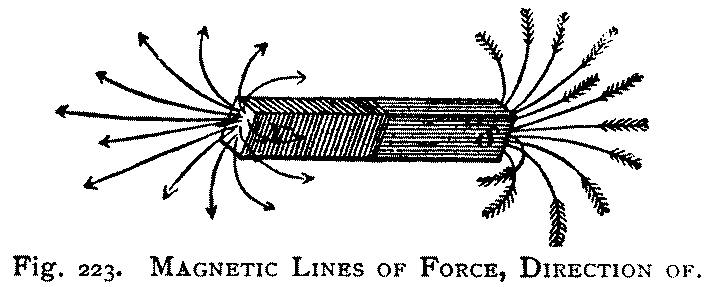
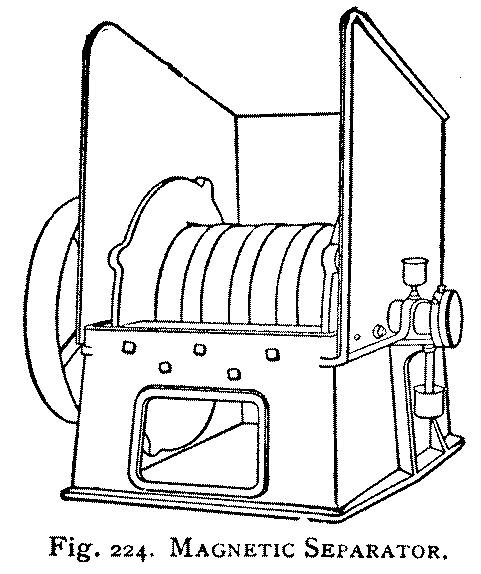
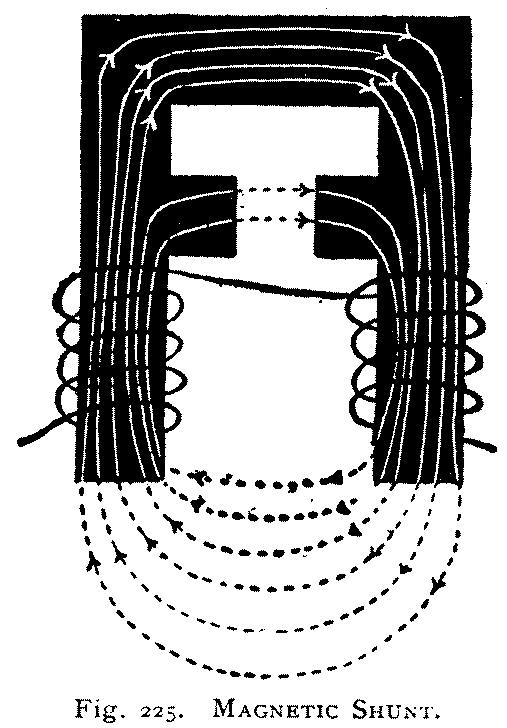
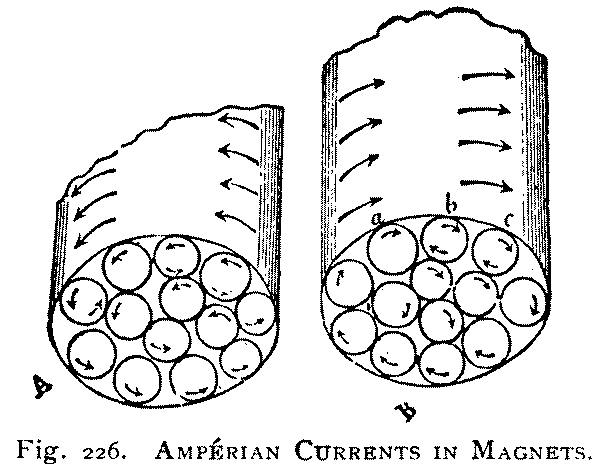
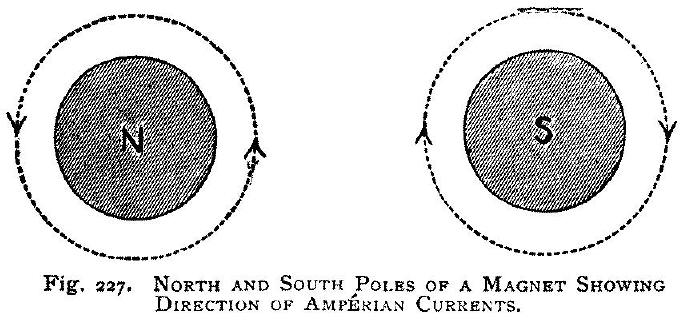
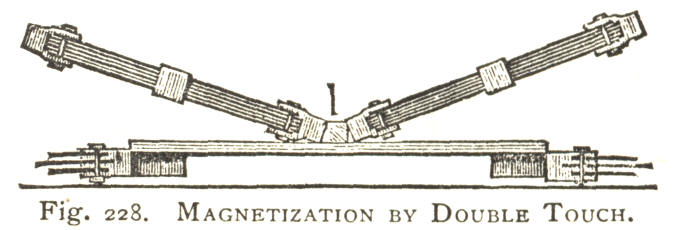
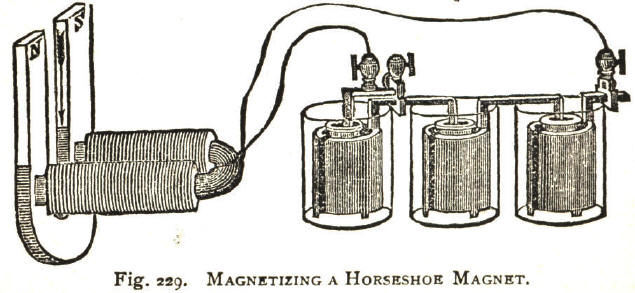
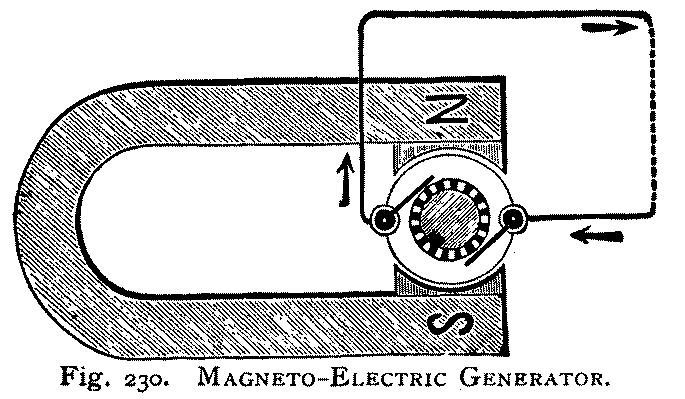
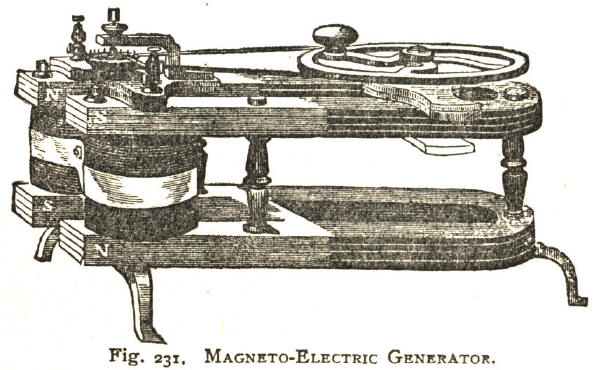
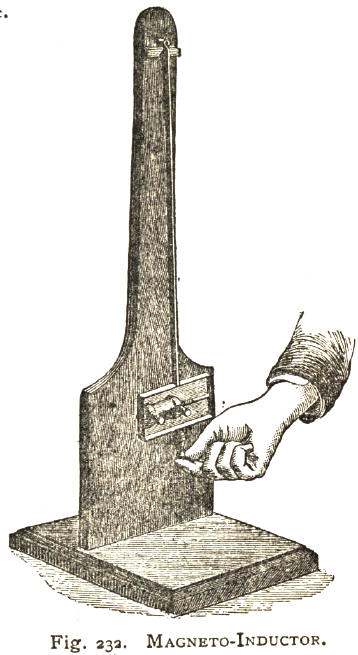
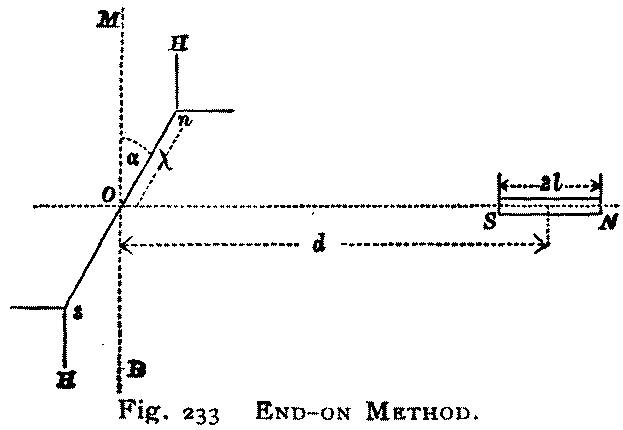
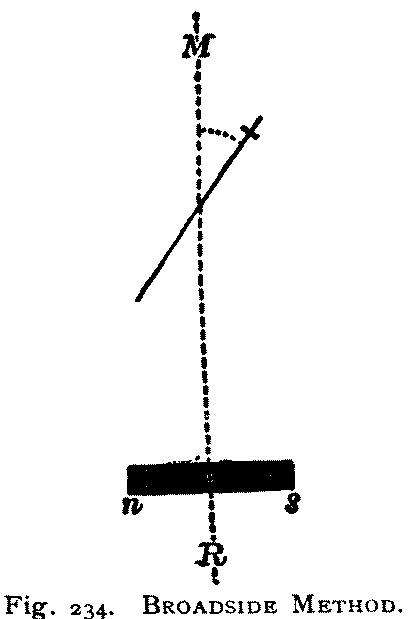
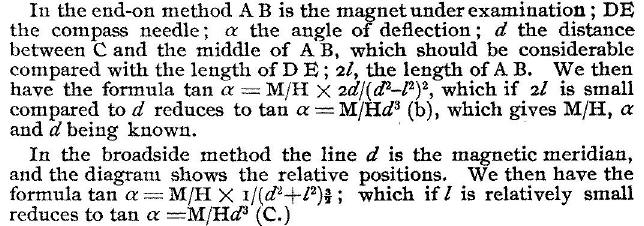
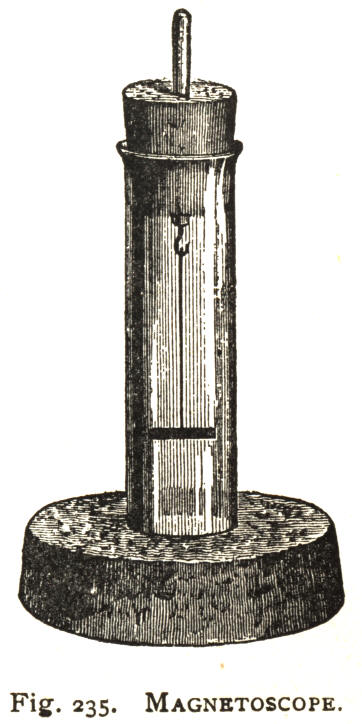
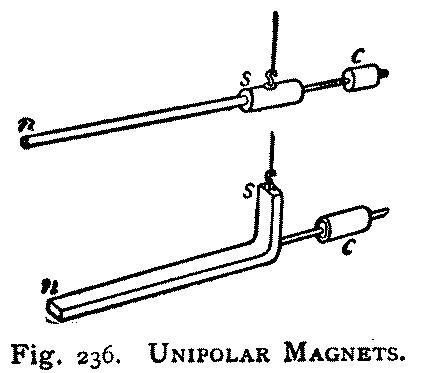
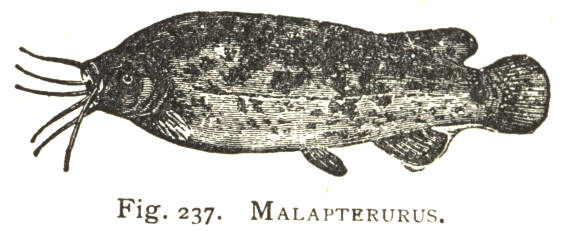
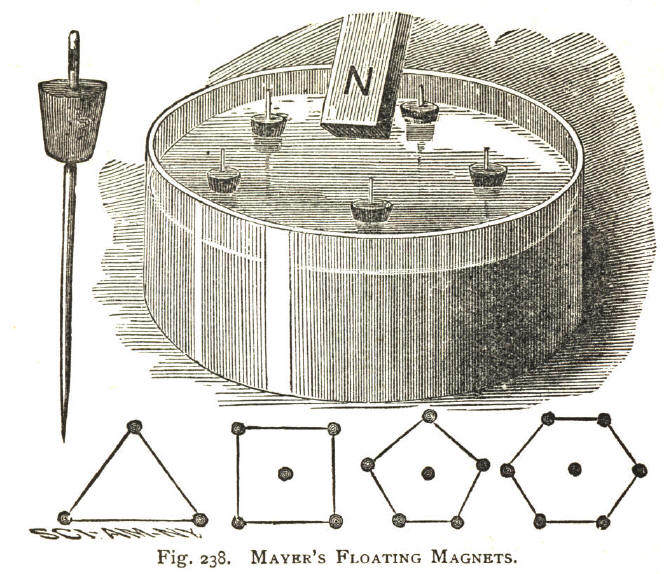
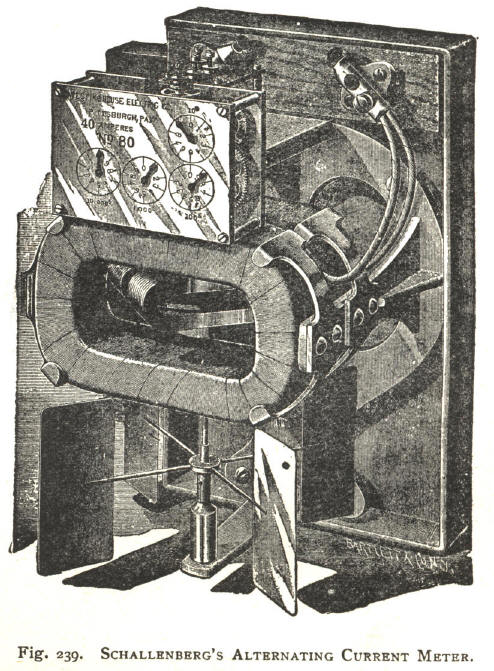
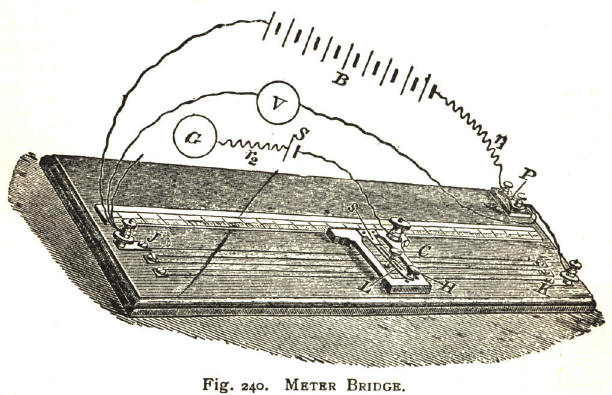
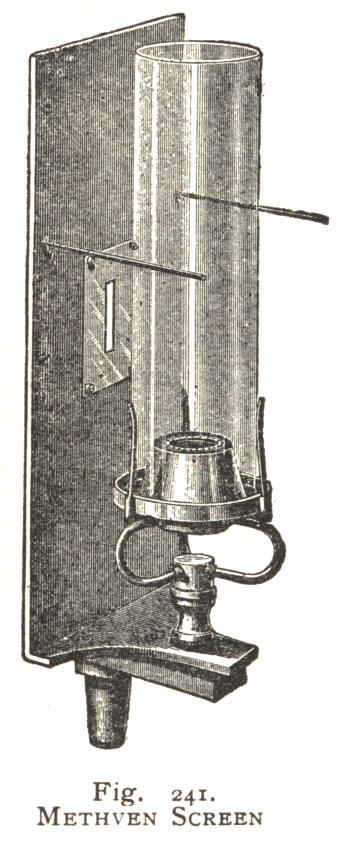
Fig. 241. METHVEN SCREEN
376 STANDARD ELECTRICAL DICTIONARY. Mho. A unit of conductance, not in very general use. It is the reciprocal of the ohm. Thus a resistance of ten ohms is a conductance of one-tenth mho. Mica. A natural mineral, a silicate of several oxides; muscovite. It is used as an insulator and dielectric. Its resistance per centimeter cube after several minutes electrification at 20º C. (68º F.) is 8.4E13 ohms (Ayrton). Its specific inductive capacity is 5, air being taken at 1. Mica, Moulded. An insulating material, whose body is made of mica pulverized and cemented together with heat and pressure and some suitable cement. Shellac is often used as the cement. Micro. A prefix meaning "one-millionth of;" a micro-farad is one-millionth of a farad. Micrometer. An instrument for measuring small distances or small differences. It generally is based upon an accurate screw which may have a worm wheel for head, actuated by a worm or helix with graduated head, so that exceedingly small advances of the screw may be produced. The pitch of the screw being known its actual advance is known. Micrometer, Arc. A micrometer for measuring the distance between voltaic arc electrodes. Micron. A unit of length. It is one-millionth of a meter or four one-hundred-thousandths of an inch. 377 STANDARD ELECTRICAL DICTIONARY. Microphone. An apparatus which includes a contact of variable resistance; such resistance can be varied in amount by slight vibrations, such as those produced by sound waves. The apparatus in use forms part of a circuit including a telephone and current generator. As the contact is varied the resistance of the circuit and consequently the current intensity changes and sounds are emitted by the telephone corresponding to such changes. If the microphone is spoken to, the telephone will emit corresponding sounds, reproducing the voice. It has been found in practice that carbon gives the best microphone contact. One of the simplest and earliest forms is shown in the cut. A short rod or pencil of carbon, A, such as used in batteries, is sharpened at the ends and rests loosely in a vertical position between two blocks of carbon, C C, in each of which a hole is drilled to receive one of the points. The blocks are carried on a standard and base D. The blocks are connected with two terminals x, y, of a circuit, including a telephone and battery. There are two contacts to be disturbed. If delicately adjusted a fly walking over the base-board will disturb the contacts enough to produce sounds in the telephone. These sounds are possibly not due only to sound waves, but in part to absolute mechanical disturbances. The various forms of telephone transmitter are generally microphones. Fig. 242. MICROPHONE. Microphone Relay. A combined microphone and telephone. A microphone is placed close to the diaphragm of a telephone. The slight sound waves emitted by the telephone affect the microphone and are repeated in its circuit. The microphone circuit includes a local battery and telephone. Microtasimeter. An apparatus for indicating minute changes in temperature or atmospheric moisture. 378 STANDARD ELECTRICAL DICTIONARY. A button of compressed lampblack is placed in series with a battery and galvanometer. A strip of some substance, affected in its length either by heat or by moisture, is held pressing against the button. A slight change in length of the strip varies the resistance of the button and hence affects the galvanometer. In this way exceedingly slight changes in heat or moisture may be indicated. For heat indications vulcanite may be used. The heat of the hand held near it is enough to affect the galvanometer. For moisture a slip of gelatine is used. The moisture of a damp slip of paper two or three inches distant is sufficient to affect the galvanometer. In the cut, Fig. 2, shows the general distribution of the apparatus in circuit with a battery and galvanometer. C is the base of the apparatus, from which the standard, B, with adjusting screw, H, rises. The strip of vulcanite is held between I and G. Within D is the carbon button (F in Fig. 3) pressed between G and E; A is a standard to carry the parts last described. In Fig. I it is shown as part of a Wheatstone bridge, a, b and c being resistance coils; l the tasimeter, and g the galvanometer. If a balance is secured, any variation in the resistance of the tasimeter will disturb the galvanometer. Synonym--Tasimeter. Fig. 243. MICROTASIMETER. 379 STANDARD ELECTRICAL DICTIONARY. Mil. A unit of length; one-thousandth part of a lineal inch. It is equal to .025399 millimeter; .000083 foot; .001000 inch. Mil, Circular. A unit of area; employed in designating the cross-sectional area of wires and other circular conductors. It is equal to .78540 square mil; .000507 square millimeter; 7.8E-7 (.00000078) square inch. If the diameter of a wire is given in mils, the square of its diameter gives its cross-sectional area in circular mils. Mil-foot. A unit of resistance. (See Resistance, Mil-foot, Unit of). Mil, Square. A unit of area; one-millionth of a square inch. It is equal to .000645 square millimeter; 1.2733 circular mil; .000001 square inch. Milli. A prefix; one-thousandth. Thus a milligram is one-thousandth of a gram; a millimeter is one thousandth of a meter. Milligram. A unit of weight ; one-thousandth of a gram, q. v. It is equal to .015432 grain; .000032 troy ounce. Millimeter. A unit of length; one-thousandth of a meter. It is equal to 39.37079 mils; .03937 inch; .00109 yard. 380 STANDARD ELECTRICAL DICTIONARY. Milli-oerstedt. A proposed but not adopted unit of current; one-thousandth of an oerstedt. It is equal to one-thousandth of an ampere. [Transcriber's note: oersted: 1. CGS unit of magnetic intensity, equal to the magnetic pole of unit strength when undergoing a force of one dyne in a vacuum. 2. Formerly, the unit of magnetic reluctance equal to the reluctance of a centimeter cube of vacuum between parallel surfaces.] mm. Contraction for millimeters. Molar. Referring to phenomena of mass as gravitation. Mechanics generally treats of molar laws and phenomena. [Transcriber's note: Molar, or mole, often refers to a quantity of a substance containing an Avagadro number (6.02E23) of molecules--a weight equal to the atomic weight of the molecule. For example, a mole of hydrogen (H2) is 2.015 grams; sodium chloride (NaCl) is 58.443 grams.] Molar Attraction. The attraction of mass for mass; gravitation. Synonyms--Mass Attraction--Gravitation. Molecular Affinity. The attraction of molecules for each other as seen in the formation of double salts, the combining of water of crystallization with a salt, and in other cases; a phase of affinity belonging to chemistry, although outside of true atomic attraction. Molecular Attraction. The attraction of molecules; physical affinity. Cohesion, the attraction of similar molecules for each other, and adhesion, that of dissimilar molecules, are examples. This should be distinguished from molecular affinity, a phase of chemical force. Molecular Bombardment. When a gas contained in a vessel is brought to a sufficient state of rarefaction the molecules cease to be subject to the laws of diffusion, but move back and forth in straight lines from side to side of the vessel. Their courses can be affected by electric discharge, which can cause them to all impinge upon one of the electrodes, the positive one, producing luminous effects. The path, if referred to the negative electrode, tends to be normal to its surface, so that the resultant path may be curved, as the stream of molecules go to the positive electrode. The fanciful name of molecular bombardment is given to the phenomenon, the luminous effect being attributed to the impinging of the molecules against the positive electrode as they are projected from the positive. The course of the molecules is comparable to the stream of carbon particles from the positive to the negative electrode in an arc lamp. (See Matter, Radiant.) Molecular Chain. The theoretical rows of molecules supposed to extend from anode to cathode in an electrolytic cell (see Cell, Electric--Grothüss' Hypothesis) are called molecular chains. 381 STANDARD ELECTRICAL DICTIONARY. Molecular Rigidity. The tendency of the molecules of a mass to retain their position in a mass in resistance to polarizing or depolarizing force, the first being the effect of a magnetic field. It is the theoretical cause of coercive force, q. v., and of residual magnetism. (See Magnetism, Residual.) Molecule. The smallest particle of matter that can exist alone. It is made up of atoms, but an atom can never exist alone, but only, with one or two possible exceptions, combined with one or more other atoms as a molecule. The molecules under present conditions are not in constant contact with each other, but are perpetually vibrating through paths, in solids probably in defined paths, in liquids and gases in perpetually new paths. The molecules collide with each other and rebound. This motion is the kinetic motion termed heat. At the absolute zero--minus 273.72° C. (-460.7° F.) the molecules would be in contact and quiescent. In the gaseous state the molecules of most substances occupy the same volume; those of a few elements occupy one-half and of others twice the normal volume. The mean free path of the molecule of hydrogen is about 1/20,000 mm. (1/508,000 inch) (Maxwell) or twice this length (Crookes), the collisions in hydrogen are about 17,750 millions per second; the diameter is about 8/10,000,000 mm. (8/254,000,000 inch) ; A particle of matter 1/4,000 mm. (1/102,000 inch) contains, it is supposed, about 40,000 molecules. The results of different authorities vary so widely as to deprive the subject of much of its interest. A Sprengel pump, such as used for exhausting Geissler tubes, or incandescent lamp bulbs, may leave only one hundred-millionth (1/100,000,000,) of an atmosphere present, giving the molecules a capability of an average free path of vibration 33 feet long. Moment. When a force is applied so as to tend to produce rotation around a point, the product of the force by the shortest distance from the point of rotation to the extension of the line of the force. Such distance is the perpendicular to the extension of the line through the point of rotation. Mordey Effect. A phenomenon observed in dynamo armatures. At full loads the hysteresis decreases. The effect is thus expressed by S. P. Thompson. "When an armature core is rotated in a strong magnetic field, the magnetization of the iron is being continually carried through a cycle, but in a manner quite different from that in which it is carried when the magnetizing force is periodically reversed, as in the core of a transformer. Mordey has found the losses by hysteresis to be somewhat smaller in the former case than in the latter." Morse Receiver. The receiving instrument formerly universally used in the Morse system. It is now but little employed, the sounder having displaced it. Several types were invented. It consists of machinery which carries a reel of paper ribbon arranged to be fed over a roller by clockwork. A pencil, inking roller, or embossing stylus (for the latter the roller must have a groove) is carried by an arm with restricted range of vibration just over the paper and roller. The armature of an electro-magnet is attached to the arm. When the magnet is excited the armature is attracted and the marking device is pressed on the paper. If the clockwork is in operation the marker will make a line as long as the armature is attracted. When released no mark will be produced. In this way the dots and dashes of the Morse code are made on a ribbon of paper. As an inking arrangement a small roller is carried by the end of the vibrating arm. The embosser, or dry point stylus, was very extensively used. The clockwork was generally driven by descending weights. Synonym--Morse Recorder. 382 STANDARD ELECTRICAL DICTIONARY. Mortar, Electric. An electric toy which may have various modifications. In the cut a wooden mortar with recess to receive a ball is shown. Two wires enter the base but do not touch. On placing the ball in position and passing a spark from a Leyden jar across the interval between the wires, the heat and disturbance are enough to project the ball. Gunpowder may be used, the discharge being passed through a wet string to prolong the spark. Fig. 244. ELECTRIC MORTAR. Motor, Compound or Compound Wound. A motor which has two windings on the field magnets, one in parallel with that on the armature, the other in series therewith, exactly as in a compound dynamo. (See Dynamo, Compound.) Motor, Differential. A differentially wound motor; with a compound wound field, whose series coil and shunt coil are wound in opposition to each other. It is virtually a compound wound dynamo. (See Dynamo, Compound Wound.) Motor, Electric. A machine or apparatus for converting electric energy into mechanical kinetic energy. The electric energy is generally of the dynamic or current type, that is to say, of comparatively low potential and continuous or virtually continuous flow. Some electrostatic motors have, however, been made, and an influence machine can often be operated as a static motor. Electric motors of the current type may be divided into two classes--direct current and alternating current motors. Direct current motors are generally based on the same lines of construction as dynamos. One of the great discoveries in modern electricity was that if a current is passed through a dynamo, the armature will rotate. This fact constitutes the principle of the reversibility of the dynamo. 383 STANDARD ELECTRICAL DICTIONARY. Motors built on the dynamo model may be series wound, shunt wound, or compound wound, or of the magneto type, in the latter case having a fixed field irrespective of any current sent through them. The field may be produced by an electro-magnet separately excited and unaffected by the current sent through the motor. A current passed through a magneto or motor with separately excited field will turn it in the direction opposite to that required to produce the same current from it were it worked as a generator. A current passed through a series wound motor acts exactly as above. Both these facts follow from Lenz's law, q. v. A current passed through a shunt wound motor acts oppositely to the above. The direction of rotation is the same as that required to produce a current of the same direction. This is because the field being in parallel with the armature the motor current goes through the magnet coils in the direction the reverse of that of the current produced in the armature when it is used as a dynamo. Hence this also carries out Lenz's law. The compound wound motor acts one way or the other according as its shunt or series winding preponderates. The two may exactly balance each other, when there will be no motion at all. The series connections of a compound wound dynamo should therefore be reversed, making both series and shunt work in unison, if the dynamo is to be used as a motor. The general principles of the electric motor of the dynamo, or continuous rotation type, can only be outlined here. The current passing through the field magnets polarizes them and creates a field. Entering the armature by the brushes and commutators it polarizes its core, but in such a way that the north pole is away from the south pole of the field magnet, and the same for the south pole. Hence the armature rotates. As it does this the brushes connect with other commutator sections, and the poles of the armature are shifted back. This action continues indefinitely. Another class of motors is of the reciprocating type. These are now very little used. (See Motor, Reciprocating.) One valuable feature of continuous rotation electric motors is the fact that they absorb energy, to a great extent proportional in amount to the work they have to do. The rotation of the armature in the field of the motor involves the cutting of lines of force by its coils. This generates an electro-motive force contrary in direction to that producing the actuating current. The more rapid the rotation the greater is this counter-electro-motive force. The motor armature naturally revolves faster with diminished resistance to the motion of the armature. This increases the counter-electromotive force, so that less energy is absorbed. When the motor is called on to do work, the armature rotates more slowly, and the counter-electro-motive force diminishes, so that the machine absorbs more energy. (See Jacobi's Law.) 384 STANDARD ELECTRICAL DICTIONARY. Motor Electro-motive Force. The counter-electro-motive force of a motor. (F. J. Sprague.) A motor rotates in virtue of the pull of the field magnet upon the poles of the core of its armature. In responding to this pull the windings of the armature cuts lines of force and hence generates a counter-electro-motive force, for which the above term was suggested. Motor-Generator. A combined motor and generator used to lower the potential difference in a portion of a circuit, e. g., that part within a building. A motor-generator is a dynamo whose armature carries two commutators, with two separate windings, one of fine wire of many turns, the other of coarse wire of few turns. If the potential of the system is to be lowered, the main current is passed through the fine winding. This causes the armature to turn motor-fashion, and a potential difference is generated by the rotation of the large coils in the field. This potential difference is comparatively low and by properly proportioning the windings may be lowered to as great a degree as required. The same apparatus may be inverted so as to raise potential difference. It acts for continuous current systems as the induction coil transformer does for alternating current systems. Synonym--Continuous Current Transformer. Motor, Multiphase. A motor driven by multiphase currents. It is arranged in general terms for distribution of the multi phase currents in coils symmetrically arranged around the circle of the field. These coils are wound on cores of soft iron. A rotating field is thus produced, and a permanent magnet or a polarized armature pivoted in such a field will rotate with the field, its poles following the poles of the rotatory field. The cut, Fig. 245, illustrates the principles of action of a four phase current motor, connected to a four phase current dynamo or generator. The generator is shown on the left hand of the cut and the motor on the right hand. In the generator the armature N S is supposed to be turned by power in the direction shown by the arrow. Each one of the pair of coils is wound in the reverse sense of the one opposite to it, and the two are connected in series with each other, and with a corresponding pair in the motor. The connection can be readily traced by the letters A A', a a' for one set of coils and B B' b b' for the other set. 385 STANDARD ELECTRICAL DICTIONARY. For each rotation of the armature two currents, each in opposite direction, are produced in A A', and the same is the case for B B'. These currents which have an absolutely constant relation of phase, and which it will be seen alternate four times for each rotation of the armature, regulate the polarity of the field of the motor. The resultant of their action is to keep the poles of the field magnet of the motor constantly traveling around its circle. Hence the armature N S of the motor, seen on the right hand of the cut, tends to travel around also its north and south poles, following the south and north poles of the rotatory field respectively. Fig. 245. FOUR-PHASE CURRENT GENERATOR AND MOTOR. It is not essential that the armature should be a magnet or polarized. Any mass of soft iron will by induction be polarized and will be rotated, although not necessarily synchronously, with the rotatory field. Any mass of copper, such as a disc or cylinder, will have Foucault currents induced in it and will also rotate. The only components of such currents which are useful in driving the motor are those which are at right angles to the lines of force and to the direction of motion. A very good type of armature based on these considerations is a core of soft iron wound with insulated copper wire in one or more closed coils; and so wound as to develop the currents of proper direction. Such an armature is used in the Tesla alternating current motor. An efficiency of 85 per cent. has been attained with some of the Tesla motors. Motor, Prime. A machine used for producing mechanical motion against resistance. It may operate by converting heat or any other form of kinetic or potential energy into mechanical energy of the moving type. A steam-engine and a water-wheel are examples of prime motors. Motor, Reciprocating. The early type of motor depending upon reciprocating motion, such as the motion of a coil in a solenoid. These were based upon the lines of a steam engine, and have been abandoned except for special purposes where reciprocating motion is especially required, as in the case of rock drills. 386 STANDARD ELECTRICAL DICTIONARY. Fig. 246. RICORDON'S RECIPROCATING MOTOR. In the cut, B is an electro-magnet; A is an armature; E a pole piece. The current enters by the springs, b b, and by commutation is supplied and cut off alternately, thus maintaining a reciprocating movement of the armature and rotation of the fly-wheel. Synonym--Pulsating Motor. Motor, Series. A motor whose winding on the armature is in series with the winding on the field. It is similar to a series dynamo. (See Dynamo, Series.) Motor, Shunt. A motor whose winding on the armature is in parallel with the winding on the field magnets. It is similar to a shunt wound dynamo. (See Dynamo, Shunt.) Fig. 247. MULTIPLE ARC CONNECTION. Multiple. A term expressing connection of electric apparatus such as battery couples, or lamps in parallel with each other. In the ordinary incandescent lamp circuits the lamps are connected in multiple. Synonym--Multiple Arc. 387 STANDARD ELECTRICAL DICTIONARY. Multiple Arc Box. A resistance box arranged so that the coils may be plugged in multiple instead of in series. Such can be used as a rheostat, as the resistance can be very gradually changed by putting the coils one by one into parallel with each other. Thus by adding in parallel with a 10 ohm coil a 10,000 ohm coil the resistance is decreased to 9.999001 ohms, and thus the resistance can be very slowly changed without sudden stops or abrupt changes. [Transcriber's note: The correct value is 9.99001] Multiple Series. Arrangements of electric apparatus in a circuit in a number of series, which minor series are then arranged in parallel. The term may be used as a noun, as "arranged in multiple-series," or as an adjective, as "a multiple-series circuit." Fig. 248. MULTIPLE SERIES CONNECTION. Multiple Switch Board. A switch board on whose face connecting spring jacks or other devices are repeated for the same circuits, so that different operators have each the entire set of connections repeated on the section of the board immediately in front of and within their reach. This multiplication of the same set of connections, giving one complete set to each operator, gives the title "multiple" to the type of switch board in question. The typical multiple switch board used in telephone exchanges is the best example of this construction. The calling annunciators of the subscribers are distributed along the bottom of the board extending its full length. To each operator a given number is assigned, all within reach of the right or left hand. This gives five or six feet length of board to each, and an operator only responds to those subscribers within his range. But anyone of his subscribers may want to connect with any of the others in the entire central station. Accordingly in front of each operator spring jacks are arranged, one for each of the entire set of subscribers connected in that office. The operator connects as required any of the calling subscribers, who are comparatively few, to any one of the large number served by the central station. Thus the entire set of subscribers' spring jacks are multiplied over and over again so as to give one set to each operator. 388 STANDARD ELECTRICAL DICTIONARY. Multiple Wire Method for Working Electro-magnets. A method for suppressing sparking in working electro-magnets intermittently. The magnet core is wound with a number (from four to twenty) of separate layers of fine wire. A separate wire is taken for each layer and all are wound in the same direction, from one end to the other of the space or bobbin without returning. The ends are then joined so as to bring all the wires in parallel. The effect of this is that as the coils vary in diameter the time constants of each is different from that of the others, the coefficient of self-induction being less, and the resistance being greater for the coils farthest from the central axis. Thus the extra currents run differently in the different coils, and only a comparatively small spark can be produced owing to the division of forces thus brought about. Fig. 249. DIAGRAM ILLUSTRATING MULTIPLE WIRE WORKING. Multiplex Telegraphy. Any system of telegraphy transmitting more than four messages simultaneously over a single wire. Properly it should apply to all transmitting more than one, but conventionally has the above restricted meaning, distinguishing it from duplex and quadruplex telegraphy. Multiplying Power of a Shunt. When a resistance is placed in parallel with a galvanometer on a circuit the following relation obtains. Let s and g equal the resistances of the shunt and galvanometer respectively, S and G the currents in amperes passing through them, V the potential difference between their common terminals, and A the whole current in amperes. Then we have A = ( (s + g ) / s ) * G and ( (s + g ) / s ) is termed the multiplying power of the shunt, as it is the factor by which the current passing through the galvanometer must be multiplied by to produce the total current. Muscular Pile. A species of voltaic battery, often termed Matteueci's pile, made up of alternate pieces of muscle cut longitudinally and transversely respectively. The different pieces represent the elements of a battery, and their difference of potential is naturally possessed by the pieces. Myria. A prefix; one million times. Thus myriavolt means one million volts. [Transcriber's note: Contemporary usage is mega, as in megavolt.]