Front matter (continued 4)
Reading edition

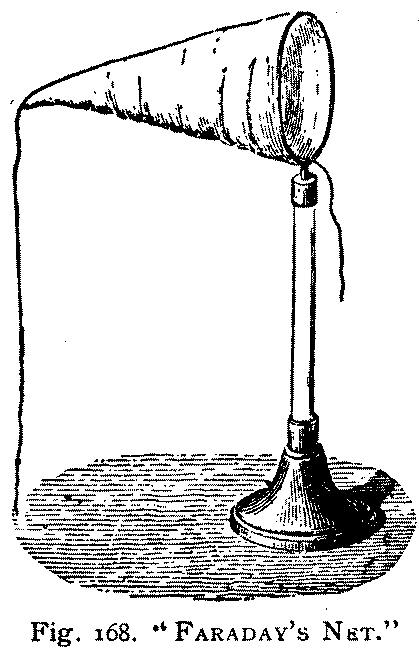
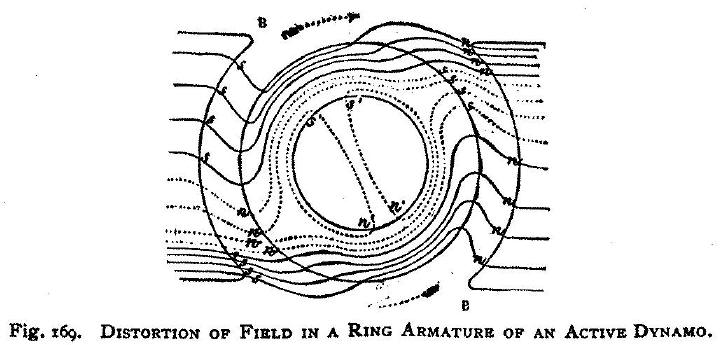
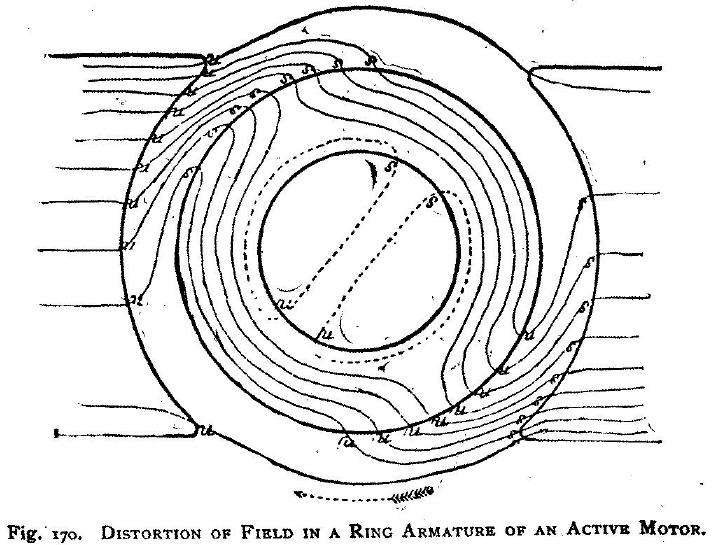
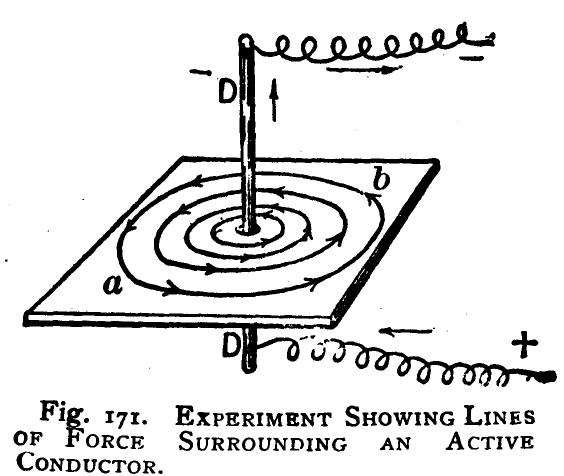
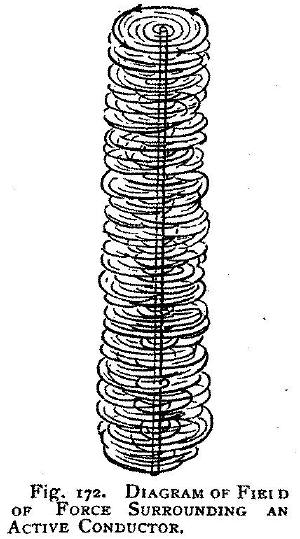
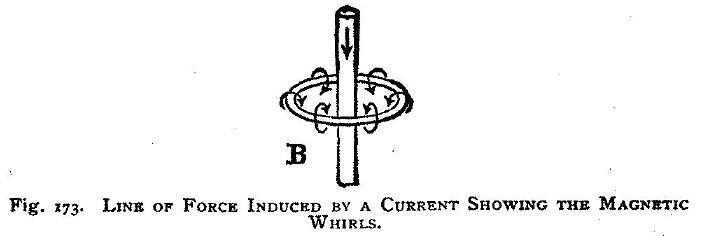
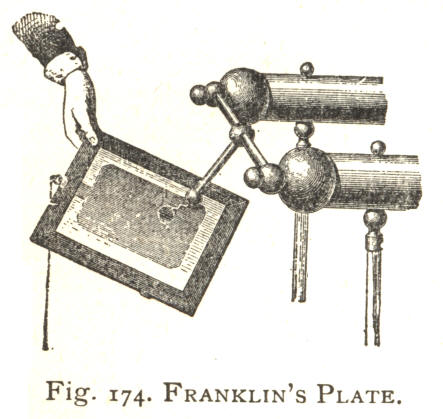
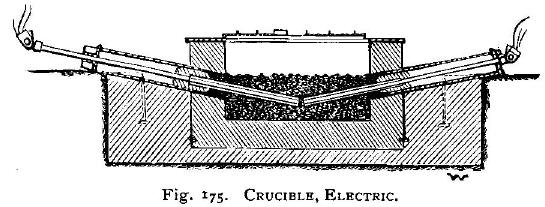
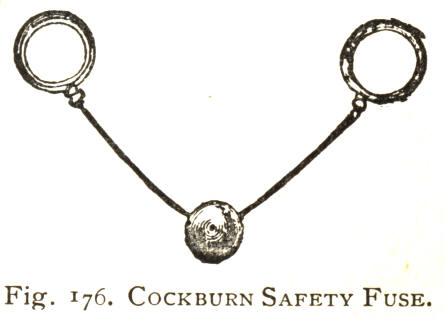
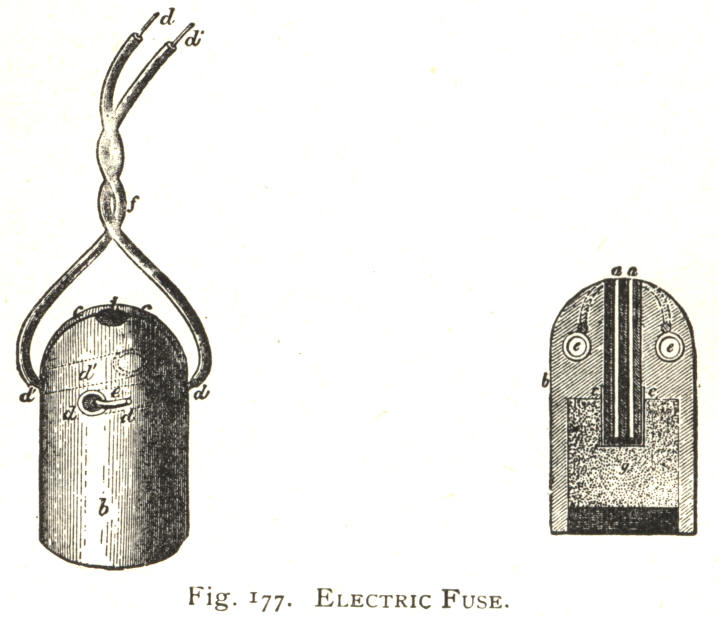
248 STANDARD ELECTRICAL DICTIONARY. F. Abbreviation for Fahrenheit, as 10º F., meaning 10º Fahrenheit. (See Fahrenheit Scale.) Fahrenheit Scale. A thermometer scale in use in the United States and England. On this scale the temperature of melting ice is 32°; that of condensing steam is 212°; the degrees are all of equal length. Its use is indicated by the letter F., as 180° F. To convert its readings into centigrade, subtract 32 and multiply by 5/9. (b) To convert centigrade into F. multiply by 9/5 and add 32. Thus 180° F. = ((180-32) * 5/9)° C. = 82.2° C. Again 180° C. = (180 * 9/5) + 32 = 324° F. [Transcribers note: 180° C. = (180 * 9/5) + 32 = 356° F. ] The additions and subtractions must be algebraic in all cases. Thus when the degrees are minus or below zero the rules for conversion might be put thus: To convert degrees F. below zero into centigrade to the number of degrees F. add 32, multiply by 5/9 and place a minus sign (-) before it. (b) To convert degrees centigrade below zero into Fahrenheit, multiply the number of degrees by 9/5, subtract from 32 if smaller; if greater than 32 subtract 32 therefrom, and prefix a minus sign, thus: -10° C. = 32 - (10 * 9/5) = 14°. Again, -30°C. = (30 * 9/5) - 32 = 22 = -22° F. 249 STANDARD ELECTRICAL DICTIONARY. Farad. The practical unit of electric capacity; the capacity of a conductor which can retain one coulomb of electricity at a potential of one volt. The quantity of electricity charged upon a conducting surface raises its potential; therefore a conductor of one farad capacity can hold two coulombs at two volts potential, and three coulombs at three volts, and so on. The electric capacity of a conductor, therefore, is relative compared to others as regards its charge, for the latter may be as great as compatible with absence of sparking and disruptive discharge. In other words, a one farad or two farad conductor may hold a great many coulombs. Charging a conductor with electricity is comparable to pumping air into a receiver. Such a vessel may hold one cubic foot of air at atmospheric pressure and two at two atmospheres, and yet be of one cubic foot capacity however much air is pumped into it. The farad is equal to one fundamental electrostatic unit of capacity multiplied by 9E11 and to one electro-magnetic unit multiplied by 1E-9. The farad although one of the practical units is far too large, so the micro-farad is used in its place. The capacity of a sphere the size of the earth is only .000636 of a farad. [Transcriber's note: Contemporary calculations give about .000720 farad.] Faraday, Effect. The effect of rotation of its plane produced upon a polarized beam of light by passage through a magnetic field. (See Magnetic Rotary Polarization.) Faraday's Cube. To determine the surface action of a charge, Faraday constructed a room, twelve feet cube, insulated, and lined with tinfoil. This room he charged to a high potential, but within it he could detect no excitement whatever. The reason was because the electricity induced in the bodies within the room was exactly equal to the charge of the room-surface, and was bound exactly by it. The room is termed Faraday's cube. Faraday's Dark Space. A non-luminous space between the negative and positive glows, produced in an incompletely exhausted tube through which a static discharge, as from an induction coil, is produced. It is perceptible in a rarefaction of 6 millimeters (.24 inch) and upwards. If the exhaustion is very high a dark space appears between the negative electrode and its discharge. This is known as Crookes' dark space. Faraday's Disc. A disc of any metal, mounted so as to be susceptible of rotation in a magnetic field of force, with its axis parallel to the general direction of the lines of force. A spring bears against its periphery and another spring against its axle. When rotated, if the springs are connected by a conductor, a current is established through the circuit including the disc and conductor. The radius of the disc between the spring contacts represents a conductor cutting lines of force and generating a potential difference, producing a current. If a current is sent through the motionless wheel from centre to periphery it rotates, illustrating the doctrine of reversibility. As a motor it is called Barlow's or Sturgeon's Wheel. If the disc without connections is rapidly rotated it produces Foucault currents, q. v., within its mass, which resist its rotation and heat the disc. 250 STANDARD ELECTRICAL DICTIONARY. Fig. 168. "FARADAY'S NET." Faraday's Net. An apparatus for showing that the electric charge resides on the surface. It consists of a net, conical in shape and rather deep, to whose apex two threads, one on each side, are attached. Its mouth is fastened to a vertical ring and the whole is mounted on an insulating support. It is pulled out to its full extent and is electrified. No charge can be detected inside it. By pulling one of the threads it is turned with the other side out. Now all the charge is found on the outside just as before, except that it is of course on the former inside surface of the bag. The interior shows no charge. Faraday's Transformer. The first transformer. It was made by Michael Faraday. It was a ring of soft iron 7/8 inch thick, and 6 inches in external diameter. It was wound with bare wire, calico being used to prevent contact of the wire with the ring and of the layers of wire with each other, while twine was wound between the convolutions to prevent the wires from touching. Seventy-two feet of copper wire, 1/20 inch diameter, were wound in three superimposed coils, covering about one-half of the ring. On the other half sixty feet of copper wire were wound in two superimposed coils. Faraday connected his coils in different ways and used a galvanometer to measure the current produced by making and breaking one of the circuits used as a primary. The coil is of historic interest. Faraday's Voltameter. A voltameter, in which the coulombs of current are measured by the volume of the gas evolved from acidulated water. (See Voltameter, Gas.) Faradic. adj. Referring to induced currents, produced from induction coils. As Faraday was the original investigator of the phenomena of electro-magnetic induction, the secondary or induced electro-magnetic currents and their phenomena and apparatus are often qualified by the adjective Faradic, especially in electro-therapeutics. A series of alternating electrostatic discharges, as from an influence machine (Holtz), are sometimes called Franklinic currents. They are virtually Faradic, except as regards their production. 251 STANDARD ELECTRICAL DICTIONARY. Faradic Brush. A brush for application of electricity to the person. It is connected as one of the electrodes of an induction coil or magneto generator. For bristles wire of nickel plated copper is generally employed. Faradization. In medical electricity the analogue of galvanization; the effects due to secondary or induced currents; galvanization referring to currents from a galvanic battery; also the process of application of such currents. Faults. Sources of loss of current or of increased resistance or other troubles in electric circuits. Feeder. A lead in an electric central station distribution system, which lead runs from the station to some point in the district to supply current. It is not used for any side connections, but runs direct to the point where current is required, thus "feeding" the district directly. In the two wire system a feeder may be positive or negative; in the three wire system there is also a neutral feeder. Often the term feeder includes the group of two or of three parallel lines. Feeder Equalizer. An adjustable resistance connected in circuit with a feeder at the central station. The object of the feeder being to maintain a definite potential difference at its termination, the resistance has to be varied according to the current it is called on to carry. Feeder, Main or Standard. The main feeder of a district. The standard regulation of pressure (potential difference between leads) in the district is often determined by the pressure at the end of the feeder. Feeder, Negative. The lead or wire in a set of feeders, which is connected to the negative terminal of the generator. Feeder, Neutral. In the three wire system the neutral wire in a set of feeders. It is often made of less diameter than the positive and negative leads. Feeder, Positive. The lead or wire in a set of feeders, which wire is connected to the positive terminal of the generator. Ferranti Effect. An effect as yet not definitely explained, observed in the mains of the Deptford, Eng., alternating current plant. It is observed that the potential difference between the members of a pair of mains rises or increases with the distance the place of trial is from the station. [Transcriber's note: This effect is due to the voltage drop across the line inductance (due to charging current) being in phase with the sending end voltages. Both capacitance and inductance are responsible for producing this phenomenon. The effect is more pronounced in underground cables and with very light loads.] 252 STANDARD ELECTRICAL DICTIONARY. Ferro-magnetic. adj. Paramagnetic; possessing the magnetic polarity of iron. Fibre and Spring Suspension. A suspension of the galvanometer needle used in marine galvanometers. The needle is supported at its centre of gravity by a vertically stretched fibre attached at both its ends, but with a spring intercalated between the needle and one section of the fibre. Fibre Suspension. Suspension, as of a galvanometer needle, by a vertical or hanging fibre of silk or cocoon fibre, or a quartz fibre. (See Quartz.) This suspension, while the most delicate and reliable known, is very subject to disturbance and exacts accurate levelling of the instrument. Fibre suspension is always characterized by a restitutive force. Pivot suspension, q. v., on the other hand, has no such force. Field, Air. A field the lines of force of which pass through air; the position of a field comprised within a volume of air. Field, Alternating. Polarity or direction being attributed to lines of force, if such polarity is rapidly reversed, an alternating field results. Such field may be of any kind, electro-magnetic or electrostatic. In one instance the latter is of interest. It is supposed to be produced by high frequency discharges of the secondary of an induction coil, existing in the vicinity of the discharging terminals. Field Density. Field density or density of field is expressed in lines of force per unit area of cross-section perpendicular to the lines of force. Field, Distortion of. The lines of force reaching from pole to pole of an excited field magnet of a dynamo are normally symmetrical with respect to some axis and often with respect to several. They go across from pole to pole, sometimes bent out of their course by the armature core, but still symmetrical. The presence of a mass of iron in the space between the pole pieces concentrates the lines of force, but does not destroy the symmetry of the field. When the armature of the dynamo is rotated the field becomes distorted, and the lines of force are bent out of their natural shape. The new directions of the lines of force are a resultant of the lines of force of the armature proper and of the field magnet. For when the dynamo is started the armature itself becomes a magnet, and plays its part in forming the field. Owing to the lead of the brushes the polarity of the armature is not symmetrical with that of the field magnets. Hence the compound field shows distortion. In the cut is shown diagrammatically the distortion of field in a dynamo with a ring armature. The arrow denotes the direction of rotation, and n n * * * and s s * * * indicate points of north and south polarity respectively. 253 STANDARD ELECTRICAL DICTIONARY. The distorted lines must be regarded as resultants of the two induced polarities of the armature, one polarity due to the induction of the field, the other to the induction from its own windings. The positions of the brushes have much to do with determining the amount and degree of distortion. In the case of the ring armature it will be seen that some of the lines of force within the armature persist in their polarity and direction, almost as induced by the armature windings alone, and leak across without contributing their quota to the field. Two such lines are shown in dotted lines. In motors there is a similar but a reversed distortion. Fig. 169. DISTORTION OF FIELD IN A RING ARMATURE OF AN ACTIVE DYNAMO. Fig. 170. DISTORTION OF FIELD IN A RING ARMATURE OF AN ACTIVE MOTOR. 254 STANDARD ELECTRICAL DICTIONARY. Field, Drag of. When a conductor is moved through a field so that a current is generated in it, the field due to that current blends with the other field and with its lines of force, distorting the field, thereby producing a drag upon its own motion, because lines of force always tend to straighten themselves, and the straightening would represent cessation of motion in the conductor. This tendency to straightening therefore resists the motion of the conductor and acts a drag upon it. Field of Force. The space in the neighborhood of an attracting or repelling mass or system. Of electric fields of force there are two kinds, the Electrostatic and the Magnetic Fields of Force, both of which may be referred to. A field of force may be laid out as a collection of elements termed Lines of Force, and this nomenclature is universally adopted in electricity. The system of lines may be so constructed that (a) the work done in passing from one equipotential surface to the next is always the same; or (b) the lines of force are so laid out and distributed that at a place in which unit force is exercised there is a single line of force passing through the corresponding equipotential surface in each unit of area of that surface. The latter is the universal method in describing electric fields. It secures the following advantages:--First: The potential at any point in the field of space surrounding the attracting or repelling mass or masses is found by determining on which imaginary equipotential surface that point lies. Second: If unit length of a line of force cross n equipotential surfaces, the mean force along that line along the course of that part of it is equal to n units; for the difference of potential of the two ends of that part of the line of force = n; it is also equal to F s (F = force), because it represents numerically a certain amount of work; but s = I, whence n = F. Third: The force at any part of the field corresponds to the extent to which the lines of force are crowded together; and thence it may be determined by the number of lines of force which pass through a unit of area of the corresponding equipotential surface, that area being so chosen as to comprise the point in question. (Daniell.) Field of Force, Electrostatic. The field established by the attracting, repelling and stressing influence of an electrostatically charged body. It is often termed an Electrostatic Field. (See Field of Force.) 255 STANDARD ELECTRICAL DICTIONARY. Field of Force of a Current. A current establishes a field of force around itself, whose lines of force form circles with their centres on the axis of the current. The cut, Fig. 172, shows the relation of lines of force to current. Fig. 171. EXPERIMENT SHOWING LINES OF FORCE SURROUNDING AN ACTIVE CONDUCTOR. Fig. 172. DIAGRAM OF FIELD OF FORCE SURROUNDING AN ACTIVE CONDUCTOR. Fig. 173. LINK OF FORCE INDUCED BY A CURRENT SHOWING THE MAGNETIC WHIRLS. The existence of the field is easily shown by passing a conductor vertically through a horizontal card. On causing a current to go through the wire the field is formed, and iron filings dropped upon the card, tend, when the latter is gently tapped, to take the form of circles. The experiment gives a version of the well-known magnetic figures, q. v. See Fig. 171. The cut shows by the arrows the relation of directions of current to the direction of the lines of force, both being assumptions, and merely indicating certain fixed relations, corresponding exactly to the relations expressed by the directions of electro-magnetic or magnetic lines of force 256 STANDARD ELECTRICAL DICTIONARY. Field, Pulsatory. A field produced by pulsatory currents. By induction such field can produce an alternating current. Field, Rotating. In a dynamo the field magnets are sometimes rotated instead of the armature, the latter being stationary. In Mordey's alternator the armature, nearly cylindrical, surrounds the field, and the latter rotates within it, the arrangement being nearly the exact reverse of the ordinary one. This produces a rotating field. Field, Rotatory. A magnetic field whose virtual poles keep rotating around its centre of figure. If two alternating currents differing one quarter period in phase are carried around four magnetizing coils placed and connected in sets of two on the same diameter and at right angles to each other, the polarity of the system will be a resultant of the combination of their polarity, and the resultant poles will travel round and round in a circle. In such a field, owing to eddy currents, masses of metal, journaled like an armature, will rotate, with the speed of rotation of the field. Field, Stray. The portion of a field of force outside of the regular circuit; especially applied to the magnetic field of force of dynamos expressing the portion which contributes nothing to the current generation. Synonym--Waste Field. Field, Uniform. A field of force of uniform density. (See Field Density.) Figure of Merit. In the case of a galvanometer, a coefficient expressing its delicacy. It is the reciprocal of the current required to deflect the needle through one degree. By using the reciprocal the smaller the current required the larger is the figure of merit. The same term may be applied to other instruments. It is often defined as the resistance of a circuit through which one Daniell's element will produce a deflection of one degree on the scale of the instrument. The circuit includes a Daniell's cell of resistance r, a rheostat R, galvanometer G and shunt S. Assume that with the shunt in parallel a deflection of a divisions is obtained. The resistance of the shunted galvanometer is (GS/G+S ; the multiplying power m of the shunt is S+G/S; the formula or figure of merit is m d (r+R +G S/G+S). The figure of merit is larger as the instrument is more sensitive. Synonym--Formula of Merit. 257 STANDARD ELECTRICAL DICTIONARY. Filament. A thin long piece of a solid substance. In general it is so thin as to act almost like a thread, to be capable of standing considerable flexure. The distinction between filament and rod has been of much importance in some patent cases concerning incandescent lamps. As used by electricians the term generally applies to the carbon filament of incandescent lamps. This as now made has not necessarily any fibres, but is entitled to the name of filament, partly by convention, partly by its relative thinness and want of stiffness. (See Incandescent Lamps--Magnetic Filament.) Fire Alarm, Electric, Automatic. A system of telegraph circuits, at intervals supplied with thermostats or other apparatus affected by a change of temperature, which on being heated closes the circuit and causes a bell to ring. (See Thermostat.) Fire Alarm Telegraph System. A system of telegraphic lines for communicating the approximate location of a fire to a central station and thence to the separate fire-engine houses in a city or district. It includes alarm boxes, distributed at frequent intervals, locked, with the place where the key is kept designated, or in some systems left unlocked. On opening the door of the box and pulling the handle or otherwise operating the alarm, a designated signal is sent to the central station. From this it is telegraphed by apparatus worked by the central station operator to the engine houses. The engines respond according to the discipline of the service. Fire Cleansing. Freeing the surface of an article to be plated from grease by heating. Fire Extinguisher, Electric, Automatic. A modification of the electric fire alarm (see Fire Alarm, Electric, Automatic), in which the thermostats completing the circuits turn on water which, escaping through the building, is supposed to reach and extinguish a fire. Flashing in a Dynamo or Magneto-electric Generator. Bad adjustment of the brushes at the commutator, or other fault of construction causes the production of voltaic arcs at the commutator of a generator, to which the term flashing is applied. Flashing of Incandescent Lamp Carbons. A process of treatment for the filaments of incandescent lamps. The chamber before sealing up is filled with a hydro-carbon vapor or gas, such as the vapor of a very light naphtha (rhigolene). A current is then passed through the filament heating it to redness. The more attenuated parts or those of highest resistance are heated the highest, and decompose most rapidly the hydro-carbon vapor, graphitic carbon being deposited upon these parts, while hydrogen is set free. This goes on until the filament is of uniform resistance throughout. It gives also a way of making the resistance of the filament equal to any desired number of ohms, provided it is originally of high enough resistance. The process increases the conductivity of the filament. After flashing the chambers are pumped out and sealed up. 258 STANDARD ELECTRICAL DICTIONARY. Flashing Over. A phenomenon observed in high potential dynamos. On a sudden alteration of the resistance of the circuit a long blue spark will be drawn out around the surface of the commutator from brush to brush. The spark is somewhat of the nature of an arc, and may seriously injure commutators whose sections are only separated by mica, or other thin insulation. In the case of commutators whose sections are separated by air spaces it is not so injurious. Flats. In a commutator of a dynamo, the burning or wearing away of a commutator segment to a lower level than the rest. Sometimes two adjacent bars will be thus affected, causing a flat place on the commutator. It is not always easy to account for the formation of flats. They may have their origin in periodic vibrations due to bad mounting, or to sparking at the particular point. Floor Push. A press or push button constructed to be set into the floor to be operated by pressing with the foot. It is used to ring an alarm bell, sound a buzzer or for similar service. Fluid, Depolarizing. A fluid used in voltaic batteries to dispose of the hydrogen, which goes to the negative plate. This it does by oxidizing it. Chromic acid, nitric acid, and chloric acids are among the constituents of liquid depolarizers. (See Electropoion Fluid.) Fluid, Electric. The electric current and charge have sometimes been attributed to a fluid. The theory, which never was much more than hypothetical, survives to some extent in the single and double fluid theory. (See Single Fluid Theory-Double Fluid Theory.) Fluorescence. The property of converting ether waves of one length, sometimes of invisible length, into waves of another length (visible). AEsculin, quinine salts, uranium glass and other substances exhibit this phenomenon. The phenomenon is utilized in the production of Geissler tubes. Flush Boxes. A heavy iron box covered with a heavy hand plate and laid flush (whence the name), or even with the surface of a roadway. Into it conductors of an underground system lead, and it is used to make connections therewith and for examining the leakage of the conductors and for similar purposes. It is a "man-hole" (q. v.) in miniature. Fluviograph. An electric registering tide gauge or water level gauge. 259 STANDARD ELECTRICAL DICTIONARY. Fly or Flyer, Electric. A little wheel, ordinarily poised on a point, like a compass needle. It carries several tangentially directed points, all pointing in the same sense. When connected with a source of electricity of high potential it revolves by reaction. The tension of its charge is highest at the points, the air there is highly electrified and repelled, the reaction pushing the wheel around like a Barker's mill or Hero's steam engine. Sometimes the flyer is mounted with its axis horizontal and across the rails on a railroad along which it travels. Synonym--Reaction Wheel. Foci Magnetic. The two points on the earth's surface where the magnetic intensity is greatest. They nearly coincide in position with the magnetic poles. Fog, Electric. Fogs occurring when the atmosphere is at unusually high potential and accompanied by frequent change of such polarity. Following Horns. In dynamo-electric machines the projecting ends of the pole pieces towards which the outer uncovered perimeter of the armature turns in its regular operations. The leading horns are those away from which the armature rotates. In considering rotation the exposed portion of the superficies of the armature is considered. The definition would have to be reversed if the part facing the pole pieces were considered. Synonym--Trailing Horns. Foot-candle. A unit of illuminating power; the light given by one standard candle at a distance of one foot. The ordinary units of illuminating power are entirely relative; this is definite. It is due to Carl Herring. Foot-pound. A practical unit of work or energy. The quantity of work required to raise a pound one foot, or one hundred pounds one-hundredth of a foot, and so on; or the potential energy represented by a weight at an elevation under these conditions. Foot-step. In a dynamo with armature at the lower end of its field magnets, the plate generally of zinc, interposed between it and the iron base plate to prevent the leakage of lines of force outside of the circuit. Any diamagnetic material which is mechanically suitable may be used. Force. Force may be variously defined. (a) Any cause of change of the condition of matter with respect to motion or rest. (b) A measurable action upon a body under which the state of rest of that body, or its state of uniform motion in a straight line, suffers change. (c) It may be defined by its measurement as the rate of change of momentum, or (d) as the rate at which work is done per unit of space traversed. Force is measured by the acceleration or change of motion it can impart to a body of unit mass in a unit of time, or, calling force, F, mass, m acceleration per second a we have F = m a. The dimensions of force are mass (M) * acceleration (L/(T^2)) = (M*L)/(T^2). 260 STANDARD ELECTRICAL DICTIONARY. Force de Cheval. Horse power (French). It is the French or metric horse power. It is equal to: 542.496 Foot lbs. per second. .9864 English Horse Power. 75.0 Kilogram-meters per second. Force, Electro-magnetic. The mechanical force of attraction or repulsion acting on the electro-magnetic unit of quantity. Its intensity varies with the square of the distance. It may also be defined as electric force in the electro-magnetic system. Its dimensions are equal to mechanical force ((M*L)/(T^2)) divided by quantity ((M^.5)*(L^.5)) = ((M^.5)*(L^.5))/(T^2). Force, Electrostatic. The force by which electric matter or electrified surfaces attract or repel each other. It is also termed electric force (not good) and electro-motive intensity. It is the mechanical force acting upon a unit quantity of electricity. Its intensity varies with the square of the distance. Its dimensions are therefore equal to (quantity * unity / (square of distance) Q. * 1 / (L^2) = ((M^.5) * (L^1.5) )/ T*1 / (L^2) = ((M^.5) * (L^.5)) / T These dimensions are also those of potential difference. [Transcriber's Note: The image of the preceding paragraph is included for "clarity".] The objection to the term electric force is that it may be applied also to electro-magnetic force, and hence be a source of confusion. Forces, Parallelogram of. The usual method of composing forces or resolving a force. The sides of a parallelogram of forces represent component forces and the diagonal represents the resultant. See Component--Resultant--Forces, Composition of--Forces, Resolution of. Forces, Composition of. When several forces act in a different direction upon a point they may be drawn or graphically represented as arrows or lines emanating from the point in the proper direction and of lengths proportional to the force they exercise. Any two can be treated as contiguous sides of a parallelogram and the parallelogram can be completed. Then its diagonal, called the resultant, will represent the combined action of the two forces, both as regards direction and intensity. This is the composition of two forces. If more than two forces act upon the given point the resultant can be composed with any of the others and a new force developed. The new resultant can be combined with another force, and the process kept up, eliminating the components one by one until a final resultant of all is obtained. This will give the exact direction and intensity of the forces, however many or varied. 261 STANDARD ELECTRICAL DICTIONARY. Forces, Resolution of. The developing from a single force treated as a resultant, two other forces in any desired direction. The reverse of composition of forces. (See Forces, Composition of--Forces, Parallelogram of--Components--Resultant.) Force, Tubes of. Aggregations of lines of force, either electrostatic or magnetic. They generally have a truncated, conical or pyramidal shape and are not hollow. Every cross-section contains the same number of lines. The name it will seem is not very expressive. Force, Unit of. The fundamental or C. G. S. unit or force is the dyne, q. v. The British unit of force is the poundal (the force which will produce an acceleration of one foot per second in a mass of one pound). It is equal to about 10/322 pound. A force cannot be expressed accurately in weight units, because weight varies with the latitude. Forming. The process of producing secondary battery plates from lead plates by alternately passing a charging current through the cell and then allowing it to discharge itself and repeating the operation. (See Battery, Secondary, Planté's.) Foundation Ring. In a dynamo armature the ring-shaped core on which Gramme ring armatures and other ring armatures are wound. Fourth State of Matter. Gas so rarefied that its molecules do not collide, or rarely do so; radiant matter, q. v. [Transcriber's note: This term now refers to plasma, an ionized gas, which contains free electrons. The ions and electrons move somewhat independently making plasma electrically conductive. It responds strongly to electromagnetic fields.] Frame. In a dynamo the bed-piece is sometimes called the frame. Franklin's Experiment. Franklin proved the identity of lightning and electricity by flying a kite in a thunder storm. The kite was of silk so as to endure the wetting. When the string became wet sparks could be taken from a key attached to its end. The main string was of hemp; at the lower end was a length of silk to insulate it. The key was attached near the end of and to the hemp string. Franklin's Plate. A simple form of condenser. It consists of a plate of glass coated on each side with tinfoil with a margin of about an inch of clear glass. One coating may be grounded as indicated in the cut, and the plate charged like a Leyden jar. Or one side may be connected with one terminal, and the other with the other terminal of an influence machine and the pane will be thus charged. Synonym--Fulminating Pane. 262 STANDARD ELECTRICAL DICTIONARY. Fig. 174. FRANKLIN'S PLATE. Franklin's Theory. The single fluid theory, q. v., of electricity. Frequency. The number of double reversals or complete alternations per second in an alternating current. Synonym--Periodicity. Frictional Electricity. Electricity produced by friction of dissimilar substances. (See Electrostatic Series.) The contact theory holds that friction plays only a secondary rôle in this process; that it increases the thoroughness of contact, and tends to dry the rubbing surfaces, but that the charges induced are due to contact of dissimilar substances, not to friction of one against the other. Frictional Heating. The heating of a conductor by the passage of a current; the Joule effect, q. v. Fringe. The outlying edge of a magnetic field. Frog, Galvani's Experiment With. A classic experiment in electricity, leading to the discovery of current or dynamic electricity. If a pair of legs of a recently killed frog are prepared with the lumbar nerves exposed near the base of the spinal column, and if a metallic conductor, one half-length zinc and the other half-length copper, is held, one end between the lumbar nerves and the spine, and the other end against one of the muscles of the thigh or lower legs, the moment contact occurs and the circuit is completed through the animal substance the muscles contract and the leg is violently drawn upwards. Galvani, in 1786, first performed, by accident, this famous experiment, it is said, with a scalpel with which he was dissecting the animal. He gave his attention to the nerves and muscles. Volta, more happily, gave his attention to the metals and invented the voltaic battery, described by him in a letter to Sir Joseph Banks, dated 1800. Frog, Rheoscopic. If the nerve or living muscle of a frog is suddenly dropped upon another living muscle so as to come in contact with its longitudinal and transverse sections, the first muscle will contract on account of the stimulation of its nerve due to the passage of a current derived from the second muscle (Ganot). The experiment goes under the above title. 263 STANDARD ELECTRICAL DICTIONARY. Frying. A term applied to a noise sometimes produced in a voltaic arc due to too close approach of the carbons to each other. It has been suggested that it may be due to volatilization of the carbon. (Elihu Thomson.) Fulgurite. An irregular and tubular mass of vitrified quartz, believed to be formed by melting under the lightning stroke. Fig. 175. CRUCIBLE, ELECTRIC. Furnace, Electric. A furnace in which the heat is produced by the electric current. It has hitherto been practically used only in the extraction of aluminum and silicium from their ores. The general principle involves the formation of an arc between carbon electrodes. The substances to be treated are exposed to the heat thus produced. Sometimes the substances in the arc form imperfect conductors, and incandescence takes a part in the action. Sometimes the substances are merely dropped through the arc. [Transcriber's note: Silicium is silicon.] Fuse Board. A tablet on which a number of safety fuses are mounted. Slate is excellent material for the tablet, as it is incombustible, and is easily drilled and worked. Fuse Box. A box containing a safety fuse. Porcelain is an excellent material for its base. No combustible material should enter into its composition. Fuse, Cockburn. A safety fuse or cut off which consists of a wire of pure tin running from terminal to terminal, to whose centre a leaden ball is secured by being cast into position. The connection with the terminals is made by rings at the ends of the wire through which the terminal screws are passed and screwed home. When the tin softens under too heavy a current the weight of the shot pulls it apart. Fig. 176 COCKBURN SAFETY FUSE. 264 STANDARD ELECTRICAL DICTIONARY. Fig. 177. ELECTRIC FUSE. Fuse, Electric. A fuse for igniting an explosive by electricity. There are two kinds. In one a thin wire unites the ends of the two conducting wires as they enter the case of the fuse. The larger wires are secured to the case, so that no strain comes on the fine wire. On passing a current of sufficient strength the small wire is heated. In use the fuse is bedded in powder, which again may be surrounded by fulminating powder, all contained in a copper or other metallic case. Such a detonator is used for exploding guncotton and other high explosives. The other kind of fuse is similar, but has no thin connecting wire. The ends of the conductors are brought nearer together without touching. In use a static discharge is produced across from end to end of the conductors, igniting a proper explosive placed there as in the other case. The first kind of fuse is generally operated by a battery or small mechanical generator--the latter by a spark coil, frictional or influence machine or by a Leyden jar.

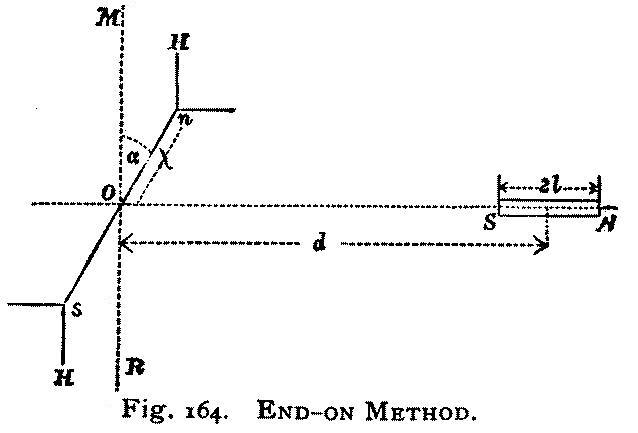
264 STANDARD ELECTRICAL DICTIONARY. Galvanic. adj. Voltaic; relating to current electricity or the electrolytic and electro-chemical relations of metals. (For titles in general under this head see Voltaic--or the main title.) Galvanic Element. A galvanic couple with exciting fluid and adjuncts; a galvanic cell. The word element is sometimes applied to the electrodes of a cell, as the carbon element or zinc element. 265 STANDARD ELECTRICAL DICTIONARY. Galvanic Polarization. The polarization of a voltaic couple. (See Polarization.) Galvanism. The science of voltaic or current electricity. Galvanization. (a) Electroplating or depositing a metal over the surface of another by electrolysis. (b) In medical electricity the effects produced on any part of the system by the current of voltaic battery. Various descriptive qualifications are prefixed, such as "general" galvanization, indicating its application as applied to the whole body, "local" for the reverse case, and so on. Galvanization, Labile. Application of the galvanic current in electro-therapeutics where one sponge electrode is employed which is rubbed or moved over the body, the other being in constant contact with the body. Galvanized Iron. Iron coated with zinc by cleaning and immersion in melted zinc. The iron is prevented from rusting by galvanic action. It forms the negative element in a couple of which the zinc is the positive element. From this electric protective action the name is derived. Galvano-cautery, Chemical. Electro-therapeutic treatment with sharp electrodes, one of which is inserted in the tissue and a current passed by completing the circuit through the tissue so as to electrolyze or decompose the fluids of the tissue. It is applied in the removal of hair or extirpation of the follicle. The process is not one of heating, and is improperly named cautery. Galvano-faradization. In medical electricity the application of the voltaic and induced or secondary current simultaneously to any part of the system. Galvanometer. An instrument for measuring current strength and sometimes for measuring inferentially potential difference, depending on the action of a magnetic field established by the current, such action being exerted on a magnetic needle or its equivalent. A current passing through a conductor establishes circular lines of force. A magnetic needle placed in their field is acted on and tends to place itself parallel with the lines, in accordance with the principles of current induction. (See Induction, Electro-magnetic.) A common compass held near a conductor through which a current is passing tends to place itself at right angles to such conductor. For a maximum effect the conductor or the part nearest the needle should lie in the magnetic meridian. If at right angles thereto its action will only strengthen the directive force of the earth's induction or magnetic field, as the needle naturally points north and south. Such combination is virtually a galvanometer. 266 STANDARD ELECTRICAL DICTIONARY. A typical galvanometer comprises a flat coil of wire placed horizontally within which a magnetic needle is delicately poised, so as to be free to rotate with the least possible friction. The needle may be supported on a sharp point like a compass needle, or may be suspended by a long fine filament. It should be covered by a glass plate and box, or by a glass shade. Finally a graduated disc may be arranged to show the amount of deflection of the needle. In use the apparatus is turned about until the needle, as acted on by the earth's magnetic field, lies parallel to the direction of the coils of wire. On passing a current through the coil the needle is deflected, more or less, according to its strength. By using exceedingly fine wire, long enough to give high resistance, the instrument can be used for very high potentials, or is in condition for use in determining voltage. By using a coil of large wire and low resistance it can be employed in determining amperage. In either case the deflection is produced by the current. The needle is often placed above or below the coil so as only to receive a portion of its effect, enough for all practical purposes in the commoner class of instruments. The galvanometer was invented by Schweigger a short time after Oersted's discovery, q. v. Galvanometer, Absolute. A galvanometer giving absolute readings; properly one whose law of calibration can be deduced from its construction. Thus the diameter of the coil, and the constants and position of a magnetic needle suspended in its field being known, the current intensity required to deflect the needle a given number of degrees could be calculated. Galvanometer, Aperiodic. A galvanometer whose needle is damped (see Damping) as, for instance, by the proximity of a plate of metal, by an air vane or otherwise, so that it reaches its reading with hardly any oscillation. A very light needle and a strong magnetic field also conduce to vibrations of short period dying out very quickly. Such galvanometers are termed "dead-beat." No instrument is absolutely dead-beat, only relatively so. 267 STANDARD ELECTRICAL DICTIONARY. Fig. 178. ASTATIC GALVANOMETER. Galvanometer, Astatic. A galvanometer with a pair of magnetic needles connected astatically, or parallel with their poles in opposition. (See Astatic Needle.) Each needle has its own coil, the coils being wound in opposite directions so as to unite in producing deflections in the same sense. As there should be some directive tendency this is obtained by one of the magnets being slightly stronger than the other or by the proximity of a fixed and adjustable controlling magnet, placed nearer one needle than the other. For small deflections the currents producing them are proportional to their extent. Galvanometer, Ballistic. A galvanometer whose deflected element has considerable moment of inertia; the exact opposite of an aperiodic or dead beat galvanometer. (See Galvanometer, Aperiodic.) All damping by air vanes or otherwise must be carefully done away with. Fig. 179. SIEMENS & HALSKE'S GALVANOMETER. Siemens & Halske's galvanometer is of the reflecting or mirror type (see Galvanometer, Reflecting) with suspended, bell-shaped magnet, in place of the ordinary magnetic needle, or astatic combination of the lightest possible weight in the regular instrument. A copper ball drilled out to admit the magnet is used as damper in the ordinary use of the instrument. To convert it into a ballistic galvanometer the copper ball is removed. The heavy suspended magnet then by its inertia introduces the desired element into the instrument. 268 STANDARD ELECTRICAL DICTIONARY. Referring to the cut, Fig. 179, M is the suspended magnet, with north and south poles n and s; S is the reflecting mirror; r is the tube containing the suspending thread; R is the damper removed for ballistic work. The ballistic galvanometer is used to measure quantities of electricity in an instantaneous discharge, which discharge should be completed before the heavy needle begins to move. The extreme elongation or throw of the needle is observed, and depends (1) on the number of coulombs (K) that pass during the discharge; (2) on the moment of inertia of the needle and attached parts; (3) on the moment of the controlling forces, i. e., the forces tending to pull the needle back to zero; (4) on the moment of the damping forces; (5) on the moment of the deflecting forces due to a given constant current. The formula is thus expressed: K = (P / PI ) * A * sin( kº / 2 ) / tan( aº ) in which K = coulombs discharged; P = periodic time of vibration of needle; A = amperes producing a steady deflection equal to aº ; kº = first angular deflection of needle. For accuracy kº and aº should both be small and the damping so slight as to be negligible. Otherwise a correction for the latter must be applied. For approximate work for kº and aº the deflections read on the scale may be used with the following formula: K = (P / PI ) * ( A / 2 ) * ( kº / aº ) Galvanometer Constant. Assume a galvanometer with a very short needle and so placed with respect to its coils that the magnetic field produced by a current circulating in them is sensibly uniform in the neighborhood of the needle, with its lines of force at right angles thereto. The field is proportional to the current i, so that it may be denoted by G i. Then G is the galvanometer constant. If now the angle of deflection of the needle is ? against the earth's field H, M being the magnetic moment of the needle we have G i M cos ? = H M sin ? or i = (H/G)* tan ?. H/G is the reduction factor; variable as H varies for different places. For a tangent galvanometer the constant G is equal to 2*PI*(n/a), in which n denotes the number of turns of wire, and a denotes the radius of the circle. Galvanometer, Differential. A galvanometer in which the needle is acted on by two coils wound in opposition, each of equal deflecting action and of equal resistance. If a current is divided between two branches or parallel conductors, each including one of the coils, when the needle points to zero the resistances of the two branches will bc equal. In the cut, C C' represent the coils, and A and B the two leads into which the circuit, P Q, is divided. 269 STANDARD ELECTRICAL DICTIONARY. Fig. 180. THEORY OF DIFFERENTIAL GALVANOMETER. Fig. 181. DIFFERENTIAL GALVANOMETER. Galvanometer, Direct Reading. A calibrated galvanometer, whose scale is graduated by volts or amperes, instead of degrees. Galvanometer, Marine. (Sir William Thomson's.) A galvanometer of the reflecting type, for use on shipboard. A fibre suspension is adopted for the needle. The fibre is attached to a fixed support at one end and to a spring at the other, and the needle is suspended by its centre of gravity. This secures it to a considerable extent from disturbance due to the rolling of the ship. A thick iron box encloses the needle, etc., to cut off any magnetic action from the ship. (See Galvanometer, Reflecting.) Galvanometer, Potential. A galvanometer wound with fine German silver wire to secure high resistance used for determination of potential difference. Galvanometer, Proportional. A galvanometer so constructed that the deflections of its index are proportional to the current passing. It is made by causing the deflecting force to increase as the needle is deflected, more and more, or by causing the restitutive force to diminish under like conditions, or by both. The condition is obtained in some cases by the shape and position of the deflecting coils. Galvanometer, Quantity. A galvanometer for determining quantities of electricity, by the deflections produced by discharging the quantities through their coils. It is a ballistic galvanometer with very little or no damping. 270 STANDARD ELECTRICAL DICTIONARY. Fig. 182. PRINCIPLE OF REFLECTING GALVANOMETER. Fig. 183. REFLECTING GALVANOMETER. Galvanometer, Reflecting. A galvanometer the deflections of whose needle are read by an image projected by light reflected from a mirror attached to the needle or to a vertical wire carrying the needle. A lamp is placed in front of the instrument facing the mirror. The light of the lamp is reflected by the mirror upon a horizontal scale above the lamp. An image of a slit or of a wire may be caused thus to fall upon the scale, the mirror being slightly convex, or a lens being used to produce the projection. 271 STANDARD ELECTRICAL DICTIONARY. If the mirror swings through a horizontal arc, the reflected image will move, in virtue of a simple geometrical principle, through an arc of twice as many degrees. The scale can be placed far from the mirror, so that the ray of light will represent a weightless index of very great length, and minute deflections of the needle will be shown distinctly upon the scale. In the cut, Fig. 182, the ray of light from the lamp passes through the aperture, m m, and is made parallel by the lens, L. At s is the mirror attached to the needle and moving with it. A scale placed at t receives the reflection from the mirror. The cut, Fig. 183, shows one form of the instrument set up for use. Synonym--Mirror Galvanometer. Galvanometer Shunt. To prevent too much current passing through a galvanometer (for fear of injury to its insulation) a shunt is sometimes placed in parallel with it. The total current will be distributed between galvanometer and shunt in the inverse ratio of their respective resistances. (See Multiplying Power of a Shunt.) 272 STANDARD ELECTRICAL DICTIONARY. Fig. 184. SINE GALVANOMETER. Galvanometer, Sine. A galvanometer whose measurements depend upon the sine of the angle of deflection produced when the coil and needle lie in the same vertical plane. The needle, which may be a long one, is surrounded by a coil, which can be rotated about a vertical axis passing through the point of suspension of the needle. Starting with the needle at rest in the plane of the coil, a current is passed through the coil deflecting the needle, the coil is swung around deflecting the needle still more, until the needle lies in the plane of the coil; the intensity of the current will then be in proportion to the sine of the angle through which the coil and needle move. In the galvanometer M is a circle carrying the coil, N is a scale over which the needles, m and n, move, the former being a magnetic needle, the latter an index at right angles and attached thereto; a and b are wires carrying the current to be measured. The circles, M and N, are carried by a base, O, around which they rotate. H is a fixed horizontal graduated circle. In use the circle, M, is placed in the magnetic meridian, the current is passed through the coil, M; the needle is deflected; M is turned until its plane coincides with the direction of the needle, m. The current strength is proportional to the sine of the angle of deflection. This angle is measured by the vernier, C, on the circle, H. The knob, A, is used to turn the circle, M. 273 STANDARD ELECTRICAL DICTIONARY. Fig. 185. TANGENT GALVANOMETER. Galvanometer, Tangent. A galvanometer in which the tangents of the angles of deflection are proportional to the currents producing such deflections. For this law to apply the instrument in general must fulfill the following conditions: (1) The needle must be controlled by a uniform magnetic field such as that of the earth; (2) the diameter of the coil must be large compared to the length of the needle; (3) the centre of suspension of the needle must be at the centre of the coil; (4) the magnetic axis of the needle must lie in the plane of the coil when no current is passing. If a single current strength is to be measured the best results will be attained when the deflection is 45°; in comparing two currents the best results will be attained when the deflections as nearly as possible are at equal distances on both sides of 45°. The needle should not exceed in length one-tenth the diameter of the coil. For very small deflections any galvanometer follows the law of tangential deflection. As for very small deflections the tangents are practically equal to the arcs subtended, for such deflections the currents are proportional to the deflections they produce. The sensibility is directly proportional to the number of convolutions of wire and inversely proportional to their diameter. The tangent law is most accurately fulfilled when the depth of the coil in the radial direction is to the breadth in the axial direction as squareRoot(3):squareRoot(2), or about as 11:9. Galvanometer, Torsion. A galvanometer whose needle is suspended by a long filament or by a thread and spiral spring against whose force of torsion the movements of the needle are produced. The current strength is determined by bringing the needle back to its position of rest by turning a hand-button or other arrangement. The angle through which this is turned gives the angle of torsion. From this the current strength is calculated on the general basis that it is proportional to the angle of torsion. Fig. 186. TORSION GALVANOMETER. 274 STANDARD ELECTRICAL DICTIONARY. Galvanometer, Vertical. A galvanometer whose needle is mounted on a horizontal axis and is deflected in a vertical plane. One of the poles is weighted to keep it normally vertical, representing the control. It is not used for accurate work. Synonym--Upright Galvanometer. Fig. 187. VERTICAL GALVANOMETER. Galvanometer, Volt- and Ampere-meter. A galvanometer of Sir William Thomson's invention embodying the tangent principle, and having its sensibility adjustable by moving the magnetic needle horizontally along a scale (the "meter") towards or away from the coil. A curved magnet is used to adjust the control. The leads are twisted to prevent induction. The instrument is made with a high resistance coil for voltage determinations, and with a low resistance coil for amperage determinations. At one end of a long base board a vertical coil with its plane at right angles to the axis of the board is mounted. A scale (the "meter" of the name) runs down the centre of the board. A groove also runs down the centre. The magnetic needle is contained in a quadrant-shaped glass-covered box which slides up and down the groove. A number of short parallel needles mounted together, with an aluminum pointer are used.
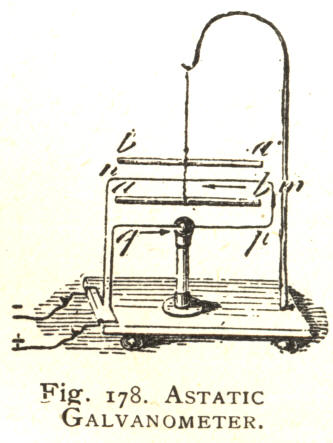
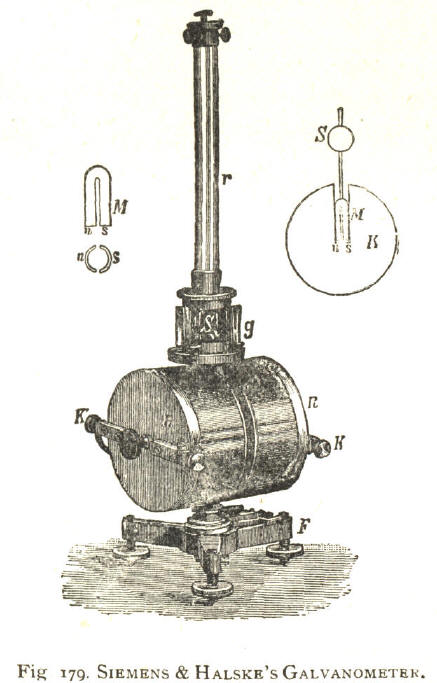
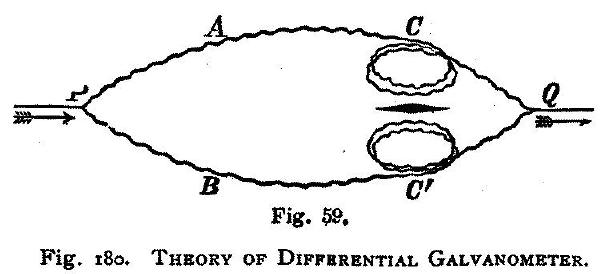
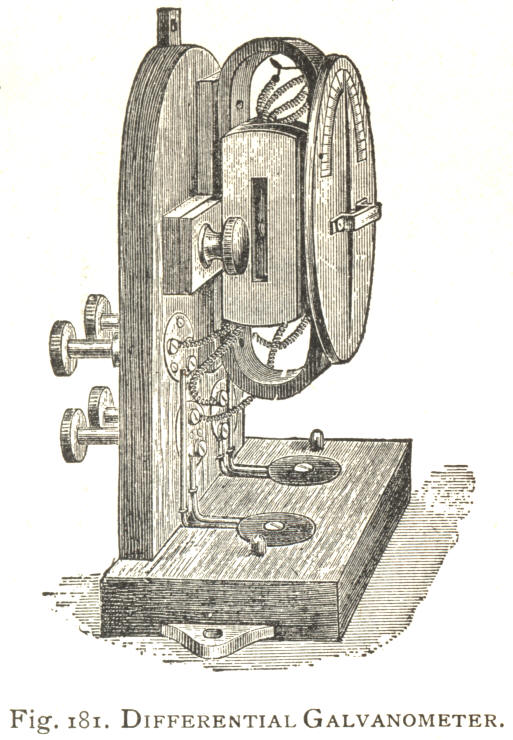
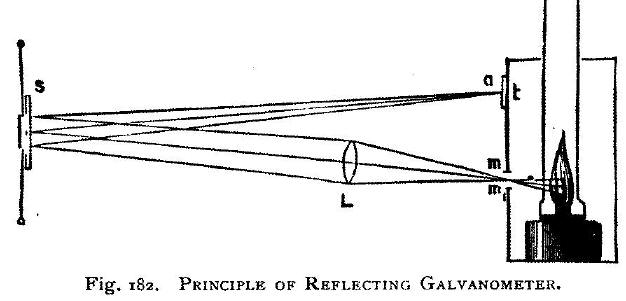
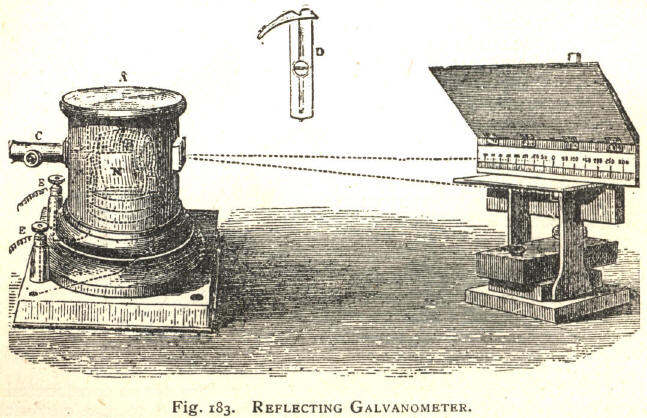
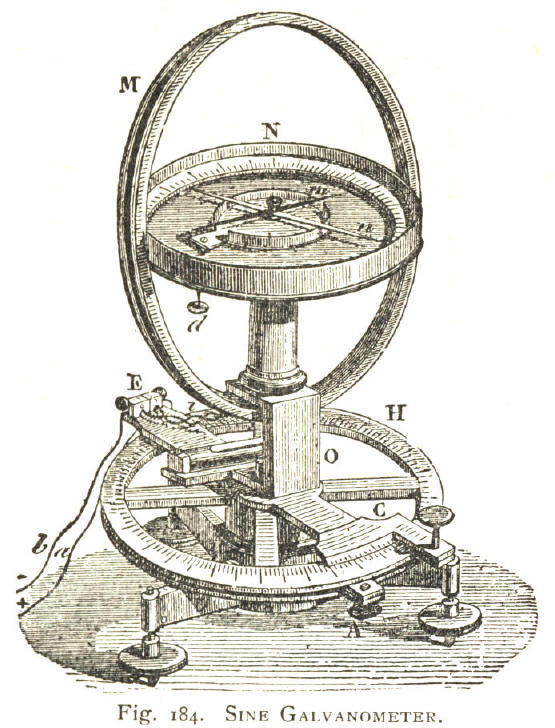
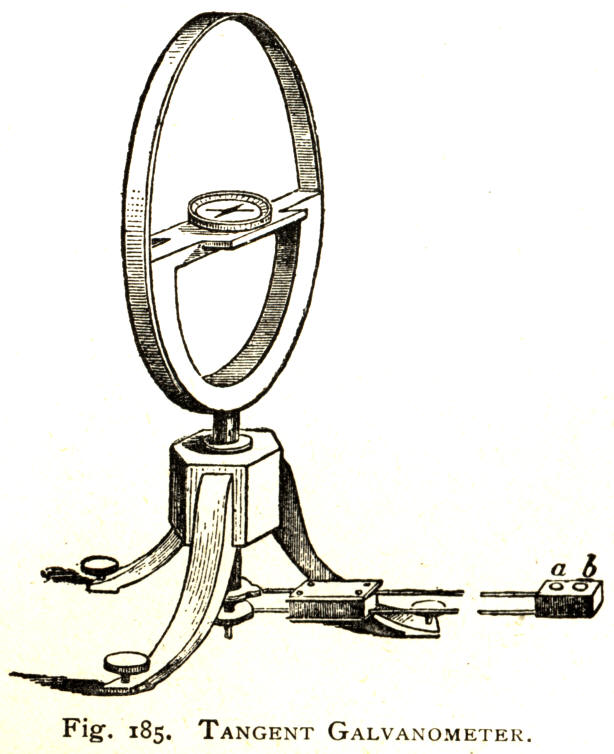
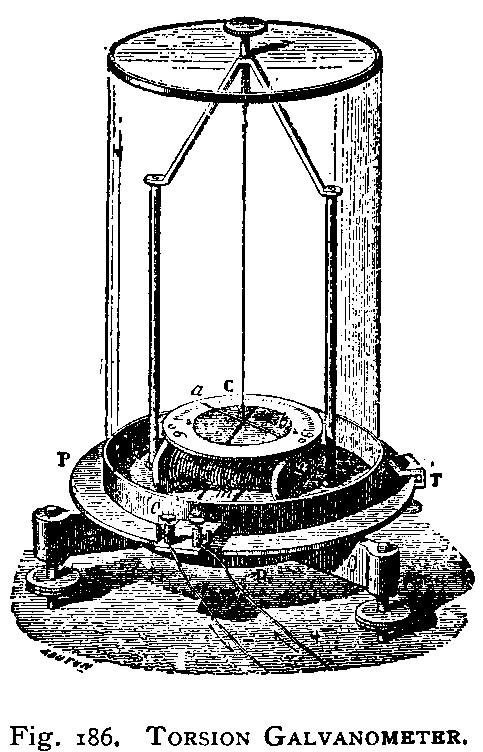
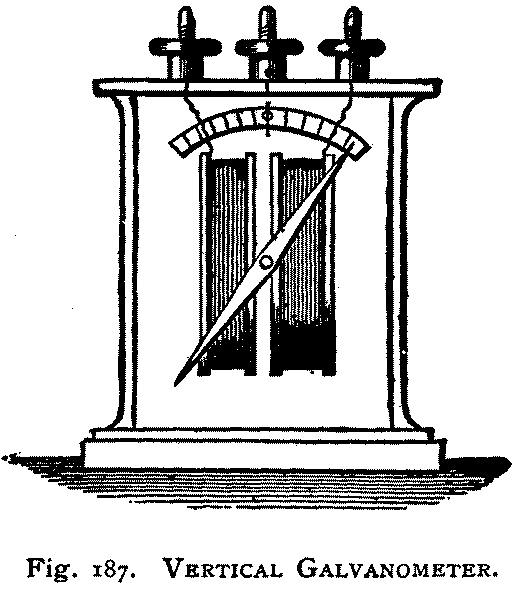
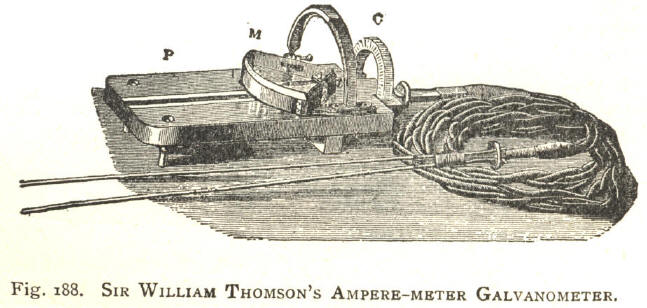
Fig. 188. SIR WILLIAM THOMSON'S AMPERE-METER GALVANOMETER. 275 STANDARD ELECTRICAL DICTIONARY. In the cut P is the base board, M is a glass covered case containing the magnetic needle, and sliding along the base board, being guided by the central groove, C, is the coil. Between the coil and the needle is the arched or bent controlling magnet. The long twisted connecting wires are seen on the right hand. Galvano-plastics. The deposition of metals by electrolysis, a disused term replaced by electro-deposition, electroplating, and electro-metallurgy. Galvano-puncture. An operation in medical electricity. (See Electro-puncture.) Galvanoscope. An instrument, generally of the galvanometer type, used for ascertaining whether a current is flowing or not. Any galvanoscope, when calibrated, if susceptible thereof, becomes a galvanometer. Gas, Electrolytic. Gas produced by the decomposition, generally of water, by electrolysis. It may be hydrogen or oxygen, or a mixture of the two, according to how it is collected. (See Gases, Mixed.) Gases, Mixed. The mixture of approximately one volume of oxygen and two volumes of hydrogen collected in the eudiometer of a gas voltameter or other electrolytic apparatus. Gassing. The evolution of gas from the plates of a storage battery in the charging process, due to too high voltage in the circuit of the charging dynamo. Gastroscope. An apparatus for illuminating by an incandescent lamp the interior of the stomach, and with prisms to refract the rays of light so that the part can be seen. The stomach is inflated with air, if desirable, to give a better view. An incandescent platinum spiral in a water jacket has been employed for the illumination. Gassiot's Cascade. A goblet lined for half its interior surface with tinfoil. It is placed in the receiver of an air pump from the top of whose bell a conductor descends into it, not touching the foil. On producing a good rarefaction, and discharging high tension electricity from between the conductor just mentioned and the metal of the machine, a luminous effect is produced, as if the electricity, pale blue in color, was overflowing the goblet. Gauss. A name suggested for unit intensity of magnetic field. Sylvanus P. Thomson proposed for its value the intensity of a field of 1E8 C. G. S. electro-magnetic units. J. A. Fleming proposed the strength of field which would develop one volt potential difference in a wire 1E6 centimeters long, moving through such field with a velocity of one centimeter per second. This is one hundred times greater than Thomson's standard. Sir William Thomson suggested the intensity of field produced by a current of one ampere at a distance of one centimeter The gauss is not used to any extent; practical calculations are based on electro-magnetic lines of force. 276 STANDARD ELECTRICAL DICTIONARY. Gauss' Principle. An electric circuit acts upon a magnetic pole in such a way as to make the number of lines of force that pass through the circuit a maximum. Fig. 189. GAUSS' TANGENT POSITION. Gauss, Tangent Positions of. The "end on" and "broadside" methods of determining magnetization involve positions which have been thus termed. (See Broadside Method and End on Method.) Gear, Magnetic Friction. Friction gear in which the component wheels are pressed against each other by electromagnetic action. In the cut, repeated from Adherence, Electro-magnetic, the magnetizing coil makes the wheels, which are of iron, press strongly together. Fig. 190. MAGNETIC FRICTION GEAR. 277 STANDARD ELECTRICAL DICTIONARY. Geissler Tubes. Sealed tubes of glass containing highly rarefied gases, and provided with platinum electrodes extending through the glass tightly sealed as they pass through it, and often extending a short distance beyond its interior surface. On passing through them the static discharge luminous effects are produced varying with the degree of exhaustion, the contents (gas), the glass itself, or solutions surrounding it. The two latter conditions involve fluorescence phenomena often of a very beautiful description. The pressure of the gas is less than one-half of a millimeter of mercury. If a complete vacuum is produced the discharge will not pass. If too high rarefaction is produced radiant matter phenomena (see Radiant State) occur. Geissler tubes have been used for lighting purposes as in mines, or for illuminating the interior cavities of the body in surgical or medical operations. Generating Plate. The positive plate in a voltaic couple, or the plate which is dissolved; generally a plate of zinc. Synonyms--Positive Plate--Positive Element. Generator, Current. Any apparatus for maintaining an electric current. It may be as regards the form of energy it converts into electrical energy, mechanical, as a magneto or dynamo electric machine or generator; thermal, as a thermo-electric battery; or chemical, as a voltaic battery; all of which may be consulted. Generator, Secondary. A secondary or storage battery. (See Battery, Secondary.) German Silver. An alloy of copper, 2 parts, nickel, 1 part, and zinc, 1 part. Owing to its high resistance and moderate cost and small variation in resistance with change of temperature, it is much used for resistances. From Dr. Mathiessen's experiment the following constants are deduced in legal ohms: Relative Resistance (Silver = 1), 13.92 Specific Resistance at 0° C. (32F.), 20.93 microhms. Resistance of a wire, (a) 1 foot long, weighing 1 grain, 2.622 ohms. 1 foot long, 1/1000 inch thick, 125.91 " 1 meter long, weighing 1 gram, 1.830 " 1 meter long, 1 millimeter thick, 0.2666 " Resistance of a 1 inch cube at 0°C. (32° F.), 8.240 microhms. Approximate percentage increase of resistance per 1° C. (1.8° F.) at about 20° C. (68° F.), 0.044 per cent. Gilding, Electro-. The deposition of gold by an electric current, or electrolytically in the electroplating bath. Gilding Metal. A special kind of brass, with a high percentage of copper, used to make objects which are to be gilded by electrolysis. 278 STANDARD ELECTRICAL DICTIONARY. Gimbals. A suspension used for ships' compasses and sometimes for other apparatus. It consists of a ring held by two journals, so as to bc free to swing in one plane. The compass is swung upon this ring, being placed concentrically therewith. Its journals are at right angles to those of the ring. This gives a universal joint by which the compass, weighted below its line of support, is always kept horizontal. Fig. 191. COMPASS SUSPENDED IN GIMBALS. Glass. A fused mixture of silicates of various oxides. It is of extremely varied composition and its electric constants vary greatly. Many determinations of its specific resistance have been made. For flint glass at 100° C. (212° F.) about (2.06E14) ohms --at 60° C (140° F.) (1.020E15) (Thomas Gray) is given, while another observer (Beetz) gives for glass at ordinary temperatures an immeasurably high resistance. It is therefore a non-conductor of very high order if dry. As a dielectric the specific inductive capacity of different samples of flint glass is given as 6.57--6.85--7.4--10.1 (Hopkinson), thus exceeding all other ordinary dielectrics. The densest glass, other things being equal, has the highest specific inductive capacity. Gold. A metal, one of the elements; symbol Au. c .; atomic weight, 196.8; equivalent, 65.6; valency, 3; specific gravity 19.5. It is a conductor of electricity. Annealed. Hard drawn. Relative Resistance (Annealed Silver = 1), 1.369 1.393 Specific Resistance, 2.058 2.094 Resistance of a wire at 0° C. (32°F.) (a) 1 foot long, weighing 1 grain, 57.85 58.84 ohms (b) 1 foot long, 1/1000 inch thick, 12.38 12.60 " (c) 1 meter long, weighing 1 gram, .4035 .4104 " (d) 1 meter long, 1 millimeter thick, .02620 .02668 " Resistance of a 1 inch cube at 0° C.(32° F.) .8102 .8247 Approximate increase in resistance per 0° C., (1.8° F) at about 20° C. (68° F.), 0.365 per cent. Electro-chemical equivalent (Hydrogen = .0105), .6888 279 STANDARD ELECTRICAL DICTIONARY. Gold Bath. A solution of gold used for depositing the metal in the electroplating process. A great number of formulae have been devised, of which a few representative ones are given here. COLD BATHS. HOT BATHS. Water, 10,000 10,000 10,000 10,000 5,000 3,000 Potassium Cyanide, 200 -- 200 10 -- 50 Gold, 100 15 100 10 10 10 Potassium Ferrocyanide, -- 200 -- -- 150 -- Potassium Carbonate, -- 150 -- -- 50 -- Ammonium Chloride, -- 30 -- -- 20 -- Aqua Ammoniae, -- -- 500 -- -- -- Sodium Phosphate, -- -- -- 600 -- -- Sodium Bisulphite, -- -- -- 100 -- -- (Roseleur.) In the baths the gold is added in the form of neutral chloride, Auric chloride (Au Cl6). Gold Stripping Bath. A bath for removing gold from plated articles without dissolving the base in order to save the precious metal. A bath of 10 parts of potassium cyanide and 100 parts of water may be used, the articles to be stripped being immersed therein as the anode of an active circuit. If the gilding is on a silver or copper basis, or on an alloy of these metals the same solution attacks the base and dissolves it, which is objectionable. For silver articles it is enough to heat to cherry red and throw into dilute sulphuric acid. The gold scales off in metallic spangles. For copper articles, a mixture of 10 volumes concentrated sulphuric acid, 1 volume nitric acid, and 2 volumes hydrochloric acid may be used by immersion only, or with a battery. The sulphuric acid in such large excess is supposed to protect the copper. For copper articles concentrated sulphuric acid alone with the battery may be used. This does not sensibly attack the copper if it is not allowed to become diluted. Even the dampness of the air may act to dilute it. Graduator. Apparatus for enabling the same line to be used for telegraph signals and telephoning. One type consists in coils with iron cores or simply electromagnets. These act to retard the current in reaching its full power and also prolong it. This gives a graduated effect to the signals, so that the telephone diaphragm is not audibly affected by the impulses. The telephoning current is so slight and so rapid in its characteristic changes that it is without effect upon the ordinary telegraph. 280 STANDARD ELECTRICAL DICTIONARY. Gram. The unit of weight in the metric system; accepted as the unit of mass in the absolute of C. G. S. system of units. It is the one-thousandth part of mass of a standard weight preserved under proper conditions in Paris, and supposed to be the mass of a cubic decimeter of distilled water at the temperature of the maximum density of water. The standard is the kilogram; the temperature is 3.9º C. (39º F.). The standard kilogram is found to be not exactly the weight of a cubic decimeter of water, the latter weighing 1.000013 kilogram. If therefore the defined gram on the water basis is taken as the unit it varies very slightly from the accepted gram. 1 gram is equal to 15.43234874 grains. (Prof. W. H. Miller.) Gram-atom. The number of grams of an element equal numerically to the atomic weight, as 16 grams of oxygen, 1 gram of hydrogen, 35.5 grams of chlorine; all which might be expressed as gram-atoms of oxygen, hydrogen and chlorine respectively. The gram-atom approximately expresses the number of gram-calories required to heat one gram of the substance 1º C. (1.8º F.). This is in virtue of Dulong and Petit's discovery that the atomic weight of an element multiplied by its specific heat gives approximately a constant for all elements. [Transcriber's note: A gram-atom is the mass, in grams, of one mole of atoms in a monatomic element. A mole consists of Avogadro's number of atoms, approximately 6.02214E23.] Gram-molecule. The number of grams of a substance equal numerically to its molecular weight. Graphite. Carbon; one of three allotropic modifications of this element. It occurs in nature as a mineral. It is used as a lubricant for machinery; for commutator brushes; for making surfaces to be plated conductive, and for mixing with manganese binoxide in Leclanché cells. Gravitation. A natural force which causes all masses of matter to attract each other. Its cause is unknown; it is often supposed to be due to the luminiferous ether. [Transcriber's note: Einstein's explanation of gravity, General Relativity and the curvature of space-time, came 23 years later, 1915.] 281 STANDARD ELECTRICAL DICTIONARY. Gravity, Acceleration of. The velocity imparted to a body in one second by the action of gravitation at any standard point upon the earth's surface in a vacuum. This will vary at different places, owing principally to the variation in centrifugal force due to the earth's rotation. For standard valuation it must be reduced to sea level. The following are examples of its variation: Equator, 978.1028 centimeters per second Paris, 980.94 " Greenwich 981.I7 " Edinburgh, 981.54 " Pole (N. or S.), 983.1084 (theoretical) " As round numbers for approximate calculations 981 centimeters or 32.2 feet may be employed. [Transcriber's note: The acceleration of gravity at the equator is also reduced by the increased distance from the center of the earth (equatorial bulge). Increased altitude reduces gravity. Reduced air density at altitude reduces buoyancy and increases apparent weight. Local variations of rock density affects gravity.] Gravity, Control. Control by weight. In some ammeters and voltmeters gravity is the controlling force. Grid. A lead plate perforated or ridged for use in a storage battery as the supporter of the active materials and in part as contributing thereto from its own substance. Ground. The contact of a conductor of an electric circuit with the earth, permitting the escape of current if another ground exists. Ground-wire. A metaphorical term applied to the earth when used as a return circuit. Fig. 192. GROVE'S GAS BATTERY. Grove's Gas Battery. A voltaic battery depending for its action on the oxidation of hydrogen instead of the oxidation of zinc. Its action is more particularly described under Battery, Gas. In the cut B, B1 * * * are the terminals of the positive or hydrogen electrodes, marked H, and A, Al * * * are the terminals of the negative or oxygen electrodes marked O, while M, M1 * * * is dilute sulphuric acid. 282 STANDARD ELECTRICAL DICTIONARY. Guard Ring. An annular horizontal surface surrounding the balanced disc in the absolute electrometer. (See Electrometer, Absolute.) Guard Tube. A metal tube surrounding a dry pile used with a quadrant electrometer, or other electrometers of that type. It prevents the capacity of the lower brass end of the pile (which brass end closes the glass tube containing the discs) from momentary change by approach of some conductor connected to the earth. There are other guard tubes also. Gun, Electro-magnetic. An electro-magnet with tubular core. If, when it is excited a piece of an iron rod is pushed into the central aperture of the core and is released, the magnetic circle will try to complete itself by pushing the rod out so that it can thus be discharged, as if from a popgun. Synonym--Electric Popgun. Fig. 193. "ELECTRIC POPGUN." Gutta Percha. The hardened milky juice of a tree, the Isonandra gutta, growing in Malacca and other parts of the Eastern Archipelago. It is much used as an insulator or constituent of insulators. Resistance after several minutes electrification per 1 centimeter cube at 54º C. (75º F.), 4.50E14 ohms. The specific resistance varies--from 2.5E13 to 5.0E14 ohms. A usual specification is 2.0E14 ohms. The influence of temperature on its resistance is given in Clark & Bright's empirical formula, R = R0 at, in which R is the resistance at temperature tº C--Ro the resistance at 0º C (32º F), a is the coefficient .8944. The resistance increases with the time of passage of the current, the variation being less the higher the temperature. 283 STANDARD ELECTRICAL DICTIONARY. Time of Relative Resistance Relative Resistance Electrification. at 0º C (32º F.) at 24º C (75º F.) 1 minute 100 5.51 2 " 127.9 6. 5 " 163.1 6.66 10 " 190.9 6.94 20 " 230.8 7.38 30 " 250.6 7.44 60 " 290.4 7.6 90 " 318.3 7.66 In cable testing one minute is generally taken as the time of electrification. Pressure increases the resistance by the formula Rp=R (1+ .00327 P) in which Rp is the resistance at pressure p--R resistance at atmospheric pressure--p pressure in atmospheres. Thus in the ocean at a depth of 4,000 meters (2.4855 miles), the resistance is more than doubled. The longer the pressure is applied, the greater is the resistance. The specific inductive capacity of gutta percha is 4.2. Good gutta percha should not break when struck with a hammer, should recover its shape slowly, and it should support much more than 300 times its own weight. Gyrostatic Action of Armatures. Owing to gyrostatic action a rotating armature resists any change of direction of its axis. On ships and in railway motors which have to turn curves this action occurs. A 148 lb. armature running at 1,300 revolutions per minute may press with 30 lbs. on each journal as the ship rolls through an angle of 20° in 16 seconds.
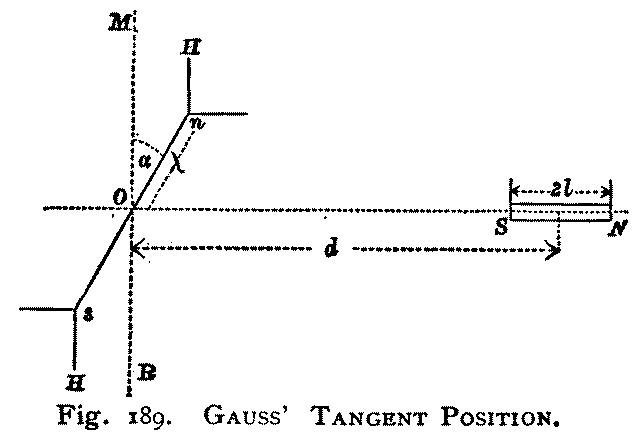
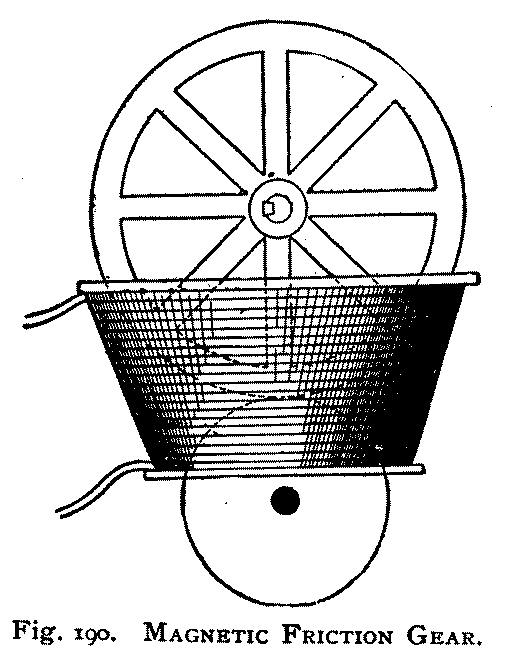
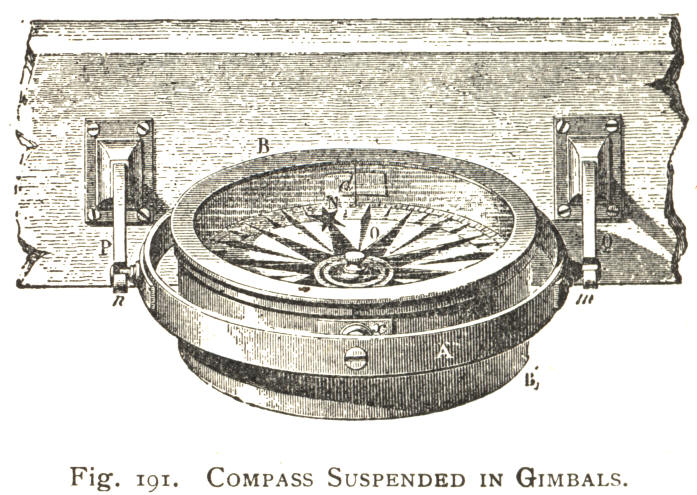
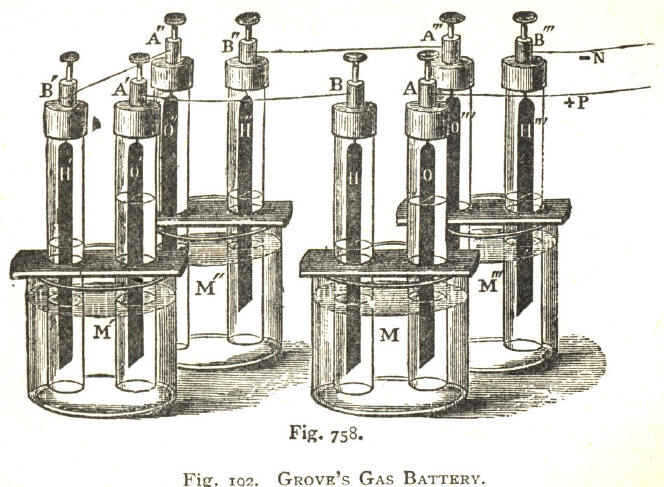
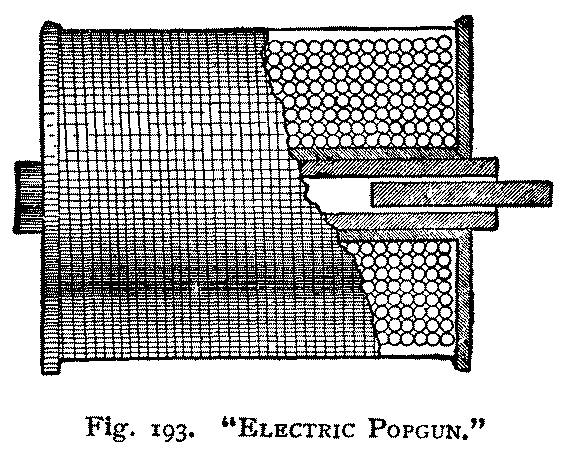
283 STANDARD ELECTRICAL DICTIONARY. H. (a) The symbol for the horizontal component of the earth's magnetization. (b) The symbol for the intensity of a magnetizing force or field. The symbol H, as it is generally used, may mean either the number of dynes which act upon a unit pole, or the number of lines of force per centimeter. (c) The symbol for the unit of self-induction. Hair, Removal of, by Electrolysis. A method of depilation by destruction of individual hair follicles by electrolysis. A fine platinum electrode is thrust into a hair follicle. It is the negative electrode. The positive electrode is in contact with the body of the person under treatment; it is often a sponge electrode simply held in his hand. A current of two to four milliamperes from an E. M. F. of 15 to 20 volts, is passed. This destroys the follicle, the hair is removed and never grows again. A gradual increase of current is advised for the face. As only one hair is removed at once, but a small number are taken out at a sitting. 284 STANDARD ELECTRICAL DICTIONARY. Haldat's Figures. With a pole of a strong bar magnet, used like a pencil, imaginary figures are drawn upon a hard steel plate, such as a saw-blade. The pattern is gone over several times. By dusting iron filings on a sheet of paper laid over the steel plate, while horizontal, very complicated magnetic figures are produced. Hall's Experiment. A cross of thin metal, such as gold leaf, is secured upon a pane of glass. To two opposite arms a battery is connected in circuit with them. To the other two arms a galvanometer is connected in circuit. If the cross is put into a field of force whose lines are perpendicular thereto, the galvanometer will disclose a constant current. The current is pushed, as it were, into the galvanometer circuit. Other metals have been used with similar results. They must be thin or the experiment fails. If the arm receiving the battery current is horizontal, and if it flows from left to right, and if the lines of force go from downward through the cross, the current in the galvanometer circuit will flow from the observer through the other arms of the cross, if the cross is of gold, silver, platinum or tin, and the reverse if of iron. The experiment has indicated a possible way of reaching the velocity of electricity in absolute measure. Hall Effect. The effect observed in Hall's experiment, q. v. Hall Effect, Real. A transverse electro-motive force in a conductor through which a current is passing produced by a magnetic field. Hall Effect, Spurious. A spurious electro-motive force produced in a conductor, through which a current is passing by changes in conductivity of the conductor brought about by a magnetic field. Hanger Board. A board containing two terminals, a suspending hook, and a switch, so that an arc lamp can be introduced into a circuit thereby, or can be removed as desired. Harmonic Receiver. A receiver containing a vibrating reed, acted on by an electro-magnet. Such a reed answers only to impulses tuned to its own pitch. If such are received from the magnet it will vibrate. Impulses not in tune with it will not affect it. (See Telegraph, Harmonic.) Head Bath, Electric. A fanciful name for an electro-medical treatment of the head. The patient is insulated by an insulating stool or otherwise. His person is connected with one terminal of an influence machine. An insulated metallic circle, with points of metal projecting inward or downward, is placed about the head. The circle is connected with the other pole of the machine. On working it a silent or brush discharge with air convection streams occurs between the patient's head and the circle of points. 285 STANDARD ELECTRICAL DICTIONARY. Head-light, Electric. An electric head-light for locomotives has been experimented with. It includes the parabolic reflection of the regular light with an arc-lamp in place of the oil lamp. An incandescent lamp may be used in the same place, but has no great advantage over oil as regards illuminating power. Heat. A form of kinetic energy, due to a confused oscillatory movement of the molecules of a body. Heat is not motion, as a heated body does not change its place; it is not momentum, but it is the energy of motion. If the quantity of molecular motion is doubled the momentum of the molecules is also doubled, but the molecular mechanical energy or heat is quadrupled. As a form of energy it is measured by thermal units. The calorie is the most important, and unfortunately the same term applies to two units, the gram-degree C. and the kilogram-degree C. (See Calorie.) Calories are determined by a calorimeter, q. v. Independent of quantity of heat a body may be hotter or colder. Thermometers are used to determine its temperature. Heat is transmitted by conduction, a body conducting it slowly for some distance through its own substance. Bodies vary greatly in their conductivity for heat. It is also transmitted by convection of gases or liquids, when the heated molecules traveling through the mass impart their heat to other parts. Finally it is transmitted by ether waves with probably the speed of light. This mode of transmission and the phenomena of it were attributed to radiant heat. As a scientific term this is now dropped by many scientists. This practice very properly restricts the term "heat" to kinetic molecular motion. The mechanical equivalent of heat is the number of units of work which the energy of one unit quantity of heat represents. (See Equivalents, Mechanical and Physical.) Heat, Atomic. The product of the specific heat of an element by its atomic weight. The product is approximately the same for all the elements, and varies as determined between 5.39 and 6.87. The variations are by some attributed principally to imperfection of the work in determining them. The atomic heat represents the number of gram calories required to raise the temperature of a gram atom (a number of grams equal numerically to the atomic weight) one degree centigrade. 286 STANDARD ELECTRICAL DICTIONARY. Heat, Electric. This term has been given to the heat produced by the passage of a current of electricity through a conductor. It is really electrically produced heat, the above term being a misnomer. The rise of temperature produced in a cylindrical conductor by a current depends upon the diameter of the conductor and on the current. The length of the wire has only the indirect connection that the current will depend upon the resistance and consequently upon its length. The quantity of heat produced in a conductor by a current is in gram-degree C. units equal to the product of the current, by the electro-motive force or potential difference maintained between the ends of the wire, by .24. The cube of the diameter of a wire for a given rise of temperature produced in such conductor by a current is equal approximately to the product of the square of the current, by the specific resistance (q. v.) of the material of the conductor, by .000391, the whole divided by the desired temperature in centigrade units. Heat, Electrical Convection of. A term applied to the phenomena included under the Thomson effect, q. v., the unequal or differential heating effect produced by a current of electricity in conductors whose different parts are maintained at different temperatures. Heater, Electric. An apparatus for converting electrical energy into thermal energy. An incandescent lamp represents the principle, and in the Edison meter has been used as such to maintain the temperature of the solutions. Heaters for warming water and other purposes have been constructed, utilizing conductors heated by the passage of the current as a source of heat. (See also Heating Magnet.) Heating Error. In voltmeters the error due to alteration of resistance of the coil by heating. If too strong a current is sent through the instrument, the coils become heated and their resistance increased. They then do not pass as much current as they should for the potential difference to which they may be exposed. Their readings then will be too low. One way of avoiding the trouble is to have a key in circuit, and to pass only an instantaneous or very brief current through the instrument and thus get the reading before the coils have time to heat. The heating error does not exist for ammeters, as they are constructed to receive the entire current, and any heating "error" within their range is allowed for in the dividing of the scale. Heating Magnet. An electro-magnet designed to be heated by Foucault currents induced in its core by varying currents in the windings. It has been proposed as a source of artificial heat, a species of electric heating apparatus for warming water, or other purposes. 287 STANDARD ELECTRICAL DICTIONARY. Heat, Irreversible. The heat produced by an electric current in a conductor of identical qualities and temperature throughout. Such heat is the same whatever the direction of the current. The heating effect is irreversible because of the absence of the Thomson effect, q. v.) or Peltier effect, q. v. Heat, Mechanical Equivalent of. The mechanical energy corresponding to a given quantity of heat energy. Mechanical energy is generally represented by some unit of weight and height, such as the foot-pound; and heat energy is represented by a given weight of water heated a given amount, such as a pound-degree centigrade. Joule's equivalent is usually accepted; it states that 772.55 foot pounds of mechanical energy are equivalent to 1 pound-degree F. (one pound avds. of water raised in temperature one degree Fahrenheit). Other equivalencies have also been deduced. Heat, Molecular. The product of a specific heat of the compound by its molecular weight. It is approximately equal to the sum of the atomic heats of its constituent elements. The molecular heat represents the number of gram calories required to raise the temperature of a gram-molecule (a number of grams equal numerically to the molecular weight) one degree centigrade. The molecular heat is approximately equal for all substances. Heat, Specific. The capacity of a body for heat; a coefficient representing the relative quantity of heat required to raise the temperature of an identical weight of a given body a defined and identical amount. The standard of comparison is water; its specific heat is taken as unity. The specific heats by weight of other substances are less than unity. The specific heat varies with the temperature. Thus the specific heat of water is more strictly 1+.00015 tº C. Specific heat is greater when a substance is in the liquid than when it is in the solid state. Thus the specific heat of ice is 0.489; less than half that of water. It differs with the allotropic modifications of bodies; the specific heat of graphite is .202; of diamond, .147. The product of the specific heat by the atomic weight of elements gives a figure approximately the same. A similar law applies in the case of molecules. (See Heat, Atomic-Heat, Molecular.) The true specific heat of a substance should be separated from the heat expended in expanding a body against molecular and atomic forces, and against the atmospheric pressure. So far this separation has not been possible to introduce in any calculations. 288 STANDARD ELECTRICAL DICTIONARY. Heat, Specific, of Electricity. A proposed term to account for the heat absorbed or given out in unhomogeneous conductors, by the Thomson effect, or Peltier effect (see Effect, Thomson--Effect, Peltier.) If a current of electricity be assumed to exist, then under the action of these effects it may be regarded as absorbing or giving out so many coulombs of heat, and thus establishing a basis for specific heat. Heat Units. The British unit of heat is the pound degree F--the quantity of heat required to raise the temperature of a pound of water from 32° to 33° F. The C. G. S. unit is the gram-degree C.; another metric unit is the kilogram-degree C. The latter is the calorie; the former is sometimes called the small calorie or the joule; the latter is sometimes called the large calorie. The term joule is also applied to a quantity of heat equivalent to the energy of a watt-second or volt-coulomb. This is equal to .24l gram degree calorie. Hecto. A prefix to terms of measurement--meaning one hundred times, as hectometer, one hundred meters. Heliograph. An apparatus for reflecting flashes of light to a distant observer. By using the Morse telegraph code messages may thus be transmitted long distances. When possible the sun's light is used. Helix. A coil of wire; properly a coil wound so as to follow the outlines of a screw without overlaying itself. Fig. 194. LEFT-HANDED HELIX. Fig. 195. RIGHT-HANDED HELIX. Henry. The practical unit of electro-magnetic or magnetic inductance. It is equal to 1E9 C. G. S., or absolute units of inductance. As the dimensions of inductance are a length the henry is equal to 1E9 centimeters, or approximately to one quadrant of the earth measured on the meridian. Synonyms--Secohm--Quadrant--Quad. 289 STANDARD ELECTRICAL DICTIONARY. Hermetically Sealed. Closed absolutely tight. Glass vessels, such as the bulbs of incandescent lamps, are hermetically sealed often by melting the glass together over any opening into their interior. Heterostatic Method. A method of using the absolute or attracted disc electrometer. (See Electrometer Absolute.) The formula for its idiostatic use, q. v., involves the determination of d, the distance between the suspended and fixed discs. As this is difficult to determine the suspended disc and guard ring may be kept at one potential and the lower fixed disc is then connected successively with the two points whose potential difference is to be determined. Their difference is determined by the difference between d and d', the two distances between the discs. This difference is the distance through which the micrometer screw is moved. The heterostatic formula is: V' - V = (d' - d)* squareRoot( 8*PI*F / S ) in which V and V' are potentials of the two points; d' and d the two distances between the discs necessary for equilibrium; S the area of the disc and F the force of attraction in dynes. (See Idiostatic Method.) High Bars of Commutator. Commutator bars, which in the natural wear of the commutator, project beyond the others. The surface then requires turning down, as it should be quite cylindrical. High Frequency. A term used as a noun or as an adjective to indicate in an alternating current, the production of a very great number of alternations per unit of time--usually expressed as alternations per second. Hissing. A term applied to a noise sometimes produced by a voltaic arc; probably due to the same cause as frying, q. v. Hittorf's Solution. A solution used as a resistance. It is a solution of cadmium iodide in amylic alcohol. Ten per cent. of the salt is used. It is contained in a tube with metallic cadmium electrodes. (See Resistance, Hittorf' s.) Fig. 196. HITTORF'S RESISTANCE TUBE. 290 STANDARD ELECTRICAL DICTIONARY. Holders. (a) The adjustable clamps for holding the armature brushes of dynamos and motors. (b) The clamps for holding the carbons of arc lamps. (c) The clamps for holding safety fuses, q. v. (d) Holders for Jablochkoff candles and other electric candles. (See Candle Holders.) (e) A box or block of porcelain for holding safety fuses. Hood. A tin hood placed over an arc-lamp. Such hoods are often truncated cones in shape, with the small end upwards. They reflect a certain amount of light besides protecting the lamp to some extent from rain. Horns. The extensions of the pole pieces of a dynamo or motor. (See Following Horns-Leading Horns.) Synonym--Pole Tips. Horse Power. A unit of rate of work or activity. There are two horse powers. The British horse power is equal to 33,000 pounds raised one foot per minute, or 550 foot pounds per second, or 1.0138 metric horse power. The metric horse power (French) is equal to 75 kilogram-meters, or 542 foot pounds per second, or .986356 British horse power. H. P. is the abbreviation for horse power. (See Horse Power, Electric.) Horse Power, Actual. The rate of activity of a machine, as actually developed in condition for use. It is less than the indicated or total horse power, because diminished by the hurtful resistances of friction, and other sources of waste. It is the horse power that can be used in practise, and which in the case of a motor can be taken from the fly-wheel. Horse Power, Electric. The equivalent of a mechanical horse power in electric units, generally in volt-amperes or watts; 745.943 watts are equivalent to the activity of one British horse power; 735.75 are equivalent to one metric horse power. The number 746 is usually taken in practical calculations to give the equivalency. [Transcriber's note: Contemporary values are: Mechanical (British) horsepower = 745.6999 Watts; Metric horsepower = 735.49875 Watts] Horse Power, Indicated. The horse power of an engine as indicated by its steam pressure, length of stroke, and piston area, and vacuum, without making any deduction for friction or hurtful resistances. The steam pressure is in accurate work deduced from indicator diagrams. Horse Power, Hour. A horse power exerted for one hour, or the equivalent thereof. As the horse power is a unit of activity, the horse power hour is a unit of work or of energy. It is equal to 1,980,000 foot pounds. H. P. Abbreviation for "horse power." 291 STANDARD ELECTRICAL DICTIONARY. Hughes' Electro-magnet. A horseshoe electro-magnet with polarized core. It is made by mounting two bobbins of insulated wire on the ends of a permanent horseshoe magnet. It was devised for use in Hughes' printing telegraph, where very quick action is required. The contact lasts only .053 second, 185 letters being transmitted per minute. Fig. 197 HUGHES' ELECTRO-MAGNET. Fig. 198. HUGHES' INDUCTION BALANCE. Hughes' Induction Balance. An apparatus for determining the presence of a concealed mass of metal. The apparatus is variously connected. The cut shows a representative form; a and a' are two primary coils, each consisting of 100 meters (328 feet) of No. 32 silk covered copper wire (0.009 inch diameter) wound on a boxwood spool ten inches in depth; b and b' are secondary coils. All coils are supposed to be alike. The primary coils are joined in series with a battery of three or four Daniell cells. A microphone m is included in the same circuit. The secondary coils are joined in series with a telephone and in opposition with each other. The clock is used to produce a sound affecting the microphone. If all is exactly balanced there will be no sound produced in the telephone. This balance is brought about by slightly varying the distance of one of the secondaries from the primary, until there is no sound in the telephone. If now a piece of metal is placed within either of the coils, it disturbs the balance and the telephone sounds. 292 STANDARD ELECTRICAL DICTIONARY. To measure the forces acting a sonometer or audiometer is used. This is shown in the upper part of the cut. Two fixed coils, c and e are mounted at the ends of a graduated bar. A movable coil d is connected in the telephone circuit; c and e by a switch can be connected with the battery and microphone circuit, leaving out the induction balance coils. The ends of the coils c and e, facing each other are of the same polarity. If these coils, c and e, were equal in all respects, no sound would be produced when d was midway between them. But they are so wound that the zero position for d is very near one of them, c. Assume that a balance has been obtained in the induction balance with the coil d at zero. No sound is heard whether the switch is moved to throw the current into one or the other circuit. A piece of metal placed in one of the balance coils will cause the production of a sound. The current is turned into the sonometer and d is moved until the same sound, as tested by rapid movements of the switch, is heard in both circuits. The displacement of d gives the value of the sound. A milligram of copper is enough to produce a loud sound. Two coins can be balanced against each other, and by rubbing one of them, or by breathing on one of them, the balance will be disturbed and a sound will be produced. Prof. Hughes has also dispensed with the audiometer. He has used a strip of zinc tapering from a width of 4 mm. (.16 inch) at one end to a sharp edge or point at the other. The piece to be tested being in place in one coil, the strip is moved across the face of the other until a balance is obtained. As possible uses the detection of counterfeit coins, the testing of metals for similarity of composition and the location of bullets in the body have been suggested. Care has to be taken that no masses of metal interfere. Thus in tests of the person of a wounded man, the presence of an iron truss, or of metallic bed springs may invalidate all conclusions. The same principle is carried out in an apparatus in which the parts are arranged like the members of a Wheatstone bridge. One pair of coils is used, which react on each other as primary and secondary coils. One of the coils is in series with a telephone in the member of the bridge corresponding to that containing the galvanometer of the Wheatstone bridge. The latter is more properly termed an induction bridge. Synonyms--Inductance Bridge--Inductance Balance--Induction Bridge. 293 STANDARD ELECTRICAL DICTIONARY. Hydro-electric. adj. (a) A current produced by a voltaic couple or the couple itself is sometimes thus characterized or designated as a "hydro-electric current" or a "hydro-electric couple." It distinguishes them from thermo-electric. (b) Armstrong's steam boiler electric machine (see Hydroelectric Machine) is also termed a hydro-electric machine. Hydro-electric Machine. An apparatus for generating high potential difference by the escape of steam through proper nozzles. It consists of a boiler mounted on four glass legs or otherwise insulated. An escape pipe terminates in a series of outlets so shaped as to impede the escape of the steam by forcing it out of the direct course. These jets are lined with hard wood. They are enclosed in or led through a box which is filled with cold water. Fig. 199. ARMSTRONG'S HYDRO-ELECTRIC MACHINE. This is to partly condense the steam so as to get it into the vesicular state, which is found essential to its action. Dry steam produces no excitation. If the boiler is fired and the steam is permitted to escape under the above conditions the vesicles presumably, or the "steam" is found to be electrified. A collecting comb held against the jet becomes charged and charges any connected surface. 294 STANDARD ELECTRICAL DICTIONARY. The boiler in the above case is negatively and the escaping "steam" is positively charged. By changing the material of the linings of the jets, or by adding turpentine the sign of the electricity is reversed. If the water contains acid or salts no electricity is produced. The regular hydro-electric machine is due to Sir William Armstrong. Faraday obtained similar results with moist air currents. Hydrogen. An element existing under all except the most extreme artificial conditions of pressure and cold as a gas. It is the lightest of known substances. Atomic weight, 1; molecular weight, 2; equivalent, 1; valency, 1; specific gravity, .0691-.0695. (Dumas & Boussingault.) It is a dielectric of about the same resistance as air. Its specific inductive capacity at atmospheric pressure is: .9997 (Baltzman) .9998 (Ayrton) Electro-chemical equivalent, .0105 milligram. The above is usually taken as correct. Other values are as follows: .010521 (Kohllrausch) .010415 (Mascart) The electro-chemical equivalent of any element is obtained by multiplying its equivalent by the electro-chemical equivalent of hydrogen. The value .0105 has been used throughout this book. Hygrometer. An instrument for determining the moisture in the air. One form consists of a pair of thermometers, one of which has its bulb wrapped in cloth which is kept moist during the observation. The evaporation is more or less rapid according to the dryness or moisture of the air, and as the temperature varies with this evaporation the relative readings of the two thermometers give the basis for calculating the hygrometric state of the air. Another form determines the temperature at which dew is deposited on a silver surface, whence the calculations are made. Hysteresis, Magnetic. A phenomenon of magnetization of iron. It may be attributed to a sort of internal or molecular friction, causing energy to be absorbed when iron is magnetized. Whenever therefore the polarity or direction of magnetization of a mass of iron is rapidly changed a considerable expenditure of energy is required. It is attributed to the work done in bringing the molecules into the position of polarity. 295 STANDARD ELECTRICAL DICTIONARY. The electric energy lost by hysteresis may be reduced by vibrations or jarring imparted to the iron, thus virtually substituting mechanical for electrical work. On account of hysteresis the induced magnetization of a piece of iron or steel for fields of low intensity will depend on the manner in which the material has been already magnetized. Let the intensity of field increase, the magnetization increasing also; then lower the intensity; the substance tends to and does retain some of its magnetism. Then on again strengthening the field it will have something to build on, so that when it attains its former intensity the magnetization will exceed its former value. For a moderate value of intensity of field the magnetization can have many values within certain limits. Synonym--Hysteresis--Hysteresis, Static--Magnetic Friction. Hysteresis, Viscous. The gradual increase or creeping up of magnetization when a magnetic force is applied with absolute steadiness to a piece of iron. It may last for half an hour or more and amount to several per cent. of the total magnetization. It is a true magnetic lag.