Front matter (continued 3)
Reading edition
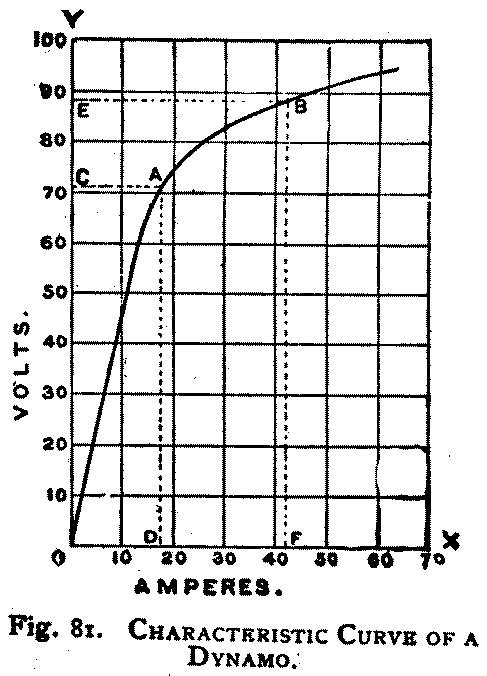
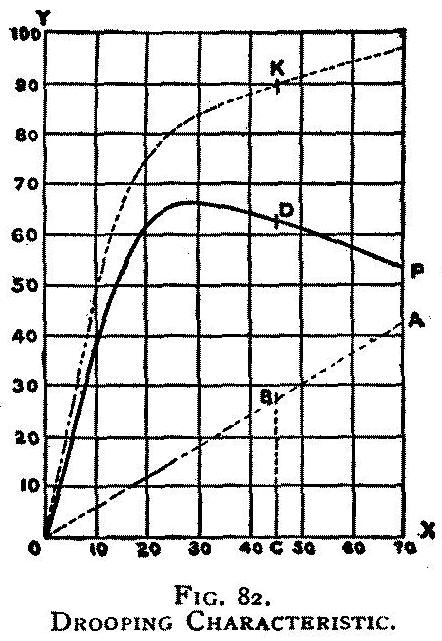
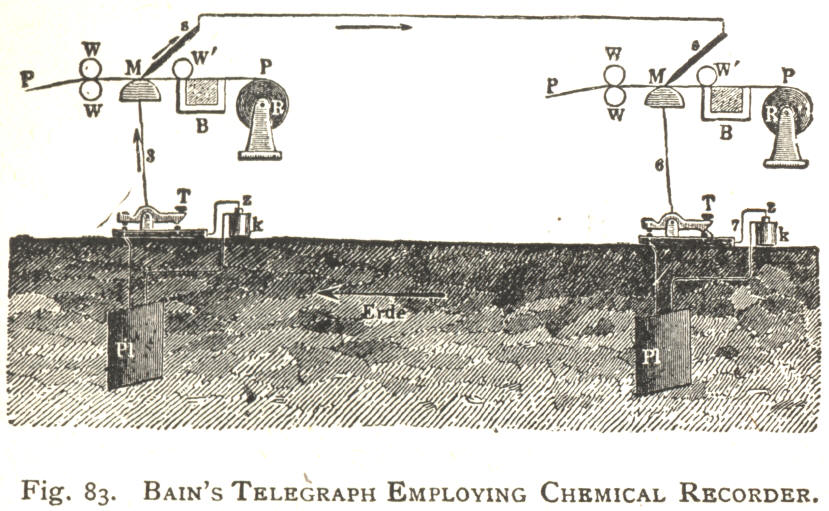
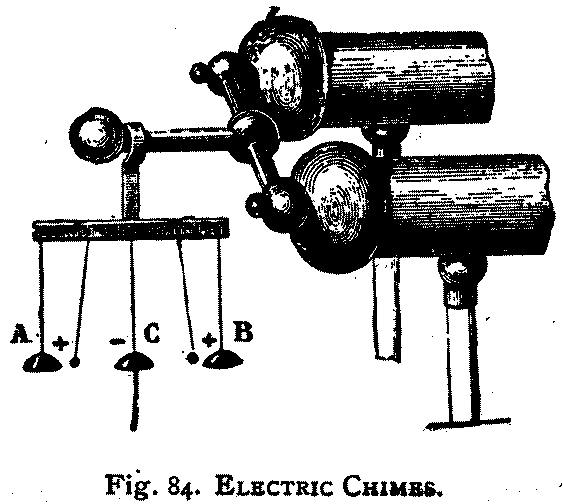
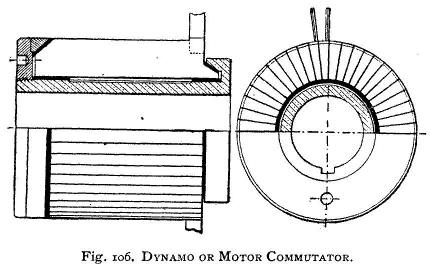
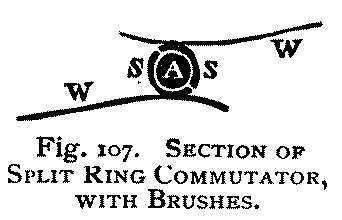
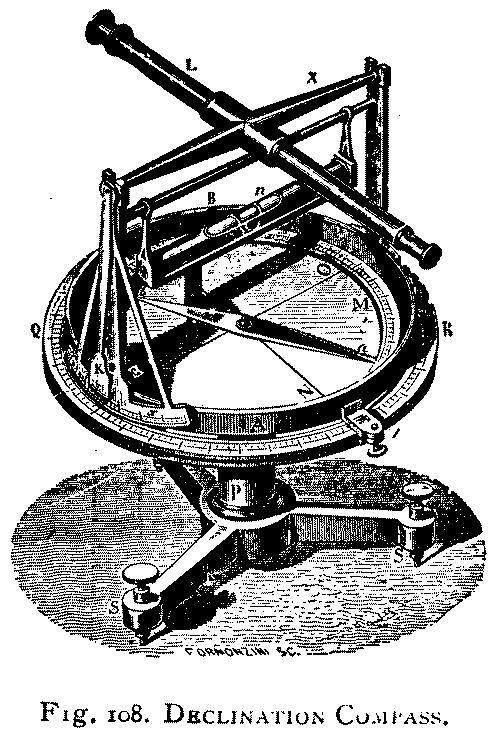
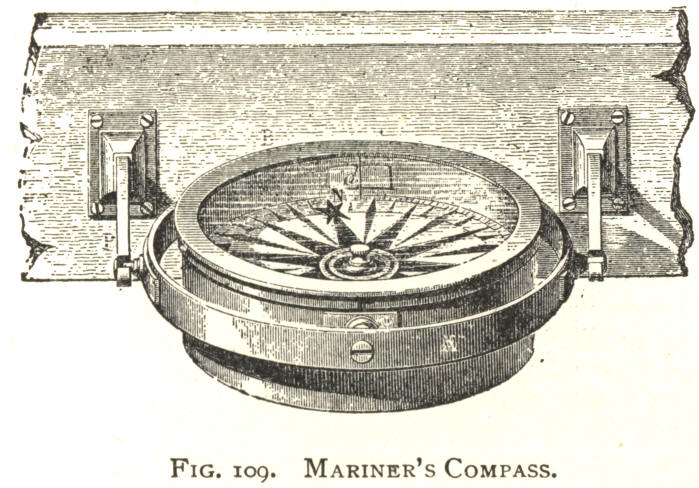
176 STANDARD ELECTRICAL DICTIONARY. Damper. (a) A copper frame on which the wire in a galvanometer is sometimes coiled, which acts to damp the oscillations of the needle. (b) A tube of brass or copper placed between the primary and secondary coils of an induction coil. It cuts off induction and diminishes the current and potential of the secondary circuit. On pulling it out, the latter increases. It is used on medical coils to adjust their strength of action. Damping. Preventing the indicator of an instrument from oscillating in virtue of its own inertia or elasticity. In a galvanometer it is defined as resistance to quick vibrations of the needle, in consequence of which it is rapidly brought to rest when deflected (Ayrton). In dead-beat galvanometers (see Galvanometer, Dead-Beat,) damping is desirable in order to bring the needle to rest quickly; in ballistic galvanometers (see Galvanometer, Ballistic,) damping is avoided in order to maintain the principle of the instrument. Damping may be mechanical, the frictional resistance of air to an air-vane, or of a liquid to an immersed diaphragm or loosely fitting piston, being employed. A dash-pot, q. v., is an example of the latter. It may be electro-magnetic. A mass of metal near a swinging magnetic needle tends by induced currents to arrest the oscillations thereof, and is used for this purpose in dead-beat galvanometers. This is termed, sometimes, magnetic friction. The essence of damping is to develop resistance to movement in some ratio proportional to velocity, so that no resistance is offered to the indicator slowly taking its true position. (See Galvanometer, Dead-Beat.) Dash-Pot. A cylinder and piston, the latter loosely fitting or perforated, or some equivalent means being provided to permit movement. The cylinder may contain a liquid such as glycerine, or air only. Thus the piston is perfectly free to move, but any oscillations are damped (see Damping). In some arc lamps the carbon holder is connected to a dash-pot to check too sudden movements of the carbon. The attachment may be either to the piston or to the cylinder. In the Brush lamp the top of the carbon holder forms a cylinder containing glycerine, and in it a loosely fitting piston works. This acts as a dash-pot. Dead Beat. adj. Reaching its reading quickly; applied to instruments having a moving indicator, which normally would oscillate back and forth a number of times before reaching its reading were it not prevented by damping. (See Galvanometer, Aperiodic--Damping.) Dead Earth. A fault in a telegraph line which consists in the wire being thoroughly grounded or connected to the earth. 177 STANDARD ELECTRICAL DICTIONARY. Dead Point of an Alternator. A two-phase alternator of the ordinary type connected as a motor to another alternator cannot start itself, as it has dead points where the relations and polarity of field and armature are such that there is no torque or turning power. Dead-Turns. In the winding of an armature, a given percentage of the turns, it may be 80 per cent., more or less, is assumed to be active; the other 20 per cent. or thereabouts, is called dead-turns. This portion represents the wire on such portions of the armature as comes virtually outside of the magnetic field. They are termed dead, as not concurring to the production of electro-motive force. Dead Wire. (a) The percentage or portion of wire on a dynamo or motor armature that does not concur in the production of electromotive force. The dead-turns, q. v., of a drum armature or the inside wire in a Gramme ring armature are dead wire. (b) A disused and abandoned electric conductor, such as a telegraph wire. (c) A wire in use, but through which, at the time of speaking, no current is passing. Death, Electrical. Death resulting from electricity discharged through the animal system. The exact conditions requisite for fatal results have not been determined. High electro-motive force is absolutely essential; a changing current, pulsatory or alternating, is most fatal, possibly because of the high electro-motive force of a portion of each period. Amperage probably has something to do with it, although the total quantity in coulombs may be very small. As applied to the execution of criminals, the victim is seated in a chair and strapped thereto. One electrode with wet padded surface is placed against his head or some adjacent part. Another electrode is placed against some of the lower parts, and a current from an alternating dynamo passed for 15 seconds or more. The potential difference of the electrodes is given at 1,500 to 2,000 volts, but of course the maximum may be two or three times the measured amount, owing to the character of the current. Decalescence. The converse of recalescence, q. v. When a mass of steel is being heated as it reaches the temperature of recalescence it suddenly absorbs a large amount of heat, apparently growing cooler. Deci. Prefix originally used in the metric system to signify one-tenth of, now extended to general scientific units. Thus decimeter means one-tenth of a meter; decigram, one-tenth of a gram. Declination, Angle of. The angle intercepted between the true meridian and the axis of a magnetic needle at any place. The angle is measured to east or west, starting from the true meridian as zero. 178 STANDARD ELECTRICAL DICTIONARY. Declination of the Magnetic Needle. The deviation of the magnetic needle from the plane of the earth's meridian. It is also called the variation of the compass. (See Magnetic Elements.) Decomposition. The reduction of a compound substance into its constituents, as in chemical analysis. The constituents may themselves be compounds or proximate constituents, or may be elemental or ultimate constituents. Decomposition, Electrolytic. The decomposition or separation of a compound liquid into its constituents by electrolysis. The liquid must be an electrolyte, q. v., and the decomposition proceeds subject to the laws of electrolysis, q. v. See also Electrolytic Analysis. Decrement. When a suspension needle which has been disturbed is oscillating the swings gradually decrease in amplitude if there is any damping, as there always is. The decrement is the ratio of the amplitude of one oscillation to the succeeding one. This ratio is the same for any successive swings. De-energize. To cut off its supply of electric energy from an electric motor, or any device absorbing and worked by electric energy. Deflagration. The explosive or violent volatilizing and dissipating of a substance by heat, violent oxidation and similar means. It may be applied among other things to the destroying of a conductor by an intense current, or the volatilization of any material by the electric arc. Deflecting Field. The field produced in a galvanometer by the current which is being tested, and which field deflects the needle, such deflection being the measure of the current strength. Deflection. In magnetism the movement out of the plane of the magnetic meridian of a magnetic needle, due to disturbance by or attraction towards a mass of iron or another magnet. Deflection Method. The method of electrical measurements in which the deflection of the index of the measuring instrument is used as the measure of the current or other element under examination. It is the opposite of and is to be distinguished from the zero or null method, q. v. In the latter conditions are established which make the index point to zero and from the conditions necessary for this the measurement is deduced. The Wheatstone Bridge, q. v., illustrates a zero method, the sine or the tangent compass, illustrates a deflection method. The use of deflection methods involves calibration, q. v., and the commercial measuring instruments, such as ammeters and volt meters, which are frequently calibrated galvanometers, are also examples of deflection instruments. 179 STANDARD ELECTRICAL DICTIONARY. Degeneration, Reaction of. The diminished sensibility to electro-therapeutic treatment exhibited by the human system with continuance of the treatment in question. The general lines of variation are stated in works on the subject. Deka. Prefix originally used in the metric system to signify multiplying by ten, as dekameter, ten meters, dekagram, ten grams; now extended to many scientific terms. De la Rive's Floating Battery. A small galvanic couple, immersed in a little floating cell and connected through a coil of wire immediately above them. When the exciting battery solution is placed in the cell the whole, as it floats in a larger vessel, turns until the coil lies at right angles to the magnetic needle. Sometimes the two plates are thrust through a cork and floated thus in a vessel of dilute sulphuric acid. A magnet acts to attract or repel the coil in obedience to Ampére's Theory, (See Magnetism, Ampere's Theory of.) Delaurier's Solution. A solution for batteries of the Bunsen and Grenet type. It is of the following composition: Water, 2,000 parts; potassium bichromate, 184 parts; sulphuric acid, 428 parts. Demagnetization. Removal of magnetism from a paramagnetic substance. It is principally used for watches which have become magnetized by exposure to the magnetic field surrounding dynamos or motors. The general principles of most methods are to rotate the object, as a watch, in a strong field, and while it is rotating to gradually remove it from the field, or to gradually reduce the intensity of the field itself to zero. A conical coil of wire within which the field is produced in which the watch is placed is sometimes used, the idea being that the field within such a coil is strongest at its base. Such a coil supplied by an alternating current is found effectual (J. J. Wright). If a magnetized watch is made to turn rapidly at the end of a twisted string and is gradually brought near to and withdrawn from the poles of a powerful dynamo it may be considerably improved. A hollow coil of wire connected with a pole changer and dip-battery has been used. The battery creates a strong field within the coil. The watch is placed there and the pole changer is worked so as to reverse the polarity of the field very frequently. By the same action of the pole changer the plates of the battery are gradually withdrawn from the solution so as to gradually reduce the magnetic field to zero while constantly reversing its polarity. (G. M. Hopkins.) Steel may be demagnetized by jarring when held out of the magnetic meridian, or by heating to redness. 180 STANDARD ELECTRICAL DICTIONARY. Density, Electric Superficial. The relative quantity of electricity residing as an electric charge upon a unit area of surface. It may be positive or negative. Synonyms--Density of Charge--Surface Density. Dental Mallet, Electric. A dentist's instrument for hammering the fillings as inserted into teeth. It is a little hammer held in a suitable handle, and which is made to strike a rapid succession of blows by electro-magnetic motor mechanism. Depolarization. (a) The removal of permanent magnetism. (See Demagnetization.) (b) The prevention of the polarization of a galvanic cell. It is effected in the Grove battery by the reduction of nitric acid; in the Bunsen, by the reduction of chromic acid; in the Smee battery, mechanically, by the platinum coated or rather platinized negative plate. Other examples will be found under the description of various cells and batteries. A fluid which depolarizes is termed a depolarizer or depolarizing fluid or solution. (See Electropoion Fluid.) Deposit, Electrolytic. The metal or other substance precipitated by the action of a battery or other current generator. Derivation, Point of. A point where a circuit branches or divides into two or more leads. The separate branches then receive derived or partial currents. Desk Push. A press or push button, with small flush rim, for setting into the woodwork of a desk. Detector. A portable galvanometer, often of simple construction, used for rough or approximate work. Detector, Lineman's. A portable galvanometer with a high and a low resistance actuating coil, constructed for the use of linemen and telegraph constructors when in the field, and actually putting up, repairing or testing lines. Deviation, Quadrantal. Deviation of the compass in iron or steel ships due to the magnetization of horizontal beams by the earth's induction. The effect of this deviation disappears when the ship is in the plane of the electric meridian, or at right angles thereto; its name is taken from the fact that a swing of the ship through a quadrant brings the needle from zero deviation to a maximum and back to zero. 181 STANDARD ELECTRICAL DICTIONARY. Deviation, Semicircular. Deviation of the compass in iron or steel ships due to vertical induction. (See Induction, Vertical.) The effect of this induction disappears when the ship is in the electric meridian. Its name is derived from the fact that a swing of the ship through half the circle brings the needle from zero deviation to a maximum and back to zero. Dextrotorsal. adj. Wound in the direction or sense of a right-handed screw; the reverse of sinistrotorsal, q. v. Fig. 128. DEXTROTORSAL HELIX. Diacritical. adj. (a) The number of ampere turns, q. v., required to bring an iron core to one half its magnetic saturation, q. v., is termed the diacritical number. (b) The diacritical point of magnetic saturation is proposed by Sylvanus P. Thompson as a term for the coefficient of magnetic saturation which gives a magnet core one-half its maximum magnetization. Diagnosis, Electro. A medical diagnosis of a patient's condition based on the action of different parts of the body under electric excitement. Diamagnetic. adj. Possessing a negative coefficient of magnetic susceptibility; having permeability inferior to that of air. Such substances placed between the poles of a magnet are repelled; if in the form of bars, they tend to turn so as to have their long axis at right angles to the line joining the poles. The reason is that the lines of force always seek the easiest path, and these bodies having higher reluctance than air, impede the lines of force, and hence are as far as possible pushed out of the way. The above is the simplest explanation of a not well understood set of phenomena. According to Tyndall, "the diamagnetic force is a polar force, the polarity of diamagnetic bodies being opposed to that of paramagnetic ones under the same conditions of excitement." Bismuth is the most strongly diamagnetic body known; phosphorus, antimony, zinc, and many others are diamagnetic. (See Paramagnetic.) 182 STANDARD ELECTRICAL DICTIONARY. Diagometer. An apparatus for use in chemical analysis for testing the purity of substances by the time required for a charged surface to be discharged through them to earth. It is the invention of Rousseau. An electrometer is charged with a dry pile. One of its terminals is connected with one surface of the solution or substance to be tested, and the other with the other surface. The time of discharge gives the index of the purity of the substance. Diamagnetic Polarity. Treating diamagnetism as due to a polar force, the polarity of a diamagnetic body is the reverse of the polarity of iron or other paramagnetic bodies. A bar-shaped diamagnetic body in a field of force tends to place itself at right angles to the lines of force. Diamagnetism. (a) The science or study of diamagnetic substances and phenomena. (b) The magnetic property of a diamagnetic substance. Diameter of Commutation. The points on the commutator of a closed circuit ring--or drum--armature, which the brushes touch, and whence they take the current, mark the extremities of the diameter of commutation. Were it not for the lag this would be the diameter at right angles to the line connecting the centers of the opposite faces of the field. It is always a little to one side of this position, being displaced in the direction of rotation. In open circuit armatures the brushes are placed on the diameter at right angles to this one, and sometimes the term diameter of commutation is applied to it. All that has been said is on the supposition that the armature divisions correspond not only in connection but in position with those of the armature coils. Of course, the commutator could be twisted so as to bring the diameter of commutation into any position desired. Diapason, Electric. A tuning-fork or diapason kept in vibration by electricity. In general principle the ends of the fork act as armatures for an electro-magnet, and in their motion by a mercury cup or other form of contact they make and break the circuit as they vibrate. Thus the magnet alternately attracts and releases the leg, in exact harmony with its natural period of vibration. Diaphragm. (a) In telephones and microphones a disc of iron thrown into motion by sound waves or by electric impulses, according to whether it acts as the diaphragm of a transmitter or receiver. It is generally a plate of japanned iron such as used in making ferrotype photographs. (See Telephone and Microphone.) (b) A porous diaphragm is often used in electric decomposition cells and in batteries. The porous cup represents the latter use. [Transcriber's note: Japanned--covered with heavy black lacquer, like enamel paint.] 183 STANDARD ELECTRICAL DICTIONARY. Dielectric. A non-conductor; a substance, the different parts of which may, after an electric disturbance, remain, without any process of readjustment, and for an indefinite period of time, at potentials differing to any extent (Daniell). There is no perfect dielectric. The term dielectric is generally only used when an insulator acts to permit induction to take place through it, like the glass of a Leyden jar. Dielectric Constant. The number or coefficient expressing the relative dielectric capacity of a medium or substance. (See Capacity, Specific Inductive.) Dielectric, Energy of. In a condenser, the conducting coatings are merely to conduct the current all over the surface they cover; the keeping the electricities separated is the work of the dielectric, and represents potential energy which appears in the discharge. The amount of energy is proportional to the charge, and to the potential difference. As any electrified body implies an opposite electrification somewhere, and a separating dielectric, the existence of a condenser is always implied. [Transcriber's note: The energy stored in a capacitor (condenser) is (Q*Q)/2C = (Q*V)/2 = (C*V*V)/2 The energy is proportional to the voltage SQUARED or the charge SQUARED.] Dielectric Polarization. A term due to Faraday. It expresses what he conceived to be the condition of a dielectric when its opposite faces are oppositely electrified. The molecules are supposed to be arranged by the electrification in a series of polar chains, possibly being originally in themselves seats of opposite polarities, or having such imparted to them by the electricities. The action is analogous to that of a magnet pole on a mass of soft iron, or on a pile of iron filings. Dielectric Strain. The strain a solid dielectric is subjected to, when its opposite surfaces are electrified. A Leyden jar dilates under the strain, and when discharged gives a dull sound. The original condition is not immediately recovered. Jarring, shaking, etc., assist the recovery from strain. The cause of the strain is termed Electric Stress. (See Stress, Electric.) This is identical with the phenomenon of residual charge. (See Charge, Residual.) Each loss of charge is accompanied with a proportional return of the dielectric towards its normal condition. Dielectric Resistance. The mechanical resistance a body offers to perforation or destruction by the electric discharge. Dielectric Strength. The resistance to the disruptive discharge and depending on its mechanical resistance largely or entirely. It is expressible in volts per centimeter thickness. Dry air requires 40,000 volts per centimeter for a discharge. 184 STANDARD ELECTRICAL DICTIONARY. Differential Winding Working. A method of working an electro-magnet intermittently, so as to avoid sparking. The magnet is wound with two coils. One is connected straight into the circuit, the other is connected in parallel therewith with a switch inserted. The coils are so connected that when the switch is closed the two are in opposition, the current going through them in opposite senses. Thus one overcomes the effect of the other and the magnet core shows no magnetism, provided the two coils are of equal resistance and equal number of convolutions or turns. Fig. 129. DIFFERENTIAL WINDING WORKING OF ELECTRO-MAGNETIC APPARATUS. Diffusion. A term properly applied to the varying current density found in conductors of unequal cross sectional area. In electro-therapeutics it is applied to the distribution of current as it passes through the human body. Its density per cross-sectional area varies with the area and with the other factors. Diffusion Creep. When electrodes of an active circuit are immersed in a solution of an electrolyte, a current passes electrolytically if there is a sufficient potential difference. The current passes through all parts of the solution, spreading out of the direct prism connecting or defined by the electrodes. To this portion of the current the above term is applied. If the electrodes are small enough in proportion to the distance between them the current transmission or creep outside of the line becomes the principal conveyor of the current so that the resistance remains the same for all distances. Dimensions and Theory of Dimensions. The expression of the unitary value of a physical quantity in one or more of the units of length (L), time (T) and mass (M) is termed the dimensions of such quantity. Thus the dimension or dimensions of a distance is simply L; of an angle, expressible by dividing the arc by the radius is L/L; of a velocity, expressible by distance divided by time--L/T; of acceleration, which is velocity acquired in a unit of time, and is therefore expressible by velocity divided by time--L/T/T or L/T2; of momentum, which is the product of mass into velocity--M*L/T; of kinetic energy taken as the product of mass into the square of velocity--M*(L2/T2); of potential energy taken as the product of mass into acceleration into space-M*(L/T2)*L reducing to M*(L2/T2). The theory is based on three fundamental units and embraces all electric quantities. The simple units generally taken are the gram, centimeter and second and the dimensions of the fundamental compound units are expressed in terms of these three, forming the centimeter-gram-second or C. G. S. system of units. Unless otherwise expressed or implied the letters L, M and T, may be taken to indicate centimeter, gram and second respectively. It is obvious that very complicated expressions of dimensions may be built up, and that a mathematical expression of unnamed quantities may be arrived at. Dimensions in their application by these symbols are subject to the laws of algebra. They were invented by Fourier and were brought into prominence by J. Clerk Maxwell. Another excellent definition reads as follows: "By the dimensions of a physical quantity we mean the quantities and powers of quantities, involved in the measurement of it." (W. T. A. Emtage.) 185 STANDARD ELECTRICAL DICTIONARY. Dimmer. An adjustable choking coil used for regulating the intensity of electric incandescent lights. Some operate by the introduction and withdrawal of an iron core as described for the choking coil (see Coil, Choking), others by a damper of copper, often a copper ring surrounding the coil and which by moving on or off the coil changes the potential of the secondary circuit. Dip of Magnetic Needle. The inclination of the magnetic needle. (See Elements, Magnetic.) Dipping. (a) Acid or other cleaning processes applied by dipping metals in cleaning or pickling solutions before plating in the electroplater's bath. (b) Plating by dipping applies to electroplating without a battery by simple immersion. Copper is deposited on iron from a solution of copper sulphate in this way. Synonym--Simple Immersion. Dipping Needle. A magnet mounted in horizontal bearings at its centre of gravity. Placed in the magnetic meridian it takes the direction of the magnetic lines of force of the earth at that point. It is acted on by the vertical component of the earth's magnetism, as it has no freedom of horizontal movement. (See Magnetic Elements, and Compass, Inclination.) Directing Magnet. In a reflecting galvanometer the magnet used for controlling the magnetic needle by establishing a field. It is mounted on the spindle of the instrument above the coil and needle. Synonym--Controlling Magnet. 186 STANDARD ELECTRICAL DICTIONARY. Direction. (a) The direction of an electric current is assumed to be from a positively charged electrode or terminal to a negatively charged one in the outer circuit. (See Current.) (b) The direction of magnetic and electro-magnetic lines of force is assumed to be from north to south pole of a magnet in the outer circuit. It is sometimes called the positive direction. Their general course is shown in the cuts diagrammatically. The circles indicate a compass used in tracing their course. The magnetic needle tends to place itself in the direction of or tangential to the lines of force passing nearest it. (c) The direction of electrostatic lines of force is assumed to be out of a positively charged and to a negatively charged surface. Fig. 130. DIRECTION OF LINES OF FORCE OF A PERMANENT MAGNET. Fig. 131, DIRECTION OF LINES OF FORCE OF AN ELECTRO-MAGNET. 187 STANDARD ELECTRICAL DICTIONARY. Directive Power. In magnetism the power of maintaining itself in the plane of the magnetic meridian, possessed by the magnetic needle. Discharge, Brush. The static discharge of electricity into or through the air may be of the brush or spark form. The brush indicates the escape of electricity in continuous flow; the spark indicates discontinuity. The conditions necessary to the production of one or the other refer to the nature of the conductor, and of other conductors in its vicinity and to the electro-motive force or potential difference; small alterations may transform one into the other. The brush resembles a luminous core whose apex touches the conductor. It is accompanied by a slight hissing noise. Its luminosity is very feeble. The negative conductor gives a smaller brush than that of the positive conductor and discharges it more readily. When electricity issues from a conductor, remote from an oppositely excited one, it gives an absolutely silent discharge, showing at the point of escape a pale blue luminosity called electric glow, or if it escapes from points it shows a star-like centre of light. It can be seen in the dark by placing a point on the excited conductor of a static-electric machine. Synonyms--Silent Discharge--Glow Discharge. Discharge, Conductive. A discharge of a static charge by conduction through a conductor. Discharge, Convective. The discharge of static electricity from an excited conductor through air or rarefied gas; it is also called the quiet or silent discharge. The luminous effect in air or gas at atmospheric pressures takes the form of a little brush from a small positive electrode; the negative shows a star. The phenomena of Gassiot's cascade, the philosopher's egg and Geissler tubes, all of which may be referred to, are instances of convective discharge. Discharge, Dead Beat. A discharge that is not oscillatory in character. Discharge, Disruptive. A discharge of a static charge through a dielectric. It involves mechanical perforation of the dielectric, and hence the mere mechanical strength of the latter has much to do with preventing it. A disruptive discharge is often oscillatory in character; this is always the case with the discharge of a Leyden jar. 188 STANDARD ELECTRICAL DICTIONARY. Discharge, Duration of. The problem of determining this factor has been attacked by various observers. Wheatstone with his revolving mirror found it to be 1/24000 second. Fedderson, by interposing resistance, prolonged it to 14/10000 and again to 138/10000 second. Lucas & Cazin made it from 26 to 47 millionths of a second. All these experiments were performed with Leyden jars. Discharge, Impulsive. A disruptive discharge produced between conductors by suddenly produced potential differences. The self-induction of the conductor plays an especially important part in discharges thus produced. Discharge, Lateral. (a) A lightning discharge, which sometimes takes place between a lightning rod and the building on which it is. (b) In the discharge of a Leyden jar or condenser the discharge which takes the alternative path, q. v. Discharge, Oscillatory. The sudden or disruptive discharge of a static condenser, such as a Leyden jar, or of many other charged conductors, is oscillatory in character. The direction of the currents rapidly changes, so that the discharge is really an alternating current of excessively short total duration. The discharge sends electro-magnetic waves through the ether, which are exactly analogous to those of light but of too long period to affect the eye. Synonym--Surging Discharge. [Transcriber's note: Marconi's transmission across the English channel occurs in 1897, five years after the publication of this book.] Fig. 132. DISCHARGER. Discharger. An apparatus for discharging Leyden jars. It consists of a conductor terminating in balls, and either jointed like a tongs or bent with a spring-action, so that the balls can be set at distances adapted to different sized jars. It has an insulating handle or a pair of such. In use one ball is brought near to the coating and the other to the spindle ball of the jar. When nearly or quite in contact the jar discharges. Synonyms--Discharging Rod--Discharging Tongs. 189 STANDARD ELECTRICAL DICTIONARY. Discharger, Universal. An apparatus for exposing substances to the static discharge spark. It consists of a base with three insulating posts. The central post carries an ivory table to support the object. The two side posts carry conducting rods, terminating in metal balls, and mounted with universal joints. A violent shock can be given to any object placed on the table. Synonym--Henley's Universal Discharger. Discharge, Silent. This term is sometimes applied to the glow or brush discharge and sometimes to the condition of electric effluvium. (See Discharge, Brush--Effluvium, Electric.) Discharge, Spark. The discontinuous discharge of high tension electricity through a dielectric or into the air produces electric sparks. These are quite strongly luminous, of branching sinuous shape, and in long sparks the luminosity varies in different parts of the same spark. A sharp noise accompanies each spark. High density of charge is requisite for the formation of long sparks. Disconnection. The separation of two parts of, or opening a circuit, as by turning a switch, unscrewing a binding screw, or the like. The term is sometimes used to indicate a class of faults in telegraph circuits. Disconnections may be total, partial or intermittent, and due to many causes, such as open or partially replaced switches, oxidized or dirty contact points, or loose joints. Displacement, Electric. A conception of the action of charging a dielectric. The charge is all on the surface. This fact being granted, the theory of displacement holds that charging a body is the displacing of electricity, forcing it from the interior on to the surface, or vice versa, producing a positive or negative charge by displacement of electricity. While displacement is taking place in a dielectric there is assumed to be a movement or current of electricity called a displacement current. Disruptive Tension. When the surface of a body is electrified, it tends to expand, all portions of the surface repelling each other. The film of air surrounding such a body is electrified too, and is subjected to a disruptive tension, varying in intensity with the square of the density. Dissimulated Electricity. The electricity of a bound charge. (See Charge, Bound.) Dissociation. The separation of a chemical compound into its elements by a sufficiently high degree of heat. All compounds are susceptible of dissociation, so that it follows that combustion is impossible at high temperatures. 190 STANDARD ELECTRICAL DICTIONARY. Distance, Critical, of Alternative Path. The length of air gap in an alternative path whose resistance joined to the impedance of the rest of the conductors of the path just balances the impedance of the other path. Distance, Sparking. The distance between electrodes, which a spark from a given Leyden jar or other source will pass across. Synonym--Explosive Distance. Distillation. The evaporation of a liquid by heat, and sometimes in a vacuum, followed by condensation of the vapors, which distil or drop from the end of the condenser. It is claimed that the process is accelerated by the liquid being electrified. Distributing Box. In an electric conduit system, a small iron box provided for giving access to the cable for the purpose of making house and minor connections. Synonym--Hand Hole. Distributing Switches. Switch systems for enabling different dynamos to supply different lines of a system as required. Spring jacks, q. v., are used for the lines, and plug switches for the dynamo leads. Thus, dynamos can be thrown in or out as desired, without putting out the lights. Distribution of Electric Energy, Systems of. The systems of electric current distribution from central stations or from private generating plants, mechanical or battery, the latter primary or secondary. They include in general the alternating current system and direct current systems. Again, these may be subdivided into series and multiple arc, multiple-series and series-multiple distribution, and the three, four, or five wire system may be applied to multiple arc or multiple series systems. (See Alternating Current--Current System--Multiple Arc--Multiple Series--Series Multiple--Three Wire System.) Door Opener, Electric. An apparatus for opening a door by pushing back the latch. A spring then draws the door open, and it is closed against the force of the spring by the person entering. Electro-magnetic mechanism actuates the latch, and is operated by a switch or press-button. Thus a person on the upper floor can open the hall door without descending. Dosage, Galvanic. In electro-therapeutics the amount of electric current or discharge, and duration of treatment given to patients. Double Carbon Arc Lamp. An arc lamp designed to burn all night, usually constructed with two parallel sets of carbons, one set replacing the other automatically, the current being switched from the burnt out pair to the other by the action of the mechanism of the lamp. 191 STANDARD ELECTRICAL DICTIONARY. Double Fluid Theory. A theory of electricity. Electricity is conveniently treated as a fluid or fluids. According to the double fluid hypothesis negative electricity is due to a preponderance of negative fluid and vice versa. Like fluid repels like, and unlike attracts unlike; either fluid is attracted by matter; the presence in a body of one or the other induces electrification; united in equal proportions they neutralize each other, and friction, chemical decomposition and other causes effect their separation. The hypothesis, while convenient, is overshadowed by the certainty that electricity is not really a fluid at all. (See Single Fluid Theory--Fluid, Electric.) Synonym--Symmer's Theory. [Transcriber's note: Current is the motion of negative electrons in a conductor or plasma. Unequal distribution of electrons is static electricity. The relatively immobile nuclei of atoms are positive when one or more of its electrons is absent and accounts for part of the current in electrolysis and plasmas.] Double Fluid Voltaic Cell. A cell in which two fluids are used, one generally as depolarizer surrounding the negative plate, the other as excitant surrounding the positive plate. A porous diaphragm or difference in specific gravities is used to keep the solutions separate and yet permit the essential electrolytic diffusion. Grove's Cell, Bunsen's Cell, and Daniell's Cell, all of which may be referred to, are of this type, as are many others. Double Wedge. A plug for use with a spring-jack. It has connection strips at its end and another pair a little distance back therefrom, so that it can make two loop connections at once. Synonym--Double Plug. Doubler. A continuously acting electrophorous, q.v.; an early predecessor of the modern electric machines. It is now no longer used. D. P. Abbreviation for Potential Difference. Drag. The pull exercised by a magnetic field upon a conductor moving through it or upon the motion of an armature in it. Dreh-strom. (German) Rotatory currents; a system of currents alternating in periodic succession of phases and producing a rotatory field. (See Field, Rotatory--Multiphase Currents.) Drill Electric. A drill for metals or rock worked by an electro-magnetic motor. For metals a rotary motion, for rocks a reciprocating or percussion action is imparted. It is used by shipbuilders for drilling holes in plates which are in place in ships, as its flexible conductors enable it to be placed anywhere. For rock-drilling a solenoid type of construction is adopted, producing rapid percussion. 192 STANDARD ELECTRICAL DICTIONARY. Drip Loop. A looping downward of wires entering a building, so that rain water, as it runs along the wire, will drip from the lowest part of the loop instead of following the wire into or against the side of the building. Driving Horns. Projections on the periphery of an armature of a dynamo for holding the winding in place and preventing its displacement. Various arrangements have been adopted. They are sometimes wedges or pins and are sometimes driven into spaces left in the drum core. The toothed disc armature cores make up an armature in which the ridges formed by the teeth form practically driving horns. Dronier's Salt. A substance for solution for use in bichromate batteries. It is a mixture of one-third potassium bichromate and two-thirds potassium bisulphate. It is dissolved in water to make the exciting fluid. Drop, Automatic. A switch or circuit breaker, operating to close a circuit by dropping under the influence of gravity. It is held up by a latch, the circuit remaining open, until the latch is released by a current passing through an electro-magnet. This attracting an armature lets the drop fall. As it falls it closes a local or second circuit, and thus may keep a bell ringing until it is replaced by hand. It is used in burglar alarms, its function being to keep a bell ringing even though the windows or door by which entrance was made is reclosed. 193 STANDARD ELECTRICAL DICTIONARY. Fig. 133. THE MAGIC DRUM. Drum, Electric. A drum with a mechanism within for striking the head with a hammer or some equivalent method so as to be used as a piece of magical apparatus. In the one shown in the cut a sort of telephone action is used to produce the sound, the electro-magnet D and armature being quite screened from observation through the hole. (See Fig. 133) A ring, C, shown in Fig. 133, with two terminals, the latter shown by the unshaded portions a a, and a suspending hook E, also with two terminals, and two suspending conductors A, B, carry the current to the magnet. A sudden opening or closing of the circuit produces a sound. Dub's Laws. 1. The magnetism excited at any transverse section of a magnet is proportional to the square root of the distance between the given section and the end. 2. The free magnetism at any given transverse section of a magnet is proportional to the difference between the square root of half the length of the magnet and the square root of the distance between the given section and the nearest end. Duct. The tube or compartment in an electric subway for the reception of a cable. (See Conduit, Electric Subway.) Dyad. A chemical term; an element which in combination replaces two monovalent elements; one which has two bonds or is bivalent. Dyeing, Electric. The producing mordanting or other dyeing effects on goods in dyeing by the passage of an electric current. Dynamic Electricity. Electricity of relatively low potential and large quantity; current electricity as distinguished from static electricity; electricity in motion. 194 STANDARD ELECTRICAL DICTIONARY. Dynamo, Alternating Current. A dynamo-electric machine for producing an alternating current; an alternator. They are classified by S. P. Thompson into three classes--I. Those with stationary field-magnet and rotating armature. II. Those with rotating field magnet and stationary armature. III. Those with both field magnet part and armature part stationary, the amount of magnetic induction from the latter through the former being caused to vary or alternate in direction by the revolution of appropriate pieces of iron, called inductors. Another division rests on whether they give one simple alternating current, a two phase current, or whether they give multi phase currents. (See Current, Alternating--Currents, Multiphase.) A great many kinds of alternators have been constructed. Only an outline of the general theory can be given here. They are generally multipolar, with north and south poles alternating around the field. The armature coils, equal in number in simple current machines, to the poles, are wound in opposite senses, so that the current shall be in one direction, though in opposite senses, in all of them at anyone time. As the armature rotates the coils are all approaching their poles at one time and a current in one sense is induced in every second coil, and one in the other sense in the other coils. They are all in continuous circuit with two open terminals, each connected to its own insulated connecting ring on the shaft. As the coils pass the poles and begin to recede from them the direction changes, and the current goes in the other direction until the next poles are reached and passed. Thus there are as many changes of direction of current per rotation as there are coils in the armature or poles in the field. Fig. 134. ALTERNATING CURRENT DYNAMO WITH SEPARATE EXCITER MOUNTED ON MAIN SHAFT. 195 STANDARD ELECTRICAL DICTIONARY. The field-magnets whose windings may be in series are often excited by a separate direct current generation. Some are self-exciting, one or more of the armature coils being separated from the rest, and connected to a special commutator, which rectifies its current. By properly spacing the coils with respect to the poles of the field, and connecting each set of coils by itself to separate connecting rings, several currents can be taken from the same machine, which currents shall have a constant difference in phase. It would seem at first sight that the same result could be attained by using as many separate alternators as there were currents to be produced. But it would be almost impossible to preserve the exact relation of currents and current phase where each was produced by its own machine. The currents would overrun each other or would lag behind. In a single machine with separate sets of coils the relation is fixed and invariable. Fig. I35. DIAGRAM OF ARRANGEMENT OF ARMATURE COILS AND COLLECTING RINGS IN AN ALTERNATING CURRENT DYNAMO. Dynamo, Alternating Current, Regulation of. Transformers, converters, or induction coils are used to regulate alternating current dynamos, somewhat as compound winding is applied in the case of direct-current dynamos. The arrangement consists in connecting the primary of an induction coil or transformer into the external circuit with its secondary connected to the field circuit. Thus the transformer conveys current to the field picked up from the main circuit, and represents to some extent the shunt of a direct-current machine. Dynamo, Commercial Efficiency of. The coefficient, q. v., obtained by dividing the mechanically useful or available work of a dynamo by the mechanical energy absorbed by it. This only includes the energy available in the outer circuit, for doing useful work. 196 STANDARD ELECTRICAL DICTIONARY. Fig. 136. COMPOUND WOUND DYNAMO. Dynamo. Compound. A compound wound dynamo; one which has two coils on its field magnet; one winding is in series with the external circuit and armature; the other winding is in parallel with the armature winding, or else with the armature winding and field winding, both in series. (See Winding, Long Shunt--Winding, Short Shunt.) Such a dynamo is, to a certain extent, self-regulating, the two coils counteracting each other, and bringing about a more regular action for varying currents than that of the ordinary shunt or series dynamo. The extent of the regulation of such a machine depends on the proportions given its different parts. However good the self-regulating may be in a compound wound machine, it can only be perfect at one particular speed. To illustrate the principle on which the approximate regulation is obtained the characteristic curve diagram may be consulted. Fig. 137. CURVES OF SERIES AND SHUNT WINDINGS SUPERIMPOSED. One curve is the curve of a series winding, the other that of a shunt winding, and shows the variation of voltage in each with resistance in the external or working circuit. The variation is opposite in each case. It is evident that the two windings could be so proportioned on a compound machine that the resultant of the two curves would be a straight line. This regulation would then be perfect and automatic, but only for the one speed. 197 STANDARD ELECTRICAL DICTIONARY. Dynamo, Direct Current. A dynamo giving a current of unvarying direction, as distinguished from an alternator or alternating current dynamo. Dynamo, Disc. A dynamo with a disc armature, such as Pacinotti's disc, q. v. (See also Disc, Armature.) The field magnets are disposed so that the disc rotates close to their poles, and the poles face or are opposite to the side or sides of the disc. The active leads of wire are those situated on the face or faces of the disc. Fig. 138. POLECHKO'S DISC DYNAMO. Dynamo-electric Machine. A machine driven by power, generally steam power, and converting the mechanical energy expended on driving it into electrical energy of the current form. The parts of the ordinary dynamo may be summarized as follows: First, A circuit as complete as possible of iron. Such circuit is composed partly of the cores of an electro-magnet or of several electro-magnets, and partly of the cylindrical or ring-shaped core of an armature which fits as closely as practicable between the magnet ends or poles which are shaped so as to partly embrace it. Second, of coils of insulated wire wound upon the field-magnet cores. When these coils are excited the field-magnets develop polarity and the circuit just spoken of becomes a magnetic circuit, interrupted only by the air gaps between the poles and armatures. Thirdly, of coils of insulated wire upon the armature core. These coils when rotated in the magnetic field cut magnetic lines of force and develop electro-motive force. 198 STANDARD ELECTRICAL DICTIONARY. Fourthly, of collecting mechanism, the commutator in direct current dynamos, attached to the armature shaft and rotating with it. This consists of insulated rings, or segments of rings to which the wire coils of the armature are connected, and on which two springs of copper or plates of carbon or some other conductor presses. The electro-motive force developed by the cutting of lines of force, by the wires of the armature, shows itself as potential difference between the two springs. If the ends of a conductor are attached, one to each of these brushes, the potential difference will establish a current through the wire. By using properly divided and connected segments on the commutator the potential difference and consequent direction of the current may be kept always in the same sense or direction. It is now clear that the external wire may be connected with the windings of the field-magnet. In such case the excitement of the field-magnets is derived from the armature and the machine is self-excited and entirely self-contained. The above is a general description of a dynamo. Sometimes the coils of the field-magnets are not connected with the armature, but derive their current from an outside source. Such are termed separately excited dynamos. Some general features of dynamo generators may be seen in the definitions under this head and elsewhere. The general conception is to cut lines of force with a conductor and thus generate electromotive force, or in some way to change the number of lines of force within a loop or circuit with the same effect. Dynamo, Electroplating. A dynamo designed for low potential and high current intensity. They are wound for low resistance, frequently several wires being used in parallel, or ribbon, bar or rectangular conductors being employed. They are of the direct current type. They should be shunt wound or they are liable to reverse. They are sometimes provided with resistance in the shunt, which is changed as desired to alter the electro-motive force. Dynamo, Equalizing. A combination for three and five-wire systems. A number of armatures or of windings on the same shaft are connected across the leads. If the potential drops at any pair of mains, the armature will begin to be driven by the other mains, acting to an extent as an element of a motor, and will raise the potential in the first pair. Dynamo, Far Leading. A motor dynamo, used to compensate the drop of potential in long mains. Into the mains at a distant point a series motor is connected, driving a dynamo placed in shunt across the mains. The dynamo thus driven raises the potential difference between the two mains. 199 STANDARD ELECTRICAL DICTIONARY. Dynamograph. A printing telegraph in which the message is printed at both transmitting and receiving ends. Dynamo, Inductor. A generator in which the armature or current-generating windings are all comprised upon the poles of the field magnets. Masses of iron, which should be laminated and are the inductors, are carried past the field magnet poles concentrating in their passage the lines of force, thus inducing currents in the coils. In one construction shown in the cut the field magnets a, a .. are U shaped and are arranged in a circle, their poles pointing inwards. A single exciting coil c, c ... is wound around the circle in the bend of the V-shaped segments. The poles carry the armature coils e, e ... The laminated inductors i, i ... are mounted on a shaft S, by spiders h, to be rotated inside the circle of magnets, thus generating an alternating current. Synonym--Inductor Generator. Fig. 139. INDUCTOR DYNAMO. Dynamo, Interior Pole. A dynamo with a ring armature, with field magnet pole pieces which extend within the ring. 200 STANDARD ELECTRICAL DICTIONARY. Dynamo, Iron Clad. A dynamo in which the iron of the field magnet is of such shape as to enclose the field magnet coils as well as the armature. Dynamometer. A device or apparatus for measuring force applied, or rate of expenditure of energy by, or work done in a given time by a machine. A common spring balance can be used as a force dynamometer, viz: to determine how hard a man is pulling and the like. The steam engine indicator represents an energy-dynamometer of the graphic type, the instrument marking an area whence, with the aid of the fixed factors of the engine, the work done may be determined. Prony's Brake, q. v., is a type of the friction dynamometer, also of the energy type. In the latter type during the experiment the whole power must be turned on or be expended on the dynamometer. Dynamo, Motor. A motor dynamo is a machine for (a) converting a continuous current at any voltage to a continuous current of different strength at a different voltage or for (b) transforming a continuous current into an alternating one, and vice versa. For the first type see Transformer, Continuous Current; for the second type see Transformer, Alternating Current. Dynamo, Multipolar. A dynamo having a number of field magnet poles, not merely a single north and a single south pole. The field magnet is sometimes of a generally circular shape with the poles arranged radially within it, the armature revolving between the ends. Dynamo, Non-polar. A name given by Prof. George Forbes to a dynamo invented by him. In it a cylinder of iron rotates within a perfectly self-contained iron-clad field magnet. The current is taken off by brushes bearing near the periphery, at two extremities of a diameter. A machine with a disc 18 inches in diameter was said to give 3,117 amperes, with 5.8 volts E. M. F. running at 1,500 revolutions per second. The E. M. F. of such machines varies with the square of the diameter of the disc or cylinder. Dynamo, Open Coil. A dynamo the windings of whose armatures may be grouped in coils, which are not connected in series, but which have independent terminals. These terminals are separate divisions of the commutator and so spaced that the collecting brushes touch each pair belonging to the same coil simultaneously. As the brushes come in contact with the sections forming the terminals they take current from the coil in question. This coil is next succeeded by another one, and so on according to the number of coils employed. Dynamo, Ring. A dynamo the base of whose field magnets is a ring in general shape, or perhaps an octagon, and with poles projecting inwardly therefrom. 201 STANDARD ELECTRICAL DICTIONARY. Dynamo, Coupling of. Dynamos can be coupled exactly like batteries and with about the same general results. An instance of series coupling would be given by the dynamos in the three wire system when no current is passing through the neutral wire, and when the lamps on each side of it are lighted in equal number. Dynamo, Self-exciting. A dynamo which excites its own field. The majority of dynamos are of this construction. Others, especially alternating current machines, are separately excited, the field magnets being supplied with current from a separate dynamo or current generator. Dynamo, Separate Circuit. A dynamo in which the field magnet coils are entirely disconnected from the main circuit, and in which current for the field is supplied by special coils carried for the purpose by the same armature, or by a special one, in either case a special commutator being provided to collect the current. Dynamo, Separately Excited. A dynamo whose field magnets are excited by a separate current generator, such as a dynamo or even a battery. Alternating current dynamos are often of this construction. Direct current dynamos are not generally so. The term is the opposite of self-exciting. Fig. 140. SERIES DYNAMO. Dynamo, Series. A dynamo whose armature, field winding, and external circuit are all in series. In such a dynamo short circuiting or lowering the resistance of the external circuit strengthens the field, increases the electro-motive force and current strength and may injure the winding by heating the wire, and melting the insulation. 202 STANDARD ELECTRICAL DICTIONARY. Dynamo, Shunt. A dynamo whose field is wound in shunt with the external circuit. Two leads are taken from the brushes; one goes around the field magnets to excite them; the other is the external circuit. In such a dynamo the lowering of resistance on the outer circuit takes current from the field and lowers the electro-motive force of the machine. Short circuiting has no heating effect. Fig. 141. SHUNT DYNAMO. Dynamo, Single Coil. A dynamo whose field magnet is excited by a single coil. Several such have been constructed, with different shapes of field magnet cores, in order to obtain a proper distribution of poles. Dynamo, Tuning Fork. A dynamo in which the inductive or armature coils were carried at the ends of the prongs of a gigantic tuning fork, and were there maintained in vibration opposite the field magnets. It was invented by T. A. Edison, but never was used. Dynamo, Uni-polar. A dynamo in which the rotation of a conductor effects a continuous increase in the number of lines cut, by the device of arranging one part of the conductor to slide on or around the magnet. (S. P. Thomson.) Faraday's disc is the earliest machine of this type. 203 STANDARD ELECTRICAL DICTIONARY. Dyne. The C. G. S. or fundamental unit of force. It is the force which can impart an acceleration of one centimeter per second to a mass of one gram in one second. It is equal to about 1/981 the weight of a gram, this weight varying with the latitude.

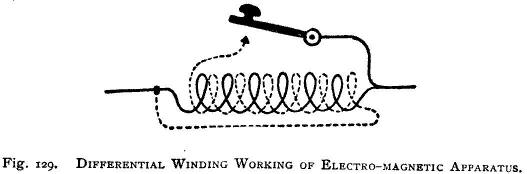
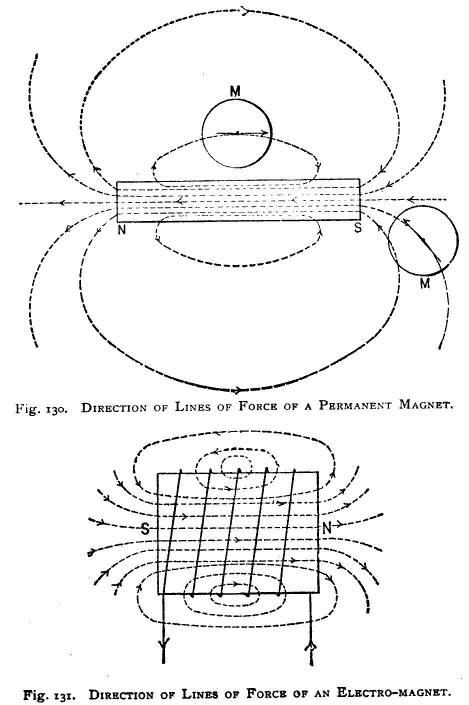
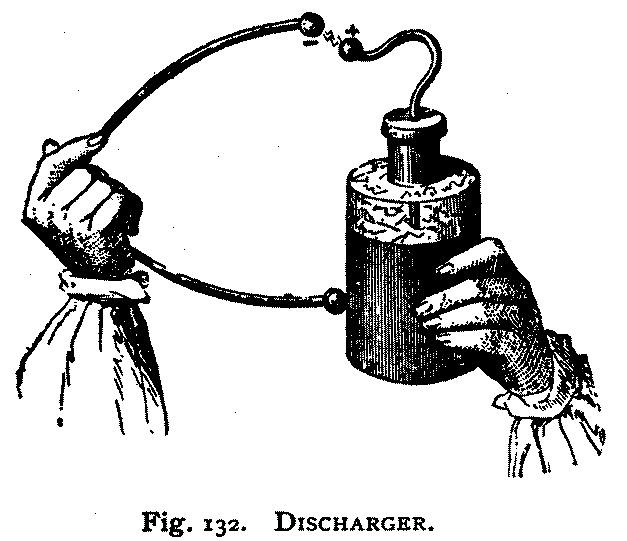
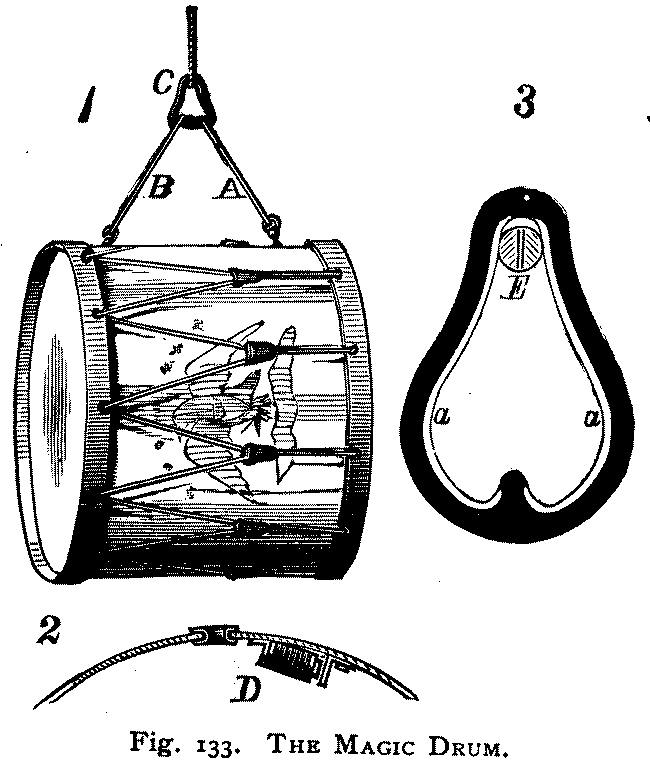
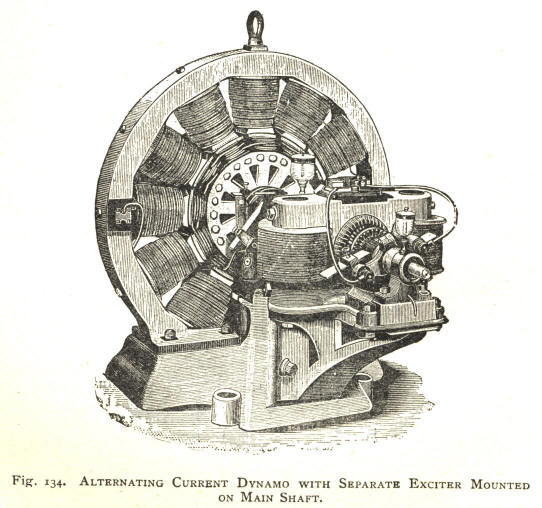
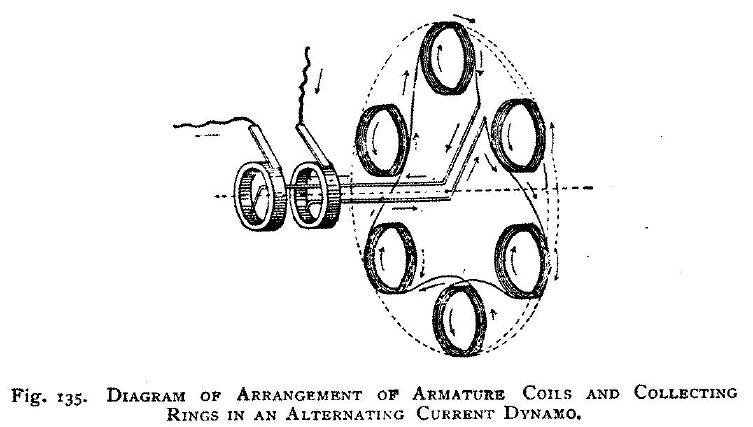
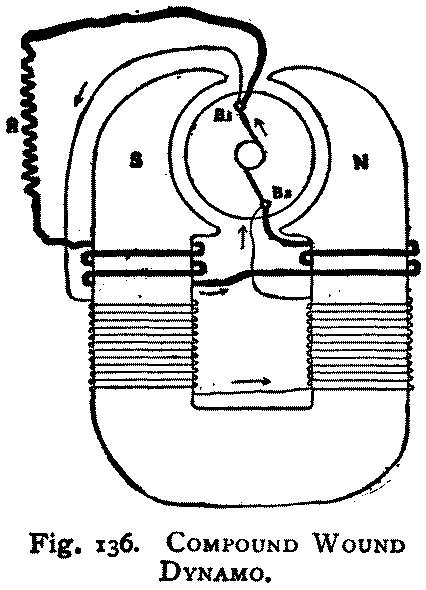
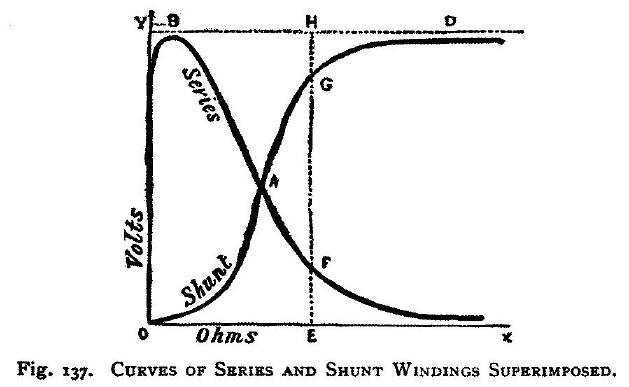
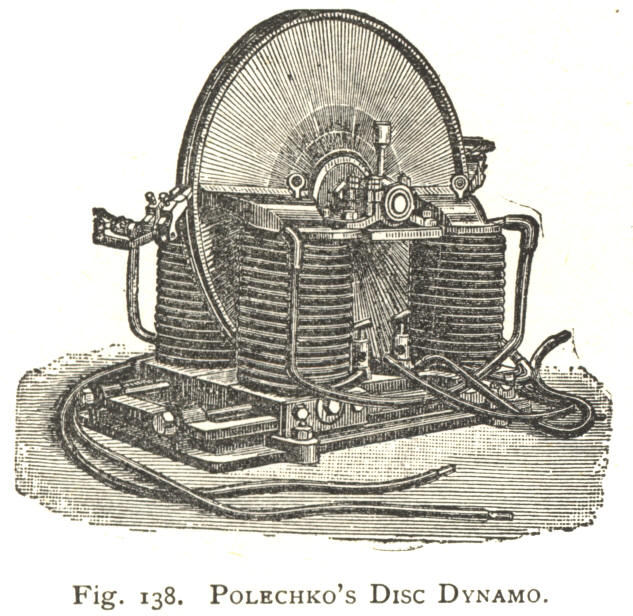
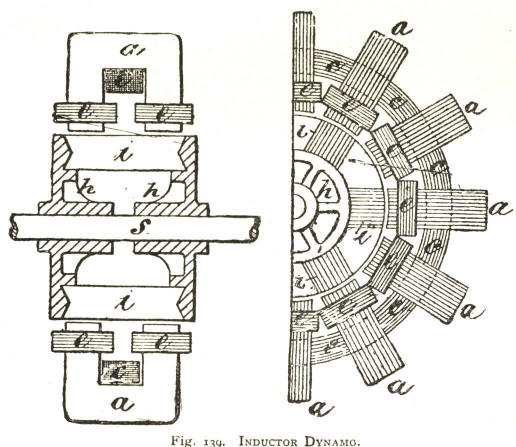
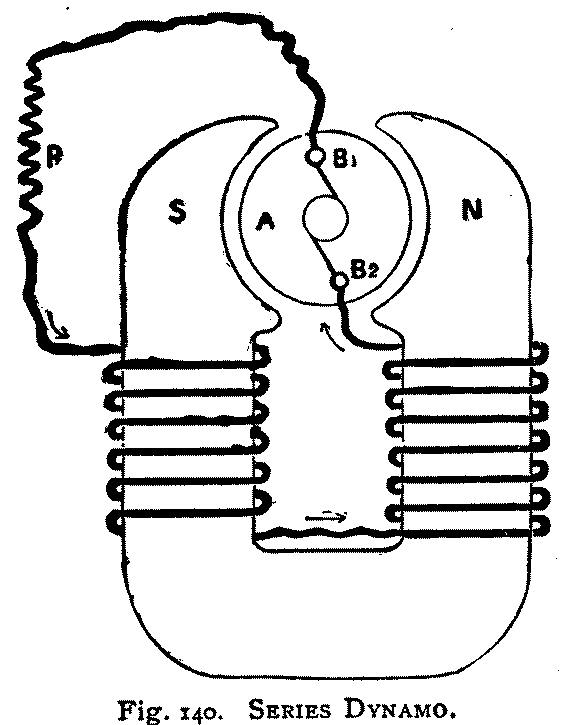
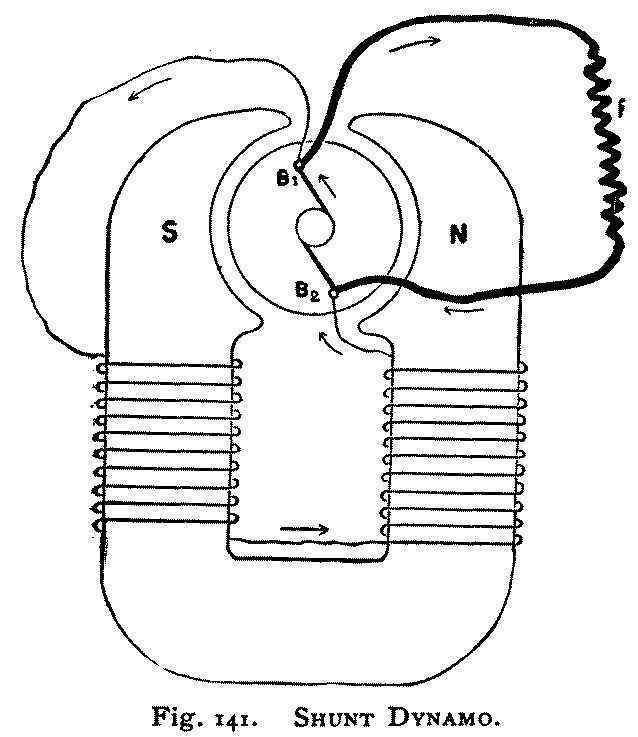
Earth. (a) The earth is arbitrarily taken as of zero electrostatic potential. Surfaces in such condition that their potential is unchanged when connected to the earth are said to be of zero potential. All other surfaces are discharged when connected to the earth, whose potential, for the purposes of man at least, never changes. (b) As a magnetic field of force the intensity of the earth's field is about one-half a line of force per square centimeter. (c) The accidental grounding of a telegraph line is termed an earth, as a dead, total, partial, or intermittent earth, describing the extent and character of the trouble. [Transcriber's note: Fallen power lines can produce voltage gradients on the earth's surface that make walking in the area dangerous, as in hundreds of volts per foot. Lightning may be associated with substantial changes in the static ground potential.] Earth, Dead. A fault, when a telegraph or other conductor is fully connected to earth or grounded at some intermediate point. Synonyms--Solid Earth--Total Earth. Earth, Partial. A fault, when a telegraph or other conductor is imperfectly connected to earth or grounded at some intermediate point. Earth Plate. A plate buried in the earth to receive the ends of telegraph lines or other circuits to give a ground, q. v. A copper plate is often used. A connection to a water or gas main gives an excellent ground, far better than any plate. When the plate oxidizes it is apt to introduce resistance. Earth Return. The grounding of a wire of a circuit at both ends gives the circuit an earth return. Earth, Swinging. A fault, when a telegraph or other conductor makes intermittent connection with the earth. It is generally attributable to wind action swinging the wire, whence the name. Ebonite. Hard vulcanized India rubber, black in color. Specific resistance in ohms per cubic centimeter at 46º C. (115º F.): 34E15 (Ayrton); specific inductive capacity, (air = 1): 2.56 (Wüllner); 2.76 (Schiller); 3.15 (Boltzmann). It is used in electrical apparatus for supporting members such as pillars, and is an excellent material for frictional generation of potential. Its black color gives it its name, and is sometimes made a point of distinction from Vulcanite, q. v. 204 STANDARD ELECTRICAL DICTIONARY. Economic Coefficient. The coefficient of electric efficiency. (See Efficiency, Electric.) Edison Effect. A continuous discharge resulting in a true current which takes place between a terminal of an incandescent lamp filament and a plate placed near it. The lamp must be run at a definitely high voltage to obtain it. Ediswan. An abbreviation for Edison-Swan; the trade name of the incandescent lamp used in Great Britain, and of other incandescent system apparatus. Fig. 142. GYMNOTUS ELECTRICUS. Eel, Electric (Gymnotus Electricus). An eel capable of effecting the discharge of very high potential electricity, giving painful or dangerous shocks. Its habitat is the fresh water, in South America. Faraday investigated it and estimated its shock as equal to that from fifteen Leyden jars, each of 1.66 square feet of coating. (See Animal Electricity and Ray, Electric.) Effect, Counter-inductive. A counter-electro-motive force due to induction, and opposing a current. Efficiency. The relation of work done to energy absorbed. A theoretically perfect machine would have the maximum efficiency in which the two qualities named would be equal to each other. Expressed by a coefficient, q. v., the efficiency in such case would be equal to 1. If a machine produced but half the work represented by the energy it absorbed, the rest disappearing in wasteful expenditure, in heating the bearings, in overcoming the resistance of the air and in other ways, its efficiency would be expressed by the coefficient 1/2 or .5, or if one hundred was the basis, by fifty per centum. There are a number of kinds of efficiencies of an electric generator which are given below. Efficiency, Commercial. Practical efficiency of a machine, obtained by dividing the available output of work or energy of a machine by the energy absorbed by the same machine. Thus in a dynamo part of the energy is usefully expended in exciting the field magnet, but this energy is not available for use in the outer circuit, is not a part of the output, and is not part of the dividend. If M represents the energy absorbed, and W the useful or available energy, the coefficient of commercial efficiency is equal to W/M. M is made up of available, unavailable and wasted (by Foucault currents, etc.,) energy. Calling available energy W, unavailable but utilized energy w, and wasted energy m, the expression for the coefficient of commercial efficiency becomes W / ( W + w + m ) when M = W + w + m Synonym--Net efficiency. 205 STANDARD ELECTRICAL DICTIONARY. Efficiency, Electrical. In a dynamo or generator the relation of total electric energy produced, both wasted and useful or available to the useful or available electrical energy. If we call W the useful electric and w the wasted electric energy, the coefficient of electrical efficiency is equal to W / ( W + w ) Synonyms--Intrinsic Efficiency--Economic Coefficient--Coefficient of Electrical Efficiency. Efficiency of Conversion. In a dynamo or generator the relation of energy absorbed to total electric energy produced. Part of the electric energy is expended in producing the field and in other ways. Thus a generator with high efficiency of conversion may be a very poor one, owing to the unavailable electric energy which it produces. The coefficient of Efficiency of Conversion is obtained by dividing the total electric energy produced by the energy absorbed in working the dynamo. If M represents the energy absorbed, or work done in driving the dynamo or generator, W the useful electric, and w the wasted electrical energy, then the coefficient of efficiency of conversion is equal to (W + w ) / M In the quantity M are included besides available (W) and unavailable (w) electric energy, the totally wasted energy due to Foucault currents, etc., calling the latter m, the above formula may be given ( W+ w ) / (W + w + m ) This coefficient may refer to the action of a converter, q. v., in the alternating system. Synonym--Gross Efficiency. Efficiency of Secondary Battery, Quantity. The coefficient obtained by dividing the ampere-hours obtainable from a secondary battery by the ampere hours required to charge it. Efficiency of Secondary Battery, Real. The coefficient obtained by dividing the energy obtainable from a secondary battery by the energy absorbed in charging it. The energy is conveniently taken in watt-hours and includes the consideration of the spurious voltage. (See Battery, Secondary.) 206 STANDARD ELECTRICAL DICTIONARY. Efflorescence. The appearance of a dry salt upon the walls of a vessel containing a solution above the normal water-line from evaporation of a liquid. It appears in battery jars and in battery carbons, in the latter interfering with the electrical connections, and oxidizing or rusting them. (See Creeping.) Effluvium, Electric. When a gas is made to occupy the position of dielectric between two oppositely electrified surfaces a peculiar strain or condition of the dielectric is produced, which promotes chemical change. The condition is termed electrical effluvium or the silent discharge. By an apparatus specially constructed to utilize the condition large amounts of ozone are produced. Synonym--Silent Discharge. Elastic Curve. A crude expression for a curve without projections or sudden sinuosities; such a curve as can be obtained by bending an elastic strip of wood. Electrepeter. An obsolete name for a key, switch or pole changer of any kind. Elasticity, Electric. The phenomenon of the dielectric is described under this term. When a potential difference is established between two parts of the dielectric, a flow of electricity displacement current starts through the dielectric, which current is due to the electric stress, but is instantly arrested by what has been termed the electric elasticity of the dielectric. This is expressed by ( electric stress ) / ( electric strain ) and in any substance is inversely proportional to the specific inductive capacity. Electricity. It is impossible in the existing state of human knowledge to give a satisfactory definition of electricity. The views of various authorities are given here to afford a basis for arriving at the general consensus of electricians. We have as yet no conception of electricity apart from the electrified body; we have no experience of its independent existence. (J. E. H. Gordon.) What is Electricity? We do not know, and for practical purposes it is not necessary that we should know. (Sydney F. Walker.) Electricity … is one of those hidden and mysterious powers of nature which has thus become known to us through the medium of effects. (Weale's Dictionary of Terms.) This word Electricity is used to express more particularly the cause, which even today remains unknown, of the phenomena that we are about to explain. (Amédée Guillemin.) 207 STANDARD ELECTRICAL DICTIONARY. Electricity is a powerful physical agent which manifests itself mainly by attractions and repulsions, but also by luminous and heating effects, by violent commotions, by chemical decompositions, and many other phenomena. Unlike gravity, it is not inherent in bodies, but it is evoked in them by a variety of causes … (Ganot's Physics.) Electricity and magnetism are not forms of energy; neither are they forms of matter. They may, perhaps, be provisionally defined as properties or conditions of matter; but whether this matter be the ordinary matter, or whether it be, on the other hand, that all-pervading ether by which ordinary matter is surrounded, is a question which has been under discussion, and which now may be fairly held to be settled in favor of the latter view. (Daniell's Physics.) The name used in connection with an extensive and important class of phenomena, and usually denoting the unknown cause of the phenomena or the science that treats of them. (Imperial Dictionary.) Electricity. . . is the imponderable physical agent, cause, force or the molecular movement, by which, under certain conditions, certain phenomena, chiefly those of attraction and repulsion, . . . are produced. (John Angell.) It has been suggested that if anything can rightly be called "electricity," this must be the ether itself; and that all electrical and magnetic phenomena are simply due to changes, strains and motions in the ether. Perhaps negative electrification. . .means an excess of ether, and positive electrification a defect of ether, as compared with the normal density. (W. Larden.) Electricity is the name given to the supposed agent producing the described condition (i. e. electrification) of bodies. (Fleeming Jenkin.) There are certain bodies which, when warm and dry, acquire by friction, the property of attracting feathers, filaments of silk or indeed any light body towards them. This property is called Electricity, and bodies which possess it are said to be electrified. (Linnaeus Cumming.) What electricity is it is impossible to say, but for the present it is convenient to look upon it as a kind of invisible something which pervades all bodies. (W. Perren Maycock.) What is electricity? No one knows. It seems to be one manifestation of the energy which fills the universe and which appears in a variety of other forms, such as heat, light, magnetism, chemical affinity, mechanical motion, etc. (Park Benjamin.) 208 STANDARD ELECTRICAL DICTIONARY. The theory of electricity adopted throughout these lessons is, that electricity, whatever its true nature, is one, not two; that this Electricity, whatever it may prove to be, is not matter, and is not energy; that it resembles both matter and energy in one respect, however, in that it can neither be created nor destroyed. (Sylvanus P. Thomson.) In Physics a name denoting the cause of an important class of phenomena of attraction and repulsion, chemical decomposition, etc., or, collectively, these phenomena themselves. (Century Dictionary.) A power in nature, often styled the electric fluid, exhibiting itself, when in disturbed equilibrium or in activity, by a circuit movement, the fact of direction in which involves polarity, or opposition of properties in opposite directions; also, by attraction for many substances, by a law involving attraction between substances of unlike polarity, and repulsion between those of like; by exhibiting accumulated polar tension when the circuit is broken; and by producing heat, light, concussion, and often chemical changes when the circuit passes between the poles, or through any imperfectly conducting substance or space. It is evolved in any disturbance of molecular equilibrium, whether from a chemical, physical, or mechanical cause. (Webster's Dictionary.) In point of fact electricity is not a fluid at all, and only in a few of its attributes is it at all comparable to a fluid. Let us rather consider electricity to be a condition into which material substances are thrown. . .(Slingo & Brooker.) [Transcriber's note: 2008 Dictionary: Phenomena arising from the behavior of electrons and protons caused by the attraction of particles with opposite charges and the repulsion of particles with the same charge.] Electricity, Cal. The electricity produced in the secondary of a transformer by changes of temperature in the core. This is in addition to the regularly induced current. Synonym--Acheson Effect. Electrics. Substances developing electrification by rubbing or friction; as Gilbert, the originator of the term, applied it, it would indicate dielectrics. He did not know that, if insulated, any substance was one of his "electrics." A piece of copper held by a glass handle becomes electrified by friction. Electrification. The receiving or imparting an electric charge to a surface; a term usually applied to electrostatic phenomena. Electrization. A term in electro-therapeutics; the subjection of the human system to electric treatment for curative, tonic or diagnostic purposes. Electro-biology. The science of electricity in its relation to the living organism, whether as electricity is developed by the organism, or as it affects the same when applied from an external source. 209 STANDARD ELECTRICAL DICTIONARY. Electro-capillarity. The relations between surface tension, the potential difference and the electrostatic capacity of fluids in contact. Although nominally in contact such surfaces are separated by about one-twenty-millionth of a centimeter (1/50000000 inch) ; thus a globule of mercury and water in which it is immersed constitute an electrostatic accumulator of definite electrostatic capacity. Again the mercury and water being in electric connection differ in potential by contact (see Contact Theory). A definite surface tension is also established. Any change in one of these factors changes the other also. A current passed through the contact surfaces will change the surface tension and hence the shape of the mercury globule. Shaking the globule will change its shape and capacity and produce a current. Heating will do the same. (See Electrometer, Capillary; and Telephone, Capillary.) Mercury and water are named as liquids in which the phenomena are most conveniently observed. They are observable in other parallel cases. Electro-chemical Equivalent. The quantity of an element or compound liberated from or brought into combination, electrolytically, by one coulomb of electricity. The electro-chemical equivalent of hydrogen is found by experiment to be .0000105 gram. That of any other substance is found by multiplying this weight by its chemical equivalent referred to hydrogen, which is its atomic or molecular weight divided by its valency. Thus the atomic weight of oxygen is 16, its valency is 2, its equivalent is 16/2 = 8; its electro-chemical equivalent is equal to .0000105 X 8 = .000840 gram. Electro-chemical Series. An arrangement of the elements in the order of their relative electrical affinities so that each element is electro-negative to all the elements following it, and electro-positive to the elements preceding it. The usual series begins with oxygen as the most electro-negative and ends with potassium as the most electro-positive element. There is, of course, no reason why other series of compound radicals, such as sulphion (SO4), etc., should not also be constructed. For each liquid acting on substances a separate series of the substances acted on may be constructed. Thus for dilute sulphuric acid the series beginning with the negatively charged or most attacked one is zinc, amalgamated or pure, cadmium, iron, tin, lead, aluminum, nickel, antimony, bismuth, copper, silver, platinum. In other liquids the series is altogether different. Electro--chemistry. The branch of electricity or of chemistry treating of the relations between electric and chemical force in different compounds and reactions. (See Electrolysis--Electrochemical series--Electro-chemical Equivalent .) 210 STANDARD ELECTRICAL DICTIONARY. Electro-culture. The application of electricity to the cultivation of plants. In one system wires are stretched or carried across the bed under the surface, and some are connected to one pole and others to the other pole of a galvanic battery of two or more elements. In some experiments improved results have thus been obtained. Another branch refers to the action of the electric arc light on vegetation. This has an effect on vegetation varying in results. Electrode. (a) The terminal of an open electric circuit. (b) The terminals of the metallic or solid conductors of an electric circuit, immersed in an electrolytic solution. (c) The terminals between which a voltaic arc is formed, always in practice made of carbon, are termed electrodes. (d) In electro-therapeutics many different electrodes are used whose names are generally descriptive of their shape, character, or uses to which they are to be applied. Such are aural electrodes for the ears, and many others. (e) The plates of a voltaic battery. Electrode, Indifferent. A term in electro-therapeutics. An electrode to which no therapeutic action is attributed but which merely provides a second contact with the body to complete the circuit through the same. The other electrode is termed the therapeutic electrode. Electrodes, Erb's Standards of. Proposed standard sizes for medical electrodes as follows: Name. Diameter. Fine Electrode, 1/2 centimeter .2 inch Small " 2 " .8 " Medium " 7.5 " 3.0 " Large " 6X2 " 2.4 X .8 " Very large " 16x8 " 6.4 x 3.2 " Electrodes, Non-polarizable. In electro-therapeutics electrodes whose contact surface is virtually porous clay saturated with zinc chloride solution. The series terminate in amalgamated zinc ends, enclosed each in a glass tube, and closed with clay. Contact of metal with the tissues is thus avoided. Electrode, Therapeutic. A term in electro-therapeutics. An electrode applied to the body for the purpose of inducing therapeutic action, or for giving the basis for an electric diagnosis of the case. The other electrode is applied to complete the circuit only; it is termed the indifferent electrode. Electro-diagnosis. The study of the condition of a patient by the reactions which occur at the terminals or kathode and anode of an electric circuit applied to the person. The reactions are divided into kathodic and anodic reactions. 211 STANDARD ELECTRICAL DICTIONARY. Electro-dynamic. adj. The opposite of electrostatic; a qualification of phenomena due to current electricity. Synonym--Electro-kinetic. Electro-dynamic Attraction and Repulsion. The mutual attraction and repulsion exercised by currents of electricity upon each other. The theory of the cause is based upon stress of the luminiferous ether and upon the reaction of lines of force upon each other. For a resumé of the theory see Induction, Electro-magnetic. Electro-dynamics. The laws of electricity in a state of motion; the inter-reaction of electric currents. It is distinguished from electro-magnetic induction as the latter refers to the production of currents by induction. The general laws of electro-dynamics are stated under Induction, Electro-magnetic, q. v. Synonym--Electro-kinetics. Fig. 143. DIAGRAM OF CONNECTIONS OF SIEMENS' ELECTRO-DYNAMOMETER. 212 STANDARD ELECTRICAL DICTIONARY. Electro-dynamometer, Siemens'. An apparatus for measuring currents by the reaction between two coils, one fixed and one movable, through which the current to be measured passes. It is one of the oldest commercial ammeters or current measurers. It comprises a fixed coil of a number of convolutions and a movable coil often of only one convolution surrounding the other. The movable coil is suspended by a filament or thread from a spiral spring. The spring is the controlling factor. Connection is established through mercury cups so as to bring the two coils in series. In use the spring and filament are adjusted by turning a milled head to which they are connected until the coils are at right angles. Then the current is turned on and deflects the movable coil. The milled head is turned until the deflection is overcome. The angle through which the head is turned is proportional to the square of the current. The movable coil must in its position at right angles to the fixed one lie at right angles to the magnetic meridian. Thus in the diagram, Fig. 143 A B C D is the fixed coil; E F G H is the movable coil; S is the spiral spring attached at K to the movable coil. The arrows show the course of the current as it goes through the coils. Electrolier. A fixture for supporting electric lamps; the analogue in electric lighting of the gasolier or gas chandelier. Often both are combined, the same fixture being piped and carrying gas burners, as well as being wired and carrying electric lamps. Electrolysis. The separation of a chemical compound into its constituent parts or elements by the action of the electric current. The compound may be decomposed into its elements, as water into hydrogen and oxygen, or into constituent radicals, as sodium sulphate into sodium and sulphion, which by secondary reactions at once give sodium hydrate and sulphuric acid. The decomposition proceeds subject to the laws of electrolysis. (See Electrolysis, Laws of.) For decomposition to be produced there is for each compound a minimum electro-motive force or potential difference required. The current passes through the electrolyte or substance undergoing decomposition entirely by Electrolytic Conduction, q. v. in accordance with Grothüss' Hypothesis, q. v. The electrolyte therefore must be susceptible of diffusion and must be a fluid. The general theory holds that under the influence of a potential difference between electrodes immersed in an electrolyte, the molecules touching the electrodes are polarized, in the opposite sense for each electrode. If the potential difference is sufficient the molecules will give up one of their binary constituents to the electrode, and the other constituent will decompose the adjoining molecule, and that one being separated into the same two constituents will decompose its neighbor, and so on through the mass until the other electrode is reached. This one separates definitely the second binary constituent from the molecules touching it. 213 STANDARD ELECTRICAL DICTIONARY. Thus there is an exact balance preserved. Just as many molecules are decomposed at one electrode as at the other, and the exact chain of decomposition runs through the mass. Each compound electrolyzed develops a binary or two-fold composition, and gives up one constituent to one electrode and the other to the other. Fig. 144. ACTION OF MOLECULES IN A SOLUTION BEFORE AND DURING ELECTROLYSIS. The cut shows the assumed polarization of an electrolyte. The upper row shows the molecules in irregular order before any potential difference has been produced, in other words, before the circuit is closed. The next row shows the first effects of closing the circuit, and also indicates the polarization of the mass, when the potential difference is insufficient for decomposition. The third row indicates the decomposition of a chain of molecules, one constituent separating at each pole. 214 STANDARD ELECTRICAL DICTIONARY. Electrolysis, Laws of. The following are the principal laws, originally discovered by Faraday, and sometimes called Faraday's Laws of Electrolysis: 1. Electrolysis cannot take place unless the electrolyte is a conductor. Conductor here means an electrolytic conductor, one that conducts by its own molecules traveling, and being decomposed. (See Grothüss' Hypothesis.) II. The energy of the electrolytic action of the current is the same wherever exercised in different parts of the circuit. III. The same quantity of electricity--that is the same current for the same period----- decomposes chemically equivalent quantities of the bodies it decomposes, or the weights of elements separated in electrolytes by the same quantity of electricity (in coulombs or some equivalent unit) are to each other as their chemical equivalent. IV. The quantity of a body decomposed in a given time is proportional to the strength of the current. To these may be added the following: V. A definite and fixed electro-motive force is required for the decomposition of each compound, greater for some and less for others. Without sufficient electro-motive force expended on the molecule no decomposition will take place. (See Current, Convective.) Electrolyte. A body susceptible of decomposition by the electric current, and capable of electrolytic conduction. It must be a fluid body and therefore capable of diffusion, and composite in composition. An elemental body cannot be an electrolyte. Electrolytic Analysis. Chemical analysis by electrolysis. The quantitative separation of a number of metals can be very effectively executed. Thus, suppose that a solution of copper sulphate was to be analyzed. A measured portion of the solution would be introduced into a weighed platinum vessel. The vessel would be connected to the zinc plate terminal of a battery. From the other terminal of the battery a wire would be brought and would terminate in a plate of platinum. This would be immersed in the solution in the vessel. As the current would pass the copper sulphate would be decomposed and eventually all the copper would be deposited in a firm coating on the platinum. The next operations would be to wash the metal with distilled water, and eventually with alcohol, to dry and to weigh the dish with the adherent copper. On subtracting the weight of the dish alone from the weight of the dish and copper, the weight of the metallic copper in the solution would be obtained. In similar ways many other determinations are effected. The processes of analysis include solution of the ores or other substances to be analyzed and their conversion into proper form for electrolysis. Copper as just described can be precipitated from the solution of its sulphate. For iron and many other metals solutions of their double alkaline oxalates are especially available forms for analysis. The entire subject has been worked out in considerable detail by Classen, to whose works reference should be made for details of processes. Electrolytic Convection. It is sometimes observed that a single cell of Daniell battery, for instance, or other source of electric current establishing too low a potential difference for the decomposition of water seems to produce a feeble but continuous decomposition. This is very unsatisfactorily accounted for by the hydrogen as liberated combining with dissolved oxygen. (Ganot.) The whole matter is obscure. (See Current, Convection.) 215 STANDARD ELECTRICAL DICTIONARY. Electrolytic Conduction. Conduction by the travel of atoms or radicals from molecule to molecule of a substance with eventual setting free at the electrodes of the atoms or radicals as elementary molecules or constituent radicals. A substance to be capable of acting as an electrolytic conductor must be capable of diffusion, and must also have electrolytic conductivity. Such a body is called an electrolyte. (See Grothüss' Hypothesis--Electrolysis-- Electrolysis, Laws of--Electro-chemical Equivalent.) Electro-magnet. A mass, in practice always of iron, around which an electric circuit is carried, insulated from the iron. When a current is passed through the circuit the iron presents the characteristics of a magnet. (See Magnetism, Ampére's Theory of--Solenoid--Lines of Force.) In general terms the action of a circular current is to establish lines of force that run through the axis of the circuit approximately parallel thereto, and curving out of and over the circuit, return into themselves outside of the circuit. If a mass of iron is inserted in the axis or elsewhere near such current, it multiplies within itself the lines of force, q. v. (See also Magnetic Permeability--Permeance--Magnetic Induction, Coefficient of Magnetic Susceptibility--Magnetization, Coefficient of Induced.) These lines of force make it a magnet. On their direction, which again depends on the direction of the magnetizing current, depends the polarity of the iron. The strength of an electro-magnet, below saturation of the core (see Magnetic Saturation), is proportional nearly to the ampere-turns, q. v. More turns for the same current or more current for the same turns increase its strength. In the cut is shown the general relation of current, coils, core and line of force. Assume that the magnet is looked at endwise, the observer facing one of the poles; then if the current goes around the core in the direction opposite to that of the hands of a clock, such pole will be the north pole. If the current is in the direction of the hands of a clock the pole facing the observer will be the south pole. The whole relation is exactly that of the theoretical Ampérian currents, already explained. The direction and course of the lines of force created are shown in the cut. The shapes of electro-magnets vary greatly. The cuts show several forms of electro- magnets. A more usual form is the horseshoe or double limb magnet, consisting generally of two straight cores, wound with wire and connected and held parallel to each other by a bar across one end, which bar is called the yoke. In winding such a magnet the wire coils must conform, as regards direction of the current in them to the rule for polarity already cited. If both poles are north or both are south poles, then the magnet cannot be termed a horseshoe magnet, but is merely an anomalous magnet. In the field magnets of dynamos the most varied types of electro-magnets have been used. Consequent poles are often produced in them by the direction of the windings and connections. To obtain the most powerful magnet the iron core should be as short and thick as possible in order to diminish the reluctance of the magnetic circuit. To obtain a greater range of action a long thin shape is better, although it involves waste of energy in its excitation. 216 STANDARD ELECTRICAL DICTIONARY. Fig. 145 DIAGRAM OF AN ELECTRO-MAGNET SHOWING RELATION OF CURRENT AND WINDING TO ITS POLARITY AND LINES OF FORCE. Fig. 146. ANNULAR ELECTRO-MAGNET Electro-magnet, Annular. An electro-magnet consisting of a cylinder with a circular groove cut in its face, in which groove a coil of insulated wire is placed. On the passage of a current the iron becomes polarized and attracts an armature towards or against its grooved face. The cut shows the construction of an experimental one. It is in practice applied to brakes and clutches. In the cut of the electro-magnetic brake (see Brake, Electro-magnetic), C is the annular magnet receiving its current through the brushes, and pressed when braking action is required against the face of the moving wheel. The same arrangement, it can be seen, may apply to a clutch. 217 STANDARD ELECTRICAL DICTIONARY. Fig. 147. BAR ELECTRO-MAGNET. Electro-magnet, Bar. A straight bar of iron surrounded with a magnetizing coil of wire. Bar electromagnets are not much used, the horseshoe type being by far the more usual. Electro-magnet, Club-foot. An electro-magnet, one of whose legs only is wound with wire, the other being bare. Fig. 148. CLUB-FOOT ELECTRO-MAGNETS WITH HINGED ARMATURES. Electro-magnet, Hinged. An electro-magnet whose limbs are hinged at the yoke. On excitation by a current the poles tend to approach each other. Fig. 149. ELECTRO-MAGNET, HINGED Electro-magnetic Attraction and Repulsion. The attraction and repulsion due to electromagnetic lines of force, which lines always tend to take as short a course as possible and also seek the medium of the highest permeance. This causes them to concentrate in iron and steel or other paramagnetic substance and to draw them towards a magnet by shortening the lines of force connecting the two. It is exactly the same attraction as that of the permanent magnet for its armature, Ampére's theory bringing the latter under the same title. In the case of two magnets like poles repel and unlike attract. In the case of simple currents, those in the same direction attract and those in opposite directions repel each other. This refers to constant current reactions. Thus the attraction of unlike poles of two magnets is, by the Ampérian theory, the attraction of two sets of currents of similar direction, as is evident from the diagram. The repulsion of like poles is the repulsion of unlike currents and the same applies to solenoids, q. v. (See Magnetism and do. Ampére's Theory of--Induction, Electro-dynamic--Electro-magnetic Induction.) 218 STANDARD ELECTRICAL DICTIONARY. Electro-magnetic Control. Control of a magnet, iron armature, or magnetic needle in a galvanometer, ammeter, voltmeter or similar instrument by an electro-magnetic field, the restitutive force being derived from an electro-magnet. The restitutive force is the force tending to bring the index to zero. Electro-magnetic Field of Force. A field of electro-magnetic lines of force, q. v., established through the agency of an electric current. A wire carrying a current is surrounded by circular concentric lines of force which have the axis of the wire as the locus of their centres. Electro-magnets produce lines of force identical with those produced by permanent magnets. (See Field of Force--Magnetic Field of Force--Controlling Field--Deflecting Field.) Electro-magnetic Induction. When two currents of unlike direction are brought towards each other, against their natural repulsive tendency work is done, and the consequent energy takes the form of a temporary increase in both currents. When withdrawn, in compliance with the natural tendency of repulsion, the currents are diminished in intensity, because energy is not expended on the withdrawal, but the withdrawal is at the expense of the energy of the system. The variations thus temporarily produced in the currents are examples of electro-magnetic induction. The currents have only the duration in each case of the motion of the circuits. One circuit is considered as carrying the inducer current and is termed the primary circuit and its current the primary current, the others are termed the secondary circuit and current respectively. We may assume a secondary circuit in which there is no current. It is probable that there is always an infinitely small current at least, in every closed circuit. Then an approach of the circuits will induce in the secondary an instantaneous current in the reverse direction. On separating the two circuits a temporary current in the same direction is produced in the secondary. 219 STANDARD ELECTRICAL DICTIONARY. A current is surrounded by lines of force. The approach of two circuits, one active, involves a change in the lines of force about the secondary circuit. Lines of force and current are so intimately connected that a change in one compels a change in the other. Therefore the induced current in the secondary may be attributed to the change in the field of force in which it lies, a field maintained by the primary circuit and current. Any change in a field of force induces a current or change of current in any closed circuit in such field, lasting as long as the change is taking place. The new current will be of such direction as to oppose the change. (See Lenz's Law.) The action as referred to lines of force may be figured as the cutting of such lines by the secondary circuit, and such cutting may be brought about by moving the secondary in the field. (See Lines of Force--Field of Force.) The cutting of 1E8 lines of force per second by a closed circuit induces an electro-motive force of one volt. (See Induction, Mutual, Coefficient of.) Electro-magnet, Iron Clad. A magnet whose coil and core are encased in a iron jacket, generally connected to one end of the core. This gives at one end two poles, one tubular, the other solid, and concentric with each other. It is sometimes called a tubular magnet. Electro-magnet, One Coil. An electro-magnet excited by one coil. In some dynamos the field magnets are of this construction, a single coil, situated about midway between the poles, producing the excitation. Electro-magnetic Leakage. The leakage of lines of force in an electro-magnet; the same as magnetic leakage. (See Magnetic Leakage.) Electro-magnetic Lines of Force. The lines of force produced in an electro-magnetic field. They are identical with Magnetic Lines of Force, q. v. (See also Field of Force-Line of Force.) Electro-magnetic Stress. The stress in an electro-magnetic field of force, showing itself in the polarization of light passing through a transparent medium in such a field. (See Magnetic Rotary Polarization.) Electro-magnetic Theory of Light. This theory is due to J. Clark Maxwell, and the recent Hertz experiments have gone far to prove it. It holds that the phenomena of light are due to ether waves, identical in general factors with those produced by electro-magnetic induction of alternating currents acting on the ether. In a non-conductor any disturbance sets an ether wave in motion owing to its restitutive force; electricity does not travel through such a medium, but can create ether waves in it. Therefore a non-conductor of electricity is permeable to waves of ether or should transmit light, or should be transparent. A conductor on the other hand transmits electrical disturbances because it has no restitutive force and cannot support an ether wave. Hence a conductor should not transmit light, or should be opaque. With few exceptions dielectrics or non-conductors are transparent, and conductors are opaque. 220 STANDARD ELECTRICAL DICTIONARY. Again, the relation between the electrostatic and electro-magnet units of quantity is expressed by 1 : 30,000,000,000; the latter figure in centimeters gives approximately the velocity of light. The electro-magnetic unit depending on electricity in motion should have this precise relation if an electro-magnetic disturbance was propagated with the velocity of light. If an electrically charged body were whirled around a magnetic needle with the velocity of light, it should act in the same way as a current circulating around it. This effect to some extent has been shown experimentally by Rowland. A consequence of these conclusions is (Maxwell) that the specific inductive capacity of a non-conductor or dielectric should be equal to the square of its index of refraction for waves of infinite length. This is true for some substances--sulphur, turpentine, petroleum and benzole. In others the specific inductive capacity is too high, e. g., vegetable and animal oils, glass, Iceland spar, fluor spar, and quartz. Electro-magnetic Unit of Energy. A rate of transference of energy equal to ten meg-ergs per second. Electro-magnetism. The branch of electrical science treating of the magnetic relations of a field of force produced by a current, of the reactions of electro-magnetic lines of force, of the electromagnetic field of force, of the susceptibility, permeability, and reluctance of diamagnetic and paramagnetic substances, and of electro-magnets in general. Electro-magnet, Long Range. An electro-magnet so constructed with extended pole pieces or otherwise, as to attract its armature with reasonably constant force over a considerable distance. The coil and plunger, q. v., mechanisms illustrate one method of getting an extended range of action. When a true electro-magnet is used, one with an iron core, only a very limited range is attainable at the best. (See Electro-magnet, Stopped Coil--do. Plunger.) Electro-magnet, Plunger. An electro-magnet with hollow coils, into which the armature enters as a plunger. To make it a true electro-magnet it must have either a yoke, incomplete core, or some polarized mass of iron. Electro-magnet, Polarized. An electro-magnet consisting of a polarized or permanently magnetized core wound with magnetizing coils, or with such coils on soft iron cores mounted on its ends. The coils may be wound and connected so as to cooperate with or work against the permanent magnet on which it is mounted. In Hughes' magnet shown in the cut it is mounted in opposition, so that an exceedingly feeble current will act to displace the armature, a, which is pulled away from the magnet by a spring, s. 221 STANDARD ELECTRICAL DICTIONARY. Fig. 150 HUGHES' POLARIZED ELECTRO-MAGNET Electro-magnets, Interlocking. Electro-magnets so arranged that their armatures interlock. Thus two magnets, A A and B B, may be placed with their armatures, M and N, at right angles and both normally pulled away from the poles. When the armature M is attracted a catch on its end is retained by a hole in the end of the other armature N, and when the latter armature N is attracted by its magnet the armature M is released. In the mechanism shown in the cut the movements of the wheel R are controlled. Normally it is held motionless by the catch upon the bottom of the armature M, coming against the tooth projecting from its periphery. A momentary current through the coils of the magnet A A releases it, by attracting M, which is caught and retained by N, and leaves it free to rotate. A momentary current through the coils of the magnet B B again releases M, which drops down and engages the tooth upon R and arrests its motion. Fig. 151. INTERLOCKING ELECTRO-MAGNETS. 222 STANDARD ELECTRICAL DICTIONARY. Electro-magnet, Stopped Coil. An electro-magnet consisting of a tubular coil, in which a short fixed core is contained, stopping up the aperture to a certain distance, while the armature is a plunger entering the aperture. This gives a longer range of action than usual. Electro-magnet, Surgical. An electro-magnet, generally of straight or bar form, fitted with different shaped pole pieces, used for the extraction of fragments of iron or steel from the eyes. Some very curious cases of successful operations on the eyes of workmen, into whose eyes fragments of steel or iron had penetrated, are on record. Electro-medical Baths. A bath for the person provided with connections and electrodes for causing a current of electricity of any desired type to pass through the body of the bather. Like all electro-therapeutical treatment, it should be administered under the direction of a physician only. Electro-metallurgy. (a) In the reduction of ores the electric current has been proposed but never extensively used, except in the reduction of aluminum and its alloys. (See Reduction of Ores, Electric.) (b) Electro-plating and deposition of metal from solutions is another branch. (See Electroplating and Electrotyping.) (c) The concentration of iron ores by magnetic attraction may come under this head. (See Magnetic Concentration of Ores.) Electrometer. An instrument for use in the measurement of potential difference, by the attraction or repulsion of statically charged bodies. They are distinguished from galvanometers as the latter are really current measurers, even if wound for use as voltmeters, depending for their action upon the action of the current circulating in their coils. Electrometer, Absolute. An electrometer designed to give directly the value of a charge in absolute units. In one form a plate, a b, of conducting surface is supported or poised horizontally below a second larger plate C, also of conducting surface. The poised plate is surrounded by a detached guard ring--an annular or perforated plate, r g r' g'--exactly level and even with it as regards the upper surface. The inner plate is carried by a delicate balance. In use it is connected to one of the conductors and the lower plate to earth or to the other. The attraction between them is determined by weighing. By calculation the results can be made absolute, as they depend on actual size of the plates and their distance, outside of the potential difference of which of course nothing can be said. If S is the area of the disc, d the distance of the plates, V-V1 the difference of their potential, which is to be measured, and F the force required to balance their attraction, we have: F = ( ( V - V1 )^2 * S ) / ( 8 * PI * d^2 ) 223 STANDARD ELECTRICAL DICTIONARY. If V = 0 this reduces to F = ( V^2 * S ) / ( 8 * PI * d^2 ) (2) or V = d * SquareRoot( (8 * PI * F ) / S ) (3) As F is expressed as a weight, and S and a as measures of area and length, this gives a means of directly obtaining potential values in absolute measure. (See Idiostatic Method--Heterostatic Method.) Synonyms--Attracted Disc Electrometer--Weight Electrometer. Fig. 152. SECTION OF BASE OF PORTABLE ELECTROMETER. In some forms the movable disc is above the other, and supported at the end of a balance beam. In others a spring support, arranged so as to enable the attraction to be determined in weight units, is adopted. The cuts, Figs. 152 and 154, show one of the latter type, the portable electrometer. The disc portion is contained within a cylindrical vessel. Fig. 153. DIAGRAM ILLUSTRATING THEORY OF ABSOLUTE ELECTROMETER. Referring to Fig. 152 g is the stationary disc, charged through the wire connection r; f is the movable disc, carried by a balance beam poised at i on a horizontal and transverse stretched platinum wire, acting as a torsional spring. The position of the end k of the balance beam shows when the disc f is in the plane of the guard ring h h. The end k is forked horizontally and a horizontal sighting wire or hair is fastened across the opening of the fork. When the hair is midway between two dots on a vertical scale the lever is in the sighted position, as it is called, and the disc is in the plane of the guard ring. 224 STANDARD ELECTRICAL DICTIONARY. Fig. 154. PORTABLE ELECTROMETER. The general construction is seen in Fig. 154. There the fixed disc D is carried by insulating stem g1. The charging electrode is supported by an insulating stem g2, and without contact with the box passes out of its cover through a guard tube E, with cover, sometimes called umbrella, V. The umbrella is to protect the apparatus from air currents. At m is the sighting lens. H is a lead box packed with pumice stone, moistened with oil of vitriol or concentrated sulphuric acid, to preserve the atmosphere dry. Before use the acid is boiled with some ammonium sulphate to expel any corrosive nitrogen oxides, which might corrode the brass. In use the upper disc is charged by its insulated electrode within the tube E; the movable disc is charged if desired directly through the case of the instrument. The upper disc is screwed up or down by the micrometer head M, until the sighted position is reached. The readings of the micrometer on the top of the case give the data for calculation. 225 STANDARD ELECTRICAL DICTIONARY. Fig. 155. LIPPMAN'S CAPILLARY ELECTROMETER. Electrometer, Capillary. An electrometer for measuring potential difference by capillary action, which latter is affected by electrostatic excitement. A tube A contains mercury; its end drawn out to a fine aperture dips into a vessel B which contains dilute sulphuric acid with mercury under it, as shown. Wires running from the binding-posts a and b connect one with the mercury in A, the other with that in B. The upper end of the tube A connects with a thick rubber mercury reservoir T, and manometer H. The surface tension of the mercury-acid film at the lower end of the tube A keeps all in equilibrium. If now a potential difference is established between a and b, as by connecting a battery thereto, the surface tension is increased and the mercury rises in the tube B. By screwing down the compressing clamp E, the mercury is brought back to its original position. The microscope M is used to determine this position with accuracy. The change in reading of the manometer gives the relation of change of surface tension and therefore of potential. Each electrometer needs special graduation or calibration, but is exceedingly sensitive and accurate. It cannot be used for greater potential differences than .6 volt, but can measure .0006 volt. Its electrostatic capacity is so small that it can indicate rapid changes. Another form indicates potential difference by the movement of a drop of sulphuric acid in a horizontal glass tube, otherwise filled with mercury, and whose ends lead into two mercury cups or reservoirs. The pair of electrodes to be tested are connected to the mercury vessels. The drop moves towards the negative pole, and its movement for small potential differences (less than one volt) is proportional to the electro-motive force or potential difference. 226 STANDARD ELECTRICAL DICTIONARY. Electrometer Gauge. An absolute electrometer (see Electrometer, Absolute) forming an attachment to a Thomson quadrant electrometer. It is used to test the potential of the flat needle connected with the inner surface of the Leyden jar condenser of the apparatus. This it does by measuring the attraction between itself and an attracting disc, the latter connected by a conductor with the interior of the jar. Electrometer, Lane's. A Leyden jar with mounted discharger, so that when charged to a certain point it discharges itself. It is connected with one coating of any jar whose charge is to be measured, which jar is then charged by the other coating. As the jar under trial becomes charged to a certain point the electrometer jar discharges itself, and the number of discharges is the measure of the charge of the other jar. It is really a unit jar, q. v. Fig. 156. THOMSON'S QUADRANT ELECTROMETER. Fig. 157. HENLEY'S QUADRANT ELECTROSCOPE. 227 STANDARD ELECTRICAL DICTIONARY. Electrometer, Quadrant. (a) Sir William Thomson's electrometer, a simple form of which is shown in the cut, consists of four quadrants of metal placed horizontally; above these a broad flat aluminum needle hangs by a very fine wire, acting as torsional suspension. The quadrants are insulated from each other, but the opposite ones connect with each other by wires. The apparatus is adjusted so that, when the quadrants are in an unexcited condition the needle is at rest over one of the diametrical divisions between quadrants. The needle by its suspension wire is in communication with the interior of a Leyden jar which is charged. The whole is covered with a glass shade, and the air within is kept dry by a dish of concentrated sulphuric acid so that the jar retains its charge for a long time and keeps the needle at approximately a constant potential. If now two pairs of quadrants are excited with opposite electricities, as when connected with the opposite poles of an insulated galvanic cell, the needle is repelled by one pair and attracted by the other, and therefore rotates through an arc of greater or less extent. A small concave mirror is attached above the needle and its image is reflected on a graduated screen. This makes the smallest movement visible. Sometimes the quadrants are double, forming almost a complete box, within which the needle moves. (b) Henley's quadrant electrometer is for use on the prime conductor of an electric machine, for roughly indicating the relative potential thereof. It consists of a wooden standard attached perpendicularly to the conductor. Near one end is attached a semi-circular or quadrant arc of a circle graduated into degrees or angular divisions. An index, consisting of a straw with a pith-bell attached to its end hangs from the center of curvature of the arc. When the prime conductor is charged the index moves up over the scale and its extent of motion indicates the potential relatively. When the "quadrant electrometer" is spoken of it may always be assumed that Sir William Thomson's instrument is alluded to. Henley's instrument is properly termed a quadrant electroscope. (See Electroscope.) Electro-motive Force. The cause which produces currents of electricity. In general it can be expressed in difference of potentials, although the term electro-motive force should be restricted to potential difference causing a current. It is often a sustained charging of the generator terminals whence the current is taken. Its dimensions are (work done/the quantity of electricity involved), or ( M * (L^2) /(T^2 ) ) / ((M^.5) * (L^.5)) = ( (M^.5) * (L^1.5) ) /(T^2) The practical unit of electro-motive force is the volt, q. v. It is often expressed in abbreviated form, as E. M. D. P., or simply as D. P., i. e., potential difference. Electro-motive force and potential difference are in many cases virtually identical, and distinctions drawn between them vary with different authors. If we consider a closed electric circuit carrying a current, a definite electro-motive force determined by Ohm's law from the resistance and current obtains in it. But if we attempt to define potential difference as proper to the circuit we may quite fail. Potential difference in a circuit is the difference in potential between defined points of such circuit. But no points in a closed circuit can be found which differ in potential by an amount equal to the entire electro-motive force of the circuit. Potential difference is properly the measure of electro-motive force expended on the portion of a circuit between any given points. Electro-motive force of an entire circuit, as it is measured, as it were, between two consecutive points but around the long portion of the circuit, is not conceivable as merely potential difference. Taking the circle divided in to degrees as an analogy, the electro-motive force of the entire circuit might be expressed as 360º, which are the degrees intervening between two consecutive points, measured the long way around the circle. But the potential difference between the same two points would be only 1º, for it would be measured by the nearest path. [Transcriber's notes: If 360º is the "long" way, 0º is the "short". A formal restatement of the above definition of EMF: "If a charge Q passes through a device and gains energy U, the net EMF for that device is the energy gained per unit charge, or U/Q. The unit of EMF is a volt, or newton-meter per coulomb."] 228 STANDARD ELECTRICAL DICTIONARY. Electro-motive Force, Counter. A current going through a circuit often has not only true or ohmic resistance to overcome, but meets an opposing E. M. F. This is termed counter-electro-motive force. It is often treated in calculations as resistance, and is termed spurious resistance. It may be a part of the impedance of a circuit. In a primary battery hydrogen accumulating on the negative plate develops counter E. M. F. In the voltaic arc the differential heating of the two carbons does the same. The storage battery is changed by a current passing in the opposite direction to its own natural current; the polarity of such a battery is counter E. M. F. Electro-motive Force, Unit. Unit electro-motive force is that which is created in a conductor moving through a magnetic field at such a rate as to cut one unit line of force per second. It is that which must be maintained in a circuit of unit resistance to maintain a current of unit quantity therein. It is that which must be maintained between the ends of a conductor in order that unit current may do unit work in a second. Electro-motive Intensity. The force acting upon a unit charge of electricity. The mean force is equal to the difference of potential between two points within the field situated one centimeter apart, such distance being measured along the lines of force. The term is due to J. Clerk Maxwell. Electro-motive Series. Arrangement of the metals and carbon in series with the most electro-positive at one end, and electronegative at the other end. The following are examples for different exciting liquids: Dilute Sulphuric Dilute Hydrochloric Caustic Potassium Acid Acid. Potash. Sulphide. Zinc Zinc Zinc Zinc Cadmium Cadmium Tin Copper Tin Tin Cadmium Cadmium Lead Lead Antimony Tin Iron Iron Lead Silver Nickel Copper Bismuth Antimony Bismuth Bismuth Iron Lead Antimony Nickel Copper Bismuth Copper Silver Nickel Nickel Silver Antimony Silver Iron Gold Platinum Carbon In each series the upper metal is the positive, dissolved or attacked element. 229 STANDARD ELECTRICAL DICTIONARY. Electro-motograph. An invention of Thomas A. Edison. A cylinder of chalk, moistened with solution of caustic soda, is mounted so as to be rotated by a handle. A diaphragm has an arm connected to its center. This arm is pressed against the surface of the cylinder by a spring. When the cylinder is rotated, a constant tension is exerted on the diaphragm. If a current is passed through the junction of arm and cylinder the electrolytic action alters the friction so as to change the stress upon the diaphragm. If the current producing this effect is of the type produced by the human voice through a microphone the successive variations in strain upon the diaphragm will cause it to emit articulate sounds. These are produced directly by the movement of the cylinder, the electrolytic action being rather the regulating portion of the operation. Hence very loud sounds can be produced by it. This has given it the name of the loud- speaking telephone. The same principle may be applied in other ways. But the practical application of the motograph is in the telephone described. Fig. 158. ELECTRO-MOTOGRAPH TELEPHONE Electro-motor. This term is sometimes applied to a current generator, such as a voltaic battery. Electro-muscular Excitation. A term in medical electricity indicating the excitation of muscle as the effect of electric currents of any kind. Electro-negative. adj. Appertaining to negative electrification; thus of the elements oxygen is the most electro-negative, because if separated by electrolytic action from any combination, it will be charged with negative electricity. 230 STANDARD ELECTRICAL DICTIONARY. Electro-optics. The branch of natural science treating of the relations between light and electricity. Both are supposed to be phenomena of or due to the luminiferous ether. To it may be referred the following: (a) Electro-magnetic Stress and Magnetic Rotary Polarization; (b) Dielectric Strain; all of which may be referred to in this book; (c) Change in the resistance of a conductor by changes in light to which it is exposed (see Selenium); (d) The relation of the index of refraction of a dielectric to the dielectric constant (see Electro-magnetic Theory of Light); (e) The identity (approximate) of the velocity of light in centimeters and the relative values of the electrostatic and electro-magnet units of intensity, the latter being 30,000,000,000 times greater than the former, while the velocity of light is 30,000,000,000 centimeters per second. Electrophoric Action. The action of an electrophorous; utilized in influence machines. (See Electrophorous.) Fig. 159. ELECTROPHOROUS. Electrophorous. An apparatus for the production of electric charges of high potential by electrostatic induction, q. v. It consists of a disc of insulating material B, such as resin or gutta percha, which is held in a shallow metal-lined box or form. The disc may be half an inch thick and a foot or more in diameter, or may be much smaller and thinner. A metal disc A, smaller in diameter is provided with an insulating handle which may be of glass, or simply silk suspension strings. To use it the disc B is excited by friction with a cat-skin or other suitable substance. The metallic disc is then placed on the cake of resin exactly in its centre, so that the latter disc or cake projects on all sides. Owing to roughness there is little real electric contact between the metal and dielectric. On touching the metal disc a quantity of negative electricity escapes to the earth. On raising it from the cake it comes off excited positively, and gives a spark and is discharged. It can be replaced, touched, removed and another spark can be taken from it, and so on as long as the cake stays charged. The successive discharges represent electrical energy expended. This is derived from the muscular energy expended by the operator in separating the two discs when oppositely excited. As generally used it is therefore an apparatus for converting muscular or mechanical energy into electric energy. 231 STANDARD ELECTRICAL DICTIONARY. Electro-physiology. The science of the electric phenomena of the animal system. It may also be extended to include plants. The great discovery of Galvani with the frog's body fell into this branch of science. The electric fishes, gymnotus, etc., present intense phenomena in the same. Electroplating. The deposition by electrolysis of a coating of metal upon a conducting surface. The simplest system makes the object to be plated the negative electrode or plate in a galvanic couple. Thus a spoon or other object may be connected by a wire to a plate of zinc. A porous cup is placed inside a battery jar. The spoon is placed in the porous cup and the zinc outside it. A solution of copper sulphate is placed in the porous cup, and water with a little sodium or zinc sulphate dissolved in it, outside. A current starts through the couple, and copper is deposited on the spoon. A less primitive way is to use a separate battery as the source of current; to connect to the positive plate by a wire the object to be plated, and a plate of copper, silver, nickel or other metal to the other pole of the battery. On immersing both object and plate (anode) in a bath of proper solution the object will become plated. In general the anode is of the same material as the metal to be deposited, and dissolving keeps up the strength of the bath. There are a great many points of technicality involved which cannot be given here. The surface of the immersed object must be conductive. If not a fine wire network stretched over it will gradually fill up in the bath and give a matrix. More generally the surface is made conductive by being brushed over with plumbago. This may be followed by a dusting of iron dust, followed by immersion in solution ot copper sulphate. This has the effect of depositing metallic copper over the surface as a starter for the final coat. Attention must be paid to the perfect cleanliness of the objects, to the condition of the bath, purity of anodes and current density. Voltaic batteries are largely used for the current as well as special low resistance dynamos. Thermo-electric batteries are also used to some extent but not generally. Electro-pneumatic Signals. Signals, such as railroad signals or semaphores, moved by compressed air, which is controlled by valves operated by electricity. The House telegraph, which was worked by air controlled by electricity, might come under this term, but it is always understood as applied to railroad signals, or their equivalent. 232 STANDARD ELECTRICAL DICTIONARY. Electropoion Fluid. An acid depolarizing solution for use in zinc-carbon couples, such as the Grenet battery. The following are formulae for its preparation: (a) Dissolve one pound of potassium bichromate in ten pounds of water, to which two and one-half pounds of concentrated sulphuric acid have been gradually added. The better way is to use powdered potassium bichromate, add it to the water first, and then gradually add the sulphuric acid with constant stirring. (b) To three pints of water add five fluid ounces of concentrated sulphuric acid; add six ounces pulverized potassium bichromate. (c) Mix one gallon concentrated sulphuric acid and three gallons of water. In a separate vessel dissolve six pounds potassium bichromate in two gallons of boiling water. Mix the two. The last is the best formula. Always use electropoion fluid cold. (See Trouvé's Solution--Poggendorff's Solution--Kakogey's Solution-- Tissandrier's Solution--Chutaux's Solution.) Electro-positive. adj. Appertaining to positive electrification; thus potassium is the most electro-positive of the elements. (See Electro-negative.) Electro-puncture. The introduction into the system of a platinum point or needle, insulated with vulcanite, except near its point, and connected as the anode of a galvanic battery. The kathode is a metal one, covered with a wet sponge and applied on the surface near the place of puncture. It is used for treatment of aneurisms or diseased growths, and also for removal of hair by electrolysis. (See Hair, Removal of by Electrolysis.) Synonym--Galvano-puncture. Electro-receptive. adj. A term applied to any device or apparatus designed to receive and absorb electric energy. A motor is an example of an electro-receptive mechanism. Electroscope. An apparatus for indicating the presence of an electric charge, and also for determining the sign, or whether the charge is positive or negative. The simplest form consists of a thread doubled at its centre and hung therefrom. On being charged, or on being connected to a charged body the threads diverge. A pair of pith balls may be suspended in a similar way, or a couple of strips of gold leaf within a flask (the gold leaf electroscope). To use an electroscope to determine the sign of the charge it is first slightly charged. The body to be tested is then applied to the point of suspension, or other charging point. If at once further repelled the charge of the body is of the same sign as the slight charge first imparted to the electroscope leaves; the leaves as they become more excited will at once diverge more. If of different sign they will at first approach as their charge is neutralized and will afterwards diverge. The gold-leaf electroscope is generally enclosed in a glass bell jar or flask. Sometimes a pair of posts rise, one on each side, to supply points of induction from the earth to intensify the action. (See Electrometer, Quadrant--Electroscope, Gold leaf, and others.) 233 STANDARD ELECTRICAL DICTIONARY. Electroscope, Bennett's. A gold-leaf electroscope, the suspended leaves of which are contained in a glass shade or vessel of dry air. On the inside of the glass shade are two strips of gold leaf, which rise from the lower edge a short distance, being pasted to the glass, and connected to the ground. These act by induction to increase the sensitiveness of the instruments. Electroscope, Bohenberger's. A condensing electroscope (see Electroscope, Condensing) with a single strip of gold leaf suspended within the glass bell. This is at an equal distance from the opposite poles of two dry piles (see Zamboni's Dry Pile) standing on end, one on each side of it. As soon as the leaf is excited it moves toward one and away from the other pile, and the sign of its electrification is shown by the direction of its motion. Electroscope, Condensing. A gold leaf electroscope, the glass bell of which is surmounted by an electrophorous or static condenser, to the lower plate of which the leaves of gold are suspended or connected. In use the object to be tested is touched to the lower plate, and the upper plate at the same time is touched by the finger. The plates are now separated. This reduces the capacity of the lower plate greatly and its charge acquires sufficient potential to affect the leaves, although the simple touching may not have affected them at all. Electroscope, Gold Leaf. An electroscope consisting of two leaves of gold leaf hung in contact with each other from the end of a conductor. When excited they diverge. The leaves are enclosed in a glass vessel. Fig. 160. GOLD LEAF ELECTROSCOPE. 234 STANDARD ELECTRICAL DICTIONARY. Electroscope, Pith Ball. Two pith balls suspended at opposite ends of a silk thread doubled in the middle. When charged with like electricity they repel each other. The extent of their repulsion indicates the potential of their charge. Electrostatic Attraction and Repulsion. The attraction and repulsion of electrostatically charged bodies for each other, shown when charged with electricity. If charged with electricity of the same sign they repel each other. If with opposite they attract each other. The classic attraction and subsequent repulsion of bits of straw and chaff by the excited piece of amber is a case of electrostatic attraction and repulsion. (See Electricity, Static--Electrostatics--Coulomb's Laws of Electrostatic Attraction and Repulsion.) Electrostatic Induction, Coefficient of. The coefficient expressing the ratio of the charge or change of charge developed in one body to the potential of the inducing body. Electrostatic Lines of Force. Lines of force assumed to exist in an electrostatic field of force, and to constitute the same. In general they correspond in action and attributes with elcctro-magnetic lines of force. They involve in almost all cases either a continuous circuit, or a termination at both ends in oppositely charged surfaces. Fig. 161. ELECTROSTATIC LINES OF FORCE BETWEEN NEAR SURFACES. Fig. 162. ELECTROSTATIC LINKS OF FORCE BETWEEN DISTANT SURFACES. 235 STANDARD ELECTRICAL DICTIONARY. The cut, Fig. 161, shows the general course taken by lines of force between two excited surfaces when near together. Here most of them are straight lines reaching straight across from surface to surface, while a few of them arch across from near the edges, tending to spread. If the bodies are drawn apart the spreading tendency increases and the condition of things shown in the next cut, Fig. 162, obtains. There is an axial line whose prolongations may be supposed to extend indefinitely, as occupying a position of unstable equilibrium. Here the existence of a straight and unterminated line of force may be assumed. A direction is predicated to lines of force corresponding with the direction of an electric current. They are assumed to start from a positively charged and to go towards a negatively charged surface. A positively charged body placed in an electrostatic field of force will be repelled from the region of positive into or towards the region of negative potential following the direction of the lines of force, not moving transversely to them, and having no transverse component in its motion. [Transcriber's note: More precisely, "A positively charged body placed in an electrostatic field of force will be repelled from the region of positive into or towards the region of negative potential ACCELERATING in the direction of the lines of force, not ACCELERATING transversely to them, and having no transverse component in its ACCELERATION." Previously acquired momentum can produce a transverse component of VELOCITY.] Electrostatics. The division of electric science treating of the phenomena of electric charge, or of electricity in repose, as contrasted with electro-dynamics or electricity in motion or in current form. Charges of like sign repel, and of unlike sign attract each other. The general inductive action is explained by the use of the electrostatic field of force and electrostatic lines of force, q. v. The force of attraction and repulsion of small bodies or virtual points, which are near enough to each other, vary as the square of the distance nearly, and with the product of the quantities of the charges of the two bodies. Electrostatic Refraction. Dr. Kerr found that certain dielectrics exposed to electric strain by being placed between two oppositely excited poles of a Holtz machine or other source of very high tension possess double refracting powers, in other words can rotate a beam of polarized light, or can develop two complimentary beams from common light. Bisulphide of carbon shows the phenomenon well, acting as glass would if the glass were stretched in the direction of the electrostatic lines of force. To try it with glass, holes are drilled in a plate and wires from an influence machine are inserted therein. The discharge being maintained through the glass it polarizes light. Synonym--Kerr Effect. Electrostatic Series. A table of substances arranged in the order in which they are electrostatically charged by contact, generally by rubbing against each other. The following series is due to Faraday. The first members become positively excited when rubbed with any of the following members, and vice versa. The first elements correspond to the carbon plate in a galvanic battery, the succeeding elements to the zinc plate. Cat, and Bear-skin--Flannel--Ivory--Feathers--Rock Crystal--Flint Glass--Cotton--Linen--Canvas--White Silk--the Hand--Wood--Shellac--the Metals (Iron-Copper-Brass-Tin-Silver-Platinum)--Sulphur. There are some irregularities. A feather lightly drawn over canvas is negatively electrified; if drawn through folds pressed against it it is positively excited. Many other exceptions exist, so that the table is of little value. 236 STANDARD ELECTRICAL DICTIONARY. Electrostatic Stress. The stress produced upon a transparent medium in an electrostatic field of force by which it acquires double refracting or polarizing properties as regards the action of such medium upon light. (See Electrostatic Refraction.) Electro-therapeutics or Therapy. The science treating of the effects of electricity upon the animal system in the treatment and diagnosis of disease. Electrotonus. An altered condition of functional activity occurring in a nerve subjected to the passage of an electric current. If the activity is decreased, which occurs near the anode, the state is one of anelectrotonus, if the activity is increased which occurs near the kathode the condition is one of kathelectrotonus. Electrotype. The reproduction of a form of type or of an engraving or of the like by electroplating, for printing purposes. The form of type is pressed upon a surface of wax contained in a shallow box. The wax is mixed with plumbago, and if necessary some more is dusted and brushed over its surface and some iron dust is sprinkled over it also. A matrix or impression of the type is thus obtained, on which copper is deposited by electroplating, q. v. Element, Chemical. The original forms of matter that cannot be separated into constituents by any known process. They are about seventy in number. Some of the rarer ones are being added to or cancelled with the progress of chemical discovery. For their electric relations see Electro-chemical Equivalents--Electro-chemical Series. The elements in entering into combination satisfy chemical affinity and liberate energy, which may take the form of electric energy as in the galvanic battery, or of heat energy, as in the combustion of carbon or magnesium. Therefore an uncombined element is the seat of potential energy. (See Energy, Potential.) In combining the elements always combine in definite proportions. A series of numbers, one being proper to each element which denote the smallest common multipliers of these proportions, are called equivalents. Taking the theory of valency into consideration the product of the equivalents by the valencies gives the atomic weights. 237 STANDARD ELECTRICAL DICTIONARY. Element, Mathematical. A very small part of anything, corresponding in a general way to a differential, as the element of a current. Element of a Battery Cell. The plates in a galvanic couple are termed elements, as the carbon and zinc plates in a Bunsen cell. The plate unattacked by the solution, as the carbon plate in the above battery, is termed the negative plate or element; the one attacked, as the zinc plate, is termed the positive plate or element. Synonym--Voltaic Element. Elements, Electrical Classification of. This may refer to Electro-chemical Series, Electrostatic Series, or Thermo-electric Series, all of which may be referred to. Element, Thermo-electric. One of the metals or other conductors making a thermo-electric couple, the heating of whose junction produces electro-motive force and a current, if on closed circuit. The elements of a couple are respectively positive and negative, and most conductors can be arranged in a series according to their relative polarity. (See Thermo-electric Series.) Elongation. The throw of the magnetic needle. (See Throw.) Synonym--Throw. Embosser, Telegraph. A telegraphic receiver giving raised characters on a piece of paper. It generally refers to an apparatus of the old Morse receiver type, one using a dry point stylus, which pressing the paper into a groove in the roller above the paper, gave raised characters in dots and lines. Fig. 163. MORSE RECEIVER. 238 STANDARD ELECTRICAL DICTIONARY. E. M. D. P. Abbreviation for "electro-motive difference of potential" or for electro-motive force producing a current as distinguished from mere inert potential difference. E. M. F. Abbreviation for "electro-motive force." Fig. 164. END-ON METHOD. End-on Method. A method of determining the magnetic moment of a magnet. The magnet under examination, N S, is placed at right angles to the magnetic meridian, M O R, and pointing directly at or "end on" to the centre of a compass needle, n s. From the deflection a of the latter the moment is calculated. Endosmose, Electric. The inflowing current of electric osmose. (See Osmose, Electric.) End Play. The power to move horizontally in its bearings sometimes given to armature shafts. This secures a more even wearing of the commutator faces. End play is not permissible in disc armatures, as the attraction of the field upon the face of the armature core would displace it endwise. For such armatures thrust-bearings preventing end play have to be provided. Energy. The capacity for doing work. It is measured by work units which involve the exercise of force along a path of some length. A foot-pound, centimeter-gram, and centimeter-dyne are units of energy and work. The absolute unit of energy is the erg, a force of one dyne exercised over one centimeter of space. (See Dyne.) The dimensions of energy are force (M * L / T^2) * space (L) = M * (L^2 / T^2). Energy may be chemical (atomic or molecular), mechanical, electrical, thermal, physical, potential, kinetic, or actual, and other divisions could be formulated. 239 STANDARD ELECTRICAL DICTIONARY. Energy, Atomic. The potential energy due to atomic relations set free by atomic change; a form of chemical energy, because chemistry refers to molecular as well as to atomic changes. When atomic energy loses the potential form it immediately manifests itself in some other form, such as heat or electric energy. It may be considered as always being potential energy. (See Energy, Chemical.) [Transcriber's note: This item refers to chemical energy, that is manifest in work done by electric forces during re-arrangement of electrons. Atomic energy now refers to re-arrangement of nucleons (protons and neutrons) and the resulting conversion of mass into energy.] Energy, Chemical. A form of potential energy (see Energy, Potential) possessed by elements in virtue of their power of combining with liberation of energy, as in the combination of carbon with oxygen in a furnace; or by compounds in virtue of their power of entering into other combinations more satisfying to the affinities of their respective elements or to their own molecular affinity. Thus in a galvanic couple water is decomposed with absorption of energy, but its oxygen combines with zinc with evolution of greater amount of energy, so that in a voltaic couple the net result is the setting free of chemical energy, which is at once converted into electrical energy in current form, if the battery is on a closed circuit. Energy, Conservation of. A doctrine accepted as true that the sum of energy in the universe is fixed and invariable. This precludes the possibility of perpetual motion. Energy may be unavailable to man, and in the universe the available energy is continually decreasing, but the total energy is the same and never changes. [Transcriber's note: If mass is counted a energy (E=m*(c^2)) then energy is strictly conserved.] Energy, Degradation of. The reduction of energy to forms in which it cannot be utilized by man. It involves the reduction of potential energy to kinetic energy, and the reduction of kinetic energy of different degrees to energy of the same degree. Thus when the whole universe shall have attained the same temperature its energy will have become degraded or non-available. At present in the sun we have a source of kinetic energy of high degree, in coal a source of potential energy. The burning of all the coal will be an example of the reduction of potential to kinetic energy, and the cooling of the sun will illustrate the lowering in degree of kinetic energy. (See Energy, Conservation of--Energy, Potential--Energy, Kinetic.) Energy, Electric. The capacity for doing work possessed by electricity under proper conditions. Electric energy may be either kinetic or potential. As ordinary mechanical energy is a product of force and space, so electric energy is a product of potential difference and quantity. Thus a given number of coulombs of electricity in falling a given number of volts develop electric energy. The dimensions are found therefore by multiplying electric current intensity quantity ((M^.5) * (L^.5)), by electric potential ((M^.5)*(L^1.5) / (T^2)), giving (M * (L^2)/(T^2)), the dimensions of energy in general as it should be. The absolute unit of electric energy in electro-magnetic measure is (1E-7) volt coulombs. 240 STANDARD ELECTRICAL DICTIONARY. The practical unit is the volt-coulomb. As the volt is equal to 1E8 absolute units of potential and the coulomb to 0.1 absolute units of quantity, the volt-coulomb is equal to 1E7 absolute units of energy. The volt-coulomb is very seldom used, and the unit of Electric Activity or Power (see Power, Electric), the volt-ampere, is universally used. This unit is sometimes called the Watt, q. v., and it indicates the rate of expenditure or of production of electric energy. The storing up in a static accumulator or condenser of a given charge of electricity, available for use with a given change of potential represents potential electric energy. The passing of a given quantity through a conductor with a given fall of potential represents kinetic electric energy. In a secondary battery there is no storage of energy, but the charging current simply accumulates potential chemical energy in the battery, which chemical energy is converted into electric energy in the discharge or delivery of the battery. It is customary to discuss Ohm's law in this connection; it is properly treated under Electric Power, to which the reader is referred. (See Power, Electric.) [Transcriber's note: A volt-ampere or watt is a unit of power. A volt-coulomb-second or watt-second is a unit of energy. Power multiplied by time yields energy.] Energy, Electric Transmission of. If an electric current passes through a conductor all its energy is expended in the full circuit. Part of the circuit may be an electrical generator that supplies energy as fast as expended. Part of the circuit may be a motor which absorbs part of the energy, the rest being expended in forcing a current through the connecting wires and through the generator. The electric energy in the generator and connecting wires is uselessly expended by conversion into heat. That in the motor in great part is utilized by conversion into mechanical energy which can do useful work. This represents the transmission of energy. Every electric current system represents this operation, but the term is usually restricted to the transmission of comparatively large quantities of energy. A typical installation might be represented thus. At a waterfall a turbine water wheel is established which drives a dynamo. From the dynamo wires are carried to a distant factory, where a motor or several motors are established, which receive current from the dynamo and drive the machinery. The same current, if there is enough energy, may be used for running lamps or electroplating. As electric energy (see Energy, Electric,) is measured by the product of potential difference by quantity, a very small wire will suffice for the transmission of a small current at a high potential, giving a comparatively large quantity of energy. It is calculated that the energy of Niagara Falls could be transmitted through a circuit of iron telegraph wire a distance of over 1,000 miles, but a potential difference of 135,000,000 volts would be required, something quite impossible to obtain or manage. [Transcriber's note: Contemporary long distance power transmission lines use 115,000 to 1,200,000 volts. At higher voltages corona discharges (arcing) create unacceptable losses.] 241 STANDARD ELECTRICAL DICTIONARY. Energy, Kinetic. Energy due to matter being actually in motion. It is sometimes called actual energy. The energy varies directly with the mass and with the square of the velocity. It is represented in formula by .5 *M * (v^2). Synonyms--Actual Energy--Energy of Motion--Dynamic Energy. Energy, Mechanical. The energy due to mechanical change or motion, virtually the same as molar energy. (See Energy, Molar.) Energy, Molar. The energy of masses of matter due to movements of or positions of matter in masses; such as the kinetic energy of a pound or of a ton in motion, or the potential energy of a pound at an elevation of one hundred feet. Energy, Molecular. The potential energy due to the relations of molecules and set free by their change in the way of combination. It is potential for the same reason that applies to atomic and chemical energy, of which latter it is often a form, although it is often physical energy. The potential energy stored up in vaporization is physical and molecular energy; the potential energy stored up in uncombined potassium oxide and water, or calcium oxide (quicklime) and water is molecular, and when either two substances are brought together kinetic, thermal or heat energy is set free, as in slaking lime for mortar. Energy of an Electrified Body. An electrified body implies the other two elements of a condenser. It is the seat of energy set free when discharged. (See Dielectric, Energy of.) The two oppositely charged bodies tend to approach. This tendency, together with the distances separating them, represents a potential energy. Energy of Stress. Potential energy due to stress, as the stretching of a spring. This is hardly a form of potential energy. A stressed spring is merely in a position to do work at the expense of its own thermal or kinetic energy because it is cooled in doing work. If it possessed true potential energy of stress it would not be so cooled. Energy of Position. Potential energy due to position, as the potential energy of a pound weight raised ten feet (ten foot lbs.). (See Energy, Potential.) Energy, Physical. The potential energy stored up in physical position or set free in physical change. Thus a vapor or gas absorbs energy in its vaporization, which is potential energy, and appears as heat energy when the vapor liquefies. 242 STANDARD ELECTRICAL DICTIONARY. Energy, Potential, or Static Energy. The capacity for doing work in a system due to advantage of position or other cause, such as the stress of a spring. A pound weight supported ten feet above a plane has ten foot lbs. of potential energy of position referred to that plane. A given weight of an elementary substance represents potential chemical energy, which will be liberated as actual energy in its combination with some other element for which it has an affinity. Thus a ton of coal represents a quantity of potential chemical energy which appears in the kinetic form of thermal energy when the coal is burning in a furnace. A charged Leyden jar represents a source of potential electric energy, which becomes kinetic heat energy as the same is discharged. Energy, Thermal. A form of kinetic molecular energy due to the molecular motion of bodies caused by heat. Entropy. Non-available energy. As energy may in some way or other be generally reduced to heat, it will be found that the equalizing of temperature, actual and potential, in a system, while it leaves the total energy unchanged, makes it all unavailable, because all work represents a fall in degree of energy or a fall in temperature. But in a system such as described no such fall could occur, therefore no work could be done. The universe is obviously tending in that direction. On the earth the exhaustion of coal is in the direction of degradation of its high potential energy, so that the entropy of the universe tends to zero. (See Energy, Degradation of.) [Transcriber's note: Entropy (disorder) INCREASES, while AVAILABLE ENERGY tends to zero.] Entropy, Electric. Clerk Maxwell thought it possible to recognize in the Peltier effect, q. v., a change in entropy, a gain or loss according to whether the thermo-electric junction was heated or cooled. This is termed Electric Entropy. (See Energy, Degradation of.) 243 STANDARD ELECTRICAL DICTIONARY. Fig. 165. EPINUS' CONDENSER, Epinus' Condenser. Two circular brass plates, A and B, are mounted on insulating supports, and arranged to be moved towards or away from each other as desired. Between them is a plate of glass, C, or other dielectric. Pith balls may be suspended back of each brass plate as shown. The apparatus is charged by connecting one plate to an electric machine and the other to the earth. The capacity of the plate connected to the machine is increased by bringing near to it the grounded plate, by virtue of the principle of bound charges. This apparatus is used to illustrate the principles of the electric condenser. It was invented after the Leyden jar was invented. Fig. 166. EPINUS' CONDENSER. E. P. S. Initials of Electrical Power Storage; applied to a type of secondary battery made by a company bearing that title. Fig. 167. CAM EQUALIZER. 244 STANDARD ELECTRICAL DICTIONARY. Equalizer. In electro-magnetic mechanism an arrangement for converting the pull of the electro-magnet varying in intensity greatly over its range of action, into a pull of sensibly equal strength throughout. The use of a rocking lever acting as a cam, with leverage varying as the armature approaches or recedes from the magnet core is one method of effecting the result. Such is shown in the cut. E is an electro-magnet, with armature a. A and B are the equalizer cams. The pull on the short end of the cam B is sensibly equal for its whole length. Many other methods have been devised, involving different shapes of pole pieces, armatures or mechanical devices other than the one just shown. Equipotential. adj. Equal in potential; generally applied to surfaces. Thus every magnetic field is assumed to be made up of lines of force and intersecting those lines, surfaces, plane, or more or less curved in contour, can be determined, over all parts of each one of which the magnetic intensity will be identical. Each surface is the locus of equal intensity. The same type of surface can be constructed for any field of force, such as an electrostatic field, and is termed an equipotential surface. Equipotential Surface, Electrostatic. A surface in an electrostatic field of force, which is the locus of all points of a given potential in such field; a surface cutting all the lines of force at a point of identical potential. Lines of force are cut perpendicularly by an equipotential surface, or are normal thereto. Equipotential Surface, Magnetic and Electro-magnetic. A surface bearing the same relation to a magnetic or electro-magnetic field of force that an electrostatic equipotential surface (see Equipotential Surface, Electrostatic,) does to an electrostatic field of force. Equivalent, Chemical. The quotient obtained by dividing the atomic weight of an element by its valency. Equivalents, Electro-chemical. The weight of any substance set free by one coulomb of electricity. The following give some equivalents expressed in milligrams: Hydrogen .0105 Mercury (mercurous) 2.10 Gold .6877 Iron (ferric) .1964 Silver 1.134 Iron (ferrous) .294 Copper (cupric) .3307 Nickel .3098 Mercury (mercuric) 1.05 Zinc .3413 Lead 1.0868 Chlorine .3728 Oxygen .89 245 STANDARD ELECTRICAL DICTIONARY. Equivalent, Electro-mechanical. The work or energy equivalent to unit quantities of electric energy, q. v.; or equivalent to a unit current in a conductor whose ends differ one unit of potential. The unit of electric energy taken is the watt-second or volt-coulomb. One volt-coulomb is equal to Ergs 1E7 [10000000] Foot Pound .737337 Gram-degree C. .24068 Horse Power Second .0013406 Pound-degree F. .000955 One horse power is equal to 745.943 volt coulombs per second. Equivalent, Electro-thermal. The heat produced by a unit current passing through a conductor with unit difference of potential at its ends; the heat equivalent of a volt-coulomb or watt-second. It is equal to Gram-degree C. .24068 Pound-degree F. .000955 Equivalent, Thermo-chemical. The calories evolved by the combination of one gram of any substance with its equivalent of another substance being determined, the product obtained by multiplying this number by the equivalent (atomic or molecular weight / valency) of the first element or substance is the thermo-chemical equivalent. If expressed in kilogram calories, the product of the thermo-chemical equivalent by 0.43 gives the voltage required to effect such decomposition. The following are thermo-chemical equivalents of a few combinations: Water 34.5 Zinc oxide 43.2 Iron protoxide 34.5 Iron Sesquioxide 31.9 X 3 Copper oxide 19.2 Equivolt. "The mechanical energy of one volt electro-motive force exerted under unit conditions through one equivalent of chemical action in grains." (J. T. Sprague.) This unit is not in general use as the unit of electric energy, the volt-coulomb and (for rate of electric energy) the volt-ampere being always used. Erg. The absolute or fundamental C. G. S. unit of work or energy. The work done or energy expended in moving a body through one centimeter against a resistance of one dyne. Erg-ten. Ten millions of ergs, or ten meg-ergs. Escape. A term applied to leakage of current. Etching, Electric. A process of producing an etched plate. The plate is coated with wax, and the design traced through as in common etching. It is then placed in a bath and is connected to the positive terminal from a generator, whose negative is immersed in the same bath, so that the metal is dissolved by electrolytic action. By attaching to the other terminal and using a plating bath, a rough relief plate may be secured, by deposition in the lines of metal by electroplating. Synonym--Electric Engraving. 246 STANDARD ELECTRICAL DICTIONARY. Ether. The ether is a hypothetical thing that was invented to explain the phenomena of light. Light is theoretically due to transverse vibrations of the ether. Since the days of Young the conception of the ether has extended, and now light, "radiant heat," and electricity are all treated as phenomena of the ether. Electrical attraction and repulsion are explained by considering them due to local stresses in the ether; magnetic phenomena as due to local whirlpools therein. The ether was originally called the luminiferous ether, but the adjective should now be dropped. Its density is put at 936E-21 that of water, or equal to that of the atmosphere at 210 miles above the earth's surface. Its rigidity is about 1E-9 that of steel (see Ten, Powers of); as a whole it is comparable to an all-pervading jelly, with almost perfect elasticity. The most complete vacuum is filled with ether. All this is a hypothesis, for the ether has never been proved to exist. Whether gravitation will ever be explained by It remains to be seen. [Transcriber's note: The Michelson-Morley experiment in 1887 (five years before this book) cast serious doubt on the ether. In 1905 Einstein explained electromagnetic phenomenon with photons. In 1963 Edward M. Purcell used special relativity to derive the existence of magnetism and radiation.] Eudiometer. A graduated glass tube for measuring the volumes of gases. In its simplest form it is simply a cylindrical tube, with a scale etched or engraved upon it, closed at one end and open at the other. The gas to be measured is collected in it over a liquid, generally water, dilute sulphuric acid in the gas voltameter, or mercury. Many different shapes have been given them by Hoffmann, Ure, Bunsen and others. Evaporation, Electric. The superficial sublimation or evaporation of a substance under the influence of negative electricity. It is one of the effects investigated by Crookes in his experiments with high vacua. He found that when a metal, even so infusible as platinum, was exposed to negative electrification in one of his high vacuum tubes, that it was volatilized perceptibly. A cadmium electrode heated and electrified negatively was found to give a strong coating of metal on the walls of the tube. Even in the open air the evaporation of water was found to be accelerated by negative electrification. Exchange, Telephone. The office to which telephone wires lead in a general telephone system. In the office by a multiple switch board, or other means, the different telephones are interconnected by the office attendants, so that any customers who desire it may be put into communication with each other. The exchange is often termed the Central Office, although it may be only a branch office. Excitability, Faradic. The action produced in nerve or muscle of the animal system by an alternating or intermitting high potential discharge from an induction coil. 247 STANDARD ELECTRICAL DICTIONARY. Excitability, Galvanic. The same as Faradic excitability, except that it refers to the effects of the current from a galvanic battery. Excitability of Animal System, Electric. The susceptibility of a nerve or muscle to electric current shown by the effect produced by its application. Exciter. A generator used for exciting the field magnet of a dynamo. In alternating current dynamos, e. g., of the Westinghouse type, a special dynamo is used simply to excite the field magnet. In central station distribution the same is often done for direct current dynamos. Exosmose, Electric. The outflowing current of electric osmose. (See Osmose, Electric.) Expansion, Coefficient of. The number expressing the proportional increase in size, either length, area or volume, of a substance under the influence generally of heat. There are three sets of coefficients, (1) of linear expansion, (2) of superficial expansion, (3) of cubic expansion or expansion of volume. The first and third are the only ones much used. They vary for different substances, and for the same substance at different temperatures. They are usually expressed as decimals indicating the mixed number referred to the length or volume of the body at the freezing point as unity. Expansion, Electric. (a) The increase in volume of a condenser, when charged electrostatically. A Leyden jar expands when charged, and contracts when discharged. (b) The increase in length of a bar of iron when magnetized. This is more properly called magnetic expansion or magnetic elongation. Exploder. (a) A small magneto-generator for producing a current for heating the wire in an electric fuse of the Abel type (see Fuse, Electric), and thereby determining an explosion. (b) The term may also be applied to a small frictional or influence machine for producing a spark for exploding a spark fuse. Explorer. A coil, similar to a magnetizing coil (see Coil, Magnetizing), used for investigating the electro-magnetic circuit and for similar purposes. If placed around an electro-magnet and connected with a galvanometer, it will produce a deflection, owing to a momentary induced current, upon any change in the magnet, such as removing or replacing the armature. It is useful in determining the leakage of lines of force and for general investigations of that nature. It is often called an exploring coil. Hughes' Induction Balance (see Induction Balance, Hughes') is sometimes called a Magnetic Explorer. The exploring coil may be put in circuit with a galvanometer for quantitative measurements or with a telephone for qualitative ones. 248 STANDARD ELECTRICAL DICTIONARY. Extension Bell Call. A system of relay connection, q. v., by which a bell is made to continue ringing after the current has ceased coming over the main line. It is designed to prolong the alarm given by a magneto call bell, q. v., which latter only rings as long as the magneto handle is turned. A vibrating electric bell (see Bell, Electric,) is connected in circuit with a local battery and a switch normally open, but so constructed as to close the circuit when a current is passed and continue to do so indefinitely. The distant circuit is connected to this switch. When the magneto is worked it acts upon the switch, closes the local battery circuit and leaves it closed, while the bell goes on ringing until the battery is exhausted or the switch is opened by hand. Eye, Electro-magnetic. An apparatus used in exploring a field of electro-magnetic radiations. It is a piece of copper wire 2 millimeters (.08 inch) in diameter, bent into an almost complete circle 70 millimeters (.28 inch) in diameter, with terminals separated by an air gap. This is moved about in the region under examination, and by the production of a spark indicates the locality of the loops or venters in systems of stationary waves.