THE STORY OF GRISELL BAILLIE'S SHEEP'S HEAD
Reading edition
THE Lady Grisell Baillie, as she was called after her marriage, was the daughter of a very eminent Covenanter, Sir Patrick Hume of Polwarth. Grisell was born in 1665, and during all the years of her girlhood her father was seldom able to come home to his house of Polwarth, for fear of the officers of the Government seizing him. On one occasion he was taken and cast into prison in Dumbarton Castle for full fifteen months. Grisell was but a little girl at the time, but she had a wisdom and a quaint discretion beyond her years. Often she was entrusted with a letter to carry to him past the guard, and succeeded in the attempt where an elder person would certainly have been suspected and searched.
When her father was set at liberty, it was not many weeks till the soldiers again came seeking him; for new troubles had arisen, and the suspicion of the King was against all men that were not active in his service.
Parties of soldiers were continually searching the house in pursuit of him. But this occasioned no alarm to his family, for they all, with three exceptions, thought him far from home.
Only Sir Patrick's wife, his little daughter Grisell, and a carpenter named James Winter were trusted with the secret. The servants were frequently put to the oath as to when they saw their master; but as they knew nothing, all passed off quite well.
With James Winter's assistance the Lady Polwarth got a bed and bed-clothes carried in the night to the burying-place, a vault under the ground at Polwarth Church, a mile from the house. Here Sir Patrick was concealed a whole month, never venturing out. For all light he had only an open slit at one end, through which nobody could see what was below.
To this lonely place little Grisell went every night by herself at midnight, to carry her father victuals and drink, and stayed with him as long as she could with a chance of returning home before the morning. Here in this dismal habitation did they often laugh heartily at the incidents of the day, for they were both of that cheerful disposition which is a continual feast.
Grisell brings the sheep's head to her father in the vault
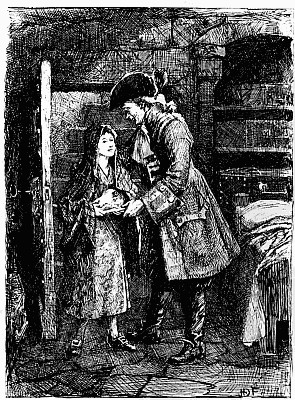
Grisell had ordinarily a terror of the churchyard, especially in the dark, for being but a girl, and having been frightened with nursery stories, she thought to see ghosts behind every tomb. But when she came to help her father, she had such anxious care for him that all fear of ghosts went away from her. She stumbled among the graves every night alone, being only in dread that the stirring of a leaf or the barking of a dog betokened the coming of a party of soldiers to carry away her father to his death. The minister's house was near the church. The first night she went, his dogs kept up such a barking that it put her in the utmost fear of a discovery. The next day the Lady Polwarth sent for the curate, and, on pretext of a mad dog, got him to send away all his dogs. A considerate curate, in sooth!
There was great difficulty in getting victuals to carry to Sir Patrick without the servants, who were not in the secret, suspecting for what purpose they were taken. The only way that it could be done was for Grisell to slip things off her plate into her lap as they sat at dinner.
Many a diverting story is told about this. Sir Patrick above all things was fond of sheep's head. One day while the children were eating their broth, Grisell had conveyed a whole sheep's head into her lap. Her brother Sandy (who was afterwards Lord Marchmont) looked up as soon as he had finished, and cried out with great astonishment, 'Mother, will ye look at our Grisell. While we have been supping our broth, she has eaten up the whole sheep's head!'
For indeed she needed to be looked to in these circumstances. This occasioned great merriment when she told her father of it in his hiding-place at night. And he desired that the next time there was sheep's head Sandy should have a double share of it.
His great comfort and constant entertainment while in this dreary abode (for he had no light to read by) was to repeat over and over to himself Buchanan's Latin Psalms. And to his dying day, nearly forty years after, he would give the book to his wife, and ask her to try him at any place to see if he minded his Psalms as well as he had done in the hiding-hole among the bones of his ancestors in Polwarth Kirkyard.
After this, James Winter and the Lady Polwarth made a hole in the ground under a bed that drew out of a recess in the wall. They lifted the boards and took turns at digging out the earth, scratching it with their hands till they were all rough and bleeding, for only so could they prevent a noise being heard. Grisell and her mother helped James Winter to carry the earth in bags and sheets to the garden at the back. He then made a box bed at his own house, large enough for Sir Patrick to lie in, with bed and bed-clothes, and bored holes in the boards for air. But in spite of all this, the difficulty of their position was so great, and the danger so certainly increasing, that it was judged better that Sir Patrick should attempt to escape to Holland.
It was necessary to tell the grieve, John Allen, who was so much astonished to hear that his master had been all the time about the house, that he fainted away. However, he made up willingly enough a story that he was going to Morpeth Fair to sell horses, and Sir Patrick having got forth from a window of the stables, they set out in the dark. Sir Patrick, being absent-minded, let his horse carry him whither it would, and in the morning found himself at Tweedside, far out of his way, at a place not fordable and without his servant.
But this also was turned to good. For after waiting a while he found means to get over to the other side, where with great joy he met his servant. Then the grieve told him that he had never missed him till, looking about, he heard a great galloping of horses, and a party of soldiers who had just searched the house for Sir Patrick, surrounded him and strictly examined him. He looked about everywhere and could not see his master, for he was in much fear, thinking him to be close behind. But in this manner, by his own absent-mindedness, Sir Patrick was preserved, and so got safely first to London and afterwards to Holland.
Thence Sir Patrick sent home for his wife and family. They came to him in a ship, and on the way had an adventure. The captain was a sordid and brutal man, and agreed with them and with several other people to give them a bed on the passage. So when there arose a dispute who would have the bed, the Lady Polwarth said nothing. But a gentleman coming to her said, 'Let them be doing. You will see how it will end.' So two of the other gentlewomen lay on the bed, the Lady Polwarth with Grisell and a little sister lying on the floor, with a cloak-bag of books she was taking to Sir Patrick for their only pillow.
Then in came the captain, and first ate up all their provisions with a gluttony incredible. Then he said to the women in the bed, 'Turn out, turn out!' and laid himself down in place of them. But Providence was upsides with him, for a terrible storm came on, and he had to get up immediately and go out to try to save the ship. And so he got no more sleep that night, which pleased the gentlewomen greatly in spite of all their own fears and pains. They never saw more of him till they landed at the Brill. From that they set out on foot for Rotterdam with one of the gentlemen that had been kind to them on the crossing to Holland.
It was a cold, wet, dirty night. Grisell's little sister, a girl not well able to walk, soon lost her shoes in the dirt. Whereupon the Lady Polwarth took her upon her back, the gentlemen carrying all their baggage, and Grisell going through the mire at her mother's side.
At Rotterdam they found their eldest brother and Sir Patrick himself waiting to conduct them to Utrecht, where their house was. No sooner were they met again than they forgot everything, and felt nothing but happiness and contentment.
And even after their happy and prosperous return to Scotland they looked back on these years in Holland, when they were so poor, and often knew not whence was to come the day's dinner, as the happiest and most delightful of their lives. Yet the years of Grisell Baillie's after-life were neither few nor evil.