THE FIGHT AT SVOLDER ISLAND (a.d. 1000)
Reading edition
OLAF TRYGGVASON, King of Norway, had sailed with a large fleet eastwards to Wendland, passing through the Danish king's dominion without his goodwill, and was now returning thence. He sailed with a light breeze and fair weather for Denmark, the smaller ships going before, and the larger ships following behind because they needed more wind.
At an island off Wendland were gathered many great chiefs: the island is called Svolder. In this fleet was Sweyn, King of the Danes, who had many charges against King Olaf—one being that Olaf had taken to wife Sweyn's sister without his leave; another that he had established himself in Norway, a land tributary to Sweyn and subdued by King Harold his father. Earl Sigvaldi was there with the Danish king because he was his earl. And in this combined fleet was a mighty chief, Olaf the Swede, King of the Swedes, who deemed he had to avenge on King Olaf of Norway great dishonour; for he had broken betrothals with, and smitten with his glove, Olaf the Swede's mother. This same woman Sigridr Sweyn, the Danish king, had now to wife, and she was strongly urging on Sweyn to do King Olaf hurt or dishonour. With this fleet, too, was Earl Eric, Hacon's son, who deemed he had very great charges against King Olaf and his men, because they had been present at the slaying of his father, Earl Hacon, and had driven out of the land all his sons; and Olaf had established himself in the kingdom afterwards.
These chiefs had an overwhelming host, and lay in a harbour on the inner side of the island; but King Olaf's ships were sailing past outside, and the chiefs were on the high ground of the island, and saw where the fleet was sailing from the east. They saw that the small craft sailed in front.
Soon they saw a ship large and splendid. Then said King Sweyn: 'Get we to our ships with all speed; there sails Long Snake from the east.'
Answered Earl Eric: 'Bide we awhile, sire; they have more big ships than Long Snake alone.'
And so it was. This ship belonged to Styrkar of Gimsa.
Now saw they yet another ship, large and well-equipped, a ship with a figure-head.
Said King Sweyn: 'Now here will be sailing Long Snake; and take we heed that we be not too late in meeting them.'
Then answered Earl Eric: 'That will not be Long Snake; few of their big ships have passed as yet; there are many more to come.'
And it was even as the Earl said.
Now sailed a ship with striped sails, a long-ship built for speed, and much larger than the others that had gone by. And when King Sweyn saw that this ship had no figure-head on her, then stood he up and said, laughing the while: 'Olaf Tryggvason is afraid now; he dares not to sail with his dragon's head; go we and attack him.'
Answered then Earl Eric: 'That is not Olaf Tryggvason. I know the ship, for I have often seen it; it belongs to Erling Skjalgsson. And 'tis better that we go astern of him to this battle. Brave wights are on board there, as we shall surely know if we meet Olaf Tryggvason. Better is a gap in the King's fleet than a ship thus well-manned.'
Then said Olaf, the Swedish king, to the Earl: 'We ought not to fear joining battle with Olaf, though he have many ships. And it is great shame and disgrace for men to hear in other lands, if we lie by with an overwhelming host while he sails the high road of the seas outside.'
Earl Eric answered: 'Sire, let this swift long-ship pass if she will. I can tell you good tidings: that Olaf Tryggvason has not sailed by us, and this day you will have the chance of fighting with him. There are here now many chiefs, and I expect of this bout that we shall all have plenty of work.'
Still they said, when this long-ship and many craft had gone by: 'That must have been Long Snake. And Earl Eric,' said the Danes, 'will never fight to avenge his father if he do not so now.'
The Earl answered much in wrath, and said that the Danes would not be found less loath to fight than himself and his men.
They waited not long ere three ships came sailing, whereof one, by far the largest, bore a golden dragon's head. Then all said that the Earl had spoken truth, and there now was Long Snake.
Earl Eric answered: 'That is not Long Snake.' But he bade them attack if they would.
And at once Sigvaldi took his long-ship and rowed out to the ships, holding up a white shield; they, on the other hand, lowered their sails and waited. But that large ship was the Crane, steered by Thorkell Dydrill, the King's kinsman. They asked of Sigvaldi what tidings he had to tell them. He declared he could tell them tidings of Sweyn, the Danish king, which it were right Olaf Tryggvason should know—he was setting a snare for him if he were not on his guard. Then Thorkell and his men let their ship float, and waited for the King.
Then saw King Sweyn four ships of great size sailing, and one by far the largest, and on it a dragon's head conspicuous, all of gold. And they all at once said: 'A wondrous big ship and a beautiful one is the Long Snake. There will be no long-ship in the world to match her for beauty, and much glory is there in causing to be made such a treasure.'
Then said Sweyn, the Danish king, out loud: 'The Long Snake shall bear me; I shall steer it this evening before set of sun.'
Whereat Earl Eric said, but so that few men heard: 'Though Olaf Tryggvason had no more ships than may now be seen, never will Danish king steer this ship if they two and their forces have dealings together.'
Sigvaldi, when he saw where the ships were sailing, bade Thorkell Dydrill draw his ship under the island; but Thorkell said the wind sat better for them to sail out at sea than to keep under the land with large ships and light breeze. But they gathered them under the island, these last four, because they saw some of their ships rowing under the island, and suspected that there might be some new tidings; so they tacked and stood in close to the island, and lowered their sails and took to their oars. The large ship of this group was named Short Snake.
And now the chiefs saw three very large ships sailing, and a fourth last of all. Then said Earl Eric to King Sweyn and to Olaf, the Swedish king: 'Now stand ye up and to your ships; none will now deny that Long Snake sails by, and there ye may meet Olaf Tryggvason.'
Whereat silence fell on the chiefs, and none spake; and great fear was on the crews, and many a one there dreaded his bane.
Olaf Tryggvason saw where his men had laid them under the island, and, feeling sure that they must have heard some tidings, he also turned these ships inwards to the island, and they lowered sail. Earl Sigvaldi steered his ship inwards along the island to meet the fleet of the other kings that was coming out from the harbour inside. Therefore sang Stefnir about Sigvaldi, the foul traitor who drew Tryggvason into a trap.
'None will now deny that "Long Snake" sails by'
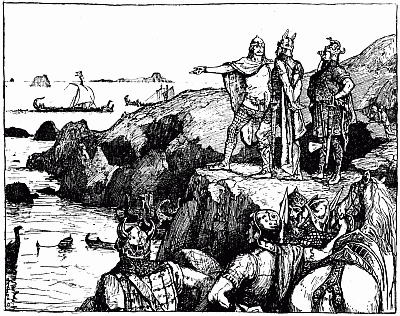
Sweyn, the Danish king, and Olaf, the Swedish king, and Earl Eric had made this agreement between them, that, if they slew Olaf Tryggvason, he of them who should be nearest at the time should own the ship and all the share of booty taken in the battle; but of the realm of the Norse king they should each have a third.
Then saw Olaf Tryggvason and all his men that they were betrayed, for lo the whole sea about them was covered with ships; but Olaf had a small force, as his fleet had sailed on before him. And now lay in his place each one of those three chiefs, Sweyn, King of Danes, with his force; Olaf, King of Swedes, with his host; while in the third place Earl Eric set his men in array.
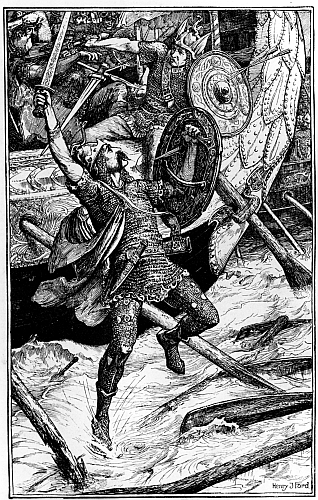
KING OLAF LEAPS OVERBOARD
Then talked with King Olaf a wise man, Thorkell Dydrill, and said: 'Here are overwhelming odds to fight against. Hoist we our sails, and sail we after our fleet out to sea; for in no man is it cowardice to know his own measure.'
King Olaf answered with loud voice: 'Bind we our ships together with ropes, and let men don their war apparel and draw their swords; my men must not think of flight.'
And Olaf Tryggvason asked his men: 'Who is chief over this force that lies here nearest to us?'
They answered:
'We think it be Sweyn, King of Danes.'
Then said King Olaf: 'We need not fear that force; never did Danes win victory in battle when fighting on shipboard against Norsemen.'
Again asked King Olaf: 'Who lies there out beyond with so many ships?'
He was told that it was Olaf Ericsson, King of Swedes.
Then answered King Olaf: 'We need not fear Swedish horse-eaters;[37] they will be more eager to lick up what is in their sacrificial bowls than to board Long Snake under our weapons.'
And yet again asked King Olaf Tryggvason: 'Who owns those large ships that lie out beyond the other squadrons?'
He was told that it was Earl Eric, Hacon's son, with the Iron Earn, of all ships the largest.
Then said King Olaf: 'Many high-born men are arrayed against us in that host, and with that force we may expect a stubborn battle: they are Norsemen as are we, and have often seen bloody swords and exchange of blows, and they will think they meet their match in us, as in truth they do.'
So these four chiefs, two kings and two earls, joined battle with Olaf Tryggvason. Sigvaldi indeed took little part in the fight, but Skuli Thorsteinsson in his short poem says that Sigvaldi was there. Very sharp and bloody was this contest, and the Danes fell most because they were nearest the Norsemen. Soon they did not hold their ground, but withdrew out of shot range; and this fleet, as Olaf had said, came off with no glory. But none the less the battle raged fierce and long, and numbers fell on either side—of the Swedes, however, most—till it came about that Olaf the Swede saw this to be the best counsel for himself and his fleet, to make as if they shunned the fight. And so he bade his ships drop away sternwards; and then Earl Eric lay broadside on.
King Olaf Tryggvason had laid the Long Snake between Short Snake and the Crane, and the smallest ships outside them. But Earl Eric, as each of these was disabled, caused it to be cut away, and pressed on to those that were behind. Now, when the small ships of King Olaf were cleared, the men leapt from them and went up on the larger ships. There was in this bout much loss of life in either party; but ever, as men fell in Earl Eric's ships, others took their place, Swedes and Danes; whereas none took the place of the men who fell on Olaf's side. All his ships were cleared presently except Long Snake; this held out because it was highest inboard and best manned. And while there were men to do so, they had gone thither aboard, and though some of the crew had perished, the ship had maintained its full numbers. But when Short Snake and Crane were disabled, then Earl Eric had them cut away, and thereafter Iron Ram lay broadside to broadside with Long Snake.
This battle was so stubborn as to stir wonder, first for the brave attack, but still more for the defence. When ships made at the Snake from all sides yet the defenders so hasted to meet them that they even stepped over the bulwarks into the sea and sank with their weapons, heedless of all else save, as in a land fight, to press ever forwards.
The men fell there first in the ship's waist, where the board was lowest, while forward about the prow and aft in the space next the poop they held out longest. And when Earl Eric saw that the Snake was defenceless amidships he boarded it with fifteen men. But when Wolf the Red and other forecastlemen saw that, then they advanced from the forecastle and charged so fiercely on where the Earl was that he had to fall back to his ship. And when he came on board the Ram the Earl roused his men to attack bravely; and they boarded the Snake a second time with a large force.
By this time Wolf and all the forecastlemen had come to the poop, and all the foreship was disabled, Earl Eric's force attacking King Olaf's on every side. Earl Eric with his men then charged aft on the space next the poop, and a stubborn resistance was there. King Olaf had been all that day on the poop of the Snake; he bare a golden shield and helm, heavy ring-mail, strong so that nought could pierce it, though 'tis said that there was no stint of missiles showered on the poop, for all men knew the King, as his armour was easily recognised and he stood high on the stern-castle. And by him stood Kolbjorn, his marshal, clad in armour like to the King's.
Now, this battle went as might be looked for when brave men on both sides met: those lost who were fewer in numbers. And when all King Olaf's force had fallen, then leapt he overboard himself, holding his shield above his head; and so did Kolbjorn, his marshal, but his shield was under him on the sea, and he could not manage to dive, wherefore the men who were in the small ships took him, but he received quarter from the Earl. And after this all leapt overboard who yet lived; but most of these were wounded, and those who received quarter were taken as they swam: these were Thorkell Netja, Karlshead, Thorstein, and Einar Bowstring-shaker.
But after the battle was ended Earl Eric took for his own Long Snake and the other ships of King Olaf, and the weapons of many men who had wielded them manfully to the death.
Most famous has been this battle in Northland; first by reason of the brave defence, next for the attack and victory, wherein that ship was overcome on the deep sea which all had deemed invincible, but chiefly because there fell a chief famous beyond any of the Danish tongue. So greatly did men admire King Olaf and seek his friendship, that many would not hear of his being dead, but declared that he was yet alive in Wendland or in the south region. And about that many stories have been made.