PRINCE CHARLIE'S WAR
Reading edition
I
THE BOYHOOD OF PRINCE CHARLIE
IN 1734 the city of Gaeta, in the kingdom of Naples, was held by an Austrian force, and was besieged by a mixed army of French, Walloons, Spaniards, and Italians, commanded by the Duke of Liria. Don Carlos, a Spanish prince, was doing his best, by their aid, to conquer the kingdom of Naples for himself. There is now no kingdom of Naples: there are no Austrian forces in Italy, and there is certainly, in all the armies of Europe, no such officer as was fighting under the Duke of Liria. This officer, in the uniform of a general of artillery, was a slim, fair-haired, blue-eyed boy of thirteen. He seemed to take a pleasure in the sound of the balls that rained about the trenches. When the Duke of Liria's quarters had been destroyed by five cannon shots, this very young officer was seen to enter the house, and the duke entreated, but scarcely commanded, him to leave. The boy might be heard shouting to the men of his very mixed force in all their various languages. He was the darling of the camp, and the favourite of the men, for his courage and pleasant manners.
This pretty boy with a taste for danger, Charles Edward Stuart, was called by his friends 'the Prince of Wales.' He was, indeed, the eldest son of James VIII. of Scotland and Third of England, known to his enemies as 'the Pretender.' James, again, was the son of James II., and was a mere baby when, in 1688, his father fled from England before the Prince of Orange.
The child (the son of James II.) grew up in France: he charged the English armies in Flanders, and fought not without distinction. He invaded Scotland in 1715, where he failed, and now, for many years, he had lived in Rome, a pensioner of the Pope. James was an unfortunate prince, but is so far to be praised that he would not change his creed to win a crown. He was a devout Catholic—his enemies said 'a bigoted Papist'—he was the child of bad luck from his cradle; he had borne many disappointments, and he was never the man to win back a kingdom by the sword. He had married a Polish princess, of the gallant House of Sobieski, and at Gaeta his eldest son, though only a boy, showed that he had the courage of the Sobieskis and the charm of the Stuarts. The spies of the English Government confessed that the boy was more dangerous than the man, Prince Charles than King James.
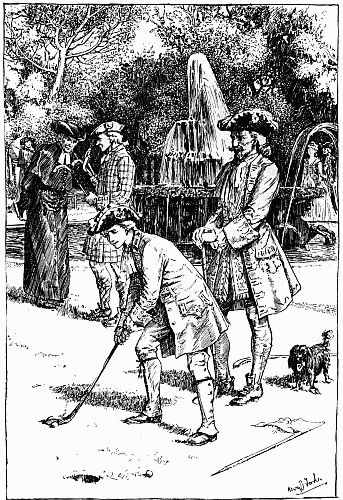
'IN THE BORGHESE GARDENS PRACTISED THAT ROYAL GAME OF GOLF'
While Charles, at Gaeta, was learning the art of war, and causing his cousin, the Duke of Liria, to pass some of the uneasiest moments of his life, at home in Rome his younger brother Henry, Duke of York, aged nine, was so indignant with his parents for not allowing him to go to the war with his brother, that he flung away his little sword in a temper. From their cradle these boys had thought and heard of little else but the past glories of their race; it was the dream of their lives to be restored to their own country. In all he did, the thought was always uppermost with Charles. On the way from Gaeta to Naples, leaning over the ship's side, the young Prince lost his hat; immediately a boat was lowered in the hope of saving it, but Charles stopped the sailors, saying with a peculiar smile, 'I shall be obliged before long to go and fetch myself a hat in England.'
Every thought, every study, every sport that occupied the next few years of Charles' life in Rome, had the same end, namely, preparing himself in every way for the task of regaining his kingdom. Long days of rowing on the lake of Albano, and boar-hunting at Cisterna, made him strong and active. He would often make marches in shoes without stockings, hardening his feet for the part he played afterwards on many a long tramp in the Highlands. Instead of enjoying the ordinary effeminate pleasures of the Roman nobility, he shot and hunted; and in the Borghese Gardens practised that royal game of golf, which his ancestors had played long before on the links at St. Andrews and the North Inch of Perth. His more serious studies were, perhaps, less ardently pursued. Though no prince ever used a sword more gallantly and to more purpose, it cannot be denied that he habitually spelled it 'sord,' and though no son ever wrote more dutiful and affectionate letters to a father, he seldom got nearer the correct spelling of his parent's name than 'Gems. In lonely parts of Rome the handsome lad and his melancholy father might often have been seen talking eagerly and confidentially, planning, and for ever planning, that long-talked-of descent upon their lost kingdom.
If his thoughts turned constantly to Britain, many hearts in that country were thinking of him with anxious prayers and hopes. In England, in out-of-the-way manor-houses and parsonages, old-fashioned, high-church squires and clergymen still secretly toasted the exiled family. But in the fifty years that had passed since the Revolution, men had got used to peace and the blessings of a settled government. Jacobitism in England was a sentiment, hereditary in certain Tory families; it was not a passion to stir the hearts of the people and engage them in civil strife. It was very different with the Scots. The Stuarts were, after all, their old race of kings; once they were removed and unfortunate, their tyranny was forgotten, and the old national feeling centred round them. The pride of the people had suffered at the Union (1707); the old Scots nobility felt that they had lost in importance; the people resented the enforcement of new taxes. The Presbyterians of the trading classes were Whigs; but the persecuted Episcopalians and Catholics, with the mob of Edinburgh, were for 'the auld Stuarts back again.' This feeling against the present Government and attachment to the exiled family were especially strong among the fierce and faithful people of the Highlands. Among families of distinction, like the Camerons of Lochiel, the Oliphants of Gask, and many others, Jacobitism formed part of the religion of gallant, simple-minded gentlemen and of high-spirited, devoted women. In many a sheiling and farmhouse old broadswords and muskets, well-hidden from the keen eye of the Government soldiers, were carefully cherished against the brave day when 'the king should have his own again.'
In 1744 that day seemed to have dawned to which Charles had all his life been looking forward. France, at war with England, was preparing an invasion of that country, and was glad enough to use the claims of the Stuarts for her own purposes. A fleet was actually on the point of starting, and Charles, in the highest spirits, was already on shipboard, but the English admiral was alert. A storm worked havoc among the French ships, and it suited the French Government to give up the expedition. Desperate with disappointment, Charles proposed to his father's friend, the exiled Lord Marischall, to sail for Scotland by himself in a herring-boat, and was hurt and indignant when the old soldier refused to sanction such an audacious plan.
Charles had seen enough of hanging about foreign courts and depending on their wavoring policy; he was determined to strike a blow for himself. In Paris he was surrounded by restless spirits like his own; Scots and Irish officers in the French service, and heart-broken exiles like old Tullibardine, eager for any chance that would restore them to their own country. Even prudent men of business lent themselves to Charles's plans. His bankers in Paris advanced him 180,000 livres for the purchase of arms, and of two Scottish merchants at Nantes, Walsh and Routledge, one undertook to convey him to Scotland in a brig of eighteen guns, the 'Doutelle,' while the other chartered a French man-of-war, the 'Elizabeth,' to be the convoy, and to carry arms and ammunition. To provide these Charles had pawned his jewels, jewels which 'on this side I could only wear with a very sad heart,' he wrote to his father; for the same purpose he would gladly have pawned his shirt. On June 22 he started from the mouth of the Loire in all haste and secrecy, only writing for his father's blessing and sanction when he knew it would be too late for any attempt to be made to stop him. The companions of his voyage were the old Marquis of Tullibardine, who had been deprived of his dukedom of Athol in the '15; the Prince's tutor and cousin, Sir Thomas Sheridan, a rather injudicious Irishman; two other Irishmen in the French and Spanish services; Kelly, a young English divine; and Æneas Macdonald, a banker in Paris, and younger brother of the chieftain Macdonald of Kinloch Moidart, a prudent young man, who saw himself involved in the Prince's cause very much against his will and better judgment.
II
PRINCE CHARLIE'S LANDING
England and France being at war at this time, the Channel was constantly swept by English men-of-war. The 'Doutelle' and her convoy were hardly four days out before the 'Elizabeth' was attacked by an English frigate, the 'Lion.' Knowing who it was he had on board, Walsh, the prudent master of the 'Doutelle,' would by no means consent to join in the fray, and sheered off to the north in spite of the commands and remonstrances of the Prince. The unfortunate 'Elizabeth' was so much disabled that she had to return to Brest, taking with her most of the arms and ammunition for the expedition. At night the 'Doutelle' sailed without a light and kept well out to sea, and so escaped further molestation. The first land they sighted was the south end of the Long Island. Gazing with eager eyes on the Promised Land, old Lord Tullibardine was the first to notice a large Hebridean eagle which flew above the ship as they approached. 'Sir,' he said, 'it is a good omen; the king of birds has come to welcome your royal highness to Scotland.'
Charles had need of all happy auguries, for on his arrival in Scotland things did not seem very hopeful. With his usual rash confidence he had very much exaggerated the eagerness of his friends and supporters to welcome him in whatever guise he might come. Never had fallen kings more faithful and unselfish friends than had the exiled Stuarts in the Highland chiefs and Jacobite lairds of Scotland, but even they were hardly prepared to risk life and property with a certainty of failure and defeat. Let the Prince appear with 5,000 French soldiers and French money and arms, and they would gather round him with alacrity, but they were prudent men and knew too well the strength of the existing Government to think that they could overturn it unaided.
The first man to tell the Prince this unwelcome truth was Macdonald of Boisdale, to whom he sent a message as soon as he landed in Uist. This Boisdale was brother of the old Clanranald, chief of the loyal clan Macdonald of Clanranald. If these, his stoutest friends, hesitated to join his expedition Charles should have felt that his cause was desperate indeed. But his mind was made up with all the daring of his five-and-twenty years, and all the ill-fated obstinacy of his race. For hours he argued with the old Highlander as the ship glided over the waters of the Minch. He enumerated the friends he could count on, among them the two most powerful chiefs of the North, Macdonald of Sleat, and the Macleod. 'They have both declared for the existing Government,' was the sad reply. Before taking leave of the Prince, Boisdale again urged his returning 'home.' 'I am come home,' replied Charles passionately, 'and can entertain no notion of returning. I am persuaded that my faithful Highlanders will stand by me.'
'I WILL, THOUGH NOT ANOTHER MAN IN THE HIGHLANDS SHOULD DRAW A SWORD'
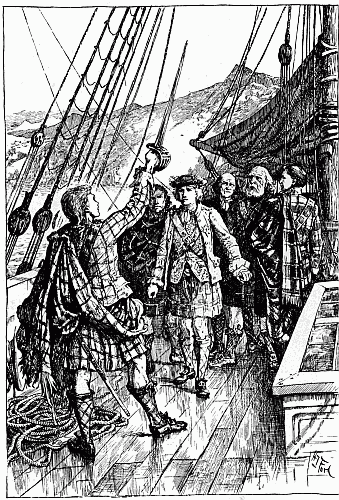
On July 19 the 'Doutelle' cast anchor in Loch na-Nuagh, in the country of the loyal Macdonalds. The first thing Charles did was to send a letter to the young Clanranald to beg his immediate presence. The next day four of the chief men of the clan waited on Charles, Clanranald, Kinloch Moidart, Glenaladale, and another who has left us a lively picture of the meeting. For three hours, in a private interview, Clanranald tried in vain to dissuade the Prince. Then Charles—still preserving his incognito—appeared among the assembled gentlemen on deck. 'At his first appearance I found my heart swell to my very throat 'writes the honest gentleman who narrates the story. His emotion was fully shared by a younger brother of Kinloch Moidart's who stood on deck silent from youth and modesty, but with his whole heart looking out of his eyes. His brother and the other chiefs walked up and down the deck arguing and remonstrating with Charles, proving the hopelessness of the undertaking. As he listened to their talk the boy's colour came and went, his hand involuntarily tightened on his sword. Charles caught sight of the eager young face, and, turning suddenly towards him cried, 'Will you not assist me?' 'I will, I will; though not another man in the Highlands should draw a sword, I will die for you.' Indeed, years after all had failed, young Clanranald prepared a new rising, and had 9,000 stand of arms concealed in the caves of Moidart.
The boy's words were like flint to tinder. Before they left the ship the hesitating chieftains had pledged themselves to risk property, influence, freedom, and life itself in the Prince's cause. These gallant Macdonalds were now willing to run all risks in receiving the Prince even before a single other clan had declared for him. Old Macdonald of Boisdale entertained Charles as an honoured guest in his bare but hospitable Highland house. All the people of the district crowded to see him as he sat at dinner. The young Prince delighted all present by his geniality and the interest he showed in everything Highland, and when he insisted on learning enough Gaelic to propose the king's health in their native language, the hearts of the simple and affectionate people were completely gained.
Meanwhile young Clanranald had gone to Skye to try and persuade Macleod and Sir Alexander Macdonald to join the Prince. It was all in vain; these two powerful chiefs were too deeply committed to the Government. Next to these two, the most influential man in the Highlands was Cameron of Locheil. Indeed, such was the respect felt by all his neighbours for his gentle and chivalrous character, that there was no one whose example would carry such weight. It was all-important to gain him to the cause. No one saw more clearly than Locheil the hopelessness of the undertaking, no one was more unwilling to lead his clansmen to what he knew was certain destruction. He would see the Prince, he said, and warn him of the danger and entreat him to return. 'Write to him,' urged Locheil's brother, 'but do not see him. I know you better than you know yourself. If this Prince once sets eyes on you he will make you do whatever he pleases.' It was but too true a prophecy. When all argument had failed to move Locheil's prudent resolution, Charles exclaimed passionately, 'In a few days, with a few friends, I will raise the Royal Standard and proclaim to the people of Britain that Charles Stuart is come over to claim the crown of his ancestors, to win it or perish in the attempt. Locheil, who, my father has often told me, was our firmest friend, may stay at home and learn from the newspapers the fate of his Prince.' It was more than the proud, warm heart of the chief could stand. 'No,' he cried with emotion, 'I will share the fate of my Prince, and so shall every man over whom nature and fortune has given me any power.'
Even before the Royal Standard was raised an unexpected success crowned the rebel arms. The Government had troops stationed both at Fort Augustus and Fort William. The latter being in the heart of the disaffected district, the commanding officer at Fort Augustus despatched two companies of newly-raised men to its assistance. This body, under a Captain Scott, was approaching the narrow bridge which crossed the Spean some seven miles from Fort William; all at once a body of Highlanders appeared, occupying the bridge and barring further passage. Had the troops plucked up courage enough to advance they would have found only some dozen Macdonalds; but the wild sound of the pipes, the yells of the Highlanders, and their constant movement which gave the effect of a large body, struck terror into the hearts of the recruits; they wavered and fell back, and their officer, though himself a brave man, had to order a retreat. But the sound of firing had attracted other bodies of Macdonalds and Camerons in the neighbourhood. All at once the steep, rough hillside seemed alive with armed Highlanders; from rock and bush they sprung up, startling the echoes by their wild shouts. In vain the disordered troops hurried along the road and rushed across the isthmus to the further side of the lakes; there a new party of Macdonalds, led by Keppoch, met them in front, and the whole body surrendered with hardly a blow struck. They were carried prisoners to Locheil's house, Achnacarry. In default of medical aid, the wounded captain was sent to Fort William, in that spirit of generous courtesy which characterised all Charles's behaviour to his defeated enemies.
'Go, sir, to your general; tell him what you have seen. . . .'
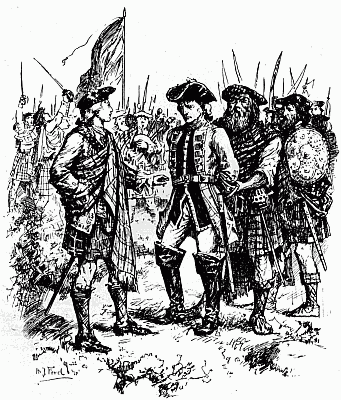
On August 19 the Royal Standard was raised at Glenfinnan, a deep rocky valley between Loch Eil and Loch Sheil, where the Prince's monument now stands. Charles, with a small body of Macdonalds, was the first to arrive, early in the morning. He and his men rowed up the long narrow Loch Sheil. The valley was solitary—not a far-off bagpipe broke the silence, not a figure appeared against the skyline of the hills. With sickening anxiety the small party waited, while the minutes dragged out their weary length. At last, when suspense was strained to the utmost, about two in the afternoon, a sound of pipes was heard, and a body of Camerons under Lochiel appeared over the hill, bringing with them the prisoners made at the Bridge of Spean. Others followed: Stewarts of Appin, Macdonalds of Glencoe and Keppoch, till at least 1,500 were present. Then the honoured veteran of the party, old Tullibardine, advanced in solemn silence and unfurled the royal banner, with the motto Tandem Triumphans. As its folds of white, blue, and red silk blew out on the hill breeze, huzzas rent the air, and the sky was darkened by the bonnets that were flung up. An English officer, a prisoner taken at Spean, stood by, an unwilling spectator of the scene. 'Go, sir,' cried the Prince in exultation, 'go to your general; tell him what you have seen, and say that I am coming to give him battle.'
III
THE MARCH SOUTH
For a full month Prince Charles had been in Scotland. During that time a body of men, amounting to a small army, had collected round him; his manifestoes had been scattered all over the country (some were even printed in Edinburgh), and yet the Government had taken no steps to oppose him. News travelled slowly from the Highlands; it was August 9 before any certain account of the Prince's landing was received in Edinburgh. One bad fruit of the Union was that Scotch questions had to be settled in London, and London was three days further away. Moreover, at that greater distance, men had more difficulty in realising the gravity of the situation. Conflicting rumours distracted the authorities in Edinburgh; now it was declared that the Prince had landed with 10,000 French soldiers, at another time men ridiculed the idea of his getting a single man to rise for him. Those who knew the country best took the matter most seriously. The question of defence was not an easy one. At that time almost all the available British troops were in Flanders, fighting the French; the soldiers that were left in Scotland were either old veterans, fit only for garrison duty, newly raised companies whose mettle was untried, or local militias which were not to be trusted in all cases. If the great lords who had raised and who commanded them chose to declare for the Stuarts, they would carry their men with them.
The commander-in-chief, Sir John Cope, was not the man to meet so sudden and so peculiar a crisis. He had nothing of a real general's love of responsibility and power of decision. To escape blame and to conduct a campaign according to the laws of war was all the old campaigner cared for. When it was decided that he was to march with all the available forces in Scotland into the Highlands he willingly obeyed, little guessing what a campaign in the Highlands meant. Almost at once it was found that it would be impossible to provide food for horses as well as men. So the dragoons under Colonel Gardiner were left at Stirling. We shall hear of them again. But his 1,500 infantry were weighted heavily enough; a small herd of black cattle followed the army to provide them with food, and more than 100 horses carried bread and biscuit. Confident that the loyal clans would come in hundreds to join his standard, Cope carried 700 stand of arms. By the time he reached Crieff, however, not a single volunteer had come in, and the stand of arms was sent back. Cope followed one of the great military roads which led straight to Fort Augustus, and had been made thirty years before by General Wade. Now across that road, some ten miles short of the fort, lies a high precipitous hill, called Corryarack. Up this mountain wall the road is carried in seventeen sharp zigzags; so steep is it that the country people call it the 'Devil's Staircase.' Any army holding the top of the pass would have an ascending enemy at its mercy, let alone an army of Highlanders, accustomed to skulk behind rock and shrub, and skilled to rush down the most rugged hillsides with the swiftness and surefootedness of deer.
While still some miles distant, Cope learned that the Highlanders were already in possession of Corryarack. The rumour was premature, but it thoroughly alarmed the English general. He dared not attempt the ascent; to return south was against his orders. A council of war, hastily summoned, gave him the advice he wished for, and on the 28th the army had turned aside and was in full retreat on Inverness.
Meanwhile, the Prince's army was pressing forward to meet Cope. The swiftest-footed soldiers that ever took the field, the Highlanders were also the least heavily-weighted. A bag of oatmeal on his back supplied each man's need, Charles himself burned his baggage and marched at the head of his men as light of foot and as stout of heart as the best of them. On the morning of the 27th they were to ascend Corryarack. The Prince was in the highest spirits. As he laced his Highland brogues he cried, 'Before I take these off I shall have fought with Mr. Cope!' Breathless the Highland army reached the top of the hill; they had gained that point of vantage. Eagerly they looked down the zigzags on the further side; to their amazement not a man was to be seen, their road lay open before them! When they learned from deserters the course Cope's army had taken, they were as much disappointed as triumphant.
A body of Highlanders was despatched to try and take the barracks at Ruthven, where twelve soldiers, under a certain Sergeant Molloy, held the fort for the Government. This man showed a spirit very different from that of his superior officer's. This is his own straightforward account of the attack and repulse:
'Noble General,—They summoned me to surrender, but I told him I was too old a soldier to part with so strong a place without bloody noses. They offered me honourable terms of marching out bag and baggage, which I refused. They threatened to hang me and my party. I said I would take my chance. They set fire to the sally-port which I extinguished; and failing therein, went off asking leave to take their dead man, which I granted.'
Honour to Molloy, whatever the colour of his cockade!
Though unsuccessful at Ruthven, some members of this party, before rejoining the Prince's army at Dalwhinnie, made an important capture. Macpherson of Cluny was one of the most distinguished chiefs in the Highlands, ruling his clan with a firm hand, and repressing all thieving amongst them. As captain of an independent company, he held King George's commission; his honour kept him faithful to the Government, but his whole heart was on the other side. He was taken prisoner in his own house by a party 'hardly big enough to take a cow,' and once a prisoner in the Highland army, it was no difficult task to persuade him to take service with the Prince.
The army now descended into the district of Athol. With curious emotion old Tullibardine approached his own house of Blair from which he had been banished thirty years before. The brother who held his titles and properties fled before the Highland army, and the noble old exile had the joy of entertaining his Prince in his own halls. The Perthshire lairds were almost all Jacobites. Here at Blair, and later at Perth, gentlemen and their following flocked to join the Prince.
One of the most important of these was Tullibardine's brother, Lord George Murray, an old soldier who had been 'out in the '15.' He had real genius for generalship, and moreover understood the Highlanders and their peculiar mode of warfare. He was no courtier, and unfortunately his blunt, hot-tempered, plain speaking sometimes ruffled the Prince, too much accustomed to the complacency of his Irish followers. But all that was to come later. On the march south there were no signs of divided counsels. The command of the army was gladly confided to Lord George.
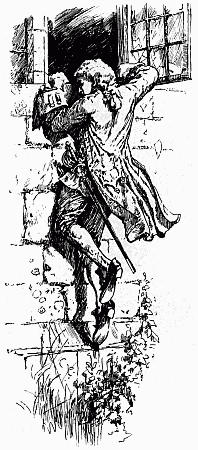
Another important adherent who joined at this time was the Duke of Perth, a far less able man than Lord George, but endeared to all his friends by his gentleness and courage and modesty. Brought up in France by a Catholic mother, he was an ardent Jacobite, and the first man to be suspected by the authorities. As soon as the news spread that the Prince had landed in the West, the Government sent an officer to arrest the young duke. There was a peculiar treachery in the way this was attempted. The officer, a Mr. Campbell of Inverawe, invited himself to dinner at Drummond Castle, and, after being hospitably entertained, produced his warrant. The duke retained his presence of mind, appeared to acquiesce, and, with habitual courtesy, bowed his guest first out of the room; then suddenly shut the door, turned the key and made his escape through an ante-room, a backstairs, and a window, out into the grounds. Creeping from tree to tree he made his way to a paddock where he found a horse, without a saddle but with a halter. He mounted, and the animal galloped off. In this fashion he reached the house of a friend, where he lay hid till the time he joined the Prince.
Escape of the Duke of Perth
No Jacobite family had a nobler record of services rendered to the Stuarts than the Oliphants of Gask. The laird had been 'out in the '15,' and had suffered accordingly, but he did not hesitate a moment to run the same risks in the '45. He brought with him to Blair his high-spirited boy, young Lawrence, who records his loyal enthusiasm in a journal full of fine feeling and bad spelling! Indeed, one may say that bad spelling was, like the 'white rose,' a badge of the Jacobite party. Mistress Margaret Oliphant, who with her mother and sisters donned the white cockade and waited on their beloved Prince at her aunt's, Lady Nairne's, house, also kept a journal wherein she regrets in ill-spelt, fervent words that being 'only a woman' she cannot carry the Prince's banner. This amiable and honourable family were much loved among their own people. 'Oliphant is king to us' was a by-word among retainers who had lived on their land for generations. But at this crisis the shrewd, prosperous Perthshire farmers refused to follow their landlord on such a desperate expedition. Deeply mortified and indignant, the generous, hot-tempered old laird forbade his tenants to gather in the harvest which that year was early and abundant. As Charles rode through the Gask fields he noticed the corn hanging over-ripe and asked the cause. As soon as he was told, he jumped from his horse, cut a few blades with his sword and, in his gracious princely way, exclaimed 'There, I have broken the inhibition! Now every man may gather in his own.' It was acts like this that gained the hearts of gentle and simple alike, and explain that passionate affection for Charles that remained with many to the end of their days as part of their religion. The strength of this feeling still touches our hearts in many a Jacobite song. 'I pu'ed my bonnet ower my eyne, For weel I loued Prince Charlie,' and the yearning refrain, 'Better loued ye canna be, Wull ye no come back again?' On the 3rd Charles entered Perth, at the head of a body of troops, in a handsome suit of tartan, but with his last guinea in his pocket! However, requisitions levied on Perth and the neighbouring towns did much to supply his exchequer, and it was with an army increased in numbers and importance, as well as far better organised—thanks to Lord G. Murray—that Charles a week later continued his route to Edinburgh. Having no artillery the Highland army avoided Stirling, crossed the Forth at the Fords of Frew entirely unopposed, and marched to Linlithgow, where they expected to fight with Gardiner's dragoons. That body however did not await their arrival, but withdrew to Corstorphine, a village two miles from Edinburgh.
The next halt of the Prince's army was at Kirkliston. In the neighbourhood lay the house of New Liston, the seat of Lord Stair, whose father was so deeply and disgracefully implicated in the massacre of Glencoe. It was remembered that a grandson of the murdered Macdonald was in the army with the men of his clan. Fearing that they would seize this opportunity of avenging their cruel wrong, the general proposed placing a guard round the house. Macdonald hearing this proposal, went at once to the Prince. 'It is right,' he said, 'that a guard should be placed round the house of New Liston, but that guard must be furnished by the Macdonalds of Glencoe. If they are not thought worthy of this trust they are not fit to bear arms in your Royal Highness' cause, and I must withdraw them from your standard.' The passion for revenge may be strong in the heart of the Highlander, but the love of honour and the sense of loyalty are stronger still. The Macdonalds, as we shall see, carried their habit of taking their own way to a fatal extent.
IV
EDINBURGH
Meanwhile nothing could exceed the panic that had taken possession of the town of Edinburgh. The question of the hour was, could the city be defended at all, and if so, could it, in case of siege, hold out till Cope might be expected with his troops? That dilatory general, finding nothing to do in the North, was returning to Edinburgh by sea, and might be looked for any day. There could be no question of the strength of the Castle. It was armed and garrisoned, and no army without large guns need attempt to attack it. But with the town it was different. The old town of Edinburgh, as everybody knows, is built along the narrow ridge of a hill running from the hollow of Holyrood, in constant ascent, up to the Castle rock. On each side narrow wynds and lanes descend down steep slopes, on the south side to the Grassmarket and the Cowgate, on the north—at the time of which we write—the sides of the city sloped down to a lake called the Norloch, a strong position, had the city been properly fortified. More than two hundred years before, in the desolate and anxious days that followed Flodden, the magistrates of the city, hourly expecting to be invaded, had hastily built a high wall round the whole city as it then was. For the time the defence was sufficient. But the wall had been built without reference to artillery, it had neither towers nor embrasures for mounting cannons. It was simply a very high, solid, park wall, as may be seen to this day by the curious who care to visit the last remnants of it, in an out-of-the-way corner near the Grassmarket.
If the material defences were weak, the human defenders were weaker still. The regular soldiers were needed for the Castle; Hamilton's dragoons, stationed at Leith, were of no use in the defence of a city, the town guard was merely a body of rather inefficient policemen, the trained bands mere ornamental volunteers who shut their eyes if they had to let off a firearm in honour of the king's birthday. As soon as it seemed certain that the Highland army was approaching Edinburgh, preparations, frantic but spasmodic, were made to put the city in a state of defence.
The patriotic and spirited Maclaurin, professor of mathematics, alone and unaided, tried to mount cannons on the wall, but not with much success. The city determined to raise a regiment of volunteers; funds were not lacking; it was more difficult to find the men. Even when companies were formed, their ardour was not very great. Rumour and ignorance had exaggerated the numbers and fierceness of the Highland army; quiet citizens, drawn from desk or shop, might well shrink from encountering them in the field. Parties were divided in the town; the Prince had many secret friends among the citizens. In back parlours of taverns 'douce writers,' and advocates of Jacobite sympathies, discussed the situation with secret triumph; in many a panelled parlour high up in those wonderful old closes, spirited old Jacobite ladies recalled the adventures of the '15, and bright-eyed young ones busied themselves making knots of white satin. 'One-third of the men are Jacobite,' writes a Whig citizen, 'and two-thirds of the ladies.'
On Saturday, 14th, the news reached Edinburgh that the Prince had arrived at Linlithgow, and that Gardiner had retired on Corstorphine, a village two miles from Edinburgh. Consternation was general; advice was sought from the law officers of the Crown, and it was found that they had all retired to Dunbar. The Provost was not above suspicion. His surname was Stuart; no Scotsman could believe that he really meant to oppose the chief of his name.
'In many a panelled parlour'
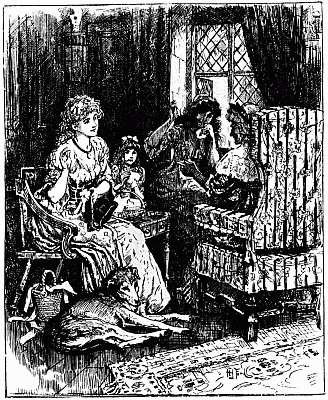
On Sunday, as the townsfolk were at church about eleven o'clock, the firebell rang out its note of alarm, scattering the congregation into the streets. It was the signal for the mustering of the volunteers. The officer in command at the Castle was sending the dragoons from Leith to reinforce Gardiner at Corstorphine, and the volunteers were ordered to accompany them. They were standing in rank in the High Street, when the dragoons rattled up the Canongate at a hard trot; as they passed they saluted their brothers in arms with drawn swords and loud huzzas, then swept down the West Bow and out at the West Port. For a moment military ardour seized the volunteers, but the lamentations and tears of their wives and children soon softened their mood again. A group of Jacobite ladies in a balcony mocked and derided the civic warriors, but had finally to close their windows to prevent stones being hurled at them.
One of the volunteer companies was composed of University students. Among them was, doubtless, more than one stout young heart, eager for fame and fighting, but most were more at home with their books than their broadswords. 'Oh, Mr. Hew, Mr. Hew,' whispered one youth to his comrade, 'does not this remind you of the passage in Livy where the Gens of the Fabii marched out of the city, and the matrons and maids of Rome were weeping and wringing their hands?' 'Hold your tongue,' said Mr. Hew, affecting a braver spirit, 'you'll discourage the men.' 'Recollect the end, Mr. Hew,' persisted his trembling comrade; 'they all perished to a man!' This was not destined to be the fate of the Edinburgh volunteers. On the march down the West Bow, one by one they stole off, up the narrow wynds and doorways, till by the time they reached the West Port, only the student corps remained, and even its ranks were sadly thinned. The remnant were easily persuaded that their lives were too precious to their country to be rashly thrown away, and quietly marched back to the college yards.
There was no alarm that night. At one o'clock the Provost, accompanied by a few of the city guard, carrying a lantern before him, visited the outposts and found all at their places. In the narrow streets of Edinburgh the people were accustomed to transact all their business out of doors. Next morning (Monday, 16th), the streets were already crowded at an early hour with an anxious, vociferous crowd. At 10 o'clock a man arrived with a message from the Prince, which he incautiously proclaimed in the street. If the town would surrender it should be favourably treated; if it resisted it must expect to be dealt with according to the usages of war. Greatly alarmed, the people clamoured for a meeting, but the Provost refused; he trusted to the dragoons to defend the city. A little after noon, the citizens looking across from the Castle and the northern windows of their houses, saw the dragoons in retreat from Coltbridge As they watched the moving figures, the pace quickened and became a regular flight; by the time the dragoons were opposite the city on the other side of the Norloch, they were running like hares. They made at first for their barracks at Leith, but the distance still seemed too short between them and the terrifying Highlanders; they never drew rein till they had reached Prestonpans, nor did they rest there longer than an hour or two, but galloped on, and were at Dunbar before nightfall. And yet they had not exchanged a blow with their foes! At the first sight of a reconnoitring party of horsemen, panic had seized them and they had fled. This was the celebrated 'Canter of Coltbridge.'
The effect on the city was disturbing in the extreme. A tumultuous meeting was held in the council chamber, the volunteers were drawn up in the streets. As they stood uncertain what to do a man on horseback—it was never known who he was—galloped up the Bow, and as he passed along the ranks, shouted 'The Highlanders are coming, sixteen thousand strong.'
It was too much for the volunteers, they marched up to the Castle and gave in their arms! Meanwhile, a packet was handed into the council chamber signed C. P., and offering the same terms as in the morning, only adding that the town must open its gates by two o'clock next morning. The cry was unanimous to surrender, but to gain time deputies were sent to the Prince at Gray's Mill, two miles from Edinburgh, to ask for further delay. Hardly had the deputies gone when, in through the opposite gate galloped a messenger from Dunbar, to say that Cope had landed there with his troops. Opinion now swung round the other way, and men's courage rose to the point of speaking about resistance. The deputies returned at ten at night; Charles, they said, was inexorable and stuck to his conditions. To cause a delay, a new set of deputies were sent forth at a very late hour, and went out by the West Bow in a hackney coach.
'Och no! she be relieved'
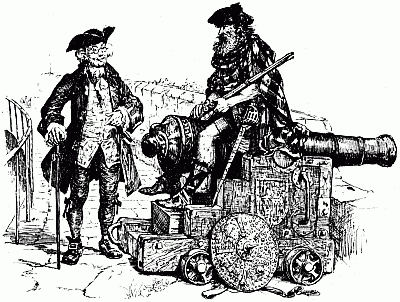
To gain time, and then steal another march on Cope, was even more important to the Prince than to his enemies. There were weak points in the wall that might be attacked. The chief gate of the city, the Netherbow, lay midway up the High Street, dividing the real borough of Edinburgh from the Canongate; on each side of this gate the wall descended sharply down hill, running along Leith Wynd on the north side and St. Mary's Wynd on the south. The houses of the latter—Edinburgh houses numbering their ten or twelve stories—were actually built on to the wall. By entering one of these, active and determined men might clear the wall by a fire of musketry from the upper windows, and then make an escalade. Another weak point was at the foot of Leith Wynd, where the wall met the Norloch. About midnight Locheil and five hundred of his men started to make a night attack. They were guided by Mr. Murray of Broughton (the Prince's secretary, afterwards a traitor), who had been a student in Edinburgh and knew the town well. To avoid chance shots from the guns of the Castle, they made a wide circle round the town, but so still was the night that across the city they could hear the watches called in the distant fortress. Swift and silent as Red Indians, the Highlanders marched in the shadow cast by the high, dark houses of the suburbs without arousing the sleeping inmates. They could see cannons on the walls, but no sentinels were visible. They determined to try fraud before resorting to force. Twenty Camerons placed themselves in hiding on each side of the gate, sixty stood in the dark recess of the Wynd, the rest were at the bottom of the slope. One of the number, disguised as the servant of an English officer of dragoons, knocked loudly at the gate, demanding admission. The watch refused to open and threatened to fire. So this stratagem was not successful. Already the dawn was beginning to break, and a council was held among the leaders of the band in low hurried whispers. They were deliberating whether they should not retreat, when all at once a heavy rumbling noise from within the city broke the silence of the night. The hackney coach before mentioned had deposited its load of deputies at the council chamber and was returning to its stable-yard in the Canongate. A word to the watchmen within and the gates swung on their heavy hinges. In rushed the body of Camerons, secured the bewildered watchmen, and in a few minutes had seized the city guard-house and disarmed the soldiers. Then they struck up the wild pibroch 'We'll awa' to Sheriffmuir to haud the Whigs in order,' and startled citizens rushing to their windows saw in the dim twilight the streets filled with plaids and bonnets. The conquerors visited all the outposts as quietly as if they were troops relieving guard. A citizen strolling along by the wall early next morning found a Highland soldier astride on one of the cannons, 'Surely you are not the same soldiers who were here yesterday?' 'Och no!' was the answer with a grave twinkle, 'she be relieved.'
At noon Prince Charles rode to Holyrood by way of Arthur's Seat and Salisbury Crags. He was on foot as he approached the ancient home of his race, but the large and enthusiastic crowd which came out to meet him pressed so closely upon him in their eagerness to kiss his hand, that he had to mount a horse, and rode the last half mile between the Duke of Perth and Lord Elcho. A gallant young figure he must have appeared at that moment—tall and straight and fresh-coloured, in a tartan coat and blue bonnet, with the cross of St. Andrew on his breast. As he was about to enter the old palace of Holyrood, out of the crowd stepped the noble and venerable figure of Mr. Hepburn of Keith. He drew his sword, and, holding it aloft, with grave enthusiasm marshalled the Prince up the stairs. It was surely a good omen; no man in Scotland bore a higher character for learning, goodness, and patriotism than Mr. Hepburn; he was hardly less respected by the Whigs than the Jacobites.
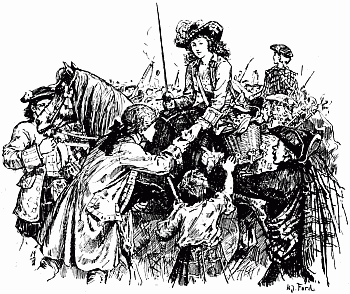
That same afternoon, at the old Cross in the High Street, with pomp of heralds and men-at-arms, James VIII. was proclaimed king, and his son's commission as regent was read aloud to the listening crowd. Loud huzzas almost drowned the wild music of the bagpipes, the Highlanders in triumph let off their pieces in the air, and from every window in the high houses on each side ladies fluttered their white handkerchiefs. Beside the Cross, beautiful Mrs. Murray of Broughton sat on horseback, a drawn sword in one hand, while with the other she distributed white cockades to the crowd. Even grave Whig statesmen like the Lord President Forbes were disturbed by the enthusiastic Jacobitism that possessed all the Scotch ladies. More than one followed the example of the high-spirited Miss Lumsden, who let her lover clearly understand that she would have nothing more to say to him unless he took up arms for the Prince, and doubtless more young gallants than Robert Strange joined the rebels for no better reason than their ladies' command.
Mrs. Murray of Broughton distributes cockades to the crowd
A ball was given at Holyrood that same evening, and surrounded by all that was bravest and most beautiful and brilliant in Scottish society, it was no wonder that Charles felt that this was but the beginning of a larger and more complete triumph.
V
PRESTONPANS
In less than a month Prince Charles had marched through a kingdom, and gained a capital, but he felt his triumph insecure till he had met his enemies in fair fight. Nor were his followers less eager for battle. In a council of war held at Holyrood, Charles declared his intention of leading the army against Cope, and of charging in person at its head. That, however, the chiefs would not hear of; the Prince's life was all-important to their cause, and must not be rashly exposed to danger. The arms that the Edinburgh trained bands had used to so little purpose—about a thousand muskets—had fallen into the hands of their enemies; but even with this addition, the Highland soldiers were insufficiently accoutred. The gentlemen, who marched in the front ranks, were, it is true, completely armed with broadsword, musket, pistol, and dirk, but in the rank and file many an unkempt, half-clothed, ill-fed cateran carried merely a bill-hook or scytheblade fixed into a long pole. It was the swiftness and splendid daring of their onset that made these ill-armed, untrained clansmen the equals or more than the equals of the regular army that opposed them.
In the meantime Cope, with his army of 2,000 foot, reinforced by the fugitive dragoons, some 600 men under Gardiner, were marching from Dunbar. Gardiner, as brave a soldier as he was a good and devout Christian, was full of foreboding. The 'canter of Coltbridge' had broken his heart; a 'most foul flight,' he called it, and added, to a friend who tried to comfort him, that there were not ten men in his troop whom he could trust not to run away at the first fire. No such misgiving seems to have disturbed Sir John Cope. On Friday the 20th the Hanoverian army reached Prestonpans, and formed its ranks on a plain between the sea on the north and the ridge of Carberry Hill on the south. The road from Edinburgh to Haddington passed through this plain, and the simple old general argued that the advancing army would be sure to take the easiest road. Fortunately Lord George Murray knew better where the peculiar strength of the Highlanders lay.
Early on Friday morning the Prince's army broke up from their camp at Duddingstone. Charles himself was the first man on the field. As the troops began their march, he drew his sword and cried: 'Gentlemen, I have thrown away the scabbard;' high-spirited words which found an echo in the hearts of all the brave men present.
The army marched in column, three abreast, the various clans holding together under their own chiefs. Two miles short of Prestonpans Lord George learned the position of Cope's army, and at once led his light-footed soldiers up the slopes that commanded the plain. The English general was hourly expecting to see his enemies approach from the west by the road, and he was fully prepared to meet them at that point. At two in the afternoon, to his amazement, they suddenly appeared from the south, marching over the ridge of the hill.
The Hanoverian soldiers had enough spirit to receive them with cheers, to which the Highlanders responded by wild yells. They longed ardently to sweep down the slope and give instant battle, but the nature of the ground made this impossible even to a Highland army. Intersecting the hillside were high stone walls, which would have to be scaled under a hot fire from below, and at the bottom was a swamp, a wide ditch, and a high hedge. A certain gentleman in the Prince's army—Mr. Ker of Gordon—rode over the ground on his pony to examine its possibilities. He went to work as coolly as if he were on the hunting-field, making breaches in the wall and leading his pony through, in spite of a dropping fire from the Hanoverians. He reported that to charge over such ground was impossible. The Highlanders were bitterly disappointed; their one fear was that Cope should again slip away under cover of darkness. To prevent this Lord Nairne and 600 Perthshire men were sent to guard the road to Edinburgh. Seeing that nothing more could be done that night, both armies settled down to rest; General Cope lay in comfort at Cockenzie, Prince Charles on the field; a bundle of peastraw served for his pillow; a long white cloak thrown over his plaid for a covering.
Among the volunteers who had recently joined the Prince was an East Lothian laird called Anderson. He had often shot over the fields about Prestonpans. During the night he suddenly remembered a path which led from the heights, down through the morass on to the plain, slightly to the east of Cope's army. He sought out Lord George and told him of this path, and he, struck with the possibility of making immediate use of the information, took him without delay to the Prince. Charles was alert on the instant, entered into the plan proposed, and the next moment the word of command was passed along the sleeping lines. A few moments later the whole army was moving along the ridge in the dim starlight. But here a difficulty occurred. At Bannockburn, and in all great battles afterwards, except Killiekrankie, the Macdonalds had held the place of honour on the right wing of the army. They claimed that position now with haughty tenacity. The other clans, equally brave and equally proud, disputed the claim. It was decided to draw lots to settle the question. Lots were drawn, and the place of honour fell to the Camerons and Stewarts. An ominous cloud gathered on the brows of the Macdonald chiefs, but Locheil, as sagacious as he was courteous, induced the other chiefs to waive their right, and, well content, the clan Macdonald marched on in the van.
Up on the hill the sky was clear, but a thick white mist covered the plain. Under cover of this the Highlanders passed the morass in the one fordable place. In the darkness the Prince missed a stepping-stone and slipped into the bog, but recovered so quickly that no one had time to draw a bad omen from the accident. A Hanoverian dragoon, standing sentinel near this point, heard the march of the soldiers while they were still invisible in the dusk, and galloped off to give the alarm, but not before the Highland army was free from the swamp and had formed in two lines on the plain. Macdonalds and Camerons and Stewarts were in the first line; behind, at a distance of fifty yards, the Perthshiremen and other regiments led by Charles himself.
Learning that the enemy was now approaching from the east side of the plain, Cope drew up his men to face their approach. In the centre was the infantry—the steadiest body in his army—on his left, near the sea and opposite the Macdonalds, Hamilton's dragoons, on the right, the other dragoons under Gardiner, and in front of these the battery of six cannon. This should have been a formidable weapon against the Highlanders, who, unfamiliar with artillery, had an almost superstitious fear of the big guns, but they were merely manned by half-a-dozen feeble old sailors. There was a brief pause as the two armies stood opposite each other in the sea of mist. The Highlanders muttered a short prayer, drew their bonnets down on their eyes, and moved forward at a smart pace. At that moment a wind rose from the sea and rolled away the curtain of mist from between the two armies. In front of them the Highlanders saw their enemy drawn up like a hedge of steel. With wild yells they came on, their march quickening to a run, each clan charging in a close compact body headed by its own chief. Even while they rushed on, as resistless as a torrent, each man fired his musket deliberately and with deadly aim, then flung it away and swept on, brandishing his broadsword. A body of Stewarts and Camerons actually stormed the battery, rushing straight on the muzzles of the guns. The old men who had them in charge had fled at the first sight of the Highlanders; even the brave Colonel Whiteford, who alone and unassisted stood to his guns, had to yield to their furious onset. Gardiner's dragoons standing behind the battery were next seized by the panic; they made one miserable attempt to advance, halted, and then wheeling round, dashed wildly in every direction. Nor could Hamilton's dragoons on the other wing stand the heavy rolling fire of the advancing Macdonalds. Mad with terror, man and horse fled in blind confusion, some backwards, confounding their own ranks, some along the shore, some actually through the ranks of the enemy.
James More wounded at Prestonpans
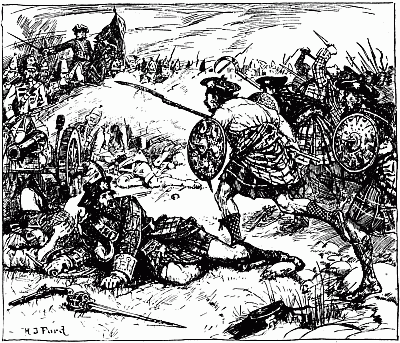
Only the infantry in the centre stood firm and received the onset of the Highlanders with a steady fire. A small band of Macgregors, armed only with scytheblades, charged against this hedge of musketry. This curious weapon was invented by James More, a son of Rob Roy Macgregor. He was the leader of this party, and fell, pierced by five bullets. With undaunted courage he raised himself on his elbow, and shouted, 'Look ye, my lads, I'm not dead; by Heaven I shall see if any of you does not do his duty.' In that wild charge, none of the clansmen failed to 'do his duty.' Heedless of the rain of bullets, they rushed to close quarters with the Hanoverian infantry, who, deserted by the dragoons, were now attacked on both sides as well as in front. A few stood firm, and the gallant Colonel Gardiner put himself at their head. A blow from a scytheblade in the hands of a gigantic Macgregor ended his life, and spared him the shame and sorrow of another defeat. The Park walls at their back prevented the infantry from seeking ignoble security in flight, after the fashion of the dragoons, and they were forced to lay down their weapons and beg for quarter. Some 400 of them fell, struck down by the broadswords and dirks of their enemy, more than 700 were taken prisoners, and only a few hundreds escaped.
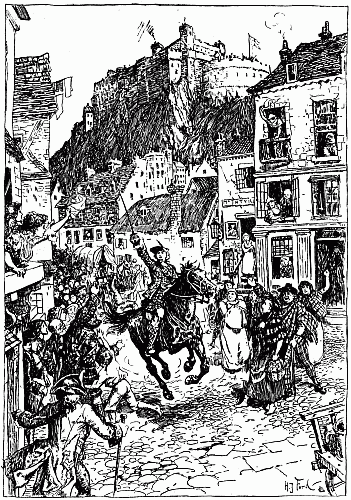
'HE GALLOPED UP THE STREETS OF EDINBURGH SHOUTING, "VICTORY! VICTORY!"'
The battle was won in less than five minutes. Charles himself commanded the second column, which was only fifty yards behind the first, but, by the time he arrived on the scene of action, there was nothing left to be done. Nothing, that is, in securing the victory, but Charles at once occupied himself in stopping the carnage and protecting the wounded and prisoners. 'Sir,' cried one of his staff, riding up to him, 'there are your enemies at your feet.' 'They are my father's subjects,' answered Charles sadly, turning away.
In vain did Sir John Cope and the Earl of Home try to rally the dragoons. Holding pistols to the men's heads, they succeeded in collecting a body in a field near Clement's Wells, and tried to form a squadron; but the sound of a pistol-shot renewed the panic and off they started again at the gallop. There was nothing for it but for the officers to put themselves at the head of as many fugitives as they could collect, and conduct the flight. Hardly did they draw rein till they were safe at Berwick. There the unfortunate general was received by Lord Mark Ker with the well-known sarcasm—'Sir, I believe you are the first general in Europe who has brought the first news of his own defeat.'[38]
In the meantime, the wounded they had left on the field were being kindly cared for by the victorious army. Charles despatched a messenger to bring medical aid—an errand not without danger to a single horseman on roads covered with straggling bodies of dragoons. But the adventure just suited the gallant spirit of young Lawrence Oliphant. At Tranent the sight of him and his servant at their heels sent off a body of dragoons at the gallop. Single fugitives he disarmed and dismounted, sending the horses back to the Prince by the hands of country lads. Once he had to discharge his pistol after a servant and pony, but for the most part the terrified soldiers yielded at a word.
Entering the Netherbow, he galloped up the streets of Edinburgh shouting, 'Victory! victory!' From every window in the High Street and Luckenbows white caps looked out, while the streets were crowded with eager citizens, and joyful hurrahs were heard on every side. At Lucky Wilson's, in the Lawn Market, the young gentleman alighted, called for breakfast, and sent for the magistrates to deliver his orders that the gates were to be closed against any fugitive dragoons. Hat in hand, the magistrates waited on the Prince's aide-de-camp, but at that moment the cry arose that dragoons and soldiers were coming up the street. Up jumps Mr. Oliphant and out into the street, faces eight or nine dragoons, and commands them to dismount in the Prince's name. This the craven Hanoverians were quite prepared to do. Only one presented his piece at the young officer. Mr. Oliphant snapped his pistol at him, forgetting that it was empty. Immediately half a dozen shots were fired at him, but so wildly that none did him any harm beyond shattering his buckle, and he retreated hastily up one of the dark steep lanes that led into a close.
The commander of the Castle refused to admit the fugitives, threatened even to fire on them as deserters, and they had to gallop out at the West Port and on to Stirling. Another of the Prince's officers, Colquhoun Grant, drove a party of dragoons before him all the way into Edinburgh, and stuck his bloody dirk into the Castle gates as a defiance.
Sadder was the fate of another Perthshire gentleman, as young and as daring as Lawrence Oliphant. David Thriepland, with a couple of servants, had followed the dragoons for two miles from the field; they had fled before him, but, coming to a halt, they discovered that their pursuers numbered no more than three. They turned on them and cut them down with their swords. Many years afterwards, when the grass was rank and green on Mr. Thriepland's grave, a child named Walter Scott, sitting on it, heard the story from an old lady who had herself seen the death of the young soldier.
The next day (Sunday) the Prince held his triumphant entry up the High Street of Edinburgh. Clan after clan marched past, with waving plaids and brandished weapons; the wild music of the pipes sounded as full of menace as of triumph. From every window in the dark, high houses on each side, fair faces looked down, each adorned with the white cockade. In their excitement the Highlanders let off their pieces into the air. By an unfortunate accident one musket thus fired happened to be loaded, and the bullet grazed the temple of a Jacobite lady, Miss Nairne, inflicting a slight wound. 'Thank God that this happened to me, whose opinions are so well known,' cried the high-spirited girl. 'Had a Whig lady been wounded, it might have been thought that the deed had been intentional.'[39]
VI
THE MARCH TO DERBY
A successful army, especially an insurgent army, should never pause in its onward march. If Prince Charles could have followed the flying dragoons over the Border into England he would have found no preparations made to resist him in the Northern counties. Even after the King and Government were alarmed by the news of the battle of Preston, a full month was allowed to pass before an army under General Wade arrived at Newcastle on the 29th of October. Dutch, Hessian, and English troops were ordered home from Flanders and regiments were raised in the country, though at first no one seems to have seriously believed in anything so daring as an invasion of England by Prince Charles and his Highlanders.
So far there had come no word of encouragement from the English Jacobites. Still, Charles never doubted but that they would hasten to join him as soon as he crossed the Border. On the very morrow of Prestonpans he sent messengers to those whom he considered his friends in England, telling of his success and bidding them be ready to join him. In the meantime he waited in Edinburgh till his army should be large and formidable enough to undertake the march South. After the battle numbers of his soldiers had deserted. According to their custom, as soon as any clansman had secured as much booty as he could conveniently carry, he started off home to his mountains to deposit his spoil. A stalwart Highlander was seen staggering along the streets of Edinburgh with a pier glass on his back, and ragged boys belonging to the army adorned themselves with gold-laced hats, or any odd finery they could pick up.
Many new adherents flocked to join the Prince. Among these was the simple-minded old Lord Pitsligo. He commanded a body of horse, though at his age he could hardly bear the fatigues of a campaign. In Aberdeenshire—always Jacobite and Episcopalian—Lord Lewis Gordon collected a large force; in Perthshire Lord Ogilvy raised his clan, though neither of these arrived in time to join the march South. Even a Highland army could not start in mid-winter to march through a hostile country without any preparations. Tents and shoes were provided by the city of Edinburgh, and all the horses in the neighbourhood were pressed for the Prince's service.
On the first day of November the army, numbering 6,000 men, started for the Border. Lord George led one division, carrying the supplies by Moffat and Annandale to the West Border. Charles himself commanded the other division. They pretended to be moving on Newcastle, marched down Tweedside and then turned suddenly westward and reached England through Liddesdale.
On the 8th they crossed the Border. The men unsheathed their swords and raised a great shout. Unfortunately, as he drew his claymore, Locheil wounded his hand, and his men, seeing the blood flow, declared it to be a bad omen.
But fortune still seemed to follow the arms of the Adventurer. Carlisle was the first strong town on the English Border, and though insufficiently garrisoned, was both walled and defended by a Castle. The mayor, a vain-glorious fellow, was ambitious of being the first man to stay the victorious army, and published a proclamation saying that he was not 'Patterson, a Scotchman, but Pattieson, a true-hearted Englishman, who would defend his town against all comers.'
A false report that Wade was advancing from the West made Charles turn aside and advance to Brampton in the hope of meeting him, but the roads were rough, the weather was wild and cold, the Hanoverian general was old, and again, as at Corryarack, Charles prepared to meet an enemy that never appeared.
In the meantime a division of the army had returned to Carlisle and was laying siege to it with great vigour. Lord George Murray and the Duke of Perth worked in the trenches in their shirt sleeves. The sound of bullets in their ears, the sight of formidable preparations for an assault, were too much for the mayor and his citizens; on the 13th, the 'true-hearted Englishmen' hung out a white flag, and the Prince's army marched in and took possession. It was another success, as sudden and complete as any of the former ones. But there were ominous signs even at this happy moment. The command of the siege of Carlisle had been given to the Duke of Perth, and Lord George Murray, the older and abler general, resented the slight. He sent in his resignation of the command of the forces, but with proud magnanimity offered to serve as a volunteer. Charles accepted the resignation, but the idea of losing the one general of any experience they had, created consternation among the chiefs. The crisis would have become serious but for the generous good sense and modesty of the Duke of Perth, who sent in his resignation also to the Prince. A more ominous fact was that they had been almost a week in England and no one had declared for them. Charles refused to let anything damp his hopefulness. Lancashire was the stronghold of Jacobitism. Once in Lancashire, gentlemen and their following would flock to join him.
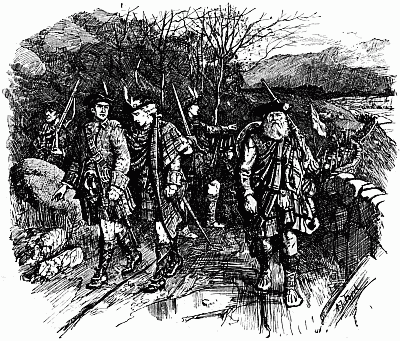
The road between Carlisle and Preston lies over bare, stony heights, an inhospitable country in the short, bleak days and long nights of November. Charles shared every hardship with his soldiers. He had a carriage but he never used it, and it was chiefly occupied by Lord Pitsligo. With his target on his shoulder he marched alongside of the soldiers, keeping up with their rapid pace, and talking to them in his scanty Gaelic. He seldom dined, had one good meal at night, lay down with his clothes on, and was up again at four next morning. No wonder that the Highlanders were proud of 'a Prince who could eat a dry crust, sleep on pease-straw, dine in four minutes, and win a battle in five.' Once going over Shap Fell he was so overcome by drowsiness and cold that he had to keep hold of one of the Ogilvies by the shoulderbelt and walked some miles half asleep. Another time the sole of his boot was quite worn out, and at the next village he got the blacksmith to nail a thin iron plate to the boot. 'I think you are the first that ever shod the son of a king,' he said, laughing as he paid the man.
Still entire silence on the part of the English Jacobites. The people in the villages and towns through which they passed looked on the uncouth strangers with ill-concealed aversion and fear. Once going to his quarters in some small town the 'gentle Locheil' found that the good woman of the house had hidden her children in a cupboard, having heard that the Highlanders were cannibals and ate children!
The town of Preston was a place of ill omen to the superstitious Highlanders. There, thirty years before, their countrymen had been disastrously defeated. They had a presentiment that they too would never get beyond that point. To destroy this fear, Lord George Murray marched half his army across the river and encamped on the further side.
Crossing Shap Fell
Manchester was the next halting-place, and there the prospects were rather brighter. An enterprising Sergeant Dickson hurried on in front of the army with a girl and a drummer boy at his side. He marched about the streets recruiting, and managed to raise some score of recruits. In Manchester society there was a certain Jacobite element; on Sunday the church showed a crowd of ladies in tartan cloaks and white cockades, and a nonjuring clergyman preached in favour of the Prince's cause. Among the officers who commanded the handful of men calling itself the Manchester Regiment, were three brothers of the name of Deacon, whose father, a nonjuring clergyman, devoted them all gladly to the cause. Another, Syddel, a wig-maker, had as a lad of eleven seen his father executed as a Jacobite in the '15, and had vowed undying vengeance against the house of Hanover. Manchester was the only place in England that had shown any zeal in the Prince's cause, and it only contributed some few hundred men and 3,000l. of money.
The situation seemed grave to the leaders of the Prince's army. He himself refused to recognise any other fact than that every day brought him nearer to London. On October 31 the army left Manchester. At Stockport they crossed the Mersey, the Prince wading up to the middle. Here occurred a very touching incident. A few Cheshire gentlemen met Charles at this point, and with them came an aged lady, Mrs. Skyring. As a child she remembered her mother lifting her up to see Charles II. land at Dover. Her parents were devoted Cavaliers, and despite the ingratitude of the royal family, loyalty was an hereditary passion with their daughter. For years she had laid aside half her income and had sent it to the exiled family, only concealing the name of the donor, as being of no interest to them. Now, she had sold all her jewels and plate, and brought the money in a purse as an offering to Charles. With dim eyes, feeble hands, and feelings too strong for her frail body, she clasped Charles's hand, and gazing at his face said, 'Lord, now lettest Thou Thy servant depart in peace.'
The Highland forces were in the very centre of England and had not yet encountered an enemy, but now they were menaced on two sides. General Wade—'Grandmother Wade' the Jacobite soldiers called him—by slow marches through Yorkshire had arrived within three days' march of them on one side, while, far more formidable, in front of them at Stafford lay the Duke of Cumberland with 10,000 men. He was a brave leader, and the troops under him were seasoned and experienced. At last the English Government had wakened up to the seriousness of the danger which they had made light of as long as it only affected Scotland. When news came that the Scots had got beyond Manchester, a most unmanly panic prevailed in London. Shops were shut, there was a run on the Bank, it has even been asserted that George II. himself had many of his valuables removed on to yachts in the Thames, and held himself in readiness to fly at any moment.
The Duke of Cumberland and his forces were the only obstacle between the Prince's army and London. Lord George Murray, with his usual sagacity, determined to slip past this enemy also, as he had already slipped past Wade. While the Prince, with one division of the army, marched straight for Derby, he himself led the remaining troops apparently to meet the Duke of Cumberland. That able general fell into the snare and marched up his men to meet the Highlanders at Congleton. Then Lord George broke up his camp at midnight (of December 2), and, marching across country in the darkness, joined the Prince at Leek, a day's journey short of Derby. By this clever stratagem the Highland army got a start of at least a day's march on their way to London.
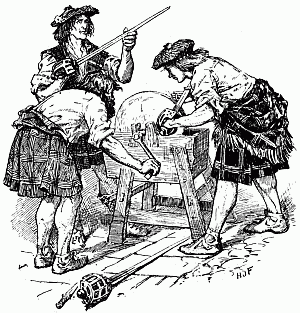
On the 4th, the Highland army entered Derby, marching in all day in detachments. Here Charles learned the good news from Scotland that Lord John Drummond had landed at Montrose with 1,000 French soldiers and supplies of money and arms. Never had fortune seemed to shine more brightly on the young Prince. He was sure now of French assistance, he shut his eyes to the fact that the English people were either hostile or indifferent; if it came to a battle he was confident that hundreds of the enemy would desert to his standard. The road to London and to a throne lay open before him! That night at mess he seriously discussed how he should enter London in triumph. Should it be in Highland or English dress? On horseback or on foot? Did he notice, one wonders, that his gay anticipations were received in ominous silence by the chiefs? At least the private soldiers of his army shared his hopes. On the afternoon of the 5th many had their broadswords and dirks sharpened, and some partook of the Sacrament in the churches. They all felt that a battle was imminent.
Next morning a council of war was held. Charles was eager to arrange for an immediate advance on London. Success seemed to lie within his grasp. Lord George Murray rose as spokesman for the rest. He urged immediate retreat to Scotland! Two armies lay one on either hand, a third was being collected to defend London. Against 30,000 men what could 5,000 avail? He had no faith in a French invasion, he was convinced that nothing was to be looked for from the English Jacobites. 'Rather than go back, I would I were twenty feet underground,' Charles cried in passionate disappointment. He argued, he commanded, he implored; the chiefs were inexorable, and it was decided that the retreat should begin next morning before daybreak. This decision broke the Prince's heart and quenched his spirit; never again did his buoyant courage put life into his whole army. Next morning he rose sullen and enraged, and marched in gloomy silence in the rear.
All the private soldiers and many of the officers believed that they were being led against the Duke of Cumberland. When returning daylight showed that they were retreating by the same road on which they had marched so hopefully two days before, they were filled with grief and rage. 'Would God,' writes a certain brave Macdonald, 'we had pushed on though we had all been cut to pieces, when we were in a condition for fighting and doing honour to our noble Prince and the glorious cause we had taken in hand.' The distrust caused in the Prince's mind by Lord George's action had, later, the most fatal effect.
'Many had their broadswords and dirks sharpened'
VII
THE RETREAT
Never, perhaps, in any history was there a march more mournful than that of the Highland army from Derby. These soldiers had never known defeat, and yet there they were, in full retreat through a hostile country. So secret and rapid were their movements that they had gained two full days' march before the Duke of Cumberland had any certain news of their retreat. Though he started at once in pursuit, mounting a body of infantry on horses that they might keep up with the cavalry, and though all were fresh and in good condition, it was not till the 18th that he overtook the Prince's army in the wilds of Cumberland. Lord George Murray, looking upon himself as responsible for the safety of the army, had sent on the first division under the Prince, and himself brought up the rear with the baggage and artillery. In the hilly country of the North of England, it was no light task to travel with heavy baggage. The big wagons could not be dragged up the steep ill-made roads, and the country people were sullenly unwilling to lend their carts. The general was reduced to paying sixpence for every cannon ball that could be carried up the hills. The Prince was already at Penrith on the 17th, but Lord George had been obliged to stop six miles short of that point. Marching before daybreak on the 18th, he reached a village called Clifton as the sun rose. A body of horsemen stood guarding the village; the Highlanders, exhilarated at meeting a foe again, cast their plaids and rushed forward. On this the Hanoverians—a mere body of local yeomanry—fled. Among a few stragglers who were taken prisoner was a footman of the Duke of Cumberland, who told his captors that his master with 4,000 cavalry was following close behind them. Lord George resolved to make a stand, knowing that nothing would be more fatal than allowing the dragoons to fall suddenly on his troops when they had their backs turned. He had a body of Macdonalds and another of Stuarts with him; he found also some two hundred Macphersons, under their brave commander Cluny, guarding a bridge close to the village. The high road here ran between a wall on one side, and fields enclosed by high hedges and ditches on the other. On either side he could thus place his soldiers under cover. As evening fell he learned that the Hanoverian soldiers were drawn up on the moor, about a mile distant. He sent some of his men to a point where they should be partly visible to the enemy over a hedge; these he caused to pass and repass, so as to give a delusive idea of numbers. When the night fell the Highland soldiers were drawn up along the wall on the road, and in the enclosures behind the hedges; Lord George and Cluny stood with drawn swords on the highway. Every man stood at his post on the alert, in the breathless silence. Though the moon was up, the night was cloudy and dark, but in a fitful gleam the watchful general saw dark forms approaching in a mass behind a hedge. In a rapid whisper he asked Cluny what was to be done. 'I will charge sword in hand if you order me,' came the reply, prompt and cheery. A volley from the advancing troops decided the question. 'There is no time to be lost; we must charge,' cried Lord George, and raising the Highland war cry, 'Claymore, Claymore,' he was the first to dash through the hedge (he lost his hat and wig among the thorns, and fought the rest of the night bareheaded!). The dragoons were forced back on to the moor, while another body of horse was similarly driven back along the high road by the Stuarts and Macdonells of Glengarry. About a dozen Highlanders, following too eagerly in pursuit, were killed on this moor, but the loss on the other side was far greater. Nor did the Duke of Cumberland again attack the retreating enemy; he had learned, like the other generals before him, the meaning of a Highland onset.[40]
A small garrison of Highlanders had been left in Carlisle, but these rejoined the main army as it passed through the town. There was an unwillingness among the soldiers to hold a fort that was bound to be taken by the enemy. Finally the Manchester regiment consented to remain, probably arguing, in the words of one of the English volunteers, that they 'might as well be hanged in England as starved in Scotland.'
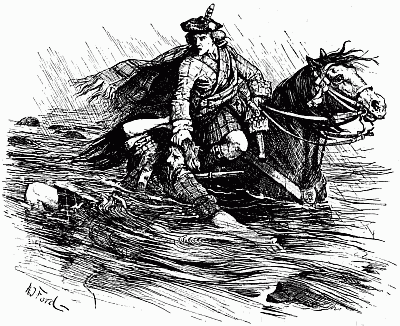
The Esk was at this time in flood, running turbid and swift. But the Highlanders have a peculiar way of crossing deep rivers. They stand shoulder to shoulder, with their arms linked, and so pass in a continuous chain across. As Charles was fording the stream on horseback, one man was swept away from the rest and was being rapidly carried down. The Prince caught him by the hair, shouting in Gaelic, 'Cohear, cohear!' 'Help, help!'
They were now again on Scottish ground, and the question was, whither were they to go next? Edinburgh, immediately after the Prince's departure, had gladly reverted to her Whig allegiance. She was garrisoned and defended; any return thither was practically out of the question. It was resolved that the army should retire to the Highlands through the West country.
Dumfries, in the centre of the Covenanting district, had always been hostile to the Stuarts. Two months before, when the Highland army marched south, some of her citizens had despoiled them of tents and baggage. To revenge this injury, Charles marched to Dumfries and levied a large fine on the town. The Provost, Mr. Carson, was noted for his hostility to the Jacobites. He was warned that his house was to be burned, though the threat was not carried out. He had a little daughter of six years old at the time; when she was quite an old lady she told Sir Walter Scott that she remembered being carried out of the house in the arms of a Highland officer. She begged him to point out the Pretender to her. This he consented to do, after the little girl had solemnly promised always to call him the Prince in future.
'The Prince caught him by the hair'
An army which had been on the road continuously for more than two winter months, generally presents a sufficiently dilapidated appearance; still more must this have been the case with the Highland army, ill-clad and ill-shod to begin with. The soldiers—hardly more than 4,000 now—who on Christmas day marched into Glasgow, had scarcely a whole pair of boots or a complete suit of tartans among them. This rich and important town was even more hostile than Dumfries to the Jacobites, but it was necessity more than revenge that forced the Prince to levy a heavy sum on the citizens, and exact besides 12,000 shirts, 6,000 pairs of stockings, and 6,000 pairs of shoes.
At Stirling, whither the Prince next led his army, the prospects were much brighter. Here he was joined by the men raised in Aberdeenshire under Lord Lewis Gordon, Lord Strathallan's Perthshire regiment, and the French troops under Lord John Drummond. The whole number of his army must have amounted to not much less than 9,000 men.
The Duke of Cumberland had given up the pursuit of the Highland army after Carlisle; an alarm of a French invasion having sent him hurrying back to London. In his stead General Hawley had been sent down to Scotland and was now in Edinburgh at the head of 8,000 men. He was an officer trained in the Duke of Cumberland's school, severe to his soldiers and relentlessly cruel to his enemies. A vain and boastful man, he looked with contempt on the Highland army, in spite of the experience of General Cope. On the 16th he marched out of Edinburgh with all his men, anticipating an easy victory. Lord George Murray was at Linlithgow, and slowly retreated before the enemy, but not before he had obtained full information of their numbers and movements. On the nights of January 15 and 16, the two armies lay only seven miles apart, the Prince's at Bannockburn and General Hawley's at Falkirk. From the one camp the lights of the other were visible. The Highland army kept on the alert, expecting every hour to be attacked.
All the day of the 16th they waited, but there was no movement on the part of the English forces. On the 17th the Prince's horse reconnoitred and reported perfect inactivity in Hawley's camp. The infatuated general thought so lightly of the enemy that he was giving himself up to amusement.
The fair and witty Lady Kilmarnock lived in the neighbourhood at Callender House. Her husband was with the Prince, and she secretly favoured the same cause. By skilful flattery and hospitality, she so fascinated the English general that he recklessly spent his days in her company, forgetful of the enemy and entirely neglectful of his soldiers.
Charles knew that the strength of his army lay in its power of attack, and so resolved to take the offensive. The high road between Bannockburn and Falkirk runs in a straight line in front of an old and decaying forest called Torwood. Along this road, in the face of the English camp, marched Lord John Drummond, displaying all the colours in the army, and making a brave show with the cavalry and two regiments. Their advance was only a feint. The main body of the army skirted round to the south of the wood, then marched across broken country—hidden at first by the trees and later by the inequalities of the ground—till they got to the back of a ridge called Falkirk Muir, which overlooked the English camp. Their object was to gain the top of this ridge before the enemy, and then to repeat the manœuvres of Prestonpans.
Meanwhile, the English soldiers were all unconscious, and their general was enjoying himself at Callender House. At eleven o'clock General Huske, the second in command, saw Lord John Drummond's advance, and sent an urgent message to his superior officer. He, however, refused to take alarm, sent a message that the men might put on their accoutrements, and sat down to dinner with his fascinating hostess. At two o'clock, General Huske, looking anxiously through his spy-glass, saw the bulk of the Highland army sweeping round to the back of the ridge.
A messenger was instantly despatched to Callender House. At last Hawley was aroused to the imminence of the danger. Leaving the dinner table, he leaped on his horse and arrived in the camp at a gallop, breathless and bare-headed. He trusted to the rapidity of his cavalry to redeem the day. He placed himself at the head of the dragoons, and up the ridge they rode at a smart trot. It was a race for the top. The dragoons on their horses were the first to arrive, and stood in their ranks on the edge of the hill. From the opposite side came the Highlanders in three lines; first the clans (the Macdonalds, of course, on the right), then the Aberdeenshire and Perthshire regiments, lastly cavalry and Lord John Drummond's Frenchmen. Undismayed, nay, rather exhilarated by the sight of the three regiments of dragoons drawn up to receive them, they advanced at a rapid pace. The dragoons, drawing their sabres, rode on at full trot to charge the Highlanders. With the steadiness of old soldiers, the clans came on in their ranks, till within ten yards of the enemy. Then Lord George gave the signal by presenting his own piece, and at once a withering volley broke the ranks of the dragoons. About 400 fell under this deadly fire and the rest fled, fled as wildly and ingloriously as their fellows had done at Coltbridge or Prestonpans. A wild storm of rain dashing straight in their faces during the attack added to the confusion and helplessness of the dragoons. The right and centre of Hawley's infantry were at the same instant driven back by the other clans, Camerons and Stewarts and Macphersons. The victory would have been complete but for the good behaviour of three regiments at the right of Hawley's army, Price's, Ligonier's, and Barrel's. From a point of vantage on the edge of a ravine they poured such a steady fire on the left wing of the Highlanders, that they drove them back and forced them to fly in confusion. Had the victorious Macdonalds only attacked these three steady regiments, the Highland army would have been victorious all along the line. Unfortunately they had followed their natural instinct instead of the word of command, and flinging away their guns, were pursuing the fugitive dragoons down the ridge. The flight of the Hanoverians was so sudden that it caused suspicion of an ambush. The Prince was lost in the darkness and rain. The pipers had thrown their pipes to their boys, had gone in with the claymore, and could not sound the rally. It was not a complete victory for Charles, but it was a sufficiently complete defeat for General Hawley, who lost his guns. The camp at Falkirk was abandoned after the tents had been set on fire, and the general with his dismayed and confused followers retired first to Linlithgow and then to Edinburgh. Hawley tried to make light of his defeat and to explain it away, though to Cumberland he said that his heart was broken; but the news of the battle spread consternation all over England, and it was felt that no one but the Duke of Cumberland was fit to deal with such a stubborn and daring enemy.
The Prince's army did not reap so much advantage from their victory as might have been expected; their forces were in too great confusion to pursue the English general, and on the morrow of the battle many deserted to their own homes, carrying off their booty. A more serious loss was the defection of the clan Glengarry. The day after the battle a young Macdonald, a private soldier of Clanranald's company, was withdrawing the charge from a gun he had taken on the field. He had abstracted the bullet, and, to clean the barrel, fired off the piece. Unfortunately it had been double loaded, and the remaining bullet struck Glengarry's second son, Æneas, who was in the street at the time. The poor boy fell, mortally wounded, in the arms of his comrades, begging with his last breath that no vengeance should be exacted for what was purely accidental. It was asking too much from the feelings of the clansmen. They indignantly demanded that blood should atone for blood. Clanranald would gladly have saved his clansman, but dared not risk a feud which would have weakened the Prince's cause. So another young life as innocent as the first was sacrificed to clan jealousy. The young man's own father was the first to fire on his son, to make sure that death should be instantaneous. Young Glengarry was buried with all military honours, Charles himself being chief mourner; but nothing could appease the angry pride of the clan, and the greater part of them returned to their mountains without taking any leave.
The poor boy fell, mortally wounded
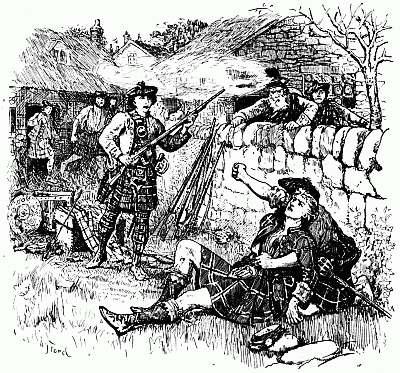
VIII
IN THE HIGHLANDS
On January 30 the Duke of Cumberland arrived in Edinburgh. His reception was a curious parody of Charles's brilliant entry four months before. The fickle mob cheered the one as well as the other; the Duke occupied the very room at Holyrood that had been Charles's; where the one had danced with Jacobite beauties, the other held a reception of Whig ladies. Both were fighting their father's battle; both were young men of five-and-twenty. But here likeness gives way to contrast; Charles was graceful in person, and of dignified and attractive presence; his cousin, Cumberland, was already stout and unwieldy, and his coarse and cruel nature had traced unpleasant lines on his face. He was a poor general but a man of undoubted courage. Yet he had none of that high sense of personal honour that we associate with a good soldier. In Edinburgh he found many of the English officers who had been taken prisoner at Prestonpans. They had been left at large on giving their word not to bear arms against the Prince. Cumberland declared that this 'parole' or promise was not binding, and ordered them to return to their regiments. A small number—it is right that we should know and honour their names—Sir Peter Halket, Mr. Ross, Captain Lucy Scott, and Lieutenants Farquharson and Cumming, thereupon sent in their resignations, saying that the Duke was master of their commissions but not of their honour.
On the 30th the Duke and his soldiers were at Linlithgow, and hoped to engage the Highland army next day near Falkirk. But on the next day's march they learned from straggling Highlanders that the enemy had already retired beyond the Forth. They had been engaged in a futile siege of Stirling Castle. The distant sound of an explosion which was heard about midday on the 1st, proved to be the blowing up of the powder magazine, the last act of the Highlanders before withdrawing from Stirling. This second, sudden retreat was as bitter to the Prince as the return from Derby. After the battle at Falkirk he looked forward eagerly and confidently to fighting Cumberland on the same ground. But there was discontent and dissension in the camp. Since Derby the Prince had held no councils, and consulted with no one but Secretary Murray and his Irish officers. The chiefs were dispirited and deeply hurt, and, as usual, the numbers dwindled daily from desertion. In the midst of his plans for the coming battle, Charles was overwhelmed by a resolution on the part of the chiefs to break up the camp and to retire without delay to the Highlands. Again he saw his hopes suddenly destroyed, again he had to yield with silent rage and bitter disappointment.
The plan of the chiefs was to withdraw on Inverness, there to attack Lord Loudon (who held the fort for King George); to rest and recruit, each clan in its own country, till in the spring they could take the field again with a fresher and larger army. Lord George Murray led one division by the east coast and Aberdeen, to the rendezvous near Inverness, Charles led the other by General Wade's road through Badenoch and Athol. Cumberland with his heavy troops and baggage could not overtake the light-footed Highlanders; by the time he reached Perth he was six days' march behind them. He sent old Sir Andrew Agnew to garrison the house of Blair, and other small companies to occupy all the chief houses in Athol. He himself retired with the main body to Aberdeen, and there waited for milder weather.
In the neighbourhood of Inverness lies the country of the Mackintoshes. The laird of that ilk was a poor-spirited, stupid man. It was his simple political creed that that king was the right one who was willing and able 'to give a half-guinea to-day and another to-morrow.' That was probably the pay he drew as officer in one of King George's Highland companies. Of a very different spirit was his wife. Lady Mackintosh was a Farquharson of Invercauld; in her husband's absence she raised a body of mixed Farquharsons and Mackintoshes, several hundred strong, for the Prince. These she commanded herself, riding at their head in a tartan habit with pistols at her saddle. Her soldiers called her 'Colonel Anne.' Once in a fray between her irregular troops and the militia, her husband was taken prisoner and brought before his own wife. She received him with a military salute, 'Your servant, captain;' to which he replied equally shortly, 'Your servant, colonel.'