THE PITEOUS DEATH OF GASTON, SON OF THE COUNT OF FOIX
Reading edition
MORE than five hundred years ago, on St. Catherine's Day, 1388, Master Jean Froissart, a priest of Hainault, rode into the little town of Orthez. He was in search of information about battles and tournaments, for he was writing his famous 'History and Chronicle.' To get news of all kinds he rode gaily about, with a white greyhound in a leash, and carrying a novel which he had begun for the entertainment of ladies and princes. Arriving at Orthez (where, long afterwards, the Duke of Wellington fought the French on the borders of Spain), Master Froissart alighted at the hotel with the sign of the Moon. Meanwhile a knight who had travelled with Froissart went up to the castle, and paid his court to Gaston Phœbus, Count of Foix. He found the Count in the gallery of the palace just after dinner, for this prince always went to bed at midday and took supper at midnight. He was a great and powerful noble, of stately and beautiful presence, though now he was nearly sixty years old. A wise knight he was, bold in enterprise, and of good counsel. Never did he suffer any unbeliever in his company, and he was very pious, every day making many and long prayers, and giving alms to the poor folk at his gate. He took much delight in minstrelsy, and at his midnight supper songs and virelays were chanted to him. Till about three o'clock in the morning he listened while Master Froissart read aloud his poems, tales, or histories, while the courtiers yawned, no doubt, and wished for bedtime. But it was the good Count's manner to turn night into day. He was sometimes melancholy, and, as is told in the story of Orthon, men believed that he saw and knew events far distant, but in what manner none could tell. This great prince dwelt at peace while the wars of France, England, Portugal, and Spain raged outside his dominions. Rich, powerful, handsome, and deeply religious, he seemed to have everything that could make him happy, but he had no son and heir; his lands, on his death, would go to a distant cousin. Nor did the lady his wife live with the Count of Foix. Concerning this, and the early death of the Count's one son, Gaston, Master Froissart was very curious, but he found that people did not care to speak of the matter. At length an old squire told him the story of the death of Gaston.
The Countess of Foix was the sister of the King of Navarre, and between the Count her husband, and the King her brother, a quarrel arose on a question of money. The Count therefore sent his wife to her brother at Pampeluna, that she might arrange the matter; but the end of it was that she stayed in Navarre, and did not return to her lord. Meanwhile her son Gaston grew up at Orthez, and married a daughter of the Count of Armagnac, being now a lad of sixteen, a good squire, and in all things very like his father. He had a desire to see his mother, and so rode into Navarre, hoping to bring home his mother, the Countess of Foix. But she would not leave Navarre for all that he could say, and the day came when he and the young squires of his company must return. Then the King of Navarre led him apart into a secret chamber, and there gave him a little purse. Now the purse was full of a powder of such sort that no living creature could taste of it and live, but must die without remedy.
'Gaston, fair nephew,' said the King, 'you see how your father, the Count, holds your mother in bitter hate—a sore grief to me and to you also. Now to change all this, and bring your father and mother back to their ancient love, you must watch your chance and sprinkle a little of this powder on any food that your father is about to eat, taking good care that no man sees you. And the powder is a charm so strong that your father, as soon as he has tasted it, will desire nothing so much as to be friends with your mother again, and never will they leave each other. But you must take heed that no man knows of this purpose, or all is lost.'
The young Count, believing, in his innocence, what his uncle said, made answer that he would gladly do as he was bidden. Then he rode back to Orthez, and showed his father all the presents and jewels that had been given to him in Navarre, except the little purse.
Now it was the custom of the young Count to be much in the company of his brother by another mother, and, as they played together one day, this boy, named Yvain, caught hold of the little purse which Gaston wore about his neck under his coat, and asked him what it was. But Gaston made no answer. Three days later the lads quarrelled over a stroke at tennis, and Gaston struck Yvain a blow. Yvain ran weeping to his father, the Count, who asked what ailed him.
'The Count leaped up, a knife in his hand'
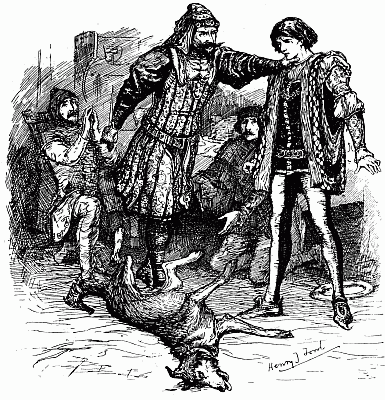
'Gaston struck me,' said he, 'but it is Gaston, not I, who deserves a blow.'
'What has he done?' asked the Count.
'Ever since he came from his mother's in Navarre he carries about his neck a little purse full of a powder. But I only know that he says you and his mother will soon be good friends once more.'
'Ha!' cried the Count, 'do you be silent.'
That day at dinner, as Gaston served the meats, for this was his duty, the Count called to him, seized his coat, opened it, and, with his knife, cut the purse from the boy's neck. Gaston said no word, but grew pale and trembled. The Count opened the purse, spread the powder on a piece of bread, and threw it to a dog. No sooner had the dog eaten the bread than his eyes turned round, and he fell dead.
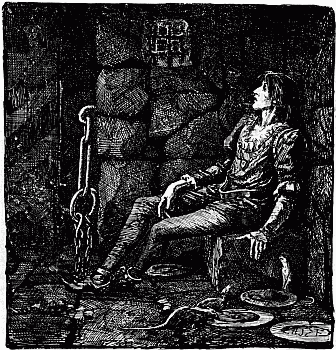
Gaston in prison
The Count leaped up, a knife in his hand, and would have slain his son as a traitor, but the knights and esquires, kneeling, prayed him to hold his hand.
'Perchance,' said they, 'Gaston knew not the nature of that which was in the purse, and is guiltless in this matter.'
'So be it,' said the Count. 'Hold him prisoner in the tower at your own peril.'
Then he seized all the companions and friends of Gaston, for they must have known, he said, that his son carried a purse secretly. Fifteen of the fairest and noblest of the boys he put to death with horrible tortures, but they knew nothing and could tell nothing. Then he called together all his nobles and bishops, and told them that Gaston also must die. But they prayed for his life, because they loved him dearly, and he was the heir of all the Count's lands. So the Count decided to keep Gaston in prison for some months, and then send him to travel for two or three years. The Pope sent a cardinal to the Count, bidding him spare Gaston, but, before the Cardinal reached Orthez, Gaston was dead.
One day the servant who took meat and drink into the boy's dark dungeon saw that he had not tasted food for many days. All the dishes lay full of mouldering meat in a row along the wall. Then the servant ran and warned the Count that Gaston was starving himself to death. The Count was trimming his nails with a little knife, and he sped in great anger to the dungeon.
'Traitor, why dost thou not eat?' he cried, dealt the boy a cuff, and rushed out again, and so went to his chamber.
But the point of the little knife, which was in his hand, had cut a vein in Gaston's neck, and, being weak with hunger and grief, Gaston died, for the vein could not be staunched. Then the Count made great lament, and had his head shaven, and wore mourning for many days.
Thus it chanced that the Count of Foix lived without an heir, turning night into day, praying much, and listening to minstrels, giving alms, and hearkening to strange messages of death and war that were borne to him how no man knew. And his brother, Pierre, was a good knight and wise by day, yet at night madness fell on him, and he raved, beating the air with a naked sword. And this had been his manner ever since he fought with and slew a huge bear on the hills. Now when his wife saw that bear brought home dead she fainted, and in three days she fled with her children, and came back no more. For her father had once pursued that bear, which cried to him: 'Thou huntest me who wish thee no harm, but thou shalt die an ill death.' He then left off pursuing the bear; but the Count's brother slew the beast on another day, and thereafter he went mad in the night, though by day he was wise enough.
These tales were told to Master Froissart by the old squire at Orthez.