THE DEATH OF HACON THE GOOD (a.d. 961)
Reading edition
[Eric Bloodaxe, Harold Fairhair's favourite son, ruled Norway for a year or so after his father's death. Then he and his queen Gunnhilda became so hated by the people that they welcomed as king his brother Hacon, who returned from England, where he had been brought up. Eric was forced to flee. For some time he was in Northumberland; he fell in the west while freebooting, about a.d. 950. Gunnhilda and her sons went to Denmark; they made many attempts to recover Norway; the issue of the last is here told.]
KING HACON, Athelstan's foster-son, long ruled over Norway; but in the latter part of his life Eric's sons came to Norway, and strove with him for the kingdom. They had battles together, wherein Hacon ever won the victory. The last battle was fought in Hordaland, on Stord Island, at Fitjar: there Hacon won the victory, but also got his death-wound.
And this battle came about in this wise. Gunnhilda's sons sailed northward from Denmark, taking the outer way, nor came they to land oftener than for men to get knowledge of their goings, while they also got knowledge of the public banquets given to King Hacon. They had ships well-found in men and weapons; and in their company was a mighty viking named Eyvind Skreyja; he was a brother of Queen Gunnhilda.
Hacon was at a banquet at Fitjar on Stord Island when they came thither; but he and all his men were unaware of their coming till the ships were sailing up from the south and had now gotten close to the island. King Hacon was even then sitting at table.
Now came a rumour to the King's guard that ships were seen sailing; wherefore some who were keenest of sight went out to look. And each said to his fellows that this would be an enemy, and each bade other to tell the King; but for this task none was found save Eyvind Finnsson, who was nicknamed Skald-spoiler.
He went in before the King, and spake thus: 'Fleeting hour is short, sire, but meal-time long.'
Said the King: 'Skald, what news?'
Eyvind answered:
'Vengers ('tis said) of Bloodaxe crave The battle-shock of belted glaive; Our sitting-time is done. Hard task, but 'tis thine honour, King, I seek, who here war tidings bring. Arm swiftly, every one!'
Then answered the King: 'Eyvind, thou art a brave wight and a wise; thou wouldst not tell war tidings unless they were true.' Whereupon all said that this was true, that ships were sailing that way, and within short space of the island. And at once the tables were taken up, and the King went out to see the fleet.
But when he had seen it he called to him his counsellors, and asked what should be done.
'Here be sailing many ships from the south: we have a force small but goodly. Now, I wish not to lead my best friends into overwhelming danger; but surely would be willing to flee, if wise men should not deem that this were great shame or folly.'
Then made answer each to other that everyone would rather fall dead across his fellow than flee before Danes.
Whereat the King said: 'Well spoken for heroes as ye are! And let each take his weapons, nor care how many Danes there be to one Norseman.'
Thereafter the King took his shield, and donned his coat of ring-mail, and girded him with the sword Millstone-biter, and set a golden helm on his head. Then did he marshal his force, putting together his bodyguard and the guests of the feast.
Gunnhilda's sons now came up on land, and they likewise marshalled their force, and it was by far the larger. The day was hot and sunny; so King Hacon slipped off his mail coat and raised his helm, and egged on his men to the onset laughing, and thus cheered his warriors by his blithe bearing. Then the fight began, and it was most stubborn. When the missiles were all thrown, King Hacon drew sword and stood in front under the banner, and hewed right and left; never did he miss, or, if he missed his man, the sword bit another.
Eyvind Skreyja went fiercely forward in the battle, challenging the Norsemen's courage. And chiefly pressed he on where Hacon's banner was, crying, 'Where is the Norsemen's king? Why doth he hide him? Why dares he not come forth and show himself? Who can point me to him?'
Hacon casts his shield away
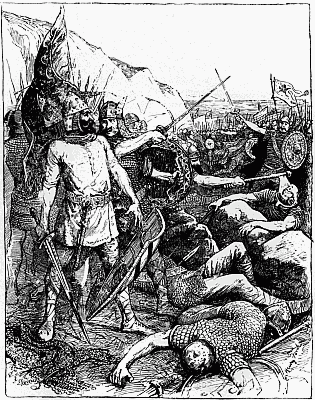
Then answered King Hacon: 'Hold thou on forward, if thou wilt find the Norsemen's king.'
And Hacon cast his shield by his side, and gripped his sword's mid-hilt with both hands, and ran forth from under the banner.
But Thoralf Skumsson said, 'Suffer me, sire, to go against Eyvind.'
The King answered: 'Me he wished to find; wherefore me he shall first meet.' But when the King came where Eyvind was, he hewed on either side of him, and then, with Millstone-biter in both hands, hewed at Eyvind's head, and clove him through helm and head right down to the shoulders.
This battle was not good for men weak in strength, weapons, or courage. Nor was it long after the fall of Eyvind Skreyja ere the whole Danish force turned and fled to their ships. Great numbers fell on the side of Eric's sons; but they themselves escaped.
King Hacon's men followed them far that day, and slew all whom they might; but the King bade his swift ship be launched, and rowed northwards along the coast, meaning to seek his house at Alrekstead, for he had gotten a wound by an arrow that pierced his arm while he drove before him the flying foe. And he lost so much blood that he swooned away. And when he came to the place called Hacon's Stone (it was where he was born), there he stayed for the night, bidding his land tent be set up and himself be carried ashore.
And as soon as King Hacon knew that his wound was mortal, he called to him his counsellors, and talked at large with his friends about those things that had been done in his days. And of this he then repented, that he had done much against God and Christian men's laws during his rule.
His friends offered to convey his body westwards to England, and bury it there in Church ground.
But the King answered: 'Of this I am not worthy; I lived as heathen men live, so, too, shall ye bury me.'
He bewailed the quarrels of himself and his kin; and having but one daughter, a child, and no son, he sent a letter to Gunnhilda's sons, wherein it was written that he gave to his kinsman Harold Grayfell his guard and his kingdom.
After this King Hacon died: he had ruled Norway for twenty-six years. He was mourned both by friends and foes. As Eyvind Skald-spoiler says:
'The King is born in blessed day Such love who gains: Of his fair age ever and aye Good fame remains.'
His men carried his body to Sœheim in North Hordaland, and raised a mound over it.