J. E. MARR, M.A., F.R.S.
Reading edition
FELLOW AND LECTURER OF S. JOHN'S COLLEGE, CAMBRIDGE, AND UNIVERSITY LECTURER IN GEOLOGY.
CAMBRIDGE: AT THE UNIVERSITY PRESS. 1898 [All Rights reserved.]
Cambridge: PRINTED BY J. & C. F. CLAY, AT THE UNIVERSITY PRESS.
PREFACE.
The present work has been written in order that students may gain by its perusal some idea of the methods and scope of Stratigraphical Geology. I believe that this idea can be obtained most satisfactorily, if a large number of the details connected with the study of the stratified rocks are omitted, and I have accordingly given very brief accounts of the strata of the different Systems.
The work is intended for use in conjunction with any book which treats of the strata of the Geological Column at considerable length; some of these books are mentioned on pages 124, 125.
J. E. M.
Cambridge, November, 1898.
CONTENTS.
PAGE
CHAPTER I.
Introduction 1
CHAPTER II.
Account of the growth and progress of stratigraphical geology 6
CHAPTER III.
Nature of the stratified rocks 21
CHAPTER IV.
The law of superposition 31
CHAPTER V.
The test of included organisms 40
CHAPTER VI.
Methods of classification of the strata 58
CHAPTER VII.
Simulation of structures 72
CHAPTER VIII.
Geological maps and sections 84
CHAPTER IX.
Evidences of conditions under which strata were formed 97
CHAPTER X.
Evidences of conditions under which strata were formed, continued 116
CHAPTER XI.
The classification of the stratified rocks 125
CHAPTER XII.
The Precambrian rocks 132
CHAPTER XIII.
Cycles of change in the British area 149
CHAPTER XIV.
The Cambrian system 152
CHAPTER XV.
The Ordovician system 164
CHAPTER XVI.
The Silurian system and the changes which occurred in Britain at the close of Silurian times 174
CHAPTER XVII.
The Devonian system 183
CHAPTER XVIII.
The Carboniferous system 192
CHAPTER XIX.
The changes which occurred during the third continental period in Britain; and the foreign Permo-Carboniferous rocks 202
CHAPTER XX.
The Permian system 209
CHAPTER XXI.
The Triassic system 218
CHAPTER XXII.
The Jurassic system 226
CHAPTER XXIII.
The Cretaceous system 236
CHAPTER XXIV.
The Eocene rocks 244
CHAPTER XXV.
The Oligocene and Miocene periods 251
CHAPTER XXVI.
The Pliocene beds 256
CHAPTER XXVII.
The Pleistocene accumulations 260
CHAPTER XXVIII.
The Steppe period 267
CHAPTER XXIX.
The Forest period 275
CHAPTER XXX.
Remarks on various questions 278
ADDENDA ET CORRIGENDA.
p. 38, line 15 from bottom: for 'joining' read 'jointing'
p. 208, line 6 from bottom: for 'Dr' read 'Messrs Medlicott and'
p. 214, line 15 from bottom: after 'Permo-Carboniferous Strata' insert 'through the Permian'
p. 217, last line of footnote: for 'Dr' read 'Messrs Medlicott and'
p. 217, insert a second footnote: 'For information concerning the Permian volcanic rocks see Sir A. Geikie's Ancient Volcanoes of Great Britain.'
p. 235, insert a footnote: 'A good account of the British Jurassic rocks will be found in Mr H. B. Woodward's Memoir on "The Jurassic Rocks of Britain." Mem. Geol. Survey, 1893—.'
p. 250, top line: for 'Gardiner' read 'Gardner'
[Trancriber's Note: Above corrections were made to the text.]
CHAPTER I.
INTRODUCTION.
It is the aim of the Stratigraphical Geologist to record the events which have occurred during the existence of the earth in the order in which they have taken place. He tries to restore the physical geography of each period of the past, and in this way to write a connected history of the earth. His methods are in a general way similar to those of the ethnologist, the archæologist, and the historian, and he is confronted with difficulties resembling those which attend the researches of the students of human history. Foremost amongst these difficulties is that due to the imperfection of the geological record, but similar difficulty is felt by those who pursue the study of other uncertain sciences, and whilst this imperfection is very patent to the geologist, it is perhaps unduly exaggerated by those who have only a general knowledge of the principles and aims of geology.
The history of the earth, like other histories, is a connected one, in which one period is linked on to the next. This was not always supposed to be the case; the catastrophic geologist of bygone times believed that after each great geological period a convulsion of nature left the earth's crust as a tabula rasa on which a new set of records was engraved, having no connexion with those which had been destroyed. Careful study of the records of the rocks has proved that the conclusions of the catastrophists were erroneous, and that the events of one period produce their impression upon the history of the next. Every event which occurs, however insignificant, introduces a new complication into the conditions of the earth, and accordingly those conditions are never quite the same. Although the changes were no doubt very slow, so that the same general conditions may be traced as existent during two successive periods, minor complications occurred in the inorganic and organic worlds, and we never get an exact recurrence of events. Vegetable deposits may now be in process of accumulation which in ages to come may be converted into coal, but the general conditions which were prevalent during that Carboniferous period when most of our workable coal was deposited do not now exist, and will never exist again. The changes which have taken place and which are taking place show an advance from the simple to the more complex, and the stratigraphical geologist is confronted with a problem to which the key is development, and it is his task to trace the development of the earth from the primitive state to the complex condition in which we find it at the present day.
Our general ignorance of the events of the earliest periods of the history of the earth will be emphasised in the sequel, and it will be found that the complexity which marks the inorganic and organic conditions which existed during the deposition of the earliest rocks of which we have detailed knowledge points to the lapse of enormous periods of time subsequent to the formation of the earth, and previous to the deposition of those rocks. The imperfection of the record is most pronounced for that long period of time, but in this respect the geologist is in the same condition as the student of human history, for the relics of the early stone age prove that man in that age had attained a fairly high state of civilisation, and the gap which separates palæolithic man from the first of our race is relatively speaking as great as that which divides the Cambrian period from the commencement of earth-history. Nevertheless, human history is a science which has made gigantic strides towards the solution of many problems connected with the development of man and civilisation, and similarly geology has advanced some way in its task of elucidating the history of our globe.
The task of the stratigraphical geologist is two-fold. In the first place, he must establish the order of succession of the strata, for a correct chronology is of paramount importance to the student of earth-lore. The precautions which must be taken in making out the order of deposition of the rocks of any area, and correlating those of one area with those of another will be considered in the body of the work. When this task is completed, there yet remains the careful examination of all the information supplied by a study of the rocks of the crust, in order to ascertain the actual conditions which existed during the deposition of any stratum or group of strata. In practice, it is generally very difficult to separate these two departments of the labour of the stratigraphical geologist, and the two kinds of work are often done to a large extent simultaneously, or sometimes alternately. Frequently the general succession of the deposits comprising an important group is ascertained, and at the same time observations made concerning the physical characters of the deposits and the nature of their included organisms, which are sufficient to afford some insight into the general history of the period when these deposits were laid down; a more detailed classification of the same set of deposits may be subsequently made, and as the result of this, more minute observations as to the variations in the physical and biological conditions of the period are possible, which permit us to write a much more concise history of the period. So great has been the tendency to carry on work in a more and more detailed manner, that it is very difficult if not impossible to tell when any approach to finality is reached in the study of a group of strata in any area. Roughly speaking, we may state that our knowledge of a group of strata is obtained by three processes, or rather modifications of one process. The general order of succession is established by the pioneer, frequently as the result of work carried on through one or two seasons. Subsequently to this, a more minute subdivision of the rocks is possible as the result of labours conducted by one or more workers who are enabled to avail themselves of the work of the pioneer, and our knowledge of the rocks is largely increased thereby. But the minutiæ, often of prime importance, are supplied by workers who must spend a large portion of their time in the area where the work lies, and it is only in districts where work of this character has been performed, that our knowledge of the strata approaches completion. The strata of the Arctic regions, for example, have in many places been examined by pioneers, but a great deal remains to be done in those regions; the main subdivisions only have been defined in many cases, and our information concerning the physical history of Arctic regions in past times is comparatively meagre. To come nearer home—a few miles north of Cambridge lies the little patch of Corallian rock at Upware; it has been frequently visited, and a large suite of organic remains extracted from it, but no one has devoted the time to the collection of remains from this deposit which has been devoted to that of some other formations presently to be mentioned, and accordingly our knowledge of the fauna of that deposit is far from complete. Contrast with this the information we possess of the little seam known as the Cambridge Greensand, from which organic remains have been sedulously collected during the extensive operations which have been carried on for the extraction of the phosphatic nodules which occur in the seam. The suite of relics of the organisms of that period is accordingly far more perfect than in the case of many other beds, and indeed the large and varied collection of relics of the vertebrata of the period which furnish much information of value to the palæontologist would not have been gathered together, had not this seam been so carefully worked, and an important paragraph in the chapter bearing on the history of this period would have remained unknown to us. Again, two little patches of limestone of the same age, one in central England and the other in the island of Gothland, have been the objects of sedulous inquiry by local observers, and we find again that our knowledge of the physical history of the period, as regards these two regions, is exceptionally perfect. Special stress is laid upon this point, for in these days, when every county possesses its learned societies whose members are desirous of advancing in every possible way the progress of science, it is well to insist upon the importance of this detailed work which can only be done by those who have a large amount of time to devote to the rigorous examination of the rocks of a limited area.
CHAPTER II.
ACCOUNT OF THE GROWTH AND PROGRESS OF STRATIGRAPHICAL GEOLOGY.
The history of the growth of a science is not always treated as an essential part of our knowledge of that science, and many text-books barely allude to the past progress of the science with which they deal. The importance of a review of past progress has, however, attracted the attention of many geologists, and Sir Charles Lyell, in his Principles of Geology, gave prominence to an historical sketch of the rise and progress of the science. Historical studies of this nature have more than an academic value; the very errors made by men in past times are useful as warnings to prevent those of the present day from going astray; the lines along which a science has progressed in the past may often be used as guides to indicate how work is to be conducted in the future; but perhaps the greatest lesson which is taught by a careful consideration of the rise and progress of a study is one which has a moral value, for he who pays attention to the growth of his science in past times, gains a reverence for the old masters, and at the same time learns that a slavish regard for authority is a dangerous thing. This is a lesson which is of the utmost importance to the student who wishes to advance his science, and will prevent him from paying too little attention to the work of those who have gone before him, whilst it will enable him to perceive that as great men have fallen into error through not having sufficient data at their disposal, he need not be unduly troubled should he find that conclusions which he has lawfully attained after consideration of evidence unknown to his predecessors clash with those which they adopted. Want of this historic knowledge has no doubt caused many workers to waste their time on work which has already been performed, but it has also led others to withhold important conclusions from their fellow-workers because they were supposed to be heterodox. In an uncertain science like geology one of the great difficulties is to keep an even balance between contempt and undue respect for authority, and assuredly a scientific study of the past history of a science will do much to enable a student to attain this end. It will be useful, therefore, at this point to give a brief account of the rise and progress of the study of stratigraphical geology, so far as that can be done without entering into technical details, at the same time recommending the student to survey the progress of this branch of our science for himself, after he has mastered the principles of the subject, and such details as are the property of all who have studied the science from the various text-books written for advanced students.
William Smith, the 'Father of English Geology,' is rightly regarded as the founder of stratigraphical geology on a true scientific basis, but like all great discoverers, his work was foreshadowed by others, though so dimly, that this does not and cannot detract from his fame. It is desirable, however, to begin our historical review at a time somewhat further back than that at which Smith gave to the world his epoch-making map and memoirs.
Before the eighteenth century, stratigraphical geology cannot be said to have existed as a branch of science—the way had not been prepared for it. Data had been accumulated which would have been invaluable if at the disposal of open-minded philosophers, but with few exceptions prejudice prevented the truth from becoming known. There were two great stumbling-blocks to the establishment of a definite system of stratigraphical geology by the writers of the Middle Ages, firstly, the contention that fossils were not the relics of organisms, and, secondly, when it was conceded that they represented portions of organisms which had once existed, the assertion that they had reached their present positions out of reach of the sea during the Noachian Deluge. For full details concerning the mischievous effects of these tenets upon the science the reader is referred to the luminous sketch of the growth of geology in the first four chapters of Sir Charles Lyell's Principles of Geology.
The disposition of rocks in strata, and the occurrence of different fossils in different strata, was known to Woodward when he published his Essay toward a Natural History of the Earth in 1695, and the valuable collections made by Woodward and now deposited in the Woodwardian Museum at Cambridge, show how fully he appreciated the importance of these facts, though he formed very erroneous conclusions from them, owing to the manner in which he drew upon his imagination when facts failed him, maintaining that fossils were deposited in the strata according to their gravity, the heaviest sinking first, and the lightest last, during the time of the universal deluge. The following extracts from Part II. of Woodward's book, show the position in which our knowledge of the strata stood at the end of the seventeenth century: "The Matter, subsiding ..., formed the Strata of Stone, of Marble, of Cole, of Earth, and the rest; of which Strata, lying one upon another, the Terrestrial Globe, or at least as much of it as is ever displayed to view, doth mainly consist.... The Shells of those Cockles, Escalops, Perewinkles, and the rest, which have a greater degree of Gravity, were enclosed and lodged in the Strata of Stone, Marble, and the heavier kinds of Terrestrial Matter: the lighter Shells not sinking down till afterwards, and so falling amongst the lighter Matter, such as Chalk, and the like ... accordingly we now find the lighter kinds of Shells, such as those of the Echini, and the like, very plentifully in Chalk.... Humane Bodies, the Bodies of Quadrupeds, and other Land-Animals, of Birds, of Fishes, both of the Cartilaginous, the Squamose, and Crustaceous kinds; the Bones, Teeth, Horns, and other parts of Beasts, and of Fishes: the Shells of Land-Snails: and the Shells of those River and Sea Shell-Fish that were lighter than Chalk &c. Trees, Shrubs, and all other Vegetables, and the Seeds of them: and that peculiar Terrestrial Matter whereof these consist, and out of which they are all formed, ... were not precipitated till the last, and so lay above all the former, constituting the supreme or outmost Stratum of the Globe.... The said Strata, whether of Stone, of Chalk, of Cole, of Earth, or whatever other Matter they consisted of, lying thus each upon other, were all originally parallel: ... they were plain, eaven, and regular.... After some time the Strata were broken, on all sides of the Globe: ... they were dislocated, and their Situation varied, being elevated in some places, and depressed in others ... the Agent, or force, which effected this Disruption and Dislocation of the Strata, was seated within the Earth."
Woodward's writings no doubt exercised a direct influence on the growth of our subject, but the indirect effects of his munificent bequest to the University of Cambridge and his foundation of the Chair of Geology in that University were even greater, for as will be pointed out in its proper place, two of the occupants of that chair played a considerable part in raising stratigraphical geology to the position which it now occupies.
The discoveries which were made after the publication of Woodward's book and before the appearance of the map and writings of William Smith are given in the memoir of the latter author, written by his nephew, who formerly occupied the Chair of Geology at Oxford[1]. It would appear that the fact that "the strata, considered as definitely extended masses, were arranged one upon another in a certain settled order or series" was first published by John Strachey in the Philosophical Transactions for 1719 and 1725. "In a section he represents, in their true order, chalk, oolites, lias, red marls and coal, and the metalliferous rocks" of Somersetshire, but confines his attention to the rocks of a limited district.
The Rev. John Michell published in the Philosophical Transactions for 1760 an "Essay on the Cause and Phænomena of Earthquakes," but Prof. Phillips gives proofs that Michell, who in 1762 became Woodwardian Professor, had before 1788 discovered (what he never published) the first approximate succession of the Mesozoic rocks, in the district extending from Yorkshire to the country about Cambridge. Michell's account was discovered written by Smeaton on the back of a letter dated 1788. The following is the succession as quoted in Phillips' memoir (p. 136):
Yards of thickness.
"Chalk 120
Golt 50
Sand of Bedfordshire 10 to 20
Northamptonshire lime and Portland lime, lying in several strata 100
Lyas strata 78 to 100
Sand of Newark about 30
Red Clay of Tuxford, and several 100
Sherwood Forest pebbles and gravel 50 unequal
Very fine white sand uncertain
Roche Abbey and Brotherton limes 100
Coal strata of Yorkshire —"
The order of succession of the Cretaceous, Jurassic, Triassic and Permian beds will be readily recognised as indicated in this section, though the discovery of the detailed succession of the Jurassic rocks was reserved for Smith.
In the year 1778, John Whitehurst published An Inquiry into the Original State and Formation of the Earth, containing an Appendix in which the general succession of the strata of Derbyshire is noted. The main points of interest are that the author clearly recognised the 'toad-stones' of Derbyshire as igneous rocks, "as much a lava as that which flows from Hecla, Vesuvius, or Ætna," though he believed that they were intrusive and not contemporaneous, and he also foreshadows the distinction between the solid strata and the superficial deposits,—"we may conclude," he says, "that all beds of sand and gravel are assemblages of adventitious bodies and not original strata: therefore wherever sand or gravel form the surface of the earth, they conceal the original strata from our observation, and deprive us of the advantages of judging, whether coal or limestone are contained in the lower regions of the earth, and more especially in flat countries where the strata do not basset."
Werner, who was born in 1750, exercised more influence by his teaching than by his writings. His ideas of stratigraphical geology were somewhat vitiated by his theoretical views concerning the deposition of sediment from a universal ocean, in a definite order, beginning with granite, followed by gneiss, schists, serpentines, porphyries and traps, and lastly ordinary sediments. He recognised and taught that these rocks had a definite order "in which the remains of living bodies are successively accumulated, in an order not less determinate than that of the rocks which contain them[2]." The limited value of Werner's stratigraphical teaching is accounted for by Lyell, who remarks that "Werner had not travelled to distant countries; he had merely explored a small portion of Germany, and conceived and persuaded others to believe that the whole surface of our planet, and all the mountain-chains in the world, were made after the model of his own province," and the author of the Principles justly calls attention to the great importance of travel to the geologist. Those who cannot travel extensively should at any rate pay special attention to the works published upon districts other than their own, and even at the present time, the writings of some British workers are apt to be marked by some of that 'insularity' which our neighbours regard as a national characteristic.
It is now time to turn directly to the work of William Smith, who, of all men, exercised the most profound influence upon the study of stratigraphical geology and may indeed be regarded as the true founder of that branch of the science. The memoir of his life which was before mentioned is all too short to illustrate the methods of work which he followed, but in it we can trace his success to three things:—firstly, his 'eye for a country,' to use a phrase which is thoroughly understood by practical geologists, though it is hard to explain to others, inasmuch as it epitomises a number of qualifications of which the most important are, a ready recognition of the main geological features from some coign of vantage, an intuitive perception of what to note and what to neglect, and the power of storing up acquired information in the mind rather than the note-book, so that one may use it almost unconsciously for future work; secondly, ability to draw conclusions from his observations, and thirdly, and perhaps most important of all in its ultimate results, a facility for checking these conclusions by means of further observations, and dropping those which were clearly erroneous, whilst extracting the truth from those which contained a germ of truth mixed with error.
Besides writers referred to above "some foreign writers, in particular Scilla and Rouelle, appear to have made very just comparisons of the natural associations of fossil shells, corals, &c. in the earth, with the groups of similar objects as they are found in the sea, and thus to have produced new proofs of the organic origin of these fossil bodies; but they give no sign of any knowledge of the limitation of particular tribes of organic remains to particular strata, of the successive existence of different groups of organization, on successive beds of the antient sea. Mr Smith's claim to this happy and fertile induction is clear and unquestionable[3]." We get a clue to the manner in which he arrived at his view in the following passage[4]:—"Accustomed to view the surfaces of the several strata which are met with near Bath uncovered in large breadths at once, Mr Smith saw with the distinctness of certainty, that 'each stratum had been in succession the bed of the sea'; finding in several of these strata abundance of the exuviae of marine animals, he concluded that these animals had lived and died during the period of time which elapsed between the formation of the stratum below and the stratum above, at or near the places where now they are imbedded; and observing that in the successively-deposited strata the organic remains were of different forms and structures—Gryphites in the lias, Trigoniæ in the inferior oolite, hooked oysters in the fuller's earth,—and finding these facts repeated in other districts, he inferred that each of the separate periods occupied in the formation of the strata was accompanied by a peculiar series of the forms of organic life, that these forms characterized those periods, and that the different strata could be identified in different localities and otherwise doubtful cases by peculiar imbedded organic remains[5]."
William Smith seems to have recognised intuitively the truth of a law which was but dimly understood before his time,—the law of superposition, which may be thus stated: "of any two strata, the one which was originally the lower, is the older." This may appear self-evident but it was certainly not so. As the result of this recognition he established the second great stratigraphical law, with which his name will ever be linked, that strata are identifiable by their included organisms.
Before Smith's time, geological maps were lithological rather than stratigraphical, they represented the different kinds of rocks seen upon the surface without regard to their age; since Smith revolutionised geology, the maps of a country composed largely of stratified rocks are essentially stratigraphical, but partly no doubt on account of adherence to old custom, partly on economic grounds, the majority of our stratigraphical maps are lithological rather than palæontological, that is the subdivisions of the strata represented upon the map are chosen rather on account of lithological peculiarities than because of the variations in their enclosed organisms. It is hardly likely that Government surveys will be allowed to publish palæontological maps, which will be almost exclusively of theoretical interest, and it remains for zealous private individuals to accomplish the production of such maps. When they are produced, a comparison of stratigraphical maps founded on lithological and palæontological considerations will furnish results of extreme scientific interest.
Turning now from Smith's contributions to the science as a whole, we may now consider what he did for British geology. His geological map was published in 1815 and was described as follows:—"A Geological Map of England and Wales, with part of Scotland; exhibiting the Collieries, Mines, and Canals, the Marshes and Fen Lands originally overflowed by the Sea, and the varieties of Soil, according to the variations of the Substrata; illustrated by the most descriptive Names of Places and of Local Districts; showing also the Rivers, Sites of Parks, and principal Seats of the Nobility and Gentry, and the opposite Coast of France. By William Smith, Mineral Surveyor." The map was originally on the scale of five miles to an inch. In 1819 a reduced map was published, and in later years a series of county maps. He also published several geological sections, including one (in 1819) showing the strata from London to Snowdon.
The student should compare Smith's map of the strata with one published in modern times in order to see how accurate was Smith's delineation of the outcrop of the later deposits of our island.
The following table, taken from Phillips' memoir, p. 146, is also of interest as showing the development of Smith's work and the completeness of his classification in his later years, and as illustrating how much we are indebted to Smith for our present nomenclature, so much so that as Prof. Sedgwick remarked when presenting the first Wollaston Medal of the Geological Society to Smith, "If in the pride of our present strength, we were disposed to forget our origin, our very speech would bewray us: for we use the language which he taught us in the infancy of our science. If we, by our united efforts, are chiselling the ornaments and slowly raising up the pinnacles of one of the temples of nature, it was he who gave the plan, and laid the foundations, and erected a portion of the solid walls by the unassisted labour of his hands."[6]
Comparative View of the Names and Succession of the Strata.
Table drawn up in 1799. Table accompanying the map, drawn up in 1812. Improved table drawn up in 1815 and 1816 after the first copies of the map had been issued.
London Clay 1 London Clay
Clay or Brick-earth 2 Sand
3 Crag
Sand or light loam 4 Sand
1 Chalk Chalk 5 Chalk Upper Lower

2 Sand Green Sand 6 Green Sand
Blue Marl 7 Brick Earth
Purbeck Stone, Kentish Rag and Limestone of the vales of Pickering and Aylesbury, Iron Sand and Carstone 8 Sand

9 Portland Rock
10 Sand
11 Oaktree Clay
12 Coral Rag and Pisolite
13 Sand
3 Clay Dark Blue Shale 14 Clunch Clay and Shale
15 Kelloway's Stone
Cornbrash 16 Cornbrash
4 Sand and Stone 17 Sand and Sandstone
5 Clay
6 Forest Marble Forest Marble Rock 18 Forest Marble
19 Clay over Upper Oolite
7 Freestone Great Oolite Rock 20 Upper Oolite
8 Blue Clay

9 Yellow Clay
10 Fuller's Earth 21 Fuller's Earth and Rock
11 Bastard ditto and Sundries
12 Freestone Under Oolite 22 Under Oolite
13 Sand 23 Sand
24 Marlstone
14 Marl Blue Blue Marl 25 Blue Marl
15 Blue Lias Blue Lias 26 Blue Lias
16 White Lias White Lias 27 White Lias
17 Marlstone, Indigo and Black Marls
18 Red Ground Red Marl and Gypsum 28 Red Marl
19 Millstone Magnesian Limestone 29 Redland Limestone
Soft Sandstone
20 Pennant Street

21 Grays Coal Districts 30 Coal Measures
22 Cliff
23 Coal
Derbyshire Limestone 31 Mountain Limestone
Red and Dunstone 32 Red Rhab and Dunstone
Killas or Slate 33 Killas
Granite, Sienite and Gneiss 34 Granite, Sienite and Gneiss
The above table contains a very complete classification of the British Mesozoic rocks, one of the Tertiary strata which is less complete, and a preliminary division of the Palæozoic rocks into Permian (Redland Limestone), Carboniferous (Coal Measures and Mountain Limestone), Devonian (Red Rhab and Dunstone) and Lower Palæozoic (Killas).
Since Smith's time the main work which has been done in classification is a fuller elucidation of the sequence of the Tertiary and Palæozoic Rocks, and this we may now consider.
The Mesozoic rocks are developed in Britain under circumstances which render the application of the test of superposition comparatively simple, for the various subdivisions crop out on the surface over long distances, and the stratification is not greatly disturbed. With the Tertiary and Palæozoic Rocks it is otherwise, for some members of the former are found in isolated patches, whilst the latter have usually been much disturbed after their formation.
Commencing with the Tertiary deposits we may note that "the first deposits of this class, of which the characters were accurately determined, were those occurring in the neighbourhood of Paris, described in 1810 by MM. Cuvier and Brongniart.... Strata were soon afterwards brought to light in the vicinity of London, and in Hampshire, which although dissimilar in mineral composition were justly inferred by Mr T. Webster to be of the same age as those of Paris, because the greater number of fossil shells were specifically identical[7]." It is to Lyell that we owe the establishment of a satisfactory classification of the Tertiary deposits which is the basis of later classifications. Recognising the difficulty of applying the ordinary test of superposition to deposits so scattered as are those of Tertiary age in north-west Europe, he in 1830, assisted by G. P. Deshayes, proposed a classification based on the percentage of recent mollusca in the various deposits. It may be noted, that although this method was sufficient for the purpose, it has been practically superseded, as the result of increase of our knowledge of the Tertiary faunas, by the more general method of identifying the various divisions by their actual fossils without reference to the number of living forms contained amongst them. The further study of the British Tertiary rocks was largely carried on by Joseph Prestwich, formerly Professor of Geology in the University of Oxford.
Amongst the Palæozoic rocks, it has been seen that the Permian, Carboniferous and some of the Devonian beds were recognised as distinct by Smith, though a large number of deposits now known to belong to the last named were thrown in with other rocks as 'killas.' The Devonian system was established and the name given to it in 1838 by Sedgwick and Murchison, largely owing to the palæontological researches of Lonsdale. An attempt was subsequently made to abolish the system, but the detailed palæontological studies of R. Etheridge finally placed it upon a secure basis. The establishment of the Devonian system cleared the way for the right understanding of the Lower Palæozoic rocks, which Sedgwick and Murchison had commenced to study before the actual establishment of the Devonian system, and to these workers belongs the credit of practically completing what was begun by William Smith, namely, the establishment of the Geological Sequence of the British strata. The controversy which unfortunately marked the early years of the study of the British Lower Palæozoic Rocks is well-nigh forgotten, and in the future the names of Sedgwick and Murchison will be handed down together, in the manner which is most fitting.
Our account of the growth of British Stratigraphical Geology is not yet complete. In 1854, Sir William Logan applied the term Laurentian to a group of rocks discovered in Canada, which occurred beneath the Lower Palæozoic Rocks. Murchison shortly afterwards claimed certain rocks in N.W. Scotland as being of generally similar age, and since then a number of geologists, most of whom are still living, have proved the occurrence of several large subdivisions of rocks in Britain, each of which is of pre-Palæozoic age.
The above is a brief description of the growth of our knowledge of the order of succession of the strata which is the foundation of Stratigraphical Geology. A sketch of the manner in which the knowledge which has been obtained has been applied to the elucidation of the earth's history of different times would require far more space than can be devoted to it in a work like the present, but some idea of it may be gained from a study of the later chapters of the book. It will suffice here to remark, that to Godwin-Austen we owe the foundation of what may be termed the physical branch of Palæo-physiography, which is concerned with the restoration of the physical conditions of past ages, while Cuvier and Darwin have exerted the most influence on the study of Stratigraphical Palæontology.
CHAPTER III.
NATURE OF THE STRATIFIED ROCKS.
The present constituents of the earth which are accessible for direct study are divisible into three parts. The inner portion, consisting of rocks, is known as the lithosphere; outside this, with portions of the lithosphere projecting through into the outermost part, is the hydrosphere, comprising the ocean, lakes, rivers, and all masses of water which rest upon the lithosphere in a liquid condition. The outermost envelope, which is continuous and unbroken is the atmosphere, in a gaseous condition. It is well known that some of the constituents of any one of these parts may be abstracted from it, and become a component of either of the others; thus the atmosphere abstracts aqueous vapour from the hydrosphere, and the lithosphere takes up water from the hydrosphere, and carbonic anhydride from the atmosphere.
The nebular hypothesis of Kant and Laplace necessitates the former existence of the present solid portions of the lithosphere in a molten condition, and accordingly the first formed solid covering of the lithosphere, if this hypothesis be true, must have been formed from molten material, or in the language of Geology, it was an igneous rock. Consequently, the earliest sedimentary rock was necessarily derived directly from an igneous rock, with possible addition of material from the early hydrosphere and atmosphere, and all subsequently formed sedimentary rocks have therefore been derived from igneous rocks (with the additions above stated) either directly, or indirectly through the breaking up of other sedimentary rocks which were themselves derived directly or indirectly from igneous rocks. The observations of geologists show that this supposition that the materials of sediments have been directly or indirectly obtained for the most part from once-molten rocks is in accordance with the observed facts, and so far their observations testify to the truth of the nebular hypothesis. This being the case, the study of the petrology of the igneous rocks is necessary, in order to arrive at a true understanding of the composition of the sedimentary ones. The igneous rocks are largely composed of four groups of minerals, viz.—quartz, felspars, ferro-magnesian minerals, and ores. Of these the quartz (composed of silica) yields particles of silica for the formation of sedimentary rocks; the felspars, which are double silicates of alumina and an alkali or alkaline earth, being prone to decomposition furnish silicate of alumina and compounds of soda, potash, lime, &c. The ferro-magnesian minerals (such as augite, hornblende and mica) may undergo a certain amount of decomposition, and yield compounds of iron, lime, &c. We may also have fragments of any of these minerals, and of the ore group in an unaltered condition. The composition of a sedimentary rock which has undergone no alteration after its formation will therefore depend upon the character of the rock from which it was derived, the chemical changes which take place in the materials which compose it, before they enter into its mass, and the mechanical sorting which they undergo prior to their deposition.
In the above passage the terms igneous rock and sedimentary rock have been used, and it is necessary to give some account of the sense in which they were used.
An igneous rock is one which has been consolidated from a state of fusion. It is not necessary to discuss here the exact significance of the word fusion, and whether certain rocks which are included in the igneous division were formed rather from solution at high temperature than from actual fusion. This point is of importance to the petrologist, but to the student of stratigraphical geology the term igneous rock may be used in its most comprehensive sense. These igneous rocks were consolidated either upon the surface of the lithosphere or in its interior.
The other great group of rocks is one to which it is difficult to apply a satisfactory name. They have been termed by different writers, sedimentary, stratified, derivative, aqueous, and clastic, but no one of these terms is strictly accurate. The term sedimentary implies that they have settled down, at the bottom of a sheet of water for instance. It can hardly be maintained that limestones formed by organic agency, like the limestones of coral reefs, are sedimentary in the strict sense of the term, and an accumulation like surface-soil can only be called a sediment by straining the term. Stratified rocks are those which are formed in strata or layers, but many of the rocks which we are considering do not show layers on a small scale, and igneous rocks (such as lava-flows) are also found in layers, though such layers are not true strata in the sense in which the term is used by geologists; the term stratified is perhaps the least open to objection of any of those named above. Derivative implies that the fragments have been derived from some pre-existing rock, but as there are many ways in which fragments of one rock may be derived from another, the term is too comprehensive. Aqueous rocks should be formed in water, and most of the class of rocks which we are considering have been so formed, but others such as sand-dunes and surface-soil have not. (The term Aerial or Æolian has been suggested to include these rocks which are thus separated from the Aqueous rocks proper; the objection to this is that the origin of these rocks is closely connected with that of the true Aqueous rocks, and moreover the group is too small to be raised to the dignity of a separate subdivision.) Lastly, the name clastic has been given, because the rocks so called are formed by the breaking up of pre-existing rocks. There are two objections to this name. In the first place, some rocks included under the head clastic are formed by solution of material and its consolidation from a state of solution by chemical or organic agency, though we may perhaps speak of rocks being broken up by chemical as well as by mechanical action. The most important objection is that many clastic rocks are formed by the breaking up of rocks subsequently to their formation, and it has been proposed that rocks of this nature should be termed cataclastic, while those which are formed by the breaking up of pre-existing rocks upon the earth's surface should be termed epiclastic; another group formed of materials broken up within the earth, and accumulated upon its surface as the result of ejection of fragmental material from volcanic vents being termed pyroclastic. This classification is scientific, and under special circumstances is extremely useful, but the older terms have been used so generally, and with this explanation their use is so unobjectionable, that they may be retained, and the term stratified will be generally used to indicate all rocks which are not of igneous origin or formed as mineral veins in the earth's interior.
The division of rocks into three great groups, the Igneous, Stratified and Metamorphic (the latter name being applied to those rocks which have undergone considerable alteration since their formation), is objectionable, since we have metamorphic igneous rocks as well as metamorphic stratified ones. The most convenient classification is as follows:—
A. Igneous 1. 2. Unaltered. Metamorphic.
B. Stratified 1. 2. Unaltered. Metamorphic.
It must be distinctly understood that all geological phenomena must be taken into account by the stratigraphical geologist. The upheaval of strata, the production of jointing and cleavage in them, their intrusion by igneous material, their metamorphism, give indications of former physical conditions equally with the lithological characters of the strata, and their fossil contents. Nevertheless it is not proposed to give a full account of the various phenomena displayed by rocks; the student is referred to Text-books of General Geology for this information. It will be as well here, however, to point out in a few words the exact significance of the existence of strata in the lithosphere.
The formation of strata and their subsequent destruction to supply material for fresh strata are due to three great classes of changes. Beginning with a portion of lithosphere composed of rock, it is found that rock is broken up by agents of denudation, as wind, rain, frost, rivers and sea. These agents perform their function mainly upon the portion of the lithosphere which projects through the hydrosphere to form land, and the land is the main area of denudation. The materials furnished by denudation are carried away, and owing to gravitation, naturally proceed from a higher to a lower level, often resting on the way, but if nothing else occurs, ultimately finding their way to the sea, where they are deposited as strata. The sea is the principal area for the reception of this material, and it is there accordingly that the bulk of stratified rock is formed. If nothing else occurred, in time the whole of the land would be destroyed, and the wreckage of the land deposited beneath the sea as stratified rock. As it is there is a third class of change, underground change, causing movements of the earth's crust (to use a term which can hardly be defined in few words but which is generally understood), and as the result of the relative uplift of portions of the earth's crust, the stratified rocks formed beneath the oceans are raised above its level, giving rise to new masses of land, which are once more ready for destruction by the agents of denudation. This cycle of change (all parts of which are ever proceeding simultaneously) is one of the utmost importance to the stratigraphical geologist.
Stratification is the rock-structure of prime importance in stratigraphical geology, and a few words must here be devoted to its consideration, leaving further details to be dealt with hereafter. The surface of the ocean-floor is, when viewed on a large scale, so level, that it may be considered practically horizontal, and accordingly in most places the materials which are laid down on the ocean-floor give rise to accumulations which at all times have a general horizontal surface (when the ocean-slopes depart markedly from horizontality the deposits tend to abut against these slopes rather than to lie with their upper surfaces parallel to their original angle). A practically horizontal surface of this character may give rise to a plane of stratification (or bedding-plane) in more than one way. A pause may occur during which there is a cessation of the supply of material, so that the material which has already been accumulated has sufficient time to become partially consolidated before the deposition of fresh material upon it. In this way a want of coherence between the two masses is produced, along the plane of junction, which after consolidation of the deposits causes an actual divisional plane along which the two deposits may be separated. This is a plane of stratification. The pause may be produced in various ways, sometimes between successive high tides, at others as the result of physical changes which may have taken ages to happen. Again, after material of one kind has been deposited, say sand, some other substance such as clay may be accumulated on its upper surface, giving rise to a plane of stratification between two deposits of different lithological characters. If this occurs alone, there may be actual coherence between the two strata, so that it is erroneous to speak of a plane of stratification as if it were always one along which one deposit could be readily split from the other, though as a general though by no means universal rule, change from one kind of deposit to another is also marked by want of coherence between the two. The material between two planes of stratification forms a stratum or bed, though if the deposit be very thin it is known as a lamina, and the planes are spoken of as planes of lamination (no hard and fast line can be drawn between strata and laminæ; several of the latter usually occur in the space of an inch).
A stratum will have its upper and lower surface apparently parallel, though not really so, for no stratum extends universally round the earth, and many of them disappear at no great distance when traced in any direction. Parts of one stratum may be composed of different materials from other parts when traced laterally, thus one stratum may be found composed essentially of sand in one place, of mud in another, and of a mixture of the two in an intervening locality. Whatever be the composition of a stratum it dies out eventually, owing to the coming together of the upper and lower bounding planes of stratification. The stratum is thickest at some spot, from that spot it becomes thinner in all directions, until it disappears at last by the coalescence of the bounding-planes. This is spoken of as thinning-out. Strata, then, consist of lenticular masses of rock, separated from the underlying and overlying strata by planes of stratification. The shape of the lenticle may vary immensely, the thickness bearing no definite relationship to the horizontal extent. Some strata, many feet in thickness, may thin out and disappear completely in the course of a few yards, whilst others an inch or two in thickness may be traced horizontally for many miles. We often find thin strata of coal and limestone, extending for great distances, strata of mud thinning out more rapidly, and sandstones still more rapidly, but no universal rule connecting rapidity of thinning-out with composition of the strata can be laid down.
Having seen what a stratum is, it now remains to speak of the composition of the stratified rocks. They have been classified according to their composition, and according to their origin. According to composition they have been divided into:
Arenaceous rocks, composed essentially of grains of sand.
Argillaceous rocks, composed essentially of particles of mud.
Calcareous rocks, composed essentially of particles of carbonate of lime.
Carbonaceous rocks, composed largely of hydrocarbon compounds.
Siliceous rocks, composed essentially of silica not in the form of grains;
whilst according to their origin they have been separated into:—
Mechanically-formed rocks, composed of fragments derived from other rocks by mechanical fracture.
Chemically-formed rocks, composed of particles which have been chemically deposited from a state of solution.
Organically-formed rocks, composed of materials which have been derived from a state of solution or from the gaseous condition by the agency of organisms.
Whichever classification be adopted (and each is useful for special purposes), it must be noted that no hard and fast line can be drawn between one division and another. A rock may be partly arenaceous and partly calcareous, composed of a mixture of sand and lime, and the same rock may similarly be partly mechanically and partly organically formed, the sand being due to mechanical fracture, and the lime to the agency of organisms, and so with the other divisions.
As many of the changes which have occurred in past times have been concerned in destruction and obliteration, whilst deposition is the cause of preservation, the study of deposits is peculiarly adapted for testing the truth of the grand principle of geology that the changes which have taken place in past times are generally speaking similar in kind and in intensity of action to those which are in progress at the present day, and a study of the modern deposits is specially important as throwing light upon the characters of those which have been formed in past times. It will be abundantly shown in the sequel that the deposits of the strata are in general comparable in all essential respects with those which are being formed at present, and accordingly they give most valuable indications as to the nature of the physical and other conditions under which they were laid down. The desert sand, the precipitate of the inland sea, the reef-limestone and many another deposit can thus be detected by an examination of their lithological characters, combined with consideration of other kinds of evidence. The petrology of the sedimentary rocks is still in its infancy, though much has already been done, but it offers a wide field of inquiry to the field-geologist and worker with the microscope[8].
CHAPTER IV.
THE LAW OF SUPERPOSITION.
In a previous chapter this law was given as follows: "Of any two strata, the one which was originally the lower is the older;" the general truth of the law depends upon the fact that except under very exceptional circumstances the strata are deposited upon the surface of the lithosphere, and not beneath it. There are occasions where strata may be deposited beneath the lithosphere, but as a general rule the geologist will not be misled by such occurrences. In caverns, accumulations often occur which are newer than the strata over the cavern roof, and so long as caverns are formed in ordinary sedimentary rocks, no great difficulty will result from this exception to the law of superposition. When caverns occur beneath masses of land ice, the order of superposition may be misleading. A deposit may be formed on the surface of the ice, and subsequently to this a newer deposit may be laid down in a sub-glacial or englacial cavern; upon the melting of the ice the newer deposit would be found with the older one resting upon its surface.
Apart from these exceptional cases, the law as stated holds good, but the reader will notice the insertion of the word 'originally' which requires some comment.
A geologist speaks of one bed lying upon another not only when the beds are horizontal, but when they are inclined at any angle, until they become vertical, so that until beds have been turned through an angle of 90° by earth-movement the test of superposition is applicable, but when they have been turned more than 90°, the stratum which was originally lower rests upon that which was originally above it, and in the case of these inverted strata, the test of superposition is no longer applicable. It was formerly supposed that cases of inversion were comparatively rare and local, and that the test of superposition could therefore be generally applied with confidence, but it is now known that though this is generally true of such strata as have been subjected only to those widespread, fairly uniform movements which are spoken of as epeirogenic or continent-forming, where the radius of each curve is very long, inversion is a frequent accompaniment of the more local orogenic or mountain-forming movements, where the radius of a curve is short. Though orogenic movements are limited as compared with those of epeirogenic character, they often affect large tracts of country, in which case the apparent order of succession of the strata need not be the true one, and examples of inversion may be frequent[9].
It is not easy to lay down any definite rules for detecting inverted strata, where the top of an inverted arch is swept off by denudation or the bottom of an inverted trough concealed beneath the surface, beyond stating that if an easily recognised set of beds is obviously repeated in inverse order, inversion must have occurred, though even then it may not be clear which side of the fold shows the beds in original and which in inverted sequence. Suggestions are frequently made that ripple-marks and worm-tracks may be utilised in order to discover inversion, for the well-formed ripple-marks will appear convex on the upper surface of a bed which is not inverted, and we may note concave casts of these ripple-marks on the under surface of the overlying bed, whilst worm-tracks will appear concave on the upper surface, and their casts convex on the lower surface of the succeeding bed under similar conditions. In the case of inversion the occurrences will be the exact opposite to these. Unfortunately ripple-marks and worm-tracks may, as will appear in the sequel, be simulated by structures produced in quite a different way, and unless the observer is certain that he is confronted with true ripple-marks and worm-tracks he may be seriously misled. The geologist must take into account all the evidence at his disposal, when he is dealing with cases of possible inversion, but oftentimes he will after due consideration of all the phenomena be left in doubt unless he is able to supplement his observations on the succession of the strata by evidence derived from the included fossils.
The test of superposition is most apt to be misleading when the strata have been affected by the faults known as reversed faults or thrust-planes.
Reference to text-books will show that a fold consists of two parts, the arch and the trough, and that the two are connected by a common-, middle-, or partition-limb. In the case of an inverted fold, an S-shaped or sigmoidal structure is the result (Fig. 1 A).
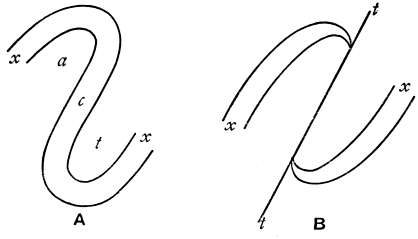
Fig. 1.
A. A sigmoidal fold, showing a bed xx in an overfold with arch (a), trough (t) and common limb c.
B. A similar bed xx affected by a thrust-plane tt which replaces the common limb.
Here the portions of any bed (xx) which occur in the arch or trough are in normal position, and have not been moved round through an angle of 90°, whilst the portion which occurs in the common limb c has been moved round through an angle greater than 90° and is inverted, so that its former upper surface now faces downwards. In Fig. 1 B the common limb is replaced by a reversed fault, or thrust-plane, and the inverted portion of the bed seen in the common limb is therefore absent. An observer, applying the test of superposition, might suppose that the position of the bed x on the left-hand side of the figure was a different bed from the portion which is seen on the right-hand side, instead of belonging to the same bed, and in this way, if a number of parallel thrust-planes affected one bed or a set of beds, he might be led to infer the occurrence of a great thickness of strata where there was in reality a slight thickness, or even one bed only repeated again and again by faulting. It is quite certain that exaggerated estimates of the thickness of deposits have frequently been made owing to the non-recognition of the occurrence of repetition as a consequence of the existence of thrust-planes.
Where thrust-planes are suspected, it is well to look for some of the following features:
(a) The strata of a country affected by thrust-planes often crop out as lenticular masses, thinning out rapidly in the direction of the strike[10]. This is true of beds thrown into sharp folds whether or not inverted, but the lenticles will be wider in a direction at right angles to that of the strike as compared with their length when inversion has not occurred. It is also true of beds which were originally deposited as lenticles, such as many massive sandstones, and as almost any kind of deposit may be formed originally as a lenticle, the test by itself is by no means sufficient as a proof of thrusting, though it is suggestive.
(b) The surfaces of the strata are often affected by the striations known as slickensides, and the joint-faces of gently inclined beds are also frequently marked by slickensides which often run in a nearly horizontal direction.
(c) A parallel structure presenting the appearances characteristic of the mechanically-formed features of a foliated rock is often developed, and one or more of certain accompanying phenomena will probably be found, which will be noticed more fully in a later chapter.
(d) Extension or stretching of the rocks will have been frequently produced, causing rupture, and the resulting fissures are usually filled with mineral-veins, though this occurrence is by no means characteristic of rocks which have been affected by thrust-planes.
(e) Chemical changes may have occurred which have resulted in the reconstitution of some of the rock-constituents, which may crystallise where pressure is least, thus we often find rocks which have undergone movements of the type we are considering marked by the existence of sericitic films upon the surfaces.
Another reservation must be made when considering the law of superposition. The test is only applicable for limited areas. Suppose we find a deposit of clay a resting upon another deposit of limestone b in the south of England, and can prove that the apparent succession is the true one, that is, that there has been no inversion; it is clear that the test of superposition is applicable in that area. Now, we may be able to trace the two deposits continuously across the country, one as a clay, the other as a limestone; so that when we reach the north of England we find the clay a still reposing upon the limestone b. The test of superposition is applicable in that area also, the clay of the northern area being newer than the limestone of the same region. But, for reasons which will ultimately appear, it by no means follows that the clay of the north is newer than the limestone of the south, although the two deposits are continuously traceable with the same lithological characters; it may have been formed simultaneously with the limestone of the south, or even before it. Something more, therefore, than the test of superposition is necessary in order to make out the relative ages of continuous deposits in a wide region, and this is still truer in the case of deposits which are discontinuous, whether separated from one another by the sea, or by outcrops of older or newer rocks.
A few words of warning may be added with reference to the detection of bedding-planes. A bedding-plane is one which separates two beds, and its existence is determined during the deposition of the beds. Many other planes are formed in rocks subsequently to their deposition, and it is not always easy to distinguish these from true bedding-planes. That even experienced observers may be led astray is shown by the fact that, of recent years, it has been proved that great masses of rock have been claimed as of sedimentary origin, and their apparent order of succession noted, which are in truth naught but irregular masses of intrusive igneous rocks affected by divisional planes which simulate bedding, produced in the rocks subsequently to their consolidation. Joints, faults, and cleavage-planes may all at times simulate planes of bedding, and it is frequently very difficult to distinguish them in the limited exposures with which a geologist has oftentimes to deal. It is easier to make suggestions for distinguishing bedding-planes from other planes which simulate them, than to apply the suggestions in practice, and the student of field geology will find that experience is the only guide, though after years of experience he may be confronted with cases where the evidence is insufficient to convince him that he is dealing with planes of stratification and not with some other structure.
From what has been remarked, it will be inferred that the test of superposition though of prime importance to the geologist is frequently insufficient to enable him to ascertain the true order of succession of the strata, and he is compelled to supplement this test by some other. There are several useful physical tests which may frequently be applied. Thus, if a rock a contains fragments of another rock b, under such circumstances as to show that the fragments of b were included in a during its deposition, it is clear that b is older than a. Here again, it will be found from what appears in a later chapter that the student is confronted with difficulties when actually examining rocks, for fragmental rocks of cataclastic origin, where the fragments have been formed as the result of fracture produced by earth-movements subsequently to the deposition of the rock, simulate epiclastic rocks in which the fragments were introduced during the accumulation of the deposits to so surprising a degree as sometimes to baffle the most experienced observer. Not only are the fragments of these cataclastic rocks broken up, but they may be further rounded so as to imitate in a remarkable manner the water-worn pebbles of an epiclastic conglomerate. Again, an older series of rocks may have had structures impressed upon them as the result of changes subsequent to their formation, and before the formation of a newer set which the latter therefore do not exhibit. Jointing, cleavage, and various metamorphic phenomena may thus be exhibited by the older rocks, but great care is required in applying this test, especially with a limited thickness of rocks, as one set may not exhibit the structures not because they were not in existence when the structures were developed, but because their nature is such that they were incapable of receiving or retaining the structures. For instance a mass of grit which is older than a mass of clay-slate may not be cleaved, because, although subjected to the pressure which produced the cleavage, it was of a nature not adapted to the development of cleavage structure.
On the whole, application of tests dependent upon physical features of rocks, does not often supplement to any great extent the information supplied by ascertaining the order of superposition, and in all cases, where possible, every other kind of information should be supplemented, by that which is acquired after examination of the included organisms of the strata.
CHAPTER V.
THE TEST OF INCLUDED ORGANISMS.
The second great law of the Stratigraphical Geologist is that fossiliferous strata are identifiable by their included organisms, in other words, that we can tell the geological age of deposits by examination of the fossils contained in them, though the determination of age must be given in more general terms in some cases than in others. Considerable misconception has arisen concerning the value of fossils as indices of age, and it is necessary therefore to discuss the significance of the law of identification of strata by their included organisms at some length.
The comparison between fossils and medals has frequently been made and fossils have well been styled the "Medals of Creation"; and the significance of fossils as guides to the age of deposits may perhaps be made clearer if we pursue this comparison some way. In the first place there is clear indication of a gradual increase in the complexity of organisation of the fossils as one passes from the earlier to the later rocks, and accordingly the general facies of a fauna is likely to furnish a clue to the age of the rocks in which it is found, even though every species or even genus represented in the fauna was previously unknown to science. So an antiquary versed in the evolution of art or metallurgy, might detect the general age of a medal with whose image and superscription he was not acquainted. He would know that a medal struck in iron was formed subsequently to the bronze age, or that one formed of palladium appertained to the present century. But quite apart from any theoretical knowledge, an antiquary would find as the result of accumulated experience that certain medals are characteristic of certain periods; he would learn that the denarius is characteristic of a different period from that indicated by the coin of the Victorian era, even though he had no knowledge of the technicalities of numismatics. The same is the case with the geologist. He may not be influenced by any knowledge of the evolution of faunas and floras, but actual work amongst the rocks will show him that the trilobite is not found with the belemnite or the ichthyosaur with the elephant, save under exceptional circumstances, which only prove the rule, as for instance when worn bones of ichthyosaurs are washed from their proper strata into gravels with elephant-bones.
It must be distinctly understood that the determination of fossils as characteristic of different periods is solely made as the result of experience. No à priori reasoning may give one indication of the actual range in time of a species or genus; no one can say why Discina has a long range in time, whilst that of the closely related Trematis is very limited. This being the case, the greater the mass of evidence which is accumulated as to the range of a fossil, the greater will be the value of that fossil as a clue to the age of the deposit in which it is found. This is so important, that it requires more than mere notice. If a fossil is found in abundance in a group of strata B in any one area, and is not found in an underlying group A or overlying group C in that area after prolonged search, we may confidently speak of the fossil as characteristic of the strata B in that area, though without further work, the value of the fossil as a clue to age in other areas would be unproved. It may nevertheless happen, that after more prolonged search in A or C, in the original area a few specimens of the fossil which has been spoken of as characteristic of B may be found in one or other of them, in small quantity. The value of the fossil as one characteristic of B will be slightly diminished, though only slightly, as it is not likely to turn up in numbers in the strata A or C after the prolonged search. Should the fossil be found also to be characteristic of the strata B in areas other than the original one, it becomes of more than local value, and if, after much study it is found to characterise the same strata over wide areas, the cumulative evidence now obtained will render the fossil peculiarly important to the stratigraphical geologist. The detection of characteristic fossils is not quite so simple as might be supposed from the above remarks, for examination of the position of one fossil will not prove the contemporaneity of beds in different places, to prove this, all the evidence at our disposal must be considered, for reasons which will be presently pointed out.
As the result of accumulated knowledge, we can now compile lists of characteristic fossils of the major subdivisions of the strata, which are of world-wide utility and as our knowledge increases, we are enabled to subdivide the strata into minor divisions of more than local value.
What is a fossil? Before discussing the value of fossils as aids to the stratigraphical geologist, it may be well to make a few observations as to what constitutes a fossil. It is difficult to give any concise definition, and as is often the case in geology, an explanatory paragraph is of more value than a mere definition. The term fossil was originally applied to anything dug up from the rocks of the earth's crust, and was used with reference to inorganic objects as well as organic remains, for instance minerals were spoken of as fossils. It is now applied essentially though not exclusively to relics of former organisms, though one still reads of fossil rain-drops, fossil sun-cracks, and so on. Furthermore, the relics need not necessarily be parts of the organism, the track of a worm or a bird's nest if embedded in the strata would be termed a fossil. It is generally agreed that no sharp line can be drawn between recent and fossil organic remains which is based upon the degree of mineralisation (or as it was sometimes termed petrifaction) of the relics, for many true fossils have not undergone mineralisation, subsequent to their entombment.
It has been suggested that the name fossil should be applied to organic remains which have been entombed by some process other than human agency, but this restriction is undesirable. The stone-implement of the river gravels is as genuine a fossil as the ammonite extracted from the chalk, and the human relics of very recent date may give information of a character quite similar to that supplied by other remains, for instance, the occurrence of moa-bones in New Zealand in accumulations below those containing biscuit-tins and jam-pots has been used as a geological argument pointing to the extinction of the moa before the arrival of Europeans in New Zealand. The biscuit-tin here serves all the purposes of a fossil, and there is no valid reason why it should not be spoken of as such.
This statement brings one to consider another method which has been adopted in order to separate fossil organisms from recent ones, namely the time-test. This again is inapplicable, for no line can be drawn between the shell which was buried in yesterday's tidal deposit and that which has lain in the strata through geological ages, and each may be equally useful to the geologist.
Whilst, then, we can give no definition of fossil which is likely to meet with general acceptance, the term can be so used, as not to give rise to any doubts as to its meaning, and it is generally applicable to any organic relics which have been embedded in any deposit or accumulation by any agent human or otherwise.
Mode of occurrence of fossils. It will not be out of place to say a few words as to the way in which fossils are found in strata, as beds are often inferred to be unfossiliferous, because of ignorance of methods which should be pursued in searching for organic relics. It is unnecessary to dilate upon the actual modes of preservation of organisms, which is treated of fully in other works. In the first place, it is rash to assert that any deposit is unfossiliferous because no fossils have been found in it, even after prolonged search. The Llanberis slates had been eagerly searched for fossils for many years without result, but that the search was not exhaustive was proved by the discovery of trilobites in them some years ago. Seekers after fossils are rather prone to confine their attention to strata which are already known to be fossiliferous than to pay much attention to those which have hitherto yielded no organic remains.
Some kinds of deposits are more often fossiliferous than others. Limestones which are frequently largely of organic origin, are often rich in remains, and muddy deposits more frequently furnish fossils than those of a purely sandy nature. The difference in the yield is not necessarily due to the original inclusion of more remains in one rock than in another, but is often caused by the obliteration of former relics owing to changes which have taken place in the rocks subsequently to their deposition. No sedimentary rock must be regarded as unfossiliferous, however unfitted it appears for the preservation of fossils. The writer has seen fossils, not only in coarse conglomerates, rocks which frequently contain no traces of organisms, but in deposits composed largely of specular iron ore, and even in intrusive igneous rocks, though in the latter case, the inclusion of fossils was due to circumstances which cannot have occurred with frequency.
In sandy strata, the substance of the fossils has often been completely removed, leaving hollow casts, which may be almost or quite unrecognisable. In these circumstances, much information may be obtained by taking impressions of the casts in modelling wax or some other material. The importance of this process may be judged from the results it yielded to Mr Clement Reid in the case of the fossils of the Pliocene deposits occurring in pipe-like hollows in the Cretaceous rocks of Kent and the discovery of the remarkable reptiles described by Mr E. T. Newton from the Triassic sandstones of Elgin.
In argillaceous rocks which have been affected by the processes producing cleavage, the fossils may be distorted beyond recognition or owing to the difficulty of breaking the rocks along the original planes of deposition, may remain invisible. Under such circumstances, small nodules of sandy or calcareous nature may sometimes be found included in the argillaceous deposits and may perhaps yield fossils. Oftentimes, also, where the argillaceous rock is in close proximity to a harder rock, such as massive grit, the argillaceous rock in close contiguity to the hard rock may escape the impress of cleavage-structure, and fossils may be readily extracted from rocks in this position when not obtainable from other parts of the deposit. It was under these circumstances that the trilobites alluded to above were obtained from the Llanberis slates.
The fossils of calcareous rocks are often very obvious, but difficult to extract, as they break across when the rock is fractured. They are frequently obtainable in a perfect condition when the rock is weathered. Occasionally they may be extracted from certain argillaceous limestones if the limestone be heated to redness, and suddenly plunged into cold water. Fossils are often found in a state which enables them to be readily extracted when a limestone is coarsely crystalline, though they cannot be extracted in a perfect condition when the same limestone is in a different state.
Many microzoa, which are invisible in rocks, even when viewed through a lens, may be found in microscopic sections of calcareous and silicious rocks, and plant structures may be detected under similar circumstances in the case of carbonaceous rocks.
Various special methods of extracting fossils from rocks have been described by different writers, many of which are very complex, and require much time. The mechanical action of the sand-blast and the solvent action of various acids as hydrochloric and hydrofluosilicic have been found of use upon different occasions[11]. The various processes which have been utilised in order to extract and develop fossils can, however, be best learned by information obtainable from curators of palæontological collections, and by actual experience, and there is yet much information to be acquired as to the manner of extracting fossils from various kinds of rocks.
Relative value of fossils to the Stratigraphical Geologist. It has been hinted above that no general rule as to the relative value of fossils as guides to the age of strata can be laid down, and that the ascertainment of their relative value is largely the result of actual experience. It may be noted, however, that organisms which possess hard parts are naturally more important to the geologist than those which do not, as few traces of the latter are preserved in the fossil state, and even when preserved are usually too obscure to be of much practical use. Of the organisms which do possess hard parts, different groups have been utilised to a different degree, and one group will be more or less important than another, according to the use to which it is applied. Groups of organisms which have a long range in time are naturally useful for the identification of large subdivisions of the strata, whilst those which have had a shorter range are valuable when separating minor subdivisions.
Again, as the bulk of the sedimentary deposits has been formed beneath the waters of the ocean, relics of marine organisms are naturally more useful than those of freshwater ones. Other things being equal, the more easily the organism is recognisable, and the more abundant are its remains, the greater its value to the stratigraphical geologist, and as the remains of invertebrates are usually found in greater quantities and in more readily recognisable condition than those of the vertebrates, they have been used more extensively as indices of age. Of the invertebrates, the mollusca are often very abundant, their remains are adapted for preservation, and their characteristics have been extensively studied, and accordingly they have been and are of great use to the geologist. Of other groups, the graptolites, corals, echinids, brachiopods, and trilobites have been very largely utilised. The Lower Palæozoic strata have been divided into numerous groups, each characterised by definite forms of graptolites, and a similar use has been made of the ammonites in the case of the Mesozoic rocks. It is not to be inferred that these groups of organisms are naturally more useful than other groups, on account of the extent to which they have been used; we can merely state that they have been proved to be useful as the result of prolonged study; when other groups have received equal attention, they may well be found to be equally useful for the purposes which we have in view.
Contemporaneity and Homotaxis. From what has been already stated, it will be recognised that the ages of the various fossiliferous rocks of the geological column[12] in any one area can be identified with greater or less degree of certainty by reference to their included organisms, the various subdivisions being marked by the possession of characteristic fossils, and it will be naturally and rightly inferred that the greater the number of characteristic fossils of any one deposit, the more certain is the identification of that deposit. In practice, geologists are wont to ascertain the age of the strata after consideration of all the fossils found therein, some of which may be actually characteristic whilst many may come up from the strata below, or pass into those above. Having ascertained the order of succession and fossil contents of the strata in various regions, it is the task of the geologist to compare the strata of these two regions, and this task is fraught with considerable difficulty. Much controversy has arisen as to the degree of accuracy with which strata of remote regions can be correlated, and the subject is one which requires full consideration.
Suppose that a series of strata which we will call A, B, and C is found in any one area, each member of which contains characteristic fossils which enable it to be recognised in that area, and we will further suppose that in another area a series of strata A´, B´, and C´ is discovered, of which A´ has the fauna of A in the former area, and similarly B´ the fauna of B, and C´ that of C.
It cannot be assumed that the stratum A is therefore contemporaneous with A´, B with B´, and C with C´, but on the other hand, it must not be assumed that they are not contemporaneous. This is a statement which requires some comment. It has been urged that if the deposits A and A´ in different localities contain the same fauna, this is a proof that the two are not contemporaneous, for some time must have elapsed in order to allow of the migration of the organisms from one area to another, it being justifiably assumed that they did not originate simultaneously in the two areas. But everything depends on the time taken for migration as compared with the period of existence of the fauna. If the former was extremely short as compared with the latter it may be practically ignored, for we might then speak of the strata as contemporaneous, just as a historian would rightly speak of events in the same way which occurred upon the same afternoon, though one might have happened an hour before the other. Let us then glance at the evidence which we have at our disposal, which bears upon this matter.
The objection to identification of strata with similar faunas as contemporaneous was urged by Whewell, Herbert Spencer, and Huxley, and the latter suggested the term Homotaxis or similarity of arrangement as applicable to groups of strata in different areas, in which a similar succession of faunas was traceable, maintaining that though not contemporaneous the strata might be spoken of as homotaxial. Huxley went so far as to assert that "for anything that geology or palæontology are able to show to the contrary, a Devonian fauna and flora in the British Islands may have been contemporaneous with Silurian life in North America, and with a Carboniferous fauna and flora in Africa[13]," a statement which few if any living geologists will endorse. If the statement be true, and the fauna which we speak of as Devonian, when present be always found (as it is) above that which we in Britain know as Silurian and below that which we term Carboniferous, the faunas must have originated independently in the three centres, and disappeared before the appearance of the next fauna, or having originated at the same centre, each must have migrated in the same direction, spread over the world, and become extinct as it reached the point or line from which it started. Suppose for instance a fauna A originates at the meridian of Greenwich, migrates eastward, and dies out again when it once more reaches Greenwich, that B and C do the same, at a later period, then the fauna B will always be found above A and C above B, but if B did not become extinct when it reached the Greenwich meridian, it would continue its eastward course, and C having in the meantime started on its first round, the fossils of the fauna B would be found both above and below those of C. It will be shown below that cases of recurrence do occur, but nowhere do we find a Silurian fauna above a Devonian one, or a Devonian one above one belonging to the Carboniferous, nor is the fauna of a great group of rocks found in one region above the fauna of another group, and in another region below the same. And this is true not only of the faunas of one major division, such as those of the Silurian and Carboniferous periods, but also of the faunas of many minor subdivisions into which the large ones are separated, for instance we do not find the Llandovery fauna of the Silurian period which in Britain is found below the Wenlock fauna embedded elsewhere in strata above the Wenlock. I have simplified the statement by assuming that the faunas are identical in the different localities, and exactly similar throughout the whole thickness of the containing strata, which is naturally not the case, but the additional complexity does not conceal the truth of what has been stated. In the absence of actual inversion of well-marked faunas, only one explanation is possible, namely, that the time for migration of forms is so short as compared with the entire period during which the forms existed, that it may be practically ignored, and the strata containing similar faunas may be therefore spoken of truthfully as contemporaneous and not merely homotaxial[14].
Apparent anomalies in the distribution of fossils. There are several occurrences which have tended to augment the distrust frequently felt concerning the value of fossils as indices of the age of the beds in which they occur, which may be here considered.
Though the greater number of fossil remains belonged to organisms which lived during the time of accumulation of the deposits in which they are now embedded, this is by no means universally the case, and the occurrence of remanié fossils, which have been derived from deposits more ancient than the ones in which they are now found is far from being a rare event. The existence of remains of this nature in the superficial drifts and river-gravels of our own country has long been recognised, and no one would suppose that the Gryphæa and other shells furnished by these gravels had lived contemporaneously with the species of Corbicula, Unio and other molluscs which are part of the true fauna of the gravels. In this case the water-worn nature of the remains is a good index to their origin, but in other cases, it is by no means an infallible guide, for we sometimes find on the one hand that remains of organisms proper to the deposits in which they occur are water-worn, whilst on the other the relics of remanié fossils are not. The now well-known gault fossils of the Cambridge Greensand at the base of the chalk were not always recognised as having been derived from older beds, and there are certain fossils found in nodules in the Cretaceous rocks of Lincolnshire, which still form a subject for difference of opinion, for while some writers maintain that they belong to the deposits in which they are now found, others suppose that the nodules have been washed out of earlier beds.
Occasionally we find forms which occurring in a set of beds A in an area, are absent from the overlying beds B, and appear again in the succeeding deposits C. Such cases of recurrence are by no means rare, though many supposed instances of recurrence have been recorded as the result of stratigraphical or palæontological errors. The best examples have been noted by Barrande among the Lower Palæozoic deposits of Bohemia. The stage D of Bohemia consists of five 'bandes' or subdivisions, the lowest (d 1), central (d 3) and uppermost (d 5) divisions are mainly argillaceous, whilst the second (d 2) and fourth (d 4) are essentially arenaceous. Some of the forms found in d 1, d 3 and d 5 have not been found in d 2 and d 4. The best-known example is the trilobite Æglina rediviva. It is clear that this and other forms did not become extinct during the deposition of the strata of d 2 and d 4, though they may have disappeared temporarily from the Bohemian area, or else lingered on in such diminished numbers that their remains have not been discovered. The range of the organism is in fact right through the deposits of the stage D, and the discontinuity of distribution is not a real anomaly; it may be compared to some extent with cases of discontinuous distribution in space. It is needless to remark that the whole fauna does not disappear for a time and then reappear, but only a few out of the many forms which compose it. The comparative rarity of examples of recurrence after long intervals is an indication that the palæontological record as it is termed is not so imperfect as some suppose, for if our knowledge of fossils were very imperfect, we should expect cases of apparent recurrence to be common, as the result of the non-detection of fossils in the intermediate beds. One of the most marked cases of apparent recurrence known some years ago was the reappearance of a genus of trilobite Ampyx in Ludlow rocks, found in the Bala rocks, but not in the Llandovery or Wenlock strata. It has since been discovered in Llandovery beds, and its eventual discovery in beds of Wenlock age may be regarded as certain. A supposed case of recurrence which would have been remarkable, that of the disappearance of Phillipsia in Ordovician rocks, its entire absence in those of Silurian age, and its reappearance in the Devonian, has broken down, for the supposed Ordovician form has been shown to belong to an entirely different group of trilobites from that containing the genus Phillipsia, and it has been therefore renamed Phillipsinella.
Many apparent anomalies of distribution have been explained as due to migration, but it is doubtful whether any one of these supposed anomalies is actual and not due to errors in determining the position of the beds or the nature of their included fossils. Some of the supposed anomalies have already been shown to be due to error, and the others will almost certainly be cleared up. In speaking of anomalies of distribution, the geologist can only be guided by experience as to what constitutes an anomaly. For instance the existence of a complete fauna in any one place in the beds of a system above that to which it is elsewhere confined would be regarded as anomalous and as probably due to error, whilst the reappearance of several forms in beds of a system higher than that in which they had hitherto been found, could hardly be considered as an anomaly. A geologist would suspect the statement that after the disappearance of an Ordovician fauna in an area and its replacement by a Silurian fauna, the Ordovician fauna reappeared for a time, but would not regard the statement that a Cenomanian fauna partly reappeared in the Chalk Rock with surprise.
The existence of a Silurian fauna in Ordovician times was maintained by Barrande in the case of the Bohemian basin. Lenticular patches of Silurian rocks having the lithological characters of the Silurian strata are found in the Ordovician beds of that region, and they contain fossils specifically identical with those of the Silurian rocks. Barrande explained this appearance as due to the existence of a fauna in other regions resembling the Silurian fauna of Bohemia, during the Ordovician period, when the normal Ordovician fauna of Bohemia inhabited that area. He supposed that in parts of the basin, when favourable conditions arose, colonies of the foreign fauna settled for a time, but did not get a permanent footing in the basin until the commencement of Silurian times. The theory of colonies has now been rejected for the Bohemian area, and the phenomena shown to be due to repetition of strata by folding and faulting, but it is a theory which is again and again advocated in order to explain apparently anomalous phenomena in other areas, and these apparent anomalies which are so explained, must be regarded with grave suspicion.
The various complexities alluded to in the foregoing pages increase the difficulty experienced by the geologist in correlating strata in different areas by their included organisms, but no one of them disproves the possibility of making these correlations, which can be carried on to a greater or less extent according to the nature of the faunas.
A good deal of misconception has arisen concerning the geographical distribution of former faunas, owing to the tendency to compare them exclusively with the littoral faunas of the present day. These littoral faunas have a comparatively limited geographical distribution, the forms of one marine province often differing considerably from those of an adjoining one, and still more widely from one which is remote, so that anyone confronted with the relics of faunas from the existing Australian and European seas, would find no indications furnished by identity of species that the faunas were contemporaneous. Recent researches have shown, however, that the creatures whose remains are deposited at some distance from the coast-line have a much stronger resemblance to one another than the littoral organisms have, if the fauna of two distant areas be compared. It is still a moot point which will be discussed in a later chapter, how far the deep-sea deposits of modern times are represented amongst the strata of the geological column by deposits of similar origin. But it is certain that many of the ancient strata are not littoral deposits, and it will be found that it is by comparison of the faunas of the deeper-water deposits that the geologist correlates the strata of remote regions: where shallow water deposits are formed, the faunas differ markedly in different regions, and these shallow-water forms can only be correlated owing to their occurrence between deeper-water strata. Thus if strata A, B and C be found in one area, and the fauna of A and C are deep-water forms, those of B being shallow-water forms, and in another area beds A´ contain the same fauna as A, and C´ the same fauna as C whilst the fauna of B´ is different from that of B, we can nevertheless correlate the strata B and B´ (if they be conformable with the underlying and overlying beds), because of the identity of age of the associated beds in the two areas. It will possibly be found that the strata A and C can be further subdivided into A1, A2, ... &c. C1, C2, ... by the existence of minor faunas, which are comparable in the two cases, but such subdivisions may not be established in the case of the beds B and B´.