J. E. MARR, M.A., F.R.S. (continued 4)
Reading edition
CHAPTER XVIII.
THE CARBONIFEROUS SYSTEM.
The Classification. The British rocks of the Carboniferous system have been classified according to their lithological characters, but as the classification has been altered from time to time, we may use that which seems most acceptable to the majority of British geologists at the present day. According to this, the beds are grouped as below:—
Upper Carboniferous Coal Measures Millstone Grit Ardwick Stage Pennant Stage Gannister Stage

Lower Carboniferous Carboniferous (Mountain) Limestone Series.
The Lower Carboniferous beds have been further subdivided into:—
Yoredale Series or Upper Limestone Shales, Mountain Limestone, Lower Limestone Shales, with Sandstones and Conglomerates,
but as these lithological types are found to be very variable when traced laterally for comparatively short distances, it is found more satisfactory to use the terms in a purely lithological sense rather than with chronological significance.
The somewhat abnormal development of the higher portions of the Carboniferous rocks of Britain renders the local classification only partially applicable in other regions, and as our knowledge progresses, a palæontological classification will probably be adopted. This has already been done with the more purely open-water sediments of Russia and Eastern Asia, where the development of the beds is more normal. There the rocks are classified as under:—
Upper Carboniferous or Gshellian, Middle Carboniferous or Moscovian, Lower Carboniferous,
and as this classification has already been found to be applicable over rather wide areas, it is almost certain that, as in the case of the rocks of other systems, it will prove more serviceable than one which is mainly (though not quite exclusively) based upon vertical variation of lithological characters, especially as the Carboniferous rocks over large tracts in North America possess faunas which are similar to those which have been discovered in Russia, Eastern Asia and North Africa.
Description of the strata. The variations in the lithological characters and fossil contents of the British Carboniferous strata when traced from north to south have been so frequently described, and utilised as a means of illustrating the indications as to local variations in physical conditions which are supplied by those strata, that little need be said upon the subject. The restoration of the physical geography of Carboniferous times over the British area will be found in a chapter by the late Professor Green in the work upon Coal by various professors at the Yorkshire College of Science and also in Prof. Hull's Physical History of the British Isles. Some modifications must be made in these restorations as the result of recent research, the principal being caused by discoveries amongst the Carboniferous rocks of Devonshire.
Taking the strata in vertical succession, we find evidence of the occurrence of a complete marine period (the second great marine period) between the second and third continental periods. The first shallow-water phase over a great portion of the British Isles is marked by thin terrigenous sediments, indicating that the period was a brief one; it was followed by the deep-water phase, probably of some length, lasting through the greater part of the remainder of Lower Carboniferous times; while the concluding shallow-water phase was lengthy as compared with that of the beginning of the period, and is marked by the accumulation of the great thickness of deposits belonging to the Millstone Grit and Coal Measures. There is no doubt, however, that in some parts of the British area minor changes produced local terrestrial conditions during the period, and accordingly we find that the deepest water deposits of the system in Britain are succeeded by an unconformable junction with the sediments of the upper portion of the system.
The general change in the lithological characters of the beds of the Lower Carboniferous division when traced from south to north is shewn in the following diagram (Fig. 20).
It will be seen that the land and open sea areas were in the respective positions which they occupied during Devonian times, but that as the result of greater submergence, with which the accumulation of sediment did not keep pace, the shallow-water marine deposits of Devonian age are in Devon replaced by open-sea deposits[88], while shallow-water marine deposits further north replace the anomalous deposits which were found there during the Devonian period.

Fig. 20.
a. Radiolarian cherts of Devon.
b. Mountain limestone of Central England.
c. Mechanical sediments of Northern England.
d. Freshwater deposits of Southern Scotland.
O.R. Older rocks.
Owing to the accumulation of thick masses of sediment, the Lower Carboniferous sea of the north of England appears to have been largely silted up, and although the organic deposits of the south are so thin that they did not render the sea shallow in that region, the general level of the Lower Carboniferous floor of the south was also uplifted, and actually converted into land, as the result of the upward movement which took place in Devonshire and tracts of France; and owing to silting up in the north, and elevation in the south, a general plane surface was produced over very extensive areas, not only in Britain but upon the Continent, upon which the peculiar deposits and accumulations of Upper Carboniferous times were laid down, sometimes in shallow water, sometimes upon the land, and often under conditions which cannot at present be determined with accuracy. That the deposits of the Millstone Grit and Coal Measure epochs were to a large extent laid down in water is admitted by all, and in the case of many of the deposits of the Millstone Grit, and some thin deposits of the Coal Measures, it is equally clear that the water area was part of an expanse of ocean, for we find marine fossils, as corals, crinoids, and cephalopods, in these beds. Associated with them in the Coal Measures are other beds in which the ordinary Carboniferous genera of marine invertebrates are absent, and their place is taken by shells which bear much resemblance to the modern fresh-water mussel, and it has been maintained with good reason that as the ordinary marine forms are rarely or never mixed with those resembling recent fresh-water shells, the latter are truly fresh-water[89]. If this be so, many of the mechanically formed sediments of the Coal Measures were of fresh-water origin, laid down in shallow lagoon-like expanses, probably shut off from the main ocean by a narrow portion of intervening land, which was occasionally destroyed, thus permitting incursions of salt-water when some of the ordinary marine invertebrates of the period obtained a temporary footing in the area.
There is not only a difference of opinion as to the mode of accumulation of many of the mechanical sediments of the Coal Measures, but also as to that of the coal-seams which accompanied them. Two different theories have been put forward to account for these coal-seams, which are usually spoken of as the drift theory and the growth-in-place theory. According to the former, in its extreme application, coal is an aqueous deposit formed by the settlement of drifted masses of vegetation upon the floor of a water-tract, while those who push the growth-in-place theory to its extreme limits maintain that coal is the result of growth of vegetation upon the actual site where the coal is now found. Much apparently conflicting evidence has been advanced by the advocates of the two hypotheses, and special cases of coal-formation have been appealed to by each in support of their views; thus the existence of coal composed largely of bodies which resemble the spores of modern lycopods,—objects of so resinous a nature that they float on the surface until they are decomposed,—is cited by the upholders of the growth-in-place theory, while the supporters of the other hypothesis can point with equal force to the occurrence of the finely divided carbonaceous mud containing remains of fishes which gives rise to cannel coal in some places. One of the main assertions in support of the growth-in-place theory was that of the supposed universality of 'underclays' or old surface soils beneath all coal-seams, but though these are common, they are far from universal. It is impossible to do justice in small compass to this question of coal-formation, but it may be pointed out that much of the difference of opinion can be understood if it be remembered that the term 'coal' is rather a popular term which has been admitted into scientific terminology, and therefore used somewhat loosely, than a strictly scientific term applied to a definite substance, and accordingly, just as at the present day we find carbonaceous substances growing in one place on land to form peat, in other places on a tract sometimes dry and sometimes submerged, to form the carbonaceous deposits of the cypress-swamps, and once more accumulated beneath the shallows of a sea as a sediment to form the carbonaceous muds of the ocean margins where the mangroves grow, so the diverse substances which are included under the general term coal may have accumulated in one place on land, in another beneath water, and in a third on an area alternately dry and submerged. This is not a question of great importance; the important point is that accumulations of vegetation on a fairly large scale are found at the present day on plains, for even if they grow on mountain regions, the deposits are readily denuded before they are covered up, and also it must be noted that a moist climate is necessary for the growth of much vegetation. The conclusion that the accumulations of coaly matter were formed on plains is borne out by their great horizontal extent as compared with their thickness, and it is now generally agreed that the coal vegetation which is found in the normal coal-measures was essentially a swamp vegetation.
An attempt has been made to prove that an upland vegetation of very different character existed contemporaneously with it, but reasons will be given in the sequel for concluding that this supposed upland Carboniferous flora is everywhere of later date.
The later shallow-water phase of Carboniferous times, as already stated, was unusually long, it was also very widespread, and appears to have been accompanied over wide areas by humid conditions during its continuance, and accordingly the marsh conditions which existed during Upper Carboniferous times were probably on a larger scale than that of similar conditions before or after. Special stress is laid upon this fact, as it is a good illustration of the view which seems to be gaining ground, that every period possessed peculiar conditions never to be repeated, which must have left their impress upon the character of the sediments.
Though the conditions above described were widespread, they were naturally not universal, and accordingly in many parts of the world, as previously stated, we find true marine deposits of Upper Carboniferous times, though even these were sometimes replaced during part of the epoch, by conditions which were favourable for the formation of coal-seams in those places. Interruption in the continuance of a humid temperate climate over the regions of North-West Europe is also suggested by the discovery of deposits which are maintained to be of glacial origin amongst the Coal Measures of France[90].
The Floras and Faunas. The flora of the Carboniferous rock is so noteworthy that the period has been termed the Period of Cryptogams; the remains of ferns, horsetails, and clubmosses predominate, and many of the forms reached a gigantic size. Though the floras of the various stages are marked by a general resemblance, there are differences which enable the palæobotanist to ascertain the stratigraphical position of the beds by reference to the included plant remains, and a considerable number of successive floras have been described[91]. The invertebrate fauna does not differ on the whole very greatly from that of Devonian times, though the trilobites are now becoming rare, and the mollusca assume a more prominent position as compared with the brachiopods. Corals occur in abundance in the calcareous deposits of the period, and frequently give rise to sheets of reef-formation, but the foraminifera and crinoidea certainly play the principal part as limestone-producers, and the influence of the latter in giving rise to great masses of limestone which are frequently used for ornamental purposes is too well known to need more than passing reference. The air-breathers have also been detected in greater abundance, though they are rare, when we consider the comparatively favourable conditions for their preservation presented by the Coal Measure rocks. Myriopods, arachnids, insects and pulmoniferous gastropods have however been found with tolerable frequency. The danger of arguing from imperfect data is well illustrated by the great addition to our knowledge of the insect-fauna of these times due to the exploration of the beds of one small coal-field, that of Commentry in France, of which the insects have been described by M. C. Brongniart. The vertebrates are represented by a considerable variety of fishes, and less abundant though tolerably numerous remains of Amphibia, which occur in the Carboniferous rocks of the North of England, Ireland, France, North America and elsewhere.
The existence of definite zones of organisms in the case of the Carboniferous rocks has been denied, and it appears to be considered by some that the Carboniferous rocks were accumulated so rapidly as compared with rocks of some other systems that the fauna remained very similar throughout. It is very doubtful if this was so. In the case of other systems, the division into zones has only been accomplished by means of more detailed researches than those which have been conducted amongst the Carboniferous rocks of Britain: again, the occurrence of successive floras suggests that there may have been a similar succession amongst the faunas, and finally we find that zonal division has been carried on to some extent amongst the Carboniferous strata of other regions. The following classification of the Russian type of sediment may prove useful, as an indication of the possibility of more detailed separation of our own beds:—
Gshellian (with Fusulina and Archimedipora) Beds with Spirifera fascigera, Spiriferina Saranae, &c. Beds with Producta cora, P. uralica, Camarophoria crumena, &c. Beds with Syringopora parallela and Spirifera striata.

Moscovian Stage of Spirifera mosquensis.
Lower Carboniferous Stage of Spirifera Kleini. Coals, Sandstones and Shales with Noeggerathia tenuistriata and Producta gigantea. Stage of Producta mesoloba.

The marine fauna of the Upper Carboniferous beds, which is so poorly represented in Britain, but is well developed in Spain, Russia, Asia and North America, is largely characterised by the abundance of foraminifers of the genus Fusulina and Fusulinella and of bryozoa of the genus Archimedipora. It is very desirable that the truly marine fauna of the Spirorbis limestone and other marine bands of the British Coal Measures should be carefully studied to see if they present any close relationship with that of the Gshellian beds[92].
CHAPTER XIX.
THE CHANGES WHICH OCCURRED DURING THE THIRD CONTINENTAL PERIOD IN BRITAIN; AND THE FOREIGN PERMO-CARBONIFEROUS ROCKS.
At the close of Carboniferous times a marked change took place in the nature of the earth-movements. The prevalent depression which occurred over the British and adjoining regions during Carboniferous times was replaced by upward movement, accompanied by orogenic folds, which once more brought on continental conditions and developed a series of mountain ranges. The change is marked even at the close of Carboniferous times by the abnormal red sandstones of the uppermost part of the Carboniferous system which are found around Whitehaven in Cumberland and Rotherham in Yorkshire, as the Whitehaven Sandstone and Rotherham Red Rock. These movements continued through Permian and Triassic times, and it is to them and to the climatic conditions of the periods, that the anomalous nature of the Permo-Triassic deposits is largely due, as will be shewn in the succeeding chapters. At present it is our purpose to call attention to the effect of these movements upon the sediments which had been deposited previously to their occurrence.
Over the British area, two different systems of orogenic movement can be detected, producing folds of which the axes run approximately at right angles to one another. One of these, of which the Pennine system is the best representative in Britain, caused the production of elevations having axes in a general north and south direction, and we may therefore speak of it as the Pennine system of movement, while the other, which gave rise to folds running in an east and west direction, is well represented in the Mendip Hills, and may be therefore termed the Mendip system, though it is more widely known as the Hercynian system, as, on the Continent, the rocks which are greatly affected by it form the foundations of the region occupied by the ancient Hercynian forest.
The effects of these systems were in the main similar; they resulted in the uplift of parallel belts of country to form hill-ranges with intervening lowlands, but when studied in detail the movements are seen to be of a different character. The Pennine system of movements was of a type which is familiar to the geologists as developed in the Great Basin Region of the western territories of North America, and produced what is spoken of as Basin-Range structure. The movements were of the nature of direct uplift, causing fracture, only accompanied by folding in a minor degree, and accordingly the hills are composed of terraced scarps, with one gently sloping side, and one steep scarp-side, the latter on the upthrow side of the fault, as seen in Fig. 21.
In the Mendip system, the folds were of the Alpine type, which is a familiar product of lateral pressure, consisting essentially of overfolds, though these are often complicated by reversed faults.
Of the Pennine system, the Pennine Chain itself furnishes the most noteworthy example in Britain, but we have indications of other folds of this system, such as that which runs from the Lake District to the Ayrshire coast, which is partly concealed as the result of other movements, and a still more marked one, in the rocks of the Malvern Hills.
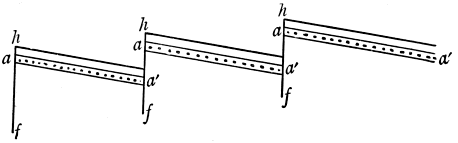
Fig. 21. a a´. One stratum displaced by faults f f. h. Hills.
The Mendip system is well shewn in the Mendip Hills, but the remains of a still more important anticline are seen in South Devon and Cornwall, separated from the Mendip Hills by the great syncline of Devon. Another parallel anticline runs from Lancashire to Yorkshire at right angles to the Pennine Chain and separates the coal-field of Cumberland and that of Northumberland and Durham, from those of South Lancashire, and Yorkshire, Notts, and Derbyshire.
On the European continent the Ural Chain is the most important uplift of the system of which the Pennine Chain forms a minor representative, while the Hercynian system has caused the compression and stiffening of many of the Carboniferous and earlier rocks which now rise to the surface in many parts of central Europe.
The extensive continental area which was the result of these uplifts not only determined the formation of abnormal deposits, but allowed the occurrence of a long period of time subsequently to the close of the Carboniferous period, of which few deposits now exposed in Europe are representative, and we must accordingly seek other regions in order to find typical representatives of this Permo-Carboniferous period, of which the strata developed in the Salt Range of India have been most carefully worked, especially by Dr Waagen, though marine sediments of the period are known elsewhere, as in Spitsbergen, the Ural Mountains, China and Australasia; and a group of somewhat anomalous sediments of this age in parts of India, Australia and South America is of peculiar interest, on account of the insight as to the climatic conditions of the times which it affords.
The Permo-Carboniferous Rocks. In the Salt Range of the North-West of India an interesting series of sandstones alternating with limestones rests unconformably upon lower rocks. The sandstones are known as the Speckled Sandstones, while the limestones are termed the Productus Limestones. The Lower and Middle Speckled Sandstones are succeeded by the Lower Productus Limestone which is separated from the Lower division of the Middle Productus Limestone by the Upper Speckled Sandstone; these are all of the Permo-Carboniferous period, while the upper part of the Middle Productus Limestone and the Upper Productus Limestone belongs to the Permian period. The fossils, largely invertebrates, are intermediate in character between those of Carboniferous and Permian ages. Similar fossils are found in the marine Permo-Carboniferous beds of the other areas which have been named above. The Lower Speckled Sandstone is of interest on account of the occurrence of boulder-beds within it, and this division of the sandstone has been correlated with the lowest (Talchir) stage of the Permo-Carboniferous strata of other parts of India, while the other Speckled Sandstones and those divisions of Productus Limestone which are referred to the Permo-Carboniferous are correlated with the higher divisions of other parts.
Special mention is made of the Talchir division, on account of the occurrence therein of boulder beds which have long been known, and whose glacial origin was inferred by Dr W. T. Blanford forty years ago. The accumulations shew signs of having been deposited in water, but the existence of large subangular, sometimes striated boulders therein, which must have come from distant sources, and the occasional occurrence of striated rock surfaces on the strata upon which the Talchir beds repose unconformably points to ice-action; this would not be so very remarkable if it were an isolated case, though sufficiently so, from the comparative nearness of the region to the equator; but researches conducted in different parts of the southern hemisphere have brought to light similar, and sometimes even more striking evidences of glacial action in widely distinct regions[93]. In Australia they have been found in New South Wales, Victoria, South Australia, East Australia and Tasmania; the Dwyka boulder-conglomerates of South Africa and certain deposits of similar character discovered by Prof. Derby in Southern Brazil have been referred to the same period, and their glacial origin has also been inferred. This widespread distribution of deposits which are generally contemporaneous, of which the glacial origin may now be taken as established, is extremely remarkable, and must be taken into careful consideration by those who put forward theories framed to account for former climatic changes.
The Flora and Fauna. The flora of the Permo-Carboniferous beds has caused as much discussion as the question concerning the origin of the boulder-deposits. In the southern hemisphere, the Permo-Carboniferous rocks of those countries which have yielded boulder-beds also contain remains of a flora which is now known as the Glossopteris flora, from the prevailing genus, which is associated with other genera, such as Gangamopteris. These fossils appear to be ferns, though their modern allies have not been indicated with certainty; associated with them are rare cycads and conifers. The Glossopteris flora is markedly contrasted with the Coal-Measure flora of the northern hemisphere with its giant lycopods. Moreover Glossopteris appears in the northern hemisphere in rocks of later date than the Permo-Carboniferous period. It has been suggested that the Glossopteris flora originated in a continent in the southern hemisphere, on which the boulder beds were also formed in isolated water areas, and that some of the forms migrated northwards. To this continent the name Gondwanaland has been applied by Prof. Suess, from the Gondwana series of the Permo-Carboniferous rocks of India, in which the Glossopteris flora is found, and it has also been maintained that the southern Glossopteris flora was contemporaneous with the northern flora of ordinary Coal-measure type, though whether this was so to any extent remains to be proved, for the beds containing the Glossopteris flora are distinctly newer than any which have furnished a typical northern Coal-measure flora. In any case, the change of floras between Coal Measure and Permo-Carboniferous times is very marked, and when taken in connexion with the widespread glacial deposits, is one of the most striking phenomena displayed by the rocks of the stratified column[94].
The fauna has already been noticed. It consists of brachiopods, some of which are of peculiar genera. The general similarity of the faunas in regions so remote as Spitsbergen, the Ural Mountains, India, and New South Wales, indicates an extensive sea during the period. It can hardly be supposed that the fauna of Permo-Carboniferous times has been completely described, for the fossils of one or two areas only have been made known to us with any degree of fulness, and when the Permo-Carboniferous and marine Permian faunas are as well known as those of Triassic times (and the latter have only been fully described very recently) there is no doubt that the important break which was at one time supposed to exist between Palæozoic and Mesozoic faunas will be filled in satisfactorily[95].
CHAPTER XX.
THE PERMIAN SYSTEM.
Classification. It has already been observed that as the result of the Pennine and Mendip systems of earth-movement, the Carboniferous rocks of Britain are succeeded by a marked unconformity, and that the rocks of the succeeding Permian and Triassic systems of Britain shew an abnormal development. The principal areas where Permian rocks are found are on either side of the Pennine Chain in the North of England, but sporadic exposures of rocks of this age are found in some of the Midland and Southern counties. The Permian rocks have been well studied in Germany, and the German names are sometimes adopted in Britain, and the following comparison will prove useful:—
Britain. Germany.
Magnesian Limestone Marl Slate Magnesian Limestone Kupferschiefer } Zechstein.
Lower Permian Sandstones Rothliegende.
The term Zechstein has been applied in a somewhat different sense by different writers, but the one given in the table appears to find most favour.
In a region which was essentially continental, considerable variations in the lithological characters of the rocks may be expected, when the strata are traced laterally, but we nevertheless find that the differences are not so great as was formerly supposed to be the case when certain red sandstones lying above recognised Permian strata in the district on the west side of the Pennine Chain towards its northern extremity were also referred to the Permian; these sandstones (the St Bees Sandstones) are now generally admitted to be of Triassic age, and comparison between the rocks on opposite sides of the Pennine Chain is much simplified, as seen below.
West side. East side.
Thin Magnesian Limestones and Marls Magnesian Limestone
Hilton Shales Marl Slate
Penrith Sandstone and Brockrams Lower Permian Sandstones.
Description of the Strata. On the east side of the Pennine Chain, the Lower Permian sandstone is an inconstant deposit often consisting of yellow false-bedded arenaceous strata. The Marl Slate is an argillaceous shale, often containing bituminous matter, and yielding several fish-remains and some plants; it is usually only a few feet in thickness. The Magnesian Limestone is typically developed in Durham as a yellow or greyish limestone containing a variable percentage of carbonate of magnesia; when traced southward, it alters its characters, becoming mixed with mechanical deposits, and some chemical precipitates in places, so that at Mansfield it appears as a red sandstone with grains cemented by a mixture of carbonates of lime and magnesia; and, like the rest of the Permian strata, it has disappeared when we reach Nottingham. In addition to the southward thinning of the Permian beds of this area, there is some evidence of their disappearance in a westerly direction, though, as the present strike of the beds is nearly north and south, the indications of this are less convincing.
On the east side of the Pennine Chain, the main difference observable is the relative thickness of the major divisions. The Lower Permian sandstones have thickened out considerably, while the reputed representatives of the Magnesian Limestone are thin. The Penrith sandstone is of considerable interest. It contains in places, as near Appleby, thick deposits of breccia consisting of angular fragments chiefly composed of Carboniferous Limestone, which in many cases have undergone subsequent dolomitisation, embedded in a matrix of red sandstone. This breccia is known as brockram. Many beds of the Penrith sandstone are composed of crystalline grains of sand, due to deposition of silica in crystalline continuity with the quartz of the original grain after the formation of the deposit; of more significance, for our present purpose, is the presence of other accumulations of the sand, in which the individual grains often approach the form of spheres, thus resembling the 'millet-seed' sands of modern desert regions. The Hilton shales are grey sandy shales, with plant remains, and above them are variable deposits including thin magnesian limestones which have yielded no fossils.
The isolated Permian deposits of the midland and southern counties of England consist of red marls and sandstones with occasional breccias, and in the absence of fossils, their exact position in the Permian series is still unknown.
The German Permian rocks resemble those of Britain, especially as seen in Durham, in many particulars, and give indications of formation under physical and climatic conditions generally similar to those which were then prevalent in the British area. At Stassfurt, in Germany, the less soluble constituents of ocean water are accompanied by a great variety of salts:—chlorides, sulphates and borates; and the very soluble salts of potassium and magnesium known as the Abraum salts are found in abundance as well as the less soluble salts of sodium and calcium. The occurrence of these very soluble salts is so infrequent on a large scale among the rocks of the Geological Column, and the matter is one of so great theoretical import, that it is necessary to take special note of their presence in the Permian strata.
The frequent existence of chemical deposits in the Permian Rocks of N.W. Europe, the formation of red sandstones, and the dolomitisation of limestone beds and fragments of pre-existing limestones point to inland seas of a Caspian character, while the evaporation necessary for the formation of the precipitates also indicates a fairly warm temperature. The presence of millet-seed sands, in very lenticular patches, suggesting former sand-dunes, and the occurrence in places of breccias (like some parts of the brockram) almost devoid of matrix, piled up against pre-existing cliffs, recalling screes of modern times, give almost certain evidence of the occurrence of land tracts most probably of desert character, during part of the period of accumulation of the materials of the Permian rocks. The fossil evidence supports this view, and geologists are mostly agreed that the Permian rocks of north-west Europe were accumulated in an area of desert character, occupied in part by inland seas, though there is much difference of opinion as to the extent of these seas, some geologists holding that a number of isolated sheets of water were necessary to produce the distribution and character of the accumulations. It is still a vexed question with British geologists how far the Pennine ridge stood up as land during the period, but leaving this and other minor considerations out of account, it may be noted that the similarity of deposits in the different areas, whether we examine the order of succession, the lithological characters or the included fossils, suggests communication between the water tracts of different regions, though this communication need not have been more than a series of straits, or comparatively narrow belts of water[96].
The extensive development of Permian and Triassic rocks with terrestrial characters in the southern hemisphere also, and the absence of newer deposits in many places, suggests that the land areas of these times in that hemisphere have largely remained such ever since, in which case, the Permo-Triassic series of movements produced a marked direct effect upon our present continental areas, and at any rate produced an indirect one upon the British land tracts.
The presence of anomalous deposits of Permian age over wide areas need not be surprising, but it would be indeed remarkable if no ordinary marine type of Permian rocks was known, and the researches of recent years have proved that this type is extensively developed, in Eastern Europe, Asia, and North America, where Permian rocks consisting of limestones, with a greater or less admixture of mechanical deposits, occur in some abundance. The studies of Waagen and others in India have given us the farthest insight into the nature of these beds. Below is a general classification taken from Waagen's work:—
Salt Range. Germany.
Base of Trias Unfossiliferous Shale and Sandstone Top Beds of Upper Productus Limestone Passage Beds into Trias

Cephalopoda Beds of Upper Productus Limestone Gypsum Beds

Middle Division of Upper Productus Limestone Lower Division of Upper Productus Limestone Zechstein (in restricted sense)

Upper Division of Middle Productus Limestone Weissliegende and Kupferschiefer
Middle Division of Middle Productus Limestone Rothliegende.
It will be seen that in the Salt Range there is a complete passage from the Permo-Carboniferous strata through the Permian into the Trias, and the detailed work which has been carried out by Waagen and others amongst the rocks of the Salt Range must make this, for the present at all events, the type area for the marine development of the strata of Permo-Carboniferous and Permian ages.
The Permian flora and fauna. The Permian flora presents some difficulties. The flora of the Zechstein consists largely of ferns and conifers, but that of the Rothliegende of Germany has been compared with that of the Carboniferous, and if a true Permian flora of the northern hemisphere has many forms of Carboniferous affinities, the presence of the Glossopteris flora in Permo-Carboniferous rocks of more southerly regions seems to imply its origin there and slow migration northwards. It must be noted, however, that the Rothliegende has been divided by some geologists into an upper and lower division, of which the lower is actually referred to the Carboniferous system. All that can be now said is, that our knowledge of the floras of Permo-Carboniferous and Permian times is still incomplete, and that the difficulties will no doubt be cleared up as the result of further work.
The invertebrate fauna of the north-west European Permian deposits is chiefly noticeable on account of the paucity of species, though individuals are often abundant. The shells are also sometimes stunted and occasionally distorted. These characters bear out the supposition that the aqueous deposits were laid down in inland seas of Caspian character and not in the open ocean. Polyzoa, brachiopods, and lamellibranchs predominate, but other groups are found. The vertebrates consist of forms of fish, amphibia and reptiles, and the Permian rocks are the earliest strata in which the remains of true Reptilia are known to occur with certainty. The Reptiles belong to the orders Anomodontia (Theromora) and Rhynchocephalia, of which the former is exclusively Permian and Triassic, while the latter is abundant in the strata of those periods, but is represented at the present day by the genus Sphenodon of New Zealand. The Amphibia belong to the order Labyrinthodontia which ranges from Carboniferous to Lower Jurassic, but the members of the order are most abundant in Permian and Triassic strata, and these periods may be spoken of as the Periods of Labyrinthodonts.
A few words must be said of the fauna of the truly marine Permian beds. It is much richer than that of the abnormal deposits of north-western Europe, and its study is important as furnishing another link between Palæozoic and Mesozoic life. Many Palæozoic genera pass up into the Permian rocks, and, as will be ultimately seen, several occur in those of the Triassic system, and one or two even in the basal Jurassic strata, though Mesozoic forms predominate in the Lower Jurassic Rocks, and there is a fairly equal admixture of forms usually considered as Palæozoic and of those generally regarded as Mesozoic in Triassic rocks, while the Palæozoic forms still predominate over the Mesozoic in the Permian strata. Along with these characteristic Palæozoic genera, it is interesting to find representatives of more than one genus of the tribe of Ammonites, which is to take so prominent a place in the fauna of the Mesozoic rocks, amongst the true marine Permian sediments of India and other areas. The announcement of the contemporaneity of ammonites with fossils regarded as exclusively palæozoic was received with considerable doubt, but this contemporaneity is now clearly established, and need not be regarded as in any way anomalous.
With the deposition of the Permian rocks, Palæozoic time comes to an end, but as already remarked there is no marked and sudden change to characterise it. Had our classification been originally founded on study of the Indian Rocks instead of those of Britain, and similar terms adopted, the line of demarcation between Palæozoic and Mesozoic rocks would probably have been drawn below the Permo-Carboniferous deposits, and if it had been based on study of other areas, perhaps elsewhere. The palæontological break is purely local, and it is of the utmost importance that it should be recognised as such, and that it should not be considered that division into Palæozoic and Mesozoic implies some great and widespread change which occurred between the times covered by the deposits of each of these great divisions[97].
CHAPTER XXI.
THE TRIASSIC SYSTEM.
Classification. The term Triassic has been applied to these rocks on account of the threefold division into which those of Germany naturally fall. These three divisions are:—
Keuper, Muschelkalk, Bunter;
but above the Keuper beds we find a group of deposits of some importance, which shew affinities with both Triassic and Jurassic rocks, which may be looked upon as true passage beds, though they are generally placed in the Triassic System. They are known as Rhætic or locally in Britain as Penarth Beds. The Muschelkalk is usually considered to be unrepresented in Britain, and accordingly the British deposits may be, and are usually grouped as under:—
Rhætic or Penarth beds
Keuper Keuper Marls Keuper Sandstones

[Muschelkalk] absent
Bunter Upper Red and Mottled Sandstones Bunter Pebble Beds Lower Red and Mottled Sandstones.
The threefold grouping has been applied more or less universally, but when used outside the north-west European area, it loses its significance, as the conditions which enable one to differentiate the rocks of the three divisions were naturally only prevalent over a limited area.
Description of the strata. The British Triassic rocks possess a certain sameness as regards their general characters, consisting mainly of mechanical sediments coloured red by peroxide of iron, with occasional chemical precipitates of rock-salt and gypsum. They have a wider distribution over Britain than have the Permian rocks, and the lithological characters of the different subdivisions do not as a rule vary to a remarkable degree when traced laterally. The differences in detail in the characters of the various deposits are noteworthy, and an explanation of the exact origin of some of these abnormal deposits which will satisfy everyone is not yet forthcoming. Leaving the details out of consideration for the moment, and looking at the general aspect of the deposits, the prevalence of conditions generally similar to those which existed over the British Isles in the preceding Permian period is decidedly indicated by the nature of the strata, though the continental conditions appear to have been more widely established over our area, as shewn by the general absence of any calcareous deposits resembling the Magnesian Limestone. We find chemical precipitates, millet-seed sandstones, and scree-like breccias in the British Triassic rocks as well as in those of Permian age, and the paucity of a marine invertebrate fauna in the Triassic rocks of Britain is even more apparent than in the Permian strata. It is only at the extreme close of the Triassic period, during the deposition of the rocks which are admitted on all hands to be of Rhætic age, that we note the incoming of those marine conditions over our area, which prevailed so extensively, with few local exceptions, during the remainder of the Mesozoic and the early part of Tertiary times; the Rhætic beds, in fact, mark the commencement of the third marine period. Referring to the strata in further detail, we may proceed to consider the character of the different subdivisions in the order of their formation, commencing as usual with the oldest. The Bunter deposits rest in places upon those of Permian age with an unconformity at the junction, but as these unconformities occur frequently among the British Triassic rocks, it is doubtful whether this unconformity marks more than very local change of physical conditions. The lower and upper divisions of the Bunter sandstone consist of false-bedded red and variegated sandstones, and there is no great difficulty in explaining their formation in desert areas with tracts of water, but the great change which marks the appearance and disappearance of the middle division, the Bunter pebble beds, requires some explanation, for the contrast between the lithological characters of the rocks of this division and those of the rocks appertaining to the preceding and succeeding division is very marked. The matrix differs, but the main difference is the abundance of pebbles, mostly of fairly uniform size, well rounded, and largely consisting of liver-coloured quartzite. Much difference of opinion exists as to the exact origin of these pebble beds, and the source of the pebbles, but without entering into this vexed question, it may be remarked that the agency of rivers has been somewhat generally invoked to account for their transport, and the conditions during their accumulation need not have been very different from those which are now found in northern India where the torrential rivers of the south side of the Himalayan chains debouch upon the plain, and spread an abundant deposit of well-worn pebbles over the finer silts which were previously laid down thereon.
The junction of the Bunter and Keuper beds requires a short notice. It is usually if not always an unconformable one in Britain, and it is generally assumed that the absence of the Muschelkalk of the Continent is due to the presence of land undergoing denudation in Britain during the time when the Muschelkalk was elsewhere deposited, though it is quite possible that the Muschelkalk epoch is represented in Britain not only by the time which elapsed when the unconformity was being impressed on the rocks, but also during the true deposition of the upper part of the Bunter beds, or the lower part of the Keuper, or both.
The Keuper sandstones and marls contain a great development of chemical deposits, of millet-seed sands, and of many other features pointing to desert conditions, such as sun-cracks, tracks of animals impressed upon a rapidly drying surface, and pseudomorphs of mud after rock salt in the form of cubes and hopper-crystals; furthermore we find the scree-like breccias at different horizons of the Keuper beds where they abut against the old Mendip ridge composed largely of mountain-limestone which furnished the fragments, as was the case with the brockrams abutting against the Pennine ridge. It must be noted that the chemical precipitates of Triassic age consist of the less soluble substances dissolved in ocean water, namely, gypsum and rock salt, whilst the more deliquescent potash and magnesia salts are not represented in Britain.
Turning to these continental beds, we get evidence of a general approach to open sea conditions as we pass away from Britain in a south-easterly direction as roughly shewn in the following diagram (Fig. 22), where B represents the Bunter beds, M the Muschelkalk, and K the Keuper.
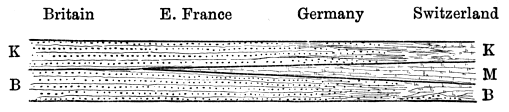
Fig. 22.
It will be seen that the mechanical sediments gradually die out and become replaced by calcareous material as one passes from Britain towards Switzerland; the Muschelkalk is very thin in the east of France and thickens out in Germany, while in Switzerland Keuper, Muschelkalk and Bunter are alike largely represented by calcareous deposits, and the mechanical deposits are chiefly argillaceous, the only important sandstone being situated at the extreme base of the Bunter series.
The marine development of the Triassic system is naturally the one which is most widely spread, though full appreciation of its importance has only taken place as the result of researches in distant climes of recent years. It is found in southern Europe, in Spitsbergen, in considerable tracts of Asia, including India, and along the Pacific coast region of North America, and everywhere possesses much the same characters.
It will be seen from the above remarks that the physical conditions which prevailed in the continental area of Triassic times which is now partly occupied by the British Isles are most closely represented by those of the desert regions of central Asia, hemmed in by the mountain ranges which intercept the vapour-laden winds of the oceans, and cause them to precipitate the great bulk of their vapour on the seaward slopes of the mountains, so that they blow over the deserts as dry winds, causing the fall of any large amount of rain to be a rare though by no means unknown event in the desert regions.
Flora and Fauna of the Period. The Triassic flora is essentially similar to that of the higher Permian strata, though many of the genera are different.
The invertebrate fauna of the British deposits is, as might be expected, very poor until the beds of the Rhætic series are reached. In the beds below the Rhætics, the principal invertebrate remains are the tests of the crustacean genus Estheria, though a few obscure lamellibranch shells have been recorded. The vertebrate fauna is of great interest. A number of fishes have been found, the most remarkable of which is the genus Ceratodus, occurring in the Rhætic beds of Britain and lower Triassic strata of foreign countries. It is closely related to the Barramunda of the Queensland rivers belonging to the order Dipnoi. As in the Permian strata, abundance of Labyrinthodont amphibians have been discovered, and the reptiles belong to the orders Anomodontia and Rhynchocephalia. In the Rhætic beds of Britain and in still lower Triassic beds abroad the orders Ichthyopterygia and Sauropterygia (represented by Ichthyosaurus and Plesiosaurus) are found.
The Triassic rocks also yield the earliest known mammals, the best known, Microlestes, occurring in the Triassic rocks of Britain and the Continent. These mammals are now placed in a subclass Metatheria of the order Monotremata.
The marine invertebrate fauna of the normal Triassic rocks presents some points of considerable interest. As already remarked, the fauna may be looked upon as a passage fauna between that of Palæozoic and that of Mesozoic times, the number of Palæozoic forms which pass into the Trias being approximately comparable with those which appear here and range upwards into higher Mesozoic strata. This may be well seen by examining the table given in >Chapter XXI. of the Second Edition of Sir Charles Lyell's Student's Elements of Geology, in which three columns shew the genera of Mollusca common to older rocks, those characteristic of the Trias, and those common to newer rocks. Amongst the first are Orthoceras, Bactrites, Loxonema, Murchisonia, and Euomphalus, in the second column are Ceratites, Halobia (Daonella), Koninckina, and Myophoria, and in the third, Ammonites, Cerithium, Opis, Plicatula and Thecidium[98].
The Ammonites are largely utilised in the case of the Mesozoic strata for separation of these strata into zones, each zone being characterised by some species of Ammonite, and the researches of Mojsisovics have proved that this zonal subdivision, long adopted for Jurassic rocks, is also applicable to those of Triassic age[99]. He gives the following table of the classification of the Triassic rocks of the Mediterranean Province, which is reproduced, as it is founded upon Palæontological evidence, and will probably be widely adopted.
Series Zonal Divisions
Rhætic 1. Zone of Avicula Contorta
Juvavic Upper Juvavic Middle Juvavic Lower Juvavic 2. Zone of Sirenites Argonautae 3. Zone of Pinnacoceras Metternichi 4. Zone of Cyrtopleurites bicrenatus 5. Zone of Cladiscites ruber 6. Zone of Sagenites Giebeli
Carnic Upper Carnic Middle Carnic Lower Carnic 7. Zone of Tropites subbullatus 8. Zone of Trachyceras Aonoides 9. Zone of Trachyceras Aon
Noric Upper Noric Lower Noric 10. Zone of Protrachyceras Archelaus 11. Zone of Protrachyceras Curionii
Muschelkalk Upper Muschelkalk Lower Muschelkalk 12. Zone of Ceratiles trinodosus 13. Zone of Ceratiles binodosus
Buntsandstein Werfener Schichten 14. Zone of Tirolites Cassianus
CHAPTER XXII.
THE JURASSIC SYSTEM.
The Jurassic rocks were formerly separated on account of differences of lithological character into Oolites and Lias, but it was apparent that the Oolites were more important than the Lias, and a fourfold division was made into:—
Upper or Portland Oolites Middle or Oxford Oolites = Malm
Lower or Bath Oolites Lias. = Dogger
The Lias strata have also been spoken of as the Black Jura, the Lower Oolites and part of the Oxford Oolites as Brown Jura, and the rest of the Oxford Oolites with the Portland Oolites as White Jura.
As the outcome of a detailed study of the faunas of the Jurassic rocks, a further subdivision has been made, partly based upon the original British series, but the divisions are defined with greater accuracy, so that they are applicable over wider areas. They are as follows:—
Upper Oolites Purbeckian Portlandian Kimmeridgian
Middle Oolites Corallian Oxfordian Callovian
Lower Oolites Bathonian Bajocian
Lias Toarcian Liassian Sinemurian.
Many of these series have been still farther subdivided into smaller stages, and the whole differentiated into a number of zones characterised by different forms of Ammonites. Dr E. von Mojsisovics gives thirty-two Ammonite zones, of which fourteen occur in the Lias, eight in the Lower Oolites, six in the Middle Oolites, and four in the Upper Oolites.
Characters of the strata. The whole of the Jurassic rocks and also those of Lower Cretaceous age may be regarded as having been deposited during the first shallow water phase of the third marine period, but this shallow water phase is represented by strata which are varied owing to numerous marine changes resulting in the production of land at times, and estuarine conditions, shallow water, marine conditions, and somewhat deeper sea conditions respectively at other times, and accordingly the strata of the British Isles vary greatly when traced laterally. That the uplifts of the Permo-Triassic periods produced some effect on the nature and distribution of the Jurassic rocks is certain, but it is not quite clear how far the ridges produced by these uplifts were submerged and denuded during the deposition of the main portion of the Jurassic strata.
Viewed broadly, the Jurassic rocks of Britain may be regarded as consisting of three great clay deposits, the Lias, Oxford and Kimmeridge Clays, alternating with the deposits of variable lithological characters, which compose the Bajocian, Bathonian, Corallian, Portlandian and Purbeckian subdivisions. This essentially argillaceous character of a large part of the deposits of Jurassic age is often overlooked, as, owing to their sameness and the comparative paucity of organisms constituting the faunas in the clays, their description in text-books can be given at much shorter length than that of the more variable and highly fossiliferous deposits which separate the clays. The following figure (Fig. 23) roughly represents the nature of the different divisions of the rocks of this system when traced across England from south-west to north-east.
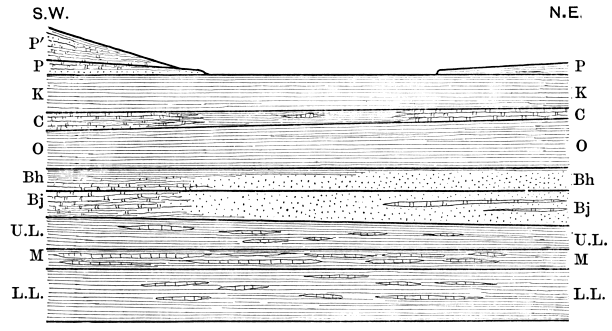
Fig. 23. Vertical scale: 1 in. = about 1000 feet.
It will be seen that the greatest variations in lithological character occur in the Bathonian and Bajocian beds, and it will be of interest to give some account of the principal variations and to attempt to account for them. In so doing it will be convenient to consider the four major divisions of the Jurassic rocks separately, and to enter into particulars concerning the local classification applied to the rocks of these divisions.
The Lias. The British Lias deposits are divided into the Lower Lias, the Marlstone, and the Upper Lias corresponding in general terms only with the Sinemurian, Liassian, and Toarcian. The Marlstone is separated from the Upper and Lower Lias on account of the greater percentage of carbonate of lime which it contains, so that the bands of argillaceous limestone are much more marked in the Marlstone than in the upper and lower divisions, which consist chiefly of clay. The three divisions possess very much the same characters throughout the country, though the presence of the Mendip ridge and its continuation beneath London is marked by the attenuation of this and succeeding strata, and by the conglomeratic character of some of the Liassic strata where they abut against it. The British Lias, as a whole, seems to have been deposited in a fairly shallow sea at no great distance from the land. It passes down conformably into the Rhætic beds, indeed the zone of Ammonites (Aegoceras) planorbis, referred by British geologists to the Lower Lias is included by some continental writers with the Rhætic beds, and the plane of demarcation here as in other cases is conventional.
The Lower Oolites. Of all the British strata, these perhaps cause most trouble to the learner, on account of the different nomenclature applied to the rocks in different parts of England, and the rapid variations in lithological character, when the beds are traced laterally. The following divisions are usually adopted for the beds of the south-western counties where the most marked marine development occurs:—
Cornbrash, Forest Marble, Great Oolite (with Bradford Clay), Fuller's Earth, Inferior Oolite.
Of these divisions, the uppermost one, the Cornbrash, though thin, retains its characters with great constancy across the island. Of the others the Forest Marble may be looked upon as a local development of the upper portion of the Great Oolite, and the Fuller's Earth is a local deposit, so that the Inferior Oolite and Great Oolite constitute the important divisions of the Lower Oolites. The variations in the characters of the rocks may be best shown in tabular form.
Gloucestershire, &c. South Northamptonshire N. Northamptonshire and Lincoln Yorkshire
Cornbrash Cornbrash Cornbrash Cornbrash
Great Oolite Great Oolite (Upper part) Northamptonshire Great Oolite Clay Great Oolite Limestone Upper Estuarine Upper Estuarine
............... ............... ............... ...............
Series Series
Lincolnshire Limestone Scarbro' Limestone
Sands Middle Estuarine Series
Inferior Oolite Lower Estuarine Series Millepore Oolite
Lower Estuarine Series
Upper Lias Upper Lias Upper Lias Upper Lias
The dotted line shows roughly the division between Bathonian and Bajocian.
The changes may be explained very simply if we leave out of account for the moment the development of Lincolnshire Limestone, with its equivalent the Scarbro' Limestone, and the Millepore series. The beds in Gloucestershire and other south-western counties are essentially marine; whilst in Northamptonshire and Lincolnshire estuarine conditions set in after the deposition of the Upper Lias, and continued throughout the deposition of the Bajocian and Lower Bathonian beds, being replaced by marine conditions during the formation of the Upper Bathonian strata, and still further north in Yorkshire the estuarine conditions generally prevailed throughout Bajocian and Bathonian times. These changes point to the existence of land towards the north. The general simplicity is modified by temporary prevalence of marine conditions twice over (during the deposition of the Millepore Oolite and the Scarbro' Limestone) in Yorkshire, and once (during the deposition of the Lincolnshire Limestone) in Lincolnshire.
Certain local deposits have not been noticed, but two of them merit brief reference. At the base of the Great Oolite of Oxfordshire is an estuarine deposit of finely laminated mechanical sediment mixed with calcareous matter known as the Stonesfield Slate, especially interesting on account of its fossils, while a bed with similar lithological characters but with a different fauna occurring at the base of the Lincolnshire Limestone (of Bajocian age) is termed the Collyweston Slate. Neither of these deposits is a slate in the true sense of the word, as they have not been affected by cleavage subsequently to their accumulation, but each has been somewhat extensively used for roofing purposes.
The Middle Oolites are much less complicated though considerable variations arise with respect to the Corallian Rocks. The Oxfordian with Callovian consist chiefly of clay, though the Callovian of the south of England is represented by calcareous sandstone, with a peculiar fauna which seems to be represented in the lower part of the Oxford Clay further north, though this Callovian fauna has not been everywhere recognised.
The Corallian of the southern counties consists of limestones with calcareous grits, the limestones being often largely composed of the remains of reef-building corals, and a similar development of the rocks of this series is found in Yorkshire, while a local development of the same character is found at Upware in Cambridgeshire, though in the other parts of the Fenland counties the Corallian is represented by an argillaceous deposit with Corallian fossils known as the Ampthill Clay.
The Upper Oolites have a tolerably constant base, the Kimmeridge Clay, usually consisting of laminated bituminous argillaceous material, but the Portlandian and Purbeckian divisions vary greatly, and are only locally developed, though their absence in some parts of central England is no doubt due to unconformity.
The Portlandian rocks of the south of England consist of limestones and sandstones which pass further northward into shallower water mechanical deposits often charged with iron hydrate, and the beds disappear in Oxfordshire. The Purbeckian rocks of the south are also limited as regards area of exposure: they consist of estuarine deposits with some terrestrial accumulations of the nature of old surface soils. Representations of the Portlandian and Purbeckian beds are found in Lincolnshire and Yorkshire, as arenaceous deposits in the former county and argillaceous ones in the latter. Both are marine deposits of a northern type, developed elsewhere in northern European and circumpolar regions, and in these counties we find a complete passage from the Jurassic rocks through the Cretaceous rocks, but the exact lines of demarcation between the different series of the passage beds are difficult to define.
The foreign Jurassic rocks of Europe and of some parts of Asia strongly resemble in general characters those which have been described above as occurring in Britain. One of the most remarkable features of the Jurassic rocks as a whole, is the absence of the Lias over wide areas, the continental period which in Britain existed in Permo-Triassic times is elsewhere frequently replaced by one of Liassic age.
The Jurassic and Cretaceous rocks are of interest on account of the evidence which they supply as to the existence of climatic zones in these periods, which run fairly parallel with those at present existing. The late Dr Neumayr in a paper already cited divides the world during later Mesozoic times into four distinct climatic zones, equatorial, north and south temperate and boreal zones (the corresponding austral zone is not known owing no doubt to the extensive sea of South Polar regions and our general ignorance of its lands). In Europe the Mediterranean Province belongs to the equatorial zone, the Middle European to the North temperate zone, and the Russian or Boreal to the Boreal zone. The last-named is marked partly by negative characters, the absence of certain Ammonite-genera and of coral reefs being noticeable, whilst the lamellibranch Aucella is very frequent. In the North temperate zone, certain Ammonite genera as Aspidoceras and Oppelia are abundant and there are also extensive coral-reefs. The Equatorial zone is marked by the Ammonite-genera Phylloceras and Lytoceras and by the Diphya group of Terebratulæ. It is of special interest to note that the fauna of the South temperate bears closer relationship to that of the North temperate than to that of the intermediate Equatorial zone.
Jurassic floras and faunas. The Jurassic flora is very similar in its characters to that of the Lower Cretaceous rocks, and the two taken together afford a decided contrast with that of later Palæozoic times, and also with that which succeeds them in the Upper Cretaceous rocks, which bears a marked resemblance to the existing flora. Cycads predominate, accompanied by conifers, and a fair number of ferns and Equisetaceæ.
The Jurassic fauna is specially noteworthy on account of the character of the vertebrata, but some notice of the invertebrates must also be taken. The abundance of corals in the Temperate zones has already been pointed out, but the mollusca form the bulk of the invertebrate fauna, lamellibranchs, gastropods and cephalopods being all abundant; of the last-named the ammonites and belemnites contribute most largely. The vertebrates include remains of fishes, amphibia, reptiles, birds and mammals. The Jurassic reptilia furnish representatives of some modern orders as the Chelonia and Crocodilia, but the most important orders are essentially characteristic of later Mesozoic times and their representatives abound in the Jurassic strata. These are the Sauropterygia (including the Plesiosaurs), the Ichthyopterygia (including the Ichthyosaurs), the Dinosauria, and the Pterosauria commonly known as Pterodactyls. No birds have hitherto been discovered in the British Jurassic rocks, but the Solenhofen Slate of Bavaria (of Kimmeridgian age) has furnished the celebrated Archæopteryx macrura, which is not only placed in a family but also in an order by itself, the order Saururæ. Many remains of mammals have been extracted from the estuarine deposits of Stonesfield, and the old surface soils of the Purbeckian beds; representatives of the Monotremata are furnished by the Plagiaulacidæ and Tritylodontidæ, the former family containing the genus Plagiaulax of the Purbeck Beds and the latter, Stereognathus of the Stonesfield slate. The Marsupialia are represented by the Amphitheridæ, Spalacotheridæ and Triconodontidæ. Some forms have been referred to the Insectivora, but there is still disagreement concerning the correctness of this reference.
Before dismissing the subject of the Jurassic fossils, attention may be called to a feature which has been frequently commented upon, namely, the general resemblance of the flora and fauna of Jurassic times to the modern Australian fauna and flora. The explanation which has been offered to account for this resemblance has been given in a preceding chapter, where it was stated that Mr A. R. Wallace considers, after review of the geological and biological evidence, that Australia was severed from the adjoining continental lands in Mesozoic times, and that the higher forms of life which on the larger continents have replaced the earlier and lower forms have not succeeded in obtaining a footing in Australia, which therefore furnishes us with a local survival of a once widespread fauna. In connection with this matter the actual existence of the genus Trigonia (a form peculiarly abundant in Jurassic strata and characteristic of Mesozoic strata in Britain) in the Australian sea is of considerable interest. [100]
CHAPTER XXIII.
THE CRETACEOUS SYSTEM.
Classification. The rocks of the Cretaceous system are conveniently divided into Upper and Lower Cretaceous. The following classification has been widely used for the British deposits, and is founded on lithological characters:
Upper Cretaceous Upper Chalk with flints Chalk
Middle Chalk with few flints
Lower Chalk without flints
Chalk Marl
Upper Greensand
Gault
Lower Cretaceous Lower Greensand Wealden Hastings sands
As the result of examination of the faunas, a more generally applicable classification has been established and is now largely adopted. It is as follows:
Danian Senonian Turonian Cenomanian Upper Cretaceous
Albian Aptian Neocomian Lower Cretaceous
In this classification the Neocomian practically represents the Wealden and Hastings beds, the Aptian the Lower Greensand and the Albian the Gault, placed according to this classification in the Lower Cretaceous, while the Upper divisions represent the strata above the Gault, consisting essentially of Chalk in England.
Description of the Strata.
(i) The Neocomian and Aptian Beds. In the south of England the Lower Cretaceous beds succeed the Jurassic rocks with little or no break, and the type of the lower beds is similar to that of the beds deposited during the Purbeck age, consisting of estuarine deposits of variable characters, chiefly arenaceous below (the Hastings sands) and argillaceous above (the Wealden series), though impure limestones are found, largely composed of the shells of the freshwater Paludina, and much ironstone is developed in places. At the close of Neocomian times, the freshwater conditions in southern England were replaced by marine conditions and the Lower Greensand strata with their marine fauna were deposited in the Aptian sea. The Neocomian and Aptian beds thin out westward, and much more rapidly to the northward, so that both divisions disappear against the now buried ridge which forms a continuation of the Mendip axis. North of this they appear in another form. At first the highest Aptian beds alone are developed as shore deposits. Passing into Norfolk lower beds come in until in Lincolnshire we get a complete development of the Neocomian and Aptian beds with a marine facies, though of fairly shallow water character, whilst in Yorkshire the two divisions are represented by a deeper water clay, forming the Upper portion of the Speeton series. There is a consensus of opinion in favour of the Neocomian beds of southern Britain having been laid down in an estuary of a river flowing from the west over a continent now destroyed. To the north of this river stood the London ridge of the Palæozoic rocks, the northern borders of which formed the coast line off which were deposited the sediments of Neocomian and Aptian ages which occur in northern England. Before the deposition of the Albian beds a considerable upheaval of some parts of Britain occurred, and an unconformity separates the higher Cretaceous beds from older strata of Cretaceous and Jurassic ages, thus complicating the major phases by local changes in the characters of the strata.
(ii) The Albian and higher Cretaceous Beds. The commencement of the deep-water phase of the third marine period may be said to occur in Albian times in Britain, reaching its maximum during the deposition of the chalk. The existence of a deeper sea towards the north of England is indicated by the characters of the Albian and newer strata. The Albian beds of gault consist of a stiff clay in southern England, replaced by coarser mechanical sediments towards the west. As one passes north from the London ridge (which exerted its influence in Albian times, after which it was finally buried in sediment) the gault thins out, and becomes gradually replaced by calcareous deposit when it is known as the red chalk which replaces the gault in northern Norfolk, Lincolnshire and Yorkshire.
A local unconformity separating the chalk and gault in parts of East Anglia points to another local uplift with its accompanying complications in the characters of the strata. After the uplift had ceased, general depression must have occurred, and the various divisions of the chalk were accumulated in a fairly open sea, though, for reasons to be given presently, this was probably of no great lateral extent, save when united with the open ocean, probably in a manner similar to the connexion between the Gulf of Mexico and the Atlantic.
The general variations in the lithological characters of the various members of the Cretaceous system will probably be rendered clearer by reference to the accompanying diagram (Fig. 24) representing the variations when traced across England from south to north[101].
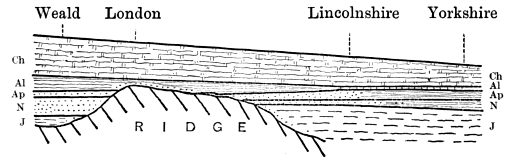
Fig. 24.
Ch. Chalk.
Al. Albian.
Ap. Aptian.
N. Neocomian.
J. Jurassic.
The clue to the physical geography of Britain during Cretaceous times is furnished to a considerable extent by study of the foreign deposits. In Northern Europe the Cretaceous beds of England are met with in Northern France, and there the characters are generally speaking similar to those of our British deposits. In Germany shallower water conditions prevailed, the lower beds gradually disappear, and the upper beds are replaced by mechanical sediments of various degrees of coarseness, becoming on the whole coarser, as one travels eastward, so that in Saxony the chalk is partly replaced by arenaceous deposits (the 'Quader' sandstones) which are responsible for the remarkable scenery of the Elbe district above Dresden. In passing northwards, indications of similar change are noted in the deposits of Denmark and Scania, whilst to the south, we get a complete change in the character of the rocks, after crossing the Loire in France, and a similar change is observable in districts lying further east. Furthermore, as will be noted more fully in a subsequent paragraph, the character of the Upper Cretaceous flora indicates the existence of a large tract of land lying to the north and north-west of Europe, so that it would appear that the Cretaceous rocks of Northern Europe were deposited in a gulf-like expansion of a western ocean, bounded on the north by Scandinavia, on the west by eastern Germany, and on the south by a ridge running eastward from the mouth of the Loire[102]. We may speak of this gulf as the Chalk gulf. To the south of the presumed ridge the character of the strata alters, and also that of the included organisms. This southern type of Cretaceous rocks is one which is very widely spread, being found in Europe south of the Loire, and of the Alps, and in Greece and Turkey, while it also occurs in the northern parts of Africa. The beds of this type are traceable through Asia Minor into India and to the shores of the Indian Ocean, indicating the existence of a widespread Cretaceous ocean, which is sometimes spoken of as the Hippurite-limestone sea, for reasons which will eventually appear. The deposits are largely formed of hard limestone which is very different in its character from the soft chalk of the northern gulf.
The climatic conditions which prevailed during Cretaceous times were apparently similar in most respects to those of the preceding Jurassic period, and as already stated the climatic zones which Neumayr defined for Jurassic times are also maintained by him to have existed during the Cretaceous period. The existence of cold has sometimes been inferred from the presence of large foreign blocks in the chalk, especially at its base, but if these are due to the transport, they might well be caused by masses of floating ice, which are often found at considerable distances from the coast in temperate regions after the break-up of the frost which succeeds an unusually hard winter. The flora and fauna are not suggestive of severe conditions.
The Cretaceous flora and fauna. It has been noted in the last chapter that the gymnospermous flora of the Jurassic period, in which cycads form a considerable percentage of the whole flora, was prevalent in Lower Cretaceous times. In the Upper Cretaceous rocks this flora is replaced by one which consists to a large extent of dicotyledonous angiosperms. These are found in the Upper Cretaceous rocks of Europe and North America, and as the researches of botanists indicate their origin in circumpolar regions, their arrival in Europe is an additional argument in favour of the existence of an extensive northern continent, sending a prolongation to the southward in eastern Europe.
The invertebrate fauna bears considerable resemblance to that of Jurassic times, and many of the dominant Jurassic genera are also found in Cretaceous rocks. A most interesting feature is connected with the character and geographical distribution of the Ammonites. In Europe they are almost exclusively confined to the deposits of the northern gulf, and before their final disappearance they undergo many changes of form. We find the discoid spiral shells of earlier times, but these are accompanied by shells which are straight, curved, boat-shaped, and coiled into various helicoid spirals, sometimes having the whorls in contact, while at other times they are separate.
In the chalk of Britain gastropods are on the whole rare, and this fact serves to emphasize the palæontological break which occurs between the Cretaceous and Tertiary rocks; but when conditions were favourable, as during the deposition of some of the strata of the Middle Chalk, gastropods are abundant, and some are related to Tertiary genera, so that we may assume that the palæontological break alluded to is exaggerated by the difference of conditions which prevailed during the deposition of the earliest Tertiary and latest Cretaceous sediments.
In the Cretaceous deposits of the southern sea, where the Ammonite tribe is almost unknown, the remarkable family of the lamellibranchs known as the Hippuritidæ furnish the dominant invertebrates of the period, and the representatives of this family are exceedingly scarce amongst the Cretaceous strata of the northern gulf, though they are found on two or three horizons.
Of vertebrates, the most interesting are the reptiles. The families which predominate in Jurassic times have many representatives amongst the Cretaceous strata also, but the order Squamata is represented by the sub-order Pythonomorpha, which is characteristic of the Cretaceous rocks. The best known representative is the gigantic Mosasaurus. Lastly, we have the remarkable toothed birds or Odontornithes, now placed in different orders, the genus Hesperornis being the only representative of the sub-order Odontolcæ of the Ratitæ, whilst Ichthyornis and allied forms are placed in the sub-order Odontormæ of the Carinatæ.
CHAPTER XXIV.
THE EOCENE ROCKS.
Classification. The Eocene Beds of the south of England have been subdivided according to the variations in their lithological characters, and the subdivisions have received local names. The following classification is generally adopted, though the different subdivisions are by no means of equal value:
Upper Eocene Upper Bagshot Beds Barton Beds
Middle Eocene Bracklesham Beds
Lower Eocene Lower Bagshot Beds
London Clay[103]
Oldhaven Beds Lower London Tertiary Strata
Woolwich and Reading Beds
Thanet Sands
The deposits vary greatly when traced abroad, and the exact equivalents of the minor subdivisions of the British rocks can seldom be ascertained at any distance from England, though the division into Upper, Middle, and Lower Eocene can be made over wide areas.
Description of the strata. The character of the strata of Europe and Asia indicates the persistence of the northern gulf and southern ocean of Cretaceous times in Eocene times also, though the area of each had shrunk in the meantime, owing to the physiographical changes which occurred at the end of Cretaceous times, giving rise to more extended land areas, and producing a shallow water phase over wide extents of ocean,—the final shallow water phase of the third and last great marine period of the British area. It is difficult to ascertain the exact importance of the physical break between Cretaceous and Eocene rocks in the south-east of England, owing to the subterranean solution of the upper part of the chalk, subsequently to the deposition of the Eocene strata, but the contraction of the Cretaceous gulf is shown in several ways, one of the most significant being the distribution of Cretaceous and Eocene rocks in the south-west of England. The existence of an outlier of Cretaceous rock at Buckland Brewer in North Devon, only three miles from the Atlantic Ocean, indicates the former extension westward of the Upper Cretaceous beds, while the occurrence of an outlier of Eocene rocks at Bovey Tracey in South Devon, resting not on Cretaceous but on Palæozoic rocks, shows that there was an uplift after the deposition of the Cretaceous rocks and before the Eocene rocks were deposited there, and that during the period of uplift the Cretaceous rocks were removed.
Owing to these physical changes, the Eocene rocks of Britain are mainly mechanical sediments, some, as the Oldhaven beds, being composed of coarse pebbles over a fairly wide district, while some of the earlier Eocene rocks are estuarine or fluvio-marine.
The Eocene rocks of Britain occur in four areas, namely, the London Basin, the Hampshire Basin, the Bovey Tracey outlier, and the north-east of Ireland and western Isles of Scotland. The deposits of the three southern areas may be considered together, and give general indications of an approach to land when passing westward. The Lower London Tertiary strata are fluvio-marine at the east end of the London Basin; they become shallower water deposits when traced westward, and begin to disappear. The London Clay is an estuarine deposit, which is generally supposed to have been laid down at the mouth of a large river flowing from the west. It is absent in the Bovey Tracey outlier.
Local disturbances caused the existence of a shallow water region in the east during the deposition of the Middle and Upper Eocene deposits, and accordingly the well-marked marine deposits which form the representatives of these divisions in Hampshire are replaced by the Bagshot beds of the London Basin, consisting chiefly of coarse mechanical sediments with a poor marine fauna, but even in the west shallow water prevailed at times during the accumulation of various plant-bearing strata. The Middle Eocene beds only are found in the Bovey Tracey outlier, though the Upper Eocene beds may originally have been laid down in that area, and subsequently denuded.
The fourth area displays a very different succession of Eocene strata, and one of extreme interest. Mechanical sediments and plant-bearing clays and lignites alternate with a vast accumulation of basaltic lavas, indicating the outbreak of the volcanic forces in the British area, after a period of quiescence which lasted through the greater part of Mesozoic times. The region in which these lavas were poured out was probably a land area during the greater part of the period of volcanic activity, but the horizontal lie of the lava flows and their wide extent indicate the existence of a flat tract of country, gradually raised into a plateau by the accumulation of sheet over sheet of basalt. How far this plateau extended it is impossible to say. The distribution of the lavas at the present day is somewhat limited in our isles, but there is no sign of dying out at the present margins of the accumulations, and they have probably escaped denudation in these regions, as maintained by Professor Judd, on account of the faults which have depressed them, while the portions which were not depressed have been removed by denudation. Two views as to the origin of the lavas have been put forward: according to Prof. Judd, they were poured forth from gigantic volcanoes, while Sir A. Geikie maintains that they represent portions of massive or fissure eruptions, the molten rock having welled out from great cracks in the earth, which are now filled by once molten rock in the form of dykes. As these dykes extend far away from the present volcanic plateau, one actually extending to the Yorkshire coast, we may well believe, whatever was the origin of the sheets of lava, that they were formerly spread far away from their present terminations[104]. Without entering here into a discussion of the exact nature of extrusion of these igneous sheets, it will suffice to say that all the evidence points to the formation of extensive plateaux, which must have presented a fairly uniform surface, similar to that which is still found characterising the volcanic districts of the western territories of North America.
The Eocene rocks of the north-west of Europe possess characters very similar to those of the south of England, and there are indications that the northern gulf had diminished in extent towards the east as well as towards the west.
Passing to southern Europe, Central Asia and northern Africa, we find the conditions of Cretaceous times reproduced, and an extensive series of marine deposits extends very widely over these regions, the most persistent deposit being a mass of limestone of Middle Eocene age, which is almost entirely composed of the tests of Nummulites, whence the development is known as the Nummulitic Limestone facies, and we may speak of the ocean as the Nummulitic Limestone Sea. The incoming of shallow water conditions marked by accumulation of coarse mechanical sediments towards the end of the Eocene period in some parts of the southern European area indicates the setting in, even then, of those continental conditions which culminated during the Miocene period.
In North America we get similar evidence of the contractions of the oceans which in Mesozoic times occupied large expanses of our present continents.
The climatic conditions of Eocene times have been noticed in passing in chapter IX., and evidence was given to prove the prevalence of a warmer climate over the British area than that which now exists. A study of the floras of various parts of the northern hemisphere suggests that climatic zones, whose lines of demarcation ran practically parallel with the Equator, existed in Eocene times also, though further information upon this subject is desirable.
The Eocene flora and fauna. The flora of prevalent dicotyledonous angiosperms, which appeared in Upper Cretaceous times, also marks the Eocene and later deposits, but a study of the floras indicates that the differentiation which now marks off the floras of different areas from one another had not occurred to so great an extent as at the present time. The existence of a rich flora in the Eocene beds of circumpolar regions in the northern hemisphere should be noted, though perhaps its importance has been somewhat exaggerated.
The invertebrate fauna shows an approximation to that of the present day. The remarkable ammonite fauna of Mesozoic times has disappeared, and gastropods and lamellibranchs predominate, many of the forms belonging to existing genera, though very rarely to existing species. The Nummulites are the most characteristic Eocene fossils, and the period may be spoken of as the Nummulitic Period, though it is now known that Nummulites are not confined to the Eocene strata.
The vertebrate fauna is very noteworthy. The fishes and reptiles are closely related to existing forms, and the orders of reptiles which predominated in Mesozoic times have completely disappeared. But the mammals are the most interesting vertebrates of the Eocene period. Instead of the lowly organised forms of Mesozoic times, we find representatives of many orders, including the highest, the Primates. The generalised forms which serve as links between groups which are now separated to a considerable extent are of particular importance. They have been detected in Eocene rocks of various regions, though the most complete series have been obtained from the Eocene rocks of North America and made known to us through the numerous memoirs of Professors Cope and Marsh[105].
CHAPTER XXV.
THE OLIGOCENE AND MIOCENE PERIODS.
(i) The Oligocene Beds.
Classification. The Oligocene Beds of Britain are classified as follows:—
Upper Wanting
Middle Hempstead Beds
Lower Bembridge Beds Osborne Beds Headon Beds
Description of the strata. Little need be said of the deposits of this period, either in Britain or abroad, except to remark that they show the further spread of continental conditions over the regions now occupied by land. The British deposits are now seen in the Hampshire Basin only, and have been spoken of as the fluvio-marine series, as many of the strata were laid down in continental sheets of water, while the true marine sediments are thin and infrequent.
The lithological characters of deposits formed under these conditions naturally vary greatly, consisting of different kinds of mechanical sediments occasionally mixed with thin freshwater marls and limestones. On the Continent similar conditions prevailed, though the occurrence of fairly wide tracts of level surface is indicated by the widespread distribution of beds of brown coal or lignite, and the coarse and thick Oligocene 'nagelfluh' of Switzerland points to the elevation of mountain ranges in the neighbourhood.
The flora and fauna. The remarks made concerning the Eocene flora and fauna are generally applicable to those of Oligocene times, except that the Oligocene fossils bear a still closer resemblance to living forms, and the Nummulites are no longer dominant.
(ii) The Miocene Period. Beds of Miocene age are wanting in Britain, and on the Continent they occur in isolated basins deposited in gulf-like prolongations of the ocean, never very far from land. A description of the strata and their fossil contents would be of little use for our present purposes, and the remarks made concerning the Oligocene beds will apply to the Miocene strata also.
The period was mainly remarkable on account of the important physical changes which occurred, to which we must devote some consideration. Commencing with the British area, we find in the south evidence of the separation of the London and Hampshire Basins at this time, for the Oligocene beds of Hampshire are tilted up on the south side of an anticline, which separates the Hampshire Basin from that of London, indicating that the movement was post-Miocene, while in Kent, beds of Pliocene age rest on the denuded top of the chalk, showing that the elevation and denudation which accompanied it were pre-Pliocene; the great Wealden anticline is thus seen to be of Miocene age. On the north side of the London Basin the line of demarcation between Eocene and Mesozoic beds runs approximately parallel to the strike of the latter in that part of Britain, and this points to the elevation of the Mesozoic strata which gave them their present south-easterly dip about the same period, though in the absence of Oligocene rocks it cannot be definitely stated that the movement was altogether post-Oligocene. The present physical geography of considerable parts of Britain must date from Miocene times.
Important as the changes were in Britain, they were slight as compared with those which affected Europe and many parts of Asia. The great mountain chains of the Old World received their maximum uplift during this great period of earth-movement, and orogenic structures were impressed upon the rocks of many regions, for the Tertiary Mountain Chains of the Old World have an Alpine structure impressed upon them as the result of intense lateral pressure, accordingly we find the Eocene strata lifted far above their original level to heights of 8,000 feet in the Alps and over 12,000 feet in the Himalayas. Away from these marked uplifts epeirogenic movements caused the disappearance of the seas of earlier Eocene times, so that towards the close of the Miocene Period, the main features of the Eurasian continent were much as they are now. The present drainage-systems must have originated at the same time, and the sculpture of our continent has been carried on more or less continuously by subaerial agents from Miocene times to the present day. That any addition to the total area of land was made is doubtful. The land which appears to have existed to the west of Britain during Cretaceous and Eocene times finally disappeared beneath the waters of the Atlantic Ocean, and the movement probably gave rise to the prominent submarine feature which now exists at some distance from the coast of Ireland. A great marine period is now existent in our ocean areas, but so far as the existing continents are concerned, we are living on the fourth continental period which practically came into existence in Miocene times.
The strike of the uplifted strata naturally coincides on the whole with the axes of the major uplifts, and accordingly we find the Mesozoic and early Tertiary strata folded around axes which have a prevalent east and west direction, with others which have a trend at right angles to this. The strike of the British Mesozoic rocks seems to have been determined by each of these sets of movements, so that although it is east and west in the south of England, it runs north and south in the eastern counties north of the Thames.
In America, although epeirogenic movements had occurred before Miocene times, with the formation of wide continental tracts, these appear to have been of the nature of plains, diversified by extensive inland sheets of water, and uplift of orogenic character converted these plains into uneven tracts in Miocene times. Many of the movements in America, which like those of Europe are still progressing with enfeebled power, differ from those of Eurasia, giving rise to raised monoclinal blocks rather than to violent folds of Alpine character, as seen in the western territories of North America, and as proved also by the differential movements which are now known to affect the Atlantic coast of that continent.
Accompanying these changes in the earth's crust were others which affected the climate, at any rate locally. The warm climate of Eocene times gradually gave way to a cooler climate in Oligocene times, and this lowering of temperature was still further advanced in Miocene times, though there is evidence that the temperature of those parts of Europe which have strata representative of the Miocene period was higher than it is at the present day.
Owing to the changes which occurred in Miocene times, the area of sedimentation was extensively shifted to our present oceans, and accordingly we find that the times subsequent to those of the Miocene uplifts are marked by scattered accumulations of continental character, with a few insignificant marine strata seldom found far inland from the present coast-lines.
CHAPTER XXVI.
THE PLIOCENE BEDS.
Classification. The Italian Pliocene Beds which have long been known have been divided into three stages, to which names have been applied which are somewhat widely used, though the division of the British deposits into the same three stages has not been made. The stages are:—
Astian. Plaisancean. Zanclean.
The classification of the British deposits may be made as follows:—
Cromer "Forest" Series. Weybourne Crag and Bure Valley Beds. Chillesford Crag. Norwich Crag and Red Crag. Upper Coralline Crag. Lower Coralline Crag.
As the English deposits are somewhat scattered it is difficult to make out the exact order of succession, but the above shows the classification which is adopted by the best authorities, the Norwich Crag (or Fluvio-marine Crag as it is sometimes termed) being now supposed to represent the upper portion of the Red Crag.
Description of the strata. The British deposits are chiefly found in the counties of Norfolk and Suffolk, but isolated patches have been detected in Kent and at St Erth in Cornwall; while the inclusion of Pliocene fossils in the glacial deposits of Aberdeenshire and on the west coasts and islands of Great Britain suggests the occurrence of Pliocene beds beneath sea-level, around the British coasts, at no great distance from the land.
The term 'Crag' has been applied to shelly sands of which the British Pliocene beds are largely composed. The oldest British Pliocene strata are supposed to be the Lenham Beds, occurring in 'pipes' on the Chalk of the North Downs, which are referred to the Lower Coralline Crag, and some writers believe that the St Erth beds of Cornwall are of similar age[106]. The former are ferruginous sands, and the latter shelly sands and clays. The higher beds of the Coralline Crag are found in Suffolk, and are largely calcareous, being made of remains of polyzoa, molluscs, and other invertebrates. They were probably deposited in deeper water than the rest of the British Pliocene strata, and contain a far larger percentage of carbonate of lime. The Red Crag consists of ferruginous shelly sands, of the nature of sand-banks, formed near land; while the Norwich Crag is of a still more littoral character, and contains remains of land shells and the bones of mammalia mingled with the marine shells of the coast. The higher Pliocene deposits are also coastal accumulations, even the so-called Forest bed being a deposit and not a true surface soil, as proved by the observations of Mr Clement Reid. At the summit of the Cromer 'Forest' Series, however, is a true freshwater bed. These British deposits appear to have been laid down on a coast line which formed one side of the estuary of a large river, of which the present Rhine is the 'betrunked' portion (to use a term introduced by Prof. W. M. Davis)[107].
On the European continent, marine Pliocene beds are found in Belgium and Italy. The former deposits greatly resemble our Crags, whilst the latter are of interest on account of the mixture of volcanic beds with marine sediments in Sicily, showing that the formation of Etna commenced in Pliocene times. Various deposits formed in inland basins are found in France and Germany, but the most remarkable occur in the Vienna basin, where Caspian conditions prevailed over large areas, and the ordinary strata alternate with chemical deposits of which the best-known are the celebrated rock salt masses of Wieliczka, near Cracow. At the same time volcanic activity was rife to the south of the Carpathian mountains. Other deposits, which are partly referable to the Pliocene period, occur in Greece at Pikermi, and in India in the Siwalik hills; these are celebrated for their remarkable mammals, as are the Pliocene strata of the Western territories of North America. The occurrence of marked earth-movements since Pliocene times is indicated by the nature of the deposits of Barbadoes, where radiolarian cherts have furnished two echinids which are described by Dr Gregory as deep-sea forms. These beds were once referred to the Miocene period, but there is good reason for assigning them to a later date, and correlating them with the Pliocene beds of other areas, in which case there must have been a considerable uplift in this region since Pliocene times, a fact of great theoretical importance.
The climatic conditions of Pliocene times show steady fall of temperature. The early Pliocene beds of Britain were deposited during the prevalence of warmer temperatures than those which now exist in the same area, but during later Pliocene times, the temperature was at first similar to that now prevailing, and afterwards distinctly colder, and we find in the upper Pliocene beds the remains of organisms of a northern type. In the uppermost deposit of the Cromer 'Forest' Series, the arctic birch and arctic willow indicate the commencement of the cold which culminated in the succeeding 'Great Ice Age.'
The flora and fauna. Little need be said of the Pliocene fossils: the flora approaches that of present times, and the invertebrates are in most cases specifically identical with those now living. The vertebrates alone differ markedly from living forms, being chiefly of extinct species, and in many cases belonging to extinct genera. It is interesting to find that the mammalian fauna of Pliocene times resembles the existing fauna of the area in which the beds are found, a fact long ago observed by Darwin. Thus the European Pliocene mammals are like existing European forms, whilst in Australia the mammalian terrestrial fauna consists of Marsupials, and in South America there are Edentata of Pliocene age[108].
CHAPTER XXVII.
THE PLEISTOCENE ACCUMULATIONS.
Classification. The term Pleistocene, as used here, is approximately equivalent to the expressions 'Glacial Period' and 'Great Ice Age' of some writers; but I have adopted it in preference to these expressions, because it may eventually be possible to define the Pleistocene period in such a manner as to give the term a strictly chronological meaning, whereas the other terms indicate the existence of climatic conditions which must have ceased in some areas sooner than in others. At present, climatic change gives us the best means for separating the accumulations formed subsequently to the Pliocene period over large parts of the Eurasian land-tract, and the most convenient division of these continental accumulations is to refer them to three periods, viz.:—
The Forest Period (in which we are now living). The Steppe Period. The Glacial Period.
Some of the accumulations which were formed during the Steppe period are included in the Pleistocene period by many writers, but I prefer to treat of them as post-Pleistocene.
In the present state of our knowledge of the glacial deposits any attempt to make a classification applicable over very wide areas is doomed to failure, and the very principles upon which the classification should be based are a subject of disagreement. The most promising basis for classification is founded on alternate recession and advance of land-ice, though the proofs that advance takes place simultaneously over very wide areas are not yet forthcoming. Dr J. Geikie in the last edition of his work The Great Ice Age adopts four periods of glaciation, with intervening periods of recession, and this division accords with the observations of many foreign geologists. In order to understand the method of classification upon this basis, a few words concerning glacial deposits in general will not be out of place. Glacial accumulations may be divided into three classes:—(i) true glacial accumulations, formed on, in, and under the ice, and left behind upon its recession, (ii) marine glacial deposits, laid down in the sea, when floating ice is extensively found on its surface, and (iii) fluvio-glacial deposits, laid down by streams which come from the ice. The two former indicate glacial conditions, while the occurrence of fluvio-glacial deposits overlain by true glacial deposits indicates an advance of land-ice, for the fluvio-glacial deposits are accumulated in front of those which are truly glacial. Accordingly if we find alternations of glacial and fluvio-glacial deposits on a large scale, we may fairly infer the alternation of periods of great glaciation with others when the ice diminished, or in other words of glacial and interglacial periods. There is, however, in many cases great difficulty in distinguishing glacial deposits from marine glacial ones, while some of the true glacial deposits formed in the ice (englacial deposits) cannot readily be distinguished from those of fluvio-glacial origin. Furthermore, as the terminal moraines of land-ice often rest upon other true glacial deposits, it is often difficult to know whether we are dealing with the products of one or two glaciations over limited areas. The test of superposition is often applicable, and one is enabled to obtain some clue as to the relative order of events. In England at least three periods of glaciation seem to be indicated by the glacial deposits. On the east coast the Cromer Forest Series is succeeded by the Cromer Till, and in Yorkshire the Basement Clay occupies a similar position with regard to the overlying glacial accumulations to that of the Cromer Till. Whether these deposits be marine or terrestrial, and the evidence is not yet sufficient to settle this question to the satisfaction of all geologists, there is no doubt that they are glacial. Above them, in East Anglia, lies the Contorted Drift, the origin of which is still a moot point, and it is overlain by the great Chalky Boulder Clay, which extends far and wide over East Anglia, the Midland Counties and into Yorkshire. Evidence has been adduced to connect this with the till or boulder clay which spreads over the upland districts of the north of England at the foot of the main hill-systems. This set of deposits indicates a second glaciation. As the upland till is often ploughed out by glaciers which have left their traces in the form of moraines in our upland regions, we seem here to have evidence of a third glaciation, which naturally leaves no traces in the southern districts, and the exact age of this cannot be ascertained in the absence of fossil evidence, though we may provisionally refer it to the Pleistocene period.