J. E. MARR, M.A., F.R.S. (continued 5)
Reading edition
Another attempt has been made to classify the glacial deposits, on the supposition that there have been periods of elevation and depression of the land during Pleistocene times. Some writers advocate one interglacial period when the land was depressed to an extent of 1400 and perhaps 2000 feet, while others have advocated the occurrence of a number of such interglacial marine periods. The evidence for the supposed oscillations is furnished by the existence of shell-bearing sands associated with boulder clays at high levels, the best known being on Moel Tryfan in Caernarvonshire, near Macclesfield in Cheshire, and near Oswestry in Shropshire. As many geologists believe that these shells have been carried to their present position by ice in a way which it is not our province to discuss here, we may dismiss this method of classification as based upon events which cannot be proved to have occurred. In the present state of our knowledge, it is indeed best to avoid, as far as possible, classifications which are intended to be applicable over wide regions, and to devote our attention to local details, gradually piecing together the evidence which is obtained as the result of exhaustive examination of each separate area[109].
The foregoing remarks will convince the student that any attempt to show the distribution of land and sea during any part of the glacial period is not likely to meet with general acceptance, as so much depends upon the terrestrial or marine origin of the deposits of the lowlands, and the mode of formation of the shell-bearing drifts of high levels. The occurrence of elevation to a greater height than that which our country at present possesses during portions at any rate of the glacial period has been inferred on general grounds, but direct evidence in favour of it is furnished by the existence of a number of ancient valleys on the land around our coasts, whose floors are often considerably below sea-level, while the valleys are now completely filled up with glacial accumulations, except where they have been partially re-excavated by streams which for some distance run above the courses of the ancient streams.
The climatic conditions of glacial times can only be briefly touched upon in this place. If the periods of advance can be proved to be contemporaneous over wide areas, this points to alternations of colder and warmer periods, or at any rate of drier and wetter periods, though local advance may be due to a number of causes. It must be borne in mind that with the temperature remaining the same, advance of ice can be brought about by increased precipitation of aqueous vapour in the form of snow.
The question of the cause of the glacial period is one that only indirectly affects the stratigraphical geologist until he has accumulated sufficient evidence to indicate the cause. It must suffice to observe that the extremely plausible hypothesis of Croll (for which the student should consult Dr Croll's Climate and Time) does not explain the apparent gradual lowering of climate throughout Tertiary times till the cold culminated in the Pleistocene period, and the student will do well to remain in suspense concerning the cause of the Ice Age until further evidence has been brought to bear upon it.
The glacial flora and fauna. The glacial deposits naturally yield few traces of life, except those which have been derived from other deposits, and we are dependent for our information concerning the fauna and flora of the glacial period upon the remains furnished by the interglacial deposits. Unfortunately it is very hard to ascertain which deposits are interglacial, and many which have been claimed as such are either preglacial or postglacial. The meagre evidence which we possess points to the existence of an arctic fauna or flora in Britain during the prevalence of this glacial period. A question which has received much attention of recent years is that of the existence of preglacial or interglacial man, on which much has been written. The existence of man in glacial times is probable, but it is the opinion of many of those who are most competent to form a judgment, that it has not been proved in the only conclusive way, namely, by the discovery of relics of man in deposits which are directly overlain by glacial deposits, or which at any rate are demonstrably older than glacial deposits[110].
CHAPTER XXVIII.
THE STEPPE PERIOD.
The occurrence of a period marked by dry climate over wide areas of the Eurasian continent, and possibly also in North America, is evidenced by the widespread distribution of an accumulation known as loess, concerning the origin of which there has been much difference of opinion, though that it was formed subsequently to the glacial period seems to be generally admitted, inasmuch as it is largely composed of rearranged glacial mud. The formation of the loess as a steppe-deposit was first advocated by Baron von Richthofen, and his views were supported by Nehring after study of the loess-fauna. Richthofen's explanation of the loess as due to the spread of dust by wind in a dry region is becoming widely accepted, and it necessitates the widespread occurrence of steppe conditions, as the loess has a very extensive geographical range, and may be truly regarded as the normal continental deposit of Eurasia during the period immediately succeeding the glacial period. In our own country, as the sea cannot have been far distant during these times the normal loess is not found, but several accumulations occur, which on stratigraphical and palæontological grounds must be regarded as synchronous with the formation of the loess. These are certain rubble-drifts of the southern counties, the older river-gravels of southern England, and some of the older cave deposits of various parts of England. It is doubtful whether any classification into minute subdivisions can be adopted for them, though Prof. Boyd Dawkins has advocated their separation into an older age of River Drift Man, and a newer period of Cave Man, on account of the evidences of a lower state of civilisation afforded by examination of the River Drift implements when compared with those fashioned by Cave Man. Roughly speaking, the Steppe period corresponds with the period during which Palæolithic man existed, at any rate in north-west Europe, and we may speak of the Steppe period as the Palæolithic period, without asserting that Palæolithic man necessarily disappeared at the time when the climate changed and caused the replacement of Steppe conditions by others favourable to forest-growth.
Description of the accumulations. The loess consists of unstratified calcareous mud or dust, with a peculiar vertical fracture, and is interesting rather on account of the nature of its fossils and of its distribution than for its lithological characters. As it is not found in Britain it is not necessary to say much about it, but merely to refer to the published descriptions[111].
The British deposits require some notice, as their characters and mode of occurrence are of some significance. Along the south coast are deposits of coarse rubble which have yielded some organic remains, which have been described by Mr Clement Reid[112], who also discusses their origin. The rock, also known as the Elephant Bed, consists of angular fragments of flint and chalk, and seems to have been produced by streams which were able to flow over the surface of the chalk when it was frozen. Many other similar deposits in the south of England, which are found on the open surface, may have had a similar origin.
The Palæolithic river-gravels are found at various distances above present river-levels, and are the surviving relics of alluvial deposits which were laid down when the rivers ran at a higher level than they now do. That they are newer than the main glacial drifts of the region in which they occur is indicated by the frequent presence in them of boulders derived from the drift. Their antiquity is shown by the physical changes which have occurred since their deposition (there having been sufficient time since then to allow of the excavation of some river-valleys to a depth of over one hundred feet beneath their former level), and also by the character of the included mammals which will presently be referred to. The deposits vary in coarseness, like those of modern alluvial flats, from the coarse gravels of the river-beds to the fine loams and marls of the flood-plains. They are found, in Britain, with their typical mammalian remains, south-east of a line drawn from the mouth of the Tees to the Bristol Channel.
The cave-deposits have a wider distribution than those which have just been noticed, being also found to the north-west of the above-mentioned line in Yorkshire, and in North and South Wales. In the south of England they are found as far east as Ightham in Kent, and in a westerly direction to Torquay and Tenby. The Ightham deposits occur in fissures and consist of materials which were apparently introduced from above by river action[113]. The cave-deposits of limestone areas are sometimes found in fissures, but at other times in caverns with a fairly horizontal floor, on which the various accumulations lie in order of formation. The deposits vary in character and may be divided into three groups, though accumulations of intermediate character are found; the first group consists of cave-earths and cave-breccias—formed by weathering of the limestone, and the retention of the insoluble residue, as a more or less ferruginous mud, mixed with angular fragments of limestone, and with the remains of creatures which inhabited the caves; the second group consists of true deposits laid down under water, as gravels, sands, and laminated clays; while the third is composed of limestone deposited from solution in water, in the form of stalagmite[114].
The organic contents of the Palæolithic period are of much interest, and it is desirable to discuss their character before making further observations upon the physical conditions of the period.
The Palæolithic flora and fauna. The plants of some of the earlier deposits of the age we are considering show the prevalence of cold conditions during their accumulation, for instance the Arctic birch and Arctic willow are found in the accumulations beneath the implement-bearing Palæolithic deposits of Hoxne in Suffolk[115]. The invertebrate fauna consists essentially of the remains of molluscs. The loess molluscs are chiefly pulmoniferous gastropods which lived upon the land, though swamp forms are occasionally associated with them. The palæolithic river-gravels have yielded numerous land- and freshwater-molluscs of living species, though some which are abundant in the British gravels are now extinct in Britain, e.g. Cyrena (Cobicula) fluminalis and Unio littoralis. Marine deposits of this age are occasionally found, as at March, in Cambridgeshire, where the fauna closely resembles that of our present sea-shores.
The vertebrate remains are much more remarkable, and it is not quite clear that the association of forms whose living allies now live under widely different conditions has been satisfactorily explained. The river-gravels and cave-deposits contain remains of temperate forms, as the bison, and brown bear, associated with those of northern forms, as the mammoth, woolly rhinoceros, glutton, reindeer, and musk ox, and also with those whose living allies are inhabitants of warmer regions, like the lion, hyæna, and hippopotamus. One of the most remarkable creatures is the sabre-toothed lion or Machairodus, remains of which have been discovered in Kent's Cavern, Torquay, and in the caves of Cresswell Crags, Derbyshire.
The loess fauna consists of characteristic steppe animals, such as the jerboa, Saiga antelope and steppe-porcupine, and it is interesting to find an indication of this fauna in the Ightham fissures.
The first undoubted relics of mankind are found in the Palæolithic deposits, which are very widely spread over the Eurasian continent. They consist mainly of implements of bone and stone, the latter being chipped, but never ground or polished, though both bone and stone implements are frequently ornamented with engraved figures. The cave-deposits have furnished implements of a higher type than those usually found in the river-drifts, but the latter are also found in caverns in deposits beneath those containing the higher type, hence the division of the period into two minor periods, that of river-drift man, and that of cave-man[116].
There are several questions of interest connected with the Palæolithic fauna, three of which deserve some notice here. The absence of the relics of the Palæolithic mammalia and of the human implements in the river-gravels north-west of the line drawn between the Tees and Bristol Channel, and the presence of the mammalian remains in the caverns of that area requires some explanation. One such explanation assumes that the relics were destroyed in the open country to the north-west of that line, owing to glaciation, but it is not by any means universally accepted.
Another difficulty which in the opinion of some writers has not been fully cleared up is the mixture of apparently southern forms like the Hippopotamus, with others of northern character like the Musk ox, under such conditions as to show that the creatures lived in the British area contemporaneously. Seasonal migration might account for it, but the wide belt of overlap of apparent northern and southern forms requires something more, though secular changes of climate might shift the belt of seasonal overlap from one place to another, causing the entire belt of overlap to extend over a considerable distance.
The third, and perhaps most important difficulty is the abrupt change from the Palæolithic type of implement to the Neolithic type, characteristic of the next period. Some implements, as those of the kitchen-middens of Denmark, and those found at Brandon and Cissbury in this country, have been appealed to as intermediate in character, but evidence has been brought forward to show that each set is truly Neolithic, the one being the implements of the lowly fisher-folk who lived contemporaneously with the makers of the highly finished polished implements of Denmark, while the others are unfinished implements thrown away during the manufacture on account of flaws or accidental fractures. The difficulty is increased when we take into account the great physical and faunistic changes which occurred between Palæolithic and Neolithic times.
The country was undoubtedly more elevated than it is at present during portions if not during the whole of Palæolithic times, as shown by the appearance of the great mammals in Britain, the discovery of their remains beneath sea-level, and especially the occurrence of remains in the caverns of rocky islands such as those of the Bristol Channel, where they could not possibly have existed unless the present islands were connected with the mainland.
The fossils of the times between the Glacial period and the Neolithic period indicate variations of climatic conditions. Upon this point I cannot do better than quote the words of Sir John Evans in his Presidential Address to the British Association at Toronto[117]. "At Hoxne the interval between the deposit of the Boulder clay and of the implement-bearing beds is distinctly proved to have witnessed at least two noteworthy changes in climate. The beds immediately reposing on the clay are characterised by the presence of alder in abundance, of hazel, and yew, as well as by that of numerous flowering plants indicative of a temperate climate very different from that under which the Boulder clay itself was formed. Above these beds characterised by temperate plants, comes a thick and more recent series of strata, in which leaves of the dwarf Arctic willow and birch abound, and which were in all probability deposited under conditions like those of the cold regions of Siberia and North America.
"At a higher level, and of more recent date than these—from which they are entirely distinct—are the beds containing the Palæolithic implements, formed in all probability under conditions not essentially different from those of the present day."
CHAPTER XXIX.
THE FOREST PERIOD.
Subsequently to Palæolithic times, the physical conditions over Eurasia changed greatly, and at the commencement of Neolithic times the conditions were favourable for the growth of forests over wide regions of that continent. At the commencement of the Forest period the physical conditions were very much the same as they are at present, though minor changes have of course taken place since then, including probably a submergence of large parts of Britain to a depth of about fifty feet beneath its former level, as indicated by the existence of Neolithic submerged forests round many parts of our coast-lines.
The Forest period may be best subdivided for local purposes by reference to the civilisation of mankind at different times, and in this way we obtain the following divisions:
Historic Iron age. Prehistoric Iron age. Bronze age. Neolithic age.
A classification may also be based upon changes in the flora. In Denmark the peat deposits of this age are divisible into five layers, characterised by different dominant forms of trees. These are as follows in descending order:
Fifth layer: Beech ... Iron age
Fourth layer: Alder
Third layer: Oak ... Bronze age
Second layer: Scotch Firs ... Neolithic age
Lowest layer: Poplar.
In our own country the forest growth has been much interfered with by man, but the lower fenland peat gives a good example of the material formed by forest growth. It is not necessary to touch on the various accumulations which are now being formed in different parts of our island, except to remark that the deposits of the Forest period give indications of earth-movements on a small scale, which is well seen in the fenland, where the forest peat is covered in places by a "buttery clay" with Scrobicularia piperata indicating submergence, and above this is a marsh peat.
The flora and fauna of the Forest period are practically those of the present day, though the larger forms of mammalia have disappeared one by one. The Irish elk and Bos primogenius probably became extinct early in the period, while as far as Britain is concerned the wolf, bear, and beaver have disappeared within historic times.
The relics of man deserve passing notice. The Neolithic period is characterised by the absence of metal instruments, though those made of stone were much more highly finished than those of Palæolithic times, and were often ground and polished. The first metal which was largely worked was bronze, which gradually replaced stone, though stone was extensively used in the Bronze age, as indicated by the imitation of bronze implements in stone. The Bronze age in turn was replaced by the Prehistoric iron age; at first, when iron was scarce, bronze implements were merely tipped with iron, but ultimately the one metal was practically replaced by the other.
The date of the Palæolithic period is unknown; no approximate date can be satisfactorily assigned to it, but various calculations, founded on different data, have been made as to the age of the Neolithic period, and several of them agree in placing it at about 7000 years from the present time.
It will be seen that no sudden and violent change marks the incoming of the human race, which to the geologist is but one of a large number of events which have followed each other in unbroken sequence, and accordingly the thread of the story where abandoned by the geologist is taken up by the antiquary, and passed on by him to the historian[118].
CHAPTER XXX.
REMARKS ON VARIOUS QUESTIONS.
There are many problems connected with geology which can only be solved by detailed study of the stratified rocks, and when solved the principles of the science will be more fully elucidated. In the present state of our knowledge some of these problems are ripe for discussion, others can merely be indicated, while others again have probably remained hidden, though it will be the task of the geologist of the future to clear them up. Among the many questions which demand knowledge of stratigraphical geology for their right understanding are the following, which will be briefly considered in this chapter:—the changes in the position of land and sea in past times, and the growth of continents; the replacement of a school of uniformitarianism by one of evolutionism; and the duration of geological time.
Changes in the position of land and sea. Certain physicists have arrived at the conclusion that the general position of our oceans and continents was determined at a very early period in the earth's history, and that the changes which have occurred in their position since then have been comparatively insignificant. The wide extent of land over which stratified rocks are distributed at once indicates that from the point of view of the geologist the changes have been very important, and it is worth inquiring whether they are not sufficiently important to prove that the primitive oceans and continents have undergone so much alteration as to be unrecognisable. Some authorities, while recognising the great changes which have occurred in the relative position of land and sea during those periods of which geologists have direct information, suppose that the changes took place to a large degree in certain 'critical areas' bordering the more stable areas of permanent ocean on the one side and permanent land on the other.
In discussing the question of general permanence of land and ocean regions it will be convenient to commence with a study of the present land areas, and at the outset we may take into consideration the present distribution of marine sediment over different parts of the land, using the last edition of M. Jules Marcou's geological map of the world for the purpose[119]. A glimpse at this map indicates that more than half of the land areas are occupied by rocks which are as yet unknown (many of which may be marine sediments), or by crystalline schists of which the mode of origin has not yet been fully explained, so that a large part of Central Asia, the interior of Africa, and of South America may have existed as land from very early times, and the same may be said of smaller portions of Europe and North America. Actual observation of a geological map therefore indicates the possibility that about half of the land surfaces may have existed as such through very long periods, but though there is a possibility of this, the probability is not very great. The unknown regions, as remarked above, may consist to a considerable extent of marine sediments, and the existence of isolated patches of late Palæozoic and of Mesozoic strata in the heart of Central Asia, points to the submergence of much wider regions than those in which these isolated patches have been found. Again, the character of the sediments when they abut against the crystalline schists frequently proves that these sediments once extended further over the crystalline schists, and have since been removed by denudation, so that even if we assume that the crystalline schists are all of very early date, and not necessarily formed in any case from marine sediments, we cannot suppose that all the area occupied by them has existed as land for long periods of time. On the other hand, the major part of Europe and North Africa, extensive tracts in Asia, the greater part of Australia, a very large part of North America and considerable tracts of South America give proofs of having been occupied by the oceans in Palæozoic and later times.
It may be answered that most of these regions containing marine sediments occur in critical areas, which have undergone a certain amount of oscillation owing to earth-movements, and that the interior parts of the great continental masses have been practically stationary. But if these lands had been land-areas through geological ages they must have been acted upon by the agents of subaerial denudation, throughout these ages, and long ago reduced to peneplains[120] unless the action of these subaerial agents was counteracted by that of elevating forces, but if these forces were sufficient to counteract the action of subaerial denudation through countless ages, they were also sufficient to raise extensive tracts of land above sea-level, and materially to alter the distribution of land and sea, and if elevation could go on to this extent, why not also depression?
Proceeding a step further, and examining the character of the sediments as well as their geographical distribution, we find further evidence of great crust-movements. It has been urged that deep-water sediments do not occur amongst the strata found on the continents,—that there are no representatives of the abysmal deposits of recent ocean floors amongst the strata of the geological column[121], but the researches of the last two decades have brought to light foraminiferal and radiolarian deposits, pteropodal deposits, and possibly deep-sea clays, which are comparable with those in process of formation at great depths in existing oceans, and though the proofs of their deep-sea origin are not always as full as might be desired in the case of the older rocks[122], we can speak with greater certainty when we examine those of Tertiary age, and if the deep-sea accumulations of this late date can be uplifted above sea-level, this is much more likely to have occurred with those of past times. When a deposit like the radiolarian rock of Barbadoes, the deep-water character of which has been conclusively proved, can be elevated into land since Miocene or possibly Pliocene times, it is evident that the crust-movements have been sufficient to produce the most profound changes in the distribution of land and sea during the long ages which are known to us. Another argument against the occurrence of extensive changes has been derived from an examination of those islands which are spoken of as oceanic islands. Strictly speaking an oceanic island is one in which the present fauna and flora give indications of their introduction by transport across intervening sea, and no indications of the existence of forms of life which inhabited it when it was once united to a continent; it may be inferred with a considerable degree of certainty that these islands have been isolated for long periods of time. It has been stated that these oceanic islands never contain marine sediments of any considerable degree of antiquity, and that there are therefore no traces of former continents over those wide tracts of ocean which are occupied by oceanic islands. The evidence is of a negative character. The islands would be less likely to exhibit ancient sediments than continents, for being near the ocean, they would be readily submerged, and the older deposits masked by newer ones, though this need not necessarily account for the entire absence of ancient rocks amongst them. The danger of the argument lies in the fact that we do not yet know how far these old rocks really are absent, as the geology of the oceanic isles has not been fully explored from this point of view, and already several cases of the asserted presence of ancient rocks on these islands have been recorded.
The argument derived from the present distribution of organisms is far too complex to be discussed here, and the student is recommended to read a masterly review of the evidence in Dr W. T. Blanford's Presidential Address to the Geological Society in 1890, on the question of the Permanence of Ocean Basins[123]. After reviewing the evidence furnished by a study of modern distribution he concludes that it "is far too contradictory to be received as proof of the permanence of oceans and continents."
The existence of former extensive land tracts over regions now occupied by sea is naturally more difficult to prove than that of sea over land, as we depend upon inference rather than actual observation to a much greater degree than when considering the permanence of continents, nevertheless a considerable amount of indirect evidence in favour of the existence of widespread land tracts over our present ocean regions has been accumulated and will be briefly noticed. We may take first the evidence derived from the nature of sediments, and afterwards that which has been acquired by studying distribution of organisms in past times.
The indications of existence of an extensive tract of continent over the North Atlantic Ocean, during Palæozoic times have already been considered, and it was seen that the thinning out of the Palæozoic sediments when traced away from the present Atlantic borders in an easterly direction over Europe and in a westerly one over North America pointed to the existence of this Palæozoic 'Atlantis,' as maintained by Prof. Hull in his work, "Contributions to the Physical History of the British Isles." This writer gives some reasons for supposing that the continental mass began to break up towards the end of Palæozoic times, though it is not clear that complete replacement of land by sea occurred, and the nature of the Wealden deposits has been pointed to as evidence of the existence of an extensive tract of land to the west of Britain during the Cretaceous period.
The Palæontological evidence in favour of destruction of ancient continental areas and their replacement by the sea is more satisfactory than that which is based on physical grounds. The distribution of the Glossopteris flora of the Permo-Carboniferous period points to the former existence of a great southern continent, including the sites of Australia, India, South Africa and South America,—the Gondwanaland of Prof. E. Suess[124].
Again, a study of Jurassic and Cretaceous faunas has led palæontologists to conclude that there was a connexion betwixt S. Africa and India in Mesozoic times across a portion of the area now occupied by the Indian Ocean, and also between S. Africa and S. America, and these inferences are supported by study of the distribution of existing forms.
The sudden appearance of the Dicotyledonous Angiosperms in Upper Cretaceous rocks has also been used as evidence of destruction of considerable tracts of land subsequently to Upper Cretaceous times, and there is a certain amount of evidence in favour of the existence of this land in the north polar region, in an area now largely occupied by water, though relics of it are left, as the Faroe Isles, Spitsbergen, Novaya Zembla and Franz Josef Land.
I cannot conclude the consideration of the question of permanence of oceans and continents more fitly than by quoting from Dr Blanford's address. He says, "There is no evidence whatever in favour of the extreme view accepted by some physicists and geologists that every ocean-bed now more than 1000 fathoms deep has always been ocean, and that no part of the continental area has ever been beneath the deep sea. Not only is there clear proof that some land-areas lying within continental limits have at a comparatively recent date been submerged over 1000 fathoms, whilst sea-bottoms now over 1000 fathoms deep must have been land in part of the Tertiary era, but there are a mass of facts both geological and biological in favour of land-connexion having formerly existed in certain cases across what are now broad and deep ocean[125]."
Growth of continents. Whatever view as to the general permanence of continents and oceans be ultimately established, the occurrence of widespread changes in the position of land and sea is indisputable, and it is of interest for us to consider the nature of these changes in the formation of continents. Prof. J. D. Dana has put forward a hypothesis of growth of continents by a process of accretion, causing diminution in the oceanic areas, which at the same time became deeper: such growth need not always take place in exactly the same way, and study of the distribution of the strata of the North American continent suggests that the growth there was endogenous, the older rocks lying to the west and north forming a horseshoe shaped continent enclosing a gulf-like prolongation of the Atlantic, which became contracted by deposition and uplift in successive geological periods, though it is still partly existent as the Gulf of Mexico. The Eurasian continent, especially its western portion, suggests more irregular growth around scattered nuclei of older rocks, though the process is not completed, and many gulf-like prolongations, as the Baltic and the Mediterranean, still remain as water-tracts, which have not yet been added to the continents.
Although extensive additions to continents may be and no doubt are often largely due to epeirogenic movements, the influence of orogenic movements on continent-formation is very pronounced. As the result of orogenic movements, the rocks of portions of the earth's crust become greatly compressed, and give rise to masses which readily resist denudation; moreover, these comparatively rigid masses, as shown by M. Bertrand, tend to undergo elevation along the same lines as those which formed the axes of previous elevations, and accordingly after a continental area has undergone denudation for a considerable period, the uplands consist of rocks which have undergone orogenic disturbance, while the tracts of ground which are occupied by rocks which have not suffered disturbances of this character, even if originally uplifted far above sea-level, tend to be destroyed, and ultimately occupied by tracts of ocean. Stumps of former mountain chains may be again and again established as nuclei of continents and as every period of orogenic movement will add to the number of these nuclei, the continental areas must in course of time become more complex in structure. Moreover, as some areas are affected by orogenic movements to a greater extent than others, the complexity of different continental masses will vary. Thus, western Europe has been affected by orogenic movements during many periods since the commencement of Cambrian times and its structure is extremely complex, while the central and western parts of Russia have not been subjected to violent orogenic disturbances since Cambrian times, and accordingly we find the structure of that area comparatively simple; the greater part of Africa seems to have escaped these movements since remote times, and the structure of that continent is extremely simple when compared with the Eurasian continental tract. It need hardly be stated that the formation of extensive chains composed of volcanic material, by accumulation of lavas and ashes on the earth's surface, may give and often has given rise to more rigid tracts, which will bring about the same effects as those produced by orogenic disturbance as illustrated on a small scale by the Lower Palæozoic volcanic rocks of Cambria and Cumbria.
Uniformitarianism and Evolution. According to the extreme uniformitarian views held by some geologists, the agents which are in operation at the present day are similar in kind and in intensity to those which were at work in past times, though no geologist will be found who is sufficiently bold to assert that this holds true for all periods of the earth's history, but only for those of which the geologist has direct information derived from a study of the rocks, and he is content to follow his master Hutton in ignoring periods of which he cannot find records amongst the rocks. The modern geologist, however, while rightly regarding the rocks as his principal source of information finds that he cannot afford to ignore the evidence furnished by the physicist, chemist, astronomer and biologist, which throws light upon the history of periods far earlier than those of which he has any records preserved amongst the outer portions of the earth itself, just as the modern historian is not content with written records, but must turn to the 'prehistoric' archæologist and geologist for information concerning the history of early man upon the earth. Interpreting the scope of geology in this general way, rigid uniformitarianism must be abandoned. Assuming that the tenets of the evolutionist school are generally true, the question is, how far does this affect the geologist in his study of those periods of which we have definite records amongst the rocks? This is a question which cannot readily be answered at the present day, for our study of the rocks is not sufficiently far advanced to enable us to point out effects amongst the older rocks which were clearly caused by agents working with greater intensity than they do at present, but as, on the other hand, we cannot prove that these effects are due to agents working with no greater intensity than that which now marks these operations, it is unphilosophical to assume the latter. No student of science at the present day would state that because there has been no observed case of incoming of fresh species within the time that man has actually observed the present faunas and floras, the hypothesis of evolution of organisms is disproved, for the time of observation has been too short, and similarly the time which has elapsed since the formation of, say, the Cambrian rocks may have been too short, as compared with the time which has elapsed since the formation of the earth, to allow of any important change in the operation of the geological agents.
Leaving out of account, for the moment, the actual evidence which has been derived from a study of the rocks, we may briefly consider the theoretical grounds upon which the substitution of an evolutionist school of geology for one of uniformity has been suggested[126]. The principal sources of energy which have exerted an influence upon geological changes are the heat received from the sun and that given off from the earth itself, both of which must have diminished in quantity throughout geological ages. To the former source we largely owe climatic changes and the operations of denudation, and accordingly of deposition; to the latter, those of earth-movement and vulcanicity. It by no means follows that because the agents were once potentially more powerful than now, they would necessarily produce greater effects, for that depends to some extent upon the various conditions which prevailed at different times. To give an example:—if there had at any time been a universal ocean of considerable depth, however active the agents of denudation were then, they could produce no effect whatever, having nothing to work upon; to take a less extreme case, if our continents at any past time were smaller and less elevated than at present, agents of denudation working with greater intensity than that of the present agents need not necessarily have produced a greater amount of denudation than that which is going on at the present day. Again, let us consider vulcanicity: "It is as certain," says Lord Kelvin, "that there is less volcanic energy in the whole earth than there was a thousand years ago, as it is that there is less gunpowder in a 'Monitor' after she has been seen to discharge shot and shell, whether at a nearly equable rate or not, for five hours without receiving fresh supplies than there was at the beginning of the action." But it does not follow that the manifestations of volcanic activity were necessarily more violent in early geological times than now, for the degree of violence would be affected by other things than the volcanic energy, such as the thickness of the earth's crust.
And now, let us consider briefly the characters of the rocks of the crust, to see if they throw any light upon this question. The earliest sediments of which we have any certain knowledge resemble in a striking manner those formed at the present day, and they seem to have been formed under very much the same conditions, though further work may show that there were somewhat different conditions which did produce definite differences in the characters of the earlier strata[127]. Our knowledge of earth-movement and vulcanicity which took place in past times is still too small to enable us to draw any certain conclusions connected with the subject under discussion from it. Perhaps the most suggestive indication of one set of conditions having been generally similar in those early periods of which we have definite records amongst the rocks is furnished by study of past climate. If we accept the nebular hypothesis as a starting point, we must admit that in the early stages of the earth's history the temperature of the surface, which would then be largely dependent upon the amount of heat given out from the earth itself as well as upon that received from the sun, must have been much higher than it is at the present day, and indeed the mere diminution of the amount of heat received from the sun would probably be sufficient to account for a very marked lowering of the temperature. Besides this change of temperature, resulting in gradual lowering of temperature over the whole earth's surface, we have other changes dependent upon different conditions, as proved by the fact, that there have been alternations of glacial and genial periods. If the general temperature had been very high in the early periods of which we have actual records, the oscillations would not be sufficient to produce a lowering of temperature sufficient to cause glacial periods, whereas if it had not been appreciably higher than now, glacial periods might be produced. This may be represented diagrammatically.
Let a represent the temperature at the commencement of earth-history and b that necessary for glaciation, and bc the lapse of time between then and now. The curved line indicates the gradual fall in temperature due to diminution of the amount of heat, while the zigzag line represents the oscillations due to secular climatic changes. If the Cambrian period x occurred comparatively soon after the commencement of earth-history as shown in fig. A, no glaciation could be produced, even during periods when secular changes caused colder conditions than the mean, whereas if the Cambrian period occurred at a time very remote from the commencement of earth-history as shown in B, glacial conditions could be produced then as now, for the mean temperature, as shown by the distance of the curve from the line bc, would be practically as it now is. The studies of the last few decades have brought into prominence the occurrence of glacial periods in remote times, probably in early Palæozoic times; and as far as the mean temperature of the earth's surface is concerned, it would appear, from the knowledge in our possession, that matters were not very different in those early times from what they now are.
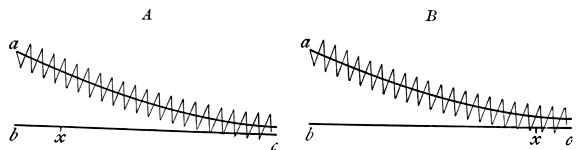
Fig. 25.
Some further remarks will be made in subsequent paragraphs concerning the period of the earth's history at which the geologist is first furnished with definite records, but in the meantime it may be observed that the geologist will do well, when working amongst the strata, to consider that the more active operation of agents, even in times of which he has definite knowledge, may have produced effects which he should be prepared to discover, as their discovery would be of considerable importance, and that he should not be content to infer that because it has been proved that agents operating with the same intensity as that which they have at present, may have produced all the effects which he can actually observe, they therefore necessarily did produce them.
Recurrences. Absolute uniformity of conditions is impossible, even in a single area. Every change which takes place upon the earth produces conditions somewhat dissimilar from those which previously existed, and these will leave their effects upon the physiography of the area. For this reason, assuming that the conditions have gradually changed from simpler to more complex, every period of time will have been marked by conditions which never prevailed before or afterwards, and these will leave their impress upon the deposits of the period. It is doubtful for instance, as already remarked, whether the exact conditions which gave rise to the extensive deposits of vegetable matter in Carboniferous times which now form coal, ever occurred to a like extent in previous or subsequent periods, and accordingly, though we have deposits of coal of other ages, none are so extensive as those of the Coal Measures. Again, as the strata of one period are largely composed of denuded particles of pre-existing strata, which were derived directly or indirectly from igneous rock, the soluble material existing in the igneous rocks must have been gradually eliminated unless restored by other processes, and we might expect to find that early sediments have, on the whole, a larger proportion of soluble silicates than the later ones.
Besides these changes, there are physical changes which are recurrent, and cause conditions generally similar to pre-existing ones to occur in an area after an interval of dissimilar ones. We have seen that deposits tend to vary according to the distance from the coast, limestone being succeeded by mud, this by sand and gravel, and after subsidence the sand and gravel are succeeded by mud, and that by limestone. These changes will produce some effect upon the organisms, and the recurrence of organisms is a well-known event, of which cases have been cited in a former chapter.
Again we find, as already pointed out, recurrence of climatic changes, with alternation of glacial and warmer periods, and these may have been very widespread, and would influence the other physical conditions, as well as the distribution of the organisms. Vulcanicity may have been more rife at some periods than others, for instance there seems, in the present imperfect state of our knowledge, evidence of enfeebled vulcanicity in later Mesozoic times, and of its renewed activity in Tertiary times. Again, orogenic movements seem to have occurred more extensively at some times than others, as for instance in early upper Palæozoic times, at the end of the Palæozoic epoch, and in early Tertiary times, though this may also be an apparent and not an actual truth, due to imperfect knowledge. In any case, in limited areas, there seem to have been alternations of periods of uplift accompanied by marked orogenic movements, and of widespread depression, accompanied by sedimentation.
The subject of rhythmic recurrence is worthy of further study. This recurrence in combination with evolutionary change may account for the apparent marked difference between Cambrian and Precambrian times, a difference which strikes some geologists as being too great to be accounted for as due to our ignorance only.
Organic evolution. This subject is too wide for more than passing notice in a work of this character. The evidence of Palæontology is of extreme importance to the biologist, and indeed, the way in which evolution of organisms has occurred can only be actually demonstrated by reference to Palæontology, and the study of Palæontology has already given much information concerning the lines on which evolution has proceeded in different groups of organisms. It must be remembered that the major divisions of the invertebrata were in existence in very early times; indeed representatives of most of them are found in the rocks containing the earliest known fauna, that of the Olenellus beds of Cambrian age. If our present views as to evolution be correct, there is no doubt that the period which elapsed between the appearance of life upon the globe and the existence of the Olenellus fauna must have been very great, possibly, as Huxley suggested, much greater than that which has elapsed between early Cambrian times and the present day. If this be so, however probable it is that we shall carry our knowledge of ancient faunas far back beyond Cambrian times, it is extremely improbable that we shall ever get traces of the very earliest faunas which occupied our earth.
Geological time. Various attempts have been made to give numerical estimates of the lapse of time which occurred since the earth was formed, or since the earliest known rocks were deposited. These attempts may be classed under two heads, namely, those made by physicists, mainly on evidence obtained otherwise than by a study of the rocks, and those made by geologists by calculating the mean rate of denudation and deposition of the rocks, and estimating the average thickness of the rocks of the geological column.
The calculations of physicists as to the age of the earth vary:—Lord Kelvin assigned 20,000,000 years as the minimum and 100,000,000 as the maximum duration of geological time. Prof. Tait has halved Lord Kelvin's minimum period, while Prof. G. Darwin admits the possibility of the lapse of 500,000,000 years.
The estimates made by geologists, which will appeal more directly to the geological student, also vary considerably, though they bear some proportion to those which have been put forward by the physicists. Prof. S. Haughton[128] assigned a period of 200,000,000 years for the accumulation of the rocks of the geological column; Mr Clifton Ward[129] one of 62,000,000 years, after studying the rocks of the English Lake District, and allowing for the gaps in the succession; Mr A. R. Wallace[130] further lowers the time for the formation of the column to 28,000,000 years; Sir A. Geikie[131] gives 73,000,000 years as the minimum and 680,000,000 as the maximum; while Mr J. G. Goodchild has lately[132] estimated the period at over 700,000,000 years.
Interesting as these figures are, they probably convey little to the ordinary reader, and it is doubtful whether the geologist is really affected by them to any extent when picturing to himself the vast duration of geological time. One numerical estimate probably does impress him, namely that made by Croll as to the date of the Great Ice Age, for if the Ice Age be so remote as Croll imagined, the commencement of earth-history must be inconceivably more remote; as Croll's estimate is not generally accepted, it is doubtful how far geologists are thus influenced, and probably the fact which does impress them most, leaving fossils out of account, is the very little change which has occurred in historic or even in prehistoric times as compared with the vast changes which are familiar to them after studying the strata of the geological column.
It is, after all, the succession of varied faunas which really gives students of the rocks the most convincing proof of the vast periods of geological time. If anyone doubts this assertion, let him consider what impression would be made upon him by observing the several thousand feet of strata of the column if none of them contained any organisms. Cognisant as he is of the slow rate of change of existing organisms, the fact that fauna has succeeded fauna in past times brings home to him in an unmistakeable manner the great antiquity of the earliest fossiliferous rocks, and as our detailed knowledge of these faunas increases the impression of great lapse of time is intensified. And if the earliest fossiliferous rocks be of such vast antiquity, and, as has been remarked, the period of their formation is comparatively recent with reference to the actual commencement of earth-history, the latter must indeed be inconceivably remote, and numerical estimates can do but little to familiarise us with the significance of the vast time which has rolled by since the world's birthday.
INDEX.
[ A ][ B ][ C ][ D ][ E ][ F ][ G ] [ H ][ I ][ J ][ K ][ L ][ M ] [ N ][ O ][ P ][ Q ][ R ][ S ][ T ] [ U ][ V ][ W ][ Y ][ Z ]
Abraum salts, 212 Æolian rocks, 24, 99, 100 Age, definition of, 60 Albian series, 236, 238 Algonkian rocks, 144 Ampthill clay, 232 Angelin, N. P., 161, 162, 165 Aptian series, 236, 237 Aqueous rocks, 24 Archæan rocks, 132 Ardmillan series, 170 Ardwick stage, 192 Arenaceous rocks, 29 Arvonian rocks, 141 Asaphus fauna, 165 Ashgill series, 164, 165, 167-169 Ashprington series, 184 Astian series, 256 Atlantis, 283 Aveline, W. T., 164 Aymestry limestone, 175, 176 Bagshot beds, 244, 246 Bajocian series, 227, 231 Bala limestone, 167 Bala series, 164 Barr series, 170 Barrande, J., 53, 55, 159, 161, 163 Barrois, C., 239 Barrow, G., 138 Barton beds, 244 Bath oolites, 226 Bathonian series, 227, 231 Bed, 27 Bedding plane, 27 Bell, A., 257 Belt, T., 153, 162 Bembridge beds, 251 Bertrand, M., 87, 286 Birkhill shales, 177 Black Jura, 226 Blake, J. F., 138-140 Blanford, W. T., 206, 208, 217, 282, 284 Bonney, T. G., 76, 141, 142 Boulder clay, 262 Bracklesham beds, 244 Bradford clay, 230 Break, palæontological, 61; physical, 60 Bristow, H., 239 Brockram, 211 Brögger, W. C., 161-163 Brongniart, H., 18 Brongniart, C., 200 Bronze age, 275-277 Brown Jura, 226 Bunter sandstone, 218, 220-222 Bure valley beds, 256 Buttery clay, 276 Caerfai beds, 152, 154, 156 Calcareous rocks, 29 Caldicote series, 139 Callaway, C., 138-140 Callovian series, 227, 232 Cambrian faunas, 158-163 Cambrian system, 152-163 Caradoc series, 165, 168-171 Carbonaceous rocks, 29 Carboniferous fauna and flora, 199-201 Carboniferous limestone, 192, 194, 195 Carboniferous system, 192-201 Carnic beds, 225 Cataclastic rocks, 24 Cave man, 268 Cenomanian series, 236 Ceratopyge fauna, 162 Chalk, 236, 238, 239 Chalk marl, 236 Chemically-formed rocks, 29, 101 Chillesford crag, 256 Chronological terms, 60 Clastic rocks, 24 Climatic conditions, 103, 112, 290, 291 Climatic zones, in Jurassic times, 233; in Cretaceous times, 241 Clymenian beds, 183 Coal, 196-199 Coal measures, 192; mode of formation of, 195-199 Coblenzian beds, 184 Collyweston slate, 231 Colonies, theory of, 55 Contemporaneity of strata, 48 Continents, growth of, 285-287 Cope, E., 249 Corallian series, 227, 232 Coralline crag, 256, 257 Cornbrash, 230 Cornstones, 186 Coutchiching series, 144 Crags, 256-259 Cretaceous fauna and flora, 241-243 Cretaceous system, 236-243 Croll, J., 265, 295, 296 Cromer Forest series, 100, 256, 259 Cromer till, 262 Cucullæa beds, 183 Cuvier, Baron G., 18, 20 Dalradian rocks, 137 Dana, J. D., 285 Danian series, 236 Darwin, C., 20, 76 Darwin, G., 295 Daubrée, A., 88 David, T. W. E., 206 Davis, W. M., 258, 280 Dawkins, W. B., 266, 268, 270, 272, 277 Deep-sea deposits, 109 De Hayes, G. P., 19 De la Beche, Sir H., 92 Deposition, order of, 37, 116 Derivative rocks, 23 Devonian flora and fauna, 189-191 Devonian system, 183-191 Dictyograptus fauna, 162 Dimetian rocks, 141 Dogger, 226 Downtonian beds, 175 Dwyka conglomerate, 206 Edwards, F. E., 250 Eifelian beds, 184 Encrinurus fauna, 185 Englacial deposits, 261 Entomis slates, 183 Eocene fauna and flora, 248, 249 Eocene rocks, 244-250 Eozoon canadense, 143 Eparchæan rocks, 132 Epeirogenic movements, 32 Epiclastic rocks, 24; simulation by cataclastic rocks, 38, 80 Epoch, definition of, 60 Estuarine series, 230 Etheridge, R., 19 Ettingshausen, Baron von, 250 Evans, Sir J., 266, 270, 274, 277 Evolution, 287, 293 Feistmantel, O., 208 Fenland, 276 Fluvio-glacial deposits, 261 Foreland grits, 184 Forest marble, 230 Forest period, 260, 275-277 Fossils, 42; strata identifiable by, 40; mode of occurrence of, 44; relative value of, 47; remanié, 52; geographical distribution of, 55; as indicative of physical conditions, 104 Fossil zone, 67 Foster, C. Le N., 239 Fox, H., 195 Freshwater deposits, 104; distinction from marine, 105 Fuller's earth, 230 Fusulina beds, 201 Gala beds, 177 Gannister stage, 192 Gardner, J. S., 250 Gault, 236, 238 Geikie, Sir A., 60, 84, 95, 125, 130, 137, 141, 142, 144, 186, 188, 199, 247, 295 Geikie, J., 263 Girvan type, 170 Glacial deposits, permo-carboniferous, 206; Pleistocene, 260-266 Glacial period, 260-266 Glenkiln shales, 169, 170 Glossopteris flora, 207, 208, 214 Godwin-Austen, R. A. C., 20 Gondwana series, 207 Gondwanaland, 207, 284 Goniatite beds, 183 Goodchild, J. G., 87, 130, 263, 295 Great ice age, 295, 296 Great oolite, 230, 231 Gregory, J. G., 258 Green, A. H., 122, 139, 193 Greensand, Lower, 236; Upper, 236 Groom, T. T., 178 Gshellian beds, 193, 201 Hampshire basin, 245 Hangman grits, 184 Harker, A., 30, 88 Harkness, R., 161 Harmer, F. W., 258 Harpes fauna, 175 Harrison, W. J., 130 Hartfell shales, 169, 170 Hastings sands, 236, 237 Haughton, S., 295 Headon beds, 251 Heim, A., 32 Hempstead beds, 251 Hercynian systems of folds, 203 Hicks, H., 134, 141, 153, 154, 160, 161, 163, 167, 184, 266 Hickson, S. J., 109 Hill, A., 239 Hill, E., 142 Hilton shales, 210, 211 Hind, W., 196 Hinde, G. J., 169, 195 Hippurite limestone, 241, 242 Hirnant limestone, 167 Homotaxis, 48 Hughes, T. McK., 141, 264, 266 Hull, E., 120, 122, 193, 283 Hume, W. F., 239 Hunt, A. R., 101 Huronian system, 143 Hutton, J., 287 Huxley, T. H., 50, 250 Igneous rocks, 21-23 Ilfracombe beds, 184 Inferior oolite, 230 Inverted strata, 32; detection of, 32 Iron age, 275, 276 Judd, J. W., 239, 247 Jukes, J. B., 84 Jukes-Browne, A. J., 126, 239, 264 Jurassic beds, 225 Jurassic fauna and flora, 234, 235 Jurassic system, 226-235 Kayser, E., 125, 191 Keewatin series, 144 Kelvin, Lord, 289 Kendall, P., 257 Keuper beds, 218, 221, 222 Kidston, B., 199 Kimmeridge clay, 232 Kimmeridgian series, 226 King, W., 217 Kjerulf, Th., 88 Koninck, L. de, 201 Kupferschiefer, 209 Lake, P., 126, 178 Lamina, 27 Lamplugh, G. W., 80, 119, 264 Lapworth, C., 32, 138, 139, 156, 168-170, 173, 178, 179 Laurentian rocks, 143 Lawson, A. C., 144, 145 Lehmann, J., 77 Lenham beds, 257 Lewis, H. C., 263 Lias, 226, 229 Liassian series, 227, 229 Lincolnshire limestone, 230, 231 Lincombe and Warberry grits, 184 Lindström, G., 114 Lingula flags, 152, 155, 156 Linnarsson, J. G. O., 161 Llandeilo limestone, 167 Llandeilo series, 165, 167 Llandovery series, 174-177 Loess, 267 Logan, Sir W., 20 London Basin, 245 London clay, 113, 244, 246 Longmyndian rocks, 138 Lower London Tertiary beds, 244, 246 Lubbock, Sir J., 270, 277 Ludlow series, 174-176 Lydekker, R., 250 Lyell, Sir C., 6, 12, 19, 106, 129, 224, 263, 270 Lynton slates, 184 McCoy, Sir F., 201 McMahon, C. A., 77 Madsen, H. P., 277 Magnesian Limestone, 209-211 Malm, 226 Maps, geological, 84, 130; use of, 86, 120, 121 Marcou, J., 130, 279 Marine deposits, 102; nature of fossils in, 107 Marl slate, 209, 210 Marlstone, 229 Marsh, O. C., 249 Marwood beds, 183 Matthew, G. F., 160-162, 180 Meadfoot sands, 184 Mechanically formed rocks, 29, 102 Mello, J. M., 270 Mendip system of folds, 203 Menevian beds, 152, 154, 156, 161 Metamorphic rocks, 25 Miall, L. C., 122 Michell, J., 10, 11 Millepore oolite, 230, 231 Miller, H., 189 Millet seed sands, 100 Millstone grit, 192 Miocene period, 252-255 Moffat shales, 169, 177 Mojsisovics, E. von, 224, 227 Morgan, C. Ll., 141 Morte slates, 184 Moscovian beds, 193, 301 Mountain limestone, 192 Murchison, Sir R. I., 19, 20, 174, 179 Murray, Sir J., 30 Muschelkalk, 218, 221, 222 Nehring, A., 267, 268 Neobolus fauna, 160 Neocomian series, 236-238 Neolithic age, 275-277 Neumayr, M., 115, 233 Newton, E. T., 45 Nicholson, H. A., 189, 250 Noachian Deluge, 8 Noetling, F., 160 Nordenskjöld, A. E., 113, 114 Noric beds, 225 Northamptonshire sands, 230 Norwich crag, 256, 257 Nummulitic limestone, 248 Old red sandstone, 183, 185, 186, 188, 191 Oldham, R. D., 208 Oldhaven beds, 244, 245 Olenellus fauna, 134, 153, 156-160 Olenus fauna, 152, 161, 162 Oligocene beds, 251, 252 Oligocene fauna and flora, 252 Oolite, 226 Ordovician faunas, 172, 173 Ordovician system, 164-173 Organically formed rocks, 29, 102, 109 Orogenic movements, 32 Osborne beds, 257 Owen, Sir R., 277 Oxford clay, 232 Oxford oolite, 226 Oxfordian series, 227, 232 Palæolithic fauna and flora, 270-274 Palæolithic man, 268, 272-274 Palæolithic period, 267-274 Palæontological break, 61 Palæo-physiography, 120 Paradoxides fauna, 152, 160, 161 Peat deposits, 275, 276 Pebble beds of Bunter, 218 Pebidian rocks, 140 Pengelly, W., 270 Pennant stage, 192 Pennine system of folds, 203 Penrith sandstone, 75, 210, 211 Period, definition of, 60 Permanence of ocean basins, 278-285 Permian fauna and flora, 214-216 Permian system, 209-217 Permo-carboniferous fauna and flora, 207, 208 Permo-carboniferous glacial deposits, 206 Permo-carboniferous period, 205-208 Phillips, J., 10, 11, 201 Physical break, 60 Pickwell Down sandstone, 183 Pilton beds, 183 Plaisancean series, 256 Planes of lamination, 27 Planes of stratification, 27 Pleistocene fauna and flora, 265, 266 Pleistocene period, 260-266 Pliocene fauna and flora, 259 Pliocene period, 256-259 Portland oolites, 226 Portlandian series, 226, 232 Prado, C. de, 161 Precambrian rocks, 132; mode of formation of, 146 Preller, C. S. du R., 264 Prestwich, Sir J., 19, 130, 279 Productus limestones, 205, 206, 214 Protolenus fauna, 160 Pseudo-stromatism, 76 Purbeckian series, 226, 232 Pyroclastic rocks, 24 Quader sandstone, 240 Ramsay, Sir A. C., 130, 153, 163, 188 Reading beds, 244 Recurrences, 292 Red crag, 256, 257 Reid, C., 45, 257, 264, 268, 271 Renard, A., 30 Reversed fault, 34 Rhætic beds, 218 Rhiwlas limestone, 167 Richthofen, Baron von, 267, 268 Ridley, H. N., 271 River drift man, 268 Rotherham red rock, 202 Rothliegende, 209 Rouelle, 13 St Bees sandstone, 210 St Erth beds, 257 Salopian beds, 175 Salter, J. W., 161, 162, 186 Scarbro' limestone, 230, 231 Schists, crystalline, 76, 77, 133, 147 Scilla, A., 13 Screes, 101 Scrope, G. P., 76 Sections, geological, 84; use of, 88 Sedimentary rocks, 23 Sedgwick, A., 16, 19, 20, 153, 174 Senonian series, 236 Series, definition of, 60 Seward, A. C., 113, 208 Sigmoidal structure, 33 Siliceous rocks, 29 Silurian faunas, 179, 180 Silurian system, 174-182 Simulation of structures, 72 Sinemurian series, 227, 229 Smith, W., 8, 12-18, 57, 85 Soil, 100 Solenhofen slate, 234 Sollas, W. J., 288 Solva beds, 152, 154, 156, 161 Speckled sandstone, 205, 206 Speeton series, 238 Spencer, H., 50 Spirorbis limestone, 201 Stages, definition of, 60 Steppe period, 260, 267-274 Stonesfield slate, 231 Strachey, J., 10 Strahan, A., 239, 264 Strata, 27; classification of, 58, 125 Stratification, 26 Stratified rocks, 23; composition of, 28; origin of, 29; classification of, 28, 125; symbols to represent, 90 Stratigraphical geology, aim of, 1; W. Smith, founder of, 8, 12-18 Suess, E., 110, 123, 207, 284 Superposition, law of, 31 Surveying, geological, 84 Systems, definition of, 60 Talchir stage, 205, 206 Tarannon shales, 174-177 Teall, J. J. H., 289 Terrestrial rocks, 99 Thanet sands, 244 Thinning out, 28 Thrust plane, 34; detection of, 35, 82 Tiddeman, B. H., 87, 263, 270 Till, 262 Time, geological, 294-296 Toarcian series, 227, 229 Topley, W., 130, 239 Torridonian beds, 135-137 Tremadoc slates, 152, 155, 162, 163 Triassic fauna and flora, 223-225 Triassic system, 218-225; ammonite zones of, 225 Trinucleus fauna, 165 Tullberg, S. A., 162 Turonian series, 236 Unconformity, 60, 78, 98 Underclays, 197 Uniformitarianism, 287-292 Uriconian rocks, 138 Ussher, W. A. E., 183 Valentian beds, 175 Verneuil, E. P. de, 161 Volcanic rocks, Cambrian, 155; Carboniferous, 199; Devonian, 184, 186; Eocene, 246, 247; Ordovician, 165-170; Precambrian, 146 Vulcanicity, 289 Waagen, W., 213, 214 Walcott, C. D., 144, 158, 160, 161, 173 Wallace, A. R., 124, 235, 240, 281, 295 Ward, J. C., 87, 88, 263, 295 Warming, E., 115 Watts, W. W., 142, 168, 178 Wealden beds, 236, 237 Webster, T., 18 Weissliegende, 214 Wenlock limestone, 175, 176 Wenlock series, 174-177 Wenlock shale, 175-177 Werfener Schichten, 225 Werner, A. G., 12 Weybourne crag, 256 Whewell, W., 50 Whidbourne, G. F., 91 White Jura, 226 Whitehaven sandstone, 202 Whitehurst, J., 11, 12 Wiman, C., 46 Wood, S. V., 250, 259 Woodward, H., 191 Woodward, H. B., 68, 130, 131 Woodward, J., 8-10 Woodward, S. P., 108, 111 Woolhope limestone, 175 Woolwich beds, 244 Wright, G. F., 263 Yoredale series, 192 Zanclean series, 256 Zechstein, 209 Zone, fossil, 67; ammonite, 225, 237; graptolite, 69
CAMBRIDGE: PRINTED BY J. AND C. F. CLAY, AT THE UNIVERSITY PRESS.
Cambridge Natural Science Manuals.
BIOLOGICAL SERIES.
General Editor, A. E. Shipley, M.A.
Elementary Palæontology—Invertebrate H. Woods, M.A., F.G.S. 6s.
Elements of Botany F. Darwin, M.A., F.R.S. 4s. 6d.
Practical Physiology of Plants F. Darwin, & E. H. Acton, M.A. 4s. 6d.
Practical Morbid Anatomy H. D. Rolleston, M.D., F.R.C.P. & A. A. Kanthack, M.D., M.R.C.P. 6s.
Zoogeography F. E. Beddard, M.A., F.R.S. 6s.
Flowering-Plants and Ferns J. C. Willis, M.A. In two vols. 10s. 6d.
The Vertebrate Skeleton S. H. Reynolds, M.A. 12s. 6d.
Fossil Plants A. C. Seward, M.A., F.G.S. 2 vols. Vol. I. 12s.
Outlines of Vertebrate Palæontology A. S. Woodward. 14s.
The Soluble Ferments and Fermentation J. Reynolds Green, Sc.D., F.R.S. 12s.
Zoology E. W. MacBride, M.A. and A. E. Shipley, M.A. [In the Press.
PHYSICAL SERIES.
General Editor, R. T. Glazebrook, M.A., F.R.S.
Heat and Light R. T. Glazebrook, M.A., F.R.S. 5s.
" " in two separate parts " " each 3s.
Mechanics and Hydrostatics R. T. Glazebrook, M.A., F.R.S. 8s. 6d.
" " in three separate parts
Part I. Dynamics " " 4s.
" II. Statics " " 3s.
" III. Hydrostatics " " 3s.
Solution and Electrolysis W. C. D. Whetham, M.A. 7s. 6d. [Out of print.
Electricity and Magnetism R. T. Glazebrook, M.A., F.R.S. In Preparation.
GEOLOGICAL SERIES.
Petrology for Students A. Harker, M.A., F.G.S. 7s. 6d.
Handbook to the Geology of Cambs F. R. C. Reed, M.A. 7s. 6d.
The Principles of Stratigraphical Geology J. E. Marr, M.A. 6s.
Crystallography Prof. W. J. Lewis, M.A. 14s. Net.
Laboratory Note-Books of Elementary Physics } { L. R. Wilberforce, M.A., and T. C. Fitzpatrick, M.A.
I. Mechanics and Hydrostatics. II. Heat and Optics. III. Electricity and Magnetism. each 1s.
Other volumes are in preparation and will be announced shortly.
Press Opinions.
BIOLOGICAL SERIES.
A Manual and Dictionary of the Flowering Plants and Ferns. Morphology, Natural History and Classification. Alphabetically arranged. By J. C. Willis, M.A., Gonville and Caius College. In Two Volumes. Crown 8vo. With Illustrations. 10s. 6d.
Bookman. One of the most useful books existing for students of botany.... The student who has this book and the chances which Kew, or even one of the smaller gardens, affords him, will make a steady and really scientific progress.
Elements of Botany. By F. Darwin, M.A., F.R.S. Second Edition. Crown 8vo. With numerous Illustrations. 4s. 6d.
Journal of Education. A noteworthy addition to our botanical literature.
Practical Physiology of Plants. By F. Darwin, M.A., F.R.S., Fellow of Christ's College, Cambridge, and Reader in Botany in the University, and E. H. Acton, M.A., late Fellow and Lecturer of St John's College, Cambridge. With Illustrations. Second Edition. Crown 8vo. 4s. 6d.
Nature. The authors are much to be congratulated on their work, which fills a serious gap in the botanical literature of this country.
Zoogeography. By F. E. Beddard, M.A., F.R.S. With Maps. 6s.
Daily Chronicle. Although included in the series of Cambridge Natural Science Manuals, and therefore designed chiefly for students of biology, Mr Beddard deals with his subject in a clear and graphic way that should commend his book to the general reader interested in the question. His style, while never lacking dignity, avoids the dulness which too often accompanies that virtue.
Elementary Palæontology—Invertebrate. By Henry Woods, M.A., F.G.S. With Illustrations. Crown 8vo. Second Edition. 6s.
Nature. As an introduction to the study of palæontology Mr Woods's book is worthy of high praise.
Outlines of Vertebrate Palæontology for the use of Students of Zoology. By A. S. Woodward, Assistant Keeper in the Department of Geology in the British Museum. Demy 8vo. 14s.
Athenæum. Mr Woodward, in studying vertebrate fossils for the purpose of this volume, takes the biological view, and has designed his work primarily for the assistance of students of vertebrate morphology and zoology. Mindful, however, of the geological side of the subject, he has introduced a chapter on the succession of the vertebrate faunas, offering a brief but convenient summary of the distribution of vertebrate life throughout geologic time. The author is to be congratulated on having produced a work of exceptional value, dealing with a difficult subject in a thoroughly sound manner.
The Vertebrate Skeleton. By S. H. Reynolds, M.A., Trinity College. Crown 8vo. 12s. 6d.
British Medical Journal. A volume which will certainly take its place amongst the standard text-books of the day.
Practical Morbid Anatomy. By H. D. Rolleston, M.D., F.R.C.P., Fellow of St John's College, Cambridge, Assistant Physician and Lecturer on Pathology, St George's Hospital, London, and A. A. Kanthack, M.D., M.R.C.P., Lecturer on Pathology, St Bartholomew's Hospital, London. Crown 8vo. 6s.
British Medical Journal. This manual can in every sense be most highly recommended, and it should supply what has hitherto been a real want.
The Soluble Ferments and Fermentation. By J. Reynolds Green, Sc.D., F.R.S., Professor of Botany to the Pharmaceutical Society of Great Britain. Demy 8vo. 12s.
Nature. It is not necessary to recommend the perusal of the book, to all interested in the subject since it is indispensable to them, and we will merely conclude by congratulating the Cambridge University Press on having added to their admirable series of Natural Science Manuals an eminently successful work on so important and difficult a theme, and the author on having written a treatise cleverly conceived, industriously and ably worked out, and on the whole, well written.
Brewer's Journal. It will of course find a place in every brewer's library, and will be a work much studied and much pondered over by the thoughtful and highly trained men who now represent our profession.
PHYSICAL SERIES.
Mechanics and Hydrostatics. An Elementary Text-book, Theoretical and Practical, for Colleges and Schools. By R. T. Glazebrook, M.A., F.R.S., Fellow of Trinity College, Cambridge, Director of the National Physical Laboratory. With Illustrations. Crown 8vo. 8s. 6d.
Also in separate parts. Part I. Dynamics. 4s. Part II. Statics. 3s. Part III. Hydrostatics. 3s.
Knowledge. We cordially recommend Mr Glazebrook's volumes to the notice of teachers.
Practical Teacher. We heartily recommend these books to the notice of all science teachers, and especially to the masters of Organised Science Schools, which will soon have to face the question of simple practical work in physics, for which these books will constitute an admirable introduction if not a complete vade mecum.
Heat and Light. An Elementary Text-book, Theoretical and Practical, for Colleges and Schools. By R. T. Glazebrook, M.A., F.R.S. Crown 8vo. 5s. The two parts are also published separately.
Heat. 3s. Light. 3s.
Journal of Education. We have no hesitation in recommending this book to the notice of teachers.
Practical Photographer. Mr Glazebrook's text-book on "Light" cannot be too highly recommended.
GEOLOGICAL SERIES.
Handbook to the Geology of Cambridgeshire. For the use of Students. By F. R. Cowper Reed, M.A., F.G.S., Assistant to the Woodwardian Professor of Geology. With Illustrations. Crown 8vo. 7s. 6d.
Nature. The geology of Cambridgeshire possesses a special interest for many students.... There is much in Cambridgeshire geology to arouse interest when once an enthusiasm for the science has been kindled, and there was need of a concise hand-book which should clearly describe and explain the leading facts that have been made known.... The present work is a model of what a county geology should be.
The Principles of Stratigraphical Geology. By J. E. Marr, M.A., Fellow of St John's College, Cambridge. Crown 8vo. 6s.
Nature. The work will prove exceedingly useful to the advanced student; it is full of hints and references, gathered during the author's long experience as a teacher and observer, and which will be valuable to all who seek to interpret the history of our stratified formations.
University Extension Journal. Mr Marr is an old University Extension lecturer, and his book, which is distinguished by the lucidity and thoroughness which characterise all his work, cannot fail to be of service to University Extension students who are making a serious study of Geology.
Crystallography. By W. J. Lewis, M.A., Professor of Mineralogy in the University of Cambridge. Demy 8vo. 14s. net.
Athenæum. Prof. Lewis has written a valuable work.... The present work deserves to be welcomed not only as a greatly needed help to advanced students of mineralogy, but as a sign that the study itself maintains an honoured place in the university Science Course.
Nature. The author and the University Press may be congratulated on the completion of a treatise worthy of the subject and of the University.
Petrology for Students. An Introduction to the Study of Rocks under the Microscope. By A. Harker, M.A., F.G.S., Fellow of St John's College, and Demonstrator in Geology (Petrology) in the University of Cambridge. Crown 8vo. Second Edition, Revised. 7s. 6d.
Nature. No better introduction to the study of petrology could be desired than is afforded by Mr Harker's volume.
London: C. J. CLAY AND SONS, CAMBRIDGE UNIVERSITY PRESS WAREHOUSE, AVE MARIA LANE AND H. K. LEWIS, 136, GOWER STREET, W.C. Medical Publisher and Bookseller.
Transcriber's Note
Any obsolete or alternate spelling and grammar was retained. All obvious typographical errors were corrected. Although hyphenation of words has been standardized to the most prevalent occurrence, the six occurrences of fresh-water were not converted to freshwater (30 occurrences) due to usage. Corrected spellings: Godwin-Austen (p. 20); Whidbourne (p. 191); and Ichthyopterygia (p. 223).