J. E. MARR, M.A., F.R.S. (continued 3)
Reading edition
Valuable as the published maps of palæo-physiography are as an aid to the student in understanding the significance of the variations of characters amongst the sediments, he will do well to supplement them by maps which he fills in for himself. He is recommended to procure a number of outline maps of England, or of the British Isles, and when studying in detail the characters of the British sedimentary rocks formed during the various periods, to place a blank map by his side when beginning the study of each period or important portion of a period. On this map he should jot down the geographical distribution of the different kinds of sediments, using the conventional signs indicated at p. 90: thus, in the case of the Lower Carboniferous rocks he would place the conventional sign for limestone in Derbyshire, a combination of those for limestone and shale in Yorkshire, and would add to these the sandstone sign in Northumberland. He should also note the general character of the fossils, using abbreviations for such terms as fresh-water fossils, shallow-sea fossils, deep-water fossils. After reading the account of the group of rocks in a comprehensive text-book, and inserting his notes on the map, he should proceed to insert the probable position of the coast-lines. He should also take notes of any indications of contemporaneous volcanic action, though these might well be inserted on a separate map. If this course be pursued, the student will not only have the significance of the variations amongst the strata impressed upon his mind, but he will have a means of obtaining at a glance the distribution of sediments and faunas of different kinds in the British area during the principal geological periods. On another set of maps he may indicate the axes of the orogenic movements which have occurred at different times, and when his various maps are completed, he will have the materials for the construction of a general account of the various geological processes which have been concerned with the building of the British area.
When an area like Britain has been studied, the student may proceed to construction of maps of wider regions, and he will find that in doing this, new sets of facts must be taken into consideration, as for instance the occurrence of different faunas on opposite sides of once-existing continental masses, and the problems connected with the present distribution of the faunas and floras. For an instance of the importance of the former distribution of life the reader may consult the twelfth section of the first part of Professor Suess' Das Antlitz der Erde, whilst a good account of the value of recent geographical distribution of organisms in supplying a clue to former distribution of land and sea will be found in Mr A. R. Wallace's Island Life, Chapter xxii.
Should the method suggested above be adopted, the student is likely to acquire a much more coherent idea of the significance of the facts of stratigraphical geology than can be obtained by a mere perusal of the accounts of the strata given in those portions of the various text-books which are devoted to a consideration of the stratigraphical branch of the science.
CHAPTER XI.
THE CLASSIFICATION OF THE STRATIFIED ROCKS.
In the succeeding chapters, a general account of the characters of the Geological Deposits of different periods will be given, for the purposes of illustrating the principles to the consideration of which the earlier chapters have been devoted. It is not proposed to enter into a description of numberless details, which would only confuse the student who wished to grasp the main principles, for many facts have been recorded which it is necessary to notice in a comprehensive text-book treating of stratigraphical geology, though their full significance is not yet grasped. The writer, while noting the main characters of the various subdivisions of the different stratigraphical systems, will assume that this work is used in conjunction with some recognised text-book. The stratigraphical portion of Sir A. Geikie's Class Book of Geology gives an admirable general account of the British Strata, while the larger text-book by the same author has a condensed though very full account of the rocks of the stratigraphical column in all parts of the world, and this is supplemented by numerous references to the original works wherein further descriptions may be found. The English edition of Prof. E. Kayser's Text-Book of Comparative Geology, edited by P. Lake, is also well adapted to the wants of the student, and an excellent account of the strata is given in Mr A. J. Jukes-Browne's Handbook of Historical Geology, which may be read with the same author's Building of the British Isles.
The reader who refers to different text-books will be struck with the variations of nomenclature even amongst the larger stratigraphical divisions, for two authors seldom subdivide the geological column into the same number of rock-systems. The following classification will be here adopted:—
Groups. Systems.
Cainozoic or Tertiary Recent Pleistocene Pliocene Miocene Oligocene Eocene

Mesozoic or Secondary Cretaceous Jurassic Triassic

Palæozoic Permian Permo-Carboniferous Carboniferous Devonian Silurian Ordovician Cambrian

Precambrian.
A few remarks may be given as to the reason for adopting this classification.
It is not for a moment suggested that the Systems have the same value, if the time taken for their accumulation be alone considered. The beds classified as Recent, for example, were probably accumulated during a lapse of time far shorter than that occupied for the deposit of some of the series or even stages of a system like the Silurian, but the recent rocks acquire a special significance from the fact that we are living in the period, and the Cainozoic rocks as a whole are capable of greater subdivision than the earlier groups, on account of the greater ease with which they can be studied, owing to the small amount of disturbance which they have usually undergone when compared with that which has affected older rocks, and the closer resemblance of their faunas and floras to those of existing times.
With reference to the groups, the writer has already commented upon the use of the terms Palæozoic, Mesozoic and Cainozoic; below the lowest Palæozoic rocks (those of the Cambrian system) lie a group of rocks which have been variously spoken of as Azoic, Eozoic, and Archæan. There is an objection to the use of any one of these words in this sense; the objection in the case of the first two is that the term is theoretical and probably incorrect, whilst the word Archæan, otherwise suitable, has also been used in a more restricted sense. In these circumstances the term Precambrian will be used when referring to any rocks which were formed below Palæozoic times, though no doubt when this obscure group of rocks is more thoroughly understood a satisfactory classification will be applied to it.
Taking the other groups into account, the lower systems of the Palæozoic group will be found to vary greatly according to the views of different writers; some make only one system, the Silurian, others two, the Cambrian and Silurian. The three systems are here adopted, not only because the one, Silurian, is too unwieldy on account of its size and requires subdivision (and the Cambrian and Silurian however defined, will be found to be of very unequal importance, whereas the three systems adopted are of fairly equal value), but especially because when the term Ordovician is used, the significance of the other terms Cambrian and Silurian is at once understood.
An attempt has been made to shew that the Devonian system is non-existent, but the result of modern research is to shew that the rocks placed in this system are worthy of the distinction, both from their importance and from the distinctness of the fauna from those of the underlying and overlying systems.
The Permo-Carboniferous system is adopted, because an important group of deposits has recently been brought to light which were not represented either in the Permian or Carboniferous system as originally defined.
Some authors have advocated the union of the Permian and Triassic systems into one system placed at the base of the Mesozoic group. This is unnecessary, and would depart from the classification originally proposed, which is to be deprecated, unless there is any strong reason for it.
The Mesozoic systems are classified according to the method generally adopted. Were a fresh classification to be proposed, a portion of the Cretaceous system might be included with the Jurassic rocks, but it is better to adhere to the old classification.
The divisions of the Cainozoic rocks are hardly systems in the sense in which the term is used in the case of the older rocks, but the reason for using these smaller subdivisions has already been mentioned. The addition of the Oligocene to the original divisions suggested by Lyell has been found useful, and the term will be used in this work.
The reasons for the adoption of the particular minor subdivisions (series and stages) in the following chapters will frequently appear when the rocks of the various systems are described, and need not be further alluded to in this place.
Although most geologists describe the stratified rocks in ascending sequence beginning with the oldest, and proceeding towards the newest, others, and notably Lyell, adopted the opposite method and commenced with an account of the newest beds. The argument generally used for the latter method is that it is easier to work from the study of the known to that of the less known, and as the faunas of the newest rocks are most like the existing faunas, the student would more readily follow a description of the rocks in the order which is opposite to that in which they were deposited.
In practice, the study of the sediments in their proper order, that is, in the order of deposit, will not be found to task the student to any great extent, especially if, as is very desirable, he has studied the main facts and principles of Palæontology before commencing the study of the rock-systems in detail. There is one reason for beginning with the study of the older sediments which outweighs any reasons which can be advanced against it, namely that the events of any period produce their effect not only upon the strata of that period, but also on those of succeeding periods.
The task of the stratigraphical geologist is really to learn the evolution of the earth, in its changes from the simple to the more complex conditions, and it is quite obvious that it is unnatural to attempt any study of evolution by working backward. For this reason the study of the sediments will be here made in the order which is usually adopted, by passing from the older to the newer, and from the simple to the more complex.
The British strata will be mainly considered, though references will frequently be made to their foreign equivalents, and a fuller account of the latter will be added when the British strata are abnormal, as are those of Triassic times, and also when a period is not represented amongst the strata of the British Isles, as for instance, the Permo-Carboniferous and Miocene periods.
The student is recommended to refer constantly to good geological maps of the British Isles, of Europe, and of the world. Of maps of the British Isles, mention may be made of Sir A. Ramsay's geological map of England, Sir A. Geikie's map of Scotland, and his map of the British Isles, J. G. Goodchild's map of England and Wales, a map of Europe by W. Topley and one of the world reduced from that by J. Marcou, accompanying the first and second volumes of the late Sir J. Prestwich's Geology. For special purposes more detailed maps will be studied, including the one-inch maps of H. M. Geological Survey, and the index map on a smaller scale. Lastly, for an account of British Geology, reference must be made to H. B. Woodward's Geology of England and Wales, where the British formations are described in order, and to W. J. Harrison's Geology of the Counties of England and Wales, where the stratigraphical geology of the country is given under the head of the different counties, which are taken in alphabetical order.
In concluding this chapter, it is hardly necessary to say that every opportunity of studying the characters of the deposits and their fossils in the field should be eagerly seized, and that much information may be acquired even on a railway journey, especially as to the influence which the deposits exert upon the scenery of a region[47].
CHAPTER XII.
THE PRECAMBRIAN ROCKS.
Study of a geological map of the world will shew that extensive regions, such as parts of Scandinavia, many tracts of Central Europe, a large area in Canada, and a considerable portion of Brazil and the adjoining countries are occupied by crystalline schists, which underlie the oldest known sedimentary strata in those places. These crystalline schists form the floor upon which the sediments constituting the bulk of the geological column rest, and it is necessary that we should know something of the character of this floor. Other rocks which can be definitely proved to be of Precambrian age are often found associated with the crystalline schists, and these associated rocks have often undergone more or less alteration subsequently to their formation. The difference between the coarser types of crystalline schists and these associated rocks is sometimes so marked that geologists have necessarily paid attention to it, and separated the two groups of rocks; the term Archæan has been used by some geologists to include the crystalline schists, and Eparchæan for the associated rocks of known Precambrian age, but though this separation may sometimes be effected, there are cases when it is impossible to draw any sharp line of demarcation between 'Archæan' and 'Eparchæan' types.
In the present state of our knowledge, a chronological classification of the Precambrian rocks when applied to wide and distant regions is destined to break down, and it will be convenient if we consider at some length the features of the Precambrian rocks of a particular region, and apply the knowledge thus gained to a study of Precambrian rocks of other areas, and to a consideration of our knowledge of the Precambrian rocks as a whole. In doing so, the term 'crystalline schists' will be used somewhat vaguely with reference to a complex of schistose rocks of which the mode of origin cannot be fully determined. We may take our own country as a region where a good development of the Precambrian rocks occurs.
A few explanatory remarks concerning the mode of detection of Precambrian rocks may not be amiss. If any true organisms have been hitherto discovered amongst the rocks formed before Cambrian times they are valueless as a means of correlating rocks, and accordingly lithological characters only are available in attempting to correlate the rocks of one area with those of another. Those who have read the preceding chapters will have gathered that comparisons founded on similarity of lithological character are not so valuable as those made after careful scrutiny of the fossils of strata, but they are by no means valueless, and when the rocks of two areas which are not far distant from one another present close lithological resemblances, their general contemporaneity may be inferred with some degree of certainty.
It is only when we get the lowest Cambrian strata overlying earlier rocks that we have absolute proof of the Precambrian age of the latter, and it is necessary, therefore, that we should have some definite lower limit to the rocks of the Cambrian system. It is now generally agreed that that limit shall be drawn at the base of a group of rocks containing what is known as the Olenellus-fauna, which will be considered at greater length in the next chapter, and it will be well, if the term Cambrian be not in future applied to any rocks beneath the ones containing the relics of this fauna, for otherwise there is danger of the indefinite downward extension of the Cambrian system. We need not be surprised to find great thicknesses of rock below the rocks containing the Olenellus-fauna, and passing upwards with complete conformity into those rocks; nevertheless, if it can be shewn that the Olenellus-fauna had not appeared during the deposition of the underlying group, the rocks of that group should be termed Precambrian. A case of this nature has not yet been detected in our area, and all the rocks which have been proved to be Precambrian in Britain are separated from the overlying Cambrian rocks by a physical break, though that break is not necessarily very large, and in some districts is probably of little importance. Hitherto the Olenellus-fauna has been detected in Ross, Warwickshire, Shropshire, Worcestershire and probably in Pembrokeshire, and the rocks underlying the Olenellus-beds in those counties can be proved to be Precambrian (i.e. if the Olenellus-age of the Pembrokeshire rocks be ultimately established, and the researches of Dr Hicks tend to prove that it will almost certainly be done). It will be convenient if we take the instances where the age of the rocks can be proved with certainty or with a considerable degree of probability first, and then consider the examples of rocks which are found below Cambrian strata, though these have not hitherto yielded the Olenellus-fauna, concluding with a notice of rocks which have been claimed to be of Precambrian age on account of their lithological characters, though they are not now seen to be immediately succeeded by strata appertaining to the Cambrian system.
Commencing with the region where we have the greatest development of the known Precambrian rocks, namely Ross, Sutherland and the Hebrides, we may explain the general relationship of the rocks by means of a generalised section (Fig. 15).

Fig. 15.
The lowest rocks a are crystalline schists, they are succeeded by a set of arenaceous rocks b known as the Torridonian beds, which rest unconformably upon the upturned edges of the crystalline schists, whilst the Cambrian rocks, c, rest with another unconformity sometimes upon the partly denuded Torridonian beds, or where the latter have been completely removed, as on the right side of the figure, directly upon the crystalline schists, thus presenting an example of unconformable overlap. The occurrence of the Olenellus-fauna in the basement beds of the Cambrian system near Loch Maree, proves the Precambrian age of the Torridonian strata, whilst the unconformable junction between the latter and the crystalline schists indicates that we are here dealing with two distinct sets of Precambrian rocks, one of Eparchæan and the other of Archæan type.
The crystalline schists consist of rocks of very varied lithological characters, some with gneissose, and others with schistose structure, and they vary in degree of acidity from ultrabasic rocks to those of acid composition. Most of them exhibit parallel structures, which in many cases can be shewn to have been impressed on the rocks subsequently to their consolidation, though this need not have occurred and probably did not occur with some of them, especially the granitoid gneisses. The researches of the members of H. M. Geological Survey have shewn that many of these rocks were originally intrusive igneous rocks, though it is not yet known into what rocks those which were first consolidated were injected, and the origin of the bulk of the schists still remains to be elucidated. Subsequently to their consolidation and before the deposition of the earliest Torridonian rocks they were subjected to more than one set of earth-movements, which folded them and impressed a series of parallel structures upon many of them; and accordingly we find that the pebbles of the crystalline schists which are found amongst the basal conglomerates of the Torridonian rocks consist of fragments which had undergone the alteration caused by these earth-movements before they were denuded from their parent-rocks[48].
The Torridonian system is composed of rocks which are largely of arenaceous character, the most prominent beds being formed of red sandstones, and the bulk of the fragments in them have clearly been derived by denudation from the crystalline schists, many of the beds being composed of arkose, where the quartz is mixed with a large proportion of felspar and often of ferro-magnesian minerals. The deposits are clearly sedimentary, and are as little altered as many strata of much more recent origin, only possessing structures produced by metamorphic action under exceptional circumstances. The detailed researches of the geological surveyors prove that the rocks of this system have a much greater thickness and are of more varied lithological characters than was previously supposed. The total thickness of the strata is over 10,000 feet, and the sandstones are associated with deposits of a muddy character, and with occasional bands of limestone; in these circumstances the discovery of fossils would excite no surprise, and in 1891 Sir A. Geikie announced the detection of "traces of annelids and some more obscure remains of other organisms in these strata," which have not yet been described[49]. These Torridonian strata furnish us with the most satisfactory group of Precambrian sediments yet detected in Britain[50].
In the south-east Highlands is a great mass of crystalline schists of a less gneissose character than that of the north-west, to which Sir A. Geikie has applied the name Dalradian. Many of these schists will be found by examination of the geological map of Scotland to be separable into divisions, which by means of their lithological characters can be traced long distances across the country, and they present all the characters of sedimentary rocks, though they are associated with intrusive igneous rocks, and have undergone great metamorphic changes since their formation. Cambrian rocks have not yet been discovered immediately above them, though they are clearly older than Ordovician times, but the existence of rocks associated with them along their north-west borders, which in lithological characters closely resemble some of the rocks of the crystalline schists of the north-west Highlands, indicates the probability of their general Precambrian age. In some instances, the extreme types of metamorphism which they exhibit are the result of the kind of action usually termed pyrometamorphic as has been shewn by Mr G. Barrow[51].
In England and Wales the rocks which have been shewn or inferred to be Precambrian, when not intrusive, are largely of volcanic origin. The most satisfactory example of the occurrence of the Olenellus-fauna is that of the Cambrian Comley sandstone of Shropshire, which rests unconformably upon a set of rocks termed by Dr Callaway the Uriconian rocks; the latter are essentially volcanic, and strongly resemble Precambrian rocks of other British areas. There is also strong reason to suppose that the sediments to which the name Longmyndian has been applied, which have been described by the Rev. J. F. Blake, are of Precambrian age, for, as Professor Lapworth has pointed out, the three great subdivisions of the Cambrian system are present in the area under consideration, and the rocks of each are entirely different from those of the adjoining Longmynd area. In Shropshire therefore we meet with one set of volcanic rocks, and another set consisting of sedimentary rocks, of which the former is certainly, the latter almost certainly of Precambrian age, and as the Longmyndian rocks are in a comparatively unaltered condition, consisting of normal sediments, we may well expect the discovery of fossils in them also[52]. The Olenellus-fauna has been found near Nuneaton in Warwickshire in beds which unconformably succeed volcanic rocks, the Caldecote series of Prof. Lapworth, and the latter are therefore of Precambrian age[53]. A few fossils belonging to the Olenellus-fauna have occurred in the oldest Cambrian rocks of the Malvern district, and these rocks rest unconformably upon those of an old ridge which is therefore composed of Precambrian rocks. The rocks of this ridge are largely of intrusive igneous origin, though parallel structures have been impressed upon them as the result of subsequent deformation, but some of the rocks are almost certainly of contemporaneous volcanic origin[54]. In the Wrekin ridge, igneous and pyroclastic rocks are found succeeded unconformably by Cambrian rocks which resemble those of the Malvern and Nuneaton districts, and probably belong to the period of existence of the Olenellus-fauna, and these igneous and pyroclastic rocks are presumably of Precambrian age, and the contemporaneous rocks constitute Dr Callaway's typical Uriconian group. Volcanic ashes and breccias are accompanied by devitrified pitchstones and intruded granitic rocks, which may or may not be all of the same general age[55]. The rocks which have been claimed as Precambrian in Pembrokeshire and in Caernarvonshire have the same general characters as those of the Wrekin ridge. Pyroclastic rocks underlie the oldest Cambrian rocks, with discordance between the two, and associated with these pyroclastic rocks are quartz felsites which according to some are of contemporaneous nature whilst others maintain their intrusive origin. In each county granites are found which are now generally recognised to be intrusive, though there seems to be no doubt as to their being of the same general age as the rocks with which they are associated, and therefore presumably Precambrian. The Pembrokeshire rocks are marked by the occurrence of a certain amount of metamorphism, probably of more than one kind, which has converted pyroclastic volcanic rocks into sericitic-schists and quartz-felsites into hälleflintas[56]. The term Pebidian given by Dr Hicks to the contemporaneous volcanic fragmental rocks should be retained, and if these rocks be eventually shewn to be contemporaneous with similar volcanic rocks of other districts, may be applied generally, as it has priority over other terms as Uriconian and Caldecote series. The term Dimetian was applied to rocks known to be intrusive, and must be dropped as a chronological term, whilst the existence of an Arvonian system separate from the Pebidian system is not fully proved.
In Caernarvonshire two ridges are found, the one running from Bangor to Caernarvon, and the other through Llanberis lake. The rocks of these are generally similar to those of St Davids, and as the lowest Cambrian rocks of the area closely resemble those of St Davids, the Precambrian age of the rocks of these ridges is rendered highly probable, though until the discovery of the Olenellus-fauna in the area, it cannot be regarded as proved[57].
The actual position of the similar rocks of Anglesey has not been so clearly fixed, as the rocks associated with them are of Ordovician age, but their resemblance to the rocks of the adjoining regions renders their Precambrian age highly probable. It is interesting to find in association with the rocks which resemble those of Caernarvonshire, others which Sir A. Geikie recognises as quite similar to some existing amongst the crystalline schists of the north-west Highlands of Scotland, and when these ancient rocks of Anglesey have been mapped in detail, they will probably be found to present greater variety than is afforded by any Precambrian rocks of Great Britain occurring S. of the Scotch border[58].
Of rocks whose age is more uncertain, but which are probably of Precambrian age, those of Charnwood Forest in Leicestershire may first be noticed. They are largely of pyroclastic origin, and from their likeness to similar rocks of proved Precambrian age, they are very probably of this age, as suggested by Messrs Hill and Bonney[59]. A group of crystalline schists is found in the south of Cornwall, especially near the Lizard, and similar rocks are found in the Channel Isles. As their relationship to newer rocks is not clear, little can be said about them, which has not already been noticed in mentioning the crystalline schists of other regions[60].
The Precambrian rocks of the European continent consist largely of crystalline schists which in their general aspects recall those of the north-west Highlands of Scotland. Important masses are found in Bavaria, Bohemia, France, Spain, Scandinavia and Russia. The Scandinavian and Russian rocks of Archæan type are in places succeeded by the Olenellus-bearing beds of the Cambrian rocks, and rocks of Eparchæan character are not extensively developed, though certain Norwegian rocks may be the equivalents of the Torridonian rocks of Scotland, and other rocks of this type are found in places in Sweden. In Bohemia and in Brittany Precambrian strata of Eparchæan type have been discovered, and this type probably occurs elsewhere in Europe.
The North American rocks require some notice, for it was in Canada that the existence of Precambrian rocks was first recognised, and the term Laurentian, originally applied to an Archæan type of Precambrian rocks in Canada, was subsequently adopted in speaking of many Precambrian rocks elsewhere, though it is now wisely restricted to the type of rock in the original area to which the name was first given. These Laurentian rocks acquired a special, interest on account of the occurrence in their limestones of a supposed reef-building foraminifer, Eozoon canadense, but detailed study of its structure and mode of occurrence has convinced most geologists that the structure is inorganic.
The Laurentian rocks of the typical Laurentide region are largely crystalline schists associated with massive crystalline rocks. The attempt to separate them chronologically into a Lower and Upper division was premature, as shewn by the fact that many of them, upon detailed study, prove to be intrusive igneous rocks. In the neighbourhood of Lake Huron, a set of sedimentary rocks overlying the Archæan rocks is of Eparchæan type, consisting to a great extent of volcanic rocks, clay-slates and schists with intrusive igneous rocks; it has been termed the Huronian System, and this term has also been extensively applied to other Eparchæan types found elsewhere, but should be restricted to the rocks of the Huron district. A number of other rocks of Eparchæan type have been discovered in various parts of North America, and have been grouped together under the title of Algonkian, a name proposed for them by Dr C. D. Walcott, and an attempt has been made to arrange them in chronological order, though in the absence of fossils, the rocks of different districts can only be so arranged by reference to lithological characters; nevertheless a detailed study of the Eparchæan and some of the more finely crystalline schistose rocks points to the existence of a number of divisions of sedimentary rocks of Precambrian age, some of which may attain to the dignity of forming separate systems[61]. By far the most instructive development of American Precambrian rocks has been found in the Rainy Lake region of Canada, and it is the subject of a special memoir by Dr A. C. Lawson[62]. The Archæan rocks of the region are divided into a lower Laurentian and an upper division, which is further subdivided into the Coutchiching series below and the Keewatin series above, though the rocks of the Keewatin series are largely of Eparchæan character. The Laurentian rocks of this region resemble those of the Laurentide area, and consist of highly crystalline schistose and gneissose rocks associated with compact rocks. The Coutchiching series consists of mica schists and grey laminated gneisses, which appear to have been of sedimentary origin, altered by subsequent metamorphic action, while the Keewatin series, which reposes sometimes upon the rocks of the Coutchiching series (when the junction is an unconformable one), sometimes upon the Laurentian rocks, is formed of pyroclastic rocks and lava flows with intercalated sedimentary rocks; some of the Keewatin rocks are highly metamorphosed but others have undergone little or no metamorphic change. The most important point in connexion with these rocks of the Rainy Lake Region has reference to the relationship between the Laurentian rocks and those of the Coutchiching and Keewatin series. Lawson demonstrates the igneous nature of the Laurentian rocks, and brings forward evidence of various kinds that they were formed "by the fusion of the basement or floor upon which the formations of the upper division of the Archæan were originally deposited. With the fusion of this floor it seems probable that portions of the superincumbent strata, which once formed integral parts of either the Coutchiching series or the Keewatin, have also been absorbed into the general magma, and reappeared on crystallization as Laurentian gneiss. This fusion, however, only extended up to a certain uneven surface, which surface constitutes the demarcation between the present upper and lower Archæan. Above this surface, or upper limit of fusion, the formation of the Coutchiching and Keewatin series retained their stratiform or bedded disposition, and rested as a crust of hard and brittle rocks upon the magma, subject to its metamorphosing influences[63]."
We may now pass briefly in review the evidence which has been so far obtained as to the mode of formation of the various Precambrian rocks. The existence of a very varied fauna amongst the earliest Cambrian strata has been commented upon by many geologists, and according to accepted explanations of the origin of that fauna, an enormous period of time elapsed before the deposition of the earliest Cambrian strata. During portions of that long period, the undoubtedly clastic rocks of Eparchæan type were deposited, and probably many others which are now so altered by metamorphism, like some of the Coutchiching rocks of Canada, that their original clastic origin can only be inferred and not directly proved. Volcanic activity was very rife during the deposition of some of these Eparchæan rocks, though perhaps not more so than during the formation of some of the Lower Palæozoic Rocks. All attempts to prove the occurrence of organisms in Precambrian strata have hitherto failed, for no undoubted fossil has been described which is unhesitatingly accepted as of Precambrian age, notwithstanding the many asserted occurrences of such fossils. That fossils will eventually be discovered is more than probable, and their non-detection at the present time is in no way very surprising, when we remember the long time that elapsed after the existence of stratified rocks below the Upper Palæozoic rocks had been recognised, before definite faunas were discovered in them. The determination of the Precambrian age of stratified rocks is recent, and now that this determination has been made, the search for fossils will be more eager, and is likely to be rewarded by their discovery. Furthermore, experience shows that when fossils are discovered in rocks of unknown age, there is a tendency to refer those rocks to some known period, and consequently we may actually possess Precambrian fossils, out of beds which have been erroneously referred to the Cambrian or a later period.
Another important question is that of the metamorphism of a large number of Precambrian rocks, and here again recent research tends to show that the metamorphism is not of a kind different from that which occurred after the end of Precambrian times; the discovery of crystalline schists in Norway, Kirkcudbrightshire and Westmorland amongst Lower Palæozoic rocks, which resemble those of Archæan masses in all respects except in the extent of area which they cover, shows that similar processes to those which occurred in Precambrian times went on during later periods, though perhaps not on so large a scale. The great extent of these metamorphic rocks of Precambrian age can hardly be due in any great degree to the longer time during which they have been subjected to metamorphic influence, for there is evidence that much of the change took place in Precambrian times, far more than has occurred since, and it is a significant fact that these old rocks are more extensively penetrated by intrusive igneous masses than those of later periods; here again we find that much of the intrusion actually occurred in Precambrian times. The greater extent of intrusion and metamorphism amongst these Precambrian rocks than amongst later sediments indicates some differences of conditions in the case of Precambrian and later times. If besides intrusion, actual fusion of floors of Precambrian rocks occurred, we may well suppose that the earlier records of the rocks are for ever lost to us, the earliest sediments having been fused, but that the history of life upon our earth is to be revealed to us first in so late a stage as that of Cambrian times is highly improbable, and we may look forward with confidence to laying bare the records of the rocks composing the geological column some way below the Cambrian portion of the column.
Upon this foundation of igneous rock, sediment and volcanic material, formed in Precambrian times, whose history we have only begun to study, was laid down the great mass of sediment which the geologist has more completely studied, where abundant traces of life are preserved, and concerning whose history we can gain a greater insight than is permitted us in the case of the old Foundation Stones.
CHAPTER XIII.
CYCLES OF CHANGE IN THE BRITISH AREA.
Before studying in further detail the strata of the geological column, it will be convenient to deal with the great physical changes which have occurred in the British area from Precambrian times to the present day, as this will clear the way for a right appreciation of the main variations in the characters and distribution of the strata.
At the end of Precambrian times there was a general upheaval of the British area, and this we may speak of as the First Continental Period. It was followed by depression and extensive sedimentation, proceeding more or less continuously though with local interruptions through Lower Palæozoic times, so that so far as Britain is concerned we may speak of Lower Palæozoic times as constituting the First Marine Period. Extensive upheaval gave rise to continental tracts and mountain chains, and deposits of abnormal character (as compared with ordinary marine deposits) at the end of Lower Palæozoic times;—the Devonian period was one of elevation and denudation, and we may therefore refer to it as the Second Continental Period. This was followed by depression and sedimentation in Carboniferous times, and these Carboniferous times constitute the Second Marine Period. Elevation gave rise to continental tracts and mountain chains at the end of Carboniferous times, and here again we find proofs of extensive denudation and the formation of abnormal deposits:—the Permo-Triassic period is the Third Continental Period. Depression set in during early Jurassic times and continued throughout the Mesozoic and the early part of Tertiary times, which form the Third Marine Period. Disturbances culminating in Miocene times once more produced terrestrial conditions. In this, the Fourth Continental Period, we are still living.
From what has been previously written it will be seen that each of the marine periods should be marked by an early and late shallow-water phase, separated by an intervening marine phase, and the importance of the phases will depend upon the length of time during which they existed, and will differ markedly in different cases, whilst the distinctness of the middle phase from the upper and lower, will depend upon the magnitude of the maximum submergence.
During the first marine period submergence was comparatively rapid, and the shallow-water phase only lasted through very early Cambrian times in most regions, whilst the deep-water phase, complicated by many minor upheavals, extended through the main part of Cambrian, Ordovician and Silurian times, and was replaced by the later shallow-water phase at the end of Silurian times.
The second marine period again was ushered in by rapid submergence, so that the shallow-water phase was brief, and the main mass of the Lower Carboniferous strata was deposited in deep water; but, unlike the first marine period, the second was characterised by the occurrence of a long interval of time marking the later shallow-water phase, during which the whole of the Upper Carboniferous strata were deposited. The Carboniferous Marine Period is the simplest of the three with which we have to deal, as the local oscillations occurring on a fairly large scale for such movements were less frequent than was the case during the first and third marine periods.
The third marine period had a long shallow-water phase at the commencement, with many minor oscillations, causing great variation in the character of the deposits and frequent minor unconformities. This shallow-water phase existed throughout Jurassic and Lower Cretaceous times. The deep-water phase existed during the deposition of the Upper Cretaceous deposits, and was succeeded by the second shallow-water phase, when the early Tertiary strata were accumulated.
The difference between the elevations which accompanied the Continental Periods and those which have been alluded to as minor elevations is no doubt one of degree, but in considering the British strata only no confusion is likely to arise on this account, as the difference was here very great.
The events which occurred during the continental periods are of extreme importance to the geologist. Every great upheaval was accompanied by crumpling and stiffening of portions of the earth's crust, and a definite trend was given to the strata as the result of these movements. It is to the earth-movements of the four great continental periods that the present structure of the British Isles is largely due, and in any attempt to restore the physical history of our islands considerable attention must be paid to the changes which were produced in the stratified rocks during these periods of earth-movement.
CHAPTER XIV.
THE CAMBRIAN SYSTEM.
Classification. The rocks of the Cambrian system when found reposing on Precambrian rocks in Britain are always separated from the latter by an unconformity. The typical development of the rocks of the system, as the name implies, is in the hilly region of Caernarvonshire and Merionethshire in North Wales, and they are also well represented in South Wales, the border counties between England and Wales, and the North-West Highlands of Scotland. Two distinct classifications of the Cambrian rocks of Britain are in use, the original one founded on variations of lithological character, whilst the second depends upon faunistic differences, but the original lithological classification has been to some extent modified to make it locally correspond with the classification based upon palæontological grounds. The following table will shew the differences:—
Lithological Classification. Palæontological Classification.
Tremadoc Slate Series[64] Beds with Intermediate Fauna
Lingula Flags Series Beds with Olenus Fauna
Menevian beds (formerly included in Lingula Flags) Beds with Paradoxides Fauna Beds with Olenellus Fauna

Solva beds Caerfai beds Formerly grouped together as Harlech or Llanberis beds
The original lithological classification was essentially the result of Prof. Sedgwick's work in North Wales, while the classification according to faunas is the outcome of the researches of Dr Hicks in South Wales.
Description of the Strata. The Cambrian rocks of North Wales occur in two complex anticlines, separated by an intermediate syncline of Ordovician strata occupying the Snowdonian hills. The southerly or Harlech anticline forms a part of Merionethshire to the east of Harlech, whilst the northern one is developed around Bangor and Llanberis. The South Welsh Cambrian rocks are chiefly found on either side of the Pembrokeshire axis of Precambrian rocks which runs through St David's. As the corresponding rocks of the two regions were deposited in bathymetrical zones of much the same depth, it will be convenient to give a general account of the rocks of the two regions at the same time, leaving the student to acquire information of the detailed variations in the larger text-books and in special memoirs[65].
The strata of the Caerfai and Solva groups show the prevalence of the shallow-water phase almost uninterruptedly through the whole of the time occupied by their accumulation in the Welsh areas. They consist chiefly of basal conglomerates, succeeded by alternations of grits and shales, though the latter are often converted into slates, owing to the subsequent production of cleavage. The basal conglomerates of the Caerfai beds are frequently marked by the existence of enormous pebbles, composed of fragments of the rocks of the underlying Precambrian groups, and the possibility of the occurrence of glacial action during their accumulation as advocated by Dr Hicks must be taken into account. Above these beds are various coloured grits, with alternations of muddy sediments often coloured red[66]. The Solva group consists of massive grits, of various colours, also with alternations of mud, which have prevalent purple and green hues. The great thickness of the strata of the Caerfai and Solva Series, which sometimes exceeds 10,000 feet, must also be noted.
The Menevian beds consist essentially of very fine, well laminated black and grey muds, which are of a texture favourable for the production of a somewhat regular jointing, causing the rock to break into small rectangular blocks. They are thin, not exceeding 600 feet in thickness, and indicate the incoming of the general deep-water phase of the Lower Palæozoic epoch. The Lingula Flags mark a local return to shallower water conditions, especially in the central portion. The total thickness is over 3,000 feet, of which the lower stage (locally the Maentwrog series) is over 500 feet, and consists of blackish muds, the middle (Festiniog stage[67]) is about 2,000 feet thick, and is composed chiefly of shallower water gritty flags, whilst the upper (Dolgelly) stage is of about the same thickness as the lower stage and has similar lithological characters.
The Tremadoc Slates are about 1,000 feet thick. They are divided into a lower and upper stage, of about equal thickness, and are essentially composed of iron-stained slates, with a considerable admixture of calcareous matter in some parts of South Wales, when they furnish the nearest approach to a limestone which has been found amongst the Welsh Cambrian strata. They were probably formed in a fairly deep sea.
Much pyroclastic rock and some lava flows are intercalated amongst the Welsh Cambrian sediments. Tuffs are formed in the lower beds of St David's, and lavas and ashes have been found amongst the Lingula Flags and Tremadoc Slates of North Wales, while the Lingula Flags of South Wales have furnished several bands of ash to the north of Haverfordwest. Much of the material of the grits and muds may be derived from volcanic rocks, though how far this is so cannot be stated in the absence of information obtained by detailed petrological examination of the rocks.
The various isolated outcrops of Cambrian strata amongst the counties of the Welsh borders and adjoining Midland counties indicate a great thinning of the Cambrian rocks in this direction.
The probable equivalents of the Caerfai rocks occur at Nuneaton, Comley, and on the flanks of the Wrekin and Malvern hills. The thin basal conglomerates are succeeded by quartzites, and sometimes red calcareous sandstones (Comley sandstone). These rocks are succeeded by thin arenaceous and calcareous beds which represent either the Solva or Menevian beds of Wales. The Lingula Flags are represented by the Malvern Shales of the Malvern area and the Stockingford Shales of Nuneaton, whilst the Tremadoc Slates have as their equivalents the Shineton Shales. The exact thicknesses of these deposits do not seem to have been recorded, but Prof. Lapworth observes that in central Shropshire "the Comley and Shineton groups which ... have a collective thickness of perhaps less than 3,000 feet, we have apparently a condensed epitome of the entire Cambrian system as at present generally defined."
The Cambrian rocks of the North-west Highlands consist of a thin conglomerate succeeded by grits and flags with shaley beds, and above these a mass of limestone, which may represent some of the Ordovician deposits as well as those of Cambrian age. Pending a complete description of the faunas of these rocks, it is sufficient to state that the only fauna which has hitherto been described in detail indicates the existence of Lowest Cambrian rocks. Further remarks will be made on this head when describing the character of the Cambrian faunas. The Cambrian rocks of the North-west Highlands are also very thin as compared with those of Wales, so that the Highland and Welsh borderland regions appear to have existed as a deeper sea area than that which is indicated by the Cambrian rocks of Wales, an inference which is to some extent borne out by study of the Cambrian rocks of extra-British areas, to which we may now turn.
The principal European developments of Cambrian rock are found in Scandinavia, Russia, Bohemia and Spain, and of these the Scandinavian one is by far the most fully developed, as there is a complete sequence in the rocks of that peninsula. They occur both in Norway and Sweden, but the Swedish exposures are the most interesting in most respects, especially those of Westrogothia and Scania. The rocks are of no great thickness, and consist essentially of black carbonaceous shales, with inconstant bands of impure black limestone composed almost entirely of the remains of trilobites or more rarely of brachiopods. These Alum Shales, as they are termed, rest unconformably upon Precambrian rocks, and have arenaceous and conglomeratic deposits at the base. In Russia the rocks are still further attenuated, and have not yielded the relics of so many faunas as have been found in the Scandinavian Cambrian rocks.
The Bohemian development is incomplete, owing apparently to an unconformity at the base of the overlying Ordovician rocks, while the Spanish deposits which seem fairly thick and composed largely of mechanical sediments have not been worked out in very great detail.
The American development of Cambrian rocks resembles the European one in many striking particulars, and as in the case of Europe, there are lateral variations in the lithological characters of the rocks, though in the opposite direction, the shallow-water deposits occurring on the east coast, and the deep-water deposits further west.
The general distribution of the different types of Cambrian strata in Europe and North America has been accounted for on the supposition that in Cambrian times a tract of land lay over much of the present site of the North Atlantic Ocean, and that the detritus of that land formed the shallow-water accumulations of Wales and the east of Canada, whilst further away from it were deposited the open-sea accumulations of Scandinavia and Russia on one side and of the more westerly regions of North America on the other, as indicated in Fig. 16.

Fig. 16.
P. Precambrian Rocks.
A. Land.
XX´. Sea level.
BB´. Shore deposits.
CC´. Deep-water deposits.
DD´. Abyssal deposits.
The Cambrian Faunas. The Cambrian Period has been termed the age of trilobites, for they are the dominant forms of the time, but they are associated with many other forms of invertebrata; indeed all the great groups of this division are represented in the earliest Cambrian fauna. Dr C. D. Walcott records representatives of Spongiae, Hydrozoa, Echinodermata, Annelida, Brachiopoda, Lamellibranchiata, Gastropoda, Pteropoda, Crustacea and Trilobita as occurring in the Olenellus beds of North America and other groups are represented in the rocks of this age in the Old World. The Cambrian trilobites as a whole are of more generalised types than those of the later systems which furnish their remains, as indicated especially by the looseness of the body, and the large number of body rings in many of the genera, while the tail or pygidium was small and formed of only a few coalesced segments, as pointed out by Barrande. In the later trilobites the test is more compact, there are on the whole fewer body rings, as more of these have become fused into a tail which is therefore larger than that of the average tail of the Cambrian trilobite.
Taking the faunas in order, the oldest or Olenellus fauna has furnished a great variety of forms in the North-west Highlands of Scotland, Shropshire, Scandinavia, Esthonia, Sardinia, Canada, and Newfoundland, whilst representative species of the fauna have been recorded also from Worcestershire, Warwickshire, Pembrokeshire, India, China, and Australia.
The dominant form is the trilobite of the genus or group Olenellus, which contains a great variety of species referable to three or four divisions which have been ranked as separate genera by some writers. Associated with Olenellus are trilobites belonging to other genera, which are found in higher deposits, though there represented by different species.
Brachiopods are fairly abundant, especially those provided with a horny shell; of these, the genus Kutorgina is widely distributed.
The zoological relationships of several of the fossils of this horizon are as yet doubtful. The Archæocyathinæ show affinities with certain corals; a number of tests, included in the genus Hyolithes and its allies are doubtfully referred to the Pteropods, and the position of the genus Volborthella is uncertain. Special attention is directed to these doubtful relationships, as it is possible that a number of 'generalised forms' of organisms occur in these strata[68].
It should be noticed here that faunas have been discovered which are possibly of earlier date than the Olenellus fauna, as they do not correspond with it, or with those of newer strata. One, the Neobolus fauna of the Salt Range of India, occurs in beds below those with Olenellus, though it is not yet clear that Olenellus will not be eventually discovered associated with it, whilst the other, the Protolenus fauna of Canada, is of unknown age[69].
The Olenellus beds are succeeded by beds containing the Paradoxides fauna, which have been found in North and South Wales, Shropshire, Scandinavia, Bohemia, Spain, and North and South America. Olenellus and its allies became extinct (or else so scarce that no relics of them have been discovered in the Paradoxides beds) before the commencement of the deposition of the strata containing the Paradoxides fauna, and few genera pass from the beds with the one fauna to that containing the other. The Paradoxides fauna existed for a considerable period, and the beds have been divided into a series of zones characterised by different species of Paradoxides, thus
Dr Hicks records the following zones in Pembrokeshire[70]:—
Zone of Paradoxides Davidis Menevian.
" " Hicksii
" " Aurora Solva.

" " Solvensis
" " Harknessi
Dr Tullberg divides the Paradoxides beds of Scania into thirteen zones, though only a few of these are characterised by definite species of Paradoxides. The Olenellus beds have not yet been divided into zones, though this will probably be the outcome of further study[71].
The strata with Paradoxides are succeeded by those with the Olenus fauna, characterised by the genus Olenus and a large number of allied genera or sub-genera as some prefer to term them. The genus Olenus (sensu stricto) is very abundant in the lower part of the series, whilst the allied forms are more abundant in the upper beds. The genus Paradoxides and its associates disappeared before the deposition of these strata containing Olenus and its allies, and indeed the complete change in the character of the faunas in Europe is very remarkable. The Olenus fauna has been found in North Wales, Pembrokeshire, Warwickshire, Worcestershire, and abroad in Scandinavia and Canada. It is interesting to note among the fossils of the Olenus beds the occurrence of a graptolite which is associated with Olenus in Scandinavia; this is the earliest recorded appearance of a group which is destined to play so important a role amongst the fossils of the succeeding system[72]. The following zones have been detected by Dr S. A. Tullberg amongst the Olenus beds of Scania:—
Zone of Acerocare ecorne.
" Dictyograptus flabelliformis.
" Cyclognathus micropygus.
" Peltura scarabæoides.
" Eurycare camuricorne.
" Parabolina spinulosa.
" Ceratopyge sp.
" Olenus (proper).
" Leperditia.
" Agnostus pisiformis.
The beds with Dictyograptus flabelliformis form a wonderfully constant horizon at or near the top of the Olenus beds. They are found in North Wales, the Border Counties between Wales and England, France, Scandinavia, Russia and Canada.
The passage fauna of the beds which are the equivalents of the Tremadoc Slates may be spoken of as the Ceratopyge fauna, for Ceratopyge forficula, a remarkable species of trilobite, characterises it in Scandinavia, and will probably be found elsewhere. Ceratopyge beds have been found in North and South Wales, Shropshire, Scandinavia, Bavaria and North America, and in each case the fauna is intermediate in character between that of the Cambrian and that of the Ordovician system, containing the loosely-formed trilobites of the former with the more compact ones of the latter. The genus Bryograptus, a many-branched graptolite, also appears to characterise this fauna[73].
The faunas of the Cambrian rocks have not been studied in sufficient detail, with reference to the physical surroundings of the organisms, to throw much light upon the conditions under which the strata were deposited, though the evidence obtained from an examination of the lithological characters of the deposits is generally corroborated by study of the organic contents.
CHAPTER XV.
THE ORDOVICIAN SYSTEM.
Classification. The Ordovician strata were originally divided into series by Sedgwick as follows:—
Upper Bala, Middle Bala, Lower Bala, Arenig.
The Arenig series was at one time included by some writers with the Lower Bala under the name Llandeilo, but the word Llandeilo is now used in the sense of Sedgwick's Lower Bala. The Middle Bala is often spoken of as Caradoc, but the terms Bala and Caradoc are sometimes used interchangeably. As much confusion attaches to the use of the name Bala without explanation, the alternative titles have been largely adopted, and as the series are well defined there is no objection to their use, save that some expression is wanted equivalent to Upper Bala. The local term Ashgill shales was originally applied by Mr W. Talbot Aveline to beds of this age in Lakeland, and I have elsewhere suggested the use of this name for the whole series in that region; its use may well be extended to the series which is developed in many parts of Britain and the continent. The terms which will be used here, therefore, for the different series of the Ordovician system are the following:—
Ashgill Series (= Upper Bala)
Caradoc " (= Middle " )
Llandeilo " (= Lower " )
Arenig. "
Adopting a palæontological classification, we may speak of the Arenig and Llandeilo beds as those containing the Asaphus fauna, whilst the Caradoc and Ashgill beds possess the Trinucleus fauna; this is the terminology employed by Angelin for the equivalent strata of Sweden. It must be noted that here the names applied are not those of absolutely characteristic genera, as was the case with those adopted for naming the Cambrian faunas, for both Asaphus and Trinucleus range through the beds of the system; but whereas Asaphus is most abundant in the beds of the two lower series, Trinucleus occurs most frequently in those of the two upper series.
Description of the strata. The Ordovician rocks are found over large tracts in North and South Wales, in the counties on the Welsh border, in Lakeland and the outlying districts in the Southern Uplands of Scotland, and in detached areas in Ireland. There are three main types of deposit:—(i) the volcanic type, in which the ordinary sediments are associated with a large amount of contemporaneous volcanic matter, (ii) the black shale type, with a fauna consisting largely of graptolites, and (iii) the ordinary sedimentary type, in which we find alternations of grits, shales, and more or less impure limestones. We also find developments which are intermediate between any two or even all three of these types. The first type is characteristically developed in Caernarvonshire and Merionethshire, the second in the Dumfriesshire Uplands, and the third in the Girvan district of Ayrshire. The variation in the thickness of these three types of deposit is shown in the accompanying sections of the Caernarvon, Merioneth, Moffat and Girvan regions (see Fig. 17).
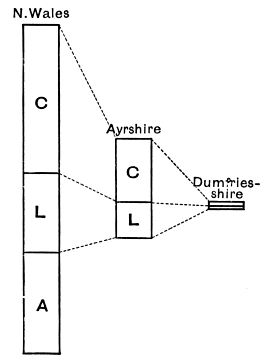
Fig. 17. Showing the variations in the characters of the Ordovician deposits of the three principal types. Scale 1 in. = 1000 feet. A = Arenig. L = Llandeilo. C = Caradoc. The thickness of the Arenig rocks of the Scotch areas is unknown.
The North Welsh area gives two different developments of the Ordovician strata, one of which is much less volcanic than the other. In the Merioneth-Caernarvon area, two great masses of volcanic rock form the Aran and Arenig hills of Merioneth and the Snowdonian group of Caernarvon. The former are of Arenig, the latter of Caradoc age. The Merionethshire volcanic rocks consist of a great thickness of lavas and ashes of intermediate composition (anderites), associated with sandy and muddy sediments of no great vertical depth. The Llandeilo beds of this area are chiefly of the nature of black shales, while the Caradoc series is represented by volcanic lavas and ashes of acid composition (felsites) with a few thin interbedded sediments. A calcareous ash forming the summit of Snowdon is of importance as being on the same horizon as a limestone (the Bala limestone) found in the other North Welsh area. The Ashgill series is not represented in Snowdonia.
In the other North Welsh tract, around Bala Lake, the volcanic matter is much less conspicuous. The Arenig rocks are not seen nearer than the Arenig mountains which form the western boundary of this second tract. The Llandeilo beds consist of shaley deposits with a well-marked limestone, the Llandeilo limestone, in the centre, whilst the Caradoc beds consist chiefly of muddy sediments with some thin ashes and a limestone, the Bala limestone, at the top. The Ashgill series contains a basal limestone, the Rhiwlas limestone, succeeded by shales, and another thin limestone called the Hirnant limestone at the summit.
In South Wales the Arenig beds[74] are chiefly composed of slates, and are divisible into an upper and lower group. The total thickness is about 2000 feet. The Llandeilo beds contain three series:—
Upper Llandeilo Slates 1000
Llandeilo Limestone 200
Lower Llandeilo Slates 800.
The Caradoc beds consist of black graptolitic shales of no great thickness, succeeded by an impure limestone on the horizon of the Bala limestone, while the Ashgill series like that of North Wales is separated into upper and lower limestone stages with an intervening stage composed of shales.
The deposits of the Welsh borderland are well developed in Shropshire, where there is practically a repetition of the Caernarvon-Merioneth development, with variations in detail. The Arenig and Caradoc volcanic rocks are not so thick as those of the Welsh district, but are nevertheless of considerable importance[75].
In the hilly region of Cumberland, Westmorland, and the adjoining parts of Yorkshire the succession differs from that of any of the Welsh regions, for the great period of volcanicity was during the formation of the Llandeilo rocks, and there were merely sporadic outbursts in Arenig and Caradoc times. The Arenig rocks consist of black shales with interstratified beds of coarser sediment, and some thin lavas and ashes of intermediate type. The Llandeilo series is represented by a very great thickness of volcanic rocks, varying in composition from basic to acid lavas, with associated pyroclastic rocks. The rocks of the Caradoc period largely consist of impure limestone with associated argillaceous rocks, and contemporaneous volcanic rocks of acid character. A marked unconformity is found locally in the centre of these. The Ashgill series consists of a basal limestone with shales above, and there is evidence that volcanic activity had not become extinct during the deposition of the rocks of this series.
Passing on to Scotland, the graptolitic type is admirably shown in the southern Uplands of the neighbourhood of Moffat, Dumfriesshire. The base of the Ordovician system has not been found, but the lowest series seems to be represented by shales with a graptolite possibly of Arenig age. Above this are volcanic beds succeeded by a group of black shales known as the Moffat shales. They are only about six hundred feet in thickness, and yet represent much of the Ordovician and part of the Silurian strata as developed elsewhere. The beds belonging to the Ordovician system are divided into two series, the Glenkiln shales below and the Hartfell shales above. The former consist of intensely black muds with few fossils save graptolites, and a deposit of chert at the base which is composed of radiolaria. The graptolites of the black shales are Upper Llandeilo forms, but the thin deposit of radiolarian chert may represent the rest of the Llandeilo period and part of the Arenig period also. The Hartfell shales are also usually black graptolite shales with lighter deposits nearly barren of organic remains; they represent the Caradoc and Ashgill series and pass conformably into the deposits of Silurian age[76]. The ordinary sedimentary type of Ordovician rocks is found in Ayrshire, though a few thin graptolitic seams are intercalated with the conglomerates and shelly sands, clays and limestones of the region, which is therefore peculiarly valuable as affording a means of comparison of the shelly type with the graptolitic type of Ordovician deposits. The Arenig series consists of black shales with graptolites, and these rocks are succeeded by a volcanic group which is probably of Llandeilo age. Above these volcanic beds, as in Dumfriesshire, we find three great divisions, two of which are of Ordovician, the third of Silurian age. The Ordovician divisions are respectively termed the Barr series, which is the equivalent of the Glenkiln shales, and the Ardmillan series above, equivalent to the Hartfell shales[77].
It is interesting to find that in the north of Ireland the rocks generally coincide in characters with those which are found along the same line of strike in Great Britain; thus, the Girvan type appears in Londonderry, Tyrone and Fermanagh, the Moffat type in County Down, and the Lake District type in the counties of Dublin and Kildare.
On the continent the volcanic material which plays so important a part in the constitution of the Ordovician accumulations of Britain is practically absent, and the strata are largely composed of accumulations of shale and limestone with occasional coarser deposits. In Scandinavia, the Arenig beds consist of limestones with a few shales, the Llandeilo deposits are largely calcareous, those of Caradoc age are partly calcareous and towards the top usually argillaceous, while the equivalents of the British Ashgill series are calcareous at the base and argillaceous at the summit. In Russia the calcareous matter preponderates over the argillaceous material.
Ordovician strata are also found in Belgium, France, Bohemia, and other places, and are largely composed of mechanical sediments of varying degrees of fineness mixed occasionally with some calcareous matter.
The variation in the characters of the Ordovician strata of Britain points to accumulation in a fairly deep sea, usually at some distance from the land, but dotted over with volcanoes which often rose above the water, causing the addition of much volcanic material to the ordinary sediments, and the existence of minor unconformities at different horizons along their flanks. As these unconformities are not always associated with volcanic material it is obvious that uplifts must have occurred occasionally during the deposition of the rocks; one important uplift is indicated by the occurrence of an unconformity in the Arenig rocks of Wales, while another is seen amongst the Caradoc rocks of the Welsh borders. On the whole, however, the period was one of slow subsidence, the deposition of material generally keeping pace with this subsidence, and accordingly there is a great uniformity of characters amongst the strata over wide areas. The probable continuation through the Ordovician period of the tract of land over the present site of the N. Atlantic ocean which as we have reason to suppose existed during Cambrian times, is indicated by similar changes of lithological character amongst the strata when traced from Britain eastward to Russia in both Cambrian and Ordovician times, and the continuance of these conditions over the American area is also indicated by study of the variations amongst the American Ordovician deposits.
The Ordovician Faunas. The Ordovician period has justly been termed the Period of Graptolites, which are the dominant forms of the time, and continue in abundance throughout the period. The abundance of graptolites in black shales associated with few other organisms has often been noted. It appears to be due to a large extent to the slow accumulation of the graptolitic deposits, allowing an abundance of these creatures to be showered upon the ocean floor, after death, for the evidence derived from detailed examination of their structure points to their existence as floating organisms. The tests of other creatures largely calcareous may well have been dissolved before reaching the sea-floor. In support of the view that these black shales are abysmal deposits may be noted the singular persistence of their lithological characters over wide areas, their replacement by much greater thicknesses of normal sediments along the ancient coast-lines, the frequent occurrence together of blind trilobites with those having abnormally large eyes when these creatures are associated with graptolites in the black shales, and lastly the interstratification of the black shales with radiolarian cherts similar to the modern abysmal radiolarian oozes. If this be so, we ought to find graptolites in marine deposits of all kinds, and indeed they are found there, though largely masked by the mass of sediment and the hosts of other included fossils, so that their discovery is rendered much more difficult than when they occur in the black shales,—a state of things which is familiar in the case of other pelagic organisms as Globigerinæ, radiolaria, and pteropods, whose tests abound in the abysmal deposits and are comparatively rare in those of terrigenous origin[78].
The characters of the Ordovician trilobites have already been noticed. These organisms are abundant, and occur in sediments of all kinds. Of other groups, the significance of the radiolaria has been referred to above. Corals occasionally form reef-like masses of limestone as in the limestones of the Caradoc epoch; the echinoderms are well represented, cystids being locally abundant; of the crustacea, many remains of tests of phyllocarida have been recorded; the brachiopods are very abundant, and of the mollusca, lamellibranchs, gastropods and cephalopods all occur with frequency though none of these groups is very prevalent. Certain forms have been referred to pteropods though with doubt, and other shells seem to be referable to the heteropods. The existence of vertebrates during Ordovician times is not, in the opinion of many geologists, proved, though remains of fishes have been recorded from the Ordovician strata of North America; but it is desirable that more evidence of this occurrence should be given[79].
The distribution of the Ordovician faunas like that of the sediments points to the prevalence of open ocean conditions over wide areas during the period, with occasional approaches to land, which was often of a volcanic nature. Around this land clustered the ordinary invertebrates, building up coral-reefs and shell-banks, whilst away in the open oceans the graptolites floated, almost alone, and sank to the ocean floor after death.
CHAPTER XVI.
THE SILURIAN SYSTEM AND THE CHANGES WHICH OCCURRED IN BRITAIN AT THE CLOSE OF SILURIAN TIMES.
Classification. The Silurian system was originally divided by its founder, Sir R. I. Murchison, into three series, as follows:—
Ludlow Series
Wenlock "
Llandovery "
The term May Hill, proposed by Sedgwick, is sometimes used as synonymous with Llandovery. This classification omits a somewhat important set of beds intercalated between those of the Llandovery and Wenlock series known as the Tarannon shales, and in Britain if we were to classify afresh, it would be more convenient to include some of the beds formerly referred to the Ludlow in the Wenlock. I shall, however, adopt the old and well-established classification, adding the term Tarannon to Llandovery, and speaking of the Llandovery-Tarannon series. The nature of the two classifications is shown in the following table:
Stages. Old Classification. New Classification. Palæontological Classification.
1 Upper Ludlow Ludlow Downtonian Fauna with Encrinurus


2 Aymestry Limestone
3 Lower Ludlow Salopian
4 Wenlock Limestone Wenlock
5 Wenlock Shale
6 Woolhope Limestone
7 Tarannon Shales Valentian Fauna with Harpes
8 Upper Llandovery Llandovery
9 Lower Llandovery
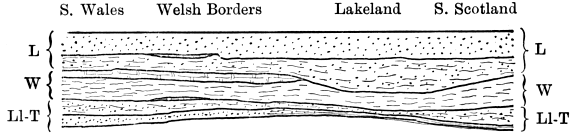
Fig. 18. L = Ludlow. W = Wenlock. Ll-T = Llandovery-Tarannon.
Description of the strata. Lithologically the Silurian deposits of Britain form a continuation of those of the Ordovician period, with a local interruption due to the elevation of portions of Wales and the Welsh borders at the close of Ordovician times. Elsewhere we find a predominance of shales passing into grits at the top of the system, the change indicating the incoming of the shallow-water phase before the commencement of the second continental period. Particular stress is laid upon the predominant shaley character of the beds, for, on account of the richness and variety of the faunas of the calcareous rocks, greater attention is naturally paid to them in geological works, and the student may get a false idea of their relative importance. An attempt is made below (Fig. 18) to give a general idea of the variations in lithological characters of the Silurian rocks in different parts of Britain.
The Silurian strata are mostly found in the same localities as those which furnish exposures of the rocks of Ordovician age.
The development in the typical Silurian region of the Welsh borders is characterised by the abundance of calcareous matter which is found there as compared with that which exists in the other British localities.
The Llandovery strata are sandy, often conglomeratic, with a fair amount of calcareous matter in places. The arenaceous nature is undoubtedly due to the proximity of land caused by local upheaval at the end of Ordovician times, and the Upper Llandovery rocks sometimes rest unconformably on the Lower ones, at other times on Ordovician, Cambrian, or even Precambrian rocks. The Tarannon shales are light green shales with intercalated grits. The Wenlock series consists of a group of shales separating a lower, very inconstant, earthy limestone from an upper, more constant, thicker and purer limestone. The latter, the Wenlock limestone, is composed of fragments and perfect specimens of various fossils, and the fragmentary nature of many of the shells indicates the occurrence of wave-action and probable formation in shallow water, in some places against coral-reefs.
The Lower Ludlow beds consist of sandy shales; they are separated from the Upper Ludlow beds by an impure limestone, the Aymestry limestone. The Upper Ludlow beds consist mainly of grits and flags, often coloured red towards the summit.
In North Wales the Llandovery beds occasionally present the shelly arenaceous types of deposit as near Llangollen, at other times as near Conway, Corwen, and in Anglesey, the graptolitic shale type. They also rest unconformably upon the Ordovician rocks in this area. The Tarannon shales resemble those of the border county. The Wenlock series consists essentially of shales, while the Ludlow development differs from that of the borders in its greater thickness and the absence of any calcareous band in the centre. In Central Wales the graptolitic type of the Llandovery-Tarannon series is found, but the graptolite-bearing shales of the Llandovery epoch are thin beds occurring between grits and flags no doubt deposited in shallow water, and this division of the series is of very great thickness.
In South Wales the Silurian rocks are very similar to those of the Welsh borders, save that the calcareous deposits are fewer and thinner.
The Lake District Silurian strata generally resemble those of North Wales. The Llandovery-Tarannon rocks are of the graptolite-shale type, intercalated with fine grits in the case of the beds of Tarannon age. The Wenlock beds consist of shales, and the Ludlow beds of gritty shales beneath, and massive flags and grits at the summit. These Ludlow beds are here of great thickness (certainly not less than 7000 feet) and were obviously accumulated for the most part in shallow water.
The Llandovery-Tarannon rocks of Southern Scotland show the two types which prevailed in the Moffat and Girvan areas in later Ordovician times. The Llandovery beds of Moffat are known as the Birkhill shales, and are very thin. The representatives of the Tarannon shales, however, the Gala beds, consist mainly of grits, and attain a great thickness. In the Girvan area, the Llandovery beds are of the shelly type. Here as at Moffat and in the Lake District there is perfect conformity between the beds of Ordovician and those of Silurian age, and accordingly it is instructive to note the completeness of the palæontological break, especially in the Moffat district. The higher Silurian beds of Southern Scotland present a general resemblance to those of North Wales and the Lake District[80].
On the European continent we find indications of conditions similar to those which prevailed during the Ordovician period; the strata become much thinner and more calcareous in Scandinavia, and still thinner in the Baltic provinces of Russia, where they consist very largely of calcareous matter. In central Europe the greater abundance of calcareous matter, compared with that which is found in the Ordovician strata of that region, points to a change in physical conditions which became still more marked after Silurian times.
In North America, the succession is very similar to that of Britain, the calcareous development of the Silurian rocks being found around Niagara, but towards the close of Silurian times the shallow-water phase became marked in places by the deposition of chemical precipitates which indicate the separation of a portion of the late Silurian ocean from the main mass during the period of formation of these abnormal deposits.
The conditions of Silurian times, until the advent of the shallow-water phase, recall those of Ordovician times and point to a wide expanse of ocean at some distance from the land, though the earliest deposits become arenaceous where they were deposited against an old land surface formed by the elevation of the Welsh Ordovician rocks, which were denuded to supply this material. One marked difference existed between the physical conditions of our area during Ordovician and Silurian times, for the volcanic activity which was rife during Ordovician times almost ceased during Silurian times, except in the region now occupied by the extreme south-west of Ireland, and accordingly volcanic material does not appreciably contribute to the formation of the Silurian deposits. The shallowness of the sea-floor at times is marked by the occurrence of masses of reef-building corals in the limestones, and these probably indicate the prevalence of a fairly warm climate, an inference supported by the nature of the Gastropod fauna of Gothland, as noticed in Chap. IX.
The shallow-water phase commences fairly simultaneously over the whole area at the beginning of the deposition of the Lower Ludlow rocks, and becomes more marked in the Upper Ludlow rocks, being most noticeable at their extreme summit, when a change occurred which will be considered at the conclusion of this chapter.
The Silurian Faunas[81]. The Silurian period has been termed the period of Crinoids, and this group of creatures certainly contained a great variety of very remarkable forms, which are specially numerous in the Wenlock Limestone of the Welsh borders, Gothland, and North America, but many of the rocks of the system display few traces of these organisms. The trilobites and graptolites still contribute largely to the fauna, the latter becoming very scarce at the summit of the system, though a few specimens have been detected in the rocks of the succeeding system. The trilobites belong to few genera though these are mostly more highly organised than those of the Ordovician period. The genus Harpes has been taken as fairly characteristic of the lower part of the system in Sweden, and it occurs there abundantly in places in Britain, whilst Encrinurus is more abundant in the upper series, but both of these genera range from higher Ordovician beds into the Devonian. Mention has already been made of the corals. Brachiopods are very abundant, and Mollusca appear with considerable frequency. The appearance of true insects is of importance, cockroaches have been recorded from Silurian rocks and a number of other insects have lately been recorded from Canada[82]. Eurypterids occur in considerable abundance in the higher parts of the system, as do also the remains of fish.
The close of Silurian times ushered in the second continental period in Britain when a large part of our area and the adjoining areas to the north and north-east were uplifted to form land, which in the case of our area was interpenetrated by watery tracts, whose exact nature is still a subject of dispute. Accordingly the deposits which were formed during this period are local and in some cases abnormal, but they will be considered in the next chapter. Simultaneously with the formation of these deposits, uplift of the sea-floor converted wider and wider areas into land, and this land underwent considerable denudation, so that the tops of the anticlines were worn away. The general trend of the anticlines was east-north-east and west-south-west, and accordingly a series of mountain chains possessed that direction, for the epeirogenic movements were accompanied by orogenic ones. Between the regions of uplifts were depressions in which sediments accumulated. The principal axes of uplift in our area range through the North of Scotland towards Scandinavia, across the Southern Scotch Uplands to the North of Ireland, through the Lake District and through Wales. As the result of lateral pressure, a cleavage structure was impressed on many of the Lower Palæozoic rocks, the strike of the rocks extended in the direction of the ridges and depressions, and the rocks as a whole became considerably compacted and hardened, thus producing one of the most important portions of the framework of our island, for although the ancient mountain chains were largely denuded during their elevation, and their stumps were afterwards covered by later deposits, upon the removal of these, the ancient stumps were once more exposed as fairly rigid masses which do not yield greatly to denuding influences, and accordingly stand out as the most important upland regions of Britain at the present day.
It is interesting to notice, as an illustration of the now well established fact that successive earth movements often occur in the same direction, that the axes of the folds produced during this second continental (Devonian) period, run parallel with the lines separating tracts of different lithological characters. It has been seen that the Ordovician and Silurian rocks of the Southern Uplands continue into Ireland, and that the beds of similar characters run in belts having a general east-north-east and west-south-west trend, which accordingly must have been the direction of the coast-line parallel to which they were deposited, and as that coast-line was due to uplift, the movement which produced it would naturally produce foldings with east-north-east and west-south-west trend. This is one of many cases where the lines separating belts of rock having different lithological characters run parallel to axial lines of folds which have been produced in the rocks at a later period.
As the result of the existence of land over parts of north-west Europe in Devonian times, it is comparatively rare to find a passage from normal Silurian rocks into normal Devonian ones; there is often an unconformity above the Silurian strata. As we proceed southwards towards central Europe, where the epeirogenic and orogenic movements died out, this is not the case, and we get complete conformity between marine sediments of the Silurian and Devonian periods.
CHAPTER XVII.
THE DEVONIAN SYSTEM.
Classification. As a result of the movements which were briefly described in the last chapter, two types of Devonian deposit are found in the British Isles, and are called respectively the Devon type and the Old Red Sandstone type. The latter rocks, formerly divided into three divisions, are now separated into two only, the upper and lower Old Red Sandstone, and the exact relation of these to the different subdivisions of the rocks of Devon type remains to be settled. The Devon type itself has given rise to much difference of opinion, two local classifications have been applied, one for the rocks of North Devon and another for those of South Devon. The classification which has been most generally adopted is as follows:—
N. Devon. S. Devon[83].
Upper Devonian (Clymenian) Pilton Beds Cucullæa (Marwood) Beds Pickwell Down Sandstone Entomis Slates Goniatite Limestones and Slates Massive Limestones
Middle Devonian (Eifelian) Morte Slates Ilfracombe Beds Middle Devonian Limestones Ashprington Volcanic Series Eifelian Slates and Shaly Limestones

Lower Devonian (Coblenzian) Hangman Grits Lynton Slates Foreland Grits Lower Devonian Slates Lincombe and Warberry Grits and Meadfoot Sands
The division into Lower Middle and Upper Devonian is generally adopted, though the alternative titles given to these divisions are not always used with the same signification, and the distribution of the different local stages given in the above classifications is usually adopted in the main, though a detailed comparison of the Devonian beds of North and South Devon is still attended with difficulty.
More than once an attempt has been made to prove that the apparent succession of the North Devon rocks, which is that given in the above table, is not the true one, and of recent years Dr Hicks has obtained a number of fossils from the Morte Slates which had hitherto yielded none, and he believes that these fossils indicate that the Morte Slates are on a lower horizon than the beds on which they rest. Whatever be the ultimate verdict, we can, at any rate, say that the "Devonian Question," as it is termed, is not settled[84].
Description of the Strata. The general variations in the lithological characters of the deposits of Devonian age will be seen from the accompanying figure which represents the deposits of Britain as they occurred from north to south before they had been affected by subsequent earth-movements (Fig. 19). The conventional signs which are used are similar to those which have been used in other parts of this work, and will save description of the section.

Fig. 19.
A. Lower Palæozoic and Precambrian Rocks.
N.S. North of Scotland Old Red Sandstone Type.
C.V. Central valley of ditto
W. Wales
N.D. North Devon Devon Type.
S.D. South Devon
The ridges separate different deposits of Devonian rocks, which were possibly deposited in isolated areas, though there was probably connexion between them at any rate at times.
The Old Red Sandstone type consists to a large extent, as the name implies, of sandstones which are coloured red by a deposit of peroxide of iron around the sand grains. They are separable into a lower and upper division with an unconformity often occurring between them. The lower Old Red passes down in places into the Silurian rocks with perfect conformity, and the upper Old Red similarly passes up into the Carboniferous strata. The existence of pebble beds at different horizons is a noteworthy feature. They are frequently found at or near the base of the two divisions. The sandstones of the lower division are often accompanied by flagstones, while the red sandstones of the upper division usually have deposits of yellow and brown sandstone intercalated between them. Inconstant beds of limestone, known as cornstones, are found in both divisions, and Prof. Sollas has shown that some of these, at any rate, are true mechanical deposits, formed by the destruction of pre-existing strata of limestone and the deposition of the resulting fragments from a state of suspension. In Scotland a great thickness of volcanic material of various kinds is associated with the two divisions. For the sake of simplicity this is omitted from Fig. 19[85]. It is not known how far normal sediments are associated with the Old Red Sandstone type of deposit. The existence of some in South Wales is suggested by evidence supplied by the late Mr J. W. Salter.
The Devon type, as will be seen in the figure, consists of rocks which are to a great extent of normal character. We find in Devonshire alternations of sandstones, shales and limestones, but even here, red sandstones, which are comparable with those of the Old Red type occur in diminished amount: the Foreland Grits and Pickwell Down Sandstones are both coloured red, and are like the sandstones formed further north. The recognition of this fact induces one to believe that the contrast between the two types of rock which are found at a short distance from one another on opposite sides of the Bristol Channel is not so marked as one is sometimes led to suppose.
The rocks of North Devon differ from those of South Devon chiefly owing to the amount of calcareous sediment found in the two areas, for limestones occur in South Devon to a great extent, and in North Devon there is a comparative poverty of this kind of sediment. Here, again, the apparent difference is possibly greater than the real one. The North Devon limestones have in places been stretched out after their formation and thus rendered thinner, and the highly-cleaved limestones are occasionally mistaken for shales, while in South Devon there is evidence of thickening of the limestones by folding subsequently to their deposition. Allowing for these changes, however, there is still a marked diminution in the amount of coarse mechanical sediments and increase in the quantity of calcareous matter as one passes from North to South Devon, and this prepares one for the condition of things met with on parts of the continent, where the mechanical sediments become finer and thinner on the whole as one travels southward, until, when we reach the Bohemian area, the Devonian rocks are found to be largely composed of calcareous sediments.
It is interesting to find that in North America the two types of Devonian strata recur, and present characters generally similar to those which they possess upon this side of the Atlantic.
Passing now to a consideration of the conditions under which the Devonian rocks were deposited, we may examine the bearing of the character of the strata as a whole, and then proceed to more detailed consideration of the nature and conditions of deposits of the two types.
The gradual increase in calcareous matter and dying out of mechanical sediments as one travels southward points to recession from land in that direction, and we have already seen that the epeirogenic and orogenic movements of this continental period elevated the Silurian sea-floor in the north, and gave rise to a Northern Continent, while oceanic conditions continued further South, and allowed the accumulation of sediments lying conformably upon those of Silurian age, and giving indications of the prevalence of physical conditions during Devonian times which were in the main similar to those of the preceding Silurian period.
In the shallow waters adjoining the land of the Northern Continent the Old Red Sandstones were laid down, and the exact conditions under which they were accumulated is a matter of some interest. The late Sir Andrew Ramsay gave reasons for supposing that many red deposits were accumulated in the waters of inland lakes, which underwent rapid evaporation, and his views have been applied, with much corroborative evidence by Sir A. Geikie, to account for the red sandstones of Devonian age, which he believes to have been accumulated in a series of inland lakes, though others hold a different opinion, and consider that the Old Red Sandstone waters had a direct connexion with those of the open ocean; the question is too intricate to be discussed at length here. Besides the difference of physical characters of the two types of strata, the difference in the nature of their included organisms is significant. The ordinary invertebrates, as corals, crinoids, brachiopods and molluscs are extremely rare in the Old Red Sandstone, which contains remarkable remains of Agnatha fishes and eurypterids, and although these are also found associated with a true marine fauna in Russia, Germany and Bohemia, the rarity or apparent absence of the ordinary marine invertebrates, though only negative evidence, which is proverbially dangerous, must be regarded.
The North Devon rocks are sediments which might well be accumulated on the shores of a continent, while those of South Devon, with their abundant coral reefs, and other organic limestones were no doubt deposited in a clearer sea, at a greater distance from the land, and the clear water deposits of Germany and still more of Bohemia, were accumulated in the open ocean. It is interesting to note in these Bohemian deposits abundance of shells of a Pteropod Styliola which has been proved by Prof. H. A. Nicholson to form masses of limestone in the Devonian system of Canada. The modern distribution of the Pteropoda suggests the open ocean character of the deposits which contain them even so far back as Devonian times, though one cannot conclude that these deposits are really analogous to the so-called Pteropod ooze of modern seas which, as a matter of fact, is largely composed of foraminiferal tests with a considerable percentage of pteropod shells.
The Devonian flora and faunas. The plant remains in the Lower Palæozoic rocks are few in number. Some undoubted terrestrial plants have been discovered, but the prevalent flora of lower Palæozoic times, so far as yet known, was one consisting of Algæ. In Devonian times we begin to meet with a number of Cryptogams of higher type, allied to those which form the dominant flora of the succeeding period. The fauna is in many ways remarkable. The Devonian period has been termed the period of ganoid fishes, and the remarkable remains, so graphically described by the late Hugh Miller, are indeed peculiarly characteristic of Devonian times, but they are largely though by no means exclusively entombed in rocks of the Old Red Sandstone type[86]. The Devon type of rock contains a great abundance and variety of the problematical group, the Stromatoporoids, which contribute extensively to the formation of many of the limestones, and although these organisms are not by any means confined to Devonian strata, their abundance and variety therein might lead one to speak of the period as that of Stromatoporoids. The remains of corals are very abundant in the limestones, and, as already stated, frequently give rise to true reef-masses. The graptolites, as remarked in the previous chapter, disappear in the rocks of the Devonian period, and as only one or two fragments have been found, we may assert that the group was practically extinct at the end of Silurian times, though species of one genus, Monograptus, lingered for a short time in greatly diminished quantity. The trilobites which played so important a part amongst the faunas of Lower Palæozoic times still occur fairly abundantly amongst the rocks of the Devonian system, and there is a very interesting point to be noticed in connexion with them. They seem to have become practically extinct in the succeeding Carboniferous period, where few genera are found, and the decadence of the group began in Devonian times. In these circumstances it is interesting to note the tendency displayed by the creatures to possess spiny coverings. It is true that Acidaspis, the most spinose of all trilobites, is abundant in Ordovician and Silurian strata, and that other spinose trilobites are found there, but the peculiarity of the Devonian trilobites is, that genera which were previously smooth, or rarely possessing one or few spines, are found represented by extremely spinose species in these beds,—the spines being developed from all parts of the test, sometimes as a fringe to head or tail, sometimes as prominent projections from glabella and neck segment, and frequently in rows down the body segments. Besides Acidaspis, we find spinose species of Phacops, Homalonotus, Cyphaspis, Bronteus and Encrinurus in Devonian strata, and the occurrence of these forms is so frequent and world-wide, that one might perhaps infer with confidence that an unknown fauna containing many spiny trilobites was of Devonian age.
The abundance of Eurypterids has been previously noted. Occurring as they do in Silurian rocks, they are far more abundant in those of Devonian age, and are found indifferently in sediments of Old Red and Devon types. Of air breathers, several insects have been found in the strata of different parts of the world.
The ordinary marine faunas are otherwise intermediate in character between those of the Silurian and Carboniferous periods, but there are several characteristic Devonian genera, and no one who is acquainted with the peculiarity of the Devonian fauna would deny to the Devonian strata the right to rank as a separate system, containing a fauna as well marked in its way as that of the Silurian system below or that of the Carboniferous above. Special stress is laid upon this point because it has been suggested that the Devonian system should be abolished, and its strata either divided between the Silurian and Carboniferous systems or referred exclusively to the latter system[87].