THE PRACTICAL GARDEN-BOOK
Reading edition

AB CD EF G
HI KL MN O
PR ST VW Z
Abobra viridiflora. A handsome tender climber with tuberous roots, that may be taken up in the fall and stored in a cellar. The foliage is dark and glossy, the flowers small and inconspicuous; but the small scarlet fruits are very effective in contrast to the leaves, making it a desirable screen plant. It is sold by seedsmen. Seeds sown as soon as warm weather comes will give plants which bloom in the open (in a warm soil and exposure), and which reach a height of 5-8 ft. It is sometimes grown as a glasshouse plant. It is cucurbitaceous (allied to melons and gourds).
Abronia. Californian trailing perennials, but treated as hardy annuals. They thrive in any warm, open garden soil, and are very satisfactory for the margins of beds or borders. The little flowers are borne in clusters. A. latifolia or arenaria (yellow) and A. umbellata or grandiflora (pink) are the leading kinds. Usually sown where they are to bloom. Peel the husk off the seed before sowing.
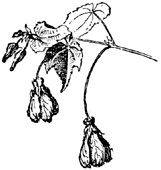
Abutilon striatum
Abutilons, or Flowering Maples as they are called by many, make fine house or bedding plants. Common kinds may be grown from seed or from cuttings of young wood. If the former, the seed should be sown in February or March in a temperature of not less than 60°. The seedlings should be potted when from four to six leaves have grown, in a rich, sandy soil. Frequent pottings should be made to insure a rapid growth, making plants large enough to flower by fall. Or, the seedlings may be planted out in the border when danger of frost is over, and taken up in the fall before frost: these plants will bloom all winter. About one-half of the newer growth should be cut off when they are taken up, as they are very apt to spindle up when grown in the house. When grown from cuttings, young wood should be used, which, after being well rooted, may be treated in the same manner as the seedlings. The varieties with variegated leaves have been improved until the foliage effects are equal to the flowers of some varieties; and, these are a great addition to the conservatory or window garden. The staple spotted-leaved type is A. Thompsoni. A compact form, now much used for bedding and other outdoor work, is Savitzii, which is a horticultural variety, not a distinct species. The old-fashioned green-leaved A. striatum, from which A. Thompsoni has probably sprung, is one of the best. A. megapotamicum or vexillarium is a trailing or drooping red-and-yellow-flowered species, which is excellent for baskets. It propagates readily from seed. Abutilons are most satisfactory for house plants when they are not much more than a year old. They need no special treatment.
Aconitum. Monk’s Hood. Wolf’s Bane. Hardy herbaceous perennials allied to larkspurs. They are showy border plants, usually flowering the first year from seed, if the seed is started early, and bearing panicles of quaint hood-shaped, rich flowers. The colors have a wide range, but are usually deep blue. The improved varieties are much superior in size and markings. Aconitums are most effective when planted in a mixed border: the flower stalks being held well up, show the blossoms to good advantage. Seed may be sown every two years, as the plants in their year-old and 2-year-old stage have the largest blossoms. Sow in gentle heat in March, transplanting to border when the weather is settled. Roots may be divided if desired, but best results are to be expected from seedlings. A. Napellus is the commonest one. The plants are very poisonous if eaten. Bloom in early summer. 2-3 ft.
Acroclinium. A low-growing everlasting annual flower, white, violet, or rose in color. Seeds should preferably be started in a hotbed or window, and planted out when danger of frost is past; the flowers should be gathered when half expanded and hung in the shade to dry. Half-hardy. Plant 1 foot apart. Grow 10-15 in. high. See Everlastings.
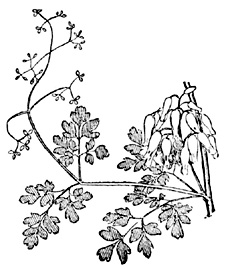
Adlumia cirrhosa
Adlumia. Mountain Fringe. Allegheny Vine. One of the daintiest of climbers, making a very rapid growth, and when once established seeding itself and thriving for years, growing 10 or 15 feet in a season. Give rich, rather moist soil. It is biennial, blooming the second year. Flowers like those of the bleeding heart and other dicentras. It is native.
Adonis. A low-growing hardy annual or perennial of the easiest culture. It makes a fine mass effect, as the flowers are a striking dark scarlet or crimson color, and the plants are very free and continuous bloomers. Sow early in the spring where wanted. The perennial yellow-flowered sorts sometimes bloom the first year from seed. Adonises are very neat in habit, and the foliage is fine and interesting. 10-15 in.
Agapanthus. African Lily. A tuberous-rooted, well known conservatory or window plant. It lends itself to many conditions and proves satisfactory a large part of the year, the leaves forming a green arch over the pot, covering it entirely in a well grown specimen. The flowers are borne in a large cluster on stems growing from 2 to 3 ft. high, as many as two or three hundred bright blue flowers often forming on a single plant. A large, well grown plant throws up a number of flower-stalks through the early season. The one essential to free growth is an abundance of water and an occasional application of manure water. Propagation is effected by division of the offsets, which may be broken from the main plant in early spring. After flowering, gradually lessen the quantity of water until they are placed in winter quarters, which should be a position free from frost and moderately dry. The Agapanthus, being a heavy feeder, should be grown in strong loam to which is added well rotted manure and a little sand.
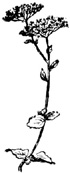
Ageratum
Ageratum. A half-hardy annual, used as a border plant, for ribbon bedding for mass effect, or in mixed beds of geranium, coleuses and other plants. The seeds germinate readily, but as the plant is only half-hardy and is usually wanted in flower when planted out, it is usual to sow the seed in boxes placed in hotbeds or windows in March, transplanting the seedlings to small boxes or pots and growing the young plants on until the 1st of May, when they may be planted out. Pieces of young wood root very easily, and the gardener usually increases his stock by cuttings. The dwarf varieties are the most desirable, and the two colors, blue and white, may be planted together. 2-3 ft. Plants may be taken up in the fall and set in the house; cut them back severely.
Allegheny Vine. See Adlumia.
Almond is about as hardy as the peach, but it blooms so early in the spring that it is little grown east of the Pacific slope. It is an interesting ornamental tree, and its early bloom is a merit when the fruit is not desired. The Almonds commonly sold by nurserymen in the east are hard-shell varieties, and the nuts are not good enough for commerce. The Almond fruit is a drupe, like the peach, but the flesh is thin and hard and the pit is the “Almond” of commerce. Culture the same as for peach.
Flowering Almond is a very early-flowering bush, excellent for shrub-borders. It is usually grafted on plum stock, and one must take care to keep down the plum sprouts which sometimes spring from the root.
Aloe. Succulent tropical plants, sometimes seen in window gardens. Of easy culture. See that the pots have perfect drainage. Make a soil of sandy loam, with one-third or one-fourth part of broken brick. Pot firmly. Water whenever needed, but the soil and drainage should be such that the earth does not remain soggy or become sour. Aloes thrive year after year without repotting. Usually propagated by cuttings. A. variegata is the commonest species.
Alonsoa. Tender annual. Not very well known, but a bright plant for second-row border or a low bedding plant. Planted against shrubbery or other protection after danger of frost is over, it lightens up a dark corner. 2-3 ft. Plant 10-15 in. apart, in a warm place protected from wind.
Alströmeria. The Alströmerias belong to the amaryllis family, being tuberous-rooted plants, having leafy stems and terminating in a cluster of from 10 to 50 small lily-shaped flowers of rich colors. Most of the kinds should be given pot culture, as they are easily grown and are not hardy in the open in the north. The culture is nearly that of the amaryllis,—a good, fibrous loam with a little sand, potting the tubers in early spring or late fall. Start the plants slowly, giving only water enough to cause root growth; but after growth has become established, a quantity of water may be given. After flowering they may be treated as are amaryllis or agapanthus. The plants grow 1-2½ ft. high. The flowers often have odd colors.
Althæa. See Hollyhock.
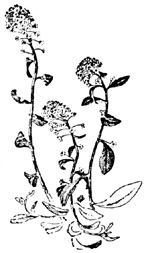
Sweet Alyssum
Alyssum, Sweet. A low-growing, hardy, white-flowered, very fragrant annual which is much used for edgings, window boxes, and the like. It is of the easiest culture in any soil, but thrives best in a garden loam of moderate fertility. Seeds may be sown as early as the ground can be well prepared in spring. The plant will begin to bloom when 2 or 3 inches high, and continue to bloom, as it grows, until after the first hard frosts. It makes a mat 1 to 2 ft. across. If immediate effects are not desired, the plants should be thinned out or transplanted to stand half a foot apart. It rarely stands more than a foot high. In the fall, plants may be cut back and put into pots or boxes, and they will bloom in the window. Better results in winter blooming are secured by starting seeds in boxes in August, September or October. There are certain hardy perennial yellow-flowered Alyssums which are useful for prominent edgings and for rockwork.
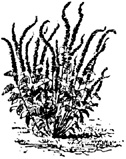
Prince’s Feather
Amarantus. Decorative annuals. One species (with erect spikes) is known as Prince’s Feather, another (with variegated foliage) as Joseph’s Coat, and still another (with drooping spikes) as Love-lies-bleeding. Probably the finest of the list is A. salicifolius, often called Fountain Plant. This has graceful willow-shaped leaves, banded and tipped with carmine, bronze and orange. The tall kinds make fine screens for unsightly objects. They may also be used against masses of green to add color. The Amaranths are half-hardy or tender plants, and should be sown in boxes in March or April, to be planted out after all danger of frost is past. Seeds may also be sown where the plants are to stand. They were once among the most popular of garden plants, but for a few years have been neglected. Fine colors have recently been developed, and they are again becoming favorites. As they are rather coarse and weedy plants, do not use them with dainty flowers. Most kinds grow 2-3 ft. high and spread 2-3 ft.
Amaryllis. Popular name of a variety of house or conservatory tender bulbs, but properly applied only to the Belladonna Lily. Most of them are hippeastrums, but the culture of all is similar. They are satisfactory house plants. The one objection to their culture is the habit of the flower-stalk starting into growth before the leaves start. This is caused in most cases by stimulating root growth before the bulb has had sufficient rest. The bulbs should be dormant for four or five months in a dry place with a temperature of about 50°. When wanted to be brought into flower, the bulbs, if to be repotted, should have all the dirt shaken off and potted in soil composed of fibrous loam and leaf-mold, to which should be added a little sand. If the loam is a heavy one, place the pot in a warm situation; a spent hotbed is a good place. Water as needed, and as the flowers develop liquid manure may be given. If large clumps are well established in 8- or 10-inch pots, they may be top-dressed with new soil containing rotted manure, and as growth increases liquid manure may be given twice a week until the flowers open. After flowering, gradually withhold water until the leaves die. The most popular species for window gardens is A. Johnsoni (properly a hippeastrum), with red flowers.
Amethyst. See Browallia.
Ammobium. A half-hardy perennial everlasting with white flowers. Thrives best in sandy soil. Sow seeds where plants are to stand. Although perennial, it blooms the first year from seed, and is usually treated as an annual. 2-3 ft. high. Plant 12-18 in. apart.
Ammoniacal Carbonate of Copper. See under Bordeaux Mixture.
Anchusa. Hardy annuals and perennials, fit for heavy borders. The plants grow to the height of 2 to 3 feet and bear purple or blue flowers, which are showy either on the plant or in bouquets. Propagated from seed sown in early spring, either where the plants are to stand or in boxes or hotbeds. The common kind is annual. Blooms in summer.
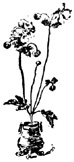
Spray of Anemone Japonica
Anemone. Wind Flower. A group of hardy perennials. The best known of this genus is A. Japonica alba, or Honorine Jobert. This species blooms from August to November, and is at that season the finest of border plants. The pure white flowers, with lemon-colored stamens, are held well up on stalks 2-3 ft. high. The flower stems are long and excellent for cutting. This species may be propagated by division of the plants or by seed. The former method should be put into practice in the spring; the latter as soon as the seeds are ripe in the fall. Sow the seed in boxes in a warm, sheltered situation in the border or under glass. The seed should be covered lightly with soil containing a quantity of sand and not allowed to become dry. A well enriched, sheltered position in a border should be given. There are red-flowered varieties.
The varieties of A. coronaria are tuberous-rooted plants. The tubers of these should be planted in the fall, late in September or early in October, in a well enriched, sheltered border, setting the tubers 3 in. deep and from 4-6 in. apart. The surface of the border should be mulched with leaves or strawy manure through the severe winter weather, uncovering the soil in March. The flowers will appear in April or May, and in June or July the tubers should be taken up and placed in a dry place in sand until the following fall. This section is not as well known as it should be. The range of color is very wide. The flowers are often 2 in. across, and are lasting. These tubers may be planted in pots in the same manner as in the border, bringing them into the conservatory or house at intervals through the winter, where they make an excellent showing when in bloom.
The little wild Wind Flowers are easily colonized in a hardy border.
Annuals. The annual flowers of the seedsmen are those which give their best bloom in the very year in which the seeds are sown. True annuals are those plants which complete their entire life-cycle in one season. Some of the so-called annual flowers will continue to bloom the second and third years, but the bloom is so poor and sparse after the first season that it does not pay to keep them.
Most annuals will bloom in central New York if the seeds are sown in the open ground when the weather becomes thoroughly settled. But there are some kinds, as Cosmos and Moonflowers, for which our season is commonly too short to give good bloom. These kinds may be started early in the house or in hotbeds; and similar treatment may be given any plants of which it is desired to secure blooms before the normal time.
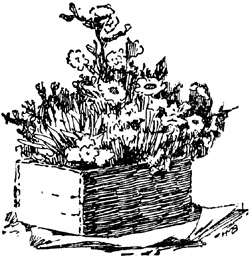
A box garden
Prepare the ground thoroughly and deep. Annuals must make a quick growth. See that the soil contains enough humus or vegetable mold to make it rich and to enable it to hold moisture. If the ground is not naturally rich, spade in well-rotted manure or mold from the woods. A little commercial fertilizer may help in starting off the plants quickly. Prepare the land as early in spring as it is in fit condition, and prevent evaporation by keeping the surface loose by means of raking.
If the flowers are to be grown about the edges of the lawn, make sure that the grass roots do not run underneath them and rob them of food and moisture. It is well to run a sharp spade deep into the ground about the edges of the bed every two or three weeks for the purpose of cutting off any grass roots which may have run into the bed. If beds are made in the turf, see that they are 3 ft. or more wide, so that the grass roots will not undermine them. Against the shrub borders, this precaution may not be necessary. In fact, it is desirable that the flowers fill all the space between the overhanging branches and the sod.
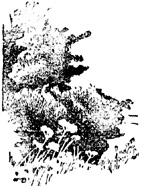
Flowers against a border
Sow the seeds freely. Many will not germinate. Even if they do all germinate, the combined strength of the rising plantlets will break the crust on the hard soils; and in the thinning which follows, only strong and promising plants are allowed to remain. Better effects are also often secured when the colors are in masses, especially if the flowers are thrown into the bays of heavy shrub borders.
Plants continue to bloom for a longer period if they are not allowed to produce seeds. The flowers should be picked, if possible, as soon as they begin to fade.
In the selection of the kinds of annuals, one’s personal preference must be the guide. Yet there are some groups which may be considered to be standard or general-purpose plants. They are easily grown almost anywhere, and are sure to give satisfaction. The remaining plants are mostly such as have secondary value, or are adapted to particular purposes or uses.
The groups which most strongly appeal to the writer as staple or general-purpose types are the following: Petunias, phloxes, pinks or dianthuses, larkspurs or delphiniums, calliopsis or coreopsis, pot marigold or calendula, bachelor’s button or Centaurea Cyanus, clarkias, zinnias, marigolds or tagetes, collinsias, gilias, California poppies or eschscholtzias, verbenas, poppies, China asters, sweet peas, nemophilas, portulacas, silenes, candytufts or iberis, alyssum, stocks or matthiolas, morning-glories, nasturtiums or tropæolums.
Annual flowers possess a great advantage over perennials in the fact that they appeal strongly to the desire for experiment. The seeds are sown every year, and there is sufficient element of uncertainty in the results to make the effort interesting; and new combinations can be tried each year.
Do not cut the old stalks down in the fall. They will stand in the snow all through the winter, and remind you of the bursting summer time and the long-ripening fall; and the snow-birds will find them in the short days of winter.
Some of the most reliable and easily grown annuals for the north are given in the following lists (under the common trade names):
WHITE FLOWERS
Ageratum Mexicanum album.
Alyssum, Common Sweet.
Alyssum, Sweet, compacta.
Centranthus macrosiphon albus.
Convolvulus major.
Dianthus, Double White Margaret.
Iberis amara.
Iberis coronaria, White Rocket.
Ipomœa hederacea.
Lavatera alba.
Malope grandiflora alba.
Matthiola (Stocks), Cut and Come Again.
Matthiola, Dresden Perpetual.
Matthiola, Giant Perfection.
Matthiola, White Pearl.
Mirabilis longiflora alba.
Nigella.
Papaver (Poppy), Flag of Truce.
Papaver, Shirley.
Papaver, The Mikado.
Phlox, Dwarf Snowball.
Phlox, Leopoldii.
Zinnia.
YELLOW FLOWERS
Cacalia lutea.
Calendula officinalis, Common.
Calendula officinalis, Meteor.
Calendula sulphurea.
Calendula suffruticosa.
Calliopsis bicolor marmorata.
Calliopsis cardaminæfolia.
Calliopsis elegans picta.
Cosmidium Burridgeanum.
Erysimum Peroffskianum.
Eschscholtzia Californica.
Hibiscus Africanus.
Hibiscus, Golden Bowl.
Ipomœa coccinea lutea.
Loasa tricolor.
Tagetes, various kinds.
Thunbergia alata Fryeri.
Thunbergia alata aurantiaca.
Tropæolum, Dwarf, Lady Bird.
Tropæolum, Tall, Schulzi.
Zinnia.
BLUE FLOWERS
Ageratum Mexicanum.
Ageratum Mexicanum, Dwarf.
Browallia Czerniakowski.
Browallia elata.
Centaurea Cyanus, Victoria Dwarf Compact.
Centaurea Cyanus minor.
China Asters of several varieties.
Convolvulus minor.
Convolvulus minor unicaulis.
Gilia achilleæfolia.
Gilia capitata.
Iberis umbellata.
Iberis umbellata lilacina.
Kaulfussia amelloides.
Kaulfussia atroviolacea.
Lobelia Erinus.
Lobelia Erinus, Elegant.
Nigella.
Phlox variabilis atropurpurea.
Salvia farinacea.
Specularia.
Verbena, Black-blue.
Verbena cœrulea.
Verbena, Golden-leaved.
Whitlavia gloxinoides.
RED FLOWERS
Cacalia, Scarlet.
Clarkia elegans rosea.
Convolvulus tricolor roseus.
Dianthus, Half Dwarf Early Margaret.
Dianthus, Dwarf Perpetual.
Dianthus Chinensis, Double.
Gaillardia picta.
Ipomœa coccinea.
Ipomœa volubilis.
Matthiola annuus (Stocks).
Matthiola, Blood-red Ten Weeks.
Matthiola grandiflora, Dwarf.
Papaver (Poppy) cardinale.
Papaver, Double.
Papaver, Mephisto.
Phaseolus multiflorus.
Phlox, Large-flowering Dwarf.
Phlox, Dwarf Fireball.
Phlox, Black Warrior.
Salvia coccinea.
Saponaria.
Tropæolum, Dwarf, Tom Thumb.
Tropæolum, Dwarf.
Verbena hybrida.
Verbena hybrida, Scarlet Defiance.
Zinnia.
GOOD FOR EDGINGS OF BEDS AND WALKS
Alyssum, Sweet.
Brachycome.
Collinsias.
Dianthuses or Pinks.
Gypsophila muralis.
Iberis or Candytufts.
Leptosiphons.
Lobelia Erinus.
Nigellas.
Nemophilas.
Portulacas or Rose Moss.
Saponaria Calabrica.
Specularia.
KINDS WHICH CONTINUE TO BLOOM AFTER FROST
Abronia umbellata.
Adonis æstivalis.
Adonis autumnalis.
Argemone grandiflora.
Calendulas.
Callirrhoë.
Carduus Benedictus.
Centaurea Cyanus.
Centauridium.
Centranthus macrosiphon.
Cerinthe retorta.
Cheiranthus Cheiri.
Chrysanthemums.
Convolvulus minor.
Convolvulus tricolor.
Dianthus of various kinds.
Elscholtzia cristata.
Erysimum Peroffskianum.
Erysimum Arkansanum.
Eschscholtzias, in several varieties.
Gaillardia picta.
Gilia Achilleæfolia.
Gilia capitata.
Gilia laciniata.
Gilia tricolor.
Iberis affinis.
Lavatera alba.
Matthiolas or Stocks.
Œnothera rosea.
Œnothera Lamarckiana.
Œnothera Drummondii.
Phlox Drummondii.
Podolepis affinis.
Podolepis chrysantha.
Salvia coccinea.
Salvia farinacea.
Salvia Horminum.
Verbenas.
Vicia Gerardii.
Virginian Stocks.
Viscaria elegans.
Viscaria oculata.
Viscaria cœli-rosa.
Antirrhinum. See Snapdragon.
Apple, the “King of Fruits,” thrives over a wider range of territory and under more varied conditions than any other tree fruit. This means that it is easy to grow. In fact, it is so easy to grow that it usually is neglected; and people wonder why the trees do not bear.
The selection of varieties of Apples for home use is, to a large extent, a personal matter; and no one may say what to plant. A variety that is successfully grown in one section may prove disappointing in another. One should study the locality in which he wishes to plant and choose those varieties which are the most successfully grown there,—choosing from amongst the successful kinds those which he likes best and which seem best to meet the purposes for which he is to grow them. When the selection is made, the trees should be procured from a near-by nurseryman, if possible, as one is then able to select his own trees, receive them in the shortest time, and plant them before they have become dry.
The land on which an orchard is to be planted should have been in cultivation at least two years previous to setting the trees and be in a fine physical condition. Dig the hole broad and deep enough to take in all the roots left after pruning off the bruised ends caused by digging up the tree, and trim back the branches at least two-thirds, making a smooth cut. Set the trunk in the center of the hole, and sift the fine dirt down through the roots, slightly lifting the tree once or twice in order that the fine soil may settle under the roots, making congenial soil for the new roots to run through. Fill in over the roots, gradually firming the soil above with the feet. When the hole is full, firm the soil around the trunk to prevent whipping by the wind, leaving the surface level. If the trees are set in the fall a slight earthing up to the trunk may be beneficial in certain soils, and if set in a dry spring a mulch of straw or grass will benefit them. Two- or 3-year-old trees (usually the latter) are the most desirable for planting in home grounds. Commercial orchards are often planted exclusively with 2-year-olds.
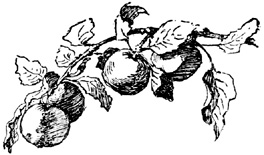
Spray of Apples
In orchard cultivation, Apple trees are usually planted 35 to 40 ft. apart each way. In home grounds they may be placed somewhat closer than this, especially if they are planted upon the boundaries, so that the limbs may project freely in one direction.
It is ordinarily advisable, especially in the humid climates east of the Great Lakes, to have the body of the tree 3½ to 4½ ft. long. The limbs should be trimmed up to this point when the tree is set. From three to five main branches may be left to form the framework of the top. These should be shortened back one-fourth or one-half when the tree is set. Subsequent pruning should keep the top of the tree open and maintain it in more or less symmetrical form. See Pruning.
In orchard conditions, the trees should be kept in clean culture, especially for the first few years; but this is not always possible in home yards. In lieu of tillage, the sward may be mulched each fall with stable manure, and commercial fertilizer may be applied each fall or spring. If fruit is wanted rather than foliage and shade, care should be taken not to make ground too rich but to keep it in such condition that the tree is making a fairly vigorous growth, with good strong foliage, but is not overgrowing. An Apple tree in full bearing is usually in good condition if the twigs grow from 10 to 18 in. each season. All leaf-eating insects may be kept off by spraying with Paris green. The Appleworm or codlin-moth may be kept in check by spraying with Paris green as soon as the blossoms fall, and again a week or ten days later. The leaf blight or apple-scab fungus may be kept in check by spraying with Bordeaux mixture just before the flowers open, and again after they fall (see Spraying). A close watch should be kept for borers. Whenever the bark appears to be dead or sunken in patches, remove it and search for the cause. A borer will usually be found underneath the bark. About the base of the tree the most serious injury occurs from borers, since the insect which enters there bores into the hard wood. His presence can be determined by the chips which are cast from his burrows. The only remedy is to dig out the larvæ. If they have got far into the wood, they can be killed by running a flexible wire into the burrows.
Apple trees should begin to bear when three to five years planted, and at ten years should be bearing good crops. With good treatment, they should continue to bear for thirty or more years. It is cheaper to buy trees from the nursery than to attempt to raise them for oneself.
The dwarf Apples are secured by grafting any variety on the Paradise or Doucin stocks, which are simply small-growing varieties of Apples. Dwarfs are much used in the Old World. There is no reason why they should not be used for home gardens in this country. They may be planted 8 to 10 ft. apart, and trained in various ways. The body or trunk should not be more than 1 or 2 ft. long. The top should be headed-in each year a third or a half of the annual growth. Dwarfs bear sooner than standards. A dwarf in full bearing should produce from a peck to a bushel of apples. Usually only the finer or dessert variety of Apples should be grown on dwarf trees.
Many of the local varieties of Apples are excellent for home use. From the following list of dessert varieties, one can select a good assortment for the home garden:
Summer.—Early Joe, Primate, Garden Royal, Summer Pearmain, Early Harvest, Summer Rose, Sweet Bough, Summer Queen, Early Strawberry, Williams Favorite.
Fall.—Chenango, Dyer, Jefferis, Jersey Sweet, Maiden Blush, Gravenstein, Fall Pippin, Mother (late fall to winter), Twenty Ounce.
Winter.—Newtown Pippin, Golden Russet, Bellflower, Belmont, King (late fall S. of N. Y.), Grimes Golden, Melon, Hubbardston (Nonesuch), Northern Spy, Jonathan, Fameuse or Snow, Lady, Rambo, Canada Red, York Imperial, Pomme Gris, Esopus Spitzenburg, Swaar, Peck Pleasant, Rhode Island Greening, Tallman Sweet, Sutton Beauty, Wagener, Seek-no-further.
Apricot. This fruit, usually thought to be too tender for the winters in the latitude of New York, has proved as hardy as the peach. Given the right conditions as to soil and exposure, it will yield abundant crops, ripening its fruits about three weeks in advance of early peaches. It would seem that more attention should be given to its cultivation. In western New York commercial orchards are now producing crops of as fine fruit as that brought from California. The introduction of the Russian varieties, a few years ago, added to the list several desirable kinds that have proved hardier and a little later in blooming than the old kinds. The fruits of the Russian varieties, while not as large as the other varieties, fully equal many of them in flavor, and they are very productive. The soil for Apricots should be rather dry; especially should the subsoil be such that no water may stand around the roots. The exposure should be to the north or west to retard the blooming period, as the one great drawback to their successful fruiting is the early blooming and subsequent freezing of the flowers or small fruits.
The two serious difficulties in the growing of Apricots are the ravages of the curculio (see Plum) and the danger to the flowers from the spring frosts. It is usually almost impossible to secure fruits from one or two isolated Apricot trees, because the curculios will take them all. It is possible, also, that some of the varieties need cross-pollination. The Apricot usually thrives best on strong soil; but otherwise the treatment which is given the peach suits the Apricot very well. The Russian varieties bear more profusely and with less care than the old-fashioned and larger kinds. Amongst the best kinds of Apricots are Montgamet, Jackson, Royal, St. Ambroise, Early Golden, Harris, Roman and Moorepark. In the east, Apricots are commonly worked on plums, but they also thrive on the peach.
Aquarium. A pleasant adjunct to a living room or conservatory is a large glass globe or glass box containing water, in which plants and animals are living and growing. A solid glass tank or globe is better than a box with glass sides, because it does not leak, but the box must be used if one wants a large Aquarium. For most persons it is better to buy the Aquarium box than to attempt to make it. Four things are important in making and keeping an Aquarium (according to Miss Rogers, in Cornell Nature-Study Leaflet No. 11):
“(1) The equilibrium between plant and animal life must be secured and maintained. Animals do not thrive in water where no plants are growing. Nature keeps plants and animals in the same pond, and we must follow her lead. The plants have three valuable functions in the Aquarium. First, they supply food for the herbivorous creatures. Second, they give off a quantity of oxygen which is necessary to the life of the animals. Third, they take up from the water the poisonous carbonic acid gas which passes from the bodies of the animals. Just how the plants do this is another story. (2) The Aquarium must be ventilated. Every little fish, snail and insect wants air. A certain quantity of air is mixed with the water, and the creatures must breathe that or come to the surface for their supply. How does Mother Nature manage the ventilation of her aquaria, the ponds and streams? The plants furnish part of the air, as we have seen. The open pond, whose surface is ruffled by every passing breeze, is constantly being provided with fresh air. A tadpole or a fish can no more live in a long-necked bottle than a boy can live in a chimney. (3) The temperature should be kept between 40° and 50° Fahr. Both nature and experience teach us this. A shady corner is a better place for the Aquarium than a sunny window on a warm day. (4) It is well to choose such animals for the Aquarium as are adapted to life in still water. Unless one has an arrangement of water pipes to supply a constant flow of water through the Aquarium, it is best not to try to keep creatures that we find in swift streams. Practical experience shows that there are certain dangers to guard against. Perhaps the most serious results come from overstocking. It is better to have too few plants or animals than too many of either. A great deal of light, especially bright sunlight, is not good for the Aquarium. A pond that is not shaded soon becomes green with a thick growth of slime, or algæ. This does not look well in an Aquarium, and is apt to take up so much of the plant-food that the other plants are starved out. The plants in the school-room window will shade the Aquarium nicely, just as the trees and shrubs on its banks shade the pond. If we find this slime forming on the light side of our miniature pond we put it in a darker place, shade it heavily so that the light comes in from the top only, and put in a few more snails. These will make quick work of the green slime, for they are fond of it, if we are not.”
The aquatic plants of the neighborhood may be kept in the Aquarium,—such things as myriophyllums, charas, eel-grass, duckmeats or lemnas, cabomba or fish grass, arrowleafs or sagittaria, and the like; also the parrot’s feather, to be bought of florists (a species of myriophyllum). Of animals, there are fishes (particularly minnows), water insects, tadpoles, clams, snails. If the proper balance is maintained between plant and animal life, it will not be necessary to change the water so frequently.
Aquatics and Bog Plants. Many water plants are easily grown, and make a fine addition to the home garden. The sedges and other bog plants, the cyperus or umbrella plant, the common wild water lily, and in large grounds the nelumbium or Egyptian lotus, all may be grown with ease. For restricted grounds any of these, with the exception of the nelumbium, may be grown in tubs made by sawing an oaken barrel in two, filling each half from one-third to one-half with soil composed of good loam, sand and leaf-mold, setting the plants well into the soil and filling the tubs with water. These tubs should be sunk to the rim in the borders or lawn, both for a good appearance and to prevent too great evaporation. By a little care in filling with water, these plants may be well grown through the hottest weather. Most of the foreign water lilies are not hardy, but some of them may be grown with ease if the pond is covered in winter.
Native Aquatics may be colonized in streams or ponds. If artificial ponds are to be made, do not get them too deep. A foot or 15 inches is sufficient depth of water to stand above the crowns of the plants; and the greatest depth of water should not be more than 2½ ft. for all kinds of water lilies. Half this depth is often sufficient. The soil should be 1 to 2 ft. deep, and very rich. Cow manure may be mixed with rich loam. Roots of hardy water lilies may be planted as soon as the pond is clear of frost, but the tender kinds (which are also to be taken up in the fall) should not be planted till it is time to plant out geraniums. Sink the roots into the mud so that they are just buried, and weight them down with a stone or clod. In cold climates, protect the pond of hardy Aquatics by throwing boards over the pond and covering with hay, straw or evergreen boughs. It is well to supply an additional depth of water as a further protection.
Aquilegia. Columbine. These hardy perennials are general favorites for borders and rockwork. Blooming early in the season, they may be said to head the procession of the perennials. The ease with which they may be cultivated, their freedom of bloom, their varied colors and odd shape entitle them to the front rank among hardy plants. They are propagated by division of the plants in the spring or from seed sown in the fall. Seedlings may be expected to bloom well the second year. They require a moist, partially sheltered situation, with exposure to the sun. The common wild Columbine (often called “honeysuckle”) is easily grown and is very attractive. Clumps of Columbine should stand 12-18 in. apart. 2-3 ft. high.
Araucaria, or Norfolk Island Pine, is now sold in pots by florists as a window plant. The common species (A. excelsa) is most excellent for this purpose, making a symmetrical evergreen subject. It keeps well in a cool window, or on the veranda in the summer. Protect it from direct sunlight, and give plenty of room. If the plant begins to fail, return it to the florist for recuperation.
Argemone. See Prickly Poppy.
Aristolochia, or Dutchman’s Pipe. A strong, woody twiner with very large, heavy leaves, forming a dense screen and having peculiarly shaped flowers. But one species is considered hardy north, A. Sipho. This will grow without special treatment and prove a satisfactory ornamental screen or porch plant. Reaches a height of 20 or 30 ft. Young plants need some protection in cold winters.
Artichoke. A tall, coarse perennial of the thistle tribe, producing flower-heads which are edible. When once established, it will last in bearing for a number of years. While this plant is not generally grown in this country, its merit as a supplementary vegetable for salads or cooking is great. It is usually grown from suckers from the root, but a start can be made by sowing the seed. Sow in a border or seed box and transplant to the garden in early summer; and the following year a crop may be had. The parts of the plant used are the flower-heads and the young suckers, the former boiled or eaten raw as a salad. The young shoots may be tied together and blanched, using them like asparagus or Swiss chard. The fleshy scales of the head and the soft “bottom” of the head are the parts used. But few of these plants would be needed for a family, as they produce a number of flower-heads to a plant and a quantity of suckers. The plants should be set from 2 to 3 ft. apart in the row, the rows being 3 ft. apart. This vegetable is not quite hardy in the north, but a covering of leaves or barnyard litter to the depth of a foot will protect them well. The plant, being a perennial, will continue to yield for a number of years under good cultivation. These plants make no mean decorative subjects, either massed or in a mixed border, and from the rarity of their culture are always objects of interest.
Artichoke, Jerusalem, is a wholly different plant from the above, although it is commonly known as “Artichoke” in this country. It is a species of sunflower which produces potato-like tubers. These tubers may be used in lieu of potatoes. They are very palatable to hogs; and when the plant becomes a weed—as it often does—it may be exterminated by turning the hogs into it. Hardy.
Arundo, or Reed, is one of the best of bold and ornamental grasses, excellent for the center of a large formal bed, or for emphatic points in a mixed border. It is perennial and hardy in the northern states, but it is advisable to give it a mulch on the approach of winter. Thrives in any rich soil, doing best where somewhat moist. 8-12 ft. The clumps enlarge year by year.
Asparagus. A hardy herbaceous perennial, much grown for the soft, edible, early spring shoots. The culture of this, the finest of early vegetables, has been simplified in the past few years, and at present the knowledge required to successfully plant and grow a good supply need not be that of a professional. The old method of excavating to the depth of 3 ft. or more, throwing in from 4 to 6 in. of broken stone or bricks for drainage, then filling to within 16 to 18 in. of the surface with well rotted manure, with 6 in. of soil upon which to set the roots, has given place to the simple practice of plowing or digging a trench from 14 to 16 in. deep, spreading well rotted manure in the bottom to the depth of 3 or 4 in.; when well trodden down covering the manure with 3 or 4 in. of good garden soil, then setting the plants, with the roots well spread out, covering carefully with soil to the level of the garden, and firming the soil with the feet. This will leave the crowns of the plants from 4 to 5 in. below the surface. In setting, 1-year-old plants will prove more satisfactory than older ones, being less liable to suffer from injury to the root system than those which have made a larger growth. Two years after setting the crop may be cut, but not sooner if a lasting bed is desired, as the effort to replace the stalks has a tendency to weaken the plant unless the roots are well established. The yearly treatment of an Asparagus bed consists of cleaning off tops and weeds in the fall and adding a dressing of well rotted manure to the depth of 3 or 4 in., this manure to be lightly forked into the bed the following spring; or, the tops may be allowed to stand for winter protection and the mulch left off. A top-dressing of nitrate of soda, at the rate of 200 pounds per acre, is often beneficial as a spring stimulant, especially in the case of an old bed. Good results will also follow an application of bone meal or superphosphate at the rate of from 300 to 500 pounds per acre. The practice of sowing salt on an Asparagus bed is almost universal. Still, beds that have never received a pound of salt are found to be as productive as those having received an annual dressing. Nevertheless, a salt dressing is recommended. In stubborn, heavy soil the best method to pursue in making a permanent bed would be to throw out all the dirt from the trench and replace with good, fibrous loam. Two rows of Asparagus 25 ft. long and 3 ft. apart would supply a large family with an abundance throughout the season, and if well taken care of will last a number of years. Conover’s Colossal is the variety most generally grown, and is perhaps the most satisfactory sort. Palmetto, a variety originating at the south, is also very popular. A newer variety, called Donald White, originating near Elmira, N. Y., is recommended by the trade.
Asperula. Hardy annuals and perennials. The low-growing Asperula, with its blue or white flowers, is not as often used as it should be. The profusion of small flowers and the long season entitle it to a place in low borders. The flowers have a pleasing fragrance. Asperulas may be used effectively on rockwork. The common white species, or Woodruff, grows less than 1 foot. Grown readily from seeds, and blooms the first year. All Asperulas thrive best in a rather moist soil.
Asters, China. Half-hardy annuals, of easy culture. The China Aster has been for years a great favorite in both old-fashioned and modern gardens. With the improvements in shapes and colors, they are now the rivals of the chrysanthemum. As early as 1731 single white and red Asters were grown and described in England, and by 1845 they are mentioned as being very numerous in New England. The Germans were, perhaps, the first to improve the Asters, and the type most admired and sought fifty years ago was the full-quilled varieties. Now, however, the informal type replaces the stiff, formal quilled flowers of that period. Compare the Comet Aster of to-day with the Asters of even twenty years ago, and note the looseness of its broad rays, giving an artistic value far beyond the tall, stiff, purple-blue or whites of that period.
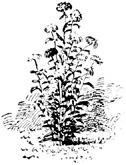
China Aster
The early Asters will bloom in August if the seed is sown in the open early in the season. They are represented by the Queen of the Market and Queen of Spring, either of which, if started in a hotbed or window, will begin to bloom the last of July. The Queen of the Market is probably the freest of growth, and with its long stems makes a very desirable variety for cut-flowers. In fact, in the rich, mellow soil in which Asters delight, this variety is likely to have its large flowers on stems so long and slender that the plants will need stakes.
The Victoria Asters hold a well deserved place among the leading varieties, and with high culture will generally lead in size and profusion of bloom, the colors ranging from white to the darkest blue. The plants are also well adapted to pot culture. The chrysanthemum-flowered Asters, both tall and dwarf, are excellent, as are the Truffaut Perfection and Peony-flowered. The Comet Asters are amongst the best. The New Branching type is now in great favor.
The culture of China Asters is easy. For early bloom the seeds should be sown in March in boxes of light soil and covered one-quarter of an inch with soil, the soil pressed down or firmed over them and the boxes placed in a hotbed or a sunny window and attention given to watering. When the seedlings are one inch high they should be transplanted to other boxes, setting the plants 3 inches apart or put into 2-inch pots. These should be again placed in a frame and grown along until the ground has become comparatively warm. The soil will need to be well enriched, mellow, and if slightly moist under the surface the results will be all that could be wished. Asters will grow fairly well on rather light soil, even if not very rich, but the best results can only be obtained when the highest culture is given. If the rust attacks the plants, spray with ammoniacal carbonate of copper.
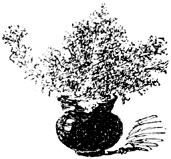
Spray of wild Aster
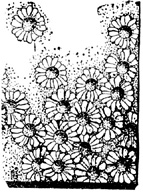
Wild Asters
Aster, Native. Wild Asters are one of the glories of the American autumn. They grow almost everywhere in the north and east,—along roadsides, in meadows and swales. Their colors range from pure white to pink, and purple, and blue. From August until winter closes in, they are conspicuous features of the landscape, vying with the goldenrods in form and color, but surpassing them in color-range. Most of them are greatly improved when transferred to the border. They become more attractive in general habit, and the flowers are usually more profuse and sometimes larger. They are of the easiest possible culture. They can be removed to home grounds in the fall or spring, and, with little care until they are established, will make most attractive displays of autumn color. The species are numerous and much confused, and it is not necessary to make a list of them here. Because of their free and careless habit, they are better adapted to planting in borders than in the formal flower beds.
Aubrietia deltoidea. A very handsome little trailing hardy perennial, covered with attractive purple flowers in early spring. Should be planted in masses for best effect. Propagated by cuttings or seeds, usually the latter. Excellent for rockwork and permanent low edgings.
Auricula. A half-hardy perennial of the Primrose tribe (Primula Auricula), very popular in Europe, but little grown in this country on account of the hot, dry summers. In this country usually propagated by seed, as for Cineraria; but special varieties are perpetuated by offsets. Seeds sown in February or March should give blooming plants for the next February or March. Keep the plants cool and moist, and away from the direct sun during the summer. Gardeners usually grow them in frames. In the fall, they are potted into 3-inch or 4-inch pots, and made to bloom either in frames as for violets or in a cool conservatory or greenhouse. In April, after blooming has ceased, repot the plants and treat as the previous year. From the best plants, offsets may be taken and treated the same as seedlings. As with most annual-blooming perennials, best results are to be expected with year-old or 2-year-old plants. Auriculas grow 6-8 in. high. Colors white and many shades of red and blue.
Azaleas are less grown in this country than in Europe, largely because of our hot, dry summers and severe winters. There are two common types or classes,—the hardy or Ghent Azaleas, and the Indian Azaleas.
Ghent Azaleas thrive in the open along the seacoast as far north as southern New England. They require a sandy, peaty soil, and are treated as other shrubs are. The large flower-buds are liable to injury from the warm suns of late winter and early spring, and to avoid this injury the plants are often protected by covers or shades of brush. In the interior country, little attempt is made to flower Azaleas permanently in the open, although they may be grown if carefully tended and well protected. Both Ghent and Indian Azaleas are excellent pot-plants, for bloom in late winter and spring. The plants are imported in great numbers from Europe, and it is better to buy these plants than to attempt to propagate them. Pot them up in large-sized pots, keep them cool and backward for a time until they are established, then take them into a conservatory temperature, in which carnations and roses thrive. They should be potted in a soil made of half peat or well decayed mold and half rich loam; add a little sand. Pot firmly, and be sure to provide sufficient drainage. Keep off red spider by syringing. After blooming, the plants may be thinned by pruning out the straggling growths, and repotted. Set them in a frame or in a semi-shaded place during summer, and see that they make a good growth. The wood should be well ripened in the fall. After cold weather sets in, keep the Indian or evergreen kinds half-dormant by setting them in a cool, dull-lighted cellar or pit, bringing them in when wanted for bloom. The Ghent or deciduous kinds may be touched with frost without injury; and they may be stored in a cellar until wanted.
Bachelor’s Button. Centaurea Cyanus and also Gomphrena. Sometimes applied to double-flowered Crowfoots.
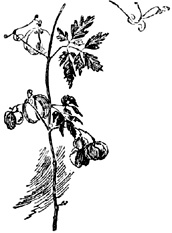
Balloon Vine
Balloon Vine, or Cardiospermum. Annual tender tendril climber of very rapid growth. Seed should not be planted until the soil becomes warm. A very pretty effect can be had by allowing the vine to run over some coarser vine, or into an evergreen tree. The balloon-like capsules show to good advantage between the leaves. It is also useful for covering piles of brush. Grows 8-12 ft. high. Give a warm, sunny place.
Balsams, or Impatiens. Tender annuals, producing both single and double flowers of many colors. These well known favorites are usually to be found in old-fashioned gardens. They are very likely to seed themselves, coming up in unexpected places and flourishing in neglect. They do best, however, in rich, sandy soil. If the seed is sown in boxes late in April and the plants transplanted several times they will be much dwarfer and the flowers much more double. A stately, though very formal and stiff, effect may be had by planting a row of Balsams in the rear of a low border, pinching off all the side shoots as they start and growing the plant to a single stem. This will become covered with the large blooms, giving it the appearance of a perfect column of flowers. Balsams are injured by the slightest frost. Seeds germinate quickly. Plants should stand 12-18 in. apart. They grow 18-30 in. high.
Bartonia. Hardy annual, with golden yellow, brilliant flowers. The tall-growing Bartonia (B. aurea) may be used in a mixed border to good advantage. It is a bushy plant, reaching 2-3 ft. high. The dwarf kind may be used as a border plant or in a rock garden, or as an edging. The fragrance of both tall and dwarf is very pronounced in the evening. The Bartonias are very easy to grow in a warm soil and sunny exposure. Their numerous thread-like, long stamens are very interesting.
Basket Plants. In order to have a good hanging basket, it is necessary that some provision be made to prevent too rapid drying out of the earth. It is customary, therefore, to line the pot or basket with moss. Open wire baskets, like a horse muzzle, are often lined with moss and used for the growing of plants. Prepare the earth by mixing some well decayed leaf-mold with rich garden loam, thereby making an earth which will retain moisture. Hang the basket in a light place, but still not in a direct sunlight; and, if possible, avoid putting it where it will be exposed to drying wind. In order to water the basket, it is often advisable to sink it into a pail or tub of water. Various plants are well adapted to hanging baskets. Among the drooping or vine-like kinds are the strawberry geranium, Kenilworth ivy, maurandya, German ivy, canary-bird flower, Asparagus Sprengeri, ivy geranium, trailing fuchsia, wandering Jew, and othonna. Among the erect-growing plants which produce flowers, Lobelia Erinus, sweet alyssum, petunias, oxalis, and various geraniums are to be recommended. Among foliage plants such things as coleus, dusty miller, begonia, and some geraniums are adaptable.
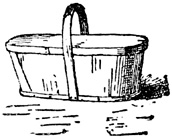
Climax basket
Baskets. For the picking and handling of fruit in the home garden, the common Climax basket, in various sizes, is the best receptacle. In these baskets the products may be sold. When the baskets are sent to market or to a friend, they should be neat and new looking; therefore keep them in a dry, dark place, as in an attic or loft, to prevent them from becoming warped and discolored.
Bean. Under the general name of Bean, many kinds of plants are cultivated. They are all tender, and the seeds, therefore, should not be planted until the weather is thoroughly settled; and the soil should be warm and loose. They are all annuals in northern countries, or treated as such.
The Bean plants may be classified in various ways. In respect to stature, they may be thrown into three general categories; viz., the pole or climbing Beans, the bush Beans, and the strict-growing or upright Beans (as the Broad or Windsor Bean). In respect to their uses, Beans again may be divided into three categories; viz., those which are used as string or snap Beans, the entire pod being eaten; those which are used as shell Beans, the full-size but immature Beans being shelled from the pod and cooked; dry Beans, or those which are eaten in their dry or winter condition. The same variety of Bean may be used for all of these three purposes at different stages of its development; but as a matter of fact, there are varieties which are better for one purpose than the other. Again, Beans may be classified in respect to their species. Those species which are best known are as follows: (1) Common Bean, or Phaseolus vulgaris, of which there are both tall and bush forms. All the common snap and string Beans belong here, as also the Speckled Cranberry types of pole Beans, and the common field Beans. (2) The Lima Beans, or Phaseolus lunatus. The larger part of these are pole Beans, but lately dwarf or bush varieties have appeared. (3) The Scarlet Runner, Phaseolus multiflorus, of which the Scarlet Runner and White Dutch Runner are familiar examples. The Scarlet Runner is usually grown as an ornamental vine, and it is perennial in warm countries, but the Beans are edible as shelled Beans. The White Dutch Runner is oftener cultivated for food. (4) The Yard-Long, or Asparagus Bean, Dolichos sesquipedalis, which produces long and weak vines and very long, slender pods. The green pods are eaten, and also the shelled Beans. The French Yard-Long is the only variety of this type which is commonly known in this country. This type of Bean is popular in the Orient. (5) The Broad Beans, of which the Windsor is the common type. These are much grown in the Old World for stock feed, and they are sometimes used for human food. They grow to one strict, central, stiff stalk, to a height of 2-4 or 5 ft., and they are very unlike other kinds of Beans in appearance. In this country, they are very little grown on account of our hot and dry summers. In Canada they are somewhat grown, and are sometimes used in the making of ensilage.
The culture of the Bean, while of the easiest, often proves a failure as far as the first crop is concerned, because of planting the seed before the ground has become warm and dry. No vegetable seed will decay quicker than Beans, and the delay caused by waiting for the soil to become warm and free from excessive moisture will be more than made up by the rapidity of growth when finally they are planted. Beans will grow in most any soil, but the best results may be obtained by having the soil well enriched and in good physical condition. From the 5th to the 10th of May in the latitude of central New York, it will be safe to plant Beans for an early crop. The Beans may be dropped 2 inches deep in shallow drills, the seeds to lie 3 inches apart. Cover to the surface of the soil, and if the ground be dry, firm it with the foot or the back of the hoe. For the bush varieties, allow 2 ft. between the drill-rows, but for the dwarf Limas 2½ ft. is better. Pole Limas are usually planted in hills 2-3 ft. apart in the rows. Dwarf Limas may be sown thinly in drills.
A large number of the varieties of both the green-podded and the wax-podded Beans are used almost exclusively as snap Beans, to be eaten with the pod while tender. The various strains of the Black Wax are the most popular string Beans. The pole or running Beans are used either green or dried, and the Limas, both tall and dwarf, are well known for their superior flavor either as shelled or dry Beans. The old-fashioned Cranberry or Horticultural Lima type (a pole form of Phaseolus vulgaris) is probably the best shell Bean, but the trouble of poling makes it unpopular. Dwarf Limas are much more desirable for small gardens than the pole varieties, as they may be planted much closer, the bother of procuring poles and twine is avoided, and the garden will have a more sightly appearance. Both the dwarf Limas and pole Limas require a longer season in which to mature than the bush varieties, and only one planting is usually made. But the bush varieties may be planted at intervals of two weeks from the first planting until the 10th of August. Each planting may be made on ground previously occupied by some early-maturing crop. Thus, the first to third plantings may be on ground from which has been harvested a crop of spinach, early radish or lettuce; after that, on ground where early peas have been grown; and the later sowings where beets or early potatoes have grown. String Beans for canning are usually taken from the last crop. One quart of seed will plant 100 ft. of drill; or 1 quart of Limas will plant 100 hills.
Limas are the richest of Beans, but they often fail to mature in the northern states. The land should not be very rich in nitrogen (or stable manure), else the plants will run too much to vine and be too late. Select a fertile sandy or gravelly soil with warm exposure, use some soluble commercial fertilizer to start them off, and give them the best of culture. Aim to have the pods set before the droughts of midsummer come. Good trellises for Beans are made by wool twine stretched between two horizontal wires, one of which is drawn a foot above the ground and the other 6 or 7 ft. high.
Bean plants are not troubled by insects to any extent, but they are sometimes attacked by blight. When this occurs, do not plant the same ground to Beans again for a year or two.
Bedding. This term is used to designate the massing of plants in the open ground for the purpose of making a bold display of color. This color may be obtained with flowers or with strong effects of foliage. Bedding is ordinarily a temporary species of planting; that is, the bed is filled anew each year. However, the term may be used to designate a permanent plantation of plants which are heavily massed so as to give one continuous or emphatic display of form or color. Some of the best permanent bedding masses are made of the various hardy ornamental grasses, as eulalias, arundo, and the like.
Some bedding is very temporary in its effect. Especially is this true of spring Bedding, in which the plants used are tulips, hyacinths, crocuses or other early-flowering bulbous plants. In this case, the ground is usually occupied later in the season by other plants. These later plants are usually annuals, the seeds of which are sown amongst the bulbs as soon as the season is far enough advanced; or the annuals may be started in boxes and the plants transplanted amongst the bulbs as soon as the weather is fit. Many of the low-growing and compact, continuous-flowering annuals are excellent for summer Bedding effects. Some of the best plants for this purpose are mentioned in the following list:
Adonis æstivalis.
Adonis autumnalis.
Ageratum Mexicanum.
Ageratum Mexicanum, dwarf.
Bartonia aurea.
Cacalia.
Calendula officinalis, in several forms.
Calendula pluvialis.
Calendula Pongei.
Calendula sulphurea, fl. pl.
Calendula suffruticosa.
Calliopsis bicolor marmorata.
Calliopsis cardaminæfolia.
Calliopsis elegans picta.
Callirrhoë involucrata.
Callirrhoë pedata nana.
Callirrhoë pedata.
Centaurea Americana.
Centaurea Cyanus, Victoria Dwarf Compact.
Centaurea Cyanus minor.
Centaurea suaveolens.
Chrysanthemum Burridgeanum.
Chrysanthemum carinatum.
Chrysanthemum coronarium.
Chrysanthemum tricolor.
Convolvulus minor.
Convolvulus tricolor.
Cosmidium Burridgeanum.
Delphinium, single.
Delphinium, double.
Dianthus, Double White Half Dwarf Margaret.
Dianthus, Dwarf Perpetual.
Dianthus Caryophyllus semperflorens.
Dianthus Chinensis, double.
Dianthus dentosus hybridus.
Dianthus Heddewigii.
Dianthus imperialis.
Dianthus laciniatus, Salmon Queen.
Dianthus plumarius.
Dianthus superbus, dwarf fl. pl.
Dianthus, Picotee.
Elscholtzia cristata.
Eschscholtzia Californica.
Eschscholtzia crocea.
Eschscholtzia, Mandarin.
Eschscholtzia tenuifolia.
Gaillardia picta.
Gaillardia picta Lorenziana.
Gilia achilleæfolia.
Gilia capitata.
Gilia laciniata.
Gilia linifolia.
Gilia nivalis.
Gilia tricolor.
Godetia Whitneyi.
Godetia grandiflora maculata.
Godetia rubicunda splendens.
Hibiscus Africanus.
Hibiscus, Golden Bowl.
Iberis affinis.
Iberis amara.
Iberis coronaria.
Iberis umbellata.
Impatiens or Balsam.
Lavatera alba.
Lavatera trimestris.
Linum grandiflorum.
Madia elegans.
Malope grandiflora.
Matricaria eximia plena.
Matthiola or Stock, in many forms.
Matthiola, Wallflower-leaved.
Matthiola bicornis.
Nigella or Love-in-a-Mist.
Œnothera Drummondii.
Œnothera Lamarckiana.
Œnothera rosea.
Œnothera tetraptera.
Papaver or Poppy, of many kinds.
Papaver cardinale.
Papaver glaucum.
Papaver umbrosum.
Petunia, Ring of Emerald.
Phlox Drummondii, in many varieties.
Portulaca.
Salvia farinacea.
Salvia Horminum.
Salvia splendens.
Schizanthus papilionaceus.
Schizanthus pinnatus.
Silene Armeria.
Silene pendula.
Tagetes or Marigold, in many forms.
Tagetes erecta.
Tagetes patula.
Tagetes signata.
Tropæolum, Dwarf.
Verbena auriculæflora.
Verbena Italica striata.
Verbena hybrida.
Verbena cœrulea.
Verbena, Golden-leaved.
Viscaria cœli-rosa.
Viscaria elegans picta.
Viscaria oculata.
Zinnia, Dwarf.
Zinnia elegans alba.
Zinnia, Tom Thumb.
Zinnia Haageana.
Zinnia coccinea plena.
Summer bedding is often made by perennial plants which are carried over from the preceding year, or better, which are propagated for that particular purpose in February and March. Such plants as geranium, coleus, alyssum, scarlet salvia, ageratum and heliotrope may be used for these beds. It is a common practice to use geranium plants which are in bloom during the winter for bedding out during the summer, but such plants are tall and ungainly in form and have expended the greater part of their energies. It is better to propagate new plants by taking cuttings or slips late in the winter and setting out young, fresh, vigorous subjects.
Very bold and subtropical effects can be made by planting in the open such things as palms, bananas, crotons, araucarias, caladiums and cannas. Plants like bananas and palms, which are kept normally in pots, would better be left in the pots and plunged to the rims rather than turned out directly into the soil. In order to attain quick and continuous effects, it is advisable to set the plants rather close. As such plants are likely to be injured by strong winds, it is well to have subtropical beds in a somewhat protected place.
Another type of bed is that which attempts to make patterns or designs, or carpet-bedding. There are comparatively few plants which are adapted to this purpose, for the plants must be such as will stand shearing and which have very strong and constant colors of foliage. The most popular bedding plants are coleus (particularly the yellow Golden Bedder) achyranthes, alternanthera, Centaurea gymnocarpa, and such succulent plants as the house leeks. Some of the annual flowers may also be used for strong color effects, as Lobelia Erinus and sweet alyssum. Ordinarily the making of carpet-beds should be left to professional gardeners, since it requires much skill and care to make and keep the beds in perfect condition; and a ragged or imperfect carpet-bed is worse than no bed at all. Carpet-beds are really curiosities, and they have no more legitimate place in the general pictorial landscape design area than painted stones or sheared evergreens. Therefore, they should be placed by themselves at one side, where they do not interfere with the general design of the place. In public parks they make a very useful attraction when set off by themselves, the same as zoölogical gardens or other attractions do.
Beefsteak Geranium is Begonia.
Beets. Being one of the hardiest of spring vegetables, the seed may be sown as early in the spring as the ground can be worked. A light, sandy soil is the best on which to grow Beets to perfection, but any well tilled garden soil will raise satisfactory crops. On heavy soil the turnip Beet gives the best results, as the growth is nearly all at or above the surface. The long varieties, having tapering roots running deep into the soil, are apt to be misshapen unless the physical condition of the soil is such that the roots meet with little obstruction. A succession of sowings should be made, at intervals of from two to three weeks, until late summer, as the Beets are much more desirable in their young stage than when they have become old and woody. The Mangel-Wurzel and the Sugar Beet are usually grown as a field crop, and will not enter into the calculations of the home garden.
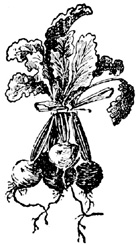
Early Beets
In order to hasten the season of the extra-early crop of Beets, the seeds may be sown in boxes or in the soil of a hotbed in February or March, transplanting the small plants to the open ground at the time the first sowing of seed is made. As the flat or turnip-rooted varieties grow at the surface of the ground, the seed may be sown thickly, and as the more advanced roots are large enough to use they may be pulled, leaving room for the later ones to develop, thus growing a quantity in a small area and having a long season of small Beets from one sowing. For winter use the late July sown seed will give the best roots, growing through the cool months of the fall to a medium size and remaining firm without being tough or stringy. These may be dug up after light frosts and before any severe cold weather, and stored in barrels or boxes in the cellar, using enough dry dirt to fill spaces between the roots and cover them to the depth of 6 inches. These roots, thus packed in a cool cellar, will be fit to use through the entire winter months. When it can be had, florists’ or sphagnum moss is an excellent medium in which to pack roots for winter.
The early round or turnip varieties are best for early and summer use. The Long Blood Beets may be used for storing, but these require a longer season of growth.
Begonias. Tender bedding and house plants. Next to the geranium, Begonias are probably the most popular for house culture of the entire plant list. The ease of culture, profusion of bloom or richness of foliage, together with their adaptability to shade, make them very desirable.
Begonias may be divided into three sections: the fibrous-rooted class, which contains the winter-flowering varieties; the tuberous-rooted, those which bloom through the summer, the tuber resting through the winter; and the Rex forms, or Beefsteak Geraniums, having large ornamental leaves.
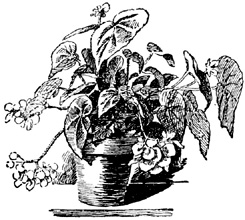
Fibrous-rooted Begonia
The fibrous-rooted kinds may be propagated by seed or cuttings, the latter being the usual method. Cuttings of half-ripened wood root easily, making a rapid growth, the plants flowering in a few months.
The tuberous-rooted varieties are propagated by division of the tuber or from seed, the former being rarely done except to increase the stock of some extra fine variety. The seeds, like those of all Begonias, are very small, and should be sown with great care. Simply sprinkle them on the surface of the soil, which should be a mixture of leaf-mold and sand, with the addition of a small amount of fibrous loam. Watering should be done by setting the pot or box in which the seeds are sown in water, allowing the moisture to ascend through the soil. When the soil has become completely saturated, set the box in a shady situation, covering it with glass or some other object until the tiny seedlings appear. Never allow the soil to become dry. The seedlings should be transplanted, as soon as they can be handled, into boxes or pots containing the same mixture of soil, setting each plant down to the seed-leaf. They will need three or four transplantings before they reach the blooming stage, and at each one after the first, the amount of fibrous loam may be increased until the soil is composed of one-third each of loam, sand and leaf-mold. The addition of a little well rotted manure may be made at the last transplanting. These tuberous-rooted Begonias make superior bedding plants if given a shady situation and deep soil; but for the amateur they are perhaps better grown as pot-plants, for one is able to give them better conditions by that method. The flowers are both double and single, ranging in color from pure white and yellow to pink and red. After flowering the plants will die down and the tubers, after drying off, may be placed in a dry, warm place until spring.
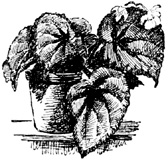
Rex Begonia
The Rex type, having no branches, is propagated from the leaves. The large mature leaves are used. The leaf may be cut into sections having at the base a union of two ribs. These pieces of leaves may be inserted in the sand as any other cutting. Or a whole leaf may be used, cutting through the ribs at intervals and laying the leaf flat on the propagating bench or other warm, moist place. In a short time young plants having roots of their own will form. These may be potted when large enough to handle, and will soon make good sized plants. Rex Begonias usually grow little during winter. Be sure that the pots are well drained, so that the soil does not become sour. New plants—those a year or so old—are usually most satisfactory. Keep them away from direct sunlight.
An insidious disease of Begonia leaves has recently made its appearance. The best treatment yet known is to propagate fresh plants, throwing away the old stock and the dirt in which it is grown.
Bellis perennis. See Daisy.
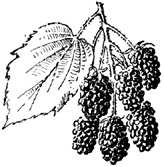
Ancient Briton Blackberry
Blackberries. The one essential to the successful growing of Blackberries is a moist soil,—not one in which water will stand, but one rich enough in humus to hold sufficient moisture to carry the crop through the growing season. It is usually found best to plant in the fall, earthing up slightly around the plants. The distance between the plants should be regulated by the variety. The smaller-growing kinds (as Early Harvest and Wilson) may be planted 4 x 7 ft., the rank-growing varieties (as Snyder) 6 x 8 ft. Thorough cultivation throughout the season will help in a material degree to hold the moisture necessary to perfect a good crop. The soil should be cultivated very shallow, however, so as not to disturb the roots, as the breaking of the roots starts a large number of suckers that have to be cut out and destroyed.
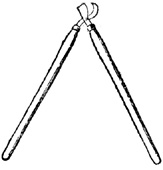
Shears for cutting out old canes
Blackberries, like dewberries and raspberries, bear but one crop on the cane. That is, canes which spring up this year bear next year. From 3 to 6 canes are sufficient to be left in each hill. The superfluous ones are thinned out soon after they start from the ground. The old canes should be cut out soon after fruiting and burned. The new shoots should be pinched back at the height of 2 or 3 ft. if the plants are to support themselves. If to be fastened to wires, they may be allowed to grow throughout the season and be cut back when tied to the wires in winter or early spring. Tools for the cutting out of the old canes are well represented in the pictures. Shears are used for shortening-in the canes.
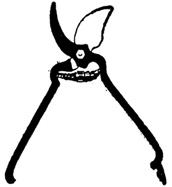
Shears for heading-in bushes
Blackberry plants are sometimes laid down in cold climates,—the tops being bent over and held to the ground by earth or sods thrown on their tips.

Knife hook for cutting out old canes
Snyder is the most popular commercial variety; but Agawam, Ancient Briton, Taylor, and others are better in quality. A new patch should be planted every five or six years.
Blue Bottle. See Centaurea Cyanus.
Bordeaux Mixture is a fungicide, used to combat mildews, leaf-diseases, blights, etc. It is sprayed on the plants with a spray pump or syringe, or it may be applied with a whisk broom. Apply enough of it so that the foliage looks blue. It is made as follows: Copper sulfate, 6 pounds; quicklime, 4 pounds; water, 40 to 50 gallons. Dissolve the copper sulfate by putting it into a bag of coarse cloth and hanging this in a vessel holding at least four gallons, so that it is just covered by the water. Use an earthen or wooden vessel. Slake the lime in an equal amount of water. Then mix the two and add enough water to make 40 gallons. It is then ready for immediate use, but will keep for some time. If the mixture is to be used on peach foliage, it is advisable to add an extra pound of lime to the above formula. When applied to such plants as carnations or cabbages, it will adhere better if a pound of hard soap is dissolved in hot water and added to the mixture. For rots, molds, mildews, and all fungous diseases.
Whilst Bordeaux Mixture is the best general fungicide, it discolors the plants until it washes off. On ornamental plants, therefore, a colorless fungicide may be preferable. In such cases, use the ammoniacal carbonate of copper solution, as follows: Copper carbonate, 1 ounce; ammonia, 1 volume 26° Baumé, ⅞ volumes water (enough to dissolve the copper); water, 9 gallons. The copper carbonate is best dissolved in large bottles, where it will keep indefinitely, and it should be diluted with water as required. For the same purposes as Bordeaux Mixture.
Border. The word border is used to designate the heavy or continuous planting about the boundaries of a place, or along the walks and drives, or against the buildings, in distinction from planting on the lawn or in the interior spaces. A border receives different designations, depending upon the kinds of plants which are grown therein; that is, it may be a shrub border, a flower border, a hardy border for native and other hardy plants, a vine border, and the like. As a rule, the most effective planting is that which is thrown into masses, for one plant reinforces the other, and the flowers have a good setting or background. Very striking displays of foliage and flowers and plant forms can be made when massed together. As a rule, plants are more easily grown when planted in a border, since the whole area can be kept cultivated with ease; and if a plant becomes weak or dies, its place is readily filled by the neighboring plants spreading into it. Planting in masses is also essential to the best arrangement of the yard, since the basis of any landscape is a more or less continuous greensward (see Lawn). The house occupies the central part of the area, and the sides are heavily massed or planted so as to make a framework for the whole place. The border may be mixed,—that is, composed of a great variety of plants,—or it may be made up of one continuous thing. In long and very striking borders, it is often best to have the background—that is, the back row—of one general type of plant in order to give continuity and strength to the whole group. In front of this a variety of plants may be set, if one desire.
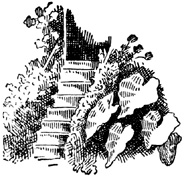
Planting by the steps
The land should be rich. The whole ground should be plowed or spaded and the plants set irregularly in the space; or the back row may be set in a line. If the border is composed of shrubs, and is large, a horse cultivator may be run in and out between the plants for the first two or three years, since the shrubs will be set from 2 to 4 ft. apart. Ordinarily, however, the cultivating is done by hand tools. After the plants are once established and the border is filled, it is best to dig up as little as possible, for the digging disturbs the roots and breaks off the crowns. It is usually best to pull out the weeds and give the border a top-dressing each fall of well rotted manure. If the ground is not very rich, a sprinkling of ashes or some commercial fertilizer may be given from time to time. The border should be planted so thick as to allow the plants to run together, thereby giving one continuous effect. Most shrubs should be set 3 feet apart. Things as large as lilacs may go 4 feet and sometimes even more. Common herbaceous perennials, like bleeding heart, delphiniums, hollyhocks, and the like, should go from 12 to 18 inches. On the front edge of the border is a very excellent place for annual and tender flowering plants. Here, for example, one may make a fringe of asters, geraniums, coleus, or anything else which he may choose (see Flower Beds).
The border is an excellent place in which to colonize native or other interesting plants. A person comes across an attractive plant on his tramp and wishes it were in his garden. Whatever the time of year, he may break off the top close to the ground, take up the roots and plant them in the border. If a little attention is given to the plant for the first two or three weeks, as watering or mulching or shading, it should become established and give satisfactory bloom the following year. Two-thirds of the herbs which one would take up in this way, even in midsummer, should grow. Into the heavy borders about the boundaries of the place the autumn leaves will drift and afford an excellent mulch. If these borders are planted with shrubs, the leaves may be left there to decay, and not be raked off in the spring. The general outline of the border facing the lawn should be more or less wavy or irregular, particularly if it is on the boundary of the place. Alongside a walk or drive, the margins may follow the general directions of the walk or drive.
There are three rules for the choosing of plants for a hardy border. Choose (1) those which you like best, (2) those which are adapted to the climate and soil, (3) those which are in place or in keeping with that part of the grounds. See Herbs, Shrubs, Trees.
Borecole is Kale.
Borers. There is no sovereign remedy for borers except to dig them out. Do not rely upon washes or other applications. If trees are examined two or three times a year, it is not a laborious undertaking to dig them out, as they will not be deep in the wood. If they do get deep in the wood, thrust a wire into the burrow. By the chips cast from the holes, or by the dead bark, the presence of borers may be detected. Apple and peach trees are particularly liable to attack. The flat-headed apple-tree borer works just underneath the bark on any part of the trunk or large branches. The round-headed apple-tree borer eats into the wood at the crown.
Boxes of many sizes can be utilized in which to grow plants. Excellent effects of bulbs and annuals may be had in old soap boxes. The boxes may be placed in the best situations for the growth of the plants, and they can receive better attention than the large flower bed. Vines planted about the edge will hide the sides,—such vines as Kenilworth ivy, moneywort, maurandya, trailing fuchsia, and the like.
Brachycome. See Swan River Daisy.
Broccoli. This is almost identical with the Cauliflower, except that it usually requires a longer season and matures in the fall. It is grown more generally in Europe than in this country. The special merit of Broccoli is its adaptability for late summer planting and its rapid growth in the late fall. It is said that a large proportion of Broccoli is used in the manufacture of pickles. The culture is the same as for Cauliflower,—deep, moist soil well enriched, cool weather, and the destruction of the cabbage worm.
The young plants may be grown in a coldframe or in a well protected border, sowing the seed about the 15th of May, transplanting into rows in July. In sections in which early fall frosts are not to be feared, the plants may be set two weeks later, say August 1, as all vegetables of the cabbage family make the best growth through the cool months of September and October. The plants should be set 18 in. apart in the rows, the rows being from 2½ ft. to 3 ft. apart.
Browallia elata is a very fine tender annual, giving a border or mixed bed a dash of amethyst blue not often found in flowers. It is a strong-growing plant with a profusion of bloom, and no doubt one of the choicest plants of its color in cultivation. There are other species with white flowers that serve as contrast, and may be grown with this. All of the kinds may be taken up and potted in the fall, cutting the plant well back, and a profusion of bloom may be obtained through the winter months if attention is given to pinching off the seed pods. In the garden, let the plants stand 12 in. apart. The plants grow 1-2 ft. high.
Brussels Sprouts. This is a vegetable that should be more generally known, as it is one of the choicest of the cabbage family, and may be had at its best after the season for cauliflower has passed. It is the better for being touched by the fall frosts. The parts used are the buttons or sprouts (miniature cabbage heads) that grow thickly along the stem. These should be cut off rather than broken. The very small hard “sprouts” or buttons are the best. The culture is essentially the same as for late cabbage or broccoli. One ounce will sow 100 ft. of drill, or make upward of 2,000 plants. Set plants in field 2-3 ft. apart. They require the entire season in which to grow.
Budding. See Grafting.
Bulbs. The outdoor culture of bulbs is extremely simple. They care for themselves throughout a greater part of the year, many of them flowering when no other plants are able to grow and bloom out of doors.
While all the so-called Holland bulbs will thrive in any kind of soil, they will all do better by being planted in a deep, sandy soil well enriched with well rotted manure. But do not let the manure come into direct contact with the bulb. Even heavy clay soil may be fitted for the growing of bulbs by the addition of sharp sand, either worked into the soil or placed directly under the bulb when planted. To make a bulb bed, choose, if possible, a sandy soil and throw out the top soil to the depth of 6 in. Put into the bottom of the bed about 2 in. of well rotted manure and spade it into the soil. Throw back half of the top soil, level it off nicely, set the bulbs firmly on this bed and then cover them with the balance of the soil; in this way one will have the bulbs from 3 to 4 in. below the surface. In the fall months the top of the ground is cooler than at the depth of 5 or 6 in. and the top of the bulb will not want to grow, while the bottom, which is always in a hurry, will send out roots, to push out the leaves and flowers the next spring. When the weather is cold enough to freeze a hard crust on the soil, the bed should have its winter overcoat. This may be straw, hay, cornstalks or leaves spread over the bed to the depth of 6 in. if the material is coarse; but if leaves are used, 3 in. will be enough, because the leaves lay close together and may smother out the frost that is in the ground and let the bulbs start. What we want is to keep them asleep until spring, because if they start too early the hard freezes of March and early April will spoil their beauty if the leaves or flowers are near or above the surface. Early in April, in New York, the covering may be removed gradually, and should all be off the beds before the leaves show above the ground.
If there is no sandy place for the beds, make them as directed, leaving the stones in the bottom of the bed for drainage. Then, when ready to set the bulb, place a large handful of sand where the bulb is to go and set the bulb on it. This will keep the water from standing around the bulb. Very fine results may be had on heavy soil by this method.
As to kinds of bulbs, select hyacinths, tulips or narcissus or daffodils, with snowdrops or crocuses of various colors around the edge. For the culture of these and other bulbs, see the various articles throughout the book.
The growing of flowering bulbs through the winter adds to the list of house plants a charming variety. The labor, time and skill required is much less than that of growing many of the larger plants more commonly used for winter decorations. The larger number of winter bulbs may be left out of doors until within four to six weeks of the time when they are wanted in flower. Hyacinths, narcissus, tulips, and crocus can be made to flower in the winter without difficulty. Secure the bulbs so as to be able to pot them by the middle or last of October, or if earlier all the better. The soil should be rich, sandy loam, if possible; if not, the best one can get, to which add about one-fourth the bulk of sand and mix thoroughly. If ordinary flower pots are to be used, put in the bottom a few pieces of broken pots, charcoal or small stones for drainage, then fill the pot with dirt so that when the bulbs are set on the dirt the top of the bulb is even with the rim of the pot. Fill around it with soil, leaving just the tip of the bulb showing above the dirt. If the soil is heavy, a good plan is to sprinkle a small handful of sand under the bulb to carry off the water, the same as is done in the beds outdoors. If one does not have pots he may use boxes. Starch boxes are a good size to use, as they are not heavy to handle; and excellent flowers are sometimes obtained from bulbs planted in old tomato cans. If boxes or cans are used, care must be taken to have holes in the bottoms to let the water run out. A large size hyacinth bulb will do well in a 5-inch pot. The same size pot will do for three or four narcissuses or eight to twelve crocuses.
After the bulbs are planted in the pots or other receptacles, they should be placed in a cool place, either in a cold pit or cellar, or on the shady side of a building, or, better yet, plunged or buried up to the rim of the pot in a shady border. This is done to force the roots to grow while the top stands still; as only the bulbs with good roots will give good flowers. When the weather gets so cold that a crust is frozen on the soil, the pots should be covered with a little straw, and as the weather gets colder more straw must be used. In from six to eight weeks after planting the bulbs, they should have made roots enough to grow the plant, and they may be taken up and placed in a cool room for a week or so, after which, if they have started into growth, they may be taken into a warmer room where they can have plenty of light. They will grow very rapidly now and will want lots of water, and after the flowers begin to show, the pots may stand in a saucer of water all the time. When just coming into bloom the plants may have full sunlight part of the time to help bring out the color of the flowers.
Bushes. See Shrubs.
Cabbage. For an early crop, the plants must be started either in February or early March, or the previous September and wintered over in coldframes. This latter method was once a common practice by gardeners near large cities, but the building of greenhouses to replace the many hotbeds of the market-gardener has changed the practice in many localities, and now most of the early Cabbages in the north are grown from seed sown in January, February or March. The plants are hardened off in March and early April and planted out as early as possible. The private grower, or one with a small garden, may often procure his early plants from the market-gardener much cheaper than he can grow them, as usually only a limited number of early Cabbage plants are wanted; but for the midseason and main crop, the seed may be sown in May or June, setting the plants in July.
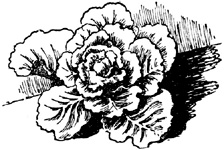
Early Cabbage
For early planting, the number of varieties is limited to three or four. For an intermediate crop the list is more extended, and the late varieties are very numerous. The early list is headed by the Jersey Wakefield, a variety which heads very quickly, and, although not one of the solid kinds, is generally grown. The Early York and Winnigstadt are good varieties to follow it. The latter especially is solid and of very good quality. For the midseason, the Succession and All Season are of the best, and for the winter supply the Drumhead, Danish Ball and Flat Dutch types are the leaders. One of the best of the Cabbages for table use is seldom seen in the garden—the Savoy Cabbage. It is a type with netted leaves, making a large, low-growing head, the center of which is very solid and of excellent flavor, especially late in the fall, when the heads have had a slight touch of frost. Savoy should be grown in every private garden.
The seed-bed should be made mellow and rich. A good border will do. The seed is sown preferably in rows, thus allowing thinning of the plants and the pulling of any weeds that germinate. The young plants will well repay attention to watering and thinning. The rows should be 3 or 4 in. apart. When the plants are large enough to transplant, they may be planted where early vegetables have been grown. Set the plants from 18 to 24 in. apart in the row, the rows being 3 ft. apart for the medium-growing kinds. One ounce of seed will furnish about two thousand plants. All Cabbages require deep and rich soil, and one that holds moisture well.
The best remedy for the Cabbage worm is to kill the first brood on the very young plants with Paris green. After the plants begin to head, pyrethrum or salt water may be used. On a small area, hand-picking may be recommended.
The maggot is the most serious Cabbage pest. After studying the seventy odd remedies proposed, Slingerland concludes that 6 are efficient and practicable: growing the young plants in closely covered frames; tarred paper cards placed snugly about the base of the plants to keep the fly away; rubbing the eggs from the base of the plant; hand-picking of the maggots; treating the plants with emulsion of carbolic acid; treating them with carbon bisulfide. The insecticidal materials are injected or poured into the soil about the base of the plant.
Respecting these two insecticides, Slingerland remarks: “Always use the crude carbolic acid, as it is much cheaper than the purified and is nearly, if not quite, as effective. It will probably be safer if used as an emulsion than if simply diluted with water. We would advise that it be made by the follow formula: 1 pound of hard soap or 1 quart of soft soap dissolved in 1 gallon of boiling water, into which 1 pint of crude carbolic acid is then poured and the whole mass agitated into an emulsion, which will remain in this condition for a long time. In treating the plants, take one part of this standard emulsion and dilute it with 30 equal parts of water; it probably can be used stronger without injury to the plants. If the emulsion is cold and semi-solid, use several parts of warm water at first. Begin the treatment early, a day or two after the plants are up, or in the case of Cabbages and Cauliflowers the next day after they are set in the field, and repeat it once each week or 10 days until about May 20 in our state. While we have little faith in the preventive effects of the early treatments, we do believe that the emulsion will then kill many of the eggs and recently hatched maggots. If it could be applied with some force through a syringe or force pump, it might not be necessary to go to the trouble of first removing some of the earth from about the plants. It must be remembered that its success will depend on the eggs or maggots being hit with it. None of the Cabbages in our experiment were injured in the least by an application containing nearly twice as much of the acid, and there is but little danger of its injuring the tenderest foliage of radishes, turnips or onions; if any injury manifests itself on these crops, dilute the emulsion with 40 or 50 or more parts of water, instead of 30. A knapsack or wheelbarrow sprayer would prove a very useful instrument in applying the emulsion on a large scale.”