THE PRACTICAL GARDEN-BOOK (continued 5)
Reading edition
The “saucer system,” in which cuttings are inserted in wet sand contained in a saucer an inch or two deep, to be exposed at all times to the full sunshine, is of a similar nature. The essentials are, to give the cuttings the “full sun” and to keep the sand saturated with water.
Whatever method is used, if cuttings are to be transplanted after rooting, it is important to pot them off in small pots as soon as they have a cluster of roots one-half inch or an inch long. Leaving them too long in the sand weakens the cutting.
Sage is a perennial, but best results are secured by resowing every two or three years. Give a warm, rich soil. Hardy.
Salpiglossis. Very fine half-hardy annuals. The flowers, which are borne in profusion, are of many colors, and rival in markings most other annuals. The flowers are short-lived if left on the plant, but will hold well if cut and placed in water. Seed should be sown in heat in February or March, the seedlings grown along until May, when they may be planted out. It is usually best to pinch out the centers of the plants at this time to cause them to branch.
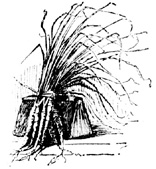
Salsify
Salsify, or Vegetable Oyster. Salsify is one of the best of winter and early spring vegetables, and should be grown in every garden. It may be cooked in several different ways. The seed should be sown as early in the spring as possible. Handle the same as parsnips in every way. The roots, like parsnips, are the better for the winter freeze, but part of the crop should be dug in the fall, and stored in soil or moss in a cellar for winter use.
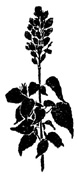
Salvia coccinea
Salvia. The Scarlet Salvia (or Sage) is a well known tender perennial, blooming late in the fall and making a fine effect in beds or borders. It is easily transplanted, and large plants removed to the house continue in bloom for some time. The blue and white species are both desirable summer flowering plants, and the low-growing Silver Leaf Sage is well adapted for edging. Propagated from seed, cuttings, or by division. Height 2 to 3 feet.
San José Scale has now become a wide-spread pest. It has been introduced into the eastern states from the Pacific slope. It is a minute scale insect the size of a small pinhead, shield-shaped, with a raised center. There are various native and comparatively harmless scales which look very much like it, and an expert is usually needed to distinguish them. The San José Scale can usually be distinguished, however, by its very serious results. In favorable seasons it spreads with enormous rapidity, covering the branches of many kinds of plants, sapping their juices, and either killing or reducing them to such a low state of vitality as to render them useless; or they are killed by the winter. The indications are that the scale will never be so serious in the moist, cool climates of the northeastern states as it is in the hotter and drier climates of the West. It has been found by careful experiments that it can be killed by a spray of kerosene and water (see Kerosene) in a proportion of one part of kerosene to four or five of water. This material is applied with a mechanical pump mixer, and the application should be made on a sunny day so that evaporation soon takes place. Spraying with kerosene in cloudy weather is very likely to result in injury to the plants. Some experimenters have found crude petroleum to be a specific for the San José Scale.
It is not to be expected that the San José Scale can be exterminated any more than the tent caterpillar or apple scab can. It follows, therefore, that we should spray for the San José Scale as we do for other pests. It is such a serious pest, however, that the state or province should take measures to hold it in check. Some system of inspection should be inaugurated, and it is probably best that nursery stock be fumigated with hydrocyanic gas before it is sold. This gas is exceedingly poisonous, however, and should never be handled by the inexperienced. Whenever it is used, it should be under the control of experts. Plants or plantations which are badly infested with the scale would better be destroyed.
Scabiosa. Mourning Bride. A useful annual, producing a profusion of bloom through the greater part of the summer if not allowed to go to seed. The flowers range in color from white to rich purple, are borne on long stems, and are very lasting. The seed may be sown where the plants are wanted, or to hasten the season of bloom may be sown in boxes in February and grown along to be planted out in April.
Scarlet Runner. One of the pole or running beans (Phaseolus multiflorus). It is a great favorite with people from the Old World, especially English and Germans. This bean is used either as an ornamental vine for porches or trellises, or as a screen to hide unsightly objects. The red flowers are very showy, either on the plant or in bouquets. The green pods are excellent as string beans, and the dried beans are of superior quality. Seed should not be sown until the ground has become thoroughly warm; or the plants may be started in the house.
Scraping of trees is rarely to be advised, except in fruit plantations. The old and hanging bark on apple and pear trees may be taken off in order to destroy the hiding places of insects and the breeding places of fungi, and also to make the plantation look more neat and kempt. Only the loose outer bark should be removed, however. Trees should not be scraped to the quick. If there is moss on trees, it can be destroyed readily by a spray of Bordeaux mixture.
A large part of the beauty of an ornamental tree lies in its characteristic bark, and it is very rare that such trees should be scraped.
Screens. See Windbreak.
Screw Pine. See Pandanus.
Sea-Kale shoots are very highly prized as a delicacy when blanched. The seed should be sown in a hotbed early in the spring, plants transplanted to the garden when from 2 to 3 inches high, and given high cultivation through the season, being covered with litter on the approach of winter. The young stalks are blanched early the following spring by covering with large pots or boxes, or by banking with sand or other clean material. The Dwarf Green Scotch, Dwarf Brown, and Siberian are among the leading varieties. Sea-kale is eaten much as asparagus is. Highly prized by those who know it.
Sea-Kale is also propagated by cuttings of the roots 4 or 5 inches long, planted directly in the soil in spring. The plant is perennial, and the early shoots may be bleached year after year.
Seed Sowing. The general rule in sowing seeds is to cover them twice or three times their thickness. This rule will apply to the majority of seeds, but in many plants of a naturally short season of bloom or growth, an instance of which is the sweet pea, it may be advisable to sow the seed deeper, that the roots may have sufficient moisture and be in a cool temperature through the hot summer months. Also, in sowing very minute seed, as tobacco, petunia, begonia, and others of like size, care should be taken to have them only under the surface of the soil,—simply pressed down with a smooth surface or allowed to settle into the soil with the soaking in of the water. The soil for all seeds should be loose and porous, in order to allow the excessive moisture to escape and the warmth to penetrate, but should be firmed directly over the seeds to induce an upward flow of moisture. One of the most common mistakes in sowing seed is in sowing all kinds at the same time without regard to the season, thus causing a failure with some, while others grow freely. All tender seed should be sown only when the ground has become thoroughly warm, while seeds of the so-called hardy plants may be sown as early in the spring as the ground is fit to work. A few kinds of seed are the better for soaking, especially such as for some reason have been delayed in sowing. Sweet pea seed is benefited by soaking if not put into the ground until the soil is warm. Seed of canna, moonflower and others with hard shells may be scraped until the outer shell is pierced or is very thin.
It is generally better to buy garden seeds than to grow them, for those who make a business of seed-growing become expert in the cultivation and selection of the plants.
Seeds of most plants should be kept dry and also rather cool. It is always better to rely upon fresh seeds. Test them in boxes in the house, if possible, before planting them in the open. If beans, peas, corn or other Seeds become buggy, pour a little bisulfide of carbon (very inflammable) into them. The material will not injure the Seeds even if poured on them. It soon evaporates. A teaspoonful will kill the insects in four quarts of Seeds, if the receptacle is tight.
Most tree Seeds should be kept moist until planted. They are usually buried or kept in sand.
Sensitive Plant (Mimosa). This curious plant is often grown for the amusement it affords by its habit of closing its leaves and dropping the leaf-stalk whenever the plant is touched. Seed should be sown in heat early in the season, and the plants grown in pots or a protected border. The seed is sold by all seedsmen. The plant grows readily in a temperature suited to beans. It will not stand frost. The young plants are usually the most sensitive.
Shade Trees. The best Shade Trees are usually those which are native to the particular region, since they are hardy and adapted to the soil and other conditions. Elms, maples, basswoods, and the like, are nearly always reliable. In regions in which there are serious insect enemies or fungous diseases, the trees which are most likely to be attacked may be omitted. For instance, in parts of the East the elm leaf beetle is a very serious pest; and it is a good plan in such places to plant other trees than elms. Amongst the best exotic trees for shade in the northern parts of the country are the Norway maple, European lindens, horse chestnut, and the European species of elm. Trees for shade should ordinarily be given sufficient room that they may develop into full size and symmetrical heads. The trees may be planted as close as 10 or 15 feet apart for temporary effect; but as soon as they begin to crowd they should be thinned.
Shelter-belts. See Windbreak.
Shrubbery. Shrubs have two kinds of values or uses: first, they are useful for their own sakes or as individual specimens; and second, for use in the making of foliage masses or groups. Ordinarily they are used only for the former purpose in home grounds; but their greatest use is, nevertheless, in heavy masses about the borders of the place or in the angles of the building. That is to say, they should contribute to the general design of the place or to its pictorial effect. If they are planted in Shrubberies or masses, the flowers are still as interesting and as showy as they are when the bushes are planted alone. In fact, the flowers usually show to better advantage, since they have a heavy background of foliage. In the Shrubbery mass the bushes are more easily cared for than when they are scattered as single specimens over the lawn. The single specimen which is irregular, or ragged, or untidy, is an undesirable object; but such a specimen may contribute an indispensable part to the border mass. In the border they do not need the attention to pruning that they do in the lawn. The main part of the Shrubbery mass should be made of the stronger, larger growing and coarser Shrubs; and the more delicate ones, or those with highly colored leaves or showy flowers, may be placed near the inner edge of the plantation. Shrubs which are valued chiefly for their flowers or showy foliage, as, for example, the Hydrangea paniculata, may be planted just in front of a bold Shrubbery mass, so that they will have a background to show off their beauties. Further directions for the lay-out of the grounds will be found under the articles Lawns and Borders.
It is ordinarily best to plow or spade the entire area in which the Shrubs are to be set. For a year or two the ground should be tilled between the Shrubs, either by horse tools or by hoes and rakes. If the place looks bare, seeds of quick-growing flowers may be scattered about the edges of the mass. The larger Shrubs, like lilacs and syringas, may be set about 4 feet apart; but the smaller ones should be set about, 2 feet apart if it is desired to secure an immediate effect. If after a few years the mass becomes too crowded, some of the specimens may be removed. Throw the Shrubs into an irregular plantation, not in rows, and make the inner edge of the mass more or less undulating and broken. It is a good practice to mulch the plantation each fall with light manure, leaf-mold or other material. Even though the Shrubs are perfectly hardy, this mulch greatly improves the land and promotes growth. After the Shrub borders have become two or three years old, the drifting leaves of fall will be caught therein and will be held as a mulch. It is often advisable not to remove these leaves, but to allow them to remain year after year, where they make a fine covering of leaf-mold. When the Shrubs are first planted, they are headed back one-half or more; but after they are established they are not to be pruned, but allowed to take their own way, and after a few years the outermost ones will droop and meet the greensward.
Good Shrubs are numerous. Some of the best are those to be found in woods and along roadsides. They are hardy. Of Shrubs which are generally adaptable for the North, the following are excellent:
Barberries.
Box.
Burning Bush, or Euonymus.
Bush Honeysuckles.
Bush Willows.
Caryopteris, blooming in August and September.
Cotoneasters.
Desmodiums, or Lespedezas, blooming in fall.
Dwarf Sumac. Rhus copallina.
Elders. Native species are excellent.
Exochorda, with profuse white bloom in spring.
Flowering Almond.
Flowering Crabs.
Flowering Currants.
Forsythias, or Golden Bells.
Fringe Tree, or Chionanthus.
Hawthorns.
Hydrangeas.
Indian Currant. Symphoricarpos vulgaris.
Japanese Quince.
Kerria, or Corchorus.
Lilacs.
Mock Orange, or Philadelphus.
New Jersey Tea, or Ceanothus.
Osiers, or Dogwoods.
Privet.
Rose Acacia.
Roses (see Roses).
Smoke Tree.
Snowballs. The Japanese is preferable.
Snowberry. Symphoricarpos racemosus.
Spireas of many kinds.
Viburnums of many kinds.
Weigelas.
White Alder. Clethra alnifolia.
Witch Hazel. Blooms on the eve of winter.
Xanthoceras sorbifolia.
Silene, or Catchfly. Some of the Silenes are hardy annuals of very easy culture. Sow seeds where the plants are to stand; or, if early results are desired, seeds may be started in boxes. The plants thrive in any garden soil, even if it is not very rich. Colors red, or sometimes running to white. One foot. Let plants stand 6 to 10 inches apart.
Smilax of the florists is closely allied to asparagus. While it cannot be recommended for house culture, the ease with which it may be grown and the uses to which the festoons of leaves may be put, entitle it to a place in the conservatory or greenhouse. Seed sown in pots or boxes in January or February, the plants shifted as needed until planted on the bench in August, will grow fine strings of green by the holidays. The plants should be set on low benches, giving as much room as possible overhead. Green-colored strings should be used for the vines to climb on, the vines frequently syringed to keep down the red spider, which is very destructive to this plant, and liquid manure given as the vines grow. The soil should contain a good proportion of sand and be enriched with well-rotted manure. After the first strings are cut, a second growth fully as good as the first may be had by cleaning up the plants and top-dressing the soil with rotted manure. Slightly shading the house through August will add to the color of the leaves. The odor from a vine of Smilax thickly covered with the small flowers is very agreeable.
Snapdragon, or Antirrhinum. An old garden favorite, flowering freely through a long season. The dwarf strain is well adapted for bedding or borders. Any light soil, well enriched with rotted manure, will grow Snapdragons to perfection. Distinct varieties should be propagated by cuttings, as they do not come true from seed. Sow seed early in the spring.
Although bloom may be obtained the first year, late sown plants sometimes persist over winter and bloom early in the spring. Snapdragons make good window plants.
Snowdrop (Galanthus). This is one of the earliest flowers of spring, always welcome. It should be planted in the edge of the border. The bulbs may be planted in October in any good border soil and left undisturbed for years; or they may be potted at that time, and after forming roots be gently forced into bloom in winter.
Snowflake (Leucoium). Culture same as for Snowdrop.
Sodding. In general, the best way to secure a lawn is by the sowing of seed (see Lawn), since it is the least expensive way. For small areas, and along the sides of walks and drives, sods may be used. The results are quicker. Unless the sod is of the right kind, however, and very carefully laid, the results are not so good as with seed.
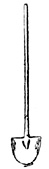
Sod-cutter, for trimming sod edgings
The sod which is best adapted to the Sodding of lawns is that which comes from an old, closely grazed pasture. Sod from a sheep pasture is supposed to be best. Such sod has been so closely grazed that it has made a very dense mat of roots, and all the weeds have been destroyed. The droppings of the animals also make the ground rich. The sod should be cut in very thin strips. It should not be more than an inch and one-half or two inches in thickness. If it is thicker than that, it is heavy and bulky to handle, and is not so easily laid. Ordinarily, the sod is cut in strips ten inches or a foot wide. A board is laid on the sod and the strip is cut along either side of it with a sod cutter or a sharp spade. Two men then roll up the sod. One stands on the strip of sod with his face toward the man who, with the spade, cuts it loose beneath. As it is cut loose, the man on the strip rolls the sod so that the upper surface is on the inside of the roll. Strips longer than ten or twelve feet make rolls which are too heavy to handle with ease.
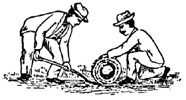
Cutting sod
The soil upon which the sod is to be placed should be very loose, so that the sod, can be pounded down firmly. Some heavy pounder should be used, as a block of wood. It is usually impossible to pound down sod with the back of a spade sufficiently firm unless the soil is very loose. The sod should be pounded until the top is about level with the surrounding soil. This insures contact with the soil beneath, so that there are no air spaces and no likelihood of drying out. Sod pounded down as firmly as this should grow very readily. If a sod edging is laid along walks and drives, it should be pounded down an inch or more lower than the surrounding loose land which is seeded, because the loose land will finally settle; otherwise the sod border is likely to be higher than adjacent land after a year or two.
If there are uneven places on the sodded area, these depressions can be filled in with very loose, fine soil; and the grass will grow through it. In dry weather, a sodded area may be mulched with a half inch of fine loam to protect it.
Soils. Soils are of many kinds. The classification of soils depends upon one’s point of view. Gardeners ordinarily call a good, friable, dark-colored, rich Soil a garden loam. No Soil is so good that it cannot be improved. It is improved in two general ways: by tilling (see Tillage), and by the application of various substances.
In considering the improvement of lands by the application of foreign substances, two distinct things are to be considered: the improvement of the physical texture, or tilth, of the Soil; the increasing of its plant-food. These are coördinate objects. In some cases one may be of prime importance, and in another case the other may be more necessary. Lands which have a fair store of available plant-food may be unproductive. Such lands may be very greatly benefited by stable manure, even though that manure may have lost a large part of fertility by being baptized under the eaves of the barn. If plant-food alone is needed, then some concentrated or commercial fertilizer may be the best thing to apply. In most cases the main or chief amelioration of the land is to be wrought by tillage, stable manures, mulches, green crops, and the like; if special results are desired, commercial fertilizers may be added more or less liberally, as the case demands (see Manures, Fertilizers).
The top-dressing of Soils is often very beneficial because it tends to prevent the escape of moisture, and often improves the physical texture. If the material contains plant-food, the land will also be directly enriched. The trimmings from lawns may be a distinct protection to lands if allowed to remain (see Lawns); and the leaves which blow into clumps of shrubbery may often be allowed to remain with good results. However, if the leaves become too thick year after year, they tend to induce a surface rooting of the shrubs. This, however, may be no disadvantage unless the mulch were finally to be removed. One of the very best top-dressings for borders and shrubbery is spent tan bark, since it does not pile up on the ground, but tends to work into it. Well-rotted sawdust often has the same effect. These materials are much used by gardeners, when they can be had, since they can be raked into the soil in the spring, and need not be removed.
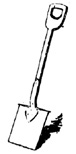
Spade
Solidago. See Goldenrod.
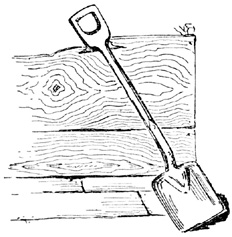
Shovel
Spades and Shovels must be a part of every garden equipment. The common and most useful forms are shown in the cuts, but long-handled tools are more useful for the loading of earth, the making of ditches, the spreading of mulches, and the like. It pays to buy the steel tools, with strongly strapped handles.
Spearmint is prized by many people as a seasoning, particularly for the Thanksgiving and holiday cookery. It is a perennial and perfectly hardy, and will live in the open garden year after year. If a supply of the fresh herbage is wanted in winter, remove sods of it to the house six weeks before wanted. Place the sods in boxes, and treat as for house plants. The plants should have been frosted and become perfectly dormant before removal.
Spinach. Probably the most extensively grown early spring vegetable, being in great demand as greens. The earliest crop that finds its way to market is gathered from seed sown in September or October, often protected by frames or other means through the severe winter, and cut soon after growth starts in early spring. Even as far north as New York Spinach may stand over winter without protection. Spinach is forced by placing sash over the frames in February and March, protecting the young leaves from severe freezing by mats or straw thrown over the frames. Seed may be sown in early spring for a succession; later in the season seed of the New Zealand Summer Spinach may be sown, and this will grow through the heat of the summer and yield a fine quality of leaves. The seed of this kind being very hard, should be scalded and allowed to soak a few hours before sowing. This seed is usually sown in hills about three feet apart, sowing four to six seeds in each hill. The spring and winter Spinach should be sown in drills 12 to 14 inches apart, one ounce being sufficient for 100 feet of drill. Remember that common Spinach is a cool-weather (fall and spring) crop.
Spraying. Of late years Spraying has come to be one of the most important of all horticultural operations. Most kinds of injurious fungi and insects can be combated by a water spray in which various poisons or injurious substances are contained. There are two general classes of Spraying material: first, fungicides, or those which are used for the control of fungi or plant diseases; second, insecticides, or those which are used for the control of insect enemies.
The fungicides usually contain copper or sulfur, or both. The most popular and generally useful fungicide is the Bordeaux mixture (which see). It should be borne in mind that most injurious fungi work on the interior of the leaf or stem, and only the spore-bearing parts come to the surface. It is therefore very important that Spraying with fungicides be done very early in order to prevent the fungus from getting a hold. It is much better to Spray once very thoroughly than to Spray a half dozen times carelessly. It is important that the entire surface of the foliage or stems be covered with the material in order to prevent the access of the fungi.
Of insecticides, there are two general types: those which kill by external contact and are applied to plant lice, scale insects, and all other insects which suck their food; and the poisonous compounds which are used for the chewing insects, as all the tribes of worms and beetles. Of the former class, the most important material is kerosene in various forms (which see). Of the latter kind is Paris green (which see). For insects, Spray just as soon as the attack is evident. Paris green and Bordeaux mixture may be used together.
The best pump for Spraying is the one which throws the stream the greatest distance with the least amount of liquid, and the best nozzle is that which distributes the material most finely and evenly. For Spraying plants close at hand, the Vermorel nozzle is now the most popular. If it is desired to reach the tops of large trees, some other nozzle should be used, as the McGowen, Boss, or other types. Every outfit should have two or three kinds of nozzles for different kinds of work. Get a pump with much power.
Spray thoroughly. The general rule is to spray the entire plant until the material begins to drip, at which time it may be supposed that the plant is covered completely. When and how often one should Spray, and what material he should use, will depend entirely upon the difficulty which he is endeavoring to combat. Most fruit trees should be Sprayed before they bloom and again just afterwards. Sometimes they will need Spraying again.
Sprekelia. Culture of Amaryllis.
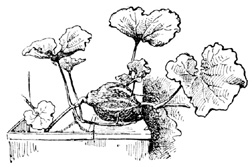
Hubbard Squash
Squash. The time of planting, method of preparing the hills and after culture are the same as for cucumbers and melons (which see), except that for the Early Bush varieties the hills should be 4 or 5 feet apart, and for the later running varieties from 6 to 8 feet apart. From eight to ten seeds should be planted in each hill, thinning to four plants after danger from bugs is over. Of the early Squashes, one ounce of seed will plant fifty hills; of the later varieties, one ounce will plant but eighteen to twenty hills. For winter use, varieties of the Hubbard type are best. For summer use, the Crooknecks and Scallop Squashes are popular. In growing winter Squashes in a northern climate, it is essential that the plants start off quickly and vigorously: a little chemical fertilizer will help. Pumpkins are grown the same as Squashes.
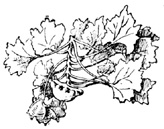
Scallop or Patty-pan Summer Squash
Squills (Scilla). Blue Bell. Wild Hyacinth. Well-known bulbous plants, most of them hardy. They plant well with snowdrops and crocus, flowering at the same time, but continuing longer in bloom. The colors are red, pink, blue or white. The blue varieties have very fine shades of color. Should be planted in October and remain undisturbed.
Stocks. The Ten-weeks and the biennial or Brompton Stocks, are found in nearly all old-fashioned gardens. Most gardens are thought to be incomplete without Stocks, and the use of the biennial flowering species as house plants is increasing. The Ten-weeks Stock is usually grown from seed sown in hotbed or boxes in March. The seedlings are transplanted several times previous to being planted out in early May. At each transplanting the soil should be made a little richer. The double flowers will be more numerous when the soil is rich.
The biennial species should be sown the season previous to that in which flowers are wanted, the plants wintered over in a cool house, and grown on the following spring. They may be planted out through the summer and lifted into pots in August or September for winter flowering. These may be increased by cuttings taken from the side shoots; but the sowing of seed is a surer method, and unless an extra fine variety is to be saved, it would be the best one to pursue. Height 10 to 15 inches.
Storing. The principles which are involved in the Storing of perishable products, as fruits and vegetables, differ with the different commodities. All the root crops, and most fruits, need to be kept in a cool, moist and uniform temperature if they are to be preserved a great length of time. Squashes, sweet potatoes, and some other things, need to be kept in an intermediate and what might be called a high temperature; and the atmosphere should be drier than for most other products. The low temperature has the effect of arresting decomposition and the work of fungi and bacteria. The moist atmosphere has the effect of preventing too great evaporation and the consequent shriveling. In the Storing of any commodity, it is very important to see that the product is in proper condition for keeping. Discard all specimens which are bruised or which are likely to decay. Much of the decay of fruits and vegetables in Storage is not the fault of the Storage, but is really the work of diseases with which the materials are infested before they are put into Storage. For example, if potatoes and cabbages are affected with the rot, it is practically impossible to keep them any length of time.
Apples, winter pears, and all roots, should be kept at a temperature somewhat near the freezing point. It should not raise above 40° Fahr. for best results. Apples can even be kept at one or two degrees below the freezing point if the temperature is kept uniform. Cellars in which there are heaters are likely to be too dry and the temperature too high. In such cases it is well to keep fresh vegetables and fruits in tight receptacles, and pack the roots in sand or moss in order to prevent shriveling. In these places, apples usually keep better if headed up in barrels than if kept on racks or shelves. In moist and cool cellars, however, it is preferable for the home supply to place them on shelves, not piling them more than five or six inches deep, for then they can be sorted over as occasion requires. In case of fruits, be sure that the specimens are not over-ripe when placed in storage. If apples are allowed to lie in the sun for a few days without being packed, they will ripen so much that it is very difficult to keep them.
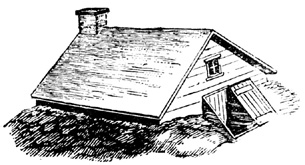
A good out-door cellar
Cabbages should be kept at a low and uniform temperature, and water should be drained away from them. They are Stored in many ways in the field, but success depends so much upon the season, particular variety, ripeness, and the freedom from injuries by fungi and insects, that uniform results are rarely secured by any method. The best results are to be expected when they can be kept in a house which is built for the purpose, in which the temperature can be kept uniform and the air fairly moist. When Stored out of doors, they are likely to freeze and thaw alternately; and if the water runs into the heads, mischief is likely to result. Sometimes they are easily Stored by being piled into a conical heap on well-drained soil and covered with dry straw, and the straw covered with boards. It does not matter if they are frosted, provided they do not thaw out frequently. Sometimes cabbages are laid head down in a shallow furrow plowed in well-drained land, and over them is thrown straw, the stumps being allowed to project through the cover. It is only in winters of rather uniform temperature that good results are to be expected from such methods.
In the Storing of all things, especially those which have soft and green matter, as cabbages, it is well to provide for the heating of the produce. If the things are buried out of doors, it is important to put on a very light cover at first so that the heat may escape. Cover them gradually as the cold weather comes on. This is important with all vegetables that are placed in pits, as potatoes, beets and the like. If covered deeply at once, they are likely to heat and rot. All pits made out of doors should be on well-drained and preferably sandy land.
When vegetables are wanted at intervals during the winter from pits, it is well to make compartment pits, each compartment holding a wagon load or whatever quantity will be likely to be wanted at each time. These pits are sunk in well-drained land, and between each of the two pits is left a wall of earth about a foot thick. One pit can then be emptied in cold weather without interfering with the others.
An outside cellar is better than a house cellar in which there is a heater, but it is not so handy. If it is near the house, it need not be inconvenient, however. A house is usually healthier if the cellar is not used for storage. House cellars used for storage should have a ventilating shaft.
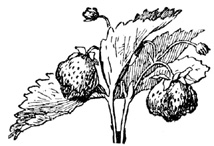
Strawberries
Strawberry. The saying that Strawberries will grow on almost any soil is misleading, although true. Some varieties of Strawberries will grow on certain soils better than other varieties. What these varieties are can only be determined by an actual test, but it is a safe rule to select such varieties as prove good in many localities. As to the methods of culture, so much depends on the size of the plot, the purpose for which the fruit is wanted, and the amount of care one is willing to give, that no set rule can be given for a garden in which but few plants are grown and extra care can be given. Large fruits and a number of them may be had by growing to the single plant, keeping off all runners and relying on numerous fruit-crowns on one plant for the crop of berries. Or Strawberries may be grown by the narrow matted-row system, in which the runners, before rooting, should be turned along the rows at a distance of from 4 to 6 inches from the parent plant. These runners should be the first ones made by the plant and should not be allowed to root themselves, but “set in.” This is not a difficult operation; and if the runners are separated from the parent plant as soon as they become well established, the drain on that plant is not great. All other runners should be cut off as they start. The row should be about 12 inches wide at fruiting time. Each plant should have sufficient feeding ground, full sunlight, and a firm hold in the soil. This matted-row system is perhaps as good a method, either in a private garden or field culture, as could be practiced. With a little care in hoeing, weeding and cutting off runners, the beds seem to produce as large crops the second year as the first.
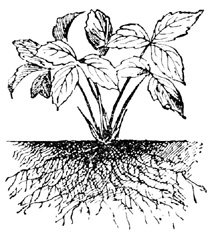
Well planted Strawberry
The old way of growing a crop was to set the plants 10 to 12 inches apart, in rows 3 feet apart, and allow them to run and root at will, the results being a mass of small, crowded plants, each striving to obtain plant-food and none of them succeeding in getting enough. The last, or outside runners, having but the tips of their roots in the ground, are moved by the wind, heaved by the frost, or have the exposed roots dried out by the wind and sun.
Ground rich in potash produces the firmest and best flavored berries. Excessive use of stable manure, usually rich in nitrogen, should be avoided, as tending to make too rank growth of foliage and berries of a soft texture.
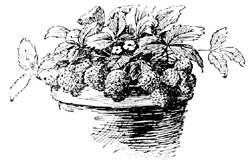
Pot-grown Strawberry
Except in the case of a skillful grower in a favored locality, the fall setting of plants is not to be recommended. The preparation of the soil and care of the plants more than overbalance the partial crop obtained the following spring.
In the single-plant or hill system the plants should be set 12 inches apart, in rows 3 feet apart. In the narrow matted row system the plants should be set 18 inches apart, in rows 3½ feet apart. The first method requires about 14,000 plants per acre, the second about 8,000 plants.
The winter treatment of a Strawberry bed should consist in covering the plants, when the ground is frozen, in November or December, with straw or hay. Salt marsh hay, if obtainable, is the best, as no weed seeds are introduced. Cover the soil and the plants to the depth of 3 to 6 inches. As soon as growth begins in spring, rake the mulch off, allowing it to lie between the rows; or, if the soil is hard or weedy, it may be taken off the patch entirely, the ground tilled, and then replaced for the purpose of holding moisture and keeping the berries clean.
Usually, Strawberries may be fruited twice or three times; but on rich soil, with extra good care, the first crop may be very heavy, and the patch may be plowed up thereafter. Some varieties do not produce pollen, and not more than two rows of these should be planted without a row of a pollen-bearing kind.
The rust and mildew may be held in check by Bordeaux mixture. It is usually sufficient to spray after the blooming season (or at any time the first year the plants are set), in order to secure healthy foliage for the next year.
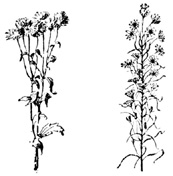
Double Sunflower
Orgyalis Sunflower
Sunflower (Helianthus). People who know only the coarse annual Sunflower are not aware of the beauty which it is possible to secure with the herbaceous perennials belonging to that family. No border should be without a few of the hardy species. Their blooming period extends from early in August until heavy frost. The color runs from light lemon to the richest orange, and the range of growth from 3 to 10 feet, thus enabling one to scatter them through the border without any formal arrangement. They are of the easiest culture. Plants may be dug in the wild or bought of nurserymen. The domesticated double Helianthus multiflorus is always valuable.
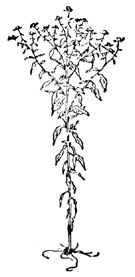
Wild Sunflower Plant
Of the annual Sunflowers, there are some which are not generally cultivated that should receive more attention. The silver-leaved species from Texas (H. argophyllus), and the small, light lemon-yellow variety, are two of the best.
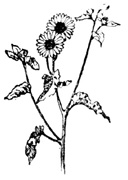
Wild Sunflower
Swainsona. This makes a very desirable house plant, blooming through the late winter and early spring months. The blossoms, which resemble those of the pea, are borne in long racemes. The foliage is finely cut, resembling small locust leaves, and adds to the beauty of the plant, the whole effect being exceedingly graceful. It may be grown from seed or cuttings. Propagate a new stock each year. The flowers are large and pure white. The plant has been called the “Winter Sweet Pea,” but the flowers are not fragrant.
Swan River Daisy (Brachycome iberidifolia) is a charming little border plant, growing to the height of 12 to 15 inches, and bearing quantities of blue or white flowers. The flowers last a long time when cut, and give a vase of flowers a light, graceful effect. The seed should be sown in boxes, hotbed, or windows; or, in warm garden soil, the seed may be sown where the plants are to stand. Only half hardy, and should not be planted out until settled weather. Annual.
Sweet Corn. See Corn.
Sweet Herbs. The Herb garden should find a place on all amateurs’ grounds. Herbs may readily be made profitable by disposing of the surplus to the green grocer and the druggist. The latter will often buy all that the housewife wishes to dispose of, as the general supply of medicinal herbs is grown by specialists, and goes into the hands of the wholesaler and is often old when received by the local dealer. The seedsmen’s catalogues mention upwards of forty different Herbs, medicinal and culinary. The majority of them are perennial, and will grow for many years if well taken care of. However, it is better to resow every three or four years. The annual kinds are raised from seeds each year. Beds 4 feet square of each of the Herbs will supply an ordinary family.
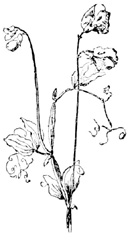
Sweet Pea
Sweet Pea. No annual receives greater attention these days than the Sweet Pea. Sweet Pea exhibitions are held in several sections of the country, the press gives considerable space to the discussion of varieties, and the public generally is interested in the growing or buying of the flower. On any occasion the Sweet Pea is in place. A bouquet of shaded colors, with a few sprays of galium or the perennial gypsophila, makes one of the choicest of table decorations. Deep, mellow soil, early planting and heavy mulching suit them admirably. Sow the seeds as soon as the ground is fit to work in the spring, making a drill 5 inches deep. Sow thickly and cover with 2 inches of soil. When the plants have made 2 or 3 inches growth above the soil, fill the drill nearly full, leaving a slight depression in which water may be caught. After the soil is thoroughly soaked with water, a good mulch will hold the moisture. To have the ground ready in early spring, it is a good plan to trench the soil in the fall. The top of the soil then dries out very quickly in the spring and is left in good physical condition. Frequent syringing with clear water will keep off the red spider that often destroys the foliage, and attention to picking the seed pods will lengthen the season of bloom. If the finest flowers are wanted, do not let the plants stand less than 8-12 inches apart.
A succession of sowings may be made at intervals through May and June, and a fair fall crop obtained if care is taken to water and mulch; but the best results will be secured with the very early planting. In the middle and southern states, the seed may be planted in fall, particularly in lighter soils. It is easy to get soils too rich in nitrogen for Sweet Peas; in such case, they will run to vine at the expense of flowers. If the plants are watered, apply enough to soak the soil, and do not water frequently.
Sweet Potatoes are grown from sprouts planted on ridges or hills, not by planting the tubers, as with the common or Irish potato. The method of obtaining these sprouts is as follows: In April, tubers of Sweet Potatoes are planted in a partially spent hotbed by using the whole tuber (or if a large one, by cutting it in two through the long way), covering the tubers with 2 inches of light, well firmed soil. The sash should be put on the frames and only enough ventilation given to keep the Potatoes from decaying. In ten or twelve days the young sprouts should begin to appear, and the bed should be watered if dry. The sprouts when pulled from the tuber will be found to have rootlets at the lower end and along the stems. These sprouts should be about 3 to 5 inches long by the time the ground is warm enough to plant them out. The ridges or hills should be prepared by plowing out a furrow 4 to 6 inches deep. Scatter manure in the furrow and plow back the soil so as to raise the center at least 6 inches above the level of the soil. On this ridge the plants are set, placing the plants well in to the leaves, and about 12 to 18 inches apart in the rows, the rows being from 3 to 4 feet apart. The after cultivation consists in stirring the soil between the ridges; and as the vines begin to run they should be lifted frequently to prevent rooting at the joints. When the tips of the vines have been touched by frost the crop may be harvested, the tubers left to dry a few days, and stored in a dry, warm place. To keep Sweet Potatoes, store in layers in barrels or boxes in dry sand, and keep them in a dry room. See that all bruised or chilled potatoes are thrown out.
Syringing plants with water has two general offices: to clean the plants of pests or of dirt; to check evaporation or transpiration from the plant itself.
Gardeners look upon water as a good insecticide. That is, if it can be thrown upon the plants somewhat forcibly by means of a syringe or pump, or by the hydrant hose, it will wash off the insects and drown many of them. The water should be applied in a fine and somewhat forcible spray. Care should be taken that the plant is not torn or bruised. The red spider is one of the most serious pests on house plants, and, in a dry season, on plants about the lawn. It thrives in a dry atmosphere. It usually lives on the under sides of the leaves. Syringing the plants frequently will destroy the pests. The thrips and slugs on rose bushes can nearly always be kept in check if one can spray or syringe his plants frequently. See Spraying.
Syringing to check transpiration from the foliage is very useful with plants which are recently transplanted. For instance, when carnations are taken from the field and placed in the house, it is well to syringe them occasionally until they have become established. The same is true with cuttings.
In Syringing plants, it is well to take care that the ground does not become too wet; otherwise the plant may suffer at its root. In the house, plants should rarely be syringed except when the weather is bright, so that they may soon dry off. The plant should not go into the night with wet foliage. Out of doors in hot weather, it is best to syringe toward nightfall. The foliage will ordinarily not suffer in such cases. With plants in the house, it is necessary to keep the leaves dry most of the time in order that fungi may not breed. This is true of carnations, which are very liable to attacks of the rust.
Plants are sometimes syringed or sprayed to protect them from frost. See Frost.
Terraces may be desirable for two reasons: to hold a very steep slope; to afford an architectural base for a building.
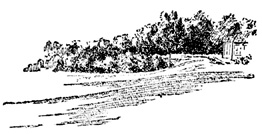
A slope is better than a terrace
It is rarely necessary to make a distinct Terrace in the lawn. Even if the lawn is very steep, it may be better to make a gradual slope than to cut the place in two with a Terrace. A Terrace makes a place look smaller. It is always difficult to make and to keep in repair. The surface is not readily cut with a lawn mower. Unless the sod is very dense, the upper corner tends to wash off with the rains and the foot tends to fill in. Nature does not have straight banks unless they are rock. The illustration in the margin shows how it is possible to treat a sloping lawn. In the distance is a distinct, sharp-angled Terrace; but in the foreground this Terrace has been carried out into the lawn, so that the slope is an agreeable one.
If it is necessary to Terrace a yard in order to hold it, the Terrace would better be at one side rather than in the middle. In that case, one is able to secure a good breadth of lawn. If the Terrace is at the outer side next the street, a perpendicular, mason-work, retaining wall may be constructed. If it is on the inner side of the lawn, it may be placed close to the building and be made to appear as a part of the architecture: it may be made the base of the building. If this is done, there should be a balustrade around the edge of the Terrace to give it architectural feeling. The descent from the Terrace to the lawn may be made by means of steps, so as to add to the architectural aspect of the place. Terraces are most in place about buildings which have many strong horizontal lines; they do not lend themselves so well to buildings in the Gothic style. The general tendency is to make too many Terraces. The cases are relatively few in which they may not be dispensed with.
Thinning of fruit has four general uses: to cause the remaining fruit to grow larger; to increase the chances of annual crops; to save the vitality of the tree; to enable one to combat insects and diseases by destroying the injured fruit.
The Thinning of fruit is nearly always done soon after the fruit is thoroughly set. It is then possible to determine which of the fruits are likely to persist. Peaches are usually Thinned when they are the size of one’s thumb. If Thinned before this time, they are so small that it is difficult to pick them off; and it is not so easy to see the work of the curculio and thereby to select the injured fruits. Similar remarks will apply to other fruits. The general tendency is, even with those who Thin their fruits, not to Thin enough. It is usually safer to take off what would seem to be too many than not to take off enough. The remaining specimens are better. Varieties which tend to overbear profit very greatly by Thinning. This is notably the case with many Japanese plums, which, if not Thinned, are very inferior.
Thinning may also be accomplished by pruning. If one knows where the fruit buds are, cutting them off will have the effect of removing the fruit. In the case of tender fruits, like peaches, however, it may not be advisable to Thin very heavily by means of pruning, since the fruit may be still further Thinned by the remaining days of winter, by late spring frost, or by the leaf-curl or other disease. However, the proper pruning of a peach tree in winter is, in part, a Thinning of the fruit. The peach is borne on the wood of the previous season’s growth. The best fruits are to be expected on the strongest and heaviest growth. It is the practice of peach-growers to remove all the weak and immature wood from the inside of the tree. This has the effect of Thinning out the inferior fruit and allowing the energy of the tree to be expended on the remainder. Apples are rarely Thinned; but in many cases, Thinning can be done with profit. On all home grounds, fruits should be Thinned whenever the trees are very full. In general, the best time to thin the fruit, as already said, is when the fruits have become large enough to be seen and handled. The discarded fruits should be burned if they contain insects or fungi.
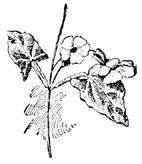
Thunbergia alata
Thunbergia. Tender climbers, making very pretty low screens. They are at their best when grown along the ground where the moisture keeps them free from the attacks of red spider. Some of the kinds are very fine vase or basket plants. All may be grown easily from seed. Annuals, 4 to 6 feet. Flowers white and yellow.
Tillage. By Tillage is meant the stirring of the soil. Tillage is the fundamental operation in agricultural practice. Most farmers till for three reasons: to get the seed into the land; to keep the weeds down; and to get the crop out of the land. The real reason for Tillage, however, is to ameliorate the land; that is, Tillage makes the soil mellow and fine, and an agreeable place in which plants may grow. It enables the soil to hold moisture, to present the greatest feeding surface to roots, to allow the circulation of air, and intensifies many chemical activities. Tilling the soil is the first means of making it productive. If one understands the many forces that are set at work, the Tilling of the soil becomes one of the most interesting and exciting of all agricultural operations.
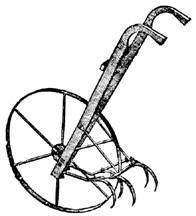
For hand Tilling
The exact method of Tilling the soil in any particular case must be determined by many circumstances. Light soils are handled differently from heavy soils; and much depends also upon the season of the year in which the Tillage is done. In all ordinary soils, the effort should be made to work them deep, so that there is a deep reservoir for the storage of moisture and a large area in which roots can work. Subsequent Tillage throughout the growing season is performed very largely for the purpose of keeping the top of the soil loose and fine so that the moisture from beneath cannot pass off into the atmosphere. This loose layer of soil, extending two or three inches from the surface, may itself be very dry; but it breaks up the capillary connection between the lower soil and the air, and thereby prevents evaporation. This surface layer of loose, mellow soil is often spoken of as the earth-mulch. It answers much the same purpose as a mulch of straw or leaves in interposing a material between the moist soil and the air through which the moisture cannot rise. If this mulch is repaired as often as it should be, weeds cannot grow; but the object of the Tilling is more to make and maintain the mulch than to destroy weeds. The surface should be Tilled shallow in the growing season as often as it tends to become compact or encrusted. This will be after every rain, and usually as often as once in ten days when there is no rain. The tools to be used for this surface Tillage are those which will comminute or fine the soil most completely without compacting it or leaving it in ridges or in furrows. In garden work, a fine rake is the ideal thing; whereas in field work, some of the wire-tooth weeders or smoothing harrows are excellent. In fields which are hard and lumpy, however, it will be necessary to use heavier and rougher tools.
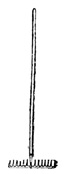
Steel rake
In order to break down hard clay soils, one must exercise great care not to work them when they are wet; and also not to work them very much when they are dry. There is a time, shortly after a rain, when clay lumps will break to pieces with a very slight blow. At this time it is well to go over them with a harrow or a rake. After the next rain, they can be gone over again, and before the end of the season the soil should be in fine condition. An excellent way of breaking down clay land is to plow or spade it in the fall and allow it to weather in the winter. In such cases the land should not be raked or harrowed, but allowed to lie rough and loose. Very hard clay lands sometimes run together or cement if handled in this way, but this will not occur if the land has stubble or sod or a dressing of manure, for the fibrous matter will then prevent it from puddling. Lime sown on clay land at the rate of twenty to forty bushels to the acre also has a distinct effect in pulverizing it. This may be sown in fall, or preferably in spring when the land is plowed.
One of the most important ways of ameliorating land is to work vegetable matter into it so as to give it humus. Soils which are loose, black and friable contain much of this vegetable mold. In many cases the chief value of stable manure is to add this humus to the soil. Many soils need humus more than they need plant-food, and hence stable manure gives better results in those cases than commercial fertilizers. The farmer secures the humus by plowing under stubble and sod, and occasional green crops.
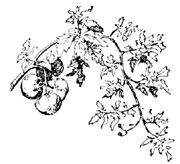
Tomato
Tomato. The early fruits are very easily grown by starting the plants in a greenhouse, hotbed or in shallow boxes placed in windows. A pinch of seed sown in March will give all the early plants a large family can use. When the plants have reached the height of two or three inches they should be transplanted into 3-inch flower pots, old berry boxes or other receptacles, and allowed to grow slow and stocky until time to set them out, which is from May 15 on (in New York). They should be set in rows four or five feet apart, the plants being the same distance in the rows. Some support should be given to keep the fruits off the ground and to hasten the ripening. A trellis of chicken-wire makes an excellent support, as does the light lath fencing that may be bought or made at home. Stout stakes, with wire strung the length of the rows, afford an excellent support. A very showy method is that of a frame made like an inverted V, which allows the fruits to hang free; with a little attention to trimming, the light reaches the fruits and ripens them perfectly. This support is made by leaning together two lath frames. The late fruits may be picked green and ripened on a shelf in the sun; or they will ripen if placed in a drawer.
One ounce of seed will be enough for from twelve to fifteen hundred plants. A little fertilizer in the hill will start the plants off quickly. The rot is less serious when the vines are kept off the ground and the rampant suckers are cut out.
Tools of many kinds, and well chosen, are one of the joys of a garden. There is great satisfaction in a well-made, clean tool which does its work well. Keep the tools bright. They should be under cover, and in place, when not in use. A cupboard may be built by the rear porch, or in the barn or carriage house. See that the cupboard is in a dry place. Various Tools have been mentioned in the preceding pages, and other useful kinds are shown in the article on Weeds.
Transplanting. This operation the gardener calls in one instance “pricking out.” This means taking young seedling plants from the seed box as soon as they are large enough to be handled—usually when the first “rough” leaves have developed—and replanting them in other boxes or pots, either singly or at a greater distance apart than they were when in the seed boxes. The term is used in the operation of setting out plants from the hotbed, frame or house to the garden; also in removing shrubs or trees. Transplant on a cloudy day, and just before a rain, if possible.
Trimming is a term which is ordinarily confounded with pruning (which see). The word “Trimming,” however, should be restricted to the shaping of the trees and not to the thinning of the tree or to pruning for wood, fruit or other special object. Trimming is only one of the means of pruning. Trimming is mostly used in the case of hedges. It is also used to keep evergreens in shape. Many ornamental plants are also Trimmed into various forms, although it is a question if such Trimming is usually wise. Fruit trees should be pruned, as a rule, rather than Trimmed: that is, they usually should be allowed to take their natural form, the pruner taking out the superfluous wood and keeping them within manageable bounds.
Tropæolum. See Nasturtium.
Tuberose. The Tuberose requires more heat to grow to perfection than it is usually possible to give here in the North. If planted in the border they will not start into growth until the ground has become thoroughly warm—usually after the middle of June,—making the season before frost too short for their perfect growth and flower. However, if started in loose soil or moss in a warm room or on benches of a greenhouse, the roots will soon start from the tuber and make a fine growth. If planted out in June with a good ball of roots they are likely to bloom before frost. If any danger of frost is feared they may be lifted into pots or boxes and taken into the house, when they will bloom without a check. As with other bulbs, a sandy soil will suit.
Tuberous Begonia. A large bed of these covered with crimson, pink, white, or yellow flowers, ranging from 2 to 4 and even 6 inches in diameter, some double, some single, is a striking sight. Yet such a sight is not uncommon about the large eastern cities where the Tuberous Begonia is now used somewhat for bedding.
Our interior summers are more trying, and so far, few in the west have succeeded so well with the Tuberous Begonia as a bedding plant. It makes a fine summer-blooming pot-plant, however, for the greenhouse or window, and with due attention to its requirements, it may be used as a bedding plant. It properly falls under greenhouse plants in its requirements.
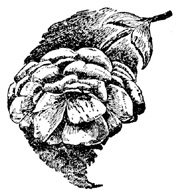
Double Tuberous Begonia
C. L. Allen, writing of its culture in his work on “Bulbs and Tuberous-Rooted Plants,” says: “The principal point learned in regard to its culture is, that it must be treated as a plant and not as a bulb. The enthusiastic florist, seeing the many good qualities of the plant, has led amateurs to believe it could be treated as a bulb, and planted out in the same manner as the gladiolus or tigridia and kept dormant during the winter in the same manner. This is a great mistake, as the tubers will not endure as long a period of rest and cannot be exposed to the air for a long time without seriously injuring their vitality. The tubers must be kept in dry earth or sand, until they show signs of growth, which will be not later than the first of March; then they may be started into rapid growth. After the eyes are fully developed the tubers may be divided: each eye will make a plant. Then they are treated in all respects like greenhouse plants, and grown on until the proper season for their planting out. This is not before the first of June, as Begonias are quite sensitive to cold nights, but not at all to heat. At that time the plants should be fully 6 inches in height and proportionately strong. Such plants will make a grand display the entire season, rather delighting in great heat.”
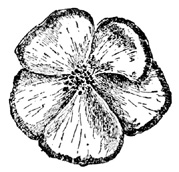
Tuberous Begonia, single.
In starting the tubers in March, they should be placed in moist sand or moss in a temperature of 60° to 65°, either in the greenhouse or window. After the buds are well started the tubers may be divided as pointed out, or planted whole. They prefer a rich, rather sandy soil. When they are well under way give them all the light and air they will bear, and keep them close to the glass to avoid “legginess” and to insure a firm, sturdy growth. A week before planting them out they should be given abundance of air and light to “harden off” the plants preparatory to setting them in sun and wind.
The beds should be in a somewhat sheltered place where they will be partially shaded from the hot midday sun. Let the soil be well enriched with old manure or humus and thoroughly worked over to a depth of one foot. During dry periods the beds will need watering from time to time; but never water them when the sun is shining full on them, or the foliage may be scorched. A mulch of leaf-mold or old manure will be helpful in keeping the soil moist and the roots cool.
Before frost the tubers should be carefully taken up and gradually dried in the shade, after which they are to be placed in dry sand or earth, in shallow boxes, and kept till time to start them in the spring. They should be kept in a cool place, secure from frost and away from stoves or heating pipes.
For amateurs it is better to recommend buying bulbs of the several colors, instead of attempting to grow them from seeds, which are extremely small and require early sowing, warmth and close attention.
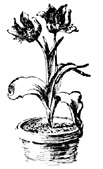
Tulip as a pot-plant
Tulips are hardy and easy to grow. The advice given under Bulbs, Crocus and Hyacinth applies to Tulips. They may be forced for winter bloom (see under Window-Gardens). The garden bed will last several years if well cared for, but most satisfactory bloom is secured if the old bulbs are taken up every two or three years and replanted, all the inferior ones being cast aside. When the stock begins to run out, buy anew. Plant in October, 4 to 6 inches deep.
Turnips and Rutabagas are usually a fall crop, from seed sown in July and early August, although many kitchen gardens have them from spring sown seed. The culture is easy. Sow in drills 12 inches apart. They will become edible in from six to eight weeks. They are cool-weather crops, and the tops stand much frost. If maggots bother, do not raise them on the same land again for three or four years. Bordeaux mixture repels the flea-beetles. One ounce will sow 150 feet of drill.
Varieties. It is usually one of the first desires of the intending planter to inquire about Varieties. It is one of the secondary things to be considered, however, for the first thing to do is to prepare the land, to determine whether one’s soil and site are adapted to the plant in question, and to discuss other matters of a general nature. When all the fundamental things are settled, then the question of Varieties, which is a special matter, may be taken up. Although the selection of Varieties is a very special matter, it is nevertheless essential to success or satisfaction in the growing of any plant.
It should first be considered that the selection of Varieties is very largely a personal matter. The man should grow the Varieties which he likes. This is especially true in the selection of Varieties for the home grounds, in which case the market ideals enter very little into the problem. Having satisfied one’s own mind as to what kinds of Varieties he would like, he may then inquire of the neighbors and of experts if those Varieties are adapted to the soil and climate. If he intends to grow for market, he should canvass the market demands thoroughly before choosing the Varieties. The lists of Varieties in books, bulletins, and seedmen’s catalogues are hints, not rules. As a general statement, it may be said that the only way to determine the best variety for one’s own conditions is to experiment. There is intense satisfaction in the experimenting itself. The best lists of Varieties are those which are recommended for some specific purpose, and which represent the combined opinions of many expert growers. It is rare that one man’s judgment should be final, particularly with respect to fruits or plants which are grown in general outdoor conditions. Under glass a gardener can make his climate and conditions, and therefore he can adapt his conditions to his plants. The experiment station test usually represents but one man’s opinion. It may be a more valuable opinion than that of another man, but it is not final. It should be studied in connection with other lists, particularly those made by practical growers. If one desires to choose Varieties, therefore, he should consult the best growers of those plants in his immediate neighborhood; he should call upon the experiment station of his state or province; and he should consult the most recent writings on the subject.
Vegetable Garden. It is one of the choicest of pleasures to raise one’s own vegetables. Make the Vegetable Garden ample, but economize labor. Plant the things in rows, not in beds. Then they can be tilled easily, either by horse- or hand-tools. Wheel-hoes will accomplish most of the labor of tillage in a small garden. Have the rows long, to avoid waste of time in turning and to economize the land. One row can be devoted to one vegetable; or two or more vegetables of like requirements (as parsnips and salsify) may comprise a row. Have the permanent vegetables, as rhubarb and asparagus, at one side, where they will not interfere with the plowing or tilling. The annual vegetables should be grown on different parts of the area in succeeding years, thus practicing something like a rotation of crops. If radish or cabbage maggots or club-root become thoroughly established in the plantation, omit for a year or more the vegetables on which they live.

Lay-out of a farm Vegetable Garden
Make the soil deep, mellow and rich before the seeds are sown. Time and labor will be saved. Rake the surface frequently to keep down weeds and to prevent the soil from baking (see Tillage). Radish seeds sown with celery or other slow-germinating seeds will come up quickly, breaking the crust and marking the rows. About the borders of the Vegetable Garden is a good place for flowers to be grown for the decoration of the house and to give to friends. Along one side of the area rows of bush fruits may be planted.
A home Vegetable Garden for a family of six would require, exclusive of potatoes, a space not over 100 by 150 feet. Beginning at one side of the garden and running the rows the short way (having each row 100 feet long) sowings may be made, as soon as the ground is in condition to work, of the following:
Fifty feet each of parsnips and salsify.
One hundred feet of onions, 25 feet of which may be potato or set onions, the balance black-seed for summer and fall use.
Fifty feet of early beets, 50 feet of lettuce, with which radish may be sown to break the soil and be harvested before the lettuce needs the room.
One hundred feet of early cabbage, the plants for which should be from a frame or purchased. Set the plants 18 inches to 2 feet apart.
One hundred feet of early cauliflower; culture same as for cabbage.
Four hundred and fifty feet of peas, sown as follows:
100 feet of extra early.
100 feet of intermediate.
100 feet of late.
100 feet of extra early, sown late.
50 feet of dwarf varieties.
If trellis or brush is to be avoided, frequent sowings of the dwarfs will maintain a supply.
After the soil has become warm and all danger of frost has passed, the tender vegetables may be planted, as follows:
Corn in five rows 3 feet apart, three rows to be early and intermediate, and two rows late.
One hundred feet of string beans, early to late varieties.
Vines as follows:
10 hills of cucumbers, 6 x 6 feet.
20 hills of muskmelon, 6 x 6 feet.
6 hills of early squash, 6 x 6 feet.
10 hills of Hubbard, 6 x 6 feet.
One hundred feet of okra.
Twenty eggplants. One hundred ft. (25 plants) tomatoes.
Six large clumps of rhubarb.
An asparagus bed 25 feet long and 3 feet wide.
Late cabbage, cauliflower and celery are to occupy the space made vacant by removing early crops of early and intermediate peas and string beans.
A border on one side or end will hold all herbs, such as parsley, thyme, sage, hyssop, mints.
Verbena
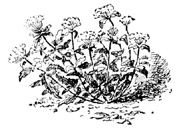
Verbena. The Verbena is one of the most satisfactory garden plants, blooming early. Bloom continues through the dry, hot days of summer. As the cool weather of the fall comes on, Verbenas increase in size of plant and flower until killed by severe frost. Plants grown from seed sown in a hotbed or house early in the spring, transplanted into pots or boxes when large enough, and planted out as soon as the ground has become warm, are more vigorous and seem to have more fragrance than those grown from cuttings. Many of the strains have become so well fixed that the colors come true from seed. Cuttings are often employed, but the handling of stock plants is a difficult matter except in the hands of a professional, and when plants are wanted in quantity it is cheaper to buy them of the plantsman than to grow them from seed or attempt to keep over stock plants. Therefore, for the home garden, seed-grown plants are usually most satisfactory. Give a sunny position. Thin to 10 to 15 inches apart each way.
Vinca, or Periwinkle. Trailing plants. Useful in covering unsightly places, for vases, urns or baskets. Some of the species (as the common evergreen, mat-like “running myrtle”) are hardy, but the most useful ones need the protection of a house through the winter. The variegated-leaved kinds are fine for winter decorations. Propagated mostly by cuttings. Perennials.
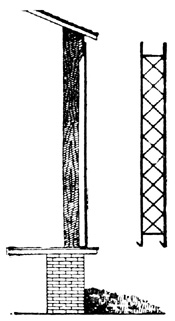
A vine support for a porch
Vines. The use of Vines for screens and pillar decorations has increased in the last decade until now they may be seen in nearly all grounds. The tendency has been towards using the hardy Vines, of which the ampelopsis, or Virginia creeper, is one of the most common. It is a very rapid grower, and lends itself to training more readily than many others. The Japan ampelopsis (A. tricuspidata or Veitchii) is a fine clinging Vine, growing very rapidly when once established, and being brilliantly colored after the first fall frosts. It clings closer than the other, but is not so hardy. Either of these may be grown from cuttings or division of the plants. Two woody twiners of recent introduction are the actinidia and the akebia, both from Japan. They are perfectly hardy, and are rapid growers. The former has large, thick, glossy leaves, not affected by insects or disease, growing thickly along the stem and branches, making a perfect thatch of leaves. It blooms in June. The flowers, which are white with a purple center, are borne in clusters, followed by round or longish edible fruits. The akebia has very neat cut foliage, quaint purple flowers, and often bears ornamental fruit. Other hardy Vines are the wistaria, clematis, tecoma (or trumpet-flower), aristolochia (or Dutchman’s pipe), hedera (or ivy), and loniceras (or honeysuckles).
Of the tender Vines, the nasturtiums and ipomœas are the most common, while the adlumia (p. 3), balloon vine (p. 28), passion vine, and the gourds (p. 115), are frequently used. One of the best of recent introduction is the annual hop, especially the variegated variety. This is a very rapid growing Vine, seeding itself each year, and needing little care. See Hop. All the tender Vines should be planted after all danger of frost is over.
ANNUAL HERBACEOUS CLIMBERS
Tendril-climbers
Adlumia (biennial).
Balloon Vine.
Cobæa.
Gourds.
Nasturtiums.
Sweet Pea.
Wild Cucumber.
Twiners
Beans, Flowering.
Cypress Vine.
Dolichos.
Hop, Japanese.
Ipomœa.
Moonflower.
Morning-glory.
Thunbergia.
Yam, Chinese, or Cinnamon Vine (perennial from a hardy tuber).
PERENNIAL WOODY CLIMBERS FOR THE OPEN
Tendril-climbers
Ampelopsis tricuspidata.
Clematis of many kinds.
Grape of various kinds.
Greenbrier.
Ivy (by roots).
Roses (scramblers).
Trumpet Creeper (by roots).
Virginia Creeper.
Twiners
Actinidia polygama.
Akebia quinata.
Aristolochia, or Dutchman’s Pipe.
Bittersweet, or Celastrus.
Honeysuckles.
Moonseed.
Wistaria.
Violets
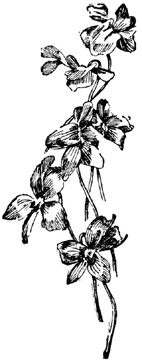
Violet. While the culture of Violets as house-plants rarely proves successful, there is no reason why a good supply may not be had elsewhere through the greater part of the winter and the spring months. A sheltered location being selected, young plants from runners may be set in August or September. Have the ground rich and well drained. These plants will make fine crowns by December, and often will bloom before weather sufficiently cold to freeze them. In order to have flowers through the winter, it will be necessary to afford some protection to the plants. This may best be done by building a frame of boards large enough to cover the plants, making the frame in the same way as for a hotbed, four to six inches higher at the back than the front. Cover the frame with sash or boards, and as the weather becomes severe, mats or straw should be placed over and around the frame to protect the plants from freezing. Whenever the weather will permit, the covering should be removed and air admitted, but no harm will come if the frames are not disturbed for several weeks. A large amount of sunlight and a high temperature through the middle of winter are to be avoided, for if the plants are stimulated a shorter period of bloom will result. In April the frame may be removed, the plants yielding the later part of the crop without protection. Violets belong with the “cool” plants of florists. When well hardened off, considerable frost does not harm them. They should always be kept stocky. Start a new lot from runner-plants each year. They thrive in a temperature of 55° to 65°.
Walks. The place for a Walk is where it is needed. It should go directly between two points. It need not be straight, but if it is curved, the curve should be direct. That is, the pedestrian should be conscious that he is going in the direction in which he desires to go, and is not making a detour for the simple purpose of following the walk. Convenience should be the first thing to be considered. After the Walks have been laid in the most convenient places, the question of ornamenting the borders may be considered. It is always well to avoid, so far as possible, the bisecting of lawns by Walks, as that makes two lawns where there should be only one. The larger a greensward can be made to look, the more park-like and natural is the place. Avoid taking the Walks circuitously around the borders unless they are laid for the simple purpose of making a ramble to show off the grounds. All Walks which are designed for serious use should appear to be necessary, direct and convenient.
Some soils which contain considerable loam and sand will pack with tramping and will make good Walks, but it is usually necessary to lay some material on the soil. Gravel, cinders, and the like, may be better than the natural surface; but in many cases they are worse, since the surface is loose and is unpleasant to walk on. In Walks which are on decided slopes, and down which the water is likely to run, any loose material is very objectionable, since it runs to the low places. The best material for Walks, all things considered, is cement, or what is called artificial stone. If well made, it is as durable as flagging, and is not so likely to get out of place. It holds its surface perfectly year after year.
The only objection to cement Walks is when they are more or less temporary, for in such cases they cannot be moved. There is often very serious difficulty in securing good cement Walks, but the difficulties are easily overcome. They are chiefly two: there is not sufficient draining material beneath the cement; and the cement itself is not made strong enough. There should be at least a foot of loose material, as brickbats or cinders, below the cement cover; and if the place is low and likely to hold water, there should be still greater drainage. Pound the material down, or let it stand for some time until it becomes thoroughly settled together. Then lay the cement in two courses. The first course may be three or four inches thick and made of well mixed mortar, comprising three parts Portland cement, one part water lime, and two to three times as much sharp sand as Portland. When this has become partially hardened, but before it is set and while still moist, put on a finishing layer of one inch, made of one part Portland cement, one part water lime, and one part sharp sand. It is important that the materials be very thoroughly mixed. See that the edges of the walk are made square and true by laying down a form of boards lengthwise the area before the cement is put on. The edges should be as thick as the middle, for a thin crust on the edge tends to snap off. A walk made in this way on a well-drained foundation will last almost indefinitely. It is best that it be made in such season that it can become thoroughly set before frosty weather comes.
Wallflower. A favorite plant for pots or garden, having a clove-like fragrance. Seed of most varieties should be sown the year before wanted. One kind, being an annual, will flower the same season the seed is sown. Hardy. Two to 3 feet.
Washing orchard trees is an old practice. It usually results in making a tree more vigorous. One reason is that it destroys insects and fungi which lodge underneath the bark; but probably the chief reason is that it softens the bark and allows the trunk to expand. It is possible, also, that the potash from the soap or lye eventually passes into the ground and affords some plant-food. Trees are ordinarily Washed with soap suds or with a lye solution. The material is usually applied with an old broom or a stiff brush. The scrubbing of the tree is perhaps nearly or quite as beneficial as the application of the wash itself.
It is customary to wash trees late in spring or early in summer, and again in the fall, with the idea that such Washing destroys the eggs and the young of borers. It no doubt will destroy borers if they are just getting a start, but it will not keep away the insects which lay the eggs, and will not destroy the borers which have found their way underneath the bark. It is perhaps quite as well to wash the trees very early in the spring, when they are starting into growth. It is an old practice to wash trees with strong lye when they are affected with the oyster-shell bark louse. The modern method of treating these pests, however, is to spray with some kerosene compound when the young growth is starting, for at that time the young insects are migrating to the new wood and they are very easily destroyed.
Watering House Plants. It is impossible to give rules for the Watering of plants. Conditions that hold with one grower are different from those of another. Advice must be general. Give one good Watering at the time of potting, after which no water should be given until the plants really need it. If, on tapping the pot, it gives out a clear ring, it is an indication that water is needed. In the case of a soft-wooded plant, just before the leaves begin to show signs of wilt, is the time for Watering. When plants are taken up from the ground, or when plants have their roots cut back in repotting, gardeners rely, after the first copious Watering, on syringing the tops of the plants two or three times each day, until a new root-growth has started, Watering at the roots only when absolutely necessary. Plants that have been potted into larger pots will grow without the extra attention of syringing, but those from the borders, that have had their roots mutilated or shortened, should be placed in a cool, shady spot and be syringed often. One soon becomes familiar with the wants of individual plants, and can judge closely as to need of water. All soft-wooded plants with a large leaf-surface need more water than hard-wooded plants, and a plant in luxuriant growth of any kind more than a plant that has been cut back or become defoliated. When plants are grown in living-rooms, moisture must be supplied from some source, and if no arrangement has been made for having a moist air the plants should be syringed often. See Syringing.
Watering pot
Watermelon. The culture of this is essentially the same as that for muskmelons (which see), except that most varieties require a warmer place and longer period of growth. Give the hills a distance of from 6 to 10 feet apart. Choose a warm, “quick” soil and sunny exposure. It is essential, in the North, that the plants grow rapidly and come into bloom early. One ounce of seed will plant thirty hills.
Wax Plant. The Wax Plant, or Hoya, is one of the commonest of window-garden plants, and yet it is one which people usually have difficulty in flowering. However, it is one of the easiest plants to manage if a person understands its nature. It is naturally a summer-blooming plant, and should rest during the winter time. In the winter, keep it just alive in a cool and rather dry place. If the temperature does not go above 50° Fahr., so much the better; neither should it go much lower. In late winter or spring, the plant is brought out to warm temperature, given water and started into growth. The old flower-stems should not be cut off, since new flowers come from them as well as from the new wood. When it is brought out to be started into growth, it may be repotted, sometimes into a size larger pot, but always with more or less fresh earth. The plant should increase in value each year. In conservatories, it is sometimes planted out in the ground and allowed to run over a wall, in which case it will reach a height of many feet.
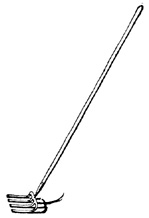
Potato hook and weed-puller

Finger-weeder
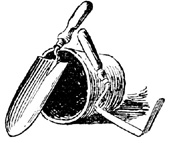
Trowel and angle-weeder
Weeds. Many very strong Weeds are a compliment to one’s soil: only good soil produces them. But they are not a compliment to one’s tillage. If the soil is well prepared and well tilled to conserve moisture and to unlock plant-food (see Tillage), Weeds will find little chance of growing. Stir the ground often: it benefits the ground and keeps out the Weeds. Plant vegetables in long straight rows rather than in beds, for thereby tillage is made easier. For beds and for small plants, the hand-weeders (as shown in the margin) are very efficient. They save laborious finger-work. Weed seeds are often distributed in manure, especially if Weeds have been allowed to grow and ripen on the piles. See that pernicious Weeds do not seed about the premises. For the treatment of weedy lawns, see the article Lawns.
Windbreaks. There is the greatest difference of opinion as to the value of Windbreaks for fruit plantations. These differences arise from the fact that a Windbreak may be of great benefit in one place, but a disadvantage in another. It is always advisable to break the force of very strong winds, for such winds tend to injure the trees when laden with fruit or ice, and they blow off the fruit; and in dry countries they cause the soil to become parched. If the wind is usually warmer than the area, however, particularly in the winter time, it is better not to stop it, but to allow it to circulate through the plantation. This is the case in areas which lie close to large bodies of water. The wind coming off the water is warmer than that off the land, and tends thereby to protect the fruit plantation from severe cold. A circulation of air is desirable in late spring and early fall in order to avoid the still frosts. Therefore, if the area is very closely surrounded by dense plantations, it may have what the fruit-growers call “stagnant air;” but thinning out the Windbreak on one or two sides, or cutting holes through it, may allow the air to move through, thereby affording atmospheric drainage and insuring greater immunity from the light local frosts.
It is ordinarily better to break the force of the winds than to stop or deflect them. That is, the Windbreak may be thin enough to allow the wind to take its normal direction, but its force is broken. A stone wall or a very dense hedge of evergreens may cause the wind to rise over the plantation or to be deflected to one side; and this, in many cases, as already said, may be a decided disadvantage. The philosophy of a good Windbreak for fruit plantations may be summed up in this way: the force of heavy winds should be broken; warm winds should be allowed to circulate freely through the plantation; still air should be avoided.
Ordinarily, one or two rows of deciduous trees are sufficient protection. When the plantation is very much exposed to very cold or land winds, a thick evergreen screen may be a decided advantage. It is usually better to have the heavy Windbreak on the upper side of the area, so that it may not interfere with the natural drainage of the cold air down the slope. In making a Windbreak, it is important that those trees be chosen which will not become harboring places for orchard enemies. The wild cherry, for example, is inveterately attacked by the tent caterpillar, and the wild crabs and wild plums are likely to breed orchard insects. If the Windbreak is planted some time in advance of the orchard, the row of fruit trees next the Windbreak will be very likely to suffer from lack of moisture and food.
A different type of Windbreak is that which is desired for a shelter belt about the home grounds. The matter of atmospheric drainage does not enter into this problem to any great extent. Such shelter belt is usually placed at the extreme edge of the home yard, toward the heaviest or prevailing wind. It may be a dense plantation of evergreens. If so, the Norway spruce is one of the best for general purposes. For a lower belt, the arborvitæ is excellent. Some of the pines, as the Scotch or Austrian, are also to be advised, particularly if the belt is at some distance from the residence. As a rule, the coarser the tree the farther it should be placed from the house.
Persons may desire to use the Windbreak as a screen to hide undesirable objects. If these objects are of a permanent character, as a barn or an unkempt property, evergreen trees should be used. For temporary screens, any of the very large-growing herbaceous plants may be used. Very excellent subjects are sunflowers, the large-growing nicotianas, castor beans, large varieties of Indian corn, and plants of like growth. Very efficient summer screens may be made with ailanthus, paulownia, basswood, sumac, and other plants which tend to throw up succulent shoots from the base. After these plants have been set a year or two, they are cut back nearly to the ground every winter or spring, and strong shoots are thrown up with great luxuriance during the summer, giving a dense screen and presenting a semi-tropical effect. For such purposes, the roots should be planted only two or three feet apart. If, after a time, the roots become so crowded that the shoots are weak, some of the plants may be removed. Top-dressing the area every fall with manure will tend to make the ground rich enough to afford a very heavy summer growth.
Wind Flower. See Anemone.
Window-Gardens. The Summer Window Garden.—This type of gardening is particularly suited to those who live in the crowded city, where the want of other space makes the Window-Garden the only one possible.
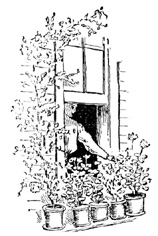
A summer window ledge
Handsomely finished boxes, ornamental tiling, and bracket work of wood and iron suitable for fitting out windows for the growing of plants, are on the market; but such, while desirable, are by no means necessary. A stout pine box of a length corresponding to the width of the window, about 10 inches wide and 6 deep, answers quite as well as a finer box, since it will likely be some distance above the street, and its sides, moreover, are soon covered by the vines. A zinc tray of a size to fit into the wooden box may be ordered of the tinsmith. It will tend to keep the soil from drying out so rapidly, but it is not a necessity. A few small holes in the bottom of the box will provide for drainage; but with carefulness in watering these are not necessary, since the box by its exposed position will dry out readily during summer weather, unless the position is a shaded one. In the latter case provision for good drainage is always advisable.
Since there is more or less cramping of roots, it will be necessary to make the soil richer than would be required were the plants to grow in the garden. The most desirable soil is one that does not pack hard like clay, nor contract much when dry, but remains porous and springy. Such a soil is found in the potting soil used by florists, and it may be obtained from them at from 50 cts. to $1 a barrel. Often the nature of the soil will be such as to make it desirable to have at hand a barrel of sharp sand for mixing with the soil, to make it more porous and prevent baking.
Some pot the plants and then set them in the window-box, filling the spaces between the pots with moist moss. Again, they are planted directly in the soil. The former method, as a general rule, is to be preferred in the winter Window-Garden; the latter during the summer.