THE PRACTICAL GARDEN-BOOK (continued 3)
Reading edition
Eschscholtzia. See California Poppy.
Eutoca. Hardy early-flowering annuals having pink or blue flowers, good for masses. Sow seed early where wanted. Height 1 foot. Eutocas are properly classed with Phacelias.
Evergreens. Evergreens are plants which hold their foliage in winter. Ordinarily, however, in this country the word Evergreen is understood to mean coniferous trees with persistent leaves, as pines, spruces, firs, cedars, junipers, arborvitæ, retinosporas, and the like. These trees have always been favorites with plant lovers, as they have very distinctive forms and other characteristics. Many of them are of the easiest culture. It is a common notion that, since spruces and other conifers grow so symmetrically, they will not stand pruning; but this is an error. They may be pruned with as good effect as other trees, and if they tend to grow too tall the leader may be cut out without fear. A new leader will arise, but in the meantime the upward growth of the tree will be somewhat checked, and the effect will be to make the tree dense. The tips of the branches may also be headed in with the same effect. The beauty of an Evergreen lies in its natural form; therefore, it should not be sheared into unusual shapes, but a gentle trimming back, as suggested, will tend to prevent the Norway spruce and others from growing open and ragged. After the tree attains some age, 4 or 5 inches may be taken off the ends of the main branches every year or two with good results. This slight trimming is ordinarily done with Waters’ long-handled pruning shears.
There is much difference of opinion as to the proper time for the transplanting of Evergreens, which means that there is more than one season in which they may be moved. It is ordinarily unsafe to transplant them in the fall in northern climates or bleak situations, since the evaporation from the foliage during the winter is likely to injure the plant. The best results are usually secured when they are transplanted just as new growth is beginning, rather late in the spring. Some people also plant them in August, and the roots secure a hold of the soil before winter. In transplanting conifers, it is very important that the roots be not exposed to the sun. They should be moistened and covered with burlaps or other material. The holes should be ready to receive them. If the trees are large, or if it has been necessary to trim in the roots, the top should be cut when the tree is set. Large Evergreens (those 10 feet and more high) are usually best transplanted late in winter, at a time when a large ball of earth may be moved with them. A trench is dug around the tree, it being deepened a little day by day so that the frost can work into the earth and hold it in shape. When the ball is thoroughly frozen, it is hoisted onto a stone-boat and moved to its new position.
For low hedges or screens, one of the most serviceable Evergreens is the arborvitæ in its various forms. Red cedars are also useful. Perhaps the handsomest of all of them for such purposes is the ordinary hemlock spruce; but it is usually difficult to move. Transplanted trees from nurseries are usually safest. If the trees are taken from the wild, they should be selected from open and sunny places. For neat and compact effects near porches and along walks, the dwarf retinosporas are very useful. Most of the pines and spruces are too coarse for planting very close to the house. They are better at some distance removed, where they serve as a background to other planting. If they are wanted for individual specimens, they should be given plenty of room, so that the limbs will not be crowded and the tree become misshapen. Whatever else is done to the spruces and firs, the lower limbs should not be trimmed up, at least not until the tree has become so old that the lowest branches die. Some species hold their branches much longer than others. The oriental spruce (Picea orientalis) is one of the best in this respect. The occasional slight heading-in, which we have mentioned, will tend to preserve the lower limbs, and it will not be marked enough to alter the form of the tree.
Everlastings are flowers which retain their shape and usually their color when they are dried. Most of them are members of the composite family. In order to have them hold shape and color, cut them with very long stems just before they are fully expanded, and hang them in an airy place away from the sun. They are all annuals, or grown as such, and are of very easy culture. Sow seeds where the plants are to stand. Good kinds are Ammobium, Gomphrena or Bachelor’s Buttons, Rhodanthe, Helichrysum, Xeranthemum, and Acroclinium. Certain wild composites may be similarly used, particularly Anaphalis and species of Gnaphalium. Some of the grasses make excellent additions to dry bouquets (see Grass). With these dry bouquets, various seed pods look well.
Fenzlia. Little hardy annuals, having a profusion of bloom through the entire summer. The flowers are a delicate pink, with yellow throat surrounded by dark spots. A charming edging plant or window box subject. Sow the seed in boxes or where plants are wanted, and thin to the distance of 10 inches. Height 3 to 4 inches. Now classed with Gilia.
Ferns. Probably the one Fern grown most extensively as a house plant is the small-leaved Maidenhair Fern (or Adiantum gracillimum). This and other species are among the finest of house plants, when sufficient moisture can be given. They make fine specimens, as well as serving the purpose of greenery for cut-flowers. Other species often grown for house plants are A. cuneatum and A. Capillus-Veneris. All these do well in a mixture of fibrous sod, loam, and sand, with ample drainage material. They may be divided if an increase is wanted.
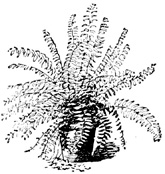
Boston Fern
Other Ferns for house culture include Nephrolepis exaltata. This is no doubt the most easily grown of the list, flourishing in a sitting-room. The new variety of N. exaltata, called the Boston Fern (see figure), is a decided addition to this family, having a drooping habit, covering the pot and making a fine stand or bracket plant.
Several species of Pteris, particularly P. serrulata, are valuable house Ferns, but require a warmer situation than those mentioned above. They will also thrive better in a shady or ill-lighted corner.
Perfect drainage and care in watering have more to do with the successful growing of Ferns than any special mixture of soils. If the drainage material in the bottom of the pot or box is sufficient, there is little danger of over-watering; but water-logged soil is always to be avoided. Do not use clay soils. Ferns need protection from the direct sunshine, and also a moist atmosphere. They thrive well in a close glass box, or window-garden, if the conditions can be kept equable.
The native Ferns transplant easily to the garden, and they make an attractive addition to the side of a house, or as an admixture in a hardy border. The Ostrich and Cinnamon Ferns are the best subjects. Give all outdoor Ferns a place which is protected from winds, otherwise they will shrivel and perhaps die. Screen them from the hot sun, or give them the shady side of the building. See that the soil is uniformly moist, and that it does not get too hot. Mulch with leaf-mold in the fall.
Fertilizers. Soil is productive when it has good physical texture, plant-food, and a sufficient supply of moisture. Even though it has an abundance of plant-food, if its texture is not good, it will not raise a good crop. Soil has good texture when it is open, mellow, friable, rather than loose and leachy, or hard and cloddy. Commercial Fertilizers add plant-food, but usually they have only a small influence in correcting faulty texture. Therefore, before concentrated Fertilizers are applied to land, it should be gotten into good physical condition by judicious tillage and by the incorporation of vegetable mold or humus. The leading source of humus in most gardens is stable manure. See Manure.
The plant-food in commercial Fertilizers is largely in a soluble or quickly available condition. Therefore, a little Fertilizer applied late in the fall or early in the spring will tend to start the plants off quickly in the spring and to cause them to become established before the trying weather of summer. For garden purposes, it is usually advisable to buy one of the so-called complete Fertilizers; that is, one which contains nitrogen, potash and phosphoric acid. If a luxuriant growth of stalk and foliage is wanted rather than flowers or fruit, an application of nitrogen alone is usually advisable. The most readily available nitrogen in commercial form is that which is afforded by nitrate of soda and sulfate of ammonia. In garden practice this may be applied at the rate of 300 to 400 pounds an acre, although this quantity is more than is profitable to use in most general field or agricultural conditions. If it is desired to have stout, stocky plants, with early and profuse bloom, it is ordinarily advisable to use somewhat sparingly of nitrogen and to use a little more heavily of potash and phosphoric acid. This is especially true of the leguminous plants, which have the power of appropriating atmospheric nitrogen, and among such plants are sweet peas. Heavy fertilizing of sweet pea land with strong stable manure tends to make the vines grow too tall and to bear comparatively few flowers. For dressing of lawns, a Fertilizer which is comparatively rich in nitrogen is usually to be advised.
An important value of commercial Fertilizers is to use them to start off the plants quickly in the spring. The food is available and acts at once. When used for this purpose, the Fertilizer may be applied in the hill; but when it is desired for the enriching of the land and for the support of the crop throughout the season, it should be applied to the entire surface. Always avoid putting the Fertilizer on the crown of the plant, or directly in contact with it. It is usually better to work the Fertilizer in lightly. For most garden operations, it is better to apply in spring.
Feverfew. See Pyrethrum.
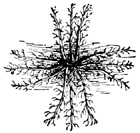
Branches of Fig tree pegged down
Fig. The Fig is little grown in the East except as a curiosity, but on the Pacific coast it has gained more or less prominence as an orchard fruit. The trees are usually planted at distances of about 18 to 25 feet apart. Figs will stand considerable frost, and seedling or inferior varieties grow out of doors without protection as far north as Virginia. Many of the varieties fruit on young sprouts, and, inasmuch as the roots will stand considerable cold, these varieties will often give a few Figs in the northern states. Figs have been fruited in the open ground in Michigan. In all frosty countries, however, the Fig should be laid down during the winter time. The following notes from Professor Massey, of North Carolina, indicate how this may be done:
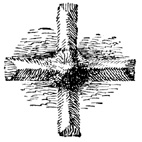
Fig branches covered with earth
“The light hoar-frosts that have occurred here affected vegetation only on low grounds, and today (November 5) our gardens on high ground show no signs of frost. Lima beans and tomato vines are as green as in summer time, and this morning we gathered ripe Figs from our trees in the garden—the latest I have ever known Figs to ripen. As the early crop of Figs ripens in July (if it escapes the winter frosts, for the fruit is now set on the trees), and the late crop begins in August and continues to ripen in succession till frost, it is easy to see what a desirable fruit the Fig is. In this section it is easy to have a great abundance of Figs, and it is possible almost anywhere in the United States to have both early and late crops in abundance by taking a little trouble to protect the trees in winter. Years ago the writer grew Figs in abundance in a very cold locality in northern Maryland, and never failed to get a good crop. Where the winter temperature seldom drops lower than 18° or 20° above zero, Figs will need no special protection if sheltered from cold winds. In colder climates they should be branched from the ground, and, after the leaves have fallen, be bent to the ground in four bundles and covered with earth, making a sharp mound over the center and sloping off like a four-pointed star or cross, as shown in the cuts, taken from Bulletin 74 of North Carolina Experiment Station.”
Flower Beds. Two classes of subjects are to be considered in the discussion of Flower Beds: those concerned with the location of the bed; those concerned with the actual making of the bed itself. Most persons do not consider the former subject. If one wants a flower garden in which there is to be a collection of plants grown for the plants’ sake, the garden should be placed at the rear or one side, and may be laid out in regular fashion like a vegetable garden. If the flowers are to be a part of the home picture,—that is, a part of the place itself,—then they may be freely distributed amongst the border planting, or as edgings along groups of shrubbery. It is rarely, if ever, allowable to place formal beds in the lawn in home grounds. The place for carpet-bedding is usually in parks or other public areas, in sections which are set aside and devoted to that particular purpose, the same as another section may be devoted to a zoölogical garden, play-ground or to other specific use. Flowers which are grown in the middle of the lawn have little relation to other planting, and they have no background to show them off to good advantage. It is also difficult to grow them in small beds in the grass, since they are exposed to sun and wind, and the grass roots absorb the food and moisture. In the formal bed, every effort must be made to keep it prim, otherwise it becomes displeasing; whereas, if the flowers are planted more or less promiscuously in large, irregular borders, or along the edge of shrubbery, the failure of one or even of a dozen plants is not a serious matter. The growing of plants in formal designs requires so much care and attention that a large part of the fun of plant-growing is lost. Such plant-growing should ordinarily be left to those who make a business of it.
In making a Flower Bed, see that the ground is well drained; that the subsoil is deep; that the land is in a mellow and friable condition, and that it is rich. Each fall it may have a mulch of rotted manure or of leaf-mold, which may be spaded under deeply in the spring; or the land may be spaded and left rough in the fall, which is a good practice when the soil has much clay. Make the Flower Beds as broad as possible, so that the roots of the grass running in from either side will not meet beneath the flowers and rob them of food and moisture. It is well to add a little commercial fertilizer each fall or spring.
Flowering Maple. See Abutilon.
Forget-me-not. This old favorite grows so easily, looks so cheerful, and with a little care will bloom so long, that it should have a place in every collection of flowering plants. It is perennial, but the best results may be had by dividing the roots as often as every other year; or seedlings may be taken up from around the old plants. They require a moist soil, with shade a part of the day. They will thrive exceedingly if grown in a frame like pansies. Easily grown from seeds, usually blooming the first fall. Excellent for low edgings. Height 6 inches.
Four-o’clock. Mirabilis. Tender annual, a plant of old-fashioned gardens, and always interesting. Grows 2 to 3 feet high. Drop seeds where the plants are to stand, thinning them to 12 to 18 inches apart. The colors are white and pink. There are variegated-leaved forms; also dwarfs. Excellent for the back row in a bed of annuals.
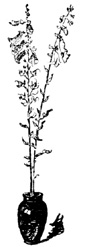
Foxglove
Foxglove, or Digitalis. Foxgloves make most effective border plants, either as a background or planted among other things. The tall flower-spikes are covered during the blooming period with funnel-shaped drooping flowers in various colors and with fine markings. Some of the newer varieties have flowers that rival the Gloxinias in shadings and markings. The plants are perfectly hardy, growing in one situation for a number of years; but, as with many other perennials, they are all the better for being divided at intervals. They may be grown readily from seed. Sow in boxes under glass or in the border where wanted. They bloom the second year. A rich, deep soil and partial shade suit their requirements. Period of bloom, July and August. Height 2 to 4 feet.
Frame. See Hotbed and Coldframe.
Freesia. One of the best and most easily handled winter-flowering bulbs. The white or yellowish bell-shaped flowers are produced on slender stalks just above the foliage, to the number of six to eight in a cluster. They are very fragrant, and last for a considerable time when picked. The bulbs are small, and look as though they could not produce a growth of foliage and flowers, but even the smallest mature bulb will prove satisfactory. Several bulbs should be planted together in a pot, box or pan, in October, if wanted for the holidays, or later if wanted at Easter. The plants bloom from ten to twelve weeks from planting, under ordinary care. No special treatment is required; keep the plants cool and moist through the growing season. The soil should contain a little sand mixed with fibrous loam, and the pot should be well drained. After flowering, gradually withhold water and the tops will die down, after which the roots may be shaken out and rested until time to plant in fall. Care should be taken to keep them perfectly dry. The bulbs increase rapidly from offsets. Plants may also be grown from seed, which should be sown as soon as ripe, giving blooming plants the second or third year. Height 12 or 15 inches. Easy to bloom in the window. The white form (Freesia refracta alba) is the best. See Bulbs.
Fritillaria, or Fritillary. Bulbous plants, the commoner species hardy. Only the Crown Imperial is well known in this country. This is an old-fashioned plant, which takes care of itself when once planted. The other hardy Fritillarias are treated like tulips.
Frost. The light frosts of late spring and of early fall may be prevented by any means which will keep the air in motion, or which will fill the air with moisture or cloud-like vapor, so that there is less radiation from the ground. When frost is expected, it is well to water the plants and the ground thoroughly. This will ordinarily protect them from two or three degrees of still frost. The water should be applied just at nightfall. On larger areas, it is often practicable to make a smudge. In order to be effective, the smudge must be rather dense and lie over the whole area, and it should be kept up until the danger from frost is past. Material which burns very slowly and with much smoke is preferable. Moist manure or straw or other litter is useful. Materials which are dry enough to blaze are of little use. Ordinarily, frost comes towards morning. It is well to have the piles of rubbish ready at nightfall and have them lighted toward the latter part of the night, when the frost is expected. The smudge should be kept up until sunrise. It is well to have these piles of smudge material on all sides of the area; or if the area is on a slope, it may be sufficient to have them on the upper side, for there is usually a movement of air down the hillside and the area will thereby be covered with the smudge. For a thorough protection, it is best to have many small piles rather than a few large ones. If the piles are placed every ten feet around the areas, better results are to be expected. There are especially prepared tar-like materials for use in smudging plantations, but they are little used in this country, although some of them are excellent.
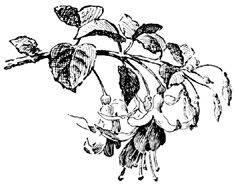
Fuchsia
Fuchsia. Well-known window or greenhouse shrub. It is readily grown from cuttings. Soft, green wood should be used for cuttings, and it will root in about three weeks, when the cuttings should be potted. Take care not to have them pot-bound while in growth, but do not over-pot when bloom is wanted. Given warmth and good soil, they will make fine plants in three months or less. In well protected, partially shady places they may be planted out, growing into miniature bushes by fall. Plants may be kept on from year to year; and if the branches are well cut back after blooming, abundant new bloom will come. But it is usually best to make new plants each year from cuttings, since young plants usually bloom most profusely and demand less care. Fuchsias are amongst the best of window subjects.
Fumigation is mentioned under Insects.
Fungi. Flowerless, leafless plants, living mostly on food (either living or dead) which has been prepared by other plants or by animals, Molds, mushrooms and puff-balls are familiar examples. Some of the parasitic kinds cause great damage to the plants or animals on which they live. Examples of these injurious parasitic kinds are apple-scab fungus, potato mildew, grape mildew, corn smut fungus, and the like. Most of these are combated by spraying with materials containing copper or sulfur.
Funkia, or Day Lily. Hardy perennial herbs, growing in dense clumps and bearing attractive foliage. They are of the easiest culture. F. subcordata, the white-flowered species, is commonest. Of blue-flowered forms there are several, of which F. ovata (or F. cærulca) is perhaps the best. Funkias are excellent for borders, or as a formal edging to long walks or drives. There are variegated forms. Funkias grow 12 to 24 inches high, and the flower clusters stand still higher. Propagated by dividing the roots. Day Lily is a name applied also to species of Hemerocallis, which are yellow-flowered lilies.
Gaillardias are plants that should have a place in every garden, either as border plants or for cutting. The flowers are very showy and lasting in bouquets, as well as on the plants. The double form has perfect balls of color. Gaillardias are both annual and perennial. The perennials usually have flowers much larger than the annuals; and they bloom the first year if seed is started early. These are also propagated by seed or cuttings. If from seed, it should be sown under glass in February or March, setting out the young plants where wanted when danger of frost is over. The cuttings may be made of the new growth in the fall and wintered over in the house. Set 2 feet apart. Height 2 feet, blooming from July until hard frosts. The perennials are usually orange.
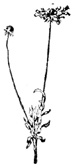
Gaillardia picta
The annual kind (Gaillardia picta of florists) is probably the best kind for the home garden. It is of the easiest culture. Hardy. Two feet. Sow seeds where plants are to bloom. The colors of the flowers are in rich shades of yellow and red.
Galanthus. See Snowdrop.
Garlic. An onion-like plant, the bulbs of which are used for flavoring. Little known in this country except amongst those of foreign birth. It is multiplied the same as multiplier onions—the bulb is broken apart and each bulbule or “clove” makes a new compound bulb in a few weeks. Hardy; plant in early spring, or in the South in the fall. Plant 2 to 3 inches apart in the row.
Gas Plant is Dictamnus.
Geranium. What are generally known as Geraniums are, strictly speaking, Pelargoniums, which see. The true Geraniums are mostly hardy plants, and therefore should not be confounded with the tender Pelargoniums. Geraniums are worthy a place in a border. They are hardy perennials, and may be transplanted early in the spring, setting them 2 feet apart. Height 10 to 12 inches.
The common wild Cranesbill (Geranium maculatum) improves under cultivation, and is an attractive plant when it stands in front of taller foliage.
Gilia. Low-growing hardy annuals, good for front borders or rockwork, growing from seed very quickly and continuing in flower a long season. They will do well in light soil. Sow seed in the fall or early spring where plants are wanted. Gilia tricolor, blue, white and yellow, is the best, but there are excellent white and red sorts.
Gladiolus. A popular summer-flowering bulbous plant, thriving best in moist, sandy loam, that has had an application of well rotted manure the previous year. No manure should be used the year of planting, as it has a tendency to rot the bulbs. Plantings may be made from the time the ground is in condition to work in the spring until late in June. In planting, the bulbs should be set 3 inches deep and 8 to 10 inches apart, unless they are to be grown in groups, when they may be planted five or six in the space of 1 foot. Stakes should be furnished each plant to support the flower-spike. When in groups, one stake may be used, setting it in the middle of the circle.
Gladioli are increased by bulblets formed around the old bulbs (or corms), or they may be grown from seed. The bulblets should be planted in drills in April or May, and will grow to flowering size in one or two years. In the same way, seed sown early in drills, grown through the summer, the little bulbs taken up and stored through the winter and again planted out, will often make bulbs large enough to flower the second year.
Care should be taken to lift all bulbs before freezing weather, as most varieties are tender. They should be harvested with the tops on, and laid away in a cool, dry place to ripen. The tops are then cut off and the bulbs stored in a dry place (fit for potatoes, but drier) until wanted the following spring. See Bulbs.
Glaucium, or Horned Poppy. The kind most cultivated (G. luteum) has bright yellow flowers in July and September. The flowers, contrasting with the deep cut glaucous leaves, make a fine effect in the mixed or ribbon border. Seed may be sown in the open ground where wanted. Thin to 12 inches apart. Height 12 to 20 inches. Perennial; but treated as a hardy annual.
Gloxinia. Choice greenhouse tuberous-rooted perennials, sometimes seen in window gardens, but really not adapted to them. Gloxinias must have a uniform moist and warm atmosphere and protection from the sun. They will not stand abuse or varying conditions. Propagated often by leaf-cuttings, which should give flowering plants in one year. From the leaf, inserted half its length in the soil (or sometimes only the petiole inserted) a tuber arises. This tuber, after resting until midwinter or later, is planted and flowering plants soon arise. Gloxinias also grow readily from seeds, which may be germinated in a temperature of about 70°. Flowering plants may be had in a year if seeds are sown in late winter or early spring. This is the usual method. Soil should be porous and rich.
Godetia. Very free-blooming annuals in fine colors, harmonizing well with the California poppy. Many of the varieties are beautifully blotched with contrasting colors. They are very satisfactory plants for solid beds or border lines, blooming from June to October. Seed may be sown in heat, and seedlings planted in open ground at a distance of 18 inches apart when danger of frost is over. A rather poor soil will cause them to bloom better than one very rich, as they are inclined to make a rank growth. Height 1 to 2 feet.
Golden Feather. See Pyrethrum.
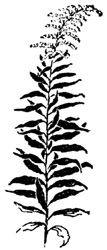
Goldenrod
Goldenrod (Solidago of many species). The Goldenrod of the wayside is so familiar that the thought of bringing it into the garden is distasteful to many persons. But if given a suitable place in a well enriched border, no plant has greater possibilities. A large clump against a hedge of green, or massed behind a well grown plant of the blue-flowering wild asters, makes a striking contrast. They bloom late in the season, and the rich yellow and golden colors and the graceful forms are always pleasing.
Goldenrods will grow more vigorously and the blooms be larger if the roots are divided every third or fourth year. There are several species catalogued by nurserymen, and some of the stock is superior to the wild type, either having a larger truss of flowers or blooming later. Goldenrods range in height from 2 to 6 feet. All are easily propagated by division. Transplant in the fall, if convenient, although spring planting may be equally successful.
Gomphrena. Bachelor’s Button. Globe Amaranth. A useful everlasting for winter bouquets. Seed may be sown in heat in March, the plants transplanted once before setting out to cause them to grow stocky and branching; or seed may be sown in a warm place where the plants are to grow. The flowers, to retain their colors, should be cut before fully expanded and dried in a dark, airy place. See Everlastings. Set the plants 18 inches apart. Height 12 inches. The heads resemble clover heads. The term Bachelor’s Button is also given to the cornflower (Centaurea Cyanus).
Gooseberry. Since the advent of the practice of spraying with fungicides to prevent mildew, the culture of the Gooseberry has increased. There is now no reason why, with a little care, good crops of many of the best English varieties may not be grown. The price for good fruits of Gooseberry is usually remunerative, as the market is rarely overstocked by the sudden ripening of the crop, since the fruits ripen through a long season. A large part of the crop is picked green for culinary purposes. The leading market variety is Downing, a native sort, which is little subject to mildew. Several of the English varieties have proved of value, having larger fruits than the natives. Whitesmith, Chautauqua, Triumph and Industry are among the best.
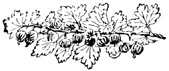
Gooseberries
The propagation of the Gooseberry is similar to that of the currant, although the practice of earthing up a whole plant, causing every branch thus covered to throw out roots, is common with the European varieties. The rooted branches are cut off the following spring and planted in nursery rows or sometimes directly in the field. In order to succeed with this method, the plant should have been cut back to the ground so that all the shoots are yearling.
Pruning is essentially the same as for the currant (which see); and the treatment of the currant worm is the same as for that fruit.
Gooseberries should be set (either in fall or spring) 3 to 4 feet apart; rows 5 to 7 feet apart. Select a rich, rather moist soil. The tops need no winter protection. If mildew and worms are to be kept in check, spraying must be begun with the very first sign of trouble and be thoroughly done.
Gourds are valuable as rapid-growing screen vines, the curious fruits of many varieties adding much to their attractiveness. Cultivation the same as for melons or squashes. Height 10 to 15 feet. Provide a chicken-wire trellis; or let them run on a brush pile.
Grafting. Grafting is the operation of inserting a piece of a plant into another plant with the intention that it shall grow. It differs from the making of cuttings in the fact that the severed part grows in another plant rather than in the soil. There are two general kinds of Grafting—one of which inserts a piece of branch in the stock (Grafting proper), and one which inserts only a bud with little or no wood attached (budding). In both cases the success of the operation depends upon the growing together of the cambium of the cion (or cutting) and that of the stock. The cambium is the new and growing tissue which lies underneath the bark and on the outside of the growing wood. Therefore, the line of demarcation between the bark and the wood should coincide when the cion and stock are joined. The plant upon which the severed piece is set is called the stock. The part which is removed and set into the stock is called a cion if it is a piece of a branch, or a bud if it is only a single bud with a bit of tissue attached. The greater part of Grafting and budding is done when the cion or bud is nearly or quite dormant. That is, Grafting is usually done late in winter and early in spring, and budding may be done then, or late in summer, when the buds have nearly or quite matured.
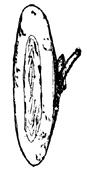
The bud severed from its twig
The prime object of Grafting is to perpetuate a kind of plant which will not reproduce itself from seed or of which seed is very difficult to obtain. Cions or buds are therefore taken from this plant and set into whatever kind of plant is obtainable and on which they will grow. Thus, if one wants to propagate the Baldwin apple, he does not for that purpose sow seeds thereof, but takes cions or buds from the tree and grafts them into some other apple tree. The stocks are usually obtained from seeds. In the case of the apple, young plants are raised from seeds which are obtained mostly from cider factories, without reference to the variety from which they came. When the seedlings have grown to a certain age, they are budded or grafted; and thereafter they bear fruit like that of the tree from which the cions were taken.
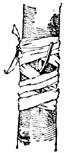
The bud tied
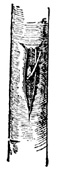
The bud inserted
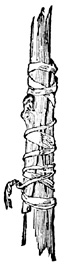
Whip-graft
There are many ways in which the union between cion and stock is made. Budding may be first discussed. It consists in inserting a bud underneath the bark of the stock, and the commonest practice is that which is shown in the illustrations. Budding is mostly performed in July, August and early September, when the bark is still loose or will peel. Twigs are cut from the tree which it is desired to propagate, and the buds are cut off with a sharp knife, a shield-shaped bit of bark (with possibly a little wood) being left with them (see illustration). The bud is then shoved into a slit made in the stock, and it is held in place by tying with some soft strand. In two or three weeks the bud will have “stuck” (that is, it will have grown fast to the stock), and the strand is cut to prevent its strangling the stock. Ordinarily the bud does not grow until the following spring, at which time the entire stock or branch in which the bud is inserted is cut off an inch above the bud; and the bud thereby receives all the energy of the stock. Budding is the commonest Grafting operation in nurseries. Seeds of peaches may be sown in spring, and the plants which result will be ready for budding that same August. The following spring, or a year from the planting of the seed, the stock is cut off just above the bud (which is inserted near the ground), and in the fall of that year the tree is ready for sale; that is, the top is one season old and the root is two seasons old, but in the trade it is known as a 1-year-old tree. In apples and pears the stock is usually two years old before it is budded, and the tree is not sold until the top has grown two or three years. Budding may be performed also in the spring, in which case the bud will grow the same season. Budding is always done in young branches, preferably in those not more than one year old.
Grafting is the insertion of a small branch (or cion), usually bearing more than one bud. If Grafting is done on small stocks, it is customary to employ the whip-graft, which is illustrated in the margin. Both stock and cion are cut across diagonally, and a split made in each, so that one fits into the other. The graft is tied securely with a string, and then, if it is above ground, it is also waxed carefully. In larger limbs or stocks, the common method is to employ the cleft-graft. This consists in cutting off the stock, splitting it and inserting a wedge-shaped cion in one or both sides of the split, taking care that the cambium layer of the cion matches that of the stock. The exposed surfaces are then securely covered with wax. Grafting is usually performed early in the spring, just before the buds swell. The cions should have been cut before this time, when they were perfectly dormant. Cions may be stored in sand in the cellar or in the ice house, or they may be buried in the field. The object is to keep them fresh and dormant until they are wanted.
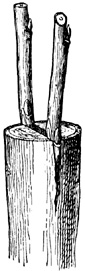
Cleft-graft
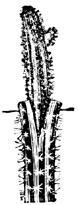
Cleft-grafting a Cactus
If it is desired to change the top of an old plum, apple or pear tree to some other variety, it is usually done by means of the cleft-graft. If the tree is very young, budding or whip-grafting may be employed. On an old top the cions should begin to bear when three to four years old. All the main limbs should be grafted. It is important to keep down the suckers or water-sprouts from around the grafts, and part of the remaining top should be cut away each year until the top is entirely changed over (which will result in two to four years).
A good wax for covering the exposed parts is made as follows: Resin, 4 parts by weight; beeswax, 2 parts; tallow, 1 part. In making the wax, the materials are first broken up and melted together. When thoroughly melted the liquid is poured into a pail or tub of cold water. It soon becomes hard enough to handle, and it is then pulled and worked over until it becomes tough or “gets a grain,” at which stage it becomes the color of very light-colored manilla paper. When wax is applied by hand, the hands must be well greased. Hard cake tallow is the best material for this purpose. In top-grafting large trees, it is well to carry a supply of tallow when waxing, by smearing the backs of the hands before entering the tree.
Grape. One of the surest of fruit crops is the Grape, a crop each year being reasonably certain after the third year from the time of setting the vines. The Grape does well on any soil that is under good cultivation and well drained. A soil with considerable clay is better under these circumstances than a light, sandy loam. The exposure should be to the sun; and the place should admit of cultivation on all sides. One- or 2-year-old vines should be planted, either in the fall or early spring. At planting the vine is cut back to 3 or 4 eyes, and the roots are well shortened in. The hole in which the plant is to be set should be large enough to allow a full spreading of the roots. Fine soil should be worked around the roots and firmed with the feet. If the season should be dry, a mulch of coarse litter may be spread around the vine. If all the buds start, the strongest one or two may be allowed to grow.
The canes arising from these buds should be staked and allowed to grow through the season; or in large plantations the first-year canes may be allowed to lie on the ground. The second year one cane should be cut back to the same number of eyes as the first year. After growth begins in the spring, two of the strongest buds should be allowed to remain. These two canes now arising may be grown to a single stake through the second summer, or they may be spread horizontally on a trellis. These are the canes which form the permanent arms or parts of the vine. From them start the upright shoots which, in succeeding years, are to bear the fruits.
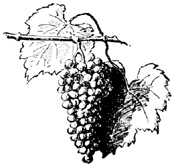
Grape
In order to understand the pruning of Grapes, the operator must fully grasp this principle: Fruit is borne on wood of the present season, which arises from wood of the previous season. To illustrate: A growing shoot, or cane of 1899, makes buds. In 1900 a shoot arises from each bud; and near the base of this shoot the Grapes are borne (1 to 4 clusters on each). While every bud on the 1899 shoot may produce shoots or canes in 1900, only the strongest of these new canes will bear fruit. The skilled Grape-grower can tell by the looks of his cane (as he prunes it in winter) which buds will give rise to the Grape-producing wood the following season. The larger and stronger buds usually give best results; but if the cane itself is very big and stout, or if it is very weak and slender, he does not expect good results from any of its buds. A hard, well-ripened cane the diameter of a man’s little finger is the ideal size.
Another principle to be mastered is this: A vine should bear only a limited number of clusters,—say from 30 to 80. A shoot bears clusters near its base; beyond these clusters the shoot grows on into a long, leafy cane. An average of two clusters may be reckoned to a shoot. If the vine is strong enough to bear 60 clusters, 30 good buds must be left at the pruning (which is done from December to late February).
The essential operation of pruning a Grape vine, therefore, is each year to cut back a limited number of good canes to a few buds, and to cut off entirely all the remaining canes or wood of the previous season’s growth. If a cane is cut back to 2 or 3 buds, the stub-like part which remains is called a spur. Present systems, however, cut each cane back to 8 or 10 buds (on strong varieties), and 3 or 4 canes are left,—all radiating from near the head or trunk of the vine. The top of the vine does not grow bigger from year to year, after it has once covered the trellis, but is cut back to practically the same number of buds each year. Since these buds are on new wood, it is evident that they are each year farther and farther removed from the head of the vine. In order to obviate this difficulty, new canes are taken out each year or two from near the head of the vine, and the 2-year or 3-year-old wood is cut away.
The training of Grapes is a different matter. A dozen different systems of training may be practiced on the same trellis and from the same style of pruning,—for training is only the disposition or arrangement of the parts.
On arbors, it is best to carry one permanent arm or trunk from each root over the framework to the peak. Each year the canes are cut back to short spurs (of 2 or 3 buds) along the sides of this trunk.
Grapes are set from 6 to 8 feet apart in rows which are 8 to 10 feet apart. A trellis made of 2 or 3 wires is the best support. Slat trellises catch too much wind and blow down. Avoid stimulating manures. In very cold climates, the vines may be taken off the trellis in early winter and laid on the ground and lightly covered with earth. Along the boundaries of home lots, where Grapes are often planted, little is to be expected in the way of fruit because the ground is not well tilled. For mildew and rot, spray with Bordeaux mixture. See Spraying.
Concord is the most cosmopolitan variety, but its quality is not the best. For the home garden, a good selection may be made from the following list: Winchell or Green Mountain, Campbell Early, Worden, Concord, Niagara, Moore Diamond, Vergennes, Agawam, Salem, Wilder, Iona, Brighton, Delaware.
Grapery. The European grapes rarely thrive out of doors in eastern America. Grape houses are necessary, with or without artificial heat. Fruit for home use may be grown very satisfactorily in a cold Grapery (without artificial heat). A simple lean-to against the south side of a building or wall is cheap and serviceable. When a separate building is desired, an even-span house running north and south is preferable. There is no advantage in having a curved roof, except as a matter of looks. A compost of four parts rotted turf to one of manure is laid on a sloping cement bottom outside the house, making a border 12 feet wide and 2 feet deep. The cement may be replaced with rubble on well drained soils, but it is a poor makeshift. Every three years the upper 6 inches of the border should be renewed with manure. The border inside the house is prepared likewise. Two-year-old potted vines are planted about 4 feet apart in a single row. Part of the roots go through a crevice in the wall to the outer border and part remain inside; or all may go outside if the house is desired for other purposes. One strong cane is trained to a wire trellis hanging at least 18 inches from the glass, and is cut back to 3 feet the first year, 6 the second, and 9 the third. Do not be in a hurry to get a long cane. Pruning is on the spur system, as recommended for arbors on page 120. The vines are usually laid on the ground for winter and covered with leaves or wrapped with cloth.
As soon as the buds swell in early spring, tie the vines to the trellis and start out one shoot from each spur, rubbing off all others. After the berries begin to color, however, it is better to leave all further growth to shade the fruit. Pinch back each of these laterals two joints beyond the second bunch. To keep down red spider and thrips, the foliage should be sprayed with water every bright morning except during the blooming season. At least one-third of the berries should be thinned from each bunch; do not be afraid of taking out too many. Water the inside border frequently all through the summer, and the outside occasionally if the season is dry. Mildew may appear in July. The best preventives are to syringe faithfully, admit air freely, and sprinkle sulfur on the ground.
Fruit may be kept fresh on the vines in a warm (or artificially heated) Grapery until late December: in a coldhouse it must be picked before frost. After the fruit is off, ventilate from top and bottom and withhold water, so as to thoroughly ripen the wood. Along in November the canes are pruned, covered with straw or wrapped with mats and laid down till spring. Black Hamburg is superior to all other varieties for a cold Grapery; Bowood Muscat, Muscat of Alexandria and Chasselas Musque may be added in the warmhouse. Good vines will live and bear almost indefinitely.—S. W. Fletcher.
Grasses of various kinds are grown for ornament, the most popular types being the hardy perennials, which make attractive clumps in the lawn or border. The best of the permanent kinds in the North are the various sorts of Eulalia (properly Miscanthus). When once established they remain for years, making large and bold clumps. The striped kind, or zebra grass, is particularly good. These grasses thrive in any good soil. They grow from 4 to 7 feet high. The great reed, or Arundo Donax, is a bold subject and perfectly hardy. In a rich and rather moist soil, it grows 10 to 12 feet high when well established. Pampas Grass is most excellent in the Middle States and South. Some of the big native grasses and sedges make attractive lawn clumps.
Grasses are also grown for dry or everlasting bouquets. For this purpose, small-growing delicate annual species are mostly used. Good types are species of agrostis, briza, bromus, eragrostis, and pennisetum. Seeds of these and of others are sold by seedsmen. With ordinary treatment, they thrive in any garden soil.
For notes on sod-making, see Lawn.
Greenhouse. In America the word Greenhouse has come to be applied to all kinds of glass-houses in which plants are grown. Originally the word was applied to those houses in which plants are merely preserved or kept green during the winter. Other types of glass-houses are the conservatory, in which plants are displayed; stove or hothouse, in which plants are grown in a high temperature; the propagating pit, in which the multiplication of plants is carried forward; and the houses which have various temperatures, as cold, cool and intermediate. The principles which underlie the construction and management of glass-houses are too extensive to be discussed here. The reader should refer to special books on the topic. For the general subject, Taft’s “Greenhouse Construction” and “Greenhouse Management” are excellent. For particular applications to floriculture, Hunt’s “How to Grow Cut-flowers” is a standard work. For applications to the forcing of vegetable crops, Bailey’s “Forcing-Book” may perhaps be consulted.
The smaller the glass-house the more difficult it is to manage, because it is likely to be more variable in temperature, moisture and other conditions. This is particularly true if the house is a small lean-to against the south side of a dwelling house, for it becomes very hot at midday and comparatively cold at night. In order to moderate the heat in these little houses, it is ordinarily advisable to use ground glass for the roof or to whitewash it. The house conservatory may be heated by a coal stove, but the best results are rarely to be attained in this case. A stove is likely to leak gas, and the temperature is more or less uneven. The best results are to be attained when the conservatory is heated by steam or hot water, piped in the modern fashion with wrought iron pipes, which go together with threads. If the conservatory is heated from the heater which supplies the dwelling house, it should have an extra amount of pipe; otherwise it will be necessary to keep the dwelling house too hot for comfort in order to maintain the conservatory at its proper temperature. It is always best, when practicable, to heat the conservatory with a separate apparatus. There are various small hot water and steam heaters, the size of coal stoves, which are excellent for the purpose. For a small conservatory, hot water is usually preferable to steam, since it is less likely to fluctuate. For large establishments, however, the steam is usually the better. For further discussions of related subjects, see Hotbed, Window Garden, Potting and Watering.
Grevillea. A very graceful greenhouse plant, suitable for house culture. The plants grow freely from seed, and until they become too large are as decorative as ferns. Grevilleas are really trees, and are valuable in greenhouses and rooms only in their young state. They withstand much abuse. They are now very popular as jardiniere subjects. Seeds sown in spring will give handsome plants by the next winter.
Gypsophila. Baby’s Breath. Gypsophila muralis is one of the dainty little plants called Baby’s Breath. It is a low-growing annual forming compact mounds of green, thickly covered with little pink flowers. It is one of the most attractive border plants in cultivation. It is also a charming pot-plant. G. paniculata is a hardy perennial having panicles of bluish white flowers. This is very graceful, and the flowers are fine for cutting and for use with sweet pea bouquets or with other choice flowers. The panicles are so lasting that they may be used in winter bouquets. The annuals may be planted 1 foot apart; the perennials 3 feet. Both are readily grown from seed, and bloom the first year.
Hardy. A relative term, used to denote a plant which endures the climate (particularly the winter climate) of a given place. Half-hardy plants are those which withstand some frost or uncongenial conditions, but will not endure the severity of the climate. Tender plants are those which are injured by light frosts.
Hedges. Hedges are much less used in this country than in Europe, and for several reasons. Our climate is dry, and most Hedges do not thrive so well here as there; labor is high-priced, and the trimming is therefore likely to be neglected; our farms are so large that much fencing is required; timber and wire are cheaper than live Hedges. However, they are used with good effects about the home grounds. In order to secure a good Hedge, it is necessary to have a thoroughly well-prepared, deep soil, to set the plants close, and to shear them at least twice every year. For evergreen Hedges the most serviceable plant in general is the arborvitæ. The plants may be set at distances of 1 to 2½ feet apart. For choice Hedges about the grounds, particularly outside the northern states, some of the retinosporas are very useful. One of the most satisfactory of all coniferous plants for Hedges is the common hemlock, which stands shearing well and makes a very soft and pleasing mass. The plants may be set from 1 to 3 feet apart. Other plants which hold their leaves and are good for Hedges are the common box and the privets. Box Hedges are the best for very low borders about walks and flower beds. The dwarf variety can be kept down to a height of 6 inches to a foot for any number of years. The larger-growing varieties make excellent Hedges 3, 4 and 5 feet high. The ordinary privet or prim holds its leaves well into winter in the North. The so-called Californian privet holds its leaves rather longer and stands better along the seashore. In the southern states, nothing is better than Citrus trifoliata.
For Hedges of deciduous plants, the most common species are the buckthorn, the European thorn apple or cratægus, osage orange, and various kinds of roses.
Hedges should be trimmed the year after they are set, although they should not be trimmed very closely until they reach the desired or permanent height. Thereafter they should be sheared into the desired form in spring or fall. If the plants are allowed to grow for a year or two without trimming, they lose their lower leaves and become open and straggly. Osage orange and some other plants are plashed—that is, the plants are set at an angle rather than perpendicularly, and they are wired together in such a way that they make an impenetrable barrier just above the surface of the ground.
Helianthus. See Sunflower.
Helichrysum. These are perhaps the most popular of the Everlastings (which see), having large flowers of several colors. They grow readily from seed, blooming from July to October. Height 10 inches to 2 feet. Should be planted or thinned to stand 18 inches apart.
Heliotrope. A universal favorite house or border plant, growing readily from cuttings or seeds, and producing quantities of fragrant violet, purple or white flowers. One of the best methods of cultivation is to set a strong plant in the border and peg the new growths to the ground, where they will root and form a perfect mat, flowering profusely during the fall months until frost. They will endure the temperature of a living room well if the room is not too dry. Red spider is a natural enemy of the Heliotrope, and when once it obtains a foothold is a very difficult pest to manage, but frequent syringing with water will keep it in check. A light, rich soil and an abundance of heat are their requirements. Height 1 to 3 feet. Propagated by cuttings or layers.
Hellebore (White Hellebore) is often used for the killing of currant-worms and other insects (see Currant). It is not so poisonous as the arsenites, and therefore is to be preferred when it is necessary to apply a poison to nearly ripe fruit. It is usually applied in a spray with water, at the rate of ⅓ ounce to the gallon. It is harmless to foliage.
Helleborus, or Christmas Rose, may be had in flower at the holidays if grown in a frame and protected. The usual time for it to flower in the open border is in March or early April. It will continue to bloom for many years if grown in a shady place. Roots may be divided as an increase is wanted. It may also be grown from seeds; and seedlings may be expected to bloom a year from the spring in which they are sown. Height 6 to 10 inches.
Hemerocallis, or Yellow Day Lily. The advice given under Funkia will apply to this.
Herbs are plants which die to the ground in winter. They may be annual, biennial, or perennial. For a list of annual Herbs suitable for the flower garden, see the articles on Annuals and Bedding. A border or free mass of perennial Herbs is one of the charms of any place. It is informal, easy of care, and self-sustaining. The large part of the mass should be composed of common and hardy things—wild or from gardens—and incidental features may be made of the choicer and rarer exotics. In most cases, plants look better when judiciously mixed than when planted one kind in a bed. See Border.
Hibiscus. Annuals and perennials, some of them shrubs, with showy, hollyhock-like flowers. The annual Hibiscuses are very satisfactory. They grow quickly and flower freely. The flowers are usually white or yellow, of large size, and appear from July on. The herbaceous perennial kinds are amongst the best of hardy border plants, blooming in late summer and fall. The commonest of these is Hibiscus Moscheutos. Give rich, moist soil.
The greenhouse species are old favorites. They may be used in outdoor bedding through the summer, lifted in the fall and cut back. Keep rather dry and dormant during winter. Propagated by cuttings.
Hippeastrum. Consult Amaryllis.
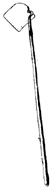
Common hoe
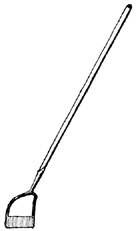
Scarifier
Hoes should be of several patterns if the most efficient work is to be done in the garden. The ordinary Hoe is adapted only to the rougher and coarser Hoe-work, such as digging and fitting the ground. For much of the subsequent tillage, some of the narrow-blade and pointed Hoes are excellent. For cutting off weeds, the push Hoe or scarifier is excellent.
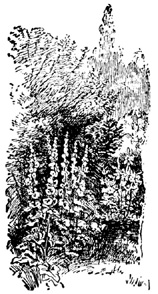
Hollyhocks
Hollyhock. These old garden favorites have been neglected of late years, primarily because the Hollyhock rust has been so prevalent, destroying the plants or making the unsightly. The double varieties seem to suffer the most; and for that reason, and from the fact that the less formal type is in favor, the single varieties are now the most generally grown. Their culture is very simple. The seed is usually sown in July or August, and the plants set where wanted the following spring. They will bloom the same year in which they are transplanted—the year following the seed-sowing. New plants should be set every two years, as the old crowns are apt to rot or die after the first flowering. For rust, spray early with Bordeaux mixture or ammoniacal carbonate of copper.
Hop, Ornamental. Humulus Japonicus, or the annual Hop, is one of the best rapid-growing screen vines in cultivation. It makes a dense canopy of attractive foliage. The leaves are finely cut, and in one variety variegated with white. This variegated variety is a fine vine for a porch or front screen, always attracting attention to its markings. This Hop is propagated by seed sown in boxes in March. When once established, it will seed itself and start as soon as the soil becomes warm. Set plants 4 to 8 feet apart. Height 8 to 20 feet.
Horseradish. As a kitchen garden vegetable, this is usually planted in some out-of-the-way spot and a piece of the root dug as often as needed, the fragments of roots being left in the soil to grow for further use. This method results in having nothing but tough, stringy roots, very unlike the product of a properly planted and well cared for bed. The best roots are those planted in the spring at the time of setting early cabbage, and dug as late the same fall as the weather will permit. It becomes, therefore, an annual crop. The roots for planting are small pieces, from 4 to 6 inches long, obtained when trimming the roots dug in the fall. These pieces may be packed in sand and stored until wanted the following spring. In planting, the roots should be set with the upper end 3 inches below the surface of the ground, using a dibber or sharp-pointed stick in making the holes. The crop may be planted between rows of early-sown beets, lettuce or other crop, and given full possession of the ground when these crops are harvested. Where the ground is inclined to be stiff or the subsoil is near the surface, the roots may be set in a slanting position. In fact, many gardeners practice this method of planting, thinking that the roots make a better growth and are more uniform in size.
Hotbed. A Hotbed is a frame or box which has artificial heat and a transparent covering and in which plants are grown. It differs from a coldframe (which see) in the fact that it has artificial bottom heat. This bottom heat is usually supplied by fermenting organic matter, chiefly horse manure, but hot air, hot water or steam conveyed in pipes, may be employed. It is covered with sash of which the normal or standard size is 3 feet wide and 6 feet long. These sashes are laid crosswise the box or frame. The standard size of frame is 6 feet wide and 12 feet long. A “frame,” therefore, accommodates four sashes. However, the frame may be of any length desired. This frame is ordinarily made of boards, and the back of it is 3 or 4 inches higher than the front, so that the sashes slope to the sun. It is customary to have a space of 6 to 10 inches between the earth and the sash on the lower or front side. The manure which is used to heat the bed may be placed on top of the ground and the frame set on the pile, or it may be placed in a pit. If the land is warm and well drained, it is ordinarily better to have a pit from 1 to 2 feet deep and to set the frame over it. This is especially the case if it is desired to have a permanent Hotbed yard. The place in which the frames are set should be protected from the cold and prevailing winds by a rising slope, a high board fence, a building, hedge, or other obstruction. If the frame yard is near the main buildings, it will be much more accessible in rainy or snowy times, and the plants are likely to have better care. Water should also be handy.
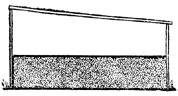
Section of a Hotbed
The time of starting a Hotbed will depend upon the kinds of plants to be grown, the amount of time which one wishes to gain, and something, also, on the quality of the manure. The hardier the plant the earlier it can be started. In the latitude of New York, from the first to the middle of March is the usual time for starting a Hotbed. In this bed are sown seeds of early flowers and such vegetables as cabbage, cauliflower, tomato, etc. In the raising of any plants in the Hotbed, it is very essential that they do not become “drawn” or “leggy.” In order to prevent this, they must be given plenty of room, thorough ventilation on all pleasant days, and not too great heat. It is well to transplant them once or twice before they are finally set in the field, especially if they are started, in New York, as early as the first or middle of March. When they are transplanted, they can be set in another Hotbed or in a coldframe; but it is important that the succeeding frames in which they are set should not be very much colder than the one in which they grew, else they may become stunted. It is well, however, to transplant them into a gradually cooler and freer atmosphere in order to harden them off, so that they may go into the open ground without danger. On every pleasant day, raise the sash at the upper end 1 or 2 inches, or if the sun shines brightly and the wind does not blow, give even more air; and eventually strip off the sashes entirely. It is very important that the plants are not kept too close and grown too soft. It is usually advisable to sow cabbage, lettuce and other hardy plants in different frames from tomatoes and other tender things, in order that the proper requirements may be given to each. At night the Hotbeds (at least early in the season) will need more protection than the glass sash. It was formerly the custom to use thick rye-straw mats to cover Hotbeds, but it is now a common practice to use the straw matting which can be bought of carpet dealers. This is rolled out on the sashes at night in one or two thicknesses; and if the weather is sharp, board shutters, the size of the sash, may be laid on top. As the manure heat begins to fail give more and more air, so that the plants may be able to shift for themselves when the bottom heat is finally exhausted.
Fresh horse manure is the material which is commonly used for the heating of Hotbeds. If it can be secured from livery stables, so that it is all of nearly or quite the same age, better results may be expected. Manure from highly fed horses usually heats better than that from horses which receive little grain, or in which there is very much litter. Put the manure in a pile, preferably under cover, and as soon as it shows signs of heating, fork it over in order to mix the entire mass and to cause it to heat evenly. When it is steaming throughout the whole mass, it may be put in the bed. Assuming that the Hotbed has a pit beneath it, it is well to put in 2 or 3 inches of coarse litter in order to keep the manure off the cold ground. The manure is then put in and tramped down, in layers of 4 to 6 inches each. If the manure is of the right consistency, it will pack without becoming dense and soggy; that is, it will spring a little beneath the feet. If it has too much litter, it will fluff up under the feet and not pack well. From 18 to 24 or even 30 inches of manure is placed in the pit. On top, an inch of dry straw or light leaf-mold may be placed to serve as a distributor of the heat to the earth above. From 3 to 4 inches of rich, light earth is placed upon this, in which to sow the seed. The manure will ordinarily heat violently for a few days. Place a soil thermometer in it, and as soon as the temperature begins to fall below 90° the seeds of tomatoes and egg-plants may be sown; and when it begins to fall below 80°, the seeds of cabbages, lettuce and cauliflower may be sown. If the frame is not placed over a pit and the manure is put on top of the ground, it will be necessary to allow the body of manure to project 1 or 2 feet in all directions in order to prevent the edges of the bed from freezing.
In starting plants in a Hotbed, one must not expect to gain as much time in the crop as he gains in the starting of the seeds: that is, if he starts the seeds two months ahead of the normal season, he will not gain two months in the ripening of the crop. Ordinarily, he cannot expect to gain much more than one-half the time, particularly if the plants are transplanted to the field from the Hotbed.
Some plants may be grown to maturity in the Hotbed, particularly lettuce and radishes. After Hotbeds have been emptied of their plants, the sashes may be stored away, and the frames, with their spent manure, used for the growing of an early summer crop of melons or cucumbers.
House Plants. See Window-Garden.
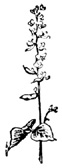
Hyacinth bean
Hyacinth Bean (Dolichos Lablab). A very rapid-growing twiner, bearing fragrant flowers of purple or white. It is a fine screen plant. Plant seeds when the ground is warm where the plants are to grow; or they may be started early in pots. Height 10 feet.
Hyacinths are most popular winter- or spring-flowering bulbs. Hyacinths are hardy, but they are often used as window or greenhouse plants. They are easy to grow and very satisfactory. For winter flowering the bulbs should be procured early in the fall, potted in October in soil composed of loam, leaf-mold and sand. If ordinary flower pots are used, put in the bottom a few pieces of broken pots, charcoal or small stones for drainage; then fill the pot with dirt, so that when the bulb is planted the top will be on a level with the rim of the pot. Fill in around the bulb with soil, leaving just the tip of the bulb showing. These pots of bulbs should be placed in a cold pit, cellar or on the shady side of a building. In all cases, plunge the pot in some cool material (as cinders). Before the weather becomes cold enough to freeze a crust on the ground, the pots should have a protection of straw or leaves to keep the bulbs from severe freezing. In from six to eight weeks the bulbs should have made roots enough to grow the plant, and the pots may be placed in a cool room for a short time. When the plants have started into growth, they may be placed in a warmer situation. Watering should be carefully attended to from this time, and when the plant is in bloom the pot may be set in a saucer or other shallow dish containing water. After flowering, the bulbs may be ripened by gradually withholding water until the leaves die. They may then be planted out in the border, where they will bloom each spring for a number of years, but will never prove satisfactory for forcing again. The open ground culture of Hyacinths is the same as for tulips, which see. See Bulbs.
Water Culture of Hyacinths.—The Hyacinth is the most popular of the Dutch bulbs for growing in vases. The Narcissus may be grown in water, and do just as well, but it is not as pretty in glasses as the Hyacinth. Glasses for Hyacinths may be had of florists who deal in supplies, and in various shapes and colors. The usual form is tall and narrow, with a cup-like mouth to receive the bulb. They are filled with water, so that it will just reach the base of the bulb when it has been placed in position in the cup above. The vessels of dark-colored glass are preferable to those of clear glass, as roots prefer darkness. When the glasses, or bowls as above mentioned, have been arranged, they are set away in a cool, dark place to form roots like potted bulbs. Results are usually secured earlier in water than in soil. To keep the water sweet, a few lumps of charcoal may be put in the glass. As the water evaporates, add fresh; add enough so that it runs over, and thereby renews that in the glass. Do not disturb the roots by taking out the bulb.
Hydrangea. One of the commonest lawn shrubs is Hydrangea paniculata. The commonest fault in growing it is scattering the plants over the lawn, where they suffer in the competition with grass roots, and do not show off to advantage. It is far better to mass them in front of taller things. The Hydrangea blooms on wood of the season; therefore it should be pruned after bloom—in winter or early spring (see Pruning). Cut back heavily, in order to secure the strong new shoots upon which the flowers are borne.
Hyssop. See Sweet Herbs.
Ice Plant, or Mesembryanthemum. Fine little plants for rockwork or edging. The majority of the species are greenhouse and window plants, but a few can be recommended for outdoor planting. A very sunny location, with gravelly soil, will give the best results, either in the open or in the house. Easily propagated by pieces of the plant laid on moist sand in a somewhat sunny place. The common Ice Plant of window-gardens is readily grown from seeds or slips. It is prized for its glandular-glistening thick foliage (whence the common name). The little flowers, which open in sunshine, are also interesting.
Impatiens Sultani is a generally known conservatory plant, making a charming pot subject for warm greenhouse or a room. It is readily propagated from seed or cuttings, seed being preferable. Flowers bright pink-red. Of easy culture in a fairly moist atmosphere. Height about 18 inches.
Insects. For horticultural purposes, Insects might be grouped into three general classes: borers, or those which live inside the plant tissue; chewing Insects which live on the outside of the plant; and the sucking Insects.
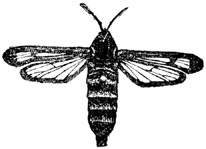
Moth of one of the borers
As a general statement, it may be said that the digging out of borers is the only complete remedy. Sometimes an application of something to the body of the tree may keep them out, but it is always uncertain; and it usually involves more work than to dig them out. All trees which are subject to borers (especially apples, peaches and pears) should be examined at least twice every year. See Borers.
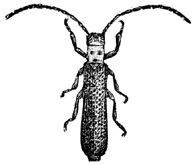
A beetle borer
The general run of chewing or biting Insects may be killed by the arsenical poisons. Such Insects are the common types of worms and beetles which feed on foliage. The leading poison which is now used for this purpose is Paris green (which see). Hellebore and pyrethrum are useful when it is not advisable to use arsenical poisons.
The sucking Insects include all the kinds of plant lice, the squash bug and all the scale Insects. These are dispatched by some material which kills by external application, especially material which has kerosene or petroleum in it. The common material heretofore used for this purpose is kerosene and soap emulsion; but it is now believed that the emulsion of kerosene and water is fully as efficient, and since machines have been perfected for automatically mixing it, it is a much more practicable remedy. See Kerosene Emulsion.

Weevil—a chewing insect
In the fighting of all Insects, success depends upon taking them in time. If something is known of the life history of the Insect, very much will be gained, for the operator may be on hand as soon as the Insect is expected to appear.
Insects on House Plants.—The most troublesome or common Insects with which the amateur is likely to meet in the window-garden or conservatory are the red spider, mite, mealy bug, aphis, and scale.
The red spider is a very minute Insect with a reddish body. Its presence may be suspected whenever plants are growing in a warm and dry place. Usually it first appears on the under side of leaves, but it multiplies rapidly, and will soon not be so choice of position. It sucks the juices of the leaves, and they soon indicate the injury by a dull appearance, and also, in many cases, by small whitish or paler areas on the upper surfaces. The mite is of similar habits and size, but is of a pale color, with black on its back. It appears under the same conditions as the red spider. These pests are small, but are very serious if allowed to multiply unchecked. They should be looked after as soon as their presence is detected.
The remedy is to arrange for keeping the air about the plants more moist, and giving drenchings of the foliage with clear or soapy water. The latter is most effective. The soap used may be simply the common washing soap, or that sold at drug stores known as whale-oil soap. In fighting them, care must be used not to keep the soil soaked with water, or it will check the plants in vigor and only add to the strength of the enemy. Even florists sometimes get into just such a predicament. Flagging and extreme variations in dryness and humidity of the air, checking the vigor of plants, favor the appearance and presence of the red spider quite as much as extreme and continued dryness of the air.
The aphids or plant lice are readily discernable when they appear on plants, as they are sure to do under nearly all conditions. They are small, have elongated, succulent bodies, move about slowly and awkwardly, on rather long, hairlike legs, and are most commonly of a pale green color, though often brown or reddish, and sometimes of other shades. Fumigation of the plants in a closed box with burning tobacco stems will kill them. Latterly florists evaporate a liquid extract of tobacco (which is sold by dealers in florists’ supplies) by dropping a hot iron into a pan of it. A tea made by soaking tobacco stems in water for a few hours, and applied with a syringe, is effective, and a safe remedy in inexperienced hands. A tablespoonful of tobacco sheep-dip, or extract of tobacco, to a couple of gallons of water, also makes an effective syringing or dipping solution. As mentioned above, we should use care, especially in the winter time, when the soil often dries out slowly, to avoid soaking it when already wet or sufficiently moist.
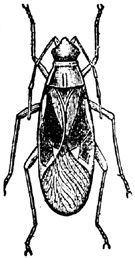
One of the kind which sucks its food
Mealy bug has a small, flat, tortoise-shaped body, from about one-sixteenth to one-eighth of an inch long. The Insects collect in masses in the axils of the leaves. They are covered with a white mealy or cottony substance, and are readily recognized, although persons unfamiliar with their appearance have sometimes mistaken them for bits of down or cotton lodged upon the foliage or in the axils of the leaves. The young are small, and likely to escape observation unless one looks closely. They are flat, of a creamy or pinkish tint, and lie close to the surface of the leaves, especially on the under surface. Coleus and bouvardias are among the plants upon which mealy bugs are most often found. Owing to the oily nature of their covering, it is difficult to wet their bodies with any ordinary liquid that may be applied for the purpose of destroying them. Fir-tree oil is one of the most effective remedies for them. This liquid is rather expensive, but for a small collection a gallon can will last for a long time. It is also effective against other Insects. For mealy bugs, two tablespoonfuls of the oil to one pint of water will make an effective dipping or spraying solution. Soft or rain-water should be used, and tin, wooden, or earthenware vessels. Galvanized iron vessels are to be avoided. Apply forcibly with a syringe or atomizer, preferably in the evening. If effective, the mealy bug will turn buff-color. For other Insects, except for the scale, mentioned below, the solution will not need to be more than half or a fourth so strong. Where there are only a few mealy bugs, the plant may be gone over with a soft brush and the Insects crushed.
The codlin-moth
Scales are most commonly of a brown or whitish color, flat or tortoise-shaped, and easily seen. They adhere closely by the under surface of their bodies to the stems, branches, and foliage of woody plants. The mature Insect is stationary, and its body at length becomes a shell containing hundreds of eggs. These hatch, and the young emerge from the shell, crawl about and settle, to develop into the familiar form. A strong solution of fir-tree oil, like that used for mealy bugs, is a good remedy. A strong solution of whale-oil soap, made by adding an ounce or more of the soap to three gallons of water, even more if necessary, is also useful in combating them. After dipping or syringing the plants they may be allowed to stand over night, when they should be rinsed off with clear water. Applications may need repeating every three or four days until the Insects are gotten rid of. It is difficult, for a time, to tell when they are dead. If killed, the bodies will fall off easily, and in the case of the soft-shelled species shrivel up somewhat after a time. Kerosene and water emulsion (see Kerosene) will kill them.
Insecticide. A substance which will kill insects. Insecticides are of two general classes—those that kill by contact (see Kerosene), and those that poison the insect (see Paris Green and Hellebore).
Iris. Many handsome perennials, of which the Blue Flag is familiar to every old-fashioned garden. Most Irises thrive best in a rather moist soil, and some of them may be colonized in the water in margins of ponds. Gardeners usually divide them into two sections—the tuberous-rooted or rhizomatous, and the bulbous. A third division—the fibrous-rooted—is sometimes made. The common and most serviceable species belong to the tuberous-rooted section. Here belongs the beautiful and varied Japanese Iris, Iris lævigata (or I. Kæmpferi), which is among the most deserving of all hardy perennials. Most of these Irises need no special care. They are propagated by division of the rootstocks. Plant the pieces 1 foot apart if a mass effect is desired. When the plants begin to fail, dig them up, divide the roots, discard the old parts and grow a new stock, as before. I. Susiana, of this section, is one of the oddest of Irises, but it is not quite hardy in the North. Of the bulbous section, most species are not hardy in the North. The bulbs should be taken up and replanted every two or three years. The Persian and Spanish Irises belong here. The bulbs give rise to but a single stem.
Kale. A low-growing, spreading plant belonging to the cabbage family and extensively used for winter and spring greens. The same culture as given to late cabbage is suitable. At the approach of severe freezing weather a slight protection is given in the North. The leaves remain green through the winter and may be gathered from under the snow at a time when material for greens is scarce. Some of the Kales are very ornamental because of their blue and purple curled foliage. The Scotch Curled is the most popular variety. Kales are extensively grown at Norfolk, Va., and southward, and shipped north in winter. Let the plants stand 18 to 30 inches apart. Young cabbage plants are sometimes used as Kale. See Collards. Borecole is a kind of Kale. Sea Kale is a wholly different vegetable (which see).
Kerosene is fatal to insects. It is likely to injure plants if applied full strength, although if applied in full sunlight (so that evaporation takes place rapidly) it may do no harm. It is safest to apply it in dilution. Of late, there are pumps which mix or emulsify Kerosene and water in definite proportions, and this mixture (in the proportion of ⅕ or ¼ Kerosene) is fatal to insects and usually harmless to plants. The standard Kerosene emulsion is with soap, but the perfection of mechanical devices for emulsifying it with water is probably destined to supplant the soap emulsion.
Kerosene Emulsion.—Hard soap, ½ pound; boiling soft water, 1 gallon; Kerosene, 2 gallons. Dissolve the soap in the water, add the Kerosene, and churn with a pump for 5 to 10 minutes. Dilute 10 to 25 times before applying. Use strong emulsion, diluted four times in winter, for all scale insects. For insects which suck, as plant-lice, mealy bugs, red spider, thrips, bark-lice or scale. Cabbage-worms, currant-worms, and all insects which have soft bodies can also be successfully treated.
Kohlrabi. This vegetable looks like a leafy turnip growing above ground. If used when small (2 to 3 inches in diam.), and not allowed to become hard and tough, it is of superior quality. It should be more generally grown. The culture is very simple. A succession of sowings should be made from early spring until the middle of summer, in drills 18 inches to 2 feet apart, thinning the young plants to 6 or 8 inches in the rows. It matures as quickly as turnips. One ounce of seed to 100 feet of drill.
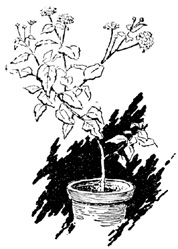
Lantana
Lantana is a popular greenhouse pot-plant, and is occasionally seen in window-gardens, being grown for the profusion of its orange-red, heliotrope-shaped flowers. In the South, and sometimes in the North, it is planted out for the summer. It is very easy to grow, and also to propagate by means of cuttings. Although the flowers of the common species are ill-scented, the profusion of bloom makes it desirable.
Larkspur. Delphinium. The Larkspurs are among the very best hardy plants, being free-flowering and having a good habit. They should be in every mixed border, particularly the perennial kinds. The tall flower-spikes, showing above the cut foliage, give the plant a striking effect. The flowers are in shades of blue in most varieties. The plants are propagated by division of root or from seed. The latter method will give good results, although the resulting plants are not likely to be the same variety as the seed plant.
As winter approaches, a covering of coarse litter should be thrown over the crowns of the perennial kinds. The plants will come into bloom in late June and continue for a long season. Plants should be set 3 to 5 feet apart if in rows, but they are seen to better advantage when mixed with other border plants. Height of plants from 3 to 5 feet.
The annual Larkspur may be grown from seed sown in heat and transplanted to the ground in May; or seed may be sown where the plants are wanted and the seedlings thinned to 1 foot. These seedlings will bloom in June, and continue through the summer. Plants grow from 8 to 18 inches high.
Lathyrus. See Pea, Everlasting; also, Sweet Pea.
Lawns. In order to have a good Lawn, two things are essential: first, a pleasing surface or contour; second, a dense, firm sod.
It is fun to make a garden
Inasmuch as the Lawn is, or should be, a permanent thing, it is necessary that the greatest care be exercised to grade the land and to thoroughly prepare it before any seeds are sown. About a new building the filling should be allowed to settle, so that the finished surface will slope gradually away from the foundations and the steps. If the land is very hard clay, or if the place is rather low, it is always well to lay tile under-drains at frequent intervals. Everything should be done to cause the land to be deep and loose, so that the grass roots will run far into the soil and not be pressed for lack of moisture in a dry time. If the land has not had applications of manure in recent years, it is well to plow in, or to spade in, a liberal quantity of well-rotted litter from the barnyard. Work this into the soil as deeply as possible. If the hardpan is rather high, it is well to subsoil the area or to trench it (that is, to spade it up two or three spades deep). If the land is apparently not fertile in plant-food, it is well to add a dressing of some commercial fertilizer to the surface when the grass seed is sown. This will start the grass quickly and allow it to get a foothold before the severe weather of midsummer comes.
A garden corner
The kind of grass seed to sow will depend upon the region and also upon the personal tastes of the owner. The one standard Lawn grass is June grass or blue grass (Poa pratensis). The seeds of this grass are sold in the hulls, and therefore the bushel weighs only fourteen pounds. Not less than two and one-half to three bushels should be sown to the acre. In the southern states, June grass will not hold, and Bermuda grass is used, being sown about as thick as recommended for the June grass. There are various prepared Lawn grass mixtures which are excellent, but the June grass alone will give a very excellent Lawn in a short time. Whether one shall sow white clover in his Lawn depends mostly upon his personal taste. If he likes the white clover, it is well to put in a quart or two of seed to the acre, sowing it separately from the June grass in order to get an even distribution. Some persons like to see the white clover in certain parts of the Lawn. It thrives very well where the land is rather moist. In parts of the East, Rhode Island bent grass is used for lawns.
A nursery
The grass seed should be sown in the cool of the year. It may be sown in September and thereby become established before winter; or it may be sown very early in the spring. In newly made Lawns, it is a good plan to grade the area thoroughly in the fall, allowing it to settle in the winter; and then, if the surface remains even, to sow the grass seed on one of the latest snows in spring. By sowing it on the snow, one can see that it is distributed evenly; and when the snow melts, the seed is carried into the land and does not need covering. It is well to sow three or four quarts per acre of timothy seed, for the timothy germinates very quickly, and makes a green area the first season, but is killed out as soon as the June grass gains a foothold. Timothy will not stand the continued cutting, whereas the June grass will. The timothy, therefore, serves as a temporary covering to the land, indicating where the borders are, and thereby outlining the area for the Lawn mower to cut. The timothy seed should be sown separately from the June grass in order to insure even distribution. On hard lands it is well to sow two or three quarts per acre of crimson clover seed. The long roots of this plant tend to improve the physical condition of the soil; and when they decay, they leave nitrogen in the soil for the grass to use. Since crimson clover is an annual plant, it will not do any permanent mischief in the Lawn.
A lawn, with planting on the sides
The first season the weeds will probably come up thickly, especially if the land is rich. These weeds should not be pulled, for whenever one is pulled out of the ground, many grass plants are rooted up and the surface is made uneven. The only way in which to keep down weeds is to mow them frequently with a Lawn mower. They will not appear in any great numbers the second year, unless there should be some perennial weeds, like dandelion or dock; and these may be pulled out the first fall or the following spring.
It is rare that one secures a perfectly good and uniform sod from one sowing of seed; especially is this true if the soil varies in different parts of the area. If the surface contour is satisfactory, it is unwise to dig up the areas on which the seed has not caught. It is best to rake them over with a steel rake in fall or spring, sowing on a little commercial fertilizer rather rich in nitrogen, and sow more seed. Nearly every Lawn will need patching in this way from year to year. If the Lawn is attended to in fall and spring by sowing grass seed, the weeds will rarely do serious mischief. When weeds are troublesome on the Lawn, it means that there is not sufficient grass, and every effort should be made to get more grass. Therefore, when the perennial weeds are pulled out, sow more grass seed.
A picturesque rill on the lawn
When narrow-leaved plantain bothers, it is an indication that the land is too poor and dry for grass. In such cases, the land usually lacks humus or vegetable matter; and in various severe incursions of the plantain, it may be necessary to spade up the weedy areas and to work rotted manure into the soil. Usually, however, the plantain can be killed out by enriching the soil and sowing more grass seed. The common practice of sprinkling Lawns is nearly always pernicious, since the water is not supplied in sufficient amount to wet down very far, and the grass tends to make surface roots. When the watering is omitted the plants suffer. The more a Lawn is sprinkled, the more the grass depends upon the sprinkling. If it is necessary to water the Lawn, the water should be allowed to run directly from the hose until the surface area is completely soaked. It is best to do this at nightfall. When the water is applied by means of a sprinkler, a large part of it evaporates and does no good to the ground. The fundamental treatment of the Lawn is to have the land so deep and porous that the grass roots strike deep into the soil and do not need the surface water. A Lawn which is well made will need watering only in unusually dry times.
Mow the Lawn frequently when it is growing rapidly,—in spring and early summer. In the fall mow less frequently, and let it go into the winter with a long coat of grass. If the Lawn is mown as often as is needed, it will not be necessary to rake off the trimmings. In fall, top-dress the Lawn with commercial fertilizer at the rate of 500 pounds to the acre. If the Lawn has not been raked clean of all the trimmings and decayed refuse which covers the surface of the ground, it is not necessary to dress it with stable manure; for manure is unsightly, unsavory, and often brings in weeds. Many persons make the mistake of raking the Lawn clean in late fall.