THE PRACTICAL GARDEN-BOOK (continued 4)
Reading edition
Closely associated with the making of the Lawn is the general arrangement of the planting. It is the common fault to scatter the planting. Much better effects are secured by massing or grouping the planting. See Borders and Flower Beds. Particularly along the boundaries and about the foundations of buildings, the shrubbery and other plants may be massed to excellent effect. In large places there should be more or less mass planting along the walks and drives. In the curves and retreats of these plantings one will find many pleasant corners; and here the children may have their play-houses and their pets. A little brook winding across a corner or along one side of a Lawn may make a pleasant picture if it is allowed to take on a half-wild character.
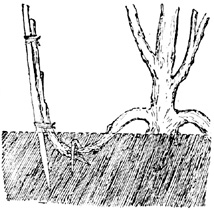
A layer
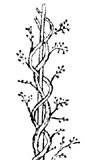
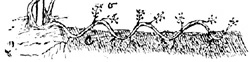
Several layers from one vine
Layers are parts (usually stems) of plants laid down on the earth while still attached to the parent, with the expectation that they will take root and can then be separated as independent plants. All vine-like plants can be propagated readily by means of Layers; so can most soft-wooded plants, as willows, maples, currants, etc. It is usual to put down the branches in the fall. In a year they should be ready to be severed from the parent. They may also be made in spring, before growth starts. See that the layered part rests in moist earth. Usually roots arise more freely if the shoot is cracked or notched at the buried point. The Layer may be held down by a forked stick (“pegged down”), or by a stone or clod. See that the shoot does not throw up suckers behind the layered part.
Leek. This belongs to the onion family, and is used mostly as flavoring for soups. Well grown Leeks have a very agreeable and not very strong onion flavor. Leek is of the easiest culture, and is usually grown as a second crop, to follow beets, early peas, and other early stuff. The seed should be sown in a seed-bed in April or early May and the seedlings planted out in the garden in July, in rows 2 feet apart, the plants being 6 inches apart in the rows. The plants should be set deep if the neck or lower part of the leaves is to be used in a blanched condition. The soil may be drawn towards the plants in hoeing, to further the blanching. Being very hardy, the plants may be dug in late fall, and stored in the same manner as celery, in trenches or in a cool root-cellar. One ounce of seed to 100 feet of drill.
Lettuce is probably the most extensively grown salad vegetable. It is now in demand, and is procurable, every month in the year. The winter and early spring crops are grown in forcing-houses and coldframes, but a supply from the garden may be had from April to November, by the use of a cheap frame in which to grow the first and last crops, relying on a succession of sowings for the intermediate supply. Seed for the first crop may be sown in a coldframe in March, growing the crop thick and having many plants which are small and tender; or, by thinning out to the distance of 3 inches and allowing the plants to make a larger growth, the plants pulled up may be set in the open ground for the next crop. Sowings should be made in the garden from April to October, at short intervals. A moist location should be selected for the July and August sowings. The early and late sowings should be of some loose-growing variety, as they are in edible condition sooner than the cabbage or heading varieties.
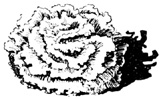
Plant of heading lettuce
The cabbage varieties are far superior to the loose-growing kinds for salads. To be grown to perfection, they should have very rich soil, frequent cultivation and an occasional stimulant, such as liquid manure or nitrate of soda. The Cos Lettuce is an upright-growing type much esteemed in Europe, but less grown here. The leaves of the full grown plants are tied together, thus blanching the center, making it a desirable salad or garnishing variety. It thrives best in summer. One ounce of seed will grow 3,000 plants or sow 100 feet of drill. In the garden, plants may stand 6 inches apart in the rows, and the rows may be as close together as the system of tillage will allow.
Lily. Bulbous plants of many kinds. It has been said of this family of plants that it has no “poor relations,” each of them being perfect in itself. Many of the choicest kinds are comparatively unknown, although easy to cultivate. In fact, all of the Lilies may be grown with comparative ease. A light, rich, well-drained soil, mellow to the depth of at least 1 foot, a handful of sand under each bulb if the soil is inclined to be stiff, and planting so that the crown of the bulb will be at least 4 inches below the surface, are the general requirements. One exception to the depth of planting is Lilium auratum, or Golden-Banded Lily. This should be planted deeper—at least 8 inches below the surface—as the new bulbs form over the old one and soon bring the bulbs to the surface if they are not planted deep.
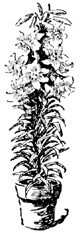
Easter Lily
While Lilies may have partial shade, they should never be planted near or under trees. The shade or protection of tall-growing, herbaceous plants is sufficient. In fact, the best results, both as to growth and effect, may be had by planting amongst low shrubbery or border plants. Most kinds are the better for remaining undisturbed for a number of years; but if they are to be taken up and divided, or moved to other quarters, they should not be allowed to become dry. The small bulbs, or offsets, may be planted in the border, and if protected will grow to flowering size in two or three years. In taking up bulbs for division it is best to do so soon after the tops die after blooming. At least this should be done early in the fall, not later than October, giving the plants a chance to become established before freezing weather. A mulch of coarse litter or evergreen boughs should be placed over the bulbs after the ground has become frozen, to be gradually removed as the spring advances.
As pot-plants some Lilies are very satisfactory, especially those that may be forced into bloom through the winter. The best kinds for this purpose are L. Harrisii (Easter Lily), L. longiflorum, and L. candidum. Others may be forced with success, but these are the ones most generally used. The winter culture of these for forcing is the same as for Hyacinths (in pots), which see. The article on Bulbs gives directions for both outdoor and indoor growing which are directly applicable to Lilies.
Lily, Chinese Sacred. See Narcissus.
Lily-of-the-Valley. A perfectly hardy little plant, bearing racemes of small white bell-shaped flowers in early spring. For ordinary cultivation, sods or mats of roots may be dug from any place in which the plant is colonized. Usually it thrives best in partial shade; and the leaves make an attractive mat on the north side of a building, or other shady place, in which grass will not grow. The plants will take care of themselves year after year.
For forcing indoors, imported roots or “pips” are used, as the plants are grown for this particular purpose in parts of Europe. These roots may be planted in pots, and treated as recommended for winter-flowering bulbs, under Bulbs. Florists force them in greater heat, however, often giving them a bottom heat of 80° or 90°; but skill and experience are required in order to attain uniformly good results in this case.
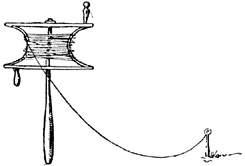
A garden Line
Line. A garden Line is one of the most convenient things connected with garden operations. It is always wanted when long rows of seed are to be sown, and it is also necessary in laying out walks or drives. A very simple, yet handy, holder for a line is shown on the margin. The pin is driven in the soil at the starting point, and the line is unwound as the operator walks towards the end of the row. A line should be 100 feet long for common garden operations.
Lobelia. Some of these are well-known garden plants, being used very freely as edging for ribbon beds or basket plants. They require a loose, rich soil, and some stimulant when in full flower. The flowers continue through a long season. They propagate freely from seed. Lobelia Erinus, in blue, 6 inches high, is one of the most popular of all annual edging plants. In Europe various perennial Lobelias are popular, but they are seldom seen in American gardens.
London Purple. Discussed under Paris Green.
Love-Lies-Bleeding. See Amarantus.
Manure adds plant-food to the soil, and it also improves the texture or physical condition of the soil. This latter effect is often its greatest value. If one wants mere plant-food alone, he may often do better to add it in some more concentrated form. See Fertilizers. Manure, when thoroughly incorporated with the soil, makes the ground congenial for the plant. It is important, in garden operations, that the Manure be rotted or composted, or “short” or “fine,” as the gardeners say. It then incorporates readily with the soil and quickly gives up its fertility. Manure is composted by letting it decay in piles. The compost pile should be flat on top, so that it will catch the rains, and 3 to 5 feet high.
The most desirable Manure for the garden and for house plants is probably old cow Manure. It does not burn or lose its strength. It may be kept for a number of years if piled under shelter, becoming more available each year. It mixes well with soil and leaf-mold. When once rotted, this manure is very lasting and easily assimilated by plants. Horse Manure is very likely to become overheated, and to lose its value; and it is too loose and dry for many purposes. Pig Manure, unless well composted with soil or refuse, is usually too heavy and rich. Sheep Manure is at its best when used in a liquid form, although it is most excellent to mix with soil to loosen it.
All garden refuse, such as vines, leaves, decaying vegetables, will make Manure if composted with soil; and if the wash water is thrown on the compost pile much fertility will be added. Wood ashes from stoves, the chip dirt from the woodshed—in fact, almost any substance that will decay—will furnish plant-food, and should be added to the compost pile. This pile should be turned often, to mix the material.
When practicable, it is best to apply Manure in the fall, as it then has time to become incorporated with the soil before spring. Beds which are to be used for flowers next year may be dressed with Manure in the fall and deeply spaded, leaving the surface rough and loose. It is well to be careful that the Manure does not contain weed seeds.
Marigold. The Marigolds of the old-fashioned gardens are still among the best of plants for fall color. They are hardy annuals of the easiest culture, and are always certain of giving strong and excellent results. They have been much improved of late years. The old-fashioned African Marigolds grow 2 to 3 feet high, and they are useful for scattering in mixed borders or making large masses or displays of color in the remoter parts of the place. The French or dwarf Marigolds grow about 1 foot high and are more tufty in their habit. They are better adapted for edgings than for mass effects in the main parts of the grounds. All Marigolds may be sown where the plants are to stand, since the flowers are usually not wanted until late summer or early fall, at which time they usually give their best bloom. If they are wanted earlier, however, the seeds may be started in the house or hotbed. Tall varieties may be allowed to stand from 10 to 18 inches apart and the dwarfs at somewhat less distances.
Matthiola will be found under Stocks.
Mignonette. Probably no flower is more generally grown for its fragrance than this. The Mignonette needs a cool soil, only moderately rich, shade part of the day, and careful attention to cutting the flower-stalks before the seeds are ripe. If a sowing be made in late April, followed by a second sowing in early July, the season may be extended until severe frosts. There are few flowers that will prove as disappointing if the treatment it needs is omitted. Height 1 to 2 feet. Treated as a half-hardy annual. It can be sown in pots late in summer and had in the house in winter.
Moon-Flowers are species of Morning-Glories that open their flowers at night. A well-grown plant trained over a porch trellis, or allowed to grow at random over a low tree or shrub, is a striking object when in full flower at dusk or through a moonlit evening. In the southern states the Moon-Flower is a perennial, but even when well protected does not survive the winters in the North. Cuttings may be made before danger of frost and wintered in the house, or the plants may be grown from seed sown in January or February. Cuttings usually give best results in the northern states, as the seasons are not long enough for seed plants to give good bloom. Seeds should be scalded or filed just before sowing. The true Moon-Flower is Ipomœa Bona-Nox, white-flowered; but there are other kinds. This grows 20 to 30 feet where the seasons are long enough.
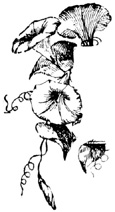
Morning-Glories
Morning-Glory is perhaps the most popular of all twining herbs, because of the ease with which it may be grown, the quickness with which it covers the object, and the quantities of bright, cheerful flowers it bears. Many of the kinds—in fact all that are generally known—may be readily grown from seed, flowering early in the summer. Tender annuals. Give rich soil and plenty of water. The beautiful cypress vine belongs to this group. It requires the same treatment as the Morning-Glory, but the seeds should be scalded just previous to sowing.
Dwarf Morning-Glories (Convolvulus tricolor). They come into flower much sooner than the tall climbing varieties, and are covered with flowers through a long season. They may be used with fine effect in vases or large hanging baskets. Give a full sunny exposure. May thrive on soil that is not very rich. They grow 1 foot high. Half-hardy annuals.
Mulberry. Both for fruit and ornament the Mulberry should be more generally planted. Even if the fruit is not to the taste, the tree is naturally open-centered and round-headed, and is an interesting subject; some of the varieties have finely cut leaves. The fruits are in great demand by the birds, and after they begin to ripen the strawberry beds and cherry trees are free from robins and other fruit-eating birds. For this reason alone they are a valuable tree for the fruit-grower. Trees may be purchased cheaper than one can propagate them.
If planted in orchard form, place them 25 to 30 feet apart. About the borders of a place they can go closer. The Russian varieties are often planted for windbreaks, for they are very hardy and thrive under the greatest neglect; and for this purpose they may be planted 8 to 20 feet apart. The Russians make excellent screens. They stand clipping well. New American, Trowbridge and Thorburn are leading kinds of fruit-bearing Mulberries for the North. The true Downing is not hardy in the northern states; but New American is often sold under this name. Mulberries thrive in any good soil, and need no special treatment.
Mulch is used both in protecting plants from the severe freezing of winter and the severe drought of summer. The same material may be used in either case, although it is now considered best to make an earth Mulch to prevent evaporation and retain the moisture through the dry season. This earth Mulch is made by breaking the crust of the soil and leaving it in fine particles. This may be done with a horse cultivator, a hoe or a rake. In fact, any tool which leaves the top of the soil loose will be instrumental in preventing evaporation of soil water. See Tillage. The Mulching of the ground around blackberries, currants, gooseberries, or raspberries with straw or hay is often practiced to keep the fruits clean; and the winter Mulch of strawberry beds is used between the rows for the same purpose, as well as to retain moisture and to afford winter protection. Winter Mulch usually consists of leaves, straw, hay, rough manure, boughs of evergreens, or any coarse material that will protect the plants from severe freezing and the heaving caused by alternate freezing and thawing. This winter Mulch should be removed as spring advances, unless it is of such a character as to be worked into the soil to add fertility or to loosen heavy lands. Near the seacoast salt hay is considered to be an ideal Mulch. The winter Mulch must not contain too strong or heavy manures, or plants may be injured by the leaching. For flower borders and shrubbery, muck or peat makes a good winter Mulch. Ordinarily the Mulch may be placed on to the depth of 4 to 6 inches, and if it is of loose material it may be still deeper. If dry and loose, mice may nest in it and girdle the trees or bushes. Even perfectly hardy plants are benefited by a winter Mulch, because it improves the soil. Autumn leaves, as they drift into shrubberies, make an ideal Mulch; it is not always necessary to remove these leaves. See Lawn.
Mushroom. There is no science of Mushroom growing. Certain conditions have been found to give success, but it is not known why. These conditions may be imitated ever so closely and complete failure result. There are many “systems” advised, each system the result of somebody’s success; but one cannot be sure of success by following any one of them. Good results are frequently attained when all rules are broken. The following paragraphs are from “Farmers’ Bulletin,” No. 53 (by William Falconer), of the U. S. Dept. of Agriculture (March, 1897):
Mushrooms are a winter crop, coming in from September till April or May—that is, the work of preparing the manure begins in September and ends in February, and the packing of the crop begins in October or November and ends in May. Under extraordinary conditions the season may begin earlier and last longer, and, in fact, it may continue all summer.
Mushrooms can be grown almost anywhere out of doors, and also indoors where there is a dry bottom in which to set the beds, where a uniform and moderate temperature can be maintained, and where the beds can be protected from wet overhead, and from winds, drought, and direct sunshine. Among the most desirable places in which to grow Mushrooms are barns, cellars, closed tunnels, sheds, pits, greenhouses, and regular Mushroom houses. Total darkness is not imperative, for Mushrooms grow well in open light if shaded from sunshine. The temperature and moisture are more apt to be equable in dark places than in open, light ones, and it is largely for this reason that Mushroom houses are kept dark.
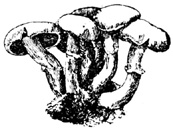
Mushroom
The best fertilizer for Mushrooms, so far as the writer’s experience goes, is fresh horse manure. Get together a lot of this material (short and strawy) that has been well trampled and wetted in the stable. Throw it into a heap, wet it well if it is at all dry, and let it heat. When it begins to steam turn it over, shake it well so as to mix thoroughly and evenly, and then tramp it down solid. After this let it stand till it again gets quite warm, then turn, shake, trample as before, and add water freely if it is getting dry. Repeat this turning, moistening and trampling as often as it is needful to keep the manure from “burning.” If it gets intensely hot, spread it out to cool, after which again throw it together. After being turned in this way several times, and the heat in it is not apt to rise above 130° F., it should be ready to make up in the beds. By adding to the manure at the second or third turning one-fourth or one-fifth of its bulk of loam, the tendency to intense heating is lessened and its usefulness not at all impaired. Some growers prefer short manure exclusively, that is, the horse droppings, while others like a good deal of straw mixed in with this. The writer’s experience, however, is that, if properly prepared, it matters little which is used.
Ordinarily the beds are only 8 to 10 inches deep; that is, they are faced with 10-inch-wide hemlock boards, and are only the depth of this board. In such beds put a layer of fresh, moist, hot manure, and trample it down firm until it constitutes half the depth of the bed; then fill up with the prepared manure, which should be rather cool (100° to 115° F.) when used, and pack all firmly. If desired, the beds can be made up entirely of the prepared manure. Shelf beds are usually 9 inches deep; that is, the shelf is bottomed with 1-inch boards and faced with 10-inch-wide boards. This allows about 8 inches for manure, and 1 inch rising to 2 inches of loam on top. In filling the shelf beds the bottom half may be of fresh, moist or wettish, hot manure, packed down solid, and the top half of rather cool prepared manure, or it may be made up of all prepared manure. As the shelf beds can not be trodden and can not be beaten very firm with the back of the fork, a brick is used in addition to the fork.
The beds should be spawned after the heat in them has fallen below 100° F. The writer considers 90° F. about the best temperature for spawning. If the beds have been covered with hay, straw, litter or mats, these should be removed. Break each brick into twelve or fifteen pieces. The rows should be, say, 1 foot apart, the first one being 6 inches from the edge, and the pieces should be 9 inches apart in the row. Commencing with the first row, lift up each piece, raise 2 to 3 inches of the manure with the hand, and into this hole place the piece, covering over tightly with the manure. When the entire bed is spawned pack the surface all over. It is well to cover the beds again with straw, hay or mats, to keep the surface equally moist. The flake spawn is planted in the same way as the brick spawn, only not quite so deep.
At the end of eight or nine days the mulching should be removed and the beds covered with a layer of good loam 2 inches thick, so that the Mushrooms can come up in and through it. This gives them a firm hold, and to a large extent improves their quality and texture. Any fair loam will do. That from an ordinary field, wayside or garden is generally used, and it answers admirably. There exists an idea that garden soil surfeited with old manure is unfit for Mushroom beds because it is apt to produce spurious fungi. This, however, is not the case. In fact, it is the earth most commonly used. For molding the beds the loam should be rather fine, free and mellow, so that it can be easily and evenly spread and compacted firmly into the manure.
If an even atmospheric temperature of from 55° to 60° F. can be maintained, and the house or cellar containing the Mushroom beds is kept close and free from drafts, the beds may be left uncovered, and should be watered if they become dry. But no matter where the beds are situated, it is well to lay some loose hay or straw or some old matting or carpet over them to keep them moist. The covering, however, should be removed just as soon as the young Mushrooms begin to appear above ground. If the atmosphere is dry, the pathways and walls should be sprinkled with water. The mulching should also be sprinkled, but not enough to cause the water to soak into the bed. However, if the bed should get dry, do not hesitate to water it.
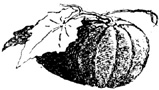
Muskmelon
Muskmelon. The natural soil for melons is a light, sandy loam, well enriched with rotted manure, although good crops may be grown on soil naturally heavy if the hills are prepared as they should be. When only heavy soil is available, the dirt where the seeds are to be planted should be thoroughly pulverized and mixed with fine, well rotted manure. A sprinkling of leaf-mold or chip-dirt will help to lighten it. On this hill from ten to fifteen seeds may be sown, thinning to four or five vines when danger of insects is over. The season may be advanced and the damage from insects lessened by starting the plants in hotbeds. This may be done by using fresh sod, cut into 6-inch pieces, placing them grass-side down in the hotbed, sowing eight to ten seeds on each piece, and covering with 2 inches of light soil. When all danger of frost is over, and the ground has become warm, these sods may be carefully lifted and set in the prepared hills. The plants usually grow without check, and fruit from two to four weeks ahead of those from seed planted directly in the hill. Old quart berry boxes are excellent to plant seeds in, as, when they are set in the ground, they very quickly decay, causing no restriction to the roots. Netted Gem, Hackensack, Emerald Gem, Montreal, Osage, and the Nutmeg Melon are popular varieties. One ounce of seed will plant about fifty hills.
For insects, see Cucumber.
Musk Plant is an old-fashioned house plant of easy culture. Raise a new stock from seeds as soon as the plants begin to fail.
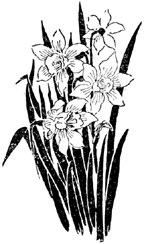
Narcissus
Narcissus. Hardy bulbous plants, including the daffodils, jonquils, and other forms. The ease with which these plants may be grown, the beauty and fragrance of the flowers, as well as their lasting qualities when cut, would seem to make their culture in this country more popular than it is. Good bulbs planted in September or October are sure to bloom in April or May. The bulbs may remain in the ground for a number of years, although the best results will be had by digging them up every three years, and resetting in a different location. Select a moist, loamy soil, slightly protected from the sun. No manure should come directly in contact with the bulb, but if needed to hold moisture the manure may be spaded down to the depth of twelve inches.
Narcissus may be forced into flower through the winter, as described under Bulbs. The most popular for winter bloom is the “Chinese Sacred Lily.” This grows in water without any soil whatever. Secure a bowl or glass dish, about three times the size of the bulb; put some pretty stones in the bottom; set in the bulb and build up around it with stones so as to hold it stiff when the leaves have grown; tuck two or three small pieces of charcoal among the stones to keep the water sweet, then fill up the dish with water and add a little every few days, as it evaporates. Set the dish in a warm, light place. In about six weeks the fragrant, fine white flowers will fill the room with perfume.
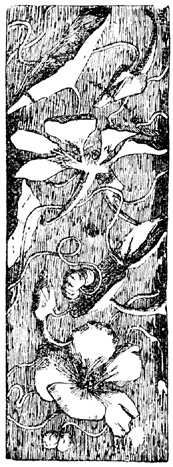
Nasturtium
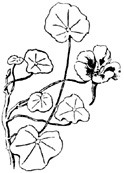
Dwarf Nasturtium
Nasturtiums (Tropæolums) are both dwarf and climbing. The Dwarf Nasturtiums make one of the most showy second-row plants for the border. The colors of the flowers have a wide range and the plants bloom profusely. It is not, however, the plant in flower that is the greatest consideration, but the flowers themselves as cut-flowers. No flower makes a finer display in vase or bowl than these rich colors, all harmonizing well and lighting up a room as very few of the common easily grown flowers do. The same may be said of the tall-growing Nasturtiums, although the flowers of these form part of their effectiveness as screen vines. Few climbers make a more rapid growth, and none are better adapted to hide unsightly objects in our yards or gardens.
For a long season of flowers and a large growth of vine the seed should be sown late in March or early in April, in boxes or pots, the plants carried along until the first of May, and planted out where wanted. The dwarf varieties bloom more freely and the flowers are of better color in rather poor soils, while for rapid growth of vine a well enriched border would be the best. The dwarf varieties may be planted 2 or 3 feet apart, and the tall ones as wanted to make a screen. The tall kinds grow 5 to 8 feet. All Nasturtiums are tender.
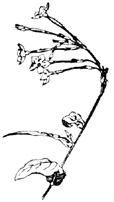
Nicotiana affinis
Nicotiana. Tender annuals (or grown as annuals). They are fine plants for borders or pots, the tall-growing varieties making a very fine show when in flower, having pure white flowers with long, tubular necks, the season of bloom being from July to October. The seeds are very fine, and should be sown on the surface of the soil, in boxes or pots. When planted out they should be set from 2 to 5 feet apart, according to kind. Some of the giant Nicotianas are excellent subjects for temporary screens; so is tobacco, which is also a Nicotiana.
Nicotiana affinis is one of the best of all garden flowers. Its long white flowers are fragrant at evening. They close in the hot sun. It is a half-hardy annual of easiest culture. Height 2 to 3 feet.
Œnothera. Evening Primrose. A very interesting group of plants, opening their flowers at evening. Many of them are fragrant and attract night insects, especially the large moths, seldom seen until dusk. The opening of the flowers of the large-flowering varieties is a source of pleasure and surprise, as one flower follows another in opening, and in a large plant the late opening flowers seem to burst all at one time. The perennial species may be propagated by division or seed, the annuals by seed. Set the tall kinds 2 to 3 feet apart. Height 1 to 3 feet. All of easy culture.
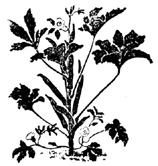
Okra or Gumbo
Okra. From the green pods of this vegetable is made the well-known Gumbo soup of the South, where the plant is more extensively grown than in the North. The pods are also used in their green state for stews, and are dried and used in winter, when they are nutritious, and form no little part of the diet in certain sections of the country. The seeds are very sensitive to cold and moisture, and should not be sown until the ground has become warm—the last week in May or the first of June being early enough in New York. The seed should be sown in a drill 1 inch deep, the plants thinned to stand 12 inches in the row. Give the same culture as for corn. One ounce will sow 40 feet of drill. Dwarf varieties are best for the North. Green Density and Velvet are leading varieties.
Oleander. While there are many named varieties of the Oleander, but two are often seen in general cultivation. These are the common red and white varieties. Both these, as well as the named varieties, are of easy management and well adapted to home culture, growing in pots or tubs for several years without special care. Well-grown specimens are very effective as porch or lawn plants, or may be used to good advantage in mixed beds of tall-growing plants, plunging the pot or tub to the rim in the soil. The plants should be cut back after flowering. They should be rested in any out-of-the-way place through the winter. When brought out in the spring, they should be given sun and air in order to make a sturdy growth. Propagation is effected by using well-ripened wood for cuttings, placed in a close frame; or the slips may be rooted in a bottle or can of water, care being taken to supply water as evaporation takes place. After being rooted, they may be potted, using soil with a large proportion of sand. Well established plants may be repotted in good loam and well rotted manure.
Onions are grown from seeds (“black seed”) for the main crop. They are also grown from sets (which are very small Onions, arrested in their development), from “tops” (which are bulblets produced in the place of flowers), and from multipliers or potato onions, which are compound bulbs.
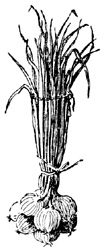
Early Onions
The extremely early crop of Onions is grown from sets, and the late or fall crop is grown from seed sown in April or early May. The sets may be saved from the crop harvested the previous fall, saving no bulbs measuring over ¾ of an inch in diameter, or, better, they may be purchased from the seedsman. These sets should be planted as early as possible in the spring, preferably on land that has been manured and trenched in the fall. Plant in rows 12 inches apart, the sets being 2 or 3 inches in the row. Push the sets well down into the ground and cover with soil, firming them with the feet or a roller. In cultivating, the soil should be thrown towards the tops, as the white stems are usually sought as an indication of mildness. The crop will be in condition to use in from three to four weeks, and may be made to last until small seed Onions are to be had. Tops or multipliers may also be used for the early crop.
In growing Onions from seed, it is only necessary to say that the seed should be in the ground very early in order that the bulbs make their growth before the extreme hot weather of August, when, for want of moisture and because of the heat, the bulbs will ripen up while small. Early in April, in New York, if the ground is in condition, the seed should be sown thickly in drills from 12 to 16 inches apart, and the ground above the seeds well firmed. Good cultivation and constant weeding is the price of a good crop of Onions. In cultivating and hoeing, the soil should be kept away from the rows, not covering the growing bulbs, but allowing them to spread over the surface of the ground. When the crop is ready to be harvested, the bulbs may be pulled or cultivated up, left to dry in double rows for several days, the tops and roots taken off, and the bulbs stored in a dry place. Later in the season they may be allowed to freeze, covering with chaff or straw to hold them frozen, and kept until early spring; but this method is usually unsafe with beginners, and always so in a changeable climate. Onion seed should always be fresh when sown—preferably of the last year’s crop. One ounce of Onion seed will sow 100 feet of drill.
One of the recent methods of obtaining extra large bulbs from seed is to sow the seed in a hotbed in February or early March, and transplant to the open ground in April.
The Danvers, Prizetaker, Globe and Wethersfield are favorite varieties, with the addition of White Queen or Barletta for pickling.
Oxalis. A number of hardy species of this are excellent plants for rockwork and edging. The greenhouse species are very showy, growing without extra care, and blooming freely through the late winter and spring months; these are mostly increased by bulbs, a few by division of the root. O. violacea is one of the commonest of house-plants. Give a sunny window, for the flowers open only in sun or very bright light. The bulbous kinds are treated as recommended for Bulbs, except that the bulbs must not freeze.
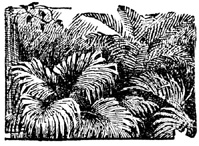
Palms
Palms. No more graceful plant for room decoration can be found than a well-grown specimen of some species of Palms. Most Palms are well adapted for this purpose when small, and as the growth is usually very slow, a plant may be used for many years. Again, the plants thrive better in partial shade. They may be grown in a sitting or drawing-room more satisfactorily than most house-plants. One of the frequent causes of failure in the culture of the Palm is the over-potting and subsequent over-watering. A Palm should not be repotted until the mass of roots fills the soil; then a pot only a size larger should be used. Use ample drainage in the bottom to carry off excess of water. Although the plants need a moist soil, water standing at their roots proves injurious. A soil composed of well rotted sod, leaf-mold and a little sand will meet their requirements. Among the best Palms for house culture are Arecas, Cocos Weddelliana, Latania, Kentia, Chamærops and Phœnix. Cycas may also be regarded as a Palm.
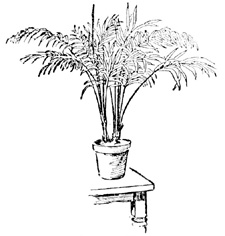
A table Palm
The date Palm may be grown from seed of the common commercial date. Seed of the other varieties may be purchased from leading seedsmen, but, as the seed germinates only under favorable conditions, and the Palm is a very slow-growing plant while young, the best plan is to purchase the plants from a dealer when wanted. When the plants become weak or diseased, take them to a florist for treatment and recuperation.
Pandanus, or Screw Pine. The Pandanus utilis and P. Veitchii are exceedingly ornamental, and are well adapted to house culture. The singular habit of growth, bright, glossy leaves, and the ability to withstand the dust and shade of a dwelling room, make them a desirable addition to the house collection. They are propagated by the offsets or young plants that grow around the base of the trunk; or they may be increased by seed. If by the former method, the offsets should be cut off and set in sand, at a temperature of 65° or 70°. The cuttings root slowly and the plants for a time make a very slow growth. The general cultural treatment is that of palms, which see.
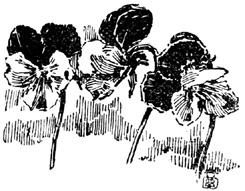
Pansies
Pansy is without doubt the most popular spring flower in cultivation. The strains of seed are many, each containing great possibilities. The culture is simple and the results are sure. Seed sown in August or September, in boxes or a frame, will make plants large enough to reset in November and bloom the following March; or they may be left until March in open seed-beds before setting out. Also, if they are sown very thinly in the frames they may remain undisturbed through the winter, blooming very early the following spring. The frame should be protected by mats, boards or other covering through the severe cold, and as the sun gains strength, care should be taken to keep them from heaving by alternate thawing and freezing. Seed sown in boxes in January or February will make fine blooming plants by April, taking the place of those blooming earlier.
The requisites for satisfactory Pansy culture are rich, moist, cool soil, protection from the noonday sun, and attention to keeping them from going to seed. As the ground becomes warm a mulch of leaf-mold or other light material should be spread over the bed to retain moisture and exclude heat. Spring and fall give the best bloom.
Paris Green is the leading arsenical insecticide. It is usually applied in a water spray, at the rate of 1 pound of the poison to 150 to 200 gallons of water. Add ½ pound of lime to prevent injury to foliage. Potatoes will usually stand a stronger mixture; peaches and some other plants do not need one so strong. Make the Paris Green into a paste with water before adding it to the 200 gallons, that it may mix better. Paris Green may be added to Bordeaux mixture with excellent results, counting the Bordeaux as if it were so much water; in this case it will not be necessary to add lime to the Paris Green. The Paris Green is used only for chewing insects, as worms and beetles. London purple is used in the same way.
Parsley grown in a box
Parsley. The curled Parsley is used almost exclusively as a garnish for meats and salads, although the flavor in soups is fine. The seed is slow to germinate, and often the second or third sowing is made, thinking the first is a failure; but usually after what would seem a long time the young plants will be seen. When sown in the open ground, it should be thinned to stand 3 or 4 inches in the row, the rows being 10 to 12 inches apart. A few plants in a border will give a supply for a large family, and with a little protection will live over winter. Roots may be lifted in the fall, put into boxes or old cans, and grown in a sunny window for winter use.
Parsnips are one of the vegetables that are the better for the winter’s freeze, although they are of good quality if taken up after the fall frosts and packed in soil, sand or moss in the cellar. The seed, which must be not over one year old, should be sown as early as possible in well prepared soil, firmed with the feet or roller. As the seed germinates rather slowly the ground often becomes crusted or baked over the seeds, in which case it should be broken and fined with a garden rake. This operation often means the success of the crop. Radish or cabbage seeds may be sown with the Parsnip seed to mark the row and break the crust. One ounce of seed will sow 200 feet of drill. Thin to 6 inches apart in the row.
Pea. Who does not long for the time when early Peas are fit to use? And how many know the great difference in quality between the smooth and the wrinkled Peas? The first are a little the earliest to be planted and to become fit for use, and on that account should be planted in a small way. For the kitchen-garden the dwarf and half-dwarf varieties are the best, as the tall kinds will need brush or wire to support them, causing considerable trouble and labor and not being as neat in appearance. The tall varieties yield a larger crop than the dwarfs, but as the rows must be made from 3 to 5 feet apart, the dwarf ones, which are planted only 6 to 8 inches apart, will give as large a yield on the same area. Always plant double rows of the tall varieties: that is, two rows from 4 to 6 inches apart, with the brush or wire between, the double rows being from 3 to 5 feet apart, according to varieties. The dwarf varieties should be planted four rows in a block, each row being only 6 or 8 inches apart. The Peas on the two center rows may be picked from the outside. Leave a space of 2 feet and plant the same. At the time of the first planting only the smooth varieties should be sown, but by the middle of April in New York the ground will be warm and dry enough for the wrinkled sorts. A succession should be sown that will come to maturity one after the other, extending the season six or eight weeks. If a further supply is wanted the early quick-maturing varieties may be sown in August, usually giving a fair crop of Peas in September and early October. In the hot weather of midsummer they often do not thrive so well. One quart of seed will plant about 100 feet of drill.
Pea, Everlasting (Lathyrus latifolius). These Peas do not have the colors or fragrance of the Sweet Pea, but are fine for planting against rocks, stumps, or fences. They bloom through a long season, and, being perfectly hardy, will live for years. Height 2 to 6 feet. Raised from seeds or from cuttings, usually the former. Keep the seed pods picked off to lengthen period of bloom.
Pea, Sweet. See Sweet Pea.
Peach. Given the proper exposure, Peaches may be fruited in many sections where now it is thought impossible to have a crop. It is usually the practice of the amateur to set Peach trees in the shelter of some building, exposed on the south or east to the sun, and “in a pocket” as regards winds. This should be reversed, except in the close vicinity of large bodies of water. The fruit buds of Peaches will stand very cold weather when perfectly dormant, often as low as 12° or 18° below zero in New York; but if the buds once become swollen, comparatively light freezing will destroy the crop. Therefore, if the trees be set on elevations where a constant air drainage may be obtained, sheltered, if at all, on the south and east, from the warming influence of the sun, the buds will remain dormant until the ground becomes warm, and the chances of a failure will be lessened. This advice applies mostly to interior sections. A well drained, sandy loam or gravelly soil suits the Peach better than a heavy soil; but if the heavier soil is well drained, good crops may be obtained.
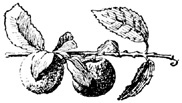
Peaches
Peaches are short-lived at best, and one should be satisfied with three or four crops from each tree. They bear young, usually a partial crop the third year. If a crop may be had every other year until the trees are eight or ten years old, they will have well repaid the effort of cultivation. But they often bear twice this long. Young trees may be set every four or five years to replace older ones, thus having trees at a bearing age at all times on a small place. Trees should be set 14 to 18 feet apart each way. A good selection of varieties for home use would be Early York, Alexander, Halo Early, Mountain Rose, Early Crawford, Wheatland, Stump, Elberta, Stevens, Oldmixon, Late Crawford and Smock.
Peach trees are always bought when they are one year old, that is, one year from the bud. For example, the bud is set in the fall of 1898. It remains dormant until the spring of 1899, when it pushes into vigorous growth; and in the fall of 1899 the tree is ready for sale. Peach trees which are more than a year old are scarcely worth the buying. It is a common practice, when setting Peach trees, to prune them back to a whip, leaving a stub bearing not more than one bud where each branch is cut off.
The three great enemies of the Peach are the borer, the yellows and the curculio.
The borer is best handled by digging it out every spring and fall. Trees which are attacked by the borer have an exudation of gum about the crown. If the borers are dug out twice a year they will not get sufficient start to make the operation very laborious. It is the only sure way.
The yellows is a communicable disease, the cause of which is not definitely known. It shows itself in the fruit ripening prematurely, with distinct red spots which extend through the flesh, and later by the throwing out of fine, branching, twiggy tufts along the main branches. The only treatment is to pull out the trees and burn them. Other trees may be set in the same places.
For a discussion of curculio, see the remarks under Plum.
Pear. No fruit plantation should be considered complete without trees of various kinds of Pears, ripening fruits from early in August till winter. The late varieties are generally good keepers, and extend the season into February, thus supplying fruit for six or seven months.
As the Pear grows to perfection on quince, the dwarf tree is peculiarly adapted to planting on small home grounds, and is often used as a boundary plant, or to serve the purpose of a screen. These dwarf trees should be set deep—4 to 6 inches below the union—to prevent the stock from growing. Dwarf trees may be set as near together as 10 to 16 feet, while the standard or tall-growing Pears should be set 18 to 25 feet apart. Trees are planted when two or three years old.
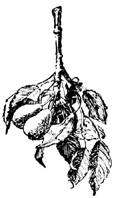
Bartlett Pears
The Pear thrives on clay soil, if well underdrained, and for this reason may succeed in places where other fruits might fail. A good, steady growth should be maintained, but the use of nitrogenous manures should be avoided, as they tend to make a rank growth and invite attacks of Pear blight, which is the worst enemy of the Pear. For summer fruits: Osband’s Summer, Bartlett, Clapp and Manning Elizabeth are among the best. For autumn: Duchess, Flemish Beauty, Bosc, Louise Bonne, Seckel and Sheldon. For winter fruit: Anjou, Clairgeau, Lawrence and Winter Nelis are excellent. Kieffer is an excellent commercial fruit, but it is too poor to be given space in the home ground except as an ornamental tree.
Of the Pear blight, Duggar writes as follows:
“Remedies. (a) The knife and the saw.—With a disease working as this does, it is very evident that there is no chance either for cure or prevention by means of spraying. The heroic treatment of the knife and saw must be adopted and vigorously pursued, as has been claimed from the beginning. The blackened leaves alone must not serve as signs of the diseased area, but one must examine carefully the branches and remove them 6 inches or more below the lowest discolorations. Often before cutting, pruners slice the bark downward to see where the injury ends. This should not be done; it is better to be sure that you are below the infected area, and run no such risk of infecting anew the tissues below. The cut surfaces of larger limbs and branches should be painted for protection against wound rots.
“(b) When to cut.—Cutting out diseased portions should be done whenever the disease is evident. This may check the injuries temporarily; but it has been shown that much can be done in the autumn to prevent the establishment of the disease the following spring. It has long been known that the disease may pass the winter in the branches by a slow growth in the neighborhood of late infections. Thorough work of eradication should especially be performed after the season of growth. Then cut out every diseased branch and burn, so that in the spring when the succulent growth begins again, there will be few places in which insects may come in contact with the bacterial exudations.
“(c) Conditions favoring the disease.—The knife is our only hope of extermination; but there are undoubtedly conditions which favor the disease. In a succulent, rapidly growing tree the bacteria find more favorable conditions for their development than in one which grows slowly, yet with sufficient vigor. For this reason, too much nitrogenous manure is dangerous; and, for the same reason, a succulent growth induced by severe pruning should be avoided.”
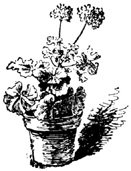
Pelargonium, or Geranium
Pelargoniums. Here belong the plants known as Geraniums—the most satisfactory of house-plants, and extensively used as bedding plants. No plants will give better returns in leaf and flower; and these features, added to the ease of propagation, make them general favorites. Cuttings of partially ripened wood root very easily, grow to blooming size in a short time, and, either planted out or grown in a pot, make fine decorations. The common or “Fish” Geraniums are much more satisfactory when not more than a year old. Take cuttings from the old plants at least once a year. In four or five months the young plants begin to bloom. Plants may be taken up from the garden and potted, but they rarely give as much satisfaction as young, vigorous subjects. Repot frequently until they are in 4- to 5-inch pots; then let them bloom.
The show Pelargoniums are those commonly known as Lady Washington Geraniums. These have but one period of bloom, usually in April, but they make up in size and coloring. This section is more difficult to manage as a house plant than the common Geranium, needing more direct light to keep it stocky, and being troubled by insects. Still, all the trouble taken to grow them will be well repaid by the handsome blossoms. Take cuttings in late spring, after flowering, and blooming plants may be had the following year. Good results are sometimes secured by keeping these plants two or three years. Cut back after each blooming season.
For house culture the Geraniums need a rich, fibrous loam, with the addition of a little sand; good drainage is also an essential.
Peony. The herbaceous Peony has long had a place in the garden, and is now in general use as an early flowering plant. It is perfectly hardy, and free from the many diseases and insects that attack so many fine plants. The single and semi-double varieties are very fine, the flowers becoming large as the plant becomes well established. The herbaceous section is readily increased by division. The tree Peonies are increased by grafting. They grow in some cases to the height of 3 or more feet, and are covered with large, very double flowers of rich colors. Height 2 to 3 feet.
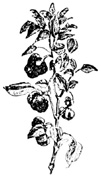
Bell Pepper
Peppers are tender while young, although they will endure a heavy frost in the fall. Their culture is that recommended for eggplants. A small seedsman’s packet of seed will be sufficient for a large number of plants, say two hundred. The large Bell Peppers are the mildest, and are used for making “stuffed Peppers” and other dishes. The small, hot Peppers are used for seasoning and sauces.
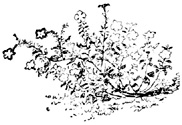
Petunia
Petunia. The improvement made in the size and markings of the Petunia has been marked of late. Now almost every shade of color may be found, aside from yellow. A bed of Petunias makes a mass of color equaled by few other flowers. They also make very fine single plants for pots, baskets or window-boxes, blooming freely through the winter, and emitting a delicate fragrance. The single varieties grow freely from seed, but if plants of one special color are wanted cuttings should be made. These cuttings root easily and bloom early. Cuttings will have to be made of the double varieties to increase their number. For common Petunias, sow seeds where plants are to grow, in a warm, sunny place; or, for earlier bloom, seeds may be started in the house. Thin to 8 to 12 inches apart. The season of bloom is cut short only by frost or other causes.
Phlox. Both the perennial and the annual Phloxes are most valuable. Excepting the petunia, no plant will give the profusion of bloom with as little care as the annual Phlox (Phlox Drummondii). Masses of one color or of contrasting colors make very effective ribbon borders or edging beds. The perennial species are very showy, having almost as wide a range of color as the annuals. They grow to the height of 3 feet. They are most effective in the back row of a border. The perennials have been much improved of late. They are hardy.
The annual Phlox is propagated by seed sown early in the spring in the border, or in March in boxes and transplanted. The perennial Phlox is increased by division of the roots, the flowers being larger and more highly colored by dividing at least every three years. The annual Phlox blooms early, and continues until late in the fall. The perennial blooms from July to frost.
Pink. See Dianthus and Carnation.
Plum. Of Plums there are three general or common types: first, the common Domestica or European Plum, which gives rise to all the older varieties, like Lombard, Bradshaw, Green Gage, the Prunes, the Egg Plums, the Damsons, and the like; second, the Japanese Plums, which have become popular within the last ten years, and which are adapted to a wider range of country than the Domesticas; third, the native Plums of several species or types, which are adapted to the plains, the middle and southern states, where the Domestica Plums do not thrive, and some kinds to the cold North.
Wherever the Domestica and Japanese Plums can be grown, the native Plums are not destined to become popular; but many of the natives are much hardier than others, and are therefore adapted to regions in which the Domestica and Japanese are not safe. Others of them are well adapted to the middle and southern states. The Domestica and Japanese Plums are considerably hardier than peaches, but not so hardy as the apple. The northern limit of their general cultivation is the southern peninsula of Michigan, central and southern Ontario, central New York and central New England.
Plums thrive on a great variety of soils, but they do better, as a rule, on those which are rather heavy and have a considerable content of clay. In fact, many of the varieties will thrive on clay as hard as that upon which pears will grow. On the other hand, they often thrive well upon light, and even almost sandy soils.
The trees are set when they are two and three years from the bud. It is preferable to have Plum trees on stocks of the same species, but it is not always possible to secure them at the nurseries. In the South, Plums are worked mostly on peach roots, and these make excellent trees where the climate is not too severe, and especially upon the lighter lands on which they are planted in the South. In the North the larger part of the Plum stocks are grown on the Myrobalan Plum roots. This Myrobalan is an Old World species of Plum, of smaller growth than the Domestica. This stock, therefore, tends to dwarf the tree, and it is also likely to throw up sprouts from the roots. Plum trees are set from 12 to 18 feet apart. Many growers like to set them 8 feet apart in rows, and have the rows from 16 to 20 feet apart.
Plums are pruned much the same as apples and pears. That is, the top is thinned out from year to year, and all superfluous branches and broken or diseased wood are removed. If the soil is very strong and the trees are close together, it may be well to head them in a little each year, especially those varieties which grow very strong and robust.
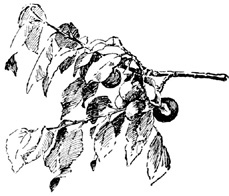
Plums
The varieties of Plums are very numerous. Of the Domestica or European type, some of the best are Bradshaw, Imperial Gage, Jefferson, Reine Claude, Coe Golden Drop, Quackenbos, Fellemburg, German Prune, Copper. The Lombard is the most cosmopolitan variety, and is always sure to give a crop, but the quality is not so good as that of the others mentioned. For culinary purposes, some of the Damsons, which are very small-fruited varieties, are excellent. Of Japanese Plums, the best so far tested for the North are Red June, Abundance, Burbank, Chabot and Satsuma. For a very early cherry-like Plum for home use, the Berger is excellent. Of the native Plums, the most cosmopolitan variety is Wild Goose. Excellent varieties are Weaver, Quaker, Forest Garden, Wayland, and others.
There are four leading difficulties in the growing of Plums—leaf blight, fruit rot, black knot, and curculio.
The leaf blight usually comes on about midsummer, the leaves becoming spotted and dropping off. The remedy for this trouble is to spray thoroughly with Bordeaux mixture, beginning soon after the fruits have set, and before the trouble begins to show.
The fruit rot may be prevented by the same means—that is, by spraying with Bordeaux mixture. It is usually best to begin just after the fruits are well set. A very important consideration in the checking of this disease is to thin the fruit so that it does not hang in clusters. If one fruit touches another, the rot spreads from fruit to fruit in spite of the spraying. Some varieties, like Lombard and Abundance, are susceptible to this injury.
The black knot is best kept in check by cutting out the knots whenever they can be seen, and burning them. As soon as the leaves drop, the orchard should be gone over and all knots taken out. Orchards which are thoroughly sprayed with Bordeaux mixture for the leaf blight and fruit-rot fungus are less liable to attacks of black knot.
The curculio, or the insect which is the parent of the worms in the fruit, is the inveterate enemy of the Plum and other stone fruits. The mature beetle lays the eggs in the fruits when they are very small, usually beginning its work about as soon as the flowers fall. These eggs soon hatch, and the little maggot bores into the fruit. Those fruits which are attacked whilst very young ordinarily fall from the tree, but those which are attacked when they are half or more grown may adhere to the tree, but are wormy and gummy at the picking time. The mature beetles are sluggish in the mornings, and are easily jarred from the trees. Taking advantage of this fact, the fruit-grower may jar them into sheets; or, in large orchards, into a large canvas hopper, which is wheeled from tree to tree upon a wheelbarrow-like frame, and under the apex of which is a tin can into which the insects roll. There is a slit or opening in one side of the hopper, which allows the tree to stand nearly in the middle of the canvas. The operator then gives the tree two or three sharp jars with a padded pole or mallet. The edges of the hopper are then quickly shaken with the hands and the insects roll down into the tin receptacle. In this receptacle there is kerosene oil, or it may be emptied from time to time. Just how long this machine is to be run in the orchard will depend entirely upon circumstances. It is advisable to use the catcher soon after the blossoms fall, for the purpose of finding out how abundant the insects are. If a few insects are caught upon each tree, there is indication that there are enough of the pests to make serious trouble. If after a few days the insects seem to have disappeared, it will not be necessary to continue the hunt. In some years, especially in those succeeding a very heavy crop, it may be necessary to run the curculio-catcher every morning for four or five weeks; but, as a rule, it will not be necessary to use it oftener than two or three times a week during that season; and sometimes the season may be shortened by one-half. The insects fall most readily when the weather is cool, and it, therefore, is best to get through the whole orchard, if possible, before noon. Upon cloudy days, however, the insects may be caught all day. A smart man can attend to 300 to 400 full-bearing trees in six hours if the ground has been well rolled or firmed, as it should be before the bugging operation begins. But whether the operation is troublesome or not, it is the price of Plums, and the grower must not expect to succeed long without it. The same treatment is essential to the saving of peaches and rarely, also, of sour cherries.
Poppy. These showy annuals and perennials should be more generally grown. Nothing will lighten up a corner better than the hardy oriental Poppy, or the solid crimson or scarlet annual Poppies. All of the varieties grow readily from seed, which, in most cases, should be sown where the plants are to bloom. The seeds of the oriental and the Iceland Poppy may be sown in pots, the plants wintered over in a frame and carefully planted out the second spring. The Poppy is very impatient of root disturbance, however, and the safest method is to sow the seed where wanted.
Portulaca, or Rose Moss. Brilliant little tender annuals, low-growing and sun-loving. They usually seed themselves, and once established will continue for years. Many of the varieties will produce a good percentage of flowers as double as roses and of many colors. Seed should be sown where wanted. They bloom freely in light, sandy soil in the full blaze of the sun.
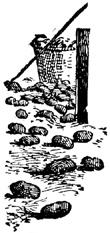
Potatoes
Potato. The common practice of growing Potatoes in ridges or elevated hills is wrong, unless the soil is so wet that this practice is necessary to insure proper drainage; but in this case the land is not adapted to the growing of Potatoes. If the land is elevated into ridges or hills, there is a great loss of moisture by means of evaporation. During the last cultivating the Potatoes may be hilled up slightly in order to cover the tubers; but the hills should not be made in the beginning. Land for Potatoes should be rather loamy in character, and ought to have a liberal supply of potash, either naturally or supplied in the drill, by means of an application of sulfate of potash. See that the land is deeply plowed or spaded, so that the roots can penetrate deeper. Plant the Potatoes 3 or 4 inches below the natural surface of the ground. It is ordinarily best to drop the pieces in drills. A continuous drill may be made by means of dropping one piece every 6 inches, but it is usually thought best to drop two pieces about every 12 to 18 inches. The drills are far enough apart to allow good cultivation. If horse cultivation is used, the drills should be at least 3 feet apart.
Small Potatoes are considered not to be so good as large ones for planting. One reason is because too many sprouts arise from each one, and these sprouts are apt to crowd each other. The same is true of the tip end or seed end of the tuber. Even when it is cut off, the eyes are so numerous that one secures many weak shoots rather than two or three strong ones. It is ordinarily best to cut the Potatoes to two or three eyes, leaving as much tuber as possible with each piece. From seven to eight bushels of Potatoes are required to plant an acre.
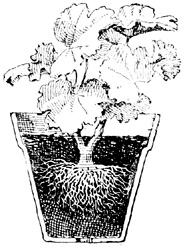
Too deep
For a very early crop in the garden, tubers are sometimes sprouted in the cellar. When the sprouts are 4 to 6 inches high the tubers are carefully planted. It is essential that the sprouts are not broken in the handling. In this practice, also, the tubers are first cut into large pieces, so that they will not dry out too much.
The staple remedy for the Potato bug is Paris green, 1 pound of poison to 150 to 200 gallons of water, with a little lime (see Paris Green). For the blight, spray with Bordeaux mixture, and spray thoroughly. Bordeaux mixture will also keep away the flea beetle to a large extent.
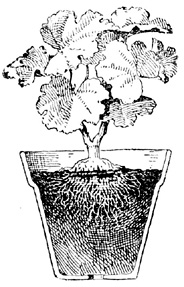
Plant too high
Potato, Sweet. See Sweet Potato.
Potting. The operation of potting a plant, while in itself simple, is very often associated with success or failure in the growth of the plant. The first and most common reason of failure is using too large a pot; the second, imperfect drainage; and the third, the poor physical condition of the soil.
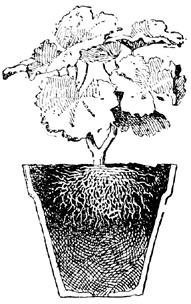
Too full
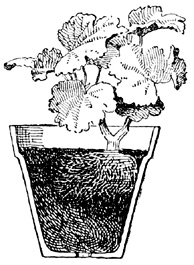
Careless
A small-rooted cutting or a feeble plant should have a pot only large enough to hold soil sufficient to surround the roots to the extent of 1 or 2 inches. More soil would hold too much moisture, thus excluding the air. As the plants grow and the ball of dirt becomes well covered with white roots, and before these roots become dark in color, the plant should be repotted, using a pot one size larger and usually a little richer soil. This operation should continue until the plant has made the desired growth. If it is desired to grow a geranium, fuchsia, begonia, or plants of a similar character, large enough for a window plant—say to the height or breadth of two feet,—a 6-inch pot will be large enough, provided the soil is rich enough to continue the growth of the plant while in flower. It often happens that pots of the various sizes are not to hand; and in case the pot is too large, it should have the drainage increased until it will take up as much room in the bottom as the pot is too large. Bear in mind that the soil should not hold free water. After the plant has filled the pot with roots it will often be necessary to supply more food as the soil becomes exhausted. This may be done by digging out the top soil down to the young, white roots, replacing with new soil in which a little rotted manure, a pinch of bone-meal or other plant-food, has been added. Liquid manure may be used. This liquid manure is made from well rotted cow-, horse-, or sheep-manure thrown into a tub or barrel, covered with water, and allowed to stand until the strength of the manure is soaked out. This liquid should be diluted before using with clear water until it has the color of weak coffee. If used with judgment, nothing will cause a better growth or a greater quantity of flowers.
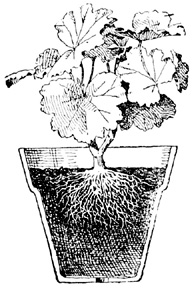
Good!
The drainage may consist of any coarse material, such as old broken pots, small stones, pieces of charcoal, and the like, over which should be placed small broken sod or a little moss to keep the dirt from washing through and eventually stopping up the crevices through which the excess water should flow.
A safe rule to follow in first potting the majority of house-plants, is to use one-third turf-loam, one-third leaf-mold or decayed leaves, and one-third sand, thoroughly mixed. Reduce the amount of leaf-mold and sand at successive pottings, adding a little well rotted manure, until, when the plants have been potted in 6-inch pots, at least four-fifths of the soil is turfy loam. Press the soil firmly in the pot and around the plant. Never fill the pot level full of soil, else the plant cannot be watered.
Prickly Poppies, or Argemones, are hardy annuals, with large, bluish striking foliage and yellow flowers. They are easily grown in a warm soil and sunny exposure. Sow the seeds where the plants are to stand. Thin to 12 to 18 inches apart. They grow 2 feet high.
Primulas, or Primroses, are of various kinds. One of them is the Auricula (which see). Others are hardy border plants. The true or English cowslip is one of these; also the plants commonly known as Polyanthus. Hardy Primulas grow 6 to 10 inches high, sending up trusses of yellow and red flowers in early spring. Propagated by division, or by seed sown a year before the plants are wanted. Give them rich, moist soil.
The Primula of the winter-garden is mostly the P. Sinensis (Chinese Primrose), grown very extensively by florists as a Christmas plant. With the exception of the full double varieties, it is usually grown from seed. The seed sown in March or April will make large flowering plants by November or December, if the young plants are shifted to larger pots as needed. The seed should be sown on the flat surface of the soil, composed of equal parts loam, leaf-mold and sand. The seed should be pressed down lightly and the soil watered carefully to prevent the seed from being washed into the soil. Very fine sphagnum moss may be sifted over the seed, or the box set in a moist place, where the soil will remain wet until the seeds germinate. When the plants are large enough they should be potted separately or pricked out into shallow boxes. Frequent pottings or transplantings should be given until September, when they should be in the pots in which they are to bloom. The two essentials to successful growth through the hot summer are shade and moisture. Height 6 to 8 inches. Bloom in winter and spring.
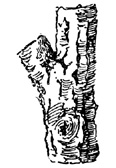
Improper way to make the wound
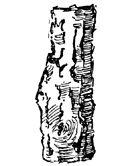
Proper way
At present the “baby Primrose” (Primula Forbesi) is popular. It is treated in essentially the same way as the Sinensis. All Primulas are impatient of a dry atmosphere and fluctuating conditions.
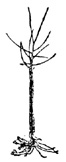
Before
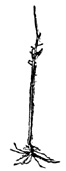
After
Prince’s Feather. See Amarantus.
Prunes are varieties of plums with firm, meaty flesh, and which readily make dried fruit. Some of the Prunes are commercially grown in the East, but they are sold in the green state as other plums are; and they are adapted to all the uses of other plums. Prunes are cultivated like other plums.
Pruning. There are two general types of inquiry connected with the question of Pruning: First, that which has to do with the healing of the wounds; and second, that which has to do with the shaping of the top and the general welfare of the tree.
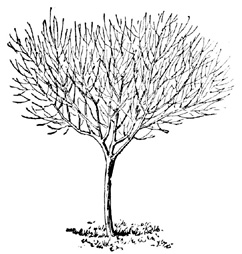
Before pruning
When a limb is cut off, it heals by being covered with callus tissue, which grows out from the cambium zone between the bark and wood and rolls over the face of the wound. The hard wood itself never heals; that is, the cells do not have the power of making new cells; therefore the old wood is simply covered up, or hermetically sealed as a cap is put on a fruit jar. It is evident, therefore, that no kind of dressing will hasten the healing of this wound. The merit of a dressing is to keep the wound sound and healthy until the callus naturally covers it over. All things considered, the best dressing is probably thick linseed-oil paint.
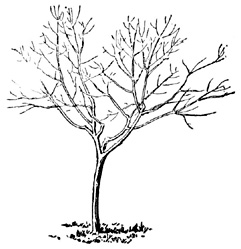
After pruning
So far as the wound is concerned, the best time for Pruning is ordinarily in the spring, when the vital activities are beginning; but the season also influences fruit-bearing and wood-making, and these questions should be considered. Those wounds heal best which are on strong main limbs, where there is a full flow of nutritious sap. The limb should be cut off so that the wound is parallel with the trunk upon which it sits, and close to it. That is to say, the longer the stub, the less rapid in general is the healing of the wound. It is the custom to cut the limb just outside the bulge at its base; but, in most cases, it is better to cut through this bulge, and to have the wound close to the main trunk.
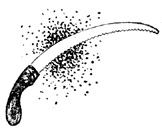
Sickle saw
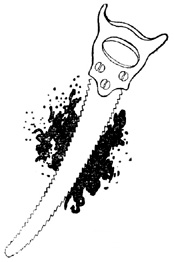
Curved Pruning saw
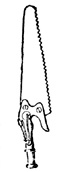
Combined saw and knife. Goes on a long handle

Common double edge saw
Heavy Pruning of the top tends to the production of wood; therefore the severe Pruning of orchard trees, following three or four years of neglect, sets the trees into heavy wood-bearing, and makes them more vigorous. Such treatment generally tends away from fruit-bearing. This heavy Pruning is usually necessary in neglected orchards, however, to bring trees back into shape and to revitalize them; but the best Pruning-treatment of an orchard is to Prune it a little every year. It should be so Pruned that the tops of the trees will be open, that no two limbs will interfere with each other, and so that the fruit itself will not be so abundant as to overload the tree. Pruning is a means of thinning. In general, it is best to prune orchard trees late in winter or early in spring. It is ordinarily better, however, to leave peaches and other tender fruits until after the buds have swollen, or even after the flowers have fallen, in order that one may determine how much they have been injured by the winter. Grapevines should be Pruned in winter or not later (in New York) than the first of March. If Pruned later than this, they may bleed. The above remarks will apply to other trees as well as to fruits.
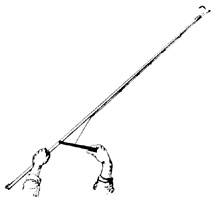
Waters’ tree Pruner—for limbs out of reach
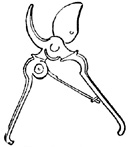
Pruning shears
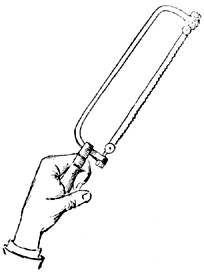
An excellent Pruning saw. The blade is on a swivel
It should be borne in mind that Pruning has two objects: one is to merely trim the tree or to make it assume some designed shape; the other is to make the tree more vigorous or more fruitful, or to make some other change in its character. These ideals are well illustrated in the Pruning of ornamental shrubs. If one wants to have the shrubs sheared into some particular shape, the shearing may be done at almost any time of the year; in fact, it is better to do it two or three times each year in order to keep the trees trim and neat. If, however, the desire is to secure more flowers, the case is a very different one. Some shrubs and trees bear their flowers on the wood of the preceding year. Such, for example, are the early flowering shrubs like lilacs and the snowballs. The flower buds are made the fall before. In this case, Pruning the shrub in winter cuts off the flower buds. The ideal time for Pruning them, therefore, is just after the flowers have passed. The flower buds will form later in the season for the production of the flowers the following spring. Other shrubs, however (particularly those which blossom late in the season), bear on wood of the current year’s growth. That is, the clematis blossoms in late summer and fall on wood which grew that same season. The greater the quantity of strong wood which grows in any season, therefore, the greater the quantity of bloom in that season. With such shrubs, it is well to Prune in winter or early spring, and to Prune rather heavily. The abundance of new shoots which arise may be expected to bear flowers later on in the same season.
Following are some shrubs which, for best results in flower-bearing, may be Pruned when dormant (in winter): camellia, Jackmani type of clematis, cornus, hibiscus (shrubby), hydrangea, many loniceras or honeysuckles, philadelphus or mock-orange, some spireas.
Shrubs which may be Pruned when in leaf (just after blooming): lilac, deutzia, weigelas, exochorda, spring-flowering loniceras, tree peony, flowering almond, some spireas and viburnums, wistaria.
The marginal illustrations show how apple, pear and plum trees may be Pruned when received from the nursery. Cut back the roots to fresh, unbroken wood.
Various kinds of useful tree Pruners are shown in the margins. See also Scraping.
Pumpkin. See Squash.
Pyrethrum. The little, low-growing yellow-foliaged Feverfew, called Golden Feather, is used extensively for edging and design beds. Propagated by cuttings, as are geraniums.
The tall-growing species are very fine border plants, being easy to grow and having showy flowers, in colors ranging from white through lilac to crimson. Their flowers appear in June and last a month, when, if the plants are cut down, they will flower again in the fall. The Persian insect powder is made from the dried flower heads of some of these species. Propagated by seed or division. Hardy and fine.

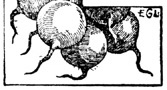
Spring Radishes
Radishes should be grown quickly in order to have them at their best. They become tough and woody if grown slowly or allowed to stay in the ground too long. A light soil, well enriched, will grow most of the early varieties to table size in from three to five weeks. To have a supply through the early months, sowings should be made every two weeks. For summer, the large white or gray varieties are best. The winter varieties may be sown in September, harvested before severe frosts, and stored in sand in a cool cellar. When they are to be used, if thrown into cold water for a short time they will regain their crispness. Sow Radishes thickly in drills, 12 to 18 inches apart. Thin as needed.
Raspberry. Both the red and black Raspberries are essentials of a good garden. A few plants of each will produce a supply of berries for a family through six or eight weeks, provided both early and late varieties are planted. A cool situation, soil that will hold moisture without being wet, and a thorough preparation of the ground, are the conditions necessary to success. The black-cap Raspberries should be set 3 to 4 feet apart, the rows 6 or 7 feet; the red varieties 3 feet apart, the rows 5 feet apart. Spring setting is usually preferable.
As with blackberries and dewberries, Raspberries bear on last year’s canes, and these canes bear but once. Therefore cut out the old canes after fruiting, or before the following spring, thus destroying such insects and fungi as may have lodged on them. New canes should have grown in the meantime, 3 to 6 to a hill.
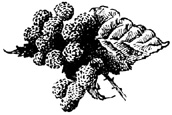
Black Raspberries
The first year after the plants are set the canes should be pinched back when they reach the height of from 30 to 36 inches. If a very vigorous growth has been made the first season two canes may be left for fruiting, but in the case of weak growth, only one cane should be allowed to fruit. In case of low-growing varieties—those that have been pinched back short—a mulch of straw or grass around the plants at fruiting time will help to hold the moisture, and also serve to keep the fruits clean in case of heavy rains. A Raspberry plantation will last three to five years. The black varieties are propagated by layers, the tip of a cane being laid in the soil in midsummer; by fall the tip will have taken root and may be separated. The red varieties are propagated by suckers from the roots. In nurseries both blacks and reds are often propagated by means of root-cuttings.
For red rust, pull out the plant, root and branch, and burn it. Short rotations—fruiting the plants only two or three years—and burning the old canes and trimmings, will do much to keep Raspberry plantations healthy. Spraying will have some effect in combating anthracnose. Raspberries may be bent over to the ground so that the snow will protect them, in severe climates.
Varieties are always changing in favor. Good black-caps are Gregg, Ohio, and Kansas. Good red and purple sorts are Shaffer, Cuthbert, Loudon, and others.
Rhododendrons are broad-leaved evergreen shrubs which require a fibrous or peaty soil and protection from bleak winds and hot suns in winter. It is well to plant them amongst trees for protection. In the North, mulch heavily with leaves in the fall. See that the soil is made fibrous with leaf-mold or other material. Rhododendrons bloom from winter buds: therefore prune just after flowering, if at all.
Rhubarb, or Pie Plant. This is usually propagated by division of the fleshy roots, small pieces of which will grow if separated from the old, established roots and planted in rich, mellow soil. Poor soil should be made rich by spading out at least 3 feet of the surface, filling with well rotted manure to within 1 foot of the level, throwing in the top soil and setting the roots with the crowns 4 inches below the surface, firming them with the feet. The stalks should not be cut for use until the second year, but the first, as well as the succeeding falls, some coarse manure should be thrown over the crowns, to be forked or spaded in lightly when spring opens.
In growing seedling Rhubarb, the seed may be sown in a coldframe in March or April, protected from freezing, and in two months the plants will be ready to set in rows, 12 inches apart. Give the plants good cultivation, and the following spring they may be set in a permanent place. At this time the plants should be set in well prepared ground, at a distance each way of from 4 to 5 feet, and treated as those set with pieces of roots.
If given good care and well manured, the plants will live for years and yield abundantly. Two dozen good roots will supply a large family.
Ricinus. See Castor Oil Plant.
Roses. It seems to be the first desire of the home maker, when he considers the planting of his grounds, to set out Roses. As a matter of fact, it should be one of the last things to do. Roses are essentially flower garden subjects, rather than lawn subjects. That is to say, the flowers are their chief beauty. They have very little to commend them in the way of foliage or habit, and they are inveterately attacked by insects and sometimes by fungi. In order to get the best results with Roses, they should be placed in a bed by themselves, where they can be tilled and pruned and well taken care of; and they should be grown as specimen plants, as other flower garden plants are. The ordinary garden Roses should rarely be grown in mixed borders of shrubbery.
Wild Roses
If it is desired to have Roses in mixed borders, then the single and informal types should be chosen. The best of all these is Rosa rugosa. This has not only attractive flowers through the greater part of the season, but it also has very interesting foliage and a striking habit. The great profusion of bristles and spines gives it an individual and strong character. Even without the flowers, it is valuable to add character and cast to a foliage mass. The foliage is not attacked by insects or fungi, but remains green and glossy throughout the year. The fruit is also very large and showy, and persists on bushes well through the winter. Some of the wild Roses are also very excellent for mixing into foliage masses, but, as a rule, their foliage characteristics are rather weak, and they are liable to be attacked by thrips.
Probably the most extensively grown class of Roses is the Remontant or Hybrid Perpetual. These, while not constant bloomers, are so easy of culture and give such good returns for the care and labor, that their popularity grows each year. The list of good varieties is very extensive, and while a few, such as General Jacqueminot, Paul Neyron, Marshall P. Wilder, Victor Verdier, Anne de Diesbach, and Ulrich Brunner, are seen in most collections, one cannot go far wrong in planting any of the list. Two of the Hybrid Chinese Roses may go with the Remontants, having the same season of bloom and being about as hardy. These are Magna Charta and Mme. Plantier.
The next group in point of hardiness, and superior to the foregoing in continuity of bloom, are the Hybrid Noisettes, such as Coquette des Alpes, Coquette des Blanches, and Elise Boelle. The blooms of these are white, often tinted with pink, very double and fragrant.
The Hybrid Tea section, containing Duchess of Albany, La France, Meteor and Wootton, is very fine. These are not hardy in the North, but if protected by a frame, or if grown in pots, wintered in a pit, no class of Roses will give more general satisfaction.
The Bourbon section contains three of the best bedding Roses,—Apolline, Hermosa, and Souvenir de la Malmaison. These will bloom continually through the fall months until severe frost, and with a little protection will prove hardy.
The Bengal Roses, of which Agrippina is a leading variety, bloom through a long season, but are not hardy, and should be protected in a pit. They also make very fine pot-plants.
The Moss Roses are well known, and are desirable in a general collection.
The little Polyantha Roses, with Cecile Brunner and Clothilde Soupert as two of the best, are always attractive, either when planted out or grown in pots.
The climbing Roses, which bloom later in the season than the Remontants, are very useful as pillar and screen plants. The old Queen of the Prairies and Baltimore Belle are still in favor. A newer and better variety is the Crimson Rambler.
Hybrid Tea Rose
The Tea Roses have proved more disappointing to the amateur than any other. No one can resist the temptation to try to have a few of these highly perfumed, richly colored Roses, but unless one has a conservatory or an especially favored location in the house, the results do not pay for the trouble. A few blooms may be had outdoors with plants set in the spring, but on the approach of winter they must be taken up and protected by more secure means than is taken with other Roses. If potted and grown in the house, they are the first plants to become infested with red spider; or if grown cool enough to escape that pest, they will be subject to an attack of mildew. Still, the results are well worth striving for, and a few persons will find the proper conditions; but the Tea Rose is essentially a florist’s flower.
All Roses are heavy feeders and require rich, moist soil. A clay soil, if well enriched and having perfect drainage, is ideal. Pruning should be carefully done, preferably in the spring. All weak growth should be cut out and the balance well cut back. The flowers of all Roses, except the Yellow Persian and the Harrison’s Yellow, being borne on the new wood, the bushes should be cut back half or more of their growth.
In the majority of cases, Roses on their own roots will prove more satisfactory than budded stock. On own-rooted stock, the suckers or shoots from below the surface of the soil will be of the same kind, whereas with budded Roses there is danger of the stock (usually Manetti or Dog Rose) starting into growth and, not being discovered, outgrowing the bud, taking possession, and finally killing out the weaker growth. Still, if the plants are set deep enough to prevent adventitious buds of the stock from starting, there is no question that finer Roses may be grown than from plants on their own roots.
The summer insects that trouble the Rose are best treated by a forceful spray of clear water. This should be done early in the day and again at evening. Those having city water or good spray pumps will find this an easy method of keeping Rose pests in check. Those without these facilities may use whale oil soap, fir-tree oil, good soap suds, or Persian insect powder.
Roses in Winter. Although the growing of Roses under glass is a business which would better be left to florists, as already said, the following advice may be useful to those who have conservatories:
When growing forcing Roses for winter flowers, florists usually provide raised beds, in the best-lighted houses they have. The bottom of the bed or bench is left with cracks between the boards for drainage; the cracks are covered with inverted strips of sod, and the bench is then covered with four or five inches of fresh, fibrous loam. This is made from rotted sods, with decayed manure incorporated at the rate of about one part in four. Sod from any drained pasture-land makes good soil. The plants are set on the bed in the spring or early summer, from 12 to 18 inches apart, and are grown there all summer.
During the winter they are kept at a temperature of 58° to 60° at night, and from 5° to 10° warmer during the day. The heating pipes are often run under the benches, not because the Rose likes bottom heat, but to economize space and to assist in drying out the beds in case of their becoming too wet. The greatest care is required in watering, in guarding the temperature and in ventilation. Draughts result in checks to the growth and in mildewed foliage.
Dryness of the air, especially from fire heat, is followed by the appearance of the minute red spider on the leaves. The aphis, or green plant louse, appears under all conditions, and must be kept down by syringing with tobacco-tea or fumigation with tobacco stems.
A Hybrid Perpetual Rose
An effectual and preferable method now employed for destroying the aphis is to fumigate with the vapor arising from a pan containing a gallon of water and a pint of strong extract of tobacco. To generate the vapor, a piece of red-hot iron is dropped into the pan. From one to three or four pans are required to a house, according to its size. For the red spider, the chief means of control is syringing with either clear or soapy water. If the plants are intelligently ventilated and given, at all times, as much fresh air as possible, the red spider is less likely to appear. For mildew, which is easily recognized by its white, powdery appearance on the foliage, accompanied with more or less distortion of the leaves, the remedy is sulfur in some form or other. The flowers of sulfur may be dusted thinly over the foliage; enough merely to slightly whiten the foliage is sufficient. It may be dusted on from the hand in a broadcast way, or applied with a powder-bellows, which is a better and less wasteful method. Again, a paint composed of sulfur and linseed oil may be applied to a portion of one of the steam or hot-water heating pipes. The fumes arising from this are not agreeable to breathe, but fatal to mildew. Again, a little sulfur may be sprinkled here and there on the cooler parts of the greenhouse flue. Under no circumstances, however, ignite any sulfur in a greenhouse. The vapor of burning sulfur is death to plants.
Propagation.—The writer has known women who could root Roses with the greatest ease. They would simply break off a branch of the Rose, insert it in the flower-bed, cover it with a bell-jar, and in a few weeks they would have a strong plant. Again they would resort to layering; in which case a branch, notched half way through on the lower side, was bent to the ground and pegged down so that the notched portion was covered with a few inches of soil. The layered spot was watered from time to time. After three or four weeks roots were sent forth from the notch and the branch or buds began to grow, when it was known that the layer had formed roots.
Vase of Roses
Several years ago a friend took a cheese-box, filled it with sharp sand to the brim, supported it in a tub of water so that the lower half inch of the box was immersed. The sand was packed down, sprinkled, and single-joint Rose cuttings, with a bud and a leaf near the top, were inserted almost their whole length in the sand. This was in July, a hot month, when it is usually difficult to root any kind of cutting; moreover, the box stood on a southern slope, facing the hot sun, without a particle of shade. The only attention given the box was to keep the water high enough in the tub to touch the bottom of the cheese-box. In about three weeks he took out three or four dozen of as nicely rooted cuttings as could have been grown in the greenhouse.