THE PRACTICAL GARDEN-BOOK (continued 6)
Reading edition
The plants most valuable for the purpose are those of drooping habit, such as lobelias, tropæolums, Othonna crassifolia, Kenilworth ivy, and sweet alyssum. Such plants may occupy the front row, while back of them may be the erect-growing plants, like geraniums, heliotropes, begonias, etc.
Just what plants will be most suitable will depend on the exposure. For the shady side of the street, the more delicate kinds of plants may be used. For full exposure to the sun, it will be necessary to select the more vigorous-growing kinds. In the latter position, suitable plants for drooping would be: *tropæolums, *passifloras, the single petunias, sweet alyssum, lobelias, verbenas, mesembryanthemums. For erect-growing plants: geraniums, heliotropes, etc. If the position is a shaded one, the drooping plants might be of the following: tradescantia, Kenilworth ivy, *senecio or parlor ivy, sedums, *moneywort, vinca, *smilax, *lygodium or climbing fern. Erect-growing plants would be dracænas, palms, ferns, coleus, centaurea, spotted calla, and others.
For shady situations the main dependence is upon plants of graceful form or handsome foliage; while for the sunny window the selection may be of blooming plants. Of the plants above mentioned for these two positions, those marked with an asterisk (*) are of climbing habit, and may be trained up about the sides of the window. Others will be found among the climbing plants mentioned under Vines, Annuals and Basket Plants.
After the plants have filled the earth with roots, it will be desirable to give the surface of the soil among the plants a very light sprinkling of bone-dust or a thicker coating of rotted manure from time to time during the summer; or instead of this, a watering with weak liquid manure about once a week. This is not necessary, however, until the growth shows that the roots have about exhausted the soil.
In the fall the box may be placed on the inside of the window. In this case it will be desirable to thin out the foliage somewhat, shorten in some of the vines, and perhaps remove some of the plants. It will also be desirable to give a fresh coating of rich soil. Increased care will be necessary, also, in watering, since the plants will have less light than previously, and, moreover, there may be no provision for drainage.
The Winter Window-Garden may consist simply of a jardiniere, or a few choice pot-plants on a stand at the window, or of a considerable collection, with more or less elaborate arrangements for their accommodation in the way of box, brackets, shelves and stands. Expensive arrangements are by no means necessary, nor is a large collection. The plants and flowers themselves are the main consideration, and a small collection well cared for is better than a large one unless it can be easily accommodated and kept in good condition.
The window for plants should have a southern, south-eastern or eastern exposure. Plants need all the light they can get in the winter, especially those which are expected to bloom. The window should be tight-fitting. Shutters and a curtain will be an advantage in cold weather.
Plants like a certain uniformity in conditions. It is very trying on them, and often fatal to success, to have them snug and warm one night and shivering in a temperature only a few degrees above freezing the next. Some plants will live in spite of it, but they cannot be expected to prosper. Those whose rooms are heated with steam, hot water or hot air will have to guard against keeping rooms too warm fully as much as keeping them too cool. Rooms in brick dwellings that have been warm all day, if shut up and made snug in the evening will often keep warm over night without heat except in the coldest weather. Rooms in frame dwellings, and exposed on all sides, soon cool down.
It is difficult to grow plants in rooms lighted by gas, as the burning gas vitiates the atmosphere. Most living-rooms have too dry air for plants. In such cases the bow window may be set off from the room by glass doors; one then has a miniature conservatory.
While keeping the plants at a suitable temperature, we must not forget that plants love moisture, or a humid atmosphere, and that our living-rooms ordinarily are very dry. A pan of water on the stove or on the register and damp moss among the pots, will afford plants the necessary humidity.
The foliage will need cleansing from time to time to free it from dust. A bath tub provided with a ready outlet for the water is an excellent place for this purpose. The plants may be turned on their sides and supported on a small box above the bottom of the tub. Then they may be freely syringed without danger of making the soil too wet. It is usually advisable not to wet the flowers, however, especially the white waxen kinds, like hyacinths. The foliage of Rex begonias should be cleansed with a piece of dry or only slightly moist cotton. But if the leaves can be quickly dried off by placing them in the open air on mild days, or moderately near the stove, the foliage may be syringed.
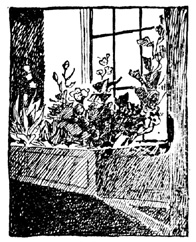
A window-box
The window-box in the room will be seen near at hand, so may be more or less ornamental in character. The sides may be covered with ornamental tile held in place by moulding; or a light lattice-work of wood surrounding the box is pretty. But a neatly made and strong box of about the dimensions mentioned on page 242, with a strip of moulding at the top and bottom, answers just as well; and if painted green, or some neutral shade, only the plants will be seen or thought of. Brackets, jardinieres and stands may be purchased of any of the larger florists.
The window-box may consist of merely the wooden box; but a preferable arrangement is to make it about eight inches deep instead of six, then have the tinsmith make a zinc tray to fit the box. This is provided with a false wooden bottom, with cracks for drainage, two inches above the real bottom of the tray. The plants will then have a vacant space below them into which drainage water may pass. Such a box may be thoroughly watered as the plants require without danger of the water running on the carpet. Of course, a faucet should be provided at some suitable point on a level with the bottom of the tray, to permit of its being drained every day or so if the water tends to accumulate. It would not do to allow the water to remain long; especially should it never rise to the false bottom, as then the soil would be kept too wet.
Some persons attach the box to the window, or support it on brackets attached below the window-sill; but a preferable arrangement is to support the box on a low and light stand of suitable height provided with rollers. It may then be drawn back from the window, turned around from time to time to give the plants light on all sides, or turned with the handsome side in as may be desired, and so on.
Often the plants are set directly in the soil; but if they are kept in pots they may be rearranged, changed about to give those which need it more light, etc. Larger plants which are to stand on shelves or brackets may be in porous earthenware pots; but the smaller ones which are to fill the window-box may be placed in heavy paper pots. The sides of these are flexible, and the plants in them therefore may be crowded close together with great economy in space. When pots are spaced, damp sphagnum or other moss among them will hold them in place, keep the soil from drying out too rapidly, and at the same time give off moisture, so grateful to the foliage.
In addition to the stand, or box, a bracket for one or more pots on either side of the window, about one-third or half way up, will be desirable. The bracket should turn on a basal hinge or pivot, to admit of swinging it forward or backward. These bracket plants usually suffer for moisture, and are rather difficult to manage.
Florists now usually grow plants suitable for Window-Gardens and winter flowering, and any intelligent florist, if asked, will take pleasure in making out a suitable collection. The plants should be ordered early in the fall; the florist will then not be so crowded for time and can give the matter better attention.
Most of the plants suitable for the winter Window-Garden belong to the groups which florists grow in their medium and cool houses. The former are given a night temperature of about 60°, the latter about 50°. In each case the temperature is 10 to 15° higher for the daytime. Five degrees of variation below these temperatures will be allowable without any injurious effects; even more may be borne, but not without more or less check to the plants. In bright, sunny weather the day temperature may be higher than in cloudy and dark weather.
PLANTS FOR AN AVERAGE NIGHT TEMPERATURE OF 60°
Upright flowering plants.—Abutilons, browallias, calceolaria “Lincoln Park,” begonias, bouvardias, euphorbias, scarlet sage, richardia or calla, heliotropes, fuchsias, Chinese hibiscus, jasmines, single petunias, swainsona, billbergia, freesias, geraniums, cupheas.
Upright foliage plants.—Muehlenbeckia, Cycas revoluta, Dracæna fragrans and others, palms, cannas, Farfugium grande, achyranthes, ferns, araucaria, epiphyllums, pandanus or “screw pine,” Pilea arborea, Ficus elastica, Grevillea robusta.
Climbing plants.—Asparagus tenuissimus, A. plumosus, Cobæa scandens, smilax, Japanese hop, Madeira vine (Boussingaultia), Senecio mikanioides and S. macroglossus (parlor ivies). See also list below.
Low-growing, trailing, or drooping plants.—These may be used for baskets and edgings. Flowering kinds are: Sweet alyssum, lobelia, Fuchsia procumbens, mesembryanthemum, Oxalis pendula, O. floribunda and others, Russelia juncea, Mahernia odorata or honey-bell.
Foliage plants of drooping habit.—Vincas, Saxifraga sarmentosa, Kenilworth ivy, tradescantia or Wandering Jew, *Festuca glauca, othonna, *Isolepsis gracilis, English ivy, Selaginella denticulata and others. Some of these plants flower quite freely, but the flowers are small and of secondary consideration. Those with an asterisk (*) droop but slightly.
PLANTS FOR AN AVERAGE NIGHT TEMPERATURE OF 50°
Upright flowering plants.—Azaleas, cyclamens, carnations, chrysanthemums, geraniums, Chinese primroses, stevia, marguerite or Paris daisy, single petunias, Anthemis coronaria, camellias, ardisia (berries), cineraria, violets, hyacinths, narcissus, tulips, the Easter lily when in bloom, and others.
Upright foliage plants.—Pittosporum, palms, aucuba, euonymus (golden and silvery variegated), araucaria, pandanus, dusty miller.
Climbing plants.—English ivy, maurandia, senecio or parlor ivy, lygodium (climbing fern).
Drooping or trailing plants.—Flowering kinds are: Sweet alyssum, Mahernia odorata, Russelia and ivy geranium.
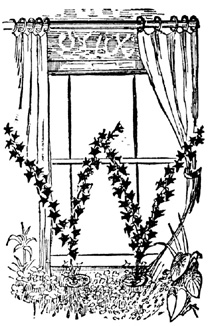
Window-garden
Bulbs in the Window-Garden.—The single Roman hyacinth is an excellent house plant. Its flowers are small, but they are graceful and especially well suited for cutting. The bulbs are easily forced, and are managed like other hyacinths. The secret of forcing the Dutch bulbs and most others is to pot them and then, after watering the pots, set them away in a cool, dark place until the pot is filled with roots. They may be placed in the cellar “to root up,” or be buried 3 or 4 inches deep in the soil. It is well to delay potting them until such time as they can be kept cool while forming their roots. A temperature of about 40° to 45° suits them during this period. In most cases it is well to select pots 5 or 6 inches in diameter and place from three to six bulbs in a pot, according to the size of the bulbs and the plants. The pot having been filled with soil, it is only necessary to press them down till the tip, or about one-fourth, shows above the soil. After this a slight jarring or sharp rap will settle the soil. They are then watered and set away, as before mentioned. If kept dark and cool they will need no more watering until they are brought out and begin to grow, when they may be watered freely.
Hyacinths, tulips and narcissus all require about the same treatment. When well rooted, which will be in six or eight weeks, they are brought out and given a temperature of some 55° to 60° till the flowers appear, when they should be kept in a cooler temperature, say 50°.
The Easter lily is managed the same way, only, to hasten its flowers, it should be kept at not lower than 60° at night. Warmer will be better. Lilies may be covered an inch or more deep.
Freesias may be potted six or more in a pot of mellow soil, and then started into growth at once. At first they might be given a night temperature of 50°, and 55° to 60° when they have begun to grow.
Bulbs like the snowdrop and crocus are planted several or a dozen in a pot and buried, or treated like hyacinths; but they are very sensitive to heat, and require only to be given the light when they have started to grow, without any forcing. Forty to 45° will be as warm as they ever need be kept. See the article on Bulbs; also, the advice given for the various plants under their respective names.
Pests.—Window-Garden pests are discussed under Insects.
Winter-killing is induced by a late fall growth, and also by a dry, unprotected soil. All tender woody plants should be well ripened before cold weather comes: cease tillage early: do not apply stimulating manures late in the season. Mulch all tender or half hardy plants (see Mulch). Even hardy plants are benefited by a mulch. When possible, it is better to bend plants to the ground and cover them than to wrap them up as they stand; but this cannot be done with tall or stiff subjects. Wrapping in straw or burlaps affords excellent protection, but it is possible to wrap too heavily. A barrel, less the heads, may be set over small plants and then filled with leaves or other loose litter; or a cylinder of wire chicken-screen may be substituted for the barrel. Remove the protection in the spring before the buds start. See that mice do not nest in the barrel or in the mulch.
Zinnia. Showy hardy annuals. The old formal type of Zinnias has given place to a race of freer forms which are excellent plants either for color effect or for cutting. The colors have been varied and brightened, the flowers doubled and the plants dwarfed. Seed should be sown in a hotbed or house in March, transplanted once at least before planting out, and set in well enriched soil. Or, the seed may be sown where the plants are to grow. The tall varieties (3 feet) should stand 18 to 24 inches apart. These are best for masses at a distance.
The Best and Newest Rural Books
BOOKS ON LEADING TOPICS CONNECTED WITH AGRICULTURAL AND RURAL LIFE ARE HERE MENTIONED. EACH BOOK IS THE WORK OF A SPECIALIST, UNDER THE EDITORIAL SUPERVISION OF PROFESSOR L. H. BAILEY, OF THE CORNELL UNIVERSITY, OR BY PROFESSOR BAILEY HIMSELF, AND IS READABLE, CLEAR-CUT AND PRACTICAL.
THE RURAL SCIENCE SERIES
Includes books which state the underlying principles of agriculture in plain language. They are suitable for consultation alike by the amateur or professional tiller of the soil, the scientist or the student, and are freely illustrated and finely made.
The following volumes are now ready:
THE SOIL. By F. H. King, of the University of Wisconsin. 303 pp. 45 illustrations. 75 cents.
THE FERTILITY OF THE LAND. By I. P. Roberts, of Cornell University. Fifth edition. 421 pp. 45 illustrations. $1.25.
THE SPRAYING OF PLANTS. By E. G. Lodeman, late of Cornell University. 399 pp. 92 illustrations. $1.00.
MILK AND ITS PRODUCTS. By H. H. Wing, of Cornell University. Fifth edition. 311 pp. 43 illustrations. $1.00.
THE PRINCIPLES OF FRUIT-GROWING. By L. H. Bailey. Fourth edition. 516 pp. 120 illustrations. $1.25.
BUSH-FRUITS. By F. W. Card, of Rhode Island College of Agriculture and Mechanic Arts. Second edition. 537 pp. 113 illustrations. $1.50.
FERTILIZERS. By E. B. Voorhees, of New Jersey Experiment Station. Third edition. 332 pp. $1.00.
THE PRINCIPLES OF AGRICULTURE. By L. H. Bailey. Third edition. 300 pp. 92 illustrations. $1.25.
IRRIGATION AND DRAINAGE. By F. H. King, University of Wisconsin. 502 pp. 163 illustrations. $1.50.
THE FARMSTEAD. By I. P. Roberts. 350 pp. 138 illustrations. $1.25.
RURAL WEALTH AND WELFARE. By George T. Fairchild, Ex-President of the Agricultural College of Kansas. 381 pp. 14 charts. $1.25.
THE PRINCIPLES OF VEGETABLE-GARDENING. By L. H. Bailey 468 pp. 144 illustrations. $1.25.
THE FEEDING OF ANIMALS. By W. H. Jordan, of New York State Experiment Station. 450 pp. $1.25 net.
FARM POULTRY. By George C. Watson, of Pennsylvania State College. 341 pp. $1.25 net.
New volumes will be added from time to time to the Rural Science Series. The following are in preparation:
PHYSIOLOGY OF PLANTS. By J. C. Arthur, Purdue University.
THE PRINCIPLES OF STOCK BREEDING. By W. H. Brewer, of Yale University.
PLANT PATHOLOGY. By B. T. Galloway and associates, of U. S. Department of Agriculture.
CARE OF ANIMALS. By N. S. Mayo, of Connecticut Agricultural College.
THE POME FRUITS (Apples, Pears, Quinces). By L. H. Bailey.
THE FARMER’S BUSINESS HANDBOOK. By I. P. Roberts, of Cornell University.
THE GARDEN-CRAFT SERIES
Comprises practical hand-books for the horticulturist, explaining and illustrating in detail the various important methods which experience has demonstrated to be the most satisfactory. They may be called manuals of practice, and though all are prepared by Professor Bailey, of Cornell University, they include the opinions and methods of successful specialists in many lines, thus combining the results of the observations and experiences of numerous students in this and other lands. They are written in the clear, strong, concise English and in the entertaining style which characterize the author. The volumes are compact, uniform in style, clearly printed, and illustrated as the subject demands. They are of convenient shape for the pocket, and are substantially bound in flexible green cloth.
THE HORTICULTURIST’S RULE-BOOK. By L. H. Bailey. Fourth edition. 312 pp. 75 cts.
THE NURSERY-BOOK. By L. H. Bailey. Fifth edition. 365 pp. 152 illustrations. $1.00.
PLANT-BREEDING. By L. H. Bailey. 293 pp. 20 illustrations. $1.00.
THE FORCING-BOOK. By L. H. Bailey. 266 pp. 88 illustrations. $1.00.
GARDEN-MAKING. By L. H. Bailey. Fifth edition. 417 pp. 256 illustrations. $1.00.
THE PRUNING-BOOK. By L. H. Bailey. Fourth edition. 545 pp. 331 illustrations. $1.50.
THE PRACTICAL GARDEN-BOOK. By C. E. Hunn and L. H. Bailey. 250 pp. Many marginal cuts. $1.00.
WORKS BY PROFESSOR BAILEY
THE SURVIVAL OF THE UNLIKE: A Collection of Evolution Essays Suggested by the Study of Domestic Plants. By L. H. BAILEY, Professor of Horticulture in the Cornell University.
FOURTH EDITION—515 PAGES—22 ILLUSTRATIONS—$2.00
To those interested in the underlying philosophy of plant life, this volume, written in a most entertaining style, and fully illustrated, will prove welcome. It treats of the modification of plants under cultivation upon the evolution theory, and its attitude on this interesting subject is characterized by the author’s well-known originality and independence of thought. Incidentally, there is stated much that will be valuable and suggestive to the working horticulturist, as well as to the man or woman impelled by a love of nature to horticultural pursuits. It may well be called, indeed, a philosophy of horticulture, in which all interested may find inspiration and instruction.
The Survival of the Unlike comprises thirty essays touching upon The General Fact and Philosophy of Evolution (The Plant Individual, Experimental Evolution, Coxey’s Army and the Russian Thistle, Recent Progress, etc.); Expounding the Fact and Causes of Variation (The Supposed Correlations of Quality in Fruits, Natural History of Synonyms, Reflective Impressions, Relation of Seed-bearing to Cultivation, Variation after Birth, Relation between American and Eastern Asian Fruits, Horticultural Geography, Problems of Climate and Plants, American Fruits, Acclimatization, Sex in Fruits, Novelties, Promising Varieties, etc.); and Tracing the Evolution of Particular Types of Plants (the Cultivated Strawberry, Battle of the Plums, Grapes, Progress of the Carnation, Petunia, The Garden Tomato, etc.).
THE EVOLUTION OF OUR NATIVE FRUITS. By L. H. BAILEY, Professor of Horticulture in the Cornell University.
472 PAGES—125 ILLUSTRATIONS—$2.00
In this entertaining volume, the origin and development of the fruits peculiar to North America are inquired into, and the personality of those horticultural pioneers whose almost forgotten labors have given us our most valuable fruits is touched upon. There has been careful research into the history of the various fruits, including inspection of the records of the great European botanists who have given attention to American economic botany. The conclusions reached, the information presented, and the suggestions as to future developments, cannot but be valuable to any thoughtful fruit-grower, while the terse style of the author is at its best in his treatment of the subject.
The Evolution of our Native Fruits discusses The Rise of the American Grape (North America a Natural Vineland, Attempts to Cultivate the European Grape, The Experiments of the Dufours, The Branch of Promise, John Adlum and the Catawba, Rise of Commercial Viticulture, Why Did the Early Vine Experiments Fail? Synopsis of the American Grapes); The Strange History of the Mulberries (The Early Silk Industry, The “Multicaulis Craze,”); Evolution of American Plums and Cherries (Native Plums in General, The Chickasaw, Hortulana, Marianna and Beach Plum Groups, Pacific Coast Plum, Various Other Types of Plums, Native Cherries, Dwarf Cherry Group); Native Apples (Indigenous Species, Amelioration has begun); Origin of American Raspberry-growing (Early American History, Present Types, Outlying Types); Evolution of Blackberry and Dewberry Culture (The High-bush Blackberry and Its Kin, The Dewberries, Botanical Names); Various Types of Berry-like Fruits (The Gooseberry, Native Currants, Juneberry, Buffalo Berry, Elderberry, High-bush Cranberry, Cranberry, Strawberry); Various Types of Tree Fruits (Persimmon, Custard-Apple Tribe, Thorn-Apples, Nut-Fruits); General Remarks on the Improvement of our Native Fruits (What Has Been Done, What Probably Should Be Done).
LESSONS WITH PLANTS: Suggestions for Seeing and Interpreting Some of the Common Forms of Vegetation. By L. H. BAILEY, Professor of Horticulture in the Cornell University, with delineations from nature by W. S. HOLDSWORTH, of the Agricultural College of Michigan.
SECOND EDITION—491 PAGES—446 ILLUSTRATIONS—12 MO—CLOTH—$1.10 NET
There are two ways of looking at nature. The old way, which you have found so unsatisfactory, was to classify everything—to consider leaves, roots, and whole plants as formal herbarium specimens, forgetting that each had its own story of growth and development, struggle and success, to tell. Nothing stifles a natural love for plants more effectually than that old way.
The new way is to watch the life of every growing thing, to look upon each plant as a living creature, whose life is a story as fascinating as the story of any favorite hero. “Lessons with Plants” is a book of stories, or rather, a book of plays, for we can see each chapter acted out if we take the trouble to look at the actors.
“I have spent some time in most delightful examination of it, and the longer I look, the better I like it. I find it not only full of interest, but eminently suggestive. I know of no book which begins to do so much to open the eyes of the student—whether pupil or teacher—to the wealth of meaning contained in simple plant forms. Above all else, it seems to be full of suggestions that help one to learn the language of plants, so they may talk to him.”—Darwin L. Bardwell, Superintendent of Schools, Binghamton.
“It is an admirable book, and cannot fail both to awaken interest in the subject, and to serve as a helpful and reliable guide to young students of plant life. It will, I think, fill an important place in secondary schools, and comes at an opportune time, when helps of this kind are needed and eagerly sought.”—Professor V. M. Spalding, University of Michigan.
FIRST LESSONS WITH PLANTS
An Abridgement of the above. 117 pages—116 illustrations—40 cents net.
BOTANY: An Elementary Text for Schools. By L. H. BAILEY.
355 PAGES—500 ILLUSTRATIONS—$1.10 NET
“This book is made for the pupil: ‘Lessons With Plants’ was made to supplement the work of the teacher.” This is the opening sentence of the preface, showing that the book is a companion to “Lessons With Plants,” which has now become a standard teacher’s book. The present book is the handsomest elementary botanical text-book yet made. The illustrations illustrate. They are artistic. The old formal and unnatural Botany is being rapidly outgrown. The book disparages mere laboratory work of the old kind: the pupil is taught to see things as they grow and behave. The pupil who goes through this book will understand the meaning of the plants which he sees day by day. It is a revolt from the dry-as-dust teaching of botany. It cares little for science for science’s sake, but its point of view is nature-study in its best sense. The book is divided into four parts, any or all of which may be used in the school: the plant itself; the plant in its environment; histology, or the minute structure of plants; the kinds of plants (with a key, and descriptions of 300 common species). The introduction contains advice to teachers. The book is brand new from start to finish.
“An exceedingly attractive text-book.”—Educational Review.
“It is a school book of the modern methods.”—The Dial.
“It would be hard to find a better manual for schools or for individual use.”—The Outlook.

THE MACMILLAN COMPANY No. 66 Fifth Avenue New York
THE CYCLOPEDIA OF AMERICAN HORTICULTURE: By L. H. BAILEY, of Cornell University, assisted by WILHELM MILLER, and many expert cultivators and botanists.
4 VOLS.—OVER 2800 ORIGINAL ENGRAVINGS—CLOTH—OCTAVO $20.00 NET PER SET. HALF MOROCCO, $32.00 NET PER SET
This great work comprises directions for the cultivation of horticultural crops and original descriptions of all the species of fruits, vegetables, flowers and ornamental plants known to be in the market in the United States and Canada. “It has the unique distinction of presenting for the first time, in a carefully arranged and perfectly accessible form, the best knowledge of the best specialists in America upon gardening, fruit-growing, vegetable culture, forestry, and the like, as well as exact botanical information.... The contributors are eminent cultivators or specialists, and the arrangement is very systematic, clear and convenient for ready reference.”
“We have here a work which every ambitions gardener will wish to place on his shelf beside his Nicholson and his Loudon, and for such users of it a too advanced nomenclature would have been confusing to the last degree. With the safe names here given, there is little liability to serious perplexity. There is a growing impatience with much of the controversy concerning revision of names of organisms, whether of plants or animals. Those investigators who are busied with the ecological aspects of organisms, and also those who are chiefly concerned with the application of plants to the arts of agriculture, horticulture, and so on, care for the names of organisms under examination only so far as these aid in recognition and identification. To introduce unnecessary confusion is a serious blunder. Professor Bailey has avoided the risk of confusion. In short, in range, treatment and editing, the Cyclopedia appears to be emphatically useful; ... a work worthy of ranking by the side of the Century Dictionary.”—The Nation.
This work is sold only by subscription, and terms and further information may be had of the publishers.
THE MACMILLAN COMPANY No. 66 Fifth AvenueNEW YORK