ON THE PLEISTOCENE GEOLOGY OF NORTH AMERICA AND ITS RELATION TO ITS FOSSIL VERTEBRATES. (continued 4)
Reading edition
Procamelus major (p. 224).
P. minor (p. 224).
P. minimus (p. 224).
Teleoceras proterus (p. 211).
Aphelops longipes (p. 211).
Tapirus haysii? (p. 207).
Hipparion ingenuum (p. 195).
Megatherium mirabile (p. 37).
Alligator (or Crocodylus) sp. indet.
The following vertebrates have been collected east of Williston, in the place mentioned in Dall’s report of 1892, on page 129, as Mixon’s:
Gomphotherium floridanum (p. 121).
Procamelus major (p. 224).
Teleoceras proterus (p. 211).
Hipparion ingenuum (p. 196).
Hipparion plicatile (p. 196).
Thinobadistes segnis (p. 37).
Manatus antiquus?.
Pseudemys cælata.
Atractosteus lapidosus.
376The list from the locality east of Newberry (Hallowell’s place of Dall’s report) is rather short. Equus littoralis, Odocoileus osceola?, Hipparion sp. indet., and Parahippus sp. indet. have been reported (Rep. Florida Geol. Surv., vol. V, p. 58; vol. VIII, pp. 42, 94). At Neals, Alachua County. Tapirus terrestris?, Gomphotherium floridanum, and Hipparion sp. indet. have been collected (Sellards as cited). At Juliette, same county, Gomphotherium floridanum has been secured, and at Hernando the same species; also Hipparion sp. indet. and Procamelus sp. indet. (Sellards Florida Geol. Surv., vol. V, p. 58). Along Santa Fe River, in the Buttgenbach mines, 6 miles north of Wade, have been found teeth of Equus and a tooth of Bison.
At Dunnellon, about 25 miles south of Williston, from the phosphate mines along the Withlacoochee River, have been obtained fossil vertebrates so similar to those found in the Alachua clays that Sellards concluded to unite his Dunnellon formation and the Alachua clays into one to be called the Alachua formation (6th Ann. Rep. Florida Geol. Surv., p. 161). The list of vertebrates found at and about Dunnellon is as follows, including the species dredged in Withlacoochee River:
Megalonyx sp. indet. (p. 38).
Chlamytherium septentrionale (p. 138).
Ursus sp. indet.
Felis sp. indet.
*Gomphotherium floridanum (p. 122).
Mammut americanum (p. 122).
Elephas imperator (p. 162).
Trichechus manatus.
*Parahippus sp. indet. (p. 196).
*Hipparion plicatile (p. 196).
Equus leidyi (p. 196).
Tapirus sp. indet. (p. 207).
*Aphelops longipes (p. 211).
*Procamelus minor (p. 225).
Odocoileus osceola (p. 233).
Bison sp. indet. (p. 263).
The species marked by an asterisk are regarded by Doctor Sellards and others as belonging to the Miocene or Pliocene (8th Ann. Rep. Florida Geol. Surv., p. 94). See also Sellards, 1913 (5th Ann. Rep. Florida Geol. Surv., p. 58; 8th Rep., p. 104).
On the basis of the fossil vertebrates it can hardly be denied that the Alachua clays and the phosphate mines at Dunnellon are of the same geological age. According to Sellards, the formation belongs to the upper Miocene or to the lower Pliocene. Merriam (Bull. Dept. Geol. Univ. Cal., vol. X, p. 439) refers it to the Pliocene. Although there is present a strong palæontological element which represents the Pleistocene, the reference of the formation to the late Miocene or early Pliocene has seemed to be required by the presence of Gomphotherium, Procamelus, Teleoceras, and Hipparion. The Pleistocene species are usually accounted for on the supposition that they are intrusions from more recent deposits.
A figure from Sellards (Geol. Surv. Florida, vol. VII, p. 53), only slightly modified is intended to show the relation of the phosphate-bearing formations to those underlying them (fig. 21).
It is worth our while to consider whether or not the reference of the Alachua formation to the Miocene or early Pliocene is required by palæontological evidence. Gomphotherium is characterized by having molar teeth which on abrasion at one or both ends of each crest, present a trefoil pattern of the enamel; also by having a band of enamel on each of the upper tusks. Now, teeth having the same structure are not uncommon 377in deposits of undoubted Pleistocene age in Kansas and Texas. That the animals possessing these teeth had tusks with enamel bands is not known, but it is quite possible that such enamel bands were present.

Fig. 21.—Diagrammatic sketch of geologic structure of Florida from north to south passing through the hard rock and pebble phosphate fields, showing relation of the phosphate deposits to the underlying formations. After Sellards.
1.
Georgia-Florida State line.
2.
Suwannee River.
3.
Lake City.
4.
Santa Fe River.
5.
Withlacoochee River.
6.
Lakeland.
7.
Arcadia.
8.
Caloosahatchee River.
9.
Gulf Coast.
a
Upper Oligocene phosphatic marls.
b
Ocala limestone.
c
Hard rock phosphate.
d
Bone Valley formation.
e
Pleistocene deposits (Pliocene and Pleistocene of Sellards).
The genus Hipparion is not confined to the Tertiary. Teeth have been discovered in the Aftonian of Iowa (Hay, Geol. Surv. Iowa, vol. XXIII, p. 150) and in Missouri (op. cit., p. 149). The writer has described a species of the genus, Hipparion cragini, collected by Professor Cragin in the Sheridan beds in Kansas (Kansas Univ. Sci. Bull., vol. X, p. 42).
One may be justified in suspecting that Procamelus lived on into the Pleistocene. Not only has it been found associated with Pleistocene fossils in five places in Florida—Archer, Williston, Dunnellon, Hernando, and Ocala—but it has been met with in possible Pleistocene deposits (the Idaho formation) in Idaho, which furnishes Equus, Cervus, Castor, and Stegomastodon mirificus (the type of which belongs in the Sheridan beds). Furthermore, the writer has had occasion to describe a collection of fossils, believed to belong to the early Pleistocene, which was obtained at Anita, Coconino County, Arizona. Among these fossils are two species of Procamelus much like those described by Leidy from the Alachua formation (Proc. U. S. Nat. Mus., vol. LIX, pp. 622–626). The writer believes that the genus Procamelus persisted into the early Pleistocene.
Two species of rhinoceros have been collected in the Alachuan formation, Teleoceras proterus Leidy and Aphelops longipes Leidy. Both occurred at Archer, while T. proterus was found near Williston and A. longipes at Dunnellon. A rhinoceros has been discovered in the Idaho formation, with the Pleistocene species named above in connection with Procamelus of these beds. In Oregon Cope made a collection which has been examined by Dr. W. D. Matthew (Bull. Amer. Mus. Nat. Hist., vol. XVI, p. 321). Here again Teleoceras was supposed to have been found with Hipparion, camels belonging to Camelops (or Procamelus), Elephas, and Equus. Matthew thought that there had happened, either before the fossils were collected or afterwards, a mingling of elements of two distinct faunas.
378To the writer it seems improbable that the commingling of Procamelus and the rhinoceroses with Pleistocene forms should occur thus accidentally so often and at such widely removed localities. It appears more probable that these Tertiary genera did not become extinct so early as has been supposed and that the association was not a secondary one. The association is what might be expected in collections made in deposits of the earliest Pleistocene.
It must not be forgotten in these discussions that the Pleistocene genera and species with which the collections in question are being compared are those of the so-called Equus beds, which appear to represent the fauna of the first interglacial stage. This, however, was preceded by the Nebraskan, the first glacial, which probably occupied a long period of time; possibly it was half as long as all the rest of the Pleistocene (Chamberlin and Salisbury, Geology, vol. III, p. 383). About the vertebrate life of this long stage we know as yet very little. The writer is quite convinced that the Idaho formation and the Alachua, or Bone Valley, belong to the earliest Pleistocene.
Marion County.—In a fissure in the limestone-rock quarry at Ocala there has been found an important collection of vertebrates. The following list is thought to include all that have been reported:
Trucifelis floridana.
Sylvilagus sp. indet.
Elephas columbi (p. 158).
Bison sp. indet.
Odocoileus sp. indet. (p. 233).
Procamelus minimus (p. 224).
Tapirus sp. indet. (p. 207).
Equus leidyi (p. 196).
Dasypus sp. indet. (p. 38).
Terrapene formosa.
Testudo distans.
T. incisa.
T. ocalana.
A part of this list was published by Sellards in 1916 (8th Ann. Rep. Florida Geol. Surv., p. 103). The tortoises were described in the same volume.
Inasmuch as Trucifelis floridana has been found in the Pleistocene at Vero, Florida, one may safely regard the specimen found at Ocala as also of Pleistocene age. All of the other mammals are admitted to be of Pleistocene age except Procamelus minimus. The fissure may have been open during some part of the Nebraskan stage.
Volusia County.—At Daytona, situated on the east coast, therefore on the youngest terrace, remains of Mammut americanum (p. 122) have been found. At DeLand there has been recovered the skull of a dolphin which Sellards (8th Ann. Rep. Florida Geol. Surv., p. 107, plate XIV) has described as Globicephalus bœreckii (p. 20). It was found at a depth of 10 feet, in sands which overlie Pliocene shell marls. The sands are regarded as belonging probably to the Pleistocene. DeLand is on the Tsala Apopka terrace. At a depth of 10 feet there was reached the supposed marine base of this terrace.
Orange County.—As stated on page 196, a tooth of an extinct horse was found somewhere in the county.
Pinellas County.—On the western shore of Tampa Bay (p. 159), near St. Petersburg, at Indian Rock, a tooth of Elephas columbi was found.
379Hillsboro and Manatee Counties.—The region around Tampa Bay is important because of the wealth of vertebrate fossils dredged up by the collectors of phosphate rock from the beds of Hillsboro, Alafia, and Manatee Rivers. Unfortunately, few accurate records have been kept of localities and conditions of occurrence of the fossils, and we usually know only that a collection was made in a certain river, perhaps not so much as that. For that reason it is concluded to group together all the fossils regarded as Pleistocene and known to have been found in Hillsboro, Manatee, and Sarasota Counties. In order to indicate as far as possible the localities, the names of the species are followed by contractions which apply as follows.
A, Alafia River.
E, Ellenton, on Manatee River.
Hc, Hillsboro County.
Hr, Hillsboro River.
Ls, Little Sarasota Bay.
Ps, Palma Sola.
M, town of Manatee.
P, Palmetto.
S, 8 miles southeast of Sarasota.
T, around Tampa Bay.
Wb, White Beach, on Sarasota Bay.
List of Pleistocene vertebrates found in Hillsboro, Manatee, and Sarasota Counties.
Homo sapiens, Ps.
Elephas imperator, P (p. 164).
E. columbi, T, S, Ps (p. 159).
E. primigenius, Ps (p. 145).
Mammut americanum, T, He, A (p. 123).
Bison latifrons, Ps (p. 263).
B. sp. indet., T, A, P, Ps (p. 263).
Odocoileus sp. indet., P, Ps (p. 233).
Tapirus sp. indet., T, A (p. 208).
Tagassu lenis?, Ps (p. 222).
Equus complicatus, A, Wb, Ps (pp. 196, 197).
E. leidyi, A. P, Wb, Ps, S (pp. 196, 197).
E. littoralis, M, Ps (p. 197).
Chlamytherium septentrionale, Hr, Wb, S (p. 38).
Testudo crassiscutata?, A.
T. ocalana, He.
Terrapene putnami, A.
Deirochelys floridana, He.
Trachemys euglypha, E.
T. jarmani, Hc.
T. sculpta, Hc.
Pseudemys extincta, Hc.
P. cælata, Ps.
Platypeltis ferox, Hc.
The bones of man belonged to the skull and are as completely fossilized as the bones of a horse and are wholly free from organic matter.
Among the mammals of this list there are no genera and few species that have not been found in the Pleistocene at many places in the United States. The presence of Elephas imperator and three species of Equus and Chlamytherium apparently indicate Pleistocene of about Aftonian times.
From Palma Sola, Manatee County, there have been sent to the U. S. National Museum by Mr. Charles T. Earle many specimens of fossil vertebrates, found at various times washed up on the beach. Some belonged evidently to deposits older than the Pleistocene, probably to Miocene, and included teeth of sharks, a beak of a platanistid porpoise, and a lower tooth of a sirenian, Metaxytherium floridanum. Other specimens, as bones of a camel, parts of the shells of tortoises, alligator or crocodile teeth and bones are of uncertain age. Ten species of the list are referred to the Pleistocene. All of the teeth are isolated, but many are well preserved and little water-worn. The bones are mostly fragmentary, some worn, some not.
Polk County.—On page 159 is an account of a tooth of an elephant. Elephas columbi, reported as being found at Kingsford, Polk County, under 38019 feet of phosphate rock and sand. It may belong to E. imperator. On page 196 is detailed the finding of several teeth of Equus in the phosphate mines of Kingsford. The species E. leidyi and E. littoralis are recognized. Unless these elephant and horse-teeth had been incorrectly reported or had been secondarily introduced into the phosphate beds, they are, in the writer’s opinion, to be referred to the first glacial stage, the Nebraskan. Dr. W. H. Dall has somewhere reported the finding of tusks at Bartow; these were supposed to have belonged to Elephas columbi (p. 180). At Nichols the large land-tortoise Testudo hayi Sellards has been recovered from a phosphate mine. From phosphate mines at Brewster has been secured the following list of vertebrates, obtained from Dr. Sellards’s reports (Florida Geol. Surv., vol. VII, pp. 100, 106, 108; vol. VIII, pp. 95, 96, 98, 100).
Gomphotherium floridanum? (p. 123).
Mammut progenium (p. 123).
Hipparion minor (p. 197).
Procamelus minor?
Teleoceras or Aphelops sp. indet. (p. 211).
Agriotherium schneideri.
Tomistoma americanum.
All of this list are referred by Sellards to the upper Miocene or lower Pliocene. The writer regards them as belonging to the first stage of the Pleistocene.
From a phosphate pit at Christina, Sellards (Florida Geol. Surv., vol. VII, p. 106, fig. 35) has reported a tooth of an undetermined species of Gomphotherium.
Sellards (Florida Geol. Surv., vol. VII, pp. 72, 110) has reported the collection of remains of Hipparion sp. indet. and of Teleoceras proterus (p. 211) from phosphate mines at Mulberry. In the U. S. National Museum are undetermined remains of Gomphotherium from the same place, sent in by Matson.
Brevard County.—In the Hopkins drainage canal at Eau Gallie have been found remains of Equus complicates (p. 196) and Elephas columbi (p. 159).
Zolfo, Hardee County.—At Zolfo, near the border of the Bone Valley area, have been found Megatherium (p. 38) and Elephas columbi (p. 160).
De Soto County.—With one exception, apparently, fossil vertebrates have been discovered in De Soto County only in deposits along Peace Creek. The exception is a place called Tourner’s or Turner’s, on Caloosahatchee River. The elephant found there will be considered among the fossils found in Lee County. At Calvenia, at the entrance of Charlie Apopkee Creek into Peace Creek, Equus leidyi (p. 198) has been secured.
Most of the fossils found below Calvenia are accredited to Arcadia. According to Leidy (Trans. Wagner Inst., vol. II, p. 19), those of his list were found on a sand-bar at Arcadia; but certainly others have been taken from phosphate rock dredged both above and below the town. As complete and as accurate a list as the writer has been able to prepare is here presented.
Peace Creek, or Peace River, has been the source of many fossil vertebrates, the greater part of them obtained at or near Arcadia. Most of the species were described by Joseph Leidy in 1889 (Trans. Wagner Free Inst., vol. II, pp. 19–31). The region was examined by Dr. W. H. Dall, 381whose report was published in 1892 (Bull. 84, U. S. Geol. Surv., pp. 128–133). He referred the bed bearing vertebrate fossils to the Pliocene. Cope (in Dall’s report, p. 130) regarded them as equivalent to the Equus beds of the Great Plains, or between these and the Loup Fork. Sellards (Florida Geol. Surv., vol. VII, pp. 78–83) places the formation in the Pleistocene.
List of fossil vertebrates found in Peace Creek at or near Arcadia.
Elephas imperator (p. 164).
E. columbi (p. 160).
Mammut americanum (p. 124).
Bison sp. indet. (p. 264).
Odocoileus osceola? (p. 233).
Tapirus terrestris (p. 208).
Equus leidyi (p. 199).
E. littoralis (p. 199).
Hipparion ingenuum (p. 199).
Delphinid sp. indet.
Trichechus antiquus.
Glyptodon petaliferus (p. 39).
Glyptodon rivipacis (p. 40).
Chlamytherium septentrionale (p. 40).
Megalonyx jeffersonii (p. 39).
Alligator mississippiensis?.
Testudo crassiscutata.
T. obtusa.
Trachemys euglypha.
Macrochelys floridana.
Chætodipterus faber.
Diodon sp. indet.
Myliobatis sp. indet.
Galeocerdo sp. indet.
Isurus sp. indet.
Of all the genera and species of mammals and reptiles appearing in the list, there is none that it is necessary to suppose was derived from Pliocene deposits, or even from those of a Pleistocene stage earlier than the first interglacial. The marine fishes and sharks have been derived possibly from the Arcadia marls. On the other hand, the presence of Elephas imperator, the species of Equus, Hipparion, Glyptodon, Chlamytherium, and the gigantic tortoise Testudo crassiscutata furnishes evidence that the age was about that of the Equus, or Aftonian, beds of the Great Plains.
St. Lucie County.—At Fellsmere, a place near the northern border of the county and about 10 miles west of Indian River, teeth of both Elephas columbi (p. 159) and Mammut americanum (p. 122) have been found, in the construction of drainage canals.
The most important locality for Pleistocene fossils in St. Lucie County, one may say in the whole State, is Vero. The topographical, geological, and palæontological conditions found here are described in the Eighth and Ninth Annual Reports of the Florida Geological Survey. Papers on the subject may be found also in the Journal of Geology for January 1917 and for October 1917; also in the American Anthropologist for the first and second quarters of 1918. Besides the large number of species of vertebrates found here, the interest is heightened by the fact that, associated with these, are human bones and objects of human manufacture. Through the valley of an insignificant stream was dug a large drainage canal, the construction of which brought to light vertebrate bones and teeth. Three beds of Pleistocene materials were exposed. At the bottom is found a bed of marl filled with marine mollusks and which is the geological equivalent of the coquina rock at St. Augustine. The same deposit is found in various places along the coast and has received from Dr. Sellards the name Anastasia formation. Above this lies a stratum composed mostly of sand, but containing also some muck. In the discussion of the locality this bed is designated as No. 2, the marl being No. 1. No. 2 has a thickness of 382about 2 feet. It in turn is overlain by No. 3, which consists mostly of vegetable matter and sand. It is called also the muck-bed. In places the muck is replaced by a bed of marl, which here and there may become pretty firmly consolidated. The thickness of No. 3 is about 2 or 3 feet. Vertebrate fossils are found in both No. 2 and No. 3. It is the purpose of the author first to present lists of the fossils which have been found in each of the upper beds, beginning with the stream of sand, No. 2.
List of fossil vertebrates found at Vero in stratum No. 2.
Trucifelis floridanus.
Felis veronis.
Ænocyon ayersi.
Vulpes palmaria.
Lutra canadensis.
Procyon lotor.
Cryptotis floridana.
Blarina brevicauda peninsulæ.
Sylvilagus sp. indet.
Neofiber alleni.
Hydrochœrus robustus.
Sigmodon sp. indet.
Elephas columbi (p. 159).
Mammut americanum (p. 122).
Bison sp. indet. (p. 263).
Odocoileus osceola? (p. 233).
Camelops? sp. indet. (p. 235).
Tagassu lenis (p. 222).
Tapirus haysii? (p. 208).
T. veroensis (p. 208).
Equus complicatus (p. 199).
E. leidyi (p. 199).
E. littoralis (p. 199).
Dasypus sp. indet. (p. 38).
Chlamytherium septentrionale (p. 38).
Megalonyx jeffersonii (p. 38).
Mylodon harlani (p. 39).
Didelphis virginiana.
Jabiru weillsi.
Cathartes aura.
Querquedula floridana.
Herodias egretta.
Alligator mississippiensis.
Testudo sellardsi.
Terrapene innoxia.
Chelydra laticarinata.
List of fossil vertebrates found at Vero, in stratum No. 3.
Lynx ruffus floridanus.
Canis riviveronis.
Canis sp. indet.
Vulpes palmaria.
Lutra canadensis.
Ursus floridanus.
Procyon lotor.
Scalopus aquaticus australis.
Sylvilagus palustris.
Neofiber alleni.
Neotoma floridana.
Sigmodon hispidus.
Oryzomys palustris.
Elephas columbi (p. 159).
Mammut americanum (p. 122).
Odocoileus osceola? (p. 233).
O. sellardsiæ (p. 233).
Bison sp. indet. (p. 263).
Tagassu lenis (p. 222).
Tapirus haysii? (p. 208).
Equus littoralis? (p. 199).
E. leidyi? (p. 199).
Chlamytherium septentrionale (p. 38).
Dasypus sp. indet. (p. 38).
Didelphis virginiana.
Ardea sellardsi.
A. herodias.
Ardea? sp. indet.
Herodias egretta?
Aluco pratincola.
Cathartes aura septentrionalis.
Larus vero.
Larus? sp. indet.
Mycteria americana?
Alligator mississippiensis.
Crotalus adamanteus.
Farancia abacura.
Drymarchon corais couperi.
Gopherus polyphemus.
Terrapene antipex.
T. innoxia.
Pseudemys floridanus persimilis.
Trachemys? nuchocarinatus.
Chelydra sculpta.
Chelonia mydas.
Caretta caretta.
Siren lacertina.
Amphiuma means.
Caranx hippos.
Caranx sp. indet.
Amiatus calvus.
Lepisosteus platystomus.
Aëtobatis narinari.
383Besides those remains which are to be assigned with certainty to one or the other or both of the strata, there are a few others about whose place in the deposit there is uncertainty:
Testudo luciæ.
Gopherus præcedens.
Trachemys bisornata.
T. sculpta.
At a point about 3 miles west of Vero, a lower jaw of Elephas imperator (p. 163) was found in the bank of the drainage canal. It was embedded in a matrix of brown sand which rests upon the stratum of marine shell marl.
The list of mammals found in stratum No. 2 shows that there are 29 species and that 21 of these are extinct. This high proportion of species no longer existing is of itself enough to show that the deposit is an old one. Again, such species as Elephas imperator and camels occur in the glaciated region only in Aftonian beds, and outside of the glaciated region only in those which are quite certainly of approximately the same age.
In the list of species found in stratum No. 3 there are 25 mammals, of which 12 species are extinct. These form, therefore, 48 per cent of the whole, indicating apparently a more recent geological time, perhaps about the Sangamon stage. It is true that the geologists hold that there has been continuous deposition and that no interval elapsed between the laying down of No. 2 and No. 3. In a region so near to the level of the sea, where the streams are small and short and have little fall, deposition must have gone on with extreme slowness; hence there may have been no period when deposition ceased. Apparently, too, there was a time when the region was somewhat lower than at present and salt water came up the stream as far as the locality where the fossils are found. The presence of Chelonia mydas, Caretta caretta, the two species of Caranx and Aëtobatis narinari may thus be explained.
The fresh-water and terrestrial mollusks of stratum No. 2 were submitted to Dr. Paul Bartsch, of the U. S. National Museum, who has reported on them (Rep. Florida Geol. Surv., vol. VIII, p. 144). He lists 29 species, all living.
The marine mollusks found in the stratum called No. 1, and which the writer refers to the first glacial stage, have been studied by Mr. W. C. Mansfield, of the U. S. Geological Survey (Rep. Florida Geol. Surv., vol. IX, pp. 78–80). Seventy-four species are specifically determined, and of these 61 are identical with living forms. Three or four species are possibly extinct. There is no question that the deposit belongs to the Pleistocene.
Nearly all of the plants were found in the bed designated as No. 3, the upper or muck-bed. These were studied by Dr. Edward W. Berry, of the Maryland Geological Survey. His report, published in 1917 (Rep. Florida Geol. Surv., vol. IX, pp. 19–33), states his conclusion that the plants belong to the late Pleistocene, either the Peorian or the Late Wisconsin. It may be stated that Dr. Berry adopts the theory that the terraces supposed to be found along the Atlantic Coast were formed during stages of submergence beneath the sea, the lowest one late in Pleistocene time.
Lee County.—The whole of Lee County is occupied by Pleistocene deposits which form a part of the Pensacola terrace. Naturally the Pleistocene is overlain, generally, at least, by accumulations of Recent materials, 384and it may not always be easy to distinguish the one from the other. So far as the writer knows, all the vertebrate fossils discovered in this county have been collected along Caloosahatchee River above Fort Myers. The geology of this river has been described by Heilprin (Trans. Wagner Inst., vol. I), Dall (Bull. 84, U. S. Geol. Surv., pp. 142–145), Matson and Sanford (Water Supply Paper 319, pp. 134–138), Sellards (2d Ann. Rep. Florida Geol. Surv., p. 123, 6th Ann. Rep. Florida Geol. Surv., pp. 41–46). The Pleistocene is underlain by Pliocene marls and hard and soft limestones and consists of beds of muck, marl, and sand of little thickness. At Labelle it is said (Sellards, 2d Ann. Rep., p. 126) that there is a fossiliferous Pleistocene marl covered by 3 feet of sandy loam. The following seem to be the species which have been found in the Pleistocene in this region:
Elephas imperator (p. 163).
Equus leidyi (p. 199).
E. sp. indet. (p. 199).
Bison latifrons (p. 264).
Mylodon harlani (p. 40).
Testudo obtusa?.
Trachemys bisornata.
T. sculpta.
The presence of Elephas imperator is an indication that the deposits belong to the early part of the Pleistocene. None of the species appear to indicate an older stage than the Aftonian.
Dade County.—Sellards (8th Ann. Rep., p. 106) records that some fragmentary remains of a proboscidean had been found in Miami River, Dade County.
Palm Beach County.—On page 105 of the report just cited, Sellards stated that Elephas columbi (p. 160), Mammut americanum (p. 123), Equus complicatus (p. 200), and Bison sp. indet. (p. 264) had been found in the Palm Beach Canal, constructed to drain the Everglades.
At some unknown point in the Everglades, possibly in Lee County, there was found many years ago a tooth of an elephant which the writer believes belonged to Elephas imperator, already mentioned on page 163. It was formerly reported as E. columbi.
ALABAMA.
An account of the Quaternary formations of Alabama may be found in Eugene A. Smith’s “Report on the Geology of the Coastal Plain of Alabama.” This was published in 1894, and the part pertaining to the Pleistocene is found on pages 28 to 65. Along the coast Smith recognized the presence of a formation which he called the Biloxi. The upper part of this was regarded as belonging to the Recent, while the lower portion was thought to be the equivalent of Hilgard’s Port Hudson, those deposits numbered 1 to 4 in the section shown on page 387, under Geology of Mississippi. The thickness of the Port Hudson is given as about 100 feet. Borings revealed the presence of shells and lignitized wood.
Along the rivers which traverse the Coastal Plain are found three terraces. The first or lowest is that which is subject to annual overflow. The second terrace, “the second bottom,” occurs along most of even the smaller streams of the Coastal Plain. It may be as much as a mile wide. The height above low water may vary from 10 to 15 feet in the lower courses of the rivers to 60 feet farther up stream. Near water-level a 385blue clay is frequently found which contains stumps, roots, and other remains of vegetation, often well preserved. Smith concluded that this second terrace was the substantial equivalence in time to the Port Hudson.
Smith presents a geological section taken along Black Warrior River, in Hale County, 150 miles above Mobile. The section included about 50 feet. As caving went on, stumps and logs were frequently brought into view. Similar sections were found on Coosa River, above Montgomery, and on Alabama River, 50 miles above Mobile.
The third terrace is found at elevations of from 50 to 100 feet above the second. It is sometimes 3 miles or more in width.
In his paper on the Citronelle formation (Prof. Paper U. S. Geol. Surv., 98, pp. 167–208), Matson discusses briefly (pp. 189–190) the Pleistocene of the area studied by him. This extends from the western end of Florida to Mississippi River. Here he recognized four terraces, from the youngest to the oldest, the Pensacola, the Hammond, the Port Hickey, and the St. Elmo. The St. Elmo merges into the Natchez formation, which Matson, quoting Chamberlin and Salisbury, regarded as sub-Aftonian. The Port Hickey terrace is stated to take its name from a locality on the Mississippi River where the typical materials of the Port Hudson formation are exposed. The Port Hickey terrace may, as suggested by Matson, be of post-Iowan age. Naturally, these correlations require confirmation.
Berry has described fossil plants (Amer. Naturalist, vol. XLI, pp. 689–697; Amer. Jour. Sci., ser. 4, vol. XXIX, pp. 387–398) which were found along Chattahoochee River, not far below Columbus, Georgia; on Warrior River, up to 356 miles above Mobile. Pleistocene deposits must occur along all the larger streams still farther north, and these deposits will yield in time bones and teeth of vertebrated animals.
Notwithstanding the considerable area of Pleistocene deposits discovered in Alabama, the number of species of vertebrates met with is remarkably small. On page 40 is recorded the finding of Megalonyx jeffersonii somewhere about Tuscumbia. At Newbern, Hale County, have been found an incisor tooth of a horse (p. 200) and a molar of a bison (p. 264). At Bogue Chitto, Dallas County, have been collected Equus leidyi (p. 200), Mammut americanum, and Elephas imperator. The last species indicates that the deposits probably belong in the Aftonian. The writer knows of no other localities in the State where vertebrate fossils of the Pleistocene have been obtained.
MISSISSIPPI.
(Text-figure 22.)
The geological history of the lower part of the Mississippi Valley during Quaternary times appears to be particularly difficult to understand and at present is far from being unraveled. It is easy to see that such a region will offer great difficulties. Here debouches into the ocean a majestic river which drains not only the glaciated portions of the United States from western New York to northwestern Montana, but the larger part of the region south of this from the Blue Ridge to the Rocky Mountains, and brings down every year enormous quantities of sand and silt, 386which are dropped partly on its flood-plain, but mostly near its mouth. Through the ages during which this has been proceeding, this river has been ever changing its bed, sometimes eroding away one bank, sometimes the opposite one; so that its flood-plain is, in most places below the mouth of the Ohio, many miles wide, varying, according to Russell (“Rivers of North America,” 1898, p. 267) from 5 miles to 80 miles in width. During the Quaternary there have been also elevations and subsidences of the bed at least from Cairo northward, as a result of which at one epoch the current was hastened and the valley cut out deeper; at another the current was checked, the channel clogged up, and the river forced to seek a new channel or even new temporary or permanent outlets to the Gulf (E. A. Smith, Geol. Surv. Alabama, 1894, pp. 30–34).
To get a correct idea of the Pleistocene geology of the lower Mississippi region, one must understand the situation at the beginning of this epoch. I. C. Russell, on page 267 of his work just quoted, calls attention to the differences displayed by the valley of the river within the glaciated region and that south of it. South of the mouth of Ohio River the wide flood-plain of the Mississippi lies from 300 to 500 feet below the general level of the bordering uplands. He states further that the hard rock bottom of the valley is only imperfectly known, but that the records of wells and borings show that an ancient valley has been filled with alluvium to a depth of at least 100 or 200 feet in its northern part and to an increasing depth southward. If to this thickness, given by Russell, we add the depth, 300 to 500 feet, which the flood-plain occupies below the bordering uplands, we get a measure of the depth of the great trench which once existed where now lies the flood-plain of Mississippi River. In his paper on the underground waters of southern Louisiana (Bull. 1, Louisiana Geol. Surv., 1905, p. 42, plate II) Harris presents the record of the Fabacher well, which was bored at New Orleans. At a depth of about 1,200 feet fossil remains were brought up which appeared to be of Pleistocene age. It is evident from these facts, as in the case of those obtained from the rivers of Texas, that at about the beginning of the Pleistocene, or more probably during the time of the so-called Lafayette, at the close of the Pliocene, the country east of the Rocky Mountains, at least, stood for a long time at a much higher level than at present and that, as a result of this elevation, there was an enormous general erosion of the face of the country and a great widening and deepening of the river valleys. This time of elevation was quite certainly followed by a prolonged period of depression, during which these canyon-like trenches and their tributaries, up to their last ramifications, were nearly completely refilled. This refilling must have occurred during the early stages of the Pleistocene, for in the materials are buried the bones of early Pleistocene animals. As quoted below, in considering the geology at Natchez, Chamberlin and Salisbury state that since the Natchez formation, 200 feet thick, was laid down, the trench of the Mississippi, 60 miles wide, has been excavated. One might change this expression and say that it had been re-excavated, but not to its original depth.
When we reflect that the greater part of the sediments which, during the Pleistocene epoch, were deposited at the mouth of Mississippi River and 387on its flood-plain from Kentucky southward, were certainly derived from the glaciated portions of its great valley, and that those regions were alternately affected by the events of five glacial and four interglacial epochs, we must conclude that corresponding deposits or phenomena of some kind exist throughout the valley. The matter is, however, so complicated that many years must elapse before a satisfactory solution will have been reached.
In his Report on the Geology and Agriculture of the State of Mississippi, 1860 (1863–65), the geologist E. W. Hilgard, on pages 5 to 46, described under the name of Orange sand a deposit which characterizes the greater part of the surface of that State. He referred this to the Quaternary and regarded it as being the southern equivalent of the northern drift. This formation is now believed to belong mostly at least to the Pliocene. Besides the Orange sand, Hilgard (op. cit., pp. 194–201) referred other formations to the Quaternary. These in order would be as follows, the latest above:
5.
Modern alluvium.
4.
Second bottom, or Hommock deposits.
3.
Yellow loam deposits.
2.
The Bluff formation.
1.
Orange sand.
The Bluff formations were described as occupying a narrow belt along the borders of the Mississippi bottom in northern Mississippi and along the river itself in the southern part of the State. He stated that the fossils belonged to terrestrial species, and quoted Leidy’s list of vertebrates, already mentioned, remarking that the blue clay which furnished them was said to belong to the Bluff formation. He reported that the snails found in the Bluff formation seemed all to belong to living species. The yellow loams occupied a large part of the surface of the State, overlying the Orange sand and forming a great part of the soils of the State. The succeeding formations were found along many of the rivers.
In 1869 (Amer. Jour. Sci., vol. XLVII, pp. 331–346), Hilgard reported the results of a geological reconnaissance of Louisiana. In this he proposed the name Port Hudson group for extensive deposits of clays which were especially well displayed at Port Hudson. This formation was further described by Hilgard in 1872 (Smithson. Contrib. Knowl., vol. XXIII, No. 248, p. 5). Two geological sections taken near Port Hudson were presented, one of which is here reproduced.
Section midway between Port Hudson and Fontana.
6. Yellow loam, sandy below 8–10
5. White and yellow hardpan 18
Orange and yellow sand, sometimes ferruginous sandstone, irregularly stratified 8–15
4. Heavy greenish or bluish clay 7
3. White indurate silt, or hardpan 18
2. Heavy green clay with porous calcareous concretions above, ferruginous below; some sticks and impressions of leaves 30
1. Brown muck with cypress stumps 3–4
White or blue clay with cypress stumps
The cypress stumps of No. 1 were numerous and well preserved.
The writer reproduces Hilgard’s geological map of the lower Mississippi region, in which is represented the distribution of the Port Hudson according to that writer’s views (fig. 22). It will be seen that it was supposed to 388pass eastward into the coast region of Mississippi, Alabama, and Florida. Westward from Atchafalaya River it was believed to occupy a large part of southern Louisiana and to pass into Texas and around the Gulf coast to near the Rio Grande. It will be observed that in the latter State it corresponds in a general way to what has been called by Deussen the Lissie formation.
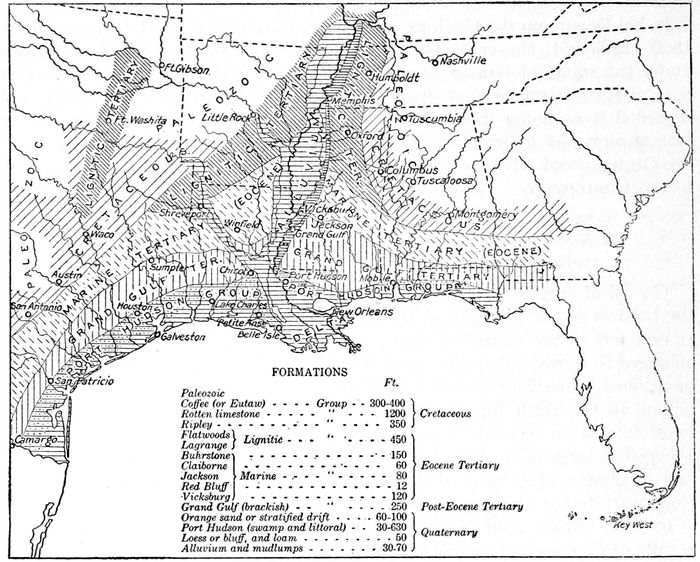
Fig. 22.—The Mississippi embayment. Redrawn from Hilgard. Used to show the distribution of the Port Hudson group.
Although Hilgard represents on his map an alluvial deposit as covering the region of the delta, a belt along the western side of the great river as far up as Cairo, and the wide tract between Mississippi and Yazoo Rivers, a study of his paper shows that he believed that much of these regions was underlain by his Port Hudson. He recognized it at Greenwood on the Yazoo, 60 miles east of the Mississippi; at Vicksburg, and at various places in the delta. Usually its upper surface occurs at about low-water level along rivers, and elsewhere is met with in digging wells. At Vicksburg it was encountered by Grant’s Army in digging his famous canal. It was believed by Hilgard that the same deposit was present at Petite Anse, overlying the Orange sand and overlain by more recent deposits.
Inasmuch as Hilgard believed that the Orange sand was laid down at the time when the northern drift was being deposited, he had to refer his Port Hudson to a later time, and this time he seemed to regard as being the epoch called by Dana the Champlain.
389McGee referred the deposits of the lower Mississippi Valley (sometimes called the Mississippi embayment) to his Columbia formation (12th Ann. Rep. U. S. Geol. Surv., plate I, p. 392). This formation, in his view, had been laid down during a great subsidence of the borders of the continent and when the waters of the Gulf reached as far north as the mouth of Ohio River or beyond. He relegated Hilgard’s Orange sand to the Pliocene and recognized four phases as belonging to the Pleistocene. These were, beginning below: (1) Port Hudson; (2) Orange sand (of Safford, not that of Hilgard); (3) loess; (4) brown (or yellow) loam. Of these divisions there were really only three, for he regarded the loess as only a phase of the loam and as lying sometimes above, sometimes below the latter. He recognized the Port Hudson clays as flooring the entire flood-plain of the Mississippi from the mouth of the Ohio well toward the gulf shore. The formation was believed to be usually a low-lying one; but at Natchez (as seen by his section given on page 391) it is elevated high above the present flood-plain.
Gilbert D. Harris, geologist in charge of the geological survey of Louisiana, and Arthur C. Veatch, assistant geologist, have contributed much to our knowledge of the Pleistocene geology of the State. Reference to their works will be found in the descriptions of several fossil-bearing localities, especially in the description of Petite Anse.
Harris, in 1905 (Bull. 1, Geol. Surv. Louisiana, p. 13), expressed the conclusion that the longer the geology of southern Louisiana is studied the more futile appears the attempt to make satisfactory subdivisions in the Quaternary deposits—subdivisions that have any definite time or structural limits. He regarded it as a mistake to assign to the Port Hudson a special place in geologic time.
Chamberlin and Salisbury in 1906, as quoted below, made no mention of the Port Hudson formation; but that part of it supposed to be found at Natchez was evidently included in their Natchez formation.
Inasmuch as Petite Anse and Natchez have furnished more species of fossil vertebrates than any other localities in their States, and likewise human relics supposed to be of equal age with the extinct mammals, these places will receive especial attention.
Natchez is the most important locality in Mississippi as regards Pleistocene vertebrate palæontology. So far as the writer knows the first mention of the occurrence of vertebrate fossils here was a note by Dr. G. Troost in 1835 (Trans. Geol. Soc. Penn., vol. I, p. 143), who stated that he had in his possession a tooth of a mastodon found at Natchez.
In 1845 (Proc. 6th Meet. Assoc. Amer. Geologists and Naturalists, pp. 77–79), Dr. M. W. Dickeson, of Natchez, read a paper entitled “On the Geology of the Natchez Bluffs,” in which he distinguished 22 several beds. These were said to be of varying thickness and distinctly marked, but all composed of various colored clays and sands, and containing numerous organic remains, embedded wood, and detrital matter. Probably by far the greater part of these beds were of subordinate importance and do not appear to have been noted since that time. Beneath the surface soil Dickeson recognized a mass of yellow loam 20 to 30 feet in thickness, exceedingly fine and free from gravel. In this had been found shells 390of Helix and scattered bones of mastodons. Below this came a bed of ferruginous sands and gravels 4 feet thick. This was succeeded below by what he called the mastodon bed, in which Dickeson had detected remains of more than 30 individual mastodons. The thickness of this was not given. The next stratum, his No. 6, was a fine clay of blue color, from 12 to 15 feet thick. In this and his No. 22, an ash-colored clay, at low-water mark, he discovered remains of what has since proved to be Megalonyx jeffersonii. The localities where his fossils were found were not given with exactness.
At a meeting of the Academy of Natural Sciences, October 6, 1846 (Proc., etc., vol. III, p. 107), Dickeson exhibited a large collection of fossil bones obtained by him in the vicinity of Natchez. Among these were the head and lower jaw of the Megalonyx already mentioned. He stated that the stratum that contains these organic remains is a tenacious blue clay that underlies the diluvial drift east of Natchez and which diluvial deposit abounds in bones and teeth of the Mastodon giganteus. Associated with the megalonyx were remains of bear, bison, deer, and horse. The collection was more notable because of the presence of a part of a human innominate bone. Dickeson affirmed that this had been taken out of the blue clay about 2 feet below three associated skeletons of the megalonyx; and it is further stated to have accorded in respect of color, density, etc., with those of the megalonyx and other associated bones. This bone is now in the collection of the Academy of Natural Sciences, Philadelphia.
In 1846 the English geologist, Sir Charles Lyell, studied the geology of the region at Natchez (Second Visit to U. S. N. A., ed. 2, vol. II, pp. 194–201). With him were Dr. Dickeson and B. L. C. Wailles, afterwards State geologist of Mississippi (Wailles, Agric., Geol. Miss., 1854, p. 213). In the yellow loam of the bluffs Lyell recognized loess deposits, from their resemblance to those of the Rhine. These he estimated to occupy the upper 60 feet of the bluff, and in them were found 20 species of land-snails, all yet living. He reported that this loess sometimes passed into a lacustrine deposit which contained shells of Lymnæa, Planorbis, Paludina, Physa, and Cyclas, and that with the land-snails had been found, at different depths, remains of the mastodon, while in clay under the loam (meaning evidently the loess) and above the sand and gravel, entire skeletons of the megalonyx had been met with, associated with bones of the horse, bear, stag, ox (Bison). Lyell noted especially the recent development of deep ravines. One of these, called the Mammoth Ravine, had been formed, he was assured, within the preceding 35 years. Its length was 7 miles and its depth 60 feet. In this ravine was found the human innominate bone referred to above. He was shown this bone, and states that Dr. Dickeson was persuaded that the bone had been taken out of the clay underlying the loam (loess). This indicates that Dickeson himself did not take out the human bone. Lyell thought that, like most of the other fossils, it had been picked up in the bed of the stream, which would simply imply that it had been washed out of the cliffs, and that it may have been dislodged from some Indian grave near the top. He (p. 197) stated that the place where the 391bone was found was 6 miles from Natchez. The reader may consult further Lyell’s account of his observations at Natchez in volume III of the American Journal of Science, 1847, page 266.
In 1854 Wailles (op. cit., p. 286) published a list of the vertebrate fossils which had been found in the State. This list had been prepared by Dr. Leidy. While no localities are mentioned in either publication, it is quite certain that most, if not all, of the species had been found at Natchez. Wailles (p. 285) stated that the most prolific locality was on Pine Ridge, in townships 7 and 8 north, range 3 west, 6 miles north of Natchez. While the name is not used, it is supposed that reference is here had to the Mammoth Ravine mentioned by Lyell. Leidy’s list was as follows:
Felis atrox Leidy.
Ursus americanus fossilis.
U. amplidens Leidy.
Equus americanus Leidy.
Cervus virginianus fossilis.
Bison latifrons Leidy.
Boötherium cavifrons Leidy.
Elephas primigenius.
Tapirus americanus fossilis.
T. haysii Leidy.
Megalonyx jeffersonii Harlan.
M. dissimilis Leidy.
Mylodon harlani Owen.
Ereptodon priscus Leidy.
Mastodon giganteus.
Hilgard (Agric. Geol., Mississippi, 1860, p. 196, a work not issued until the early part of 1863), republished Leidy’s catalogue of species just mentioned and stated that these had been found in a solid blue clay.
In J. W. Foster’s “Prehistoric Races of the United States,” published in 1873, p. 61, is a statement made by Professor C. G. Forshey, in which he says that he visited the locality where the human innominate bone was found and that it was in Bernard’s Bayou, 2.5 miles north from Natchez. This does not accord with the statement of Wailles, who lived near Natchez and who visited the locality in company with Lyell and Dickeson. Forshey presented reasons for concluding that the bone was not derived from the Bluff formation. He stated that the mastodon bones and all others, of which there were many, were rotten, and that it was only with difficulty that any of them could be preserved. On the other hand, Leidy, in speaking of the bones of the megalonyx found in the Mammoth Ravine (Smithson. Contrib. Knowl., vol. VII, art. 5, p. 6), and of those of the Mylodon (op. cit., p. 48), says that they were in a good state of preservation.
In his work on the Lafayette formation published in 1891 (12th Ann. Rep. U. S. Geol. Surv., pp. 347–521), McGee discussed the geology about Natchez. On page 397 he presented a composite section obtained along about 3 miles of the bluff. This in a modified form is here given.
Section at Natchez.
feet.
7. Loess 10 to 50
6. Brown loam 10 to 40
5. Stratified loamy sand 5 to 15
4. Tenacious blue clay (Port Hudson) 10 to 15
3. Cross-stratified sand, with pebbles 30 to 50
2. Stratified gravel 5 to 15
1. Greenish and blue clay, to above low water (Grand Gulf, Tertiary) 5 to 10
McGee noted that these divisions (except the Port Hudson and Grand Gulf) are purely arbitrary, inasmuch as the character and thickness of the beds change more or less within no great distances.
392He noted the fact that the loess abounded in mollusks mostly of land and swamp species; also that some of the gravelly beds well down towards the Port Hudson clays had yielded bones and teeth of elephants and mastodons.
In 1898, Dr. B. Shimek visited Natchez and studied especially the loess (Amer. Geologist, vol. XXX, pp. 279–298, with plates X-XVI). He estimated the thickness of the loess as not exceeding 30 feet. He collected from this loess more than 4,600 shells of mollusks; and these proved to belong to 39 species or well-recognized subspecies. These species are all terrestrial in habit and all are now found living either on the hills in the immediate vicinity or in similar situations in other parts of the South. Shimek came to the conclusion that the loess of that region had been deposited by the action of the winds. He was unable to find any “brown loam” above the loess, the presence of which other authors had affirmed.
Shimek found no traces of mammalian bones in the loess and was inclined to doubt that they occur there. He does not appear to have visited the locality from which most of the bones were reported.
Chamberlin and Salisbury, in 1906 (Geology, vol. III, p. 386, fig. 513), discussed briefly the geological situation at Natchez. The Natchez formation (evidently including the Port Hudson) has a thickness of about 200 feet and is made up of materials derived mostly from the so-called Lafayette, on which it there rests unconformably. In this Natchez formation are also crystalline pebbles and calcareous clays assignable to wash from the glacial regions. Between this Natchez formation and the overlying loess a marked interval is indicated. The authors are inclined to assign the Natchez deposits to the earliest part of the Pleistocene, viz, to the Aftonian and the drift epoch preceding the Aftonian. Since the time when the Natchez formation was deposited the great trench of the Mississippi Valley, about 60 miles wide, has been excavated.
Already on page 391 has been given the list of fossil mammals which Leidy made out for the State geologist of Mississippi, B. L. C. Wailles. A revision of this is here presented, with the addition of Castoroides ohioensis.
Megalonyx jeffersonii (p. 40).
M. dissimilis (p. 41).
Mylodon harlani (p. 41).
Ereptodon priscus (p. 41).
Equus complicatus (p. 200).
E. leidyi (p. 200).
Tapirus haysii (p. 208).
T. terrestris (p. 208).
Odocoileus virginianus (p. 233).
Symbos cavifrons (p. 254).
Bison latifrons? (p. 265).
Mammut americanum (p. 125).
Elephas columbi? (p. 180).
Castoroides ohioensis (p. 280).
Ursus americanus.
U. amplidens.
Felis atrox.
According to Lyell (Amer. Jour. Sci., vol. III, 1847, p. 268), Megatherium and Castoroides had been found in the bluffs at Natchez.
From this list of mammals it is possible perhaps to reach some conclusion regarding the geological age of the deposits containing them. In case we accept without reserve the species, 16 in number, as determined, only 3, Tapirus terrestris, Odocoileus virginianus, and Ursus americanus, are yet living, leaving about 81 per cent of the whole as being extinct, and what was called Tapirus terrestris was probably an extinct form. This alone makes it probable that the time of their existence was early in the Pleistocene. 393All three of the supposed existing species may, however, prove to belong to extinct species closely related to those whose names they yet bear.
Certain species may be left out of consideration because of paucity of specimens and our consequent lack of knowledge of them. These are Megalonyx dissimilis, Ereptodon priscus, and Ursus amplidens.
In case the high percentage of extinct species is not recognized as being decisive, we may consider the assemblage from another point of view. Certain species of the list appear to have existed throughout the Pleistocene, at least from the time of the first interglacial stage. These are Megalonyx jeffersonii, Mammut americanum, Elephas columbi, and Castoroides ohioensis, and their presence indicates only a Pleistocene time. Others of the list are not known to have existed after the time of the last Wisconsin drift-sheet, and may be supposed to have become extinct before that time. These are Mylodon harlani, Equus complicatus, Equus leidyi, Tapirus haysii, and Bison latifrons. All of these quite certainly existed until after the Illinoian drift period, probably into the Sangamon interglacial, except apparently Equus leidyi.
The list contains no species of primitive mastodons belonging to the genus Gomphotherium, no species of Hipparion, no camels; and Elephas imperator appears to be missing. There is, therefore, no necessity for believing that the mammal-bearing deposits at Natchez are as old as the Sheridan, or Aftonian stage, but the ancient forms mentioned may at any time turn up there or elsewhere in the immediate region.
The presence of Symbos cavifrons might be supposed to point to a rather late date in the Pleistocene; but evidence has accumulated which indicates that it reaches back farther in time than we have supposed. Taking all into consideration, the writer concludes that the fossil vertebrates found at Natchez date back at least as far as the time of the Illinoian drift stage. There is nothing to prove that they are not as old as the Aftonian stage, except the apparent absence of camels, Elephas imperator, mastodons belonging to Gomphotherium, and a multiplicity of species of Equus.
Unfortunately, vertebrate fossils, especially those known to belong to definite horizons in the Pleistocene, are, aside from Natchez, rarely found; but near Orizaba, in Tippah County, a tooth of a horse has been discovered which appears to have been Equus leidyi (p. 200). Remains of a deer (p. 234) have been found in a railroad cutting at Aberdeen, Monroe County. Mastodons are not uncommon, as may be seen on consulting the pages where these animals in Mississippi are discussed (pp. 124 to 126).
TENNESSEE.
(Figure 23.)
There are not many States which furnish fewer Pleistocene deposits of any considerable area than does Tennessee. Lying, as it does, away from the sea, there are no marine Pleistocene beds; situated beyond the glacial area, there are no glacial-drift deposits; and almost half of the State, the eastern, being mountainous, with rivers running in narrow valleys, there has been little opportunity for accumulation of loose Pleistocene materials. 394The U. S. Geological Survey has published about 25 folios describing the geology of this mountainous part of Tennessee. One will search these folios, perhaps in vain, for any mention of Pleistocene deposits and for traces of these on the maps. Now and then mention is made of narrow strips of alluvium along some of the larger rivers; nevertheless there are evidences that in some of these strips there are Pleistocene deposits. From the mountainous region westward to near Mississippi River there have doubtless been, during the Pleistocene, better opportunities for deposition of alluvium along the river courses, but such deposits have been little studied. Along the great river forming the western boundary there is a band, 10 to perhaps 25 miles in width, overlain by loess. This may attain a depth along the river varying from 20 to 70 feet, but away from the river it thins out to a feather-edge (Glenn, Water Supply Paper 114, U. S. Geol. Surv.). Up to this time, however, it has furnished few, if any, Pleistocene fossils.
Notwithstanding the paucity of Pleistocene areas in the mountainous portion of Tennessee, this region has furnished a considerable number of species of Pleistocene vertebrates, and bids fair to furnish its due proportion (fig. 23). These species occur, not in water-laid or wind-laid deposits, but in caves which abound in the limestones of that region. In 1918 (Resources of Tenn., vol. VIII, pp. 85–142), Mr. Thomas L. Bailey located and described more than 100 caves of considerable size. Many had been worked to obtain saltpeter. Bones have been reported from a few of them; probably bones had been met with in others, but were not regarded as important. In these caves (and in others yet to be discovered) may hereafter be found numerous remains of animals. Other sources for such fossils are the crevices that are sometimes opened up in quarrying operations. Caves and crevices of this kind are found in the Alleghany Mountain region from northern Pennsylvania to Lookout Mountain in Tennessee, and from them there is already known an extensive Pleistocene fauna.
Beginning in the northeastern corner of the State, a brief survey will be made of the localities and fossils which concern us. At Kingsport, in Sullivan County (fig. 23, 1) the writer has learned of the finding of a mastodon tooth (p. 127), but beyond the fact that it was owned by Mr. D. M. Lafitte, the writer has been able to learn nothing.
From Bristol, Sullivan County (fig. 23, 2), in the northeastern corner of the State, there has been sent to the U. S. National Museum a fragment of a maxilla containing two teeth of a tapir. This is referred to Tapirus haysii. No details regarding the place of discovery or of the geological conditions are known (p. 209).
From Hawkins County, at a locality not specified (fig. 23, 3) another mastodon tooth has been reported by Dr. S. W. McCallie (Science, ser. 2, vol. XX, p. 333) (p. 127). These announcements show at least that these animals could exist in those rough and elevated regions. From crevices in a marble quarry near Rogersville (fig. 23, 4), Hawkins County, there were sent many years ago to the U. S. National Museum a tooth of the horse Equus leidyi (p. 201); and a canine tooth of a very large peccary, Mylohyus setiger (p. 222). The same peccary has been secured from Cavetown, Maryland.
395
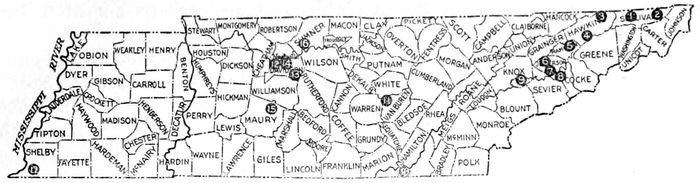
Fig. 23.—Localities where fossil vertebrates have been found in Tennessee.
1.
Kingsport, Sullivan County. Mammut americanum (p. 127).
2.
Bristol, Sullivan County. Tapirus haysii (p. 209).
3.
—— Hawkins County. Mammut americanum (p. 127).
4.
Rogersville, Hawkins County. Equus leidyi, Mylohyus setiger (p. 394).
5.
Whitesburg, Hamblen County. 19 species (p. 395).
6.
Mossy Creek, Jefferson County. Mammut americanum (p. 127).
7.
Zirkel’s Cave, Jefferson County. Tapir, peccary, bear, etc., (p. 396).
8.
Dandridge, Jefferson County. Mammut americanum (p. 127).
9.
Near Knoxville, Knox County. Mammut americanum (p. 127).
10.
Lookout Mountain, Hamilton County. Equus littoralis, Mylodon? sp. indet., Tapirus sp. indet., etc., (p. 396).
11.
Elroy, VanBuren County. Megalonyx jeffersonii, etc. (p. 397).
12.
11 miles west of Nashville. Mammut americanum (p. 127).
13.
11 miles southeast of Nashville. Mammut americanum (p. 127).
14.
Nashville, Davidson County. Equus leidyi, E. complicatus?, Camelops? sp. indet., Mylodon harlani, Odocoileus sp. indet. (p. 399).
15.
Columbia, Maury County. Elephas sp. indet. (p. 181.)
17.
Memphis, Shelby County. Megalonyx sp. indet., Castoroides ohioensis, Mammut americanum (p. 400.)
In the U. S. National Museum is a collection of remains of vertebrate animals made about 1885 by Mr. Ira Sayles, a collector for the U. S. Geological Survey, from a point about a mile north of Whitesburg, Hamblen County (fig. 23, 5). Some masses of the matrix which contained the bones accompany the collection. This matrix is a red earth such as is often found in the floor of caves and in fissures in limestone, the result of the decomposition of the calcareous rock. Some fragments are to a great extent made up of broken bones. It is evident, however, that there is now no cave at that place. Sayles suggested that the bones were “kitchen-middens” and that there had been an old fortification there. Possibly a cave or a fissure once existed there and the rock inclosing it may have dissolved away, leaving the floor.
In this collection the writer has found the following species; these were described in 1920 (Proc. U. S. Nat. Mus., vol. LVIII, pp. 85–95, plates III, IV; text-figs. 1–3). Those preceded by an asterisk are extinct.
List of species.
*Testudo munda.
*Equus leidyi (p. 201).
*E. littoralis (p. 201).
*Tapirus tennesseæ (p. 209).
*Mylohyus nasutus (p. 223).
Odocoileus virginianus (p. 234).
*Sangamona fugitiva.
Cervus canadensis (p. 243).
*Elephas primigenius.
Sciurus carolinensis.
Tamias striatus.
Marmota monax.
Castor canadensis.
Neotoma pennsylvanica?.
Microtus pennsylvanicus.
Lepus americanus.
Ursus floridanus.
Procyon lotor.
*Ænocyon ayersi?.
396In this list there are 19 species, of which 8 are extinct. The latter form, therefore, 42 per cent of the whole list. This ratio appears to indicate a time about the middle of the Pleistocene. There are no forms that require an earlier date and there is good reason for believing that the horses and the tapir did not exist after the last glacial stage, perhaps not after the Sangamon interglacial.
It is interesting to find in eastern Tennessee the remains of Elephas primigenius. The discovery of teeth of this animal at Beaufort, North Carolina, in eastern Tennessee, and especially in Texas, proves that the range of that species extended even farther south in the New World than it did in the old. It is not improbable that the animal withdrew to the south during one or more of the glacial stages. However, none of the other species found at Whitesburg suggests a cooler climate than now prevails there.
It is possible that some of the forms referred to existing species are really extinct. The teeth identified as those of Odocoileus virginianus are smaller than those usually found in recent individuals. The deer Sangamona fugitiva appears in a collection made at Cavetown, Maryland, and in another made at Alton, Illinois, in or beneath deposits of loess that are believed to have been laid down about the time of the Sangamon stage.
In Jefferson County mastodon remains have been found at two places, Dandridge (fig. 23, 8) and Mossy Creek. No details are known about the first case; in the case of the tooth found 3 miles south of Mossy Creek (fig. 23, 6) it is stated that it was discovered at a depth of 6 feet and beneath a white oak stump. Between the two villages, on the left bank of Dumplin Creek, 5 miles above its mouth, is Zirkel’s Cave. From this cave (fig. 23, 7) Mercer (Dept. Amer. Archæol. Univ. Penn., 1896) reported the discovery of remains of tapir (p. 395), peccary (p. 223), bear, and small rodents; but to what species they belonged is not known. The tapir and the peccary indicate Pleistocene times. The bear probably belonged to the same epoch.
At a point 7 miles southeast of Knoxville (fig. 23, 9) Professor S. W. McCallie reported the finding of a mastodon tooth beneath 30 inches of clay. At Lookout Mountain (p. 395, fig. 23, 10) have been secured a tooth of a horse, probably Equus littoralis (p. 201), remains of tapir and probably of Mylodon (p. 43). Just where the horse-tooth was found is not known. The tapir was found in a cave on the left bank of Tennessee River, 0.25 mile below the mouth of Chattanooga Creek (Mercer, as cited above; also in Amer. Naturalist, vol. XXVIII, p. 355). Mercer’s accounts are brief and were intended only as preliminary reports. From him, through Miss Harriet Newell Wardle, of Philadelphia, the writer has received a letter in which are given some details about the investigation of this cave in 1893 and 1896.
Dr. Mercer extended his trench inward from the entrance a distance of about 50 feet and downward to the rocky bottom of the cave. He recognized the presence of three layers, as follows: (1) top layer, from 6 to 8 inches deep, containing relics of both white man and Indian; (2) middle layer, about 2 feet thick, containing evidence of Indian only; (3) red cave 397earth, varying from one to several feet in thickness, according to the uneven conditions of the cave floor. This latter layer was subdivided into an upper zone (a) about a foot deep, which showed evidences of intrusion of bones and refuse from the overlying layer, and (b) the undisturbed red earth which contained bones of bats and perhaps of some other animals. In the upper zone (a) of the red-earth layer Mercer found a jawbone and loose teeth of Tapirus haysii (p. 209) and a jawbone of Mylodon (p. 43) without teeth, both as identified by Professor Cope. Later, Cope became doubtful as to the Mylodon bone. In this upper zone of red earth, “within a few varying inches of the depth of the tapir specimen above or below it,” Mercer found bones of cave rats (Neotoma), marmot (Marmota), squirrel, deer, opossum, teeth and fragments of the skull of a large unidentified mammal, a small and a large bird, wild turkey, two species of turtles, frogs, and drum-fish. The skull and other bones of the large unidentified mammal had plainly been cracked to secure the marrow, and were otherwise crushed and splintered. Also, as many as 493 hornstone chips were found, besides bones rubbed to a point, and 10 potsherds. It becomes a question how the tapir bone and teeth and perhaps the bone of the mylodon and the evidences of the Indian’s presence got into this upper layer of red earth. Mercer “thought it reasonable to conclude that the tapir had been intruded into the red earth from the upper layer and had been in contact with the Indians.” This appears to indicate the idea that the tapir had existed there at a late period, probably after the Pleistocene; but the evidences appear to show that this animal lived in the United States not later than about the Sangamon stage of the Pleistocene. It is more probable that the tapir remains had not been disturbed and that the relics of man had, by some means, made their way down into the red earth. There remains also the possibility that Indians and tapirs and mylodons had lived together in that region during the middle of the Pleistocene and while the upper foot of red clay was being deposited. The presence of the other animals mentioned by Mercer does not disprove this possibility, for all of them pretty certainly existed there during the middle Pleistocene.
Not far from Elroy, Van Buren County (fig. 23, 11) there is an interesting cavern known as Bigbone Cave. This and the bones which it has furnished are now to be described.
Mercer (Proc. Amer. Philos. Soc., vol. XXXVI, pp. 36–70) found that in the greater part of this cave the nitrous earth that had formed the floor had been removed to such an extent that on the walls its stains remained at a height of one’s waist. Wherever any of this deposit remained it was exceedingly dry and any disturbance of it produced a cloud of dust. It appears to have consisted mostly of the dung and excretions of animals, such as bats and cave rats. The preservation of the cartilage and horny sheaths of the claw was due to this dryness of the atmosphere. Where Mercer found the bones he recognized four layers, to represent which he published a figure (op. cit., p. 47, fig. 4). This is here reproduced with unimportant changes (fig. 24). On top there was a layer from 2 to 3 inches thick which had resulted from the disturbance produced by the passing of white men and possibly to some extent of Indians. With the 398dust were mingled remains of charred vegetable substances that had been used as torches.
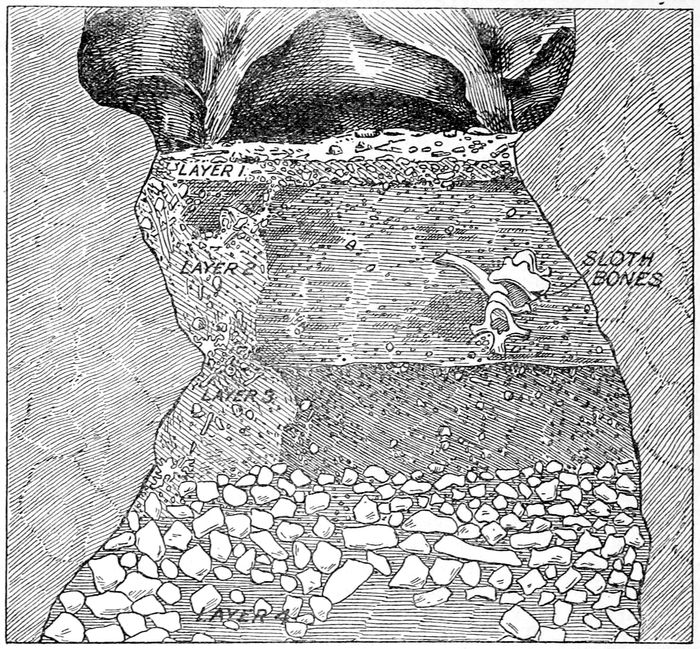
Fig. 24.—Diagram showing a vertical section of the gallery in Bigbone Cave near Elroy, Van Buren County, Tenn. Adapted from Mercer.
The second layer was 2 to 5 feet deep and consisted almost entirely of well-preserved dried excrements of cave rats (Neotoma) and of porcupines (Erethizon). In it were observed nuts, sticks, fur, and moss. The only animal remains found in this layer were the bones of Megalonyx (p. 42), quills and coprolites of Erethizon dorsatum, coprolites and a jaw of a cave rat referred to Neotoma magister, and jaws of two bats, Adelonycteris fuscus and Myotis subulatus (Vespertilio gryphus of Mercer). Some traces were found of an undetermined herbivorous mammal about as large as a bear. With the lot of Megalonyx bones from this cave which were described by Harlan there were remains referred to Bos (Bison), Ursus, Cervus (Odocoileus?), and a human metatarsal; but these were reported as having been picked up on the surface and may therefore have belonged to quite recent skeletons.
Besides the animal remains found by Mercer in his second layer, there were present quantities of vegetable matter belonging to several species. All, however, were forms yet living in that region.
399Mercer’s third layer appears to have consisted of dry excrements which had become somewhat hardened. Its thickness was a foot. In it were found vegetable matter, some bat jaws and fur, and the carcass of a “window fly.” The fourth layer consisted of a fine water-laid clay which on drying had contracted and broken up into small angular masses. The interstices appear to have been filled by materials soaking down from the upper layers of excrement. No organisms were found in it.
Mercer concluded that the sloth remains were geologically recent, and this may be true. Megalonyx jeffersonii has been found in the northern States in deposits overlying the Wisconsin drift, and it is quite reasonable to suppose that the animal existed in Tennessee up to as late a time as it did in Ohio and Illinois. The persistence of the cartilages of the sloth, and the framework of the window fly which lay below the sloth bones, naturally suggests a comparatively short time; but if, through the dryness of the cave, they could endure a thousand years, they might possibly endure several thousand. One must consider also the length of time required for 1.5 or 2 feet of cave floor to be built up from the excrements of bats, porcupines, and cave rats, but there is no reason to refer the time back further than about the close of the Wisconsin stage.
On another page (p. 127) is presented the little that is known about the remains of two mastodons which have been reported from the region about Nashville. One tooth was found 11 miles west of the city (fig. 23, 12); a part of a skeleton at a point 11 miles southeast of it (fig. 23, 13). A tooth of an undetermined species of elephant was found long ago near Columbia, Maury County (p. 395, fig. 23, 15). According to Folio 95 of the U. S. Geological Survey, there are some narrow strips of alluvium along Duck River, at Columbia. The tooth may or may not have been found in this alluvium. Apparently in the neighborhood of Gallatin, Sumner County (fig. 23, 16), was found before 1835, at a depth of 40 feet, a tooth of an elephant (p. 181). The information furnished by the tooth, as reported, is not worth much.
In June 1920, the writer received from Mr. William Edward Myer, of Nashville, a small box of fossils, collected near Nashville (fig. 23, 14). The exact locality is given as being about 300 yards upstream from Lock A, in Cumberland River. According to a sketch sent by Mr. Myer and here reproduced (fig. 25), there are loose deposits about 30 feet in thickness lying upon bed-rock. This bed-rock is found at about the level of low-water in the river. On this rock there is found first a bed of gravel, which, to judge from Myer’s sketch, is 2 or 3 feet in thickness. Above this comes a bed of sand of about the same thickness. The rest of the 30 feet is composed of gravel; and this rises to the level of the flood-plain. In the lowermost stratum, the bed of gravel, were found a tooth of Equus leidyi (p. 201), a part of a femur of a horse of large size (p. 201), and an antler of a small and probably unnamed deer (p. 234). This antler resembles those of some of the Central American species of Odocoileus. In the next stratum above were found some indeterminable fragments of turtle bones, a tooth of a young mastodon (p. 127), and a calcaneum of a large camel (p. 225), belonging probably to the genus Camelops. In October 1920, Mr. Myer 400sent from the same locality a part of a molar of Mylodon harlani (p. 43). These remains appear to the writer to indicate that the deposits are of early Pleistocene age, about that of the first interglacial.
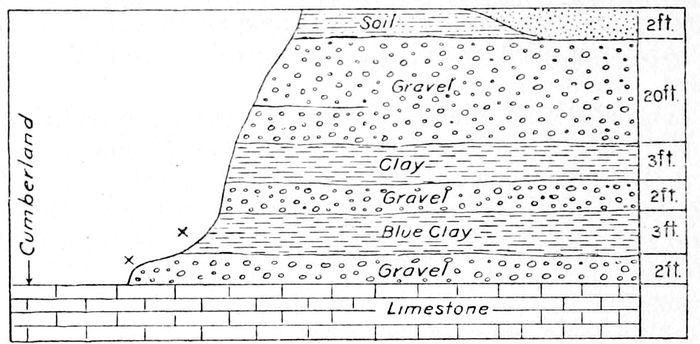
Fig. 25.—Section on Bank of Tennessee River at Nashville.
Somewhere about Memphis (fig. 23, 17), were found, about the middle of the last century, some scanty remains of a young mastodon, a bone of Megalonyx (p. 43), and a part of a lower jaw of Castoroides (p. 280). Jeffries Wyman thought that these remains had been found in diluvium of the Mississippi River. It appears probable that they were found in the loess, which is well developed at that locality. Some exactness in reporting the locality would have led to the solution of this question.
KENTUCKY.
The State of Kentucky lies almost wholly south of the area of glaciation. Only along Ohio River, from about 50 miles above Cincinnati to about as many miles below, do any ice-laid drift materials appear, and these belong to the Illinoian glacial stage. For information on this drift the reader may consult Leverett’s account (Monogr. U. S. Geol. Surv., vol. XLI, pp. 256–258, plate II). Near Carrolton, between Ohio and Kentucky Rivers, is a ridge of Illinoian drift which rises as much as 200 feet above low water. Later-formed terraces of these rivers are found up to 90 feet. Not far away from this locality drift materials are found on the highlands to a height of 300 feet above the Ohio. Below Rising Sun, Indiana, on the Kentucky side, are knolls of drift deposits rising about 150 feet above the river. This Illinoian drift occupies nearly the whole of Boone County; elsewhere it forms a narrow strip along the Ohio.
Naturally there were laid down, at various times during the Pleistocene, deposits beyond the glacial front. Rivers coming down from the glaciers brought into the Ohio valley enormous quantities of gravel, sands, and clay, much of which must have been deposited along the banks or at the bottom. Such materials may have been laid down there during all or some of the earlier glacial stages, some perhaps during interglacial times. Probably at later times the most of these early deposits were swept away, but some may have persisted. The rock floor of the Ohio (Leverett, op. cit., p. 83) is below the level of the present stream, generally between 30 and 40160 feet, and, at some points in its lower course, 75 feet. There might, therefore, now exist Illinoian drift materials anywhere above this rocky floor, as well as high up on the bluffs. It may be difficult, sometimes impossible, to determine the actual age of such deposits. During the whole Pleistocene, the rivers which enter the Ohio from the south were bearers of fine and coarse materials from the higher lands where they took origin. Sometimes, and in some parts of their courses, they may have occupied channels other than those now holding the waters. During times of depression of the country the sediments were dropped along the channels until the latter may have been nearly filled. Then the country may later have become elevated, so that the streams again cut down and left some of the old deposits as terraces. In some parts of the State, as in the region of Mammoth Cave, water circulating in the limestone rocks has dissolved these so as to produce caverns and fissures of various sizes. In such caves, when they became opened to the surface, animals would seek hiding-places and would perhaps bring in others as their prey. Dying there, their bones might be preserved. From such a cave has been secured a fine specimen of the skull of a peccary (p. 223). Such caves should be examined with great care.
One of the most famous localities for fossil vertebrates in this country is that known as Bigbone Lick, in Boone County, about 22 miles in a straight line southwest of Cincinnati. Fossil bones were collected there as long ago as 1739. A condensed history of the explorations made there for fossils was given by William Cooper in 1831 (Monthly Amer. Jour. Geol., vol. I, pp. 158–174, 205–216). An account of the locality, its geology, and something about the fossil vertebrates and fresh-water mollusks found there was given by the geologist Charles Lyell in 1845 (“Travels in North America,” Murray ed., vol. II, pp. 62–66).
Enormous quantities of bones and teeth, especially those of Mammut americanum, have been collected at this place. When it was first discovered, bones of this animal, of the elephants, and some others, must have been lying exposed on the surface, the result probably of erosion by the creek passing there through what was then a marsh. General William Henry Harrison, in 1795, shipped from there 13 hogsheads of bones, but these were lost on their way to Pittsburgh. Dr. Goforth is reported to have got as many mastodon teeth as a wagon and four horses could draw. These teeth are said to have weighed from 12 to 20 pounds each. If this statement of weights is true, some or all of the teeth were those of elephants. In 1807, General William Clark made a collection at Bigbone Lick, at the instances of President Thomas Jefferson. Brief notices of these were published by Dr. Samuel L. Mitchill and by Dr. Caspar Wistar. Some of these bones were sent to the American Philosophical Society at Philadelphia and were afterwards put into the collection of the Academy of Natural Sciences. Another part was sent to Paris. Remains of various species, mostly the mastodon, have gone into many museums of this country and of Europe; but it is evident that the greater part of the things collected there, and especially of the finest things, has been lost to science.
Notwithstanding the amount of work done at Bigbone Lick, the geology of the locality, and especially of the bone-bearing levels, is not well known. 402Most persons who have labored there were interested almost wholly in getting as many bones as possible and then in getting away. Cooper, as cited, published a map of the region and indicated where the excavations had been made up to that time. This map is here presented, redrawn (map 41). From Cooper’s account it appears that all of the bones had been found within a very circumscribed area, near a number of salt springs. The bones occurred on the surface and as deep as 25 feet. Cooper attributed this variation of depth to the unevenness of the surface, his idea being that the bone-bearing stratum occupied a certain level. He concluded that the valley had been filled up to a depth of not less than 30 feet by unconsolidated beds of various kinds, of which the uppermost was a light-yellow clay. This appeared to have been brought down from the higher grounds by flowing water. In it were found bones of buffaloes and other modern animals. Below this came a thinner layer of darker color, softer and more gravelly, which contained remains of reedy plants and fresh-water mollusks. It is described as being sometimes very thin or even wanting. It was in this layer that the bones, or most of them, were buried. It was itself underlain by a bed of blue clay of a very compact and tenacious kind. Cooper added that this bone-bearing layer appeared sometimes to be embedded in the blue clay.
The next important investigations made at this place, so far as the writer knows, are those instituted by Professor N. S. Shaler in 1868 (Geol. Surv. Kentucky, 2d ser., vol. III, 1877, pp. 196–198; Allen’s “The American Bison,” 1876, pp. 232–236). He reported that he had sent to the Museum of Comparative Zoology at Harvard at least a ton of bones. Immediately at the salt springs Shaler appears not to have been able to discover any order in the disposition of the bones. “It is only at points remote from the springs, where the beds seem to have been formed by a mixture of the creek mud and the waste from the springs, that we find the remains in the order which will enable us to form some opinion as to the succession of occurrence of these animals at this point.” At one place he thought he had succeeded in finding a distinct order of succession. Just where this place was he did not indicate, nor what kinds of deposits were passed through. The depth reached appears to have been only 8 feet. Unfortunately, the great collection made by Shaler has remained unstudied, except the remains of the buffalo (J. A. Allen, “The American Bison,” 1876, with plates).
Shaler thought that the beds of glacial drift did not extend south of Ohio River. The discovery that the Illinoian drift-sheet covers most of Boone County (Leverett, Monogr. U. S. Geol. Surv., vol. XLI, pp. 257–258) throws much light on the history of the locality. It appears rather strange that Shaler did not find rocks of far northern origin at Bigbone Lick. The geologic history appears to be something like this. When the Illinoian ice-sheet crossed the Ohio there was present the predecessor of Bigbone Creek. Inasmuch as the glacial sheet did not remain there long, a rather thin deposit was laid down in the creek. This is probably represented by the bed of blue mud mentioned by Cooper. When the glacier retired, the locality became a swamp covered probably by vegetation and receiving mud and gravel brought there by the stream and washed down from the 403surrounding hills. Doubtless the salt springs existed then as now and attracted thither elephants, mastodons, and other species. What were all the changes undergone there between the Illinoian and Wisconsin drift stages can not be guessed; but during the latter time, when the Ohio was carrying down vast quantities of detritus, some from the glaciated regions, some from the non-glaciated, its muddy waters were often backed up into Bigbone Creek, as they are sometimes now, and they left there the upper yellow clay described by Cooper, or at least most of it. When the Wisconsin stage had passed and Bigbone Creek was free to work in that valley, erosion began. As the creek was cutting down its bed to the present level it doubtless often changed its position, and in this way produced the irregularity of surface which both Cooper and Shaler mention.
Notwithstanding its widely extended reputation, Bigbone Lick has furnished relatively few species of vertebrates, and there is question regarding the antiquity of some of these. About the presence of Mammut americanum there is no doubt. About the presence of elephants also there can be no question; and the writer is quite certain that both Elephas primigenius and E. columbi occurred there. Undoubtedly Equus complicatus has been collected there; also Boötherium bombifrons, Symbos cavifrons, Bison antiquus, and B. bison; but it is not certain that the remains of the last-named species are not of Recent times. Shaler mentions the presence of Bison latifrons, but he probably had in mind B. antiquus. The type of B. latifrons was found in another creek valley. The occurrence of the Cervus canadensis, Odocoileus virginianus, and Alces americanus is mentioned by Cooper, who stated that he thought he had seen traces of all of them. Shaler was doubtful as to the elk. In Allen’s monograph on American bison, on page 234, Shaler admits the moose. The following is a list of the species which have been reported from Bigbone Lick. References are made to pages where further information is given on the species.
Megalonyx jeffersonii (p. 44).
Mylodon harlani (p. 44).
Equus complicatus (p. 202).
?Tapirus haysii (p. 209).
Odocoileus virginianus (p. 234).
Cervus canadensis (p. 243).
Cervalces scotti.
Alces americanus.
Rangifer caribou (p. 247).
Boötherium bombifrons (p. 255).
Symbos cavifrons (p. 255).
Bison antiquus (p. 265).
Bison bison (p. 270).
Mammut americanum (p. 128).
Elephas primigenius (p. 146).
Elephas columbi (p. 160).
Ursus americanus.
It is proper now to determine, if possible, during which of the Pleistocene stages each of these species lived. It is quite probable that none of the individual animals that have been dug up at Bigbone Lick lived there before the Illinoian glacial stage. To find such, if they have been preserved there, the excavations would have to be carried much deeper. The writer assumes that any of the animals that lived there in the interval between the Illinoian and the Wisconsin stages lived, died, and were buried during the Sangamon stage. Megalonyx jeffersonii may belong to the Sangamon or to the Late Wisconsin, for we know nothing about the depth at which the bones and teeth were secured. Mylodon harlani is not known to have existed anywhere after the Wisconsin, and hence we may refer it to 404the Sangamon. Equus complicatus also may with certainty be referred to the Sangamon; likewise Tapirus haysii, in case the type was not found in South Carolina. As to the cervids Odocoileus virginianus, Cervus canadensis, Alces americanus, their status is doubtful. They might go back to the Sangamon or have lived there at any time up to and during the Recent. The reindeer is most likely to have existed there during the Wisconsin ice-stage. The fine specimen of Cervalces scotti at Princeton University was found in New Jersey in deposits overlying Wisconsin drift, but it may be taken as certain that the species had existed before the time of the Wisconsin. There is no record of depth, matrix, or associated fossils in the case of the type of this species, which was found at Bigbone Lick. It is natural to refer the two species of musk-oxen to the Wisconsin stage; but there are indications that at least Symbos cavifrons has been found at other localities in pre-Wisconsin deposits. Shaler recorded it as being found near the bottom of his excavation with the horse and with the bison which he called Bison latifrons, but which is Bison antiquus. It and Symbos cavifrons probably belong to the Sangamon.
From the fact that bones of the mastodon and the two species of elephants were found by Shaler in the deeper deposits, it is probable that the individuals represented belonged to the Sangamon or some other pre-Wisconsin deposit; but, inasmuch as all three species lived after the Wisconsin, there seems to be no known reason why some of their bones may not have been buried in the late and superficial deposits at Bigbone Lick. As to the bones of the bear found at this place little can be said.
The numerous remains of Bison bison appear by all accounts to have been found only in the uppermost parts of the deposits. Shaler was of the opinion that the buffalo (Allen’s “The American Bison,” p. 234) had come to the region east of Mississippi River at a very late period, after the disappearance from Bigbone Lick of the elephants, the mastodon, and Symbos. It seems to the present writer that the presence of the existing buffalo east of the Mississippi only after the passing of the Wisconsin ice-sheet is quite certain; but that it came only after the extinction of the great proboscideans is hardly to be sustained. In many localities over the country remains of all three species have been found in swamps overlying the Wisconsin drift. In 1890 (Amer. Naturalist, vol. XXIV, p. 953), Professor Lucien Underwood described a fine skull of the American buffalo which had been found in making a sewer at Syracuse, New York. Underwood stated that it had been found in black muck, at a depth of 10 feet; but Mr. John Cunningham, superintendent of grounds at the university, who saw the place and secured the skull from the laborer who encountered it, told the present writer that the depth was 17 feet. It would seem that that bison had lived on the shores of Onondaga Lake not long after the Wisconsin glacier had withdrawn from the place.
We do not know under what geological conditions the type of Bison latifrons was found; but it pretty certainly came from post-Illinoian deposits, probably Sangamon, along possibly Woolper’s Creek in Boone County. Proboscidean remains have been reported from the Kentucky 405side of the Ohio in the region of Cincinnati, but it would be hazardous at present to assign them a geological age. The same may be said about the mastodon remains found in digging the canal around the falls, although the low level along the river seems to indicate the Late Wisconsin.
A collection, forming probably two farm-wagon loads, was made several years ago at Bluelick Springs, by Mr. Thomas W. Hunter. The springs having failed, Mr. Hunter undertook to dig down and restore the flow. In this he failed, but he did find great quantities of bones, mostly those of the mastodon, but also of elephants, buffaloes, and a few others (p. 129). There were about 100 mastodon teeth, many tusks, and large pieces of these; and of these pieces about 20 had been planed off so as to be flat on one or on two sides, as if they had lain in the bottom of a stream and the water and sand had worn them down on one side and then the tusks had been turned over and undergone a planing of the opposite side. Among the bones were two ungual phalanges of Megalonyx jeffersonii (p. 44), and remains of the elk (p. 243), and deer (p. 234). To none of the species found there need one assign a higher antiquity than late Pleistocene; but some might have been older. In Scott County, between Stamping Ground and Georgetown, there has been found, in the bottom of an old sink-hole, a part of a lower jaw with teeth of Tapirus haysii (p. 210). The time of existence of this animal is to be regarded as lying somewhere back of the Wisconsin glacial stage. With this jaw, Professor Arthur M. Miller sent to the writer some pieces of jaws of Tapirus haysii (p. 210) which had been found in an old stream-deposit at Yarnallton, Fayette County. From a fissure filled with calcite, at Monday’s Landing, Mercer County, there has been sent to the writer, by Professor Miller, a molar tooth of a horse (p. 202). Nothing more can be said of this horse than that it is older than the Wisconsin stage. It may be as old as the first interglacial.
About 5 or 6 miles below Henderson, on Ohio River, many years ago, considerable parts of the skeleton of Megalonyx jeffersonii were found (p. 44). With them were reported to have been discovered antlers and bones of the deer (p. 234). A description of the locality was sent to Joseph Leidy and published by him in his work on ground-sloths (Smiths. Contrib. Knowl., vol. VII, art. 5, p. 7). The bone-bed lay at an elevation of only 5 or 6 feet above an ordinary stage of low water. It was composed of a ferruginous sand and contained various species of fresh-water mollusks and stems and limbs of trees. This was underlain by a bluish clay, while above it, rising 40 or 50 feet, were beds of siliceous earth and widely spread marls. Neither the geology of the place, so far as the writer knows, nor the history of the animal requires us to believe that the geological age is beyond that of the Late Wisconsin or Wisconsin. However, a short time before, near Evansville, Indiana, at the mouth of Pigeon Creek, and apparently only about 10 miles away from where Owen found megalonyx bones, there had been discovered by Frances A. Lincke, and described by Leidy (Proc. Acad. Nat. Sci., Phila., vol. VII, 1854, pp. 406199–200), a collection of vertebrate fossils. This included remains of megalonyx (p. 32), a cervical vertebra of a bison (p. 257), a vertebra of a horse (p. 186), a tooth of Tapirus haysii (p. 203), and a part of the upper jaw of the wolf known as Ænocyon dirus (p. 204). The horse was most probably Equus complicatus, while the bison was probably one of the extinct species. The wolf is regarded as being the same as that so abundantly found in the collections made at Rancho La Brea, near Los Angeles. The writer regards the fauna as belonging to the Sangamon, unless it is still older. The specimens were found sticking out of the river at low water, and it becomes quite probable that the Henderson beds and bones are of the same age as those at Evansville.
As mentioned on another page (p. 223) it is probable that the fine skull of Platygonus compressus that was sent many years ago to the Academy of Natural Sciences of Philadelphia by Dr. Samuel Brown, of Lexington, Kentucky, and described by Leidy (Trans. Amer. Philos. Soc., vol. X, p. 331, plates XXXV-XXXVII) had been found somewhere in Rock Castle County. It counts as another product of the caves which abound in the Alleghany range of mountains.
407