PART II THE PLAYFUL EXERCISE OF IMPULSES OF THE SECOND OR SOCIONOMIC358 ORDER
Elizabeth L. Baldwin translation
PART II THE PLAYFUL EXERCISE OF IMPULSES OF THE SECOND OR SOCIONOMIC358 ORDER
I. Fighting Play
Our conception of experimentation includes a large number of phenomena having the common tendency to bring into action the manifold inborn predispositions of the organism, but without reference to those instincts by means of which the relation of the individual to other living creatures is regulated. In experimentation only the more general needs, such as are indubitably grounded in the nature of the organism, are allowed expression, in such a manner as to bring into action the sensor and motor apparatus as well as the higher mental faculties. The individual would exhibit similar qualities in isolation; he plays with himself, not with his relations to others, and even when association exists, as, for instance, in ball-catching, he recognises at the same time that experimental play is involved. Now, however, we enter on the consideration of such play as is intentionally directed toward other beings, and first on our list is the inborn impulse to fight. Walther von der Vogelweide has shown the power of this instinct in the impressive lines:
“Des Stromes Wellen rauschten kühl; Ich sah darin der Fische Spiel. Ich sah, was ringsum in der Welt: Den Wald, das Laub, Rohr, Gras und Feld, Und was da alles kriecht und fliegt Und seine Bein’ zur Erde biegt. Dis sah ich, und ich sag’ Euch das Keins lebt von ihnen ohne Hass.”
“The stream’s waves murmured oolly; I saw the fishes playing there; I saw all that was in the whole round world; In wood, and bower, and marsh and mead, and field, All things which creep and fly, And put a foot to earth. All these I saw, and say to you, That nothing lives among them without hate.”
In our common speech, too, life is referred to as a battle, and is in reality too often a general struggle for money or power. It is but natural, then, to find the fighting impulse developed early in childhood and practised in play. Indeed, the demand for its exercise is so strong that there is scarcely any form of play which may not take on the character of a contest. Especially is this the case when there is any difficulty to overcome or danger to be encountered. “Both danger and difficulty,” says Lazarus, “appear as incarnated opponents over whom it is possible to gain a victory.”359 In the same way play with lifeless objects is easily converted into a contest by the force of æsthetic illusion. As numerous examples of such intensive stimulation of the fighting impulse have already been given, I shall here mention only the mountain climber’s struggle with lofty peaks. In this chapter such collateral themes must be avoided, as we shall find our immediate problem very wide. In order to discriminate as to the relative importance of the various fighting plays the following division of the subject will prove convenient: First, there are direct fighting plays in which the contestants immediately measure their strength, whether mental or physical. The second group is composed of indirect fighting plays where the victory is sought through means of conducting the contest. Among the mental phases of this we find betting and gambling. In the third group we place merely offensive sports in which no defence is possible or availing, such as playful destructiveness, teasing, and the enjoyment of the comic (so far as it is connected with fighting at all). After disposing of all these, two subdivisions yet remain: first, playful chasing, fleeing, and hiding (hunting plays); and, second, the enjoyment of witnessing a contest.
1. Direct Physical Fighting Play
Any one who takes the hand of a two-year-old child and strikes himself with it, pretending to be much hurt, can not doubt after seeing the delight displayed by the little creature, the pleasurable effect of the discharge of this impulse so deeply seated in human nature. Yet the fighting instinct seems to be comparatively late in assuming the form of regular independent playful contests. Unprovoked tussling merely for the fun of the thing seldom appears earlier than the third year, while young bears, dogs, and other animals begin such play almost at once. In this youthful tussling the chief aim is to throw one’s opponent to the ground and to hold him in this helpless position. So far as my observation goes in this little-investigated sphere, very small boys seldom stand for their combats. Usually one already seated seizes his comrade, who may be standing near, by the foot, pulls him down, and they fight, rolling over on the floor, and each seeking to keep the upper hand. The effort is constantly made to keep the enemy’s head down, a position so distasteful to the party concerned that the scene threatens to end in noisy and serious strife. As the children grow older they gradually formulate rules for their contests partly through imitation of their elders and partly as the result of their own experience. As with adults, the proper grip of the opponent’s body is an important point. “He caught him by the waist, where he was weakest” is quoted as far back as the Hildebrandslied. For throwing, it is often necessary to slip the hand through the other’s arms and give him a sudden twist, or to place one arm on his neck and push him backward. The legs, too, have their part to do. Sometimes a boy is thrown across a projected knee, or a leg is thrust outward to check the fall when the attempt is made to throw sideways by lifting. Or the method adopted by Odysseus in an extremity may be employed—a sudden blow dealt at the bend of his opponent’s knee being the cause of his overthrow. Usually the fight ends at this point,360 but sometimes the tussling is continued on the ground, as described above, and the playful character is very apt to be lost. Sometimes it happens, on the contrary, that the fight is over before either contestant is thrown. I saw two boys wrestling, when one of them was lucky enough to get a good grip on his opponent’s body, but the latter could bend his head back, whereupon they desisted and called it a tie. There is often an effort to take the enemy unawares, as when a boy leaps unexpectedly on his opponent’s back, gives him a violent push, or runs against him forcibly. Suddenly dousing one another with water is another favourite if not very pleasant youthful sport.
Prize fighting by adults seems to have been generally practised in Europe as well as in other parts of the world from remote antiquity. The ancient Egyptians were zealous wrestlers. Among the Greeks, where the art was extraordinarily developed, it often became brutal; breaking the fingers and throttling were allowed, and a familiar sculptured group shows a cruel twisting of the arms to hold down the thrown wrestler. Ring fighting was practised by both boys and men among early Germans, as numerous ethnological remains demonstrate. In Japan, prize fighting is as much a national sport as is bull baiting in Spain. Bastian saw it in Burma, Ratzel among the Eskimos, Indians, Hawaiians, etc., and other observers in remote parts of the earth. Among the Brazilian Bororó friendly contests are governed by the following rules: “To seize a man by his right wrist is a challenge. The two contestants face one another, and each places his hands on the other’s shoulders or on the small of the back. In this position they must stand with bodies perfectly erect,361 their feet wide apart, and each looking toward the other’s back. They maintain a good-humoured silence for some time, and then suddenly become very much in earnest, and make desperate efforts to throw one another by tripping. One usually opens the attack by thrusting one of his heels into the knee hollow of his opponent and trying to bend it, but the other is prepared, and sets his sturdy leg so far back that the effort is fruitless. Attack and resistance on both sides follow in rapid succession until one of the contestants falls.”362
Here, too, is opportunity for the application of the wiles practised by Odysseus when the mighty Ajax lifted him off his feet.
“... Still his craft not deserted Odysseus: He dealt a blow from the back and loosened the joint of his knee So that backward he fell and Odysseus sank down above him Right on his broad chest. And the people around were amazed.”
In von den Steinen’s description of the Brazilian customs, the effort to pull down the head, mentioned above in connection with childish wrestling, is dwelt upon as the chief aim instead of the grip on the waist. “The contestants, representatives of different tribes, come forward in pairs, their bodies smeared with yellowish red uruku, and with black. They stoop, catch up a handful of sand, and in a crouching position, with hands hanging down, they rapidly circle round each other, casting angry glances at their opponents, and calling out threateningly, ‘Húuha! húuha!’ Then one touches his right hand to his adversary’s left, and at this signal they all leap to the attack, springing up and down as fast as possible on the same spot, not unlike angry apes, each seeking to seize and bend down the other’s head. This violent exercise goes on for some time without any direct attempt to throw one another. They are very friendly after it is over, and may be seen walking about with their arms around each other’s shoulders.”
As a last example I quote Berlepsch’s graphic description of the Schwingen as practised in the Swiss Alps. Shirt and trunks are the only articles of clothing allowed, and the latter expose half the thigh, and must be made of stout, strong drilling. Every man grasps with his right hand the waistband of his opponent, and with his left the rolled-up trouser leg, and now begin, either standing or kneeling, violent efforts to overthrow one another. For a complete conquest this must be accomplished twice.363 The struggle is especially exciting when the contestants represent different valleys, and on them rests the responsibility of maintaining the honour of their native place. “As soon as the two athletes have taken the proper grip they sink on their right knees and withdraw the lower part of the body as far as a good hold will permit. If one has reason to fear that he is about to be lifted, he lies flat down on his stomach and the other must follow suit. In this unnatural position they torment one another for half an hour at a time, writhing on the ground like snakes, and stretching sinews and muscles until their faces grow dark with the strain. If neither can manage to overcome his opponent by endurance, superior strength, or strategy, they at last voluntarily abandon the conflict, utterly exhausted, and shake hands on their prowess, but neither can claim a victory.”364 So-called tests of strength are similar to this.365 In pulling contests the attempt is made to draw the opponent toward one, sometimes by the hands—in the Bavarian mountains it is done by hooking the middle fingers together—sometimes by seizing a stick at its ends or across, sometimes with a rope, as the Greek boys did, sometimes by a band around the neck, which serves to strengthen the muscles of the back,366 and sometimes by hooking one knee of each together, so that the contestants can only hop about on one foot until the contest is decided. Another test of strength is the pushing which children usually take up of themselves, as many schoolroom benches could testify. In Japanese contests pushing across a line seems to be a leading feature. Zettler gives the following description of it: “Japanese prize fighters are trained to their profession through centuries of inheritance from father to son, and by every conceivable means calculated to produce perfect specimens of their kind. In stature they are veritable giants, not only in height but in the development of all the limbs and masses of fat, which would not lead one to expect special adroitness or muscular force. In their ring contests the effort is made either to throw or to push one another off the arena, which is an elevated circular platform thickly strewn with sand and surrounded with a double ring of straw. Whoever makes one step over the edge is lost. Weight is of great use in this contest.” Children frequently make use of a combination of pulling and pushing, which is really imitative play. One child, for instance, takes his position on a sand heap and defends himself against another who represents the enemy storming his castle. From the well-nigh innumerable tests of strength we may select the following as typical: The players stand with outstretched arms opposite one another, seize hands and pull, or one stands firm with stiffened arms while the other tries to stir him, or they sit in such a way that the knees of one are caught between those of the other, and the effort is made to force the legs apart; or sometimes it is to open the rolled-up fist, etc.367
Fighting with fists leads the way to fighting with weapons, though the rolled-up fist is used by the angry child as a weapon earlier than the open hand. In playful fighting, however, the blow with the fist is not much used. Sometimes a little playful boxing is indulged in, but it is difficult to keep within the bounds of play in a fisticuff. Gymnastic exercises of this kind as practised by the Greeks and English are more important. Among the former blows were aimed at the head, and, “to strengthen the blow,” says Fedde, “the fist and forearm were wrapped with thongs of oxhide, which left the fingers free to double up the fist. Later a strip or ring of hard leather was added, which, as it was held around the ball of the fist, inflicted severe wounds, being sometimes studded with nails or lead knobs. The soft leather thongs of earlier times were called friends (μείλιγαι), while the dangerous knobs in later use received the name of bullets (σφαῖραι), and a specially cruel kind of gloves were ants (μύρμηκες).”368 That not only practised athletes used these, and that they were donned in the playful contests of mere boys, is proved by the speech of Lucien’s Scythian, Anacharsis. “And those standing so straight there,” he says as he is observing the youthful sports, “beat one another and kick with the feet. There is one who has been hit on the chin, and his mouth is full of blood and sand, and his teeth almost knocked out, poor fellow, and yet the archon does not separate them and end the strife. On the contrary, he urges them on and praises the one who gives the blow.”369 Raydt says of English boxing: “An English specialty in physical exercise is boxing, practised methodically and with all possible skill. The fists are incased in thickly wadded gloves, which render the blows harmless, and a distinction is made between extreme severity and lighter strokes, the tactics admitting of felling an opponent by the former or exhausting him with the latter. The boxing which I have seen was carried on in an orderly and decorous manner, and still I was convinced that it is a very severe exercise, and should not be introduced into the schools.”370 Regular boxing matches, requiring seconds and an umpire, as they are given by the students, are fought either to settle some dispute—“Fighting with fists is the natural and English way for English boys to settle their quarrels,” is said in Tom Brown’s School Days—or as a spectacle for a large audience to witness. In both cases it is fighting play only when the belligerent instinct as such forms the chief motive, and when, too, the quarrel in one case, or the prize offered and desire for self-display in the other, gives occasion for the exercise of the fighting instinct. There can be no doubt that this is often the case. Like our own students, English youths often fight, not because they have any quarrel, but because they seek one, because they want to fight, and the struggle thus becomes not the means but actually the end. The case is frequently the same with prize fighting. Professional boxers at the beginning of the nineteenth century were to a great extent rough fellows, who were only after money, or at best notoriety. But Conan Doyle has recently given us in his Rodney Stone a masterly description of a blacksmith who was a good husband and a skilful workman, yet even in his old age could not resist an invitation to take part in a public prize fight. What primarily influenced this man was a deep-rooted manly enjoyment of fighting for the fight’s sake, and many Greek and English athletes have felt as he did.
Another primitive method of fighting is by throwing missiles; even monkeys throw stones, dry branches, and fruit. Miss Romanes’s ape was very sensitive to ridicule. One day the tailoress came into the room, and a nut was given to the monkey to open with his hammer, as he knew how to do. The nut proved to be empty, and the woman could not help laughing at the monkey’s blank expression. “He then became very angry, and threw at her everything he could lay his hands on—first the nut, then the hammer, then a coffee-pot, which he seized out of the grate, and lastly all his own shawls. He threw things with great force and precision by holding them in both hands and extending his long arms well back over his head before projecting the missile, standing erect the while.”371
The child begins very early to throw things to the ground, as we have seen, and seems to delight in watching their motion as well as in the noise. Later the child turns the skill thus acquired to the account of his fighting instinct, and in this way genuine offensive throwing begins as soon as he is able to tumble about alone. The enjoyment is doubled when it becomes not only a question of hitting the enemy, but of dodging his missiles as well. The prettiest and most harmless form of such sport is snowballing; but also fruit, cherry stones, clods of earth, pebbles, hay in the meadows, pillows from the beds, etc., all serve the same purpose. Some games of ball, too, are of a similar character. K. Weinhold tells us how he as a boy played against his comrades with a six-pound cannon ball. The wonder is that no bones were broken. “Less fortunate,” he continues, “were the islanders who indulged in this mad folly, for in their case it was punished. On a holiday the contest between boatmen and landsmen was begun, and after several days the latter retired as victors. The boatmen, stung by the taunts of their conquerors, took counsel with their friend Hard Grimkelssohn, who advised them to make balls of horn and challenge the shore people to another game. That evening six of the latter lay dead, while the boatmen lost not a single man.”372 In many ball games, however, the players do not themselves catch the ball, which is sent to a base or home, as in the English game of football. Behind each party is a base consisting of two upright posts and a connecting rod, and each side endeavours to get the ball over the other’s base or to prevent such a result when it threatens their own. This is a specialized form of reciprocal mass contest, since the enemy is not attacked in person, but the effort is made to wrest from him a symbolic stronghold, as is common in mental contests. There are many similar ball games—for instance, baseball—where the ball is thrown by hand and its analogue found among the North American Indians; and cricket, where a single player, armed with a bat, defends the easily approached wicket. The idea is carried further when the ball which is thrown becomes the goal as well, so that the same instrument is at once weapon and symbol of the enemy. Playful pelting is indulged in in carnival times, when berries and confetti are thrown about promiscuously; in former times there were many occasions for this lively sort of play. Travellers experience the primitive impulse which makes it hard for them to resist the temptation to throw when in midsummer they stand in a little snow field, and students are universally given to throwing beer mugs, in spite of its being occasionally dangerous. The principle of returning offensive missiles is not much applied in play, and yet I remember that as a boy I enjoyed shooting with bow and arrow at another boy similarly armed. We stood about fifteen feet apart and tried to hit each other with light and harmless cane arrows. A still more innocent battle was fought with popgun and berries.
It is doubtful whether children really play with thrusting weapons; they rather exercise than fight with their wooden swords and spears, but when it comes to an offensive use of the weapons play turns to earnest, and, as with the young Goethe, ends disastrously in quarrelling and blows. Boys who are much older engage in actual fighting plays with such weapons, but it is left to the students’ duels to exhibit its highly developed form. Some years ago the half-grown sons of a professor in a university town went to a fencing hall and fought out a regular contest in a perfectly friendly spirit, although it was by no means bloodless. Many readers will no doubt recall such incidents. Such contests between boys and young men are very interesting, and in Germany we distinguish between them and real duels in that they are playful, while the latter are brought about by some serious offence. That serious wounds sometimes result from these fencing matches is no argument against their playful character, for many games are dangerous, and these contests certainly come within our definition of a play, the satisfaction afforded by them being not in conquest but in fighting as such. When, indeed, one student provokes another intentionally from dislike or anger, the fighting which results is not a play; but the elaborately arranged appointments and the fencing matches which result from some remarks made, perhaps, in all courtesy, though it may end in injury to one or both parties, undoubtedly is of this character.373 In the same way must have been managed the jousts and tourneys of the middle ages, the knightly combats of ancient Teutons, and youthful trials at arms and many similar contests as practised by various peoples374 where, so long as there is no evidence of a quarrel, but only a natural demand to satisfy an inborn impulse to fight, it is all playful. We must not forget, however, that the desire for self-exhibition, to display one’s skill and courage, is also conspicuous.
This subject brings us to a question which I touched upon in The Play of Animals. In reviewing the fighting plays of animals we found that many mammals and birds fight hotly in youth who seldom beard an enemy in later life, habitually taking to flight when attacked. The supposition in such cases must be that fighting play serves as practice for the mating contest, since even the peaceful ruminants engage in bitter combat with rivals. This supposition granted, we may further assume that the fighting plays of the fiercer animals are also connected with the sexual life, and may it not be true with men as well? It is indisputable, of course, that human combat with wild beasts and other enemies is often a struggle for food and ownership, and accordingly, in considering play as preparatory for serious fighting, its aim must be considered as only partially sexual. Still, the connection is sufficiently close to deserve a few words of mention.375 A great difference is observable in the tussling of boys as they approach maturity. While the games of six-year-olds are uniformly harmless, and proceed amid laughter and fun, as the age of puberty approaches fighting play assumes a much more serious character, and even when only play is intended the whole bearing of the participants is greatly modified. Genuine make-believe, the innocent measuring of strength, is no longer practised; the youth desires to prove that he can play with danger, too; he assumes an offensive and boastful air, and regards each of his contemporaries as a rival. The inward restlessness which characterizes this time of life is directed by instinct toward belligerence, and every opportunity to fight is welcomed. It is at this time that the weapons, properly blunted or otherwise rendered less effective, may still be dangerous, for youths of all vigorous peoples will engage in some kind of spirited combat. Take, for example, the description of London boys, by Fitz Stephen, who lived in the time of Henry II. We find not only the nobility, but the merchant class as well, exercising themselves at all times of the year in armed contests, which, in spite of their playful character, often had serious results. In the dead of winter, often on ice, they assembled for this purpose, with staves for lances, held jousts “from which they did not always escape uninjured, for many were the legs and arms broken in the fray. But the youths, in their desire for glory, delighted in such practice, which served as a preparation for the time when they should go to war.”376
While we are obliged to attribute a very general significance to such dangerous indulgence of daring warlike spirit, still we can not fail to trace its connection with sexual life. Without the youth’s necessarily knowing it, there is something similar to the bellicose tendency exhibited by animals in their pairing season, in the feeling of rivalry which possesses him at this time. The same thing is shown in the spirit of adventure, which at first is only a general desire for change, and delight in struggle and risk, but in its manifestations that are most closely connected with play appears in many mediæval knights in close conjunction with courtship. “The heroic deeds of adventurous knights,” says Alwin Schultz, “should be included in the category of fighting plays. Thus Ulrich von Lichtenstein, in his open letter to all knights, promised to every knight who would break a lance with him on his homeward journey from Venice to Bohemia a gold ring for his sweetheart, and to any one who should unhorse him the steed on which he rode; while in case he himself came out conqueror all he required was that the vanquished knight should pay homage to his lady.” Another knight, Waltman von Lättelstedt, took with him on a ride from Merseberg to Eisenach a damsel on a palfrey, having with her a sparrowhawk and a hunting dog. “Waltman proclaimed that on his arrival at Eisenach he would be ready to fight all comers, and that whoever should overcome him could have the girl, the palfrey, the sparrowhawk, and even the dog and harness, but must permit the girl to ransom herself if she chose with a guilder and a gold ring. Whomsoever he should overthrow must give to him, as well as to the maiden, a ring of equal value. When she came back from Eisenach this young girl had gold rings enough to bestow one on every maid of high degree in all the town of Merseberg.”377 Such contests were more formidable with the North Germans. Among these warriors it was common for a hero to travel to a distant land, and when a woman there pleased him, to demand her surrender from husband or father or brother in two weeks’ time, the demand to be supported in the lists.378
And finally it may be mentioned that the tourney, which was at first practised chiefly as preparatory for war, became later as often a contest for a woman. In one English tilt the king promised the kiss of an eight-year-old girl as the reward of success, and Eastern tourneys were often instituted to win the hand of a princess.379 What was there done with intention may often unconsciously ground the various contests of young men.
2. Direct Mental Contests
The impulse to opposition is a quality which is usually regarded as a very unpleasant disposition of mind, but which is in reality, when kept within proper bounds, the very leaven of human life. We shall see later that rivalry taken in connection with the imitative impulse is one of the mainsprings of advance of culture, and the oppositional force connected with the fighting instinct is also necessary for the mental development of mankind. The great newcomers in the various departments of learning are almost invariably either friendly or bitter opponents of long standing authorities, and any project which meets with no opposition sinks to sleep. For the individual, too, it is quite as important, since a man without it would be entirely too hospitable to suggestion; indeed, abnormal suggestibility rests finally on the suspension of this instinct. Children early show a playful as well as an earnest resistance to authority. While Sully is right when he says that an attitude of absolute hostility to law on the part of the child would make education impossible, still he admits that the best children—from a biological standpoint—have “most of the rebel” in them.380 The sweetness of forbidden fruit is imparted largely by the combative instinct. Such a spirit is manifested playfully, not when disobedience is attended with cries and struggles or sulky behaviour, but when it is enjoyed for its own sake, as a source of triumphant satisfaction. When a two-year-old child who has been told not to throw his spoon under the table repeats the action, not in anger but with twinkling eyes, he is acting playfully. Some of their speeches, however, exhibit this spirit most clearly. For instance, a small boy who had been rather rough with his younger brother and was remonstrated with by his mother, asked, “Is he not my own brother?” and then cried triumphantly, when his mother admitted the undeniable fact, “Well, then, you said I could do what I please with my own things!”381 Another child of three years and nine months answered his nurse who called him: “I can’t come; I have to look for a flea!” and pretended to be doing so while he broke out in a roguish laugh.382 A three-year-old Italian girl said to her grandmother under similar circumstances, “Non posso venire, la piccolina [her doll] mi succhia!”383
With children of school age, playful resistance to authority is naturally directed chiefly against the teacher. As an example I regretfully recall a piece of mischief of which I myself was guilty. I had looked back during a recitation to speak to the boy behind me, when the teacher called out to me to turn around. At that I turned around so completely as to be able to continue my conversation from the other side. The indulgent teacher was so amused at my impudence that he did not punish me as I deserved. Hans Hoffman has shown in his Ivan the Terrible how ill-mannered schoolboys can take advantage of a teacher who does not possess the secret of command; and Carl Vogt says of his school days at the gymnasium: “Study and work were for the majority secondary considerations. Most of the boys stayed there for the purpose of tormenting their fellow-students and enraging their teachers. By studying the peculiarities of character possessed by our tyrants we soon found a weak side to each of them and tried such experiments with these weaknesses as their owners could not avenge by punishment. Thus the whole school was leagued against the professoriat, and now single combat or skirmishing, now slyly preconcerted mass operations were for the time in favour, and there were occasional truces, but no lasting peace.”384 E. Eckstein’s humorous sketches, too, are especially popular because of their celebration of this warfare against the teachers.
We have yet to notice adult opposition to political, scientific, artistic, social, and religious authority. It is of course usually serious, and yet it seems to me that in spite of its practical side there is often something playful in it, something of enjoyment of the conflict for its own sake. The obstructionist in legislation, the opponents of time-honoured regulations, customs, doctrines, rules of art and dogmas, all take, if they are born fighters, a peculiar pleasure in the excitement of resistance to authority. They like to blend their voices in the war cries of spiritual combat. It is one of the pleasures of life.
Contradiction is another form of opposition. I once snapped the fingers of my four-year-old nephew, Heinrich K., for some misbehaviour. After he had been quiet for a while, as was his habit, this dialogue passed between us, evidently soon becoming playful to the child: “Uncle, I’ll shut you up in a room so you can never get out.” “Oh, I’ll climb out of a window.” “Then I will shut the blinds.” “But I will open them.” “But I’ll nail them shut.” “Then I’ll saw a hole in the door.” “But I’ll have an iron door, very strong.” “Then I’ll make a hole in the floor.” “But I will go underneath and make iron walls to the whole house.” And so it went on until I gave up the struggle with childish inventiveness. Enjoyment of such playful dispute often lasts a lifetime. As a fourteen-year-old boy I once argued for hours with a friend as to whether the beauty of colour was relative or absolute. One of us contended that a blue embroidered chair might be positively ugly, however attractive the colour, while the other maintained that the beauty of the blue would make the chair admirable. I mention this trivial example only because it shows so plainly the playful character of such talk, for without any personal interest in the matter we waxed warm over our respective views and presented them with great energy. The heated discussion gave us quite as much satisfaction as solving the problem could have done; in fact, the charm of conversation is largely to be attributed to the enjoyment of disputation. On examining closely into what constitutes the attraction of such entertainment for us we find that besides relating and listening to anecdotes and gossip about acquaintances (this is also play) our chief pleasure is in more or less playful combating of opposite opinion. People who have no interest or talent for these three things are at a loss in society.
We now take up such intellectual contests as are commonly included in the lists of fighting plays, including the solution of riddles, to which we alluded under experimentation. The measuring of mental readiness between individuals when the problem is given orally by a third person, and this is the original and natural method, is a genuine intellectual duel. It was a favourite entertainment of the ancient Germans which Rückert has celebrated in his beautiful poem. Another form is the putting of difficult questions alternately to opposed parties, as in our modern spelling bee. There are examples of this in the Eddas, such as the intellectual duels between Odin and a giant, and between Thor and the dwarf Alvis. Romantic troubadour songs belong here too. Uhland and Rückert once engaged in a metrical debate as to whether it is worse to find one’s lover dead or faithless. Uhland preferred death, while Rückert attempted to sustain the thesis “better false than dead.”385 Rivalry is conspicuous in such contests, as we shall have occasion to note later.
In our common forfeit games, too, mental contest often forms the basis of the fun. For instance, it is a distinct attack and parry when a handkerchief is thrown to a player and a word pronounced to which he must find a rhyme. In English, where the spoken and written words are so unlike, the spelling of unfamiliar words is turned into a game; and another idea is to introduce into a story some object or incident suggesting the name of one of the players, whereupon he must continue the recital, passing it on to another in the same way. Or a passage from some great author may be cited and his name guessed, and many similar devices. Finally, we mention the important group of plays for which the stimulus is partly intellectual experimentation, but is primarily attributable to the combative instinct, such as board and card games, both of which are symbolic of physical contests in which the players appear as leaders of opposing forces and originators of strategic operations. A genuine battle ground is afforded by the board, and the great object is to have the right man in the right place at the right time. In cards strategy is exhausted in the choice of the right champion at the right moment, but is rendered much more difficult by the fact that the former contestants have disappeared from view, while the reserve is concealed. Thus it results that board games afford opportunity for the display of skill in arrangement and card games especially cultivate memory, while both are important promoters of the logical faculty and of imaginative foresight.386 An important distinction between them is that in board games the strength of the contestants is exactly equal at the start, and the material chances are identical, while in cards inequality is the rule.
Board plays (the name is not very fortunate, for the battlefield is by no means always a board) are older and more generally distributed than the others. When Lazarus points out reasoning games in distinction from games of chance as indicative of a higher state of culture387 he can not be referring to board games in general, since some of the lowest and most savage tribes indulge in them. There are three distinct varieties of these plays. In the first kind one, or possibly two, stand opposed to a large party, but the conditions are equalized by the rule that all the party must act together while the smaller side is rendered more formidable by various advantages, such as greater freedom of motion and capacity for lying in wait and taking prisoners. The object is to dislodge the single fighter from his stronghold and cut off his retreat, or to surround him in the open field and take him captive. The prototype of the former is the beleaguered fortress, and of the latter combats with dangerous beasts of prey. The Malay Rîman-Riman, or Tiger-play, is a good example of the latter. The arena is somewhat of this form and appearance, the figure being simply traced on the sand, or stamped with red and white on boards or cloth. The single player has twenty-four stones, the men, ôrang-ôrang. The other players have a single large one or sometimes two, the tiger, rîman. The tiger is governed by fixed rules, and the men seek to pen him up so that he can not move.388
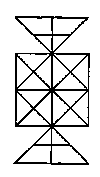
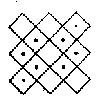
In the second kind the parties, being numerically equal, stand opposed as in checkers, where a hot struggle goes on to get three men in a row—at least this is one of the simplest forms of the game as described by Ovid. Among German antiquities there is a representation of two men with a board set with stones. Schuster at least considers this a game similar to checkers.389 And besides, there are groups engaged in the Damen-Spiele, which was probably known to the ancient Egyptians as well as the Greeks and Romans, although we can not be certain as to the rules of these ancient games, πόλις, ludus latrunculorum. In mediæval times elaborately ornamented boards were used for this game. “Especially noteworthy,” says Weinhold, “is one that is used as a reliquary on the altar at Asschaffenburg. It is set with jasper and beryl crystals, beneath which various figures are inlaid in the Roman manner on a gold ground.”390 Büttikofer brought with him from Liberia a very interesting ethnological specimen, almost unique in character. The game played in that region does not require a board or other flat surface, but wooden cases into which rods are inserted like arrows in a quiver. This represents the placing of the men on a board. Each player has ten rods, of which only four are placed at the beginning of the game. The dots in the cut show their position. The object is to get into the enemy’s country by judicious jumping, the reserve ammunition being placed as occasion requires until the supply is exhausted.391 Another form of this kind of game is the Oriental Mangale, which is now becoming quite general.392 In Damascus, where, according to Petermann, it is constantly played in all the coffee houses, a board two feet by six inches is used. It is over an inch thick and has in its upper side two parallel rows of holes, seven in number in Damascus; other places have six, eight, or nine. In these holes tiny pebbles, gathered in a particular valley by pilgrims to Mecca, are laid; usually seven in each. The player removes the stones from the first depression on his right, and throws them one by one toward the left and into the holes on his opponent’s side. This play is kept up under certain rules and conditions, of course, and with the aid of much counting393 of winnings, and whoever gets the most stones has the game.394 In concluding we must not fail to notice the noblest of all board games, chess, which, on account of the great variety of men employed and their complicated moves, is the most difficult of games, as well as the most entertaining. Many are of the opinion that some ancient games are of the same character, but it is probable that real chess is of Indian origin, whence it spread to the Persians and Arabians, and through them into northern Africa, Sicily, Sardinia, and Spain. In the last-named country we hear of it as early as the ninth century, and it appeared in Italy and Germany certainly not later than the eleventh, soon becoming the favourite game of the educated classes. This is proved by the fact that in a book of sermons published in the latter half of the thirteenth century one Jacobus de Cessoles, a Dominican, attempts to set forth a system of rules for right living founded on the rules of the ludus scaccorum.395 The game has naturally undergone many changes in the course of time; for instance, the Arabians originally had elephants in the place of our bishops; but it has always preserved the character of a battle, and is so represented in old Arabian manuscripts.396
Our third group of board plays is comprised of those which add the attraction of chance to intellectual enjoyment of the contest. It is true that to a certain degree chance is an element in the purest games of reason, since the most skilful player can not foresee all the consequences of a move, and various uncontrollable influences397 may interfere with the best-laid plans; but in the games which we are now considering there is a blending of risk with calculation, which has a peculiar charm. Perhaps the most familiar game of this kind is backgammon, which was certainly known to the Greeks and Romans, and possibly to the Egyptians and Phœnicians. In this game and kindred ones the object is to throw away men whose value is determined chiefly by chance, while the advance to advantageous points is a matter of calculation, thus affording a combination of direct and indirect fighting. Backgammon is of peculiar ethnologic interest because of the prominent part it plays in the controversy as to whether Asiatic influence is traceable in primitive American civilization. E. B. Tylor has stated in several passages398 that a kind of backgammon played on a cruciform board is a favourite amusement of the East Indians, and is called by them Patschisi (in Burmah: Patschit), and a very similar form of the game was known to the pre-Columbian Mexicans under the name of Patolli. Tylor considers the complicated nature of the game as a sufficient disproof of its independent origin, and from this, and a certain kinship to chess which is apparent in it, he concludes that the whole group of games furnishes an important argument in favour of Asiatic influence on American life before the time of Columbus.
Dominoes may serve as the connecting link between such games as we have been considering and card games, since the lack of a prescribed field, the concealed store of each player, and the chance distribution at the beginning, as well as the acquisition of new ammunition during the game are common features. Playing cards are supposed to be a comparatively recent invention of the Chinese, which, like chess, was carried into Spain by the Saracens, and thence spread all over Europe in the fourteenth century. Many are of the opinion that they are a modification of chess, and in fact the oldest game known to be played with them is one of the most complicated that we have—namely, Taroc, which requires seventy-eight cards. It was played in Bologna in the beginning of the fifteenth century.
Since the victory in card games is not won by virtue of the position of the cards, but by their succession and value, the faculty of memory is largely concerned, as victor and vanquished at once disappear and the men yet unengaged are concealed. This and the inequality of the players’ forces at the beginning constitute the distinguishing feature of cards. Lazarus’s penetrating glance has descried the point which differentiates the various games, placing them in the varying relation of accident and calculation. “Not all games,” he says, “are alike in this. There are some in which chance is predominant—as poker, for example, or the new game of bluff, so popular in America, where so much depends on the dealing, and the play is not so much a calculation as an attempt to exhaust one’s opponent.... The stronger games, however, such as whist, Boston, l’hombre, solitaire, piquet, Skat, euchre, etc., depend on the sustained influence of both chance and calculation. After the cards are once distributed calculation begins, but chance continues to be powerful,399 for at every play a new card enters into the combination and must be given its due weight, whether from the hand of friend or enemy. This is more obvious in the cases where the original force is recruited by drawing from the pack; yet even here attentive following of the progress of the game will furnish data for determining the probable situation of a third card, and thus, after all, skill has as much to do with it as chance. And in such a game as whist en deux in which all the cards are dealt, and each player knows exactly the strength of his opponent, the whole thing depends on calculation, and consequently is not so attractive. It would be a game of chess with cards but for its inferiority in variety and combination.”400 Lazarus goes on to say why chance is indispensable in card games—namely, because, as there is no such thing as space combination, the monotony would be wearisome, and continued playing well-nigh impossible. Without Fortune’s reverses, too, the games would necessarily be begun with equal forces, and it is easy to see how little enthusiasm such games would excite. Only in connection with chance, then, can Reason find in cards a task worthy of her powers, and, indeed, a small prize is a stimulus sometimes needed to keep up our interest. This may be a suitable place to mention that it was formerly the custom to play for money or some stake with all games of chance and even with chess.
I close this review of contests which are purely intellectual with two brief remarks, the first of which concerns the invention of board games. It is difficult to find a perfectly satisfactory answer to the question of their origin. However, their complication points to adults rather than children as their probable inventors, and to me the following consideration seems important: The primitive races, who find it difficult to convey their thoughts in speech, naturally take to marking on the sand, and hence the figures might arise.401 If the leader of one of the more intelligent peoples wished to instruct them concerning some past or future combat, it would be a simple method of illustrating his meaning to draw an outline on the ground and represent the position of the hostile forces by small stones or similar objects whose movements would symbolize the manœuvres of the forces or the advances of knights for single combat. This would, no doubt, be exceedingly interesting to those conducting it, and also to the spectators, and might easily be repeated for the sake of the amusement afforded until some inventive genius turned it into a veritable play with board and men. To show that there is nothing improbable in this supposition we may point to the fact that such play is actually carried on by our own officers (Italian, manovra sulla carta).
The second remark relates to the pleasurable quality of games involving use of the reasoning faculty. We have already shown that play with reason takes the form of experimentation with imagination and the other intellectual faculties in their capacity of illusion workers as well as in their more constructive activity; now we find further that its recreative effect is much greater than is realized during the progress of the game, and that the consciousness of standing voluntarily in a world of our own creation may be a feature in the interest excited by the game.402 The chief source of satisfaction, however, is enjoyment of the fight, in the playful intellectual duel, where bold attack and skilful parry, systematic advance and stubborn resistance, crafty manœuvring and direct assault, single combat and the general skirmish, as well as pursuit and demolition, succeed one another in ever-renewed combinations. In those games which add the charm of uncertainty to the mental contest the effect is of course still more complicated. As I shall have occasion later to speak exhaustively of games of chance, I confine myself here to Lazarus’s significant conclusion from the union of these contrasted forces. “That men, and, indeed, the same man can take pleasure in such opposite and absolutely contradictory principles of play seems wonderful, and yet it is most natural, for both are elements of human nature grounded in the very essence of his being and the normal manner of using his powers. In his serious, moral life, directed by the mandates of duty, he is also controlled by two contrary forces, freedom and necessity. He must bow to Fate and yet strive and struggle for what is his own. He expends his energies according to his own behests, and must then await success and reward till the turn of Fortune’s wheel. Both disappointment and struggle, receiving and expending, suffering and toiling, are woven into the texture of his life and character, and become the sources of his volition as well as the arbiters of his fortune. He obeys both forces; to pursue and hold to what is good is his dual impulse, both in life and in play.”403
3. Physical Rivalry
In playful competition indirect conquest of an opponent is aimed at, since the effort is to show that one can perform the task better than another. In it the fighting instinct assumes the form of rivalry. “No entreaties or commands,” says Lazarus, “nor even tips, could arouse our coachman to such a display of skill and speed as could another coachman who showed a disposition to race with him. Apart from the fighting instinct itself, jealousy is the prime cause of rivalry”. Spinoza defines it as “the desire for a thing aroused in us by the belief that others want it.” One of the first manifestations of jealousy in children is with regard to the love and caresses of its parents; we all know at what an early age the infant expresses his disapproval when his mother pets another child—sometimes as early as the second quarter. If he shows it simply as anger he is plainly jealous, as older children are; but if (as a dog often does when the hand he loves strokes another) he tries to win to himself by all sorts of cajoleries the maternal tenderness, then he enters upon a sort of rivalry. True emulation, however, is first developed when the aim is to win approbation and admiration when praise rather than love is the alluring reward—in short, when the child becomes ambitious. Say to a three- or four-year-old boy, “Your friend Otto can draw beautifully,” and it is ten to one that he will answer, “But I can draw better.” This desire to surpass others is what leads to the indirect contest which we call rivalry.
Imitation, too, plays the part of a first cause here, as Spinoza points out in pursuance of his definition of emulation. As, however, this subject will come up for discussion later, let it suffice to say here that imitation is exceedingly important for all mental and physical development, and is accordingly especially conspicuous in the play of children. The effort to say “I can, too,” easily takes on a certain hostile character when there is difficulty in attainment, and so imitation becomes actual rivalry as soon as the effort is for “I can do better,” and the struggle becomes sharper in proportion to the consciousness of a desire to surpass. Thus we are justified in regarding the impulse of jealousy which is related to the fighting instinct as the foundation of rivalry as well.
Before going on to investigate this playful rivalry it may be useful to inquire into its social significance. G. Tarde, in his interesting sociological study, Les lois de l’imitation,404 attempts to prove that imitation is the mainspring of social evolution. But along with the peaceful operations of imitation, the fighting instinct, too, makes itself felt in manifold ways, as a principle of progress (as I remarked above in discussing combativeness), in conjunction it is true with imitation and usually under the form of rivalry. It is evident that social progress would be slow indeed if men only imitated and never opposed what is done in their presence. Rivalry in ownership, power, and authority is the force which urges each to do his utmost in the struggle for life, and which has produced the most advanced civilizations. A people without ambition is lost; not merely stationary, but actually decadent. As in art bald imitation of even the best models results in weakness, so in society. Men must will to do better in order to do as well.
In spite of their variety we can very quickly review the physical imitative games, since under movement-plays we have already noticed a considerable number belonging to this class, and since it is their psychological side alone that chiefly appeals to us. The following examples, then, are merely chosen to show by means of their variety the great importance of imitation in human play.405 Children learn most of their bodily movements by such play in a way which clearly illustrates the mingled effects of imitation and emulation. When one child jumps off the second step, another child who sees him immediately tries to cover three; and when boys are practising their leaps each makes a mark in the sand beyond the others as his goal. To lift a heavier weight, to throw farther, to run faster, to jump higher, to make a top spin longer, to stay longer under water, to shoot higher, farther, and with better aim than his comrades can, is the burning wish of every childish heart. In order to see the same enthusiastic rivalry in physical prowess exhibited by adults, we must turn to the half-civilized peoples to whom such acquirements are of surpassing value in the struggle for life. Among the ancient Germans, for example, such contests were carried to the highest degree of perfection, and, in spite of their avowedly playful character, conducted with such seriousness that they often became matters of life and death. Skill, prowess, and endurance in leaping, running, lifting and throwing huge stones, the use of bow and arrow, diving and swimming, riding and rowing, were all the subjects of contest, and each victor sought to surpass the achievements of the former one. All warlike peoples of whom ethnology is cognizant show much the same picture, and highly civilized nations, too, accord an important position to athletic contests, as the Greek and Roman games bear witness, as well as the championships and records of our own day. Rivalry enters, too, into such games as tenpins, billiards, croquet, golf, etc., all of which are favourite amusements. The pleasure they afford is complicated, including display of one’s own strength and skill, the pleasure of watching others, the stimulus of rivalry and the satisfaction of overcoming an opponent. Sometimes, and especially in croquet and billiards, the contest closely approaches fighting play, since the participants not only try to attain the object of the game, but are apt to engage in direct hostilities.
We now turn to some examples that are better calculated to exhibit the many-sidedness of rivalry, which is, of course, an element in all the games of skill which we have mentioned. We are not so well prepared to find it in games requiring patient effort, yet even the Eskimos, in their Fadenfiguren, indulge in fierce emulation,406 and a play as peaceful as kite-flying is not exempt. “The Hervey Islanders believe that once the god Tane challenged the god Rongo to a kite-flying contest, in which the latter won because his cord was longer.”407 In drinking there is rivalry in the effort to withstand the power of alcohol, and students have a time-honoured tradition that the man is a fine fellow and worthy of all respect who can drink the rest of the company under the table. It is more charitable to attribute this practice to rivalry rather than to love of drunkenness.408 The instance of the two boys holding burning matches illustrates how readily the ability to suppress any manifestation of pain lends itself to rivalry. The old Germans tested their endurance by sitting at feasts after their battles, and when they were covered with wounds. In a grotesquely exaggerated saga it is related of the wounded sons of Thorbrand: “Thorodd got such a blow in the neck that his head hung sideways; his hose were all bloody and would not meet. Snorri could see and feel that a sword was sticking in his thigh, but Thorodd said nothing. Among the gayest of the gay is Snorri, son of Thorbrand, who sits with the others at table, but eats little and looks white. When asked what ails him he says, ‘When the vulture has won the fight he is not in haste to eat.’ Then Gode looks at his neck and finds an arrow head at the root of his tongue.”409 The jeering of Walthar and Hagen, who vie with one another in mocking at their wounds, is another case in point. Finally, the passion for making collections, which is so strong in both children and adults, may be considered as a form of competitive rivalry which reaches its climax in the miser.
4. Mental Rivalry
The space devoted to the more general kinds of emulation has purposely been curtailed in order to devote more to the special case of gaming, as much of the ground has been covered already.
Children are fond of displaying their mental acquirements even before they are old enough to go to school, but it is there, of course, that the best opportunity is afforded them. Colozza tells us how the Italian children use their recess time for contests over the multiplication table.410 During school hours recitation is easily transformed to emulation which can be turned to account by the judicious teacher with better results than are attained by one who tries to draw the line too rigidly between work and play.
The intellectual rivalries of adults are exceedingly varied. Music offers unlimited opportunities when people are far enough advanced to have any sort of society, and even primitive tribes indulge in this sort of entertainment. Among the Eskimos the contestants compete in public for the prize for singing, and then fall into actual combat, thus combining the two forms of rivalry. Grosse quotes from Rink the following musical dialogue between two East Greenlanders. “Savdlat: ‘The south, the south, oh, the south over there! As I stood on the headland I saw Pulangitsissok, who had grown fat upon halibut. The people of this land know not how to speak. Therefore they are ashamed of their language. They are dumb over there; their speech is not like ours. In the north we speak in one way, different from those in the south. Therefore we can not understand their talk.’” To this challenge Pulangitsissok responds: “‘There was a time, as Savdlat knows, when I was a good sledger, when I could take a heavy load on my kajak. Four years ago he found this out. That was the time when Savdlat bound his kajak to mine for fear he might capsize. Then he could carry a good load on his kajak, too. As I was tugging along you cried out pitifully, and were afraid and almost overturned. I had to hold on to my ropes to keep us up.’”411 Such sarcastic dialogue often leads to direct contests, in which the singers try to rout one another by means of their witty improvisations. A later form is the contest in oratory and song on an assigned theme, opening with a direct challenge between the contestants. The poem of Wartburg-Krieg is especially famed, while Plata’s symposium may be instanced as a fine example of competitive oratory on a given theme.
Other kinds of rivalry frequently arise in social gatherings, such as recounting experiences in love, hunting, and battle, as was pre-eminently the custom among the ancient Germans. “One after another,” says Weinhold,412 “boasted of his prowess and sought to prove it by tales of his wonderful deeds. To heighten the effect, each chose an opponent worthy of his mettle. Thus it happened that Eystein and Sigurd, the crusader, both Norwegian kings, once had a controversy in court. Eystein advanced the proposition that it was impossible to live aright in society, and called on his brother to sustain the contrary. Then the travelled warrior Sigurd, who had filled all lands with the fame of his deeds, and the peace-loving, home-staying Eystein, each related what he had done and could do: the one his battles, his fame in the East; the other that he had built huts for poor fishers, made roads over rugged mountains, opened harbours, widened Christendom, and strengthened the Church—in short, extended his kingdom by every peaceable method. The talk became warm, and the silence which followed was ominous, but as they were both noble-hearted no harm came of it.” Very characteristic, too, is the Harbardhslied in the Edda, where the gods Wotan (under the name Harbardh) and Donar emulously recount their achievements:
Donar: “Do you ask what I did to Rungner, The giant with sturdy heart and head of stone? I felled him then, he lies at my feet. And what did you, Harbardh, the while?” Harbardh: “For more than five full winters Was I on an island that is called Allgrün; There I found men to fight and enemies to fell, Many things to prove, and many maids to free,” etc.
Singing the praise of one’s future deeds is another form of such boasting. A company of carousing men have need of a wild boar or some other sin offering to go through their midst as they perjure themselves with oaths concerning the hazardous and difficult deeds which they mean to perform.
Before taking up games of chance again I mention once more the fact that many reasoning games are also rivalries—dominoes, for example, and backgammon413—since the chief effort is to reach a certain goal first and direct efforts are made to embarrass and retard the adversary, so that genuine fighting play results.
In chance games proper, however, the contestants do not attack one another directly, but seek to conquer by the better solution of some problem, the point of departure from other rivalries being that the reward of solution, at least in games of pure chance, is entirely accidental, and not dependent on the player’s strength or skill. We will now attempt to review the more important phenomena connected with such games, and later study the question in its psychological bearings.
The wager is akin to play with chance and arises from the holding of opposite opinions, which can only be settled by future events. Even if the bet concerns something which is past or present, still the decision must be in the future, and the fighting element comes in in the striving of each to prove his superiority, the interest being much enhanced by pooling the stakes. The bettor’s conviction as to the correctness of his opinion may be strong or weak414—absolute certainty destroys the validity of the bet, while absolute uncertainty makes it a mere game of chance, whereas it should depend, like the best card games, on a union of reasoning and hazard. For this reason future events are the proper subjects of the wager, and we will confine ourselves for brevity’s sake to such bets. Schaller says rightly: “The future is pre-eminently the object of conjecture, of the reckoning of probabilities. Even when present circumstances seem to tend inevitably to a certain result, there are still infinite possibilities that other results may transpire. Therefore the wager should concern something yet to come.”415
One of the earliest forms of betting was on physical or mental superiority, and the stakes formerly so common in reasoning games may be regarded in the same light. There was much betting on the victor in the old German riddle contests and life itself was sometimes staked, if we may depend on the ancient accounts. More often, though, physical prowess was the subject of the wager. “Indeed, Tacitus may be right,” says Schuster, “when he records that the Germans disdained to be praised for ordinary physical vigour, yet they gave prizes to the victors in their contests and liked to claim the glory when it set them above others. Reputation with them must not be mere empty words; one must work for it to the full extent of his powers. Many examples illustrate this spirit; for instance, Welent and Amilias, the smiths, each boasted that he could not be surpassed in his art. The latter offered to bet on it, and Welent replied, ‘I have not much property, but I will stake it all.’ Then said Amilias, ‘If you have nothing else, stake your head, and I will stake mine, and whichever of us is the better man shall cut the other’s head off.’ Two of Olaf Trygvason’s retainers boasted of being superior mountain climbers, one wagering his ring on it, and the other his head.”416 Schuster cites, too, the famous contest in the Nibelungenlied, to which Brunhild thus challenges King Gunther:
“She said: If he is your lord and you are in his hire, Tell him that I have sworn that whoever can resist my play, And prove himself my master there, him will I wed, While if I win you must go alone from hence.”
Fable makes animals wager in the same way; the old tale of the hare and the hedgehog is found even in Africa, although there the hedgehog has become a tortoise.417
The stakes are not always, however, on one’s own ability, but quite as often on the performances of others, or on the speed and endurance of animals. This is indeed the most popular form of the sport, doubtless because the agreeable tension of expectation is thus prolonged until the very moment of the dénouement, as it is not likely to be in the more personal contests. In riding, rowing, sailing, and running contests spectators, as well as participants, bet on the result.418 “Betting on races,” says E. v. Hartmann, “is the most dangerous and exciting form of gambling, being dependent purely on chance, and yet offering a false appearance of being essentially influenced by intelligence and judgment. The custom is fostered of raising the stakes at the last moment under the influence of artificial stimulation to interest during the race itself. Immature boys, sons of respectable labourers, are thus initiated in the fascinations of the passion for gaming who would otherwise have little inclination for it.”419 In various parts of the world wagers are laid on the result of fights between animals. In ancient Greece gamecocks were bred with special care, and Tanagra, Rhodes, Chalcis, and Delos were famous for the achievements of their respective breeds. The birds were fed with garlic before the fight to augment their excitement, and were armed with artificial spurs. The stakes were often enormous.420 Cock-fights in which betting seemed to be the principal feature were held during the middle ages in most European cities, and in some localities have survived to the present day. Malays are especially devoted to this sport. It only remains to add in conclusion that lifeless things, too, may be the subject of bets. The Gilbert Islanders set two sailboats, about four feet long, afloat, and bet as to which will sail fastest.421 This is very near to being play with pure chance, and the wager of Canning with an English duke is even more so. They staked a hundred pounds on the question of who should meet most cats on a certain road.
There is but one opinion as to the origin of games of pure chance—namely, that they grew out of the serious questioning of Fate in the form of oracles, and colour is given to the theory by the custom of jesting with the oracle. The Greek custom of pouring wine into a metal cup and from the sound it made reading one’s prospects in love, drawing straws—a practice which Walther von der Vogelweide has made famous—the various flower oracles, counting the cuckoo calls, observing the flight of birds—as, for example, how many times the kite circles—and many other such customs422 were originally conducted seriously, with a view to gaining some knowledge of the future, and even when playfully practised smack of superstition. Tylor says, in his admirable study of this subject: “Soothsaying and games of chance are so closely allied that the instruments of each are used interchangeably, as among the clever Polynesian magicians cocoanuts are skilfully rolled about in a circle. In the Tonga Islands the chief use made of a holiday is to inquire whether the sick will be cured. They offered loud prayers to the family deity that he would place the nuts aright, then spun them, and from their position judged of the god’s will. Under other circumstances, when the cocoanuts are rolled simply for amusement, no prayer is offered and no significance attached to the result. The Rev. G. Turner found the same custom in the Samoan Islands in another stage of development. There a company sits in a circle, the nuts are rolled about among them, and the oracle’s answer depends on whether the monkey face of the nut is turned toward the questioner when it stops rolling. The Samoans formerly used this method to detect a thief, but now it is a forfeit game.”423 In this sort of play with chance there is nothing special at stake, yet it is no doubt closely connected with those forms which have this feature.
Another of the earliest of the manifold forms of chance games is the casting of lots. New Zealand wizards decide the fortunes of war by throwing staffs. If the stick which represents their own tribe falls on that of another, then a favourable outcome may be confidently expected to the battle. The Zulus have a similar ceremony, and the Hindus cast lots before the temple and supplicate the gods for victory. In the Iliad the crowd prayed with outstretched hands while the dice in Agamemnon’s helmet decided who should be the first to fight Hector. Tacitus tells us that the German priests tossed three dice on a white cloth before they attempted to reveal the future.424 The origin, then, of the use of dice in games of chance is indubitable. The ancient form of backgammon common in India and Mexico was played with lots instead of dice, as was also the case with the Arabian Tâb. Some Indian tribes use the simple casting of lots for gambling purposes. The Arabian does not throw, but draws lots as a substitute for the Meisir forbidden in the Koran.425 The complicated Chinese game lotto is well known, and Bastian found a similar one used in Siam.426 E. von Hartmann refers repeatedly in his Tagesfragen to our European lottery, combating the popular idea that it is reprehensible, and should not be fostered by the state. He sees in a well-conducted state lottery the best means of directing the ineradicable tendency to play games of chance into harmless channels. Money speculation is, as a rule, little different from a lottery, since the great majority of speculators have no more intimation of the outcome than is furnished by the law of probabilities which governs pure games of chance. Returning now to simpler manifestations, we find many which are closely related to the use of lots. North American Indians, who are zealous gamblers, use marked or coloured stones, seeds, and teeth, and stake their clothing, furniture, weapons, and, in fact, all that they possess. In Burmah a favourite game is played with beans, and in many of the villages a thrashing floor is erected for the express purpose of supplying the demand.427 In Siam the children play with shells, and everything depends on whether the opening falls up or down.428 A similar game was known to the Greeks, and in Rome a coin was tossed with the cry, “Caput aut navis!” equal to our “Heads or tails!” We must suppose that such play by children is derived from adult games of chance.
Astragalus and dice were the implements used in many such games. The former are peculiarly shaped bones from the ankles of sheep, goats, or calves, and their use for such purposes is very ancient. They are capable of resting on any one of four sides which may vary in value, as the six sides of dice. The Schliemann collection in the Berlin Museum contains some of them which were found in the “second city.” In ancient Greece four astragali were used in the games of adults, and were thrown either from the free hand or from a cup. Special names were given to the various throws, such as Aphrodite, Midas, Solon, Euripides, etc., and the worst throw was called, there as in Rome, the dog. The children of antiquity also played with these bones a game partly of chance and partly of skill, and Hellenic children use them to this day. Ulrichs saw them at Arachola on Parnassus. “The children there,” he says, “play with the astragalus, which is a small four-sided bone rounded at the end and so shaped as to be capable of resting on any of its sides. In the game the uppermost side is read, the commonest throw being that which brings the round end up and is called the baker or the donkey. Then follow the thief, the vizier, and, rarest of all, the king, the side which looks like an ear and is opposite the vizier.”429
The name vizier seems to point to Mohammedan influence, and indeed the children of Damascus have a special game of chance with astragalus in which the terms vizier and thief are both used.430 Some think that ordinary dice are derived from the astragalus, but it would be difficult to prove, though their imitation in other materials seems to suggest it, as in the case of the oblong dice used by the Romans with cubical ones, and several hundred prehistoric dice found in Bohemia are of similar form. The Berlin Museum, too, has oblong dice from India and China, showing that they were widely used in the Orient, and Hyde points out in his history of games of chance that the Greek word κύβος is related to the Arabic Kab, which meant simply made of lamb’s bones. On the other hand, cubical dice with spots like ours are found in Theban graves, so that we can not be positive as to the priority of the astragalus.
Possibly cocoanut rolling was the primitive form of roulette as we have seen it used in half-religious, half-playful manner by the South Sea Islanders. The Berlin Museum has Chinese rolling dice through which a peg passes, projecting on each side or with the peg on one side only, and the ball tapering to a point on the other. According to Egede, Greenlanders have a sort of roulette, an oblong ball about which the players sit with the stake before them.431 Another form of chance game is the morra, which was probably known to the ancient Egyptians, and was in all likelihood at first a clever method of calculating.432 As a play the hands of all the players are thrown simultaneously into the air, and each must guess at the number of outstretched fingers without taking time to count. This amusement, still very popular among Italian peasants, was called by the Achæans “micare digitis.” In China, where it is zealously cultivated, it bears the name of “tsoey-moey.”433 The North American Indians have a modification of it in their cane guessing—namely, the effort to locate a small object passed quickly about in a company. It is used for gambling purposes, the Indians staking all that they have, even to their wives sometimes.434 The “Kyohzvay” play is taken quite as seriously in Burmah. For this a stick is fixed among the folds of a tightly wrapped cord, and the game is won or lost435 according as it is or is not successfully concealed.436 The various games of cards afford by far the most important instances of play with chance, and their name is legion. We have not time even to glance at such games as faro, lansquenet, rouge et noir, trente et quarante, etc., except to say that they all depend on a combination of reason with chance, and so more speedily put an end to suspense as to who is the victor than do purely chance plays. We are now confronted by the difficult question of what it is that constitutes the demoniacal charm of gaming, whose power is demonstrated by the value of the stakes with which a man will tempt Fate. Every one is familiar with Tacitus’s description of the ancient Germans who, when they had lost everything else, staked their freedom and their life on the last throw. H. M. Schuster gives a long list of examples of Germans staking freedom, wife, and children, the clothes on their backs, life itself, yes, even their souls’ salvation when their passion for play was at its height. That this is a universal Aryan trait is shown by the Indian poem of Nala and Damayanti. The former, under the power of a hostile demon, loses at play with Pushkara his ornaments, jewelry, horses, wagons, and clothes. In vain his wife and followers seek to restrain his madness; for many months the ruinous play goes on until Nala has lost all his property and even his kingdom. Then as Pushkara, with loud laughing at the unlucky fellow, cried out that now he must put up his wife Damayanti, Nala rose from the table and walked away with his faithful wife, stripped as he was of all else. The Chinese, Siamese, and Burmese, too, are all passionate gamblers, and the Malays are famous for their wagers on animal fights. This is sufficient to show that the wonderfully strong attractive power of gaming, “le jeu-passion, dont le rôle tragique est vieux comme l’humanité,”437 is the result of numerous causes whose aggregate, according to Fechner’s principle, is far greater than their numerical sum. Taking account of the essentials only, we still have a threefold phenomenon; these are, desire to win the stake, the stimulus of strong effects, and the impulse given by the fighting instinct.
Winning the stake is so important that without it games of chance become very flat and most unimpressive, as forms of entertainment. How is this to be explained? Sometimes it appears as veritable cupidity, the “fascination d’acquérir d’un bloc, sans peine, en un instant.”438 The seductive chink of gold pieces is heard and visions of new names of wealth open before us, promising to deliver us from all burdens and dangers which in spite of their distance and vagueness we strive to get possession of by a single turn of Fortune’s wheel; the gold fever is at home in gambling dens. Yet—and I think this is important—as a rule, it is not mere greed for gain as such, but a feeling more refined. It is boundless delight in sudden good fortune that makes the unearned winnings so enticing. That inward striving after the absolute, which is so deeply rooted in the human breast, is concerned in the longing to experience at least one moment of exhilarating joy with which a single stroke of Fortune’s wand sets our hearts aflame:
“From the clouds it must fall, Such is the gift of the gods; And the strongest power of all Is that which belongs to the moment.”
It would be misleading to suppose that all wagers in a game of chance are attributable to a desire to win, even in this refined sense. In so far as it is the chief motive, there is no real play at all, for it constitutes a serious aim wholly outside the sphere of play. There must be some other meaning to the intense delight in winning, and Lazarus, as usual, puts his finger on it. “Even for an onlooker, not pecuniarily interested, the charm increases with the value of the stake.”439 The stake serves not only to enhance the thought of winning the game, but intensifies the decisive moment.440 A gambler must have excitement at any price, and he also wants to risk something; betting satisfies both demands.
The need for intense stimuli which we are so constantly encountering in the course of this inquiry appears as the second motive in our classification, and it is met by a storm of effects which betting excites. Consequently gambling is pre-eminently suited to supply this demand. I have already pointed out that betting on the performances of others is an especially popular form of gambling, since in this way alone can the excitement be enjoyed unimpaired by personal considerations. So, too, in games of pure chance, which relegate the player to comparative inactivity and impart a feeling of externality among its other effects. By far the most important of these effects is the contrast of the emotions of hope and fear, and often this simultaneous action of opposing passions is sufficient to stir the soul to its depths, since, as Lazarus penetratingly remarks, the result is in either case positive; the question is not, winning or not winning, it is winning or losing. This is another point which renders games of chance peculiarly fit for the production of exciting effects. Also besides fear and hope there is the tension of expectation and the shock of surprise to render the mental agitation more intense and varied. This explains why gambling is the last resort of the dissipated, worn-out man who needs sharp stimuli to arouse his exhausted powers.441
Gambling is, moreover, a fighting play, and this is doubtless one of its most important phases. There is no other form of play which displays in so many-sided a fashion the combativeness of human nature and with so slight expenditure of time and strength. There is the charm of danger as such, enjoyment of bold betting which in the changing course of the game is constantly renewed, and further indirect as well as direct battle with an opponent, for he who makes the best throw gets the best card. Besides all this there is the desire to win his wager, and by means of the steady augmenting of stakes it differs from all other fighting plays in affording at the last moment, when all seems lost, an opportunity of retrieving everything by a sudden overwhelming victory. And finally there is the defiance of the power of chance, or rather, if a religious rearing makes one scruple to put it in this form, we may call it a struggle with the powers of darkness.
The question now arises whether this is properly called a fight when the player can not influence the outcome, but must submit absolutely to the incalculable hazards of fortune. What right has he to congratulate himself on a victory for which he is in no way responsible? To this it may be answered that in addition to this subjective, psychological condition there is an active contest; for an illusion exists in connection with every game of chance that in some way the outcome is dependent on the capacity of the player, and a little reflection will show that this is characteristic of human nature. How else arises our naïve sense of worth or of shame? Are we not vain of physical beauty, of inherited advantages, and of riches which we have not earned? Does not the consciousness of deformity, stupidity, weakness, awkwardness, or even a lowly origin impart a feeling of shame and a sense of responsibility for our own shortcomings? We feel as if we had had a voice in the fashioning of our bodies and souls and a choice of our position in life—in short, as the vulgar saying has it, as if we had not been careful enough in the choice of our parents. Just in the same way we are proud of our luck in play. Luck is genius, and he whom it smiles upon is a hero.442 This failure to discriminate between fortunate circumstance and personal merit is shown in a striking manner in popular poetry. Its heroes are often armed with magic weapons or directly assisted by higher powers who lend them supernatural strength or work ruin to their enemies. Such advantage is thus given them that the reflecting person has some difficulty in regarding their exploits as especially praiseworthy, yet the average hearer is undisturbed by such considerations. For instance, consider the invulnerability of Achilles and Siegfried’s Tarnkappe, which gave him in the fight with Brunhild “the strength of twelve men.”
In the case which we are considering, however, this habit of mind has a twofold significance: First, there is the personification of chance as fate, with whom the player struggles. Lazarus says: “Instead of blind chance, he pictures before him a reasoning intelligence whose laws he tries to fathom, and in the face of many failures and mistaken conclusions he persists in attempting to calculate his chances and to count on them, forgetting that the reckoning of probabilities is useful only in generalities and is practically worthless when applied to a single case. By and bye he endows luck with moral qualities as well. He will risk everything on a single card, and either can not believe that Fate will be inexorable, that his faith and perseverance must at last be rewarded, or else assumes an attitude of defiance to a hostile being.”443 In the second place, the gambler regards the implements of his trade as does the magician among primitive peoples the means of performing his incantations. It is actual fetich worship in which personification assumes proportions quite different from those it bears in the general idea of fate. Demons who sometimes obey the player’s will, and sometimes mockingly defy him, seem to dwell in the dice and cards, transforming play into a contest in magic arts. This is perhaps not so strongly felt by cultivated people of the present day as I have represented it, yet it is present in a more or less rudimentary form in all devotees of the game. While some scoff at it, even they avoid those things which are traditionally supposed to bring ill luck. Thus, when I was a student, in our games with dice which were very popular, the following rules were rigidly observed: In order to throw double sixes, the player took the dice cup in his right hand, placed the left over it and shook it solemnly three times up and down before making the final throw. If low numbers were desired, the inverted cup was held slantingly and drawn carefully back on the table so that the dice glided out rather than rolled. For medium throws there was a choice between two methods over whose comparative efficacy there was serious controversy: either to rise from the table and empty the cup from a height, or to propel the dice suddenly by a sidelong movement from the cup, held at a slant. Was all this mere joking? To a certain extent certainly it was, yet the boys half believed in it and had a poor opinion of beginners who did not know how to handle the dice. Among the lower classes, however, and among peoples of less advanced civilization this fetichism is much stronger. Konrad von Haslan, says Schuster, testifies to having seen and heard “how on the one hand dice are honoured, greeted, and kissed, and have offerings of booty made to them, while on the other they were beaten and abused as if they possessed life. Often the player who has lost by them takes revenge by picking out the spots or smashing the dice with a stone or biting them in two to make them suffer.”444 All these circumstances combine to make gaming a fighting play not alone with men, but also with supernatural powers whose inscrutable decisions possess a peculiar power and whose favour lends to the fortunate player a special nimbus, while the vanquished does not suffer in his own esteem as if he had been conquered by a human foe.
Finally, we should note that gaming has various mental connections with experimentation, since enjoyment of the excitation of hope and fear and the feeling of suspense as well as the shock of surprise is experimental in every case. With this is combined great activity of attention and imagination to whose agency the personification of which we have spoken must be ascribed; reason’s part in the process is displayed in the complex calculation of probabilities, and that of the will most conspicuously in the effort to appear outwardly calm while the wildest excitement reigns within, and hope and despair surge in alternate waves across the soul.
It is difficult to say which of these stimuli ought to be placed at the head of the list, but two appear to me to be rather more important than the others. First, the combative impulse, whose influence is particularly strong here; and, second, pleasure in intense effects, as when the “gold fever” takes the form of longing for a supreme moment which shall fill the soul to the brim, something which will transcend all other transporting agents. Both find their satisfaction at the gaming table, owing to the suddenness and importance of its revelations. In concluding, it may be remarked that the extraordinary persistence of gamblers, who sometimes sit all night at the table, as if hypnotized, may be at least partly explained by the law of repetition taken in conjunction with the independent attractions of the game. The performance of the last part of a mechanically repeated action tends to lead to the production of the first part again.
5. The Destructive Impulse
Turning our attention now to the third of our principal groups of fighting plays, the first subject—namely, the destructive impulse—will not occupy us long, as we have already given some consideration to it in the section on analytic movement-play. There we were chiefly concerned with the experimental element as manifested in the desire to take things to pieces. Here we shall emphasize the fighting instinct which is so easily aroused even toward a lifeless object, and frequently becomes a sort of delirium which is only appeased by the entire destruction of the object, as if it were a vanquished foe. And here, too, belongs the inquiry under what circumstances the discharge of this impulse, whether directed against a living or a lifeless object, may be considered as playful. As soon as rage ceases to be the chief influence, and the destruction is continued simply for the sake of its intoxicating effects, it takes on more or less of a playful character, though it is inexpedient to attempt to set clearly defined limits to what is earnest and what is play.445 When children tear paper or overturn structures laboriously erected by themselves, how often the interest is cumulative, developing finally into passionate eagerness from action which was at first indifferent! The paper is seized in the teeth, the building kicked to bits, objects which are breakable entirely destroyed, flowers pulled to pieces, etc. Education should interfere at this point and direct the play, imposing proper checks. Madame Necker de Saussure relates of a previously gentle and tractable girl of eighteen months that “one day when she was alone with her mother, who was confined to her bed from illness, the child, without the least provocation, broke into open rebellion. Clothes, hats, fans, and every movable object that she could lay her hands on were piled in the middle of the floor, and she danced around the pile and sang with the greatest delight. Her mother’s serious displeasure had no restraining effect.”446 “A girl three years old,” says Paolo Lombroso, “was left alone for a few moments, and proved her ability to improve the time. She at once began most energetically, and with full consciousness of what she was doing, to pull to pieces a basket of vegetables. She reduced all these to fragments, and then emptied an inkstand in her lap, amusing herself by smearing it on the wall and floor with her fingers. When that palled she took a corkscrew and punched her apron as full of holes as a sieve.”447 A little later in life the impulse leads to more violent misdemeanours. The destruction of garden borders, smashing of furniture in public parks, and many other acts of vandalism which we prosecute, are practised by half-grown lads, and sometimes even by students.448 Some may object to calling such roughness play, but play it surely is if there is no malicious intention, as is usually the case. Such mischief is often reprehensible, and deserves to be checked, yet such antics as those of the subalterns as described by Eugen Thossan can not be taken seriously. He says: “Suddenly a beer mug flew across the table and hit Sergeant Putz square in the face. This was the signal for a general free fight. Steins flew through the air like cannon balls. Four lamps borrowed from the officers’ rooms were on the table; one was struck and the chimney fell off. Somebody called out ‘When the chimney is gone the lamp may as well follow,’ and a blow from a fist shattered the lamp. A mad rage for destruction was kindled, and with anything that came to hand all the lamps were beaten to pieces. In the general hullabaloo no one noticed the wounds that he received from the splinters and blows. When every vestige was demolished, a frightful war whoop rose to the hall above.” It is more than probable that such orgies as this often have a certain connection with the sexual life. We find among animals—deer, buffalo, etc.—a similar rage for destruction during their breeding season.