PART I PLAYFUL EXPERIMENTATION (continued 2)
Elizabeth L. Baldwin translation
But how is it with the savage tribes? Here we find, indeed, that for the painting of their bodies, as well as for other ornaments, the warm colours are almost exclusively chosen. Besides black and white, hardly any other colours than red and yellow are found at all. “The Australian has always, in his bag of kangaroo skin, a supply of white clay and of red and yellow ochre. For ordinary occasions he contents himself with dabs on cheeks, shoulders, and breast; on holidays he paints his whole body.”125
Bushmen rub their faces and hair with red ochre; red is the Fire Islander’s favourite. Other savages use, with deep blue-black, a blazing vermilion, a combination which imparts to their faces the wildest and most forbidding expression. Among the famous discoveries which Fraas has described so well126 was a lump of kneaded paste about as big as a nut, compounded of iron rust and reindeer fat, and intensely red in colour. Probably every huntsman of the Ice period had one of these to colour his body with. The same colours are chosen for their other ornaments as well. The Australians stripe their girdles and neck and brow bands with red, white, and yellow, and the same or similar colours are in demand with the Bushmen and Fire Islanders. Among the Botoku red feathers, as the most costly decoration, form the insignia of rank. Others wear yellow feathers in the hair, and the same ornament floats above the brow of the Australian hunter. The cool colours are scarcely ever seen in primitive ornamentation, even in combination with red and yellow. Blue decorations are extremely rare, and the Eskimo’s lip wedge of green nephrite is quite unique in colour.127 From this brief survey we reach the conclusion that primitive man is not so sensitive as we are to the stimulus of the colder colours. In the painting of the body and some other ornamentation the prevalence of red and yellow may be partly attributed to the more general distribution of these pigments, but such a reason can not be assigned in the case of feathers, and we can not therefore deny the probability that for the savage simple green and blue lack the charm which they possess for the cultivated eye.128 That the cooler colours are imperfectly perceived, however, is an unwarranted supposition in the provisional stage which our knowledge of the subject has up to the present time attained.129 With them, as with children, probably the cooler colours fail to arrest their attention and excite their interest as they do ours. Whether this is the result of a kind of colour blindness or whether it is due solely to the intensive emotional effect of the warm colours it is difficult to say. The extraordinary want of susceptibility to reflected colour displayed by educated adults proves that the lack of æsthetic interest may assume the form of partial colour blindness. There are thousands, for example, who have never noticed the intense blue of a shaded cement road under a clear sky, although they may have seen it a hundred times. And they will complain bitterly of the gross inaccuracy of a picture which faithfully reproduces what is actually before them.
We may not dwell on the pleasure that is derived from colour in natural scenery, in ornament and in clothing, in the arts and industries, for the theme is practically inexhaustible, and we would hardly have space for even the baldest enumeration of its leading divisions. It would, for example, be well worth while to trace the historical development of the various standards of taste in such matters, to which this pleasure has at different times conformed. The special emphasis given to colour in the last decade has deeply influenced our poetry, and is characteristically illustrated in the writings of Jacobsen and G. Keller. The following passage from Martin Salander could hardly have been written in any century before the present one: “The setting sun, whose level rays shone through the handsome dining room, glittered on the golden lining of a large beaker, which stood before him, freshly filled with ruddy wine. The yellow gleam shot with indescribable beauty through the heart of the rich red transparent fluid. Martin raised his eyes from the glowing colour picture, which, coming direct from the open sky, was like a flaming seal for his thoughts. A sprightly lady sitting opposite him noticed that a rosy shimmer from the cup spread over his animated face, and begged him to sit still, for he looked beautiful. Flattered, he kept his face unmoved while the reflection vibrated with the wine in the cup, for a slight tremor ran along the table and disturbed the contents of the cups.” It is interesting, too, to note that boys concern themselves much less about colour than girls do, and yet the history of painting seems to show that the masculine sex has a finer colour sense than the feminine. This is probably explained by the fact that boys early develop the fighting instinct, and the active motor side of their nature keeping perceptive play activities more in the background, without necessarily depreciating their inborn capacity for enjoyment of colour.
I now turn to the subject of play with colour, as it is practised by adults. In his classification of the arts Kant has, strangely enough, inserted a colour art besides painting, because he looks upon the latter as pre-eminently linear. As a matter of fact, there are several colour arts. Such, to a certain extent, was the glass tinting of the middle ages, which resembles æsthetic tapestry weaving more than it does painting. Pyrotechnics, too, produce very lively enjoyment by means of the play of light and colour, and finally we have that modern invention, the serpentine dance, which seems to be quite near to music in the direction of sensuous gratification, while far below it as a means of intellectual expression. Those modern painters who strive only to impart colour-tone and harmony, to make the effect of their pictures resemble that of music, are far surpassed by the serpentine dance (a fact which is sufficient to prove that such an aim is mistaken). Here is actual rhythmical movement, ecstasy terminating in itself, waving and attenuation as of tone, and, above all, the thing that moves us so, the succession of glowing colours on a dark background, whose intensity takes hold of the beholder’s soul as only the noblest of musical instruments or perfectly harmonious voices can.
(c) Perception of Form
Recognition, the first requirement for reproduction, is dependent on perception of form. Later, in considering mental experimentation, I shall return to this subject and treat it more fully. Here I will make only the general statement that the visible form of objects is of higher biological value to the exceedingly important faculty of recognition than is colour or brilliancy. Evidently the child has a very special interest in form, or he could not without great effort distinguish the meaning of simple outline at the relatively early age when we find him doing so. It is remarkable how indifferent little children are to gay colour in pictures. Konrad Lange has treated the subject exhaustively in his well-known book, and Sigismund says: “I can not affirm that there is any preference for coloured pictures at this age (two years). When I laid before the child copies of the same picture done in colours and in black and white he seemed to regard them with equal pleasure.”130 This indifference is displayed, too, by children who take the liveliest interest in a gaudy ribbon or bright flowers; therefore it seems to me probable that the child is so concentrated in the apperception of form that he has no attention left to bestow on the colour—a legitimate argument for the importance of form in recognition. Very striking, too, is the child’s extraordinary capacity for illusion in the observation of form. When Souriau says, “Regarder un dessin, c’est voir des chimères dans les nuages,” he rightly adds that it applies with special force to children.131 “Mere outlines,” says Sigismund, “serve for any object of that general shape. My little one calls a square a bonbon, and a circle a waiter.”132 Preyer’s son called a square drawn on paper with a red pencil a window, a triangle was a roof, and a circle a ring.133 All this goes to show how strongly the child’s interest is concentrated on the apperception of form.134 Such a capacity for illusion often has notable results. Thus Marie G——, when three years old, saw a painting which represented the early morning just before sunrise, and asked me to turn the picture round to see if the sun was on the other side.
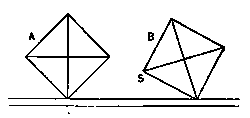
Recognition and illusion are two of the threads from which the complex web of æsthetic enjoyment is woven. When the child begins to take pleasure in form it is difficult to say, and more difficult still to determine, when the æsthetic personification, which is so important to adults, arises. Experiment may, however, throw some light on both questions. Marie G—— was five years old when I first attempted something of the sort with her. I showed her a straight line, and near it an irregular one, and, in order to excite her interest, told her that I wanted to keep one of them and was in doubt as to which it should be. She pointed at once to the straight one—“I should keep that.” Well-drawn equilateral triangles were preferred to irregular ones, but she gave a characteristic reason for choosing the uneven quadrilateral instead of a perfect rectangle—because, she said, it looked like a hat. Here the less pleasing form was preferred for the sake of its meaning; she was still quite clear in her idea of regularity. She asked me, for instance, to draw “some straight figures and some of the other kind.” By straight she meant regular—she called a perfect circle straight. We thus find in a child the æsthetic rule operative—namely, that formal regularity is agreeable. Personification of the figure by children is also a subject for experimentation. German students of æsthetics found out long ago that the object of our enjoyment is endowed by our imagination with personal attributes analogous to our own. “We conceive of all natural objects,” says Wölfflin, “as analogous to our physical organism.”135 One of the first requirements of our organism is that it shall maintain its equilibrium, and accordingly an elementary fact in our personification of natural objects is that a distorted figure causes us an unpleasant feeling of disturbed equilibrium. I showed the five-year-old Marie G—— these two figures, and asked which she would rather have. Unhesitatingly she pointed to A. “Why?” I asked. “Because it stands on the point.” “But the other one stands on its point too.” “Yes, but this” (pointing to the angle S) “is so low.” She played with the squares, and turned them so that they rested on the horizon line. “Now they hang down,” she said; “but this one” (pointing to B) “is just willing to come down.” That the child at play personifies all possible objects is a familiar fact, and we here find that they can conceive of even abstract figures according to physical analogies.
Savages manifest pleasure in form, more particularly in their ornamentation. It was formerly believed that creative imagination was responsible for some of their geometric patterns, but lately this idea has more and more given place to the opinion that all their patterns, without exception, are the product of imitation. The reports of Ehrenreich and von den Steinen of the tribes of central Brazil go far to confirm this view. With them animals almost invariably furnished the models, their forms being reproduced in a conventionalized manner. Thus a zigzag was derived from the markings of a snake, the cross from those of a lizard, etc.136 It is possible that this theory attempts to prove too much, for basket work may well account for some patterns which it would be difficult to find in Nature.137 This possibility being once granted there is no convincing proof that natural models were used in the construction of conventional figures at all. Often the resemblance may have been an afterthought, as a child calls a square a window, though it may have been drawn with no such intention, or the Eskimo explains the peculiar outlines of his characters by likening them to animal forms. However this may be, it is at least certain that these savage people offer a convincing proof that the pleasure which is derived from form is primordial and universal. If geometric figures did originate in imitation of natural models, still the persistence and abstract conventionalizing of them points to a high valuation, which is in one case at least independent of such accidental association—namely, when ornamentation is applied to tools and utensils, and especially if we consider their fine polish and symmetrical form as belonging to the order of embellishments. “Smoothness and good proportion,” says Grosse rightly, “are usually not so much æsthetic as practical qualities. An awkwardly shaped weapon does not reach the mark as surely as does a symmetrical one, and a well-polished arrow or spear head penetrates farther than a roughly finished weapon. Yet we find among primitive people articles which have just as much care bestowed upon them, without any such evident utility. The blubber lamp of the Eskimo need not be either so regular in form or so highly polished in order to shed its light and heat; the Fire Islander’s basket would no doubt be quite as useful were it a little less evenly woven. Australians always carve their talismans symmetrically, though, for all we know to the contrary, they might be just as effective otherwise. In all such cases we may be sure that the workman is satisfying an æsthetic as well as a practical demand.”138
Since we can devote but a passing glance to the significance of form in the art of cultured man, I confine myself to some remarks on the æsthetic effect of the simplest of all forms—the straight line. Fr. Carstanjen, in his interesting paper on the developmental factors of the early renaissance in the Netherlands,139 advances the opinion that progress and development in art are the direct result, psychologically speaking, of dissatisfaction with contemporary art and its productions with which the people have become satiated. As concerns the evolution of form, the common process seems to be that, by a naturalism more or less fortunate, something like style is first acquired by means of the mastery of straight lines. From this point development is in the direction of overcoming their stiffness and angularity. The representation of form is constantly more free, reaching thus a high degree of beauty, but passing on through a period of extravagant exaltation of circles, spirals, swells, and curves to final and inevitable decadence. In following out this succession of styles it becomes apparent that separation from the direct is, æsthetically speaking, separation from repose (as well as from stiffness). So Wölfflin says, in pointing out emotional analogies as they bear on form: “A line composed of short, delicate curves is commonly called tremulous, while one with wider and shallower vibrations indicates dull humming or buzzing. A zigzag rustles and splashes like falling water, and when very pointed sounds shrill like whistling. The straight line is quite still; in architecture it suggests the quiet simplicity of the antique.”140 It is a most interesting study to note the almost illimitable force of this effect of the straight line in an art which, having reached the pinnacle of its development, allows full swing to the tendency toward rounded forms as well. During the most flourishing period of the Italian renaissance there was scarcely a single master who gloried more in the pride of sensuous loveliness than did Titian, yet even in the midst of his intoxicating triumphs he attained something of that quiet grandeur which, according to Winckelmann, formed the basis of Greek art. How can we account for this? In my opinion it was accomplished, in part at least, though not entirely, by the use of the short straight line which characterizes Titian’s style, and is repeated in the work of many of his imitators—I mean the line that is formed by the peculiar inclination of the head. It is found in the wonderful Madonna of the house of Pesaro, in the Flora of the Uffizi, the Laura de Dianti in the Louvre, in the so-called “Loves” and other works of the master. Their chief common characteristic is a certain commanding dignity impossible to describe. Among those artists influenced by Titian, Moretto has followed him most successfully.
This same line may become almost unpleasing when the figure is too much in profile and the head bends forward, as does Mary Magdalene’s in Titian’s Dresden Madonna. I mention this because it is repeated in the Medea by Feuerbach, who is very faithful to Titian’s ideal. He is, moreover, one of the vanguard of German artists who are leading the way to the new idealism—a thing as yet more hoped for than realized. And just here I have a word to say. An essential of ideal art is that, as opposed to naturalistic reproduction, it plays with conventionalized form and subordinates reality to it. While at the height of the renaissance marvellous effects were achieved by mingled and contrasted curves, such as astonish us in the work of Raphael and sometimes of Rubens, of our modern idealism we may say: if we are justified at all in calling its developments new, it is because, from the standpoint of form, it does possess one unique and original characteristic—namely, that in it for the first time straight lines, and especially the perpendicular, are dominant in a well-mastered technique, which is no longer primitive. There are many traces of this principle in Feuerbach’s work, and it is still more strikingly shown in that of Böcklin, who has close kinship with the Venetians. The tensely upstretched necks of the swans in the Island of the Blest is a perfect example of the new style. It comes out again in the stiff little trees of his spring landscape, in the abrupt lines of the drapery of a Muse at the Arethusan spring, in the perpendicular line extending from the shoulder of the musical shepherd boy quite to his foot, and in many other pictures. Max Klinger is partial to the horizontal, and much of the characteristic power of his Pieta is due to his employment of these lines; three stone steps, the outstretched body of the Redeemer, the stretch of a wall in the background, the straight lines of a thick wood, in contrast to these the upright half figures of John and Mary. Many of our modern idealistic painters have unfortunately abandoned the use of this “line of Praxiteles,” which imparts so finely poised a position to the head and body and that peculiar mysterious dignity and air of detachment to the whole figure—“schöne, stille Menschen.” In the industrial arts this preference for straight lines is most conspicuous in what we wish to appear as new and original, and even in the newest styles for men it gives us the creased trousers, the waistless coat, and the stiff, high hat. These phenomena, however, we will not presume to attribute to the influence of ideal art.
(d) Perception of Movement
When sight is the medium of perception movement plays are at the same time visual plays, otherwise consciousness is reached through the sense of touch. We will here give special attention to experimental exercise of the motor apparatus, as actual movement play is treated of in detail in another section. After some general remarks, a few cases will be cited whose most important feature is the pleasure derived from the contemplation of the movement, as is especially the case when it is not self-produced. The powerful attraction which movement has for us is well grounded biologically, for evidently it is of the utmost importance in the struggle for existence that attention should be at once and instinctively aroused by any stir or change in the environment.141 But perception of movement by means of the eye alone, and consequently the instinct of keeping absolutely motionless, is of great importance to the pursued animal. Thus Edinger says: “I have repeatedly seen a hungry snake pause in the midst of his pursuit of a fleeing mouse, when it crouched down and was quiet. I have seen it recoil from the frog, which it was trying to catch, as soon as the creature kept still.”142 Even our own involuntary attention to motion has some analogy to instinct, and recalls the violent and sudden reaction with which we respond to an unexpected touch on the bare back.143 As a matter of psychological fact, there is associated with movement, as with sensations of hearing, a strong emotional effect.
It is no wonder, therefore, that all his life long man shows a peculiar interest in movement, and acquires the capacity to detect its intimations very early in life. Indeed, this capacity is one of the first to be developed, and depends, apart from skin stimuli and the so-called after images which reveal objective movement to the eye at rest, principally on the ability to follow the moving object with the glance. Practice is necessary for the mastery of this capacity. The eyes accompany, in addition to the regular objective motion, a constantly renewed backward movement as well, by means of which we again grasp the escaping object, an effort requiring the simultaneous exercise of volition and attention. “This process requiring continuous and constantly renewed attention,” says L. W. Stern, “this lying in wait that the object may not give us the slip (for any laxity would at once be avenged by an increased difficulty in fixing the object), bears witness to a condition and teaches us that the object with which we are carrying on this game of ‘catcher’ is in motion.”144 This explains why little children so easily lose sight of a moving object which they wish to follow with the eye.
Here again we find that playful experimentation is essential, and, according to Raehlmann, it commonly appears toward the end of the fifth week, rarely earlier.145 That Preyer’s boy on the twenty-third day followed with his eyes a slowly moving light was probably an instance of forced development, as a result of much experimenting. On the twenty-ninth day the same child crowed aloud at the sight of a swaying tassel. On the sixty-second day he gazed at a swinging lamp with constant manifestations of delight for nearly half an hour, but his eyes did not follow the swing of the pendulum; they moved, it is true, now left, now right, but not in time with the lamp. “On the one hundred and first day a pendulum making forty complete swings in a minute was for the first time followed with mechanical exactness by his glance.”146 As his capacity for following the movement increased, the greater his interest in it became. A dog racing away or leaping about the child, the fast horse, the hopping toad, the crawling worm or gliding snake, running water, leaping flame, a rolling wagon, and, more than all, the fast-rushing train, with its cloud of steam—all these excite a really passionate sympathy. The smoke of a cigar, too, gives great satisfaction, and if a father knows how to make the beautiful blue rings he must at once renounce his peaceful contemplative enjoyment of his own play, for the youngster will demand a very different tempo in the repetition than is agreeable to him. In enumerating instances of animal motion I omitted one because it deserves more extended notice—namely, the flight of insects, in which children take such lively interest. The common illusion that an insect which has been caught can be induced to fly away by the recital of a form of words is highly interesting, in itself considered as well as in view of its probable origin. May not such poetic formulæ be traceable to a religious or at least superstitious origin? The commonest of these rhymes are those addressed to the ladybird (Coccinella septempunctata) and the June bug. Rochholz has made a collection of the names of the former, and found that in India it was sacred to the god Indra, and among the old Germans to Frega. I give two German forms of the verse:
“Muttergotteshühle, Mückenstühle, Fliege auf, fliege auf! Wohl über die Bussenberg, Dass es besser Wetter wird.” “Marienkäferchen, wann wird Sonne sein? Morgen oder heut? Flieg weg in den Himmel!”
An English one is:
“Ladybird, ladybird, Fly away home; If you’ll be quick, The sunshine will come.”
All are familiar with the adjuration to the June bug. French children sing:
“Hanneton, vole, vole! Ton mari est a l’école, Il a dit qu’si tu volais, Tu aurais d’la soupe au lait Il a dit qu’si tu n’volais pas, Tu aurais la tête en bas.”
To the butterfly, which is not so easily caught, the invitation is to alight:
“Molketewer sett di, Kömmt e Pogg de frett di!”
And in Scotch:
“Le, la, let, My bonnie pet!”
The snail, too, is addressed in a rhyme which favours the illusion that he will put out his horns to order:
“Schneck’ im Haus, kreich heraus, Strecke deine vier Hörner heraus! Sonst werf ich dich in Graben, Fressen dich die Raben.”
“Snail, snail, put out your horn, Or I’ll kill your father and mother the morn.”147
As a final example, I will mention the gruesome custom which, according to Papasliotis, obtains in modern Greece, and especially in Crete, of attaching a small lighted taper to a beetle and releasing it amid the acclamations of excited children. A passage in Aristophanes gives the impression that the children of ancient Greece also indulged in this cruel sport.148
The eye of the adult, too, delights in movement; absolute immobility is as disturbing as absolute stillness. Here, as elsewhere, in considering the playful indulgence of sensuous perceptions, we must distinguish between pleasure in movement as such and pleasure in sensuously agreeable movement. Even children seem to exhibit this difference. Some weeks after the experiments in form described above I drew irregular zigzags and some even, wavy lines in the air before Marie G——, then five years old, and asked which she liked better. She chose the latter, though the others were calculated to produce a much more exciting impression, giving as her reason that the wavy lines were “straighter”; evidently meaning, as in the case of the figures, that these were more regular. In adults susceptibility to sensuously agreeable movement is doubtless still stronger, yet with them, too, there is a wide margin of pleasure in movement as such. From the multiplicity of available examples of this I select first the observation of street scenes, which I have already noticed in the case of animals,149 especially the dog. The pleasure which we find in gazing out of our own windows or from behind the plate glass of a café at the bustle and swarm of a city’s traffic detaches itself from all intellectual or even imaginative associations, and is gradually merged into a dreamy consciousness of a sensation of movement, mingled with mild enjoyment of its contrast with our own repose. With similar sensations we observe the stir of an ant-hill, the swarming of gnats in the evening glow, the confusion of snowflakes, and the whirling of leaves in a wind. A special interest attaches to the witnessing of skilful acrobatics where the feeling of inner imitation is strongly excited, and well does the juggler know how to turn this interest to account. The dexterous leaps which Amaranthus records at the beginning of the eighteenth century furnishes us an historical example: “Many are the leaps by which the jugglers cause the money of the spectators to jump into their own purses, and they have names as strange as they are ridiculous. There is the monkey jump, which throws one backward, landing him on both feet; the trout leap, which does the same thing twice in quick succession and with the legs crossed; twenty-two monkey jumps without stopping; a great variety of table and board jumps; the goat and hare leaps; the leap through eight rings, one from floor to ceiling, over chairs, etc.”150
The enjoyment is of course strengthened when the already interesting motion becomes sensuously agreeable; a low degree of such pleasure is experienced in witnessing regular motion in a single direction, such as that of a rushing stream or of clouds sailing across the heavens. In one of his verses Gottfried Keller calls these latter the “friendly companions of the dwellers on earth.” “As they wander on they attract and distract the burdened soul of him who observes them with wonder, and keep him amused all through the weary hours.” Gurgling springs add to their upward gushing motion the soft underground murmur of their waters, while the beauty of circling motion is perhaps never more effectively shown than in the majestic floating of birds of prey. Darwin says in his Voyage of the Beagle round the World: “When the condors are wheeling in a flock round and round any spot their flight is beautiful. Except when rising from the ground, I do not recollect ever having seen one of these birds flap its wings. Near Lima I watched several for nearly half an hour, without once taking off my eyes. They moved in large curves, sweeping in circles, descending and ascending, without giving a single flap.” Perhaps our pleasure is even greater in wave motions, as they roll over the ocean or are produced by the wind on a field of grain, or surge in the current of a rapid stream. These noble verses of Mörike’s on the Rhine falls bear witness to the power of the æsthetic feeling so aroused:
“Halte dein Herz, o Wanderer, fest in gewaltigen Händen! Mir entstürzte vor Lust zitternd das meinige fast. Rastlos donnernde Massen auf donnernde Massen geworfen, Ohr und Auge wohin retten sie sich im Tumult?... “Rosse der Götter, im Schwung, eins über den Rücken des ander Stürmen herunter und streu’n silberne Mähnen umher; Herrliche Leiber, unzählbare, folgen sich, nimmer dieselben, Ewig dieselbigen—wer wartet das Ende wohl aus?”151
Finally, we will notice dancing movements. It is not only among birds that the courted female gazes with interest at the dancing of the male; we see it in all public dancing. This is one of the instances where visual play is as important as the movement, for even among the participants pleasure is heightened by the exciting spectacle of the other dancers,152 and it is true the world over that spectators of a dance always become as passionately aroused as do the performers themselves. The piercing trills with which the women of some negro tribes at intervals accompany the dance of the males are surely not merely invitations to the latter, but indications as well of their own excitement. For this reason many onlookers are impelled to keep time with the rhythmic dance by clicking the tongue or clapping the hands. “The feeling of pleasure which is kindled in the performer,” says Grosse, “sheds its rays on the beholder as well.... In this way both become passionately excited, intoxicated by the sounds and movements; the transport constantly increasing, swells at last to veritable madness, which often results in violent outbreaks.”153 The solo dances of primitive peoples presuppose an onlooking public more than mass dances do. Among Bushmen and Eskimos the men dance alone, while, according to Eyre, Australian women do it sometimes alone and sometimes in companies to, arouse the men.154 Among the civilized people of the Orient professional dancing girls perform in the presence of men, in which case the spectators alone can be said to play. And the same is true of our ballet, which, indeed, except for its direct sexual effect, possesses but little pleasurable quality.155
II. Playful Use of the Motor Apparatus
In this new section we by no means cut loose from what is sensory in a subjective sense, for of course we become conscious of our own movements only through the sensory paths of sight and what is collectively called touch, chiefly sensations of contact, and tendon and joint sensations. Yet from an objective standpoint we must enter upon the investigation of an entirely new province, where we shall be concerned not so much with the senses as with the manifold co-ordinated muscular movements of which our bodies are capable, and which are necessary or at least useful for the accomplishment of the tasks of life.
Since these movements are progressively acquired, the child’s first efforts can hardly be said to be voluntary. Many that are instinctive and automatic must be repeated over and over before voluntary ones come, for will implies an image which is a memory picture of the movement to be made. Preyer thinks that no intentional movements are made before the end of the first quarter.156 Vierordt, indeed, says that their development is gradually progressive. “All indications point to the arm as first becoming obedient to volition, and the sucking movements, too, seem early to lose their reflex character. Then follow intentional movements of the head and neck and some groups of face muscles, and finally those of the lower limbs, which as late as the sixth month still move in the most haphazard manner.”157 Playful experiment then promotes this acquisition of control over the bodily movements by the will, and strengthens and renders it permanent after it has been acquired.
Playful movements naturally fall into two great subdivisions, namely, those belonging to the organs as such and those directed toward other objects in connection with such organs—a distinction already familiar to us in our study of the production of noises and tones. We will now consider the first of these divisions, the most important phenomenon of which is locomotion.
A. PLAYFUL MOVEMENT OF THE BODILY ORGANS
In other connections we have touched upon many movement plays, such as voice practice and the production of sounds by means of various bodily organs, experimentation with tactile stimuli, and watching moving objects. This sort of exercise often combines motor with sensor play, as has been frequently pointed out. Therefore, to avoid repetition, I will in this section, after a few preliminary remarks suggested by such bearings of the subject as I conceive to be essential, proceed at once to consider the most important and obvious of all movement-plays—namely, those connected with change of place.
In voice practice experiments with the larynx, tongue, lips, and breathing muscles are involved. When children whisper, for example, their enjoyment must be due as much to the lip movements as to the slight sounds produced. The fact that the blind deaf-mute Laura Bridgman158 playfully indulged in the production of various sounds seems to confirm this, and the principle is applicable too to other noises. The child who claps his hands, splashes in the water, bangs on the table with his fist, or puffs out his cheeks to blow a horn; the grown man who shuffles his feet, drums on the table or window pane, the noisy dancer, and even the piano or violin player who indulges in movements now loud, now soft, now slow, now quick—all derive a considerable part of their pleasure in the sport from the motor discharge which is involved.
No exhaustive demonstration is needed to prove that the same conditions prevail in experimentation with touch stimuli and the observation of motion, which is so often connected with it. “In the first year,” says Preyer, in speaking of the manifold and apparently aimless movements of the infant, “exercise of the muscles is the raison d’être of all this activity which appears to be aimless. An adult lying on his back could not repeat the commonest movements of a seven to twelve months child without extreme fatigue.”159 In arm movements the development of right-handedness is of especial interest. Formerly it was attributed to the mother’s or nurse’s method of carrying the child, to the greater weight of one side of the body, and similar pretexts; but Baldwin’s investigations show that such extraneous influences have little to do with it, for he found on excluding such agencies a marked preference for the right hand in the seventh and eighth months, displayed first in strenuous grasping movements.160 An entirely satisfactory explanation has not yet been offered, though Sticker’s theory, is perhaps most probable—namely, that the left brain hemisphere has a better blood supply than the right.161 When there is some difficulty to overcome, some opportunity to display dexterity, there are heightened stimulus and greater directness in the movements of arms and hands. Older children delight to set themselves such tasks as, for instance, clasping the hands behind the back, so that one arm crosses the shoulder, or placing the open hand on a table and raising the ring finger without any of the others, or laying the fingers over one another, etc. When such efforts are overlooked and directed by parents and teachers, we have the beginning of gymnastics, which remains a play so long as the subject enjoys it. Free-hand movements, exercises with dumb-bells and weights and the like, so far as the interest is not centred in the foreign body, all belong here. The intense desire for movement in many forms of mental disease should also be noted in this connection, since they have an indirect playful character, and by their very exaggeration are calculated to throw some light on the conduct of normal humanity. No psychic derangement shows this more clearly than does mania. The voice of such patients, says Kraepelin, “is usually high-pitched.... They are contented, feel inclined to all sorts of fun, and teasing, singing, and joking,” yet all this is invariably followed by a sudden plunge into the contrary mood. “That grave symptom of derangement, strong propensity to movement seems to stand in the closest connection with liveliness of spirits. The patient fairly revels in emotion; he is uneasy, can not long lie or sit still, stirs about, skips, runs, dances. He gesticulates wildly, claps his hands, makes faces, scribbles and rubs on the ground, walls, and windows, beats and drums on the floor, strips off his clothes, tears them to ribbons, etc.”162 Since movement and its opposite are closely connected, the question arises whether the strange rigidity of body manifested in catalepsy is not referable to the same cause. There is certainly often a certain designedness about it. “When any attempt is made to change the position of the patient every muscle is found to be tense. If the head is forced aside by pressure, it flies back to its former position when released. To support the head hardly requires more than the weight of a finger. We are best acquainted with the psychic organ of this stubborn resistance in the common cases where the patient responds contrarily to speech suggestions. He can be made to go forward by being ordered back, and vice versa, will take a seat when told not to, stand still when commanded to go on, etc.”163
Finally, before going on to our principal subject, we should glance at the instinctive chewing motions which were mentioned among tactile plays. When a full-grown man going for a walk sticks a twig in his mouth and gnaws it the movements of his own jaw are of more interest to him than is the stick, except as it promotes sensations of contact. We take genuine pleasure in crunching toast and gnawing on a bone, and the unfortunate habit of biting the finger nails is one form of such play. Many smokers soon chew up the mouth pieces of their pipes and cigar holders, and others constantly bite pencil or penholder, and are unhappy when such indulgence is denied them. Betel-chewing, which, it is true, has the attraction of a narcotic, is indulged in, according to Von Bibra, by one hundred million human beings.164 New Zealanders use kauri, the resin of a certain tree. “In the northern part of Sweden resin obtained from the trunk of a pine tree is very generally chewed.”165 Americans who twenty-five years ago chewed prepared resin have adopted the chewing-gum habit. Material for it is brought chiefly from Mexico; in 1895 four million pounds of chicle gum was imported for this purpose. Jules Legras says of Russia: “Gnawing sunflower seeds is the favourite amusement of children and of the poorer classes. The streets are full of shops where the beloved grain is sold, and the common people stuff their pockets with it. They skilfully split open the husk with the front teeth, discard it, and mechanically chew the kernel. It is a national habit, inexplicable to an outsider, for the seeds are tasteless; but the jaws are kept busy, and their motion forms an accompaniment to the vague dreaming of the poor people.”166
Turning now to our subject proper—namely, playful locomotion or change of place—we find the biological significance of play, the elaboration of certain imperfect instincts, brought out with marked distinctness. The child’s first practice in the direction of future walking is found in the alternative kicking, which is so essential to muscular development.167 Further progress is marked by raising the body and learning to sit, efforts marking the beginning of the struggle with weights which Souriau regards as the leading stimulus to movement-play. So long as this struggle to retain his equilibrium lasts, the child’s behaviour betrays the direct intention of the play. Preyer says: “In his fourteenth week my sturdy boy easily made his first attempt to sit, having his back well propped. In his twenty-second week the child could raise himself in the effort to reach my face, but not till the thirty-ninth week could he sit alone, and still preferred a back. In his carriage it was necessary for him to hold on even in the fortieth and forty-first weeks. But when for a supreme moment he did manage to sit up unassisted he was evidently delighted, and made the greatest efforts to preserve his equilibrium.”168
Creeping is an imperfect though genuine sort of locomotion preparatory to walking. “It is a treat,” says Sigismund, “to watch a creeping child. The tiny creature, seated on the floor, longs for something beyond his reach; straining to get it, he loses his balance and falls over. In that position he still stretches his hand out, and notices that he is nearer the object of his desire, and that a few more such forward motions would attain it. Soon he becomes more active, sure, and courageous, and learns to maintain his centre of gravity on three supports while he lifts the fourth member for his next step forward, for at first the child raises but one limb at a time, though he soon learns to use the right hand and left foot together. I have never seen one so use the hand and foot on the same side. Sometimes the child crawls backward like a crab, even when there is nothing before him which he wishes to shun.”169 Fouquières gives two beautiful ancient representations of creeping children, the first going toward some fruit which lies on a footstool, and the other gazing at a vase on the ground.170
Children who have a lively desire to roam before they are able to walk invent many expedients which afford them great satisfaction; for example, a little boy, Werner H——, has acquired remarkable skill in getting about by stiffening his arms as he stretches them down at his sides and swinging himself forward as if on crutches, as we sometimes see the unfortunates do who have had both legs amputated.
Learning to stand is an essential step preliminary to talking, and causes a child the liveliest satisfaction, giving him further control over his own body, and responding as it does to an inborn impulse. Sigismund places the first efforts in this direction in the eighteenth or twentieth week. “If the nurse holds up a child of this age on her lap, supporting it under the arms, it will dance, hop, and spring perpetually like a hooked fish, bound like a grasshopper, draw up his legs like a closed pocket knife, and twist his head and neck—in short, he will exhibit the same mercurial exuberance of motion which pleases us in young goats, lambs, and kittens. The child’s movements, however, are naturally in the direction of the normal human attitude, and he will make desperate attempts to pull himself up by his nurse’s dress or the edge of a chair or his bath tub, and when by the exertion of this utmost strength he succeeds he commonly breaks out into loud cries of joy.”171 The playful quality so clearly recognised here appears also in Preyer’s remark that his boy in the fortieth week preferred to be exercised in standing rather than in sitting, although the former was more difficult.172 This fact no doubt enhanced the pleasure. At the end of the first year or beginning of the second the child is usually far enough on to stand entirely alone. “He is amazed at his own daring, standing anxiously with feet wide apart, and at last letting himself down rather abruptly.”173
Coming now to actual walking, it is uncertain whether the alternating kicks of the infant point to special instinctive impulses, but we may be sure that when a child pushes forward on being held with the feet touching the floor he feels the stirrings of instinct. “Champney’s child,” says Preyer, “was held upright for the first time at the end of the nineteenth week, so that his feet rested on the floor, and he was moved forward; his legs worked with regularity, and each step was taken accurately and without hesitation or wavering even when the feet were lifted too high. Only in this case was the alternation interrupted, and he made another effort to take the step with his feet in the air. Resting the body sideways on one foot seemed to transfer the stimulus to the other. These observations ground my belief that walking is an instinctive act.”174 This happens somewhat later if the child is not moved forward on being held up; thus Baldwin, whose experiment included no such motion, found that the “native walking reflex” suddenly appeared in the ninth month, while previous to that only a single alternation appeared, which might well be ascribed to chance.175 Independent experimentation begins when, having drawn himself up by a chair, the child walks around it with the help of his hands, all the time resting on the seat, in which progress the achievement of a corner is as critical a movement as the rounding of a jutting crag in the path of a mountain climber. Soon after this arrives the crucial test—the terrible risk of the first step alone, which, when successfully accomplished, throws both parent and child into a transport of joy. The appreciative Sigismund gives a beautiful description of this too: “Forward steps having been practised while the hands cling to some fixed object, he is prepared to venture alone. This first step alone of a little child makes one involuntarily hold his breath at the sight. The small face reveals a conflict between the bold resolve to venture all and the cautious counsels of conservatism. Suddenly one little foot is shoved forward rather than lifted, and one hand at last stretched out as a balance. Sometimes that one step is all, and the little Icarus sinks down again. But often the child to whom the effort is particularly difficult makes, like a boy learning to skate or a man walking a rope, several steps in one direction, especially when the haven of safety is near at hand. Many children make no further attempts for weeks after the first; others, again, follow it up at once. Very gradually walking loses its anxious, doubtful character, and becomes an easy habit not requiring attention.” Froebel has well described the pleasure in success which, together with the gratification of instinctive impulse, makes learning to walk such a satisfaction. “The fact is well established,” he says, “that walking, and especially the first steps, give the child pleasure merely as a demonstration of his strength, although this is soon followed by other elements of enjoyment, such as the realization that it is means of arriving and of obtaining.”176 As it becomes mechanical, walking, of course, loses its playful character. Pleasure in simple locomotion is experienced by adults, as a rule, only when the discharge of their motor impulses has been hindered by a sedentary life, and even then motion is not the chief source of satisfaction. The regular rhythm of walking acts like a narcotic on an excited mind, which reacts to it unconsciously. I remember that Ibsen’s John Gabriel Borkmann paced up and down like a sick wolf before the door of the wife from whom he was separated; and we find a fearful reminder of the restless walking back and forth of caged animals in the deep-worn footprints of the prisoner of Chillon. We find, though, for all ages games whose object is the conquest of some difficulty, great or small. We frequently see small dogs keep one leg up in the air without any apparent reason and, run along on three, and in the same way children try all sorts of experiments in walking. Now one of them is lame in one foot, now one small leg is stiff, now he drags his feet, now walks with a jerk or on tiptoe. Many of these movements are turned to account in elementary gymnastics, and those pathological subjects whose mania takes a playful turn show quite similar peculiarities in walking.177 Almost as soon as the child has learned to preserve his equilibrium in ordinary walking he proceeds to complicate the problem by trying to walk on curbstones, in a rut, on a beam, on a balustrade or narrow wall. Unusual facility in these leads on to rope walking, and afterward turns out to be of great service to the mountain climber on narrow ridges and snow-covered ledges. A famous architect was so foolhardy as to walk round the narrow leads of the Königstuhl tower in Heidelberg, and it is recorded of the ancient Norse king Olav Tryggvason that he possessed the accomplishment, among others, of being able to run across the oars of a boat while the men were rowing. Another form of self-imposed difficulty and consequent conversion of locomotion into play is the attempt to step on all the cracks in the pavement or floor or on certain figures in a carpet. Something of this kind must have led to the game of Paradieshüpfen in Germany, hop-scotch in England, la Marelle in France, in which certain spaces are marked out in the sand or on a floor, on whose outlines the foot must not be set.
Running games will form our next subject, and we find that the child’s earliest efforts for locomotion are as much like running as walking. His first steps alone are, it is true most hesitatingly made, but the nearer the goal, especially if it happens to be his mother kneeling with outstretched arms, the more rapid are his movements. Gradually the distinction between running and walking becomes more marked. For an example of genuine practice for a quick run Preyer’s observations may again be cited. He says that on the four hundred and fifty-ninth day the boy stopped short several times in his rapid course and stamped. In his seventy-seventh week this child ran nineteen times without stopping around a large table, calling out “mama,” and “bwa, bwa, bwa,”178 the while. This simple running soon loses its charm, and is not much used later in play until it is transformed into a contest and acquires a new and higher meaning, of which we shall speak presently. Yet there are many running games whose attraction consists in the difficulties to be overcome, and very rapid running is a delight in itself, throwing us into a sort of transport and exciting in us “je ne sais quelle idée d’infini, de désir sans mesure, de vie surabondante et folle, je ne sais quel dedain de l’individualité quel besoin de se sentir aller sans se retenir, de se perdre dans le tout.”179
Running down a smooth slope is a diversion which easily tempts even grown people, and boys at least find something like it in their game of snapping the whip, in which game a chain is made with the strongest boy in front. He has the task of moving the whole line in curves, so that the end ones are obliged to run in dizzy haste. In both cases natural forces, coming to the aid of the individual’s own efforts, add to the enjoyment. Overcoming difficulties is prominent in the Hellenic πιτυλίζειν, which it seems consisted in running on the tips of the toes, as well as in the equally ancient ἐκπλεθρίζειν, which was a peculiar varied running, without curves, in a straight line back and forth, the line growing shorter and shorter till a central point was reached, where, as only one step remained, the runner came to a standstill.180
Hopping and skipping are also to be classed with running plays; the body is suspended in the air for an instant in all these movements, though in hopping and skipping the motion is more vertical. They belong in the same category with the vagaries of locomotion which I have pointed out, and any lively child finds it hard to dispense with them when out for a walk, just as lambs and kids do. In the ordinary skip one foot at a time comes with a slight shoving motion on the ground and gives us the beginning of a galop and the principle of the waltz, while hopping forms the foundation for the polka. This hop on one foot is utilized in many plays, such as the hopscotch already mentioned, and in chasing and fighting games, like “Cock Fight” (German Hahnenkampf), “Fox in his Hole,” etc. In Greece the ἀσκωλιάζειν was a popular game, and Grasberger says that their hopping was the same as ours, and in some games he who accomplished the task with the fewest hops won the prize. In a catching game the contestants hopped on a circular line and attempted to touch one another with the free foot. Finally, the drollest and most popular form of the game, which never failed to excite laughter in all beholders, was the genuine Askoliasmos. A skin well oiled on the outside and filled with air was stepped on by the player, who attempted to stand on it while he went through various dancing and hopping motions. The favourite circus trick of running on a rolling cannon ball is a modern form of this.
Children begin to jump by leaping downward. Before the little experimentor has halfway learned to go down steps he likes to reach the ground by a jump from the last one, at first a difficult enough exploit. But soon this palls, and something harder is at once undertaken, just as the habitual drunkard attains to stronger and stronger potations. The three-year-old can take two or three steps or boldly leap from a chair on which he has laboriously clambered with this intent. When some large stone pillars intended for a garden gate lay in the street before my house all the children in the neighbourhood collected to enjoy the pleasure of jumping off of them. Psychologically this pleasure is derived not merely from the agreeable flying motion, but from the stimulus of difficulty to be overcome and a feeling of pride in encountering risks. Chamberlain tells of two small Americans who had in their familiar speech a word for “the feeling you have just before you jump, don’t you know, when you mean to jump and want to do it and are just a little bit afraid to do it,” and another for “the way you feel when you have just jumped and are awfully proud of it.”181 Perhaps the liveliest feeling of pleasure is caused by the leap into water, because the soft, yielding, and yet resisting element furnishes an unusually long trajectory. Many South Sea islanders have cultivated this art to an astonishing degree. The pleasure of snowshoeing, too, consists chiefly in the circumstance that the path ends suddenly in an abrupt slope, over which the skilful sportsman flies in a tremendous leap amid a whir of soft snow. “To see,” says Nansen in his book on Greenland, “how the practised runner makes his leap into the air is one of the finest spectacles in the world. To see him whizzing boldly down the mountain, collect himself in a few steps before the spring, pause and take position, and then like a sea gull glide through the air, striking the ground at a distance of twenty to twenty-five metres immersed in a cloud of flying snow—all this sends a thrill of sympathetic pleasure through one’s frame.” Later, children learn high and long-distance jumps, the doorstep, a tiny stream and narrow ditch affording opportunity for the first practice, and an older boy leaps gaily over a low hedge, a wide brook, or his comrade’s back in leap-frog. The element of danger exists here and some combativeness, as though it were a sort of conquest of the object; these features are especially prominent when the vault is made over a blazing fire, as in the custom with some mountaineers’ games. It is first heard of in the Palilia, a herdsman’s game of ancient Rome, commemorative of the founding of the city, and the people of the Nicobar Islands believe that leaping through fire is a sure cure for colds, fevers, etc.182 The salto mortale marked the highest degree of difficulty and danger—a Greek vase shows it as a somersault in the midst of the high jump. Norwegian youths can spring up so high as to touch the ceiling with one foot and agilely regain their upright position. The Greeks used weights of stone or lead, which they swung violently to intensify the force of the leap, the springboard being apparently unknown to them. Grasberger regards the statement that Phayllos of Crete could cover from fifty to fifty-five feet183 as well authenticated, but it was certainly a prodigious leap. Similar incredible feats are reported of the ancient Germans, one being that of the Viking Halfdan, who jumped over a gorge thirty yards wide.184 From this is but a step to the world-famed contest between Brunhilde and Gunther, in which Brunhilde hurled a mighty stone and then leaped after it as far as or farther than the stone went, and Siegfried performed the same feat, carrying Gunther with him.
Climbing is probably the outcome of a special instinct. The striking fact that a newborn infant is at once able to cling with his hands certainly points to this. It has been shown by Robinson that infants may cling fast enough to a stick to be lifted from the ground and held suspended in midair.
The first attempts at actual climbing occur in the second year in conjunction with creeping, and are usually efforts to go upstairs. Young animals whose future life demands skill in climbing also manifest this upward tendency. Where Lenz says that the two-weeks-old kid enjoys neck-breaking adventures and makes remarkable leaps, that he always wants to go upon piles of wood or stone, on walls and rocks, and that climbing upstairs is his chief delight,185 he gives at the same time a faithful picture of dawning human impulses. Little George K——, a year and a half old, made his way in an unguarded moment from the garden to the third story of his father’s house. Numberless accidents have resulted from the climbing upon chairs and tables, which is so indefatigably persisted in, and there are few plays which afford so much pleasure to older children as climbing trees. It is probable that, in spite of the danger of the situation, there is an instinctive feeling of security and comfort when they are cosily settled among the branches. We naturally attribute this, to the habits of their progenitors, but a simpler explanation of their enjoyment of the situation may be that their elders can not get to them. That girls gladly participate in this supposedly masculine indulgence is noteworthy. Marlitt and Mrs. Hungerford give amusing instances of trying situations in which older girls have been placed through this propensity. The tall and glossy beech tree, with all sorts of beauties luring one to its topmost branches, presents special difficulties to adventurers. Climbing steep cliffs, too, is a favourite pastime; one of the pleasantest recollections of my own youth is of climbing a wooded slope in the neighbourhood of St. Blasien in the Black Forest, where I spent half a day with two other children building a moss hut on an almost inaccessible crag. The modern fad of making foolhardy excursions to the highest peaks is too familiar to need enlarging on. It clearly shows that the most difficult movement plays are combative. Th. Wundt, the famous climber, is quite right when he says in his book on the Jungfrau and the Bernese Oberland that the mountain climber “takes Nature by storm; he does not expect that she will present a smiling aspect; he measures strength with her; he seeks a contest which will try him to the uttermost, and the longing for adventure is much stronger than any mere passive enjoyment.” We find traces of this same spirit in old German records, as witness thus: King Olaf Tryggvason, to prove his prowess, climbed the Smalsarhorn, hitherto regarded as unscalable, and fixed his shield to its summit.186
With only a passing mention of swimming movements, in which the South Sea Islanders excel, I turn at once to the dance, or what may be called the artistic form of locomotion, confining myself, however, strictly to those forms of it which have to do with pure movement-play. We must, I think, assume that elementary ideas of dancing are present in childhood, but the developed art belongs to adults. Besides the walking, running, hopping, and skipping of which we have spoken, the child makes use of every imaginable turn and attitude of the head, trunk, and limbs, and a careful study of the various gymnastic motions of all times and peoples could hardly reveal greater variety than is found among these little ones. A certain rhythm, too, is noticeable in their ordinary hopping and skipping, but the essential feature of the dance, the regulation of bodily movement by measured music, must be acquired. Preyer’s statement that his child in its twenty-fourth month danced in time with music,187 it seems to me, is an exception to the rule, for among the large number of small children whom I have seen dancing to music I can not recall a single one who kept time regularly and with assurance without some teaching and example. I myself learned the polka step, moving forward in a straight line, when I was a ten-year-old boy, and I can remember feeling that it was something new and peculiar, and that many of my comrades had great difficulty in achieving it. I am told by a woman teacher that she attempted to teach some little girls between five and eight years old to walk in time to a march played on the piano, and that not a single one of them could do it successfully on the first trial. Yet, on the other hand, it is certain that children learn dancing very quickly through imitation, especially among savages. It is amazing to see with what assurance these little ones can participate in the complicated dances of their elders. I shall return to this in speaking of imitative plays. The ring dances of European children, which we shall shortly refer to under social plays, are derived from mediæval and ancient dances of adults.
To find the sources of pleasure in dancing we must go back to the common ground of satisfaction in obeying the impulse for motion, yet it is not easy to assign a general explanation for the peculiar charm of rhythmical movement. Spencer holds that passionate excitement naturally manifests itself in rhythmic repetition; while Minor, on the contrary, sees in it the expression of a prudential instinct to restrain the fury of passionate feeling.188 As Schiller, too, says:
“Es ist des Wohllauts mächtige Gottheit, Die zum geselligen Tanz ordnet den tobenden Sprung, Die der Nemesis Gleich, an des Rhythmus goldenem Zügel Lenkt die brausende Lust und die verwilderte zähmt.”189
This view is quite plausible when applied to the social effect of dancing, as Grosse has pointed out. Rhythm does subdue and order “riotous lust,” and afford a harmless outlet to the general need for some expression of it. Yet it would be a mistake to suppose that its effect is always subduing, since, as a matter of fact, it often leads to the wildest tumult. “Oh, thou bold gamester,” an old song runs, “Make for us a long row, Hip, hip, hurrah! how he can go! Heart, lungs, and liver he will overthrow.”190
Spencer’s remark makes it clear, from the other point of view, that rhythm is a most suitable instrument for the expression of passionate emotion, be it sad or joyful, but fails to explain why it is in itself intensely exciting and pleasurably so. Grosse justly says of Spencer’s view: “According to this theory the rhythm of dancing movements seems to be only a sharply and strongly intensified form of locomotion. It does not at all explain the pleasurable quality of rhythm, and if we are unwilling to accept description in lieu of explanation we can only regard this statement of fact as introductory to further investigation.”
Since Darwin’s theory, mentioned above, has as yet found little substantial proof, the intoxicating effects of rhythmic motion must find some other explanation here. Such movements are employed among most peoples as a means of producing ecstatic conditions. Selenkas gives a simple instance from Borneo: “The candidate [for the office of doctor] was led before the Manangs as they squatted on the ground. The Dekan, or spokesman, addressed him, and, rising, anointed his forehead with oil and ordered him to go around the ring bearing a lance to which was hung a medicine bag. The Dekan followed him at a trot, and their speed was constantly increased as the accompanying song of the others grew louder, until at last the novitiate, gasping and stumbling as if hypnotized, broke down.”191
Here we have in elementary form the kind of intoxication which is so fruitful in the production of religious ecstasy as it is indulged in by many Christian sects, notably the American Puritans in their rolling exercise. Numerous descriptions, however, show that some dance movements may produce the same effect; indeed, some investigators have been led to the belief that all dancing was originally religious, but this view is as one-sided as is the attempt to refer dancing exclusively to courtship. It is safer to regard it rather as an exciting movement-play which possesses, in common with other narcotics, the magic power of abstracting us from commonplace existence and transporting us to a self-created world of dreams. When accompanied by special influences, which relate to fighting or love, the agitation produced is sufficient to stir the soul to its depths; but even without these associations the intoxicating power of movement is apparent, its simplest effects being a kind of anæsthesia, relaxation of all tension, unconsciousness of fatigue, and the illusion of being free from bodily weight, like a spirit floating about in space. As Schiller says, “Befreit von der Schwere des Leibes.” This illusion, in itself productive of great enjoyment, explains our pleasure in such dances as we are considering. Much has been said in criticism of the modern round dance. Apart from sexual considerations, to which, after all, I do not attach much weight, present-day dancing, is said to lack the social effect of mass plays and the stimulus of mimic dances. But if we look upon it as a simple movement-play, and consider it more from the standpoint of the dancer than of the spectator, that criticism loses its force. The slower time of old-fashioned waltzing was certainly more effective, and made a much more dignified spectacle, but from the dancer’s point of view it was a distinct advance when the tempo was quickened, for the present method plunges the dancing pair more surely and quickly into the delicious tumult and madness of motion.192
Since it would take too long even to glance at all the gymnastic dances of times gone by, it will serve our purpose to point out those which were controlled by rhythm. The wild leaping of mediæval ring dancing, where it is said that even the ladies jumped a distance of six feet, and flew through the air like birds; the Spartan βίβασις, kept up until exhaustion ensued; the forward, sideward, and backward springing, and the measured tramping of the Australian corroborris; the squatting and kneeling of the Nicobar Islanders; bowing the body, swinging the arms, and nodding the head in the Dajak war dance; the clapping and “Haxenschlagen” of Europeans—all these are typical phenomena. Sometimes, in the midst of the general agitation of the body, one part will remain rigid, as in this instance, described by Man: “The dancer bent his back and threw his whole weight on one leg, whose knee was crooked; the hands were stretched out before his breast, one thumb held between the other thumb and forefinger while the other fingers were strained forward. In this position the dancer turned round, hopping forward on the supporting leg, and with every hop stamping on the floor with the free foot.193 Similar spreading out of the fingers is mentioned in Selenkas’s picture of a Malay woman’s dancing in Sumatra,194 and I saw a comic European dancer hold his arm out horizontally, but turned up from the elbow in a stiff manner, which made the immobility of the upper part of his body appear in ridiculous contrast to the lively motion of his legs. It would seem that the inhibition of all involuntary muscular innervation produces more absolute surrender to the prescribed movements of the dance....”
Before entering on the second half of this section we must devote a few words to artificial methods of moving the body, which are divided into two classes, those which are passive and those employed in active locomotion. Naturally the first implement of this kind to be mentioned is the cradle, of whose use among the Greeks we find no evidence, but the Romans had them since the time of Plautus. The oldest German record of them is in the Saxon manuscript at Heidelberg.195 Of course, the cradle’s rocking motion and its soothing effect should be included in our enumeration of agreeable movements. The same may be said of swinging, which we find practised by many birds and by the ape; indeed, one case is recorded where a monkey himself attached a rope to the projection of a roof and swung himself on it. The human race, too, probably without exception, enjoy the sport. The hammock is in some cases the prototype of the swing. Von den Steinen relates of the Brazilian Bakairi that the men when at home spend most of their time swinging in hammocks.196 Parkinson describes a still more primitive sort of swing. It seems that the Gilbert Islanders select a stout, well-grown cocoanut tree and attach a cord to it, on the other end of which is a club. A young woman climbs on the trunk, and taking her seat there is swung by a youth, who, watching his chance when the motion is well under way, catches hold with his hands and swings with her.197 The Greeks had several forms of the swing, among them the joggling board, consisting of a flexible plank supported at its ends on fixed beams, and the rope swing which with its comfortable seat supported by four cords was used by adults. The Berlin Museum possesses a bowl ornamented with the figure of a fawn running under a young girl in such a swing and sending her high in the air. Athens celebrated a special holiday called after the swing, αἰῶραι.198
Pleasure in riding and driving being partly due to the control we have over the horses, such enjoyment is a combination of active and passive. Even when we are only steering a boat the illusion is easily supported that we are to some extent responsible for its progress. Riding has other elements of attraction: besides the forward motion and lofty seat there is some peculiar enjoyment of each particular gait, the sensuously agreeable canter and the hard shake of the trot, which, so far as it can be pleasurable, furnishes an instance of more vehement enjoyment. Among artificial means of locomotion, those are most agreeable which afford a swift and yet smooth gliding or rocking motion. Souriau says in his Esthétique du Mouvement that the chief attraction of movement-plays lies in the overcoming of gravitation. But in that case, as I pointed out in my earlier work, downward movement would have no charm, since gravitation is there triumphant. The child’s first jump is, as we have seen, downward, and the downward rush of a sled fills us with exquisite delight. Souriau’s other supposition, that perhaps it is the exemption from friction, from the slight hindrances and detentions which commonly attend our movements, which accounts for our pleasure,199 seems more probable. It is to be hoped that among the sports of the future, flying either in balloons or with flying machines will be included. Lilienthal, in recounting his experiences in these arts, assures us that gliding through the air in a slanting direction affords a new and delightful sensation.
A long list of inventions, for the most part recreative, meet the demand for aids to active locomotion, notably appliances for rowing and the bicycle. Among ancient implements of this character I mention but two: stilts and snowshoes. Running on stilts is a favourite sport of children, both on account of the difficulties it presents and because of the elevation it affords. It was practised by both Greeks and Romans, and Pollux mentions a Spartan dance which was performed on stilts, probably the kind which is bound to the foot.200 In speaking of the ethnological distribution of this custom Andree says that stilts are found all over the world. “In China they are very skilfully used, and are not unknown to Africa among many African tribes. The negro boys left of the Congo bind stilts to their ankles to appear taller. They are well known to the Malays and the inhabitants of the South Sea Islands. In Tahiti a limb of a tree is used, having a smaller branch projecting at about a metre from the ground, and in this fork the foot is placed. The beautifully carved stilts of the Marquise Islanders have attained a certain celebrity.”201 The snowshoe, which has recently become popular once more, seems to be as ancient as the skate.202
“In skating,” says Weinhold, “the men and boys emulated the example of Ullr and Skadi, who must have been very gods of snow and ice. But they did not use steel skates like ours, but stood on long boards and held a staff to steady them. Many Norsemen became famous for this kind of running; such sagas of their skill have come down to us.... The Finns were teachers of this art, which was carried to great perfection among them. In their peace treaties any violator of them was menaced with being called a traitor as far as ships sailed or shields glittered, as the sun shone or snow fell, or the Finn could skate.”203
B. PLAYFUL MOVING OF FOREIGN BODIES
The primitive impulse to extend the sphere of their power as far as possible leads men to the conquest and control of objects lying around them. We can distinguish six different groups of movement-plays resulting from this impulse: 1, Mere “hustling” things about; 2, destructive or analytic play; 3, constructive or synthetic play; 4, plays of endurance; 5, throwing plays; 6, catching plays.
1. Hustling Things about
By this rather inelegant but expressive term we designate a kind of play which belongs to early childhood. From the grasping impulse the tendency is developed in the second quarter to push and pull things about in all directions, to shake and test them with hands and lips, to seize and to push away. External objects are all playthings to the child, says Perez, all objects of his investigating tendencies. “Il les manie, les tourne, les abat, les redresse, les jette, les reprend, les poursuit à quatre pattes, quand il ne peut les atteindre, les attire à lui, les frappe, les uns contre, les autres, fouille dans leurs profondeurs, les entasse et les sépare, enfin joue ou s’instruit par eux de mille manières.”204 Tearing paper gives particular pleasure. The child “seizes it with avidity, crumples it up in his hand as if pleased to find that there is power enough in the tiny fist to change the form of anything, or he polishes the tables with it as zealously as a Dutch woman.”205
“A child delights to play with things that can be put in motion, takes pleasure in shaking a well-filled purse, turning the handle of a coffee mill, pulling out drawers, dabbling in water, and for the same reason older children are fond of handling smooth sand and clay.”206 Autenrieth gives a good instance of what we call joy in being a cause, which is conspicuous in all play of this class. “All small boys regard it as a treat to be allowed to paddle in street puddles, where they can produce a great effect with little effort.”207
Much that might suitably be classed here has already been mentioned in connection with seeing, hearing, and tactile plays, since the impulse to set surrounding objects in motion is very closely connected with the desire for sensuous excitement. To avoid repetition I will simply refer to what has been said, and content myself here with adding one more play to the list, as it has special claim to be classed with them—namely, flying kites and similar play with captive insects. Although a little child can have but a very imperfect conception of the difference between animate and inanimate objects, yet living creatures certainly have a paramount interest for him. Everything which flies or crawls is watched and questioned with an almost passionate interest, and the desire to follow a flying insect and to possess it leads the child to tie a string to some part of its body. K. von den Steinen saw two Bororó boys in Brazil, one of whom had a bee and the other a butterfly fluttering on a cord.208 In Greece such sport was called μηλολόνδη or μηλολάνδη. Gold beetles were attached to cords three yards long, with pieces of wood on the end, and unmercifully pulled about in the air—veritable “hustling” indeed.209 Children sometimes treat little birds in the same way. “When a boy catches a sparrow,” says Geiler von Kaisersberg, “he ties a thread one or two ells long to it, letting the bird fly while he holds the cord in his hand. If it darts off and tries to get away the boy jerks the string, and the poor little creature falls down again.”210
Paper kites in the form of birds and animals afford similar entertainment, and have a remarkably lifelike appearance as they sail aloft. They impart to their owners a pleasant sense of a widely extended sphere of control. This fine sport originated in China, where it is the national game. Bastion saw Siamese children211 playing with kites, and the Berlin Museum has paper ones from the Soudan. They are in use also in the South Sea Islands as far down as New Zealand.
In concluding, I remark it was this faculty of busying one’s self with all sorts of objects in this kind of play which first suggested to me the term experimentation which I have found useful in a much wider sense.
2. Destructive (Analytic) Movement-Play
The simplest and earliest handling of external objects exhibits the fundamental principle which differentiates the forms of our conscious activity, showing them to be such as make for division or for concentration. Play which separates or analyzes easily acquires a special character which allies it with the fighting instincts and concerts it into wild destructiveness. The veriest infant shows its beginnings in his desire to tear paper, pull the heads off of flowers, rummage in boxes, and the like; and as the child grows older he displays more clearly this analytic impulse—boys as a rule more than girls, be it noted. They are constantly taking their toys to pieces, dissecting tools, weapons, clocks, toys, etc.; and since the child, like the savage, has not our clear perception of the difference between what is living and the lifeless, he will pull to pieces a beetle, a fly, or a bird with the same serenity which accompanies his demolition of a flower. Perez tells this of a child hardly ten months old. “His nurse put him on the grass and gave him a turtle to play with, and as he seemed to be absorbed in watching it, left him for a moment. When she came back one of the creature’s legs was torn half off, and the zealous investigator was applying his powers to another.”212 As far back as Fischart’s time this was known to be different from actual cruelty, and Keller in his Romeo und Julia auf dem Dorfe gives us a classic instance. The boy and girl were playing together with a doll which he suddenly jerked away from the little girl and mischievously tossed up in the air. The doll came to grief in his hands, for a little hole appeared in one of her knees and some bran was escaping. The little girl did not seem to notice the hole, so the boy kept quite still busily making it larger with his finger and increasing the flow of bran. His silence at last aroused her suspicion, and she came closer and beheld his wickedness with horror. “Just look at that!” he cried, holding the leg so that some bran fell in her face; and when she tried to reach the doll, he leaped away, and would not stop until the whole leg hung limp and empty as a husk. Then follows a description of how the offended child was finally won over to join the boy in the work of destruction, helping to bore hole after hole in the body of the martyr. Other examples of the workings of the destructive impulse will be adduced under fighting plays.
3. Constructive (Synthetic) Movement-Play
Constructive play bears about the same relation to imitation that analytic play bears to the fighting instinct. Circumstances under which this relation can not be traced are comparatively rare and very primitive. However, it is important to bear in mind that back of the μίμησις, in which Aristotle finds the essence of artistic effort, and back of the overflow of dammed-up energies which the new psychology emphasizes, there is still something primeval. Ribot calls it “Le besoin de créer,” or a demand for some external result of our instinctive movements, which is, after all, but a specialized form of joy in being a cause.213 Pleasure in the work of our own hands, which takes a negative form in destructive sport, here becomes positive creation, the instinct for building, for uniting scattered elements into a new whole. Its simplest form is found in the child’s moulding new forms from some suitable material, their chief charm being their newness. Moist sand is heaped up or dug away, snow tunnelled through or rolled into a great ball, sticks of wood piled, water collected in a pond, etc. Such things are always going on where there are children. “I have a boy in mind,” says Michelet, “hardly eighteen months old, who claps his hands joyously when he succeeds in laying one little stick upon another. He admires his work, and, like a small creator, seems to say: ‘See that? It is very good.’”214 Marie G—— affords the following pretty instance: One day, when she was about three, she sat on the floor in great distress, with tears pouring down her cheeks. Soon she noticed that the drops rolled down like silver balls on her woollen dress, and at once began to collect the transparent pearls in a fold, and so accumulated as she sobbed a little “heap of woe” in her lap.
We readily see how imitation brings about great variety in the manifestations of the constructive tendency. The fun is not at its height until the sand is converted into mountains, tunnels, moats, and walls, the snow into the figure of a man, the mud to a similitude of dolls, the woodpile to buildings, water to lakes, streams to waterfalls, etc. Arranging the same or similar objects in rows is a more advanced and yet primitive kind of constructiveness. Preyer reports such arrangement of shells, pebbles, and buttons in the twenty-first month.215 Where this is not imitation of elders it may be regarded as the forerunner of that preference for regular succession which is so prominent in decoration.
Closely connected with all this is the disposition to make collections. The disposition to appropriate and cling to whatever attracts the attention (James216 makes it a special instinct, which he calls appropriation or acquisitiveness) is a feature of constructive activity. Animals as well as children try to accumulate whatever pleases them. Viscachas, woodrats, various members of the crow family, and many other birds, have the habit of hoarding especially bright objects. The inclination first shows itself in children in their collecting in one place various things of only ordinary interest, as in the pockets of a small boy,217 or a girl’s bureau drawers; and adults too often retain this habit. G. Keller, whose metier for the grotesque is well known,218 gives exaggerated instances of the mania for collecting, as in the case of the lacquered cabinet belonging to Züs Bünzlin, one of his heroines. It contained a gilded and painted Easter egg, a half dozen silver teaspoons, the Lord’s Prayer printed in gold on a red transparent substance which she said was human skin, a cherry stone on which a crucifix was carved, a broken ivory box lined with red silk and containing a small mirror and a thimble, another cherry stone inside of which a miniature game of skittles was going on, a nut with a Madonna in it under glass and a silver heart inside, and so on. But the passion for collecting reaches its height only when some particular kind of thing forms its object. It is natural to us all to get together as many things as we can of a kind which especially attracts us. When the four-year-old girl who never tires of picking flowers ties those she had plucked into a bouquet to carry home, we have the beginning of discriminating collection; when she searches for and hoards shells or coloured pebbles of unusually perfect shape, she is really within the charmed circle. Munkacsy tells us of his childhood: “Strange as it may seem, my chief enjoyment was in gathering stones on the street, and many a box on the ear has the habit earned for me. I stuffed my pockets so full that the integrity of my trousers was seriously threatened; and besides, my father had frequently forbidden it.”219 Boys will collect anything, says James, which they see other boys collect, “from pieces of chalk and peach pits up to books and photographs.”220 Of the hundred students whom he questioned, only four or five had never collected anything. The words “which they see other boys collect” intimate that imitation and rivalry have much to do with this impulse. Any boy is admired and envied who has very rare butterflies, beetles, eggs, stamps, etc., or a large number of them; as indeed is any man, for the same principle applies to adults. There are other manifestations, too, of the combative emulative spirit which is active in almost all play. The search for more specimens often leads to contests which place even those who are otherwise honourable in an attitude of open hostility, and admits the practice of deceit, treachery, and robbery. Kleptomania is frequently nothing else than an overwhelming and imperative impulse for collecting. Yet the fact that adults collect things which have no intrinsic value shows that imitation and the combative spirit are here only incidental, in spite of their seeming weight. In impulsive insanity the patient carefully saves the refuse from his own body, hair that has been cut off, finger nails, bits of skin, and even more unpleasant things. This must have its origin in a deep-rooted demand for synthetic activity.
4. Playful Exercise of Endurance
The play which we have been considering gains, as other kinds do, a further charm when difficulties are associated with it, and it becomes more like fighting play. When Strümpell’s little daughter learned to grasp easily she was no longer satisfied with holding ordinary things, and took to picking up objects so small as to be difficult to get hold of.221 When she was two and a half years old she enjoyed opening the door of a little clock, and never tired of fitting the small snap into its slot; she could also thread the finest needle. Animals, too, seem to enjoy overcoming difficulties. Parrots like to take out screws, and Miss Romanes says that her monkey tried with indefatigable perseverance to put back the handle on a hearth brush which he had taken apart, and turned away from it at once as soon as he succeeded.222 There are all sorts of puzzles which indulge this fancy, such as untying apparently fast knots with a single jerk, disentangling intertwined rings, taking balls or rings off an endless cord, taking two corks, held between the thumb and forefinger of one hand, with the thumb and forefinger of the other without leaving the hands joined, and many such things. The Greek χαλκισμός is explained for the first time by Becker in the fifth scene of his Charikles: “It was an attempt to bring a coin spinning on its edge to a standstill by touching it from above with the finger.” Rochholz thus describes the Swiss “Fadmen”: “A boy sitting in a basket which is swung to and fro in the air gets a prize if he succeeds in threading a needle during the process.... In Aargau the contestants sit on a stout bottle with their feet crossed.”223 Strutt gives two English examples from the fourteenth century. A youth standing on a light flexible pole stretched over water, attempted to put out one candle with another.224 The familiar Chinese game which we call jackstraws was mentioned by Amaranthus in 1715.225 The Berlin Museum has many such puzzles from remote parts of the world. O. Finsch mentions two (probably imported) much used in India: the Chut-jueh-mudra, in which a cube is put together from tiny bits, and the “five-horse game,” where two wooden rings strung on a cord are to be removed without loosening the knot, and other such sports as are common among ourselves.226 The difficult task of forming various figures with a string held stretched between the two hands (cat’s cradle) affords entertainment for hours at a time to the Eskimos in Baffin Land. They call the game ajarorpoq.227 It is found also in Australia, Borneo, New Guinea, New Zealand, and Java, where, Schmetz says, the children play it too. Finally, I may add that von Hartmann classes much of the ladies’ fancy work with such play, inasmuch as it does not possess artistic value, and its intrinsic worth is out of all proportion to the effort expended.228
5. Throwing Plays
Whereas the forms of movement-play which we have been considering are more or less connected, throwing is regarded by many as a special instinct. Preyer says that it is “undoubtedly instinctive.” When monkeys get excited they throw anything they can get hold of; and a five-year-old idiot whose brain structure was much like that of a monkey did the same thing when he was teased.229 In any case, throwing is certainly an interesting phenomenon, which, if monkeys did not indulge in it, we should claim as a prerogative of the human race. At first it was defensive, the missile serving at a distance as a substitute for one of the bodily members, and consequently first gave the idea of a machine, if we take the word μηχανή in its more general sense. The next step, and one which monkeys can not attain, is the fashioning of the projectile into a work of art.
Accidental dropping of objects seems to introduce the idea of throwing to the infant mind, and what we have called visual play furthers its development, since the child from watching the falling object comes to repeat the process intentionally, and so learns to throw. The following report of Preyer’s traces this progression: “Thirtieth week: Frequent dropping, but still not noticed. Thirty-fourth week: The child looks after the object dropped, but indifferently. Forty-seventh week: The child throws down anything that is given him after playing with it a little, and often looks after it. On one occasion he threw a book on the floor eight times in succession, and his pursed-up lips indicated serious determination.”230 Further developments were hampered by the interference of his parents. Sigismund, too, gives valuable notes, and adds some luminous remarks on the biological and psychological significance of such play. “All children like to throw,” he says, “and are often blamed for it very unjustly. We should remember that although some window panes may be endangered by such play, it lays the foundation for man’s supremacy over the other animals, and that by means of it muscles are gradually developed and strengthened. We should rejoice, then, with the children when a stone goes a long way or bounds into the water with a splash. When children get out of doors the desire to throw something takes possession of them; even the yearling picks up pebbles and delights to roll them. The older boys stand on the coping or carriage block, and are engrossed in testing the force and directness of their aim. They are trying the power of will over matter.”231 This is the correct designation of the peculiar satisfaction derived from throwing. It is that which comes from sending the object from us and, as it were, projecting our individuality into a wider sphere of action. Souriau says: “We take a special interest in the extension of motion originated by ourselves. It becomes a part of us. The force which we behold at work outside of us is our own.”232
If we include rolling or sliding in our definition of throwing, we are confronted by a bewildering variety of games;233 but since the ends of a general psychology of play would not be furthered by an enumeration of these, we will try to single out such as illustrate the varied forms of satisfaction which throwing in general affords. First of all let us keep in mind our principle, that inventive play presupposes a complication of instinctive tendencies through the satisfaction of which enjoyment is greatly enhanced. Usually it is impulses for fighting and imitation which ally themselves with that toward movement and render the play more varied and pleasurable. There are, indeed, very few throwing plays that have not culminated in contests of one kind or another, and many are at the same time imitative, though whether they were originated by children or adults it is difficult or even impossible to say. Our study of primitive acoustic instruments showed that the child is sometimes actively inventive. Trying, then, to keep clear as much as possible of fighting and imitative play, we distinguish several kinds of throwing plays which we may briefly characterize as follows: (a) Simple throwing, upward, downward, or horizontally; (b) propulsion by means of a blow (c) rolling, spinning, shoving, and skipping; (d) throwing at a target.