Volume 2 — Chapter XXXIV Peace and Prosperity
Reading edition
Unexampled material prosperity has come to the islands, partly as a result of the establishment of peace, and the improvement in means of communication; partly from a very different cause.
As a simple matter of fact, tariff legislation enacted by Congress has been the commercial salvation of the islands. The tariff law of 1909, known as the Payne Bill, was passed August 5, 1909, and went into effect sixty days thereafter. In order to make the effect of this act more apparent, the figures from July 1, 1909, in the following statistical tables are printed in bold-faced type. These tables speak for themselves, very loudly.
Internal-Revenue Statistics
Trade with the United States
Total Trade, including that with the United States
Fiscal Year Imports Exports Total Customs Collections Foreign Tonnage
Value Increase (+) or Decrease (-) Value Increase (+) or Decrease (-) Value Increase (+) or Decrease (-)
Per Cent Per Cent Per Cent
1899 $13,116,567 — $14,640,162 — $3,106,380 336,550 —
1900 20,601,436 +57 19,821,347 +35 5,542,289 636,034 +89
1901 30,276,200 +47 23,222,348 +17 8,982,813 987,094 +55
1902 32,029,357 + 6 24,544,858 + 6 8,528,938 1,104,968 +12
1903 32,978,445 + 3 33,150,120 +35 9,540,706 1,542,200 +40
1904 33,221,251 + 1 30,226,127 - 9 8,493,868 1,542,138 —
1905 30,879,048 - 7 32,355,865 + 7 8,263,444 1,417,396 - 8
1906 25,799,290 -16 31,918,542 - 1 7,553,206 1,455,055 + 3
1907 28,786,063 +12 33,721,767 + 6 8,194,708 1,293,266 -11
1908 30,918,745 + 7 32,829,816 - 3 8,318,020 1,464,448 +13
1909 27,794,482 -10 31,044,458 - 5 8,539,098 1,392,333 - 5
1910 37,067,630 +33 39,717,960 +28 8,286,073 1,715,268 +23
1911 49,833,722 +34 39,778,629 +0.2 8,678,810 1,808,308 +15
1912 54,549,980 + 9 50,319,836 +26 9,363,296 1,939,079 + 7
1913 56,327,533 +11 56,683,326 +17 8,246,026 1,868,811 - 4
Fiscal Year Receipts from Percentage Tax on Business Amounts of Business on which Percentage Tax is Collected Increase (+) or Decrease (-)
Per Cent
1906 $666,996 $200,098,983 —
1907 677,847 203,354,298 + 2
1908 643,707 193,112,160 - 5
1909 631,877 189,563,361 - 2
1910 759,718 227,915,673 +20
1911 885,804 265,741,443 +17
1912 951,775 285,532,500 + 7
1913 1,110,000 333,000,000 +17
The Philippine government collects as internal revenue one-third of one per cent of the gross business done by merchants and manufacturers in the islands. The fiscal year ending June 30, 1909, was the last before the opening of free trade with the United States. The figures for the four subsequent years therefore show the resulting stimulus to business.
The gross business on which the percentage tax was collected in 1909 was $190,000,000 (₱380,000,000). The increases over that year have been:—
The gross business increased by a fifth in one year; by two-fifths in two years; by more than a half in three years; and by more than three-quarters in four years.
In the year 1909 the total exports and imports of the Philippine Islands amounted to $59,000,000 (₱118,000,000). The increases over that year have been:—
The total trade increased by nearly one-third in one year; by more than a half in two years; by more than three-quarters in three years; and more than doubled in four years.
United States Currency Philippine Currency
Total increase of business as above $353,000,000 ₱706,000,000
Total increase of trade as above 156,000,000 312,000,000
Total increase of business and trade $509,000,000 ₱1,018,000,000
It is astonishing how fully Providence sometimes squares accounts with the falsifier. Whatever may be thought of the advisability or inadvisability of the hemp duty rebate, there is no escape from the conclusion that it does not determine the price of hemp. While it is true that there has been a time during the past two years when the hemp grower received half, or less than half, the price for his product which he obtained ten years ago, it is also true that during the latter part of this same period he has received very much higher prices than either he or any of his ancestors ever before obtained. This apart from the fact that the price ten years ago was quite abnormal, due to crop shortage resulting from a bad state of public order. It is a poor rule that does not work both ways. If the hemp rebate is responsible for the recent slump in prices, it must also be responsible for their having later “kicked the beam.”
The facts set forth in the following tables are also significant of improved conditions:—
Banking
Fiscal Year Total Resources of Commercial Banks Increase (+) or Decrease (-)
Per Cent
1906 $15,351,690
1907 17,054,358 +11
1908 17,454,214 + 2
1909 18,138,425 + 4
1910 22,856,455 +26
1911 24,557,697 + 7
1912 35,885,728 +46
1913 31,210,177 -13
Postal Savings Bank
Coastwise Tonnage Cleared
If possible, let us have more of this same kind of tariff-wrought poverty and commercial distress! The country needs it.
This extraordinary story of rapid increase in commercial prosperity, as well as in the volume of commerce between the Philippines and the United States, is but a faint indication of what would come about under a fixed policy which assured future adequate protection to life and property in these islands.
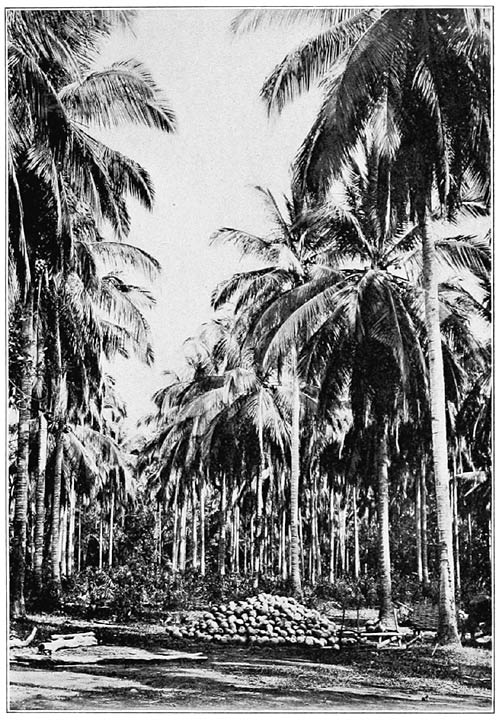
A Typical Cocoanut Grove.
Dried cocoanut meat is one of the principal exports of the Philippines.
Should we not stimulate the commercial development of the islands by adopting liberal provisions as to the sale of public lands, safeguarding the public interest by imposing at the same time severe conditions as to cultivation? And should not our anti-imperialist friends cease to rail at those of their countrymen who are willing to spend the money without which commercial development is impossible? Can they not grasp the fact that the influx of Americans and American capital sounds the death knell of slavery and peonage? It was Americans whose testimony enabled me to prove to the world the existence in the Philippines of these twin evils, and to bring pressure to bear which resulted in prohibitive legislation. It is Americans who are helping the poor Filipinos to become owners of land. It is Americans who are encouraging them to take contracts for cultivating cane, so that they have a direct interest in the crop.
Increasing prosperity means more money for the maintenance of order, for schools, for hospitals, for sanitary work and for public improvements. The diminution of exports which would promptly follow any serious disturbance of the peace of the country would result in the loss of much of the ground already gained.
The average business man is not a sentimentalist. So long as he can safely carry on his work, and can be sure of just treatment, he does not worry much over the nationality of the government officials who maintain such conditions, but he will not invest his money in a country where it is not reasonably certain that such conditions will continue to prevail.
The business men of the Philippines know by experience what American government of the archipelago means. Some of them know, also by experience, what Filipino rule means. The slump in real estate values and customs receipts which so promptly followed Mr. Wilson’s expression of hope that the frontiers of the United States might soon be contracted, conclusively demonstrated their opinion as to the effect of Philippine independence on the peace and prosperity of the country.
The number of Filipinos who thus far have demonstrated ability successfully to manage large commercial enterprises is exceedingly limited. Must not commercial prosperity coexist with political independence, if the latter is to be stable?
During the visit of the congressional delegation which accompanied Mr. Taft on his return to the Philippines in 1907, public sessions were held at which the Filipinos were given opportunity to make complaints. One fervid orator denounced the collection of customs dues, internal revenue taxes, the land tax and the cedula tax. A congressman asked him how he expected to get money to run the government after all taxes were abolished. He replied, “That is a detail which can be settled later.”
Would it not be well to consider, at this time, one very important detail, namely, what would be the effect on the insular government of a marked falling off in the business from the taxes on which practically all of the insular revenues are at present derived?