Volume 2 — Chapter XXV Slavery and Peonage (continued 2)
Reading edition
“... Mr. Worcester now practically admits that he knew of similar conditions elsewhere than among the Moros, but that he never had anything to say about them and allowed them to go on until, it would seem, he thought that he could make some political capital out of a controversy with the Philippine Assembly regarding anti-slavery legislation.”
It did not lie in my power to correct it. On the Philippine Commission rests the full responsibility for failure to enact anti-slavery legislation from the time when it first learned of the existence of this crime among the Filipinos until it passed its first act prohibiting and penalizing it on April 29, 1909. As I have already shown, the matter was dealt with, in 1903, by directing the inclusion of proper legislation in a proposed new Penal Code never completed. Valuable years were then lost in testing the adequacy of existing law, and when it proved inadequate further time was, in my opinion, needlessly wasted in drafting the necessary act. To this extent, and to this extent only, the commission shares responsibility for existing conditions. Since April 29, 1909, that responsibility has rested on the assembly alone.
I have given two of the reasons for its refusal to act. There is another, but I should have hesitated to give it, as it would have been hard to prove, had not Speaker Osmeña furnished the necessary evidence. He is commonly considered to be the leading Filipino statesman of the day, so special importance attaches to his utterances and he, if any one, can speak with authority concerning the attitude of the assembly. The ominous rumble from the United States which reached these distant shores led him to give out a newspaper interview explaining the inactivity of that body. He said:—
“Never has Mr. Worcester attempted to furnish us with the facts which he has placed before Congress. The bill itself was sent to the Assembly for action but on account of the unfriendliness of the members for the secretary of the interior and the lack of sympathy between the Assembly and him, it was not given the consideration that it would have received if Mr. Worcester had at the same time sent us the facts which he has sent on to the United States.
“Mr. Worcester as the secretary of the interior, and not as commissioner was in duty bound to furnish the Assembly with the facts that he claims to have found. It is the duty of all of the administrative officers of the government to enlighten the legislature and to furnish it with information gained officially by them. As a matter of fact, Mr. Worcester showed that he was not anxious for the Assembly to consider the matter by never once even mentioning the subject to me, as is customary with other matters for legislation which the secretaries have wished taken up by the Assembly.”
If this were not so pathetic it would be very, very funny. The assembly is now made up of 81 Filipino delegates representing 34 provinces. An unfeeling American secretary of the interior, residing at Manila, is charged with having failed to inform them of what was going on under their very noses. All information deemed by the commission necessary to justify legislation was transmitted by me to that body when we lost our slavery case in the Supreme Court.
Never during all the years that this matter has been pending has there been the slightest suggestion that the assembly desired to receive information concerning it. If its members were to tell the half of what they themselves know about slavery and peonage the facts which I have been able to gather would fade into insignificance, but this is not the important thing in this interview.
The important thing is that dislike of the person who happened to introduce in the commission a bill prohibiting slavery and peonage in the Philippines is considered a valid reason for the refusal of the assembly to consider it during four successive years.
Shall thousands of suffering human beings be allowed to go on sweating blood for such a reason?
It is my earnest hope that as a result of the publicity which has now been given this matter there will be speedy action, either by the Philippine Legislature or by the Congress of the United States.
I hope that every right-minded person who reads these lines will insist that we have done with concealment of the truth and suppression of the facts; have done with boggling over hurting the feelings of the Filipino people; and will demand that those who have power to end the disgraceful conditions which now exist in the islands shall promptly and effectively exercise it.

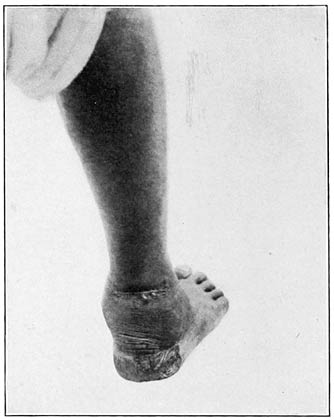
The Penalty for Loyalty to the United States.
This man had his lips cut off and was hamstrung, by order of the bandit chief Felizardo, because he was suspected of giving information to Americans.
The native press has naturally bitterly opposed any investigation of the truth or falsity of my statements. The following extract from a recent editorial is typical of its attitude:—
“Slavery is not slavery unless it has the characteristics of frequency and notoriousness. Is there here, or has there ever been, at least since Christian civilization has reigned, anything that resembles it? Where is, or who has seen previous to now, such characteristic slavery? Mr. Worcester? Let him point it out, let him give a detailed account of it, let him define it. What will you bet that he will not do so? How is he going to do it if it does not exist! It was enough for him to say: “There is slavery in the Philippines” for men, press, government officials and every stripe of public elements in America to admit the possibility of the affirmation and even an investigation of its likelihood to be ordered.
“That is simply absurd. The mere investigation is an offense. The proof must come solely from, and must be demanded solely of, him who imputes the charge. If he does not demonstrate it, if he does not make it patent, further investigation is not needed. All that there was to investigate is investigated: it is that he has lied.”
It allowed me to leave Manila without the faintest suggestion that it desired to hear me, and then had the governor-general cable me an invitation to testify and to assist in the investigation when I was halfway home and could not possibly return.
Assemblyman Sandoval, defending in the public press a friend charged with buying a Tagbanua slave who had been thrice sold, says that the several purchasers did not buy the unfortunate man but bought his debt. A debt is not ordinarily purchased for itself and it is admitted that in this instance the man went with it.
The Filipino politicians have hardly approached this matter in a judicial spirit, and the timid and the politic, who refused to give me the information they might have furnished, had some reason for their fears.
The removal of Judge Ostrand and Director of Education Crone, who gave valuable testimony, was loudly demanded on the ground that they were “traducers of the Filipino people.”
The people were urged to “get together” and disprove my statements.
I have been denounced as an enemy of “the Filipino people.”
It has been claimed:—
That my charges were false, and without foundation.
That, if they were true, I myself was to blame for the continued existence of slavery.
That I published my report when I did in order to hold my position.
That I published it when I did in anger because I had lost my position.
That I had been removed because I published it.
In just one instance, so far as I know, has a Filipino considered the possibility that the motive which actuated me was a desire to help many thousands of unfortunate human beings.
What is needed to end slavery and peonage is congressional legislation enforced by Americans.
Without hesitation I assert that their existence in the Philippine Islands is the greatest single problem which there confronts the government of the United States, in its effort to build up a respectable and responsible electorate and establish representative government.
Is it reasonable to suppose that the hand which to-day crushes down the Filipino servant, the Filipino labourer, and the wild-man of the hills, will to-morrow raise them up and point them on the way to freedom?