Volume 2 — Chapter XXVI Murder As a Governmental Agency
Reading edition
In discussing the prevalence of slavery in the Philippine Islands, Sr. Manuel Quezon has stated that it has never existed there as an institution. This is true, to the extent at least that it has never been recognized as a legal institution, nor directed nor authorized by order of any competent governmental authority. The same statements cannot be truthfully made with reference to murder, as I shall conclusively show by the records of the Insurgent government.
I wish at the outset to draw a sharp line between acts of barbarity or ferocity, committed without authority by ignorant and irresponsible Insurgent officers or soldiers during the heat of battle or as the result of passions aroused by armed strife, and those which I now discuss. The former must be regarded as breaches of military discipline. Aguinaldo sought to protect his government from their consequences by issuing endless orders in Spanish strictly forbidding them.
His troops were ordered again and again to respect American prisoners and treat them with humanity.
So far as concerns his own people, however, he displayed a very different spirit from the outset.
As we have already noted there exists among the Insurgent records a document written in Tagálog by him, and therefore obviously not intended for the information of Americans, which contains the following:—
Obviously Aguinaldo did not deem it wise to order the murder of the Spanish prisoners as a whole, nor that of the friars as a whole.
The following letter, marked “confidential,” addressed to his cousin Baldomero Aguinaldo, for a time the Insurgent secretary of war, tells a significant tale of the course finally decided upon:—
“Filipino Republic, “Office of the Military Governor, “Malolos, February 17, 1899.
“Señor Secretary of War:—
“Referring to your note in regard to an unhealthy town or place in the province of Nueva Ecija fit for the concentration there of the friars; beside the town of Bongabong there is no good place except the town of La Paz in the province of Tarlac, because, according to my observation, even the persons born there are attacked by malarial fever and ague and if they are strangers very few will escape death.
“Your always faithful subordinate,
(Signed) “Isidoro Torres.
“there were 297 Spanish friars held prisoners in Luzón, and that on February 17, 1899, those in Nueva Ecija, Tarlac, and Pampanga, 111 in all, had been ordered by him to be concentrated in La Paz”!
On February 15, 1900, an expedition under the immediate command of Brigadier-General J. M. Bell sailed from Manila under the personal supervision of Major-General Bates. This was composed of troops detailed to take possession of North and South Camarines and Albay, to which provinces Insurgent troops, having many Spanish prisoners in their possession, had been forced to retire as a result of the operations in Tayabas Province. In compliance with these instructions the town of Daet was occupied after some resistance and the Insurgents in that quarter were driven to the northeast, taking with them a number of Spanish prisoners. A large proportion of these were murdered by command of the officer in charge of the guerilla band guarding them, probably because he was not able to force them to move as rapidly as his own men.
Aguinaldo’s orders were not always couched in such general terms as the one above quoted. Among the most interesting of the captured Insurgent documents is the following:—
“Our Honourable President: We, the signers, who subscribe the declaration appended; by these presents protest against the American proclamation; we recognize no authority but that of God and the Revolutionary Government, and we offer our lives and property for the independence of our country.
“Manila, San Miguel, January 12, 1899.
“Feliciano Cruz “Severino Quitiongco.”
(25 signatures follow.)
(On the back is written in the handwriting of E. Aguinaldo):
The difference in the spelling of the name Severino Quitiongco is doubtless due to the fact that Aguinaldo wrote it down as it sounded to him.
When the Insurgent government began to be pinched for funds, failure to pay taxes became, in many cases, sufficient ground for murdering the delinquent.
The method of procedure is set forth in the testimony of a tax collector, published in General Orders, No. 259, 1901, Division of the Philippines:—
“I carried a letter of authorization to act as special agent, which means authority to commit murder. Each time a murder was ordered a letter was sent to one of four men (named above) by one of the chiefs (naming them). Afterward the letter was taken up and burned. If a man did not pay his contributions to the insurgent collector he was ordered to be killed.”
The chief cause for murder was friendliness toward the Americans. As time passed and the common people had an opportunity to contrast the brutality of their own soldiers with the kindly treatment usually accorded them by the American troops, they welcomed the latter. Weary of danger to life and property, the better men in the towns became very desirous to see the reëstablishment of local governments, and ready to assist in the work. The answer of the Insurgent leaders took the form of wholesale orders for the murder or assassination of all persons friendly to the Americans. I shall cite enough such orders to show that this policy was duly provided for throughout the length and breadth of the Insurgent territory.
Pursuant to these instructions Pablo Mejia, a Filipino of high character and conspicuous ability, was assassinated in a street of Cebú in August, 1899. The Visayans had reason to be proud of him and to execrate his assassins.
On July 11, 1900, Fullón issued a more sweeping order, containing the following provisions:—
“1. Any meeting or assembly of a popular character, held at the instance of the Officers of the United States, for the purpose of recognizing the liberty and independence of the towns of this province, is absolutely forbidden.
“2. The person arranging such meeting shall be shot at once without trial or court martial, unless forced to do so by majeure.
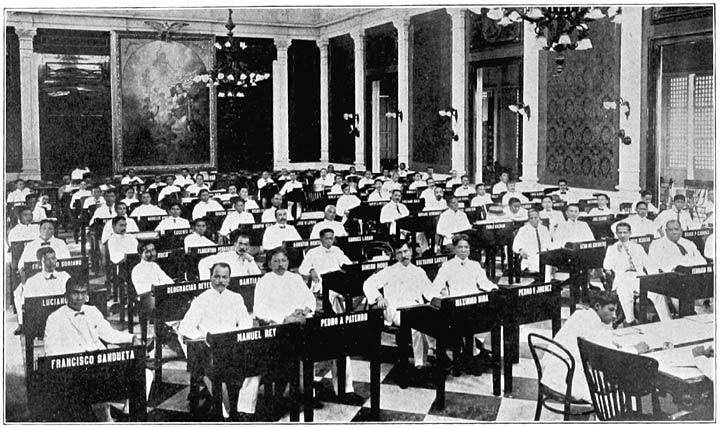
The Philippine Assembly in Session.
The following is a sample order for the assassination of an obnoxious individual:—
“October 4, 1900.
“Confidential.
“To the Local Chiefs of Sogod, Kabalián, Anajauan, Hinundayan, and Hinunangan (Leyte):
“Immediately upon the appearance in the town under your jurisdiction of the traitor to the Mother Country, Severino Komandao, you will secure his person and send him to these headquarters under the proper guard; or if that person should come into the town followed by an American force, you shall try to have him killed by treachery (traidoramente), by ‘Dukut’ (assassination), for this is what a Filipino deserves who does not know how to respect his own land and proceeds to injure the beautiful ideal that we have in view.
“Return the present communication, treating it as confidential. Health and fraternity.
“Maninging, October 4, 1900.
“M. Pacheco, “Military Commander.”
“The Military Commander:
“The undersigned, Local Chief, notes the orders contained in the present circular and will strictly comply therewith.
“Kabalián, October 6, 1900.
In Negros, the Tagálogs long failed to effect a lodgement. Ultimately, however, they managed to stir up trouble, and to secure the help of “Pope” Isio, a noted outlaw. On May 19, 1900, he suggested the advisability of punishing “by decapitation all those who go with the Americans” and ordered that “if it should appear that they are real spies of the enemy they must be beheaded immediately without any pretext whatsoever against it.” To be considered a “real spy,” it was necessary only to be seen talking to Americans.
Evidently he obeyed orders, for he was still alive in November, 1901, at which time “Papa” Isio wrote him again, directing that there be an uprising of all the towns on December 20.
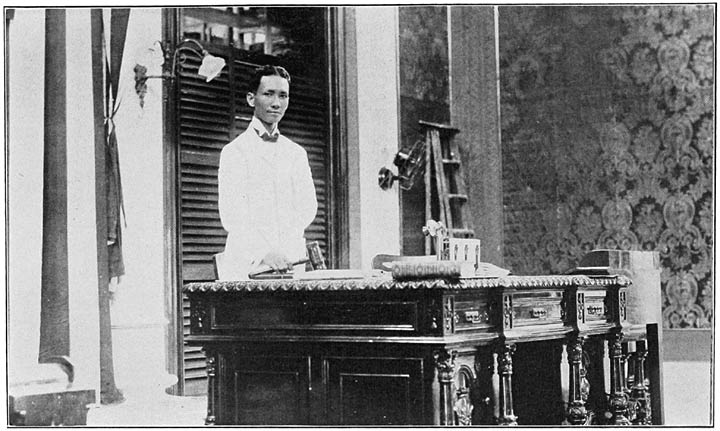
Señor Sergio Osmeña, Speaker of the Philippine Assembly.
In July, 1900, General J. Alejandrino ordered:—
“1st. That the Commanders of Columns proclaim as traitors all those in their respective Zones who in obedience to personal interests or from weakness under pressure of the enemy, accept civil positions and they shall be treated as such when they fall into our hands.
Nowhere is the policy which was being carried out set forth with more brutal frankness than in the following letter:—
“August 3, 1900.
“This letter is folded in envelope shape and addressed: Sr. Teodoro Sandico, Colonel, 1st Military Chief of Staff in Santo Domingo.
“My Respected Chief and Dear Brother: I have received your respected order, regarding the organization of the Committee in the towns of Zaragosa, Aliaga, and Licab; (Nueva Ecija) from the movements and actions of these towns, I don’t believe it possible to organize immediately. Before we can, it will be necessary that four or five lives be taken in each town. I believe that what ought to be done to those towns is to make a new conquest of them, especially the town of San Juan de Guimba; it is difficult there to set straight the Tagálogs and Ilocanos of importance, as they are badly inclined and they care to do nothing but pervert our soldiers.
“This is what I am able to inform you, in fulfilment of the respected order of the Chief.
“God guard you many years.
Cailles did not hesitate to report the results of his orders for the assassination of individuals, giving full and grewsome details. The following is a sample circular letter on this subject, sent out by him:—
“To the local Chiefs and Commanders of Columns, of the province:—
“On this date I have received a communication from the Presidente of Santa Cruz which is as follows:—
“Sr. General: ... I am pleased, much pleased my General, to inform you with much satisfaction of the end in this world of the villain, of the great traitor, Salvador Reyes, in the following manner:—
“This morning at 8 o’clock, according to the reports of Srs. Lázaro Alfonzo and Modesto de los Reyes, who would gladly give their lives for our honour and glory, your coachman told them that the traitor was proceeding to the northern part of the town. They followed him and upon coming to the front of the house and shop of Cabezang Jacinto Talcon, the aforementioned Sr. Modesto attacked him with a bolo like a tiger, with all the strength of his body and soul, hitting by chance his left jaw, when the other, that is to say, Sr. Lázaro Alfonso, followed the first, catching the traitor by the throat with his right hand and with the other fired three pistol shots at him, one of which missed and the other two took effect in the traitor’s shoulder, from the effects of which he fell like a stone upon his face.
The organization of the Federal Party caused an outburst of fury among the Insurgent leaders beside which that aroused by the organization of municipal governments was mild.
Throughout the islands the murdering of officers, members and agents of this party was ordered, and even those who sympathized with its ends were to be shot.
The following is a sample of the orders sentencing to death the adherents of this truly patriotic organization:—
“March 22, 1901.
“Señor Emilio Zurbano y Kajigal,
“Lieutenant Colonel and Military Governor of the Province of Tayabas.
“2nd. In view of the preceding section, the Local Presidentes and Commanders of the columns of this province, will carefully watch their respective jurisdictions in order that not one agent of the enemy nor of the Federal Party, may be secretly able to obtain any signatures of the residents, they shall seize any one who may do it and send him to me with all the possible safeguards for the execution of what is ordered in the foregoing section.
“3rd. All persons who may show themselves to be inclined to the Federal Party, will also be captured and shot on being arrested prior to the proceedings and legal formalities, because being inclined towards this party, is the same as declaring oneself a traitor to the country.
“4th. The commander of a column or local presidente who shall tolerate the existence of the Committees of the Federal Party in his jurisdiction, being able to avoid it, will be tried and in case he is found guilty, will be discharged from his duty and will also be shot, as a traitor to his country.
“5th. The presidentes of the popular committees, will furnish detailed information to the local presidentes and commanders of columns of persons within the towns occupied by the enemies who are engaged in the propagation of the Federal Party or in getting adhesions in any way, either directly or indirectly, to the said party, and the presidente of the popular committee who may fail to accomplish so sacred a duty, will also be punished with the penalty of death.
“6th. When any of the representatives of the federal party, or any of its adherents cannot be captured on account of remaining constantly with the enemy or being protected by him, the local presidentes and commanders of the columns will procure by all means the execution of the said representative or adherent within the line of the enemy through persons of known decision and of patriotism worthy of all commendation.
“7th. All the citizens living in the province of Tayabas who may be representatives or adherents to the Federal Party, aside from the criminal liability which he incurs personally, will be deprived of the benefits of his property, which will be seized by the Government, who will take charge of the profits of the same.
“8th & last. The Local Presidente of the pueblo in which exists any Committee of the Federal Party and the Commander of the column to whose protection the pueblo is entrusted on pain of incurring the punishment detailed in section third of the present proclamation, will proceed to the total destruction of the pueblo in which there is a federalist committee, if, after having been ordered to disband it, at the expiration of seven days the same continues in its traitorous and criminal functions.
“Issued at the Military Government, March 22nd, 1901.
I might furnish many similar data, but enough of orders. Any one who is not convinced by these extracts from the official Insurgent records that murder was a duly authorized governmental agency under the Philippine “Republic” is not amenable to reason or influenced by incontrovertible facts.
One of the common methods of procedure with victims of “dukut” was to bury them alive. A number of individuals suffered this fate at Taytay, near Manila. They were taken out at night, made to kneel beside graves already dug, hit over the head with an iron bar and knocked into their last resting places and the earth was shovelled in on to them. They were confessed by a native priest, and people of the town were required to stand by and see them meet their end.
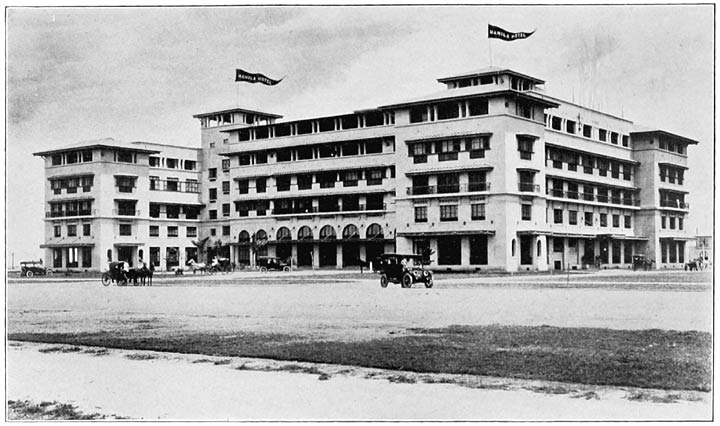
The Manila Hotel.
The ground on which this fine building stands was redeemed from the bay, by using a part of the dredged material, when the new harbor was built.
An American lawyer who afterward defended some of their murderers when the latter were apprehended and brought to trial, told me that among other grewsome details furnished by his clients, who shamelessly admitted to him their guilt, were the following:—
Taylor gives the following account of certain incidents which occurred in Ilocos Sur:—
The Insurgent leaders themselves reported in a most businesslike manner their orders for assassination and the results of their activities in this direction.
The following are sample communications of this sort:
“Headquarters Camp No. 6. “Tierra Libre (Free Soil), Saluyan (Laguna Province) “November 18th, 1900.
“General Juan Cailles, “Military Governor of La Laguna:
* * *
“In Nagcarlang it appears that there will be soon a spy, one Juan, a native of Biñang, for he has already commenced to disobey the committee, and so I with much prudence have ordered his eternal rest. The inhabitants have left the town and no one will serve either as barber or laundry-man to the Americans.
* * *
“Proclamation of Lieutenant Colonel Emilio Zurbano, “Military Governor of Tayabas, To His Fellow-citizens. “Headquarters and Military Government, “Tayabas, April 23, 1901.
“Fellow-citizens: The holiness, purity and elevation of purpose of us who fight for our independence has caused the execution of five of our fellow-citizens on the 18th instant at five o’clock in the afternoon. They were shot on the plaza of the town of Sampaloc....
“Vivencio Villarosa, for assassination of eleven foreigners and for disloyalty; Pedro Cordero, for disloyalty and spying; Remigío Aviosa, for improper exercise of authority, for many assaults and robbery in a band; Segundo Granada, for many assaults and stealing many animals, and Rufino Sabala for being addicted to and a disseminator of the doctrines of the Federal Party have fallen on the plaza of Sampaloc at the very moment when the twilight of the happy triumph of our ideal began to advance over the horizon of our country until now hidden in clouds of blood. May they rest in peace.
* * *
Blount has made the following statement:—
One may well doubt whether he himself wrote the book which goes under his name, for in it he is made constantly to contradict himself. Relative to this matter he has also said:—
Directions for poisoning soldiers were included in a letter written on August 21, 1900, to the Brigadier General Superior Military Commander of the Province of Leyte as follows:—
“It would also be well, in my humble opinion, for you to find out from the old men and quack doctors the kind of poison that can be mixed in alcoholic drinks and in cocoanut wine (tuba), as our enemies now drink these liquors; and after this poison has been known and tried, let it be used in such a way as to undermine the constitution of the man, until some day death occurs; for which purpose you ought to have persons, wherever there are Americans, to poison them. These things are now being done in Luzón, Cebu and Panay.
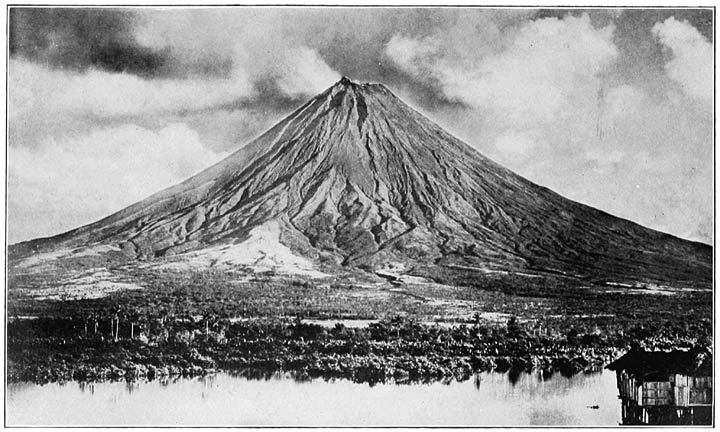
Mayon Volcano.
This beautiful volcano, which in the recent past has destroyed many lives and much property, has now been quiescent for some ten years.
As damnable as any of these horrible documents was the order of General Antonio Luna for the massacre of all Americans, foreigners and “disloyal” Filipinos in Manila.
This effort to massacre all white persons in the city fell through, partly because the plan leaked out, and partly because Cavite Insurgent soldiers did not obey orders.
I consider it important that the authenticity of this much-discussed order should be placed beyond reasonable doubt, and so give Taylor’s findings in full. He says:—
“The search was continued, and finally one of the original orders, a translation of which immediately precedes this note, was produced by Dr. Manuel Xeres y Burgos who was then a surgeon employed in the Bilibid prison in Manila and who had been an officer in the territorial militia of that city. Doctor Burgos wrote in July, 1901, to Colonel Crowder, military secretary to the Military governor of the Philippines, that if he gave him all the details in regard to the means he had employed in obtaining the document, it would require many sheets of paper, and the story would seem like a novel to those who only superficially knew the customs of the Philippines. He said that ‘a few days after the beginning of hostilities we were given to read an order of a mysterious character; we were not allowed to take a copy thereof or to keep it in our possession, probably from fear of some treachery. However the bearer told me that several copies had been made which were to be sent to all the districts in which the “Filipino militia” had been distributed. The chief of the latter were the men called upon to execute said order. You know that, thank God, it was not executed, not only through lack of arms, but also because most of the chiefs who were in Manila felt a repugnance to execute such a barbarous and foolish order, which, had it been attempted, would have been the cause of the extermination of all the Filipinos who were within the American lines as a just reprisal for such an atrocious order.
“‘Luckily, not only the savage measure prescribed was never carried into execution, but it was impossible to attack the American army, the men who had been detailed to do it in Manila having only a few hundred bolos as arms, and the chiefs of the militia understood that with such arms they could not think of resisting the rifles and cannon of the Americans.
“‘Up to the middle of April, 1899, several Filipinos who came from the lines declared that General Luna had sentenced us to death for having disobeyed that terrible order. We were 14 who were considered as traitors to our country, and we were precisely those who had worked for the release of the prisoners in whom we had the greatest confidence, answering for them to the authorities and exposing ourselves to get into trouble if they had broken their word.
“‘We had decided to collect all papers which referred to certain facts, in order to show some day who were those who had lent real services to the country, and we resolved to try and find the document which was the principal cause of the danger which had threatened us at that time.
“‘We would have had the paper in our possession since August last if it had not been for the terror inspired by the secret police with its unjustified arrests, and our emissaries fled from Manila and did not come back until after the end of the persecution.
“‘On the 25th of February, 1901, our friend Benito Albey, who had been lieutenant of the militia and had distinguished himself in the war against Spain, began, on our advice, a new investigation, which was crowned with success.
“‘The document was found among the baggage left by Colonel Leyba to Teodoro de los Santos at Malolos, and which the latter had remitted to a certain Tolo Quesada at Alava, Pangasinán.
“‘I am sincerely happy that said document, which is the clear proof of General Luna’s iniquitous methods, should have been found so that it may serve as a voucher to the thoroughness of General Otis’ investigations; although I would have liked to keep it among my papers, I have more satisfaction to be useful to the American General, who has obtained the sympathy of the Filipinos by his kind treatment.
“‘And I hope, General Crowder, that you will say as much to General Otis, as I wish him to know that there are Filipinos who have kept a grateful recollection of him, and that all Filipinos are not ungrateful.
“‘Very respectfully, “‘Manuel Xeres Burgos.
“‘General Crowder.’
“On June 30, 1901, the original of this order, signed by Luna and produced by Burgos, was shown to Aguinaldo, who, after examining it, stated that the signature was that of General Antonio Luna, with which he was well acquainted. He furthermore stated that he had no personal knowledge of such an order, and had hitherto been unaware of its existence. He was then asked whether General Luna’s authority, as Director of War, was of sufficient scope to authorize him to issue such an order without express authority from the insurgent government. He declined to answer this question.
“A photographic reproduction of the original of the order of Luna, dated February 7, 1899, a printed copy in Spanish, the translation which preceded this note, and the correspondence upon which the foregoing statement is based, is given beginning on page 1903, Senate Document No. 331, part 2, Fifty-seventh Congress, First Session, ‘Hearings before the Committee on the Philippines of the United States Senate.’
“There does not seem to me to be the slightest reason for doubting the authenticity of this order. It was an atrocious one, but that argument is not sufficient to prove that the order delivered up by Dr. Burgos was a forgery in whole or in part.
“The facts of the case seem to me to be the following: In January, 1899, Doctor Burgos was employed in Bilibid prison by the Americans, and as an officer of Sandatahan was deep in the plotting for a general massacre of the foreigners in Manila. Sometime that month he wrote to Aguinaldo that the uprising in Manila should begin in Bilibid prison, and that the Sandatahan should be posted on San Pedro street and the adjacent thoroughfares in preparation for an attack upon the Zorilla theatre, where the Pennsylvania regiment was quartered across the way from the prison (Exhibit 349). His suggestion was adopted as part of the plan for the uprising. Burgos, like the majority of the Filipinos in Manila, believed that Aguinaldo would win, and was doing what he could to aid his cause, but without giving up his position under the American government. The plan embodied in Luna’s order was to be carried out as part of the attack upon Manila; but that attack was delivered prematurely, and it was found impossible to carry out the uprising in Manila which was to have preceded the attack upon the American lines. After February 5, 1899, the majority of the Filipinos in Manila ceased to believe that Aguinaldo was going to beat the Americans, and Burgos, who was known to have taken part in the movement in Manila headed by Sandico, found it expedient to ward off any investigation of his conduct by giving information. He wanted to stay out of prison, and he wanted to remain surgeon of Bilibid prison. He was well aware that Sandico was known by the Americans to have organized bodies of sandatahan in Manila, and he therefore delivered to the provost marshal general a partial copy of Luna’s order which, if it was not then in his possession, he had seen; and he saw no reason for telling more than seemed expedient for the attainment of his immediate purpose, he said that it had been issued by Sandico, who he well knew the Americans would believe was the man most likely to have issued it. He naturally desired to avoid having to make too many explanations. In 1901, Luna being dead, and Burgos being safe from his vengeance, he found no great difficulty in delivering up the original document, which was probably, as he said, in the papers of Colonel Leyba, or Leiva, a native of Manila whose family lived there and whose house had probably been a centre of insurgent intrigue. In 1899 or 1900 Colonel Leyba, a trusted and confidential aid of Aguinaldo, had been murdered by ‘The Guards of Honour’ in Pangasinán Province, and Burgos seems to have had access to his papers. This, at least to me, seems a plausible explanation of the incomplete form in which this first order appeared, and why it appeared at all. It is true that I have found no record of it among the record-books kept at Malolos; but this order was not of a character to be written out in full in any letter-sent book; and, furthermore, the record-books of the government at Malolos show that almost no records were kept there for a week after the outbreak of hostilities. The clerks and officials were probably busy in preparing to defend the place against an advance of the Americans, whom they had hitherto looked upon with contempt.
In reality there was nothing novel about the issuing of such an order in the Philippines.
Alfonso Ocampo, who was to have led the attack in an attempt to massacre all Spaniards in Cavite at the outbreak of the revolt of 1896, testified as follows concerning the proposed movement:—
On June 26, 1896, there was issued an order for an uprising in Manila, which contained the following provisions, among others:—
“Fourth. While the attack is being made on the Captain-General and other Spanish authorities, the men who are loyal will attack the convents and behead their infamous inhabitants. As for the riches contained in said convents, they will be taken over by the commissioners appointed by this G. R. Log. for the purpose, and, none of our brothers will be permitted to take possession of that which justly belongs to the treasury of the G. N. F. [Grand Philippine Nation?—Tr.].
“Fifth. Those who violate the provisions of the preceding paragraph will be considered malefactors, and will be subjected to exemplary punishment by this G. R. Log. [Grand Regional Lodge?].
“Sixth. On the following day the brothers designated will bury the bodies of all the hateful oppressors, in the field of Bagumbayan, as well as those of their wives and children. Later a monument commemorating the independence of the G. N. F. (Grand Philippine Nation?) will be erected on that site.
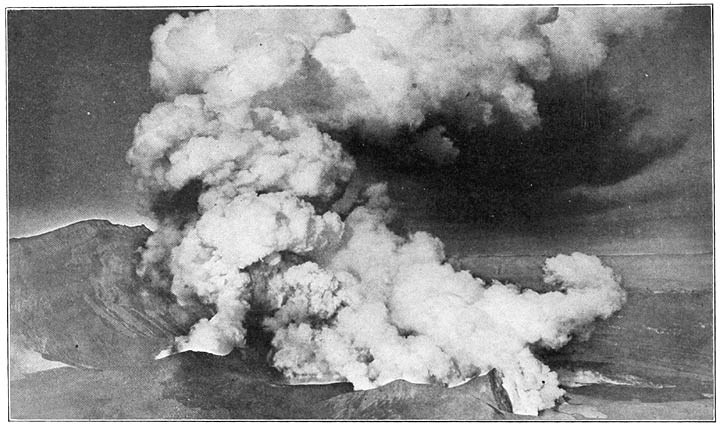
The Crater of Taal Volcano.
This photograph was taken a few hours before the destructive eruption of January 29, 1910, which killed some 1400 people in a few moments.
General MacArthur is credited by Blount with the following statement:—
As a matter of fact, plenty of people appealed to the Americans for protection and got it. I have seen document after document each recommending some individual to American officers everywhere as worthy of protection, and as needing it on account of services rendered to Americans. Relative to this matter, Taylor says:—
In very many cases our efforts to furnish protection were necessarily futile. It is easy enough to protect a town from an open attack. It is often excessively difficult to protect an individual against an assassin who proffers him one hand in assumed friendship and stabs him with the other.
We shall never know how many men were murdered in accordance with the orders which I have cited, and other similar ones.
In reviewing the sentence of the Taytay murderers, General Adna R. Chaffee, who, as the ranking military officer in the Philippines, was closely in touch with the situation, made the following statement:—
Taylor has made the following summary of the facts:—
The blood of these men cries out against those who would deceive the American people into believing that the Filipinos were ever united in loyalty toward the Filipino Republic or the leaders who made murder a governmental agency in the Philippine Islands.
Most of the men who wrote the orders and perpetrated the acts which I have cited are alive and active to-day. Were independence granted, they would rule again the country that they ruled before. Is there any reason for believing that their warped intelligences have straightened, or their hard hearts softened? Would the United States care to assume responsibility for any government which they could set up or would maintain?
* * *