American Intervention
Reading edition
The prelude to the American occupation of Manila was the demand made on Spain by the Government of the United States of America to evacuate the Island of Cuba.
It was known in Manila that the hostile squadron was on the way to the Philippine capital. Submarine mines were laid, or said to have been laid, for some old cable was purchased for the purpose from the telegraph-ship Sherard Osborn when the submarine cable was removed from Bolinao and carried on to Manila. Admiral Patricio Montojo went with four ships to await the arrival of the enemy off Subig (Zambales) on the west coast of Luzon. Subig is a fine natural harbour, but with precipitous shores just as Nature has made it. For years the “project” had existed to carry a State railway there from Manila, and make Subig the principal Government Naval Station and Arsenal instead of Cavite. But personal interests and the sloth of the Government combined to frustrate the plan. Under the pressing circumstances the military authorities pretended to be doing something there, and sent up a commission. Admiral Montojo expected to find batteries of artillery mounted and 14 torpedoes in readiness, but absolutely nothing had been done, so he at once returned to Manila Bay, and prepared to meet the adversary off Cavite. In Cavite there were two batteries, with three guns between them, but at the last moment two defective guns were put ashore there from the Don Juan de Austria and two similar pieces from the Castilla.
In Hong-Kong there was great agitation among the members of the Philippine Patriotic League (Junta Patriotica) and the rebel chiefs exiled under the alleged Treaty of Biac-na-bató. The League had presented to several European Governments, through its own agents, a sort of Memorandum, to which no official recognition could be given. The leaguers were now anxious to co-operate with the Americans in compelling the Spaniards to evacuate the Archipelago. An influential American in Hong-Kong accepted the honorary post of treasurer of the Patriotic League Fund, but quarrels over the spoil resulted in General Aguinaldo being obliged by one of his ex-ministers to pay him his share, amounting to several thousands of Mexican dollars. Under these circumstances General Aguinaldo and his suite proceeded to Singapore, travelling incognito, so as to avoid any undue interference, and Aguinaldo took the opportunity to explain in certain official quarters the existing conditions in the Philippines. The rebel general opportunely arrived in Singapore at or about the time of the outbreak of American-Spanish hostilities. Certain American authorities in the Far East were desirous of utilizing Aguinaldoʼs services and prestige with the armed natives to control them and prevent reprisals when the American forces should appear before Manila. It was hoped that, in this way, the lives of many Spaniards in the Islands would be spared. Indeed, it eventually resulted so, for Aguinaldo, with admirable tact, restrained any impolitic movement on the part of his followers during the American operations against the Spaniards. Only one who had lived in the Islands could adequately appreciate the unbounded confidence some 20,000 armed natives must have had in Aguinaldo to have refrained, at his bidding, from retaliating on their old masters. According to El Liberal newspaper of Madrid, dated June 28, 1898 (which quotes from El Dia), the aspirations of the Revolutionary Party would appear to have been, at that date, as follows, viz.:—
1. Philippine Independence to be proclaimed.
2. A Federal Republic to be established by vote of the rebels; pending the taking of this vote Aguinaldo was to appoint the members of that Government.
3. The Federal Republic to recognize a temporary intervention of American and European Administrative Commissions.
4. An American Protectorate to be recognized on the same terms as those fixed for Cuba.
5. Philippine ports to be opened to all the world.
6. Precautionary measures to be adopted against the influx of Chinese.
7. The existing judicial system to be reformed.
8. Liberty of the press and right of assembly to be proclaimed.
9. Ample tolerance of all religions and sects, but abolition and expulsion of all monastic Orders.
10. Measures to be adopted for working up the natural resources of the Archipelago.
11. The wealth of the country to be developed by the construction of highroads and railways.
12. The obstacles operating against the development of enterprises and employment of foreign capital to be removed.
13. The new Government to preserve public order and check all reprisals against the Spaniards.
14. Spanish officials to be transported to another safe and healthy island until there should be an opportunity for their return to Spain.
From Singapore, General Emilio Aguinaldo returned with his suite to Hong-Kong, where instructions had been given apparently favouring his plans for co-operation in the Islands. Consequent on this, General Aguinaldo and his staff made preparations for proceeding to Manila in an American warship when it should be deemed opportune to do so. About the same time the Philippine Patriotic League issued a proclamation which is too long to reproduce here, as it covers eight folios of print. This document sets forth that whereas the Treaty of Biac-na-bató had not been fulfilled by the Spanish Government, the Revolutionists considered themselves absolved therefrom, and morally free again to take the offensive in open warfare for the security of their rights and liberty. But this document does not quote any of the text of the above alleged treaty. Proclamations and exhortations to the rebels were issued with such frequency that it would be tedious to cite them all, but the following is a fair example:—
(Translation of Full Text)
Philippine Patriots:—
A nation which has nothing good can give nothing. It is evident we cannot depend on Spain to obtain the welfare we all desire. A country like Spain, where social evolution is at the mercy of monks and tyrants, can only communicate to us its own instincts of calumny, infamy, inquisitorial proceedings, avarice, secret police, false pretences, humiliation, deprivation of liberties, slavery, and moral and material decay which characterize its history. Spain will need much time to shake off the parasites which have grown upon and cling to her; she has no self-dependence so long as her nationality is composed of inquisitorial monks, ambitious soldiers, demoralized civil servants, and a populace bred to support this state of things in silence. It is therefore useless to expect anything from Spain.
During three and a half centuries Spainʼs policy has been a delusion. Is there a conflict between Spain and England or Holland? Then the friars come and relate to us preposterous absurdities of the miracles of Saint Francis and of the Image of the Virgin of the Rosary, whilst Simon de Anda calls the Pampango natives his brothers so long as they fight to save the Spanish flag falling into the hands of English or Dutch savages! Is the foreign invasion ended? Then the friars, through their salaried agents in the press, reward us with epithets such as monkey, buffalo, etc. Is there another conflict imminent between Germany and Spain? Then the friars call the natives Spaniards and the military officers own us as their sons and they dub us brave soldiers. Is the conflict finished? Then we are again overgrown boys, beings of inferior race and incapable of being civilized. Is there now to be a struggle with Americans? Then General Augusti, who is the living symbol of Spanish authority, who ought to be the most prudent of the prudent, the most cultivated of the cultivated, points at America as a nation composed of all social excrescences; the friars and their enslaved Spaniards want again to cajole and cheat us with offers of participation in public affairs, recognition of the military grades of ex-rebel chiefs, and other twaddle degrading to those who would listen to it. In fact, they have called into their councils the sons of the country, whilst they exclusively carry out their own ideas, and reserve to themselves the right to set aside all the resolutions at a stroke. They offer to enrol in their ranks the insurgents of yesterday, so that they can have them all shot on the morrow of the present difficulty. What irrision! Do you want another trick exposed? Now that Spain is in danger of losing the Philippines, the executioners of the other day—the everlasting tyrants—tell us that America will sell the Islands to England. No, America has its past and its present. America will preserve a clear intelligence; she is not dominated by friars and tyrants like Spain; she is liberal; she has liberated her slaves against the will of the Spaniards who were, for the most part, their owners. A country is known by its national character; review its past history and it is easy to understand the calumny launched against the Americans. But even though we became English, should we not gain by it? The English have conceded self-government to many of their colonies, and not of the frail delusive sort that Spain granted to Cuba. In the English colonies there are liberties which Spain never yielded to hers in America or the Philippines.
Our country is very rich, and as a last resource we can buy it from the Americans. Do not be deceived by the Spaniards! Help the Americans, who promise us our liberty. Do not fall into the error of taking Spain to be a civilized country. Europe and America consider her the most barbarous of the century. There the weakest is the most persecuted. In no country to-day but Spain is the Inquisition tolerated. It is proved by the tortures imposed on the prisoners of Montjuich, of the Philippines, and of Cuba. Spain did not fulfil the agreement entered into with Maximo Gomez at Zanjón, nor that made with Aguinaldo at Biac-na-bató. Spain is a nation always more ready to promise than to perform. But ask for friars, soldiers, and State dependents to come and devour our wealth, and instantly you will get them. Spain has nothing else to give, and God grant she will keep what she has. Spain will flatter you under the present circumstances, but do not be deceived. Submit every fawning offer to your conscience. Remember the executions of the innocents, the tortures and atrocities which have been the means of covering with decorations the breasts of those who took the blood of your fathers, brothers, relations and friends. Providence will aid the Americans in their triumph, for the war is a just one for the nation elected to lead us to the goal of our liberty. Do not rail against the designs of Providence; it would be suicidal. Aid the Americans!
(Anonymous.)
On the other side, far richer in poetic imagination and religious fervour, is the Allocution of the Archbishop of Madrid-Alcalá published in Madrid on the day hostilities commenced. The following extract will suffice to show how the religious sentiment of the people was indirectly appealed to to convince them that Spain was defending a noble cause.
Very Beloved Sons:—
The cursed hunger for gold and the unquenchable thirst for power have combined to tarnish that flag which the Great Queen Isabella raised, by the hand of Columbus, in the West Indies. With justice trodden under foot, the voice of the Pope unheeded, and the intervention of the nations despised with arrogance, every road to the counsels of peace has been barred and the horrors of war have become a necessity. Let Heaven be witness that we are not the authors of this disaster, and let the responsibility before God be on that vain people whose dogma seems to be that money is the God of the world.... There, ploughing the seas, go our soldiers and our sailors. Have no fear, let no one weep, unless, indeed, it be for fear of arriving too late for the fray. Go, braves, to fight with the blessing of the Fatherland. With you goes all Spain, from the Mediterranean to the Atlantic, from Irun to Tarifa. With what envy do We contemplate you weighing anchor to leave our shores! Oh! why does juvenility, or decrepitude, or duty deprive us of the joy of taking part in your enterprise? But no! with you goes our Spanish heart.... May the Immaculate Virgin, whose scapulary hangs around your necks and whose blessed image floats on your flags, protect you under her mantle in the moment of danger, deliver you from all evil, and shower blessings upon you! May Saint James, patron of Spain, and the martyr Nicodemus and Saint Telmo and Saint Raymond and the King Saint Ferdinand go before you and ever march in the vanguard wherever you may go and make you invulnerable to the bullets of the enemy, so that you may return victorious to tread once more this noble soil and kiss the cheek of the weeping mother who bore you!... We, who cannot go to take part in the battles, will hold and brandish the arms of prayer, like Moses who prayed on the mountain, whilst Joshua slew his ferocious enemies in the valley.... God has triumph in His hand and will give it to whom He pleases. He gave it to Spain in Covadonga, in Las Navas, in El Salado, in the river of Seville, on the plain of Granada, and in a thousand battles which overflow the pages of history. O Lord, give it us now! Let the nations see that against the right of might there is the might of right!
To all beloved sons, from our heart We have pleasure in sending you our pastoral benediction, in the name of the Father, and the Son, and the Holy Ghost. Amen.
Given in our palace in Madrid on the 23rd of April, 1898.
José Ma Archbishop-bishop of Madrid-Alcalá.
This Allocution calls to mind Spainʼs last struggle with Mexico. Was it a battle of the saints? The Spaniards relied on Santa Isabel; the Mexicans appealed to Santa Guadalupe, and the latter came out victorious.
In Manila, as the critical day approached, Gov.-General Augusti issued his general order as to special military service and his proclamation to the Philippine people. The latter is couched in vituperative and erroneously prophetic language, but both can be better appreciated from the following translated texts:—
Special Military Service
Whereas it is necessary to adopt every possible means for the defence of this territory and to render assistance to the army and the fleet in the approaching operations against the United States of North America, I order:
1. It is hereby declared that a state of war exists.
2. All public functionaries of the State and the municipalities, not exceeding 50 years of age and not physically unfit, are obliged to take up arms in defence of the country and serve whenever they are required. They will proceed, at once, to their offices and lodge their names and serve under their present chiefs.
3. All Spaniards and sons of Spaniards (although not born in the Peninsula) above the age of 20 and not more than 50, living in the Provinces, are also hereby required to take up arms.
4. All those not comprised in the foregoing are at liberty to serve as Volunteers.
(a) All native Spaniards who are not employed in the public offices.
(b) All those who are under 20 and more than 50 years of age, and who are strong enough to endure the fatigue of a campaign.
(c) All foreigners (except North Americans) who are domiciled in Manila or in the capitals of the Provinces.
5. The General Sub-Inspector will organize these Volunteers, and distribute them as required for defensive purposes.
6. Public functionaries will receive their orders for military service from their respective administrative chiefs.
7. From this date no one capable of bearing arms is allowed to leave these Islands. This prohibition does not apply to those who are seriously ill.
Proclamation
Spaniards:—
Between Spain and the United States of North America hostilities have broken out.
The moment has arrived to prove to the world that we possess the spirit to conquer those who, pretending to be loyal friends, take advantage of our misfortunes and abuse our hospitality, using means which civilized nations consider unworthy and disreputable.
The North American people, composed of all the social excrescences, have exhausted our patience and provoked war with their perfidious machinations, with their acts of treachery, with their outrages against the law of nations and international treaties.
The struggle will be short and decisive. The God of Victories will give us one as brilliant and complete as the righteousness and justice of our cause demand. Spain, which counts upon the sympathies of all the nations, will emerge triumphantly from this new test, humiliating and blasting the adventurers from those States that, without cohesion and without a history, offer to humanity only infamous traditions and the sorry spectacle of Chambers in which appear united insolence and defamation, cowardice and cynicism.
A squadron manned by foreigners, possessing neither instruction nor discipline, is preparing to come to this Archipelago with the blackguardly intention of robbing us of all that means life, honour, and liberty. Pretending to be inspired by a courage of which they are incapable, the North American seamen undertake as an enterprise capable of realization the substitution of Protestanism for the Catholic religion you profess, to treat you as tribes refractory to civilization, to take possession of your riches as if they were unacquainted with the rights of property, and to kidnap those persons whom they consider useful to man their ships or to be serviceable in agricultural or industrial labour.
Vain designs! Ridiculous boastings!
Your indomitable bravery will suffice to frustrate the attempt to carry out their plans. You will not allow the faith you profess to be made a mockery of, with impious hands placed on the temple of the true God, the images you adore to be thrown down by unbelief. The aggressors shall not profane the tombs of your fathers, they shall not gratify their lustful passions at the cost of your wivesʼ and daughtersʼ honour, or appropriate the property that your industry has accumulated as a provision for your old age. No, they shall not perpetrate any of the crimes inspired by their wickedness and covetousness, because your valour and your patriotism will suffice to punish and abase the people who, claiming to be civilized and polished, have exterminated the natives of North America instead of bringing to them the life of civilization and of progress.
Filipinos, prepare for the struggle, and united under the glorious Spanish banner, which is ever bedecked with laurels, let us fight with the conviction that victory will reward our efforts; against the shouts of our enemies let us resist with Christian decision and the patriotic cry of “Viva España!
Manila, 23rd of April, 1898.
Your General, Basilio Augusti y Davila.
The volunteers and guerilla battalions which had been so recently disbanded by General Primo de Rivera, because they terrorized the peaceful inhabitants, were now publicly thanked and praised for their past services and called upon again to serve their country. The Mayor of Manila issued his own proclamation, exhorting the inhabitants to help the Spaniards against the Americans. Archbishop Nozaleda also made his appeal to the people, assuring them that four Spanish battleships were on their way out (although, as a matter of fact, only one existed, namely, the Pelayo 8,500 tons, built in 1887), and that from direct communication with the Almighty he had learnt that the most Christian Spain would be victorious in the next engagement.
There was a general stampede of those who could get away; numbers of families fled up the Pasig River towards the Lake of Bay. The approaches to Manila from the north were held by the rebels; Cavite Province threw off the cloak of pacification and sent fresh levies to invest the highroads leading from the south to the capital. General Augustiʼs wife and children, who had been conducted for safety to Macabebe (Lower Pampanga), were kidnapped by the rebels. All Americans (about 25), except one family, took refuge on board foreign ships in the bay. The one exception was a Mr. Johnson, who had been travelling through the Islands with a cinematograph show, and he refused to remove his wife, who had just given birth. The well-known s.s. Esmeralda took on board a crowd of passengers for Hong-Kong at fancy rates of passage. Refugees offered as much as four times the usual passage-money for a saloon berth, and deck-passengers were willing to pay three times the normal rate. The Chinese were leaving the Islands by hundreds by any available opportunity, for they had just as much to fear from the loyal as the rebel faction. The rich Chinese were robbed and the labouring class were pressed into service fit for beasts of burden. Despised by the Spaniards and hated by the natives, their lives were not safe anywhere. Foreign families of neutral nationality sought more tranquil asylum far beyond the suburbs or on ships lying in the harbour. Two days before the Americans arrived a native regiment was suspected of disaffection. The Spanish officers therefore picked out six corporals and shot them forthwith, threatening to do the same on the morrow if the ringleaders were not handed over. During the night the whole regiment went over to the rebels with their rifles and accoutrements. No intelligent European foreigner entertained any doubt as to the result of the coming contest, but the general fear (which happily proved to be unfounded) was that it would be followed by an indiscriminate massacre of the Spaniards.
There were warships of several nations in the bay, and the Spanish fleet was moored off Cavite awaiting the arrival of the adversaryʼs squadron. The Spanish men-of-war, which were always painted white, had their colour changed to dark grey like the American ships. All coast lights were extinguished. The Island of Corregidor and Funta Restinga were hastily supplied with a few 6-inch guns from the Castilla. Punta Gorda, Punta Larisi, the rock El Fraile, and Caballo Island had toy batteries compared with the American armament.
After an intimation of “no surrender” from the Spaniards, by a cannon-shot fired from the Fort of Santiago towards the approaching United States fleet, the American ships opened fire, to which the Spanish fleet responded with a furious broadside; but being badly directed it did very little damage. The Don Antonio de Ulloa discharged a broadside at the enemyʼs ships with almost no effect, and simultaneously the drums were beaten, whilst the officers and crews shouted “Long live the King, Queen, and Spain!” Firing on both sides then became general. The well-aimed shots of the Americans were beginning to tell forcibly against the Spaniards. The Don Juan de Austria advanced towards the Olympia and was met with a shower of shot and shell, obliging her to turn back. The Reina Cristina, seeing the failure of the Don Juan de Austria, steamed full-speed towards the Olympia, intending to engage her at short range, but a perfect hurricane of projectiles from the Olympia made her retreat with her decks strewn with the dead and dying. The Baltimore had one gun put out of action by the Hontoria guns of Punta Sangley, whilst half a dozen men were slightly injured. The Boston also was slightly damaged, but further than that the American ships suffered little or nothing. By 7.30 a.m. the Spanish flagship Reina Cristina was in flames, so a boat was lowered to transfer the Admiral and his staff to the Isla de Cuba. The captain of the Reina Cristina, Don Luis Cadarso, although mortally wounded, heroically commanded his men up to the moment of death. By 8 a.m. the Spanish ships were decidedly crippled, and the American squadron withdrew to another part of the bay, where, behind a number of foreign war and merchant ships, they had left two supply transports, from which they took fresh ammunition. Meantime the little Spanish gunboats General Lezo, Marqués del Duero, Manila, Velasco, and Argos, which were quite unfit for action, ran ashore at Cavite Viejo. The three shore-batteries of Fort Santiago, the Luneta battlement, and Fort San Antonio Abad (Malate) respectively continued ineffectual firing towards the American fleet until the Commodore sent a message telling them to cease fire or he would shell the city. At 11 a.m. the Americans returned in line of battle, and opened fire on the Spanish ships which still had their flags flying, and cannonaded and silenced the forts at Punta Sangley and Cañacao. These operations lasted about one hour. Of the Spanish ships the Castillo, and Reina Cristina were burnt; the Don Juan de Austria was blown up, and the Don Antonio de Ulloa, pierced all over with shot, sank after the action, and about half of her crew which had survived the battle were drowned. Only the two cruisers Isla de Cuba and Isla de Luzon remained in fighting condition, but the position was so hopeless that Admiral Montojo ordered them to run aground in the Bay of Bacoor.
The Americans then opened fire on the Arsenal and Fort of Cavite, which had not a single gun left in place. Soon a Spanish officer, named Lostoa, signalled for a truce to save the women, children, and wounded. An American officer met him and replied that having destroyed the fleet the American mission was ended for the present, and agreed to suspend firing provided the shore-batteries at the river-mouth were silent. General Augusti was consulted as to this condition, and agreed to it. The mail-steamer Isla de Mindanao was aground off Las Piñas, and being armed as a cruiser the Americans fired on her and she was soon ablaze. There was still another parley with reference to Cavite. The Americans demanded the surrender of the Arsenal, the Admiral, and the surviving crews of the destroyed fleet. As General Peña declined to surrender Cavite, the Americans gave the Spaniards two hours to evacuate, under the threat of bombarding Manila if the demand were not complied with. Again the answer was negative, and five hours were allowed so that General Peña could consult with the Captain-General. General Augusti having authorized the evacuation, in less than two hours Cavite and the whole isthmus, including San Roque, Caridad, Estanzuela, and Dalahican, were under American control. All the Spanish families returned to Manila by land. The next day (May 2) the débriswas cleared away from Cavite and the environs, and the dwellings were cleansed and put in order for indefinite military occupation.
The evacuation of Corregidor Island was demanded by the Americans, and the 100 men composing the garrison were allowed to depart in boats for Naig on the west coast of Cavite. Their commander, however, surrendered himself prisoner, and went on board the Baltimore with his family. He was at once offered (but wisely refused) his liberty, and later on he was put ashore at Balanga (Bataan).
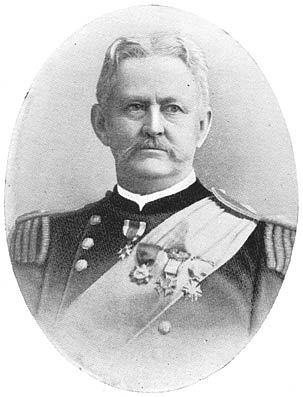
Maj.-General Wesley Merritt
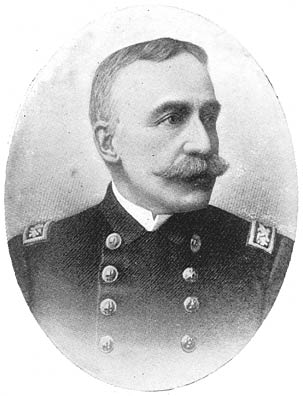
Admiral George Dewey
The Spaniards exhibited great bravery in the battle of Cavite, and man for man they proved themselves to be in no way inferior to their opponents. Considering the wretched condition of their old-fashioned ships and armament compared with the splendid modern equipment which the Americans brought, no other result could have been expected. The American losses were seven men wounded, none killed, and only slight damage to one vessel.
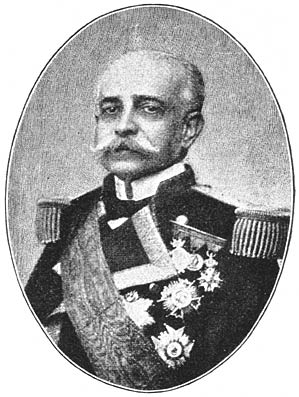
Admiral Patricio Montojo
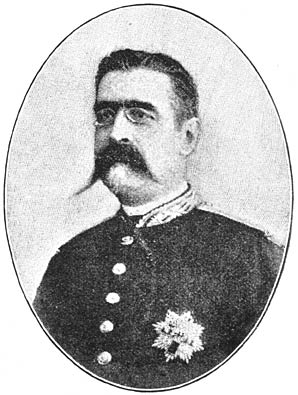
General Basilio Augusti
On May 2 he demanded to be put in possession of the telegraph-station, and on this being refused he ordered the cable connecting Luzon with Hong-Kong to be cut. The Spanish authorities had just time before this measure was taken to report the bare facts to Madrid by cable. The news produced immense consternation in the Spanish capital. The whole city was instantly in uproar. Mobs of people filled the streets, wildly denouncing the incapability of a Government which could lead them to such disaster. The newspaper offices were thronged. Special supplements were issued as quickly as possible. The cafés, clubs, and other public meeting-places were besieged. General Borbon drove out in a carriage from which he harangued the populace, and was, in consequence, sent to a fortress for three months. There was an attempt at holding a mass meeting in the Puerta del Sol, but the surging crowd started down the Calle de Sevilla and the Carrera de San Gerónimo shouting, “Long live Weyler!” “To the house of Weyler!” They reached his residence, and after a series of frantic vivas for the army, navy, etc., they called on General Weyler to appear at the balcony. But being himself in somewhat strained relations with the existing Government, he did not think it prudent to show himself. Then some one having set up the cry of “Down with the whole Government!” which was responded to with frenzied applause, the rioters set out for Sagastaʼs house, returning by the Carrera de San Gerónimo. At that moment the mounted civil guard met and charged the crowd. Many were trodden under foot, and arrests were made. The Civil Governor, Señor Aguilera, followed up in his carriage, and when the military police had dispersed the general mass, leaving only here and there a group, the Civil Governor stepped out of his carriage and addressed them. His words were hissed from the balcony of a club, and it was already past midnight when the first outburst of public indignation and despair had exhausted itself. On May 2 the Heraldo of Madrid, calmly reviewing the naval disaster, commented as follows:—
It was no caprice of the fortune of war. From the very first cannon-shot our fragile ships were at the mercy of the formidable hostile squadron; were condemned to fall one after the other under the fire of the American batteries; they were powerless to strike, and were defended only by the valour and breasts of their sailors. What has been gained by the illusion that Manila was fortified? What has been gained by the intimation that the broad and beautiful bay on whose bosom the Spanish Fleet perished yesterday had been rendered inaccessible? What use was made of the famous Island of Corregidor? What was done with its guns? Where were the torpedoes? Where were those defensive preparations concerning which we were requested to keep silence?
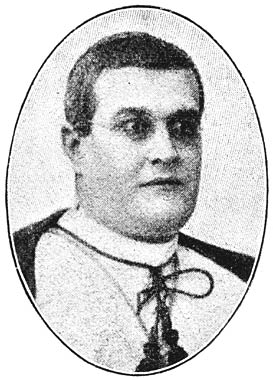
Archbishop Bernardino Nozaleda
Several merchant vessels were seized in and about Manila Bay, and supplies from seawards were cut off from the city, which was quite at the mercy of Admiral Dewey, who could have bombarded it and forced surrender the same day. But it was not easy to foresee what might follow. Admiral Dewey had full discretion to act as circumstances might seem to guide him, but it was evident that whatever the surrender of the Captain-General of the Archipelago might theoretically imply, a military occupation of Manila was far from being tantamount to possession of the Islands. Hemmed in everywhere on land by the insurgent forces which now occupied and collected taxes in several Luzon provinces, the Spaniards could have been shelled out of the capital and forced to capitulate, or driven to extermination by the thousands of armed natives thirsting for their blood. The Americans had, consequently, a third party to consider. The nativesʼ anxiety to oust the Spaniards was far stronger than their wish to be under American, or indeed any foreign, control. But whilst a certain section of the common people was perfectly indifferent about such matters, others, wavering at the critical moment between their opposition to the Spaniards and repulsion of the foreign invader, whoever he might be, proclaimed their intention to cast in their lot with the former. Lastly, there was Aguinaldoʼs old rebel party, which rallied to the one cry “Independence.” “Nothing succeeds like success,” and if the rebel version of the alleged Treaty of Biac-na-bató had been fulfilled in the spirit, no doubt Aguinaldo would have been unanimously revered as a great reformer. But the relinquishment of the strife by the leaders, the money transaction, and the immediate renewal of Spanish severities, together created an impression in the minds of the rebel rank-and-file that, in some way, their general welfare had been sacrificed to personal interest. It was doubtful, therefore, how Aguinaldo would be received on his return to the Islands. With the object of investigating the feelings of the old rebel party, the leader José Alejandrino and two other rebels accompanied the American expedition to Cavite, where they disembarked. Several days passed in convincing the rebels of Aguinaldoʼs good faith in all that had occurred, and in the meantime Aguinaldo himself arrived on May 19 with 12 other rebel leaders in the American despatch-boat Hugh McCulloch. It yet remained doubtful whether he still held the confidence of the rank-and-file; but when he at length landed at Cavite, his old companions-in-arms, and many more, rallied to his standard with the greatest enthusiasm. The rebels at that date were computed to number 30,000, and Aguinaldo, on taking the command, declared himself Dictator. Aguinaldo was, naturally, at that period, on the most amicable terms with Admiral Dewey, who allowed him to have two modern field-pieces, 500 rifles, and 200,000 rounds of ammunition, enjoining on him the strict observance of his engagement to repress reprisals against the Spaniards.
To prepare the natives for the arrival of the Americans, Emilio Aguinaldo sent over in advance of the American Fleet the following exhortation:—
Compatriots:—
Divine Providence is about to place independence within our reach, in a manner most acceptable to a free and independent people.
The Americans, not for mercenary motives but for the sake of humanity, in response to the woes of the persecuted, have thought fit to extend their protecting arm to our beloved country, now that they have been obliged to sever their relations with Spain on account of the tyranny practised in Cuba, to the great prejudice of the large commercial interests which the Americans have there. An American squadron is at this moment preparing to sail for the Philippines. We, your brothers, fear you may be induced to fire on the Americans. No, brothers, never make this mistake. Rather blow out your own brains than treat with enmity those who are your liberators.
Your natural enemies, your executioners, the authors of your misery and your woe, are the Spaniards who rule you. Raise against these your weapons and your hatred. Understand well, against the Spaniards; never against the Americans. Do not heed the Governor-Generalʼs decree, calling you to arms, even though it cost you your lives. Die rather than be ungrateful to our American liberators. The Governor-General calls you to arms. Why? To defend your Spanish tyrants? To defend those who have despised you and in public speeches called for your extermination—those who have treated you little better than savages? No! no! a thousand times, no!
Glance at history and you will see that in all Spainʼs wars undertaken in the Far East, Philippine blood has been sacrificed; we were sent to fight for the French in Cochin China over a matter which in no way concerned us; we were forced by Simon de Anda to spill our blood against the English, who, in any case, would have been better rulers than the Spaniards; every year our sons are taken away to be sacrificed in Mindanao and Sulu against those who, we are led to believe, are our enemies when, in reality, they are our brothers, fighting, like us, for their liberty. After such a sacrifice of blood against the English, the Annamites, the Mindanaos, etc., what reward or thanks have we received from the Spanish Government? Obscurity, poverty, the slaughter of our dear ones. Enough, brothers, of this Spanish tutelage!
Note that the Americans will attack by sea and prevent any reinforcements coming from Spain, therefore the insurgents must attack by land.
You will, probably, have more than sufficient arms, because the Americans, having arms, will find means to help us. Wherever you see the American flag, there flock in numbers. They are our redeemers.
Our unworthy names are nothing, but we all invoke the name of the greatest patriot our country has seen, certain in the hope that his spirit will be with us and guide us to victory, our immortal José Rizal.
Cavite being occupied by the American forces, foreign Manila residents were permitted to take refuge there, for no one could tell when the Spaniards would be forced to capitulate, or what might happen if they did. Meantime the rebels had cut off, to a considerable extent, but not entirely, supplies of food to the capital, which was, however, well stored; and at no time during the three and a half monthsʼ siege was there a danger of famine among the civilian population, although prices of commodities gradually advanced to about double the normal rates. Even the hotels in the city only charged double prices. The Spanish troops fared far worse; their condition became more and more deplorable. All were badly and insufficiently fed, as much from disorganized commissariat arrangements as from actual want of supplies. The latest arrivals of youthful raw recruits particularly felt the pangs of hunger, and as the swarming rebels took one outpost after another from its emaciated defenders and raided the adjacent provinces, the Spanish prisoners in their hands (soldiers, friars, and civil servants) reached the figure of thousands. Among them was Brig.-General Garcia Peña (lately in command of Cavite), a colonel, several other officers, a civil governor, etc., and some hundreds of volunteers.
Of the neutral warships in the bay, Germany had sent the largest number, and the actions of their commanders caused much anxiety to the blockading forces. In the city the German Consul made little secret of his sympathies for Spain, and was in frequent consultation with the Captain-General. German and Spanish officers fraternized freely in the streets and cafés. On May 18 a German steamer, with cargo and provisions, was reported outside Manila Bay, but her entry into the port was forbidden by the Americans. Later on the commander of a German man-of-war and his staff were received and fêted by the Captain-General. These German officers were invited to a picnic at San Juan del Monte accompanied by several general and other high Spanish military officers. The German commanderʼs post-prandial oration at the feast was much commented upon, for he is said to have declared (presumably on his own responsibility) that so long as William II was Emperor of Germany the Philippines should never come under American sway. The party then rode back to Manila, watched by the rebels, who were too wise to intercept them and so jeopardize their own cause by creating international complications. There is little doubt that the attitude taken up by the Germans nurtured the hope entertained by Spaniards all over the world, that at the last hour some political entanglement between the other Powers might operate beneficially for Spainʼs interests.
The city and commercial suburb of Binondo wore their usual aspect, although trade was almost at a standstill. The undisguised sympathies of Great Britain for America revived the long dormant feeling of distrust and ill-will towards the British residents, which now became so marked that the Captain-General issued a proclamation commanding due respect to be paid to neutral foreigners. Even this did not prevent a Spanish officer spitting in the face of an Englishman. Indeed, at any time, there was far more danger to all civilian classes from the Spanish soldiery than from the rebels, who were strictly enjoined by Admiral Dewey not to attempt to enter the city. Had they done so, certainly their choicest prize would have been the Archbishop Nozaleda, who, well aware of this, escaped, long before the capitulation of the city, to Shanghai on board the German warship Darmstadt.
The volunteers, too, were constantly giving trouble to the Spanish authorities, from whom they demanded their pay, and once when this was refused they threatened to seize the stores.
Although trade in and with Manila had been more or less suspended, and at intervals absolutely so, since the great naval engagement, just a few profited by the circumstances of war. One British firm there, figuratively speaking, “coined” money. They were able frequently to run a steamer, well known in Chinese waters (in which I have travelled myself), between Manila and Hong-Kong carrying refugees, who were willing to pay abnormally high rates of passage. In ordinary times fares ranged from ₱50 saloon accommodation to ₱8 a deck passage. On one trip, for instance, this steamer, with the cabins filled at ₱125 each, carried 1,200 deck passengers (no food) at ₱20, and 30 deck passengers (with food) at ₱30. Their unsold cargoes on the way in steamers when Manila was blockaded came in for enormously advanced prices. Shiploads of produce which planters and native middlemen were glad to convert into pesos at panic rates were picked up “dirt cheap,” leaving rich profits to the buyers. When steamers could not leave Manila, a Britisher, Mr. B——, walked for several days under the tropical sun to embark for Yloilo with trade news, and steamers were run at high war rates in and out of Borneo, Hong-Kong, and the Philippine southern ports. One British firm obtained a special licence to run a steamer between Hong-Kong and the port of Dagúpan, hitherto closed to foreign traffic. These were, naturally, the exceptions, for, upon the whole, the dislocation and stoppage of trade entailed very serious losses to the general body of merchants. A few days after the bombardment of Cavite the natives refused to accept the notes of the Banco Español Filipino (the Spanish bank), and a run was made on the bank to convert them into silver. However, the managers of the Hong-Kong and Shanghai Banking Corporation, and the Chartered Bank of India, Australia, and China, came to the rescue of the Banco Español-Filipino and agreed to honour the paper issue in order to check the scare. The three banks thereupon opened their doors and satisfied the note-holders, ordinary business being, meanwhile, suspended.
Aguinaldo had not only been busy organizing his forces, but had, in several engagements with the Spaniards, driven them back with loss, made prisoners, and replenished his own armouries. He then assumed the Dictatorship and issued the following proclamation:—
Filipinos:—
The Great North American nation, example of true liberty, and, as such, the friend of freedom for our country oppressed and subjugated by the tyranny and despotism of its rulers, has come to offer its inhabitants protection as decisive as it is disinterested, regarding our unfortunate country as gifted with sufficient civilization and aptitude for self-government. In order to justify this high conception formed of us by the great American nation, we ought to abstain from all acts which would destroy that opinion, such as pillage, robbery and every kind of outrage against persons or property. So as to avoid international conflicts during the period of our campaign I order as follows:—
Article 1.—The lives and properties of all foreigners shall be respected, including in this denomination the Chinese and all Spaniards who have not directly or indirectly contributed to the bearing of arms against us.
Article 2.—Those of the enemy who shall surrender their arms shall be, in like manner, respected.
Article 3.—Medical establishments and ambulances shall also be respected as well as the persons and effects connected therewith, provided they show no hostility.
Article 4.—Persons disobeying the above three articles shall be summarily tried and executed if their disobedience should lead to assassination, incendiarism, robbery or rape.
Given at Cavite, May 24, 1898.
Emilio Aguinaldo.
On June 8, at 5 p.m., a Philippine deputation, headed by Dr. Santos, waited on the American Consul-General in Singapore and delivered to him a congratulatory address on the American successes in the war with Spain. In reply to this address, the Consul-General made some pleasing remarks which were received with vociferous cheers by the Filipinos for the President of the United States and all sympathizers with their welfare. At the close of the reception a band of Philippine musicians played a selection of graceful airs of their native isles.
No. 87.
Department of State,
Washington, July 20, 1898.
Sir,—
Your No. 229 of the 9th ultimo, inclosing printed copies of a report from the Straits Times of the same day ... with a view to its communication to the Press, has been received and considered. By Departmentʼs telegram of the 17th of June you were instructed to avoid unauthorized negotiations with the Philippine insurgents. The reasons for this instruction were conveyed to you in my No. 78 of the 16th of June, by which the Presidentʼs views on the subject of your relations with General Aguinaldo were fully expressed. The extract now communicated by you from the Straits Times of the 9th of June, has occasioned a feeling of disquietude and a doubt as to whether some of your acts may not have borne a significance and produced an impression which this Government would be compelled to regret. The address presented to you by the 25 or 30 Filipinos who gathered about the consulate discloses an understanding on their part that the object of Admiral Dewey was to support the cause of General Aguinaldo, and that the ultimate object of our action is to secure the independence of the Philippines “under the protection of the United States.” Your address does not repel this implication, and it moreover represents that General Aguinaldo was “sought out by you,” whereas it had been the understanding of the Department that you received him only upon the request of a British subject ... who formerly lived in the Philippines. Your further reference to General Aguinaldo as “the man for the occasion” and to your “bringing about” the “arrangement” between “General Aguinaldo and Admiral Dewey which has resulted so happily” also represents the matter in a light which causes apprehension lest your action may have laid the ground of future misunderstandings and complications. For these reasons the Department has not caused the article to be given to the Press, lest it might seem thereby to lend a sanction to views, the expression of which it had not authorized.
Respectfully yours,
William R. Day.
During the first few weeks following the Cavite naval battle nothing remarkable occurred between the belligerents. The British Consul and Vice-Consul were indefatigable in the services they rendered as intermediaries between Admiral Dewey and General Augusti. The American fleet was well supplied with coal from British vessels. The Manila-Dagúpan Railway was in working order, and bringing supplies into the city. The Spanish authorities issued a decree regulating the price of meat and other commodities. American vessels made occasional trips outside the Bay, and brought in captive sailing-vessels. Neutral passenger-steamers were allowed to take away refugees other than Spanish subjects. The rebels outside Manila were very active in the work of burning and pillaging churches and other property. Streams of smoke were daily seen rising from the valleys. In the outskirts of the city, skirmishes between Spanish troops and rebels were of frequent occurrence. The Spaniards still managed to preserve routes of communication with the country districts, although, little by little, the rebels were closing in upon them. Aguinaldo and his subordinate leaders were making strenuous efforts effectually to cut off all supplies to the city, with the view of co-operating with the Americans to starve the Spaniards into capitulation. The hospitals in the capital were crowded with wounded soldiers, brought in at great risk from the rural districts. Spanish soldiers sauntered about the city and Binondo—sad spectacles of emaciation in which body and soul were only kept together by small doles of rice and dried fish. The volunteers who had enlisted on the conditions of pay, food, and clothing, raised an unheeded cry of protest, and threatened revolt, whilst the officers whiled away the time in the cafés with resigned indifference. The Archbishop issued his Pastoral Letter, in which he told the natives that if the foreigners obtained possession of the Islands there would be an end to all they most dearly cherished. Their altars would be desecrated; the churches would become temples of heresy; Christian morality would be banished, and vice would become rampant. He reminded them (with the proviso “circumstances permitting”) that he had appointed June 17 as the day on which the consecration of these Islands to the “Heart of Jesus” would be solemnly confirmed.
To draw the remnant of loyalty to his side, the Gov.-General instituted a reformed “Consulting Assembly” composed of 15 half-castes and natives, under the nominal presidency of Pedro A. Paterno, the mediator in the Biac-na-bató negotiations. Señor Paterno, whose sympathy for Spain was still unalienated, issued a Manifiesto of which the following is a translation (published in El Comercio of Manila on June 2, 1898):—
Filipinos: Beloved Brethren.
I love our country as none other does. I want it to be great, free, and happy, and to shape its own destinies according to its desires and aspirations. Therefore, I respect all the vital forces in it at the cost of my life and my fortune. A long time ago I risked my existence for the rights and liberties of the Philippine people, who were sorely agitated, by bringing the majority together, and directing the salvation of their interests based on liberty and justice. My ideas are neither strange nor new; they are the result of study and political experience, and not recently conceived under the existing circumstances. I desire, with all the vehemence of my soul, to see my country strong and great—its honour and dignity respected and in the enjoyment of the greatest happiness. But however great our efforts may be we need an ally. Let us imitate the example of the Great Powers; they cannot exist alone, however strong and great they may be. They need help, and the union of strength increases their power. Russia seeks France; Germany seeks Italy and Austria. Unhappy is the Power that isolates itself! And what better ally can we have than Spain, a nation with which we are united for nearly four centuries in religion, laws, morals, and customs, understanding full well her virtues and her defects? The evil days of Spanish colonization are over, and by dint of experience and the sacrifice of blood Spain has understood that we are already of age, and require reforms in our territory such as the formation of Philippine Militia, which gives us the force of arms, and the Consulting Assembly, which gives us the power of speech, participation in the higher public employments, and the ability to control the peaceful development and progress of society. Spain is at war with the United States; we neither know that nation nor its language. The Americans will endeavour by all imaginable means to induce us to help them against Spain. And then, alas! they, the all-powerful, will absorb us and reward our treachery to Spain by betraying us, making us slaves and imposing upon us all the evils of a new colonization. On the other hand, by helping Spain, if we die, we do so in the fulfilment of our duty; if we live, we shall obtain the triumph of our aspirations without the dangers and risks of a civil war. We shall not die! No! Under the flag which shields us and our garrisons, fighting with faith, decision, and ardour, as a country does which yearns to be free and great, the enemy will disappear like the wave which washes the seashore. Let us hope to obtain from Spain all the good that the American stranger can offer to us. Let us help our old ally, our old friend Spain, and realize, with her, more quickly our aspirations. These are they:—With the greatest decentralization possible consistent with national unity, the organization and attributions of public powers must be based on three principles:—(1) Spanish sovereignty. (2) Local representation. (3) Colonial Government responsibility. Three institutions correspond to these three principles, viz.: (1) The institution of the General Government of the Philippines. (2) The Insular Deputation or Philippine Assembly. (3) The Governative Council. In this way the rights of the Government and those of the Colony are harmonized. Let us shun the policy of suspicion and doubt. With these firm and solid guarantees let us establish civil and political liberty. The Assembly, representing the will of the people, deliberates and resolves as one would treat oneʼs own affairs in private life, and thus constitutes the legislative power of the Archipelago. Its resolution will be put into practice with all fidelity by the executive power in its character of responsible government. There are only Spaniards in the Archipelago; we are all Filipinos and all European Spaniards. Such is the programme of the party who want home rule for the Philippines—ever Spanish! Thus shall we see the destinies of this country guided under the orange and red flag. Thus will my beloved country be governed, without detriment to the integrity of Spain. Finally, under Spain our future is clear, and with all certainty we shall be free and rule. Under the Americans our future is cloudy; we shall certainly be sold and lose our unity; some provinces will become English, others German, others French, others Russian or Chinese. Let us struggle, therefore, side by side with Spain, we who love the Philippines united and free. Long live Spain!
Pedro Alejandro Paterno. Manila, 31st of May, 1898.
This Manifiesto was replied to a week later by the rebel party, who published a Refutation, of which the following is a translation:—
Refutation of the Manifiesto of Señor Paterno.
“Actions speak louder than words.”
A better phrase, or idea, could not be found with which to reply to the Manifiesto of Don Pedro A. Paterno, published in El Comercio of the 2nd instant, than the epigraph which heads these lines.
Señor Paterno begins by saying that he loves his country as none other does; he wants it to be great, free, and happy, and to shape its own destinies according to its own desires and aspirations. Would to God such beautiful language represented the truth, for it is just what we wish and what we have, long ago, been aiming at, at the risk of our lives and property, as proved by our actions and our arguments, especially since the middle of the glorious year of 1896, the period in which we commenced the conquest, by force of arms, of our most cherished liberties. May Señor Paterno forgive us if we cite a little of the history of this movement, so that he may see that neither are we ungrateful, nor are we acting with precipitation, but as a logical and undeniable consequence of the vile conduct and bad faith of the Spanish Government.
For over 300 years the country slumbered in ignorance of all that referred to its rights and political liberties. It was resigned to the Spanish governmental system of spoliation, and no one thought of reforms. But when the Revolution of September, 1868, broke out in Spain and overthrew the throne of Isabella II., the first revolutionary leaders, inspired by ideas of humanity and justice, caused an Assembly of Reformists to be established here, one of the members of which, if we remember rightly, was Don Máximo Molo Paterno, father of Don Pedro. The Assembly agreed to and proposed good and appropriate reforms, amongst which was that relating to the incumbencies which were monopolized by the friars. What did the Spanish Government do with these reforms? What did the friars do? Ah! though it may appear cruel to Señor Paterno, historical facts oblige us to remind him that the Government, in agreement with the friars, engineered the military rising of the City of Cavite in January, 1872, and at the instigation of its authors and accomplices, sentenced the secular priests Father José Burgos, Father Jacinto Zamora, Father Mariano Gomez, parish priests of Manila, Santa Cruz (suburb), and Bacoor (Cavite) respectively, to be garotted. Moreover, another secular priest, Father Agustin, the Philippine lawyers and landed proprietors, Don Joaquin Pardo de Tavera, Don Antonio Regidor, Don Pedro Carrillo, Don José Basa, and others, amongst whom was Don Maximo Molo Paterno, the father of Don Pedro, were banished to the Ladrone Islands. This virtuous grand old man (Don Máximo Paterno) did indeed (and we proclaim it with pride) make sacrifices of health and fortune for the advancement of the liberties of his native country. From the year 1872 the Spanish Government carried on a persistent persecution of all the Philippine reformers by unjust imprisonment and banishment. In 1888 the authorities went so far as to prosecute 700 representative men of the suburbs of Manila, simply for having presented a petition of rights and aspirations to the Gov.-General Don Emilio Terrero. There is not a single insalubrious island or gloomy corner in the country which has not been the forced home of some banished Filipino. No one was sure of his personal liberty; none were safe in their homes, and if three or four Filipinos met together for an innocent purpose, they were spied, arrested, and banished. Calumny has brought about enough banishments to Fernando Po, Chafarinas Islands, Ceuta, and other African and Spanish places to demonstrate the bad faith, cruelty, and injustice of the Spanish Government with respect to the Philippine people. This virile, intelligent people received the supreme decree of reforms with joy and enthusiasm, sharing the feelings of those who felt in their souls the flame of liberty. This people worked, through legitimate channels, to advance its ideal, inspired by the purest loyalty to Spain. How did the Spanish Government fulfil, on its part, the decree spontaneously issued in 1868? By prosecuting and banishing the reformists, and employing a system of terror to damp the courage of the Filipinos. Vain, ridiculous fallacy!—for it ought to have known better after three centuries of rule of that country of intelligence, birthplace of Rizal, Luna, Rosario and other living examples of Philippine energy. The Filipinos, lovers of their liberty and independence, had no other recourse open to them than an appeal to arms, to bring force against force, terror against terror, death for death, resolute and sworn to practise the system of fire and blood, until they should attain for the whole Philippine Archipelago absolute freedom from the ignominious sovereignty of Spain. Now let us continue our comments on the Manifiesto.
Señor Paterno says that a long time ago he risked his existence for the rights and liberties of the Philippine people, even at the cost of his health and his fortune. We, however, do not see how he put into practice such magnificent ideas, for what we do know is that Señor Paterno passed his younger days in Madrid, where, by dint of lavish expenditure, he was very well treated by the foremost men in Spanish politics, without gaining from Spain anything whereby the Philippine people were made free and happy during that long period of his brilliant existence. On the contrary, the very epoch of the persecutions narrated above coincided with the period of Don Pedro A. Paternoʼs brilliant position and easy life in Madrid, where, because he published a collection of poems under the title of “Sampaguitas,” he became distinguished by the nickname of Sampaguitero. We know, also, that Señor Paterno came back to this, his native soil, appointed director of a Philippine Library and Museum not yet established, without salary, but with the decoration of the Grand Cross of Isabella the Catholic. This was no gain to us, no distinction to him, seeing that the same decoration was given to the Chinaman Palanca and two others, without their leaving their homes to obtain them.
How are we then to understand those generous sacrifices of health and fortune for the cause of Philippine liberty? Perhaps he refers to the recently created Philippine Militia and Consulting Assembly. Well, admitting for argument sake, that with such Militia and Consulting Assembly the liberty and happiness of the Philippines were assured (a doubtful hypothesis, Señor Paterno), this happiness is not due to Señor Paternoʼs efforts, but simply to the circumstances. Spain is at war with North America, and now offers us this sugar-plum to draw us to her side to defend her against invasion.
We ask you again, Señor Paterno, where are those sacrifices?
We do not see them, although we seek them with the light of impartiality, for, as the splendour of justice shines on our flag, we should not fail to do this even for our greatest enemies, amongst whom we do not count you.
Do you allude to the Peace of Biac-na-bató? If so, we ask, what have you done with that peace to which we subscribed in good faith, and which you and General Primo de Rivera together have stupidly and scandalously torn into shreds? You have, indeed, bungled the amnesty when many of the banished are, up to now, suffering the miseries of their sad and unjust fate.
You have put off the promised reforms which, even yet, have not come.
You have delayed the payment of the ₱400,000 for the second and third instalments of the agreed sum.
You have not delivered into the hands of our chief, Don Emilio Aguinaldo, the money as agreed upon.
Ah! You thought that when we had surrendered to you our arms and our garrisoned strongholds—when our forces were dispersed and we were absent—you could turn back to the Government of iniquity without reflecting that Divine Providence could permit, in the hour of great injustice, her emissary Don Emilio Aguinaldo to return resolved to chastise energetically the immoral and impotent Spanish Government.
Then comes Señor Paterno, telling us that however great our efforts may be in the cause of liberty, we cannot live without an ally, and that we can find no better alliance than the sovereignty of Spain. Frankly, we must say that this is inconceivably incompatible with Señor Paternoʼs clear intelligence. How do you understand an alliance with sovereignty? How can you imagine a people great, free and happy under the sovereignty of Spain? Señor Paterno cites, as examples, the alliances between Russia and France, Germany and Italy and Austria, but, so far, we do not know that Russia is the sovereign power of the French, nor the Germans that of the Italians and Austrians. Señor Paterno further says that by helping Spain in the war with the United States, if we die, we do so in the fulfilment of our duty; if we live, we shall obtain the triumph of our aspirations without the dangers and risks of a civil war. Know, Señor Paterno, and let all know, that in less than six daysʼ operations in several provinces we have already taken 1,500 prisoners, amongst whom is the Brigadier-General Garcia Peña, one Colonel, several Lieutenant-Colonels, Majors and officers, besides the Governor of the Province of Bulacan, his wife and all the civil service staff of that province. We also have about 500 Philippine volunteers as prisoners, of whom 10 have died and 40 are wounded, whilst among the European prisoners there is only one wounded. This goes to prove that the Europeans were too cowardly to defend the sovereignty of Spain in these Islands, therefore we do not understand the appeal you make to the Filipinos to defend Spain as a duty, when the Spaniards themselves are heedless of that which ought to be a more rigorous and strict obligation with them, seeing that they defend their own possession which brings them so much lucre and profit. This does not say much for the duty when the favoured ones themselves forget it and trample upon it. To die to-day for cowardly Spain! This implies not only want of dignity and delicate feeling, but also gross stupidity in weaving a sovereignty of frightened Spaniards over the heads of brave Filipinos. It is astonishing that in the face of such an eloquent example of impotence there should still be a Filipino who defends the sovereignty of Spain.
Remember, Señor Paterno, that we make war without the help of any one, not even the North Americans; but no! we have the help of God, who is the eternal ally of the great and just causes such as that which we defend against Spain—our own beloved independence!!!
Señor Paterno concludes by explaining his political and administrative principles on the basis of Spanish sovereignty, but, as we have charged that sovereignty with cowardice and immorality, we dismiss this detail.
To conclude, we will draw the attention of Señor Paterno to two things, viz.:
1. That he commits an injustice in imputing to the North Americans the intention of taking possession of these Islands as soon as we have conquered the Spaniards, for, besides having no grounds on which to make such an allegation against a nation distinguished for its humanity like the Federal Republic, there is the fact that its own constitution prohibits the absorption of territory outside America, in accordance with that principle laid down by the immortal Monroe, of America for the Americans. There is, moreover, the historical antecedent that the independence of South America, once under Spanish dominion, is largely due to the protection of the United States; and
2. That Señor Paterno should reflect on the fact that the Spaniards would never have allowed him to publish his Manifiesto had it not been for the existence and attitude of our Dictator, Don Emilio Aguinaldo. This ought to serve Señor Paterno as further proof of the cowardice of the Spaniards, who, notwithstanding all that has been shown, insist on creating discord by provoking civil war: on their heads will fall the responsibilities of the moment and of the historical past.
Cavite, 9th of June, 1898.
The Revolutionists.
The feeling against Don Pedro A. Paterno in the rebel camp was very strong for the time being, because of his supposed complicity in the alleged Biac-na-bató fraud.
The rebels stopped all the traffic on the Tondo-Malabon steam tramway line, and shortly afterwards the Manila-Dagúpan railway trains had temporarily to cease running.
General Augustiʼs wife and family were chivalrously escorted from Macabebe, where they were quite safe, by a loyal Philippine volunteer named Blanco (the son of a planter in Pampanga), who was afterwards promoted to effective rank of colonel in Spain. They were conducted from the Hagonoy marshes to the Bay of Manila and found generous protection from the Americans, who allowed them to quit the Islands. The Spanish garrisons in the whole of La Laguna and Pampanga had surrendered to the rebels, who were in practical possession of two-thirds of Luzon Island. General Augusti was personally inclined to capitulate, but was dissuaded from doing so by his officers.
Long before the capitulation of Manila the rebels were as well armed as they could wish from three sources,—that is to say, the Americans, the Spanish arms seized in warfare, and consignments from China. They also made good use of their field-pieces, and ever and anon the booming of cannon was heard in the streets of Manila. The Spaniards, hard pressed on all sides, seemed determined to make their last stand in the old citadel. The British banks shipped away their specie to China, and the British community, whose members were never united as to the course they should adopt for general safety, was much relieved when several steamers were allowed, by the mutual consent of Admiral Dewey and General Augusti, to lie in the bay to take foreigners on board in case of bombardment. Emilio Aguinaldo, on his return to the Islands, had declared himself Dictator. The Dictatorial Government administered the provinces as they were conquered from the Spaniards, collected taxes, and enacted laws. In a monthʼs time the management of these rural districts had so far assumed shape that Aguinaldo convened deputies therefrom and summoned a Congress on June 18. He changed the name of Dictatorial to Revolutionary Government, and on June 23 proclaimed the Constitution of that provisional government, of which the statutes are as follows:—
(Translation)
Don Emilio Aguinaldo y Famy,
President of the Philippine Revolutionary Government and Commander-in-Chief of its army
This Government, desirous of demonstrating to the Philippine people that one of its objects is to abolish with a firm hand the inveterate vices of Spanish administration, substituting a more simple and expeditious system of public administration for that superfluity of civil service and ponderous, tardy and ostentatious official routine, I hereby declare as follows, viz:—