Modern Manila
Reading edition
Commanding the entrance to Manila Bay there is the Island of Corregidor, situated 27 miles south-west of the city, towards which the traveller glances in vain, expecting to descry something of a modern fortress, bristling with artillery of the latest type which, if there, might hold the only channels leading to the capital against a hostile fleet. The anchorage for steamers is still half a mile to a mile and a half away from the Pasig River, but the new artificial port, commenced by the Spaniards, is being actively brought to completion by the Americans, so that the day may come when the ocean traveller will be able to walk from the steamer down a gangway to a quay and land on the south, or Walled City, side of the capital.
The Bilíbid Jail has been reformed almost beyond recognition as the old Spanish prison. A great wall runs through the centre, dividing the long-term from the short-term prisoners. In the centre is the sentry-box, and from this and all along the top of the wall every movement of the prisoners can be watched by the soldier on guard. Nevertheless, a batch of convicts occasionally breaks jail, and those who are not shot down escape. Gangs of them are drafted off for road-making in the provinces, where, on rare occasions, a few have been able to escape and rejoin the brigands. In March, 1905, a squad of 42 convicts working in Albay Province made a dash for freedom, and 40 of them got away.
Several new theatres have been opened, the leading one being the National, now called the “Grand Opera House”; comedy is played at the Paz; the Zorrilla (of former times) is fairly well-built, but its acoustic properties are extremely defective, and the other playhouses are, more properly speaking, large booths, such as the Libertad, the Taft, the Variedades, and the Rizal. In the last two very amusing Tagálog plays are performed in dialect. There is one large music-hall, and a number of cinematograph shows combined with variety entertainments.
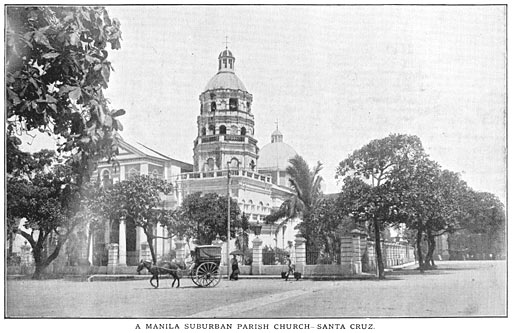
A Manila Suburban Parish Church—Santa Cruz.
The Press is represented by a large number of American, Spanish and dialect newspapers. These last were not permitted in Spanish times.
Innumerable laundries, barbersʼ shops, Indian and Japanese bazaars, shoe-black stalls, tailorsʼ shops, book-shops, restaurants, small hotels, sweetmeat stalls, newspaper kiosks, American drinking-bars, etc., have much altered the appearance of the city. The Filipino, who formerly drank nothing but water, now quaffs his iced keg-beer or cocktail with great gusto, but civilization has not yet made him a drunkard. American drinking-shops, or “saloons,” as they call them, are all over the place, except in certain streets in Binondo, where they have been prohibited, as a public nuisance, since April 1, 1901. It was ascertained at the time of the American occupation that there were 2,206 native shops in Manila where drinks were sold, yet no native was ever seen drunk. This number was compulsorily reduced to 400 for a native population of about 190,000, whilst the number of “saloons” on February 1, 1900, was 224 for about 5,000 Americans (exclusive of soldiers, who presumably would not be about the drinking-bars whilst the war was on). But “saloon” licences are a large source of revenue to the municipality, the cost being from $1,200 gold downwards per annum. A “saloon,” however, cannot now be established in defiance of the general wishes of the neighbours. There is a law (similar in spirit to the proposed Option Law in England) compelling the intending “saloon” keeper to advertise in several papers for several days his intention to open such a place, so that the public may have an opportunity of opposing that intention if they desire to do so.
The American advent has abolished the peaceful solitude of the Walled City where, in Spanish days, dwelt the friar in secluded sanctity—where dignitaries and officials were separated by a river from the bubbling world of money-makers. An avalanche of drinking-bars, toilet-saloons, restaurants, livery stables, and other catering concerns has invaded the ancient abodes of men who made Philippine history. The very names of the city streets remind one of so many episodes in the Islandsʼ progress towards civilization that to-day one is led to pause in pensive silence before the escutcheon above the door of what was once a noble residence, to read below a wall-placard, “Horses and buggies for hire. The best turn-out in the city. Telephone No. ——.” This levelling spirit is gradually converting the historic Walled City into a busy retail trading-centre. For a long time the question of demolishing the city walls has been debated. Surely those who advocate the destruction of this fine historical monument cannot be of that class of Americans whose delight is to travel thousands of miles, at great expense, only to glance at antiquities not more interesting, in the possession of others, and who would fain transport Shakespeareʼs house bodily to American soil. The moat surrounding the Walled City is already being filled up, but posterity will be grateful for the preservation of those ancient bulwarks—landmarks of a decadent but once glorious civilization. Most of the Spanish feast-days have been abolished, including the St. Andrewʼs day (vide Li-ma-hong, p. 50), and the following have been officially substituted, viz.:—
New Yearʼs Day January 1
Washingtonʼs birthday February 22
Holy Thursday — —
Good Friday — —
Decoration Day May 31
Independence Day July 4
Occupation Day August 13
Thanksgiving Day November 24
Christmas Day December 25
Rizal Day December 30
Manila was formerly the capital of the province of that name, as well as the Philippine metropolis. Since the American occupation the city and suburbs form a kind of federal zone; what was once Manila Province is now known as Rizal Province, and with it is incorporated that territory formerly designated Mórong District, the capital town of this newly-created province being Pasig.
The Municipal Board of Manila is composed of five persons, namely a Philippine mayor and one Philippine and three American members, who are practically all nominees of the Insular Government. The emolument of the mayor and of each member is $4,500. The Board, assisted by a staff of 20 persons, native and American, has the control of the ten following departments, viz.:—Police, Fire, Law, Police Courts, Justice of the Peace Courts, Public Works, Assessments and Collections, Deeds Register, City Schools, and Sheriffʼs Office connected with the government of the federal zone of Manila.
Manila is the seat of the Insular Government, which comprises (1) the Philippine Commission (Legislative), composed of eight members, of whom five (including the president) are Americans and three are Filipinos; (2) the Civil Commission (Executive), the president of which holds the dual office of President of the Philippine Commission and Gov.-General, whilst the four secretaries of Interior, Finance and Justice, Public Instruction, and Commerce and Police are those same Americans who hold office as members of the Philippine Commission. The Philippine Commission is empowered to pass statutes, subject to ratification by Congress, the enacting clause being, By authority of the United States, be it enacted by the Philippine Commission. The Insular Government communicates with the Washington Government through the Department of the Secretary of State for War.
Up to the end of 1904 the chief authority in these Islands was styled the “Civil Governor.” Thenceforth, by special Act of Congress, the title was changed to that of “Governor-General.”
$ gold
President of the Philippine and Civil Commissions 20,000
Four American Members of the Philippine Commission, ex-officio Members of the Civil Commission each 15,500
Three Philippine Members of the Philippine Commission each 5,000
Departments
The total cost of the Civil Service for the year 1903 amounted to 8,014,098.77 pesos (vide “Official Gazette,” Vol. II., No. 8, dated February 4, 1904), equal to $4,007,049.38 gold.
Since then the Manila Press has recorded many cases of breach of public trust by those who were sent to teach the Islanders how to rule themselves (vide p. 493). The financial loss arising from malfeasance on the part of any civil servant is made good to the Treasury by a Guarantee Society, which gives a bond in each case, whilst it takes years to recover the consequent loss of prestige to the State. The obvious remedy for this state of things would be the establishment in America of a Colonial Civil Service into which only youths would be admitted for training in the several departments. Progressive emolument, with the prospect of a long, permanent career and a pension at the end of it would be inducements to efficiency and moral stability.
The Philippine Civil Service is open to all United States citizens and Filipinos between the ages of 18 and 40 years in accordance with Philippine Commission Act No. 5, known as the “Civil Service Act,” passed September 19, 1900. The service is divided into “classified” and “unclassified.” The former division is strictly subject to the provisions of the above Act; the latter indicates the positions which may be filled by appointment without subjection to the provisions of the said Act. The Act declares its purpose to be “the establishment and maintenance of an efficient and honest civil service in the Philippine Islands.” American soldiers who have less than six months to serve can apply for permission to be examined for the civil service. The Act does not include examination for civil positions in the Military Division of the Islands, but the Civil Service Board is empowered to hold such examinations to fill vacancies as they may occur in the nine military departments which employ civilians. General examinations, some in English only, others in Spanish only, or both, are held every Monday, and special examinations which include those for scientific, professional, and technical positions are taken on specified dates. The commencing salaries of the positions offered range from $1,200 downwards. Medical attendance is furnished gratis, and the minimum working time is six and a half hours per day, except from April 1 until June 15—the hottest weather—when the minimum working day is five hours. American women are employed in the Post Office.
The Civil Commission is located in the Walled City in the building which was formerly the Town Hall, a new Town Hall having been built outside the walls. Occasionally, when public interest is much aroused on the subject of a proposed measure, the Commission announces that a public conference will be held for the expression of opinion thereon. A few persons state their views before the Commissioners, who rebut them séance tenante, and the measure, as proposed, usually becomes law, unless outside agitation and popular clamour induce the Commissioners to modify it. At times the proceedings have been enlivened by sparkling humour. A worthy and patriotic Filipino once gravely prefaced his speech thus:—“I rise to speak, inspired by Divine Right”—but he had to wait until the roars of laughter had subsided. When the “Sedition Act” was being discussed, a less worthy auditor declared assassination of the Chief of a State to be merely a political offence. He expected to go to prison and pose as a martyr-patriot, but the Commission very rightly damped his ambition by declaring him to be a fool irresponsible for his acts.
Philippine Commission Acts are passed with great rapidity, amended and re-amended, sometimes several times, to the bewilderment of the public. Out of 862 Acts passed up to the end of 1903, 686 of them were amended (some five times) and on 782 no public discussion was allowed. The “Internal Revenue Law of 1904” had not been in force nine months when it was amended (March, 1905) by another law. By Philippine Commission Acts Nos. 127 and 128 the limits of the Surigao and Misámis provinces were defined and afterwards upset by Act No. 787. The policy of the Americans anent the Philippines was continually shifting during the first five years of their occupation, and only since ex-Governor Taft became Secretary of War does it seem to have assumed a somewhat more stable character.
The Archipelago is divided into 41 provinces (exclusive of the Moro Province, vide p. 577), all under civil rule, in accordance with Congress Act of July 1, 1902, and War Office Order of July 4, 1902, whereby the remainder of military government ceased. In June, 1904, nearly all the above 41 provinces had native governors with salaries ranging from $3,000 gold downwards. In most of these provinces the native governor and two American officials of about equal rank, such as the Treasurer and the Supervisor, form a Provincial Council, but the member who disagrees with the vote of the other two can appeal to the Gov.-General. After the War of Independence several insurgent chiefs were appointed to provincial governments; for instance, Cailles in La Laguna, Trias in Cavite, Clímaco in Cebú, etc. For obvious reasons the system is advantageous. Juan Cailles, Governor of La Laguna, is the son of a Frenchman who married a native in one of the French colonies and then settled in these Islands. For some time Juan Cailles was registered at the French Consulate as a French citizen. As commander of the insurgents of La Laguna and Tayabas during the War of Independence, he maintained strict discipline in his troops, and energetically drew the line between legitimate warfare and common freebooting.
The provincial governor may be either elected or appointed by the Civil Commission. If he be a Filipino, he is usually elected by vote of the vice-presidents (ex-mayors) and municipal councillors of the province. The mayor of a municipality is styled “Presidente.” Every male over twenty-three years of age who pays taxes amounting to 30 pesos, or who possesses 500 pesosʼ value of goods is eligible for election by vote of the townspeople. He holds office for two years, but can be re-elected for a consecutive term. The municipalities are of four classes according to their importance, the mayorʼs salary being as follows, viz.: First class, 1,200 pesos; second class, 1,000 pesos; third class, 800 pesos; and fourth class, 600 pesos. Provincial justices of the peace are paid by litigantsʼ fees only. For municipal improvements, or other urgent necessity, the Insular Government, from time to time, grants loans to municipalities, repayable with interest. In some cases two or more towns have been wisely merged into one municipality: for instance, Cauit, Salinas, and Novaleta (Cavite) go together; Baliuag, Bustos, and San Rafael (Bulacan) form one; Barasoain and Malolos (Bulacan) are united; as are also Taal and Lemery (Batangas). By Philippine Commission Act No. 719 the 51 municipalities of Yloilo Province were reduced to 17.
Malolos is the new capital of Bulacan Province, and the two former provinces of Camarines Norte and Camarines Sur are now one, under the name of Ambos Camarines. In the dependent wards of towns (barrios) the municipal police are practically the only official representatives; the post of lieutenant (teniente de barrio) is gratis and onerous, and few care to take it.
The Guardia Civil or Rural Guard of Spanish times has been superseded by the Philippine Constabulary under the supreme and independent command of a cavalry captain (U.S.A.) holding local rank of Brig.-General. In the private opinion of many regular army officers, this force ought to be under the control of the Division Commander. The officers are American, European, and Philippine. The privates are Filipinos, and the whole force is about 7,000 strong. The function of this body is to maintain order in rural districts. For some time there were cases of batches of the rank-and-file passing over to the brigands whom they were sent to disperse or capture. However, this disturbing element has been gradually eliminated, and the Philippine Constabulary has since performed very useful service. Nevertheless, many educated natives desire its improvement or suppression, on account of the alleged abuse of functions to the prejudice of peaceful inhabitants (vide p. 550).
Co-operating with municipal police and the Philippine Constabulary there is an organized Secret Police Service. It is a heterogeneous band of many nationalities, including Asiatics, which, as an executive force to investigate crimes known to have been committed, renders good service; as an initiative force, with power, with or without authority, to molest peaceful citizens in quest of imaginary misdemeanours, in order to justify the necessity of its employment, it is an unwelcome institution to all, especially the lower-middle and common classes, amongst whom it can operate with greater impunity.
The following General Order was issued by the Division Commander in January, 1905, viz.:—
It is reported by the Civil Governor that in several places in Luzon there have gathered numbers of dishonourably discharged men from the army who are a hindrance to progress and good order. The Division Commander desires that in future no dishonourably discharged soldiers be allowed to remain in the Islands, where their presence is very undesirable. It is therefore directed that, in acting on cases where the sentence is dishonourable discharge without confinement, the dishonourable discharge be made to take effect after arrival in San Francisco, where the men so discharged should be sent by first transport.
The Philippine Archipelago is a military division under the supreme command of a Maj.-General. The commanders, since the taking of Manila (1898), have been successively Maj.-Generals Merritt, Otis, McArthur, Chaffee, Davis, Wade, Corbin, and Wood.
The Division is administratively subdivided into three departments, namely Luzon, Visayas, and Mindanao, the two former being commanded by Brig.-Generals and the last by a Maj.-General.
The Department of Luzon, headquarters at Manila, includes the following principal islands, viz. Luzon, Catanduanes, Romblon, Masbate, Marinduque, Mindoro, Sibuyán, Polillo, Ticao, Tablas, Lúcbang, and Búrias.
The Department of Visayas, headquarters at Yloilo, embraces the islands of Cebú, Negros, Panay, Leyte, Sámar, and Bojol.
The Department of Mindanao, headquarters at Zamboanga, includes all the remaining islands of the Philippine Archipelago.
Besides the American troops, there is a voluntary enlistment of Filipinos, forming the Philippine Scout Corps, a body of rural police supplementary to the constabulary, commanded by a major and 100 American first and second lieutenants. Until recently the troops were stationed over the Islands in 98 camps and garrison towns, as follows, viz.:—In the Department of Luzon 76, Visayas 8, and Mindanao 14; but this number is now considered unnecessarily large and is being reduced to effect economy.
The Army, Navy, and Philippine Scouts expenses are entirely defrayed by the United States Treasury. A military prison is established in the little Island of Malahi, in the Laguna de Bay, whence the escape of a prisoner is signalled by three shots from a cannon, and whoever captures him receives a $30-reward. As the original notice to this effect required the recovery of the prisoner “alive or dead,” two armed natives went in pursuit of an American soldier. To be quite sure of their prey they adopted the safe course of killing him first. Such an unexpected interpretation of the notice as the grim spectacle of an Americanʼs head was naturally repugnant to the authorities, and the “alive or dead” condition was thenceforth expunged.
Revenue for one year gold $332,194.17
Disbursements for one year 198,338.93
Profit $133,855.24
Lieut.-General, Active Service $11,000; retired $8,250 gold.
Maj.-General, Active Service $7,500; retired $5,625 gold.
Brig.-General, Active Service $5,500; retired $4,125 gold.