“Allah Akbar!”
Reading edition
The Military Department of Mindanao comprises the large island of that name and the adjacent insular territories inhabited chiefly by Mahometans, called by the Christians Moros (vide p. 129, et seq.).
The natural features of these southern islands are, in general, similar to those of the other large islands of the Archipelago, but being peopled by races (exclusive of the settlers) of different habits, customs, religions, and languages, some aggressively savage and warlike, others more or less tractable, but all semi-civilized, the social aspect is so distinct from that of the islands inhabited by the Christian Filipinos as almost to appear like another quarter of the tropical globe.
In consideration of the above, the Sultan undertook to maintain order between his Dattos, to repress internecine warfare, and gradually to abolish slavery throughout his jurisdiction.
Apparently the Sultan entered into the agreement much in the spirit of Mr. Micawber, who signed the I.O.U.ʼs and thanked God his debts were paid. The ruler of Sulu was not over-willing and far less able to give effect to its conditions, his power being more nominal than real in his own possessions, and in Mindanao almost nil. Nevertheless, it was a politic measure on the Americansʼ part, because its non-fulfilment opened the way for the adoption, with every appearance of justification, of more direct and coercive intervention in the affairs of this region. General Bates was succeeded by other generals in the command of this district, without any very visible progress towards definite pacification and subjection to civilization. The military posts on the coasts, evacuated by the Spaniards, were occupied by American troops and new ones were created, but every attempt to establish law and order beyond their limits, on the white manʼs system, was wasted effort. When the Spanish-American War broke out, the Spanish military authorities were on the point of maturing a plan for the final conquest of Mindanao. Due to the persistent activity of my old friend General González Parrado, they had already achieved much in the Lake Lanao district, through the Marahui campaign. On the evacuation of the Spaniards the unrestrained petty chiefs were like lions released from captivity. Blood-shed, oppression, extortion, and all the instinctive habits of the shrewd savage were again rife. A preconcerted plan of campaign brings little definite result; it never culminates in the attainment of any final issue, for, on the native side, there is neither union of tribes nor any combined organized attempt at even guerilla warfare, hence the destruction of a cotta or the decimation of a clan has no immediate and lasting moral effect on the neighbouring warlike tribe. Life is cheap among them; a Moro thinks no more about lopping off anotherʼs head than he does about pulling a cocoanut from the palm-tree. The chief abhors the white man because he interferes with the chiefʼs living by the labour of his tribe, and the tribesman himself is too ignorant even to contemplate emancipation. Subservience to the bidding of the wily Datto, poverty, squalidity, and tribal warfare for bravado or interest seem as natural to the Moro as the sight of the rising sun. Hence, when the Americans resolved to change all this and marched into the tribal territories for the purpose, the war-gongs rallied the fighting-men to resist the dreaded foe, unconscious of his mission of liberty under the star-spangled banner. The sorrows or the joys of one tribe are no concern of the other; thus there was seldom, if ever, any large combination of forces, and the Americans might be fighting hard in the Taraca country, or around the Lanao Lake, whilst the neighbouring clan silently and doggedly awaited its turn for hostilities. The signal for the fray would be the defiant reply of a chief to the Americansʼ message demanding submission, or a voluntary throwing down of the gauntlet to the invader, for the Moro is valiant, and knows no cringing cowardice before the enemy. Troops would be despatched to the cotta, or fortress, of the recalcitrant ruler, whence the lantaca cannon would come into action, whilst the surging mob of warriors would open fire in squads, or rush forward in a body, bárong or kris in hand, only to be mown down, or put to flight and the cotta razed to the ground. A detailed account of the military operations in these islands would be but a tedious recital of continuous struggles with the irresistible white man. In Mindanao, the Malanao tribes, occupying the northern regions around the Lake Lanao districts, seem to have offered the most tenacious resistance. On April 5, 1902, a fierce encounter with the Bacólod tribes ended with their fort being destroyed, 120 Moros killed, and 11 Americans wounded. In the following month the bloody battle of Bayan brought such disastrous results to the natives that they willingly accepted peace for the time being. In the Taraca River engagement, 10 cottas were destroyed, 250 Moros were killed, 52 were taken prisoners, and the booty amounted to 36 cannon and 60 rifles. The Moros possessed a large number of Remington rifles, looted from the Spaniards, on whom they had often made surprise raids. The Bacólod and the Taraca tribes, although frequently defeated, gave much trouble long after the other districts had been forced into submission.
The instructions of the President of the United States to the Philippine Commission, dated April 7, 1900, direct as follows, viz.:—“In dealing with the uncivilized tribes of the Islands the Commission shall adopt the same course followed by Congress in permitting the tribes of our North American Indians to maintain their tribal organizations and government, and under which many of those tribes are now living in peace and contentment, surrounded by a civilization to which they are unable or unwilling to conform.”
From the American point of view, but not from the Moro way of looking at things, an apparent state of anarchy prevailed everywhere; but the Sultans and the Dattos took very good care not to tolerate what, in Europe, one would term anarchy, tending to subvert the local rule. There is no written code of Moro justice. If a Moro stole a buffalo from another, and the case were brought before the judge, this functionary and the local chief would, by custom, expect to make some profit for themselves out of the dispute. The thief would have to pay a fine to the headman or go into slavery, but having no money he would have to steal it to purchase his freedom. The buffalo being the object of dispute would be confiscated, and to be even with the defendant for the loss of the buffalo, the plantiff would lop off the defendantʼs head if he were a man of means and could afford to pay 105 pesos fine for his revenge.
The real difficulty was, and still is, that there is no Sultan, or Datto, of very extended authority to lay hold of and subdue, and whose defeat or surrender would entail the submission of a whole district or tribe. The work of subjection has to be performed piecemeal among the hundreds of Dattos, each of whom, by established custom, can only act for himself and his own retainers, for every Datto would resent, at the risk of his life, any dictation from another. All this is extremely irritating to the white commander, who would prefer to bring matters to a definite crisis by one or more decisive contests, impossible of realization, however, in Mindanao or Sulu Islands.
Districts Emolument of Governor
Zamboanga (including Basilan Is.) Not exceeding $3,500 gold if he be a civilian.
Joló (sulu) (including Tawi Tawi group)
Lanao (including Ylígan and Lake Lanao)
Cottabato (including Polloc)
Davao (including Cátil)
Dapítan (a sub-district of Zamboanga) Not exceeding $2,000 gold, if he be a civilian.
Each district is controlled by a District Council composed of the governor, the secretary, and the treasurer. At present all the district governors are army officers.
Section 15 of the above Act No. 787 provides that governors and secretaries of districts must learn and pass an examination in the dialects of their localities within 18 months after taking office, or be subject to dismissal.
Under Philippine Commission Act No. 82, entitled “The Municipal Code,” amended in its application to the Moro Province by the Legislative Council of the Moro Province Act No. 35, of January 27, 1904, the Moro districts and sub-districts are furthermore sub-divided in the following manner, viz.:—
A Tribal Ward is furthermore divided into Tribal Ward Districts. The district headman is the deputy of the tribal ward headman to whom he is immediately responsible. His annual salary ranges from ₱96 to ₱600, and his badge of office is a baldric of yellow canvas with a metal disc as mentioned above. The tribal ward headmanʼs district deputies together constitute the police force of the whole ward. Tribal ward headmen and their district deputies are not required to give bond. At any time, on certain conditions, a member of a tribal ward can apply for full citizenship in a municipality. In short, the governmental system adopted is intended to raise the native progressively from savagery to municipal life.
The sources of Revenue are briefly as follows, viz:—
Provincial.—Property tax (⅞ per cent. of assessed value), industrial, cédula (poll tax of 1 peso for each male over 18 years), stamps, court fees, fines, sales of supplies to municipalities, and forestry collection.
Municipal.—Ownership and transfer of cattle, rents and profits, licences, fines and carts.
Customs Revenues in the five ports of entry, viz.:—Joló, Zamboanga, Cottabato, Siassi, and Bongao.
The Summary of the fiscal year ending June 30, 1904, stands thus:—
Revenue
Provincial Taxes and Forestry payments ₱114,713.66
Customs Revenue 222,664.39
₱337,378.05
Expenditure
Provincial ₱174,361.70
Appropriated for Public Works 26,181.76
Customs Expenses 53,170.62
Balance available 83,663.97
₱337,378.05
The maintenance of the Constabulary Force, Post Office Department, and Courts of First Instance in this Province is an Insular Government charge.
The revenue collected within the province (including the customs receipts) is spent therein. No remittance of funds is made to the Insular Treasury, but provincial accounts are subject to Insular Government audit, and have to be rendered to Manila.
On General Woodʼs recommendation, the Bates Agreement (vide p. 571) was rescinded on the ground that it was an obstacle to good government. In truth, the Sultan of Sulu was probably quite as unable as he was unwilling to carry out its provisions. However, under Philippine Commission Act No. 1259 (amended by Act No. 1320 of April 12, 1905), certain small annual money allowances are made to the present Sultan of Sulu and his principal advisers.
Datto Ali thenceforth became a fugitive with some 60 armed followers and about a hundred others whom he pressed into his service as carriers. After the battle, Datto Djimbangan, Aliʼs brother, was taken unawares at his ranche by a detachment of American troops. He was conducted as a prisoner to Cottabato, and in February, 1905, he was transferred to the Zamboanga jail to await his trial for sedition and rebellion. Again the Taracas ventured on a series of attacks on the American military posts in the locality. A body of troops was despatched there in March, and after ten daysʼ operations this tribe was routed and dispersed, the American casualties being two men killed, one drowned, 10 wounded, and one officer slightly wounded. On May 8 a party of 39 men and two officers, reconnoitring about Simbalan, up the Cottabato Valley, was attacked, 13 men being killed, two taken prisoners, six wounded, and the two officers killed. It would appear that the guides were conducting the party safely, when a lieutenant insisted on taking another route and landed his troops in a plateau covered with cogon (pampas-grass) about eight feet high. On emerging from this they all got into a stream, where the Moros suddenly fell upon them. The punitive Simpetan Expedition immediately set out for that district and successfully operated from the 13th to the 28th of May without any American casualties. Datto Ali, who was again on the warpath, is the son-in-law of old Datto Piang, the terror of the neighbourhood in his younger days and also just after the evacuation by the Spaniards. Ali declared that he would not yield to the Americans one iota of his independence, or liberate his slaves, and swore vengeance on all who went in his pursuit. Being the hereditary Datto, the inhabitants of the valley generally sympathized with him, at least passively. In the latter half of 1904, constant endeavour was made to effect the capture of this chieftain, whilst old Datto Piang, the son of a Chinaman with a keen eye to business, supplied the Americans with baggage-carriers at a peso a day per man for the troops sent to hunt down his refractory son-in-law. Active operations were sustained against him, and from the military posts of Malábang (formerly a Moro slave-market) and Párang-Párang on the Illana Bay coast there were continually small punitive parties scouring the district here and there. At the former camp I was the guest of the genial Colonel Philip Reade, in command of the 23rd Infantry, when Lieutenant C. R. Lewis was brought in wounded from a Cottabato River sortie. Colonel Reade, whose regiment had had about the roughest work of any in the Island, had certainly inspired his men with the never-know-when-you-are-beaten spirit, for the report of a reverse set them all longing to be the chosen ones for the next party. But up to July, 1905, Datto Ali had been able to elude capture, although General Wood personally conducted operations against him a year before, establishing his headquarters at Cabacsalan, near the Lake Ligusan.
The most ferocious and arrogant Mindanao tribes occupy regions within easy access of the coast. Perhaps their character is due to their having led more adventurous lives by land and sea for generations, plundering the tribes of the interior and making slave raids in their vintas on the northern islands and christian native coast settlements. In the centre of the Island and around the mountainous region of the Apo the tribes are more peaceful and submissive, without desire or means for warfare. Many of the Bagobo tribe (which I have twice visited), in the neighbourhood of Davao, have come down to settle in villages under American protection, paying only an occasional visit to their tribal territory to make a human sacrifice.
In Basílan Island, a dependency of Zamboanga, about 13 miles distant, Datto Pedro Cuevas accepted the new situation, and under his influence peace was assured among the large Moro population of that island. The history of this manʼs career bristles with stirring episodes. Born in 1845, of Tagálog parentage, he started life as a Cavite highwayman, but was captured and deported to the agricultural colony of San Ramón, near Zamboanga, where he, with other convicts, attacked and killed three of the European overseers, and Cuevas escaped to Basílan Island. After innumerable difficulties, involving the conquest of a score of villages, he gained the control of a large number of Yacan Moros and became a sort of chief. Some years afterwards the Moros organized an attack on the Christians at Zamboanga and Isabela de Basílan, and Cuevas offered to save the Spaniards on condition of receiving a full pardon. Two Spaniards were accordingly sent as hostages to Cuevasʼ camp, and after Isabela was freed of the enemy he came to see the Spanish governor. There were several Spaniards present at the interview, and it is related that one of them let slip a phrase implying doubt as to Cuevasʼ worthiness for pardon, whereupon the undaunted chief remarked, “Sir, I thought I had won my liberty, seeing that, but for me, you would not be alive to accord it.” Thenceforth he was always a reliable ally of the Spaniards against Moro incursions. In 1882 Cuevas was opposed by an arrogant Sulu chief, Datto Calun, who challenged him to single combat, and Cuevas having slain his adversary, the tribe of the vanquished warrior, admiring the conquerorʼs valour, proclaimed him their Datto, which title was acknowledged by Datto Aliudi, the claimant to the Sulu Sultanate. On July 6, 1904, his graceful daughter Urang was married, with Mahometan rites, to a twenty-one-year-old Spanish half-caste, Ramón Laracoechea, who was introduced to me by his father, a very pleasant Vizcayan, resident in the Island since 1876. Educated in Manila, the son speaks English, Spanish, Yacano and Joloáno. The festivities lasted for several days, some Americans being among the invited guests. Shortly after this event the Datto, at the age of fifty-nine years, ended his adventurous career in this world, regretted by all. In expectation of the demise of Datto Cuevas, which was anticipated months before, there were three aspirants to the coming vacant dattoship in the persons of the son-in-law, Ramón, Cuevasʼ nephew, and an American of humble origin and scant education who had married a Zamboangueña woman.
In Sulu Island social conditions were most deplorable. Under the Bates Agreement the Moros became turbulent, and even attempted to take Joló town by assault. In August, 1903, General Wood went there, and the Dattos having been invited to meet him, quite a crowd of them came, accompanied by about 600 fighting-men in a splendid fleet of armed vintas (war-canoes). Precautions had to be taken against possible treachery, and a company of troops was brought into the town in readiness for any event. The object of the meeting was to discuss the respective limits of the Dattosʼ spheres, but owing to the haughty, insolent tone of the chiefs, nothing definite was arrived at. When they were invited to state their claims, they arrogantly replied, “We have no information to give. You say you are going to define our limits—well, what have you to tell us? We come to listen, not to talk.” Some chiefs, however, feigned to offer their submission, and all was apparently quiet for a time.
Major Hugh L. Scott (14th Cavalry) was then appointed (in September) to the government of that district. The Sultan being too weak to control his subordinates, many of them rallied their men and independently defied all interference with their old mode of living and rule. The Sultan, not unnaturally, was averse to ceding his sovereign rights to any one, and he and his Dattos obstructed, as far as they could, the Americansʼ endeavours to better the conditions of the people. Every few days a juramentado (vide pp. 146, 150) would enter the town and attack a white man with his bárong in broad daylight. There was nothing furtive in his movements, no hiding under cover to take his victim unawares, but a straight, bold frontal attack. Bárong in hand, a Moro once chased a soldier though the street, upstairs into a billiard-room, and down the other steps, where he was shot dead by a sentinel. At another time a juramentado obtained access into the town by crawling through a drain-pipe, and chased two soldiers until he was killed. Many Americans were wounded in the streets of Joló, but the aggressors were always pursued to death. Petty hostilities, attacks and counter-attacks, the sallies of punitive parties to avenge some violence committed, and the necessity for every individual in the town, civil or military, being armed and always alert, made life there one of continual excitement and emotion.
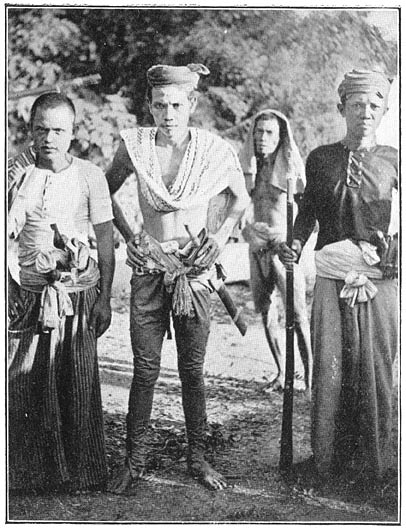
Panglima Hassan of Sulu (Central figure).
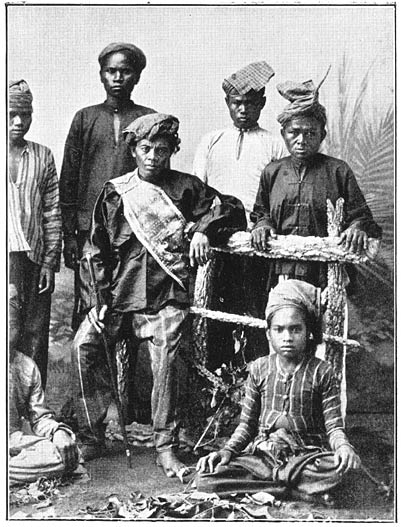
A Mindanao Datto and Suite
Again, in May, 1905, Datto Pala, of Sulu Island, with a large following, threatened Joló town, and General Wood personally led the expedition against this chief. Eight miles from Maybun the Moros had dug pits and placed wires to impede the Americansʼ advance, but, notwithstanding these obstacles, the enemy was vigorously attacked and surrounded near the Maybun Lake, three miles from the town. After several daysʼ desperate fighting the cotta of Lumbo was captured, and the Datto and his men were vanquished, the losses being about seven Americans killed, about 20 wounded, and over 250 Moros killed.
In June, 1904, Datto Ambutong had a dispute with another about the possession of some property, and on Major Scott being appealed to in the matter, he ordered Ambutong to appear before him in Joló for a bichâra (judicial inquiry). The Datto, in a sulky mood, at first refused to come, but on further pressure he changed his mind. Early in the morning of the appointed day a friendly chief, Datto Timbang, came into town with four retainers, all armed, to see the Governor. Major Scott, whose guest I was, kindly invited me to the interview, during which it transpired that Datto Timbang had heard Ambutong declare he would come to the bichâra, but he would not leave it without taking heads. Datto Timbang added that he too desired to attend the bichâra with his bodyguard, resolved to slay Ambutong if he observed any threatening move on his part. The major made no objection, and at the appointed hour four of us—my gallant host, Major Barbour, Captain Charles and myself—went to the bichâra at the Governorʼs office in town. The Governor (i.e., the major) sat at his desk, and we other three took seats just behind him. Before us were the Datto Ambutong, his opponent in the question at issue, and, a yard off him, the friendly Datto Timbang and his followers, each with his hand on his bárong, ready to cut down Ambutong at a stroke if need be. Whilst the case was being heard, Hadji Butu, the Sultanʼs Prime Minister, and Sultan Tattarassa, of Parágua Island, the latter afflicted with locomotor ataxy, came in, saluted us all, and took seats. The business ended, Datto Ambutong rose from his stool, gave his hand to the major, and then walked to the back of him to salute us. I thought I should like to handle the beautiful bárong which was to have served him in taking heads. The Datto complaisantly allowed me to draw it from the sheath and pass it round to my friends. Sharp as a razor, it was the finest weapon of the class I had ever touched. The handle was of carved ivory and Camagon wood (vide p. 314), the whole instrument being valued at quite $100. Datto Timbang was watching, and the occasion was not a propitious one for taking christian blood.
The following translation of a letter which Major Hugh L. Scott courteously gave me will serve to illustrate how lightly human life is appreciated by the Moro.
This letter from your son, His Highness Datto Mohammed Dahiatul Kalbi, to my father, the Governor of Sulu, Major Scott, and to my younger brother, Sali.
I want to inform you that at 7 oʼclock in the morning of Saturday, we had a fight with Tallu. I have taken his head, but if you will allow it, I will bury it, if my father will let me do that, because he is an Islam and I would commit an offence. It scared my wife very much when she looked at the head in my house. Those that are dead were Sadalani, Namla, Muhamad, and Salui. Beyond that I have not investigated.
With greetings to my father and to my younger brother, I beg you, my younger brother, to let me bury the head, if my father does not feel bad about it. If our father should not believe that the head is there, come to our house and see yourself, so to be sure. I would not soil the faith my father has in me. To close I herewith send the kris of Orang Kaya Tallu. The end of the pen. Sunday, February 23, 1904.
Whilst I was in Zamboanga in June, 1904, Datto Pedro Cuevas, of Basílan Island, sent a message over to say that there would be no more trouble with certain pirates who had been caught, as he had cut off their heads.
It would fill a volume to recount the legends of the sharks near Cagayán de Joló which wreck ships; the Moro who heard the voice of Allah rising from a floating cocoanut to urge him to denounce the Sultanʼs evil ways; the new prophet who could point at any object and make it disappear, and a hundred other superstitious extravagances.
Exactly a month after my visit, the Sultan, accompanied by Major Scott, the Governor and Commander of Joló, came and made a short stay in Manila, where he was conducted around town and to the presence of the authorities. Many valuable presents were officially made to him, together with ₱5,000 pocket-money to console him for the postponement sine die of the “settlement” question. Driving round in wagonettes, his retinue saw the sights of the capital and made their purchases, but the Sultan himself was strictly guarded from pressmen and others who might give local publicity to his claims.
Americaʼs policy with regard to the Sultan of Sulu and all other Sultans and Dattos, as expounded to me by the best American authorities, is as clear as crystal. They wish all these petty potentates were elsewhere; but as that cannot be, they must be shorn of all power, princely dignity being out of harmony with American institutions. Nevertheless, they can call themselves what they like among their own people, provided that in their relations with the Government of the Islands they are to be simple citizens with dominion over their own personal property, but not over that of others. There is to be no sovereign power, great or small, other than American, and tribal wards are to supersede dattoships. The Dattos are more numerous than Continental barons, and of varying grades, from the Panglima Hassan type, possessor of fortresses, commander of 5,000 men, down to the titular lord of four score acres who lounges in the village, in filthy raiment, closely followed by two juveniles, the one carrying his bright metal buyo box, in case he needs a quid, and the other the bearer of the bárong, lest he must assert his dignity by force. America has decreed that from these and all their compeers the Philippines are to be preserved.
In November, 1903, the District Governor of Zamboanga summoned the Manguiguin, or Sultan of Mindanao (vide p. 131), and all the Dattos in his district to attend a durbar. The aged Sultan very reluctantly responded to the call, and, accompanied by his Prime Minister, Datto Ducalat, and a large retinue, the royal party came in about 250 armed vintas. When they were within a few miles of the port they sent a message to ask if they would be allowed to salute with their lantacas, and the reply being in the affirmative, they entered the harbour with great éclat, amidst the booming of a hundred cannon. Interpreters put off to meet them and escorted them to the landing-stage, where the District Governor waited to receive them. The Sultan wore a gorgeous turban, a royal sárong worked in thread of gold, and shoes with similar adornments. On landing, the old prince, trembling from top to toe, with despairing glance clutched the arm of the Governor for protection. Never before had he seen the great city of Zamboanga; he was overcome and terrified by its comparative grandeur, and possibly by the imposing figure of the six-foot Governor himself. The police had to be called out to restrain the mobs who watched his arrival. On the other hand, as the Sultans, the Dattos and their suites together numbered about 600, and from other places by land about 400 more had come, all armed, many of the townspeople, with traditional dread, shut themselves up in their houses, believing that such a vast assemblage of Moros might, at any moment, commence a general massacre. It is well known that the question of public security did engage the attention of the American authorities, for the gathering was indeed a formidable one, and at the moment General Wood was in Sulu Island, leading his troops against Panglima Hassan. All the available forces were therefore held in readiness to meet any emergency. With faltering footsteps and shaking like an aspen leaf, the Manguiguin, followed by his Dattos, approached the double lines of soldiers with fixed bayonets stationed on the quay. There was a pause; the Sultan, who in his youthful days had known no fear, now realized the folly of walking into the jaws of death. But the Governor assured him, through the interpreters, that he was doing him the greatest honour that could be rendered to any prince or to the great president of the greatest republic. Only half convinced and full of suspicion, the Sultan walked on in a daze, as though he were going to his last doom. Having emerged safely from this peril, the great durbar was held, and lasted some hours. This was followed by a reception at the Army and Navy Club, where a throne was erected under a canopy for the Sultan, with seats of honour around it for the chief Dattos. The reception over, the royal party was conducted to where waggons and teams awaited them to take them to a suburb at the foothills of the great sierra. The Governor purposely had the biggest American horses and the largest vehicles brought out to make an impression. The Sultan point blank refused to enter the waggon. He had run the gauntlet through rows of pointed steel, and now new horrors awaited him. Perfectly bewildered at the sight of such enormous animals, he turned piteously to his Prime Minister and invited him to lead the way. “I will follow your Highness,” the minister discreetly replied, but the muscular Governor, Captain John P. Finley, ended the palaver by gently lifting the Sultan into the vehicle, whilst he himself immediately entered it, and the timorous Prime Minister and suite summoned up courage to follow. During the drive the Governor gave the word to the teamsters to detach the forecarriages on reaching the foothills and let the teams go. To the great amazement of the Moro chiefs, the waggons suddenly became stationary, whilst the released horses galloped on ahead! The Sultan and his suite glanced at each other speechless with fright. Surely now their last day had come! So this was the trick treacherously prepared for them to segregate them from their fighting-men! But the teams were caught again, and the waggons brought them safely back to the sight of the port and the vintas. Allah had turned the hearts of the great white men and rescued his chosen people in the hour of imminent danger. The durbar was continued day by day until every point had been discussed. Meanwhile the Sultan and suite daily returned to their vintas afloat to eat, drink, and sleep, whilst in the town of Zamboanga the christian natives quaked, and crowds of Moros perambulated the streets in rich and picturesque costumes, varying in design according to the usage of their tribes. Before the departure of the royal visitor the troops were formed up, military evolutions were performed with clockwork precision, and volley after volley was fired in the air. The Sultan declared he could never receive the Governor with such splendour, but he wanted him to promise to return his visit. It was not politic, however, to agree to do so. And the Sultan and his people left, passing once more through lines of troops with bayonets fixed, this time with a firmer step than when they landed, thanking the Great Prophet for their happy deliverance from what had appeared to them a dreamland of dreadful novelty.
The Manguiguin of Mindanao was indeed “a man of sorrows and acquainted with grief,” for in the days of his decrepitude he was jilted by the widow of Utto (vide p. 143), the once celebrated Cottabato Datto, the idol of the Christian-haters.
Teachers employed—15 Americans, 50 Christian Filipinos, and nine Mahometan Filipinos.
41 Schools were established.
2,114 Children were on the school rolls.
1,342 Christian children attended on average.
240 Moro children attended on average.
₱46,898.17 were expended in the School Department, of which ₱28,355.09 were disbursed in Zamboanga District.
Besides the public schools, the Jesuits are permitted to continue their excellent work of civilization and education in their own schools wherever they have a mission established.
According to Moro custom the fruit of a manʼs labour belongs to the Datto who gives the man a subsistence. The Americans are teaching the man that the fruit of his labour is his own, and, for that purpose, market-places are established at many centres on the coast with the hope of inculcating free-labour notions, so that the seller can get cash for his goods and keep it. I visited three of these markets on the south coast of Mindanao, and also the one in course of construction at Zamboanga (ward of Magay), where Governor John P. Finley was putting his heart and soul into his scheme for creating an important Moro Exchange. By Legislative Council Act No. 55, the sum of ₱1,850 was appropriated for its construction, and the Governor had succeeded in persuading the Moros themselves to contribute ₱1,300 towards its completion. The Moros are urged to come in their produce-laden vintas and occupy the stalls erected for them in the large commodious market-shed, which has accommodation for carts and cattle if need be. Boats of less than 15 tons gross are free of tax, licence, or documents (Phil. Com. Act No. 1354, of June 15, 1905). Whenever any trouble arises up the coast the Governorʼs official vinta is despatched, manned by Moros, under the command of the Governorʼs messenger, Hadji Nuño, a parvenu Datto whose name reveals his Spanish origin.
Everything within the powers of the Legislative Council of the Moro Province seems to have been done to introduce law, order, and administrative uniformity, constrain violence, propagate knowledge and set the inhabitants on the path of morality and prosperity. The result of a centuryʼs labour, at the present rate of development, might, however, be achieved in a decade if the Insular Government had authority from Washington to relax the rigidity of the “Philippines for the Filipinos” doctrine in the special case of the Moro Province. It is true the Moros are as much Filipinos as the rest of the Philippine inhabitants, but it will be generations before they can know how to enjoy their birthright without the example of energetic white men who are, naturally, unwilling to come and philanthropically devote their lives to “pulling the chestnuts out of the fire” for the Moro. They want to reap some material advantage for themselves. Gen. Leonard Wood, in his First Annual Report of the Moro Province, remarks:—“What is needed to develop this portion of the world is a suitable class of settlers, bringing with them knowledge of modern agricultural methods, enterprise and some capital.... If he (the Moro) could see the results ... it is believed that his ambition would be stimulated and that his development would be comparatively rapid. In short, a scattering of good agriculturists throughout the province would be of inestimable value to the people. At the present time such a class of settlers is not coming, and it is not believed they will come until much more liberal inducements are offered them, especially in the way of obtaining land by settlement. Our standing among the people of these Islands has been much injured by the presence of a large and tough class of so-called Americans whose energies have been principally extended in the construction, maintenance and patronage of rum shops, which outnumber other American business establishments.”
The District of Davao is far more developed agriculturally than the other four. Planters whom I know personally are opening up land and producing large quantities of hemp, giving employment to Bagobos and others, but without any certainty about the possession of the land. Inexhaustible forests of fine timber remain undisturbed, and are left to decay in the ordinary course of nature, whilst shiploads of Oregon pine arrive for public works. My attendance at the public conferences on the timber-felling question, before the Philippine Commission in Manila, did not help me to appreciate the policy underlying the Insular Governmentʼs apparent reluctance to stimulate the development of the timber industry; indeed, it is not easy to follow the working of the “Philippines for the Filipinos” policy in several details.
In 1904 General Wood recommended to the Philippine Commission the incorporation of the present provinces of Misámis and Surigao in the Moro Province, seeing that the people of those provinces and the Moro Province belong to the same races and have identical interests. As it is, the hill tribes of Misámis find themselves between two jurisdictions, and have to pass nearly a hundred miles through the Moro Province to reach the sea coast—an anomaly which will no doubt be rectified by including the whole Island of Mindanao in the Moro Province.
The American Governmentʼs abstinence from proselytism in dealing with the Moros is more likely to succeed than Spainʼs well-meant “policy of attraction” adopted in the last years of her rule, for whatever progress this system made was counterbalanced by the futile endeavour to induce the Mahometans to change their religion. Under the wise administration set in progress by General Leonard Wood there is a hopeful future for Moroland.