Volume 50 — ORDINANCES OF CORCUERA AND CRUZAT Y GONGORA, WITH LATER ADDITIONS
Reading edition
Don Fausto Cruzat y Góngora, knight of the Order of Santiago, member of his Majesty’s Council, his governor and captain-general of these Filipinas Islands, and president of the royal Audiencia and Chancillería resident therein, etc.:
1. [On taking office, they must swear before the chief notary of the government to execute the laws according to justice; not to take bribes and excessive fees; and to abide by the laws of the kingdom, and any ordinances, and the present instructions.]
2. [Since the officials will serve as an example to the natives under them, they must see that their behavior morally and religiously is above reproach. They are also to watch carefully over the morals of those under them, and especially to see to it that blasphemy is punished.]
4. [The Indians must not be harassed with injurious taxes and assessments (as is so often the case). If such become necessary, the governor is to be informed thereof, the necessity therefor, and the sum to be assessed. A list of the citizens is also to be sent, “with mention of those who possess property, so that allowance may be given by this government to make the assessment, so that an equal charge may not rest upon those who have money and those who are destitute of it, but that each one contribute according to his several ability.” The imposition of a tax or assessment without the permission of the governor carries with it deprivation of office and satisfaction from the property of the one dismissed of the entire sum contributed, to those assessed, and a fine of 500 pesos for the treasury and fortification expenses.]
5. [In the management and disbursements of funds from the communal treasuries, there is much graft among the officials. An order sent to all the provinces the preceding year at the request of the fiscal ordering the alcaldes-mayor and corregidors to oversee and manage the communal treasuries is to be strictly obeyed. All disbursements are to be by express order of the superior government. Disbursements made without such order shall be made good from the property of the one allowing them, or their bondsmen.]
6. [Alcaldes-mayor and corregidors are not to accept any presents, even of food, during the term of their office, as their hands will be bound thereby. They must pay a just price for what they purchase. During the term of their office they are not to purchase a ranch or any lands in the territory of their jurisdiction; neither are their secretaries or alguacils-mayor to buy them: for many evils follow therefrom. They are to build no sailing craft under any consideration, “under penalty of loss thereof and two hundred pesos, applied half to fines for the treasury and fortifications, because of the great harm caused to the natives by such constructions. For when you need any vessel, you can charter one.” Likewise they are forbidden to engage in any trade with the natives and citizens of their jurisdiction, either directly or through agents. They are not to take a portion of the fees and salaries of their notaries, interpreters, and other persons, “because of the harm resulting from the judges having such shares. Nor shall you allow your officials to take them; nor shall you make an agreement with anyone in regard to the abovesaid.”]
7. You shall visit your jurisdiction once each year, remaining twelve days in each large village of the chiefs, and six days in the small villages, visiting them and trying with justice the natives in whatever they plead, remedying all that you may find necessary and clearing away whatever injuries or injustices may have been committed. [During the visit or rather, during all their term, they are not to hale anyone into court to justify any slavery, but justice is to be meted to those who appear to plead of their own accord. They, their clerks, or other officials, shall not take fees from any fifths of gold paid them in their jurisdictions; neither shall fees be exacted for the visit. They must pay their own expenses during that period and not exact them from the Indians. Contravention of this last means restoration of the amount exacted to the Indians, and four times as much as a fine.]
8. [This regulates the manner of trials and the fees for the same. No process is to be made in cases involving sums up to twenty pesos, but such cases are to be briefly despatched, and the notary cannot receive a fee in excess of four reals from each party to the suit, under penalty of returning it, and a sum four times as large as a fine to the Manila court. If one Indian causes the arrest of another Indian, and the one arrested confesses his guilt, sentence is to be passed by virtue of the confession. Otherwise witnesses shall be called, and after their depositions are taken, the case shall be judged. If there is any appeal, the case is to be tried in second instance, and after examining the witnesses the records are to be sent to the Manila Audiencia. Criminal cases must be tried as soon as possible. Those involving sums not in excess of five pesos shall be tried summarily, and nothing more than a mere record of them shall be made for the archives of the notary. No fees are to be received for depositions of witnesses, and only the fee adjudged by the tariff can be accepted for giving written records of the case to the parties involved. The tariff of fees is to be posted in a public place in the court, both in the Spanish and native language, in order that all may know the amount to be paid. Notaries are to record the amounts accepted as fees, which must not exceed the tariff. This method of trial was ordered for the purpose of saving time, expense, and trouble to the Indians.]
10. [Bridges are to be built and repaired, and rivers kept clean, especially those flowing from Laguna to Manila through Pasig and Taguig. All undergrowth, enclosures, and obstacles to the natural current are to be removed, in order that the waters may be confined to their beds, thus avoiding overflows and damage to crops. This must be done with the least possible trouble to the Indians, and all must share alike in the work.]
11. [In villages along the line of travel, the natives must not be made to act as porters (a prolific source of evil), even with light burdens. Each village must purchase immediately horses and cows, so that they may be available for travelers.]
12. [Natives must not become vagabonds, but must cultivate their land, both for their own good and that of the community. In some provinces, underbrush has sprung up and food is scarce because of the nomadic habits of the Indians, and their laziness. An edict is to be published to the effect that if all those who own lands do not cultivate and sow them within two years, such lands will be sold to the highest bidder. The official not obeying this law shall be fined fifty pesos, to be applied in halves to the treasury and the fortifications.]
13. [The rearing of fowls and swine is obligatory on the inhabitants. Each Indian is to have at least six hens and one cock, and one sow. Each Sangley is to have a dozen hens, one cock, and two sows. This will avoid scarcity and dearness in price. Close inspection is to be made by the alcaldes-mayor and corregidors, under penalty of suspension from their office. For such inspection, no fees are to be charged by any person connected therewith, under penalty of returning said fee, and a sum four times as great for the treasury.]
14. [Great harm results from Spaniards, Sangleys, and Indians giving money to other Indians for their trading. No sum must be so given in excess of five pesos, not even under pretext that it is advance pay for rice or other products. If more is given, it shall be lost, and the Indian receiving it cannot be made to pay it. The prices current at the time of the harvest shall be paid to the Indians by all purchasers other than the king, who has a special rate. No purchases can be made by individual persons until those for the royal warehouses have been made, and the tributes paid. Notaries and Indian governors are forbidden to draw up any contract at the fixed rate or at the price paid by the king.]
15. [Inasmuch as Indian slavery is forbidden; and since the transfer of those called slaves by custom is also forbidden; as is also that their descendants born after August 18, 1692 (the date of the publication in Manila of the act of the royal Audiencia of Mexico, in accordance with the royal decree of Buen Retiro, May 1, 1686), should be slaves: the officials are to carefully carry this law into effect, and prevent such slavery.]
16. [Careful regulations are made concerning the Chinese. Because of the spiritually demoralizing effect of the Sangleys on the Indians, and the harm resulting from the wasting of the substance of the latter which is given in exchange for things of little value offered them by the wily celestials, great care is to be exercised in regard to both Christian and heathen Sangleys. None of the latter are to have residence among the Indians, and if any such are found in any village, they are to be immediately sent to the Parian in Manila, the penalty in case of non-compliance with this order being two hundred lashes and four years’ service in the Cavite harbor. The married Christian Sangleys who prove detrimental to the Indians are to be sent to the villages of Santa Cruz and Binondo, and the single men to the Parian (these facts to be ascertained from the priests in charge of the various villages), in accordance with the laws of December 12, 1695, and January 16, 1696. Sangley traders may go to their trade in the jurisdictions of Tondo, Bulacan, Pampanga, Laguna de Bay, and the port of Cavite, provided they have the government license therefor, not being allowed to sleep in any village or house of the Indians, but in their own boats. Trade in any village is limited to twelve days. Any Sangley who shall be found sleeping in any village shall be sent to the governor, who may impose at will upon him the penalty of two years’ service in the harbor of Cavite. Christian Sangleys shall not be allowed to reside in any village in excess of the number required for the service of the convents and the village, and unless married to Indian women. Close lists of all such, with the necessary statistics, must be kept, and they must have the government license to remain in such villages. Any alcalde-mayor or corregidor allowing any Sangley to live in any village or to trade without the government license shall pay a fine of 200 pesos, and must pay besides the amount of the license for the period during which the Sangley has been without it.]
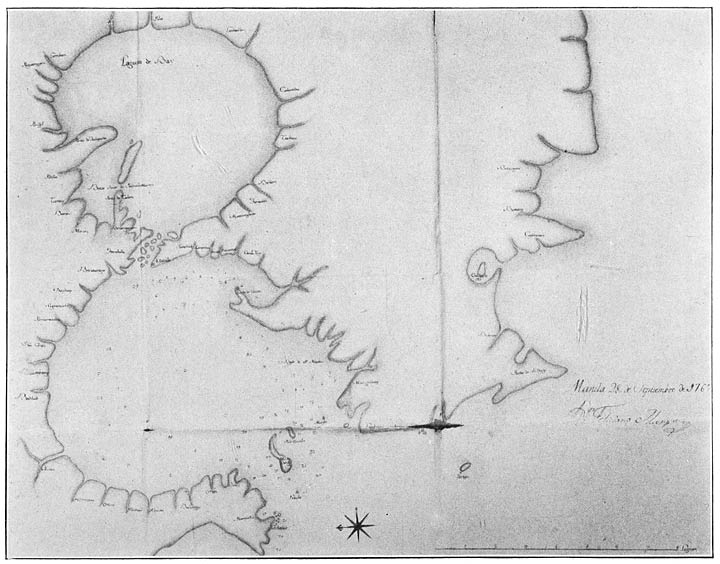
Map of Manila Bay, port of Cavite, and lake of Bay, showing depths of various parts of the bay, drawn by the engineer Feliciano Márquez, September 28, 1767
[From original MS. map (in colors) in Archivo general de Indias, Sevilla]
17. [Commerce is to be free to all Indians of whatever jurisdiction they be, throughout the Philippines; and no license is required, nor can any fee be charged them. This will ensure a good supply of provisions and other necessities, and promote the cultivation of the land. Good treatment must be shown to them, and their passage from one place to another facilitated, under penalty of a fine of 100 pesos, and a charge in the residencia of the one who transcends this order.]
18. [Large and small weights and measures are to be uniform in all the islands with those used in Manila, and shall have been sealed and marked in that city. All others shall be collected, and used under no consideration. Those using others shall restore all things sold with them, and a sum four times as great as a fine to the treasury.]
19. [This law lessens and defines those exempt from tribute, polos, and personal services. On account of so many reservations from these, the burden has fallen on the weakest of all the natives, namely, the timauas [i.e., freedmen]. Those exempt shall include all sixty years old and above; the cabezas de barangay, and their eldest sons and successors; cantors, sacristans, porters, and cooks [of the church and convents], who have been exempted in accordance with the act of Governor Santiago de Vera; all officers of justice for the time they serve only; the Pampangos who serve as soldiers and in other capacities for the royal pay in Manila, Cavite, and other presidios, for the time they serve, and their wives in case that they are married. The due honors are to be reserved always for all ex-officials of justice, and they shall be given a special bench in the Audiencia, so that they need not stand, but exemption from all dues shall be only for the length of their actual service. All other reservations than those named above are null and void, among them those of men having more than six children, a practice that has been introduced in some parts, and which was ordered suspended, by request of the fiscal, by an order of December 24, 1695. Alcaldes-mayor and corregidors violating this law shall pay the amount of all injuries resulting therefrom, and a sum four times as great, as a fine.]
20. [This law concerns the matter of repartimientos among the natives for supplies for the royal magazines, and for the galleons and vessels despatched annually to Nueva España and the Marianas. Many injuries result because the repartimiento is divided among the Indians, and the Spanish and Chinese mestizos without regard to their material conditions, which gives rise to much suffering. Often “those who have nothing to give, are compelled to get the products elsewhere, and at times to buy them at a higher price than that paid them on his Majesty’s account.” The repartimiento is to be made among all who have had a harvest, according to their several ability, and after sufficient has been reserved for the support of their families, the next year’s sowing, and for the tribute. Those who have not been able to harvest, either through the inclemency of the weather, or because they have been unable to sow because of being absent or busied in the royal service, and the poor, shall be exempt from furnishing supplies. A sworn statement given before the priest of the village shall be necessary to secure exemption. Those furnishing supplies shall be paid immediately, the money being given to each seller in person, and not to the cabezas de barangay or the notables. If the royal funds of any district are insufficient to pay for the supplies furnished, the surplus will be sent on from Manila. Under no consideration shall any debt be left standing. The alcalde-mayor who shall violate this shall be deprived of any political office forever, and shall be compelled to pay all such debt from his own property and a sum three times as great, as a fine, and he may become exempt from this penalty under no consideration. No repartimiento shall be made except at express order of the superior government, under penalty of a fine of 1,000 Castilian ducados.]
22. [Alcaldes-mayor, corregidors, priests, and other officials shall not be supported at any other than their own expense. Provisions shall be purchased at the prices current, and cash must be paid for them. The natives, however, are compelled to sell provisions to such persons for their support, but such purchases are not to exceed the amount needed. Violation of this law means loss of office.]
23. [Alcaldes-mayor and corregidors on assuming office shall receive from their predecessors an inventory of all papers in the archives (if there are no notaries in charge of them), and shall pass on the same with all that have accumulated during their term of office to their successors. This shall be a charge in their residencias, and they must present testimony that they have so done. No person is to be condemned to the galleys or to undergo any bodily mutilation, except with the advice of an assessor enrolled in the royal Audiencia. In case there is no assessor in any district, all cases involving such condemnation must be concluded, all except the sentence, and then prisoner and records sent to Manila for sentence in the royal Audiencia.]
24. [In prisons, women and men must be kept separate. If the complaint against women is slight, they shall not be confined in prison, but kept in the house of some relative. No prison fees shall be accepted by any official from the Indians imprisoned, under penalty of repaying them, and a fine four times as large.]
25. [No office can be resigned without governmental permission, under penalty of a fine of 100 pesos. Record books shall be delivered to the alcaldes-mayor and corregidors by the government secretary, in which shall be kept an account of the fines, expenses of justice, and fifths of gold. At the conclusion of anyone’s term, this book shall be delivered to the royal accountancy, and the amount of the fines and fifths to the royal treasury.]
26. [This law concerns the appointment of inferior officials by alcaldes-mayor and corregidors. No Spanish alguacil is to be appointed without government title. If any serious case demands such an officer, he shall be appointed only for the time necessary and when the immediate duty is concluded he shall be dismissed. Appointments as lieutenants, masters-of-camp, sargentos-mayor, captains, alferezes, sergeants and adjutants of native military companies, governors for the Sangleys and natives, and all other appointments to military and political posts (whether paid or not), shall not be made without government title. Appointments shall be made only when vacancies occur, and when necessary, three names shall be sent to the governor at Manila, who shall make the appointment therefrom. Without the government title, no one shall exercise any official duty, under penalty to that alcalde-mayor or corregidor who shall violate this law, of a fine of 500 pesos, the payment of the fees of media-anata and such title, while the violation shall become a charge in his residencia, and he shall be subject to all other penalties imposed for such violation. Notaries are prohibited under like penalties from drawing up such titles or countersigning the same, and shall not allow possession of any post to be taken without government title. All notaries shall be required to make full testimony of the observance of this law, and in districts having no notary, a certification must be made by the priest.]
27. [Methods of election for various jurisdictions are prescribed by this law. In the four jurisdictions of Tondo, Laguna de Bay, Bulacan, and Pampanga, considerable trouble has been experienced at the annual election of the district governor, which has resulted in much ill-feeling among the Indians, and lawsuits because of factions among them, as the elections have been participated in by all in common. Henceforth, the elections are to be held on the day assigned, by all the cabezas de barangay of each village (if there are twelve of them; if less than that number, notables of the village are to be appointed to that number), who with the retiring governor and with the intervention of the alcalde-mayor and priest of the village, shall proceed to the election. Having chosen three persons, their names shall be forwarded to the governor at Manila, in a sealed paper bearing the following title: “Election of such and such a village, which is sent to the governor and captain-general of these islands, through his government secretary.” In accordance with the governor’s choice from these three names the title of the new village governor will be expedited. In the jurisdictions of Calilaya, Balayan, Mariveles, and Cavite, elections shall be held as heretofore, and those elected shall go to, or send to, the governor in Manila for confirmation of their office. Elections shall occur between January 1 and February 28, and for each one the alcalde-mayor and the notary shall receive only three pesos. In all other jurisdictions, elections shall be held in the usual manner, and the appointment made by the alcalde-mayor, but no office shall be enjoyed without the government title. These titles shall be sent to each district, in accordance with the order of September 23, 1693, made out by the government secretary, and signed by the governor and countersigned by the secretary; and on them shall be entered the names of the successful candidates. The names of those elected shall be sent for entry in the government books, and all media-anatas shall be paid, as well as title fees and cost of sealed paper. No newly-elected official shall hold office until he has received the government title, and the old official shall hold over until such time. Violation of this law shall incur the penalties of the preceding law, and it shall be made a matter of residencia.]
28. [No encomienda shall be granted nor any acts made in regard to them without the express command of the superior government. Any claims to encomiendas must be satisfied through the proper channels. Claims to any encomiendas obtained otherwise are null and void.]
29. [No Spaniards may live in any Indian village, except by permission of the governor at Manila, and where such permission is given, they must live decently and quietly. This includes both married and single men, and is to be enforced especially in the province of Pampanga, although all Spaniards married at present to Pampangas may remain. All other men married to Spanish women or to Indian women of Pampanga [in the future], and all single men must leave the province immediately, and may not return without permission. If Spaniards wish in the future to marry Pampangas, they cannot live among the natives, under penalty of a fine of fifty pesos.]
30. [A general treasury council held in April, 1696, rules that the Indians shall not be compelled to take the tribute to the capital cities at their own expense. In case they are ordered to take it to any place, they must be paid the proper prices for transportation. If after the stipends of the priests of the villages are met, any residue of the tribute remains from the encomiendas belonging to the royal crown, the alcaldes-mayor shall notify the superior government and the royal officials of the amount in each village, so that it may be ordered taken to the place deemed most advisable. Nothing spent for transportation shall be admitted unless an order has been given for such transportation. Encomenderos and collectors shall observe the same method in order to avoid the injuries suffered by the natives. Violation of this law shall be a matter of residencia, and those violating it shall be condemned to make good all the losses to the Indians in consequence thereof, and four times that amount as a fine.]
31. [A government act of March 22, 1657, ordered all the polo funds created in each village to be suppressed, as well as the need of each chief contributing annually one peso and each timaua one toston to them, for the expenses of his Majesty’s service. Alcaldes-mayor and corregidors are ordered not to allow such funds to exist, or any contributions to be made for them, under penalty of suspension from political and military office for four years, service as a soldier, and a fine of 100 pesos.]
32. [Great care is to be taken to have the Indians plant cocoanut palms and set out abacá plants: the chiefs, trees to the number of two hundred and plants to the same number; and timauas, each to the number of one hundred. Those dying out are to be renewed, so that the number may always be kept up. This is to be a matter of personal care on the part of the alcaldes-mayor, who are to appoint a representative in each village to register the trees and plants and render account of neglect to observe this law. The palms are useful for the support of the Indians, while from its fruit are obtained oil, wine, and bonote for the furnishing of the galleons and other vessels, and the material for making rigging. For failure to prepare these supplies for the ships, a fine of 1,000 pesos shall be imposed for the purchase of oil and abacá, and the omission shall be made a charge in the residencia. Loss of office shall also be incurred, and for the inferior officials a penalty of two years in the galley without pay.]
33. [The Indians, both men and women, and the married Christian Sangleys must be made to destroy the locusts that do so great harm to the crops throughout the islands, especially the young, called locton, which are so destructive, and can be killed easily as they have no wings. Each person shall be charged during certain days or weeks to kill so many gantas of this destructive pest, under penalties that shall be imposed for neglect. Neglect by the alcaldes-mayor and corregidors in this law shall mean deposition from office, and a charge in their residencia.]
34. [No obstacle shall be placed to the Sangley craft that have government permission to trade in any province, during the time of said permission. But at the end of the term of their license, they must return to Manila, and the alcaldes-mayor and corregidors may not continue that period. Sangleys found without the government license, or with it, if outside the provinces of Tondo, Bulacan, Pampanga, Laguna de Bay, and the jurisdiction of the port of Cavite, to which the government license extends, shall be arrested and sent with their crafts to Manila, with testimony to that effect, so that they may be punished fittingly. If any license is given or continued unlawfully, a fine of 1,000 Castilian ducados shall be imposed, and perpetual deprivation of office.]
35. [A government order of September 13, 1688, in pursuance of a royal order of the ninth of the same month, arranged for “raids into the mountains of the provinces of these islands, for the reduction of the Indians in insurrection and the mountain-dwellers in the provinces of Cagayan, Caraga, Calamianes, the island of Negros, Oton, Camarines, and Leyte; and that in the said provinces of Cagayan, Caraga, Calamianes, and Oton, where Spanish and Pampanga infantry is garrisoned, whenever aid of money and rice is given on the account of his Majesty, the said raids shall be made with that part of the infantry that is deemed advisable, while the remainder shall be left for the usual matters for which it was intended. The alcaldes-mayor of Camarines and Leyte shall give aid from the royal property in their charge, in rice to the amount of one ganta of palay per day for every person taking part in the said raids, for the time of their duration, but he must not forget to send a previous report to this superior government, with the testimony of the notary of each province and the certification of the father minister of the doctrina of the number of persons to be occupied in said raids, and at the end of said raids he shall send a report of them, and the time they lasted.” Otherwise the alcaldes-mayor will not be credited with the amount of rations they have supplied for such raids. In regard to the island of Negros, the corregidor of that island shall requisition the necessary troops from the alcalde-mayor of Cebú. This order shall be sent to all the provinces and shall be kept in the archives of the courts thereof, so that it may be exactly observed.]
36. [Lists of the persons sailing in any royal vessel to points in the islands shall be furnished by the pilot or master; as well as the time for which they are supplied with food. A month’s rations are to be allowed to such persons after supplies are exhausted. If they cannot return to Manila in that time because of some unforeseen event, another month’s ration shall be given them by the alcalde-mayor in whose jurisdiction they may happen to be, and the amount entered in their accounts, so that it may be made good. All repairs to such vessels as have to be made in the provinces, and the cost of the same shall be estimated by experts in the presence of the proper officials and the priest of the village. The alcalde-mayor shall pay the same from the royal funds, and, on the statement of the priest, the expense shall be admitted.]
37. Having been informed that the native vassals of his Majesty living in the villages of the provinces of these islands had intercourse and communication with the heathen, apostate, and fugitive Indians who dwell in the mountains and hills, by going to trade with them and selling them iron for their weapons, wearing apparel, and the other things lacking in said mountains, and necessary to them for the conservation of human life, on account of which their pacification and reduction to our holy Catholic faith and to the obedience of his Majesty is impossible, frustrating, because of the interest of said Christian natives in the gold and wax which they get through said heathens and apostates, the Catholic zeal of his Majesty, who is maintaining these islands at so vast expense to his patrimony, for the sole purpose of the extension of the holy gospel and the conversion of their natives thereto; and considering the only remedy to be the avoidance of such inconvenience: on the seventh of January last of this year, I sent orders generally to all the alcaldes-mayor and corregidors, commanding them to publish an edict in every village of their jurisdiction, forbidding all the natives thereof who are subject and recognize vassalage to his Majesty, to have intercourse, communication, or trade with the heathen, apostate, and fugitive Indians, negroes, and Zambals, who inhabit the mountains and hills, and are not reduced to the royal obedience, under penalty of one hundred lashes and two years’ service in the harbor of Cavite, with only their food. Said alcaldes-mayor and corregidors shall watch, and use great care in avoiding such intercourse, communication, and trade, and shall take all the measures that appear necessary therein. They shall report to this government the results and all that arises therein, in order to see whether it is necessary to enact any other measure. They shall do this inviolably, without any pretense or tolerance, for it is not practicable that said heathens and apostates having been compelled by necessity, will become reduced to obedience to his Majesty and embrace our holy faith by means of the preaching of the father ministers of instruction. The latter shall for their part aid in a matter so to the service of both Majesties, as I have asked and requested of the reverend fathers provincial of the orders. Said alcaldes-mayor are advised that this prohibition is not to be understood in regard to the heathen Indians who live in the villages and obey and pay tribute to his Majesty; and that those of this kind shall not be prohibited from trading with the Christians, because they are subject to the obedience of the king, our sovereign, and pay him a recognition of vassalage, in the tribute which they give.
39. [This law, which was enacted by Cruzat y Góngora, May 14, 1697, and ordered to be included among the government ordinances, commands that the two cooks allowed to priests established in a district having five hundred whole tributes be no longer exempted from tribute, polos, and personal services. The ordinance enacted by Santiago de Vera, by which cantors, sacristans, porters, and cooks, are exempt from the above, shall be revised to read only the first three. This ordinance is made in pursuance with the decision of the royal Audiencia of February 22, 1697, that laws xli, and xlii, título xii, book vi of the Recopilación be obeyed. It was consequently ordered by Cruzat y Góngora’s decree of February 22, 1697, that no village shall against its will furnish any Indian tanores to the seculars, regulars, or other ecclesiastical persons, or to the alcaldes-mayor. (See ante, pp. 203, 204, ordinance 19.) Hence, that this order may be executed, the present ordinance follows.]
40. [An ordinance enacted by Governor Zabalburu, April 8, 1704, is given because of a communication received by him from Archbishop Camacho, under date of January 26, 1702. The letter asks that law vi, título i, book vi, of the Recopilación be enforced, because of the sins, both against chastity and justice, arising from natives serving in the houses of their prospective parents-in-law. It happens often, in addition to the sin against chastity that the marriage is not consummated, and the man loses his wages for the service he has rendered. The archbishop has published an edict ordering this practice to cease, but it is wise for both the civil and ecclesiastical power to act in concert in this matter, “for it often happens, on not few occasions, that fear of the royal power is stronger than veneration for the holy laws of the Church.” The governor is asked to add to the penalties of the law, those penalties which he judges advisable. Consequently, he orders that in each native village, no Indian shall receive into his house or service any man who is about to contract marriage with his daughter, during the three festival days of the village, and that he shall not receive any money or products from him because of such matrimonial contract. Timauas violating this ordinance shall receive fifty lashes, be incapacitated from holding any office, and be compelled to restore to the treasury what may have been thus paid. Notables shall lose their rank and become timauas. The due performance of this ordinance shall be a charge in the residencia of alcaldes-mayor and corregidors.]
41. [An ordinance enacted by the same governor, April 28, 1704, cites an act of his predecessor, Cruzat y Góngora, April 30, 1697, ordering that when the priests of the villages need Indians for the necessary things of the divine service, the gobernadorcillos are compelled to furnish them, the priests paying such Indians at the rate of one real per week apiece and their food. According to the order of Governor Niño de Tabora, no priest was to have more than four Indians, in addition to the cantors, sacristans, and porters. In villages so small that the stipends received by the priests are insufficient to pay for the services of the four Indians, they are not under the necessity of paying them, if their residence there is a necessity, and they reside there at the petition of the Indians, in which case the latter shall pay for the services of the four Indians. Another act of Cruzat y Góngora, of August 31, 1697, rules that the offering to be contributed by the Indians for each of the three religious festivities of the patron of each village, Corpus Christi, and Holy Thursday, be one real for each whole tribute, and one-half real for each single man or woman, this alms being fixed at the request of the procurators-general of the four friar orders and the Society of Jesus. This offering is to be collected in a humane manner, and the gobernadorcillos and cabezas de barangay are not to exact a greater sum under pretense that it is for the church. These two acts Zabalburu orders to be included in the ordinances given to each alcalde-mayor on the assumption of his office. He also orders the observance of an act enacted by himself March 13, 1704, ordering that eight bagontaos be assigned in each village weekly for the service of divine worship, the church, and the ministry of the sacramental mass; and for the service of the priests when it becomes necessary to leave the village to administer the sacraments. In villages of less than three hundred tributes, there shall be only the eight bagontaos, under penalty of punishment to the gobernadorcillos who shall allow more. This ordinance is to be proclaimed in all the villages by the alcaldes-mayor on the festival days.]
42. [In accordance with the request of Archbishop Camacho that curas and missionaries be ordered not to exact larger fees than those allowed by the royal tariffs, and that the alcaldes-mayor enforce this, an order to that effect is issued to the latter. Violations by curas and missionaries are to be reported to the superior government, and alcaldes-mayor are to get careful reports on this head from the native gobernadorcillos and their officials. Any omission in this shall become a charge in the residencia, and the alcalde-mayor shall be obliged to make good the excess fees from his own property, and pay a fine four times as large as the excess. This was ordered to be included in the ordinances, March 8, 1708.]
43. [This ordinance has to do with the government monopoly on playing-cards. On December 2, 1707, the governor orders that the department of that monopoly be taken from the control of the royal officials of the treasury and given into the charge of a special judge. Various ordinances enacted by Doctor Don Juan de Gárate y Francia are to be carefully observed. Alcaldes-mayor shall have the direction of this department in their respective jurisdictions, and in accordance therewith this ordinance is to be included among those given to them on assuming office. The special judge may appoint whom he pleases in the department, at salaries approved by the fiscal. Lastly all the packs of cards in the island are to be collected, and those bringing them are to be paid the price for which they are to be bought; and this as well as all other matters shall be done as the special judge deems best.]
44. [In consequence of two royal decrees (both of which are inserted), one dated September 30, 1714, and the other June 15, 1720, which forbid under severe penalties the manufacture and sale of brandy (made from sugarcane) in Perú and Nueva España, because of the many evils arising therefrom, Governor Toribio Joseph Miguel de Cosio y Campo orders the said decrees to be translated into the native languages of the Philippines, and proclaimed by order of the alcaldes-mayor and corregidors in their respective jurisdictions, and the strict enforcement of the same. If an Indian manufacture and sell brandy, for the first offense he shall be arrested, given two hundred lashes, and thrown into the galleys for six years; for the second offense, this shall be doubled; and for the third, tripled, besides exile from the province. The same punishment shall be meted out to the makers of instruments for the manufacture of brandy, if they are Indians. This law is made a part of the ordinances which are to be given to alcaldes-mayor, who are enjoined under severe penalties to break up this nefarious traffic.]
45. [The same governor, on May 16, 1724, in view of a report of the alcalde-mayor of Bulacan, of January 5, 1724, the writ of the fiscal, of January 20, and the vote of the royal Audiencia, forbids the alcaldes-mayor and others to exact fees from the natives for appointments, under penalty of a fine of 500 pesos and a sum four times as great as the fee exacted. All other fees are to be regulated according to law xxv, título viii, book v, of the Recopilación, and the government secretary is ordered to send a list of all fees that can be taken to all the provinces, which is to be strictly observed. All exaction of unjust fees by the royal accountancy is to cease. Copies of this ordinance are to be sent to all the alcaldes-mayor, in order that they may be affixed in the public place so that all may know of it.]
47. [The governor, after examining the report of Fray Benito de San Pablo, Recollect, formerly of the district of Romblon in the province of Panay, in regard to the exactions of the alcaldes-mayor from the natives, and the remarks of the fiscal, orders the alcaldes-mayor to collect from the Indians tribute only in the products which they possess; and but two gantas of rice, in place of the three which they have usually and unlawfully collected. This shall be made a matter in the residencia, and violations will be punished with fines and penalties.]
48. [Governor Valdés Tamon under date of July 28, 1730, orders instructions sent to the alcalde-mayor of Laguna de Bay and to all other alcaldes-mayor, commanding them to pay for the services of the natives according to the tariff (see ordinance 21), except in cases of the administration of justice and matters of the common welfare.]
49. [An ordinance of the same governor, August 9, 1730, orders the late alcalde-mayor of Ilocos to present himself in Manila within a month after being notified thereof, in order that he may hand in his accounts. He is to do this under penalty of a fine of 1,000 pesos. This ordinance arises from the report of the judge of the residencia that said alcalde-mayor, Captain Bernaldo Roldan, is building a large dwelling house in the capital city of the province, whence will ensue injury to the royal treasury from the detention of his accounts.]
50. [In order to remedy the neglect, inexperience, and laziness of alcaldes-mayor, castellans, and other officials of villages, forts, and presidios throughout the Philippines, the governor, Francisco José de Obando y Solis, on August 13, 1751, enacts that all such officials must perform their full duty promptly. Annual reports must be sent to Manila regarding the condition of villages, forts, and presidios, discipline, etc. The original reviews, which are to be made monthly, are also to be sent. All priests are urged to send separate reports concerning the same matters. Thus will the demoralized condition of the Spanish forts and presidios—where the soldiers are totally undisciplined, and hence unprepared for any sudden call—and the injuries to the royal treasury, be remedied.]
51. [The same governor, on October 25, 1751, orders that cabezas de barangay cannot, while serving in that capacity, be proposed or nominated as gobernadorcillos or other officials of justice, for from this practice has arisen considerable harm to the royal treasury, because the collection of the tribute is in charge of the gobernadorcillos and officers of justice, and one man cannot well perform two distinct duties. Ordinance 27, governing the election of gobernadorcillos and officers of justice, must be understood with these limitations and restrictions. Alcaldes-mayor and priests are ordered and urged to watch carefully over this matter in order that all frauds against the royal treasury may cease.]
52. [The same governor, in view of the many things that demand immediate remedy, notwithstanding the many government ordinances that have been enacted by his predecessors (because new laws always give rise to new conditions and other abuses), orders governors, corregidors, alcaldes-mayor, and other officers of justice immediately to “issue, and cause to be issued, the most suitable measures, so that in the villages of their districts schools be erected, established, and founded, now and henceforth, where the sons of the natives and other inhabitants of their districts may be educated and taught (in primary letters, in the Castilian or Spanish language). They shall see to it and watch so that the people study, learn, and are taught in this language, and not in that of the country or any other. They shall procure its greatest increase, extension, and knowledge, without consenting to, or permitting any person, of any rank or quality, to violate or disobey this resolution, or schools of any other language to be erected or established, under penalty of five hundred pesos, applied at the discretion of this superior government. But as soon as it is ascertained or learned that any ecclesiastical or secular person is attempting or trying to violate this resolution, his purpose shall be prevented, hindered, and disturbed; and a report of the one disquieting and disturbing, if an ecclesiastic, shall be made, in order that he may be ordered to conclude and not continue [his purpose]; and if a layman, he shall be arrested, and a cause shall be formulated briefly and summarily, his property confiscated, and he shall be sent a prisoner, together with his property, so that the most severe and commensurate penalties may be applied.” Ordinance 29, forbidding Spaniards to live in the villages of the natives, is annulled, in order that this may have better effect; but the alcaldes-mayor and other officials must look after and correct their behavior. Such schools are to be established at the cost of the various villages, being paid out of the communal funds established for schools taught in the native language. These latter shall cease in proportion as Spanish schools are established. Future offices conferred on the natives shall be given to those with the best knowledge of Spanish. This ordinance was issued October 19, 1752, as were also ordinances 53–60, which detail the report to be made to the superior government.]
53. [This ordinance commands governors, corregidors, and alcaldes-mayor, now and henceforth, to report to the superior government within a year after taking office, concerning the products and manufactures of their provinces.]
54. [Also the report shall include “the condition of the province; its fortresses, weapons, and defenses; the number of troops in garrison, and their condition; the amount of artillery mounted; the amounts of war supplies, arms, ammunition, and other utensils;” in whose charge they are, and how they are looked after. Separate reports shall be sent from those in charge of the above. Also the best methods for correcting abuses shall be discussed.]
55. [The report shall also give details regarding pay and aid of officers and soldiers, the manner of paying them, their behavior in reviews, how often the latter are held, and by whom.]
56. What bodies of militia exist in the villages and hostile frontiers, and whether they are kept in readiness; with what powers and under what rules they have been created; and whether they must be maintained permanently or only on occasion.
57. [Whether pay is determined on the total number that ought to be enrolled, or whether the proper discounts are made for death and desertion.]
58. [The annual report shall include the census of each village, visita, or mission, the data for which can he secured from the parish priests and missionaries. Also a note must be made of all innovations that occur, and that are worthy of superior notice.]
59. What convents, colleges, and houses of shelter, for education and teaching, exist in each village; their size, construction, and building fund; with the number of religious, and those educated or being educated therein, and in the doctrinas and missions which they own.
60. [The report shall also contain the location of villages and their accommodations, the inclinations of their inhabitants, and whether any intelligent persons are found in them. A map of the province shall accompany the report for the greater intelligence of the superior government, and its use in dictating laws. This resolution (ordinances 53–60) carries with it a penalty of 500 pesos in case of violation, and others at the governor’s discretion. In the future, officials shall not leave their residences until they have received the approval of the government for the strict fulfilment of their duties.]
61. [A royal decree, dated Madrid, April 5, 1765, in view of the controversy that arose [in 1764] between Governor Alfonso Hernandez de Heredia and the Audiencia in regard to the opening of the despatches, orders, and instructions belonging to Joaquin de Aguirre, who died in America before he could take his post as governor of Guatemala, to which he had been appointed; and in order that a fixed rule might be laid down: orders that whenever any appointee dies in any American village before he can assume a post to which he has been appointed, the corregidor, alcalde-mayor, or other justices, collect his papers, despatches, orders, etc., and with the notary make an inventory of them, but without examining them, and send the same sealed to the Audiencia of the district (or the governor of the district, if there is no Audiencia), with the first word of each document, its date, and signature, so that the proper measures may be taken, and the judges of the property of deceased persons shall have no authority to meddle in this. This decree is to be communicated to all the justices of the royal provinces, in order that they may so act. Account is taken of this decree in the Manila Audiencia, June 22, 1766. The fiscal, after examining the decree, June 28, 1766, advises that it be observed, and instructions be sent to the judges of the property of deceased persons and to alcaldes-mayor. At a meeting of the Audiencia, July 3, 1766, the advice of the fiscal is acted on fully.]
THE SO-CALLED ORDINANCES OF RAON
1. [Alcaldes-mayor and other justices are to receive their titles in the usual form, after giving bonds and taking the necessary oath to perform their duties lawfully, to administer justice without self-interest, and impartially, not to take excessive fees or accept bribes, to observe these ordinances and those of the Recopilación, and to promote the welfare of the provinces.]
2. [Since the conduct of the superiors furnishes an example to inferiors, alcaldes-mayor and other judicial officers must furnish a good example to the natives, by carefully observing the laws and rites of religion, and by showing the due respect and veneration to all ecclesiastics. Those of evil disposition shall be rigorously punished in accordance with their offenses.]
3. [Under no consideration shall the Indians be ill-treated by the judicial officials or anyone else, and the laws of título x, book vi, of the Recopilación shall be strictly observed. If the alcaldes-mayor are unable to prevent ill-treatment of the Indians, they shall report the same to the superior government, according to law lxxxiii, título xv, book ii, and law iii, título x, book vi; or to the fiscal of the Audiencia, according to law vi, título xviii, book ii.]
4. [The alcaldes, encomenderos, or any other person, shall not collect gold or money, or accept a loan, or present, from the Indians, or collect more than the just amount from them (law xiv, título xxix, book ii, and laws xlviii, xlix, título v, book vi). Personal services must be paid, as well as the food purchased from them, at the prices of the tariff. If the Indians are forced to buy the products that they sell, they shall buy them at suitable prices.]
5. [The tribute shall be collected only when due, and to the proper amount, both in kind and in money, according to the instructions given out by the royal accountancy. Especial care shall be taken in the examination of the lists and ages of the Indians (law xxiii, título v, book vi), in order that unlawful exemptions from the tribute may not occur, thus wronging the royal treasury. Offenses either against Indians or the royal treasury shall incur a fine of four times the amount, besides a special fine of 200 pesos.]
7. [Collection of tribute in kind is often severe upon the Indians, because of epidemics (law xiv, título v, book vi), locusts, failure of crops, and other misfortunes. At such times it is quite proper that the Indians be not molested for what they do not possess (law xxii, título v, book vi). However, since the Indians often sham, when it is to their advantage to sell their crops, the alcalde-mayor shall see to it that neither the Indians nor the royal treasure suffer unjustly. If it is necessary to collect in money what ought to be collected in kind, an additional charge of five per cent must be made, in order to cover the increased cost to the government of the products elsewhere for the storehouses, and in order that the Indians may not avail themselves unjustly of excuses from paying in kind when that is to their advantage (law lxv, título v, book vi; law xvi, título ix, book viii).]
8. [This is similar to old ordinance 20 (q.v., ante, pp. 204, 205). To it is added that the alcaldes shall send to each village an account, authorized by the provincial notary, of the distribution of the purchase or bandala so that this may be presented at the residencia, and compared by the judges with the orders given for that purpose, in order to ascertain whether the two tally, and whether there is any excess.]
9. [Whenever it becomes necessary to purchase more products than the amounts regularly fixed, orders to that effect must be issued by the superior government. Extraordinary purchases thus made shall be paid for at the prices current in that particular province where they are bought, and not at the regular price established for royal purchases.]
10. [By law xliv, título v, book vi of the Recopilación, and by ordinance 30 (q.v., ante, p. 210) of the old ordinances, it was ordered that the Indians were to pay the tribute in their own villages, while the cost of transportation to the chief cities of the provinces was to be met by the royal treasury. But the above law treats of tributes in general, and hence includes those of private encomiendas, and is contrary to the laws regarding the royal tributes, namely, law x, título ix, book viii, and law lxiii, título v, book vi. These laws declare that tributes shall be paid in the chief cities of the provinces, or if paid elsewhere, cost of transportation shall he paid by the Indians, and not by the royal treasury. This ordinance therefore amends old ordinance 30, which will prevent the frauds committed by the alcaldes under the name of transportation expenses. Besides, this expense, being so moderate, will not be hard on the Indians.]
11. [This ordinance was intended for the simplification of the accounts of the alcaldes-mayor, and for the prevention of frauds to the royal treasury. By entering in the accounts the amount of the tribute in both money and kind (it being paid in both), there was a confusion of accounts, many back accounts, and frauds through the loss of vessels or pretended fires, etc. The alcaldes-mayor are ordered to compute all the accounts in money, although the tribute shall be collected as heretofore. No certification that the collections have not been made will be received, as such documents are very suspicious. When alcaldes-mayor take office, they shall sign a contract to send in their accounts, and to store in the magazines the amount of the products necessary for the royal service, the value of which shall be reported in money. The rations that are given to the troops or crews of vessels in the various provinces shall be computed also in money, at the price established in each province. This regulation, in accord with the tenor of ordinances 4 and 5 formulated by Arandia, shall be enforced on the appointment of the new alcaldes-mayor to the various provinces.]
12. [The factor of the royal treasury shall make a chart of the products of each province which are needed for the annual provision of the royal magazines, and of the prices in each province, according to the appraisals of the tribute and of the freight that must be paid for transportation, in order to avoid confusion and doubt regarding the same. The freight is charged according to the distances and the risk in transportation. The chart shall also give the amount of the stipend for each province that is paid in kind, computed in money, as well as the prices for the food furnished to the royal vessels, and the rations for the troops. The alcaldes are to take receipts for all that they shall deliver, and place the same in their accounts in money value according to the chart.]
13. [Since the products of the royal bandala or purchase are to be brought to the royal magazines, another chart, expressing the prices paid in such purchases, transportation charges between villages, and sea freights to the royal magazines, shall be made for each province, in order to avoid fraud and confusion.]
14. The pay of their stipends to the curas and ministers of the missions, as well as the [payment for the] other ordinary expenses of each province, shall be made by the alcaldes-mayor, according to the instructions of the royal officials, and the orders of the superior government, and they shall be bound literally by those orders.
15. [The payment of the stipends of the curas and missionaries in money and not in kind is advised, in order to avoid all contentions such as are wont to occur between them and the alcaldes-mayor. The former always collect in the method most convenient to themselves, which is often to the prejudice of the royal treasury. Since there is no longer a reason, as at the beginning, for paying the stipends in both money and kind, law xxvi, título xiii, book i, of the Recopilación ought to be observed, according to which the stipend should be paid in money. The practice of paying the stipends in the villages hitherto practiced, and not compelling the curas and missionaries to have recourse to the royal treasury (according to law xix, of the above título and book), should be continued.]
16. [The alcaldes-mayor shall send annual reports to the superior government whether the sacrament has been administered in their houses to sick Indians, whether this has been neglected by any curas and missionaries, or whether the latter have caused the sick to go to the churches to receive it. If they have been thus remiss, the stipends shall not be given them, and if paid them by the alcaldes-mayor shall not be credited to them (which is in accordance with law xxvi, título xiii, book i, of the Recopilación, and the royal decree of June 11, 1704, which is, however, not to be observed in general).]
17. [The Indians are to have the administration, teaching, and instruction necessary, but are not to be molested and vexed unjustly by the curas and missionaries (see Recopilación, título xiii, book i). They must not be assessed anything, or such assessment shall be discounted from the stipends of the curas and missionaries.]
18. [In view of the poverty of the royal treasury, and the opulence of the curas and missionaries, who receive excessive stipends—since, although a village may have but one parish priest, he may collect two, three, four, or more stipends, according to the number of tributes—it is ordered that but one stipend be paid in each village, notwithstanding its size (in the same manner as if it had only five hundred tributes): The money saved thereby shall be paid out to the benefit of the public cause.]
19. [Law i, título iv, book vi, of the Recopilación, recommends that the communal fund of the native villages be an object of especial attention, and that one real from each whole tribute be paid into it. The collection for this is to be made by the alcaldes-mayor under bond, and they must report and send amounts to the royal treasury, distinctly stating the amount belonging to each village. The royal officials are to enter this account under separate headings, as provided by laws ix and xi of the above título; and this fund must be reserved for the purposes expressly stated by the superior government.]
20. [When the amount of the communal funds has reached a sufficient figure, one of the auditors especially appointed by the superior government shall with the fiscal and royal officials purchase annuities or invest the money in sea or land enterprises. The gain therefrom shall be applied to the maintenance of seminaries for Indians of both sexes, “which ought to be established in each province for the education and secular and Christian instruction of their natives, as the only means by which they can be instructed perfectly in the mysteries of our holy faith, and so that they may be good Christians and better vassals.” This is according to laws xvii-xix, título iii, book i, of the Recopilación.]
21. [Neither the alcaldes-mayor nor any other person may, without special government permission, spend anything from the communal funds, outside of the common obligations of each village—namely, expenses for cantors, sacristans, and the porter of the churches; the schoolmaster; the election fees of the gobernadorcillos, and their salaries; and the three per cent paid for the collections of the communal funds.]
22. [Each village shall have a chart showing the condition of its communal funds. This shall show receipts and the fixed expenses as above outlined.]
23. [Each alcalde shall leave his successor a record of said chart, taking a receipt for the same in order to present it to the royal accountancy. This shall be compared later by the royal officials with the accounts as handed in by his successor.]
24. [Villages of more than 500 tributes shall have eight cantors, two sacristans, and one porter, each of whom shall be paid from the communal funds the customary amount of rice annually, namely, 4 fanégas of palay of 48 gantas. Villages of 400 tributes shall have six cantors; 300, five; 200, four; and no village shall have less than the last figure. All churches having a cura or missionary shall have two sacristans and one porter. There has been much abuse in this matter, and the alcaldes-mayor are cautioned to have especial care in enforcing this ordinance, under penalty of a fine of 200 pesos.]
25. [It is important that each village have good teachers to instruct the Indians in the Spanish language; but the monthly salary granted to teachers by the communal fund, namely, one peso and one cavan of rice, is very little. Consequently, the alcaldes, with the aid of the curas and missionaries, are ordered to regulate the salaries in proportion to the tributes, reporting the same to the superior government and the royal accountancy, so that better teachers may be secured and law xviii, título i, book vi, of the Recopilación, may be better realized.]
26. [The law enacted by Governor Arandía, arranging for the expenses of media-anata and title of certain poor and old notables to be taken from the communal funds of the villages, in order that such men might serve as gobernadorcillos and the villages not be deprived of their services, is to be observed, the only condition being that the poverty must be very great, and such men very useful to the community.]
27. [No Indian tanores shall be set aside for the service of the curas, missionaries, alcaldes-mayor, or any other person, except those mentioned in ordinance 24. Those serving as cooks and servants shall not be exempt from tribute, polos, or personal services; nor shall they serve against their will. They shall receive the pay fixed by law, and accustomed to be paid to private individuals, according to law lxxxi, título xiv, book i, of the Recopilación.]
28. [If the curas and missionaries need rowers for the administration of the sacraments, and the alcaldes-mayor, for matters of the royal service, they shall not pay the Indians for such service, and shall allot said rowers by polos. Otherwise, each rower shall be paid one-half real per day and his food between Manila and Mariveles; beyond, the pay shall be regulated according to the tariffs of the various provinces.]
29. [Eight baguntaos shall be chosen in each large village each week to accompany the most holy sacrament, when it is taken to the houses of the sick, and to aid in the mass, and other matters of the divine service. Villages of five hundred tributes shall have six baguntaos, and smaller ones, four. They shall receive no pay, but shall not be employed in other matters, unless they are paid therefor, under penalty of deprivation of office to the gobernadorcillo or judicial official who permits it; and the alcalde-mayor who is aware of this and does not remedy it, shall pay the amount due such Indians, and a fine four times as great.]
30. [Girls and women must not be employed in the missions in pounding rice among the men; neither shall they be employed to sweep the cemeteries of the churches, or the houses of the curas and missionaries; for this results often in great sin, and is contrary to the laws of the kingdom, especially law xi, título xiii, book i, of the Recopilación. Alcaldes-mayor shall not permit this under a charge of the same in their residencia, and a fine of 500 pesos, in accordance with the ordinance of November 23, 1757, which was enacted because of the many complaints. Those suitable for such duties are the old and crippled who have been exempted from tribute, and the schoolboys (of whom the curas may make use freely so long as they are schoolboys, but no longer.) Alcaldes-mayor shall not employ women; and gobernadorcillos shall not make use of the services of schoolboys to the detriment of their instruction.]
31. [The Indians shall not be required to supply the curas, missionaries, or alcaldes with fish. If the latter permit this, they shall have to pay for the fish at a just price, and a sum four times as great as a fine, and shall be deprived of office perpetually, as transgressors of law xii, título xiii, book i, and law xxvi, título ii, book v, of the Recopilación.]
32. [In order that curas and missionaries may not be compelled to go without cooks and necessary servants because the Indians are unwilling to serve them, the gobernadorcillos of the villages shall furnish men for such service (not to exceed four in the large villages). From the stipend of the curas and missionaries, they shall be paid one real per week, and be given their food. In villages too small to warrant this expense on the part of the ecclesiastics, the village shall maintain the servants, and they shall not become an expense on the royal treasury.]
33. [Similar to ordinance 22 (q.v., ante, p. 206). This ordinance adds that deprivation of office shall be the penalty to the secular person violating its orders, while the ecclesiastical person who violates it shall be proceeded against according to law.]
34. [Similar to ordinance 9 (q.v., ante, pp. 197, 198). The prices in Tondo and the coast of Manila are as follows: “one hen, one and one-half reals; one dumalaga, three cuartillos; and one chick, four granos.” This ordinance is in accordance with law i, título xvii, book iv.]
35. [This ordinance cites and reiterates ordinance 42 of the old regulations (q.v., ante, p. 219), and is in accordance with law xliii, título vii, book i of the Recopilación.]
36. [Alcaldes-mayor and census-takers shall not exact the two reals from the natives which they are accustomed to take as a fee for enumerating them, under penalty of a fine of 500 pesos, and a sum four times as great as that they shall be proved to have taken. This ordinance shall be a special charge in the residencia.]
37. [Alcaldes-mayor shall be governed by law xxix, título viii, book v, of the Recopilación in regard to fees for suits and other matters. The government secretary shall send a list of all fees that may be received to all the provinces, which shall be translated into the native languages and published by proclamation, and posted in the court, so that the Indians may know their rights and make the proper complaint at the time of the residencia. The employees of the royal treasury are liable for the fees which they also exact unlawfully, and which they are accustomed to take from the cabezas de barangay and the other natives.]
38. [Similar to ordinance 8, of the old ordinances (q.v., ante, pp. 196, 197).]
39. [Similar to ordinance 24, of the old ordinances (q.v., ante, pp. 206, 207). This ordinance in its several parts is in accordance with laws ii and xxi, título vi, book vii, of the Recopilación.]
40. [This ordinance forbids alcaldes, justices, gobernadorcillos, and officials of the villages to impose any tax on the Indians. It is similar to ordinance 5 of the old ordinances (q.v., ante, p. 195), and is in accordance with law vi, título xv, book iv of the Recopilación.]
41. [No tax shall be imposed on the Indians such as has been the custom, for taking clay from any common place with which to make vessels, or for the manufacture of salt, or an annual payment for each beast or tree that they own, or other unjust impositions. The alcaldes-mayor shall report all such exactions.]
42. [Similar to ordinance 11 of the old ordinances (q.v., ante, p. 198), which is in accordance with law xxii, título xiv, book i, law xi, título xvi, of the same book, and law xxxvi, título iii, book iii, of the Recopilación.]
43. [Similar to ordinance 14 of the old ordinances (q.v., ante, p. 199).]
44. [Because of the great losses resulting from loans to the Indians, all loans in excess of five pesos are prohibited. The Indians, through their great carelessness, and indolence, are prone to seek loans, esteeming the present moment only, and being unmindful of the future. In return for the loan, it is customary for the Indian to give his land in pledge, and the creditor enjoys the usufruct thereof until payment of the sum borrowed is made. This is usury and a virtual signing away of the land, for the payment is seldom made, and hence, the land is lost permanently. Such contracts are declared null and void, and those making them shall lose the amount of the loan, and be fined a sum four times as great. It is forbidden to the Indians to sell their land by law xxvii, título i, book vi of the Recopilación.]
45. [It is against law to have Indian slaves, and any so-called by usage shall be set at liberty. The alcaldes-mayor shall send transgressors with the records of their cases to the royal Audiencia.]
46. [This ordinance cites ordinance 41 of the old ordinances (q.v., ante, pp. 217, 218). Since the method there outlined of collecting the three reals for the religious festivities, works prejudice, because the Indians generally believe that the holy sacrament of penitence is to be bought—as, under the system of collection by the priests, confession is often denied until payment is made—it is decreed that collection in the future shall be made by the alcaldes-mayor. The proceeds shall be deposited in a chest with three keys, one to be in possession of the father, another in that of the alcalde-mayor, and the third in that of the gobernadorcillo. It is quite proper that this tax be made, and that the royal treasury be exempt from payment of these church festivals, expenses which are increasing daily. This will result in good to the Indians morally and religiously, and to the royal treasury.]
47. [This ordinance merely reiterates the orders of old ordinance 31 (q.v., ante, pp. 210, 211).]
48. [Inquiry shall be made as to whether any Bilitaos and Casonos are exempt from the tribute, personal services, and other contributions of the Indians; and, if so, they shall be made to render them, and the alcaldes-mayor allowing such shall be punished. To make that investigation, and the investigation of idolatry, maganitos [i.e., idolatrous feasts], and other sins, several Indians of good life shall be secretly appointed by the alcaldes-mayor. With the approval of the curas and missionaries, Indians guilty of sins shall be severely punished.]
49. [Ordinance 43 of the old ordinances (q.v., ante, p. 219), is reënforced. In addition, it is ordered that alcaldes-mayor shall not allow public houses for gambling in their jurisdiction; for the unjust tolerance of games of chance, which are forbidden by the laws, works injury to the Indians, spiritually and materially. This prohibition shall be published by proclamation, with its penalty, namely, fifty lashes to the Indian timaua for the first violation, and a month’s imprisonment to the chief, and loss of the sum at play; for the second and third offense, the penalty shall be increased. This shall be made a charge in the residencia of the alcaldes-mayor and ministers of justice. The cooperation of the father ministers in communicating notices to the alcaldes-mayor of those who engage in gaming is asked.]
50. [The terms of old ordinance 40 (q.v., ante, pp. 216, 217), are reiterated briefly, and, if they are not observed in the future by alcaldes-mayor and other ministers of justice (for they have not been observed in the past), each violation will carry with it a fine of 100 pesos, while the violation shall be made a charge in the residencia, and inability to secure other posts in the provinces.]
54. [Indians employed on any of the public works shall labor only from the rising to the setting sun, with one and one-half or two hours for rest at midday. The rest of the time they must be made to work diligently. If any pressing necessity requires, however, such as the making of rigging, or other things for the royal service, alcaldes-mayor are empowered to lengthen the hours of labor, making the work as easy as possible for the Indians, and increasing the pay proportionally with the hours. Likewise, if the hours are diminished, the pay shall be proportionally diminished.]
55. [Much trouble is caused by the actions of various officials in regard to the allotment of Indians for the cutting of timber and other royal services, because they accept a money payment of five pesos, three reals from many who are thereby excused from taking part therein—a sum which is kept by the said officials. Besides, they collect from the royal treasury the amount of the rations that the total number of Indians would use. In order to stop this practice, it is commanded that all the Indians allotted to any royal service, or their substitutes, take part in it. This is the only way in which to prevent the frauds practiced by the cabezas de barangay and the foremen of the cutting gangs. Alcaldes, justices, and officials of the villages are to obey this ordinance strictly, under penalty of deprivation of office, a fine four times as great as the amount of the loss occasioned by them, and a further fine of 500 pesos, imposed on the alcaldes. The latter shall get a statement from the father chaplain and the foreman of the cutting gang, of the number of Indians of his province who take part in the cutting, and shall report the same to the superior government]
56. [The Indians are prohibited from wearing gold and silver ornaments on their clothes, unless the gold and silver is wrought by a goldsmith or by a silversmith, under the penalty that the Indian timaua wearing such shall be punished with fifty stripes, and confiscation of the clothes so ornamented; while the chief shall be imprisoned for one month, and his clothes so adorned shall be confiscated. The second offense shall be double this, besides some money fine.]
57. [Similar to old ordinance 10 (q.v., ante, p. 198). Stress is laid on the rivers coming to Manila from the provinces of Laguna, Pampanga, and Bulacan.]
58. [Similar to old ordinance 33 (q.v., ante, p. 211).]
59. [Similar to old ordinance 23 (q.v., ante, p. 206).]
60. [Similar to old ordinance 25 (q.v., ante, p. 207).]
61. [In part the same as old ordinance 26 (q.v., ante, pp. 207, 208). This ordinance provides in addition as follows. Alcaldes-mayor, in whose charge, according to the new rules, the distribution of the bulls of the Crusade have been placed, are to appoint as collectors and treasurers (prescribed by ordinance 11 of the Crusade instructions) either the gobernadorcillo or one of the cabezas de barangay of the respective villages, and not any Indian who pays tribute; for since the former are the most prominent men in the village and the responsibility of the tributes, as collectors and treasurers, devolves on them, this will result in greater profit to the royal treasury. Each appointment made by the alcaldes in violation of this order shall incur a penalty of 100 pesos.]
62. [Similar to old ordinance 7 (q.v., ante, p. 196). This ordinance adds: “And if the alcaldes do not comply with all the contents of this section, and of laws xi, xiii, xv-xvii, xix, xxii-xxiv, xxvi, xxviii, xxix, and xlii, título ii, book v, of the Recopilación de Indias, a charge as infractors of this section will be made against them in their residencia.”]
63. [This ordinance contains the prescriptions of old ordinances 53–60 (q.v., ante, pp. 224–226).]
64. [Alcaldes-mayor, within three months after having suffered their residencia, shall go to Manila, and their successors shall compel them to this step, in order that they may present their accounts of the royal revenues. If they stay in the provinces thirty days after the conclusion of their residencia, they and their successors shall be fined 1,000 pesos.]
65. [This ordinance cites old ordinance 36 in full (q.v., ante, p. 213), and prescribes its observance.]
66. [Since but little profit has been obtained from the raids allowed to be made according to old ordinance 35 (q.v., ante, pp. 212, 213), as they are made with Indians who have friendship and trade with those of the mountains, and who, consequently, always give warning of such raids to the latter, while expenses roll up rapidly to no advantage, it is ordered that no raids be made in the future unless by order of the superior government. In case of necessity, the alcalde-mayor shall report to the superior government the necessity for the raid, the number of men necessary, the time it will take, and the expense, his report to be accompanied by a certified statement of the cura or missionary. In case time will not permit the awaiting of special orders from the superior government, the alcalde-mayor may, with the consent of the cura or missionary, make the raid; after which he shall send full reports of the same to Manila, with certifications of the father minister, in order that the expenses may be allowed. Alcaldes-mayor shall mutually aid one another on all raids.]
67. [Alcaldes-mayor or their agents shall not buy houses, lands, or ranches in the territory of their jurisdictions during the time of their office, nor allow their notaries or alguacils to do so, under penalty of 500 pesos’ fine. They shall not build nor allow to be built any boat for transportation without the express permission of the superior government; and the work of Indians thereon shall be paid at the rate of the tariff. Such construction shall be made in places having the spiritual and temporal administration, under the above penalty. The alcalde-mayor obtaining government permission, shall inform the gobernadorcillos of the villages of his province of all the conditions, so that the Indians may lodge complaint of all injuries offered them during the construction, and obtain justice therefor. The same rule holds good for all work done for the alcalde-mayor, and payment shall be with the intervention of the father minister. Likewise work done for the latter shall be paid by him in the same manner with the intervention of the alcalde-mayor, and in absence of the latter, with that of the gobernadorcillo of the village, who shall report fully to the alcalde-mayor, so that he may remedy all abuses. This is in accord with law xi, título xiii, book i, of the Recopilación.]
68. [Alcaldes-mayor, corregidors, and other officials are allowed (by a royal decree of July 17, 1751) to trade in their provinces by reason of a payment made to the government, and mistakenly called an excise tax. They shall not, on account of that privilege, injure the trade of the Spaniards and Indians of their jurisdiction, but shall allow them to trade freely, without exacting from them any payment under pretense that it is an excise tax. Nor shall they be allowed to buy at rates lower than the others. Violation of this ordinance, which is to be proclaimed annually in the villages, and to be a charge in the residencia, incurs the penalties of deprivation of office, a fine of 500 pesos, and other penalties that may be imposed.]
69. [Similar to old ordinance 18 (q.v., ante, p. 203). The penalties assigned are restoration of what has been weighed or measured by unjust weights and measures, and a fine of 500 pesos to the alcalde-mayor allowing the use of such weights and measures, and the payment of the amount lost, with four times as much to the treasury.]
70. [Interprovincial trade of the various products shall not be prohibited, as such prohibition is in violation of law viii, título xviii, book iv and law xxv, título i, book vi, in accordance with which laws trade is to be encouraged. The Indians may cut timber in accordance with law xiv, título xvii, book iv. The desire for gain, however, shall not be allowed to cause the Indians to send out of any province the products necessary for its conservation. This may be prohibited with the consent of the father minister, from whom the alcalde-mayor shall ask a certification for his own protection. Without that certification, he shall not make such prohibition, under penalty of the penalties of the preceding ordinance. The natives shall pay no fees for the privilege of interprovincial trade; and, if any alcalde-mayor violates this, he shall incur a fine of 100 pesos, besides the responsibility of making good all the loss occasioned by his action. This shall also be a charge in the residencia.]
71. [This ordinance relates to the encouragement of the increase of the produce of each province, for which all alcaldes-mayor and other officials must work, under penalty of punishment for neglect and disobedience. The products best suited for each province are to be especially encouraged, whether of useful trees, wheat, and other grains, vegetables, cotton, pepper, etc., or domestic cattle. Each Indian shall have at least twelve hens and one cock, and one sow for breeding purposes. Factories for the making of textiles and rigging shall be encouraged and increased. Alcaldes-mayor shall strive especially to wipe out the vice of laziness—which is the chief vice among the Indians, and the origin of all their other vices—by mild means, but if necessary by harsh ones, as this is so important for the general good, in accordance with law xxi, título i, book vi. Those who do not, within two years, work in their fields and gardens and cultivate their lands shall lose them. Especial care shall be taken of this during the visit, and annual reports shall be made by the alcaldes-mayor, who shall be careful to state increase.]
72. [Similar to old ordinance 32 (q.v., ante, p. 211).]
73. [Since the laziness of the Indians is so prejudicial and the origin of many vices, especially incontinence and theft; and since it is against law xxi, título i, book vi of the Recopilación, to permit laziness among them: it is ordered that all Indians engage in some work, either the cultivation of land or the rearing of cattle, as outlined in ordinance 71. Gobernadorcillos shall be ordered to watch carefully to see that this ordinance is obeyed, and alcaldes-mayor shall verify their statements at the time of the visit. Lazy Indians shall be forced to labor at the public and royal works of the province for so long a time as the alcalde-mayor shall determine. Lands of the villages allowed to lie uncultivated for one year shall be taken from their owners, and given to other Indians who are more industrious, in accordance with law xi, título xii, book iv.]
74. [Alcaldes-mayor shall prefer for all honorable posts, such as that of gobernadorcillo, those Indians who are most industrious in the cultivation of their lands, the planting of trees, and manufactures, reporting the same to the superior government.]
75. [In view of the many infractions of old ordinance 37 (q.v., ante, pp. 213–215), that ordinance is repeated with strict orders of observance, under penalty of loss of office, a fine of 500 pesos, and charge in the residencia.]
76. [This ordinance cites old ordinance 16 (q.v., ante, pp. 199–203), but adds that the new order of the royal decree of April 17, 1766 must be observed. This decree orders that all the Catholic Sangleys who committed excesses during the time when the English occupied Manila shall be expelled from the Philippines, only true Christians being allowed to remain, according to law viii, título xviii, book vi of the Recopilación. These Sangleys are to be assigned to the respective territories and villages which are deemed best. They shall not be allowed to carry weapons of any sort, and shall be employed only in agriculture and the trades. They shall not be allowed to leave their respective villages except by permission of the justice, governor, or alcalde-mayor to whom they are subject, under penalty of perpetual exile from his Majesty’s domains.]
77. [Old ordinances 20 and 21 (q.v., ante, pp. 204–206), which are in accordance with law xxii, título iii, book vi, of the Recopilación are repealed by ordinance 52 of the present ordinances; and Spaniards are permitted to live among the Indians (as seems in harmony with law xviii, título xv, book i), the alcaldes being ordered to see that they live as good Christians. Since experience demonstrates that the residence of Spaniards in the provinces is advantageous for the instruction of the Indians in the Spanish language, for the cultivation of their products, and for the encouragement of their trade (in accordance with law xxiv, título i, book vi), the alcaldes-mayor are ordered to aid the Spaniards resident in their provinces as much as possible, and to forbid residence therein only of those who are vicious and mischievous.]
78. [Similar to old ordinance 28 (q.v., ante, p. 209).]
79. [This ordinance prescribes the method of holding the elections for gobernadorcillos (see old ordinance 27, ante, pp. 208, 209). Elections shall be held at the beginning of each year, in the royal buildings, and nowhere else. If held elsewhere, they shall be considered null and void, according to Arandía’s ordinance no. 11; and the alcalde or justice violating this order shall be fined, and the notary making the records shall lose his office. The voters in the elections shall be the twelve senior cabezas de barangay. If any of these are absent, by reason of sickness or other cause, the number shall be completed from the other cabezas de barangay, observing strict seniority always. If there are not enough cabezas de barangay, the number of twelve voters shall be completed from the senior notables of the village. With these the retiring gobernadorcillo shall vote, and they shall nominate three trustworthy persons for the post of gobernadorcillo, reporting the number of votes received by each. These nominees must be able to read, write, and speak Spanish. The ballot shall be secret, and be attested by the notary. The alcalde-mayor or the justice shall preside at the election, and the father minister may be present “if he please, in order to represent what he considers advisable, and for no other end.” The results of the election shall be sent, stamped and sealed, to the secretary of the superior government, and the appointment of gobernadorcillo shall be made from Manila, and the proper title despatched, while the other officials necessary shall be appointed as heretofore. This applies to the provinces of Tondo, Laguna, Cavite, Balayan, Mariveles, Bataan, Pampanga, and Bulacan. In other provinces distant from Manila, elections shall be held in the same manner, and appointments made by the alcaldes-mayor or justices, who shall be furnished with blank titles, which they shall fill out. No man shall assume office without the proper credentials. Names of all appointees shall be sent to the superior government and entered in the proper books, as well as the fees of the credentials and stamped paper. The fees of media-anata shall be collected from all gobernadorcillos and other officials, the amount of such fees being entered in the royal treasury annually. The royal officials, on their part, shall see that all fees are paid, and shall ascertain from the alcaldes and justices the number of gobernadorcillos in the various jurisdictions, so that they may check up the records properly.]
80. [Retiring gobernadorcillos shall hold office until all fees have been met by the newly-elected gobernadorcillos.]
81. [Cabezas de barangay may be elected to the post of gobernadorcillo without ceasing to act in the former capacity, according to Arandía’s ordinance, no. 21.]
82. [Those becoming cabezas de barangay by inheritance shall obtain their credentials from the superior government, asking for the same with the accompanying report of the alcaldes, or the persons by whom they shall have been proposed. The district of each cabeza de barangay shall contain not less than forty-five or fifty tributes.]
83. [Since the houses of the Indians are so scattered, and there is so great lack of zeal in reducing them “under the bells,” as is ordered by the laws and by many royal decrees, many spiritual and temporal wrongs are caused the Indians. For they do not attend church, and it is impossible often to attend the sick and give them the sacraments, so that many of them die without the consolation of religion. It is impossible to learn the sins committed, or the exact number of those who should pay tribute. Under penalty of being punished as enemies to the state, alcaldes-mayor are ordered to reduce the natives into villages. They shall not allow any house to be more than one-half league from a church; and, on the other hand, shall not allow them to be built so close together that there is danger of fire. Reports of what has been done in this shall be sent to the superior government annually, under penalty of a fine of 100 pesos. The ecclesiastical superiors are requested (in accordance with laws ii and iii, título iii, book vi of the Recopilación), to order their subjects to lend all the aid possible in the reduction. Any opposition offered shall be considered just cause for the ends proposed in law xiii, título xv, book i.]
84. [When the reduction of the villages is completed, the gobernadorcillo of each village shall take charge of the collection of the tribute, as compensation for which he shall be given one-half of one per cent. He shall report promptly to the alcaldes, under pain of loss of office, to which the deputies shall succeed. This method will relieve the cabezas de barangay from the collection, and the latter shall be included in the lists and pay tribute also, which will amount to a considerable increase to the royal treasury.]
85. [To obviate the harm resulting from the father ministers meddling in concerns of temporal government (contrary to law lxvi, título xiv, book i of the Recopilación), alcaldes-mayor are ordered not to allow any usurpation of their office. All measures advocated by the father ministers in behalf of the Indians, spiritually and temporally, shall be presented to the alcaldes-mayor and other justices in a respectful manner, and shall receive respectful consideration, so that the Indians may receive a good example thereby, and pay the proper respect to each one. If the alcaldes are unable to check attempted usurpation, they shall report the same to the superior government, which will take the necessary measures. The father ministers shall, on their side, present grievances against the alcaldes and other justices who do not attend sufficiently to their recommendations for the spiritual and temporal welfare of the Indians, to their superiors, if they do not wish to do so directly to the government, who shall take the matter up with the proper authorities. Observance of this ordinance is urged on the secular and regular superiors.]
86. [Alcaldes-mayor must treat the gobernadorcillos with all the respect due their office, such as never allowing them to stand, in their houses or other places. Also gobernadorcillos shall be punished if they do not fulfil their duties with honor, and properly.]
87. [Alcaldes are also ordered to see that the gobernadorcillos are treated respectfully by the father ministers, “and shall not allow the latter to lash, punish, or maltreat them, nor leave them standing, or cause them to leave the baton at the street-door when they go to see the father curas or missionaries, as this is contrary to the honor and respect of justice. Neither shall they allow them to serve the plates in the masses of said fathers, as ministers of justice ought not to be employed in that service, or others like it, which are suitable only for servants.” All ecclesiastical superiors are ordered to charge all their subjects not to violate these regulations, and all the gobernadorcillos and officers of justice shall be notified that they are not to remain standing before the father ministers; that they are to go to visit them without leaving the baton of justice behind; not to serve at the masses; and not to leave the territory of their respective villages, even under pretext of accompanying the father minister, the alcalde, or any other person—under penalty of loss of their post, disqualification from holding any office of justice in the future, and two months’ imprisonment.]
88. [On their part the alcaldes, while preserving the necessary respect toward justice, must maintain due respect for the priestly office, and seek always to promote good relations with the father ministers.]
89. [Arandía’s ordinance, no. 10, ordering alcaldes and justices to treat with the father ministers only in writing and to visit them only when accompanied, is repealed, as it is contrary to law lxv, título xiv, book i, of the Recopilación. The ecclesiastical superiors shall do their utmost to restrain their subjects within the bounds of moderation. Frequent visits between the alcaldes, gobernadorcillos, and other justices, and the father ministers are recommended. In this intercourse, however, the gobernadorcillos shall be ruled in temporal affairs by the orders and commands of the alcaldes-mayor, but are to maintain due respect to the father ministers—who shall not meddle with matters of secular government, but shall take the measures advisable for the spiritual welfare of the Indians.]
90. [Ecclesiastical superiors shall be requested to order their subjects to preach frequently to the Indians concerning their obligation of paying the tribute, and the indulgences that they obtain by taking the bull of the holy Crusade, in view of the many troubles arising from the lack of instruction in these two points “so important for their salvation, so in accordance with the intention of our Catholic monarch, and suitable to the zeal of good ministers of instruction, and of faithful vassals of his Majesty.”]