Volume 50 — FINANCIAL AFFAIRS OF THE ISLANDS, 1766
Reading edition
Statements of the amount contributed to his Majesty by the natives of the Philipinas Islands; that which is spent in their spiritual administration; what the ecclesiastical estate receives from the king and from the Indians; and the economies which the royal treasury can practice, and the augmentations which it can receive, in order to maintain these dominions with respectable forces, without the necessity of the royal situado which comes annually from Mexico—and with the advantage that the royal exchequer can in the future make good the expenditures incurred during the 202 years which have elapsed since the conquest of the said islands. By Don Francisco Leandro de Viana, a student in the old college of San Bartholome el Major of the university of Salamanca, and formerly rector of the said college; graduated as a licentiate by the chapter of Santa Barvara; a member of the Council of his Majesty; his fiscal in the royal Audiencia of Manila, and promoted to the post of alcalde of criminal cases in that of Mexico.
STATEMENT I
The number of tributes in these Philipinas Islands, and the amount that they produce yearly
By the official statement which I sent to his Majesty with my report and advices of July 14, 1760, it appears that there were one hundred and seventy-eight thousand, nine hundred and seventy-one whole tributes of Indians, at the rate of ten reals each. It also appears that there were eight thousand, one hundred and sixty-nine and one-half whole tributes of mestizos, at the rate of twenty reals each, which are equivalent to sixteen thousand, three hundred and thirty-nine whole tributes of Indians. Adding this item to the aforesaid one, they make a total of one hundred and ninety-five thousand, three hundred and ten tributes; and adding those paid by the blacks, the grand total, stated in round numbers [numero cerrado] for greater convenience in this reckoning, is placed at two hundred thousand whole tributes belonging to the royal crown.
Tributes: 200,000
A whole tribute comprises two persons, and the two hundred thousand tributes aforesaid produce to the royal exchequer, at the rate of ten reals which each one pays, the sum of two hundred and fifty thousand pesos every year.
Note
The whole tributes belonging to private encomiendas number eighteen thousand, one hundred and ninety-six and three-fourths, according to the general statement of accounts of this royal treasury for the past year of 765. From these the encomenderos collect one peso for each tribute, and the king two reals; on this account, although the number of tributes belonging to the crown and to the encomiendas exceeds two hundred and ten thousand, at ten reals each, only the two hundred thousand above stated have been considered [in this account]; and their value is placed at two hundred and fifty thousand pesos, which is the utmost that the natives of these islands pay for the benefit of the royal treasury.
STATEMENT II
What the king expends in the spiritual administration of the Indians, and what is received on this account by the ministers of the doctrinas and the missionaries.
1. For the cash stipends which his Majesty pays, at the rate of a hundred pesos for every five hundred tributes, the curas and the ministers of the doctrinas receive, according to the number of the two hundred thousand tributes, the sum of forty thousand pesos.
2. For the stipends in rice, at the rate of a hundred fanegas (each of forty-eight gantas) for every five hundred tributes, at one peso a fanega—which price was established by the royal officials in the papers granting the contribution for wine used in masses—his Majesty pays, and the aforesaid curas and ministers receive annually, the sum of forty thousand pesos.
4. For the transportation of these supplies, the cost to the royal treasury is moderately estimated at two thousand pesos.
5. For the cash stipends of forty-one religious who are missionaries, at the rate of one hundred pesos each, his Majesty pays the sum of four thousand one hundred pesos.
6. For the stipend in rice of a hundred fanegas (each of forty-eight gantas) to each missionary, at one peso a fanega (reckoned at the lowest price), his Majesty pays the further sum of four thousand one hundred pesos.
7. For the supplies of cash and rice which are paid monthly to one hundred and ninety-two Indians as escorts, who assist thirty-two of the said missionaries, at the rate for each one of one peso in cash and twenty-four gantas of rice in the hull (estimated at four reals), these amount to the sum of three thousand, four hundred and fifty-six pesos.
8. For the supplies of medicine and clothing, and for the support and comforts of sick religious, the expense is placed at five thousand pesos.
9. In some villages which contain a small number of tributes, his Majesty pays the same stipends as in the villages of five hundred tributes, for which reason what is paid by the king exceeds the amount which was estimated for the number of two hundred thousand tributes, by the sum of one thousand pesos.
10. For the stipends which his Majesty pays to the chaplains of the fortified posts—who usually are the religious who are in charge of the native villages at the said posts—are paid one thousand, six hundred and eighty pesos.
11. For the expenses of the religious who come from España to these islands—who each five years average forty-six and one-half each year—estimating these at a thousand pesos for each person, the religious orders receive and the king spends forty-six thousand, six hundred pesos.
12. For the stipend of the archbishop, the prebends of his church, and the contribution that is given to it [for its expenses], the royal treasury expends nine thousand, eight hundred pesos.
13. For the stipends of the three suffragan bishops of Zebu, Nueva Segovia, and Nueva Cazeres, for the contributions which are made to these three churches, and for other stipends to their ministers, his Majesty expends twelve thousand, four hundred pesos.
The total amount of these items is 187,229 pesos, 6 tomins.
Summary
Pesos tomins
The king receives from the Indians, as in statement i 250,000
The ecclesiastical estate receives from the king, as in statement ii 187,229 6
Net balance in favor of his Majesty 62,770 2
STATEMENT III
What should be deducted from the aforesaid 62,770 pesos, 2 tomins, as necessary expenses of the provinces of these islands.
1. The three per cent which his Majesty pays to the alcaldes-mayor for the collection of the tributes, calculated on the two hundred and fifty thousand pesos, amounts to the sum of seven thousand, five hundred pesos.
2. The pay of alcaldes, corregidors, and magistrates in the provinces of these islands amounts to the sum of seven thousand, five hundred pesos.
3. As in all the provinces the tribute is regularly paid half in money and half in kind, it is necessary to transport the said commodities from the villages to the capital; this expense costs the royal treasury, according to a fair estimate, the sum of six thousand pesos.
4. For one thousand, two hundred and ninety-eight men employed in the fortified posts the royal treasury spends, according to the pay [-rolls] of their respective garrisons, the sum of twenty-two thousand, four hundred and ninety-three pesos, two reals.
5. For fifteen thousand, five hundred and ten rations of unhulled rice, of twenty-four gantas each, estimated at the prices of two, four, and six reals, in proportion to the scarcity or the abundance of [the supplies in] the said fortified posts, the royal treasury spends seven thousand, one hundred and seventy-four pesos, six tomins.
6. For one thousand and forty-five uniforms for the said garrisons, estimated at the low price of three pesos each, the royal treasury spends three thousand, one hundred and thirty-five pesos.
7. For the consumption of balls, gunpowder, muskets, cannon, etc., estimated moderately and at the lowest price, there is an expense of five thousand, five hundred pesos.
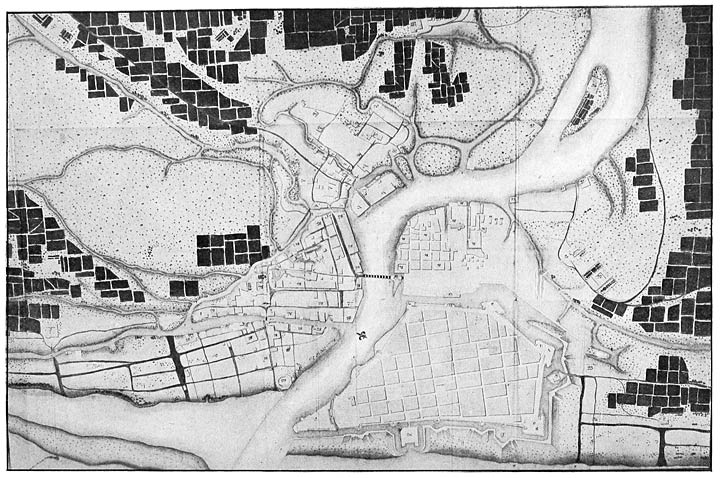
Plan of the present condition of Manila and its environs, drawn by the engineer Feliciano Márquez, 1767
[From original MS. map (in colors) in Archivo general de Indias, Sevilla]
These indispensable expenses amount to the sum of fifty-nine thousand, three hundred and three pesos, which, deducted from the sixty-two thousand, seven hundred and seventy pesos, two tomins, of the net balance contained in the summary of statement ii, leaves only three thousand, four hundred and sixty-seven pesos, two tomins, in favor of the royal treasury.
Summary
Pesos tomins
What the king receives, as in statement i 250,000
What is spent, as in statements ii and iii 246,532 6
Balance in favor of the royal treasury 3,467 2
Note
2. Attention should be directed to the following items: The exemptions from tribute which are usually granted to the villages in the cases for which the laws provide; the amount of what is not collected; that which is lost through the failure of the officials to render account, and through the omissions of the royal officials to collect as they should; the salaries which are paid to the said royal officials and to the subordinates of the established accountancy, mainly for the accounts and collections of the royal revenue in the provinces; the costs of transporting the proceeds of the said tributes to this capital; the losses of the vessels which convey the said goods, commodities, or products in which the said tributes are levied, according to the different production of the provinces; the pay of workmen [Tag., bantayes], and other petty expenses which are paid from the royal revenue in each province; the cost of the vessels which go out to cruise against the Moros, in the defense of the said provinces; and many other expenses, to ascertain and compute which would require tedious labor. But, as this report aims to show how much the king receives from the Indians and what he spends on their account, the aforesaid general computations are convincing that the royal treasury spends in these islands much more than what they produce; and that the ecclesiastical estate—or, to speak more accurately, the religious orders—profit by and receive almost all the proceeds from the tributes.
3. On this account the royal situado has been necessary in these islands, in order to pay the following expenses: the salaries of the governors, the ministers of the royal Audiencia, and their subordinates; the officials of the royal treasury; the soldiers in the garrisons of Manila and Cavite, with all their followers; the arsenal of Cavite; and numberless expenses which have grown since the retrenchments which were decreed by Señor Cruzat. And as the situado and the income-producing monopolies are not sufficient for all the said expenditure, the islands have been and will be in the most wretched condition, and in the utmost danger of being ruined, unless some remedy be applied.
STATEMENT IV
What the curas and ministers receive from the Indians
1. On account of the three reals which each whole tribute pays to the curas and ministers for the feasts of Corpus [Christi], the patron saint, and the monument at Holy Thursday, they receive from the two hundred thousand tributes the amount of seventy-five thousand pesos; and [therein] are not included the heads of barangay, the officials of the villages, and other persons exempt from tribute, who also pay the said three reals.
2. As for the value of the casual fees and parochial dues, although it is the general opinion that those same ministers of doctrinas regulate these at one peso for each tribute, it is estimated that from this source are received only one hundred and seventy thousand, four hundred pesos.
The total of these sums is 245,400 pesos.
Summary
Pesos tomins
The ecclesiastical estate receives from the king, as in statement ii 187,229 6
Also from the Indians the aforesaid sum of 245,400
Total amount 432,629 6
Note
Thus, what the ecclesiastical estate receives from the king and from the Indians, for only the spiritual administration of the latter, amounts to the sum of four hundred and thirty-two thousand, six hundred and twenty-nine pesos, six tomins, without including what is produced by the chaplaincies founded in the churches of some ministries, or by the confraternities—which are worth much, on account of duplicated offerings, since in them are enrolled not only the living but the dead. Nor [does it include] the wax for novenaries, masses, and other services which through devotion are offered by the Indians and mestizos; or the offerings at the sanctuaries, to which in all the provinces many people repair with wax and offerings for masses; or the sure revenue [from the charge] of fifteen pesos for every feast of the numberless visitas and chapels which are in all the villages (more than those which are celebrated in the principal churches); or the amounts received, at the burials, from the distinction of the silver from the wooden cross—so that, although in a certain village there may not be a silver cross, there are two of wood, and one of them is distinguished from the other by the amount of the fees [imposed for its use].
Nor have there been included in the said item the five hundred pesos which are annually paid from the royal treasury to the convents of Manila in order that they may support one or two religious who are versed in the dialects of the provinces; or the alms which they receive from the charitable foundations [obras pías] of the Misericordia, and from those which have been founded in each order; or the proceeds from the leasing of their lands acquired by donations, chaplaincies, and legacies; or the premium or interest from the funds of the confraternities, etc.
Likewise should be added the fees for burials, which, although they belong to the fabricas of the churches, are received by the curas and ministers of the doctrinas, and they are not willing to render account of these to the vice-patronship.
Besides that which is for the spiritual administration, the religious orders in these islands receive enormous amounts of money every year from the proceeds of the houses, mills, ranches, and other properties which they possess, here and in México; for they collect some rents that are exorbitant for the cultivated lands, exacting more than twenty per cent of the actual value of the said lands.
Comparison
Pesos tomins
All that the king receives from the Indians, without deducting the items mentioned in the notes on statement ii, amounts to 250,000
All that the ecclesiastical estate receives, not including the items mentioned in the notes to this statement iv, amounts to 432,629 6
That which the ecclesiastical estate receives exceeds what the king receives, by the sum of 182,629 6
It is, then, apparently fully proved that what these Indians contribute to the king is not sufficient for the necessary expenses of their spiritual administration; since, even without counting the cost of the fortified posts (which serve only for the benefit of those same Indians), it is evident that the net balance which remains in favor of the royal exchequer, after deducting the expenses mentioned in statement ii, is lost, through the causes which are stated in the second note on statement iii. From this it follows: First, that all the profit of these islands accrues to the ecclesiastical estate. Second, that in order to aid the Indians the royal revenue has been burdened, to the injury of other vassals, with the charge of the royal situado which comes annually from Nueva España, in order to maintain the forts, troops, and courts, and meet other expenses of the royal treasury here. Third, that the latter is heavily indebted, because the royal situado and the monopolies of the royal exchequer are not sufficient for so enormous expenses. Fourth, that for lack of funds the king’s service is neglected, the forts are defenseless, the provinces at the mercy of the Moros, and everything is in notable danger of total ruin, unless suitable remedies are applied in time.
Even without the necessity of increasing the tribute, I have been of opinion, and still continue in the firm persuasion that these islands could support themselves alone, and save to the royal revenue the remittance of the situado. Desiring to demonstrate this truth—which has been taught to me by the experience and continual application of eight years—I will set forth the economies and augmentations which this royal treasury can observe in order to supply its urgent needs, and to support these islands more gloriously, and to the greater advantage of the royal exchequer.
STATEMENT V
The economies which the royal exchequer can practice, and the augmentations which it can receive, in what the curas and ministers of doctrinas collect from the king and the Indians.
3. The fabricas of the churches have for funds the fees from the burials, and the eighth part of the occasional fees, with the others which I have stated in the document which treats of this subject, besides the [governmental] contribution of wine; and with the said funds there is a superabundance for paying the cost of the wine for masses and the oil for the lamps—which are set down as expenses of the royal exchequer in the third and fourth items of statement ii. These amount to nineteen thousand, one hundred and ninety-three pesos, six reals.
4. In the aforesaid paper of suggestions, and in the report of June 5, 760, the reasons were set forth why the king should not pay the cost of the missions which come from España to these islands; for the religious orders are rich, although they deny it. Thus the royal exchequer could save what is mentioned in the eleventh item of statement ii, which amounts each year to forty-six thousand, five hundred pesos.
5. The impost of the three reals for each tribute for the feasts of Corpus [Christi], the patron saint, and the monument, was granted by the provisor of this archbishopric at the instance of the religious orders, in the year 1697; and in that of 704 it was included in the provincial ordinances by Señor Zabarburo. This contribution is excessive, and the cost of the feasts is very small because the natives make the decorations of branches and furnish much wax; and the two feasts of Corpus Christi and the patron saint usually are held on the same day. For these reasons Señor Molina commanded, in his bishopric of Nueva Cazeres, that no payment should be exacted from the Indians on account of these feasts, further than half a real for each tribute, considering that this sum was sufficient to pay for their celebration. The same was the practice of Señor Arevalo, who succeeded him in the same bishopric; but Señor Matos, the last bishop there, did not act thus. It is also an intolerable burden to the Indians that at the time when they go to make their confessions, in order to fulfil the annual injunction, the said contribution is collected from them; and most of them are persuaded, through their stupidity and ignorance, that they are paying for the confession. All this I have explained in the expediente of ordinances which is pending in the royal Audiencia. It would therefore be expedient that the said three reals be collected by the alcaldes-mayor, who should give to the curas and ministers a third part of the proceeds, setting aside the other two thirds for the maintenance of the fortified posts. Thus the royal exchequer would have the benefit of this saving of expense, and would be increased by fifty thousand pesos, which is two-thirds of the proceeds of the three feasts, as is stated in the first item of statement iv.
6. The royal exchequer can save the cost of furnishing the medicines, clothing, support, and comforts for the sick religious; for the returns from the ministries are large, and the religious orders are rich. This saving, as is said in the eighth item of statement ii, amounts to five thousand pesos.
The total of all these items is 155,693 pesos, 6 reals.
Thus the royal exchequer can save expense, and increase its funds every year by the sum of one hundred and fifty-five thousand, six hundred and ninety-three pesos, six reals, the amount of the six previous items, which correspond to the costs of the spiritual administration of the Indians. This should be deducted from the amount which the ecclesiastical estate receives, for this very purpose, from the king and from the Indians—which, according to the summary of statement iv, reaches the sum of four hundred and thirty-two thousand, six hundred and twenty-nine pesos, six tomins—and there still remains, in favor of the ecclesiastical estate, two hundred and seventy-six thousand, nine hundred and thirty-six pesos.
Summary
Pesos tomins
The ecclesiastical estate receives from the king and from the Indians, as in the summary of statement iv 432,629 6
Deducting the amount of the savings which are stated in the preceding lines, 155,693 6
There remains, in favor of the ecclesiastical estate, a net balance of 276,936
Note
The escorts which are furnished to the ministers are, at most, proper in the first years of a mission; but ordinarily this is a useless expense, by which the religious orders profit—or rather their missionaries, who take no other escorts than their own servants; nor do they need escorts, especially in the well-peopled missions. Most of these are such, because many Indians from the villages take refuge in the missions, either fleeing from justice, or for not paying the tribute. Thus could be saved the cost of the said escorts; and even the stipend for every mission after twenty-five years from its establishment, by causing the people to be brought into villages.
STATEMENT VI
Other increases and savings which the royal exchequer can make, in the various directions which are here stated.
1. It is assumed that there are, at the lowest figure, six thousand heads of barangay in the provinces of these islands; for although, by the ordinance, each headship ought to have forty-five entire tributes, it is certain that there are few which reach that number, and that there are many of five, eight, ten, and twenty tributes. Therefore, assigning to each headship, on the average, at most thirty tributes, they make the six thousand above stated, the number of tributes [in them being] one hundred and eighty-three thousand, three hundred and thirty, the lowest computation that can be made of headships and of tributes. As three persons in every headship are exempted [from paying tribute], the royal exchequer is deprived of the value of nine thousand entire tributes, which, at the rate of ten reals, make eleven thousand, two hundred and fifty pesos. Therefore, by abolishing the said headships, and making the governadorcillo or headman of each village responsible for the collection of the tributes therein (as is done in Nueva España), or by allowing the said headships and decreeing that those who hold them shall pay tribute (as they formerly did, by order of the visitor, Auditor Don Joseph Arzadun), this increase in the tribute will result to the advantage of the royal exchequer, by the sum of eleven thousand, two hundred and fifty pesos.
3. By order of the above-mentioned visitor, no exemption from tribute was enjoyed by the officials of the villages, except by the governadorcillos and headmen; and counting six exempt persons [each] in three hundred and sixty villages alone—without including the visitas, which also have their officials—they make the number of two thousand, one hundred and sixty, which make one thousand and eighty tributes. These, at the rate of ten reals, amount to one thousand, three hundred and fifty pesos; consequently, by taking away these exemptions the royal exchequer will be increased by this sum.
5. Those who are for the same reason exempted in the villages of private encomiendas, according to the said general statement, number one hundred and ninety-six and one-half whole tributes. By abolishing this exemption, the increase to the royal treasury will be two hundred and forty-five pesos, five tomins.
6. The confusion in the accounts of the royal revenue in the provinces; the arrears [in despatch of business] which they experience in the offices; the increased losses of ships, with goods belonging to the royal account, which are made a pretext [for not settling their accounts]; losses by fire; uncollectible charges; negligence in pushing the collections that ought to be made; and other damages which follow from the said confusion—all these are reckoned at thirty thousand pesos a year. If the debits and credits were in money, and not produce, and the alcaldes were obliged to supply the royal storehouses, transporting at their own account the commodities from the provinces—these being placed to their credit, according to the stipulation made with each one—with the rest which I have presented before the royal Audiencia and superior government, the royal exchequer would render available the said sum of thirty thousand pesos.
7. Likewise I have asserted in the royal Audiencia that the Indians ought not to be paid for the conveyance of their tributes, [when paid] in kind, from their villages to the capital of their province, as being contrary to the laws (ley 1, titulo 9, libro 8, and ley 63, titulo 5, libro 6, in the Recopilación de Yndias) which treat of the tributes of the crown, and plainly show the obligation of the Indians to carry their tributes to the said capitals—differently from the tributes of encomiendas and from general appraisements, which are mentioned in ley 44, titulo 5, libro 6, in which it is commanded that the tributes be paid in the villages. Consequently, if the aforesaid conveyance is at the cost of the Indians, as seems just, and not at that of the royal exchequer, not only will the frauds arising from such entries in the accounts of the alcaldes be avoided, but his Majesty will save the expense which is mentioned in the third item of statement iv, which amounts to the sum of six thousand pesos.
(In case the method which is suggested in the sixth item preceding this be established, the said sum will inure to the benefit of the alcaldes-mayor, who should at their own account and risk render a statement, with payment, of the entire proceeds of the tributes; and in the obligation or contract with each one the said benefit should be kept in view, in order that it may inure to the benefit of the royal exchequer.)
8. There has always been an outcry in España against the purchase of public offices in the Yndias, notwithstanding that these have been placed on sale only in the exigencies of the crown. If the sale of these offices on the royal account is a question involving much scruple, it necessarily follows that it would be an injustice to sell them on the account of those who have authority to make appointments to those offices ad interim. Consequently, by reëstablishing the oldtime method—by which the candidates for the posts of alcalde must present themselves before the royal Audiencia with documentary evidence of their merits, in order that three qualified persons might be presented to the superior government, in the first, second, and third places respectively, for each post of alcalde—the dangers arising from the sale of offices which has been practiced in some governments would be avoided; and the selection [of officials] would be more conformable to justice and less mercenary (as I represented to his Majesty in the year 760). The royal exchequer could thus save the salaries of the alcaldes and magistrates (as is done in Nueva España), which saving would amount, as in the second item of statement iii, to the sum of seven thousand, five hundred pesos.
(If the alcaldeships were knocked down to the highest bidder in the auction-hall, together with the farming of the tributes, it would result in even greater profit to the royal exchequer.)
9. The offices of commander and military officers of the ship which goes annually to Acapulco are bestowed on citizens of this city; and the appointments to these offices can be made without giving them the salaries which hitherto they have enjoyed; for they are sought not so much for the salaries as for the honor, and for the free passage, with comfortable berths and conveniences, [which is furnished to officers]. Consequently the royal exchequer could save the amount of the said salaries, which exceeds ten thousand pesos.
10. In the paper of suggestions and the report which I cited in the first item of statement v, are mentioned the many advantages which would result from the establishment of guilds [gremios] which I propose; and from the increase of the royal revenues by the half-annats from the officials [of the crown]; and by the duties of one-fifth on silver and gold. These metals are wrought, at the will of the silver-smiths, of various standards and degrees of purity, contrary to the provisions of the royal decree of March 17, 1735; and as I cannot fix the exact amount for the aforesaid duties, a moderate estimate is made, at the lowest [standard], that the increase of the royal revenue would amount to some seven thousand pesos.
11. In each village there is a governadorcillo or headman, a deputy (and, if the village is a large one, two or three), a constable (and likewise two others, in large villages), an inspector of grain-fields [juez de sementeras], another of palm-trees, and a notary. In the visitas of the villages there are likewise deputies, constables, and inspectors of grain-fields. The large villages are more numerous than the small ones. If we allow for each one of the three hundred and sixty villages one headman or governadorcillo, only one deputy and one constable, one inspector of palm-trees and another of grain-fields, these make in each village, on the average, six offices which annually pay the half-annat, by a custom which was introduced into these islands in violation of the law of the Indias, which exempts the Indians from this royal impost. But in the settlement of its amount there is an unusual variation and difference, by which in the provinces of Tondo, Bulacan, Balayan, and Laguna de Bay (which are close to Manila) a governadorcillo pays twelve pesos, a deputy six pesos, and the constables, inspectors, and notaries four pesos [each]; while in the other provinces which likewise are close to this capital—Pampanga, Batahàn, and Cavite—a governadorcillo pays six pesos, a deputy four pesos, and the constables, inspectors, and notaries three pesos [each]. In all the other and remote provinces, a governadorcillo pays only one peso, six granos; a deputy, six and one-half reals; and the constables, inspectors, and notaries, three and one-half reals. From this it results that each village in the four first-named provinces pays thirty-four pesos, and each village in the three other provinces close by pays only twenty-two pesos; and in the thirty-seven villages of these three provinces the difference which there is between paying twenty-two pesos each and (as in the former) thirty-four, is four hundred and forty-four pesos—which is the increase for the said royal impost, if the payment is fixed at thirty-four pesos.
12. The seven provinces above mentioned have one hundred and eleven villages, and to fill up the complement of three hundred and sixty there remain in the remote provinces two hundred and forty-nine villages. Each one of these pays only five pesos, one tomin; and by ruling that they shall pay twenty-two pesos this impost will be increased by sixteen pesos, seven reals in each village. Multiplying this by two hundred and forty-seven, the number of villages, the said increase will amount to the sum of four thousand, two hundred and one pesos, seven tomins; and by equalizing [the payments of] all the provinces, at the rate of thirty-four pesos for each village, the aforesaid increase will rise to seven thousand, one hundred and eighty-nine pesos, seven tomins.
13. In my report of May 10, 760, in which I demonstrated the defective foundation of the commerce here, I proposed the increase of sixty thousand pesos every year, [in the amount of the permission?] his Majesty to permit the return of the silver from Acapulco with the impost of eight to ten per cent; and it is certain that the ten per cent will produce to the royal exchequer annually, on the average, one hundred thousand pesos, which is the amount in which the royal officials at Acapulco are interested.
15. In a report of June 5 of the same year, I proposed to save the expense of one [university] chair of civil law [Instituta], which would yield an increase of four hundred pesos.
16. In a report of July 14 of the same year was mentioned the abandonment of the sale of [papal] bulls; and it was shown that this could produce at each publication at least one hundred pesos, which would be an annual increase of fifty thousand pesos
18. By reëstablishing the farming or monopoly of playing-cards, either (preferably) by contract or by its administration or the royal account, as is commanded by the royal decrees of February 5, 730 and November 28, 1734, it could produce in all the provinces more than twenty thousand pesos, at the lowest estimate, in increase of the royal revenue.
22. The casting of plows is permitted to one person only, who is appointed by the government; if this were sold at auction it certainly would produce, at the lowest estimate, the sum of seven hundred pesos.
Thus the savings and increases of revenue contained in this sixth statement would produce to the royal treasury the aforesaid sum of one million, one hundred and fifty-seven thousand, one hundred and thirty-nine pesos, five tomins every year.
Summary
Pesos tomins
The savings and increases of revenue contained in this statement amount to the sum of 1,157,139 5
Those contained in statement v amount to 155,693 6
Total 1,312,833 3
Accordingly, the savings and the increases mentioned in the two foregoing statements are worth to the royal exchequer the sum of one million, three hundred and twelve thousand, eight hundred and thirty-three pesos, three reals; and even if it be reckoned at no more than a million, this annual product will be more than enough to maintain the islands with respectable forces, and to make good the expenses hitherto caused to the royal revenue, without the necessity of increasing the royal tribute from the Indians. And, in case it be thus increased, in the following statement will be set forth the value of the said increase.
Note
1. In the said savings and expenses have not been included the royal customs duties—on which I made a report to his Majesty under date of March 4, 760—because they are at the present time levied and collected with great increase of the royal revenue, time having confirmed what was contained in the report here cited. For, notwithstanding that the collections are now made on the Spanish ships only at the rate of three per cent, the royal exchequer has an increase of two hundred per cent, more than in past times when these duties were levied, either really or nominally [se exigia, ô se aparentava la exaccion], at eight per cent.
2. Reference can be made to the information which I furnished to his Majesty under date of June 5 in the aforesaid year of 1760, in which were discussed the savings which the royal exchequer could make in various directions, especially in the timber-cutting and in the royal storehouses, for the damage that the royal interests suffer [therein] is very evident; but no definite amount is set down for the value of the said savings, nor are they included in this account, since it is difficult to compute them.
These and many other economies can be facilitated only by disinterestedness, zeal, and application to the affairs of the royal service.
STATEMENT VII
What can be produced for the royal exchequer by an increase in the tributes
In statement i is reckoned the number of two hundred [thousand] whole tributes, at the rate of ten reals each, which is the amount that they actually pay. This computation was made by reducing the tributes of mestizos to tributes of Indians, and in the same sense ought the increase which is discussed in this statement to be understood; for, although the mestizos pay twice as much tribute as the Indians, and consequently the increase ought to be double, the number also is duplicated, in order to avoid discrepancies and to facilitate the greater perspicuity and clearness of these statements by the definite number of two hundred thousand tributes, at the rate of ten reals each. As this is a very moderate rate, it can be increased in such ratio as shall be considered necessary; for this reason, I have set down separately in the following columns the amounts by which the royal treasury will benefit from an increase in the tributes—from ten reals to sixteen, which are two pesos; to twenty-four reals, which are three pesos; and to thirty-two reals, which are four pesos.
Increase in tribute, of 6 reals of 14 reals of 22 reals
pes. tom. pes. tom. pes. tom.
The increase of 6 reals, of 14 reals, and of 22 reals in each one of the 200,000 whole tributes which statement i mentions, amounts, as seen in the respective columns, to 150,000 350,000 550,000
The said increase in each one of the 9,000 tributes mentioned in item 1, statement 6, amounts to 6,750 15,750 24,750
The said increase in each one of the 60,000 tributes mentioned in item 2, statement 6, amounts to 45,000 105,000 165,000
The said increase in each one of 1,800 tributes mentioned in item 3 of said statement amounts to 870 1,389 2,970
The said increase in the tributes mentioned in item 4 of the said statement amounts to 1,528 7 3,567 3 5,605 7
The said increase in the tributes mentioned in item 5 of the said statement amounts to 147 3 343 7 540 3
Total 204,236 2 476,551 2 748,866 2
Summary
The increase of 6 reals, of 14 reals, and of 22 reals in each tribute, according to the respective columns of this statement, amounts to 204,236 2 476,557 2 748,866 2
The increases and savings contained in the summary of statement 6 amount to 1,312,833 3 1,312,833 3 1,312,833 3
Total amount of the increases and savings of the royal revenue every year 1,517,069 5 1,789,384 5 2,061,693 5
Thus the increases and savings which the royal exchequer can practice in these islands, without increasing the royal tributes from the Indians, will be worth each year the sum of one million, three hundred and twelve thousand, eight hundred and thirty-three pesos, three tomins, as is shown in the items of statements v and vi.
If the tribute is increased from ten to sixteen reals (which are two pesos), the savings and increases will bring into the royal treasury the sum of one million, five hundred and seventeen thousand, and sixty-nine pesos, five tomins.
If the tribute is increased from ten to twenty-four reals, the said savings and expenses amount to the sum of one million, seven hundred and eighty-nine thousand, three hundred and eighty-four pesos, five tomins.
And if the tribute be increased to thirty-two pesos, the said savings and expenses amount to two millions, sixty-one thousand, six hundred and ninety-nine pesos, five tomins.
Note
All these computations of the savings and increases which this royal treasury can gain each year have been made without including in the totals the actual product of the tributes and other branches of the royal revenue in these islands; therefore, adding the said product to the total of the savings and increases which are here mentioned, there will result a greater amount than that which has been estimated. No matter how gloomily people may talk, the aforesaid statements are convincing that, even if these estimates are made lower, these islands can, notwithstanding these reductions, be maintained by their own resources alone; and in the future the royal exchequer can make good the great sums which the islands have hitherto cost, with the special advantage that the fortified towns and military posts can be put into very respectable condition, and be made superior to the forts of any hostile nation whatever.
I protest and swear that I have understood the matter thus, and that, because I consider it feasible, judging from the experience of my office, I have [here] devoted myself to demonstrating more specifically that which in general is contained in the work entitled “Demonstration of the wretched and deplorable condition of the Philipinas Islands,” etc., which last year I presented before this superior government, and of which I rendered account to his Majesty, whose royal mind will consider what is most expedient for the glory of his monarchy, the conservation of these islands, and the advantage of the royal exchequer. It is to those ends that the savings and increases of revenue are directed that are found in these statements—which are the children of the zeal, affection, fidelity, disinterestedness, and assiduity with which I have devoted myself to the affairs of the royal service. Manila, July 10, 1766.
Don Francisco Leandro de Viana