Volume 50 — THE EXPULSION OF THE JESUITS, 1768–1769
Reading edition
[This subject is one of profound and far-reaching significance in history, especially that of Europe; but the exigencies of our limited space forbid us to do more than suggest some of the more important aspects of this matter, and to furnish references to historical works in which it is treated at length. Our chief attention is necessarily given to the expulsion of the Jesuits from the Philippines, which will concern us mainly with the facts of the case; and for this we must have recourse largely to Montero y Vidal’s account of it as given in his Historia de Filipinas, ii, chapters v–vii. (Ferrando says nothing about the banishment of the Jesuits, save in a few incidental allusions which we have cited in previous notes.) To this relation we add a few contemporaneous documents, and other matter from various historical writers, presenting as far as available actual facts, and the views of both sides, impartially.]
The expulsion from the Spanish dominions
The expulsion from Filipinas
[An account of this is presented by Montero y Vidal in his Hist. de Filipinas, tomo ii; he relates the causes of this measure, and the execution of it in España and the colonies in general (pp. 141–179), and the expulsion from Filipinas (pp. 181–228), which latter account is here given:]
The Conde de Aranda, who was especially entrusted by Carlos III with all that related to the banishment of the Jesuits and the seizure of their property, addressed to the governor-general of Filipinas the following letter, dated March 1, 1767:
“Inside the annexed letter from Señor Marqués de Grimaldi, secretary of the affairs of state, you will receive another from the king our sovereign, in which his Majesty deigns to confer authority on me for the purpose of which this despatch treats—which, in short, is the banishment of the order of the Society of Jesus from all the royal dominions, in the manner and form provided in the royal decree, of which I enclose a printed copy. The very fact of the special honor which the king confers on you of [a letter with] his own signature [puño, “fist”] will convince you of the importance of the matter and of secrecy, and of the king’s resolute determination for the most punctual fulfilment [of the decree].
“As for its execution, you will be guided by the instructions framed for España and by the additional ones that apply to the Indias, availing yourself of both, to the end of selecting from each that which is best adapted to your purpose. As I have taken into consideration the distance of those countries from this one, and the difference in their mode of government, I have decided to entrust to you all discretionary power [necessary] to change or add details of circumstance, so that the [desired] result may be attained with that completeness which so important a matter requires. I think that your clear-sightedness and prudence will peaceably bring about obedience to the royal decision—without, however, neglecting guards and the use of moderate force, in order not to risk the failure of the enterprise; but in any event if, contrary to what is usual, you should encounter resistance from the religious concerned in this, or find among their adherents any inclination or resolution to oppose you, you will employ the authority and force of military power, as you would in case of rebellion.
“It will be important that in the villages where there is a college or house of the Society measures be taken (as soon as the royal decree has been made known to them) to inform the other religious orders and the secular clergy of those places that the decree of his Majesty is limited to the Jesuit religious; for it is very proper that all the other ecclesiastics, both seculars and regulars, contribute with their persuasions, so that the people generally shall reverence the decrees of his Majesty, since they must be considered as always based on important and just grounds. The king our sovereign has the greatest confidence in your fidelity and ability, and consequently I have the same. I only desire, therefore, your complete fulfilment [of this commission], and that you write to me in order to keep me informed of the results, without making any inquiries on doubtful points; for if these should arise you must decide them for yourself, being governed by the sense and idea which the royal decree and instructions themselves, as a whole, produce. May God preserve you many years. Madrid, March 1, 1767.”
Paragraphs 1 and 2 of the “Additional instructions regarding the banishment of the Jesuits from the dominions of his Majesty, for what belongs to the Indias and the Filipinas Islands,” to which the preceding document refers, say: “(1) In order that the viceroys, presidents, and governors of my domains in the Indias and the Filipinas Islands may know that they have, in virtue of the royal decision, for this purpose, the same powers that reside in me, I entrust to them those which are mentioned in the instructions for España, so that they may issue the orders designating the depositaries [for papers, goods, etc., belonging to the persons expelled], and the ports [of departure for them], and promptly make ready the necessary vessels for the transportation of the Jesuits to Europa and the port of Santa María, where they will be received and equipped for their destination. (2) As the authority of those officials will be ample, they will remain responsible for the execution of the decree—for which they may select a suitable time, and will fix the day on which it may be carried out in all parts of their territory, issuing the proper orders with the utmost promptness, in order that no information may reach any of the [Jesuit] colleges of what is being done at others in this regard.”
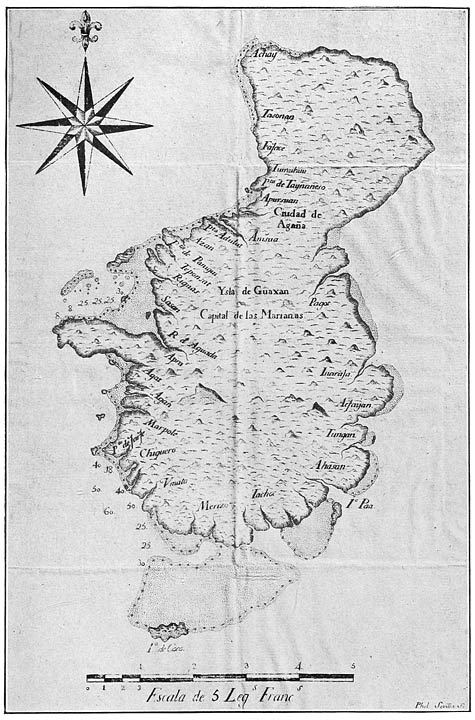
Map of Guam, one of the Marianas Islands, in Concepción’s Historia general (Sampaloc, 1788–1792)
[From copy in Library of Harvard University]
The preceding documents were accompanied by a list of the colleges, houses, and residences of the Jesuits, certainly not a very accurate one. The colleges, residences, and curacies which at that time they possessed in Filipinas were as follows: In Manila (jurisdiction)—the colleges of San Ignacio and San José, and that of San Ildefonso at Santa Cruz; also the following curacies. In the province of Tondo (Manila), which includes the present district of Morong—San Miguel, San Pedro Macati (college and novitiate), Cainta, Taytay, Antipolo, Bosoboso, San Mateo, and Mariquina. In the province of Cavite—Cavite (where they had a college), Cavite Viejo, Silan, Indan, Maragondon, Naic. In the corregidor’s district of Mindoro—Boac, Santa Cruz de Napó, Marinduque Island, Gapan. In the province of Cebú—Cebú, with a college, and the curacies of Mandaue and Liloan. In Bohol—Inabangan and Talibón (where was situated the residence of Bohol), with the villages and ministries of Loboc; Baclayon, Dauis, Malabohoc, Tagbilaran, Santísima Trinidad, and (on the coast farthest from Luzón) the curacy of Hagna. In the island of Negros—Ilog, Cabancalan (with the mission of Buyonan, Himamaylan, Cavayan and the mission of Sipalay). In the province of Otón (Iloilo)—Iloilo (with a college), Molo, Arévalo. In the island of Sámar—Catbalogan, Paranas, Humavas, Calviga, Boac, Bangajon, Tinagog, Calvayog; in the island of Capul, the ministry of Abac. In the province of Ibabao, or coast of Sámar farthest from Luzón—Palápag, Lavan, Catubig, Catarman, Bobón, Sulat, Túbig and Borongan. On the southern coast of the same island—Guiguan, Balanguigan, Basey and Lalaviton. In the island of Leyte—Carigara, Barugo, Jaro, Alangalang and Leyte. On the farther coast of the same island—the residence of Ilongos, and the ministries of Palompón, Poro, Ogmug, Baybay, Maasin, Sogor, Liloan, Cavalian and Hinondayan. In the northern part of the same island—the residence of Banigo, Palo, Tanavan, Dulac and Abuyog, and (in the interior) Dagami and Burabuen. In the island of Mindanao—the presidio of Zamboanga, with a college and ministry; Bagonbayan, Dumalon, Siocon, Catabangan, Caldera, Polombato and Siraguay. In the northern part of the same island—Dapitan, Iligan, Lavayan, Langaran, Lubungan, Disacan; Talingan, and various visitas and missions along the same coasts and the bay of Pangue. In the Marianas islands—Agaña, with a college and Indian seminary; Agat, Merizo, Pago, Guajan, Yuarajan, Umata, Rota and Saipan.
The first communication addressed to Raón by Conde de Aranda in reference to the manner of effecting the expulsion of the Jesuits was sent to him through the viceroy of Méjico, in order that the latter might despatch the letter from Acapulco. Lest this should go astray or be delayed, a second copy was sent to him by way of Cádiz and the French ships of their Company of the Eastern Indias, its bearer being an official appointed for this purpose, under the pretext that he was going there to discipline the troops. In this latter communication (on the same date of March 1), Conde de Aranda added these words to Raón: “I think that when this reaches you the very reverend archbishop will have already arrived in Manila, as he sailed from Cádiz a month ago in a Swedish ship. If that is the case, your Lordship can inform him confidentially of this despatch; and you can count on his illustrious Lordship in whatever your Lordship may deem necessary, in his opinion or his aid. For his Majesty esteems him, and I know him intimately; and I am certain that he will coöperate with whatever measures may conduce to the success of this enterprise, and to the greater service of the king.” In another and third despatch was repeated what had been previously explained to Raón, informing him that the bearer of the second despatch was his Majesty’s courier Pedro Santillac—who was to embark in Holanda, in order to go to Batavia, and thence to Manila, chartering a vessel, if there was none available, for this object.
“Sire: As soon as I read, pressed to my lips, and placed on my head the respected royal letter of your Majesty giving orders relative to the expulsion of the Jesuits who were settled in all these domains of your Majesty, and the seizure of their goods, I employed the means that occurred to my loyalty and zeal for the accomplishment and fulfilment of this important business. In consequence, there are sailing as passengers on the ship named “San Carlos Borromeo” sixty-four individuals, including the principal Jesuits of this mainland [of Luzón] and the island of Marinduque; and for the removal of a like number of missionaries from the Bisayas Islands four vessels are employed. Meantime I have the aid of the other holy religious orders in occupying temporarily the ministries there—as I fully informed your Majesty in greater detail through Conde de Aranda. May our Lord preserve the royal Catholic person of your Majesty, as these remote regions need. Manila, July 23, 1768. Sire, [I kiss] your Majesty’s royal feet.
Don Joseph Raón”
The faithlessness of Raón, information of which reached the court, caused his successor, Don Simón de Anda, to receive orders to commence legal proceedings against Raón, for the purpose of proving this grave offense and punishing it severely. That upright and severely just magistrate did so; and nothing will aid more the exact understanding of one of the most far-reaching events in the history of Filipinas than to insert here, complete, the summary drawn up by Anda of the above-mentioned lawsuit, since in it are shown in great detail the particulars of what was done in these islands in the expulsion of the Jesuits. Here is the exact copy of this important document:
In execution of the orders of the court, the properties which the Jesuits possessed in the islands were confiscated, their administrations being afterward entrusted to a special commission appointed by the governor-general. In order to give some idea of the amount of the said property, we will insert here a curious document written by a person of undeniable veracity, not at all unfriendly to the Jesuits, who on account of the offices which he held in Manila had at his disposal the respective expedientes [of the above suit]; he writes thus:
“The possessions of the Jesuits in Filipinas.—I have personally examined the voluminous expedientes drawn up for their expulsion from these islands; I have gone through the itemized inventories of all the colleges, houses, residences, and ministries; I have examined the appraisement, leases, and sale of the estates, buildings, cattle, furniture, and valuables, besides [a statement] of what was rendered useless and of the large remittances made in kind to the Peninsula; and all this has furnished me official data so accurate that I can make a statement without fear of being charged with falsehood in the matter. To enter into details would be exceedingly tedious; but to the end that all may not remain buried under the dusty cases of the Government archives, I am going to set down here a résumé which shows, with only a glance, all that was taken possession of from the Jesuits at their expulsion from Filipinas.
[Effects] Pesos
In ready money, interest that was collected, and obras pías 463,882
Produce from the sale of various estates and houses 721,553
Idem, from furniture and chattels sold in the various colleges, residences, and ministries 128,735
A printing-office, adjudged to the [archiepiscopal] seminary, and valued at 4,035
A drug-store, turned over to the royal hospital, and valued at 2,660
All these amount to the sum of 1,320,865
It is fully understood that the Jesuits of Filipinas felt profound grief at having to abandon a country in which they had gathered so rich a harvest, considering their excessive regard for worldly possessions—as is affirmed by the venerable Palafox, the bishops whose opinions we have cited, and Pope Clement XIV, who suppressed the Society, and all persons who have been occupied with this special idiosyncrasy of the Jesuits.
The incidents connected with the expulsion of the Jesuits from Filipinas were among the most productive of scandal which, in matters of that sort, the history of that country records. At that time the Jesuits enjoyed so great a predominance, and realized such enormous gains throughout the archipelago (with their well-equipped industrial enterprises, their lucrative trade, and the produce of their vast estates), and they kept the [Spanish] natives of the country so thoroughly exploited and so subjected to their domineering influence—cajoling the vanity of some with the hypocritical deference with which the fathers treated them, and favoring the notions of independence in others, giving them to understand that they [the Jesuits] were not Spaniards, but citizens of the world (which is the aspect under which they make themselves more congenial to the islanders than the friars do, for the latter never fail to make it known that they are Spaniards)—that their wrath was unutterable when the decree for their expulsion from the islands was made known to them. They attempted to evade the royal mandate, and to disparage and criticise the monarch’s authority and his acts, unloosing against these the passions of their fanatical partisans; and with their infamous conduct they presented a most melancholy spectacle, in which the royal authority was questioned, religion made light of, and vices and faults which it would have been expedient for them to keep secret were displayed to the public.
Decree by the archbishop of Manila
✝
We, Don Basilio Sancho de Santa Justa y Rufina, by the grace of God and of the holy Apostolic See archbishop of Manila and metropolitan of these Philipinas Islands; councilor and preacher to his Majesty, and apostolic subdelegate; deputy vicar-general for the royal forces on sea and land in this archdiocese and its suffragan dioceses for his Eminence the lord Cardinal de la Cerda y San Carlos, the patriarch of the Indias; chief almoner of the king our sovereign; chief chaplain and vicar-general of the said royal forces in all his domains and lordships; etc.:
This and no other is the sound doctrine which upon this point we desire our beloved faithful to bear well in mind; and in order that it may come to the knowledge of all, and that no one can allege ignorance at any time, we command that the present edict be published in the customary churches, and posted in public places, where it can be read by all. Given in our archiepiscopal palace at Manila, signed by us, stamped with the seal of our coat-of-arms, and countersigned by our undersigned secretary; on the first day of November in the year one thousand, seven hundred and sixty-nine.
Basilio, archbishop of Manila.
By command of his illustrious Lordship the archbishop of Manila, my master:
Father Don Ildephonso Garcia, secretary.