Volume 50 — EVENTS IN FILIPINAS, 1764–1800
Reading edition
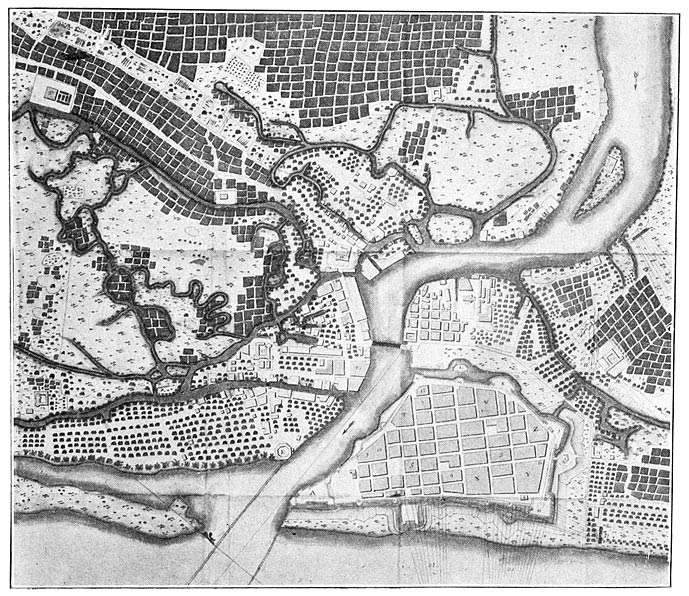
Plan of the city of Manila and its environs and suburbs on the other side of the river, by the pilot Francisco Xavier Estorgo y Gallegos, 1770
[From original MS. map (in colors) in Archivo general de Indias, Sevilla]
“The archbishop Santa Justa, a man of unparalleled firmness and energetic character, from the first moment assailed the new governor of Filipinas on the question of the diocesan visitation, to which the friars continued their opposition, and demanded his support in order to make it effectual. Anda, who regarded obedience to the laws as a rule of conduct, and who brought orders from the court to subject the regulars to the royal patronage, addressed an explicit communication to the superiors of all the religious institutes, requiring their obedience to the mandate of the sovereign, and assigning a definite term, which could not be prolonged, for the presentation of their lists of appointees, in order that the curacies might be filled in this manner. All the orders of regulars openly refused to yield obedience of this sort, excepting the Dominicans—who, more circumspect, and endeavoring to avoid the dangers which they foresaw in resistance, agreed to submit to this command—although many of the parish priests of the order soon were disobedient to this decision of their superiors.”
“By royal decree of November 9, 1774, it was ordered that the curacies held by the regulars should be secularized as fast as they became vacant. Anda suspended the execution of this command, and wrote to the court, specifying the evils which would ensue from the secularization of the curacies which the archbishop desired; and in consequence of this and of the urgent appeals of the Franciscans, Augustinians, and Recollects, the king ordered by a decree of December 11, 1776, that what had been decided on this point in the decree of November 9, 1774, should not be put into execution, and that affairs should be restored to their former status and condition, and their curacies to the religious; that the regulations for his royal patronage and the ecclesiastical visitation should be observed, but that the latter might be made by the bishops in person, or by religious of the same order as those who should serve in the curacies, and without collecting visitation fees. The king also directed in the said decree that efforts should be made, by all possible means and methods, to form a large body of competent clerics, in order that, conformably to the royal decree of June 23, 1757, these might be installed in the vacant curacies, thus gradually establishing the secularization that had been decreed.”
Sultan Israel of Joló was poisoned by the followers of his cousin Ali-Mudin, son of Bantilan, who therefore assumed the government (early in 1778); immediately the Moros renewed their raids on the Spanish provinces nearest them, and the expeditions sent against them by Sarrio could do little to punish them.
“The zealous governor visited the provinces in person, in order to inform himself of their needs and to remedy these, compelling their governors and other functionaries to fulfil their trusts as they should. He also organized various military expeditions to occupy the Igorrot country.”
By royal orders of July 17 and 26, 1784, the post of quartermaster-general of the islands was created, in accordance with a request by Basco; and that of deputy-intendant of the exchequer was united with it, independent of the superior government of the islands. It was placed in charge of one of the auditors, Ciriaco González Carvajal, also at Basco’s recommendation; and from this time the royal officials were styled “ministers of the royal exchequer.” Carvajal aided Basco greatly in establishing the monopoly of tobacco, and it was he who drew up the instructions to officials on this subject. In 1785, a dispute arose between them over the establishment of the tobacco monopoly in Camarines and Albay, each regarding this undertaking as the prerogative of his own office. Carvajal proposed that provincial intendancies should be created in Ilocos, Camarines, Cebú, and Iloilo; this was done, and approved by royal orders of November 24, 1786; but a year later the Spanish government suppressed Carvajal’s office, and these provincial intendancies as well.
The constant opposition to Basco’s reforms and efforts which he encountered finally wore out his patience, and he offered his resignation; at first it was not accepted, but he insisted, and the king allowed him to hand over the government of the islands to Pedro Sarrio. Basco embarked for Spain at the end of November, 1787, and for his eminent services was promoted in the navy, ennobled, and made governor of Cartagena. Montero y Vidal praises in high terms the character and achievements of this distinguished governor, who had secured for Filipinas greater benefits than had any other, establishing its revenues on a firm basis, introducing most important reforms, and advancing its material and moral progress; but he was assailed by “the envy, rivalry, spite, insane hatred, and lack of patriotism of the auditors, merchants, and other classes, who were governed by base motives and despicable passions, or by ignorance and covetousness.”