Volume 49 — ROJO’S NARRATIVE
Reading edition
Relation of the operations of the archbishop of Manila, governor and captain-general of the Philipinas, during the time of his government, of the measures taken during the time of the siege or blockade by the English of the capital of Manila, of its capture by assault, of the events which followed this unfortunate occurrence. Written for the defense of his fame and name which were abused and trampled under foot by envy through its calumnies, injuries, and reproaches by word and writing in letters and great libels.
Part first. Of the operations of the archbishop during the time of his government of the islands.
16. Since the archbishop assumed the responsibility, at the beginning of his government, of the many measures which were necessary for the fulfilment of that post, among various others to which he attended, he set his gaze and hand to the navy which was both in a backward state and important. He immediately endeavored to get boats, and was able to purchase three galleys—one a large one, and two small—and two champans. He gave order and money to the new alcalde-mayor of Pangasinan for two galleys and two champans; to the alcalde-mayor of Sorsogon for two more galleys, and sent him a shipbuilder; to the alcalde-mayor of Orani and Zambales order and money for a like number of the above-mentioned boats. Since he also had an order from his Majesty to construct two fragatas of fifty cannons, this was the chief thing to which he turned his attention. Having been informed of the great amount of wood which had been collected for this purpose by Mariscal Arandia, in the two cuttings which he had ordered in various places, and that said wood was for the most part used, and that at the moment of the conclusion of his government, his successor had had the cutting stopped, the archbishop again established them, in the districts which were found to be most suitable. Consequently, methodically and economically, the necessary timber was collected for a fragata, and the speedy sending of a like amount or more for the other fragata.
[All the preparations having been made, the work is started in the shipyards at Cavite, whither the archbishop goes in person. In that city he is royally entertained by the castellan of the fort, two bullfights being arranged for him, and musical concerts being given nightly during the five or six days of his stay there. The archbishop while there spends his time as follows: in the morning he celebrates mass, and goes to others attended by his suite, among whom are Manuel Galban, the auditor, and Francisco Viana, the fiscal; visits the royal storehouses, and the walls which are being repaired; during the remainder of the afternoon, if there is time, he visits the environs of the village; and at the time of the Angelus goes to the church where there is music. Thence, preceded by the musicians, he goes to his apartments where he listens to a concert until nine, at which hour he sups. Many complaints are made of this, as well as of the festivities in the palace at Manila and the time which he spends in his summer residence of Nagtahan, where he passes the hot months, namely, April, May, and a part of June. By his efforts to construct a navy, the archbishop believes that he is doing his duty. He plans to restrain the Moros from their raids, and has the coasts of the Visayan Islands guarded.]
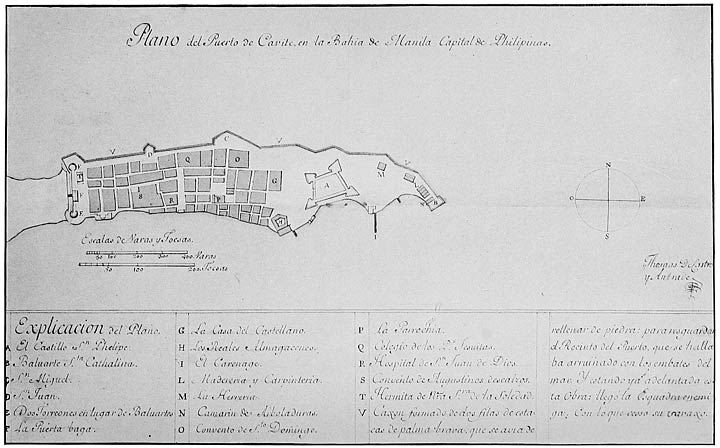
Plan of the port of Cavite and its fortifications, by Tomás de Castro y Andrade, 1762 (?)
[From original MS. (in colors), in Archivo general de Indias, Sevilla]
20. In regard to what was advised and ordered by his Majesty, the archbishop received these two embassies, and that from Jolo, with the previous consent and pleasure of the king of said island, Don Fernando I, who was greatly obliged by this attention, as well as by others which the archbishop had observed toward him. For the archbishop had given him a house and a carriage within the city, and had taken him from the most unworthy lodgings where he lived in the royal fort, because of having recognized the need of repairing it and having begun said work.
21. The ambassador or envoy from Bantilan incited said Don Fernando to petition and repeat his writings to the archbishop, so that his cause which had been so long delayed might be reviewed. This cause was so foggy and laden with many knotty and ancient points which having been examined and an extract having been made in regard to the whole matter, the archbishop sent it for a consultative vote to the royal assembly and in view of what the assembly stated in regard to their duty to declare him free from prison and with the authorization to be able to go to his kingdom, the archbishop reserved his consent, taking the time to arrange the voyage of said Don Fernando and his son, Prince Isrrael; and having taken measures in regard to his embarcation, and the other necessary things, fixing the voyage for November of that same year 1762: the preliminaries of peace were given and concluded, and the new and voluntary proposition of the said king and his son, signed by both, in it they conceded that the Spaniards could have a settlement and build their fort in their principal island of Jolo. In the meanwhile, the principal fortress of said island was to be surrendered to them as a mark of the confidence that they had in them and of the love which they professed to so good a king as the Catholic monarch. Also, in the island of Basilan the Spaniards were to be allowed to place their fortress. He ceded other distant islands which would be freely surrendered, and which were of no use to them. No other nation was to be permitted to settle in his kingdom without the consent of the Catholic king. All was accepted with the reservation of the rights of his Catholic Majesty, to whom a report was to be made.
22. The other ambassador from Mindanao proposed, and it also appeared in the letters from his sultan, that he would cede Sebugay, where he was stationed, as he was minded to move to another part of his possessions. He would maintain the ancient peace of his ancestors with the Spaniards, and would aid them against the other Moros, if they gave him arms. Nothing was concluded with this envoy, because, although the proposals were advantageous, while the archbishop was giving the matter his attention, and although he was pushing the matter urgently, the unexpected surprise of the English occurred. That also occasioned this great harm that our islands would have remained in security, and with precautions so that they might not be invaded by the Moros, who have ruined them for so long a time; and with the above-mentioned project for the settlement of the Spaniards in Jolo, the settlement which the English claimed and agreed upon with Bantilan would have been annulled. But everything was frustrated because divine ordination must prevail over human ideas.
23. During that time also the disturbance which was roused up against the Society of Jesus was quieted, some anonymous and libelous writings being scattered and read freely, and now prohibited with two others of new writings in these islands, which insulted it even to excess. By means of an edict and censure that was fulminated, these infernal stigmas were taken back, and the author of the two above-mentioned writings having been discovered, namely, a regular, he was corrected by means of his prelate, who without being induced and with only the notice had begun to punish him; and it was necessary to moderate that prelate because of the exhaustion and great age of the culprit who now recognized his error. So much the more did the archbishop push this matter as it was apparent to him, and he had experienced the truly apostolic zeal of that order in these parts, and that its workers watched with their accustomed spirit and fervor in all that concerned the good of souls; and in the visit of the archbishopric, they labored with the archbishop with great fruit and his consolation. Because of their merit, and through his long and very intimate experience of the wisdom and spirit of those religious, he wrote to his Holiness who has protected them so greatly in their adverses. He stated to his Holiness what his conscience dictated to him in favor and approval of those evangelical workers and peculiar coadjutors of the bishops. But this letter perished with the others in the captured ship “La Trinidad.”…
[24]. At the same time and at the beginning of his government, noting the orders that his Majesty had given and the extreme need of his royal works for rebuilding or repairing them, the archbishop sent master workmen and intelligent men to report on their condition. In view of their inspection and in accordance with what they themselves discovered, after a thorough inspection, those men stated the need because of the ruin which was threatened, either in whole or in part, of said buildings, with danger to those who lived in them and with their dread and uneasiness. In consideration of that, after investigations and contracts with the masters of the art, he proceeded to the adjustment of each one, under bonds to grant them their pay in three instalments, one-third at the beginning of the work, another third when it was half done, and the last third at its completion. Thus was a good beginning made in them all, and some of them were half finished, in which condition they were overtaken by the event of the war, for all would have been finished during the first three months of the following year.
Part Second. Of occurrences immediate to the siege in the year 62; and of the measures taken during that time; and those following the siege until the year 63.
1. In due time, namely, at the beginning of May, a galley was despatched to the Embocadero with the fitting aid to meet and assist the ship “Philipino” which was on its return from Acapulco. In the middle of May, another galley was despatched for the same purpose, so that after having met the said ship and after having left it with the other galley in San Jacinto, it might proceed to Cobadonga and the island of Leyte. For a long time no authentic news had come from that place except the ravages of the horrible epidemic which had caused a great mortality, and among the deceased was the alcalde-mayor. A person was sent in the said galley to take his place with the fitting instructions. That person was to repair the casualties which might have occurred, by aiding those stricken with the plague in the same manner prescribed by the general measure for all the islands as abovesaid.
4. At that time happened two events of little importance and considerable bulk, which the archbishop expedited easily. One was in regard to the master of the silver collecting the chests, according to the new order of his Majesty, and the owners not taking them to the palace, where they had formerly been gathered, whither he agreed; and in regard to this matter also, the representation of the commissary of the Inquisition, a person of learning and probity, who was well considered because of his merit and the due respect to the holy tribunal. But by the demand of the city and the register being already shut away, the chests containing it had to be opened for the necessary note of those who had not been included in said register.
5. The other event was that four merchants of the said city having prepared some bales, the city delayed giving them audience in order that they might obtain permission to register it. The hold being about ready to be closed, they went to the archbishop. The latter granted them license to embark some bales, on condition that the tickets of the poor which were left could be accommodated. The others were to be for the benefit of the royal treasury. The outcry and clamor of the city, which held many consultations, was great, and greater in their letters to the viceroy and his Majesty, with ill-founded complaints that they were deprived of liberty in regard to asking more or less cargo space. But the archbishop, having been well informed regarding the royal orders, and aware that the true motive for anger was the rivalry of the merchants to their other associates, and the application of the tickets to the royal treasury, he convinced those of the city of these puerilities and the papers which they had written in opposition were effectively withdrawn and they asked that the archbishop should so do. He had only advised the viceroy on account of the attempt of the merchants, in order that said number of piezas might not be confiscated. In fact the merchants were convinced, and satisfied, and thanked the archbishop.
7. The anxiety caused by this delay obliged the archbishop to call a meeting of the best pilots, and examine the ancient papers in regard to the direction of the ship at departure, to see whether it was through the Embocadero, or by way of Cabo Bojeador which lies at the northern end of this island. With the assistance of the fiscal and other intelligent persons, the pilots believed that the course by way of Cabo Bojeador was more expeditious and advantageous, if the ship left at the latest by the beginning of July; but, if it were despatched, as usually happened, at the end of July, or in August, it was to be feared that the terrible typhoons or hurricanes of the China Sea which reach as far as the said cape and farther, would carry it away. Consequently, it was more advisable for the said ship to pursue its voyage through the Embocadero, and the vendavals would be favorable to it until they left it, and farther until they reached the Marianas. It was not late, for other ships had left at the beginning of September. This opinion, having been attested, was sent to the commander of the ship so that the pilots might be informed of it. The ship left the mouth in fact on the third of September, and reached San Jacinto in four days, where it took wood and water aboard, and where it was overtaken by two boats or champans with the reënforcement of food, sails, and other supplies, which had been asked and which they would need. They sailed from the Embocadero on the thirteenth of said month with a favoring wind. But when they had sailed three hundred leguas, they were met by a most violent storm. We shall discuss this misfortune in due time.
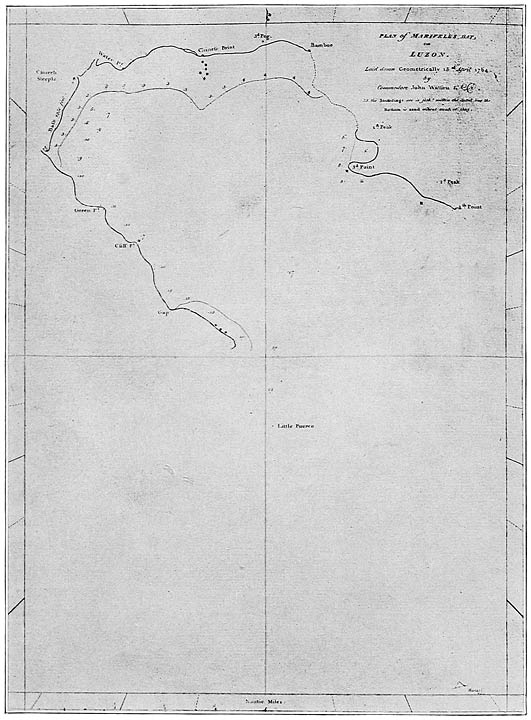
Plan of Mariveles Bay, 1764; in collection of Charts by Alexander Dalrymple ([London], 1781)
[From copy in Library of Congress]
9. The entrance of this squadron composed of thirteen ships, which formed in line and with wind or easter astern, entered and took possession of the bay, surprised our minds greatly. They stretched from the middle of the bay in a circle to the point called Sangley. The confusion of Manila and its environs with so unlooked-for a squadron, in an unprepared place can not be imagined. The people ran through the streets. Those of the suburbs came into the city, those of the city went outside, and there were some persons (as was learned afterward), who started immediately for the mountains and for Laguna. The archbishop could do no less than be surprised, and much more the chief inhabitants and auditors who surrounded him. But it was immediately resolved to write to the leader of the squadron, and that was done with courtesy, asking him his nationality and destination and granting him port and provisions according to his need and the custom of civilized nations.
10. In the meanwhile, one of the most pressing anxieties and one of danger was attended to, in regard to a large amount of powder, stored in what is called the powder works [polverista], where it is manufactured, and which is three-quarters of a legua from the city along the beach. But in the morning of the following day, a great portion of it remained to be brought, and the archbishop found it necessary to go a-horseback accompanied by his Majesty’s fiscal and several others. At twelve o’clock, this task was really finished, in which there was necessarily a great waste of this material. When they reëntered, some of the ships were almost within cannon-shot, and were threatening in that direction, which is toward the south, with respect to the city.
11. The reply of the generals was, with their letter or challenge, arrogant, and to the effect that Manila and its forts should be surrendered to the king of Gran Bretaña, from whose power the most remote possessions of the Catholic king were not free, whose court, through its evil conduct, had proclaimed war against Ynglaterra. If the Spaniards of Manila were not infatuated, they would surrender, in order not to experience the severity of their powerful arms.
13. On the night of that day, the enemy began to disembark toward the south. The Indians of the said places of the environs were not able to resist the fire from their boats and ships. The people in those places got under shelter of two regular companies who were obliged to retire. The enemy found all they could need for their rearguard and trenches in the strong edifices of the churches of Malate and of Nuestra Señora de Guia, whence without loss of time, and with ease they surrounded and took possession of the equally strong churches of San Tiago and San Juan de Bagumbayan, whence it became necessary for our men to retire. And although our men made three sallies, the enemy were only driven out for a little time from the last place. In the last sally, especially, their attack was arranged in three different parts in order to kill some people, but with greater mortality on our part, and through the inequality of arms and discipline, ours yielded ground notwithstanding that the native troops who had come in from the neighboring provinces, were now very numerous.
17. Before this misfortune befell that of the capture of the galley which had been despatched by the commander of the “Philipino,” with notice of its return from Acapulco and that it had put back to the village of Palapa. Two days after the siege began, namely, on the twenty-fourth of September, the galley entered the bay and came within sight of the squadron (of which it had no news). A fragata gave it chase and several barcas, it having been beached already toward the north in Bancusay. Although some of those who came in it were able to escape by swimming, its officers and the above-mentioned Don Antonio Sierra Tagle were captured. The enemy took possession of everything in the galley, and of many letters from which they gathered information of the “Philipino” and of the place where the latter lay. Two days later they sent a fragata and a ship in order to capture it; for the day before they had been joined by a ship and two fragatas which had become separated, or could not follow the squadron.
18. From some quite damp letters, among them that of the commander of the “Philipino,” which had been carried by those who escaped by swimming, the archbishop learned (and it was the first news) that the “Philipino” was in Palapa; that it had been unable to enter by way of the Embocadero because of stormy weather; and that on leaving Acapulco, by a letter of the viceroy to the commander, the latter had learned of the breaking out of war with Ynglaterra, and he was advised to have a care. Consequently, he must have come with that information; but said commander knew nothing of what was happening in Manila. In view of all things, and with the unanimous opinion of auditors and principal citizens, a letter was written to the commander, giving him an order to fortify himself in Palapa, and to land the silver and chests. Fortifying himself as well as possible in said port, which is very difficult to get at, and only very experienced persons know its entrances, which with but slight work can be made impassable, the said commander was to hold his ship in readiness for sinking by burning, if the ships of the enemy met it. This letter was sent with all care, by a person very skilful in the coasts of the Embocadero, so that it reached Palapa in a very few days. It had been duplicated as a precaution to what might happen to it at its first sending.
21. Other operations during the time of the siege which looked to the care and watch of the city, the archbishop practiced vigilantly. For he visited the walls personally, even at night, and some of the bastions, namely that of the foundry and that of the fort. He went out daily on horseback. Accompanied by various persons he examined the gates and outside walls, the small fort, and the house of San Fernando, where, as well as through all Bancuray and Tondo, the natives who descended from the provinces lodged. Regulations were made there for them, and they were aided with provisions. The arms that it was possible to give were furnished them, and they were drilled in some manner. In short the archbishop omitted nothing in order that he might go to give the orders which appeared advisable, and personally, at the sites where his presence seemed necessary or advisable.
22. The archbishop having retired, then, as above-mentioned, into the royal fort of San Tiago, the articles of capitulation were begun to be drawn up there. They were concluded after great labor, and received the unanimous consent of the auditors and other military men and citizens who were present. The enemy already having taken possession of the city, extended their troops in two columns toward the said fort, along the walls, and other companies in front protected by the royal chapel. As a white flag was immediately flung in the fort, there was no hostility directed toward the small citadel. Two officers entered with a message from their general, demanding surrender. But within a short time the colonel of those troops appeared, and demanded an instant surrender, or one would be forced by arms. The archbishop gave him the articles of capitulation with a message to his general. He refused to receive them, and there were no means or manner to get him to receive them and take them to his general. Consequently, they had to abide by what the colonel tenaciously answered, namely, that the general’s order was the one which he had already expressed, and that it was now no time to tire themselves out in demands and replies concerning the surrender.
23. At this pass, and in view of what was already passing in the presence of the archbishop in said fort, as the soldiers were throwing themselves from its esplanade and from the walls, and casting themselves into the river, and as some officers and regular troops there, who never surpassed eighty in number were also in part doing the same as the other soldiers, with not a few of the citizens; and as the said fort was in itself indefensible, and the principal curtain which looked on the city, and in front of which was the enemy, was threatening to fall into ruins; the archbishop found no other expedient in this conflict than to offer the colonel to accompany him to treat with his general in regard to the fort and surrender under his word of honor of the exemption from harm and safety of his person. He condescended to that without any of the bystanders, or auditors who surrounded him offering to take that matter upon themselves, or even to accompany him, except the master-of-camp and another officer. With them and the said colonel, he went to the royal palace where the general had already taken up his quarters.
24. After the salutation and the respective courtesies, in which General Draper was profuse (and he showed special veneration to the archbishop), the latter handed him the articles of capitulation that had been drawn up, and which treated of the surrender of the fort. The general answered that Admiral Cornish, whom he was awaiting from his ship, must also be consulted. But after a long time with incessant interruptions because of the continual coming of the general’s officers to get his orders, and of many of ours who presented themselves to him, the general said that since Cornish was giving time, the archbishop should give the order for the surrender, and that that would be best, because he knew the harshness of the nature of said admiral. Answer was made that the order would be given under all the military honors which were fitting. All these conferences passed by means of two interpreters—one in the English language, and the other in the French with a mixture of Latin in which the archbishop talked and which the general understood, although they both pronounced it in accordance with their native languages. Consequently, it was difficult for them to understand one another. Nevertheless, the archbishop comprehended, and not confusedly, that the general agreed to the condition proposed, and the archbishop gave the order for the surrender of the fort. The latter did not properly merit this name because of its weakness, and the dislodging already mentioned, by which it could have no defense, but manifest danger of life to those who remained there, and even of those who remained in the city.
26. The afternoon of the same day, both chiefs, Draper and Cornish, sent the archbishop the conditions under which the city would be free from the sack, the life of the citizens, and their possessions, commerce, and religion, saved, namely, by the surrender of Cavite, and the payment of four million pesos, two million to be paid at once. In this manner, they would consider the articles of the capitulation that had been signed by the archbishop, auditors, and city. Those articles were sent shortly after on the same day by the generals, approved with some restrictions as may be seen by all in their originals and in the testimonies placed in the collection of papers.
28. In such a predicament, in which the archbishop conceived all without any exception to be defendants and thrown into consternation, he found no other means than to agree to the above-mentioned proposition, which put in writing and signed by the chief persons, was taken by two commissaries to the generals, and also the order for the surrender of Cavite, stating that no move toward resistance would be made, and taking the precaution of sending a suitable officer for that purpose. The generals answered the commissaries that, if what they said was contained in the paper, they would allow them to ascertain that through their interpreter; and that since two of their ships had gone in search of the “Philipino,” if they had already captured it, they [i.e., the Spaniards] ought not to reckon on it in the payment, of which they could make use if it were not already captured. In accordance with this, a letter was to be written to the commander of the “Philipino;” and the abovesaid notice was to be executed ordering him to come from Palapa to this [city? MS. worn]. This letter agreed to by all the council and signed by the archbishop was shown to the generals and was despatched to [that commander?] by two of the chief inhabitants, who sent it safely; though as yet we are ignorant of its receipt, and it has been rumored that it has been intercepted on the way, and that even a contrary order has been given without us knowing by whom.
29. The sum found in the pious funds, chaplaincies, etc., was really ascertained and delivered. There was some difference in it because of the small coins which had been clipped, and which were received by weight. To this sum was added the amount of the wrought silver of the churches (in which it appears that in some churches some of the silver was reserved). There was a measure enacted by the archbishop, in virtue of what was discussed in the general council and of present circumstances. The superiors and the administrators of said church, who were notified thereof, agreed, and they made the delivery without any answer or protest; for they saw well that, although the secular estate contributed with ¡ts interests in the “Philipino,” it would be impossible to get during those days a suitable distribution among the citizens (and as it seemed), the destruction of the sack had left them without money or anything of value, as they declared. Besides all their powers could never make enough and be sufficient for the whole or half of the contribution demanded. And the silver of the churches being in sight, it was the best stimulus and incentive of greed, robbery, and of violence, and with profanation of the altars and of the sacristy, as had already been begun to be experienced, not only from the English troops, but also from the natives themselves and the domestics, and the especially covetous Sangleys. Not only did these misfortunes disturb the heart of the archbishop, but also the gloomy consideration of the Moros, those ancient enemies, who annually raided the provinces, and of whom it was conjectured that, hearing of our fatality, they would feed themselves with more audacity on their robberies, sacrileges, and piracies, as, in fact, has been experienced even in a village near the mouth of Marivelez which is the mouth of this bay. Thence, after their accustomed molestations, they have taken one hundred captives of both sexes, and, from the island of Marinduque, they have taken one hundred persons and the Jesuit missionary of that island.
30. It befell that in order to obviate so many inconveniences, they did not hesitate in taking from the altars the silver for the redemption and relief, which was the least danger to the faithful Catholics. By this arrangement, the payment of his Majesty was reduced, from whose royal magnificence has originated the rich adornment of the churches. But the sacred vases which belong immediately to divine worship were always reserved, as were also the chalices, cups, and monstrances. In these circumstances, the archbishop voluntarily delivered all his valuables and vases without reserving his pectoral or anything else, in order to aid so far as he was concerned in the ransom of the city, and in order that he might serve as an example, so that his [MS. worn] might not excuse himself from contributing voluntarily whatever was possible. And as it was not proper that, in these public calamities, and of the despoliation of his own spouse, the cathedral church, he should remain with adornment and should not be deprived of everything; and although his said possessions were not of any considerable importance, he had the consolation of not reserving anything and of giving them up with good will. Of money in cash he gave none, for he had none, nor, since he has been in these islands, has he had any left from his pay and stipends, for he has spent them all in the support of his household, on the poor, and for the relief of many necessities, always grieving at not helping them all, because excessive sums would have been required (as those necessities were many and grave). For this same reason, by order of the [English] commissary of artillery, the bells were taken down (as spoils that belonged to them) from the churches of the city and its environs. The archbishop, grieving over the loss of his charge, set his mind on ransoming the bells of the cathedral and royal chapel, but since he had not come to these islands with wealth to execute it, he gave an order against his agent in Cadiz, ordering him to pay the sum of five thousand pesos for which they were redeemed, notwithstanding that a very small sum remained in the possession of the said agent to comply with the order. But the great confidence which assists him in the above-mentioned animated the archbishop.
31. Advised of the scattering of the Spaniards since the day of the assault, and that they were going to the villages and mountain, where they were in danger from the barbarians and the revolted natives (as was experienced in many disasters, thefts, and murders), and their families in other directions not any more secure, and others in the city and its precincts, an order was issued for all to assemble and come to live in the city with those who were there. That order had little effect, for each one followed his own opinion and will, and began to lose his obedience to his superior. This was aided not a little by the example of those who by their employ and dignity ought to have given a better example.
32. Better fruit was obtained in ecclesiastical matters (although that not sufficient and advisable), for the prebendaries and some of the secular clergy continued to assemble at the cathedral, and in the convents of the regulars some religious remained. They were requested and charged not to abandon their churches, and to endeavor to have a suitable number of subjects for the continuance of divine worship, and to be the relief and consolation of the faithful, and that they might be able to attend to their necessities in the administration of the sacraments.
36. It appears that, on account of the said causes, and (as is known) from other apprehensions or imaginations, the British leaders proscribed the above-named auditor, and it was added that they had offered a reward for his person. The auditors learning this, went to the archbishop with this notice, and great fright; and for the time being there were no means by which to assure their lives. But within a short time a hasty message from the general to the archbishop, ordering him to cause that auditor to appear, together with the alcalde-mayor of Bulacan and other nearby alcaldes in order that, on the twenty-fifth day of October, they might, together with the city and the military men, take the oath of allegiance to his Britannic Majesty, and give their word of honor not to take arms against his nation during the war, and until the kings should agree or decide the fate of these islands. The archbishop replied to this message that he was unable to cause the appearance of Auditor Anda, since they had proscribed him, which was equivalent to handing him over to death; and that so long as Anda was not secure of his life he could not make him appear. In regard to the alcalde of Bulacan and the others, he could as little cause them to come, because in the lack of any one to govern and restrain the natives, their disturbance and revolt would increase all the more.
37. In order that he might inform the auditors of this event, the archbishop had them summoned, and with them, namely, the fiscal and the senior auditor, he began to discuss what they ought to do in regard to Auditor Anda. While they were conferring thus, Auditor Galban came with the marquis of Monte Castro, who were with General Draper at the time when my above-mentioned reply or message was given to him. He sent them so that they might discuss and talk over this point with the archbishop. They told him that he could rest assured of the life of Anda, and the general answered the same through his envoy. The conference lasted for more than three hours, with various commotions, without the auditors caring to express their opinion, giving as an excuse that the said general had told those above-mentioned that they were all prisoners of war, with the exception of the archbishop. On the night of said day, said ministers presented to the archbishop a writing, leaving in his hands and judgment as the one to whom the matter pertained, the appearance of said Anda.
38. But in order to meet this matter better, he had some of the foremost military officers invited, to whom he told all that had passed. They were of the opinion that he should cause the said Anda to retire, under security of his life, for he was incurring a great danger, and exposing the lives of many with his disturbances; and to shut off the provisions carries the same risk. [They were all of this opinion] except one military man, who asserted that if Bulacan was a separate province and had a fort or bastion, Anda ought not to be summoned, for then he could defend himself. But said province is very near Manila, being separated therefrom by only a distance of three or four hours, and it never had a bastion or fortress except that which very lately was constructed by order of the said Anda, and which the English demolished as will be told later.
39. In accordance with this opinion, the archbishop asked the general for assurance of the life of the abovesaid, in writing, and it was sent to him in the English language. The archbishop had it translated into our language, and kept in his possession the original paper. The above-mentioned copy was enclosed to him, and at the bottom of it the archbishop assured him that it was a faithful copy, and that he had had it copied into our language in order that Anda might understand it. He gave Anda strict orders to appear, but the latter replied discourteously with several absurdities, which the archbishop answered by noting his rudeness, and stating that he should have been addressed with the title of governor, and of Anda’s disrespect in judging him [i.e., the archbishop] to be the secretary of the British. The archbishop also showed Anda other errors which he suffered, and sent him the original paper of safety, so that he might make use of it in the way that he pleased, and said that he would make a charge before God and the king of his excesses.
42. All these injuries and many others, which are the necessary sequel of them, the archbishop thought over from that beginning, [which had been] without any fruit or advantage to our side, but, indeed, had, on the contrary, the pernicious effects that experience has proved, and which had already commenced to show themselves. Consequently, he found it necessary to write to Anda again, mitigating with the greatest mildness the ardor of his preceding letter, in order that Anda might consider these calamities, and change direction, increasing and arranging the terms of his commission as visitor of the land and lieutenant of the captain-general. But there was no other answer to this letter except notice of its receipt written on its envelope.
43. A like effect was obtained by the order that he gave in his letter to the treasurer, ordering him to transfer to the city the money in his care, in order that it might escape the theft which many evil natives had attempted. They would have succeeded in one of their most vigorous attacks, had not this disturbance been calmed by the alcalde of Pagsanjan, the marquises of Villamediana and Monte Castro being present. The latter were abused by three Franciscan religious, who, armed, captained the Indians in order to get possession of the treasury. In order to avoid this danger and the loss of this money, the archbishop had conferred with the generals, saying that he would hand it over to them on condition that it be reckoned as a part of the millions demanded, and that they supply him with the pay for the ministers, officers, troops, and others whose support depended on his Majesty. The relief of the community would also follow the exhibition of this treasury, and would lessen the payment of his Majesty. Nothing sufficed to make the treasurer Echauz obey. He went to Pampanga with the treasury, which he placed at the disposition of Auditor Anda, who began to use it recently for the expenses which he believed advisable or necessary, according to his projects.
44. To the question of the British, which was urgently put to him, in regard to the royal treasury and possessions, the archbishop responded briefly and truly, showing them that the king, his master, had no temporal interest in these islands, but only that strictly of the souls of his vassals, and the causing them to live as civilized beings and Christians, according to the Catholic law for their salvation; and that in order to maintain them with his ecclesiastical and secular ministers, he spent the tributes which were collected with so great right, and the two departments only of buyo and wine. In this regard he distributed very large sums annually from the treasury of Mexico. In no other manner could these islands subsist.
45. The city, orders, and Spaniards having been summoned to the royal palace, in order to express their loyalty and not to take arms against his Britannic Majesty, before his generals, an act in which their loyalty and love to his Catholic Majesty, their legitimate king, shone forth brightly, through the unwillingness, sadness, and repugnance, with which it was celebrated. Slightly before as well and separately was given the word of honor not to take arms during the war or until another arrangement was made by the sovereigns (in a certain Latin form, and which necessarily contained nothing of vassalage to his Britannic Majesty), by the archbishop, auditors, and royal officials present. The polite representation of the archbishop to the generals in the said house where they were lodging, namely, the archiepiscopal, enabled them [i.e., the above officials] to gain exemption from mixing with the others, or in their formula [of loyalty or allegiance to the British sovereign].
46. Thence, at their instance, they [i.e., the cabildo, religious, and Spaniards] were conducted to the royal palace, and in the presence of so numerous a gathering, a paper was read, in which the archbishop was reproved as one who robbed from the churches, the sum to which their silver amounted, and that of the pious funds already delivered and received; and that in regard to this, that silver would soon complete a million. And now he was about to surrender the forces and islands dependent on Manila. By that paper the heart of the archbishop was wounded as if by a double-edged sword. On two points he was unable to restrain his wrath, and he uttered in the presence of the two generals the words that his zeal dictated to him, namely, that the instance and threat of the victors had been necessary for the withdrawal of the abovesaid silver, and there were no other resources near at hand. He does not rob, who makes use, in extreme need, of the most sacred thing, which is destined in such cases most suitably to the living temples of God, namely, His faithful. But he cannot clear himself from this sacrilegious crime, who causes it by violence, and who willingly and eagerly receives its effects, and whatever is left over and above them. In regard to the second point, that meant to attempt another act of violence quite contrary to the day and to the act which was being celebrated on it to the honor and memory of the birthday of his Britannic Majesty, whose protection he implored, so that such a matter might not be discussed on such a day. And the archbishop insisted that he would sacrifice his life for his faithfulness to his king, and for his honor, which would be vindicated by his Catholic Majesty, his sovereign.
47. With this expression of anger, the archbishop retired to his room, where the above-mentioned paper was sent him. In order to deliberate on its contents, he had a general council summoned for next day, October 26, consisting of the ministers, the chief military men, and the city and ecclesiastical [cabildos]. In a few words the archbishop explained to the council the arguments pro and con regarding the cession of the islands. Since he gave all his attention and time to this, he ordered a council of those interested to discuss, with the assistance of the fiscal, and under the presidency of the senior auditor, the matter of the completion of the million. The result of that discussion will be stated later.
48. But in regard to the point of the islands, which was discussed in general council, the regulars excused themselves from voting, by saying that their rules forbade them to vote on war questions, and that they feared to act irregularly. The archbishop was unable to overlook this pretext, and told them that they had voted in like assemblies at the time of the siege, and had permitted or given license to their subjects to take all kinds of arms, to patrol the walls, and to guard the posts which were entrusted to them; and had sent the Indians from their villages to take part in the conflict. They had not done otherwise in their missions exposed to the dangers of the Moros, than to manufacture and buy all sorts of arms, and importune the superior government to supply arms to them, and afterward to handle them and make use of them in defense of their parishioners, and to fight the enemies of the faith and religion. At present it was not necessary to take these arms or to make use of them, but it was necessary to declare what was advisable in regard to conceding or denying the submission of the provinces in which religion and the instruction of their neophytes were at stake. But nothing was sufficient to get them to give their vote, that which the archbishop had alleged causing them great irritation. As their obstinacy angered the archbishop still more, he did not have them summoned to the second council.
49. In the voting of that council of the twenty-sixth, it happened that the engineer, by whom the voting commenced, refused strongly to pass any opinion, saying that he was prevented from doing so, as he was a prisoner of war. This murmur spread among the other military men present, and they added that the license of the generals was necessary in order that this council might be held. Consequently, it was necessary for the archbishop to explain these matters, by telling them that this was not a clandestine council, but one called openly and in plain sight and with the knowledge and suffrance of the generals. In it they were not discussing the taking of arms by the prisoners for the defense of the provinces, but whether the islands were to be yielded under present circumstances by the archbishop-governor. Thereupon, the voting went on with varying results. When it came to the fiscal’s vote, he again was obstinate on the points prisoners of war and the license of the generals for the council, and he said that he would accordingly take his position on the principle of it. The archbishop answered what he had said in regard to the said points, and that this was to place in doubt what he had signed. Thereupon, there was great altercation, anger, and notable incivility, with visible signs of the agony which the archbishop was suffering from this blow. But the altercation having subsided, and all of them having quieted down, the fiscal and other ministers declared their vote. Since it was now very late and the vote was not cleared up, and since it could not be well enough discerned at that time, it was ordered that the same council be convoked on the following day, with the exception of the regulars.
50. In fact, on the following day, October 27, another council was held in the afternoon. At it the archbishop had the Latin letter read which he had received on the morning of that day from General Draper, with the date of the twenty-eighth (which corresponds to the twenty-seventh of our reckoning and calendar). The vote was put, and some who had given their vote in the negative on the preceding day, namely, not to surrender the islands, retracted, and voted affirmatively. The ministers and some others expressed their opinion and gave it in writing. The vote was equally cast with but a little difference of one or two votes. The archbishop asserted that he would decide without delay what appeared most advisable to him, commending, as he had done, so grave a matter to our Lord, so that He might inspire him as to what was for His best service and that of His as well as our Catholic king. Before dissolving this council, an envoy came from General Draper with another letter bearing date of the twenty-eighth (which corresponds in our calendar to the twenty-seventh) written in the English language. It was read there by an interpreter. It was reduced to saying that, with only the cession of a few places of little importance, he would save (he gave to understand with whom he spoke, namely the archbishop) the lives of a multitude; that he was sure that his Catholic Majesty would consider himself as well served; and that those who were endeavoring to persuade the archbishop not to yield, if they did not promptly change their opinion, would answer with their lives, and that the auditors were to affix their signatures.
51. All those present having heard the context of the above-mentioned letter, without any more being added or mentioned than what was declared in the above-mentioned council, it was dissolved, and the thorn (which was very sharp) remained in the heart of the archbishop in deliberating on so serious a point. In that deliberation the least thing involved was the danger to his own life, of which he was tired and of which he almost desired the end. But that is always placed in the hands of divine Providence who directs everything positively or permissively for His greater service and glory. Not only did he consider the extermination of the city and the lives of many with which he was threatened, but also (and which was very easy), the uneasiness of the villages and missions of the provinces, in great part ruined and destroyed by their old-time enemies, the Moros, who with a little stimulus and encouragement from their new enemies would assault them on all sides and would finish with their mission ministers and justices. It was greatly to be feared that if the natives were offered exemption from tribute, and subjection, they would be the instruments of these disasters.
53. He summoned the auditors in order to show this letter to them, but they did not come as they were busy, answering that they would come if the matter were urgent. But the instances of the general of the day before having been repeated for the reply, it was sent to him in said letter between seven and eight in the morning of the said day, the twenty-ninth. But after eleven o’clock on the same day, the general sent his letter of the thirtieth of the same month (which corresponds to our date of the twenty-ninth) with the message for me not to bother myself, that that letter was to be signed by myself and the auditors, to whom he sent word that if they did not do it, he would have them immediately thrown into a galley. Instantly upon receiving this message they immediately appeared, and signed the letter together with the archbishop, both the original letter in English and its translation into Spanish. It was sent to the said general, and said auditors only gave notice that they had made their protest before the notary, and that it should not be written at the foot of said letter, in order that the general might not happen to see it, if he asked for said original letter. With such fear did they proceed, but the archbishop showed them the copy of his letter above-mentioned, in which is manifest his protest with the declaration of repeating it a thousand times.
55. Also false is the end of this report, which asserts, not indeed that it is presumed, but that it is presumed if not proved, that the archbishop tried to shield himself. Without this protection or shelter, he made the cession in his letter of the said twenty-ninth day, as is said above, with the signature of the auditors, which they placed in the letter of Draper on the thirtieth (in our calendar, the twenty-ninth), which in view of and after the receipt of that of the archbishop, the said general sent on that same twenty-ninth day, with the threatening message that he would send them to the galleys. Only the constancy of the archbishop can be well inferred. In his protest he asserts and [MS. worn] to the general in consideration of his threat of the extermination of the city the lives of many, which did not move the animosity of the auditors for their signature until they received the personal threat of their own imprisonment.
61. Its cargo consisted of one thousand one hundred and forty-eight piezas, but all that was sent outside of the hold, consisting of boxes of presents, valuables and things of value, he had placed at auction, without taking the formality to summon those interested or making any note of what was taken possession of and seized. Some of the boxes of letters which were filled with water, and which were seized by them, they opened and took cognizance of their contents. The archbishop was unable to get the return of these letters and official papers, which he demanded repeatedly. For it was well to burn the private letters, which the enemy themselves declared to be false and entangling, as they themselves noted. But no one was ignorant of the many accounts and fabulous stories which were written by several persons. The archbishop was also unable to obtain some canes which he was sending—one for the king, and the other for the prince. Their distinction was that they were made of fine bamboos of these islands, and the handles were engraved skilfully with the royal arms by noble natives of the islands. Neither did [he obtain] the valuables left by Mariscal Arandia as a legacy to our sovereigns.
62. As the whole business or object of the English was the treasure of the “Philipino” they sent two more fragatas to look for it, and in them went persons authorized by this community. Inasmuch as four citizens had been made prisoners or detained in houses of this city, as well as Auditor Don Francisco Villacorta and the fiscal, Don Francisco Viana, one cannot imagine the efforts of the archbishop, personally and in writing with the generals and the British government for the release of the above-mentioned, especially the ministers. After some days and petitions, he was able to succeed on condition that four men should be chosen to make the abovesaid efforts. In fact they were chosen by the citizens and sailed in said fragatas, although they were unable to make the port of Palapa because of very violent storms which putting them in danger of shipwreck made it necessary for them to put back to Manila after ninety days.
64. In this manner everything remained quiet. It was no time or season for answer or reply, especially with the admiral who was so strong and hard in his resolution. No other expedient was found with which to meet the conflict than the above-mentioned order. Neither could he avoid in the nearness of his embarkation the new sack of the church and convent of St. Augustine (with the exception of the reliquaries which the archbishop, feigning ignorance, had caused to be kept in the cathedral); nor that the admiral should not sack the houses of the marquis of Monte Castro and of Don Andres Blanco—the first because he had failed in his word of honor, and the second because he had not taken part in the contribution—in which were included various persons who lost their property.
65. The account of the sack which Cornish furnished to the archbishop is quite ridiculous and improbable as to the amount of twenty-nine thousand pesos at which he puts it, since by means of the investigations which the archbishop was able to carry on the sack amounts to more than eight hundred thousand pesos; and almost one-third of the inhabitants were absent so that it has been impossible to adjust their loss through the absence of many persons. However, it is a fact that the total amount must be lowered by what the Indians and house servants took in these robberies and destruction. But this adjustment could not be made at the time when Cornish threatened the new sack; for these investigations are being made at present, and as yet the last has not been heard from because of the absence of not a few inhabitants who have still to make their declaration. Neither would the irritation of Cornish, had these investigations even been finished, have considered our account and adjustment, both because of his impetuous nature, and because of the so vast discrepancy of his account to that above-mentioned. Consequently, it was only the time to yield and to enter into some kind of agreement by means of the above-mentioned order. This recourse was necessary and inevitable under the circumstances leaving it for the consideration of our king and his ministers who might take the advisable measures in view of what had happened.
70. This letter, of which a rare copy will be found in the histories, is handed in to the royal hand and most just comprehension of his Majesty under other covers. The same diligence is practiced in another letter of the fiscal with his diary and manifesto, all written in the same ink and formed almost with the same pen as the above-mentioned letter of the other minister. Both of them have not been ashamed of staining their pens with blood against the laws of decency, truth, justice, and charity, to the offense of God, of their oath of obedience to the laws of the Indias, and in contempt of the archiepiscopal dignity, and of the archbishop’s representation in these islands of the royal person of his Majesty. By their example they fermented the people, who have become scattered and corrupted with scandals, murmurings, disgust, and spite against their own prelate, pastor and father.
71. This impudence in the village, and almost universal among all classes of persons and estates, with the exception of some few of reason and judgment, is the fire that has deeply penetrated the feeling and pierced the heart of the archbishop. He maintained himself and still maintains himself firmly in the face of his enemies, in order that he might attend to the conflicts and needs of the said village and of our peoples, and not deprive the city and the many persons of both sexes who have found it impossible to leave it, of shelter; to attend, at the same time, to the protection of the churches as well as possible; and to see that the holy religion and divine worship are encouraged without commencing to grow weak in the capital. He has succeeded in doing this in the greater part through the divine Mercy; and to so great a degree have Church functions and all the ecclesiastical ministers succeeded for the welfare of the faithful, that edification and not a little wonder is caused by the fact that the faith and worship of our Lord Jesus Christ are seen to shine forth in the midst of so many hardships, conflicts, and necessities.
72. In this the royal favor and protection of the king, our sovereign, has the greatest and best share. The ecclesiastical cabildo and its ministers, the girls’ school of Santa Potenciana, the troops which were left, the invalid and sick officers in the hospital of San Juan de Dios, the archbishop and his household, and many others who are aided by the king’s pay, have been able to be maintained through his generous pity. With all this was concerned the provision which the archbishop enacted with the British governor in regard to the supply of the pay which he has administered without fail. In the regulation of them, the distribution has been made according to the circumstances of the persons and of the time, with the economy which has appeared advisable. Of the amount of these salaries, he has given and will give the orders against his Majesty’s treasury, on whom depends the subsistence of the above-mentioned vassals who have only lived and been able to support themselves with these aids of his Majesty, without having any other help so far as the human is concerned.
73. But in order that no thorn might be wanting to the archbishop to pierce him in regard to this same so favorable and equitable provision, since he assigned therein only half pay to the wearers of the toga (in consideration of the fact that if they moderated themselves under the present circumstances, it appeared sufficient, as they no longer respected his Majesty, reserving for the latter’s justification, the payment of the other half for an opportune time), they were very angry, and made an outcry against the archbishop in a most impudent letter, in which they retorted but without foundation and with a vicious comprehension, that the archbishop was applying to himself more than half pay, although he took only the half which belongs to him as governor, and nothing more, not even any stipend as archbishop. But said ministers requested, and it was given them in its entirety or as a reward until October five, without them having been willing in the future to accept the half pay which was assigned to them under the above-mentioned reasons; and although their right remained safe to them at all times, it would have demonstrated that they would have been insufficient had the archbishop changed his provision. But it was shown that one-half the pay was quite sufficient for a minister to maintain himself with moderation and economy, as was proved in the case of Don Pedro Calderon, who arrived at this capital with the captured ship “Trinidad,” and who requested that he be furnished with half pay under bond. It was conceded to him in this manner, and he supported himself, daughter, and household with it.
74. Notwithstanding so many contradictions, conflicts, accidents, and enemies, on all sides which have undermined the robust health of the archbishop, placing him in the extremity of dying, he has been experiencing the most special providence of the Most High. Not without astonishment do they see him with life and that he has been able to attend to the conflicts of all and to the continuous attacks which pressed on him constantly from all sides. There has not been any Spaniard or native, or people of these, or any religious, who have been in prison, or experienced hardship, or necessity, whom he has not helped or protected with the offices of charity, mediation, and petition with the English, from whom he has many times obtained either the protection or justice which has been fitting. Consequently, he has encountered the enemy for all this class of people, even with danger to the respect of his dignity and of his person. Individual mention of the cases and persons would be infinite; and much appears in his letters to the English on various matters. But the gratitude that has been his due is that of a people made peevish by the wicked leaven of the examples and inducements of persons, who by their rank and post, special honor, and greater obligation, and because of being singularly benefited by the archbishop, ought to be quite other, and, at least, without the abandon of the fear of God and Christian charity.
75. The inevitable situation in which the archbishop finds himself, because of being in front of the enemy and in their presence, in order to attend to the various grievous casualties which frequently occur would become more tolerable to him, if he did not experience from his own people and from the one who commands them, and from those whom they incite for the latter, that they have vomited forth their fury against his person. It seems incredible, but it is a fact, that the wrath and imprudent acts of the abovesaid who have soullessly trampled on his dignity have cost him more pangs than the presence of the enemy, who have respected him, although they have caused him great mortification.
76. From this fatal experience it comes, that the situado and wealth of the “Philipino” having been assured as abovesaid; and adding that in the same security, in which it is considered, it runs great danger from the very ones who are guarding it, and from other evildoers: the archbishop does not dare to ask for it for the help and pay of those who are supported in the city at the expense of his Majesty, but continues to ask and receive that help and pay from the British government, by which the royal treasury is doubly burdened. This treasure has as yet escaped the hand of the English, but it has fallen into so many that it is difficult for it to come into the hands of those interested; for besides its great danger, it is asserted that the expenses of its conduction, which is not finished as yet as far as Pampanga, exceed one hundred and twenty [pesos] to the thousand, while the pay which is distributed with free hand and other expenses are in excess of thirty thousand pesos per month, as the archbishop has been assured.
77. It is true that there would be no little difficulty in conducting these sums, which the archbishop asks, to the city, and that they would run many dangers; but the difficulty from which Auditor Anda would remove and free himself in its sending is greater and insuperable. This person, quite filled with wrath against the archbishop, by his apprehensions as mistaken as exorbitant, and by his scandalous productions, and who appears to be only trying to make his conduct and zeal for the royal service shine out by blackening that of the archbishop, refused to send the despatches of his Majesty, and those belonging to the archbishop himself, and which had been brought by the “Philipino,” although he was ordered to deliver those that belonged to all the tribunals, [religious] communities, and private persons. This refusal shows what would happen to any request for the silver. For if since this retention is opposed to the sovereign respect of his Majesty, by detaining the orders that he may direct to the archbishop in his royal decrees, Anda is trampling also upon the public faith, in what corresponds to the letters, business, commissions, pious funds, and matters of conscience which may be concerned in them, it being quite to the prejudice of the government of the archbishopric and to the public scorn and disrespect of its pastor.
78. Anda’s despatch also in regard to the royal seal made it necessary for the archbishop to take extreme precaution so that this royal jewel might not be endangered. This being in the power of the archbishop, had been conserved in his possession with so great secrecy without the least fear. But the said instance and procedure of said open despatch to the vice-chancellor, who was in the house of the archbishop, in his service, divulged the secret in Pampanga, and to not few persons of this city. Consequently, not without manifest danger could it be sent, or could it be preserved in the possession in which it had been, and besides to deliver these royal arms to Anda was to place them in a cruel hand for the abuse and atrocities which are experienced, and without it being possible in present affairs to have their authoritative use, for which they were destined by their sovereign owner.
79. The many persons who are fed with the silver have gone to Pampanga, among whom is a considerable number of military officers—some in order to get what belongs to them, and others for the consideration of larger pay, and all of them and all the other Spaniards incited and threatened by said auditor have been made to incur the inobservance of their oath and their word of honor. And from this irregularity and from others of which the cowardice of the fiscal and his inducements for the same purpose, furnished an example, have come other disorders and disasters of the enemy who have been irritated by these proceedings. Never did the archbishop dissuade or induce any to remain in the city or to leave it, although he well knew that it was impossible to divert some families and the religious communities, and much more those of the feminine sex; but all the fatal consequences that have been mentioned have aided to compress the spirit of the archbishop, who by the singular blessing of God has been able to live and remedy some of the fatalities.
80. He considered nothing more necessary than to petition for mail posts and opportunity to give account of everything to his Majesty, from whose Catholic zeal alone can one hope for the remedy, unless the divine Providence miraculously clears the way just as is asked from Him, without believing that it is to tempt God, through the most extreme necessities in most important matters, and of His divine service, which intervene and are contained in the present conflicts. And the efforts dictated by the archbishop’s prudence and obligation, such as giving a report to his king by two posts, doubling the despatches in the last, by which there comes to be a fourth post, must not be omitted.
The first was in December, when the engineer, Don Miguel Gomez, was sent, who was equipped as well as possible. The second was in March of the present year, by equipping two officers, Don Christoval Ròs, and Don Andres de la Torre; and at the same time in another English fragata with sufficient safety and prudent security. He duplicated the despatches in two English fragatas, addressed to his agent at Cadiz.
81. These are the most important occurrences during the time of the siege, and the period following it. Both the other occurrences previous to the siege, possess the truth that is noted; and these [succeeding it] are proved by the papers and their instruments which have been drawn up. Other verification and authentication was not ready at hand, as it was sent by the letters in the posts above-mentioned which have not gone so bare of certain necessary documents and are not of very small bulk.