Volume 49 — LETTERS FROM CORNISH TO CLEVLAND
Reading edition
Admiralty Office, April 19.
Having accomplished the imbarkation of everything designed for the expedition, with a dispatch much beyond my expectation, as we had from the whole time of my being there a violent surf to contend with, I sailed the 1st of August with the ships under mentioned, viz. Norfolk, Panther, America, Seaford, South-sea castle storeship, Admiral Stevens storeship, Osterly company’s ship, leaving the Falmouth, at the request of the president and council, to convoy the Essex India ship, who was not ready to sail, having the treasure to take on board for the China cargoes, and to bring to Manila such of the company’s servants as were to be put in possession of that government, if the expedition succeeded.
The 19th, I arrived at Malacca, and was disappointed in not finding Mr. Tiddeman there; who did not join till the 21st, having met with long calms. The difficulty of watering the squadron at this place made it the 27th before I could leave the road.
On the 2d of September, I arrived off Pulo Timean, and was joined by Capt. Grant in the Seahorse, whom I had detached, upon my first arrival at Madrass, to cruise between this island and the streights of Singapore, to stop any vessels he might suspect going to Manila.
On the 19th, I made the coast of Luconia; but was drove off again by a strong N. E. wind, which separated some of the squadron. The 22d, the gale broke up, and the wind shifting to the S. W. the 23d we recovered the land again. The next day [we] entered the bay of Manila, and, in the close of the evening, anchored off the fort of Cavite, with the whole squadron, except the South-sea castle and Admiral Stevens, the Falmouth and Essex having joined me off the coast. In the night I sent the masters to sound about the fortifications of Cavite; and, by their report, found that it might be attacked by ships.
From those considerations, I joined in opinion with the General to take advantage of circumstances so favorable for a descent, and land the troops with all dispatch, and endeavour to get possession of some posts near their works, which, if effected, would greatly facilitate the reduction of the city.
The next morning the General took an advanced post about 200 yards from the glacis; and there, under cover of a blind, intended his battery against the face of the south-west bastion. The number of troops being small, I landed a battalion of seamen, consisting of about 700 men, under the command of the Captn Collins, Pitchford, and George Ourry.
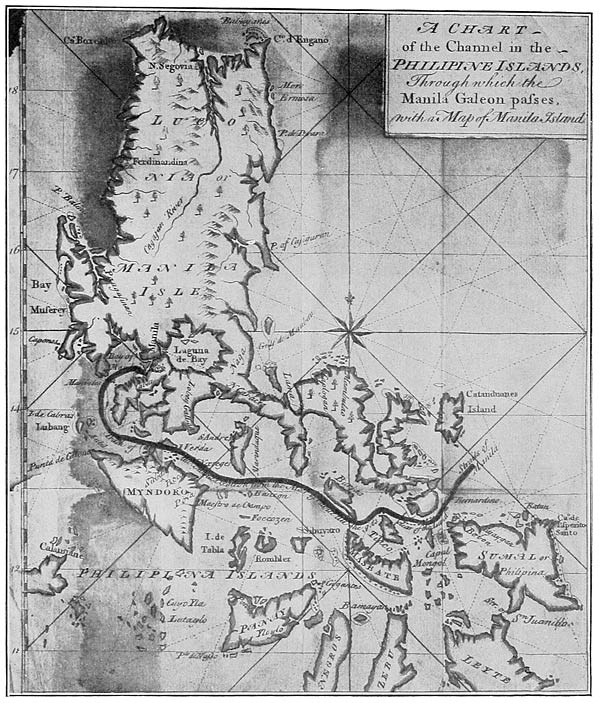
Chart of Philippines showing path of Manila galleon, from London Magazine (1763)
[From copy in Library of Congress]
The 28th of September the General acquainted me that he was beginning to work on the battery; and that if some ships could get near enough to throw shot on the works of the town opposed to it, it might take off some of the enemy’s fire and attention, and thereby facilitate its construction. In consequence of this, I ordered Com. Tiddeman, with the Elisabeth and Falmouth, towards the town, as near as the depth of water would permit, and to place the ships in such a position as would best answer the purpose intended; which was accordingly done the next day, and their fire had a very good effect.
On the 6th, at day-light in the morning, the General’s regiment, with the sea-battalion, mounted the breach, made the attack, and soon got possession of all the bastions, which completed the conquest. I immediately went on shore, and, with the General, had a meeting with the Spanish governor, and some of his principal officers; when a capitulation was agreed on, that the town and port of Cavite, with the islands and forts dependent on Manila, should be given up to his Brittanic Majesty, and that they should pay four millions of dollars for the preservation of the town and their effects, (a copy of which capitulation I have inclosed).
The siege, though short, was attended with many difficulties, and great fatigue, in which both the officers and men exerted themselves with the utmost chearfulness. We had constantly fresh gales, a lee shore, and consequently a high surf, to contend with, which made it always difficult, frequently hazardous, and sometimes impossible, to land with boats. The rains fell very heavy, and our little army were surrounded and harassed by numerous bodies of Indians, who, though undisciplined, and armed only with lances, bows and arrows, yet by a daring resolution, and contempt for death, they became not only troublesome, but formidable. I have the satisfaction of acquainting their Lordships, that throughout the whole expedition, the most perfect harmony and unanimity has subsisted between his Majesty’s land and sea forces.
You will receive with this, an account of the number of officers and men, both seamen and marines, that were landed from the squadron, as likewise of the killed and wounded in each corps. It is with concern I acquaint their Lordships with the loss of Commodore Tiddeman, who in attempting to enter the river in his barge, the morning after the reduction of Manila, was drowned with five of his people, by which unhappy accident his Majesty has lost a brave and experienced officer.
S. Cornish
[The list of which Admiral Cornish speaks is herewith given. This we take from the London Magazine (xxxii, p. 222), as only the totals landed, killed, and wounded are given in Scots Magazine.]
An Account of the Number of Seamen and Marines landed from his majesty’s Squadron under the Command of Rear Admiral Cornish; as also of the Number killed and wounded during the Attack of Manila.
Norfolk, Rear Admiral Cornish, Capt. Richard Kempenfelt. 2 commissioned officers, 12 petty ditto, 96 seamen, landed. 2 seamen killed. 1 ditto wounded. Marines. 2 commissioned officers, 9 non-commissioned ditto, 34 private, landed. 1 private killed.
Elizabeth, Commodore Tiddeman. Capt. Isaac Ourry. 1 commissioned officer, 2 petty ditto, 76 seamen, landed. 1 seaman killed. 5 ditto wounded. Marines. 2 commissioned officers, 3 non-commissioned ditto, 21 private, landed.
Grafton, Capt. Hyde-Parker. 1 commissioned officer, 3 petty ditto, 100 seamen, landed. 2 seamen wounded. Marines, 2 commissioned officers, 6 non-commissioned ditto, 32 private, landed. 1 private wounded.
Lenox, Capt. Robert Jocelyn. 1 commissioned officer, 5 petty ditto, 119 seamen, landed. 4 seamen killed. 2 ditto wounded. Marines. 3 commissioned officers, 4 non-commissioned ditto, 38 private, landed. 1 private wounded.
Falmouth, Capt. William Brereton. 1 commissioned officer, 2 petty ditto, 50 seamen, landed. 2 seamen killed. Marines. 2 commissioned officers, 1 non-commissioned ditto, 11 private, landed.
Weymouth, Capt. Richard Collins. 3 commissioned officers, 7 petty ditto, 80 seamen, landed. 1 seaman killed. 1 ditto wounded. Marines. 2 commissioned officers, 6 non-commissioned ditto, 26 private, landed. 2 private killed.
America, Capt. Samuel Pitchford, 2 commissioned officers, 2 petty ditto, 61 seamen, landed. 1 seaman, killed. 1 ditto wounded. Marines. 1 commissioned officer, 4 non-commissioned ditto, 22 private, landed. 1 private killed.
Panther, Capt. George Ourry, acting Captain. 1 commissioned officer, 2 petty ditto, 50 seamen, landed. Marines. 1 commissioned officer, 5 non-commissioned ditto, 24 private, landed.
Argo, Captain Richard King. Marines. 2 commissioned officers, 3 non-commissioned ditto, 22 private, landed.
Seahorse, Captain Charles Cathcart Grant. Marines. 1 commissioned officer, 2 non-commissioned ditto, 26 private, landed.
Seaford, Captain John Peighin. Marines. 1 commissioned officer, 2 non-commissioned ditto, 18 private, landed. 2 private killed.
Officers killed and wounded, &c. belonging to the
Norfolk, Lieut. Peter Porter, and Mr. White, surgeon’s second mate, killed.
Lenox, Thomas Spearing, second Lieut. of Marines, wounded.
Total officers, seamen, and marines: landed 1017. killed 17. wounded 17.
N. B. The surgeons, armourers, and other artificers, are not included in the above account.
Norfolk, off Cavite, October 31, 1762.
S. Cornish
Copy of a letter from Vice-Adm. Cornish, to Mr. Clevland, dated in the bay of Manila, the 10th of November, 1762.
In my letter of the 31st of October, I acquainted you of my having sent Capt. Parker, with the Panther and Argo, in quest of the galleon Saint Philipina, from Acapulco bound to Manila.
S. Cornish