Volume 49 — LETTER FROM ANDA TO CARLOS III
Reading edition
Sire:
I protest, Sire, that whatever I say in this my representation and advance in my treatise, is not for the purpose of injuring that venerable prelate whom I have ever regarded with the respect due the prince of the Church; and if I transgress in any way, and do not express myself with that moderation suitable, I protest that my words may not serve as an offense to his dignity, and that I have been actuated in this by only a real affection, with the desire that your Majesty may be informed of the acts of turbulence which have occurred in these domains, in order that you may better provide for the best government and relief of them.
I am unaware as to the motives of said prelate, that made him, although it had no bearing on the end, for which he despatched me from the fort, and so to the injury of your Majesty’s interests, when finding himself a prisoner of war with my associates, order me in a letter of October 10, 62, among other things: “to observe faithfully the treaties which were being arranged with the British chiefs in Manila.” Although I answered him from the province of Bulacan in the most courteous and fitting terms, this was not sufficient to restrain his pen, and on the twenty-sixth of the same month he wrote me pouring out instead of ink, blood and rage against my loyal procedure.
He ordered the marquis of Monte Castro to return to Manila; and Don Andres Blanco, who could not do so through his indisposition, to send his son, availing himself, in order to oblige them the more, of the expressions which may be seen in the letters of testimony which are worth your Majesty’s attention.
He wrote in terms apparently so Christian to the provincials of the Franciscan and Recollect orders, and recognizing himself as the greatest sinner, confesses that he alone is the cause of all these misfortunes and that God is punishing his flock for his sins.
Anyone would believe, in view of this so simple understanding of himself, and a so clear confession of his defects, that it was a true repentance and grief at seeing the miseries and havoc from which this city and its environs were suffering, in spiritual and temporal matters. But it is not so, Sire, for at the same time, he sends pastoral letters to said provincials, for the Indians of their provinces, in which, with the greatest simulated virtue, and pretending the greatest advantages to your royal rights, he persuades them to become subject to the English. For that purpose he sings a thousand praises of this nation but for the purpose of surprising the incautious simplicity of these silly Indians, for whom he had said letters translated into their languages in order that the poison which they held might work effects more favorable to his ideas.
Neither the threats of the enemy, nor the ostentation which this one made of his power, nor the alliance of the apostate Sangleys, declared in his favor and against your Majesty, nor the abandonment in which I remained because of the absence of the few Spaniards, who were in the provinces, nor the endurance of which I made use to dissimulate many things which I heard and saw among these poor miserable Indians for want of instruction, education, and communication with civilized people, nor the schisms and rebellion of some provinces: none of these things, Sire, was so keenly felt by me as the acts of the reverend archbishop, which were so irregular and far from the truth; of a prelate, who instead of furnishing an example, served as a stimulus to the traitors who leaning on the authority which is represented among such lofty subjects, were confident of the virtue and zeal of this prelate, only to become inflamed against me and avail themselves of his destructive ideas of this your state and religion.
It is left for the supreme intelligence of your Majesty to consider the great grief caused this royal Audiencia which was governing, to see an ecclesiastical prelate who had just been military and political head, who spared no means in order to sacrifice these your domains, which he ought to have conserved for so many reasons, or at least have maintained an indifferent attitude in the condition of prisoner.
What Catholic and loyal vassal of your Majesty could see without great grief a pastor persuading his sheep in said letters that they should submit to Gran Bretaña? Further on, he says: “If you do as I exhort and advise you, you will receive the reward from God, and for the contrary, the punishment; and if you observe, this, you will be good vassals of my king and my faithful children.”
In truth, Sire, such propositions in writing from an ecclesiastical prelate are of the greatest scandal for the community and very suspicious for the faith due to both Majesties.
What doctrine, what religion is this, in which one sees that a pastor, so repentant and full of grief for the troubles of his flock in the power of the heretical enemy, at the same time, with so efficacious and mild words induces those who are free to surrender to the same enemy! That is the same as to deliver them to the wolf so that that animal may tear them to pieces, and destroy them with the same hardships which he bewails in the others. To recognize a sin, to confess it with show of repentance and to commit a greater of the same kind: what doctrine, I repeat, is this?
A rare thing, the eagerness with which this reverend prelate undertook and prosecuted a matter so extraordinary and harmful! A good proof of this truth is what results from the above-cited letters written to the subjects abovesaid, and which are expressed in the said testimony which I enclose. The archbishop signs some as governor of Manila, although a prisoner; in others as governor and captain-general; and in others, he adds, “of these islands.” But if these islands had been already ceded to the enemy, and that surrender had been made, who could commit a greater incongruity than to call himself governor of what he had already lost, since he surrendered and ceded it to the English?
The letter which he writes to the Marquis of Monte Castro begins thus: “Yesterday afternoon, the present governor of Manila and his council imprisoned, etc., Manuel Antonio, archbishop-governor.” Consequently, at one and the same time we have three governors—the Englishman, recognized by the archbishop; the latter, for thus he signed; and myself, because your Majesty gave me that post by your laws.
The fact is that in the despatches sent by the English to the traitor Diego Silang to Ylocos, and in the edicts which they published, when they name the reverend archbishop, they say “ex-governor.” How could it be otherwise, as he was in the domains of the king of Ynglaterra, and was not the one appointed by the latter, and their governor would be opposed to your Majesty. That was the manner of procedure in regard to the title, until his burial. He performed judicial acts by means of the false secretary Monrroy and others in whatever he thought best, with the most special circumstance that he was always in favor of the English and opposed to the rights of your Majesty and your vassals.
And hence it is seen that although the English treated him with the greatest contempt, and confessed that I was acting as a loyal vassal of your Majesty, he would never relinquish the title of governor, or recognize in me your royal Audiencia, in accordance with the laws; and he died in the same conviction, as one may see by his last will, when he left to the governor, who should come from España, a carriage and its horses, so that he might make use of it, and ordered this cabildo to deliver to the same a sealed box, containing the papers, which were to be sent to your Majesty. Thus was it done without any mention of me, except to persecute me, as if I were not governor in your Majesty’s name.
Of this fact and others, my successor, Don Francisco Javier de la Torre, will give account. The latter brought to the royal assembly the measure in regard to your royal seal which was melted by order of the archbishop, who always refused to send it to your royal Audiencia. And although I petitioned it from him in my first letter of October 20, 62, and there followed in regard to it a measure on which I report separately in so far as it concerns me, the pretext that is inferred because of such a demonstration with this so estimable jewel of your Majesty is surprising; and it is surprising to say that he executed it because of its difficulty in the gates of the city and the risk which it ran of falling into the hands of the enemy. However, it is a fact that there was no danger at all. For when I petitioned it of him, I told him that he could deliver it to the person who carried my letter, a man in whom I had complete confidence. Besides he could have sent it safely by the religious whom the English used as their ambassadors to me, or by the adjutant whom the reverend archbishop himself sent to me to inform me of the suspension of hostilities. But since his intention was no other than to deprive this your image of whatever rights could represent it, legitimately and truly, on that account it was more difficult for him to send the royal seal of so little bulk than to me the withdrawal from the fort of the sum of more than one hundred thousand pesos of property which your Majesty needed for your troops, and which I placed in the royal storehouses of those provinces.
It appears that the disrespect committed toward so sacred a jewel in which your Majesty is immediately represented, cannot be greater, and it would surely have been treated with more honor if it had fallen into the hands of the enemy. This fact is sufficient to confirm the persecution that was declared, by which he aimed to erase your royal name from these domains. For in truth, what other impulse could he have had, when it is public and well known that the English meddled with nothing that concerned his palace after the sack? Above all he was immune and free from this for a long time after, and no one would deny that if he delivered it safely to the cabildo when melted, in the same way he could have delivered it entire.
By the letter written by the above-mentioned prelate, under date of October 30, 62, to Don Andres Blanco, your Majesty may see that he treats me as a rebel. The English condemned me as a rebel and disobedient to both Majesties on the fourth of November. It resulting from said sentence that I was condemned by both parties, it is proved conclusively that I was condemned by the reverend archbishop before I was condemned by the English, and that the archbishop concurred with them when they sentenced me. And it is a fact, and all Manila knew it and saw him present at the council of the English on the day on which they pronounced so unheard-of a sentence.
With these facts cited, and signed by the hand of the reverend archbishop, one can recognize clearly the faith that is merited by a letter which it appears that he wrote in regard to his actions and the protests of which I am told he made before dying. If all those who died were St. Pauls and the reverend archbishop had shown the actions of such an one and of a royal vassal of your Majesty, it is certain that his sayings and expressions ought to be of great appreciation. But since he was so opposed to the rights of your Majesty, to those of religion, and that which is least to my honor, it has been absolutely necessary to draw up this informatory process purely and nakedly made, so that after examining it, your Majesty may take the most advisable measures.
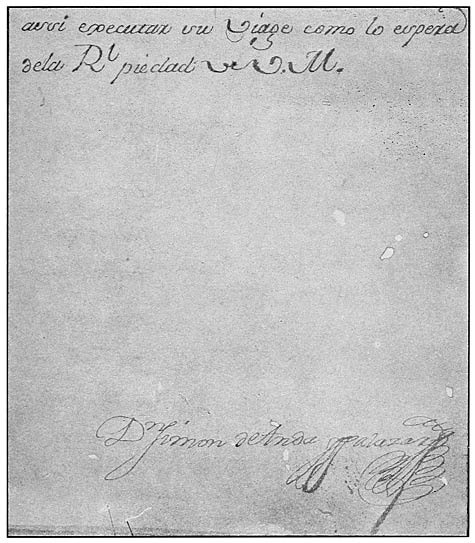
Signature of Simon de Anda y Salazar
[Photographic facsimile from original MS. in Archivo general de Indias, Sevilla]
Even if I had understood the law badly, and I had no right by it to be the governing Audiencia, it was sufficient to have hoisted your royal standard, so that every loyal vassal might follow it, and with greater reason, those of character, distinguished and honored by your Majesty.
I received a letter from the governor of Zamboanga, Don Ygnacio Andrade, which an English captain left him for the reverend archbishop, written in the port of San Jorge, June 7, 1762, and signed by Jorge Pigot, Governor of Madrast. By its expressions one can see the close and previous correspondence which the reverend archbishop had with the English. It must be noted that the said captain, Darrimple [i.e., Dalrymple] whom it cites later as having sounded all these islands, of which repeated advices were given to the reverend archbishop, came to cast anchor in this bay, in the year 61, without allowing aboard his vessel the guard which the fort sent to him. And instead of securing him, he showed him many courtesies. That captain dined at the palace, examined all the walls, its strength, the beach, even the powder factory, sounded the entire bay, and information having been given to the fort of this innovation, by a sentinel, yet he was allowed to go out freely when he pleased. For those special favors, the said governor of Madrás gives him [i.e., the archbishop] many thanks, and although it is not expressed in the letters, the head of the staff which he sends him. The said governor of Zamboanga sent it as a gift from the English to the reverend archbishop, who did not care to have his name mixed up in a matter so delicate.
Lastly, I add for the more complete conviction of your reverend archbishop, the fact that he refused to send the seal to this your royal Audiencia, which existed as long as it cared in the barrio of Santa Cruz; and that rice growers lived outside the walls of this city, where trade and commerce with the provinces was both free and continuous, and whence I got the one hundred thousand pesos of said effects, and most of the war supplies which were the greatest danger, but not the royal seal.
Don Simon de Anda y Salazar