Volume 49 — ROJO’S JOURNAL
Reading edition
Journal of what occurred at the attack and defense of the city of Manila, the capital of Philipinas islands, and of the archipelago of San Lazaro, from September 22 to October 5, 1762, the day on which it was taken by assault by Brigadier Guillermo Drapert, commander-in-chief of the British troops of the East Indias.
The city of Manila, according to the map of Father Murillo, is located in 14° 40′ of north latitude, and 158° 35′ east longitude, on a tongue of land which terminates in a point, and forming the figure of a jug or flagon, whose extremity or neck is formed by the above point itself and contains the royal fort of Santiago. At the west it is terminated by a large bay at the north by the Pasig River, which bathes its walls. On the land side from south to east, it is defended by four flat bastions with their casemates, and right flanks covered with orillons, and with ditches, covered way, and glacis. Along the sea, the city is fortified by a long curtain with five little flat bastions, a reduct located at a great distance from the wall. The lines of defense have such disproportion from one another, that those bastions cannot be defended reciprocally. It is impossible, further, to prevent the approach by the curtain, because there is neither ditch nor terreplein. Then too, the parapets are only one foot wide, and the curtain six.
The curtain embracing the north side, bathed by the river, and which has a kind of curvature where it forms two reëntrant angles, is in the same condition of weakness as that of the sea, and is defended by two small bastions, which present the same defect noted above in their lines of defense.
From the bastion of San Gabriel to the gate of the Parián on the east of the city, is located a false screen or barbacan with its parapet and banquette. It is defective, for it is fallen, and has no gate for the retreat of the soldiers. The gate of the Parián is covered and defended by a small outer work in the form of a crown, and the royal gate by a ravelin so poorly placed and so poorly ordered, that it cannot defend the faces of the collateral bastions of San Andrés and of the foundry. The flanks of the two latter bastions are not any more capable of defending the faces of the ravelin. It must be added to the above that all those fortifications are very old and defective: the walls; the chemise, or revetement, three feet thick at the cordon, without counterfort; the escarp and counter-escarp fallen in part; and almost everything useless.
The covered way is very short and filled with thickets and bushes. Its parapet is in ruins and it has no stockade or palisade. It is so low, that it leaves the most essential parts of the bastions and curtains open clear to the foot. The embrasures are poorly placed. The gates on the sea side, are pierced through, and so old and so used up, that they cannot offer any resistance at all. The esplanades of the boulevards are so irregular and so rough, that it is impossible to maneuver with the artillery, which, besides, was mounted on ship’s carriages so old that they could not be fired without danger of being dismounted.
The royal fort of Santiago is composed of two demi-bastions which dominate the city, and of a third one which points outward and prevents the approach of the enemy. It has two circular platforms, and several flanks intended for the same use. The curtains which unite these bastions have no terreplein, and the places from which to fire are distributed without any measure or proportion.
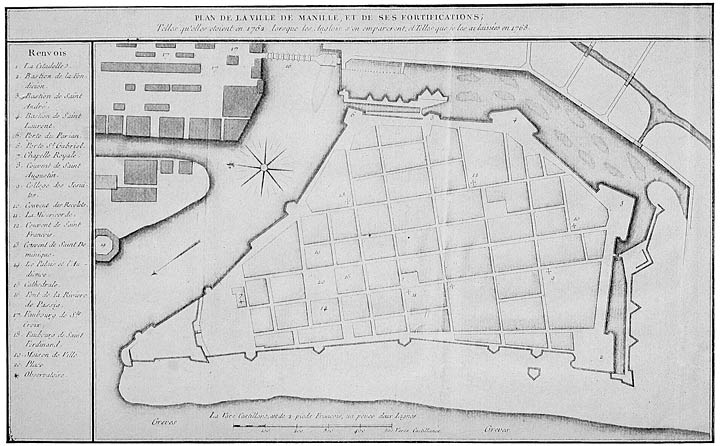
Plan of city of Manila and its fortifications, 1762, from Le Gentil’s Voyage (Paris, 1779–1781)
[From copy in library of Wisconsin Historical Society]
In this state of defense, on the twenty-second of September, 1762, at half-past five in the evening, a powerful fleet of thirteen vessels was seen. Although so unexpected a novelty caused the greatest surprise and the greatest astonishment, since there was no news in Manila of the war, and it was not supposed even that it had been declared, it was suspected nevertheless, that that was a hostile fleet. Consequently, his Excellency, Archbishop Roxo, governor and captain-general, gave on the spot the orders necessary and in accordance with the circumstances, to put the place in a state of defense, without forgetting to send to Cavite the help needed there.
At eight in the morning, some Indian and mestizo spearmen presented themselves before the enemy’s trenches, without that movement on their part having been preceded by any order. On approaching the advanced outposts who were occupying the sacristies of the church of San Juan de Bagumbayan, the bakery, and other neighboring houses, those Indians (although few in number), threw themselves on the enemy with such fury that they gained possession of the posts which have just been mentioned. They drove out the hostile musketeers, wounding and killing all that they met. But the English were promptly succored by a reënforcement of three hundred fusileers, who regained the posts that they had lost, and caused the Indians to retreat, to whom a signal was made from the bastion of San Andres to leave a clear field so that the fire of our artillery could have free play. The artillery did, by this means, great harm to the enemy.
During the whole of this day, the bombardment continued with fury, the enemy having increased their batteries of the church of Santiago by three mortars. After dinner an officer was despatched to the camp of the enemy to agree upon a truce, so that they could take away the body of their officer who had been killed. They did so, but many other dead bodies were left. On our side also, some who had been wounded were brought in.
On the morning of the twenty-eighth, a message was received from the English commander-in-chief, who urgently demanded the head of the English officer which the Indians had taken: as well as the author of that deed, with the threat that if it were not done, he would send the heads of all the prisoners whom they had in their power, and especially those of two officers, who had been made prisoners aboard the little galley. That demand was completely satisfied, and we were exculpated from a deed in which we had no part, and the blame for which was to be attributed to the lack of civilized customs among the Indians, and especially to the Sepoys, who, as has been said, did not cease to continue hostilities by their constant fire. Our captain-general (the archbishop), mounted on horseback, and went to see the hostile camp, in order to appease the trouble that that affair had aroused, and in fact it did not go farther.
The bombardment continued without cessation, and from half-past five in the evening until seven the flagship and another ship fired on the city, but with very slight result, for the balls which were fired horizontally were all buried on the shore, and those to which they gave a slight elevation, nearly all passed over the city, and were lost on the other side.
That same day, two mortars were fixed and placed in a battery on the rampart of the foundry, with which many bombs were thrown into the hostile camp and into the trenches.
October first, the Indians of Passay reported that a raft had made the shore, which was built of large masts, small masts, and yards that had belonged to the bomb-ketch; that this raft had on it the moorings, and artillery of the above bomb-ketch. They reported that they had seen many people drowned on the beach. Upon this report, the native cavalry was detached in order that they might seize those effects. But when they arrived at the place, they were repulsed by the enemy’s musketry, who had hastened from their general quarter of Malate and from the powder factory in order to protect the raft and its load.
At daybreak of the second, the enemy placed in operation a battery of eight twenty-four pounders against the flanked angle of the bastion of the foundry, and against the face which looked upon their camp. That battery was so well served, that at ten in the morning, all the parapet of that part was on the ground. At the same time, they directed their mortars (nine in number and of various calibers) toward the bastion itself. The flagship and another vessel bombarded the same bastion on the side looking seaward, with such fury that along the shore and beyond the walls on the landside, more than four thousand twenty-four pound balls were collected. But what molested us still more was the musketry of the enemy, which was placed in the tower and church of Santiago, which they had arranged for that purpose by opening in all the roofs several windows so that they dominated us. They saw also all that occurred in the city, and although the greatest efforts and the most powerful attempts were made to batter down the church with our artillery, we were unable to do it, or to dislodge the enemy from that post. But it is incredible that our bastion being open without a parapet on either side, it is incredible, I say, that of the various officers who sustained it, and of all the musketeers and artillerymen who were obliged to fire in barbet, there were killed only two artillerymen, two musketeers, and three pioneers, in spite of a desperate fire which all those men suffered from five different parts. It is true that more than twenty wounded and maimed were taken out, among whom was a lieutenant belonging to the artillery who lost his right arm. The greater part of the officers were wounded and bruised from blows with stones, and had contusions, but that did not prevent them from sticking to their posts. The vessels ceased their fire at orisons. That of the camp continued all night with the same activity, so that the artillery of our bastion having been dismounted, they were obliged to abandon that post, leaving there only a few sentinels without shelter.
That action did not at all interrupt the fire of the battery against the bastion of the foundry, so that when daybreak came, it could be seen that an eighteen-pounder cannon had fallen into the ditch, and it could not be recovered. The greater part of the face and the terreplein of the same bastion had also fallen, and their ruins had dried up the ditch. But what caused the greatest anxiety was that the engineer recognized that the enemy was busy making a new battery for the purpose of dismounting the artillery, the collateral flanks of the bastions San Andrés and San Eugenio, which flanked and defended the entrance to the covered way and the approach to the breach. In fact, that battery began to play at noon with so great activity, that it dismounted the cannons of the flanks in two hours time, overthrew the parapets, and killed some fusileers and pioneers. Twice were other parapets made with beams and bags of sand, but each time they were in ruins the moment after. Consequently, the men were obliged to retire from those bastions. The bastion of San Andrés did not suffer so much, for it was stronger. However, it had one cannon of the caliber of eighteen, which was placed in the elevated flank, dismounted. We had no other hope than in another cannon of equal caliber, of the two which were in this flank, for while we still had two cannons of the caliber of four in the low place, the latter could be of but little service.
Consequently, there was no means of getting the bearers of fascines to work. Finally, at six o’clock in the morning of the fifth, the enemy’s troops left their posts in three columns. The first directed its course toward the breach; the second toward the royal gate; and the third marched along the highway surrounding the covered way, toward the east and bordering on the plaza de armas.
The few soldiers left us occupied the gorge of the bastion of the foundry, the royal gate, the flank of the bastion of San Andrés, and the curtain joining them. The enemy were supported by their batteries and by the fusileers of the tower of Santiago, who poured in a steady fire. Consequently, it was impossible for ours to occupy the breach in order to defend the approach. The approaching columns discharged two rounds with their muskets, by which they swept the two collateral bastions, the curtain, and all the posts which could oppose them. Finally, all together, they mounted the breach, and seized the bastion of the foundry. At the same instant they attacked the royal gate, which they battered down with axes and iron levers.
After some slight opposition on our side, some officers who were there, not being able to defend those posts, the enemy fired from there on the other posts which they seized also following the cordon, and went to present themselves before the fort whither the governor and captain-general had retired.
In the doings of that day, the sargento-mayor of the royal regiment, two captains, two subalterns, about fifty soldiers of the regular troops, and thirty of the commerce militia were killed on our side, and many were wounded.
In the other doings, and especially in the last sortie, more than three hundred Indians were killed, and more than four hundred wounded.
The forces of the enemy consisted of fifteen hundred European soldiers, chosen from Drapert’s regiment, and from the battalion of the volunteers of Chamal; two artillery companies of sixty men apiece; three thousand European sailors, fusileers and well disciplined; eight hundred Sepoys, with muskets, forming two battalions, and fourteen hundred of the same troops destined for the fascines. That formed an army of six thousand eight hundred and thirty men.