Volume 48 / Part 2 — Part II
Reading edition
Of navigation and commerce: the method for establishing them in these islands, and their great benefits.
Chapter First: In which it is demonstrated, with examples, that no power can make itself respected in the world without navigation and commerce.
1. I do not presume to utter new things, but to arouse the minds of Spaniards to follow the examples of the other nations, to which end I have drawn from the works on history, both ancient and modern, what confirms this idea. [This chapter is interesting, but the limits of our space make it preferable to omit most of it, as having but slight connection with our main subject; the following sections are worth retaining.]
18. The French, who in the opinion of Cardinal Richelieu were totally unfitted for commerce, have made with it and navigation the most felicitous progress, especially since the reign of Louis Fourteenth.
19. Nor must I omit the height of glory and power to which the empire of the Muscovites has been raised since the reign of the great Czar Peter. That nation was ferocious, barbarous, and slothful, and had no intercourse with other and foreign nations. That glorious monarch formed the design of civilizing the vassals of his Russian empire, and of turning their inclinations toward political affairs, the sciences, the fine arts, and the great advantages which result from so praiseworthy occupations; but [even] his uncommon intellect found no other means [for this] than that of navigation and commerce. But he went incognito to Inglaterra and Holanda, under pretext of renewing certain treaties, but in reality with the idea of gaining instruction in those two sciences, which were his only aim. In this he actually succeeded, by dint of immense labor and mechanical occupations, which, if apparently they were unworthy of a prince, were afterward (as they still are) those which most enhanced his glory. Not to linger over what is well known, I conclude with what is to my purpose: that the great Czar Peter established commerce in his empire, overcoming insuperable difficulties; and from the year 1697 (which is the real date of that enterprise) to the present time so marvelous has been the progress of that empire that its forces by sea and land, its wealth and products, its manufactures, its vassals transformed from barbarians into civilized beings, learned men, and politicians, yield to [those of] no other power—all being due to commerce, which in the short time of sixty-seven years has wrought these apparently incredible prodigies.
21. Almost the same has happened to our España; what fear, what respect, what terror, did not our armadas inspire in the four quarters of the world? There was no power that could resist them; but, not to linger on the glories of our nation, I leave that to the histories which relate them—especially those of the reigns of the pious king Don Fernando, the Catholic monarchs, the emperor Don Carlos Fifth, Don Phelipe Second, and Don Phelipe Fourth, who certainly protected navigation and commerce. I will assert [here] only what answers my purpose: that our navy declined, our great manufactures in Sevilla, Segovia, and other places retrograded, and our commerce deteriorated, with the continual wars; and, as we did not repair this damage, we were at the same time promoting the commerce of the other nations. These have made themselves rich through our negligence and inactivity—selling to us all the more commodities the more we abandoned manufactures, and with their gains increasing their shipping the more that we gave up shipbuilding—until in these latest reigns our shipping and commerce were reëstablished. But it is necessary to extend our commerce further, in proportion to our vast domains; otherwise, we keep them greatly exposed [to danger]. For it has been now thoroughly proved that navigation and commerce have rendered formidable and terrible the forces and power of the nations who have practiced them, as also that from the decay or neglect of these activities has proceeded the ruin of kingdoms.
Chapter Second: Of the liberty of the Spaniards to navigate by way of the Cape of Good Hope
2. As the Dutch have always regarded these islands with suspicion, fearing some injury to their own commerce, they likewise have striven in every way to make amends for the damages which they fear. One of these is the extension of our commerce, because it diminishes their own; and, in order to hinder it, they have sometimes chosen to avail themselves of article 5 in the treaty of Westphalia in 1648, and of article 10 in that of Utrecht in 1714—in which is confirmed the said article 5, wherein it is provided that “the Spaniards shall retain their navigation to the Eastern Indias, in the same manner as they enjoy it at present, without being authorized to extend it further; as likewise the inhabitants of this Low Country [i.e., Netherlands] shall abstain from frequenting the places which the Castilians possess in the Eastern Indias.” From these expressions, and from the demarcation [made] by the supreme pontiff Alexander Sixth, the Dutch—who claim, by right of conquest, to enjoy the privileges and prerogatives of the Portuguese—try to argue that our ships have no right to navigate by way of the Cape of Good Hope, nor along the regions of Asia—the Coromandel Coast, Vengala, the Red Sea, etc.—intending that these Philipinas Islands shall be the limits of our navigation to the west.
3–8. [In section 3, it is shown that the demarcation of Alexander VI was made only to check possible disputes between the great Catholic nations of Spain and Portugal, and its provisions referred only to their discoveries of lands and isles, and not at all to the navigation of the sea, which no power can claim, “since it is not fitted for other dominion than that of God.” Section 4 shows that the Portuguese and Spaniards have frequented each other’s ports, without any difficulties arising between them over the navigation of those seas, which has not been and could not be forbidden to the Spaniards; and that even if the Portuguese had had any such exclusive right it could not pass over to the Dutch when they conquered the former nation in India, especially as privileges granted by the Holy See to its Catholic followers could not be claimed by Protestants. In section 5 it is asserted that the previously-cited article 5 of the treaty of Westphalia does not forbid navigation past the Cape of Good Hope, but only the entrance of Spaniards or Dutch into ports belonging to the other power; that navigation on the high seas is, “by natural right, free to all the world,” and the object of the treaty was to protect both powers in their respective possessions and commerce. As further proof of this, Viana cites (in his section 6) the Hague treaty of 1650, and comments on it in section 7. In the following section he shows how the Dutch are claiming what was never granted by Alexander VI, who separated only the conquests of Spain and Portugal, and not their navigations in the high seas, a distinction which has been observed in the practice of both countries, “who have freely navigated and traded through all the seas of the East and the West.” He claims that Japan and China “are, without doubt, included in the demarcation of Castilla.”]
9. Equally within the demarcation of España are included the kingdoms of Siam, Camboja, Cochinchina, and, in the other direction, Borney, the Molucas, and the other islands of the Malays—as was declared in the year 1524, by the geographers appointed for this purpose by the crowns of Castilla and Portugal, to whose decision the respective sovereigns agreed. As for the prohibition of navigation, if the demarcation of Alexander VI were to have been observed, it was clear that the Dutch must admit the right of the Spaniards to prevent their navigation through the seas of the kingdoms and provinces here enumerated, as also through those of Japan and China, to which the Dutch ships go every year; or else that they have not any right to forbid to the Spaniards the navigation by way of the Cape of Good Hope. For by the admission of those very Dutchmen, in a letter which the governor of Batavia wrote to the governor here [at Manila], in regard to a balandra seized by the Spaniards in the island of Mindanao (which belongs to the crown of España, and is within the limits of the aforesaid demarcation), they say that the Spaniards could not enjoy dominion over the rivers and ports of Mindanao, and that only the authority of the petty king there ought to be acknowledged; and they add that it is lawful for any power to navigate there, and make observations on the situation of those lands and towns, and to trade therein with the vassals of the princes who possess them. This carries conviction [of the principle] that as little ought the Spaniards to recognize in Eastern India any other authority than that of the princes of the ports and towns where their ships make port; and that it is lawful to navigate through those seas, to reconnoiter those lands, and to trade with their vassals, as has been done hitherto. For our ships have gone to their ports, where they have been well received, as happened recently with the ship named “Guadalupe,” in the past year of 760; and those who have come to this city, under various flags—Moro, Armenian, Malabar, Chinese, Siamese, and others—have met the same friendly reception.
Chapter Third: Of the advantages of the commerce carried on by way of the Cape of Good Hope
2. The clothing for the troops is brought from Mexico; it costs much, and serves only to kill the soldiers. If it came directly from España, it would be of better quality, cheaper, and more suitable for garments; and our [Spanish] manufactures would have this market.
3. The wine for masses comes by way of Vera Cruz; it crosses the entire kingdom of Mexico, and is shipped at Acapulco; and it arrives here with so many leakages, damages, and costs for transportation that it costs very dear—and sometimes it is mixed with water, to replace what the muleteers drink on the route [across Mexico]. If it came by way of the Cape, there would not be this uncertainty about celebrating mass and the wine would cost much less.
4. The iron which has been purchased here from the Dutch, English, and others at very high prices would cost much less if it came directly from España, and foreigners would not carry away our silver. I say the same of the lead, copper, gunpowder, balls, bombs, grenades, and cannons, which have always been bought from foreigners, on account of the negligence of the Spaniards—who, although they have [material for] all the said [supplies] within the islands, go outside to find it, for lack of application in working the mines.
5. The many thousands of pesos which the king has expended in the transportation of missions by way of Nueva España, the detention of the religious in the said kingdom in order to await the galleon (for which delay the king pays), and the amount that is contributed for clothing to the religious orders of St. Dominic and St. Francis, would have been largely saved, and can be thus saved in the future, if the said route be established. Among the ships of that navigation will come to these islands many belonging to the commerce of Cadiz, and on the other hand other ships will go to Cadiz from here, among which there will be many who will undertake [to convey], some one article and others another of the numberless commodities which can yield some profit. With this trade it will be known what the Philipinas are; our court will have more light [about them]; the infractions of law and the iniquitous acts, of which it will have accurate information, will be punished; and the measures of redress will not be delayed for four or five years, as is now the usual case.
6–7. [Viana (in section 6) reminds the government of the great advantage which the proposed route would give in sending news of an outbreak of war with any power, enforcing this by the ignorance of the Philippine colony, in the late war with England, of any hostilities with that country, of which Manila learned by the coming of the English squadron to attack that city. He urges (section 7) the lack of available shipping along the South American coast, and “the incredible amount of money which the equipment at Acapulco of the fragata ‘Santa Rosa’ (which by accident arrived at the said port from Perù) cost; and the injuries which would have followed to these islands if the divine Providence had not made ready the said fragata for our succor. Thus will be seen the advantage of the aforesaid navigation and commerce, for, without its costing the king any money, he will have in Cadiz vessels for carrying out the orders and despatching the succors and provisions which his royal compassion shall regard as expedient.”]
10. This fraud only the traders of Manila thoroughly understand, because they see it every year; the traders of Cadiz would be equally aware of it if they carried on commerce in the empire of China, as the foreigners do. They would also discover in the same way numberless small wares of Canton make which are sold in España as made in Londres and Paris, as is the case with the snuff-boxes of all kinds, whether gold or silver, or of tortoise-shell or other material; with lace-bobbins [palillos] of mother-of-pearl, ornamented with gold, and those of finely lacquered or varnished work, painted; and with various other curious articles of mother-of-pearl, ivory, etc.
12. Of course the said lines are of recognized utility and large profits, both for the Spaniards who may ship them by the said route of the Cape, and for those who will buy the goods in these islands, at more moderate prices. Above all, the profit would remain among Spaniards; our Spanish manufactures would have this additional market; we would succeed in stopping the foreigners from draining away all our silver. For it is an intolerable grief to good Spaniards that, when more than two hundred millions of pesos have come to these islands since they were conquered, there are not now found in them eight hundred thousand pesos in ready money. [This is] because our own inactivity and lack of application causes us to buy from foreigners the very articles with which these dominions abound, or which they bring from our own España—as is the case with the iron, the copper, the lead, the saltpetre; with the cinnamon, cloves, and pepper; with the wines; with the woolen stuffs; with the mirrors; with the hats, hose, galloons, and other articles, of which some are manufactured in our España, and others are produced in these islands.
13. The Spanish ships which make their navigation by way of the Cape could supply, as I have said, these islands with what they need, and carry from them to Canton many excellent products which the foreign ships cannot include in their cargoes. Such are birds’-nests, nacre or mother-of-pearl, carey or black tortoise-shell, indigo and dyes from Pampanga, balate, tapa, deer’s sinews, hides, sybucao, ebony, lumber, and other things, which have a great consumption in China; on this account every year cargoes of these commodities are carried thither by the champans which come here to trade, and by the barks which depart from here for Emui and Macao. With these products, and with the commodities from España, the said vessels would ship at Canton the same goods that the foreigners are taking on; the royal duties at Cadiz would be the same; our manufactures would be greatly promoted; the profits would be as great [to the Spaniards] as the losses to the said foreigners; the products of these islands would be cultivated according to the market for them; and, finally, in time many other advantages and benefits would be made evident.
16. Even without its cultivation, there is a wide market for all the cinnamon which comes from Samboangan. The greater part of it is used in these islands, for chocolate, and brings a very good price; for ragouts and for liquors, it is stronger than that of Ceylan; and it is being shipped, as for several years past, to Nueva España. In Samboangan no cinnamon is procured besides what the natives gather in order to better their wretched condition, but this produces a sufficient quantity. This is enough to prove that if the Spaniards would apply themselves to the cultivation of the cinnamon of the said mountains; to making new plantations, the bark of which, as being more delicate, would yield better cinnamon than that of Ceylan; and to gather what Nature herself produces, without any [human] labor: this commodity alone would be capable of enriching the islands and the Spanish commerce, and of annihilating that of the Dutch. The Dutch company supports existence, notwithstanding its many losses and obligations, on the cinnamon and [other] spices, fixing the prices of these at its pleasure, as being masters of this commerce—which indemnifies them for their losses on other things, and for the incredible costs of fortresses, troops, and [commercial] establishments in the aforesaid island of Ceylan (which would not be incurred in our cinnamon mountains).
17. The iron is another valuable product of these islands; there are mountains of this metal, the ores of which yield seventy-five per cent, only twenty-five per cent being lost in the fire. To judge from the abundance of ores in the said mountains, iron to supply the world can be obtained from them. Before the English came to attack us, the working of these mines was vigorously pushed; it was in charge of Don Juan Solano and Don Francisco Casañas. In less than eight months they established furnaces, coalpits, barracks, forges, and other facilities, and they mined a large quantity of iron; but everything was destroyed, as a result of the loss of Manila, because some malevolent persons went to plunder and destroy all the works. But it is absolutely certain that all the iron can be obtained [here] which the islands need for nails, plows, bolts, cannon-balls, bombs, grenades, cannons, and carajayes, and for other uses, which amount to more than one hundred thousand pesos every year, without the iron costing three pesos a pico. [It is also certain] that if this money remains within the islands—an amount of which hitherto the Dutch, English, and Chinese have drained us—they will become rich, and diminish the commerce of the foreigners.
18. The commerce in the iron that is necessary for these islands will alone produce, in fifteen or twenty years, more money than what they now have; and if the Indians were compelled to clothe themselves with the fabrics of the land, even with the little commerce that we have the islands would abound with silver. The trade with Nueva España in iron would be extremely advantageous to his Majesty; for the mines of Sonora and other provinces further inland cannot be worked, on account of the transportation from Mexico of the great amount of iron and quicksilver that is necessary; and this, and the expenses which are added for the conveyance of silver to Mexico, leave very little profit to the miners.
19. In carrying the iron from these islands and the quicksilver from Peru to Acapulco or to La Navidad, these effects can be transported in small vessels, and with little expense, to the coast of Guadalajara; they will cost less than if purchased in Mexico; at least thirty or forty pesos will be saved on the transportation of every arroba; and, if on the return trip by the same route the silver is embarked for Acapulco, there will be a great saving of freight in the transportation of this metal.
20. Let a computation be made of the money which must have gone out from the islands since their conquest, in order to purchase the very products in which they abound, and the amount will be incalculable for the items of cinnamon, iron, saltpetre, and other products. Let also computation be made of what the outlays must have been for purchasing wines, mirrors, and the other things which, as I have stated above, could be brought directly from España; and it will be seen that by our own fault we have enriched our enemies, and that we could have annihilated their commerce and increased our own with only the sources of gain which are pointed out in the present exposition. Then let us, even though it be late, have the discernment to avert our total ruin, by striving, with glorious emulation, to secure the greatest prosperity for the Spanish nation.
Chapter Fourth: Of the necessity for forming a company in these islands
13. If the Spaniards would form a company in the islands, similar to the foreign companies, and according to the pious anxiety with which the magnanimous heart of our beloved king and sovereign Don Phelipe Fifth, of undying memory, was concerned in this matter, all the nations who trade in India would have the same experience as the Portuguese and Dutch. Our commerce would annihilate or [at least] diminish that of all the India companies, who cannot find a market for their goods if they do not trade these in our dominions—and this they could not do if the Spanish company had large capital, and ships for navigation and trade in España and the Americas. If we could fortify the towns and garrison them, as has already been explained, the other nations would find themselves under the necessity of spending much more than they now do, in order to defend themselves against our power, if war should break out. This increase of expenses on the one hand, and diminution of their commerce on the other, are two excellent principles, which promise many advantages to the Spanish company—which, as it is not, like the others, compelled to incur these expenses, will be able to sell its commodities at lower prices, and the gains will be more certain.
14. In order to facilitate the establishment of this most beneficial company, the royal protection of our sovereign is absolutely necessary, and with it must be banished the contemptuous notion that the Spaniards form of the commercial career; for that notion usually leads them to keep their chests full of silver, for which they sell the products of their family estates. As a rule, the Spaniards spend with great economy what is necessary for their maintenance, especially those in the little hamlets throughout the kingdom; and, as they enjoy no commerce, they deprive themselves of the benefits arising from commercial activities, with detriment to their families and to the public welfare. On the other hand, they imagine that there is too great a risk in the remittance of their silver by sea, because they are so little (or not at all) acquainted with nautical science and mercantile affairs; and, as timidity prevails in their minds over ambition, they consider themselves fortunate to keep their riches under their own eyes, without thinking of investing them. But they would take hazards on their money, if they were touched by that eager desire for gain which is inseparable from all commerce, and which is stimulated by the lure of profits.
15. There are, of course, many persons whose ability enables them to understand thoroughly the benefits of commerce; but they live remote from the marine ports, they have not trustworthy acquaintances to whom they can confide the management of their capital, and they sorrowfully deprive themselves of the benefits which they would derive from its employment, the result of which is that they lead idle lives, or sometimes yield to an extravagance which is excessive and impairs their fortunes. Even more melancholy than all that I have related is the sight of the Spanish nobility, without any occupation, and, as a rule, reared in extreme ignorance and idleness. This is the source of many excesses, the beginning of ruin to the most robust constitutions, a hindrance to the generation of children, and a cause of the lessening of population which is continually growing more worthy of consideration.
16. Let there be formed, then, an Oriental company, and let the nobles of the kingdom contribute its funds; the profits [on these] will awaken in them a liking for commerce, and they will become acquainted with this most useful branch of knowledge. They will maintain their [business] relations, they will have some occupation, and will not use up their fortunes with vicious habits; their children will be brought up with a liking for commerce, and the fathers will have the satisfaction of employing some of their sons in appointments under the same company. This is the most certain means for securing the happiness of families and the prosperity of the entire monarchy; for, if commerce and the naval service (which follows the other closely) are promoted, there will be no vagabonds or idlers. Rather, idleness will come to an end, and with it many vices, on account of the enormous number of men whom a company with large capital needs to employ by land and sea—not only for its business positions, but for manufactures and navigation, in which persons from all spheres of life find an opening.
17. What a number of people must be employed by the English and Dutch companies in the more than one hundred and fifty ships which each company maintains for its commerce, and in the various colonies in which they have established that commerce! And what advantages result to these two powers from keeping so many people busy, maintaining them at the company’s expense, and freeing them from the idleness in which they would [otherwise] live! If those countries had not so great a commerce, vagabonds and idlers would abound in them; but this class of people is not seen there. On the contrary, there is great application to all the arts and sciences; for all have employment, and all are useful—some in manufactures, others in the military or the naval service, and others in commerce, etc.
18. The attainment of these fortunate advantages depends on whether our beloved king and sovereign will assure to his vassals all his royal protection for the promotion of the said company, following the example of his glorious father, Don Phelipe Fifth, ever to be remembered; for the money of the royal treasury is the main foundation for this great and most useful enterprise. For it cannot be doubted that, animated by the same spirit, there will be many contributors to the capital of the said company—all the nobility of España, from the highest rank down; the guilds of Madrid, which now form a body of considerable importance; all the merchants of España, the two Americas, and these islands; some foreigners; and many religious communities, who have set aside the proceeds of their funds for pious contributions—convinced of the benefits of this commerce, and of the prosperity which will ensue to the Spanish nation; and regarding it as certain that (as will be mentioned hereafter) our Spanish merchants, if assured of their gains by way of these seas, and the method of supplying the Americas, in great part, with the materials for clothing which they need, without the burden of the royal imposts, will not long for the illegal purchase of foreign commodities.
21. In Ilocos are manufactured the blankets which serve as sails for our ships; and canvas can be made (as it has been) of excellent quality and in enormous quantities, for there is no end to the cotton which is and can be gathered, with the greatest facility, and of the finest quality. Moreover, on the many tracts of land which the sloth of the Indians leaves untilled hemp could be cultivated—which, even if it should not yield well on the lands of one province, would without doubt succeed on those of another; for there is nothing among all the products of the earth which is not afforded by these islands, by searching for the climate—whether hot, cool, or temperate—which is suited to the needs of the crop. Flax would be produced with the same ease as hemp, without any other cultivation than that which rice receives on irrigated soil [en tubigan]; and the seed of both these plants has been sown, and is yielding very well, in the province of Cagayan.
22. There is much pitch, and cordage is so abundant that it can be supplied to all the ships of España, with what is made here; and, in order that it may be evident whether it is suited for this purpose, I will explain in detail how on this may depend the question of saving the expense of purchasing cordage in foreign kingdoms, by availing ourselves of that produced in our own dominions. [The fiber used for] cordage is both white and black; the former is known by the name of abaca, which is obtained from the bark of a tree resembling the plantain, the trunk of which is heckled like [the stems of] hemp. The fiber is very harsh; tar scorches it, and for this reason no tar is used in these ships; it is stronger than hemp, as experience has shown. It is usually of service no longer than for one voyage; the threads shrink much, and on this account all the cordage here is heavier than that of Europa. On twisting it, it is apt to break, and in order to avoid this it is cured by placing it for some time in salt water, and drying it in the sunshine, then storing it until it is needed; for if this precaution be not taken, and it becomes spattered or moistened with fresh water, it will soon become rotten. With some additional expense the cordage could be made finer and smaller, without changing its quality; it would then be more easily handled, and the manœuvers of the ships would be more expeditious.
24. There is another sort of cordage, [made] from the husks of the coco, which is superior to the other two; for with the said fiber the ships can be calked, and [even] after many years the bonote (thus they call it) comes out as fresh, strong, and sound as on the day when it was thrust between the planks. Of this species also there is a great abundance.
25. The anchors can be cast here, by putting into operation the iron mines of which mention has been made; and I can say the same of the cannons, the balls, the grape-shot, the bombs, and the grenades. For, I repeat, there is iron in these islands for supplying all the world, and there are men enough to mine and manufacture it, if there be brought from España some skilled directors (who are not found here). If it be desired to work the copper, there are mines of this also, although I cannot speak with the same certainty of these as of the iron mines; for I have not come across any records to show whether the said metal has been worked at any time, and what the product was. The same thing is true in regard to the lead mines, but I have seen ores from Paracale, which were smelted at Bacolor, by order of Don Simon de Anda; and I do not doubt that, if we had skilled master-workmen in this and other industries, many useful discoveries would be made through the agency of the aforesaid company, whose funds would allow the expenses that a private person is unable to incur.
26. To this concourse of advantages ought to be added the most important one that our Indians are exceedingly ingenious in the construction of ships. They do not understand arithmetic, or proportions and measures, or the computation of the weights of the various parts, or anything which requires knowledge; but if they have masters who will furnish to them models of the works, they imitate everything with the greatest accuracy, for they have exceedingly keen eyesight, and indescribable facility in making whatever they see. For this reason we have here excellent carpenters, calkers, and the other artisans necessary for the construction of ships, and in whatever number may be desired.
27. There is not an Indian in these islands who has not a remarkable inclination for the sea; nor is there at present in all the world a people more agile in manœuvers on shipboard, or who learn so quickly nautical terms and whatever a good mariner ought to know. Their disposition is most humble in the presence of a Spaniard, and they show him great respect; but they can teach many of the Spanish mariners who sail in these seas. In the ships of España there are sure to be some Indians from these islands, and investigation can be made to ascertain what they are. The little that I understand about them makes me think that these are a people most suited for the sea; and that, if the ships are manned with crews one-third Spaniards and the other two-thirds Indians, the best mariners of these islands can be obtained, and many of them be employed in our warships. There is hardly an Indian who has sailed the seas who does not understand the mariner’s compass, and therefore on this [Acapulco] trade-route there are some very skilful and dexterous helmsmen. Their disposition is cowardly, but, when placed on a ship, from which they cannot escape, they fight with spirit and courage.
28. Let it be considered, then, whether these circumstances are worthy of regard, and highly advantageous for the company of which I am speaking—which likewise can save much money in the difference of wages; and any one will reason that not one of the foreign companies has had the opportunities which these islands possess for the establishment of a company, since all these things which are easy and of little expense for the Spaniards were almost insuperable difficulties for the Dutch, the English, and the French—who succeeded in overcoming them by dint of silver, of conquests, and of fortifications; and by bringing from Europa supplies which we do not have to bring, because they abound in these islands.
30. With the funds of a company, enterprises could be undertaken that would be both extensive and easy. The province of Pampanga alone is capable of producing more sugar than can be consumed in China (to which the Sangleys carry it when it is cheap), in the coasts of Coromandel, Malabar, and Vengala (where it is scarce, and is sold at a high price), and in all the ports of India; having a market, all that is required of this product will be supplied in abundance, especially if the said company encourages the Indians to cultivate their lands. It would be the same with the dyes; and with deer’s hides, sinews, and tapa (or dried meat) which all come from the same province, and are sold to the Chinese who come here to trade. By establishing a mart in the capital [of Pampanga], on the company’s account, it will gather in all the said products, in exchange for cloth, especially if credit be given to some persons until the time of the harvest; and the gains will be enormous, since profits will be made on the sale of the cloth, on the purchase of the products, and on the export of these to other colonies.
31. The same method ought to be observed in the other provinces for promoting the cultivation of the lands and the abundance of so highly valuable products as they yield; by this means there would be obtained in Pangasinan all the gold which the infidels bring down from the mountains there, which exceeds three hundred thousand pesos each year, and with that which is brought from other provinces reaches five hundred thousand pesos. This commodity is very useful in all the commerce of India, and can also be carried to Europa, as is done by the English and Dutch, to whom regularly comes the gold from Philipinas; its current price is at the rate of sixteen pesos for the tae of 22-carat metal (each tae has the weight of ten reals), and in this ratio is purchased that of 21, 20, 19, and 18 carats.
32. In the provinces of Ilocos and Cagayan there might be excellent factories, to work up the great amount of fine cotton which they produce; and, by bringing skilled workmen from the Coast, the figured cottons which are brought thence could be made [here]. In all the Visayan Islands, in the province of Camarines, and in that of Albay, are made the choicest and finest webs, which they call nipis; and others, of commoner quality, which they call guinaras, and use for shirts. In Cagayan and Ilocos are woven very fine handkerchiefs, towels, coverlets, table-linen (which is of as good quality as that made in Flandes), terlingas, etc.; and if only these provinces are stimulated, and factories established with good master-workmen, the company can easily manufacture at least all the cloth which the Indians consume. As these number a million of souls, if we allow to each one an average consumption of no more than one peso, this would amount to a million of pesos; and the greater part of this amount, which now the Chinese, the Dutch, and the English carry away, would remain in the islands, and would increase the profits of the Spaniards and the losses of the said foreigners.
35. I have already mentioned the indescribable readiness with which our Indians learn perfectly whatever they see, even without the necessity of a master to instruct them. There are some who write well, without knowing how to read, as they have had no teacher; for by their natural inclination they devote themselves to imitation of the letters, and easily succeed in doing so, without being able to read what they write. This is one proof of their readiness, above mentioned, but they have still more of it in embroidery. It is a marvelous thing to see, that there is hardly an Indian who cannot embroider, and that they learn this art without any teacher save their own attention and their extraordinary patience. The hands of the Indian women are the most delicate, for every kind of sewing and needlework; and the company, by availing itself of this skill of our Indian men and women, could employ an innumerable number of people in embroidery, needlework, and the making of hose—they make them of fine quality, in Zebu of cotton, and in La Laguna of silk—and obtain much profit through these industries, in finding a market for them.
36. Near Paracali in the province of Camarines there is abundance of rock crystal, very transparent and choice. In the province of Cagayan are some stones that are very singular and rare; one of these is emerald-green veined with gold or golden-brown, and when well polished it looks like a mirror, or like the finest jasper. Another is a stone as white as marble, similar to that which abounds in the mountains of San Matheo near Manila (from which has been made the paved floor of the Society’s church in this city); and who knows what Nature is keeping concealed, for our enlightenment, in the provinces and mountains of these islands? Assiduity, good taste, and the desire for knowledge would discover many things if there were Spaniards here who would devote themselves to the investigation and examination of the many rarities in the plan of Nature.
38. If the foreigners had these trees, they would have already introduced in the world the use of this commodity, with enormous profits; and we, if we possessed industry, and zeal for the interests of the nation, would have been able with this tree, to lessen the consumption of the cinnamon and cloves of the Dutch. Let these points be considered, and the advantages will be recognized which can assuredly be expected by the company which may be formed in these islands—regarding it as certain that nothing will make progress, except by this means; rather, this colony will in a little while go wretchedly to destruction, without the least hope for its reëstablishment.
39. By way of conclusion to this chapter, I will note as the last (and an important) advantage of the aforesaid company the conspicuously fair treatment and friendly reception which the Spaniards have experienced, and may expect, throughout India. Our silver [money] is in good repute in all regions, and those peoples, especially the Chinese and the princes of India, show the greatest eagerness and make great efforts to obtain it, as being the most valuable for them; and, although the Dutch, English, French and other powers trade in this part of the world with our pesos, the Spanish ships are always better received in those ports, because they carry more silver and more products of these islands, which are held in very evident esteem.
41. In the year 1596, commerce with these islands was established in Cochinchina, and the Spaniards declined to establish a trading-post [on the land] which this king afterward bestowed upon them. In Tunquin also the Spaniards undertook their commerce; and in Zurrate, Vengala, and other kingdoms of India, both Moorish and heathen, they have been equally well received. Although, on account of the reverses of this commonwealth and the lack of courage in its merchants, the Spaniards have given up this commerce for several years past, it cannot be doubted that the aforesaid company has the opportunity to establish itself advantageously, furnishing a market for the products of these islands, bringing hither those of the said kingdoms, and establishing (if that shall be expedient) some trading-posts—with which their purchases will be at more reasonable prices, and their gains in España and Nueva España more assured.
42. Here at the same time another advantage presents itself. The commerce which now is carried on with Acapulco by private persons suffers many losses, occasioned by the unsuccessful fairs there. These losses originate in the necessity of selling the goods in order to send back [to Manila] the money that they produce; for even if the merchants lose in the sale something on the principal which they shipped, it is necessary to sell their goods in order to repay what they obtained from the obras pias for their investments. If the goods are left in Nueva España, in order to take advantage of an opportunity for better sale, they cannot meet the cost of the expenses, and here find themselves tormented by their creditors. The company cannot be placed in such straits, but will always sell their wares to advantage and profit; for when in Acapulco they do not obtain good returns on the merchandise, they can transfer it to the storehouse which they will have to establish in Mexico. This expedient alone will be sufficient to induce the Mexicans to make strenuous endeavors to be preferred in the sale at the said port, because they will not deceive the said company as they now do private persons, acting aggressively against them, in order to fix arbitrarily the prices of their goods—constrained as our merchants are to sell them, on account of the limitation of the time [of the fair], since the galleons ought to sail from the said port by the twenty-fifth of March.
44. The same author, speaking of the commerce in spices, is inclined to think that it ought to be carried on directly by the Spaniards, by the same route which other nations adopt for it, arranging the purchases in these islands in order to supply the Americas and all España by the ports of Acapulco, Panama, and Portovelo. This exhibits the utility of what I have herein set forth, for it is confirmed by the three most earnest and distinguished Spaniards of this century, to wit, the Visconde del Puerto, Don Miguel de Zabala, and Don Geronimo Ustariz. But I am surprised that this last-named writer, who treats the subject of commerce so extensively and so acutely, with the greatest erudition and knowledge of whatever there is to be known of foreign nations and countries, should be ignorant that these islands produce in abundance cinnamon, pepper, and nutmeg, which, without the necessity of buying it from the Dutch, we can use for our benefit, in order to supply all our own dominions. This is a proof that the Spaniards of Philipinas do not apply themselves to becoming acquainted with this country, in order to make known its products; and that they would not be [thus] ignorant if the alcaldes-mayor would make reports—one to their successors, and another to the government—of the condition of each province, as I advised his Majesty in the past year of 1760.
Chapter Fifth: Of the extension which the commerce of the aforesaid company can enjoy
1–3. [Viana makes remonstrance against “the limitations and restrictions with which the commerce of the Spaniards is established.” These only enable foreigners to compete with them to greater advantage, and increase the gains of foreign traders. He adduces the examples of other nations in support of his position that commerce ought to be extended and freed from restrictions, as far as possible; and complains that Spaniards only are forbidden to trade with each other, in the colonies of that monarchy. (Section 3.) “The argument for this is apparently founded on the exportation of silver, and on the opposition made by the merchants of Cadiz, who are misled by foreigners, and that of the officials at Acapulco, who find their advantage in the said limitation. Those merchants are always inveighing against the injuries that result to their trade, and the check to our [Spanish] manufactures, with which arguments they have always tried to bring about the ruin of this [Philippine] commerce; but I will see if I cannot overthrow these arguments.”]
5. Those who carry away the silver from Acapulco are all Spaniards, and the greater part of it accumulates in the empire of China, which has not waged war against us, nor will she do so, with the gains that we allow her; but those who carry away the silver which reaches Cadiz are the foreigners, and it is going to remain with the powers who are harassing and ruining us with our own wealth. Let these points of difference be compared, and decide whether it is not a weak argument, that of the export [of silver from Nueva España], against which so much clamor has been made by the commerce of Cadiz—or, to speak more correctly, the convenience of the foreigners—and I believe that it will be outweighed, not only by the loss of the royal duties which are yielded to the royal treasury by the silver which goes to Cadiz, but by the injury that is caused to us by the profits which we furnish to the foreigners. Moreover, the silver carried away from Acapulco can yield the same [amount in] duties, in order to avoid the aforesaid loss, if it be considered of much importance—which it is not; for even if two millions of pesos were carried away each year, and the royal treasury deprived of the duties thereon (for which privation there is no necessity), that is not a sum which merits the great opposition, if not bitter hatred, of the commerce of Cadiz for this poor commerce [of Manila].
6. The other argument, that of the retardment which our manufactures of España would suffer [in competition] with those of China, is as easily overthrown. It is certain that our factories cannot furnish all the goods which are consumed in our dominions, and that on this account the silks, fabrics, hose, ribbons, etc., of other powers are allowed entrance therein; and what more need is there, in the case of these wares than of those of China, for declaiming against the injury which the latter, but not the former, occasion? There is no further difference except that the Spaniards trade with one class of the goods, and the foreigners with the other. Against the foreigners there is no one to raise objections, as some of them do against our own people; and as in these clamors there is no mention of the name of Englishmen, Frenchmen, Dutch, Swedes, Danes, Irishmen, etc., but [only] of the commerce of Cadiz and of its Spanish traders, the motive for this opposition is better hidden, the injury which they exaggerate is more readily believed, the minds of people are preoccupied with impressions of this sort; and the commerce of Manila, which has neither capital nor fame nor authority, and not so much influence as that of Cadiz, is the one which always suffers, which is permitted [only] with restrictions, and which cannot repair the damages experienced by the merchants of Cadiz without knowing them.
7. Before this, I had already mentioned the great amount of silk, both raw and woven, which foreigners bring from China, and that with this they supply their own manufactures, and [likewise] obtain money from us by selling in España the fabrics from Canton as if they came from Paris, Londres, Amsterdam, etc. Is this, or is it not, detrimental to our manufactures? and, if it is, why is not an outcry made against it by the merchants of Cadiz? They will say that it is impossible to prohibit this commerce, while our own manufactures are in so backward a condition; but why will this argument not avail the Spanish merchants of Manila? They will say also that the foreigners introduce into España not fabrics from China, but those of their own manufacture; that, whether it be from one country or from another, the injury to our manufactures is the same. But what cannot be denied is, that the foreigners who obtain so great an amount of silk from China trade it in our dominions, and that we cannot do the same in order to deprive them of those enormous gains. If, then, the company of Spaniards were formed in these islands, they could convey from China a great deal of raw silk for our factories, and many special fabrics which would be of as good quality as those of Europa; they could furnish them more cheaply than the foreigners do; and, above all, the profits would remain among the Spaniards. Our commerce would steadily flourish; we would have more ships, to make our dominions safe; the marine service would be increased; and necessarily there would be diminution in the commerce of the foreigners, for which our deluded Spaniards are pleading.
8. The royal duties will be the same, if the silk and fabrics of China are carried by our ships of the company, as if they were carried by the foreigners; and even if the kindness of our sovereign makes some reduction [in the duties], in order to favor the said company and subvert those that are hostile to it, other advantages, of greater importance than the aforesaid duties, will result to the crown, in the certain knowledge that, in the present state of things, that is prohibited to the Spaniards which is allowed to foreigners—that is, the introduction of goods from China which are difficult to recognize in España, on account of the facility with which European fabrics are imitated in Canton.
9. By allowing to the aforesaid company the importation of Chinese goods into España, while the prohibition to foreigners remains in force, the trading-fleets and galleons will be supplied; and these commodities will be purchased less from foreigners, in order that our own manufactures and commerce may gain some growth.
10. All the silk which our company will put on the market will diminish the amount sold by the foreigners; and if they have not a market for this commodity they will take on smaller cargoes of it in China, Cochinchina, Canton, Tonquin, Tripara, Bengala, and Achem, and the said company will find it easier to purchase the silk. Before the nations of Europe carried away the silk from Canton, it could be bought at very low prices; but since they began to carry on this commerce—which was in the year 1685, in which the emperor of China opened his ports to all nations—up to the present time, the prices have risen more than three hundred per cent, as some merchants of this city have informed me.
11. In the six years that I have spent in Manila, the [price of] silk has risen every time; and because so much was being sent out of the country [of China], the emperor forbade, under the most rigorous penalties, the exportation of this product—of which an enormous amount is consumed in his empire, where it was already becoming scarce in the year 759—that it might be used by his vassals, whom he regards with the most extraordinary affection.
12. Finally, when the merchants of Cadiz become shareholders in the said company there will be no more talk of the export of silver by way of Acapulco, or of the injury to our manufactures from the fabrics of China; or the only ones who will cry out against it will be the foreigners connected with the said commerce [of Cadiz], when their names are made known, for they will not [then] have Spaniards to talk, as the saying is, “through a goose’s mouth.” If it shall be considered expedient (as it seems to me it is) that the aforesaid company may ship freely, and without any restriction, such wares as it shall think best to the kingdom of Nueva España, the royal duties can be so adjusted that the royal treasury will not suffer a great loss, under the certainty that the goods of the said commercial company will all be duly registered, as also the silver which they bring in return; for its directors will possess no authority for anything except what is according to the rules in the like method of commerce. This legality in the declarations [of goods shipped] will result in great benefit to the aforesaid royal duties, even though these be more moderate than the duties which are exacted from private persons whose greed for gain urges them to convey, and to bring [here], many contraband articles.
13. For greater security on this point, it could be so regulated that there would not be the slightest uncertainty, by causing the agents or directors whom it will be necessary to have in this city, to write out the invoices of what they ship, according to the entries in their cash-books, and the same with the silver and the goods that are brought back in return—information of all this being sent from here to the officials at Acapulco, and reciprocally from that port to the officials at this capital, in order that on each side any possible infraction of the law may be known, and those engaged in the commerce be restrained from committing such. This exhibition of invoices and the returns in silver can be compared with the statements which the directors of the company will furnish, in order to ascertain whether the former agree with those which will be contained in the said statements. I take for granted that in the presentation, examination, and approval of these accounts there will be the supervision of some person appointed for that purpose by our sovereign—whose royal and benevolent disposition will, it is to be believed, place some capital in the company that I have mentioned, as a foundation for this great work; and in this case it is hardly possible that the least crevice will be found by which the royal duties might suffer loss.
14. The nobility of España, from the highest rank down; the guilds of Madrid, who now form a commercial body of much importance; all the merchants of España, the kingdom of Mexico, Peru, and these islands; some foreigners; and many religious communities which have set aside the produce of their funds for pious purposes—all these will, without doubt, become shareholders in the aforesaid company, if they are convinced of the benefit of this commerce, and of the prosperity which will ensue to the Spanish nation; and when the said merchants have their gains by means of these seas assured, and a means of supplying the kingdom of Mexico with a great part of the goods which its people need, without the burden of the royal duties, it is certain that they will not desire to purchase foreign goods, except at such advantage as will prove detrimental to the foreigners.
15. It is also evident that the aforesaid company will be able to furnish its commodities at lower prices than the foreign companies do; for it does not have to incur so many expenses in maintaining troops, fortresses, etc., as do the Dutch, English, and French; nor will the costs of the navigation be so great, because the voyage is shorter. Moreover, the purchases will be [made] in China, at the same prices as those of the said foreigners; and consequently, the company transporting its merchandise to España, and being able to furnish goods at more reasonable prices than the foreigners do, for these reasons the profits will be greater and the losses of the foreigners more certain. By carrying the goods from these islands to Nueva España, the company will hinder the illicit commerce of the said foreigners, who in sailing from India to Europa, and from Europa to their colonies in America, must incur more expense than the said Spaniards, and will not be able to furnish commodities at the same prices as the latter can.
16. The English who come to trade in China carry these goods to the ports of Inglaterra, pay there the duties on them, and afterward ship them to various regions—among these to Jamayca, from which island they carry on a very extensive illicit commerce with the Windward Islands; with Nueva España, through Honduras, and by way of the coasts of Campeche and Vera Cruz; and with Peru, through the colony of Sacramento, and various other places. The number of laden vessels which enter Jamaica every year exceeds five hundred; and by this can be estimated the value of the goods which are [thus] disposed of (for all of these are carried into our dominions), and the great amount of silver which they carry away from us, thus causing loss to the royal duties of his Majesty—which, in proportion to the said goods and the money which they produce, would be very large.
17. Sabary, whom I have cited, estimates at eight millions of pesos the illicit commerce which the English carry on, from Jamayca alone, with the Spaniards of America; and he states, to the discredit of our nation, that all the ministers and officials, from the highest to the lowest, proceed by agreement to defraud the royal duties, and to become rich at the cost of what they seize from the royal revenues.
18. Probably no less is the amount of the fraudulent commerce carried on by the Dutch from Curazao; and much greater is that which is conducted by the two nations (and even by the French) in Puerto Rico, Cartagena, Buenos Ayres, Campeche, Honduras, Portovelo, Caracas, Guayaquil, and the Canarias Islands, and the other ports of the Windward Islands and the two Americas—as also is made known by the same author whom I have already cited, besides what we all know.
20. The commodities which the English illegally introduce [into our colonies] must necessarily be cheaper than those which go in our trading-fleets by way of Vera Cruz, for the latter pay many duties, and the former none; and the very English who sell in Cadiz to the Spaniards, paying their duties, sell the same commodities in Nueva España at a lower price than in Cadiz. Therefore, if some efficacious remedy be not applied to these illicit importations, I think that our commerce will be ruined; that our trading-fleets will experience great losses; that the royal duties will be diminished; and that in Nueva España the illicit commerce will reach an even greater extent than in Perù. But it also seems to me that if the commerce from these islands to Acapulco is free to our company the aforesaid losses can be in great part averted, for the following reasons.
21. When the foreigners (and especially the English) obtain so much silk, both raw and woven, from China we must believe that they find this commerce profitable, and that the said commodity is very cheap in the said empire, compared with the prices of silks in Europa. The profit is more obvious in the woven goods, because the infinite number of people who inhabit China, and the abundance of workmen in every kind of occupation, cause their manufactures to be exceedingly cheap—as all of us who live in this part of the world know by experience, who every year send to Canton commissions for many articles, because they cost us less than to make the purchases in this city. For instance: The Chinese and the Spaniards carry silver from here to Canton, where it is worth three per cent more; and nevertheless a snuff-box, a salver, and other small articles of silver cost less there than when made here to order—which shows the great saving of [cost in the] manufacture which results from the great abundance of workmen, as I have said.
22. This advantage which the English have through the commerce of Canton—to which port usually come every year thirteen or fourteen ships—can also be enjoyed by our company; and, buying at the same prices [as the English]; it can sell its goods at lower prices in Nueva España, even after paying the royal duties. For the English are obliged to make longer and more costly voyages, as is that from Canton to Inglaterra, and from there to España and Nueva España; while the Spaniards will sail from here to Acapulco. The former pay royal duties in Inglaterra, and the latter will pay these in Acapulco, saving the expenses of the second voyage which the English make, to their colonies in America. Finally, the Spaniards are not obliged to maintain, at so great expense as do the English, fortified posts and many troops, which are supported by their profits; for these reasons, the latter will not be able to sell their goods at the same price as that of the Spanish company. Consequently, they will not make illicit importations [into the Spanish colonies] of silks and [woolen] fabrics; and even those of their linen goads (which are most to be dreaded) can be diminished with [our importations of] the light linen goods of China [liencesillo] (which are used in Nueva España), with “elephants” and other goods from the coast, and, in due time, with the cotton cloths which will be woven in these islands. Here there is abundance of cotton, and of people for its cultivation and manufacture—especially if some masters in this art come from España, or, in case that fail, from the Coromandel or the Malabar coast; and if among the Indians be introduced the spinning-wheels which are already in use in the manufactures of España.
23. From all these arguments it will be possible to conclude whether they are as well adapted to free commerce [of these islands] with the kingdom of Peru, and to that which the two Americas can mutually and reciprocally conduct between each other, in order that all the vassals may have a share in the extension of the commerce which hitherto has been prohibited to them; that the products of all the provinces may be increased, by the market which will be provided for them; that the Southern [i.e., Pacific] coasts of the said Americas may have an abundance of vessels; that they may mutually aid and defend each other from enemies; that by this means all our dominions remote from España may be more securely preserved; that our silver may have wide circulation among the Spaniards, who, occupied in this lawful traffic, will not expose their money to the risks of the illicit commerce; that the commerce of the foreigners may be diminished, without the least loss to the royal exchequer in the duties from them; and, in fine, that with the gains [from this commerce], and with the decreased exportation of silver to the foreign kingdoms of Europa, the prosperity of our monarchy may begin, and it may come to be the most worthy of respect in all the world, with the extension of its commerce—which is the sole and only means of attaining success; for no other means has been found more effectual, by either ancient or modern geniuses.
Chapter Sixth: Of the difficulties which the aforesaid company will encounter, in order to establish and continue its commerce; and of the method for preventing these.
1. The difficulties and inconveniences which the celebrated Don Miguel de Zabala mentions, and the manner in which he entirely removes them, ought to be borne in mind in this chapter (like all the rest that that great man wrote), in regard to the establishment of our commerce through companies, in order that by the said work, and by what I have set forth, even the dullest person may be convinced of the usefulness of the Spanish company in these islands. Notwithstanding that the principal difficulty, and the only one to be feared, is the efforts of the foreign powers, I will copy exactly the remarks of the said author, for perhaps not all those who see this document will have [opportunity to see] them; and I cannot dispel these fears with arguments more weighty, or persuasion more effective.
2–18. [Zabala admits the danger that other powers, angered at the loss of their gains through the success of a Spanish company, would endeavor to destroy it; but he regrets the timidity of the Spanish merchants, who allow themselves to remain at the mercy and dictation of foreigners. The Spaniards would readily take measures to end this, if entire secrecy were possible, but they fear failure if their intentions are known by the foreigners. They should remember that not only are the Spanish colonies in the Indias strictly forbidden to trade in any way with the other powers, but that the latter themselves had consented to these arrangements, which España had a right to make for her own colonies. Those powers will not seek by force the ruin of Spanish commerce, as that would be too costly an enterprise, but will endeavor to gain this end by craft and intrigue. If a Spanish commercial company were formed, its larger capital and more extensive business would enable it to withstand losses which would ruin private persons. All of these considerations should relieve the fears which check the free and wide operation of Spanish commerce and thus keep it within the clutches of foreign traders. Zabala urges the formation of Spanish companies for commerce, on which must depend the security of gains therein and the prosperity of España.]
19. It is hardly possible that the nations of Europa will unite to hinder the company of these islands. The Dutch will not fail to appear with their pretended right of authority to prohibit to us the navigation by way of Cape Good Hope; but with the arguments which are presented in chapter 2, part ii [of this memorial], and those which our wise ministers of state can bring forward in favor of our well-known right in justice, the said Dutch will find themselves obliged to admit it, or they will fear the injury which we can inflict upon them by hindering their commerce in China, Japon, and other regions which are included in the arbitrary division and imaginary limit made by Pope Alexander Sixth.
20. On the other hand, likewise, the Dutch recognize and fear the superiority of the English, who are doing them much damage in India—as recently they experienced, in the past year of 760, in their establishments in Vengala, and even in those of the island of Ceylan, to judge by some shrewd suspicions that the English were encouraging the king of the said island in his revolt against the Dutch. If the Spaniards establish their company, the British forces will be further diverted, in case war should break out, by those of España and Francia; the Dutch will then consider themselves more secure, and will expect some aid in case they guide those nations to appropriate some [English] establishments; for the aforesaid powers will not, for their own advantage, consent that the English attain further superiority by unjust means.
21. The French also have a like interest in the formation of the Spanish company, and they will promote it, in order to have its aid, which may be to them very important; for if they had had it in the late war they would not have lost all their establishments in India; nor would we have lost the fortified posts of Manila and Cavite, if we had had the said company.
23. The last difficulty may be the greatest of all, and it consists in the probable opposition of the ministers and officials of his Majesty to the ministers and officials of the company. For I assume, in the pursuance of my plan, that there will be here ships of war, a suitable force for the safety of these towns, a governor and captain-general, a royal Audiencia, royal officials, etc.; and that the company will have likewise its own ships, the construction of them, cloth manufactures in the provinces, the working of mines, the cultivation of cinnamon, and other enterprises, which without the aid of the government are difficult, but with it very easy. The aforesaid opposition to those of the company, and the unpleasant relations which follow (or are very probable) between the directors and the government, may be a very great impediment to all the said activities. But this, it seems to me, can be corrected by making suitable regulations, and his Majesty issuing very strict orders for their punctual observance, with heavy penalties against the transgressors; also by the company having so many protectors in the court as its shareholders, especially if the shares be taken by the highest nobility, as an example to the rest. These will be so many more public prosecutors, who will raise an outcry against those who, in whatever way, oppose the interests of the company; and who will demand punishment for him who deserves it, in order that this may serve as a warning to others—under the well-founded assumption that the growth of the aforesaid company can interest no one so much as it does our sovereign, in order that the crown and the nation may be maintained with dignity and splendor, and gain credit by our commerce, and by the riches which it will draw to us if that commerce be undertaken and continued with the ardor which is demanded by love for our country.
24. I do not dwell so much as I might on this last difficulty, because it seems to me that what I have said is alone sufficient for taking the necessary precautions. As little will I take time to enumerate the advantages which would result to his Majesty from committing to the aforesaid company the government, management, and social order of these islands, with the obligation to maintain them with sufficient forces—for this purpose, [the crown] making over to it the tributes and the royal duties, and the company furnishing some amount to the royal revenues in acknowledgment of the [royal] authority, during the time while this sort of treaty or contract should last; on this subject, I could divulge something, if I did not realize the great difficulties therein.
25. Besides this, I consider that if his Majesty place these towns and islands under the plan that I have proposed, they can bring together their considerable military forces for the furtherance of the said company, and for such assistance as it may find necessary—so that the king may increase his royal revenues and the company save much expense, which will redound in material gains to its commerce, and to obvious damage to that of the foreigners.
26. By granting to the company the privilege of proposing [the names of] persons whom it considers trustworthy, to serve in the office of alcalde-mayor for the provinces where it will have its manufactures, cultivation of crops, or operation of mines, all possible advancement will be rendered easy, and the royal exchequer will preserve the royal revenues, by means of the said persons, for whom security will be given by the said company or its directors; and even the tributes of various provinces could be arranged, by agreement, with evident advantage and benefit to the royal exchequer.
27. Finally, all matters must be regulated on a very substantial basis—questions of government, the cases in which preventive measures must be taken, the protection of the company, and the powers which must be granted to it, as will be unavoidable in order to obviate uncertainties and injurious dissensions, in regard to which suitable advices will be given on the proper occasion.
Chapter Seventh: Of the suitability of Panama and Portovelo, in case the navigation via Cape Good Hope be impracticable.
1–2. [Viana briefly restates some of the conclusions reached in foregoing chapters, and proceeds to consider the possibility of the route via the Cape of Good Hope proving impracticable, in which case he proposes as an alternative the route via Panama.]
3. God has placed an isthmus midway between the two Americas, with the port and bay of Panama on the coast of the Southern Sea, and that of Portovelo on the opposite coast; although the former is of use only for vessels of medium size, there is another, called Perico, which admits ships of the line, their lading being conveyed in small vessels to Panama, which is two leguas distant. The second, which is that of Portovelo, is one of the most beautiful and well-defended ports in America; there are disembarked the goods of the ships from España, and they are conveyed to Panama; and the gold and silver and some products of Peru, which arrive at the latter port at the time of the [Spanish] trading-fleets, are transported to that of Portovelo by land, and by the Chagre River, for the return of the ships to España.
4. The Spanish company, when established in these islands, can have its storehouses and factors at the said ports; the ships which sail from here for Panama will leave there their cargoes, and bring back the goods which the ships of Cadiz will have carried to Portovelo; and these latter will in their turn do the same, leaving their cargoes at the said port, and, for their return voyage, taking aboard whatever might be sent to them from Panama.
5. This route would, without doubt, occasion greater expenses to the Spanish company than would the navigation via Cape Good Hope, but always many advantages to its commerce would result. If war should break out, the said route will be more secure from enemies, and our coasts will be better defended by the frequent visits of our ships to the said ports on the Southern coast; in that spacious sea they are not in danger of encountering enemies, as in the straits of Sunda, Malaca, and others of the Malayan Islands, through which it is necessary to pass in order to navigate through the seas of India and of the African coast, with risk from the nations of Europa who are established in both regions.
7. The idea of facilitating the commerce of España with these islands by the said route is not a new one, nor do I claim that it should be attributed to me; for it was brought forward in the year 1621, after the dangers of the navigation via Cape Horn [Cabo de Hornos] had been recognized, and it was realized what difficulties there were in conducting the commerce through those stormy seas. Information regarding it having been asked from the president and ministers of [the Audiencia of] Panama, “they brought forward so effectual arguments why it should not be permitted” (so Don Joseph de Veytia says, in his Norte de la contratacion) “that navigation by this route ceased.”
8. Before undertaking any enterprise people’s minds are usually dismayed at the multitude of hindrances which present themselves to the imagination; but all these are overcome, as a rule, by assiduous application, for the success of the enterprises which always are as difficult in their first stages as they are easy and simple in the middle and end of their course. The subject of commerce has encountered in our España apparently insuperable difficulties, which have intimidated the leading ministers in its promotion; and, while it cannot be denied that our nation has devoted very little attention to that most useful study, the science of commerce, our people ought to distrust the reality of the disadvantages which have been exaggerated in other times, and investigate them in these happier days. Therein the same difficulties will not be found, or it will be possible to obviate the injury which may be feared, by effectual measures for the greater stability of the commerce, the security of our dominions, and the welfare of all the vassals.
9. In Francia there was so much distrust on the subject of commerce that, its promotion and extension being deemed impossible, every project of this kind was rejected. Cardinal Richelieu, in his political testament, regards the French as incapable of commerce, as I have said; and, before this famous minister, his predecessors discussed the matter in no other fashion. But the great Louis Fourteenth and his most zealous and able [minister], Monsieur Colvert, overcoming dangers, scorning inconveniences, and trampling on difficulties, resolutely undertook, with magnanimous souls, to render that easy which for so many centuries had been deemed difficult, and finally they succeeded. Then why will it not be possible also to render the transaction of our commerce successful and easy by way of Panama, conquering the difficulties which will be alleged against it?
10. I am not ignorant of these hindrances; but I believe that, however strong they may be, they will not prevail over the welfare of the monarchy, and that the elevated and magnanimous royal soul of our beloved king and sovereign Don Carlos Third (whom may God preserve) and his zealous ministers will overcome the difficulties which have been hitherto considered insurmountable, and will hasten with suitable remedies to check the ruin of our dominions, which had its origin in the great amount of illicit commerce of the foreign nations. Perhaps they will form an entirely opposite idea from that of other times, regarding the conduct of our commerce by way of Panama, in order to provide from these islands the commodities which are needed for España and the Americas, to assure the royal duties, and to overthrow the foreigners—who, as I have said, will not be able to sell their merchandise at so moderate prices as the Spanish company can; and it will be the only effectual means of preventing the aforesaid illicit commerce.
11. I have set forth, sincerely and candidly, what my limited ability comprehends, and the knowledge that I have acquired of these islands; I have touched on these subjects as concisely as possible, in order not to render this document diffuse and too wearisome. I doubt not that in it will be found many defects, since the practical knowledge of commerce is remote from my profession; on these points, others who are more intelligent will be able to bring forward their arguments. I will be content if all will be convinced of my love for the nation, of my desire for its greater prosperity, of my ardent zeal, and of my loyalty to my king and sovereign; these are the only motives which have constrained me to offer the reflections which I have here stated—availing myself, for this little work, of the small amount of leisure which the arduous occupations of my office leave free for me.
May God grant that the effects and results correspond to my good intentions; and for the sake of their best success, the preservation of these islands, the extension of Spanish commerce, and the happy advancement of the monarchy, may He render prosperous for many years the life of our beloved king and sovereign Don Carlos Third (whom may God preserve) Manila, February 10, 1765.
Francisco Leandro de Viana
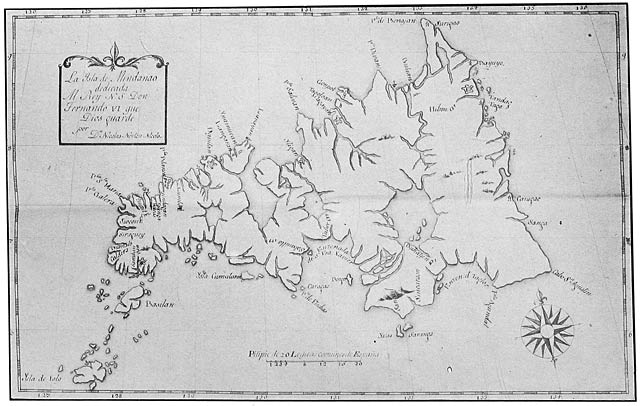
Map of Mindanao, 1757; by Nicolás Norton Nicols
Presidios with forts are marked

Without forts,

Captured and ruined by the Moros, ”
