Volume 48 — CHAPTER XXXII
Reading edition
In the year 1754, two religious were sent, of whom one died and the other retired to Cagayan, seriously ill; but he returned in the following year with another companion. In order to ameliorate the destitution which they had suffered in the preceding year, they determined to take with them a carpenter, a lay brother of their order, in order that he might, as soon as they reached the place, put together a house, which was to go in the vessel, in pieces. Their zeal did not permit them to wait until the work was finished; and, fearing that the monsoon would pass away, they embarked without their little house. Hardly had they reached Calayan when the two fell sick; other fathers went to succor them, and all became sick; accordingly, they returned [to the mainland] one after another, and it was necessary to abandon the mission after the Dominican fathers had incurred large expenses for it. Afterward, this conquest was again undertaken, by Señor Basco in 1783; and this effort has been successful in maintaining there the Dominican fathers, converting those islanders to the faith. A commandant was stationed there with his garrison, which caused much expense, because it was necessary to send them all their supplies from Philipinas; for in all those islands the only produce is camotes and such other eatable things as grow in the country itself. There is no doubt that other articles would be produced, but so numerous are the rats, which consume everything, and so frequent the baguios or hurricanes, that one may rest assured that these plagues would devastate the fields before the crops could mature. Every year a bark was sent to carry succor to the islands, but, as the baguios are so frequent in those seas, many of these vessels were wrecked; it has therefore been recognized that the maintenance of that post is impossible, and the result is, that only the Dominican fathers remain there with a small guard, who must be succored from Cagayan. For this enterprise Señor Basco was granted the title of Conde de la Conquista; but I assert that if half of what he spent in Batanes had been expended in placing missionaries in Ylocos, Pangasinan, and Cagayan, he would have gained more vassals for the king of España, and with less risk.
In order to know how to pacify the Indians, it is necessary to understand their character. Whether because of their naturally superstitious disposition, or because God has thus ordained it, they are very affectionate to the missionary fathers, and have much reverence for them; but there are not lacking some who dare to plan some perfidy against the fathers, and for this reason they need escorts to protect them from audacious attempts of that sort. At times the natives become heated and rise against authority, and the multitude come out against the fathers, unless there is some check to restrain them; such a check, is in the military posts, which ought to be near the missions, so that the Indians may have respect for these, and fear lest they will be immediately punished if they commit any insolent act. With these measures of precaution the islands were conquered, and the same are observed at the present time; but the missionaries are very few, from which it results that they are so widely separated that they have to make a day’s journey to visit one another, when they need to be confessed or on other occasions, and they are very poorly paid. For what is a hundred pesos and two hundred cavans of rice for a Spaniard to maintain himself with decency in the missions? [Even] this small stipend they sometimes cannot collect without a thousand annoyances and vexations which are occasioned to them by the alcaldes-mayor, who seek various pretexts for not paying them, and compel them to go from the mission to the [provincial] capital to collect it, as I have seen. So wretchedly do these poor religious live that there are occasions in which they find themselves obliged to use for their own support what was given to them for their guards; and they live without these, preferring to remain exposed to the affronts of the heathens rather than perish with hunger. The military posts are also few in number, and the Indians in them are unable to impose respect on their countrymen. If the money that has been spent in useless expeditions could have been employed in these sure means of pacification, that undertaking would have made much greater progress. It is true, we shall never see the rapid advances made by our ancestors in the conquest [of the islands], because the Indians have their eyes more open; the Christians themselves persuade the others not to be baptized, in order that the tribute and other taxes may not be imposed on them. Moreover, they themselves have a custom which greatly hinders their civilization, and consequently their conversion. If any one commits a murder in another village, its people do not rest until they have avenged the crime; the consequence is, that the weaker villages are obliged to remove from the district, or to league themselves with other villages. In either case, the Christian church suffers much, because those who are baptized must follow the infidels of their own village and separate themselves from the [missionary] fathers, or else must enter into the general hostilities. Nevertheless, gradually they would all be converted; for if in the neighboring villages many unbelievers are continually being baptized, who leave their own lands and are held in less regard than are the oldtime Christians, how many more would not be baptized if they could remain in their own homes, honored and courted by their old acquaintances? Christian morality is very holy, and attracts all hearts in which vice has not become deeply rooted.
In order to stop the scandals which resulted from these disputes, the bishop of Coriza assembled a [diocesan] synod in the village of Luctuy; it was the second synod held in Tungquin, and held its first session on June 24, 1753. Among the other points that were settled, action was taken on the “Lovers of the Cross,” and on the distribution of districts. As the bishop was a Recollect, and the rest of those who attended the council were his confederates, everything was decided against the Dominicans; Father Hernandez, therefore, who was the only member of his order who attended the synod, protested against all its decrees, appealed to the Apostolic See, and went out of the meeting before it was ended. After the synod closed, the Dominicans, seeing that a Recollect was going to Rome to secure approbation for the acts of the council, sent another envoy, a Dominican, to prevent this. When the whole matter was examined in the holy Congregation, two districts were set aside for the Recollect fathers, and the rest were continued in charge of the Dominicans, the beaterios of the “Lovers of the Cross” were left subject to their respective parish priests. In regard to the [acts of the] second council of Tungquin, it was ordained that they should not be carried into effect until the holy Congregation should, after a thorough examination, agree to confirm them.
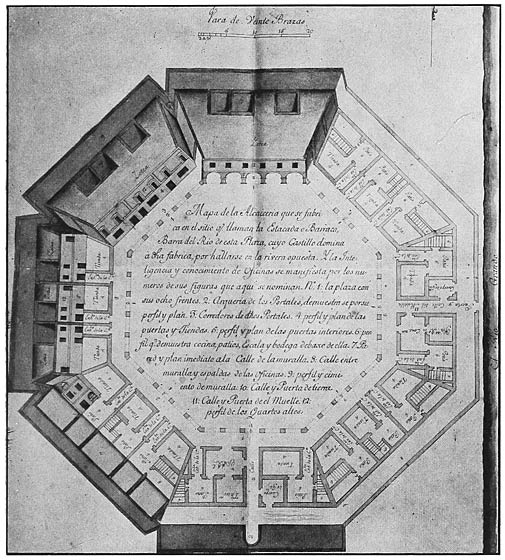
Plan of the new Alcaiceria of San Fernando, 1756
[Photographic facsimile from original MS. in Archivo general de Indias, Sevilla]