Volume 48 / Part 1 — Part I
Reading edition
In which is shown the deplorable condition of the Philipinas Islands; the necessity of preserving them, with respectable forces; and the method for attaining this, without the costs which hitherto [have been incurred], and with increase to the royal exchequer.
1. There is no greater misfortune in the world than poverty; all have a contempt for it, and all regard it with displeasure. No one honors the poor man, however heroic and eminent he may be; his subordinates serve him unwillingly, and readily show him insolence. He has no success, for lack of money; and, in fine, every undertaking costs him immense labors, fatigues, vigilance, and sorrow.
2. It is literally this which is occurring in these islands. The Moros deride us, and display their superiority compared to our weakness, which certainly is ignominious to the Catholic arms, and to the reputation of the [Spanish] nation. When we had forces for punishing them, they were curbed and humiliated; since they have seen us poor and weak they have displayed their perfidy and boldness, and are treating us with the greatest insolence ever seen—for they invade even the villages along this bay, without there being, on our side, any means to prevent this.
3. The vassals of his Majesty, both Spaniards and natives, live in the sorrow which is aroused in them by their melancholy reflections on our poor and miserable condition. The Indians, who are civil only when they fear some punishment, regard their sovereign with little respect, and the Spanish nation with disgust at seeing it humiliated by the English, the Dutch, the French, and even the Moros; and they judge that the Spaniards are somewhat more than the Indians, but much less than the other nations. And, although they are confounded at the glorious successes which our armies have gained against the English since the capture of this military post, and at the heroic valor with which the unfaithful provinces have been punished, when they become aware of our actual poverty that will be enough to destroy their reverence and respect for the acts of the superior government, and to make them bold to commit any insolence, for our lack of means to restrain them from it.
5. If we look at the condition of this fort and of that at Cavite, we shall lament, as is natural, the necessity of repairing their fortifications and building some new ones, of clearing out the ditches, of tearing down buildings, and of other works which will be deemed indispensable. If we turn our view to the artillery, we shall find it so defective, and part of it so useless, that for the defense of these forts it will be necessary to spend many thousands of pesos. If the gun-carriages which are needed and are actually lacking are built; if the forts are supplied with the gunpowder, balls, grapeshot, bombs, grenades, and other implements of war, and with iron, nails, mantelets, cordage, and oil, and, in short, with everything which ought to abound in the [royal] storehouses: the cost of all these things, which are necessary, will be enormous. If attention is given to the need of ships for transporting [hither] the situado, and of other smaller vessels for sending aid to the military posts, providing them with supplies, driving away the Moros, and transporting property from the provinces, one will be astounded at the contemplation of these expenses. And, after all, he will draw the conclusion that nothing of what I have mentioned can be undertaken, for lack of money; that the Moros will keep us in a state of continual fear; and the Indians will act as caprice leads them; that at the first outbreak of war the forts will be found entirely defenseless; that the military posts will be exposed to destruction; and, in one word, that the lack of troops and money places these islands in imminent risk of their total destruction, by various paths, and our sovereign and the Spanish nation in grievous danger of losing their honor, reputation, and influence—which must be averted by such means as are possible; and one of these is, the abandonment of these domains.
6. If, then, they produce nothing; if to maintain them must cost so much that it weakens the royal exchequer, to the injury of other and more important domains; if for lack of money the honor of the Catholic arms cannot be maintained in these distant regions; if we are exposed to being the plaything of all the nations; if we cannot resist or confront the feeblest enemy who may attack us; and finally, if we must endure the ignominy of being discreditably deprived of these faithful vassals, with the loss of all that they have: it is better to anticipate these losses in good time, to abandon or sell these regions, and allow to all [their inhabitants] free opportunity to make their property secure and take refuge in other dominions, where the power of our beloved kings and lords may shield and defend them.
7. This is the method of saving expenses, and employing those funds for other and more useful purposes, and averting the ignominies to which we are exposed—with danger not only to our property but to our lives. For we are surrounded by ferocious and inhuman enemies, such as are the English—who, warned by the events of the late war, will give no quarter if they return to these islands, on account of not exposing themselves to remain as prisoners within the walls of Manila and Cavite—the Moros, who will come to the aid of the said English, or alone by themselves if they see us very weak (and in every way those people are terrible, for they know not what humanity is); the Sangleys or Chinese, who are equally barbarous and bloodthirsty; and even the Indians, who also are cruel and ferocious.
8. The recent example of Pangasinan is the most melancholy warning. What obstinacy and blindness! what insolence and aversion toward the Spaniards! What treasons and apostasies! What murders, so inhuman and cruel! It is certain that the Indians desire to throw off the mild yoke of the Spaniards; that they are Christians, and vassals of our king, simply through fear, and fail to be either Christians or vassals when they consider us weak; and that they neither respect nor obey any one, when they find an opportunity for resistance.
9. The revolted Indians in the island of Bohol solemnize weddings among themselves, confer baptism, and perform other functions of the Catholics, for which purpose they have some persons who perform the duties of the father ministers in the villages; and this mockery, this scorn, this contumely they display for what is most sacred in our religion. They have fled from the villages, and live in their freedom in the hills; yet for this conduct they have experienced only kind treatment and promises of pardon, to which they do not, and never will, pay any attention. If we had troops and money, those insurgents would be reduced; they would be good Christians and vassals, and the royal treasury would possess the receipts from their tributes; for only the fear of punishment is adequate to subject the Indians, and draw them toward what is right.
10. More recent is the case of Pangasinan, whose natives had just been making the same mockery of our Catholic religion, and showing the same contempt for it; but chastisement has reduced them to being Christians and vassals to our king. It is argued from this that, so long as we have not the forces for coercing the Indians, they will be our greatest and most terrible enemies—from whom we cannot free ourselves, save by the measure of abandoning the islands, in case we do not maintain them with respectable forces.
Chapter Second: Of the difficulties which will result from abandoning these islands
1. Not many years had passed after their conquest when it was recognized in España that, in order to support them, it was necessary to expend much money; and the question arose whether it was more expedient to maintain these new domains, or to abandon them. Opinions were expressed on both sides: some urged that but little advantage had resulted to the crown from spending immense sums of money in this country, so distant from its sovereign—who, besides the fact that it did not promise him much profit, could not render it assistance with the promptness which was necessary. Others, on the contrary, urged that under no circumstances ought these islands to be abandoned, which were conferring such glory on our arms, victorious in the four quarters of the world, in which resounded the power of our sovereign, and his royal and Catholic zeal for the salvation of so many souls.
2. Our king and sovereign Don Phelipe the Second, of glorious memory, embraced this latter opinion, with that apostolic and heroic resolution, so celebrated in our histories, that “for the sake of one single soul that might be saved, he would consider well employed the moneys that were being spent in these islands.”
3. I believe that to this religious motive others were added, of policy and state, for maintaining these islands, which, although at the beginning they would consume much money—as occurs in every new colonizing enterprise, which [sort of work] is not done for nothing—at the same time promised great advantages, on account of the valuable products which they yielded, and the great number of people who were conquered. Efforts in this enterprise were made for several years, with the greatest ardor; the chimerical projects of Terrenate and the Molucas were begun, which cost us infinite expense; and, on the other hand, we were harassed by the Moros, with the Dutch, who were aiding them as enemies to this conquest, which they feared would be their ruin—an indication that we had a better opportunity than they to aggrandize ourselves with the commerce of all India, which would have yielded to us the very profits which they feared to lose. And we, occupied in defending ourselves from so many enemies, have not thought of making any progress, but only of leaving everything as the famous Legaspi established it—and yet continually with new burdens, on account of the creation of new offices, the increase of missions, and other expenses, which exceeded the income of this royal treasury, and were made up from that of Mexico.
4. Freed at last from the aforesaid enemies, [a time of] serenity and calm began in these islands, and much progress might have been made, to the benefit of the royal exchequer; with its forlorn condition, and the interested motives of those who were managing it, the zealous and disinterested governor Don Fausto Cruzat promptly made himself acquainted. He collected much money which had been regarded as lost; he erected or rebuilt very costly works, as the galleon “San Joseph,” the palace, the halls of the royal Audiencia and the accountancy, with prisons, storehouses, etc.; he left much money in the royal treasury; he prevented the remittance of large sums which were due from the Mexican treasury; and he practiced economies which were very considerable, and suited to his own example of interest, zeal, application, and ability. But the reduction which he made in the military force, in pay, and in the royal situado, was not the best idea for the security of these islands, and for supplying their urgent necessities—especially as no increase of the royal revenue was established in place of the said reduction. For as a consequence—and the receipts of the royal treasury having been diminished, when they might have been increased—and with the necessity of holding the Moros in check, with costly expeditions and the construction and equipment of some military posts, our expenses were increased; and since these were greater than the incomes, the islands have not retrieved their condition since that time. They have had but few troops, and this government has not been able to make itself respected, or to restrain the invasions of the Moros. Nor is it able to undertake enterprises that would be useful in the provinces, in order that these might produce for the royal revenues the great increase which they bid fair to yield, and for which plans would be made, [if the support of the government could be given], by those who were of opinion that these islands should be preserved. As is admitted by [those of] all nations, these islands are the most fertile, abundant, and rich, and the country the most delightful, in all India; and no other region is so well suited for [the center of] a flourishing commerce, on account of their situation. [For they lie midway] between the empire of China, the kingdoms of Siam and Cochinchina, the islands of Celebes and Molucas, the kingdom of Borney, Vengala, the coasts of Coromandel and Malavar, Goa, Persia, and other populous regions which have made the [mercantile] companies of Olanda and Inglaterra rich. With greater reason would they be able to increase the wealth of España, if in these islands were cultivated their many valuable products, which are greatly esteemed in the aforesaid colonies, and if these products found there the market which foreign goods now enjoy. The whole matter consists in restoring our commerce with the same courage and perseverance which the foreigners display, for which design the abandonment of these islands would be very pernicious—even laying aside religious motives, which are powerful to the Catholic zeal of the Spaniards.
7. The former navigated along the coast of California four hundred and ninety-six leguas to the north-northwest, as far as the lake which is called Lake de los Reyes [i.e., “of the Kings”], and reached Canoset; he crossed a lake, and by a river—to which he gave the name Parmentier, which was that of his Spanish interpreter—he arrived at another lake, which he named Fuente; it is one hundred and sixty leguas long and sixty wide. From this point he passed to another lake, called Ronquillo (from the name of a captain in that squadron), and in one of the villages there he learned that at a little distance toward the east there was a ship, in which it was supposed that there were Spaniards; they found an English ship, which had reached that place by the current from Bafin’s Bay, or else that of Hudson’s Bay.
9. Even without these suspicions, it cannot be doubted that in case of war breaking out the English could attack our domains in the two Americas from these islands, by the coast of the South [Sea]; and from Europe, by the opposite coast—diverting our forces in one direction, in order to strike a blow in security, where it may be most to their advantage; and to this risk we expose ourselves by abandoning these islands. But, notwithstanding this, I conclude that if we must ignominiously lose them, by not maintaining them with respectable forces, it would be better for us to abandon them rather than to encounter such a calamity. This, in my opinion, would be accomplished in the first hostilities [that might break out], since the English, who are arrogantly establishing their factory in Joló to secure the profits of their commerce in that kingdom, will much more willingly establish themselves in Manila, whenever an opportunity is afforded them; and they will profit by whatever now benefits the Spaniards—and much more, on account of their greater application and industry, which regards the entire circuit of the world as narrow for the extension of their commerce.
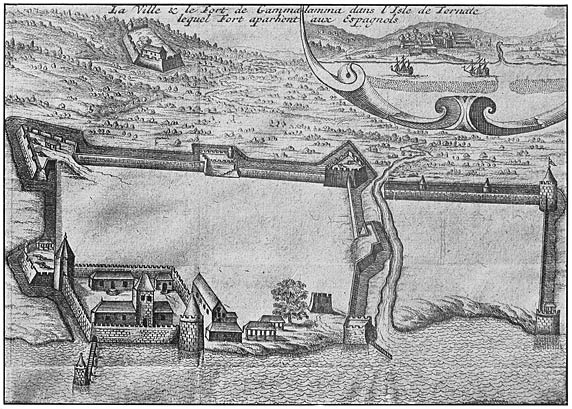
View of Spanish city and fort of Gammalamma, Terrenate; photographic facsimile from Recueil des voiages Comp. Indes orientales (Amsterdam, 1725)
[From copy in library of Wisconsin Historical Society]
12. Let a computation be made of the expense which the Molucas caused us, and of the loss which we have experienced from abandoning them; and even he who is least versed [in such matters] will concede that the latter is vastly greater than the former. For ten years’ expenditures for preserving the Molucas are not equal to the increase of strength which we have given every year to our enemies since they gained possession of those islands. I assert that we would not have abandoned that valuable piece of territory if our Spaniards had been as industrious and assiduous in trading as are the Dutch; or if they had realized what they lost, which has been the immense treasures which the Dutch have gained. But ours is the singular misfortune that we regard the land as useless that does not abound in silver; nor will we consent to be convinced that commerce is the most safe of mines, if the products which our provinces yield are promoted, cultivated, and worked up.
13. The importance of the Molucas was not thoroughly understood until we lost them; nor will the loss resulting from the abandonment of the Philipinas be realized until they are in the power of some other nation, less indolent and negligent than ours. Then their exceedingly rich products—cinnamon, cloves, pepper, nutmegs, cotton, gold, iron, and the others which are yielded in great abundance (as will be said in its place)—will be cultivated and gathered up; those foreigners will sell us these very fruits, which now we cannot appreciate, and with them will take away our money; and in any war we shall be ruined by the gains which our abandonment [of the islands] will produce to those [who possess them].
14. I believe that in view of these reflections, and of what I am going to explain, every good Spaniard will be convinced of the necessity of preserving these islands—even though it shall be at greater expense, and without the powerful incentive of religion—on account of the great benefit which can result to the monarchy if we open our eyes to avail ourselves of the advantages which these dominions offer to us, as I attempt to demonstrate in this writing.
Chapter Third: Upon maintaining the islands with respectable forces
1. Assuming the difficulties which would follow from abandoning them, which is the first measure proposed, the second seems indispensable—to place these forts not only in a condition of ordinary defense, but in one of entire security, in order to avert the ignominy and discredit of our arms, and to render worthy of respect the name of our king and sovereign, and that of the Spanish nation, which certainly have lost much of their honor in this part of the world, at seeing the derision which the Moros have repeatedly cast at us. And it has been a special providence of God that since the shameful loss of Manila our arms should regain the reputation which they had lost in the siege of this fort, by some glorious successes—so complete that they were extolled by the enemies themselves, and caused admiration throughout India—in order to show that the loyalty of the Spaniards, even when their forces were most feeble, could conquer the strongest enemy and avenge their injuries. But this glorious and heroic example of fidelity and valor—by which all the people distinguished themselves, under the orders cf their commander, Don Simon de Anda y Salazar—ought not to lull us into living in excessive confidence that, in another invasion (which may God not permit), we shall be able to accomplish the same results; for the hand of God is not always ready to work miracles, and He desires that men shall aid themselves, in order that He may aid them.
2. I say, then, that it is very easy to make these fortified places so worthy of respect that there will be no forces in this part of India able to capture them. With the same ease any person can begin to form, in his imagination, a basis of brave soldiers, of fortifications, etc.; but he will strike on a reef from not knowing how the increased expense which must necessarily burden this undertaking can be supported. For this end, I will propose some measures, after showing the way by which to make ourselves respected.
3. The towns of Manila and Cavite ought to be placed [in a condition of defense] with the plan of fortifications in the modern style which shall be furnished by the engineers who may be consulted, or may come from España, for this purpose. This expense will be very great, as is naturally obvious; and perhaps with the same expenditure the entrance of the bay could be fortified to prevent the entrance of ships and leave this place in a condition conformable thereto—devoting all attention to the said entrance and to the port of Cavite (in which the courts, the [royal] offices, the storehouses, etc, ought to be), because its situation, aided by art, will make the said port impregnable, and its maintenance less costly and more secure.
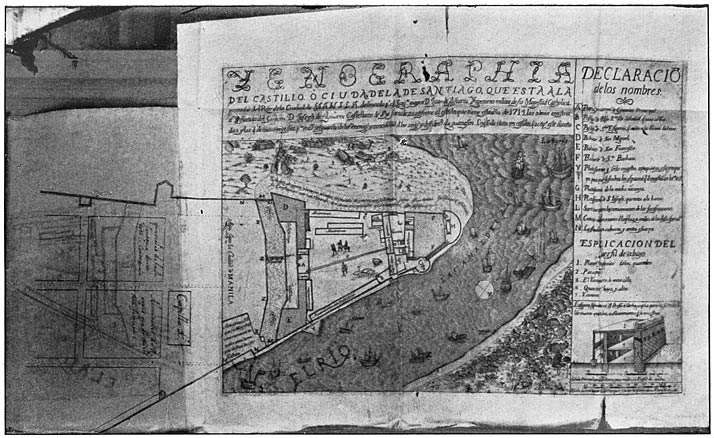
Plan of the citadel of Santiago at Manila
[From MS in Archivo general de Indias, Sevilla]
5. There is a sort of flat boats which are called “floating bastions” [baluartes en el agua]; they are of shallow keel, but of a strength which can support artillery of large caliber. This is a most admirable invention for defending the entrances of ports; those who understand the subject will give more minute information regarding these vessels, which, added to the fortification of the aforesaid entrance [of Mariveles], will make it impossible for hostile ships to enter the bay.
6. There is no doubt that Manila, as I have said, is unnecessary if Cavite is well fortified; but it is also certain that at Manila it is easier to bring in supplies, and for all the troops and the citizens to remove, with their property, to the provinces, where the enemy cannot attack them. These reflections, and the difficulties which there may be in fortifying the entrance to the bay, will be better foreseen by those who understand the subject.
7. Besides the two ships, which are necessary for the trade with Nueva España, there ought to be at Cavite two others in reserve, which could serve in any outbreak of war for the guard and defense of our fortifications, and even could be sent out for capturing the ships of our enemies which might come from Europa and from the coasts [of India] to trade at Canton, for the latter pass in sight of the coasts of Ilocos and Cagayan, and visit without fail Pulaor, Pulicondor, and Pulizapato. These ships [at Cavite] ought to have competent naval officers; and even in time of peace they will be very useful for keeping the coasts clear [of enemies], for transporting troops to the military posts, for any expedition against the Moros, and for reconnoitering and surveying the lands, and the shoals and dangerous places of our islands and seas, and discovering new routes. The navy, shipyard, and arsenal of Cavite should be placed under such regulations as shall be considered most suitable; and as warden of the said port there should be appointed a competent naval officer, or some one of the builders of ships, with the title of superintendent of the arsenal and shipyard, in order that affairs may progress in proportion to his ability.
8. The expense of the two ships which must sail to Acapulco is paid for by the same royal duties which have been hitherto paid, for there have always been at least two galleons for this purpose. As for the additional two ships, and some fragatas besides, it can be estimated that they will cost one hundred thousand pesos a year, besides their construction; this can be carried on in various parts of these islands, with evident saving of expense on account of the exceeding abundance of timber and the low wages of the workmen.
9. The principal defense and security of these islands consists in the troops. In every province there ought to be fifty soldiers, with their officers, at the disposal of the alcaldes-mayor. In this way the reduction of the villages would be made easier, without which all the rest is absolutely idle and useless. As fast as the villages are reduced, they offer greater advantages for both spiritual and temporal things; and thus could be established what would be very beneficial to the Indians and to the royal exchequer, as will be explained later.
10. With a thousand soldiers distributed in the provinces—and these in time of war could retreat to the forts—and with three thousand who may be permanently stationed in the forts, the port of Cavite and the forts which may be erected at the entrance of the bay will be impregnable. Or, [if it be a question] of not undertaking this work but of maintaining the fortified post of Manila, the said number of troops will likewise be sufficient; for the Dutch, the English, and the French, who are the powers that we can fear in India, have not the facilities for coming to conquer our towns with so many marines as there would be soldiers in our garrisons aforesaid; and, on the other hand, they may fear lest we invade them with part of the said military force and of the militia (which, disciplined on the plan that I propose in my memorandum of suggestions, will exceed six thousand men, besides the veterans). With that force, and with the enormous number of men who could be obtained from these islands for [making] earthworks [para faginas] and for other construction, the name of our sovereign and of the Spanish nation would command so much respect in this part of the world that no one would dare to invade us.
11. The permanent garrison of Manila and Cavite, according to the regulation by Señor Arandia, contains two thousand men, divided into twenty companies; and the plan which I propose for the security of the said towns and of the provinces calls for another two thousand men. From these can be formed another twenty companies, of a hundred men each; and, since usually these companies are at no time complete, it will be necessary, in order to keep them full, to increase the said plan by another thousand men, in order that the [regular] footing of four thousand men may always be maintained. They can easily be recruited in Nueva España, and [sent over] by every ship to replace those who may die; for we have learned by experience that the Americans, if they are well disciplined, are remarkably well fitted for soldiers. They are barbarians in courage, and are daring and resolute; they fling themselves into the greatest danger as joyously as into a dance; and whether on the march or in guard duty, in heat or in rain, and in the most distressing fatigues, they are always gay, contented, and good-humored. With the same aspect they endure poor food, a scanty supper, a hard bed; and, finally, they are very obedient, and their virile powers are quite spent [son de potencias mui despejadas] usually—so much so that on this account they usually have all the vices which are natural to man. But strict discipline and punishment are a great restraint on them; and, with the example of four or five hundred veteran soldiers who might come from España, a very respectable military force could be trained here—with the additional consideration that they are better able than are the Europeans to endure heat and rain, and other hardships, which ruin the latter and make no impression on the former. But it is indispensable that some officers of rank should come from España, to lay good foundations for this edifice, for in no other way can it be permanent.
12. In order that this force may serve willingly, and be reliable, it is necessary to increase their pay. It is impossible to have good officers unless they have sufficient pay to support themselves decently, and it is certain that they do not have it; the same thing is true of the soldiers, relatively; and on this account it is found that both officers and men serve by compulsion, for, by leaving the service, they make a better living, and are more highly esteemed. A captain with [a salary of] twenty-five pesos, a lieutenant with eighteen, and an alférez with fourteen, cannot feed, clothe, and house themselves; and in order to appear on the streets neat and clean, they are forced to practice a thousand stratagems and deceits, which cast discredit on the body of officers and injure their reputation among the citizens. The honorable officer who does not conform to this [sort of] life, or who has means to support himself in some other way, or who adds to his income by trading, escapes by leaving the service; and the soldier deserts, and takes refuge in one of the provinces, where he lives better and has more comforts. Therefore, in order that they may serve the king with affection, willingness, and honor, both officers and men should receive a corresponding rate of pay.
13. This, it seems to me, ought to be fixed at the rate of fifty pesos for the captain’s pay, forty for the lieutenant, thirty for the alférez, ten for the sergeant, eight for the corporal, and five for the private soldier; and in this proportion for the sargentos-mayor, the adjutants, and others. With these salaries all the military could support themselves decently, and the service would be desirable; young men of good standing would devote themselves to it; there would be emulation among the officers, and, if these were competent, among the soldiers also—who, with such pay, would not be so eager to desert the service.
14. Computing the annual expense of the aforesaid forty companies, according to the proposed schedule of pay, it would amount to very nearly the sum of three hundred and twenty thousand pesos; and adding thirty thousand pesos more, for the pay of the corps of artillerists whom we ought to have, the annual expense would be about three hundred and fifty thousand pesos. [With that force,] there would be men for the detachments which we may need to send on special service, for the expeditions that may be necessary, for proceeding wherever necessity may call for aid, and for the ships and the galleys; and, above all, for rendering ourselves respected and feared, in times of either peace or war.
15. This increase of troops and pay, compared with the pay and troops stated in Señor Arandia’s regulations, amounts to the half more; and I reckon it, with that of the artillery, at two hundred thousand pesos more of expense; this, with the hundred thousand applied for the navy alone, will make three hundred thousand pesos of increase to be charged to this royal treasury. Computing the cost not by the said regulations, but by the plan which I have just proposed, the entire cost of army, navy, and corps of artillery amounts to four hundred and fifty thousand pesos annually.
Chapter Fourth: On the facility with which these islands can produce for the royal exchequer more than what it needs for the said expenses.
1. Having constituted the aforesaid military force—or half of it, in order that the expense may be less at first—the reduction of all the Indian villages ought to be resolutely undertaken, as a matter that is absolutely essential, without which all the rest will be useless. This reduction made (which can be accomplished in less than a year), enumeration will be made of the tribute-payers in all the provinces; after the reduction their numbers will be greatly increased, because the heads of barangay will not be able to hide the tributes as easily as they now do, or to commit thefts and dishonorable acts, as they have hitherto done. The ordinances will be made duly effective, especially in regard to plantations, and other measures will be adopted that are beneficial for the better government, both economic and civil, of the villages; government buildings will be erected in the chief towns, at least, that may serve to shelter the alcalde-mayor and the troops that he will have; also a storehouse, in which to keep the property of the royal exchequer. Good schoolmasters will be employed for the instruction of the Indians, and for teaching them our language; and the matters in which the father ministers should have the right to intervene, and those in which they ought to forbear, will be strictly regulated, without any dispensation. The cultivation of the land will be conducted with the utmost care; and, finally, the tribute will be increased, to the rate of two pesos a head each year. Although this is a very moderate impost, and is profitable not only to the king but to the Indians, in order to draw them out from their continual and pernicious slothfulness, this branch of revenue will produce annually one million, six hundred thousand pesos. This addition to the royal treasury, even when some deduction is made, as is ordinary, will not only support the expenses of my plan for army, artillery, and navy, but a considerable amount of silver will be left for other allotments from the royal exchequer, and for indemnifying the expenses with which the islands have been burdened, from the time of their conquest until now.
2. The other increases and savings which the royal exchequer can make in its various branches I have set forth to his Majesty and to the superior government, and I will furnish a still more detailed account whenever it shall be deemed necessary. It is sufficient [here] to know that these can amount to some four hundred thousand pesos, and that, when added to the income from the tributes, the two items will amount to two millions of pesos annually; and even if half a million be deducted for contingencies and losses, and another half-million be spent in making payments, a million still remains as savings. Even considering the matter as gloomily and distrustfully as possible, there cannot fail to be an annual saving of half a million of pesos, as any one will understand who is moderately acquainted with the affairs of these islands.
3. With such receipts in the royal treasury, and with the aforesaid soldiery and their pay, and with navy, artillerists, and military supplies, what enterprises cannot be undertaken in these islands? Will this not be the most considerable establishment in all India? Will there be forces that can overcome us? Will the English, who have their forts and factories, with the necessary garrisons, venture again to invade this place? On the contrary, will they not fear, and with just cause, that we, superior then in forces, will attack them in their own colonies? I think that no one will doubt that the advantage is ours, assuming that my plan for savings and increases in the royal revenues is practicable; and I believe that, however numerous the difficulties which may accumulate in carrying it out, all will admit the suitability of these islands for attaining it, if only it be undertaken in earnest and followed up persistently by all the governors; for if the military forces be placed on the footing that I propose, all the rest will be overcome without special difficulty; and I dare stake my head on it.
5. For the execution of all the aforesaid, and in order that the [military] establishment proposed may suffer no delay or procrastination, it would be expedient for his Majesty to give commission for this to the governors, and to the ministers of the Audiencia, with the insistence which is merited by this project, so assured and so beneficial; and the amplest powers should be given them to proceed in such manner as they shall judge, by the majority of votes [in councils of war], to be most expedient. For in consulting his Majesty in regard to some uncertainties, and waiting for his royal decisions, the delay of at least three years will be experienced; and in so long a time the postponement of action cannot fail to be injurious to the enterprise, and to cool interest in its continuation, when it ought to be pursued with the greatest ardor, zeal, and efficiency, deferring for this all other affairs, as being less important.
6. The first thing which should be attempted is, that his Majesty issue commands—provided he approve the project for making these domains respected, and the plan for economies and increases in the royal revenues—to the viceroy of Nueva España to send over here money and soldiers, in order to serve as a foundation for the work that is to be undertaken. For this is necessary to be done, even if there were no such project; for in its present condition the place is without defense, and the government without forces to make itself obeyed; and there is no medium between the two extremes above stated—to abandon this country, or to maintain it with honor; and the latter cannot be secured without spending money, and without having sufficient troops to garrison the forts.
7. If to these succors from Nueva España were added two ships and five hundred soldiers from Europa, a corresponding force of officers, and abundance of military supplies—which could come to these islands by way of the Cape of Good Hope—great advantages would ensue. First, all the vassals in these islands would rejoice at seeing such succor as never before had been seen in them; second, the Indians would have some idea of the power of our sovereign, since, as a people of material ideas and little penetration, they do not consider or understand more than what enters through their eyes; third, they would feel more respect, fear, and dread, which is that which holds them in check, and obliges them to be Christians and vassals of our king. Fourth, such aid would serve as a terror to the Moros, and would allow the provinces, overwhelmed by their invasions, to take breath; fifth, all the soldiery would be disciplined and organized after the example of the said five hundred veteran soldiers, and with the sergeants and corporals of the latter a good corps of officers could be formed, filling vacant posts with them in place of the untrained and inexperienced (to whom can be given other appointments in the posts of alcalde-mayor, corregidor, etc.). Sixth, in these neighboring provinces the reduction [of the villages] and the increase of tribute could be immediately undertaken, without risk of resistance on their part; and when the undertaking was concluded in this region, where it is easier to carry out such a measure, it would be continued in the other provinces, one after another. Thus in a short time the benefits set down in this project would be obtained, and with them the troops and their pay could be increased, fortifications and ships built, supplies provided (which could be done here), and the Moros who harass us destroyed.
Chapter Fifth: Of the arguments which justify the increase of tributes
1. As this matter is discussed with the greatest scruples by all the authors, it has seemed to me desirable to explain, as briefly as possible, the reasons which I consider just for the increase of tributes which I mention in the preceding chapter. I see therein from the start the obstacles and difficulties which this delicate question will occasion; but I will bring together the considerations which no author denies in this discussion; I will adapt their doctrines to the Indians of these islands, in order that the justification of my design may be evident; and I will conclude with touching upon some objections which have been raised by the most learned persons whom I have consulted on this point.
2. From the confusion and disorders of ancient times originated the selection of kings, to whom and to their successors the respective kingdoms entrusted the power of establishing laws; of forming towns, and of maintaining them in peace, justice, and social order; of appointing persons for government, civil, economic, and military; of establishing tribunals; and, in fine, of providing their vassals with all the means conducive to their greatest comfort and security. The people bound themselves to contribute means for meeting these expenses, with the tributes and regular charges which might be necessary. By this mutual obligation between the kings and the vassals, the latter must be protected, defended from enemies, and maintained in peace and justice; and in return and acknowledgment they must also pay the tributes, since these are employed for the common benefit, and secure the stability and solidity of the state. If St. Paul counseled that tributes be paid to the heathen princes, with how much more reason ought they to be paid to our Catholic monarchs!
3. The payment of tributes is binding in the tribunal of conscience, under [penalty of] mortal sin, and with the obligation to make restitution when they are fraudulently withheld; and this opinion no author questions. But, as it is not possible to determine the quantity, opinions are divided, and many persons expand this matter, urging that the excessive imposition of tribute exonerates from the obligation to pay it, and establishing [the fact of] the said excess on various arguments, although I know not whether these are solid as is necessary. For, in order to speak with assurance on this matter, neither theology nor jurisprudence is sufficient; but it is necessary to know also the science of government and that of administration—which are little understood by some who clamor against excess in the tributes, without knowing whether or not there is any.
4. In matters of government, a statesman who is adorned with superior talents will distinguish the expenditures which are necessary from those which are needlessly incurred; he will know whether the tributes are sufficient to meet the obligations of the crown; and he will make a calculation of the incomes and expenses of the royal exchequer. This neither the jurist nor the theologian can do, without knowledge of these matters, which are remote from their professions, and consequently they cannot be sure whether the tributes are sufficient, or are extravagantly spent, in order that they may establish the [charge of] excess in them, or the [right of] relief from paying them, or the [justice of] scruples at imposing them. But the theologian and the jurist who may have the said information will doubtless declare with most correctness, whether the tributes are excessive or moderate, and whether there is obligation to diminish them or necessity for increasing them, in order that sovereigns may not experience the aforesaid scruples, or the vassals have cause for not paying the tributes.
5. It cannot be denied that in all the nations of Europe the tributes have been increased in this century, as the Mercuries publish it; and this is right, because continually new things are discovered which render the old ones useless—for instance, a fortification which formerly was considered impregnable is [now] regarded as very frail and weak. On the other hand, the exertions which a power makes oblige it to incur greater expenses, and all of the powers strive to place themselves in a state of equilibrium which can render their respective domains secure. The abundance of silver has raised the prices of commodities, and, as everything costs much more than formerly, and the necessity for expenditures is infinitely greater, the increase of tributes cannot be avoided, nor can the vassals be excused from the clear obligation to pay them, in proportion to the [demands of the] times, which cannot be the same.
7. Taking for granted then, the moderation (as all admit) of the tributes paid by the Indians, especially in these islands—where they paid only at the rate of four reals for each tributary, and of one real a head which was afterward imposed in addition, one entire tribute finally paying ten reals, in accordance with ley 65, tit. 5, lib. 6, of the Recopilación de Indias, without there being, from the year 1602 until now, any further burden upon them—and assuming, as an unquestioned fact, that there has been a continual increase of new offices, new military posts, and many expenses in these very islands; as also that the urgent needs of the crown are now incomparably far greater than in the past century, it seems that by an undeniable conclusion the increase of tributes ought to be lawful, in proportion to the increase in the said expenses. For without the tributes the king cannot fulfil his obligations as such, in regard to his vassals; nor can the latter omit to contribute the means for their own preservation and security, which is what the sovereign must endeavor to obtain for them.
8. What reason will there be for the vassals in the peninsula of España being the only ones to be laden with an increase in the tributes, and for the vassals in the Indias not bearing the same increase? One class is under the same obligation as the other to pay their share to their king, for the necessary expenses of the monarchy. Let, then, a survey be made of the taxes and imposts which have been increased in España since the conquest of the Indias, and it will be seen what increase of tributes has been imposed upon the Spaniards in order to defray the expenses of the crown, while in the Indias hardly any increase has been made—although it accords with equitable justice that all should bear these burdens which conduce to the common welfare, and assure the stability and permanence of all the dominions.
10. There are probably in all the world no vassals who are less burdened than are the Indians of these islands. They eat and drink without paying alcabala or any impost; the fabrics with which they clothe themselves, if made in the islands, pay nothing, and if they are of foreign make they bear no heavier burden than the light one of the customs duties; in the polos and personal services to which the king assigns them, he furnishes them with rations and pay according to the tariffs and ordinances of the provinces; and, finally, each Indian pays, at the end of the year, only five reals, from the age of eighteen years to that of sixty. I agree that at the beginning it was proper to proceed with this moderation, because the said tribute was then considered sufficient for the expenses, and those of the monarchy were also less in those times, on account of the scarcity of silver, which caused all commodities to be cheaper than they are now; and, finally, because they had not been conquered by wars occasioned by their own perverse conduct, in order to impose on them heavy tributes at the discretion of the conqueror, as is just in such cases. For they submitted of their own accord, and our conquest was made not because they had previously furnished us with causes for war, but for the sake of their greater good, both spiritual and temporal; for this reason their tribute ought to be more moderate, but not so much so that, in order to relieve these vassals, it should be charged back to the others (as it has been, unjustly), in order to support these islands. For it does not accord with justice that exemption should be granted to these Indians from their obligations, as vassals, to pay their share toward the expenses of these dominions and of the entire monarchy, in [due] proportion; and that this favor [to them] should prove injurious to the rest of the vassals, who certainly are more worthy of consideration [than these], since they are more useful.
11. “In the time of their heathendom, they ought to be considered as slaves rather than as vassals of their tyrannical petty kings, to whom they paid service as vassals. These tyrants employed them in their grain-fields, and in gathering pearls, shells, gold, dyewood, amber, and civet; in timber-cutting, and in the construction of vessels; in a word, the people had nothing more than the labor appointed to them by their tyrant masters” (thus I explained the matter to his Majesty in a report of June 5, 1760, and [here] will copy exactly the rest of its contents regarding the increase of tributes). “Your Majesty conquered these dominions and these peoples, making rational beings from brutes, Christians from heathens, and rich people from poor ones. Your Majesty gave them the freedom of the sea, the rivers, the lands, and the forests; established a governor, an Audiencia, and other courts, in order that they might be defended from their enemies and maintained in justice; formed bishoprics, with bishops and curas; and, in fine, you completed these benefits with the many privileges which are contained in the laws of the Indias, without further burden to them than the payment by each Indian of five reals. At the same time, they were able to pay much more, as it is just they should, considering that every vassal ought to contribute to his king and natural lord whatever is necessary to maintain the vassals in peace, justice, and social order; but in these islands not only does your Majesty not obtain what is needed to pay these expenses, but your Majesty supplies, and has supplied, an immense amount of money. If the rest of your vassals contributed in this proportion, your Majesty could not maintain your dominions, for you spend vastly more than what they yield to you; nor could the Indians of these islands, moreover, be instructed and governed if your Majesty spent upon them no more than you obtain from the fund of the tributes. Therefore, in order that these obligations may be reciprocal—that of your Majesty to maintain the Indians in social order, and theirs to contribute for the same—it is necessary that the tribute be proportioned to the expenses, and larger than what they are at present paying.”
12. Let these reflections be prudently considered, for, even without the constraint of the foregoing ones, they show the lawfulness of increasing the tribute; and at greater length I have stated the disposition of the Indians, as I also explained to his Majesty in the said report: “They are a people who are given up to sloth; they work one day for the food for the entire week, and the rest of the time they are without occupation, and most often [spend that time] in gambling or drinking. That is a very unusual Indian who takes pains to have a comfortable house, and to accumulate some little property for the comfort of his children; for he [usually] only works for his food and for wretched clothing, for paying his tribute, and for gambling. This is more usually the case; as also is it certain that there are no vassals who have better opportunities for being rich, or can do so more easily. Those who were exempted from going to cut timber paid the overseer five pesos, three reals each, in order not to be obliged to do this work for the period of one month; and in this is evident the facility with which they make money when they choose, and when necessity urges them.”
15. Such is the example that we set to the Indians, and they imitate us so perfectly that they all desire to live as the Spaniard does, to wear the same costly ornaments, and to be rich—but without labor, and without ceasing to be idle or to divert themselves with all the other vices. If the many Spanish vagabonds who wander about Manila and its environs were distributed in the provinces, they would trade therein; they would marry Indian women of rank, would become rich with some application and labor, and would thus furnish a good example to the Indians. In this way the foreigners (and especially the French) have established their colonies, free from the error of our pernicious vanity, inaction, and sloth; and we, although better warned than they, are unwilling to change our ideas, but prefer to maintain the Indians in the same state of idleness.
16. The means for their not being idle is, that the Spaniards should work, and encourage and aid the Indians to cultivate their lands and utilize their products. An ordinance should be published that no Indian may be a gobernadorcillo or official of his village unless he cultivate and gather in a certain portion of rice, wheat, sugar, cacao, cotton, wax, or other product, regulated by what each province produces; that if they do not cultivate their lands they must lose them, the lands being adjudicated to other persons, in order that these may cultivate them; and that exemption from tributes, polos, and personal services be granted to those who shall most distinguish themselves in tillage and harvesting. The idea is, to stimulate them in this manner to the tillage and cultivation of the lands which his Majesty grants to all the villages and the Indians who dwell in them; and these measures are very gentle compared to others which were decreed by the municipal law of the Indias. For in one of the ordinances of Mexico it is decreed that “the Indians must not be allowed to be idle, or to wander about as idlers and vagabonds; but they must work on their farms.” The authorities could compel them by force to obey this, as Señor Solorzano proves by various arguments in book 2, chapter 7 of his Política Indiana, demonstrating that no Indian would work if allowed his liberty, “through his natural inclination to an idle and easy life,” as is definitely stated in ley 1, tit. 13, lib. 6 (“Of the Indians”), and many others of the same Recopilación; and that the Indians resist work “because they are exceedingly slothful and fond of idleness, and are inclined to abandon themselves to intemperance, licentiousness, and other vices which idolatry occasions among them; and as they are so little covetous, and are content with so little for food and clothing, many passing their lives in the manner of beasts, some force and compulsion is necessary to make them give up this mode of life; for the devil prompts and persuades them not to serve or aid the Spaniards.
17. “On this account it has always been regarded as best to keep them occupied and at work, and in their heathen condition the same was done by their Ingas [i.e., Incas] and Montesumas—to such an extent that, when they lacked profitable and necessary occupation, their rulers set them to work at others that were only for pleasure, and of no use or benefit; they were even made to collect little bags of lice, and to cut and carry to the mountains stones of enormous size.”
18. All this description seems written for the Indians of these islands, and he who may have any experience with them will decide that, in order to remove them from their sloth and their vices the increase of their tributes is indispensable, as is the necessity of compelling them by the said measure to perform work that is useful to the king, and likewise to themselves, in both spiritual and temporal interests—so much so that one can and ought to form the gravest scruples at allowing the Indians to remain in their present condition, since it is the origin of numberless evils (from which I shall pray God to deliver his Majesty and his ministers), through consenting to this so pernicious sloth, and not applying some remedy to it. At the same time with the increase of the tribute, the abundance of products and the wealth of the islands will be greater; for if the Indians now do a certain amount of work in order to pay five reals, they will be under necessity of working three times as much in order to pay two pesos.
20. The difference which there may be between the Indians who were conquered by arms and those who voluntarily subjected themselves to our sway (as were those of these islands) is also found in the said regulation of rates, by which the latter will pay but one-half as much as the former; for this circumstance that I have mentioned does not relieve them from the obligations and burdens of vassals—although on account of it they have the right to be treated with more clemency, as they have been treated hitherto, and will be in the future—paying the two pesos as tribute, in order that his Majesty and the other vassals need not defray the expenses to which the people of these islands ought to contribute, since these conduce to their spiritual and temporal welfare, and to the preservation and security of these dominions.
21. Besides this, it ought to be borne in mind that, from the first years of this conquest until the one in which we now are, nearly all the provinces have at various times rebelled and risen in arms; and not one of our authors doubts that for this kind of offense the Indians ought to be punished by an increase of their tributes, that this may serve them as a warning and example; for they [thus] lost the right to be treated with the mildness which their first voluntary submission deserved. If the Spaniards had proceeded after this fashion in these islands, it would have been an easy matter to increase the tributes, in order to save the situados. Moreover, with the examples in this war [i.e., with the English] we have most rightful cause for punishing, by some such means, the traitorous and revolted provinces, by [imposing] not only the two pesos of tribute, but much more, in order to make some distinction between the Indians who have continued faithful to our king and those who have rebelled and acted disloyally.
22. With these brief reflections the minds of those who have entertained some doubts or scruples in regard to the increase of tributes which I proposed in the preceding chapter would be convinced; but there would be other difficulties to overcome in this exceedingly delicate matter. People will tell me (as I have sometimes heard it said) that any person who proposes the increase of tributes commits mortal sin, and incurs the excommunication of the bull of the Cena. But I will reply with the upright and pious intention which has influenced me to write on this subject—on which, in my opinion, depends the preservation of these islands and their Christian churches; for they will certainly be lost in a few years unless they produce [means] for the expenses which they occasion, or unless his Majesty increase the royal situado; this is a difficult matter, and he is under no obligation to do so. And it is sufficient for me, in order not to incur the said excommunication, that the bull of the Cena is not received in España in regard to matters of temporal government (in which our sovereigns are absolute), but only in what concerns ecclesiastical discipline, and the purity of the faith and the Catholic religion, in which the Spaniards have always affirmed the blindest obedience to the supreme pontiff and vicar of Christ on earth.
24. It is certain that the vassals are under obligation to pay tribute to their kings, but it is likewise certain that they have the right, in equity, that what they pay as tribute be well employed, and that punishment be administered to those who steal, extravagantly spend, or misapply those funds; for in the honest administration of the royal revenues consists the greatest comfort of the vassals and the prosperity of the [respective] monarchies. The remark made by a celebrated French writer is [worthy] of note: that if the ministers of the king of España in the Indias were not so dishonest the royal incomes would amount to more than those of all the powers of Europa. The vassal complies with the obligation which rests on him, but the kings do not fulfil theirs; for they let go without punishment all the theft, all the robbery, all the iniquity committed by their ministers. I am well aware that there cannot be government among men without these defects and vices, which without exception are utterly incurable, and all the nations of the world have committed them from the time of Adam; but he who knows our general misgovernment of the Indias and the numberless robberies which are committed [therein] will be astounded to see that the criminals are not punished. [At the same time] he is certain that the royal revenues are in great part consumed by those who manage them, while if some exemplary punishments were inflicted the thefts would be greatly checked; that, by not curbing these, heavier burdens are laid upon the vassals; and that these protest against the tributes which are imposed upon them, [levied] not strictly for the maintenance of the dominions, but in order to enrich the officials, who (especially in the Indias) make enormous fortunes with what they obtain by defrauding the royal exchequer—or, to speak more correctly, by plundering those who pay tribute.
25. If in the collection, administration, and allotment of the royal revenues there were application, zeal, disinterestedness, and economy, it is evident that the vassals would not be compelled to contribute with so many imposts and taxes; for with what is plundered and misapplied in one year the expenses could be met for the half of the following year, and perhaps, instead of increasing the taxes, it would be possible to make some reductions of these to the vassals who should be considered most burdened.
26. I have not the slightest doubt that the tributes which have been hitherto paid in these islands are not sufficient for maintaining them in a condition so respectable as that which I have already proposed; and if for this chiefest reason I have defended the increase of tributes, I likewise retract this opinion in case our court do not apply the most effective remedies, in order to check the robberies and malversations which during my time I have seen, and that they may not be responsible before the stern tribunal of God for such hardships to the Indians, and for the robberies, which will be committed in greater number in proportion to the increase in the funds which will be handled. For, strict as is the obligation of the vassals to contribute to the expenses, or pay tribute, equally so is that of the sovereigns to make proper distribution of what is contributed, and to endeavor that it be not misapplied; and so long as kings do not fulfil this obligation, by appointing zealous and disinterested officials, and punishing with the greatest severity those who are not such, there will be few persons who will venture to express opinions in favor of increasing the tributes. But [when such measures are taken] I will be the first to withdraw from this statement of my opinion; for I have always believed that the aforesaid condition [of honest administration] was inseparable from such increase.
27. I will note other objections which have been made to me against increasing the tributes; but, before mentioning them, I protest my veneration and blind obedience to the royal decrees of my king and sovereign, whose upright conscience will consider what is most in accordance with its internal peace, the rectitude of his royal intentions and the comfort of his vassals, by mercilessly punishing those who defraud the royal treasury, and issuing such other commands as are expedient.
28. There are many who restrict the powers of the sovereign which I mentioned in section 2 of this chapter, and who say that the [various] countries, when they instituted kings, did not dispossess themselves of all the authority which the people of the nation possessed; but that the latter reserved something, especially in the matter of taxes, which were proposed and demanded by the kings, while the vassals granted or denied them—[the objectors] drawing conclusions from this ancient method, and (especially in our España) from the convocation of parliament [cortes]; that the power of the king to grind his vassals is not absolute, and that these do not depend in such matters on the will of their kings alone. I frankly state these objections, which, even though they be paltry (on account of the positive opinion of the sovereign, supreme, and absolute power of our kings, who recognize no superior on earth), it is expedient for those who ought to anticipate them not to overlook; for, in order to render a question clear, and to foresee all the difficulties in its decision and practical result, a knowledge of the replies and objections which may be made is always helpful. I content myself with pointing these out, and repeating my [assertion of] invariable obedience to the royal commands of my king and sovereign, as I stated in the preceding section.
30. These and other objections I will answer briefly, by saying that the presumption of the law by which it is believed of all public officials that they conduct themselves conformably to justice, so long as quite the opposite is not evident, is stronger and more effective in favor of kings and their wise prime ministers—who, with more enlightenment, a profounder knowledge of the [affairs of] state, well-known zeal for the welfare of the monarchy, and the proper maintenance of their lofty honor and character, have decided and will decide these matters, in which we who are inferior and of more limited abilities ought to render subordinate our own opinions, and honor with the utmost respect their wise decisions, persuading ourselves, as is just, that in their councils they have borne in mind all the considerations which can produce the most advantageous judgment, before it is made known to the public. For however satisfied one may be with their reasoning, he would admit that he was convinced if it were possible for him to hear the substantial arguments which influence the royal proceedings of our sovereign—on account of which I, more than any other person, submit these productions of my dull intellect to the superior comprehension of his Majesty and his zealous ministers, protesting that I do not presume to furnish enlightenment on these subjects because I might think that they do not possess it, but in order to manifest my intense desire that what is understood to be beneficial to the state, to the glory of the nation, and to the welfare of all the vassals, may be carried into execution.
31. It will be necessary to assume that the increase of tributes in these islands will be resented in the greater part of them, and that, in order to obtain it, the precaution of stationing fifty or sixty soldiers in each province will be necessary; in view of this, the Indians will not cause the least trouble, while if they see us without military forces the aforesaid increase will be entirely impracticable.
32. Equally it must be assumed that so long as the Moros invade the provinces the Indians will resist paying tribute; for they will represent that for the defense of their villages they are employed during most of the year in making bulwarks, stockades, and little strongholds, and with weapons in their hands, on account of having no aid from the king which will secure them from the said invasions; and in truth they ought to be heeded in this point. To this end I repeat that in these islands some respectable forces are necessary, and with them must be punished the haughtiness and insolence of the Moros; for at the sight of this example the Indians will be encouraged, they will attend to their labors, they will regard with respect the affairs of his Majesty, and they will assuredly pay the tribute which may be imposed upon them, without danger of their revolting. To this end, a circular edict or decree should be drawn up, in which, suiting the mode of expression to the disposition of the Indians, should be fully explained to them the motives which constrain us to the said increase, and the obligation under which they lie to pay their share of the expenses for their spiritual and temporal maintenance under the mild sway of our Catholic king and sovereign, and for freeing them from the tyranny and servitude to which they would see themselves reduced if these islands should, for lack of military forces, pass over to another sovereign.
34. In order to [secure] the observance of the said ordinance, it will be expedient that when the tribute is increased the salaries likewise should be made larger. An alcalde-mayor has twenty-five pesos of salary a month, which makes three hundred pesos a year; but before he leaves Manila for the province to which he is assigned he spends a larger sum [than that] in the fees for his documents and in the notary’s office, and for the securities [that he must give]. In three years his term as alcalde comes to an end, and the expenses of his residencia cost him four hundred to five hundred pesos; and it needs but little less for the settlement, presentation, and despatch of the accounts of the royal revenue. Thus all the salary which he receives on account of being alcalde, which amounts to nine hundred pesos in the three years, is not sufficient for the aforesaid expenses; for the rest of their maintenance have been invented the thefts from the royal revenue which they handle, and from the Indians within their jurisdiction. For this reason, and likewise because these offices have usually been sold, as a rule they are filled by men who are not very trustworthy. But if suitable pay were assigned to them, there would be many persons of known probity who would seek them, transgressions could be more severely punished, plundering would be decreased, the appointees would furnish better bondsmen for the security of the royal exchequer, and the Indians would not experience oppression.
35. The poverty of the alcaldes-mayor, their being loaded with debts when they go from Manila, and the ambition to become rich in a short time, draw them into trading with the product of the tributes in each province; they buy vessels, lade them with goods, and convey these to Manila, or send them to other provinces. If the vessel sink, if the Moros seize it, or if it run aground on some shoal and the goods are damaged, or if any other disaster occur, the alcalde loses nothing, for he possesses nothing; and the damage is suffered by the king alone.
36. All this would be remedied by paying them more; for there would be more reliable alcaldes, and they could be compelled to deposit in the royal treasury every year, by means of their agents, the royal revenue of their respective provinces, in order to avoid the aforesaid contingencies, which here are common.
37. With better alcaldes, all the provinces would be well governed. For what is more melancholy than to surrender authority over them to persons who are incompetent, nobodies, in distressed circumstances, vicious, and thieves? How is a man of this sort to govern fifteen, twenty, or forty thousand Indians? If he cares for nothing except for conducting his own business, how is he to attend to the affairs which concern the king and the Indians? If the alcalde is inefficient, or coarse, or ill-bred, or of little capacity, how is he to govern well? how is he to administer justice, and how civilize his subjects? How is he to furnish reports on subjects which his limited intellect does not comprehend or fathom? How is he to look after the cultivation of the soil, the collection of its products, making plantations, and other things for which the ordinances provide?
38. This disappointment, this disorder, this misgovernment, and the thefts from the royal revenue can only be avoided or remedied, for the most part, by increasing the tribute and giving larger salaries to the alcaldes-mayor, the corregidors, and the other officers of justice in the provinces. There is occasion for the same increase of pay in the posts of public and royal officials, and the subordinates in the accountancy of the royal exchequer, in order to stimulate them to better work and greater zeal and application in the affairs of the royal finances.
40. In order that there shall not be such confusion, it would be expedient to separate the storehouses, or divide what belongs to the artillery and military supplies from all the rest; and to abolish the dependence of the storehouses at Cavite on those of Manila, making the regulation that in the said port be entered and unladen whatever is necessary for the equipment of ships, galleys, and other vessels of the king, without its being necessary that the vessels from the provinces which come with property belonging to the royal account should unlade their cargoes in these storehouses [at Manila], from which various goods are sent back to the said port. This causes greater expense, on account of the detention of the seamen, and because of the vessels and men that afterward are employed in conveying to the said port what [supplies] it needs, in which also they are exposed to the uncertainties of the sea. This is avoided and spared by the direct discharge of cargo in the said port, where, in fact, the main storehouse ought to stand, because there three-fourths of the goods belonging to the royal account are consumed.
41. The superior government gives orders for the hasty equipment of some vessels to cruise against the Moros, and for other purposes. The cordage, the sails, and all the rest, are sent from the Manila storehouse; the said vessels set sail, and come to supply themselves with provisions at these storehouses. Who does not see the loss of time and the increase of expenses which are uselessly incurred, and which could be saved if the storehouses at Cavite contained what they need?
42. Although what I have touched on in these last sections may seem a digression from the object of this chapter, they will be excused by those who remember what I had already stated in section 26, and by those who think that the increase of tributes will facilitate the increase of salaries. This measure will give the superior judges more discretionary power for punishing the thefts and illegal acts which are diminishing the royal patrimony, to the injury of the vassals—who have no right to complain that those who render them faithful and disinterested service should be well paid; but their right in justice calls for punishment to those who, receiving suitable pay, satiate their covetousness with the blood and sweat of those who are wretched.
43. With the increase of tribute, numberless other matters could be regulated, for the settlement of which it is needful to begin spending money. All my plan and project is based on this chapter, for in no other way—although these islands can be supported with the economies which I set forth to his Majesty in my advices of the year sixty, without the necessity of the royal situado—will it be possible to place the country in the respectable condition of strength which can oppose the nations who are established in this part of India, or to produce so great advantages to the royal exchequer. I therefore desire that these reflections of mine be carefully considered, in order that, with other opinions that carry more authority than mine, the royal and upright conscience of my beloved king and sovereign may make such decision as he shall hold most expedient; and I shall content myself with having brought forward what is dictated to me by fidelity and affection, the zeal of a good Spaniard, desire for the glory and increase of the monarchy, and the general welfare of these islands and of the entire [Spanish] nation.
45. Nearly all the provinces have their military posts, with the garrisons corresponding to the greater or less danger of enemies; and this expense is another of the heaviest incurred by the royal exchequer, which would be able to save it (in default of the increase of tributes) by laying upon the Indians and mestizos the burden of such contribution as shall be deemed necessary for maintaining the said military posts. [This would include] the pay of the troops in garrison, the cost of transporting them and of the shipment of provisions, clothing for the men, and the purchase of necessary arms; for all this would contribute to the benefit of the provinces and of their inhabitants.
46. And if, for the same reason which I have stated for the military posts, there be exacted from the natives of the provinces the cost of the thousand soldiers distributed among them who are mentioned in sections 9 and 10 of chapter third, the total saving to the royal exchequer will exceed 260,000 pesos, or will come near to 300,000. With this, and the product from the tributes (if these are paid as hitherto), and from the other sources of income, there will be in the royal treasury funds sufficient for the maintenance of the islands according to my plan, provided that the rules be observed which I set forth in my memorandum of suggestions and in my advices to his Majesty. Thus will be secured these objects: to make our power respected throughout India, to avoid the expense of the royal situado which comes from Nueva España, and to gain the many advantages which have been mentioned. I shall speak of these in the second part of this work, in which I am going to treat of navigation and commerce, the gains from which will be more than enough for maintaining these dominions, even if the tributes are not increased.