Volume 42 — Chapter IV
Reading edition
The time arrived for holding the session of the provincial chapter—the time in which the troubles which so many difficulties had caused to this province were to cease, and when not only the former peace and concord were to return, but great gains were to be secured in religious observance; for from the time of this chapter-meeting this province began to grow more strict, and to grow in all that conduces to its greater splendor, every chapter-session increasing in strictness of observance, to the greater glory of our regular institute. Such are usually the benefits that arise from the judicious choice of a good superior, who undertakes to fulfil the obligations of his office. The chapter was convened in the convent of Manila on April 14, 1674; its president was the father definitor Fray Luis de Montuyar, on account of the deaths of the two senior definitors, Master Fray José de Mendoza and Fray Isidro Rodríguez. By general agreement the election for provincial fell on our father Fray José Duque, commissary of the Holy Office. He was a native of Oropesa, and was fifty-six years old; a son of the convent of San Felipe at Madrid, and a very near relative of the glorious saint Teresa de Jesús; and an able minister in the province of Pampanga, besides having much to do with its pacification in the disturbances in that province which we have already related. He came over to this province of Filipinas in the year 1645, and always had the reputation of being a religious of very strict observance, with great ability as a ruler; and this province found him to be such during an experience of many years in his four terms of office therein—three as provincial, and one as rector-provincial—being always reverenced as the father of it. As definitors were elected fathers Fray Enrique de Castro, Fray José Gutiérrez, Fray Bernardino Márquez, and Fray Bartolomé de la Torre; and as visitors fathers Fray Antonio de Villela and the reader Fray José Rubio. Ordinances and regulations very suitable for the good government of the province were enacted, not many in number but useful and judicious.
At that period, this province was found very deficient in religious, on account of the many vacancies caused by death; on this account the ministries lacked the service which their extent and the arduous nature of some rendered necessary. Accordingly, as soon as the chapter-session adjourned the first care to which the new provincial devoted himself was to choose a well-qualified religious who might go as procurator to the two courts of Roma and Madrid, where the discords of the troubled chapter of the year 1671 had made a strong impression. For this purpose a private chapter-session was assembled, and therein a very judicious choice was made for this position, that of father Fray Juan García—a native of Las Encartaciones, and a minister in the province of Ilocos. The necessary despatches were given to him, and he embarked in the same year for Nueva España, in the galleon “San Telmo;” it was commanded by General Tomás de Endaya, a most successful man in these islands, where he died as his Majesty’s master-of-camp for them, in the year 1745. This religious had a prosperous voyage, and arrived at Nueva España and Roma; he successfully fulfilled his commission in all respects, and afterward returned to this province with a mission of religious, in the year 1679, so long was he detained in the negotiations at Roma and Madrid.
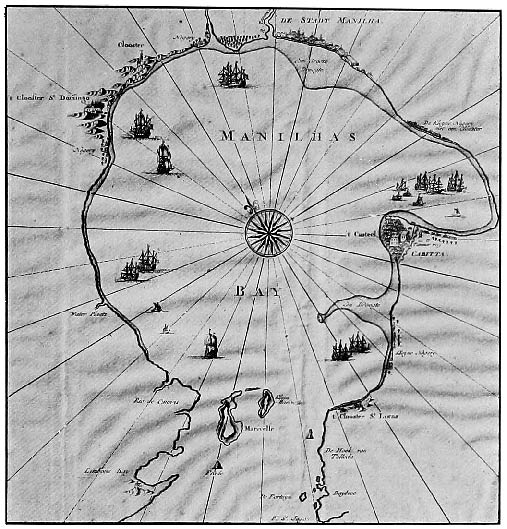
Chart of Manila Bay; photographic facsimile from Valentyn’s Oud en Nieuw Oost-Indien (Dordrecht en Amsterdam, 1724)
[From copy in library of Wisconsin Historical Society]
Commerce was also opened with the Portuguese of Macán, a trade which had been quite forgotten with the disturbances in China; and from that time it has continued, in varying degree, until this day. This trade, moreover, had been prohibited since the year 1640, on account of the wars with Portugal; but through the negotiations carried on at the court of Madrid by Don Fray Álvaro de Benavente, when he was procurator of this province—asserting that this was the best and safest means for the entrance into China for the missionaries who were going to Filipinas—the trade with Macán was opened and authorized, as was accordingly published in Manila by a royal decree; and it was made known to the Portuguese at Macán by another from their king, Don Pedro II. The pretext which was given for opening this commerce was the entrance of the missionaries into China, and its results have been various, according to what the Portuguese have found expedient for their own interests, on account of the pretensions which they make to the [ecclesiastical] patronage of China—in accordance with the line of demarcation [between the dominions] of the two crowns, by the celebrated bull of Alexander VI, a question which is not yet decided by a competent judge; and therefore our missionaries enter China when the Portuguese choose to let them do so. But the latter come every year to Manila with one or two shiploads of goods, which is the most profitable trade that they have, on account of its nearness and of their securing in barter the silver that is so esteemed by the Chinese. But as the Portuguese are so courtly and liberal a people, and inclined to boast of the obligations of nobility, some Portuguese gentlemen usually return quite destitute of funds—as occurred this year to Juan Tabora, a cavalier of the Order of Christ. He spent the wealth which he brought here, which was much, in elegant gallantries and in bull-fights; for he arrived here at a time when these and other sports were very frequent in Manila—not only on account of the prosperity and peace which were experienced during the entire term of office of Don Manuel de León, but through the jovial disposition of his favorite and secretary, Don José Castellar, who was a very witty and courtly man, and very fond of such pastimes. In these he spent whatever he was able to acquire, and when he came to die he was so poor that he was buried, through charity, in a chapel of St. Roque in the village of Mambong, belonging to the doctrina of Malolos in the province of Bulacán, which is in our charge.
This commerce with the coast of Coromandel had remained quite neglected by the Spaniards of Filipinas—who never had maintained any other trade and commerce than that with China, Japón, and Macán—until this year of 1674. Then a citizen of Manila, a Catalan, named Juan Ventura Sarra, a courageous man, having first made with a fragata which he owned a voyage to the kingdom of Siam, from which he gained some wealth, extended his navigation to this coast of Malabar, where he left trade established; and in the following year Don Luis de Matienzo went thither, with much silver, and gained enough profit to persuade the citizens of Manila to engage in this traffic. The principal commodity which is brought from the Coromandel coast is certain webs of cotton, many of them forty varas long, which they call “elephants,” which are highly valued in Nueva España; accordingly, it is this merchandise which is chiefly shipped to those regions.
The governor placed on the stocks the frame of the galleon “Santa Rosa,” the work of that accredited master of this important and useful art, Juan Bautista Nicolá; and it came from them one of the finest and largest galleons that had been built in the port of Cavite and made very successful voyages, sometimes being driven back to port. The governor commanded Juan Canosa Raguses, a very able builder of vessels with lateen sails, to build two galleys; these proved to be very suitable and swift, and rendered much service in driving away the Camucones, very crafty and troublesome pirates, who almost every year infest the Pintados Islands, plundering and taking captive. This is a barbarous people, cruel, and cowardly; indeed, they could not be the one without being also the other. They inhabit a chain of small islands, which extends from Paragua to Borney; some of them are Mahometans, and others heathen. But they [all] cause much damage to the Bisayan Islands, which they ravage without opposition—going so far as to carry away, in the year 1672, the alcalde-mayor Don José de San Miguel, as we have related in another place. They have a great advantage in the exceeding swiftness of their vessels, which enables them to find their defense in flight. Their confidence and boldness reached such a height that they even dared to infest the coasts of the island of Manila. The provincial of that time (of whom this chapter treats), Fray José Duque, while on his way to visit the islands of Pintados, came very near being made a captive, with his companion Fray Alvaro de Benavente; for they were attacked by a squadron of these pirates near the island of Marinduque, where they would have been a prey to their cruelty if they had not been protected by divine kindness, through the valor of Captain Francisco Ponce—a veteran soldier, who killed the captain and another of the pirates—and also the coming of a high wind, which gave wings to the champan to place itself in safety.
On account of his death the senior auditor, Don Francisco de Coloma, took charge of the government, in company with auditors Don Francisco de Mansilla and Don Diego Calderón y Serrano for civil affairs—for already had come the decision, in the controversy between the two auditors, by the royal and supreme Council of the Indias in favor of Don Francisco de Coloma, although his government lasted but a short time, on account of his death. During the time while they governed, however, they were very well agreed. The new governor despatched the ship “Santa Rosa” (which had just been completed) for Nueva España, in charge of General Don Francisco de Teja, a Navarrese gentleman; and it had a very prosperous voyage, as we shall see in due time.