Volume 42 — Chapter VIII
Reading edition
The government of Don Juan de Vargas Hurtado proceeded with prosperous results, on account of the favorable seasons and the great abundance of the crops which were experienced in the years 1679 and 1680; and through the success and extent of the commerce which was maintained with China and the Coromandel coast, Surrate, and other ports of Oriental India and the kingdoms of the Great Mogor—which formerly were more than fifteen in number, and furnished much income to the royal treasury with the customs duties [derecho de a nojarifazgo]. Not only from the Coromandel coast—on which the Manila trade had founded populous settlements, as Portonovo and Cololu—but from the city of Goa came ships almost every year, commerce little known [to Manila] before, and very remote. The governor devoted much attention to the sessions of the Audiencia and the obligations of his office, and thus the legal business which devolved upon that court was expedited, through the uprightness and integrity of the auditors, Don Francisco Mansilla, Don Diego Calderón, and Don Diego de Viga; the last named filled the office of fiscal acceptably to all.
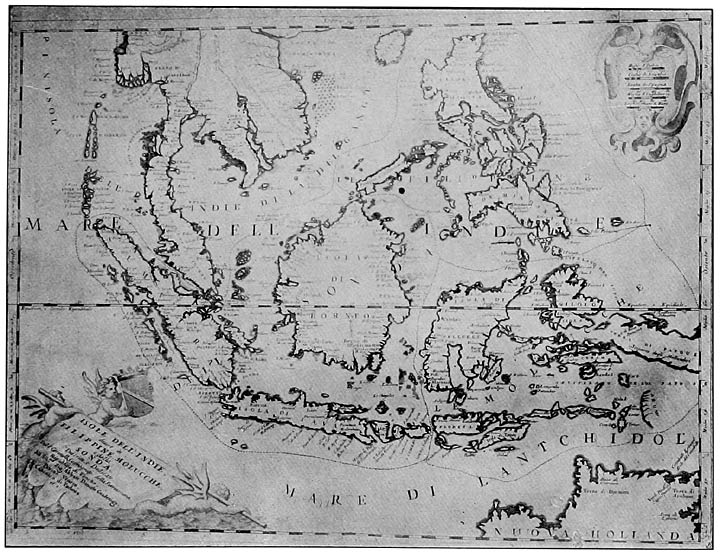
Map of Eastern Islands; photographic facsimile of map in Coronelli’s Atlante Veneto (Venetia, 1696)
[from original copy in Bibliothèque Nationale, Paris]
About this time there came to the general a solemn embassy from the principal ruler of Borney, whom those people revere as an emperor. This is the largest island of all Asia, and, according to the best cosmographers, has as great an area as all España and the kingdom of Portugal. It is thinly populated, as its surface is very mountainous; and therefore it is only on the shores of the sea and a few leguas inland that there are settlements of civilized people, if that name can be given to those barbarous nations. Borney has much wax, and in its seas are pearl-fisheries; it abounds in amber, camphor, and gold; and in its mountains are found large elephants, although smaller than those of Siám. Its inhabitants are partly Mahometans, partly heathens; but in color and disposition they resemble the natives of Filipinas, who say that they had their origin in these islands of Borney [and] the coast of Malayo. The ambassador was received with more ostentation than his person seemed to merit. Although he was corpulent and robust, he and all his retinue (which was not a small one) came barefooted and half-naked; he wore a broad bahaque, which tired him more than it covered him, and some wore a loose jacket, short and without a shirt (which is not known among these peoples); but all were well armed with lances and crises—which are swords as short as daggers, with which they are well able to defend themselves or attack, for usually they have these weapons dipped in poison. He made his entry [into the city] with great pomp, in the coach and with the halberdiers of the governor, and accompanied by the sargento-mayor of the garrison, Don José de Robles; and the governor received him under a canopy, as being he who represented the royal person. The ambassador’s credentials came in the Malayan language, written in Arabic characters; these were interpreted by the Borneans themselves, and by a Ternatan named Pedro Machado. The object of the embassy, they said, was to establish trade and commerce on both sides, and to adjust some disputes over the limits of the island of Paragua and in regard to some hostile acts which had been committed in the lands of Borney by Alcalde-mayor Don José de Somonte, in vengeance for the injuries which the Camucones had inflicted in our islands. Everything was settled to the satisfaction of both parties, and the ambassador returned well content and handsomely entertained, with a valuable present for his king in return for another (and very ordinary) one which he had brought. In the following year, the governor sent in turn an ambassador, General Don Juan de Morales Valenzuela, a man of gallant nature and tall stature, with a very goodly escort of Spaniards. He was very hospitably received by the king of Borney, in a large pavilion of bamboo and nipa, which was erected for this solemn function; and the king allowed himself to be seen by all his vassals, a favor which, they say, is very rare in that royalty. Don Juan de Morales returned very successful, the king ceding to the Spaniards dominion over all the island of Paragua, and making satisfaction for the ravages by the Camucones; and since then we have remained very good friends [with the Borneans].
All the three years’ term of our father provincial Fray Juan de Jeréz was very peaceable, our order and the observance of our rules nourishing in this province, which continually increased in prosperity through the opportune measures which this judicious and devout prelate employed; for certainly he was one of the most observant superiors it had had, and it made great advancement in every way during the time of his government.
It was decided in this chapter to ask our very reverend father general to extinguish the votes of the discreet of the convent at Manila, and those of the priors of the convents of Hagonoy and San Pablo de los Montes in the provinces of Tagalos, Mexico in Pampanga, Narvacán in Ilocos, and Dumarao in the province of Panay—on account of the usual scarcity of religious, and the deficiency which might be caused, by their absence while at the chapter, in Ilocos and Bisayas, provinces which are so remote. The other arrangements and ordinances which were made in this chapter publish its great zeal for promoting the regular observance, and the nourishing condition of that observance in this province.
Governor Don Juan de Vargas despatched for Nueva España the galleon “San Antonio,” under command of General Don Francisco Enríquez de Losada, then accountant of the royal exchequer; and in this galleon went the father procurator Fray Manuel Losada, and in his company father Fray Miguel de Negrea—a son of the convent of San Felipe, and native of that city [i.e., Madrid]; he was going back to his own province, and died on the voyage, in the high northern latitude. The voyage was a very distressing one, on account of the severe tempests which suddenly came upon them; and many of those on board died, not only seamen but passengers. A better voyage was that of the galleon “Santa Rosa,” which had sailed the preceding year by the same route from Nueva España, in charge of General Antonio Nieto; for on the morning of the day of St. John the Baptist it entered the bay of Manila, to the great joy of those who were watching it, and anchored at the port of Cavite—a good fortune which seldom has been enjoyed in these islands since the banishment of Don Fray Hernando Guerrero, in the year 1635, as we have with sadness related. In this galleon came Don Fray Diego de Aguilar, of the Order of Preachers, a native of Rioseco, as consecrated bishop of Zebú; for several years he had been detained in Nueva España. He brought in his company father Fray Manuel de Olivares, of the same order, who afterward was provincial of the province of Méjico; his nephew, Captain Don Juan de Urías; and other Spaniards. His arrival occasioned great rejoicing, on account of these islands having remained so many years destitute of a consecrated bishop, and many clerics and regulars were waiting to receive holy orders.
In this galleon arrived three religious belonging to the mission of father Fray Juan García; they were choristers, and had been left in Nueva España, to be ordained as priests, and their names are as follows: father Fray Francisco Castrillón, a native of Madrid, and son of the convent of San Felipe; he was twenty-four years old, and had spent nine in the order. He was a minister in Tagalos until the year 1690, when he returned to Méjico, where he died soon afterward. Father Fray Dionisio Navarro, a native of Leganés, and a son of the same convent of San Felipe; he was twenty-four years old, and had spent seven in the order. He was a good preacher, and well versed in the dialects of the province of Tagalos. He went to España and returned hither, and died in the convent of Manila from a long and painful infirmity, on November 2, 1714. Father Fray Antonio Gutiérrez, a native of Medina Sidonia, and a son of the province of Andalucía. For only a short time he was a minister in Tagalos, because he soon fell ill with a contraction of the tendons [tullimiento], which lasted until his death; this occurred at Manila, in the year 1693.
The arrival of this bishop of Zebú served as a great spiritual consolation for these islands; for he repeatedly performed pontifical functions, conferring holy orders on a great number of religious and clerics. He interceded with the governor, in order to reconcile with him those who had taken refuge in the churches through fear of some oppression from the absolute power of the governor—which can not be compared with any other power in the universe; and the worst is, that no means can be thought of for moderating and tempering it within the bounds of reason, because the distance of five thousand leguas which lies between the royal court of Madrid and Filipinas cannot be diminished. The swiftest post, therefore, requires three years, and most of them four; and if it happens that the galleon is obliged to put back to port, the mail is delayed to five or six years. At the end of so protracted a term as this, the most peremptory royal rescript is exposed to the danger of being withheld by the governor, according to his pleasure. The lord bishop with his intercession withdrew from asylum in the house of the Society of Jesus the secretary of Don Juan de Vargas, Captain Miguel Sánchez de Villanueva y Tejada, and restored him to favor with his master—although soon afterward the governor removed him from his service, making him alcalde-mayor of Laguna de Bay.
About this time the convent of Angat in the mountains of the province of Bulacán was received, with the title of our mother St. Monica, and father Fray Juan de Morelos was appointed its prior. It was composed of the visitas of the convent of Quingua—Tabuquillo, Abarungco, Catalonan, Guinapusan, and Santa Lucía—which, on account of being very distant from Quingua, were administered with much difficulty; and therefore the ministry of Angat was founded, more than three leguas distant from [the convent of] Sandago at Quingua. It has ordinarily two hundred and fifty tributes, with a church and convent of wood. The district is very healthful and pleasant, because the land is fertilized by a river of the best water that is known in these islands; it is the river celebrated by the name of Quingua, the waters of which, compared with many others, have been found to weigh less. This mission is bounded on every side by very fertile meadows, on which abundant harvests of excellent tobacco are gathered; for this reason it is thickly settled with people who cultivate this plant, which is so esteemed throughout the world, and which now has made its way to the chief personages therein. This district has forests, although they are scattered, of heavy and valuable timber; for they are very dense, and so extensive that they join those of Balete and San Mateo, at a distance of more than eight leguas. In the district of this ministry the religious of St. John of God possess a fine ranch stocked with cattle and horses, which is the most that they have for the support of their convent and hospital at Manila, where they aid the sick poor with their usual charity. The convent of Angat has no vote in the chapter-meetings, and therefore is counted in the number of the vicariates of this province.
Although the citizens of Manila are not easy to please, no matter how good their governors are, it appears that in the time of which we write they had much reason to be discontented with the government of Don Juan de Vargas Hurtado; for not only did he devote himself excessively to his own personal interests, to the detriment of the commonwealth, but he was of a harsh and unpleasant nature, and gave sharp answers. Besides this he spoke in a treble voice, and people heard him with difficulty. He kept every one angered at his harsh behavior, and disgusted by his being engrossed with, the pursuit of gain. This was recognized in the lading of the galleons, which is the net of the merchants; and in this year [of 1680] the galleon “San Antonio” was in danger of not making the voyage, on account of its being so overloaded by his henchman Don Juan Gallardo, the castellan of Cavite—not only with his own goods, but with those of his master the governor—that its commander, Don Tomás de Endaya, was compelled to unload the vessel and return to lade it anew, accommodating the entire cargo to the vessel’s capacity. On account of these and other well-known animosities against the governor and his retainers, the citizens this year determined to inform his Majesty against him; and they did so, the auditors and the city uniting for this purpose and making charges against him. They sent letters, with great caution, in this galleon; and these papers caused his removal in the year 1684.
About October of this year the governor sent to Macán General Antonio Nieto, in order to settle some disputes relative to commerce; he accomplished this with much discretion, his excellent procedure reflecting credit on the Castilian nation. He also, with great charity, relieved many cases of necessity, which in the said city are very numerous; but this was done without injuring one iota of the Portuguese tenacity and pride, in which that people exceed all others in Europa.