Volume 42 — Chapter XIV
Reading edition
In company with the above-mentioned governor came very distinguished officers, all Vizcayans; there were Don José de Escorta, Don Pedro Uriósolo, Don Francisco Alvarez, Don Bernardo de Endaya (who carried the despatches from his Majesty), Don Pedro de Avendaño, Don Matías de Mugórtegui, Don Francisco de León y Leal, Don Juan Bautista Curucelaegui, Don Andrés de Mirafuentes, Don José de Herrera, Don Manuel González, Don Lorenzo Mesala, Don Francisco Carsiga (who died a priest), Don José Arriola, Don Martín Martínez de Tejada, and Don Lucas Vais; all of them were generals and sargentos-mayor, whom we know as captains, and rendered much service and honor to these islands. In this galleon came Don Mateo Lucas de Urquiza; also Captain Lorenzo Lázaro, a noted pilot; Captain Don Francisco Cortés, boatswain; and for ship’s storekeeper Juan de Aramburu, a brave Vizcayan who served in many important exploits.
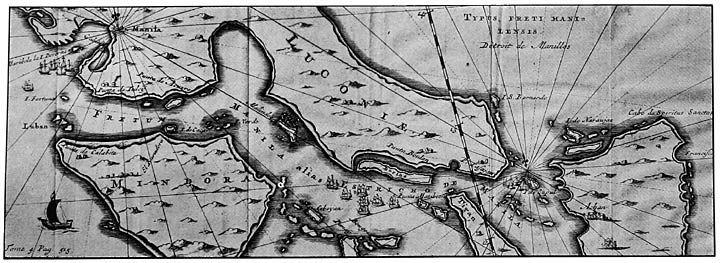
View of Strait of Manila; photographic facsimile from Recueil des voiages Comp. Indes orientales (Amsterdam, 1725)
[from copy in library of Wisconsin Historical Society]
In the almiranta “San Telmo,” in which returned the admiral Don Francisco Manuel de Fabra, came a numerous and excellent mission of religious of our father St. Augustine; it was sent by father Fray Manuel de la Cruz, who left these islands in the year 1680; he himself had been left in our hospice of Santo Tomás de Villanueva, outside the city of Méjico. This galleon “San Telmo” was in great danger of not being able to return hither, for, having set sail several days after the flagship, on leaving the port the rudder-irons broke, and the ship was almost unmanageable—a defect very difficult to repair in that place, on account of the scarcity of artisans at Acapulco. If it had not been for the diligence and energy of the warden Antonio Nieto, who sent to a great distance to get workmen, and made the repairs at his own cost and with his personal attention, this loss would have been irremediable; but his zeal and good judgment enabled the ship to pursue its voyage with but a few days’ loss of time, and to succeed in making port at these islands.
On the day following the entry of our religious into Manila, that is, the day of St. Bartholomew, the new governor, Don Miguel de Curucelaegui y Arriola, made his entry into the city; this was done with great pomp, and two triumphal arches were erected for him, by the college of the Society of Jesus and our convent, with very ingenious emblematic allusions in Latin and Castilian verse, and very expressive laudations. At this entry occurred a disaster which might have served to the heathen as a bad omen. Hardly had the governor entered through the Puerta Real, which they call Puerta de Bagumbayan, when a balcony that was on the side within the city wall above the said gate gave way, and fell, with great injury to those who were within it; so that many were left cripples, and among these a Recollect religious named Fray Luis. The fiscal of the royal Audiencia, Doctor Don Estebán de la Fuente Alanis, escaped the danger, the falling balcony striking his horse’s tail; and Captain Don Francisco de Arcocha, the equerry of the new governor, was hurt. But, although many were injured, the life of no person was endangered.
Don Gabriel de Curucelaegui began his government with great acceptability and satisfaction to all, and taking the measures necessary for the maintenance of these islands. The year of 1685 was a hard one on account of the general epidemic of smallpox which raged, not only in these islands but in all the kingdoms of China and Eastern India—especially on the Coromandel coast, where many millions of Malabàrs died. In Filipinas the ravages of the epidemic were great, principally among the infants; but the place where, it is affirmed, the pest caused incredible loss was in the mountains of Manila where the insurgent blacks [i.e., Negritos] dwell, so many dying that those mountain districts were left almost uninhabited. But it was not only among them that the disease wrought such destruction, but also among the deer and wild swine, of which there is an innumerable multitude in these mountains, even after they have contributed with their flesh to the support of so great a number of blacks. The reason why so many die with this contagion is, first, their weak physique; and second, the custom that they have of abandoning those who are attacked by the disease, on account of which they die much sooner—and, what is worse, in their heathen blindness. In China many millions of people died, so that there was no one to cultivate the fields; from this resulted great famine and mortality, after the epidemic of smallpox.