Volume 38 — INSURRECTIONS BY FILIPINOS IN THE SEVENTEENTH CENTURY
Reading edition
Gadanes; 1621
[An account of this uprising is given by Aduarte in book ii, chap. xvii, of his Historia; see our VOL. XXXII, pp. 113–120.]
In Bohol and Leyte; 1622
[See account of the Bohol revolt in VOL. XXIV, pp. 116–119; it also spread to Leyte. We present here some further account, obtained from Murillo Velarde’s Hist. de Philipinas, fol. 17, 18; Diaz’s Conquistas, pp. 132–136. Concepción (in Hist. de Philipinas, v, pp. 20–25) adds nothing new.]
Mandayas; 1625
[For particulars of this insurrection, see Aduarte’s Historia, book ii, chaps, xxviii, xxx, in our VOL. XXXII, pp. 147–152, 162. Cf. Ferrando’s account, Hist. de los PP. Dominicos, ii, pp. 114–117; and our VOL. XXII, pp. 69, 95.]
In Caraga and in Cagayan; 1629
[See VOL. XXIV, pp. 165, 175, 177, 216, 217, 229; and fuller account of that in Caraga, in Concepción’s Hist. de Philipinas, v, pp. 163–179 (in our VOL. XXXV, pp. 89–91).]
In Nueva Segovia; 1639
[See Santa Cruz’s account (Hist. Sant. Rosario) in our VOL. XXXV, pp. 47–51.]
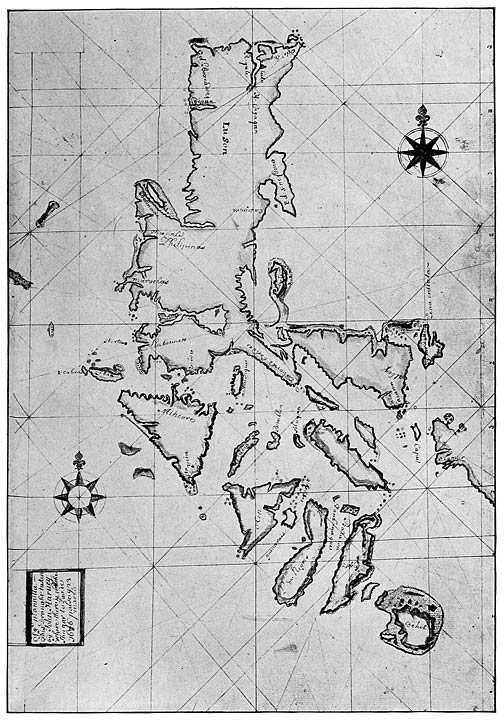
Map of the Philippine Islands, drawn by Captain John Kempthorne, ca. 1688; (evidently from earlier map of 1676); photographic facsimile
[From original manuscript map in the British Museum]
In Pampanga, 1645; and in Bulacán, 1643
[The following is taken from Diaz’s Conquistas, pp. 483, 484:]
In the Pintados; 1649–50
[The best authorities on this insurrection are the Jesuit historians, since it arose in regions under their spiritual charge. We select the earliest account, that of Combés, written while the incidents of that time were fresh in men’s minds; it is found in his Hist. de Mindanao, col. 489–498. Murillo Velarde also relates these events, in Hist. de Philipinas, fol. 171b–175. Cf. the Augustinian Diaz, in Conquistas, pp. 517–523; and the Recollect Concepción, Hist. de Philipinas, vi, pp. 247–280.]
This occasion made sufficiently evident the greatness of the benefit that the islands owe to the Society for the [treaties of] peace made with these kings—thus finding the royal arms at liberty for more pressing exigencies, and being set free, as regards those kings, from the most painful anxiety lest their forces would be allied with our dangers. With this, attention could be given to the punishment of Burney, a pirate as cruel as impious; and to finding external relief in the domestic losses and evils which had rendered our safety so uncertain. [Our forces were thus ready] in an almost general revolt of all the islands, in the provinces that were most subjugated and had never tested the keenness of our arms; for they had yielded to the echoes of our trumpets, receiving our troops in peace. But in these recent years had been operating in these new worlds the influences of that malign planet which was ruining Europe (and especially our España), with revolts of entire kingdoms, and has caused rivers of blood to run in the populous kingdom of China; and it reached these islands, to wreak on them its fierceness. And God—permitting evil, for the credit of virtue and the reward of the good—gave warlike courage to the most pusillanimous tribes, and armed the nakedness of these Indians to resist the unconquerable steel of our Spaniards.
For two days the fathers remained at home in suspense, without understanding the cause of this evil deed, or knowing who was its author; and the rebels themselves delayed to commit sacrileges by breaking with shame and declaring themselves [rebels]. Finally, on the day of Corpus Christi, about noon, the murderer came in sight, leading the multitude, and openly declared that it was he who had slain the father, loudly defying the whole world. They gave the fathers and the brother whom they found in the house the opportunity to leave it, provided that they removed nothing from it; and immediately, as barbarians and enemies of God—forgetting the faith and Christian belief of so many years, in which they had grown up—they sacked and burned the church and house, profaning the ornaments, and cutting from them drawers and turbans according to their old-time usage. If there were any of the faithful [among the crowd], they let themselves be persuaded by the argument of the barbarians for their timidity, that if they remained among the insurgents the anger of the Spaniards would be moderated, and accordingly they followed the perverse ones. The report of this sacrilegious act fanned the flame of infernal zeal itself, and found the minds of the people so ready that, almost as if there had been a general decision and they only awaited the signal for putting it into execution, in almost all the villages on that coast they burned their churches, the ministers fled, and the rebels retreated to the mountains, where they fancied they could maintain their former brutal mode of life.
In the rest of the provinces—either because they perhaps regarded it as somewhat discreditable that the men of Ibabao should display their valor in order to oppose the Spaniards, and they themselves not do so; or because all of them were (as some desire to be) in communication with the Dutch—they proceeded to follow the example and imitate the boldness of the men of Palapag. Our arms would be found greatly embarrassed if those of the Dutch were to add confidence to the insolence of the Indians; and, at the very least, there would not remain a province which would not be up in arms, and no minister or Spaniard of those who were scattered among them would escape. But God our Lord, who chastised as a father, and chose to correct with clemency the wickedness with which the Spaniards abuse the subject condition of these natives—and as a warning to the latter, to confirm them in the truth of our holy faith and disabuse them of their errors—so adjusted the times that although the Dutch fleets had not failed to come to the islands for ten years past, about that very month [i.e., June], in this year the peace kept them away, and the publication of it arrived here in good time, so that our forces were left free for the punishment [of the rebels].
Immediately the province of Camarines, on the mainland of Manila, declared itself against us, and the father guardian [of the Franciscans] was banished from Solsogon; and their lead was followed by their island of Masbate, where an alférez was put to death. This presumptuous act disturbed the peace of Cebú Island; and its natives also, without fearing the strong fort and the city to near them, also defied us, another officer being slain there. In the province of Caraga, the men of Linao revolted, displaying their evil intentions by the murder of the father prior (a discalced Augustinian), and of the Spaniards in a small garrison which was kept there, some dozen in number; but few escaped, and those were badly wounded. In the province of Iligan, which borders on Caraga, the Manobos, a barbarian tribe, seized the peaceable village of Cagayan. The entire coast [i.e., of northern Mindanao], and the adjacent island of Camigin, followed their example; in Camigin they bound the father prior (also a discalced Augustinian), the impious Indians going so far as to place their brutal feet on the neck of the holy religious. In the jurisdiction of Samboangan, the Subanos went astray—their principal village, named Siocon, releasing itself from obedience with the sacrilegious parricide of Father Juan del Campo, and the atrocious murder of his companions, as we shall afterward relate. The Boholans, on account of their valor, retained their esteem for the faith. Thus, for the punishment of so many atrocious deeds and for quelling the insolence of the barbarians, there remained to us no other arms than those of Samboangan, and no other auxiliaries than those people who had been our friends for so few years.
Those of Ibabao aroused the utmost anxiety, their insolence continually calling us to arms; for, not content with atrocities in their own country, they went to disquiet another region. They even disturbed those who dwelt on the opposite coast of Samar, threatening them with ruin if they did not follow the lead of the others. Their attempts began to be dangerous, since they stirred up the village of Paranas, which is only two leguas from the seat of our jurisdiction there—Catbalogan, where the alcalde-mayor resides; and in fact many fled to the mountains, without regard to the war which menaced them, when the Spaniards were placed under arms, two leguas from their abode. In the other villages [the natives] were in arms, and regarded us all with apprehension. At the outset, the alcalde-mayor was ready with such force as he could assemble—adventurers in the province, mestizos, and Indians; but, as the former were all collectors [of tribute] and the latter all relatives [of the insurgents], some were not accustomed to arms and the hardships of campaigning, and the others could not use weapons against those of their own blood. Accordingly this, instead of checking their fury, only rendered their boldness more insolent, and gave unwonted force to their arms; and men who before did not find enough woods in which to hide themselves from a Camucon ship, now went so far as to make daybreak assaults on our troops, and slew our men before our eyes. And as a final token of their contempt, when the captain demanded from them the head of Sumoroy, by way of atonement for what he had done, they sent down the river to him the head of a swine—although in the end, worn out, they considered it good luck that they could again secure peace.
[The authorities] in Manila, seeing that the revolt was continually gathering strength, and that the insolence of the insurgents was passing all bounds, recognized how important it was to repress it, undertaking its chastisement in earnest. For this purpose they despatched General Andres Lopez de Azaldigui (who was chief of the royal galleys of these islands), with the title of lieutenant of the captain-general; and with this authority he levied many Spaniards, being empowered to obtain them from all the fortified posts. He made all the necessary arrangements for the enterprise, but he soon recognized the danger that he incurred among the natives—who all, regarding those of Palapag as restorers of their liberty, were rejoicing over their successes—and that in our reverses we had cause to fear them as enemies, since they were on the watch to know what fortune those of Palapag had in order to follow it if they were sure of the result. A large fleet of native boats was needed for the transportation of provisions and military supplies; but, the greater the number of these that were thus assembled, the more was the danger increased. On this account the general wrote to Manila, demanding galleys; and there, in order to avoid the expense of galleys and the perils of seas so rough, they despatched orders that the armada should come from Zamboangan—for the loyalty of those people against the Bisayans, as against their old-time enemies, could not be doubted. And with the support of these [auxiliaries] effective aid might be rendered by those of the inland provinces, which had been ruled without risk by the Spaniards because they did not go there entirely in the hands of the natives.
The armada was despatched as promptly as possible by the commandant [of Zamboanga]. Sargento-mayor Pedro Duran, with two captains in active service—as chief, Captain Juan Muñoz, who was commander of the armada; and as second in command Captain Juan de Ulloa—with the most choice and distinguished soldiers of the Lutaos. As leader of these, since he was the military chief of that people, was sent General Don Francisco Ugbo (whom I have previously mentioned), with the master-of-camp, sargento-mayor, and captains of the tribe, and as many as four hundred of its men. Father Francisco Martinez had then arrived at Samboangan, to act as rector of the new [Jesuit] college there—of which the official recognition from our father general came in this same year—a religious who deserved well of those Christian churches, for he had sustained them in their earliest infancy, having labored in the arduous beginnings of [the missions in] Joló and Samboangan. By this [departure of the Lutaos] Father Alexandro Lopez found his occupation gone, and was therefore able to embark with the armada, which needed his presence and aid, as it was going for so important an enterprise—on the fortunate result of which, as many thought, depended the fidelity of all the provinces of Pintados. All fortified themselves with the holy sacraments, as solicitously as Christians of very long standing could do; and, as if they were such, on all occasions which arose in the voyage and in the battle itself they made evident, by their reverence for their holy name [of Christians] and appreciation of the danger, how they felt these obligations in their hearts. The sargento-mayor of the tribe (who belonged to its highest nobility) encountered a temptation to his own perdition; but he put it behind him by saying that he was going to war, and could not at that time discuss a matter which would work injury to his soul.
Great was the rejoicing which this armada caused in all the towns where it landed, notably in the city of Cebú, where the Lutaos were known (and most of them, especially those who commanded the joangas, had the reputation of being pirates), at seeing them, now Christians, repair to the churches with so much devotion and attend divine worship with such reverence—those very people who had ravaged the islands with fire, and damaged nearly all the churches of Bisayas with their outrages and robberies; those who yesterday were enemies, but today bearing arms in our aid; and those who yesterday were cruel enemies to God, now the avengers of insults to Him. Tears sprang to [the eyes of] all, and they did not cease to give a thousand thanks to the fathers for their labors, so effectual—not only in the conversion of that Moro people, but for the benefit of these Christian communities, removing their terror and turning their dread and mistrust of the Moro arms into joy and expectation of success.
Arriving at Palapag by the month of May [i.e., in 1650], they found that the leader of the campaign was Captain Don Xinés de Roxas; and that it had been much retarded on account of the reputation which the men of Palapag had steadily gained by their daring acts. They had fortified themselves on a height which was regarded as impregnable by nature, as only one path was known by which it could be ascended, and that very narrow and difficult. On this path the enemy had built fortifications, and from loopholes therein they did much damage to our men, without risk [to themselves]; they lost no opportunity to fall suddenly on our troops, and any man who strayed from the rest paid the penalty with his life, so sharply did they note any negligence on our part; and, as masters of the land, they boldly engaged us, secure from being pursued. The captain wearied himself much with various fortifications, and kept the men exhausted; and he engaged in the same fatiguing labor those of the armada, until the sargento-mayor of that tribe, Don Alonso Maconbon, was bold enough to ask him, face to face, why he was wearing out the men in work which was not important.
He told the captain that they had not come to haul logs, but to fight in battle, and that he must contrive to employ them in fighting; for, if he did not, they would go back to their homes. At seeing the daring of this man, and the angry words that the soldiers of Samboangan—who, as veterans, were eager to have an opportunity for distinguishing themselves—flung at him, although he resented their lack of respect he was rejoiced to see their courage; and he was encouraged to make the assault, which, with the coxcombs and foppish adventurers from Manila, seemed a dangerous enterprise. And, as those of the armada, it seems, were boasting most of their valor, he assigned them to the brunt of the battle, in order thus to employ their courage in carrying out their own advice.
The Lutaos dispersed through the place, and, breaking into a house, found the mother of the traitor and parricide Sumoroy; and they dragged her out and tore her to pieces. Sumoroy had been sent down [from their stronghold] the day before, secretly, in a hammock, and all the children and women the rebels had already placed in safety; for, from the day when they saw the Samboangan armada, they felt that their cause was lost, and, lacking confidence in the outcome, they forestalled the danger. Thus was ended this longed-for enterprise, and the war in Ibabao; for the natives, now disarmed and divided, would have no courage left, save for flight, and the hardships of a life so full of fear [as that of fugitives] would oblige them to surrender, one by one—as was actually the case. Accordingly, the armada [and its men] took their departure, leaving the islands thankful for what they had accomplished and edified by their good example. For in the heat of conflict and in dangerous encounters (which is the time when the natural disposition and the inner soul are displayed), those soldiers did not fail to invoke the sweet names of Jesus and Mary, without ceasing or neglecting this in the utmost confusion and ardor of battle, giving pious examples to the Christian soldiery—to the admiration of the natives, [although they were] accustomed to these [pious] observances; since the clamorous efforts [of the soldiers], and solicitude for their danger, disturb the piety of even the oldest veterans.
[We append to this the following account from Diaz’s Conquistas (pp. 517–523), as being more detailed and furnishing a somewhat different light on various incidents of the insurrection. In order to place it in the present document, as belonging to this special subject, it has been removed from its place in Diaz’s history of his order and its missions (see VOL. XXXVII, pp. 149–284).]
There was an Indian named Sumoroy in the village of Palapag, who was regarded as one of the best, although he was one of the very worst, and was as evil as his father—who, accredited with the same hypocrisy, was a babaylán and priest of the devil, and made the other Indians apostatize. He was greatly addicted to drunkenness, and he had so promoted it [in others] that all the village was contaminated with this vice, as well as that of lust—vices so closely allied to idolatry, of which truth there are many examples in Holy Writ. The inhabitants of Palapag were corrupted by those evil habits at the time when Governor Don Diego Fajardo—with the intention of relieving the near-by provinces of Tagalos and Pampanga from the burden of working, at the harbor of Cavite, in the building of galleons and vessels necessary for the conservation and defense of these islands—had ordered the alcaldes of Leite and other provinces to send men thence to Cavite for that employment. That was a difficult undertaking, because of the distance of more than one hundred leguas, and the troubles and wrongs to the said Indians that would result from their leaving their homes for so long a time. The father ministers went to the alcaldes, and the latter to Manila, to represent those troubles and wrongs; but the only thing that they obtained was a more stringent order to execute the mandate without more reply. Consequently they could do nothing else than obey the orders of the superior government, although they feared what very soon occurred. But what good end could so mistaken and pernicious a decision have?
It was the will of divine Providence to show forth the devout fidelity of the women amid the infidelity and apostasy of the men; for, the day before that spoliation, Doña Angelina Dinagungan, wife of Don Juan Ponce, accompanied by another good Christian woman, Doña María Malón, went to the church and saved some holy images and ornaments, besides a chest belonging to the father, with the little that it contained, which they afterward surrendered to him. Among the images that that devout woman saved from the sacrilegious hands of the rebels was an image of our Lady of the Conception, which was kept with great propriety in the house of Doña María Malón, and which was often seen to sweat abundantly and to shed tears, a miracle which spread throughout the village. When the perfidious Sumoroy heard of it, he said: “The Virgin Mary is weeping. Let us see if she will weep if we burn the house;” and he went thither, with other men like himself, and set fire to it. But Divine Clemency did not permit the fire to catch in that house, although it was of bamboo and nipa like the others. The husband of Doña María Malón, called Don Gabriel Hongpón, was a head man [cabeza de barangay]; and only he and all his people remained faithful to God and to their king. God gave him courage to resist so many, who always respected him as he was so influential a man in that village of Palapag.
Governor Don Diego Fajardo, seeing that the undertaking of the reduction of the inhabitants of Palapag was an affair requiring much care and consideration, because of the evil effects that would result from any unfavorable event, after holding a council of war determined to entrust this undertaking to the commander of the galleys, Andrés López de Asaldigui (already named on many occasions), as he had all the good qualities which can form a good soldier; for he was very brave and prudent, fortunate in the enterprises that had been entrusted to him, and a prime favorite with the soldiers because of his great liberality. That commander left Manila with the best men whom he could enlist, both Spaniards and Pampangos, and went to Catbalogan, the capital of that province, where he mustered thirteen oared vessels and two champans. His first order was to send some vessels to Panay and Iloilo for food. Well informed of the condition of the rebels of Palapag, he found that he needed more war-supplies for that conquest; for the insurgents had extended their revolt to many villages of the island, and the other neighboring islands were apparently prepared to follow their bold acts, if they were at all fortunate. Therefore Andrés López de Asaldegui sent to ask the governor for the galleys in his charge; but the latter did not send them, in order to avoid the expense that would be caused the royal treasury, which was very needy. But he sent order instead that the fleet of Zamboanga should be at his disposal.
[At this juncture, Asaldigui is summoned by the governor to investigate the loss of the galleon “Encarnación,” and “entrusting the Palapag enterprise to Captain Ginés de Rojas—a brave soldier, but one who had little reputation and affection among the soldiers, who regretted that order exceedingly, and would have returned home had they been able. To such an extent does the reputation of the leader further any enterprise.”]
Don Ginés de Rojas assembled the thirteen oared vessels and the two champans, in the latter of which he stowed the food. Likewise the fleet of Zamboanga came up with four caracoas and some Spaniards, and four hundred Lutaos; these are Indians of that region who have been recently converted to our holy faith from the errors of the cursed sect of Mahomet, by the efforts and toil of the religious of the Society. Their commandant was their master-of-camp Don Francisco Ugbo, a Lutao, and a brave man; and their sargento-mayor Don Alonso Macobo, of the same nation. The chief commander of that fleet was Captain Juan Muñoz, the admiral was Juan de Ulloa, and the captain was Suárez, who were veteran soldiers. In addition to that succor there came from Cebú Captain Don Francisco de Sandoval and Juan Fernández de León, who brought many men from Sialo, Caraga, and other provinces. When all those forces were assembled in Catbalogan, Don Ginés de Rojas divided them into three divisions, two under command of Sandoval and León, and the third in his own charge. He ordered Captain Sandoval to go to his encomienda at Catubig, and thence, with all the men whom he could assemble, to go to reduce the village of Palapag. Captain León was ordered to go with his men through Tubig, Sulat, Borongán, and other villages—first, however, to go to Guigán, to get as many men there as possible. Don Ginés de Rojas chose the villages of Catarmán and Bobor, where his encomienda lay.
All things were ready to undertake the conquest of the impregnable hill. Nothing worthy of note happened to Captain Don Francisco de Sandoval, but the Indians of Bacor prepared an ambush against Juan Fernández de León in a very dangerous pass. Juan de León de Paranas had gone out, embarking in the river of Nasán, which is very rapid because of its great current—and among other dangerous places is one more dangerous than all, namely, a fall and cataract which is two spear-lengths in height. Consequently, in order to proceed, one must unlade the boats; and, after raising them with great toil by means of certain very thick and strong rattans, must, after suspending or letting the boat down thus, again lade it. There did the enemy set their ambush for Juan de León, but it was disclosed by a friendly Indian. Our men firing their muskets and arquebuses at that side, the Indians fled with great loss; and our men proceeded to the bar of the river, where they fortified themselves in a stout stockade. Sandoval did the same in Catubig, as did Don Silvestre de Rodas, whom Don Ginés sent as a reënforcement to Sandoval.
Those leaders, having arranged matters in this manner, continued to invite and pacify the many Indians who presented themselves. But those who were entrenched on the hill, confident in their fortress and defense, persisted obstinately in their revolt, and tried to get the other villages not to declare in our favor. Don Ginés fortified his post, and ordered each captain to do the same with his, for he had resolved to blockade and capture the natives on the hill by hunger. The natives learned from their spies that Don Ginés had but few men in his quarters, as the rest had gone to get provisions; and, having determined to use so favorable an opportunity, many of them went at night, by the river, near the land. When they thought that our men were very careless and sound asleep, they pulled some stakes out of the fortification of Don Ginés, and entered in a disorderly mob. But the sentinels hearing the noise, sounded the alarm. Don Ginés, awaking, seized his sword and buckler; and, accompanied by those who could follow him so hastily, confronted the enemy, and drove them to flight with great loss—as was judged from the abundance of blood that was seen in the camp in the morning. But it was not without any harm to our men, some of whom were wounded, although no one died. One ball struck Sumoroy on the shoulder, but only one dead man was left in the camp; for our opponents dragged the others away and threw them into the water. Don Ginés did not care to pursue them, fearing some ambush, which would have been easy in that darkness.
The soldiers grumbled much at the great caution and prudence of Don Ginés de Rojas, who thought only of strengthening his fortifications, to the great labor of those who now desired to busy themselves with the enemy, and not the trees of the forest. That rose to such a pitch that the sargento-mayor of the Lutaos, Don Francisco Macombo, went to Don Ginés impatiently, and told him that neither he nor his men had come from Zamboanga to cut timber but to fight with the enemies of Palapag. Don Ginés was not displeased to see the willingness of his soldiers to fight, and therefore, in order to employ it, he had the men called to arms, and arranged the attack. He formed two divisions [for attack] from the whole army, and left the third to guard the camp. The assault was made in two parts—one by the open road, although it was better defended by the opponents; and the other by a precipitous path which was passable for the birds alone—for it was a huge steep rock, and so narrow at the place where the camp of the insurgents was established that only a single man could enter an opening made by nature—a place called for that reason by the natives, in their own language, “the eye of a needle.” The men climbed up by that path, using feet and hands without carrying their arms; for these were carried by him who followed, and afterward given to him who was ahead; and so they did one with another. In addition to that, the insurgents had posted a sentinel there to advise them of any new move, for which a few coming to his aid would be sufficient to prevent many from effecting an entrance.
Don Ginés entrusted that difficult undertaking to Captain Silvestre de Rodas, a native of Rota, and a soldier of great renown in his time, of whom are recounted incredible exploits performed by him in Ternate. He gave him command of the Lutao soldiers, with their commander Don Francisco Macombo; for himself Don Ginés took the battalion of the soldiers who attacked the hill in front. The vanguard and rearguard were placed in command of Captains Sandoval and Juan Fernández de León. The assault being planned in that form, Don Ginés engaged the enemy with his men, with great valor, to the sound of drums and trumpets, and went up the hill with great difficulty and danger. For the insurgents, cutting the rattans by which the stones and very large trunks of trees were fastened and kept back, would have been able by rolling them down to do great damage to our men, had not divine Providence directed these missiles to places where they could do no damage. Our men went up most of the hill with this obstinacy, and the enemy went out to meet them with so great valor that it seemed rather desperation; and the damage inflicted upon them by our arquebuses did not cool their obstinacy, for they tried to throw themselves on our spears and swords in their anxiety to die while killing [others]. The great advantage of the fortress of the hill increased their courage, as it could have caused great loss to our men to fight in the open and unsheltered. The fight lasted many hours, the enemy often being relieved, for they had many brave and well-armed men on the hill. Don Ginés de Rojas, seeing that the fury of the enemy was invincible (for they were fighting more like lions than like men), and that his men could not proceed with the undertaking, because they had no further strength and were tired, and had many wounded, yielded for the time being, and sounded the retreat, leaving more vigorous experience for another day. The enemy also retired, satisfied at the resistance that they had shown, although much to their cost.
Very different was the success of the brave Silvestre de Rodas, with his Lutaos in charge of Don Francisco Ugbo and Don Alonso Macombo, who on the second of July, 1650, made the assault in the most difficult point—which was the eye of the needle in the rock, as we have stated above, through which Silvestre de Rodas was the first to go. He chose the silence of the night, a time when they were least likely to be discovered. Climbing up one by one and without arms, with the labor that was necessary, at the middle of the ascent an obstacle occurred that could have blocked so great an enterprise. That was a very heavy rain, which lasted a great part of the night, and which the men endured without the slightest shelter, but with great vigilance and care that fire for their matches should not be lacking—availing themselves for that purpose of the shields of the Lutaos, which are called carazas, and are made of long narrow pieces of wood, with which they cover all the body at the side. The rain ceased and, although they were soaking, they all resumed the ascent of the hill; they reached the entrance of the rock at an opportune time, when the sentinel, quite unsuspicious of such an assault, was absent, as he had gone to get some fire (without the company of which those Indians cannot live), or indeed have a smoke, for they think that that furnishes them with fine company. On that account, Silvestre de Rodas and some of the foremost, who were the most vigorous were enabled to enter. The sentinel returned with a brand in his hand, and when he was near perceived the bad effect of his carelessness, and believed that our camp was already upon him. He looked in astonishment, and then, hurriedly taking flight, began to cry out and announce that our men had already entered the hill by means of the rock. Not less was the confusion of all, who were quite free from the dread of so unexpected an assault. Confused and lacking in counsel, a panic terror seized them and forced them into disorganized flight, so that Silvestre de Rodas and the Lutaos were allowed to become masters of the field. Unfurling their victorious banners, they took possession of the lodgings, trenches, and food of the enemy. Don Ginés de Rojas ascended the hill with his whole army, and destroyed the insurgent quarters by setting fire to them. Having published a general pardon, those who had been insurgents before, presented themselves in peace.
The chief leader Sumoroy and his sorcerer father refused to put in an appearance, or to talk of peace. But the very ones whom he had caused to rebel killed him, and carried his head to Don Ginés de Rojas, although they had been so loyal to him before that when the alcalde-mayor of Leite went at the beginning to reduce them to peace, and asked them as the first condition to deliver to him the head of Sumoroy, they, making light of the request, sent him the head of a swine. But afterward, as a token of their true obedience, they delivered the head, without any one asking for it. Don Juan Ponce remained in hiding in the island of Cebú for a long time, but after having obtained pardon he returned to Palapag; there he committed crimes that were so atrocious that the alcalde-mayor seized him and sent him to Manila, where he paid for those crimes on the scaffold. He who had the best end was Don Pedro Caamug; for he was the first to present himself, and showed great loyalty in the reduction of the others. He continued all his life to be very quiet, and was governor of his village, where he was highly esteemed; and it was proved that he was not the one who had killed Father Vicente with his hands, although he was captain of that band. Moreover, it was found to be advisable to overlook much on that occasion, as the quiet of all the Pintados Islands, who were awaiting the end of the rebels of Palapag, depended on it.
[The following additional information is obtained from Concepción’s Hist. de Philipinas, vi, pp. 247–280:]
[pp. 273–281: After the rebellion was put down in Leyte], the Indians of Bisayas remained more quiet; by those so costly experiences they had been undeceived, and had learned that it is impossible to shake off the Spanish yoke, by force or by fraud; their wildness subdued by trade and intercourse [with us], they recognize that they ought not to thrust aside what produces so many advantages for them in being treated by our sovereign as his children. These tribunals treat them with charity, mildness, and justice, besides bearing with their troublesome traits and their weaknesses, without adding injury to their wretched condition.
Don Francisco Ugbo returned from the Palapag expedition wounded, and attacked by a serious malady, which was declared mortal. This commander, learning that his last hour was at hand, showed how deeply rooted was the Christian religion in his heart, although it was of recent growth; he received the holy sacraments with extraordinary devotion and reverence, exhorted all his family and acquaintances to become good Christians, and in the midst of his intense pains endured them without complaint or anger. In his testament he commanded, as his last wishes, that his property should be shared between his relatives and his soul [i.e., in saying masses for its repose]; and he died while offering fervent acts of contrition, to the admiration and consolation of those who were present.
[See Santa Theresa’s account (in VOL. XXXVI) of one of the outer waves of this insurrection, that among the Manobos of Mindanao.]
In Pampanga and Pangasinan; 1660–61
[The following account of this revolt is taken (partly in synopsis) from Diaz’s Conquistas, pp. 568–590. These events are also related in Santa Cruz’s Hist. Sant. Rosario, pp. 331–341; Murillo Velarde’s Hist. de Philipinas, fol. 253b–256; Concepción’s Hist. de Philipinas, vii, pp. 9–35; and Ferrando’s Hist. de los PP. Dominicos, iii, pp. 67–74.]
[p. 568:] All the ten years of the government of the prudent and magnanimous governor Don Sabiniano Manrique de Lara were a melancholy period of troubles and misfortunes, greater and more continual than these islands had ever before suffered; and without doubt they would have been more painful and intolerable if they had not been ameliorated and diminished by the discretion, affable behavior, and clemency of this great governor—so that it seems as if divine Providence (or, in heathen phrase, Fortune) had trained Don Sabiniano for a governor in such times. [Diaz then enumerates several of these disasters, notably the losses of richly-laden galleons.]
[p. 571 et seq.] So frequent were these losses that Don Juan Grau de Monfalcón, procurator in Madrid for the city of Manila, in a curious treatise which he presented to the royal and supreme Council of Indias makes a computation of them for sixty-five years, and finds that only fifteen of these were exempt from such misfortunes. But they were almost continual in this calamitous term of office, although Don Sabiniano met all these disasters with serenity and steadfastness, and apparently with cheerfulness; this he did through prudence, in order that the sorrow [of the people] might not extend to despair.... But no art could long veil so much misery. The more warlike provinces of these islands ascertained the unusual events which had caused our forces to be so small, however much prudence dissimulated these; and they sought to avail themselves of so good an opportunity, deeming it a suitable time for recovering their liberty, a gift of priceless value. Subjugation is always a matter of coercion, and this in turn needs other and greater violence that it may repress this natural inclination; and in natives whose condition makes them abject this desire increases more vehemently. They did not realize that the Spaniards had freed them from the harsh captivity of their barbarous tyranny, transferring them to an honorable subjection which made them more the masters of their liberty, because these rebels had not endured that tyranny. They came to know our lack of strength, and from that passed to despising it; they presumed more on their own strength than they ought, and rashly went on, without consideration, looking only at the end and forgetting the means [to attain it].
The first who decided to try fortune by experience were the Pampangos, the most warlike and prominent people of these islands, and near to Manila. [Their rebellion was] all the worse because these people had been trained in the military art in our own schools, in the fortified posts of Ternate, Zamboanga, Joló, Caraga, and other places, where their valor was well known; but it needed the shelter of ours, and therefore it was said that one Spaniard and three Pampangos were equal to four Spaniards. This people were harassed by repeated requisitions for cutting timber, for the continual building of galleons, and they received no satisfaction for many purchases of rice for which the money was due them. The province of Pampanga is in our charge in spiritual matters, and there we have sixteen convents and doctrinas, among the best which there are in this field of Christianity. The convents are: Bacolor (which is the head of them all), Baua, Lubao, Sexmoan, Betis, Porac, Mexico, Minalin, Macabebe, Apalit, Candava, Arayat, Magalang, Gapan, and Santor. Then in the hill-country beyond these places we have large missions of warlike peoples who are being converted to our holy faith, called Italones, Abacaes, and Calonasas, and Ituríes, and various others, who have been induced to settle in several villages. These are continually increasing, and we expect in God that they will attain much growth if it is not interfered with by subjecting them to tribute and personal services, of which they have a great horror. These are the hindrances which delay the conversions of these numerous peoples, some heathens and others recently converted; for among these tribes of low condition the appetite for liberty increases with great force—spurred on by the envy which is aroused in them at seeing the freedom which is enjoyed by other peoples as being more noble or vigorous, or because the cultivation of their mental powers procures it for them. Many peoples were conquered because they did not know their own strength until they found that they were subdued. In these islands we find by experience that in no province do the people live more peaceably than in those which received us with hostility, and in none have they attempted a change [of rule] except in those which invited us with [offers of peace]—and the most pusillanimous of these have most strenuously endeavored to throw off the curb of subjection. Those immediately surrounding Manila were the last to do so, because in them our hands had seized the reins. Some were intimidated by the contact with our power, and others were restrained by a sense of honor, seeing themselves admitted to the privilege of [carrying] our arms, and honored by the confidence which up to this time had been merited by the fidelity of the Pampango people. On this occasion they were the first who broke away, because even our esteem could not remove from them their mean nature.
The governor took with him, besides his alférez Francisco de Roa and others, the following recently-created officers: Generals Don Felipe de Ugalde, Juan Enrique de Miranda, and Don Juan de Vergara; Admirals Don Diego Cortés and Don Felix de Herrera Robachero; Sargentos-mayor Don Pedro Tamayo, Martín Sanchez de la Cuesta, and Pedro Lozano; Captains Don Pedro Carmona, Don Juan de Morales, Don José Cascos de Quirós, Don Alonso de las Casas, Don Alonso de Quirante, Don Gabriel Niño de Guzmán, Juan Diaz Yañez, Silvestre de Rodas; and for his secretaries General Sebastian Rayo Doria and Juan de Padilla. The government notaries were Captain Juan Fijado and Captain Simón de Fuentes; and the aides-de-camp, Pedro Méndez de Sotomayor and Francisco Iglesias. With this detachment, who numbered at most 300 men, in eleven small champans and with four pieces of artillery, each carrying four-libra balls, Don Sabiniano began his journey; and he reached the village of Macabebe at six in the afternoon of the following day, having been delayed a long time by removing the stakes with which the insurgents had closed the entrances to the rivers. All the islands were imperiled by this war, since all the tribes were on the watch for its outcome—which, in case it were adverse to the Spaniards, would give to this [Pampango] people a great reputation, and to the rest so much confidence that not one of them would forego the opportunity for their fancied relief. A very hazardous corrective was that of resort to arms; for, whether [we remained] victorious or conquered, in any event the Spanish power would be left diminished and weakened. For, although only 200 infantry had been taken from the Manila garrison for this expedition, it was necessary that the deficiency should be made good by the ecclesiastical estate in that city—which was left in charge of Master-of-camp Don Domingo de Ugarte. As we have stated, Don Sabiniano arrived at Macabebe, a rich and populous village in that province; he came opportunely, as on that very day the people in that village had made ready their vessels and weapons to go to join the mutineers. Those of Macabebe received the governor with affected friendliness, the presence of the Spaniards so well armed having taken away their courage; and all their anxiety was to hide the tokens of their disorder. The governor was lodged in the house of Don Francisco Salonga, as it was the best in the village, although the convent was offered to him by father Fray Enrique de Castro (who was its prior), observant of the civilities requisite to guests so honored, although unexpected. He also endeavored that all the women should be kept out of sight, so that the wanton conduct of the soldiers might not give any occasion for new dangers; and Don Sabiniano gave the men strict orders, with heavy penalties for the transgressors, so that they might not render the Spanish name more odious through fault of ours. This unexpected arrival diverted the course of the resolution made by the Macabebe natives, and therefore they revoked it, dissimulating with affected protestations of loyalty; but those who were found with arms did not neglect to hasten to hide their weapons, in order that their recent inconstancy might not render suspicious, by so manifest a token of rebellion, the loyalty which their respectful behavior pledged. Don Sabiniano well understood it all, but, feigning affable manners, and careful to show confidence, he made a virtue of the occasion. The obsequious solicitude of the Macabebe men rendered doubtful the resolution of the others, who in the village of Apalit took away the despatches that had been given to Don Agustin Pimintuan, the intended ambassador of the rebels for conspiring in the provinces of Pangasinán and Ilocos, their near neighbors—fearing that he who bore them would place them in the hands of the governor, that he might with the names of the conspirators blot his own from the list of the traitors. All were afraid at the so close proximity of the governor, imagining that they already had upon them the entire Spanish power, which discouraged the former ardor of all. It was worth much to Don Sabiniano that he had made sure of one individual, named Don Juan Macapagal, a chief of the village of Arayat, since it was necessary to pass through there to reach the province of Pangasinán; and, this being assured, we were free from the danger that the Indians of the two provinces might unite their forces. Don Sabiniano wrote a letter to Don Juan Macapagal, in which, assuming his fidelity to his Majesty, he ordered that chief to come to confer with him at Macabebe. Don Juan Macapagal immediately left his home, and, passing through the camp of the rebels, went to assure Don Sabiniano of his obedience, offering his life in the service of his Majesty. Don Sabiniano treated him with great kindness, accompanied with promises [of reward], with which the fidelity of Macapagal was easily secured. Don Sabiniano made him master-of-camp of his people, and, as pledges for his constancy, asked him for his children and wife, on the pretext of assuring in Manila their safety from the rebels—thus mingling his confidence with measures of suspicion, but veiling this with pretexts of protection. The Pampango, quite contrary to what was believed, accepted this so harsh condition; but when once the resolution of a nobleman has been declared, any alteration brings in greater distrust. Don Sabiniano sent Captain Nicolás Coronado with twenty-five soldiers, ordering him to construct a fort in Arayat, as was afterward done, and also to hasten the coming of the wife and children of Macapagal. [The mutineers send an envoy to Macapagal to secure his support, but he kills the envoy and compels his followers to turn back.] The chiefs and leaders of the mutiny were already finding that their followers had grown remiss, and the courage of those who supported them had diminished, and they despaired of the constancy of these. They were still more depressed by the news which they received of the extreme honors which the governor paid to the wife and children of Don Juan Macapagal—sending them to Manila with great distinction, and entrusting them to the gallant care of General Don Francisco de Figueroa, the alcalde-mayor of Tondo—and of their entertainment and kind reception, in which they were served with a display beyond what their condition and nature required. At this demonstration the envy of the rebels guessed the superior position to which Macapagal’s fidelity would raise him, above all those of his people. By the honors paid to this chief, the governor allured the ambition of the rest, and introduced discord in order to separate by craft that body which ambition held together. Our religious availed themselves of this opportunity, and like thieves in the house, since they understood the natural disposition of the Indians, they neglected no occasion to persuade some and allure others with promises—an endeavor which, although the governor had not charged it upon them, they prosecuted with great earnestness, on account of the great risk which was incurred by the Christian church in such disturbances. All the ministers of that province accomplished much, especially the father definitors Fray José Duque and Isidro Rodríguez, also Fray Jose de Vega (the prior of Guagua), Fray Andres de Salazar, and Fray Enrique de Castro, and others—whom those natives reverenced, as their abilities deserved. Soon the results of these efforts became available; for the chief promoters of the rebellion, finding the courage of their followers so weakened, began to search for paths for their own safety. They despatched our father Fray Andrés de Salazar with a letter to Don Sabiniano, in which they alleged, as an excuse for the disturbance, the arrears of pay which were due them for their services, together with the loans of their commodities which had been taken to Manila for the support of the paid soldiers; they entreated his Lordship to command that these dues be paid, so that their people, delighted with this payment and therefore laying aside their fury, could be disarmed by their chiefs and sent back to their homes. Don Sabiniano allowed himself to be influenced by the arguments which they placed before him, considering that the anger of the people is not easily quenched by resorting to another force, and so he agreed to grant them a part of what they demanded; and they were pacified by his paying some part of the debt—although the authorities must contract fresh obligations to do this, as the royal treasury was exhausted on account of not having received even the interest on the money which had been landed at a place one hundred leguas from Manila. In view of this, the governor offered them 14,000 pesos, on account of what was due them, which amounted to more than 200,000 pesos. For this he sent his secretary, General Sebastian Rayo Doria, to authorize two other commanders, Generals Juan Enriquez de Miranda and Felipe de Ugalde, to establish peace and publish the general amnesty for the past which he granted to all that people. When the writ of amnesty was drawn up, and the words were repeated to them in their own language by the amanuensis (who was one of the Pampango tribe), in reading to them these words, “In the name of his Majesty I grant pardon, for the sake of avoiding all bloodshed,” he altered the sense of this sentence, telling them the very opposite [of what it said]. Then, slipping out of the conference, he went among the crowd to tell them [this false statement], and from this resulted fresh disturbances. The effect of this was the detention of our generals as prisoners, and the choice of a new head, or master-of-camp, for the mutiny, Don Nicolás Mañago—who immediately issued a proclamation that on the following day all should be on hand, with their arms ready for use. That day’s interval gave opportunity for the labors of our religious, who did everything in their power to undeceive the people and dispel the error under which they were laboring—making known to them the true meaning of the terms of the amnesty; and thereupon those timid creatures began to grow calm. Nor was the governor negligent meanwhile; for, as soon as he was informed of the condition of the generals whom he had sent, he commanded that the drums should immediately call the troops to arms, and they should move against the rebels—for his very desire for peace had made him keep his forces in readiness and at their stations; but, as a good officer, he knew that the most suitable means of securing an honorable peace is to make more formidable the preparations for war. The troops—[as yet] in peace, but well armed—were encamped very near the rebels; they traveled through the open country, as is possible in the settled part of that province (which is all rivers and bayous), conveyed in boats that were adequate for their numbers. The mountain route was taken by Captain Don Luis de Aduna and Don Sebastian Villareal with the cavalry, in order to embarrass the enemy’s retreat, and deprive them of their accustomed refuge, which is the mountains. Don Juan Macapagal, who with loyal ardor took the field in his Majesty’s service, was sent to his own village of Arayat, that he might, in conjunction with the people from the farms about that village, prevent the enemy from using that route to go to Pangasinán—a matter which caused the governor much anxiety, as those natives are warlike. On the same day, at sunset, Don Sabiniano met his secretary, General Sebastian Rayo Doria, whom the rebels had sent back with entreaties, that he might delay the just wrath of his Lordship, and they accompanied these with submissions and offerings. Most of our success in quieting this second revolt is due to the many efforts made by the fathers who were ministers in that province, not only with the common rebels but with their leaders—offering to the former amnesty, and to the latter rewards, on the part of his Majesty. With only the near approach of the army, its march being directed toward the rebels, and with no other writ of requisition than its fearful reputation which threatened them with chastisement, affairs assumed another guise; and those who before looked at any plan for peace with distrust now solicited it, having lost their expectation of any more favorable arrangement.
Thus did the discreet and sagacious governor, Don Sabiniano, destroy the infernal seed that discord had sowed in the hearts of the Pampangos, alluring them with [the idea of] liberty, more potent than the apple of gold flung down at the marriage of Peleus and Thetis....
Don Sabiniano received all their excuses with his usual affability, and in the name of his Majesty restored them to his favor and to the condition of faithful vassals, and gave them in due form, in writing, a general amnesty. He commanded the alcalde-mayor to distribute to them with exactness and care the sum which he had, by contracting new obligations, brought for their relief; and to order them in testimony of their repentance—now that he had brought them back to their former fidelity, and as this outbreak had been [the result of] their anxiety, in grief rather than in rebellion—to repair, as before, with men to the wood-cutting for the construction of the ships. They asked from him time to repair their houses, and permission to attend to their cultivation of the soil; and this was granted, to their satisfaction. The affairs of the province were immediately put in order. The governor commanded Juan Camacho de la Peña to retire, and left as governor of the province General Don Francisco de Atienza y Báñez—an old soldier whose valor was equal to the wisdom gained by his experiences in the governments which he had held in these islands, in Caraga and Zamboanga—with orders that he must exercise vigilance in regard to every indication of disturbance, and by prudent action and kind treatment constrain the natives to prefer their own tranquillity.
He sent a despatch by Adjutant Francisco Amaya, accompanied by seven soldiers, to the province of Pangasinán, to notify the alcalde-mayor, named Francisco Gómez Pulido, of the outcome in Pampanga, in order that he might with this example be on the alert in his own province. Don Sabiniano also ordered him to communicate this information to the alcaldes-mayor of Ilocos (Don Alonso de Peralta) and of Cagayán, and warn them to keep watch on the movements of the natives, and to endeavor that the submission of the Pampangos should confirm the others in their tranquillity. Nor was the governor content with this activity only; but he sent a sealed letter to the sargento-mayor of the royal regiment in Manila, Francisco Pedro de Quirós, with orders that he should deliver it, in a well-equipped champan with twelve soldiers, to a thoroughly reliable person; and that the latter, when two leguas beyond Mariveles, should open the letter, and execute the orders that he should find therein. These were, that he should take the route to Pangasinán, and deliver the letters which he had sent to the alcalde-mayor, in which he warned him by the events in Pampanga of the danger which he had cause to suspect in the province which was in his charge, and of the watchful care that he must exercise over the actions of the natives therein; and that if any Pampangos should be dispersed through his villages—and he regarded it as certain that such had been sent, in order to form conspiracies among those natives—he should by suitable plans arrest them and send them to Manila. Having made these arrangements, the governor returned to the capital, taking in his company Don Francisco Mañago, under pretext of employing him in the office of master-of-camp for those of his tribe in that city. Under the pretext of honoring this chief, he cloaked his anxiety to remove from the sight of the Pampangos the man to whom all eyes were directed on account of his authority and power, and from whom, it was understood, their resolution took new breath; for, if their regard for peace grew weak, his prestige and authority might not be lacking for seditions—although this alone was not the sole incentive which moved them, since it was accompanied by the influence of José Celis, a native of that province, who was incited by the laws that he had learned, which had been taught to him by the auditor Don Francisco Samaniego y Cuesta, under whom he had served. At the same time he carried with him others of the more guilty, whom he attracted with the hope of greater rewards; there was no discussion of other modes of satisfaction, as the occasion did not allow them.
After the return of the governor to Manila, affairs were so skilfully arranged that the Pampangos themselves demanded that two garrisons be placed in their province, as necessary to their security—one in Lubao, to free themselves from the invasions which in that direction they are continually suffering from the blacks of the hill-country; and the other in Arayat, as a precaution against the fears which arise from the Pangasinans—and that these should be in charge of officers thoroughly satisfactory to the governor. This, the very thing that the governor desired, was quickly agreed to, and he stationed in Arayat Captain Nicolás Coronado, and in Baras (which is Lubao) Captain Juan Giménez de Escolástica, soldiers of great valor. This step was of great importance on account of the commotions (which will be considered further on) in the provinces of Pangasinán and Ilocos, the results of which were so lamentable that up to this day they have not ceased to arouse grief. Very different were they from the events in Pampanga, for in the latter province there was not experienced any death, or ravaging of churches, or burning of villages, but merely threats of disobedience to their chiefs; but in the other provinces, all these things occurred, and many of each kind.
The alcalde-mayor, Francisco Gómez Pulido, replied to the governor’s letter that the natives in his province maintained remarkable peace, and that the alcalde-mayor of Ilocos, Don Alonso Peralta, had made the same report to him; and with this the anxiety that was felt in regard to those provinces was partly dissipated. But his vigilance was deceived; for in a fortnight from that time, in the village of Malunguey in the province of Pangasinán, from some slight cause was raised a sedition which compelled the alcalde-mayor to hasten out with the soldiers whom the governor had sent him in the champan. Those first disturbances were quieted, more because the fruit of rebellion was not yet matured than because other endeavors were made [by the Spaniards]. The alcalde-mayor was more easily satisfied than he should have been with the dissembled tranquillity, and sent a report of the whole affair to Manila. However much the ashes of dissimulation hid the fire, it did not fail to make its presence known, by the smoke that it sent forth, or by the flames which arose at every breath of wind. One is wont in such case to curb caution, even though he has not yet the wood ready for keeping up the fire of his strength; but if one is sure of safety without having turned over the ashes, a fire that cannot be checked will leap upon him in his sleep.
General Ugalde immediately formed another resolution, without submitting it to the opinions of other men; since in critical moments, when reputation and the common welfare are at stake, such opinions serve rather as a hindrance than as an advantage to success. He commanded the infantry to disembark, without allowing them to take with them anything save their weapons. He despatched the armada in charge of Captain Don Diego de Lemos, commanding him to contend once more against the severity of the elements [for an entrance to the river], and, if he could not overcome their hostility, to return to the harbor, and there await the result and new orders. He ordered the adjutant, Diego Sánchez de Almanzán, to enter the river with the joanga, at all risks, as its passage was so important for the security of the people against the enemy, who were awaiting them on the other side; and told him that if the joanga should be wrecked they would find him and his troops at a post convenient for securing the people from invasion by the enemy. Ugalde divided his soldiers into three bodies; one of these went ahead as vanguard, under command of Captain Miguel Rendón. The battalion was given to Captain Cristobal Romero, and the rearguard to Captain Juan Díaz Yáñez. Captains Nicolás Blanco and Lorenzo Coronado were sent forward with some arquebusiers, to reconnoitre the field. The general gave public orders to the men of the rearguard to shoot the first soldier who should retreat from his post. He was awaited at the bar by the forces of the insurgents, who supposed that he had come in the champans which they saw endeavoring to occupy the bar. By this precaution he took them by surprise, so little ready for it that, seeing themselves assailed and the drums sounding the call to arms behind them on the land, this second danger so terrified them that their defensive array was thrown into confusion; and their fear giving them no leisure for other plans, it sent them headlong and dispersed them in precipitate flight. The army of Ugalde arrived at the river without encountering the enemy, at four in the afternoon, and continuing the march, he entered the village of Lingayén at sunset, with all his men. The only persons whom he found alive there were the father ministers and four chiefs; but they saw in front of the royal buildings, impaled on stakes, the heads of Alcalde-mayor Francisco Gómez Pulido, Nicolás de Campos, Pedro Saraspe, and the wife and the sister-in-law of Pulido—which the rebels, in their confusion, could not hide. When those people rebel, and see that they involve themselves in danger, they try to lead the rest to engage in destruction, in order thus to persuade the rabble and those who are easily deluded that, if they remain in the villages, they expose themselves to the blows of the vengeance which will be executed on those whom the sword encounters. For the same reason, they try to burn the churches and kill the priests, thinking that with such atrocious deeds the crime becomes general, even though it has been committed by only a few. Thus fear, which so easily finds place in their pusillanimous natures, drives them to flee as fugitives; and necessity makes them take refuge with those who are traitors, fearing their cruelties. It was this that had caused most [of the people of Lingayén] to flee, since their hands were free from such crimes. On the same night when General Ugalde arrived, four agents of Don Andrés Malóng came, in accordance with the warning of Father Camacho which had hastened the general’s decision; they came to set fire to the church and seize the religious; and, as they did not find the men whom they had left in defense of the bar, or any one of their faction in the village who could warn them in time, they easily fell into the power of Ugalde’s men. He immediately ordered that their heads should be cut off and suspended from hooks on the road to Binalatongan, in order that these might be tokens of the severity that would be experienced by those who were stubborn in their rebellion. By this means General Felipe de Ugalde so quickly pushed his good fortune that when the military commander-in-chief arrived, which was on January 17, only two villages in the entire province of Pangasinán, those of Malunguey and Binalatongan, persisted in their rebellion; and most of the inhabitants of the villages had returned to their homes, remaining in their shelter and peace.
The commander-in-chief, Francisco de Esteybar, although he at first set out by land, was detained for some time because he halted at Arayat, to wait for the Pampango troops who were being levied for this campaign—until on the sixth day he was constrained to begin the march by the news which he received about the natives of Magalang, the furthest village in Pampanga, by a chief from Porac named Don Andrés Manacuil. This man had been snared and captured by Malóng, with eleven companions who were lying dead from lance-thrusts, and he alone had escaped. He declared that Don Melchor de Vera was approaching with an army of six thousand Pangasinans, and that they would reach that village on the following day; that it was not strong enough to resist the enemy, and therefore it would be necessary for the Spaniards, unless they received reënforcements, to abandon the village and take refuge in the mountains. The general’s reply was prompt action; he gave the signal to march with all the energy and promptness that the emergency demanded, and on the same day reached Magalang, at nightfall. There he learned that the rebel army had lodged that night at Macaulo, a hamlet two leguas distant. Francisco de Esteybar proposed to push ahead, but this was opposed by the leading officers, on account of the men being exhausted with marching all day long. The cavalry captain Don Luis de Aduna offered to go, with the freshest of the men, proceeding until he encountered the enemy, so as to ascertain how strong they were, and doing them what damage he could. The commander-in-chief gladly accepted the offer, and, adding a detachment of thirty foot-soldiers to the cavalry troop, he despatched them very quickly. The enemy Don Melchor de Vera came to meet the army, ignorant and unsuspecting that he would find it so near and in the field; and the night, the fatigue of his men, and the present hostile attitude of the people, rendered futile the activities of his spies. The troop of Don Luis de Aduna marched in good order, and, although he sent forward men to explore the road, when daylight came he found himself in the midst of the enemy, who were stretched out in a pleasant open field—nearly all of them lying on the ground, either from their natural sloth or overcome by sleep. The Pangasinans raised an alarm, uttering a loud shout, a signal with which all these peoples begin their battles, in order to arouse their own courage and weaken that of the enemy; but such was not the effect of their activity on this occasion, for apprehension awoke, without enlivening their courage, and, their fear of unforeseen danger prevailing, it made them run away in disorderly flight from the perils that they dreaded. As for our men—whether the horses, frightened by the unaccustomed shouting, could not be held in by the curb; or their riders, at sight of that frightful multitude armed, felt the natural effect in their hearts; or their ears were deafened by the hideous shouts, of for some other reason—the cavalry of the squadron turned their backs, with the same haste as did the enemy, without either side waiting to prove the danger with their weapons. Who doubts that Don Luis de Aduna, already informed of the multitude of those whom he was going to seek, had carefully considered the hazard? But it is not the same thing to look at the danger from afar, and to consider it while in the midst of it, if the leader has known danger beforehand from similar experiences. If he had fought in other campaigns, he would have known that mere numbers do not make these peoples more valiant; for they do not know how to wage war except in their ambuscades, where they are quite safe, and in the open field they cannot, for lack of military discipline, maintain battle for an instant. At last the cavalry arrived in safety at the camp, to report to their commander, General Francisco de Esteybar, without having accomplished anything worthy of note.
The commander, not only to proceed with the foresight which the remoteness of the country and the laborious march required, but to make sure that the enemy’s army should not leave Pampanga, waited there a week, going round a hill opposite, which had a spring on the other side. Don Melchor de Vera, although he had seen his own men take to flight, as he saw that our soldiers did the same thing, attributed to his own valor that panic of terror of which the incidents are perhaps noted among the barbarous exploits of these peoples, in recording the events of war in these islands. Don Melchor de Vera returned to the presence of his [superior, the] usurping king, and assured him that he had left the Spaniards conquered, and cut off the heads of three hundred of them and more than a thousand Pampangos, without losing a single man of his own. But all the exploit that he had performed was to cut off the heads of three Indians from the village of Cambuy (a visita of Arayat), whom Don Juan Macapagal had sent on business to the village of Telbán; their bodies were found this side of the village of Paniqui. What these peoples gain easily they regard with credulity and confidence; accordingly they supposed that the failure of the Spaniards to follow them was a recognition of their power. This delay, which they attributed to fear, gave them assurance; and as General Felipe de Ugalde had not yet set his troops in motion for Lingayén, they all considered themselves safe, and talked of following up their enterprise, to which they were led by their eagerness to make an actual raid on the province of Ilocos; for it was rich in gold, and its inhabitants had little courage. They were encouraged to this by the favorable result of the raid which “Conde” Don Pedro Gurcapos had effected a few days before, although he only went as far as Bauang; but now, with their troops still further reënforced, they wished to go as far as Cagayán, to stir up the minds of those natives, so that, if they succeeded, they could induce those people to join them. For this purpose, they detached from the best troops of the rebel army as many as four thousand men, Zambals and Pangasinans, and placed them under command of Don Jacinto Macasiag, a native of Binalatongan, for the new conquest—which they supposed would be very easy, as the minds of some of the chiefs there, with whom they had held correspondence, were prepared for it.
Soon Don Andrés Malóng repented of having separated so large a number of troops from the main body of his army, when, on the ninth of January, General Ugalde gave the signal for hostilities by way of Lingayén; and on the seventeenth of the same month the commander, Francisco de Esteybar, came unexpectedly with all the strength of the Spanish army. The rebels of Binalatongan had torn down and burned the bridge, which was built of planks—a difficulty which might prove an obstacle to the courage of Francisco de Esteybar; but a courageous soldier named Cristóbal de Santa Cruz, with two bold Merdicas, made the crossing easy. The latter leaped into the water, swimming, and the Spaniard walked upon their shields or bucklers; and in this way, fastening together all the logs and bamboos that they could collect, they made a raft large enough to transport on it the infantry. Malóng sent to summon Don Melchor de Vera, and in the interval, urged on more by the fear arising from their guilt than by the number of the Spanish soldiery (which, compared with that of the rebels, was much smaller), all the rebels took refuge in Binalatongan; but this did not last them long, for the two generals, having united their forces, marched forward to attack them and thus end the war at once. Don Andrés Malóng, having been informed of this intention, would not wait to confront the chances of fortune. He set fire to the village of Binalatongan, and plundered it of everything; and he burned the church and convent, the images of the saints which were therein becoming the prey of that barbarous multitude, who trampled on them and broke them in pieces, venting on, these figures of the saints the fury and madness which obliged them to retreat to the mountains. This they did in such haste that many fell into the hands of the soldiers whom the commander-in-chief, observing their flight, quickly sent for this purpose. The main body of the troops—not only the cavalry but the infantry—followed the rebels, as far as the ground allowed them to, killing, while the pursuit lasted, more than five hundred Zambals and rebels. After this the army not being able to continue the pursuit, returned to Lingayén in order to aid the other provinces wherever necessity might require. Soon afterward, troops of Indians began arriving, to cast themselves at the feet of the commander-in-chief, entreating pardon; and he in virtue of the powers with which he had been invested, detained those whom he considered guilty, and allowed the rest to go to their villages. The natives, in order to check the just wrath of the Spaniards, thought best to offer themselves to bring in Don Andrés Malóng a prisoner; and Francisco de Esteybar, having learned where this man had concealed himself—which was in a forest between Bagnotan and Calasiao—sent Captain Simon de Fuentes and Alférez Alonso de Alcántara with sixty soldiers, fifteen Spaniards, with fifteen Merdicas and creoles, and Sargento-mayor Pedro Machado of Ternate and some Pangasinans, who served as guides. They found the hut of Don Andrés Malóng, where they arrested him and his mother, Beata de Santo Domingo; they also took away a girl of ten years, a sister-in-law of Francisco Pulido, whom he had kept a captive for the purpose of marrying her. They found a large quantity of gold, pearls, and silver, which Malóng had taken with him. Carrying him to Binalatongan, they placed him in prison, under close guard. It is quite worth while to note what happened to Don Francisco de Pacadua, one of the principal rebels, who in this farce played the role of judge to the king Don Andrés Malóng. They had carried him a prisoner to Binalatongan; and, as he was very rich he formed a plan to escape from the prison by bribing the guards with much gold. He succeeded in this, and in his flight, while crossing the river, a crocodile seized him; but it did him no further harm than to carry him held fast in [its mouth], to the mouth of the river of Binalatongan, where some soldiers were on guard, and to leave him there, half-dead with fear, with only some slight wounds from the creature’s claws. The soldiers ran up to see who he was, and recognized Pacadua; they took him prisoner, and in due time he atoned for his crime on the gallows. They conveyed him to the presence of General Francisco de Esteybar, who ordered that he be carefully guarded until his punishment should be duly adjudged; for in the province of Ilocos very lamentable events were making pressing calls upon the Spanish forces—since, as will be seen in the proper place, the natives there had slain two religious.
Francisco de Esteybar was informed how, among the ravages and cruelties which the rebels had committed in the village of Malunguey, they had demolished the church and convent in order to use the planks in these for making their fortifications; and in a thicket had been found an image of the mother of God, [that had been taken] from that church, showing marks of ill-treatment, and with its hands cut off. Francisco de Esteybar went to Malunguey with most of his army, and they carried the sacred image in a triumphal procession to Binalatongan, where it was reverently deposited. It is said that the rebels used the hands of the sacred image as spoons for eating their cooked rice [morisqueta]—an act of insolence which was made known as being insurrection and rebellion against both Majesties. It is also related that they trampled on the rosaries and committed other impious acts, tokens of their apostasy. The fathers of St. Dominic labored much in reducing and pacifying the insurgents, displaying the ardor and energy in insurrection which they are accustomed to exert in their missions and ministries; but as the hearts of the Pangasinans were so cold, and their wills were so obstinate in their treacherous rebellion, they would not be affected even by blows from the hammer of the strongest Cyclop. But many withdrew from the ranks of the insurgents through the counsel and persuasion of father Fray Juan Camacho—Don Carlos Malóng, the brother of the usurping king Don Andrés, and many others—who, being tractable, in time embraced his wholesome counsels.
Raid of the Pangasinans and Zambals into the province of Ilocos; 1660–61
[This is related by Diaz, continuing the above account, in his Conquistas, pp. 590–616 (book iii, chapters xxi–xxiv).]
That I may give a more satisfactory relation of the melancholy tragedy in the province of Ilocos, I have thought it best to defer for later mention the march of the fantastic “Conde” Don Pedro Gumapos to that province, where we shall find him in due time, and to follow the relation of all those occurrences which was sent to our father provincial, Fray Diego de Ordas, by his vicar in that province, father Fray Bernardino Márquez—adopting the simplicity of his mode of writing, that I may without exaggeration accurately describe the events of all that occurred there; for a uniform style cannot always be employed, especially when the accounts of others are followed.
On the following day, the twentieth of December, nearly all the people in the village of Bauang confessed and received communion, most of those who had taken part in the murder of the Spaniard Juan de Silva doing penance—especially the headman, who, as he had a very quiet and peaceable disposition, had been constrained by fear of Gumapos to assist in such a crime. The fathers were greatly edified by the Christian spirit of the Indians, which is so great in this province of Ilocos. Father Fray Luís pursued his journey to Lamianán, accompanied by a native named Don Dionisio Maricdín—a friendly act which no other Indian is known to have performed on that occasion, as being disobedient to the orders of “Conde” Don Pedro Gumapos, of whom all had conceived so great fear. For this service he was afterward rewarded by General Sebastián Rayo Doria, who made the said Don Dionisio Maricdín sargento-mayor of the villages of Aringuey, Bauang, and Agoo, on July 5, 1661. Father Fray Luís reached the bar of Purao, and found there Alférez Lorenzo Arqueros, alguazil-mayor and deputy of the alcalde-mayor of the province of Ilocos; he had come with a troop of Indians from that province to set free the fathers, Fray Bernardino and Fray Luís, from the power of the Zambals. They all came to Bagnotán, from which place they notified father Fray Bernardino, who was in Bauang.
I have already related how father Fray Bernardino Márquez had remained at Bauang, where he received notice of the arrival of Lorenzo Arqueros at Bagnotán for the succor of those districts; and at the same time he had very accurate information that the Zambals were planning to make a second raid on the province of Ilocos. He immediately warned Lorenzo Arqueros of this, who was still at Bagnotán—asking that officer to go down to Bauang, if he thought it best, that he might from a nearer station check the designs of the Zambals. Father Fray Bernardino continued to receive reliable advices of the coming of the Zambals, and on that account decided one night to leave Bauang in a boat, with six Indians as a guard, to go in search of Lorenzo Arqueros. At the cost of much hardship the father found him near the visita of Dalangdang, on his march toward Bauang; the father joined the troop of Lorenzo Arqueros, and they continued the march to Bauang. They arrived there at daybreak, but found the village without inhabitants, because for fear of the Zambals they had fled to the woods.
Lorenzo Arqueros ordered his men to beat the drums, and soon the village was full of people. Father Fray Bernardino talked to the Indians, and sent notice of this aid [just received] to the village of Agoo. Those people replied by informing him that the Zambals were ready to make a second raid; and that in any case the Spaniards ought to see that Don Miguel Carreño was hanged. He was a native of the visita of Aringuey, and the father of Don Pedro Gumapos, the head of the conspirators, to whom he communicated all the operations of the loyal Indians. In consequence of this advice, Lorenzo Arqueros ordered Master-of-camp Don Lorenzo Peding, a valiant Ilocan, to go with a hundred men to arrest Don Miguel Carreño. [Carreño is seized and hanged; the Zambals of his command, dispirited by losing him, are defeated and take to flight.]
The father visitor, Fray Juan de la Isla, had considered it expedient to command the father ministers to retreat to Vigán; they obeyed, although against the dictates of their paternal charity, which was unwilling to abandon their spiritual sons. Some fathers thought that they ought not to obey this mandate; and one of them made his way through the middle of the enemies, to go to his ministry of Taguding, and others to the hills, to which the Ilocans had retreated, for fear of the Zambals.
[Arriving at Vigan, the Spaniards hold a conference regarding the threatening dangers.] The alcalde-mayor, Bishop Don Fray Rodrigo Cárdenas, and father Fray Juan de Isla were of opinion that the most prudent measure was to place in a ship all the father ministers and all the Spaniards who were there, and send them to Manila, so that they might not experience the worst severity of ill-fortune. For, although it could not be doubted that aid would come from Manila, it was very uncertain whether information of the disordered condition of those provinces had reached the supreme government, while it was most evident that the Zambal army would soon come [to Vigan], aided, as was already conjectured, by their communication with some Indian chiefs of that province. Many forcible arguments were brought forward against this opinion by the father ministers, especially Fray Bernardino Márquez, Fray José Arias, and Fray Gonzalo de la Palma, who were followed by all the other ministers. They concluded by saying that if the ministers were to retreat, it would be utter ruin to the province, in regard, not only to God but to the king; for the Indians who yet maintained their faith and loyalty would abandon all if they had not the fathers—either through fear, or carried away by their heathen customs. In that council it was also resolved to build a fort at Vigan, so that they could resist the Zambals until aid from Manila should arrive. This work was begun, but not carried out; for the Indians who worked at it were continually disappearing. The alcalde-mayor, therefore, Don Alonso de Peralta, finally decided to give orders that all the Spaniards who were in the province—except Lorenzo Arqueros, who refused to embark—and all the father ministers, both secular and religious, who wished to go to Manila, should go aboard the champans which he had at the bar there. He himself embarked in a champan with the father visitor Fray Juan de Isla and father Fray Luís de la Fuente, the bishop promising to follow them. The retreat of Don Alonso Peralta caused great injuries to that poor province, although the rest of the religious remained in Vigán, in company with the bishop and in his house; he had at his side only two secular priests—one named Don Gerónimo de Leyva, the judge-provisor and commissary of the Inquisition for that bishopric; and the other, father Don Miguel de Quiros.
I have already told how the governor, Don Sabiniano Manrique de Lara, hearing at Manila of the uprising and disturbances in the province of Pangasinán, commanded that an army and some vessels be assembled as promptly as possible, so that our arms might by land and sea punish the conspirators; and how he appointed as commander of the land forces Francisco de Esteybar—a valiant and fortunate soldier, a native of the town of Mondragon, in the province of Guipúzcoa—and of the armed fleet Felipe de Ugalde, also a brave soldier, and a native of the same province of Guipúzcoa. Don Sabiniano gave them orders that, in the emergencies that might arise in the campaign, each might act for himself, without waiting for the opinion of the other commander—for this reason, that often excellent opportunities in war are liable to miscarry. The instructions of Don Sabiniano were so judicious and clear that to this, more than any other cause, is due the speedy pacification of those provinces. At this time the Zambals—who, eager to plunder the rich province of Ilocos, and encouraged by the victory over its alcalde-mayor, had continued the pursuit of the conquered—arrived at Narvacan, where they waited some time through fear of the resistance which they would meet in the pass of Agayayos; but they were soon relieved from this fear by the very man, Don Pedro de la Peña, who had remained for the guard and defense of that pass. He tore down the stockade, and very gladly went to offer them a free passage; accordingly, they went on without further hindrance. This treason of Don Pedro de la Peña was the whole cause of the Zambals being able to raid the villages of Ilocos, from Vigan on; for this post of the Agayayos is so difficult of passage that it only affords easy entrance to one man, and a horse can go through with difficulty, between two great cliffs, which are inaccessible by the summits. And since the Zambals must pass through it one by one, it would have been impossible for them to succeed in penetrating it, with even a very few men to defend the entrance. But this traitor to his country was like Conde Don Julián in España, who gave free passage to the enemies. Don Pedro paid for it with his life, on the gallows; but that province even now bewails the harm [that he caused it].
On that same day letters arrived at Vigán from General Felipe de Ugalde, written to the alcaldes-mayor of Ilocos and Cagayán, informing them of his arrival by sea for the succor of the province of Pangasinán, and of the arrival of General Francisco de Esteybar by land. On account of the absence of the alcalde-mayor, Don Alonso, the letter which came for him was opened by the bishop, and his illustrious Lordship and his companions were delighted at the good news, and full of hopes that they would soon enjoy peace; but their joy was quenched by the information which soon followed that the Zambals had already arrived at Santa Catalina, a visita of Vigán.
Some Indian chiefs, for greater security, had brought to the bishop’s house the gold, silver, and other valuables which they possessed; and the amount thus brought together was so great that there was not space for them in the rooms above, and much property was even placed below the house. The Zambals cast their eyes on this wealth with eager desire, and their sentinels therefore watched very closely the house of his illustrious Lordship; this was a source of great anxiety to him and to the fathers, lest the poor owners should lose their property. The commander Don Jacinto [Macasiag] had promised to confer with the bishop about providing safety for these things, but did not keep his promise; his illustrious Lordship therefore commanded father Fray Gonzalo to go to talk with Don Jacinto in his quarters. The father did not shun making these journeys, because he lost no time on the road, hearing some confess, and baptizing others, even of the Zambals themselves. At the same time he gained the opportunity of seeing one of the champans of General Felipe de Ugalde arrive at the bar; it had been sent to reconnoitre those coasts, under the appearance of selling merchandise. Under the pretext of looking at the goods, father Fray Gonzalo went aboard this vessel, and informed the captain of the wretched condition in which they all were. Nothing was gained, however, by this effort, as the champan, on its return, was maliciously steered away from the place where the commander was who had sent it; but the ecclesiastics were left with the consolation that aid would soon come.
The Zambals came, plundering and killing, as far as the slope of Baduc, but they could not pass from that place to the province of Cagayán, on account of the resistance made by Alférez Lorenzo Arqueros with a troop of Ilocans and Cagayans. The bishop and the fathers were well aware of the greedy anxiety of the Zambals to plunder the valuables that were in the house of his illustrious Lordship—who, hearing reports of the abominations, thefts, and murders which they had committed in the churches, summoned them before him, and, when most of them were assembled, publicly cursed and excommunicated all those who should hereafter kill, or meddle with things belonging to the churches or to his house. Immediately after this, a sermon was preached to them by the father vicar-provincial, Fray Bernardino Márquez, rebuking them for the evil that they did instead of keeping the law of the Christians—for such were the greater part of the Zambal army. They listened very attentively to the sermon, much to the satisfaction of the bishop; and, as he always did when affairs of importance came before his illustrious Lordship, he availed himself of the Augustinian religious (especially of father Fray Gonzalo de la Palma), on account of the secular clergy being unacceptable to the Zambals. Nor is it to be doubted that not only the clerics but his illustrious Lordship would have perished, if it had not been for our religious, as is fully proved by letters written to the supreme government by the illustrious Don Fray Rodrigo de Cárdenas.
As soon as the coming of the Zambals was known, much silver belonging to the churches, and much silver and gold of private persons, were buried in different places; but on Wednesday afternoon the Zambals began to open [these] tombs, until no silver or gold was left. Our Lord granted that some of the church silver should afterward be restored; but all the gold and silver of private persons was lost. Father Fray Gonzalo asked permission of the Zambal leader, Don Jacinto, to dig up the silver belonging to the church of Taguding; Don Jacinto gave this, and promised that he would, for the father’s greater safety, assist him in person. He did so, as he had promised; but while they were engaged in digging up the silver the Zambals rushed to the house of the bishop, and pillaged whatever hampers and chests they found under the house—with so much violence and clamor that the religious, affrighted, took refuge in the apartments of his illustrious Lordship.
[The eagerness of the Zambals for plunder soon induces them to send the bishop and the priests to Santa Catalina, so that they may loot the bishop’s house and whatever of value remains in it. On the way they see many corpses of Indians slain by the foe; the village of Bantay is burned, only the church and convent, and a tiled house, are left standing. Arrived at Santa Catalina, the Zambals who escort the priests proceed to plunder and burn that village; and the fathers are unable to procure any food until the next day, save a little rice, and are compelled to flee for their lives from the flames—finally spending the second day with no shelter save a tree, and no food save what is given them by the Zambals from whom they beg it as alms.]
On the following day, January 31, the entire Zambal army encamped in Narbacán; it had been awaited by the leader, Don Jacinto Macasiag, who had been detained in Vigan by his plan of attacking a champan sent by Don Felipe de Ugalde with more than twenty soldiers. Don Jacinto returned to Narbacán, without having been able to carry out the intention which had delayed him; and found at Narbacán a letter from his kinglet, Don Andrés Malóng. The latter informed him of the arrival of the Spanish forces in his kingdom, for which reason Don Jacinto must make haste to go there with troops under him, so that they and his own men might together put an end to the “Spanish rabble;” and he must carry thither with him the Indian chiefs of the villages that they had conquered, so that these might be witnesses of the rebels’ valor against the Spaniards. Many were the letters and papers written by that infernal monster to all the Indian chiefs in all the provinces; and in the last ones written to Don Jacinto Macasiag, which the bearers concealed without giving them to him, he ordered Don Jacinto to burn all the villages with their churches and convents, and to retreat to the woods with the Zambals, since he had already conquered the Spaniards. But the result was quite different; for when he wrote it Don Jacinto had already fled and taken refuge in the hills, and the Spaniards were pursuing him.