Volume 38 — INSURRECTIONS BY FILIPINOS IN THE SEVENTEENTH CENTURY (continued 2)
Reading edition
When the Zambals saw the letter from Malóng, they began to clamor against the natives of Narbacán, on account of the injuries which they had received from the latter; and they swore that for this cause they would kill them and burn their village. But they did not fulfil the latter threat, nor dare to carry out the first, not only because the Indians had concealed themselves in the woods, but on account of the fear that the Zambals had conceived of them—especially of the Indian who led them in battle, named Don Felipe Madamba, a native of the village of Bringas; he was so loyal to his Majesty, and so valiant, that he dashed alone, on horseback, among the Zambals and Calanasas, cutting off their heads, without any one being able to resist him. He was able to escape from these affrays, but his horse and he were covered with the arrows which they shot at him, although not one of these caused him any injury worth mention.
On the same day (that of St. Ignatius the martyr), the army of the Zambals set out to go to Pangasinán, leaving part of the village of Narbacán in flames; the fathers, having compassion for those people, entreated the leader, Don Jacinto, to order his men to put out the fire. He did so, by a public order; and immediately they extinguished the flames. Litters and carriers were already provided for the bishop and the fathers, that they might follow the army; but they all, with one voice and opinion, told the guards that they would not depart from Narbacán, even though it should cost them their lives. When the guards perceived their firm resolution, they notified their chief, Don Jacinto Macasiag, who was willing that the fathers should remain; but when this decision was learned by Gumapos, who had marched ahead, he commanded his arquebusiers to go there and slay the bishop and all the ecclesiastics. They would have carried out this order, if Don Marcos Macasián had not dissuaded Gumapos from it—the latter saying that the fathers did not serve in the army, and that they were more of a hindrance than anything else, and it was therefore better to kill them.
[On the third day after the departure of the enemy, the people of Narbacán return to their homes. The bishop is accidentally hurt, and Fray Bernardino becomes ill—both cases being aggravated by the sufferings which they endured while in the hands of the Zambals.] Generals Francisco de Esteybar and Felipe de Ugalde were in Pangasinán, uncertain in what part of the country the enemy might still be, in order to send thither their forces; for, although General Ugalde had sent two champans to reconnoiter the coasts of the provinces of Ilocos and Cagayán, they had not returned with their report. By land, he had no letter from either the alcaldes or the religious of those provinces. With this, and the assurances of the fathers of St. Dominic in the province of Pangasinán that those of Ilocos and Cagayán were free from enemies, the commanders were perplexed, and almost determined to withdraw their forces from those provinces. Our Lord permitted that, the champan in which Alcalde-mayor Don Alonso de Peralta and the father visitor Fray Juan de Isla were sailing having landed at Bolinao, they should learn there how the Spanish armada was in Pangasinán; accordingly, they directed their course thither, and, having arrived, found the commanders and related to them the wretched condition in which that province of Ilocos was left. In consequence of this information, Francisco de Esteybar at once gave orders that the army should set out for that province. Before Francisco de Esteybar departed from Binalatongan, he left the place fortified, with a stronghold in the court of the church; it had four sentry-posts, four pieces of bronze artillery carrying four-libra balls, and four officers—Captains Don Alonso Quirante, Juan Diaz Ibáñez, Don Juan de Guzmán, and Nicolás Serrano. As chief commander he left Sargento-mayor Domingo Martín Barrena, with some infantry—Spaniards, Merdicas, and creole negroes [criollos morenos]. The alcalde-mayor returned in his champan to Vigán, and fathers Fray Juan de Isla and Fray Luis de la Fuente marched with the Spanish army, which on its way reached the village of Santa Cruz. The Zambals left Narbacán, and, reaching the village of Santa María, sacked and burned it, as well as the convent; they did the same at San Esteban and the village of Santiago—to whose patron [i.e., St. James] was attributed their failure to burn the church, although they set fire to it. They burned and plundered the villages of San Pedro and Candón, going from the latter to that of Santa Cruz. There they learned that the Spaniards were at Santa Lucía; then they collected many of the valuables and cloths which they had plundered and set fire to them, and they set out in search of the Spaniards, who also were coming with the same object. The latter, ignorant of the enemy’s proximity, learned of it by an accident; this was, that father Fray Juan de la Isla, having pushed ahead of the Spanish army, encountered a party of Zambals, from whom he escaped by a miracle. Father Fray Juan warned the Spaniards of the Zambals’ approach, and they forthwith set out to fight the enemy. The armies came into sight of each other between the villages of Santa Cruz and Santa Lucía, and General Francisco de Esteybar at once commanded that the signal for attack be given. The Zambals twice engaged our men, with fierceness and loud shouts; but they were finally conquered by the Spaniards—more than four hundred Zambals being killed, and the greater part of their force taken prisoners. One of these was Don Pedro Gumapos, holding in his hand the staff of the bishop, thus being fulfilled what the holy prelate had prophesied to him.
The victory completed, Francisco de Esteybar withdrew with his army to Namacpacán, where he had left Captain Simón de Fuentes with a division of the army; they took with them Gumapos and many other prisoners, and afterward sent them to Vigán. There, in company with others, they hanged the rebel leader, and after his death cut off that sacrilegious hand, which was fastened near the house of the bishop. The loss of the Spaniards was very small, but a circumstance worthy of admiration was noted; it was that, not only in this battle but in other encounters which had occurred, all those of the Zambal army who were slain lay face downward, and all the dead of the Spanish army had their faces turned upward—as if by this God had chosen to show that the Zambals died under the curse and excommunication of the bishop. On account of this so fortunate success, Generals Francisco de Esteybar and Felipe de Ugalde talked of returning to Manila, believing that now everything was quiet; but information came to them of the new uprising by the Indians of Bacarra, and Francisco de Esteybar at once ordered the army to march to that village. The manner in which those Indians revolted is as follows: I have already pointed out the multitude of letters and documents which the usurping king Malóng wrote [to the leading men] everywhere—more especially to Don Juan Magsanop and Don Pedro Almazán. The latter was a very rich chief, a native of the village of San Nicolás (then a visita of Ilauag), and so bitterly hostile to the Spaniards that he kept in his house as many pairs of fetters as there were fathers and Spaniards in the entire province, in order to fasten these on them when he should have opportunity. This Don Pedro Almazán formed an alliance with Don Juan Magsanop, a native of Bangi, a visita of the village of Bacarra; and with Don Gaspar Cristóbal, headman of Ilauag, and a native of that village. The former, in order to make sure of Don Gaspar Cristóbal, asked him for his daughter, to marry her to his own oldest son; and these three Indians, as being so influential, continually stirred up others to join their conspiracy, and called in the Calanasa tribe to aid them.
The Calanasas were heathen barbarians who lived in the clefts of the mountains and other rocky places, and their only occupation was the killing of men and animals. Feeling safe with such aid as this, the leaders of the conspiracy undertook to make Don Pedro Almazán king of the province of Ilocos, and they swore allegiance to his son as prince; the latter celebrated his wedding with the daughter of Don Gaspar Cristóbal, as they had agreed. In order that the [former] function might be celebrated with all solemnity and not lack what was requisite, they plundered the church in the village of Ilauag, and with the crown which they took from the head of the Queen of Angels (who is venerated in that church) they crowned Don Pedro Almazán as king and the married pair as princes. All these proceedings were carried on so secretly that they could never be traced; and in this condition of their plot the letter of Don Andrés Malóng found them, in which he notified them that he had conquered the Spaniards. As now they were free, in their own opinion, from that danger, and safe from the Zambals, who were on their march from Pangasinán, it seemed to them now time to bring to light their depraved intentions. Before doing so, Don Juan Magsanop wrote from Bacarra a letter to Don Gaspar Cristóbal, in which he asked what opinion the latter had reached, and that he be informed of it. The reply which Don Gaspar Cristóbal gave was to take a fagot of reeds in his hand, and himself set fire to the church in Ilauag; and he ordered the bearer of the letter to carry back that reply. When this was known to Magsanop, he made himself known, with banners displayed, at Bacarra at the end of January, 1661, and sent word to the Calanasas to come down with all speed to his aid. In the rebel league were joined the villages of Pata and Cabicungán, administered by the fathers of St. Dominic, their minister at that time being father Fray José Santa María; hearing the tumult and the shouts of the rebels, he went out of the convent, against the advice of a Spaniard (whose name is not known) who had taken refuge in it. Father Fray José persisted in his resolution, but as soon as the rebels saw him many attacked him; and, piercing him with many javelins they cut off his head, and with great delight went to sack the convent. They made the attack by way of the church, the doors of which were locked; but the brave Spaniard, now bereft of the father, when he heard their clamor from within fastened all the windows and doors that he could reach, and loaded two guns that he had inside. The servants of the father who had remained there kept loading the guns for him, and, aiming through some loopholes or apertures, they allowed the multitude to come close to the building, and then fired, without a shot failing to hit. He accomplished so much that the rebels, persuaded that some company of soldiers were inside the church, retreated without executing their purpose of sacking and burning the church and convent.
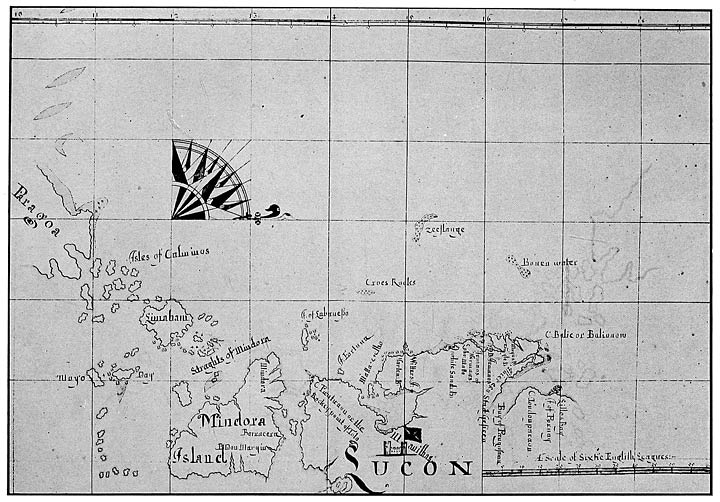
Map of portion of Philippine Islands, drawn by William Hacke, ca. 1680; photographic facsimile
[From original manuscript map in the British Museum]
Nor was the least cause of their reduction the diligent efforts of the religious who were ministers in these provinces, with their notable assiduity in preaching to the natives and exhorting them, with the arguments that we have already stated; and in this task they suffered the greatest hardships and dangers to life. In the province of Ilocos, fathers Fray Bernardino Márquez, Fray Gonzalo de la Palma, Fray Luís de la Fuente, and Fray Juan de Isla. In Pampanga, the following fathers were very prominent in the reduction: in Bacolor, Fray Francisco de Medina Basco; in Guagua, Fray Luís de la Vega; in Lubao, Fray José Botoño; in Mexico, Fray José Cornejo; in Candaba, Fray Pedro de Eguiluz; in Apalit, Fray José de Tapia; in Macabebe, Fray Enrique de Castro; but, more than all, Fray José Duque and Fray Isidro Rodríguez, whose authority among the natives could overcome the greatest difficulties. Information to this effect was given to the royal and supreme Council of the Indias by Don Sabiniano Manrique de Lara himself, in Madrid, after his return from his government in the year 1667—when father Fray Isidro Rodríguez was at the same court as procurator for this province, soliciting the numerous mission which he conducted hither, and in which I came, the least of its members.
[Notable among the losses and injuries caused by the Zambal raid was the death of the bishop of Nueva Segovia, Don Fray Rodrigo de Cárdenas, of whom Diaz gives a biographical sketch. He died at Manila, early in May, 1661.]
In Otón (Panay); 1663
Father Fray Francisco de Mesa received word of the unhappy condition in which were the souls of those parishioners of his; and, knowing that that cancer, which was spreading so far, needed to be severely cauterized, he gave information of all this to the purveyor-general of Pintados, the alcalde-mayor of that province, Admiral Pedro Duran de Monforte—a valiant soldier, whom we have mentioned in this history at various times. That officer, with the promptness that was necessary, sent Captains Gregorio de Peralta, Nicolás Becerra, and Francisco Duarte, and Adjutants Pedro Farfán and Pedro Brazales, with some Spaniards, Pampangos, and Merdicas from Siao (which is an island of Maluco)—a brave people, but cruel, which is a vice of cowards.
While the people were on their way to the village of Malonor, father Fray Francisco de Mesa decided to risk the attempt to prove whether he could through his preaching persuade them to accept better counsels, and, repentant, to put an end to that abominable farce of apostates; for it seemed to him that he would not fulfil his obligation if he did not make this endeavor. He encountered much opposition from the chiefs of the village of Laglag, who were not accomplices in the sedition by those of Malonor; but with intrepid courage to confer with the rebels. He reached the village and sent word to them to assemble in some convenient place, where he would go to discuss with them what concerned the deliverance of their souls, in case they were unwilling to come to the place where father Fray Francisco was. They replied “that they would not go out of the place where” (on account of its being rugged) “they had taken refuge for the sake of their safety—not, however, for fear of the Spaniards, whom they esteemed but lightly, for they themselves were accompanied by all the Holy Trinity, the Blessed Virgin Mary, and all the apostles, who would defend them by working miracles.” They also said that they did not need father ministers, because they had popes and bishops and priests who could minister to them in their own way, although it was very different from that which the fathers used; and “that Fray Francisco should be content with this, that they did not undertake to do harm to the other Christians who, deluded, followed him—although they could do these much harm with the power of God the Father, who assisted them”—and in this fashion they uttered other execrable blasphemies.
In Otón; 1672
[This is related by Diaz in his Conquistas, pp. 696–697.]
When the said alcalde-mayor learned this, he gathered all the soldiers that he could find, and reënlisted many veteran soldiers; and, in company with the father ministers Fray Marcos Gabilán, Fray Marcos González, and Fray Agustín de Estrada, he set out with all speed to see if he could check the disturbance; for he did not know of the falsehood uttered by the demon through the lips of the soldier. But this measure tended to fan the flames and to give further confirmation to that lie; they found, therefore, the villages deserted, and feared that this was a general rebellion. At last, the absurd cause which had influenced the natives was ascertained; and in a conference of the father ministers and the sensible Spaniards they chose the more prudent measure of withdrawing the troops, and allowing the natives to be undeceived by the course of events. The soldier, who must have been more knave than dolt, succeeded in concealing himself so well that nothing was known of him for a long time, because he left the island. The end of this revolution was, that gradually the Indians became undeceived, and ascertained that the whole thing was a lie; and through the agency of father Fray Agustín de Estrada, of whom they had a very high opinion, they were pacified, and brought back to their villages and homes. This is written only that some idea may be formed of the readiness with which these natives believe any lie; and the difficulties experienced by the religious who live among them as ministers, and the danger to the lives of the fathers if the demon concocts some fiction which, like this, is to their detriment or to the discredit of the Spaniards.
In Playa Honda; 1681
[From Diaz’s Conquistas, pp. 747–748.]
In Zambal villages; 1683
[The following account is taken from Salazar’s Hist. de Sant. Rosario, pp. 300–311. It was a revolt against ecclesiastical authority, and would have ended in the liberation of the Zambals from all Spanish rule, had they not been in awe of the fort and garrison of Paynauen. Salazar’s relation is interesting in regard to native character and missionary methods.]
On a certain occasion Calignao killed a poor woman; and as the aggressor was unknown, as this happened in a hidden place, father Fray Domingo undertook, in order to learn who did it, to use the stratagem of feeling the pulse of every person in the village. All agreed to this, except Calignao, who, being present at this trial, escaped and fled to the woods for several days. Soon returning thence to the village, he went about visiting his relatives; he told them that he was going to the mountains, not to return; but that, before he went away, he must cut off some heads. He thereupon went to the house of an Indian, a nephew of the woman whom he had murdered, and in order to kill him unsheathed the ygua, which is worse than a butcher’s knife; but the Indian, who was seated, seized his dagger in his hand, and remained thus, quietly—at which Calignao was afraid, and did not dare to carry out his purpose. At the noise of this, all the people hastened thither, as did father Fray Domingo, who, seeing the perverse Calignao in the mood for cutting off heads, said to him: “Come here, thou wicked man. Are not the murders that thou committest at night enough, without trying to kill in daylight, and in sight of all?” To which he replied: “I am looking for thee, Father, for thee first of all; do thou come here.” Two Indians then approached to pacify him; but all was in vain, for he was blind with anger and fury; and when they tried to bring him to reason, he hastily went out and fled to the mountains. Soon afterward he returned to the village, and, passing in front of the convent at a time when the servant of God was at the window, Calignao began to defy him, with both words and gestures; but father Fray Domingo answered him: “Since thou knowest that the religious do not kill, or carry arms, thou talkest thus—as thou wouldst not talk or act with the soldiers.” This made Calignao very ugly, and, walking throughout the midst of the village, he declared that he would not halt until he had taken the head from father Fray Domingo; and no one dared say a word to him, because he was sheltered by his relatives. The commandant of the fort, having learned of the cruel and shameless acts of Calignao, sent seven Spanish soldiers to guard father Fray Domingo, and ordered them to arrest or kill that evil man; but, although they twice had the opportunity to do this, the servant of God prevented it, and, most of the soldiers having become sick, they returned to their fort without having accomplished anything. The commandant, at this, ordered the headman of Balacbac to seize or kill Calignao, who every day went in or out of the said village; but he did not carry out this order, for all feared him and showed him respect—rather, indeed, they watched over his safety.
For more than three years the servant of God went about, inquiring, with great solicitude into the idolatrous customs which the Zambals had; and for this he availed himself of the boys—whom he assembled together, and taught to read, and related to them the examples and lives of the saints, bestowing on them presents and kindnesses, with great affection. Then he questioned them as to the method and the times in which their parents and elders practiced idolatry, and they told him everything, with all details. This was especially true of the boy Diego, whom father Fray Domingo baptized in Abucay; he was a nephew of a priest of their idols, and was very well instructed in our holy faith; and he was not suspected of telling the father what conduced to the greater service and honor of God. Father Fray Domingo charged the rest of the boys to keep this secret, so that their parents should not flog them; and through fear of this they remained silent, so that it was never known that the boys were the ones who had revealed the practice of idolatry. Thus father Fray Domingo came to know that the chiefs of the villages were the priests of the idols, and that they found this profitable; for by [filling] this office they obtained their food, and had the advantage in any controversy, and, without this, they would fare ill. Also that the common people were in great subjection and obedience to the said priests, who could incite them to any daring act—especially since, as he was informed, all the people in the province, both infidels and Christians, had been bound by promise and oath not to reveal their idolatries, no matter how many inquiries the father should make, even though they were ruined or lost their lives by this silence. Accordingly the servant of God found this undertaking very arduous, and foresaw that it would cost him many hardships, and that he would in it expose himself to many dangers to his reputation, and honor, and even to his life. Notwithstanding, like another Elias, zeal for the honor of God flamed in him; and laying aside all fear for what might come, he directed his efforts and all his energies to the destruction of this infernal vice.
Most of the Indians were reclaimed, and confirmed in our holy faith, by the words and deeds of father Fray Domingo; and they therefore voluntarily gave up the instruments with which they formerly sacrificed to the demon—although many did so because they could not resist, especially those who were priests and had obtained their living by those practices; these were the chief men of the villages. They remained grieved and angry, and with little love for the servant of God; and each one of them would, if he had had the power, have taken the father’s life—or a thousand of them, if he could have had so many—but they were made cowards by their fear of the soldiers at the fort. [Angered at what Fray Domingo had done to uproot their idolatries, these chiefs conspire against him, and resolve to take his life—for which deed Calignao offers his services. At the time (July, 1683), the father is in Manila soliciting contributions for building churches in the Zambal country; his head, which a year before had showed hardly a gray hair, is now almost white, at the age of forty-five—an effect of his unusual toils above described. On November 12 of that same year Fray Domingo is treacherously slain, on his return from Baubuen to Balacbac, by Calignao and an infidel Negrillo named Quibácat, with poisoned arrows. Some friendly Indians convey him to Balacbac, where he dies three days later. The commandant of the fort wishes to go to punish the Zambals for this murder, but a friar dissuades him, saying that if he leaves the fort, the Zambals would get possession of it, “and no religious or Spaniard would be left in all Playa Honda.” Soldiers are sent to seize the assassin, but he cannot be taken, for he is protected by the natives in the village, “who all were present at the funeral more from joy at seeing the father dead than from compassion, or sadness at having lost him, thinking that with the death of father Fray Domingo they could again revive their idol-worship.”]